Sample Category Title
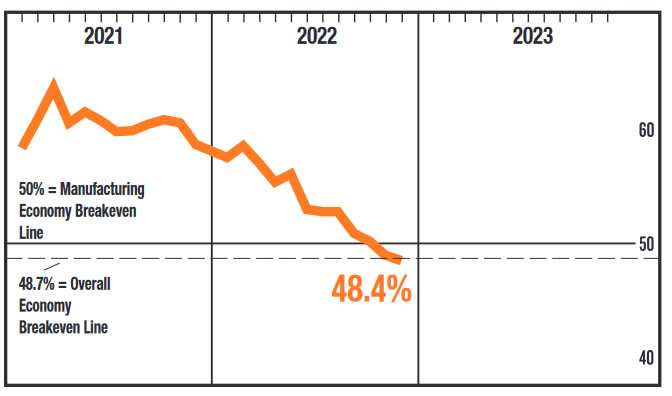
US ISM manufacturing fell to 48.4, corresponds to -0.1% contraction in GDP
US ISM Manufacturing PMI dropped from 49.0 to 48.4 in December, below expectation of 48.6. That's the lowest level since Mary 2020. Looking at some details, new orders dropped from 47.2 to 45.2. Production dropped from 51.5 to 48.4. Employment rose from 48.4 to 51.4. Prices dropped from 43.0 to 39.4.
ISM said: "The past relationship between the Manufacturing PMI and the overall economy indicates that the Manufacturing PMI for December (48.4 percent) corresponds to a 0.1-percent decrease in real gross domestic product (GDP) on an annualized basis".
Sunset Market Commentary
Markets
Risky assets enjoy an extended stay in paradise. 2023 could hardly start better for equity markets with the likes of the EuroStoxx50 jumping another 2% plus. The star index is closing in on the recovery closing high just south of 4k. Advances in US bourses were less outspoken. The Nasdaq outperforms by adding about 0.6%. The optimistic mood was attributed to early morning reports coming from China that it is considering further support for its ailing property sector. Another below-consensus inflation outcome in France also shaped the positive risk mood in the sense that the worst might be behind us. Prices in December unexpectedly fell by 0.1% m/m, bringing the yearly figure to 6.7% y/y, down from 7.1%. Consensus estimates were for 0.4% m/m and 7.3% y/y. Final French PMIs served as icing on the cake with the services and composite reading – though still sub 50 – being more than 1 point better than their preliminary estimates (49.5 and 49.1 respectively). This lifted the European-wide gauges as well (49.8 services and 49.3 composite). Core bonds rallied further with Germany outperforming the US. Ongoing price drops in commodities (oil -3.3% and at risk of losing the $80/b level, TTF gas -8% to €66.8/MWh) add to those dynamics via easing inflation expectations. Net daily changes for Germany vary between -7.6 bps to -11 bps with the belly of the curve outperforming the wings. European periphery spreads vs. Germany’s 10y yield ease a few bps, Italy on top (-7 bps). US yields also in a belly outperforming move shed 3.9 to 5.7 bps as investors across the Atlantic await the publication of the US manufacturing ISM and the Fed December minutes. During that meeting, the dot plot showed a terminal rate of 5-5.25% but with a large minority favouring even higher rates. In a speech today, Minneapolis and voting Fed president Kashkari revealed himself being part of that minority, projecting a 5.25-5.5% policy rate before pausing. His comments came even after inflation showed signs of topping out. It suggests that the Fed is cautious in calling victory until it is sure that prices have indeed peaked and are clearly on track to the 2% goal.
The dollar rally yesterday already hit a wall today. The greenback loses out against all G10 peers but the Norwegian krone. On a trade-weighted basis, the DXY index eases from 104.579 to 104.05. EUR/USD recoups about half of yesterday’s losses. The pair is trying to settle back above the 1.06(11) resistance area. Japan’s yen BoJ boost looks exhausted, at least for the short term. USD/JPY met support at 130 and EUR/JPY at the 137 area – a trading zone that served as support/resistance at multiple occasions in 2022. UK PM Sunak set out his priorities for the coming year in his first remarks of 2023. Among the pledges made are cutting inflation in half, growing the economy and ensuring that national debt is falling by the end of the current Parliamentary tenure (January 2025). Sterling was unimpressed and held an erratic trading pattern around EUR/GBP 0.88.
News Headlines
The Bank of England published its monthly Money and Credit statistical release. Approvals for house purchases by individuals, an indicator of future borrowing, decreased to 46.1k in November, from 57.9k in October, the lowest level since June 2020 (40.5k). Approvals for remortgaging (with a different lender) fell to 32.5k in November from 51.3k in October, and were below the previous 6-month average of 48.1k. The effective interest rate on newly drawn mortgages increased by 26 bps to 3.35%. The rate on the outstanding stock of mortgages increased by 9 bps, to 2.38%. The annual growth rate of borrowing by large businesses decreased by 0.4 ppt to 6.4% Y/Y, while for SMEs it rose by 0.1 ppt, to -3.8% Y/Y. The average cost of new borrowing from banks by UK non-financial businesses increased by 52 bps to an effective interest rate of 4.33%. The effective interest rate on new loans to SMEs increased by 78 bps to 5.52%, and was the highest on record (series starting in January 2016).
Swiss CPI inflation fell by 0.2% M/M in December with the Y/Y figure declining from 3% to 2.8%. Prices for fuels and heating oil, fruiting vegetables and medicines were amongst the ones falling in the final month of last year while rents for holiday flats and the hire of private means of transport increased. The average annual inflation also reached +2.8% in 2022. Prices for domestic products increased by 1.6% on average, those for imported products increased by 6.7%. Average annual inflation was +0.6% in 2021 and -0.7% in 2020.
Good News is Bad News for the Fed
Good News is Bad News for the Fed
- Leading indicators point towards a turnaround in macro momentum amid easing financial conditions, but the Fed is still far away from price stability.
- The less negative growth outlook combined with a recovering China challenges the Fed's goal of suppressing demand.
- The ISM, JOLTs, NFP and CPI over the next week will be the final key releases ahead of the February meeting; we expect Fed to hike by 50bp
While most global manufacturing leading indicators still remain at low recessionary levels, some are now beginning to show early rays of light. Taiwanese manufacturing PMI, which tends to lead the global PMI, had the largest uptick in December since spring of 2021 (Chart 1). Euro area new orders indices, German Ifo and ZEW as well as the Chicago PMI have all rebounded from the recent lows (see p. 2).
In Fed review: FOMC signals Fed Funds above 5% in 2023, 14 December, we warned that the pre-emptive easing in global financial conditions could risk prolonging the underlying price pressures. While the turnaround in leading indicators is positive from a growth perspective, it goes against the Fed's goal to suppress aggregate demand.
Yesterday, we also lifted our forecast for Chinese GDP growth amid the faster reopening (see China Outlook: Earlier reopening to drive faster rebound, 3 January), which could further underpin commodity demand irrespective of western policy choices.
In the US, the drop in gasoline prices has eased headline inflation (0.1% m/m), but as wage growth remains elevated (0.6% m/m), real purchasing power recovered in November, and likely also in December. Lower headline inflation is a double-edged sword for the Fed, as recovering purchasing power boosts private consumption, labour demand and thus sustained wage inflation. Furthermore, the drop in mortgage rates illustrates that financial conditions are not tightening anymore. The most recent NAHB expectations index suggested that even the hard-hit housing market's outlook has improved slightly.
As a result, real private consumption is still above its pre-pandemic trend, even though the economy's growth potential remains constrained by labour shortages (Chart 2). The recent decline in market's inflation expectations has lifted US real yields to restrictive levels, but given that the Fed appears to make very gradual progress towards closing the output gap, we continue to see risks tilted towards rates remaining higher for longer. Furthermore, deflating with consumers' inflation expectations paints a less optimistic view (Chart 3).
Bringing labour markets into balance would require several months of employment gains below 100 thousand, yet consensus is looking for twice as much this Friday. The rising employment costs feed into core services CPI, and even though normalizing energy and food prices will likely set next week's headline CPI near 0.0% m/m, core inflation will remain closer to 0.3%. Even in Europe, where the growth backdrop is weaker, flash data from Spain and Germany pointed towards a pick-up in core prices, and similar development in the US could well tilt the market towards another 50bp hike in February.
Fed Kashkari sees rate hikes pausing at 5.4%, but could be higher
Minneapolis Fed President Neel Kashkari said in a speech, "while I believe it is too soon to definitively declare that inflation has peaked, we are seeing increasing evidence that it may have ."
"In my view, however, it will be appropriate to continue to raise rates at least at the next few meetings until we are confident inflation has peaked," he added.
The second step of inflation fighting would be "pausing to let the tightening we have already done work its way through the economy". He sees interest rate pausing at 5.4%, but "any sign of slow progress that keeps inflation elevated for longer will warrant, in my view, taking the policy rate potentially much higher."
The third step of inflation fighting is "to consider cutting rates only once we are convinced inflation is well on its way back down to 2 percent".
But he warned, "Given the experience of the 1970s, the mistake the FOMC must avoid is to cut rates prematurely and then have inflation flare back up again. That would be a costly error, so the move to cut rates should only be taken once we are convinced that we have truly defeated inflation."
Growing Optimism?
Equity markets are pushing higher on Wednesday, buoyed by softer yields and some promising PMI revisions in Europe.
It would appear investors are increasingly coming around to the idea that central banks will be forced into cutting rates earlier than previously anticipated in order to support the economy. That would also suggest they anticipate inflation will subside faster than previously thought which would be welcome if true after a year of overshoots.
I'm sure this is a position that will change a lot in the coming months just as it has in those passed but it's seemingly boosting risk appetite in the first week of the year. You just have to wonder how much resilience economies have in the interim to weather the cost-of-living storm.
This is where the other data points will become increasingly influential. The PMIs this morning, for example, were largely contractionary but only marginally so and the upward revisions for Germany, France, Italy, Spain, and the bloc as a whole will offer some encouragement.
I feel we'll have a lot more clarity by the end of the first quarter in a number of ways from the path of inflation, terminal rates, and the ability of economies to continue to withstand those pressures. It will no doubt be a whirlwind quarter but one after which the rest of the year could look more promising. Or maybe this optimism is just a hangover from all of the festivities.
Fed minutes eyed
There's plenty more to come today that could potentially dampen the mood, most notably the Fed minutes from the December meeting. The central bank is determined to reinforce its hawkish stance on investors and prevent an unwanted loosening of financial conditions and the minutes could be another opportunity to do so. Whether investors will be in the mood to listen is another thing.
And then there are the ISM manufacturing PMI and JOLTS job openings, both of which have the potential to shake things up during such an uncertain period. It promises to be a very interesting second half of the week.
Slide continues amid uncertain China outlook
Oil prices have tumbled again today, hit it seems by the uncertain near-term economic prospects for China amid surging Covid cases. While reliable data is seemingly hard to come by, the view appears to be that there'll be significant disruption in the coming months and then a recovery from around the middle of the year which should then boost demand.
Brent has now slipped back below $80 a barrel while WTI has fallen below $75, with both now only around 5% from the December lows. Despite this, the medium-term prospects still appear quite bullish, especially if China can bounce back strongly later this year and fully transition to living with Covid, like much of the rest of the world. Of course, Russia remains the wildcard in all of this, both in terms of its output and influence within OPEC+.
Gathering momentum ahead of FOMC minutes
Gold is charging higher again buoyed by lower yields and a softer dollar. The yellow metal was running on fumes into the end of the year but appears rested and revitalized at the start of 2023. Not only is it rallying, but it's also building momentum, something that was lacking towards the end of December. Of course, whether that will be sustained will depend on the Fed minutes and, maybe more so, Friday's jobs report. We've had many setbacks over the past 12 months but who knows, maybe 2023 will be the year of positive surprises. Or perhaps that's all the festivities talking again.
Cautiously higher
There isn't much to add on the bitcoin front. It remains in consolidation, buoyed slightly by better risk appetite in the market but still in the $16,000-$17,000 range. A move above here is possible if risk appetite remains positive but I'm not sure traders will get too carried away. Headwinds remain significant for cryptos and it may take some time for traders to get back on board.
Gold: Bulls Accelerate on Expectations for More Dovish Fed
Gold extends rally in the fourth straight day and hit the highest since mid-June.
The yellow metal accelerated on Wednesday (up 1.25% until the start of American session), driven by weaker dollar and growing expectations that the Fed would further soften its tone on the monetary policy.
Traders focus on the release of minutes of central bank’s December’s meeting, due later today, expecting more dovish stance, with speculations that the Fed would go for 25 basis points hike in December, after four straight 0.75% hikes and 0.5% increase in December that signaled a slowdown in policy tightening pace.
Wide expectations point to Fed’s potential decision to slow tightening, to see the impact of its recent action, rather than worries about slowdown in economic growth.
If Fed’s rhetoric today comes in line with expectations, gold would advance further, while fresh bulls are expected to face strong headwinds if policymakers remain in hawkish mode.
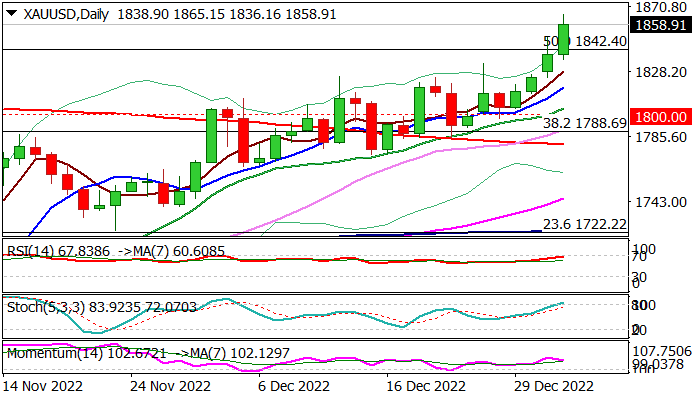
Fresh acceleration on Wednesday surged through Fibo barrier at $1842 (50% retracement of $2070/$1614 descend) and pressuring June 12 lower high ($1879), which guards next significant barriers at $1896/$1900 (Fibo 61.8% / psychological).
Daily studies are firmly bullish, though overbought conditions warn that bulls may pause for consolidation.
Broken Fibo resistance at $1842 reverted to support which should ideally contain and keep bulls intact, with deeper dips to find ground above rising 10DMA ($1818) and maintain bullish bias.
Res: 1865; 1875; 1879; 1900
Sup: 1850; 1842; 1818; 1803
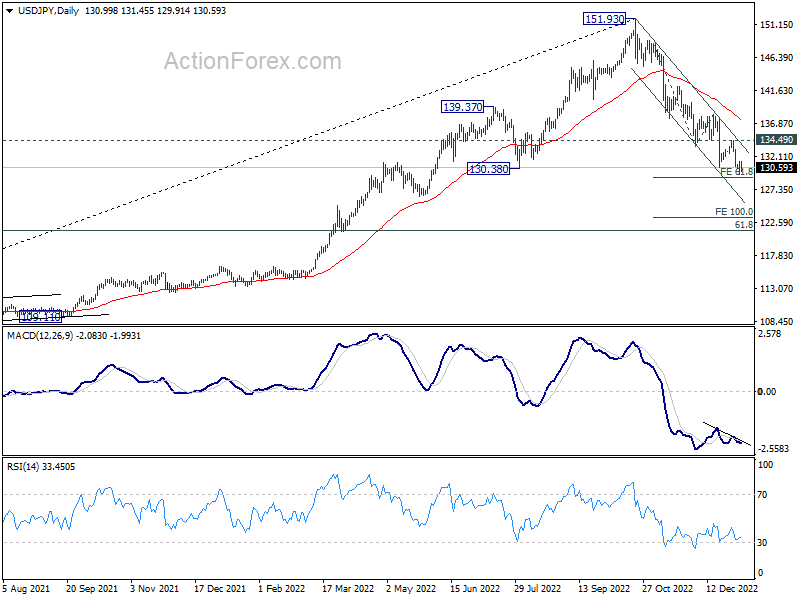
USD/JPY Mid-Day Outlook
Daily Pivots: (S1) 129.87; (P) 130.64; (R1) 131.76; More...
Intraday bias in USD/JPY remains neutral for the moment. Outlook stays bearish as long as 134.49 resistance holds. On the downside, firm break of 61.8% projection of 148.44 to 133.61 from 138.16 at 128.99 could trigger downside acceleration to 100% projection at 123.33.
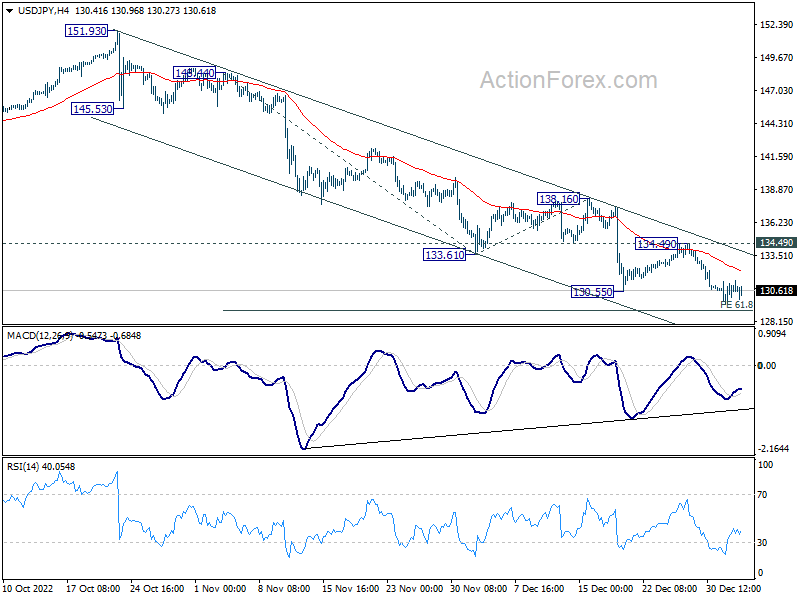
In the bigger picture, a medium term top was in place at 151.93. Sustained trading below 55 week EMA (now at 131.65) would raise the chance of bearish trend reversal. Deeper fall would be seen to 61.8% retracement of 102.58 to 151.93 at 121.43. This will now remain the favored case as long as 55 day EMA (now at 137.54) holds.
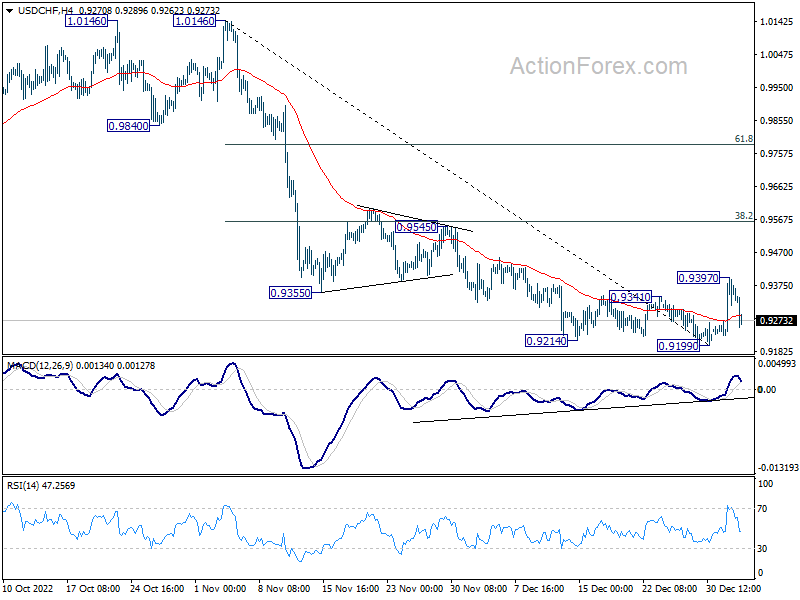
USD/CHF Mid-Day Outlook
Daily Pivots: (S1) 0.9259; (P) 0.9329; (R1) 0.9428; More...
Intraday bias in USD/CHF remains neutrals for the moment. With a short term bottoming in place at 0.9199, on bullish convergence condition in 4 hour MACD, risk will stay mildly on the upside. Above 0.9397 will extend the rebound to 55 day EMA (now at 0.9467) and above.
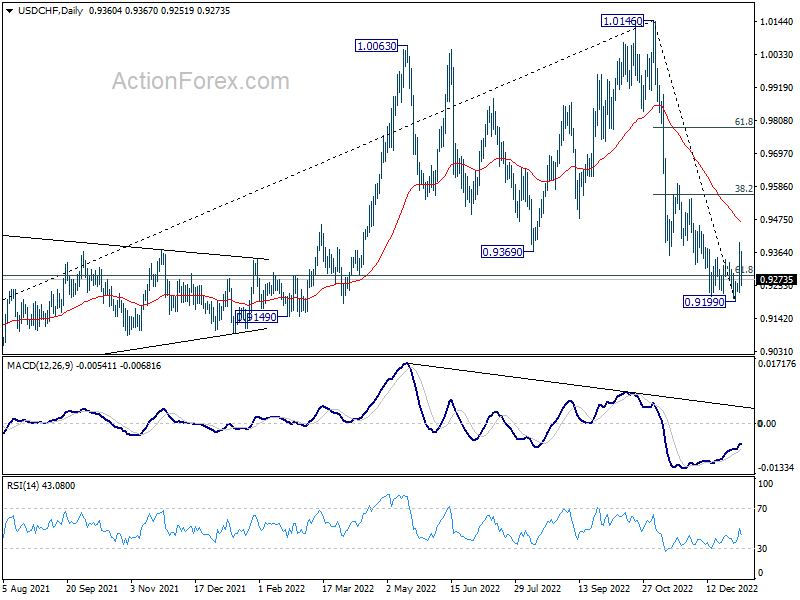
In the bigger picture, rise from 0.8756 (2021 low) has completed at 1.0146, well ahead of 1.0342 long term resistance (2016 high). Based on current downside momentum, fall from 1.0146 might be a medium term down trend itself. Sustained break of 61.8% retracement of 0.8756 to 1.0146 at 0.9287 will pave the way to 0.8756. In any case, risk will stay on the downside as long as 0.9545 resistance holds.
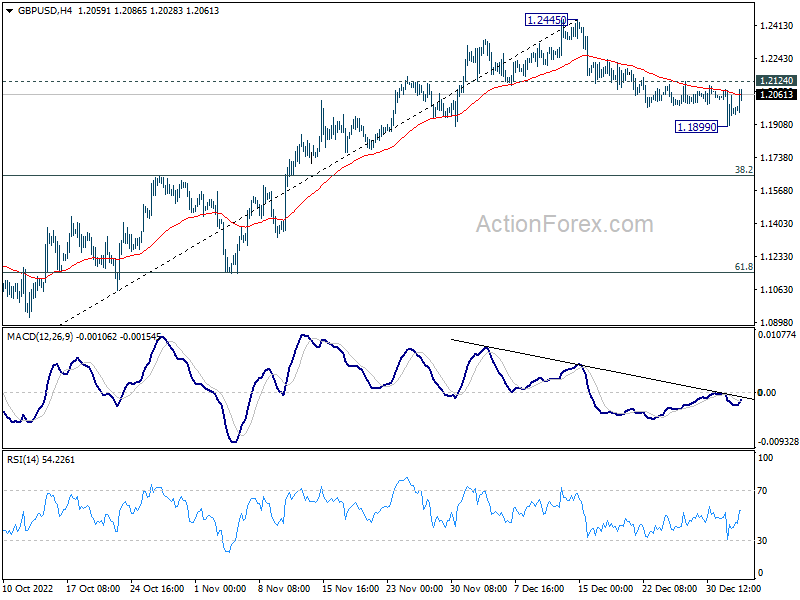
GBP/USD Mid-Day Outlook
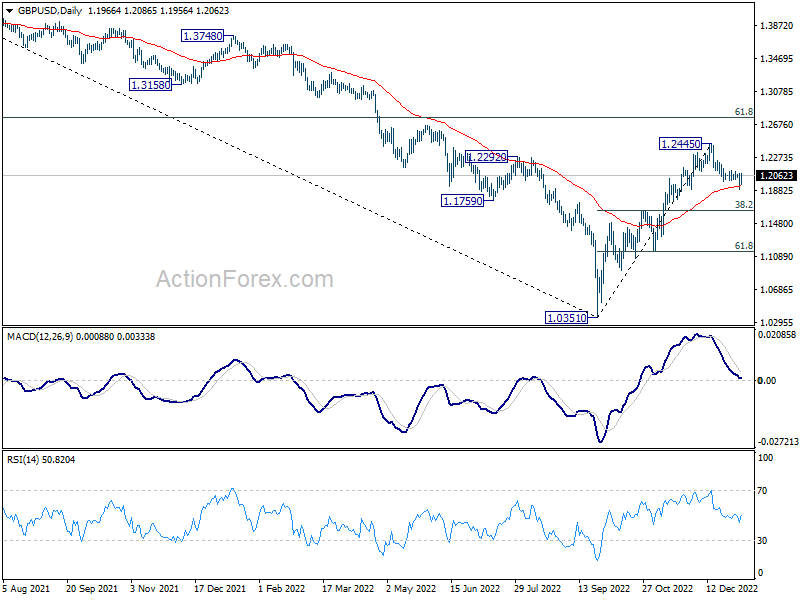
Daily Pivots: (S1) 1.1885; (P) 1.1985; (R1) 1.2069; More...
Intraday bias in GBP/USD is turned neutral with today's recovery. On the downside, break of 1.1899 and sustained trading below 55 day EMA (now at 1.1925) will target 38.2% retracement of 1.0351 to 1.2445 at 1.1645 next. However, strong rebound from 55 day EMA, followed by break of 1.2124 resistance, will argue that the pull back from 1.2445 has completed, and turn bias back to the upside for retesting this high.
In the bigger picture, rise from 1.0351 medium term bottom is at least correcting whole down trend from 1.4248 (2021 high). Further rise is expected as long as 1.1644 resistance turned support holds. Next target is 61.8% retracement of 1.4248 to 1.0351 at 1.2759. Sustained break there will pave the way back to 1.4248. This will remain the favored case as long as 55 day EMA (now at 1.1916) holds.
EUR/USD Mid-Day Outlook
Daily Pivots: (S1) 1.0485; (P) 1.0584; (R1) 1.0648; More...
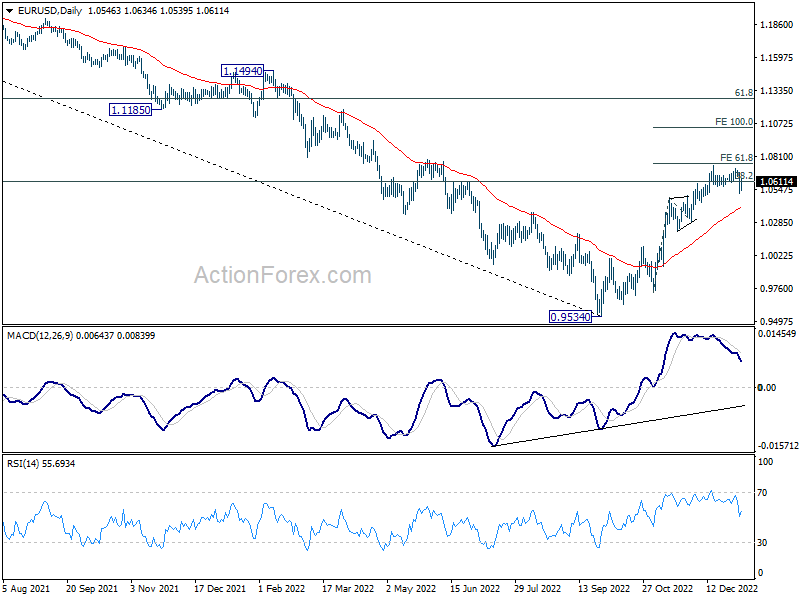
EUR/USD recovered ahead of 1.0481 resistance turned support but stays below 1.0733 resistance. Intraday bias remains neutral at this point. On the downside, break of 1.0481 will confirm short term topping, on bearish divergence condition in 4 hour MACD. Deeper fall would be seen back to 1.0289 support and below. On the upside, however, firm break of 61.8% projection of 0.9729 to 1.0481 from 1.0289 at 1.0754 will pave the way to 100% projection at 1.1041.
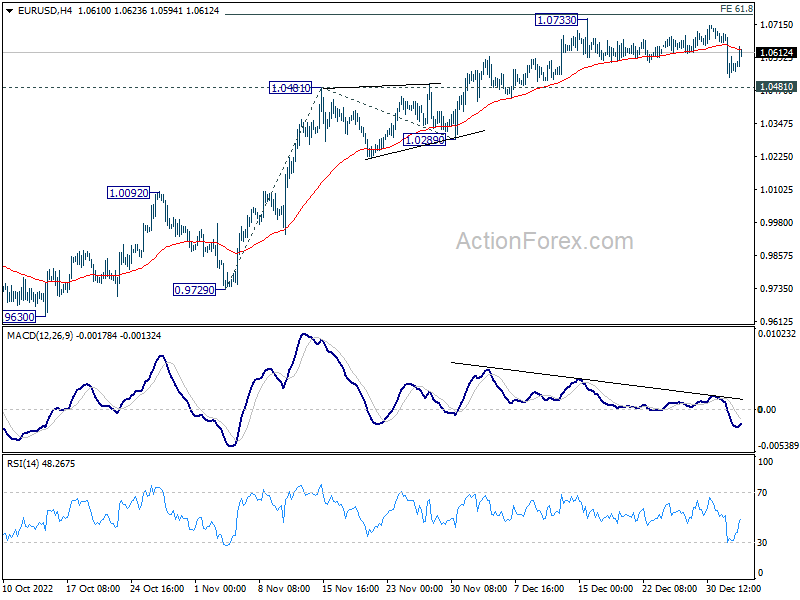
In the bigger picture, focus stays on 38.2% retracement of 1.2348 (2021 high) to 0.9534 at 1.0609. Rejection by 1.0609 will suggest that price actions from 0.9534 medium term bottom are developing into a corrective pattern. Thus, medium bearishness is retained for another fall through 0.9534 at a later stage. However, sustained break of 1.0609 will raise the chance of trend reversal and target 61.8% retracement at 1.1273.