Sample Category Title
Canada’s Economy Edges Up in October, Points to a Flat November
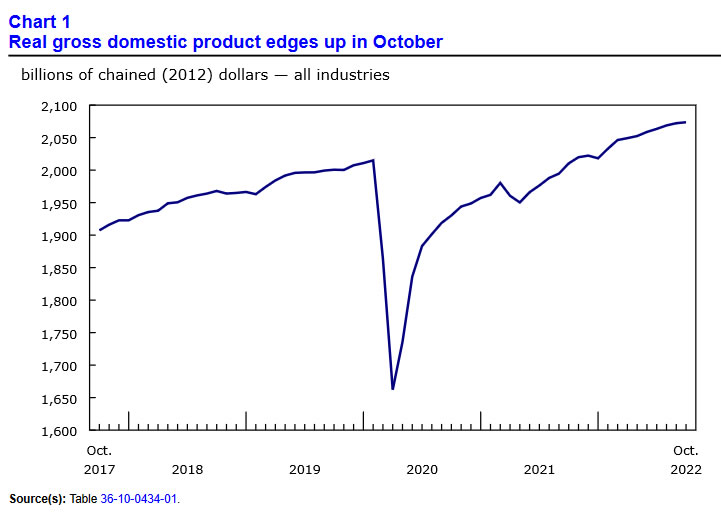
The Canadian economy expanded by 0.1% month/month (m/m) in October, beating Statistics Canada's flash estimate of no growth. The flash estimate for November points to 0.1% growth.
October's increase in activity was mixed, with output expanding in 11 of 20 industries. The service-producing sector rose by 0.3%, while the goods-producing sector declined 0.7%
The gain was led by the public sector, wholesale and client-facing industries. The public sector (education) continues its heavy lifting, while "the arts, entertainment and recreation sector increased 2.2% in October, up for the ninth month in a row." According to Statistics Canada, the Toronto Blue Jays' playoff appearance skewed the results to the upside. Go Jays!
As expected, there was weakness in goods-producing industries, which "cooled down in October, after expanding in the previous four months. The October decline was led by a decrease in mining, quarrying, and oil and gas extraction and weakening in the manufacturing sector."
Key Implications
Heading into today's release we were expecting a slowdown from the above trend pace of growth witnessed over the first nine months of 2022. With the positive print today and the flash estimate for November, our tracking for the fourth quarter remains just above 1% annualized. This deceleration of growth is aligned with our view that the lagged effects of interest rate hikes and still high inflation is causing Canadians to gradually tighten their purse strings.
Though there will be a lot of data coming out between now and the Bank of Canada's (BoC's) next policy decision in late January, we think the Bank has another hike left in store. That would bring the policy rate to a very restrictive 4.5%. Financial markets would agree that the BoC isn't done yet, with Canadian bond yields up 10 basis points this morning.
US: Spending Lose Momentum, Core PCE Deflator Eases.
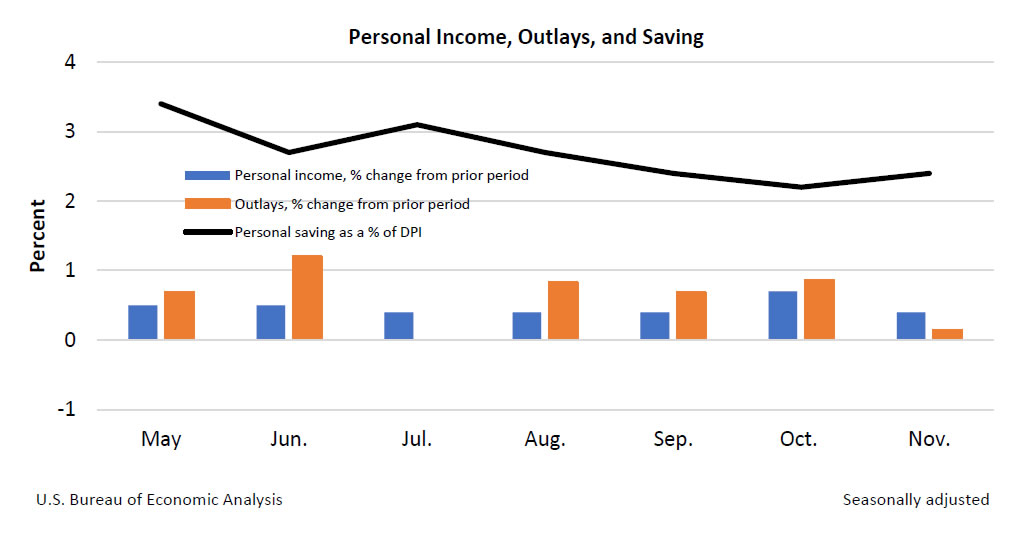
Personal income advanced 0.4% month-on-month (m/m) in November, above market expectations for a more modest gain of 0.3% m/m. Compensation of employees (+0.5% m/m) and personal income receipts on assets (+0.5% m/m) accounted for most of the strength in personal income.
Controlling for inflation and taxes, real personal disposable income was up a healthy 0.3% m/m in November.
Personal consumption lost momentum, rising modestly by 0.1% m/m – below the consensus forecast for a 0.2% gain.
In real terms, spending was up 0.1%, with services accounting for all the gains – rising by 0.3% m/m. Growth was supported by spending on food services and accommodations. Spending on goods declined 0.6% m/m, mostly driven by a drop in purchases of new motor vehicles.
The personal consumption price deflator rose 0.1% on the month, and 5.5% on a year-on-year basis. Core PCE rose 0.2% m/m, decelerating to 4.7% year-on-year (from 5.0% in October).
The personal saving rate rose for the first time in the past four months from a downwardly revised 2.2% to 2.4% in November. It remains below the pre-pandemic average of 7.5%.
Key Implications
Despite the solid reading on personal income, consumer spending on material things remained tepid. That said, an upward revision to October, alongside continued momentum in services spending suggests Q4 personal consumption expenditures is still tracking a robust 3.2% (annualized).
Much to the Fed's delight, three-months annualized core PCE inflation dropped below the policy rate, making the latter more restrictive. This will test the resilience of the American consumer who has already spent half of their pandemic savings, implying households will need to increasingly rely on credit. This is likely to lead to more precautionary behavior, leading to a marked slowing in spending over the coming quarters.
Range Trading Continues, Little Reaction to US and Canada Data
Range trading continues in overall quiet markets today. The batch of economic data from the US and Canada trigger little reactions. Yen is still set to end as the strongest one for the week, followed by Canadian and then Swiss Franc. Kiwi is the worst, followed by Sterling and than Dollar.
In Europe, at the time of writing, FTSE is up 0.05%. DAX is up 0.56%. CAC is up 0.14%. Germany 10-year yield is up 0.025 at 2.386. Earlier in Asia, Nikkei dropped -1.03%. Hong Kong HSI dropped -0.44%. China Shanghai SSE dropped -0.28%. Singapore Strait Times dropped -0.36%. Japan 10-year JGB yield dropped -0.0155 to 0.399.
Happy holidays to our readers. We'll be back on December 27.
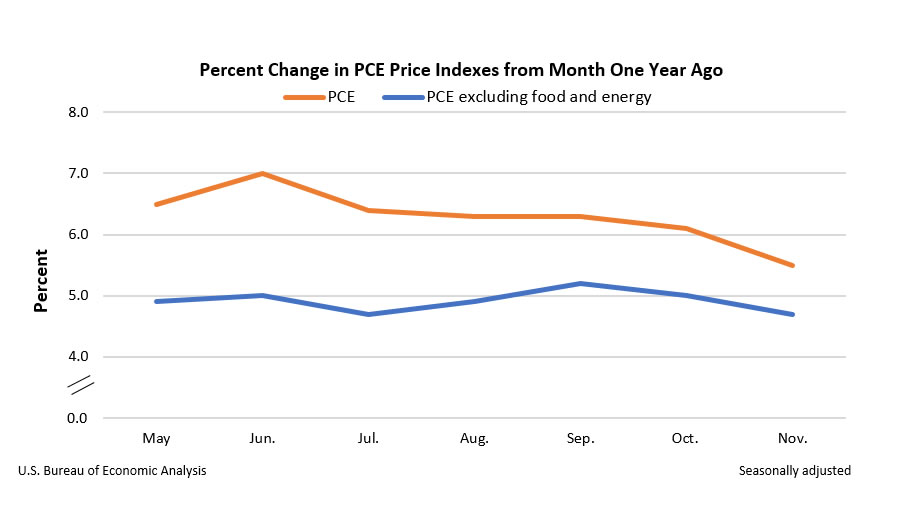
US PCE prices slowed to 5.5% yoy, core CPI down to 4.7% yoy
US personal income rose 0.4% mom or USD 80.1B in November, above expectation of 0.2% mom. Spending rose 0.1% mom or USD 19.8B, below expectation of 0.2% mom.
For the month, PCE price index rose 0.1% mom while core PCE price (excluding food and energy) rose 0.2% mom. Prices for goods decreased -0.4% mom while prices for services increased 0.4% mom. Food prices rose 0.3% mom and energy prices dropped -1.5% mom.
From the same month a year ago, PCE price index slowed from 6.1% yoy to 5.5% yoy, above expectation of 5.3% yoy. Core PCE price index slowed form 5.0% yoy to 4.7% yoy, matched expectations. Prices for goods rose 6.1% yoy and prices for services increased 5.2% yoy. Food prices increased 11.2% yoy and energy prices increased 13.6% yoy.
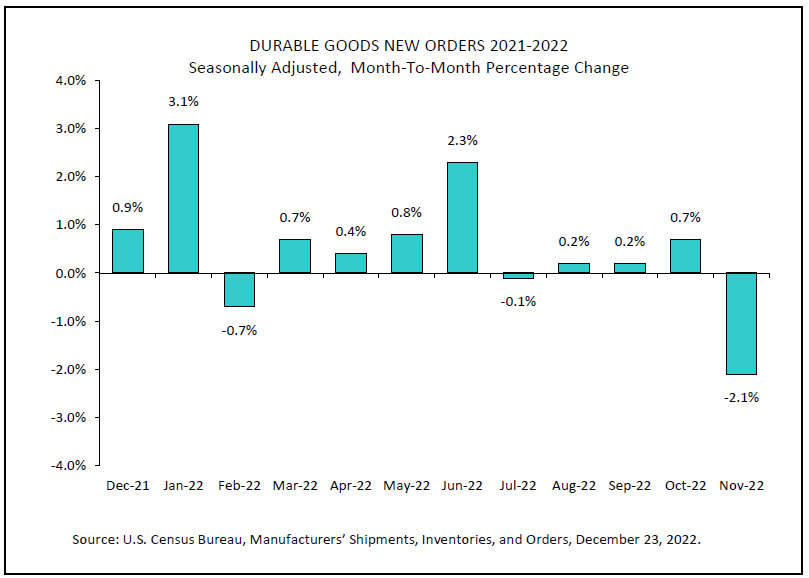
US durable goods orders down -2.1% mom in Nov, ex-transport orders up 0.2% mom
US durable goods orders decreased -2.1% mom to USD 270.6B in November, worse than expectation of -0.7% mom. Ex-transport orders increased 0.2% mom to USD 179.3B, above expectation of 0.1% mom. Ex-defense orders declined -2.6% mom to USD 252.8B. Transportation equipment decreased -6.3% mom to USD 91.3B.
Canada GDP grew 0.1% mom in Oct, essentially unchanged in Nov
Canada GDP rose 0.1% mom in October, matched expectations. Services-producing industries expanded 0.3% while goods-producing industries contracted -0.7%. 11 of 20 industrial sectors grew.
Advance information indicates that real GDP was essentially unchanged in November. Increases in accommodation and food services and wholesale trade were offset by declines in construction as well as mining, quarrying and oil and gas extraction.
Japan CPI core rose to 3.7% yoy, highest in 40 yrs
Japan CPI core (all item ex fresh food) accelerate further from 3.6% yoy to 3.7% yoy in November, matched expectations. That's also the highest level in more than 40 years since 1981.
CPI core-core (all time ex fresh food and energy), also rose from 2.5% yoy to 2.8% yoy, above expectation of 2.7% yoy. Headline all item CPI ticked up from 3.7% yoy to 3.8% yoy, above expectation of 3.7% yoy.
Economic Indicators Update
| GMT | Ccy | Events | Actual | Forecast | Previous | Revised |
|---|---|---|---|---|---|---|
| 23:30 | JPY | National CPI Core Y/Y Nov | 3.70% | 3.70% | 3.60% | |
| 23:50 | JPY | BoJ Minutes | ||||
| 13:30 | CAD | GDP M/M Oct | 0.10% | 0.10% | 0.10% | 0.20% |
| 13:30 | USD | Personal Income M/M Nov | 0.40% | 0.20% | 0.70% | |
| 13:30 | USD | Personal Spending Nov | 0.10% | 0.20% | 0.80% | 0.90% |
| 13:30 | USD | PCE Price Index M/M Nov | 0.10% | 0.30% | 0.30% | 0.40% |
| 13:30 | USD | PCE Price Index Y/Y Nov | 5.50% | 5.30% | 6.00% | 6.10% |
| 13:30 | USD | Core PCE Price Index M/M Nov | 0.20% | 0.20% | 0.20% | 0.30% |
| 13:30 | USD | Core PCE Price Index Y/Y Nov | 4.70% | 4.70% | 5.00% | |
| 13:30 | USD | Durable Goods Orders Nov | -2.10% | -0.70% | 1.10% | |
| 13:30 | USD | Durable Goods Orders ex Transportation Nov | 0.20% | 0.10% | 0.50% | |
| 15:00 | USD | New Home Sales Nov | 600K | 632K | ||
| 15:00 | USD | Michigan Consumer Sentiment Index Dec F | 59.1 | 59.1 |
US durable goods orders down -2.1% mom in Nov, ex-transport orders up 0.2% mom
US durable goods orders decreased -2.1% mom to USD 270.6B in November, worse than expectation of -0.7% mom. Ex-transport orders increased 0.2% mom to USD 179.3B, above expectation of 0.1% mom. Ex-defense orders declined -2.6% mom to USD 252.8B. Transportation equipment decreased -6.3% mom to USD 91.3B.
US PCE prices slowed to 5.5% yoy, core CPI down to 4.7% yoy
US personal income rose 0.4% mom or USD 80.1B in November, above expectation of 0.2% mom. Spending rose 0.1% mom or USD 19.8B, below expectation of 0.2% mom.
For the month, PCE price index rose 0.1% mom while core PCE price (excluding food and energy) rose 0.2% mom. Prices for goods decreased -0.4% mom while prices for services increased 0.4% mom. Food prices rose 0.3% mom and energy prices dropped -1.5% mom.
From the same month a year ago, PCE price index slowed from 6.1% yoy to 5.5% yoy, above expectation of 5.3% yoy. Core PCE price index slowed form 5.0% yoy to 4.7% yoy, matched expectations. Prices for goods rose 6.1% yoy and prices for services increased 5.2% yoy. Food prices increased 11.2% yoy and energy prices increased 13.6% yoy.
Canada GDP grew 0.1% mom in Oct, essentially unchanged in Nov
Canada GDP rose 0.1% mom in October, matched expectations. Services-producing industries expanded 0.3% while goods-producing industries contracted -0.7%. 11 of 20 industrial sectors grew.
Advance information indicates that real GDP was essentially unchanged in November. Increases in accommodation and food services and wholesale trade were offset by declines in construction as well as mining, quarrying and oil and gas extraction.
Yen Steady after Core Inflation as Expected
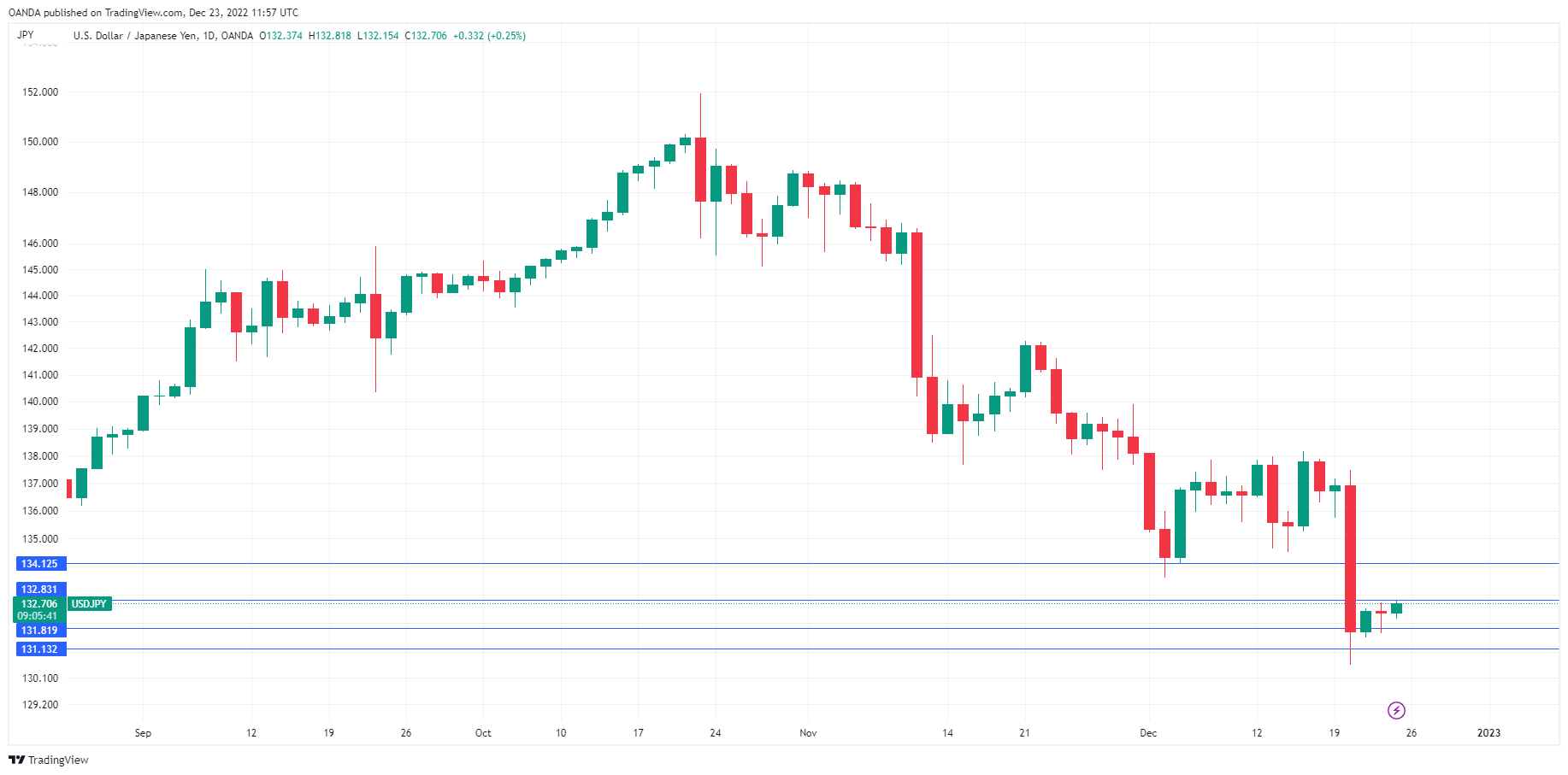
The dust is beginning to settle after the Bank of Japan’s stunning move earlier this week. At its policy meeting, the BoJ widened the yield curve on long-term bonds from 0.25% to 0.50%. The move blindsided the markets, which had anticipated a ho-hum BoJ meeting with no changes in policy. The announcement sent USD/JPY tumbling by over 500 points and has raised speculation that the BOJ could make further changes before BOJ Governor Kuroda wraps up his term in April.
The yen has since settled down and the markets are keeping an eye on other releases. National Core CPI for November delivered as expected, as the 3.7% gain matched the consensus and ticked up from 3.6% in October. The BoJ also released meeting minutes, but these were from the October meeting. Some members voiced concern about the strong descent of the yen, saying it caused uncertainty and had many negative effects on the economy. It should be kept in mind that the yen was much weaker in October when these comments were made, but it does indicate that the yen’s strength is of concern to the BOJ.
Another interesting comment was that the Bank needed to assess how the markets would react if the BoJ decided to exit its easy policy. After this week’s yield curve move, this point takes on added urgency, with rising speculation that the BoJ could tighten policy in the near term.
Markets eye PCE Core Index
In the US, there are a host of events today. The markets will be paying particular attention to the PCE Core Index, the Fed’s preferred interest indicator. The index is expected to slow to 4.6% y/y in November, down from 5.0% a month earlier. Personal Spending and Personal Income are also expected to soften. The US also releases durable goods, UoM consumer confidence and UoM inflation expectations. Investors will be paying close attention to the inflation and inflation expectation releases.
The US posted strong numbers on Thursday. Unemployment claims rose to 216,000, up from 214,000, but investors liked that the reading was lower than the consensus of 222,000. As well, GDP for Q3 was revised upwards to 3.2%, up from 2.9% in the initial estimate. The solid is another indication that the economy is well-positioned to handle additional rate hikes, which the Fed has promised as it battles inflation.
USD/JPY Technical
- USD/JPY is putting pressure on resistance at 132.83. Above, there is resistance at 134.12
- There is support at 131.13 and 130.15
Fed to Become More Dovish in 2023
A new year, and a new set of rotating Fed board members come in. Giving the varying opinions of the different main and alternate members, this annual transition can change the FOMC's bias and outlook. This could be a factor in the trajectory of the markets, because:
- There is extensive debate, still, on how high the Fed will go
- Once there, there are widely differing opinions on whether the Fed will hold fast or "pivot"
- Potential debate over whether the Fed will prioritize inflation or wages later in the year.
The other factor is that Powell has managed to maintain a particularly tight ship, even during the extraordinary measures taken to fight inflation over the last year. In fact, there have only been two dissenting votes out of all the meetings since the bottom of the pandemic. Even if more doves do get on the FOMC, it's also a question of whether they will end up actually voting for a more restrictive policy.
What's going on
The FOMC has officially 12 members, 8 of whom are permanent. Well, technically 7 are permanent, but the president of the Reserve Bank of New York "rotates" in place. Often there are less than 12, as vacancies at the Fed tend to take a long time to fill. This means the changes from the four rotating members can have a bigger impact.
The rotating members are the heads of the respective regional reserve banks. If the regional bank changes its president, and is rotated onto the board, then that will be a new member on the FOMC. That is the case this year with the arrival of the new president of the Chicago Fed, Austan Goolsbee, who's rumored to be dovish. However, it takes some time to assess the inclination of a board member's votes.
What does the rotation look like
The current holder of the Chicago chair is Evans, a noted hawk. But he will be stepping down early in the year. No hawks are slated to replace him, meaning that there will only be three board members inclined towards hawkishness next year.
Centrists Collins and George will rotate out. But also no centrists are expected to rotate in. Instead Logan will rotate in, and he's generally considered a moderate dove. He will likely be joined by Goolsbee in this camp.
Two doves will rotate out and be replaced by two other doves. That is, Kaskari and Harker will replace Mester and Bullard.
In summary, one less hawk, one less centrist; replaced by two moderate doves. The dovish end of the board remains unchanged. It's not a big shift, but it does incline the bias a little.
The immediate impact of the shift might not be noticeable, as there seems to be pretty broad agreement among members on the near-term policy. The dot-plot shows unanimity in projections in the short term. But getting towards the end of next year shows a widening split. And now there could be two more votes added to the bottom half of the average, implying a softer rate path after summer.
Canadian Dollar Eyes GDP, US Data
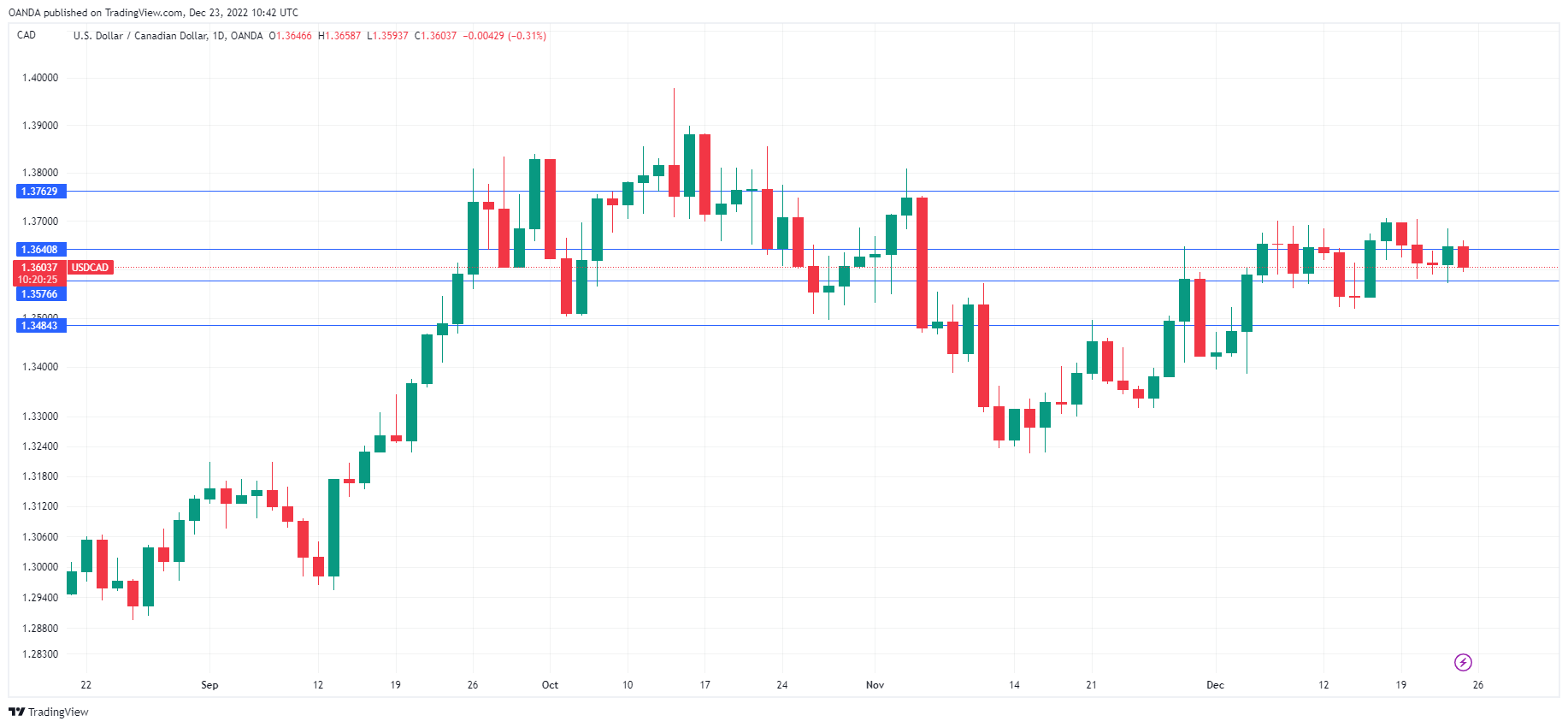
The Canadian dollar has edged lower on Friday. In the European session, USD/CAD is trading at 1.3600, down 0.33%.
It could be a busy end to the week for the Canadian dollar, with key events in both Canada and the US. Canada releases GDP for October, with a forecast of a weak gain of 0.1% m/m. This would be unchanged from September GDP. Canadian consumers have been holding tighter to the purse strings and saving their hard-earned money, as wage growth has failed to keep pace with inflation. The decline in consumer spending has hurt economic growth and there are worrying signs that economic growth has stalled in the fourth quarter.
In the US, the week wraps up with a host of events. The markets will be paying particular attention to the PCE Core Index, the Fed’s preferred interest indicator. The index is expected to slow to 4.6% y/y in November, down from 5.0% a month earlier. Personal Spending and Personal Income are also expected to soften. The US also releases durable goods, UoM consumer confidence and UoM inflation expectations.
US unemployment claims, GDP improve
The US dollar received a lift on Thursday, thanks to some solid US data. Unemployment claims rose to 216,000, up from 214,000, but investors liked that the reading was lower than the consensus of 222,000. As well, GDP for Q3 was revised upwards to 3.2%, up from 2.9% in the initial estimate. The strong data is another indication that the Federal Reserve needs to maintain its aggressive tightening stance, which has raised the likelihood of higher-for-longer rates.
The markets were hoping that Thursday’s Canadian inflation report would provide clues about BoC rate policy, but inflation was mixed. Headline CPI slowed to 6.8%, down from 6.9%, while two core indicators rose slightly. It appears too early to determine if inflation is headed lower, and as thing stands, there is a strong likelihood that the BoC will raise rates by 25 basis points at its January meeting.
USD/CAD Technical
- There is resistance at 1.3640 and 1.3762
- 1.3576 and 1.3484 are providing support
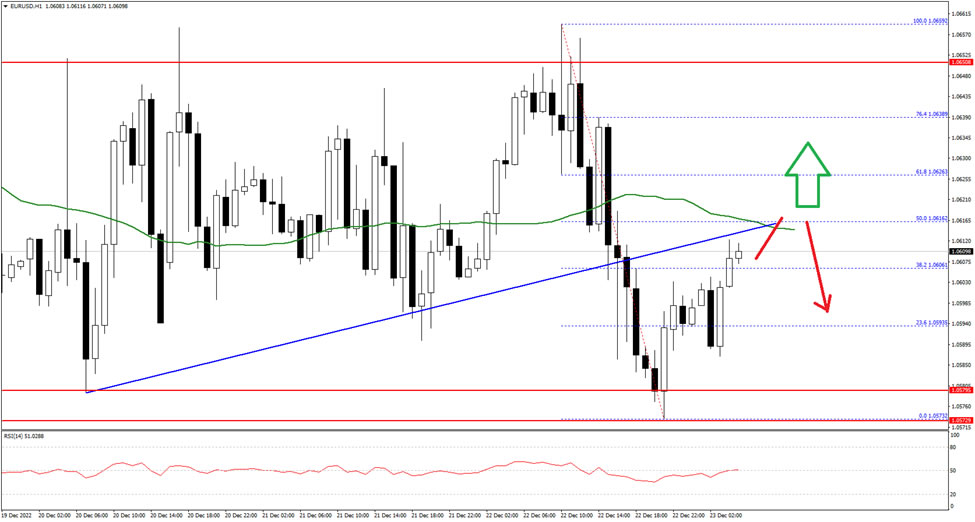
EUR/USD Pair Moved into a Short-Term Bearish Zone Below 1.0620
The Euro started a fresh decline from the 1.0660 and 1.0650 resistance levels against the US Dollar. The EUR/USD pair declined below the 1.0620 support zone to move into a short-term bearish zone.
The pair tested the 1.0575 level and settled below the 50 hourly simple moving average. It is now recovering and trading above the 1.0600 level. An immediate resistance is near the 1.0615 level and the 50 hourly simple moving average.
The first major resistance is near the 1.0620 level. A break above the 1.0620 resistance level could start another increase. In the stated case, it could rise towards the 1.0660 resistance.
Conversely, the pair might start another decline below 1.0600 on FXOpen. The next key support is near 1.0575, below the pair could drop towards the 1.0540 level. Any more losses might send the pair towards the 1.0505 level.