Sample Category Title
Weekly Focus – Softer Inflation, Harder Central Banks
In a week dominated by central bank meetings, the end result was a more hawkish impression despite inflation data for November generally surprising to the downside. In the US, the Fed hiked by 50bp as expected, but with 17 out of 19 FOMC members indicating a
Fed funds rate above 5% in 2023 and Chairman Powell saying that the labour market is extremely tight and wage growth high. However, Powell also left a door open for more modest rate hikes in the future, and markets seem to have interpreted the meeting as more or less neutral. Markets were also supported by November inflation data being lower than expected, at just 0.1% m/m for headline CPI and 0.2% m/m for core. However, we note that wage-sensitive components of CPI did not really slow down, and we also see the Fed's message as rather hawkish, pointing to high rates being maintained for long.
The ECB also delivered a 50bp rate hike as expected but with a clear message that rates are going up and that this will not be the last 50bp hike. ECB projections showed inflation exceeding the 2% target even in 2025 and the recession in 2023 being very mild if rates follow pre-meeting market pricing, which also clearly indicates that there is need and room for more hikes than that. ECB President Lagarde did not find much comfort in euro area inflation declining to 10% y/y in November, saying that it will likely rise again in January and February, which we agree with. Markets reacted with a large rise in especially 2 year yields and a stronger EUR, and we have updated our ECB call to expect a peak of 3.25% for the deposit rate in 2023. Much will depend on how inflation and other key variables actually develop over the coming months. PMI data for December rose but remain below 50, so indicating continued but slightly milder decline.
The Bank of England was also part of the 50bp hiking club, but was more dovish in its message than the Fed or the ECB, given the weakening of the British economy. But the Swiss central bank followed the trend with a hawkish message accompanying its 50bp rate hike, saying a bit like the ECB that the recession will be mild and that current monetary policy is not tight enough to bring inflation to target. Intervention to support the CHF is also clearly still a tool they can use to bring price growth down. Finally, Norges Bank was surprisingly hawkish, see the Scandi Update section.
During the coming week, we expect the Bank of Japan to stick to its outlier position as a central bank not tightening monetary policy, as inflation in Japan largely remains an imported phenomenon.
This is the final Weekly Focus in 2022, and over the holidays, we will among other things be keeping an eye on how the Covid situation develops in China, where wide spread contagion could affect supply chains and domestic demand. The US job report for December in the first week of the new year will be important to watch, given the Fed's concern over the labour market.
Weekly Focus will be back on January 6.
We wish a Happy Holiday for all our readers.
GBP/USD: Elliott Wave Analysis and Reaction to BoE
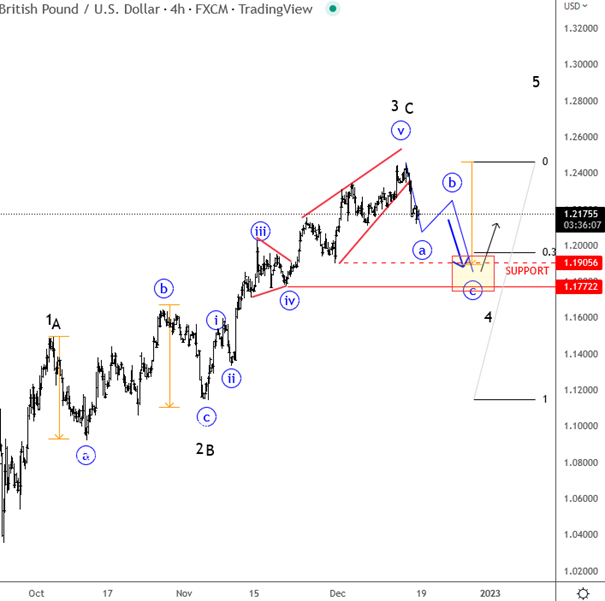
BoE raised rates yesterday by 50bp as expected, but speculators look towards the end of the hiking cycle due to recession risk which was highlighted by BoE’s Tenreyro & Dhingra. They said that 3% bank rate is more than enough to bring CPI back to target. In fact, Dhingra warned of a deeper longer recession with higher rates already before. As such, it’s not a surprise to see the pound weakening since yesterday. Notice that the price fell below the wedge, likely stepping into a corrective phase. 1.19-2.0 is support. We talked about this technical reaction a few days before the market turned as you can see on our screenshot of Elliott wave analysis below.
The question is where we go from here? Well, we try to focus on a minimum expectation which in our case is a three-wave drop, ideally wave four. Stocks are already weakening and if this will be the case in the next few sessions we think that pound can very easily make an A-B-C pattern to the south.
Updated analysis
Broken wedge suggests that temporary top is in and that market is making a three wave decline.
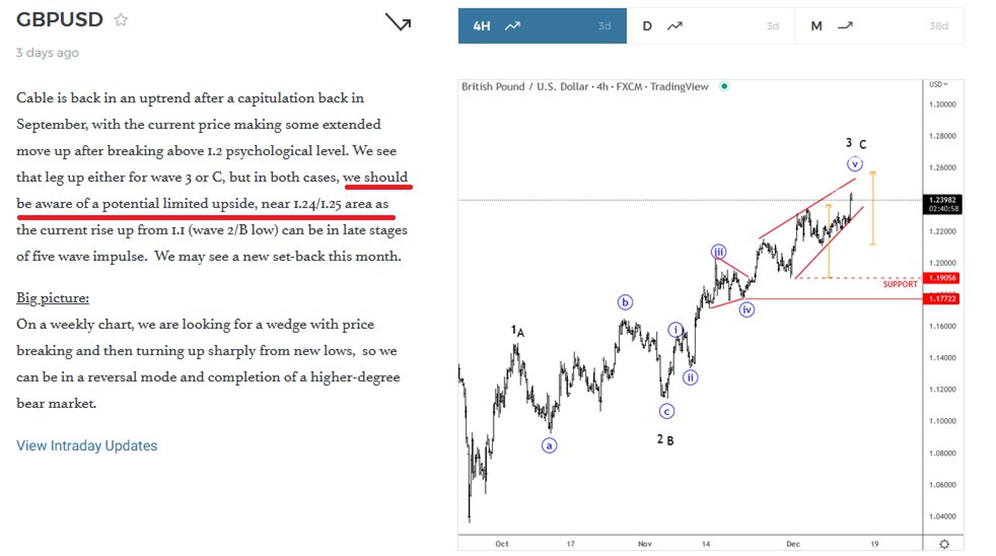
Past Elliott Wave expectations
When you see a wedge formation at the end of an extended leg, then you should be aware of a change in trend, especially ahead of important events such as was BoE rate decision this week
Will There be a Santa Rally This Year?
Stocks are down substantially this year, even including indices which had a bit of a rally through the last month or so. There has been a split in trend, which is worthy of note. The DJIA moved higher, while the Nasdaq remained relatively steady. In Europe, indices don't concentrate in certain sectors like they do in the US, but a similar trend has emerged when considering certain types of firms.
The Dow Jones consists mostly of lower valuation, so called "value stocks", which have been outperforming. Tech stocks have continued to underperform, even in periods of recovery. This is often attributed to their relatively high valuations, meaning that they are more speculative. The Fed's tightening contributes to reducing interest in higher valuation stocks, and now the Fed is expected to slow its rate hikes. This could be an indication of which sectors/stocks could benefit the most from a Santa Rally.
What are the chances this time?
In order to make an educated guess about whether we can expect a rally this year or not, we need to have a better understanding of why it happens. Which is a bit of a problem, because there isn't much agreement on the causes of the rally. Not only that, but there also isn’t even an agreement on when it happens. Some say it's in the week before Christmas, others say it's the week between Christmas and New Year, and still others say it's both.
So far this month, stocks have been trending higher thanks to an expectation that the Fed won't keep hiking rates so much. Now that they have delivered, the expectation is that US stocks can continue to rise. Across the Atlantic, the situation is a little more complicated, as the UK is expected to fall further into recession. Even if the BOE slowed the pace of hiking, there might not be as much room for optimism. Meanwhile, the ECB threatened to keep raising rates. That is expected, however, since the shared central bank was one of the last to join the hiking movement, so would likely be one of the last to end its tightening cycle.
What can we expect?
Santa rallies happen about 2 out of 3 years, on average gaining about 1.3% over the period from Christmas to the Jan 2 of the next year. It's positive, sure, but not a blow-out growth. Particularly not in the context of the market losing around 17% since the start of the year.
Another difficulty is that the final two weeks of trading for the year see dwindling liquidity as major traders go on holiday. Usually, starting with the final meeting of the Fed, activity starts to drop off, reaching a minimum between Christmas and New Years. That means that volatility tends to increase, with more erratic moves in the markets as relatively small trades can cause bigger moves.
Other factors
In general, markets tend to average higher through December. But in the case of the US in particular, they tend to do even better in an election year. 2018 was a notable exception, as the Fed was tightening though that period.
After stocks performed better in the run-up to the Fed, investors might have some time to digest the results. They could pay more attention to how the market is currently pricing in a terminal rate of 4.85%, but the average of forecasts from the Fed is 5.1%. That could lead to a revaluation of where the Fed could go in the first quarter of next year and let the Grinch into steak the Christmas cheer.
EUR/USD Mid-Day Outlook
Daily Pivots: (S1) 1.0568; (P) 1.0652; (R1) 1.0711; More...
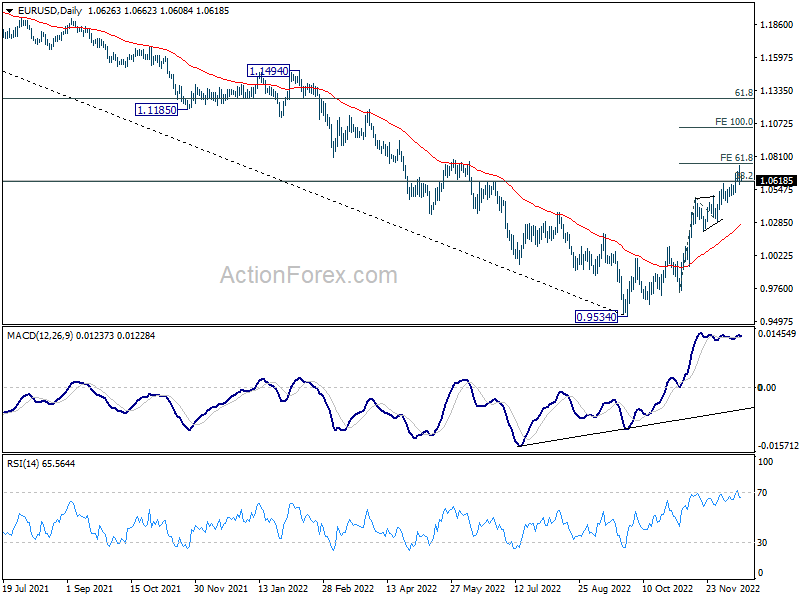
EUR/USD is staying in consolidation from 1.0733 and intraday bias remains neutral. Further rally is expected as long as 1.0481 resistance turned support holds. Firm break of 61.8% projection of 0.9729 to 1.0481 from 1.0289 at 1.0754 will pave the way to 100% projection at 1.1041. However, firm break of 1.0481 will confirm short term topping and bring deeper fall to 1.0289 support.
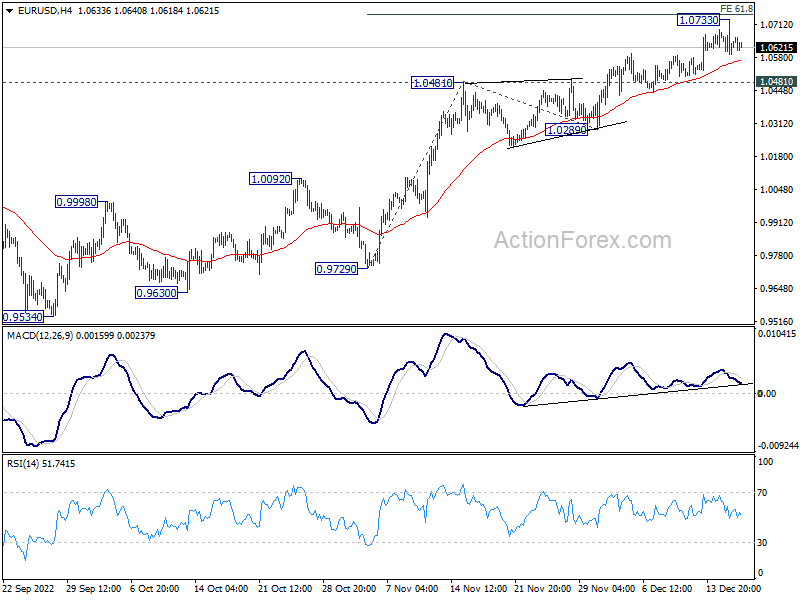
In the bigger picture, focus stays on 38.2% retracement of 1.2348 (2021 high) to 0.9534 at 1.0609. Rejection by 1.0609 will suggest that price actions from 0.9534 medium term bottom are developing into a corrective pattern. Thus, medium bearishness is retained for another fall through 0.9534 at a later stage. However, sustained break of 1.0609 will raise the chance of trend reversal and target 61.8% retracement at 1.1273.
USD/CHF Mid-Day Outlook
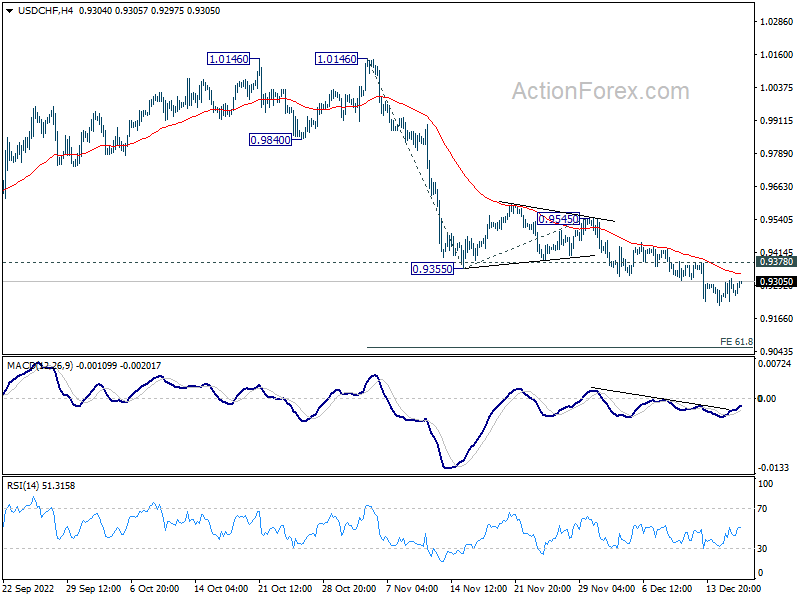
Daily Pivots: (S1) 0.9236; (P) 0.9276; (R1) 0.9326; More...
Further decline is still expected in USD/CHF with 0.9378 resistance intact. Fall from 1.0146 would target 61.8% projection of 1.0146 to 0.9355 from 0.9545 at 0.9056. However, break of 0.9378 resistance will indicate short term bottoming and turn bias back to the upside for 0.9545 resistance instead.
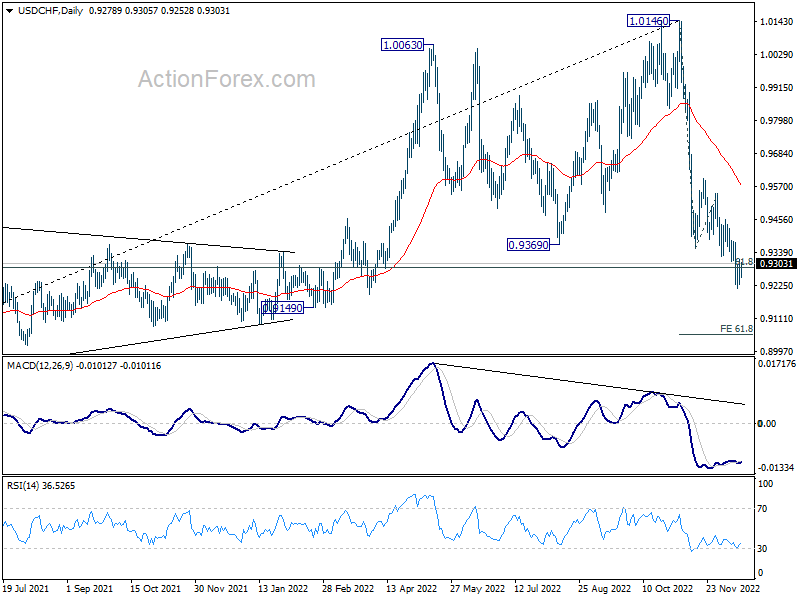
In the bigger picture, rise from 0.8756 (2021 low) has completed at 1.0146, well ahead of 1.0342 long term resistance (2016 high). Based on current downside momentum, fall from 1.0146 might be a medium term down trend itself. Sustained break of 61.8% retracement of 0.8756 to 1.0146 at 0.9287 will pave the way to 0.8756. In any case, risk will stay on the downside as long as 0.9545 resistance holds.
USD/JPY Mid-Day Outlook
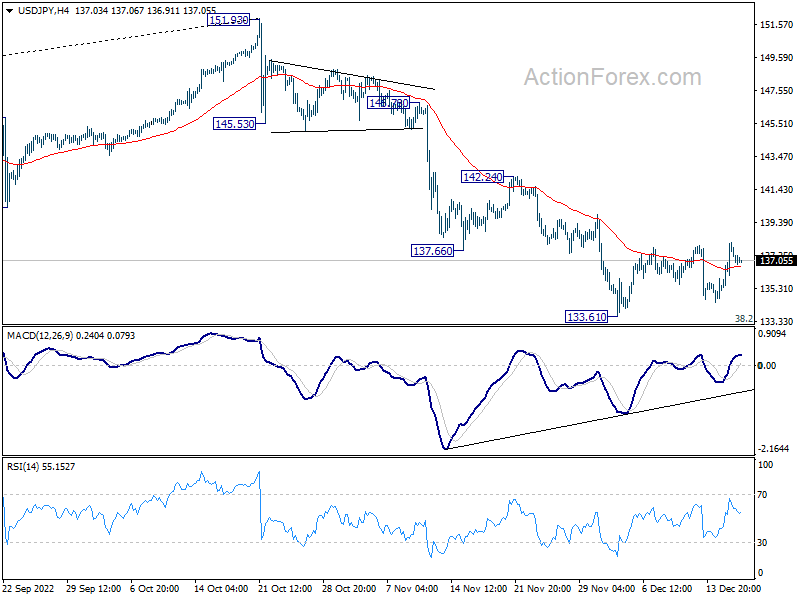
Daily Pivots: (S1) 135.97; (P) 137.07; (R1) 138.90; More...
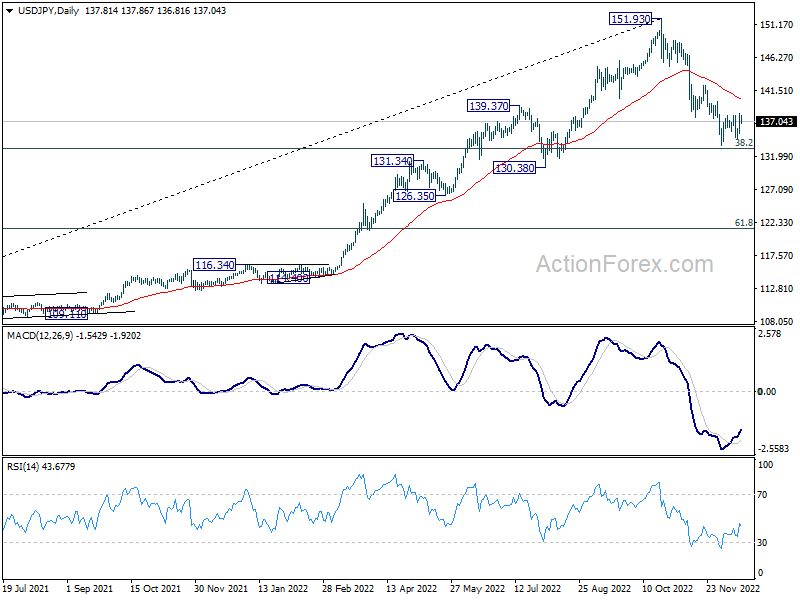
Intraday bias in USD/JPY remains mildly on the upside at this point. Rebound from 133.61 should extend higher to 142.24 resistance. On the downside, however, firm break of 133.61 support and 133.07 medium term fibonacci level will confirm resumption of whole fall from 151.93.
In the bigger picture, price actions from 151.93 medium term could be just a corrective pattern to up trend from 102.58 (2021 low). Strong support from 38.2% retracement of 102.58 to 151.93 at 133.07 and 55 week EMA (now at 131.71) will set the range for such corrective pattern. However, sustained break of 55 week EMA will pave the way to 61.8% retracement at 121.43.
GBP/USD Mid-Day Outlook
Daily Pivots: (S1) 1.2079; (P) 1.2256; (R1) 1.2355; More...
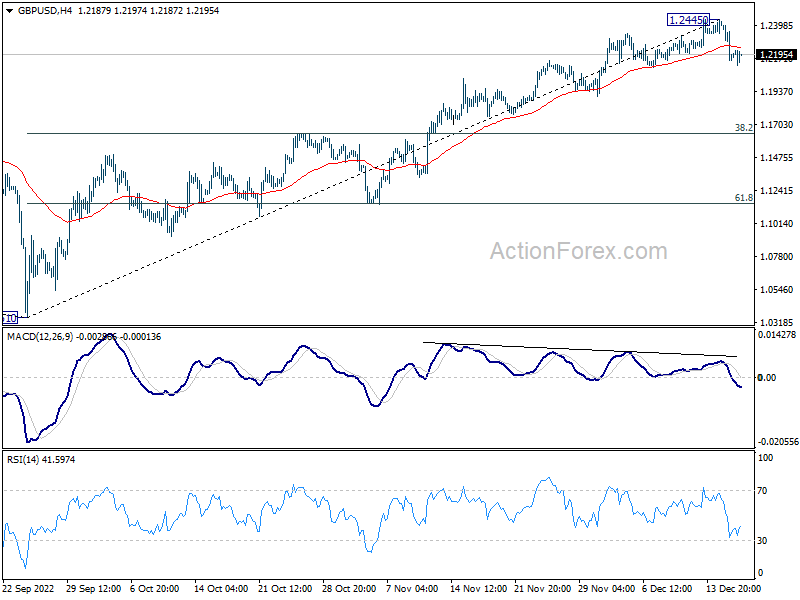
Intraday bias in GBP/USD remains on the downside for the moment. Fall from 1.2445 short term top should target 55 day EMA (now at 1.1865). Firm break there will target 38.2% retracement of 1.0351 to 1.2445 at 1.1645. For now, risk will stay on the downside as long as 1.2445 resistance holds, in case of recovery.
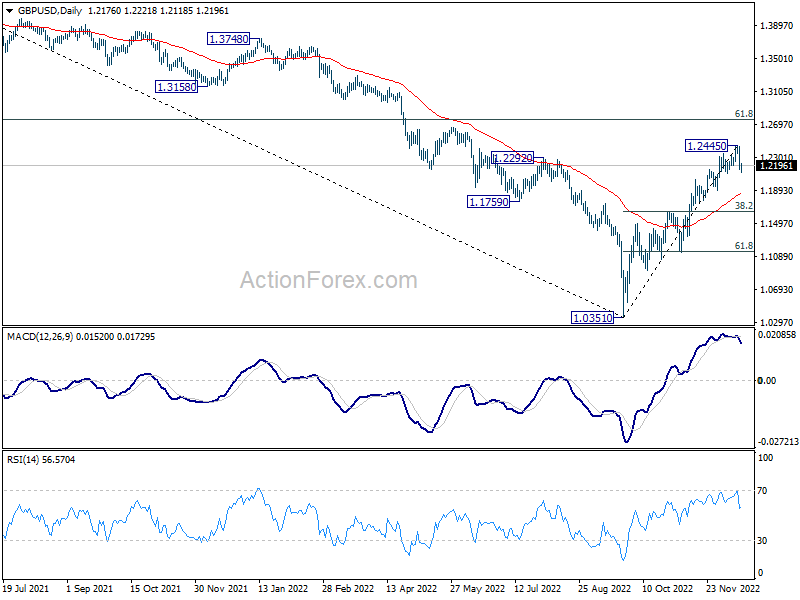
In the bigger picture, rise from 1.0351 medium term bottom is at least correcting whole down trend from 1.4248 (2021 high). Further rise is expected as long as 1.1644 resistance turned support holds. Next target is 61.8% retracement of 1.4248 to 1.0351 at 1.2759. Sustained break there will pave the way back to 1.4248. This will remain the favored case as long as 55 day EMA (now at 1.1860) holds.
Sterling Down after Weak Data, Euro and Swiss Franc Strong
Sterling is staying as one of the weakest for the week, after being sold off on weak economic data. The pressure is particularly apparent against Euro and Swiss Franc, which are the strongest ones for the week. While the financial markets are clearly in risk-off mode, Dollar is struggling to find renewed buying for now. Meanwhile, Aussie and Kiwi are still clearly pressured.
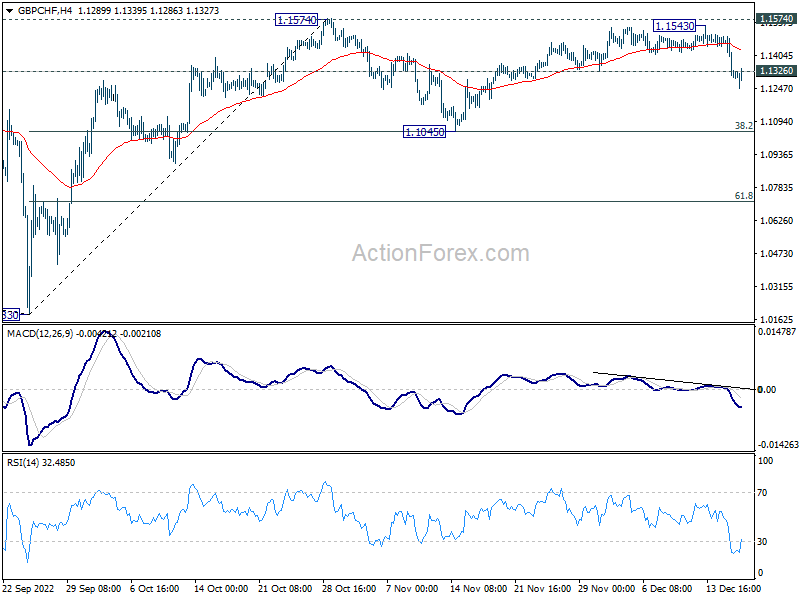
Technically, GBP/CHF's break of 1.1326 minor support indicates that corrective pattern from 1.1574 has started the third leg already. Deeper decline is now in favor for the near term. But downside should be contained by 1.1047 cluster support (38.2% retracement of 1.1083 to 1.1574 at 1.1043 to bring rebound. An upside breakout through 1.1574 is still expected at a later stage, together with EUR/CHF breaking through 0.9953.
In Europe, at the time of writing, FTSE is down -1.45%. DAX is down -0.71%. CAC is down -1.43%. Germany 10-year yield is up 0.0964 at 2.177. Earlier in Asia, Nikkei dropped -1.87%. Hong Kong HSI rose 0.42%. China Shanghai SSE dropped -0.02%. Singapore Strait Times dropped -1.01%. Japan 10-year JGB yield dropped -0.0020 to 0.256.
ECB Villeroy: The match is over in fighting inflation
ECB Governing Council member Francois Villeroy de Galhau told BFM Business radio that "the match is not over" in fighting inflation, adding that rate hikes remain the main tool.
Regarding the quantitative tightening on the APP by EUR 15B per month from March, he said, "we will re-examine it in June and we will probably increase the reduction starting in July,"
"The European economy is more resilient than we feared even a few weeks ago," he said. "There will be a strong slowdown in 2023. We will escape what certain people call a hard landing. We will have a rather significant rebound in 2024 and 2025."
ECB Rehn: More 50bps hike at least as far as I see in Feb and Mar
ECB Governing Council member Olli Rehn said, "we will stay the course as President (Christine) Lagarde yesterday indicated and this will likely mean 50 basis point rate hikes in the coming meetings, at least as far as I see in February, and March."
Another Governing Council member Robert Holzmann said the signal that more 50bps rate hikes are coming was "a toughly hawkish statement that for me is equivalent to the 75". He added that ECB could "go deep into restrictive territory if needed".
Bundesbank expects no severe economic slump in Germany
Bundesbank projects that the German economy will contract -0.5% in 2023, then grow by 1.7% in 2024 and 1.4% in 2025. President Joachim Nagel said, "Economic output is likely to shrink initially, but we expect a gradual recovery from the second half of 2023... Compared to the June projection, the rate of change of GDP for 2023 has been revised significantly downwards."
HICP inflation is projected to decline to 7.2% in 2023, then to 4.1% in 2024, and 2.8% in 2025. HICP excluding energy and food is expected to increase slightly to 4.3% in 2023, then gradually decline to 2.9% in 2024 and 2.6% in 2025.
Eurozone PMI composite rose to 48.8, consistent with -0.2% GDP contraction in Q4
Eurozone PMI Manufacturing rose from 47.1 to 47.8 in December. PMI Services rose from 48.5 to 49.1. PMI Composite rose from 47.8 to 48.8. Still, the downside extended into its sixth successive month, even though rate of decline moderated.
Chris Williamson, Chief Business Economist at S&P Global Market Intelligence said: "While the further fall in business activity in December signals a strong possibility of recession, the survey also hints that any downturn will be milder than thought likely a few months ago. The data for the fourth quarter are consistent with GDP contracting at a quarterly rate of just less than 0.2%, and forward-looking indicators are currently boding well for the rate of decline to ease further in the first quarter."
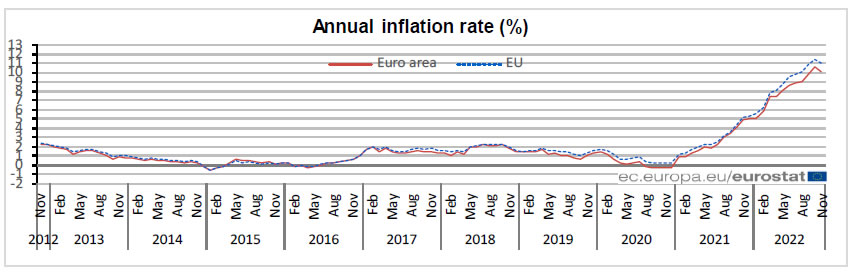
Eurozone CPI finalized at 10.1% yoy in Nov, core CPI at 5.0% yoy
Eurozone CPI was finalized at 10.1% yoy in November, down from October's 10.6% yoy. CPI core was finalized at 5.0%, unchanged from prior month's reading. The highest contribution came from energy (+3.82%), followed by food, alcohol & tobacco (+2.84%), services (+1.76%) and non-energy industrial goods (+1.63%).
EU CPI was finalized at 11.1% mom, down from October's 11.5% yoy. The lowest annual rates were registered in Spain (6.7%), France (7.1%) and Malta (7.2%). The highest annual rates were recorded in Hungary (23.1%), Latvia (21.7%), Estonia and Lithuania (both 21.4%). Compared with October, annual inflation fell in sixteen Member States, remained stable in three and rose in eight.
UK PMI manufacturing fell to 44.7, services recovery to 50.0
UK PMI Manufacturing dropped from 46.5 to 44.7 in December, a 31-month low. PMI Services rose from 48.8 to 50.0. PMI Composite rose from 48.2 to 49.0.
Chris Williamson, Chief Business Economist at S&P Global Market Intelligence said: "The December data add to the likelihood that the UK is in recession, with the PMI indicating a 0.3% GDP contraction in the fourth quarter after the 0.2% decline seen in the three months to September.
"For now, the downturn looks to be relatively mild, and the easing in the rate of decline in December is encouraging news, as is the further marked cooling of inflationary pressures. However, the fact that the downturn has moderated compared to the turmoil created in the immediate aftermath of the botched "mini budget", most notably in financial services, is no real cause for cheer. It is especially worrying to see business confidence and order book indicators remain so low by historical standards, with both of these key gauges signalling heightened degrees of economic stress.
"Hence it's no surprise to see that businesses are battening down the hatches, most notably by reducing headcounts, in a sign that the downturn not only has further to run but could yet accelerate again, especially given December's further hike to interest rates."
UK retail sales volumes down -0.4% mom in Nov, values up 0.5% mom
In November, UK retail sales volumes declined -0.4% mom, much worse than expectation of 0.3% mom rise. Ex-fuel sales dropped -0.3% mom, worse than expectation of 0.3% mom. Fuel sales volumes declined -1.7% mom.
In value term, retail sales rose 0.5% mom while ex-fuel sales rose 0.1% mom.
Japan PMI manufacturing fell to 48.8, but services improved to 51.7
Japan PMI Manufacturing fell slightly from 49.0 to 48.8 in December, above expectation of 48.0. That's the worst contractionary reading since October 2020. PMI Services, however, improved from 50.3 to 51.7. PMI Composite also rose back from 48.9 to 50.0.
Laura Denman, Economist at S&P Global Market Intelligence, said:
"The Japanese private sector economy saw a stabilisation in business activity in the final month of the year, with flash data indicating that the divergence between the manufacturing and services sectors has grown further. As has been the case since the launching of the National Travel Discount Programme in October, service providers have reportedly continued to profit from a boost in tourism volumes. Notably, firms have seemingly gained some pricing power as a result of improving demand within the sector and raised their selling prices at the sharpest rate since October 2019.
"Conversely, manufacturing firms continued to struggle in the face of subdued demand conditions and severe inflationary pressures with the latest flash PMI reading the lowest since October 2020. December data saw production and order books at Japanese manufacturers contract further, but at paces that were slower than in November. At the same time, though historically sharp, inflationary pressures cooled with the rate of input price inflation at the lowest level since September 2021."
NZ BusinessNZ manufacturing dropped to 47.4, negative dynamic at play
New Zealand BusinessNZ Performance of Manufacturing Index dropped from 49.3 to 47.4 in November. That is the first time the PMI has shown consecutive months of contraction since the first nationwide lockdown in 2020.
Looking at some details, production fell slightly from 49.9 to 49.6. Employment fell from 48.7 to 46.7. New orders dropped further from 44.4 to 41.8. Finished stocks rose from 55.0 to 56.1. Deliveries dropped from 55.4 to 50.7.
BNZ Senior Economist, Craig Ebert stated "it's been quite the sag in the PMI, compared to just three months ago when everything appeared positive. Of course, the PMI can dive down to the 40-zone when things get recessionary. And November's result wasn't that awful. That said, it also had componentry showing a negative dynamic at play".
Australia PMI composite dropped to 47.3, first signs of desired soft landing
Australia PMI Manufacturing dropped from 51.3 to 50.4 in December, a 31-month low. PMI Services dropped from 47.6 to 46.9, an 11-month low. PMI Composite dropped from 48.0 to 47.3, also an 11-month low.
Warren Hogan, Chief Economic Advisor at Judo Bank said:
"The December results are one of the most up to date readings on the Australian economy and show that higher interest rates are starting to have the desired impact on activity. The Flash PMI readings for December are still well above levels that would normally be associated with recession. What we are seeing could be the first signs of a desired soft landing for the Australian economy in 2023...
"The slowing in this leading indicator of Australian economic activity will be welcomed by the RBA. Tighter monetary policy is having the desired effect, that is, a gradual slowing in domestic demand that should eventually filter through to lower inflation...
"This important leading indicator of Australian economic activity raises the prospect of an extended pause in the rate hiking cycle. As the rate hikes of 2022 continue to work through the economy over the first half of 2023, the RBA appears to have some scope to sit back and watch for a while."
GBP/USD Mid-Day Outlook
Daily Pivots: (S1) 1.2079; (P) 1.2256; (R1) 1.2355; More...
Intraday bias in GBP/USD remains on the downside for the moment. Fall from 1.2445 short term top should target 55 day EMA (now at 1.1865). Firm break there will target 38.2% retracement of 1.0351 to 1.2445 at 1.1645. For now, risk will stay on the downside as long as 1.2445 resistance holds, in case of recovery.
In the bigger picture, rise from 1.0351 medium term bottom is at least correcting whole down trend from 1.4248 (2021 high). Further rise is expected as long as 1.1644 resistance turned support holds. Next target is 61.8% retracement of 1.4248 to 1.0351 at 1.2759. Sustained break there will pave the way back to 1.4248. This will remain the favored case as long as 55 day EMA (now at 1.1860) holds.
Economic Indicators Update
| GMT | Ccy | Events | Actual | Forecast | Previous | Revised |
|---|---|---|---|---|---|---|
| 21:30 | NZD | Business NZ PMI Nov | 47.4 | 49.3 | ||
| 22:00 | AUD | Manufacturing PMI Dec P | 50.4 | 51.3 | ||
| 22:00 | AUD | Services PMI Dec P | 46.9 | 47.6 | ||
| 00:01 | GBP | GfK Consumer Confidence Dec | -42 | -43 | -44 | |
| 00:30 | JPY | Manufacturing PMI Dec P | 48.8 | 48 | 49 | |
| 07:00 | GBP | Retail Sales M/M Nov | -0.40% | 0.30% | 0.60% | 0.90% |
| 07:00 | GBP | Retail Sales Y/Y Nov | -5.90% | -5.60% | -6.10% | -5.90% |
| 07:00 | GBP | Retail Sales ex-Fuel M/M Nov | -0.30% | 0.30% | 0.30% | 0.70% |
| 07:00 | GBP | Retail Sales ex-Fuel Y/Y Nov | -5.90% | -5.80% | -6.70% | -6.40% |
| 08:15 | EUR | France Manufacturing PMI Dec P | 48.9 | 48.1 | 48.3 | |
| 08:15 | EUR | France Services PMI Dec P | 48.1 | 49.1 | 49.3 | |
| 08:30 | EUR | Germany Manufacturing PMI Dec P | 47.4 | 46.7 | 46.2 | |
| 08:30 | EUR | Germany Services PMI Dec P | 49 | 46.4 | 46.1 | |
| 09:00 | EUR | Eurozone Manufacturing PMI Dec P | 47.8 | 46.8 | 47.1 | |
| 09:00 | EUR | Eurozone Services PMI Dec P | 49.1 | 48.5 | 48.5 | |
| 09:30 | GBP | Manufacturing PMI Dec P | 44.7 | 46.5 | 46.5 | |
| 09:30 | GBP | Services PMI Dec P | 50 | 48.5 | 48.8 | |
| 10:00 | EUR | Eurozone Trade Balance (EUR) Oct | -28.3B | -32.5B | -37.7B | -36.4B |
| 10:00 | EUR | CPI Y/Y Nov F | 10.10% | 10.00% | 10.00% | |
| 10:00 | EUR | CPI Core Y/Y Nov F | 5.00% | 5.00% | 5.00% | |
| 13:30 | CAD | Wholesale Sales M/M Oct | 2.10% | 1.40% | 0.10% | |
| 14:45 | USD | Manufacturing PMI Dec P | 47.7 | 47.7 | ||
| 14:45 | USD | Services PMI Dec P | 46.5 | 46.2 |
USDCHF Leading the Path in USDX
An interesting pair to look at to identify the path of the USDX after 9.28.22 peak is the USDCHF. We all know and seen the USDX rallying within wave ((3)) during the last 1 and a half years. The cycle now is getting mature and expected pullback was inevitable.
At Elliott Wave Forecast, as an analyst and a professional trader you need to look at different clues in the market that may help you determine a cycle or a sequence. This will allow you to figure out a possible path so you can be able to execute reasonably your trading plan ahead. The market always reacts within the transactions being made between buyers and sellers. For a market to exist you need to have both sides.
If you ever seen an exchange you know that you can see how much money is available at a specific price. Either for buying or selling an asset. This however is not available within the retail trading industry within the Forex markets. Our system is able to combine Elliott Wave theory with the addition of market correlation and distribution. And looking at the sequences among other things to determine the most probable and accurate path. Let’s have a look at the USDX 11.26.22 4 hour weekend update.
USDX 11.26.22 4 Hour weekend update
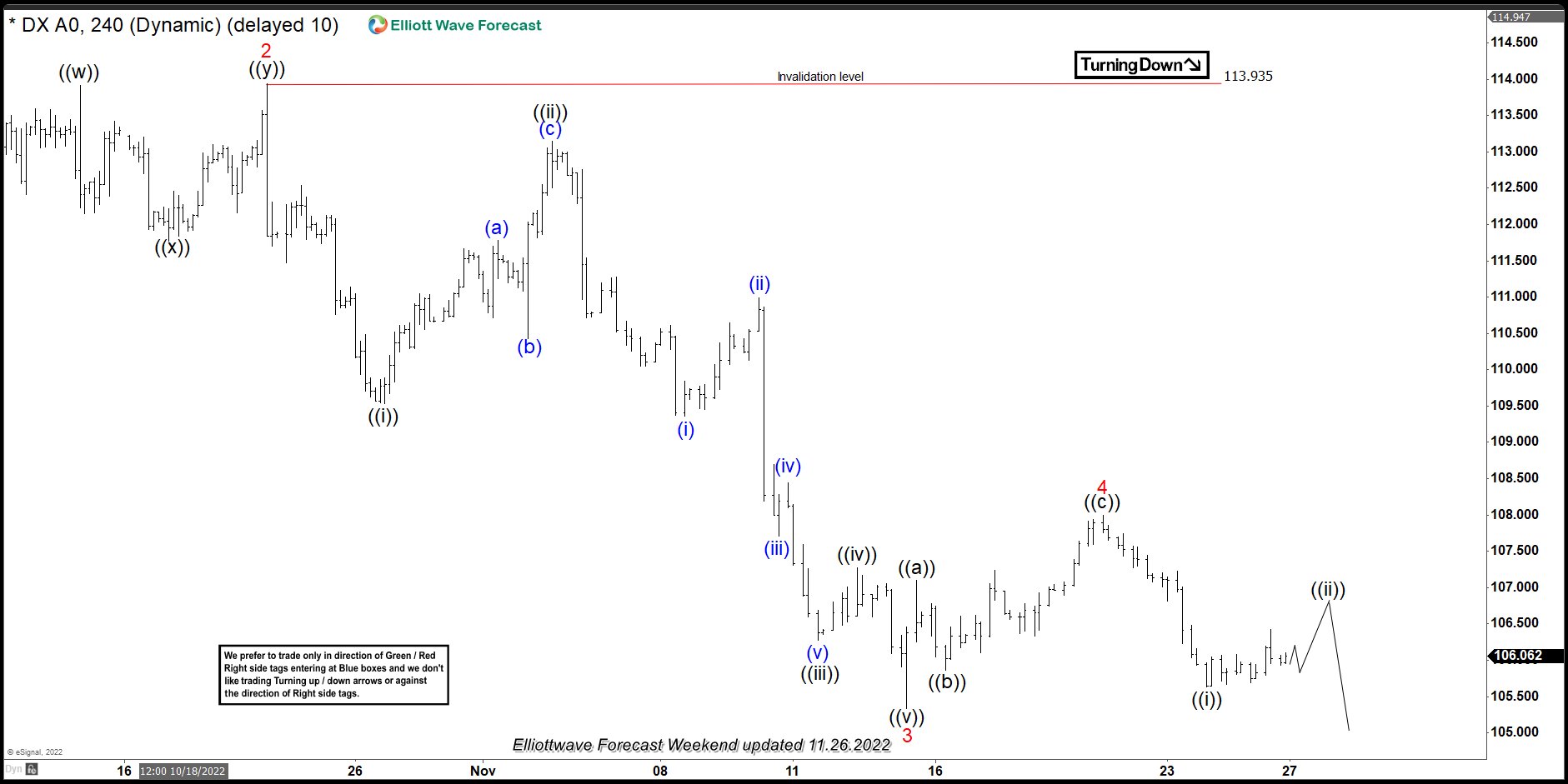
We can see that wave 2 red in the USDX was at 10.21.22 and from there made 5 waves lower into wave 3 before bouncing in wave 4 and then lower in wave 5 takes place. Now let’s have a look at what the USDCHF has done.
USDCHF 11.27.22 4 Hour weekend update
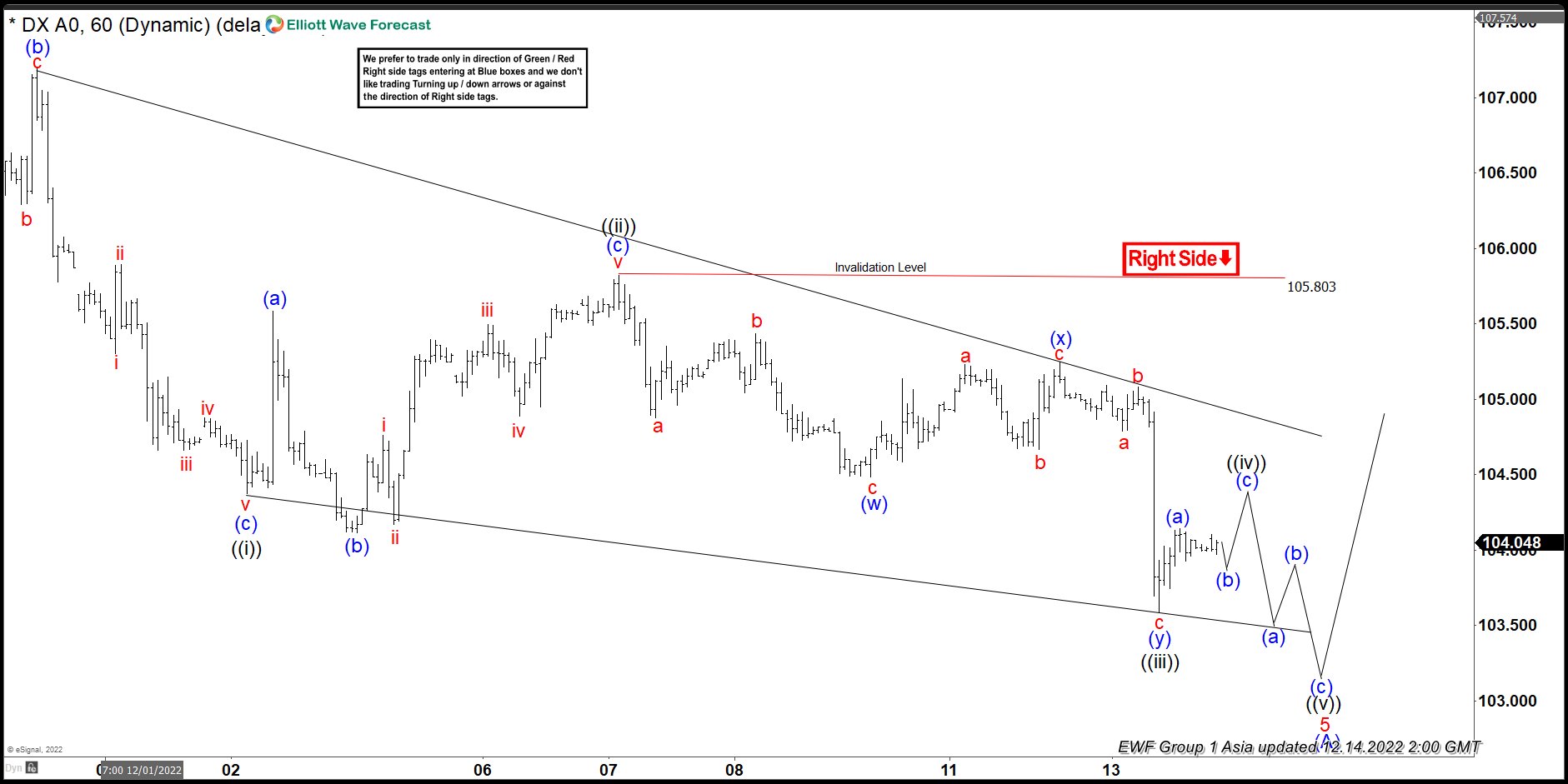
The USDCHF as we can see ended its cycle at 10.21.22 the same date that the USDX ended wave 2 red. From that point on the 2 instruments are correlated within the same cycle and path. Before ending the cycle and soon to start the bounce. Now let’s have a look at the latest charts from both instruments.
USDX 12.14.22 1 hour Asian update
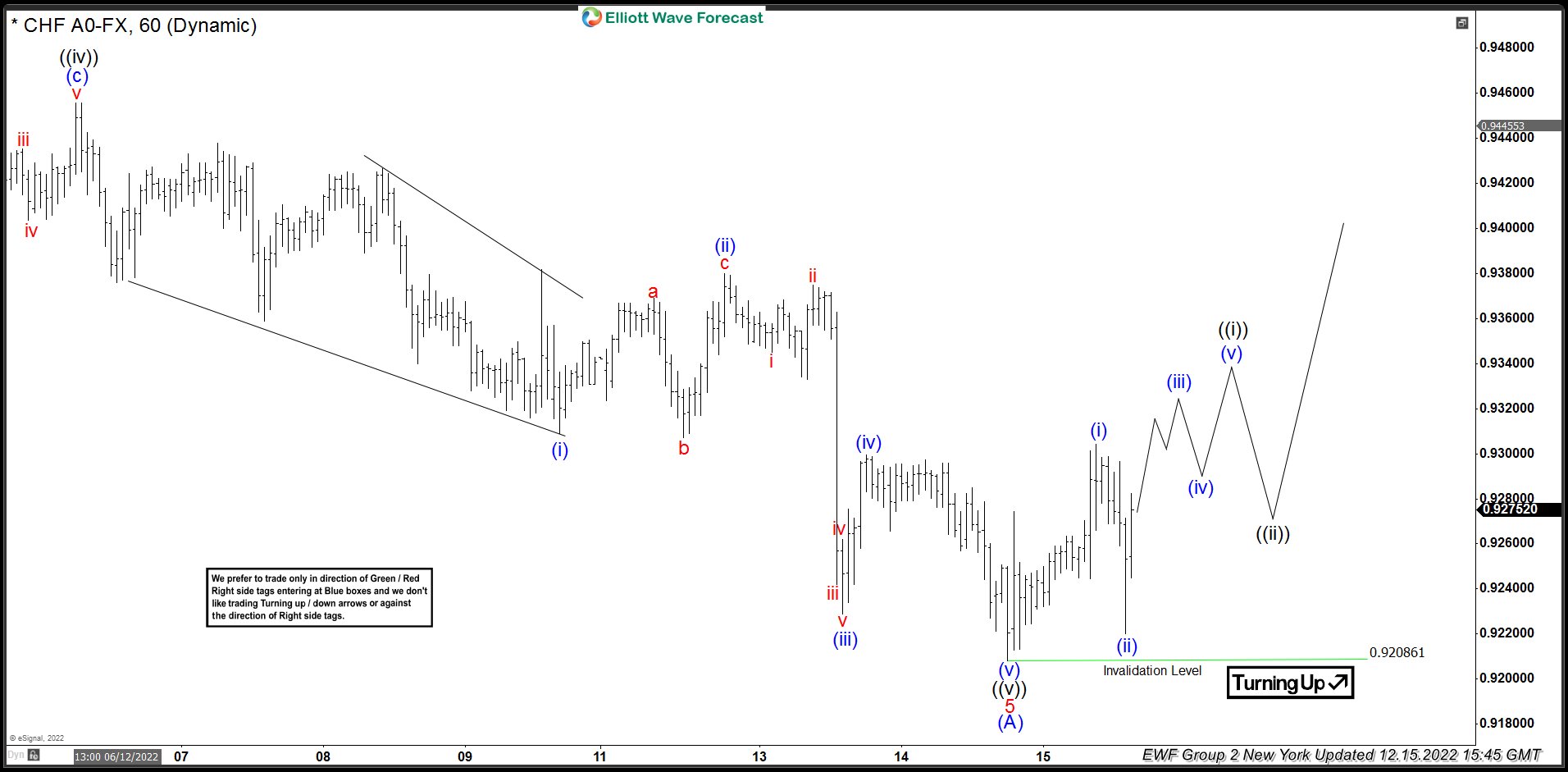
As we can see both instruments shared a similar path. This is because within a cycle we usually have some instruments that we can relate to. It gives us clues as to how and when a cycle might be ending. Most times we find instruments that we can relate that have identical swing counts and structure. We use multiple indicators to be able to accurately forecast the market. Alongside our distribution system, sequence and correlations amongst others.
Eurozone CPI finalized at 10.1% yoy in Nov, core CPI at 5.0% yoy
Eurozone CPI was finalized at 10.1% yoy in November, down from October's 10.6% yoy. CPI core was finalized at 5.0%, unchanged from prior month's reading. The highest contribution came from energy (+3.82%), followed by food, alcohol & tobacco (+2.84%), services (+1.76%) and non-energy industrial goods (+1.63%).
EU CPI was finalized at 11.1% mom, down from October's 11.5% yoy. The lowest annual rates were registered in Spain (6.7%), France (7.1%) and Malta (7.2%). The highest annual rates were recorded in Hungary (23.1%), Latvia (21.7%), Estonia and Lithuania (both 21.4%). Compared with October, annual inflation fell in sixteen Member States, remained stable in three and rose in eight.