

Sample Category Title
EUR/GBP Weekly Outlook
EUR/GBP's strong rebound last week confirmed short term bottoming at 0.8545. Initial bias is mildly on the upside this week for 0.8827 resistance. Firm break there will argue that whole decline from 0.9267 has completed and turn near term outlook bullish. On the downside, break of 0.8675 minor support will turn intraday bias neutral instead.
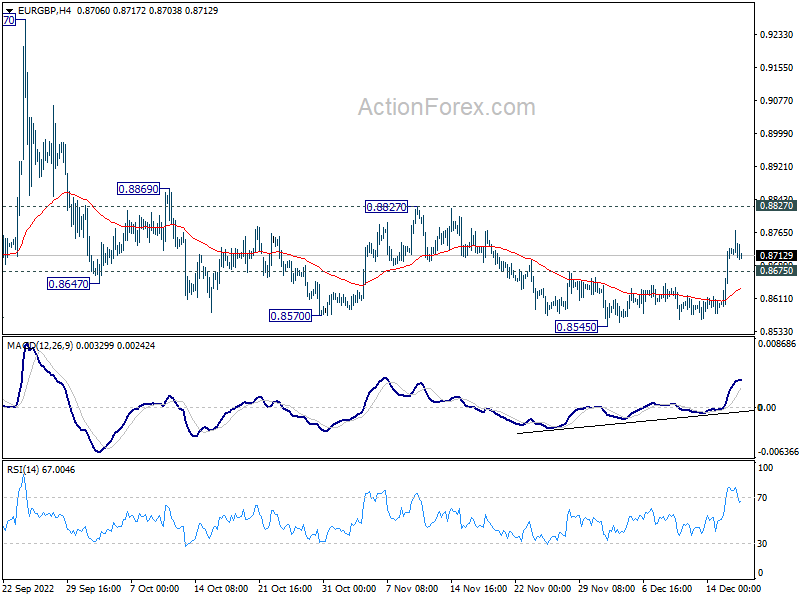
In the bigger picture, fall from 0.9267 is seen as a down leg inside long term range pattern. Deeper fall could be seen towards 0.8201/8338 support zone. But strong support should be seen there to bring reversal. Nevertheless, firm break of 0.8827 resistance will turn favor to the case that such decline is merely a correction in the up trend from 0.8201. That is, further rally would be seen at a later stage through 0.9267.
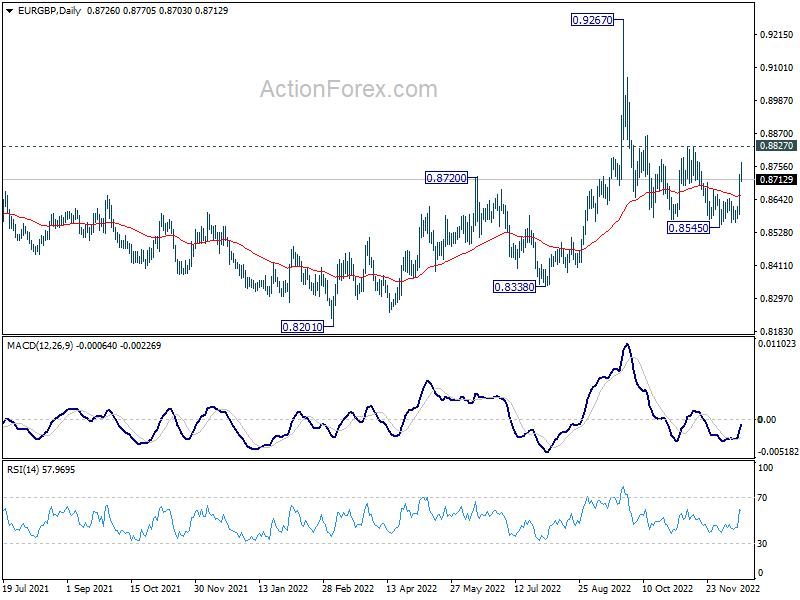
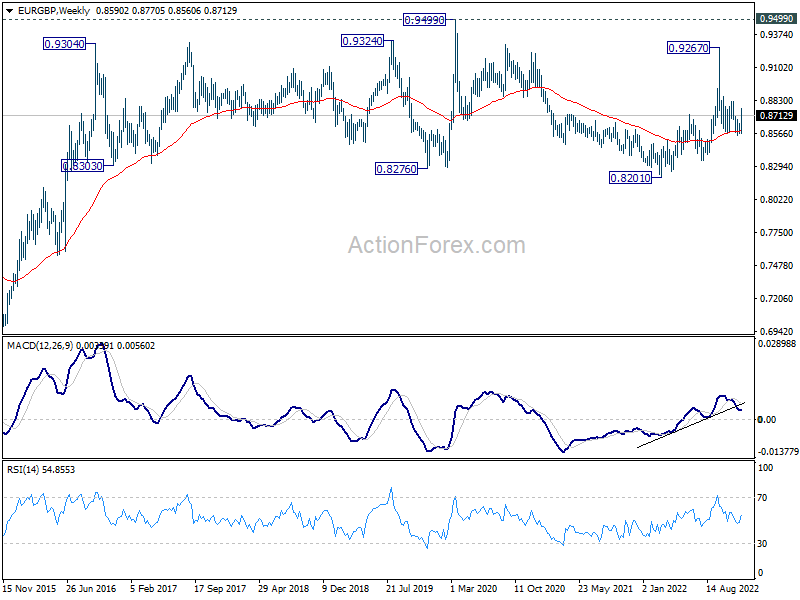
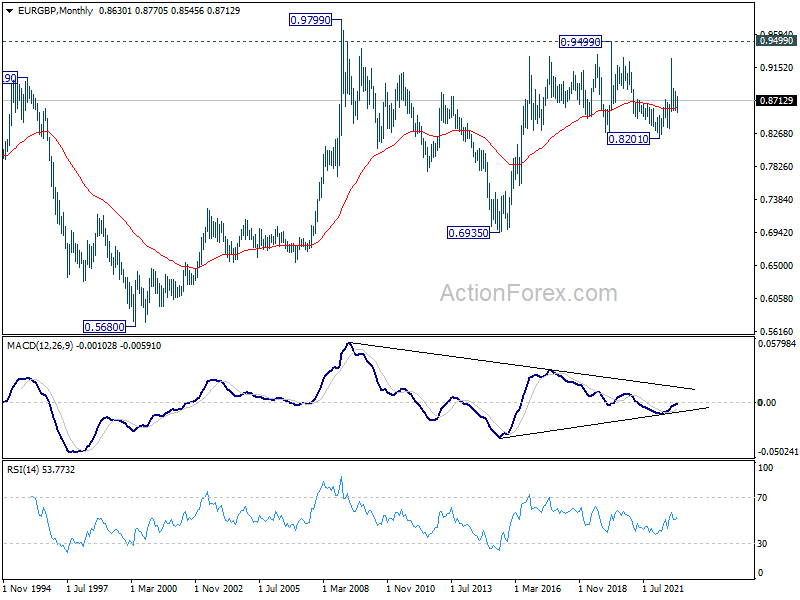
In the long term picture, long term range pattern is extending. But rise from 0.6935 (2015 low) is expected to extend at a later stage, to 0.9799 (2009 high).
EUR/AUD Weekly Outlook
EUR/AUD's rise from 1.4281 resumed last week and hit as high as 1.5916. Initial bias remains on the upside this week for 61.8% projection of 1.4281 to 1.5704 from 1.5271 at 1.6150. On the downside, below 1.5724 minor support will turn bias neutral and bring consolidations. But outlook will remain bullish as long as 1.5441 support holds, in case of retreat.
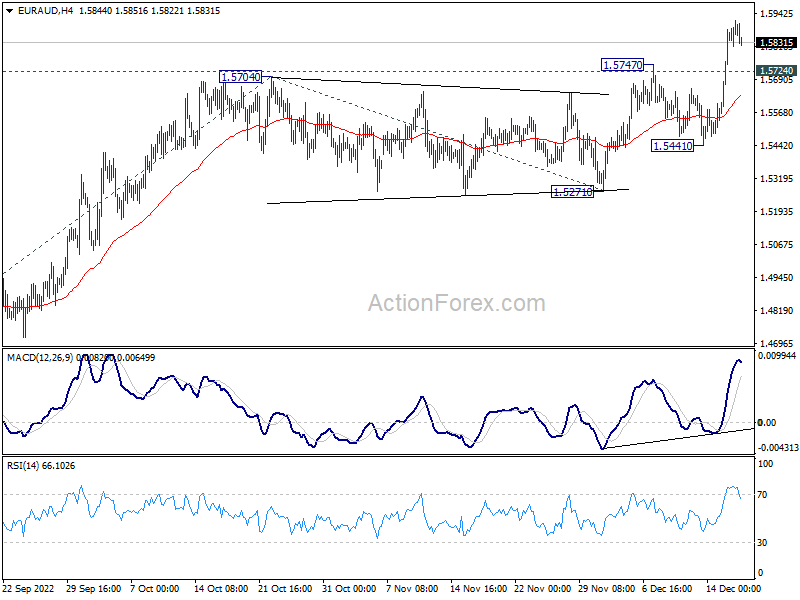
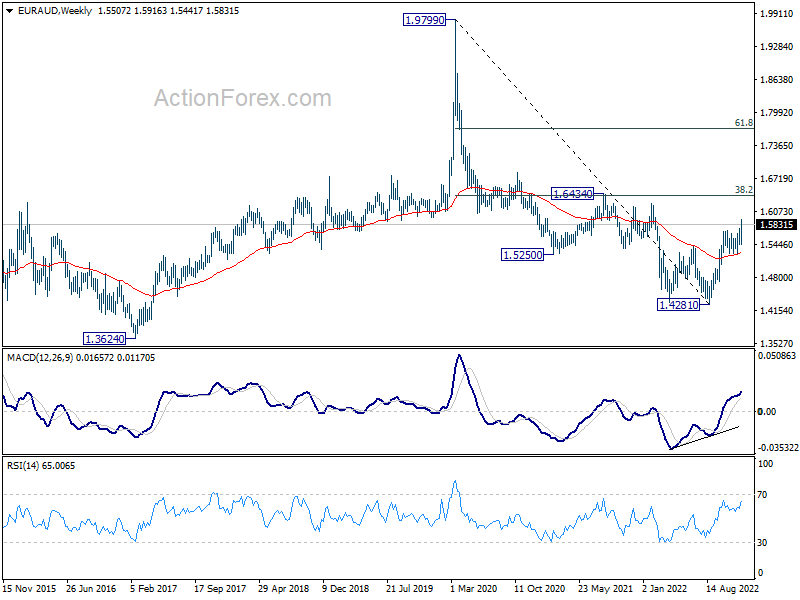
In the bigger picture, strong support from 55 day and 55 week EMA affirms underlying bullishness. As long as 1.5271 support holds, rise from 1.4281 medium term bottom is expected to continue to 1.6434 key resistance next. Decisive break there should confirm medium term bullish trend reversal.
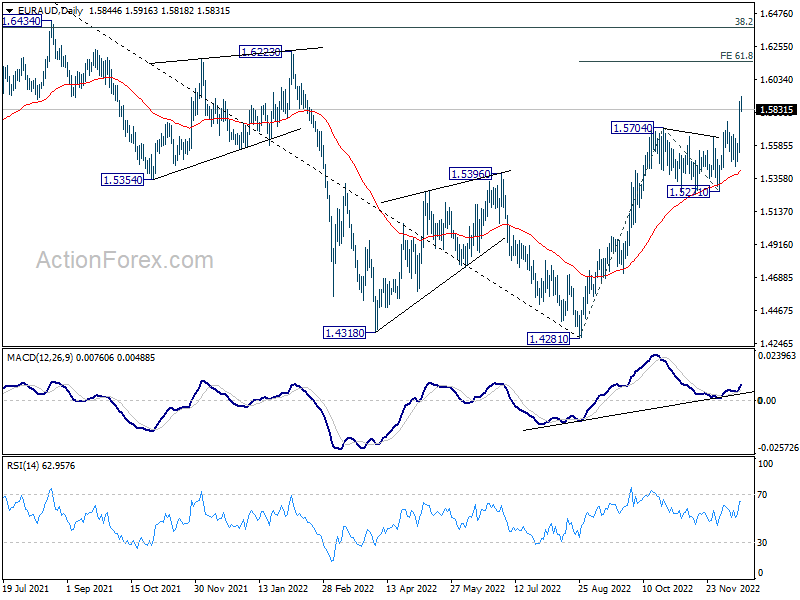
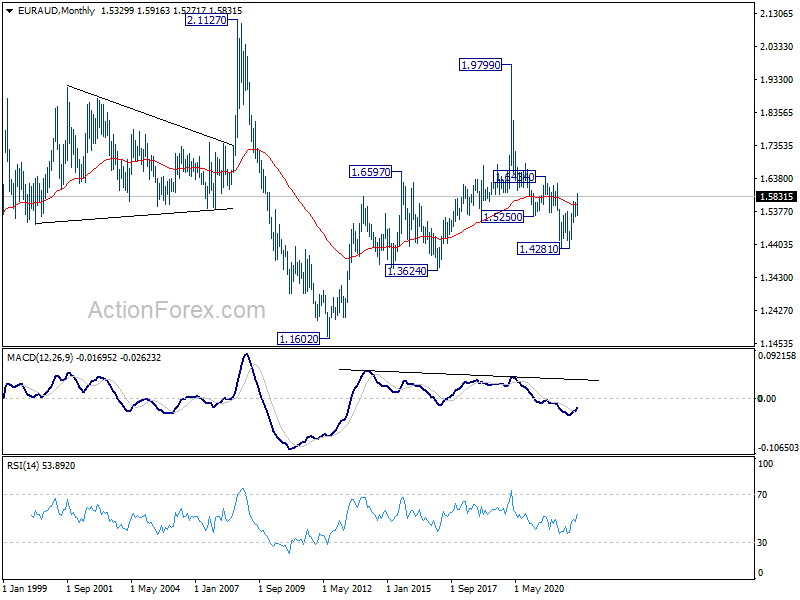
In the longer term picture, sustained trading above 55 month EMA (now at 1.5603) will raise the chance of bullish trend reversal, and at least bring further rally to 1.6434 cluster resistance, 38.2% retracement of 1.9799 (2020 high) to 1.4281 at 1.6389. Firm break of 1.6434 will turn outlook bullish.
EUR/CHF Weekly Outlook
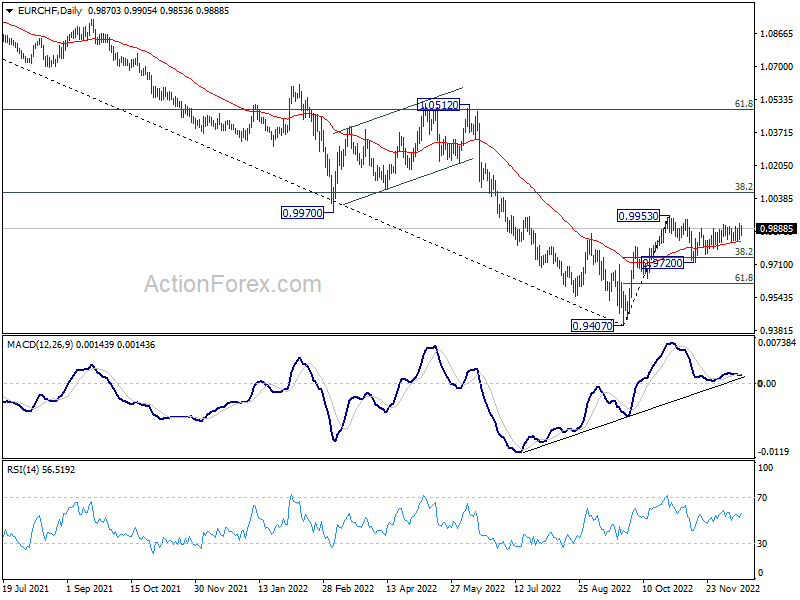
EUR/CHF's consolidation pattern from 0.9953 continued last week and overall outlook is unchanged. Initial bias stays neutral this week first. On the upside, firm break of 0.9953 resistance will resume larger rally from 0.9407 to 1.0072 fibonacci level. However, break of 0.9720 will extend the decline from 0.9953 to 61.8% retracement of 0.8407 to 0.9953 at 0.9616.
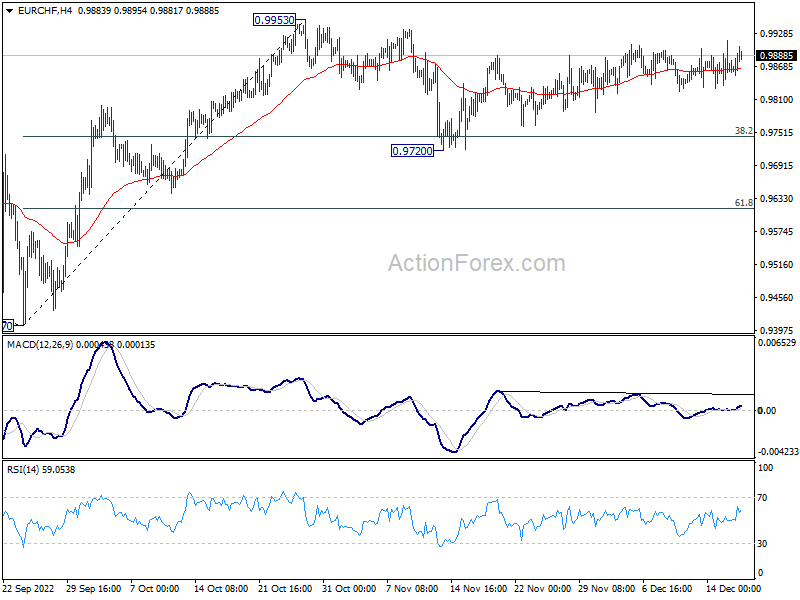
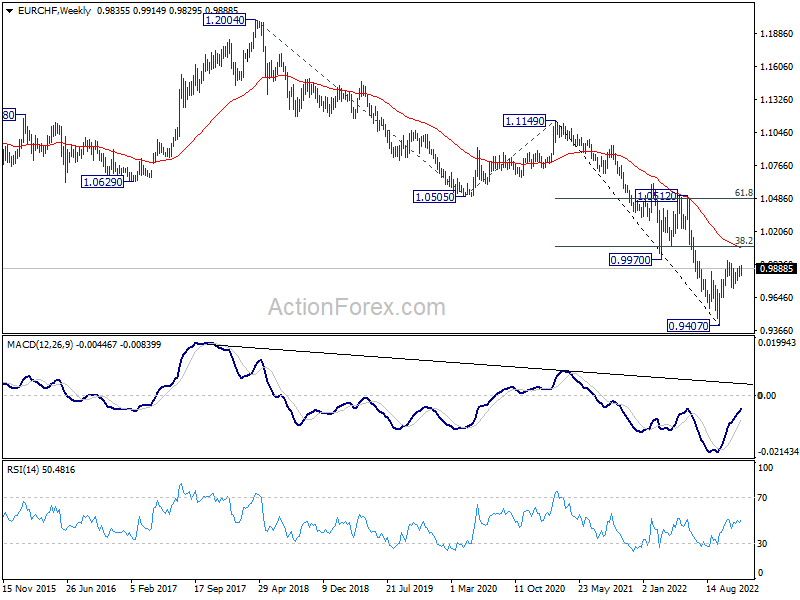
In the bigger picture, as long as 38.2% retracement of 1.1149 to 0.9407 at 1.0072 holds, price actions from 0.9407 medium term bottom will be treated as a corrective pattern. That is, long term down trend would resume through this low at a later stage. Nevertheless, firm break of 1.0072 will also have 55 week EMA (now at 1.0074) taken out. That would be an initial sign of long term bullish reversal.
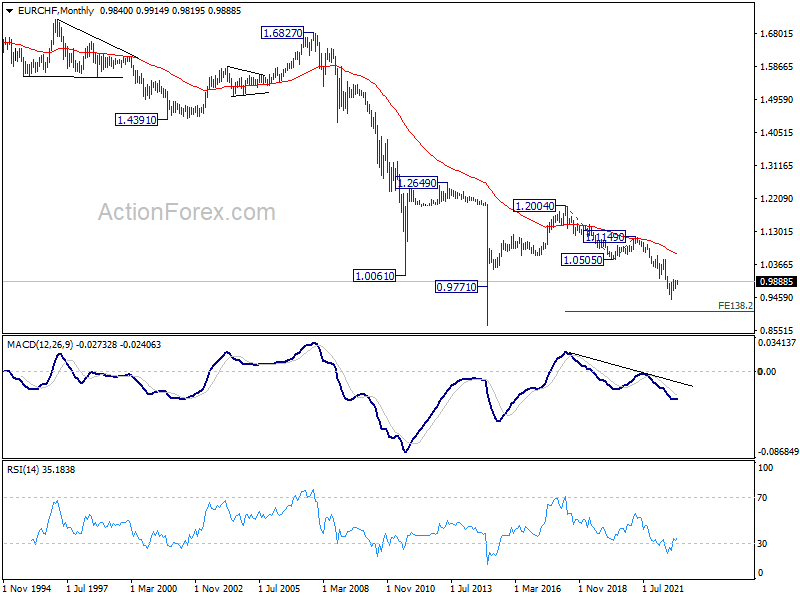
In the long term picture, capped well below 55 month EMA, EUR/CHF is seen as extending the multi-decade down trend. There is no prospect of a bullish reversal until firm break of 1.0505 support turned resistance (2020 low). In case of resumption, next target is 138.2% projection of 1.2004 to 1.0505 to 1.1149 at 0.9033.
Summary 12/19 – 12/23
Monday, Dec 19, 2022
| GMT | Ccy | Events | Consensus | Previous |
|---|---|---|---|---|
| 20:00 | NZD | Westpac Consumer Survey Q4 | 87.6 | |
| 21:30 | NZD | Business NZ PSI Nov | 57.4 | |
| 09:00 | EUR | Germany Ifo Business Climate Dec | 87.2 | 86.3 |
| 09:00 | EUR | Germany Ifo Current Assessment Dec | 93.5 | 93.1 |
| 09:00 | EUR | Germany Ifo Expectations Dec | 82.0 | 80.0 |
| 13:30 | CAD | Industrial Product Price M/M Nov | 2.20% | 2.40% |
| 13:30 | CAD | Raw Material Price Index Nov | 3.20% | 1.30% |
| 15:00 | USD | NAHB Housing Market Index Dec | 34 | 33 |
| 21:45 | NZD | Trade Balance (NZD) Nov | -2129M |
| GMT | Ccy | Events | |
|---|---|---|---|
| 20:00 | NZD | Westpac Consumer Survey Q4 | |
| Forecast: | Previous: 87.6 | ||
| 21:30 | NZD | Business NZ PSI Nov | |
| Forecast: | Previous: 57.4 | ||
| 09:00 | EUR | Germany Ifo Business Climate Dec | |
| Forecast: 87.2 | Previous: 86.3 | ||
| 09:00 | EUR | Germany Ifo Current Assessment Dec | |
| Forecast: 93.5 | Previous: 93.1 | ||
| 09:00 | EUR | Germany Ifo Expectations Dec | |
| Forecast: 82.0 | Previous: 80.0 | ||
| 13:30 | CAD | Industrial Product Price M/M Nov | |
| Forecast: 2.20% | Previous: 2.40% | ||
| 13:30 | CAD | Raw Material Price Index Nov | |
| Forecast: 3.20% | Previous: 1.30% | ||
| 15:00 | USD | NAHB Housing Market Index Dec | |
| Forecast: 34 | Previous: 33 | ||
| 21:45 | NZD | Trade Balance (NZD) Nov | |
| Forecast: | Previous: -2129M | ||
Tuesday, Dec 20, 2022
| GMT | Ccy | Events | Consensus | Previous |
|---|---|---|---|---|
| 00:00 | NZD | ANZ Business Confidence Dec | -57.1 | |
| 00:30 | AUD | RBA Minutes | ||
| 03:00 | JPY | BoJ Interest Rate Decision | -0.10% | -0.10% |
| 07:00 | CHF | Trade Balance (CHF) Nov | 3.27B | 4.14B |
| 07:00 | EUR | Germany PPI M/M Nov | -2.60% | -4.20% |
| 07:00 | EUR | Germany PPI Y/Y Nov | 30.00% | 34.50% |
| 09:00 | EUR | Eurozone Current Account (EUR) Oct | -10.3B | -8.1B |
| 13:30 | CAD | Retail Sales M/M Oct | -0.50% | |
| 13:30 | CAD | Retail Sales ex Autos M/M Oct | -0.70% | |
| 13:30 | USD | Building Permits Nov | 1.50M | 1.51M |
| 13:30 | USD | Housing Starts Nov | 1.40M | 1.43M |
| 15:00 | EUR | Eurozone Consumer Confidence Dec P | -23 | -24 |
| 23:30 | AUD | Westpac Leading Index Nov | -0.10% |
| GMT | Ccy | Events | |
|---|---|---|---|
| 00:00 | NZD | ANZ Business Confidence Dec | |
| Forecast: | Previous: -57.1 | ||
| 00:30 | AUD | RBA Minutes | |
| Forecast: | Previous: | ||
| 03:00 | JPY | BoJ Interest Rate Decision | |
| Forecast: -0.10% | Previous: -0.10% | ||
| 07:00 | CHF | Trade Balance (CHF) Nov | |
| Forecast: 3.27B | Previous: 4.14B | ||
| 07:00 | EUR | Germany PPI M/M Nov | |
| Forecast: -2.60% | Previous: -4.20% | ||
| 07:00 | EUR | Germany PPI Y/Y Nov | |
| Forecast: 30.00% | Previous: 34.50% | ||
| 09:00 | EUR | Eurozone Current Account (EUR) Oct | |
| Forecast: -10.3B | Previous: -8.1B | ||
| 13:30 | CAD | Retail Sales M/M Oct | |
| Forecast: | Previous: -0.50% | ||
| 13:30 | CAD | Retail Sales ex Autos M/M Oct | |
| Forecast: | Previous: -0.70% | ||
| 13:30 | USD | Building Permits Nov | |
| Forecast: 1.50M | Previous: 1.51M | ||
| 13:30 | USD | Housing Starts Nov | |
| Forecast: 1.40M | Previous: 1.43M | ||
| 15:00 | EUR | Eurozone Consumer Confidence Dec P | |
| Forecast: -23 | Previous: -24 | ||
| 23:30 | AUD | Westpac Leading Index Nov | |
| Forecast: | Previous: -0.10% | ||
Wednesday, Dec 21, 2022
| GMT | Ccy | Events | Consensus | Previous |
|---|---|---|---|---|
| 07:00 | EUR | Germany Gfk Consumer Confidence Jan | -38 | -40.2 |
| 07:00 | GBP | Public Sector Net Borrowing (GBP) Nov | 10.3B | 12.7B |
| 13:30 | CAD | CPI M/M Nov | -0.10% | 0.70% |
| 13:30 | CAD | CPI Y/Y Nov | 6.90% | |
| 13:30 | CAD | CPI Median Y/Y Nov | 4.80% | |
| 13:30 | CAD | CPI Trimmed Y/Y Nov | 5.30% | |
| 13:30 | CAD | CPI Common Y/Y Nov | 6.20% | |
| 13:30 | USD | Current Account (USD) Q3 | $-251.1B | |
| 15:00 | USD | Existing Home Sales Nov | 4.20M | 4.43M |
| 15:00 | USD | Existing Home Sales Change M/M Nov | 0.00% | -5.90% |
| 15:00 | USD | Consumer Confidence Dec | 101.0 | 100.2 |
| 15:30 | USD | Crude Oil Inventories | 10.2M |
| GMT | Ccy | Events | |
|---|---|---|---|
| 07:00 | EUR | Germany Gfk Consumer Confidence Jan | |
| Forecast: -38 | Previous: -40.2 | ||
| 07:00 | GBP | Public Sector Net Borrowing (GBP) Nov | |
| Forecast: 10.3B | Previous: 12.7B | ||
| 13:30 | CAD | CPI M/M Nov | |
| Forecast: -0.10% | Previous: 0.70% | ||
| 13:30 | CAD | CPI Y/Y Nov | |
| Forecast: | Previous: 6.90% | ||
| 13:30 | CAD | CPI Median Y/Y Nov | |
| Forecast: | Previous: 4.80% | ||
| 13:30 | CAD | CPI Trimmed Y/Y Nov | |
| Forecast: | Previous: 5.30% | ||
| 13:30 | CAD | CPI Common Y/Y Nov | |
| Forecast: | Previous: 6.20% | ||
| 13:30 | USD | Current Account (USD) Q3 | |
| Forecast: | Previous: $-251.1B | ||
| 15:00 | USD | Existing Home Sales Nov | |
| Forecast: 4.20M | Previous: 4.43M | ||
| 15:00 | USD | Existing Home Sales Change M/M Nov | |
| Forecast: 0.00% | Previous: -5.90% | ||
| 15:00 | USD | Consumer Confidence Dec | |
| Forecast: 101.0 | Previous: 100.2 | ||
| 15:30 | USD | Crude Oil Inventories | |
| Forecast: | Previous: 10.2M | ||
Thursday, Dec 22, 2022
| GMT | Ccy | Events | Consensus | Previous |
|---|---|---|---|---|
| 06:00 | GBP | Current Account (GBP) Q3 | -20.0B | -33.8B |
| 07:00 | GBP | GDP Q/Q Q3 F | -0.20% | -0.20% |
| 13:30 | USD | Initial Jobless Claims (Dec 16) | 220K | 211K |
| 13:30 | USD | GDP Annualized Q3 F | 2.90% | 2.90% |
| 13:30 | USD | GDP Price Index Q3 F | 4.30% | 4.30% |
| 15:30 | USD | Natural Gas Storage | -50B | |
| 23:30 | JPY | National CPI Core Y/Y Nov | 3.70% | 3.60% |
| 23:50 | JPY | BoJ Minutes |
| GMT | Ccy | Events | |
|---|---|---|---|
| 06:00 | GBP | Current Account (GBP) Q3 | |
| Forecast: -20.0B | Previous: -33.8B | ||
| 07:00 | GBP | GDP Q/Q Q3 F | |
| Forecast: -0.20% | Previous: -0.20% | ||
| 13:30 | USD | Initial Jobless Claims (Dec 16) | |
| Forecast: 220K | Previous: 211K | ||
| 13:30 | USD | GDP Annualized Q3 F | |
| Forecast: 2.90% | Previous: 2.90% | ||
| 13:30 | USD | GDP Price Index Q3 F | |
| Forecast: 4.30% | Previous: 4.30% | ||
| 15:30 | USD | Natural Gas Storage | |
| Forecast: | Previous: -50B | ||
| 23:30 | JPY | National CPI Core Y/Y Nov | |
| Forecast: 3.70% | Previous: 3.60% | ||
| 23:50 | JPY | BoJ Minutes | |
| Forecast: | Previous: | ||
Friday, Dec 23, 2022
| GMT | Ccy | Events | Consensus | Previous |
|---|---|---|---|---|
| 13:30 | CAD | GDP M/M Oct | 0.10% | 0.10% |
| 13:30 | USD | Personal Income M/M Nov | 0.20% | 0.70% |
| 13:30 | USD | Personal Spending Nov | 0.20% | 0.80% |
| 13:30 | USD | PCE Price Index M/M Nov | 0.30% | 0.30% |
| 13:30 | USD | PCE Price Index Y/Y Nov | 5.30% | 6.00% |
| 13:30 | USD | Core PCE Price Index M/M Nov | 0.40% | 0.20% |
| 13:30 | USD | Core PCE Price Index Y/Y Nov | 4.60% | 5.00% |
| 13:30 | USD | Durable Goods Orders Nov | -0.70% | 1.10% |
| 13:30 | USD | Durable Goods Orders ex Transportation Nov | 0.10% | 0.50% |
| 15:00 | USD | New Home Sales Nov | 600K | 632K |
| 15:00 | USD | Michigan Consumer Sentiment Index Dec F | 59.1 | 59.1 |
| GMT | Ccy | Events | |
|---|---|---|---|
| 13:30 | CAD | GDP M/M Oct | |
| Forecast: 0.10% | Previous: 0.10% | ||
| 13:30 | USD | Personal Income M/M Nov | |
| Forecast: 0.20% | Previous: 0.70% | ||
| 13:30 | USD | Personal Spending Nov | |
| Forecast: 0.20% | Previous: 0.80% | ||
| 13:30 | USD | PCE Price Index M/M Nov | |
| Forecast: 0.30% | Previous: 0.30% | ||
| 13:30 | USD | PCE Price Index Y/Y Nov | |
| Forecast: 5.30% | Previous: 6.00% | ||
| 13:30 | USD | Core PCE Price Index M/M Nov | |
| Forecast: 0.40% | Previous: 0.20% | ||
| 13:30 | USD | Core PCE Price Index Y/Y Nov | |
| Forecast: 4.60% | Previous: 5.00% | ||
| 13:30 | USD | Durable Goods Orders Nov | |
| Forecast: -0.70% | Previous: 1.10% | ||
| 13:30 | USD | Durable Goods Orders ex Transportation Nov | |
| Forecast: 0.10% | Previous: 0.50% | ||
| 15:00 | USD | New Home Sales Nov | |
| Forecast: 600K | Previous: 632K | ||
| 15:00 | USD | Michigan Consumer Sentiment Index Dec F | |
| Forecast: 59.1 | Previous: 59.1 | ||
2023 Global Economic Outlook
Summary
Forecast Changes
- We have not made significant changes to our country-specific or global growth outlooks, and continue to believe the global economy will enter recession in 2023. As of now, we believe over 35% of the global economy will slip into recession next year, and forecast global GDP growth of just 1.7%. Should our global GDP forecast prove accurate, the global economy will grow at the slowest pace since the early 1980s.
- While inflation has likely peaked, we believe central banks will continue to prioritize controlling inflation and will raise interest rates into early 2023. However, tightening cycles are likely to end early next year, and as inflation recedes, we believe most central banks will shift toward supporting growth. We expect select G10 central banks to ease monetary policy by the end of 2023; however, central banks in the emerging markets may decouple and initiate easing cycles earlier in the year.
- Our view on the U.S. dollar is little changed, and we continue to believe the greenback can experience a bout of renewed strength into early 2023. With the Fed likely to deliver more hikes than markets are priced for, a hawkish Fed should support the greenback. In addition, more Fed hikes combined with an ECB that is now set to deliver aggressively on rate hikes should result in further unsettled global financial markets. Volatile global financial markets should attract safe haven support to the dollar and boost the greenback into Q1-2023.
Key Themes
- Our key theme for 2023 is that of trade-offs, meaning, the combination of elevated inflation and aggressive central bank tightening in 2022 is likely to lead to recessionary conditions forming across many of the world's largest economies, both developed and emerging, in 2023. Higher interest rates can hurt consumers across the G10, especially those economies saddled with an elevated amount of household debt and variable rate mortgages.
- The inflation issues that defined 2022 will largely still be present in 2023. While headline inflation is likely headed on a downward trajectory, core inflation can prove to be more persistent and remain above central bank target ranges for all of next year. With inflation still elevated, central banks still have work to do as far as containing price growth. However, with recessions imminent, policymakers are likely to shift toward supporting growth and protecting against deep and prolonged economic downturns.
- Geopolitical developments rattled financial markets and disrupted global economic trends this year, and while the 2023 election calendar is light, politics and geopolitics can still have an impact on the global economy and financial markets. We will be particularly focused on the evolution of local politics in the emerging markets, with more of a focus on previously elected administrations in Latin America as well as upcoming presidential elections in Argentina and Turkey.
Weekly Economic & Financial Commentary: Markets Scoff at More Hawkish FOMC Rate Projections
Summary
United States: Slowing Price Growth a Welcome Reprieve, FOMC Signals More Work Ahead
- Headline and core CPI surprised to the downside in November, rising 0.1% and 0.2%, respectively. The FOMC slowed its pace of monetary policy tightening, raising the fed funds rate 50 bps to a range of 4.25%-4.50%. Retail sales flopped and industrial production slipped. All signs point to a bumpy road ahead.
- Next week: Housing Starts, Existing & New Home Sales (Tue/Wed/Fri), Leading Economic Index (Wed), Personal Income & Spending (Fri)
International: Here a Hike, There a Hike, Everywhere a Rate Hike
- The European Central Bank (ECB) raised its policy rate 50 bps to 2.00% and announced plans to begin quantitative tightening in March. Its accompanying commentary was hawkish in tone, and we now expect the ECB to raise its policy rate to 3.25% through the first half of 2023. The Bank of England raised its policy rate 50 bps to 3.50% and struck a more balanced tone, while the Swiss National Bank hiked rates 50 bps and Norway's central bank hiked rates 25 bps.
- Next week: Bank of Japan & Japan CPI (Tue/Thu), Canada GDP & CPI (Wed/Fri)
Interest Rate Watch: Markets Scoff at More Hawkish FOMC Rate Projections
- The FOMC may have slowed its pace of tightening, but the committee delivered a hawkish message about how high the fed funds rate may ultimately need to rise and how long it may need to stay elevated. However, markets appear skeptical that the FOMC will deliver, likely due to differing views on inflation.
Topic of the Week: The Trophy (and a GDP Boost) Are on the Line in the 2022 World Cup Final
- After 62 matches, the road ends here for the 2022 World Cup. Argentina and France will duel in Doha this Sunday in an enticing final matchup to decide which nation will be crowned world champions for the next four years. A World Cup win would be a welcome distraction, and potential economic benefit, to either country as both Argentina's and France’s economies are looking far less golden than their football squads.
Week Ahead – Into the Festive Season
Wall Street will have a busy week of economic data releases and a handful of important earnings. Investors will pay close attention to Nike’s results after the bell on Tuesday. Nike could provide insight into how strong the Chinese consumer is and provide one of the latest updates for holiday spending. Other key earnings include General Mills, Carmax, Micron, and FedEx.
Housing economic indicators will be plentiful this week, with weakness expected across building permits, housing starts, existing home sales, and new home sales. Final Q3 GDP is expected to remain at 2.9% and the GPD price index should hold steady at 4.3%. Personal income and spending data should soften but still remain positive, while consumer confidence is expected to slightly improve.
EU
As will be the case in many other countries next week, there isn’t too much of note to come from the eurozone next week. The ECB unofficially brought the curtain down on 2022 for the bloc with its 0.5% rate hike, while signaling more will follow. There are a few data points scheduled but nothing stands out that could be a game-changer.
UK
Strike action is likely to dominate UK headlines over the festive period, with little else to talk about beyond the cost-of-living crisis. The BoE displayed two things with its 0.5% rate hike in December; it currently remains committed to defeating high inflation whatever the cost and there is no unified view on the correct course of action next year. The economy is already likely in recession and that will become clearer in the first quarter, at which point rate hikes will be harder to justify if inflation is falling. That is the focus now in the absence of any notable events next week, beyond a revised third-quarter GDP reading.
Russia
The war in Ukraine and whether either side will make a move over the next couple of weeks will be the key focus as far as Russia is concerned. The central bank has paused its rate-cutting cycle and beyond PPI, it’s very thin on the data front.
There is nothing of note on the economic calendar next week. President Ramaphosa is seemingly safe for now, temporarily eradicating political risk from the rand, assuming he is re-elected party leader this weekend, as expected.
Turkey
The CBRT previously indicated that it will pause its easing cycle which should make next week’s rate decision fairly straightforward and uneventful. If we weren’t talking about the CBRT, I would say that with more confidence. As it is, nothing would surprise me, barring a rate hike of course.
Switzerland
The SNB hiked rates as expected to 1% and could go further in the future. Next week though looks a little flat, with the quarterly bulletin the only moderately interesting release.
China’s reopening is seeing a surge in cases that could test some healthcare capacity. Any announcements on major changes to policies might be delayed if this surge shows no signs of peaking.
The focus will also fall on rates. Both the 1-year and 5-year Loan Prime Rates are expected to remain steady at 3.65% and 4.30% respectively. Efforts are ongoing to stabilize the property sector and commercial banks could lower their quotes on five-year loan prime rates by 10 basis points.
India
No major data is scheduled for release.
Australia & New Zealand
The minutes of the December 6th RBA policy decision will be dissected for any further clues to when they will finish raising rates. RBA Governor Philip Lowe said that rate rises are “not on a pre-set course”.
Economic data will be plentiful in New Zealand. Both Trade data and ANZ business confidence will be released on Tuesday. On Wednesday, credit card spending data will be released.
The BoJ is expected to keep rates steady and maintain their dovish guidance. Policymakers want to see how bad global growth gets before removing stimulus. Traders will look for any hints on whether the BoJ will review its policy in the near future. Attention will also be on whether core inflation continues to accelerate higher.
Singapore
On Friday, the release of Singapore’s industrial production and CPI data will closely be watched. Industrial production in November is expected to further weaken, while inflation is expected to slightly ease.
Economic Calendar
Saturday, Dec. 17
Economic Events
- The Central Economic Work Conference, an annual economic planning meeting of Chinese leaders concludes with an expected growth target to be discussed
- South Africa’s governing party, the African National Congress, meets in Johannesburg for its elective conference
- Ireland’s parliament is expected to vote in Leo Varadkar as Taoiseach, or prime minister
Sunday, Dec. 18
Events
- World Cup final in Qatar
Monday, Dec. 19
Economic Data/Events
- US House committee investigating January 6th insurrection concludes
- Germany IFO business climate
- New Zealand consumer confidence, performance services index
- ECB Vice President de Guindos addresses the Nuevo Economía Forum in Madrid
- EU energy ministers meet in Brussels
- Russian Defense Minister Shoigu travels to India for meetings with his Indian counterpart and other officials
Tuesday, Dec. 20
Economic Data/Events
- US housing starts
- Canada retail sales
- China loan prime rates
- Eurozone consumer confidence
- Japan rate decision: Expected to hold rates steady
- Mexico international reserves
- New Zealand trade, business confidence
- Taiwan export orders
- Thailand car sales
- ECB Governing Council member Kazimir presents updated economic forecasts for Slovakia in Bratislava
- UK PM Sunak appears before Parliament’s Liaison Committee to discuss foreign affairs and the economy
- Nike earnings
- The Reserve Bank of Australia releases minutes from its December interest rate meeting
Wednesday, Dec. 21
Economic Data/Events
- US existing home sales, US Conference Board consumer confidence
- Australia leading index
- Canada CPI
- Hong Kong BoP
- Japan machine tool orders
- New Zealand credit card spending, consumer confidence
- South Korea trade 20 days
- EIA crude oil inventory report
- RBI Gov Das to speak at a Business Standard event
Thursday, Dec. 22
Economic Data/Events
- US Q3 final GDP, initial jobless claims, US Conference Board leading index
- China Swift global payments
- Japan leading index
- Thailand trade
- Turkey rate decision: May keep rates steady
- UK GDP
Friday, Dec. 23
Economic Data/Events
- US consumer income, new home sales, durable goods, University of Michigan consumer sentiment
- US bond markets close at 2pm
- Japan CPI, department store sales
- Mexico trade
- Singapore CPI, industrial production
- Spain GDP
- Taiwan industrial production, money supply
- Thailand forward contracts, foreign reserves
- The BOJ releases minutes of its October policy meeting
The Weekly Bottom Line: Slowing, But Not Stopping
U.S. Highlights
- The FOMC downshifted its tightening race in December, raising the policy rate by 50-bps, bringing the operating band to 4.25%-4.5%.
- The FOMC’s Summary of Economic Projections showed a less optimistic economic outlook, accompanied by higher inflation. The median consensus on the Fed Funds rate was lifted by 50-bps for 2023, implying a terminal rate of 5.25%.
- November inflation data showed a further softening in price pressures, with core CPI rising 0.2% m/m and the 12-month change falling to 6% y/y. Retail sales for November were weaker than expected (-0.6% m/m), recording its largest monthly decline in 11 months.
Canadian Highlights
- Canadian existing home sales and prices declined again in November, as the market continues to recalibrate to higher interest rates.
- However, housing starts came in at a robust 264.2 thousand units. The pipeline of projects continues to be full, fueled by low supply and the prior run-up in house prices.
- The reading on household balance sheets gave us insight into the Canadian consumer. With house prices dropping, Canadians are less wealthy than at the beginning of the year.
U.S. - Slowing, But Not Stopping
Phew, whatta week! The headlines included further evidence of softening inflation, wanning consumer momentum and the much-anticipated December FOMC interest rate announcement. The Fed met market expectations, increasing the policy rate by “only” 50 basis-points (bps), bringing the upper-bound to 4.5%. That marked a slowdown from the 75-bps pace undertaken at the four prior meetings, but still stands as a historically fast pace of policy adjustment (Chart 1).
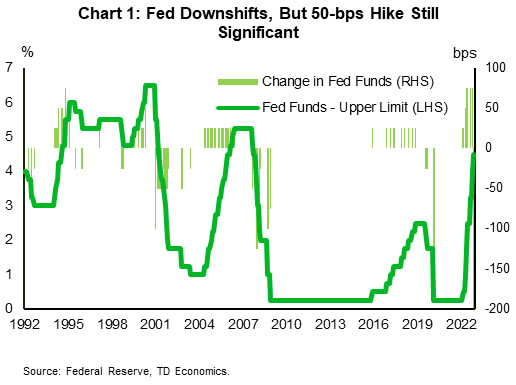
Beyond the interest rate announcement, the FOMC also released updated economic projections. Relative to the September assessment, Committee participants now expect growth to be considerably weaker in 2023 (0.5% vs 1.2%) and the unemployment rate slightly higher (4.6% vs. 4.4%). Despite the more downbeat outlook, policymakers view price pressures as having become more entrenched, and upgraded the inflation outlook through 2024. As a result, the FOMC signaled rates are likely to move at least 50-bps higher than previously expected next year – implying a terminal rate of 5.25% – with cuts not beginning until 2024.
In the press conference, Chair Powell struck a somewhat hawkish tone. When asked about the recent easing in financial market conditions, Powell stated that the Committee looks through near-term swings, but emphasized the importance of market conditions aligning to the Fed’s intentions. Moreover, Powell was quick to direct focus to the upward revision to the “dots”, reiterating that the Committee’s view on inflation remains skewed to the upside and thus future projections could still show an even higher terminal rate. Despite this deliberate signaling, market participants still believe that the Fed will begin cutting rates late next year.
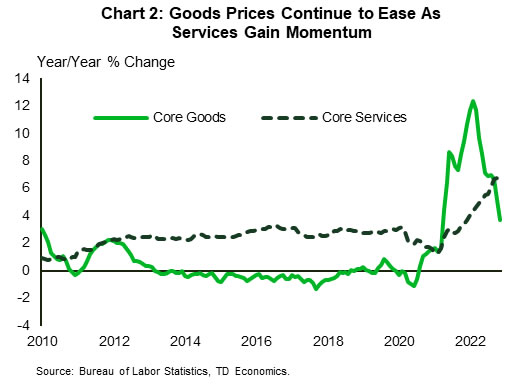
Investors current assessment might be somewhat biased by November’s CPI data, which showed a further cooling in inflationary pressures. Core inflation rose by 0.2% m/m – a tick below market expectations – bringing the 12-month change to 6.0%. Core goods prices declined for a second consecutive month, while price growth across services continued to be led by outsized gains in shelter. That said, even after removing its effects, most other service categories continue to show strength. This cuts to the heart of the issue. With goods prices appearing to have rolled over and the shelter component expected to slow in H2’2023, the move down towards 3% inflation by the end of next year is feasible. However, until we see a more meaningful slowdown in hiring activity, leading to a cooling in wage pressures, many labor-intensive service sectors will continue to run hot – preventing inflation from moving back to 2%.
Though the cumulative impact from higher rates hasn’t yet hit hiring intentions, November retail sales showed consumer momentum may be wanning. Sales fell 0.6% m/m – its biggest monthly drop in nearly a year – with notable declines in holiday categories including, electronics, clothing, and sporting goods. As we noted in our Quarterly Economic Forecast, it was unrealistic to assume the recent strength in spending would continue indefinitely. A broader demand adjustment needs to occur over the coming quarters in order to restore price stability. It would appear we are nearing the precipice of that adjustment.
Canada – Housing Drop Hits Household Wealth
It was a volatile week for financial markets, with negative sentiment south of the border pushing Canadian equities and bond yields lower. Canadian economic data didn't help sentiment either as readings on home sales and prices continued to fall (Chart 1). The national household balance sheet data showed another leg down in real estate wealth for Canadians. Though this decline was expected, it encapsulates the impact of the Bank of Canada's historic rate hiking cycle on the finances of Canadians.
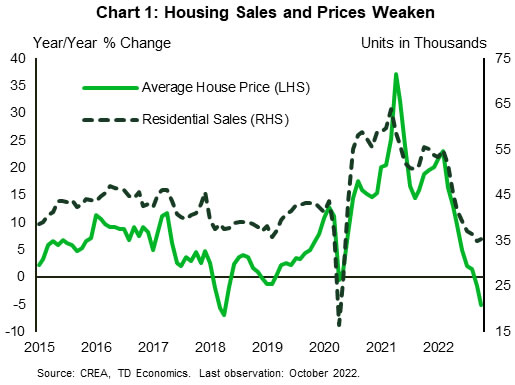
Overall activity in the resale market fell again in November, with existing home sales declining 3.3% month-on-month (m/m). At the same time, new property listings also fell 1.3% m/m. With the drop in sales once again outpacing listings, the sales-to-listings ratio is now below the 50% level which defines the midpoint of a balanced market. That is good news for buyers. However, with the month's supply of housing inventory remaining at a very low 4.2 months, supply fundamentals suggest a floor in prices may be coming sooner rather than later. This is the main reason why housing starts – which held at a solid 264.2k annualized units in November – have held up so well amidst this market adjustment.
Speaking of attracting buyers, the like-for-like MLS home price index was down over 1% on the month, putting the peak-to-trough decline at 11.5%. In terms of average house prices, the year-on-year drop now stands at 12%. With the BoC having hiked its policy rate again last week, housing activity is likely to show another decline in December, though a trough is expected to form in early 2023.
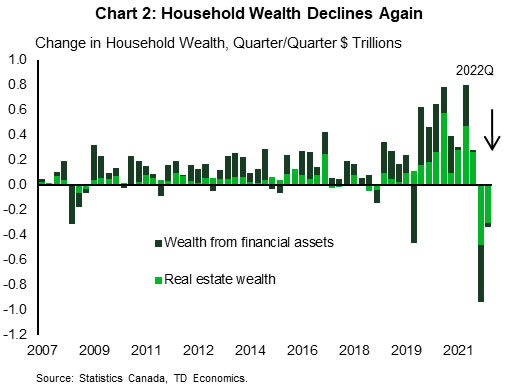
The 2022 drop in Canadian housing values is hitting household balance sheets. Canada's national balance sheet accounts for the third quarter of 2022 were released this week and showed that household wealth declined by 2.1% (Chart 2). This marks the second straight quarterly drop in wealth, bringing the total decline to 7.7% over the last six months. In dollar terms, Canadians lost approximately $1.3 trillion in wealth, with the decline in real estate values being the biggest contributor. This has and will have a far-reaching impact on the Canadian economy. When people feel less wealthy, they tend to spend less. No wonder we saw a significant pull-back in consumer spending over the summer.
We will get more insight on the Canadian consumer next week when retail sales data are released. We are expecting a temporary bounce-back in consumer spending during the holiday shopping season given the rise in employment and wages over the last two months. However, we foresee a consumer led drop in spending in the economy through 2023 (See our latest forecast). We will also be watching for CPI next week, which is expected to show a further deceleration on the back of falling gasoline prices in November - a nice reprieve for the constrained Canadian consumer.
Forward Guidance: Inflation to Cool as Economy Slows
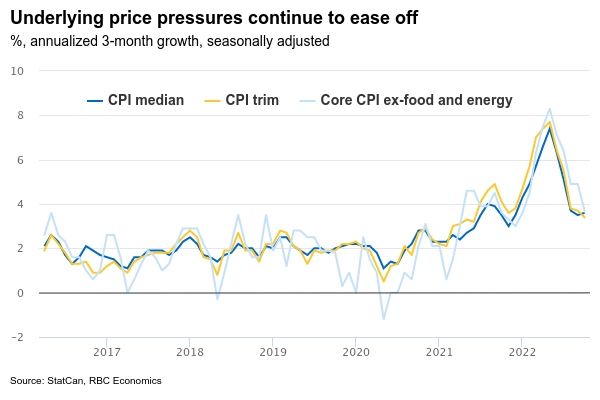
Canadian inflation is falling further from its summer peak. CPI growth likely edged down to 6.7% year-over-year. Though that’s still very high, it nevertheless marks another drop below the measure’s 8.1% peak in June. Easing global inflation pressures have been behind much of that deceleration. Gas prices declined again in November, dropping 4% from October. Food prices were likely still running 10% above year-ago levels. And ‘core’ measures of price growth, like the Bank of Canada’s preferred ‘median’ and ‘trim’ measures are still running 5% above year-ago levels. But recent month-over-month price increases have slowed significantly—an early sign that broader inflation pressures are also moderating.
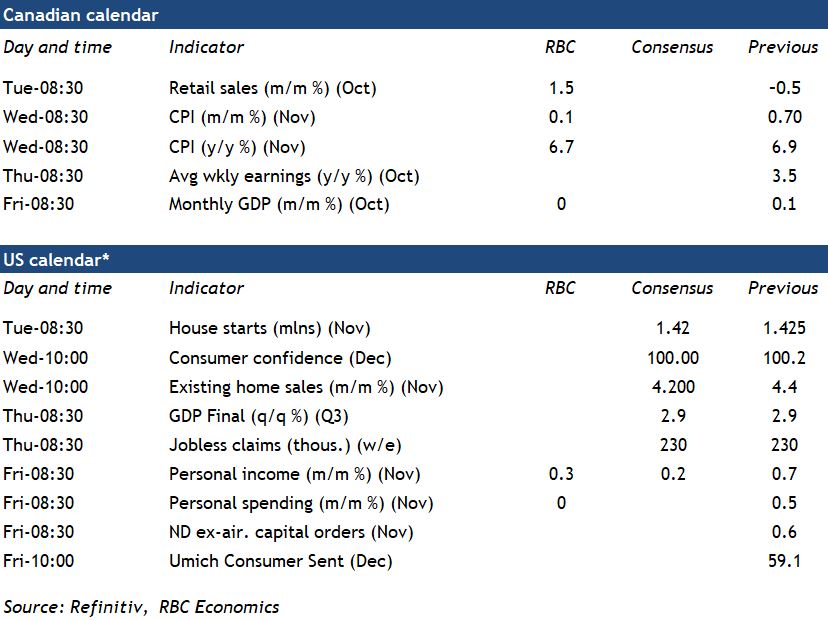
The BoC has pointed to those early signs as a reason that interest rates may not need to rise further following a 50 basis point rate hike last week. The economy is also expected to soften in coming quarters as 400 basis points of interest rate hikes in 2022 cut into household purchasing power, further easing inflation pressures. The advance estimate of October GDP was “essentially unchanged” after a small 0.1% increase in September. We expect little change in the early estimate of November output. Hours worked rose just 0.1% in November. And consumer spending is holding up well for now. Statcan’s early estimate of retail sales was up 1.5% in November and our own tracking of card transactions suggests sales early in the holiday shopping season have been strong. But the outlook for the manufacturing sector is starting to look softer and housing markets continue to retrench.
Week ahead data watch
We expect U.S. personal income to edge up 0.3% in November. Hourly wages rose 0.6% in the month, but hours worked edged lower. U.S. personal spending was likely unchanged in November, given a softening in retail sales (-0.6%). We expect ‘real’ sales (excluding price impacts) to have declined by 0.2%.
Wage growth from the SEPH data will be closely watched given the three-month rolling average hourly earnings were more than a percentage point below LFS in September.
The advance estimate from StatCan showed October retail sales grew by 1.5%. Auto sales ticked higher, and gas station sales likely ticked down on lower gasoline prices. We expect the advance estimate of November sales to remain firm. Our own tracking of card transactions suggests strong November holiday spending and another increase in unit auto sales.
Week Ahead – Bank of Japan Highlights a Data-Heavy Week
The central bank torch will pass to the Bank of Japan next week. Even though the consensus is for no policy changes, the prospects for the yen have started to improve heading into a potentially stormy year. There’s also a heavy dose of data releases from Canada and the United States.
BoJ to tighten next year?
Economic developments in Japan have been encouraging lately, raising speculation that the central bank might finally consider an exit from its decade-long stimulus program. Inflation has fired up and is currently running at 3.7%, the Tankan survey suggests business conditions are improving, and the government has unveiled a $200bn spending package to shield consumers and boost wages.
The Bank of Japan will conclude its meeting on Tuesday and despite all this economic progress, it is not expected to adjust policy. While inflation has accelerated, wage growth hasn’t picked up as much speed, so policymakers can argue that inflation dynamics are not self-sustaining yet. With the economy also contracting last quarter, it’s probably too early for any tightening moves.
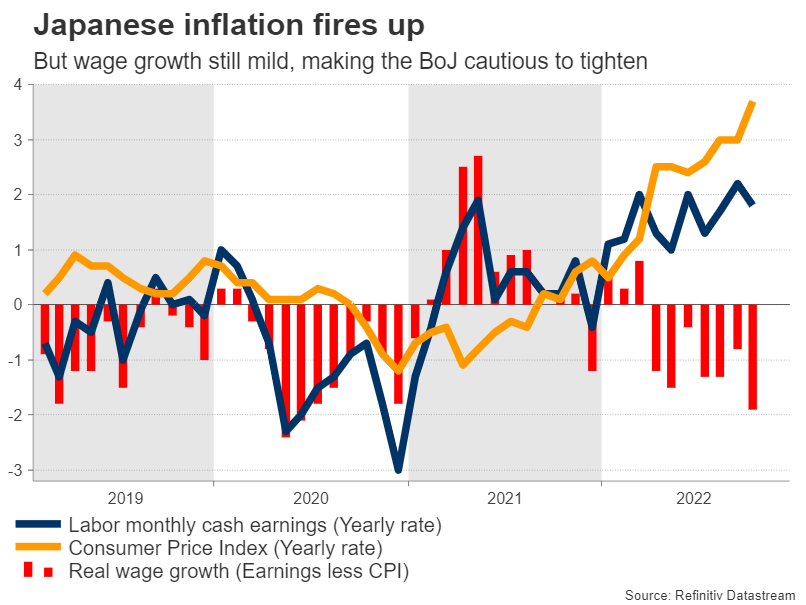
Nevertheless, it is becoming clear that policy changes are coming, possibly next year. Not only is the economic landscape improving, but Governor Kuroda also opened the door to adjusting yield curve control recently - the strategy that has decimated the yen.
By extension, the stars seem to be aligning for a comeback in the yen. Most of the elements that ravaged the currency this year - widening interest rate differentials, soaring energy prices, and a lack of tourism - have started to reverse.
Looking into next year, the BoJ might start to tighten just as foreign central banks end their own tightening cycles. With recession risks also intensifying in other major economies, rate differentials could continue to compress. Meanwhile, oil prices have declined and tourists are allowed to visit Japan again, helping to boost demand for the currency.
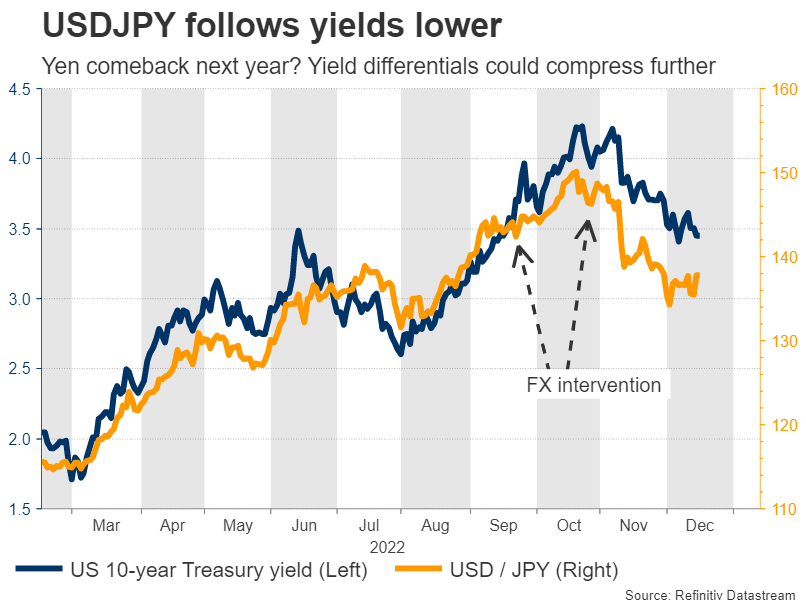
Add everything together and it’s a solid setup for the yen, which might come from behind to be the surprise winner of 2023 as the global economy tips over. One crucial variable will be who will replace Kuroda as BoJ Governor when his term expires in April. If traders get the sense it will be someone more open to raising rates, that could be the catalyst for the comeback.
Deluge of US data
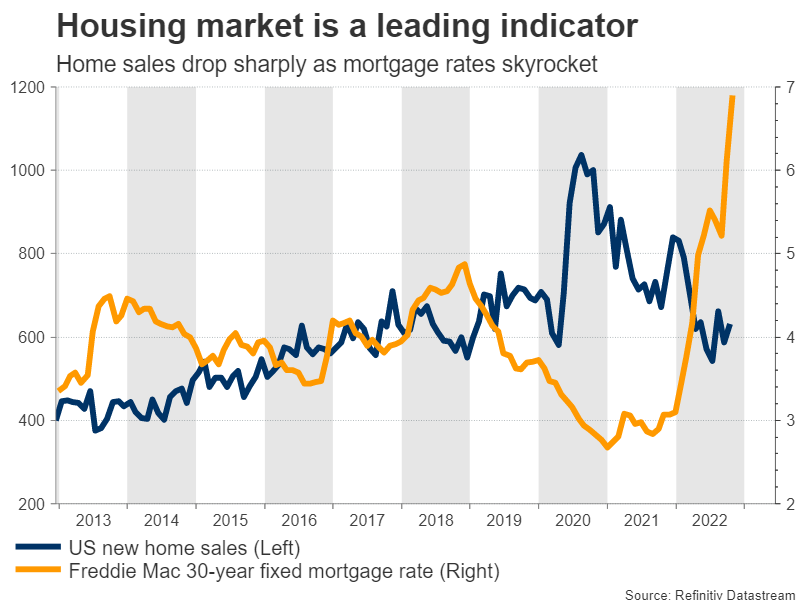
In the world’s largest economy, there’s a barrage of second-tier data releases coming up. The ball will get rolling on Tuesday with housing data for November, which has increased in importance lately as investors view the housing market as a barometer for how much interest rate increases are affecting the economy.
Consumer confidence data for December will hit the markets on Wednesday, before the week concludes with durable goods orders, personal income and spending, and the latest core PCE price index on Friday. New home sales are out on the same day.
The Federal Reserve resorted to shock tactics this week, signaling it will raise rates beyond 5% and keep them there until the end of next year. Even though this message was much more hawkish than market pricing, which currently sees rates ending next year at 4.3%, the dollar fell in the aftermath.
It seems that investors didn’t really ‘buy it’. There’s a sense that the Fed is either bluffing to tighten financial conditions or that a weakening economy next year will force policymakers to renege on their rate promises. Either way, it’s never a good sign when a currency cannot rally on positive news.
The reaction function in the dollar has turned asymmetric lately. Negative developments tend to hurt the reserve currency more than positive developments boost it, something that was on full display this week after the US inflation report and the Fed decision. This dynamic likely reflects how crowded the ‘long dollar’ trade was just a few weeks ago, but it could also be a sign that the tide is turning.
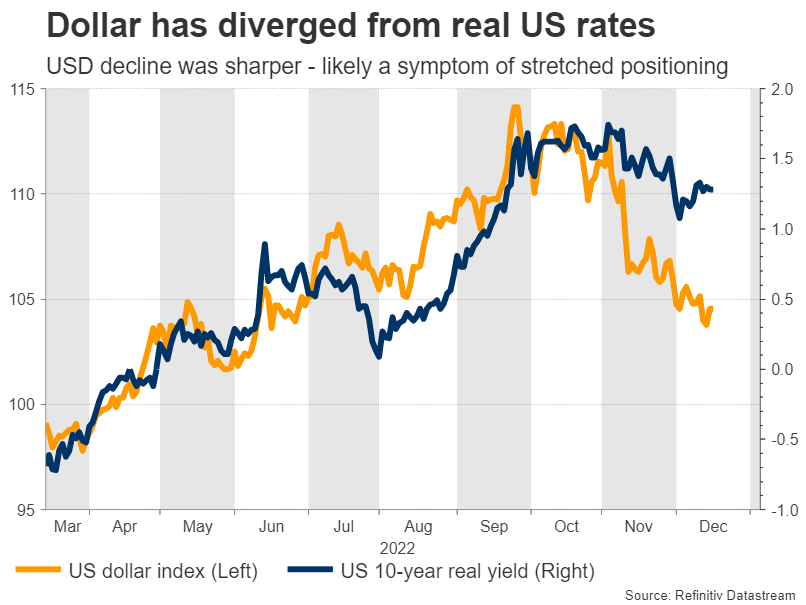
All told, the outlook for the dollar appears neutral, as it is difficult to envision either massive losses or massive gains from here. On the bearish side, US inflation is simmering down and traders clearly don’t believe the Fed will follow through on its rate plans. That said, other major economies are in even worse shape than America, so the world’s reserve currency is unlikely to enter a full-blown downtrend while Europe and China are so fragile.
Canadian data releases
Across the Canadian border, there’s another flurry of data on the menu, starting with retail sales on Tuesday. Then on Wednesday, the latest inflation report will be released, ahead of the monthly GDP print for October on Friday.
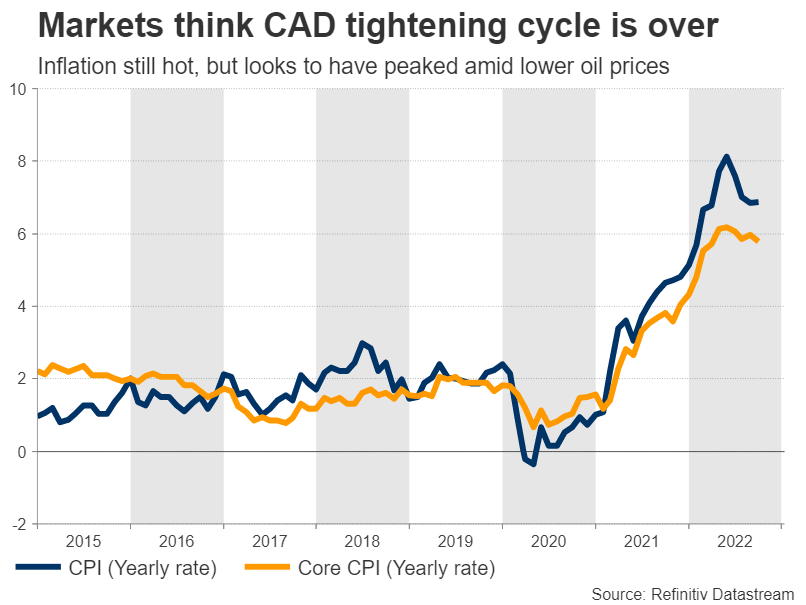
Investors will inevitably focus on the inflation prints, as those will be the most crucial for what the Bank of Canada does next. Market pricing suggests the tightening cycle is probably finished already, assigning just a 50% chance for another small rate hike next year.
As for the Canadian dollar, its fate is linked to oil prices and global risk sentiment, so it is difficult to be optimistic heading into a potentially stormy 2023 with stock market valuations still expensive and global economic momentum fading.