

Sample Category Title
EUR/GBP Daily Outlook
Daily Pivots: (S1) 0.8689; (P) 0.8730; (R1) 0.8756; More...
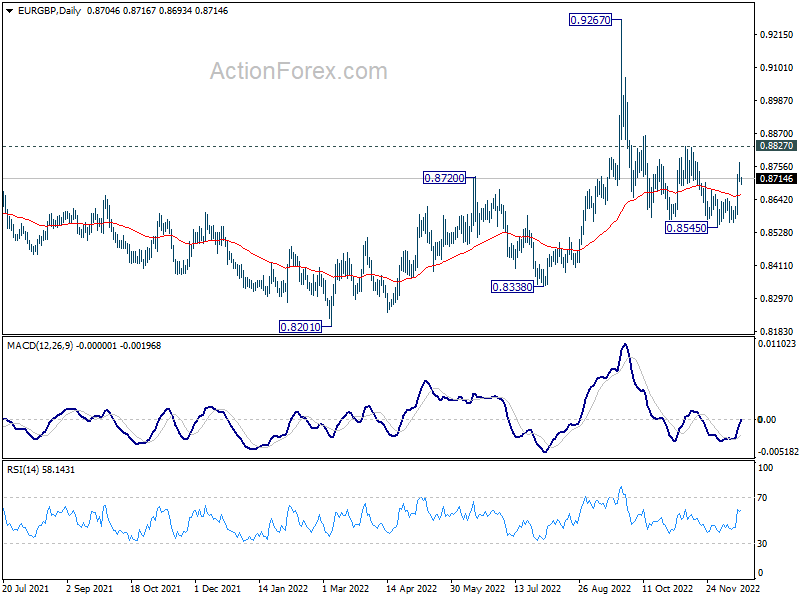
Intraday bias in EUR/GBP remains mildly on the upside. Rebound from 0.8545 would target 0.8827 resistance. Firm break there will argue that whole decline from 0.9267 has completed and turn near term outlook bullish. On the downside, break of 0.8675 minor support will turn intraday bias neutral instead, and retain near term bearishness.
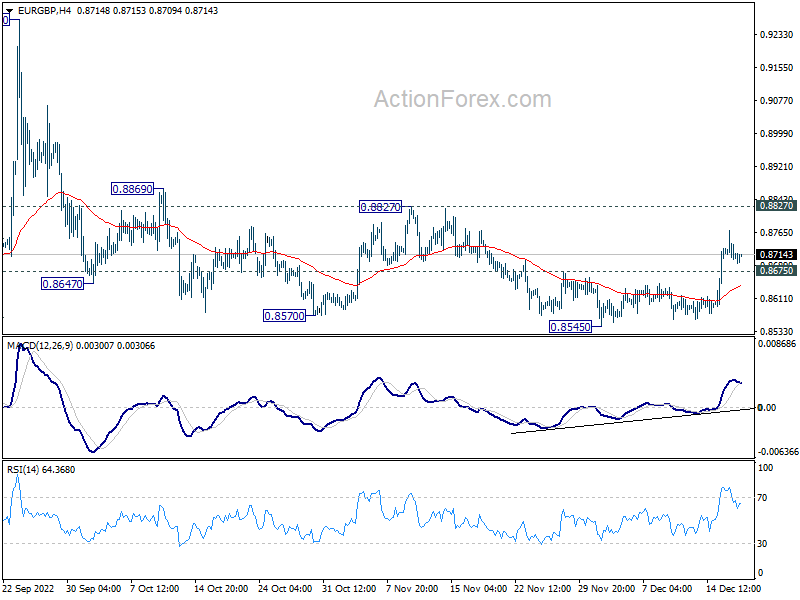
In the bigger picture, fall from 0.9267 is seen as a down leg inside long term range pattern. Deeper fall could be seen towards 0.8201/8338 support zone. But strong support should be seen there to bring reversal. Nevertheless, firm break of 0.8827 resistance will turn favor to the case that such decline is merely a correction in the up trend from 0.8201. That is, further rally would be seen at a later stage through 0.9267.
EUR/AUD Daily Outlook
Daily Pivots: (S1) 1.5798; (P) 1.5859; (R1) 1.5895; More...
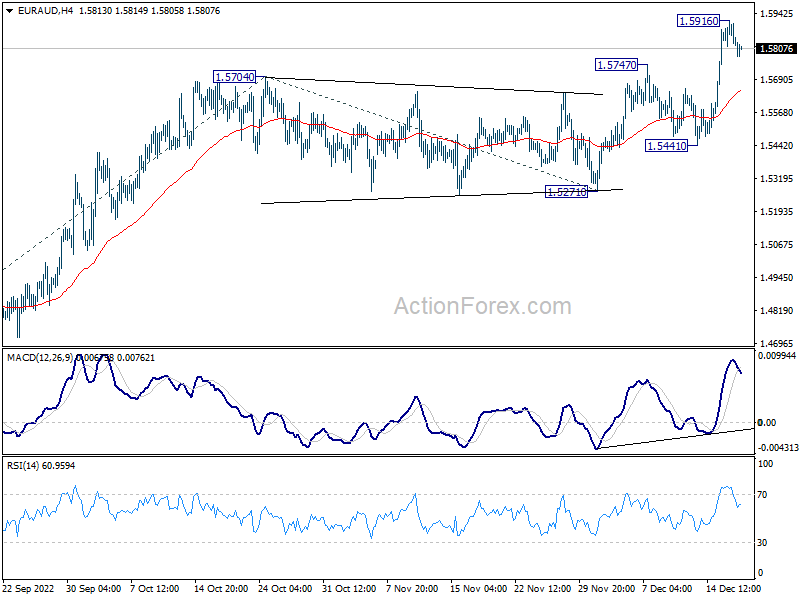
Intraday bias in EUR/AUD is turned neutral first with today's retreat. Further rise is expected as long as 1.5441 support holds. Break of 1.5916 will resume the larger rise from 1.4281 to 61.8% projection of 1.4281 to 1.5704 from 1.5271 at 1.6150.
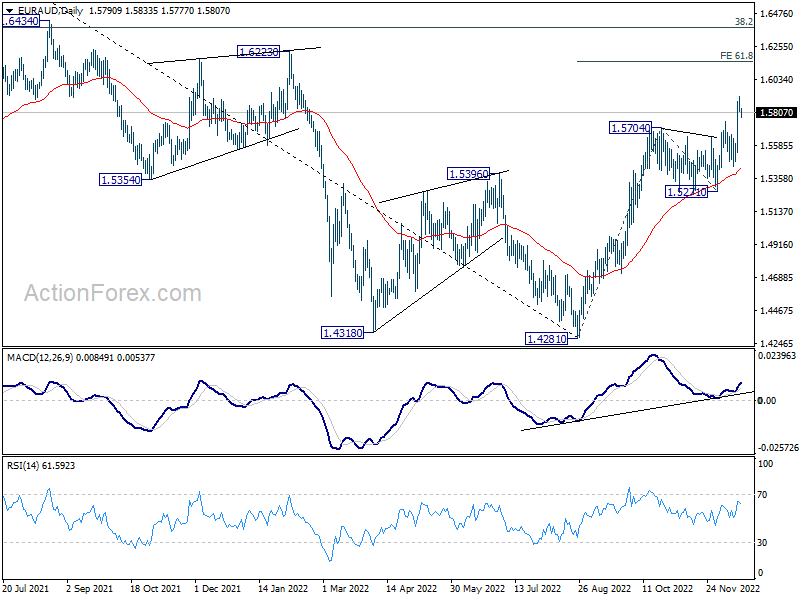
In the bigger picture, strong support from 55 day and 55 week EMA affirms underlying bullishness. As long as 1.5271 support holds, rise from 1.4281 medium term bottom is expected to continue to 1.6434 key resistance next. Decisive break there should confirm medium term bullish trend reversal.
EUR/CHF Daily Outlook
Daily Pivots: (S1) 0.9862; (P) 0.9885; (R1) 0.9913; More....
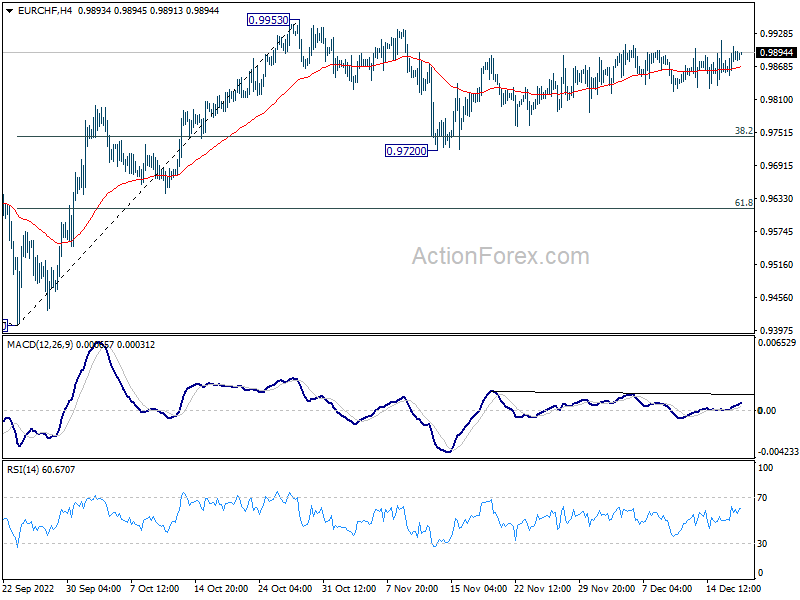
Intraday bias in EUR/CHF remains neutral as consolidation pattern from 0.9953 is extending. On the upside, firm break of 0.9953 resistance will resume larger rally from 0.9407 to 1.0072 fibonacci level. However, break of 0.9720 will extend the decline from 0.9953 to 61.8% retracement of 0.8407 to 0.9953 at 0.9616.
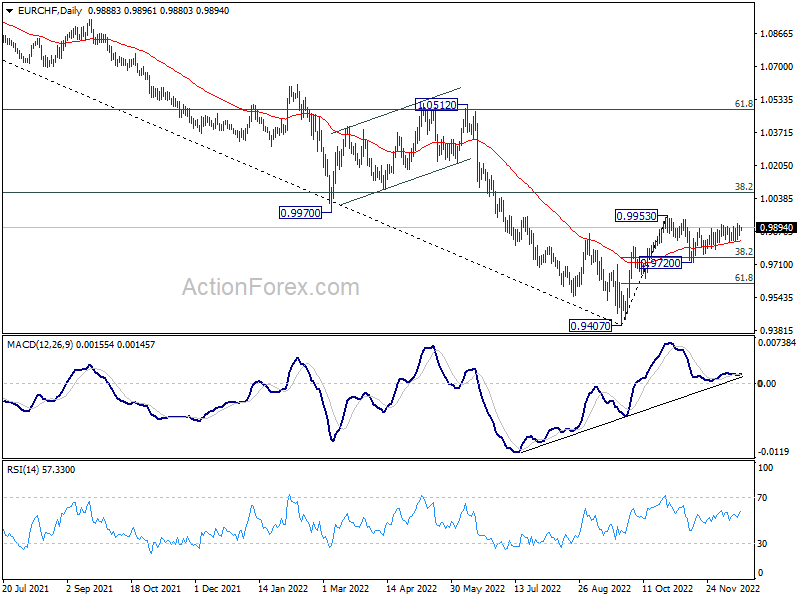
In the bigger picture, as long as 38.2% retracement of 1.1149 to 0.9407 at 1.0072 holds, price actions from 0.9407 medium term bottom will be treated as a corrective pattern. That is, long term down trend would resume through this low at a later stage. Nevertheless, firm break of 1.0072 will also have 55 week EMA (now at 1.0053) taken out. That would be an initial sign of long term bullish reversal.
EUR/JPY Daily Outlook
Daily Pivots: (S1) 144.07; (P) 145.34; (R1) 146.05; More....
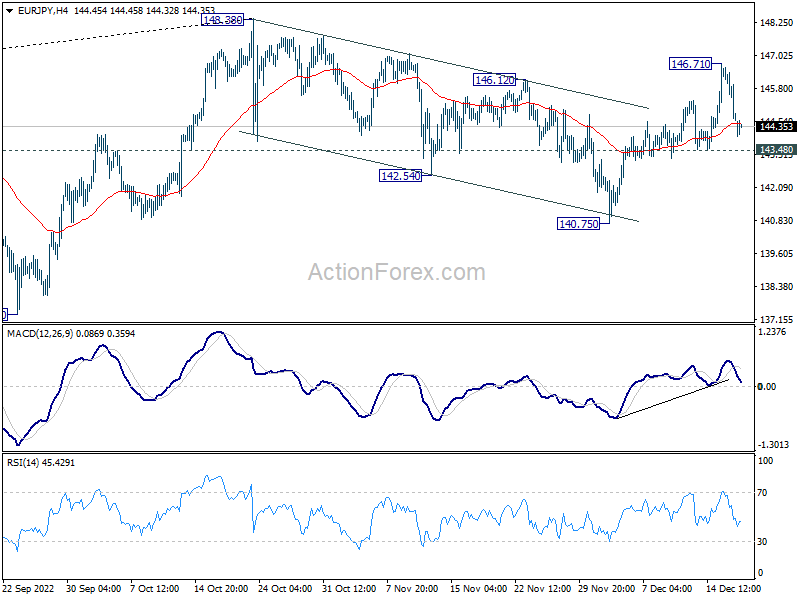
Intraday bias in EUR/JPY stays neutral for the moment. On the upside, break of 146.71 will resume the rise from 140.75 to retest 148.38 high. However, on the downside, break of 143.48 will suggest that corrective pattern from 148.38 is still extending. Bias will be back on the downside or 140.75 support, and possibly below.
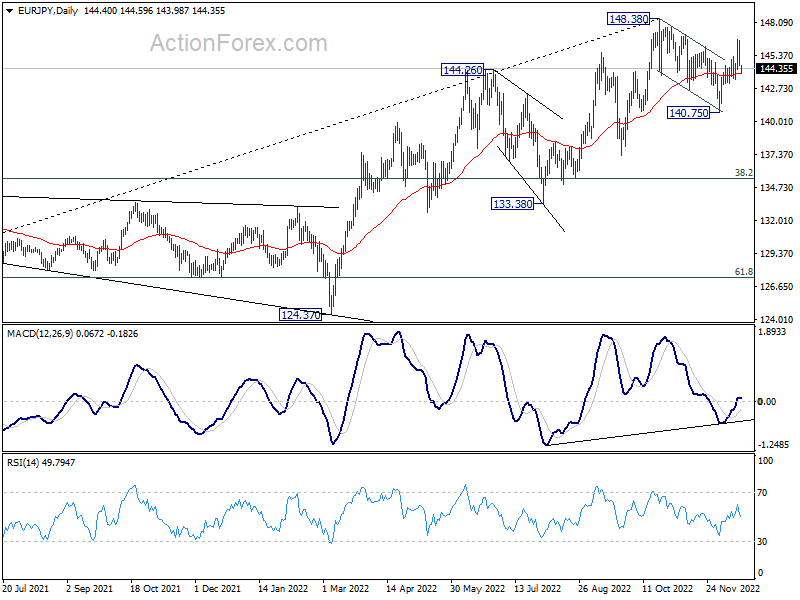
In the bigger picture, as long as 55 week EMA (now at 138.54) holds, larger up trend from 114.42 (2020 low) is still in progress for 149.76 long term resistance. However, firm break of 55 week EMA will bring deeper fall to 38.2% retracement of 114.42 to 148.38 at 135.40 before completing the correction from 148.38.
GBP/JPY Daily Outlook
Daily Pivots: (S1) 165.44; (P) 166.72; (R1) 167.44; More...
GBP/JPY falls slightly today but stays in established range. Intraday bias remains neutral for the moment. On the downside, break of 164.02 support will resume the whole fall from 172.11 through 163.02 support. Next target is 100% projection of 172.11 to 163.02 from 169.26 at 160.17. On the upside, break of 169.26 will target a retest on 172.11 high.
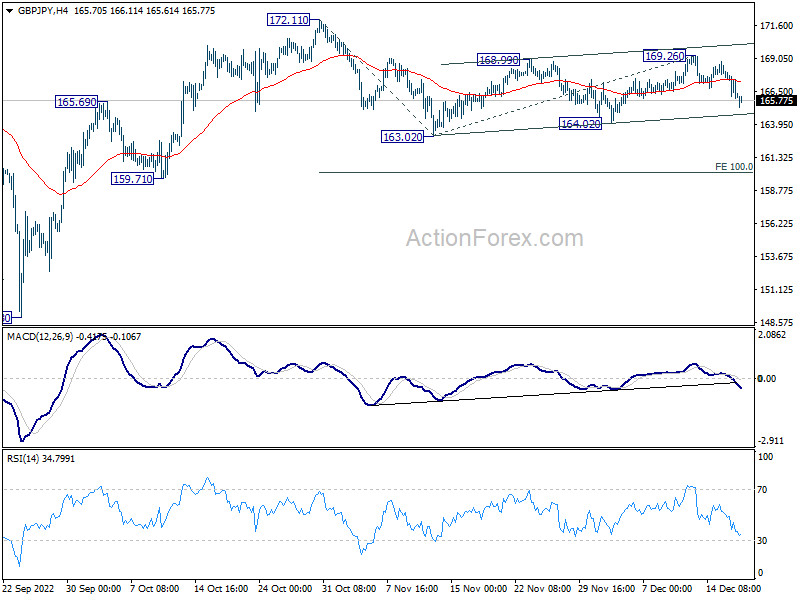
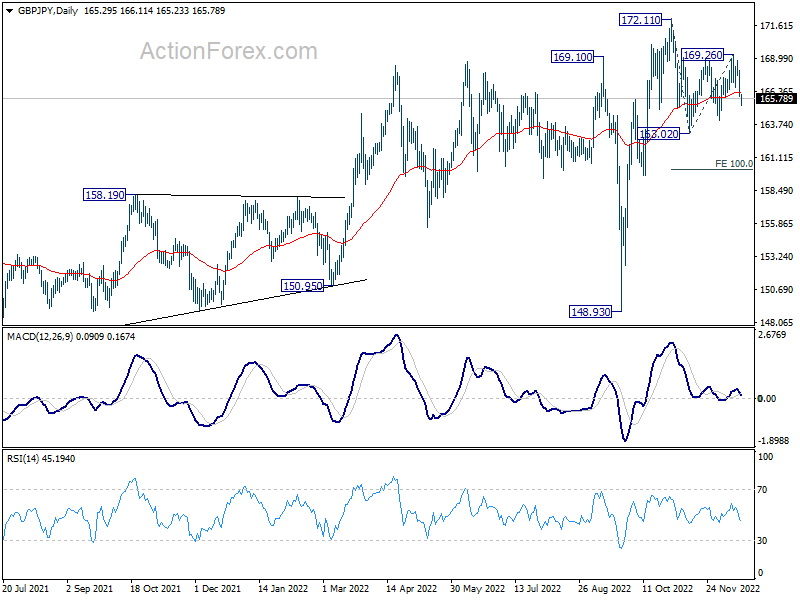
In the bigger picture, medium term upside momentum has been diminishing as seen in bearish divergence condition in weekly MACD. Sustained break of 55 week EMA (now at 161.26) will argue that it's already correcting whole up trend from 123.94 (2020 low). Nevertheless, before that, such up trend could still extend through 172.11 high.
Yen Rises on BoJ Rumor, Overall Markets Mixed
Yen rises broadly in Asian session on rumors that the Japanese government is considering to revive the joint statement with BoJ, which would loosen up the languages on the 2% inflation target, and set the stage for a policy change next year. Yet, any changes is likely only after a change in BoJ governor in April. Chief Cabinet Secretary Hirokazu Matsuno also denied the news. Anyways, Yen is currently the stronger one followed by Aussie and Sterling. Kiwi is the weaker one followed by Dollar and Euro. Overall markets mixed.
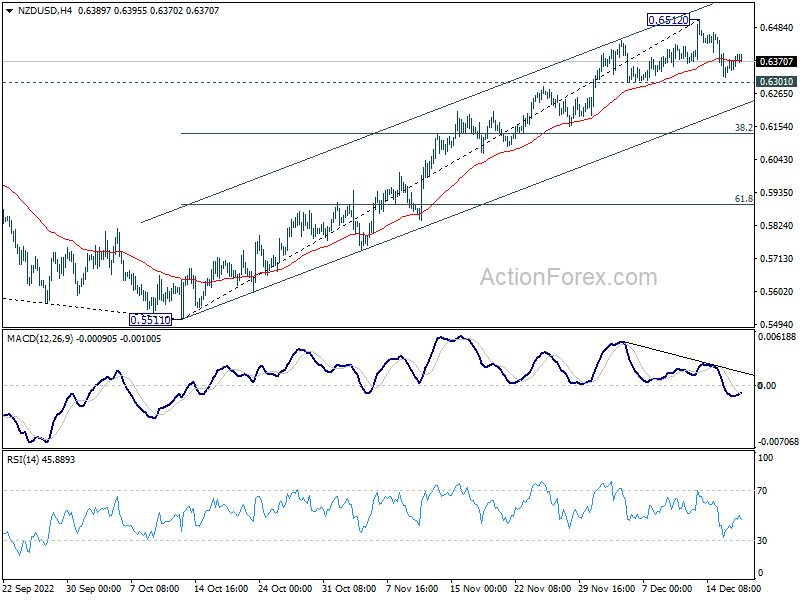
Technically, a focus of the week is whether Dollar could extend last week's rebound and solidify a sustainable rally, especially against commodity currencies. Break of 0.6301 support in NZD/USD should confirm short term topping at 0.6512, on bearish divergence condition in 4 hour MACD. Deeper fall should then be seen to 38.2% retracement of 0.5511 to 0.6512 at 0.6103.
In Asia, at the time of writing, Nikkei is down -1.11%. Hong Kong HSI is down -0.73%. China Shanghai SSE is down -1.62%. Singapore Strait Times is up 0.55%. Japan 10-year JGB yield is up 0.0046 at 0.261.
NZ BNZ performance of services dropped to 53.7
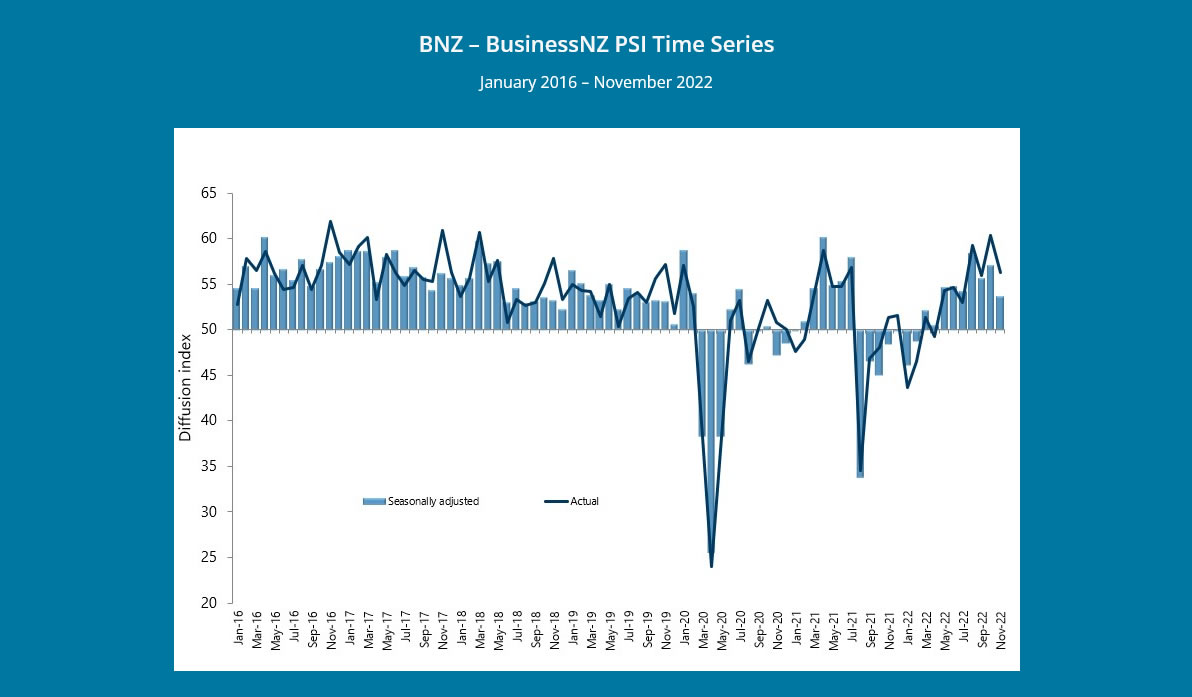
New Zealand BusinessNZ Performance of Services Index declined from 57.1 to 53.7 in November, still above long-term average of 53.6. Looking at some details, activity/sales dropped from 61.0 to 58.1. Employment tumbled from 57.1 to 51.8. New orders/business declined from 59.6 to 57.3. Stocks/inventories fell from 56.1 to 55.0. Supplier deliveries fell from 52.0 to 47.3.
BusinessNZ chief executive Kirk Hope said: "With its sister survey the PMI again showing contraction in November and economic headwinds approaching, the easing of expansion in activity is not unexpected. Also, with the Global PSI result of 48.1 at a 29-month low, it will be a tall order for the New Zealand services sector to continue the overall trends experienced during the second half of 2022".
BNZ Senior Economist Craig Ebert said that "November's PSI proved, for the third month running, to be an important counterpoint to the weakening PMI. It looks as though the services industries – just like they did in Q3 – will more than make up for any weakness in manufacturing in Q4, such that GDP for that quarter manages an expansion".
BoJ to stand pat, some more data before holidays
BoJ is widely expected to keep monetary policy unchanged this week. There were talks of a view in the policy framework some time next year, which would path the way for a policy change. The markets will listen carefully to Governor Haruhiko Kuroda for any hints on that. BoJ will also publish the minutes of last meeting. RBA minutes will also be featured.
On the data front, Germany Ifo business climate, Canada retails sales, CPI and GDP, Japan CPI, US consumer confidence, durable goods orders and PCE inflation are the highlights.
Here are some highlights for the week:
- Monday: Germany Ifo business climate; Canada IPPI and RMPI; US NAHB housing index.
- Tuesday: New Zealand ANZ business confidence; RBA minutes; BoJ rate decision; Swiss trade balance; Germany PPI; Eurozone current account; Canada retail sales; US building permits and housing starts.
- Wednesday: New Zealand trade balance; Germany Gfk consumer sentiment; UK public sector net borrowing; Canada CPI; US current account, consumer confidence, existing home sales.
- Thursday: UK current account, Q3 GDP final; US jobless claims, Q3 GDP final.
- Friday: Japan CPI, BoJ minutes; Canada GDP; US durable goods orders, personal income and spending, new home sales.
GBP/JPY Daily Outlook
Daily Pivots: (S1) 165.44; (P) 166.72; (R1) 167.44; More...
GBP/JPY falls slightly today but stays in established range. Intraday bias remains neutral for the moment. On the downside, break of 164.02 support will resume the whole fall from 172.11 through 163.02 support. Next target is 100% projection of 172.11 to 163.02 from 169.26 at 160.17. On the upside, break of 169.26 will target a retest on 172.11 high.
In the bigger picture, medium term upside momentum has been diminishing as seen in bearish divergence condition in weekly MACD. Sustained break of 55 week EMA (now at 161.26) will argue that it's already correcting whole up trend from 123.94 (2020 low). Nevertheless, before that, such up trend could still extend through 172.11 high.
Economic Indicators Update
| GMT | Ccy | Events | Actual | Forecast | Previous | Revised |
|---|---|---|---|---|---|---|
| 20:00 | NZD | Westpac Consumer Survey Q4 | 75.6 | 87.6 | ||
| 21:30 | NZD | Business NZ PSI Nov | 53.7 | 57.4 | ||
| 09:00 | EUR | Germany Ifo Business Climate Dec | 87.2 | 86.3 | ||
| 09:00 | EUR | Germany Ifo Current Assessment Dec | 93.5 | 93.1 | ||
| 09:00 | EUR | Germany Ifo Expectations Dec | 82 | 80 | ||
| 13:30 | CAD | Industrial Product Price M/M Nov | 2.20% | 2.40% | ||
| 13:30 | CAD | Raw Material Price Index Nov | 3.20% | 1.30% | ||
| 15:00 | USD | NAHB Housing Market Index Dec | 34 | 33 |
NZ BNZ performance of services dropped to 53.7
New Zealand BusinessNZ Performance of Services Index declined from 57.1 to 53.7 in November, still above long-term average of 53.6. Looking at some details, activity/sales dropped from 61.0 to 58.1. Employment tumbled from 57.1 to 51.8. New orders/business declined from 59.6 to 57.3. Stocks/inventories fell from 56.1 to 55.0. Supplier deliveries fell from 52.0 to 47.3.
BusinessNZ chief executive Kirk Hope said: "With its sister survey the PMI again showing contraction in November and economic headwinds approaching, the easing of expansion in activity is not unexpected. Also, with the Global PSI result of 48.1 at a 29-month low, it will be a tall order for the New Zealand services sector to continue the overall trends experienced during the second half of 2022".
BNZ Senior Economist Craig Ebert said that "November's PSI proved, for the third month running, to be an important counterpoint to the weakening PMI. It looks as though the services industries – just like they did in Q3 – will more than make up for any weakness in manufacturing in Q4, such that GDP for that quarter manages an expansion".
EUR/USD Corrects Lower, Here Are Important Levels To Watch
Key Highlights
- EUR/USD started a downside correction from the 1.0740 resistance zone.
- The key support is seen near the 1.0500 zone on the 4-hours chart.
- GBP/USD dipped sharply after tagging the 1.2450 resistance zone.
- The German IFO Business Climate Index could increase from 86.3 to 87.2 in Dec 2022.
EUR/USD Technical Analysis
The Euro gained pace above the 1.0620 resistance zone against the US Dollar. EUR/USD even climbed above the 1.0700 level before it faced sellers.
Looking at the 4-hours chart, the pair settled well above the 100 simple moving average (red, 4-hours) and the 200 simple moving average (green, 4-hours). It traded as high as 1.0736 before there was a downside correction.
The bears were able to push the pair below the 1.0650 support zone. There was a clear move below the 38.2% Fib retracement level of the upward move from the 1.0443 swing low to 1.0736 high.
On the downside, the first major support is near the 1.0550 level. It is near the 61.8% Fib retracement level of the upward move from the 1.0443 swing low to 1.0736 high. The next major support is near the 1.0500 zone and the 100 simple moving average (red, 4-hours).
If there is a downside break below the 100 simple moving average (red, 4-hours), the pair could decline towards the 1.0440 support zone in the coming days.
On the upside, an initial resistance is near the 1.0665 level. The next major resistance may perhaps be near 1.0695. A clear move above the 1.0695 resistance might start a steady increase.
In the stated case, EUR/USD may perhaps rise towards the 1.0740 level. Any more gains could lead the pair towards the 1.0800 resistance zone.
Looking at GBP/USD, the pair extended its increase above the 1.2400 resistance before the bears appeared and there was a sharp downside reaction.
Economic Releases
- German IFO Business Climate Index for Dec 2022 – Forecast 87.2, versus 86.3 previous.
- German IFO Current Assessment Index for Dec 2022 - Forecast 93.5, versus 93.1 previous.
- German IFO Expectations Index for Dec 2022 – Forecast 82, versus 80 previous.
Forex and Cryptocurrencies Forecast
EUR/USD: The Fed Doesn't Want to be Dovish. The ECB Either.
The past week can be divided into two parts: before and after the FOMC (Federal Open Market Committee) meeting of the US Federal Reserve. The US inflation data produced a bombshell effect on the eve of this event, on Tuesday, December 13. The Consumer Price Index (CPI), with the forecast at 7.3%, fell in November from 7.7% to 7.1% (y/y), reaching its lowest level in almost a year, while core inflation fell from 6.3% to 6.0%. As a result, the market decided that since things were going so well, it was time for the Fed to turn from hawk to dove. Or at least ease their monetary policy significantly. Based on these expectations, the 10-year Treasury bond yield fell from 3.60% to 3.43%, and the DXY Dollar Index peaked and fell to its lowest levels over the past six months, from 105.07 to 103.60 points. Accordingly, stock indices (S&P500, Dow Jones, Nasdaq) flew up, and EUR/USD jumped to 1.0672.
The feast of risk appetites and the glee of opponents of the dollar did not last long. The FOMC raised its key interest rate by 50 basis points (bp) to 4.5% at its meeting. That is, exactly as market participants expected. Surprises were expected at the subsequent press conference, which showed that the US Central Bank is still hawkish. Fed chief Jerome Powell noted that the regulator will keep rates at their peak until they are sure that the decline in inflation has become a sustainable trend. The base rate could be raised to 5.1% in 2023 and remain so high until 2024. (Recall that 4.6% was mentioned as the peak rate in the September statement). According to Jerome Powell, the Fed understands that this will trigger a recession, but is willing to pay that price to control inflation. The situation turned around 180 degrees after such statements: DXY went up, stock indices flew down, and EUR/USD fell by more than 140 points.
The last meeting of the European Central Bank this year was also held last week, on Thursday, December 15. The ECB, as well as the Fed, raised the interest rate by 50 bp: up to 2.5%, which fully met the forecasts. ECB President Christine Lagarde, as well as her overseas counterpart, showed a hawkish attitude at the press conference and made it clear that quantitative tightening (QT) in the Eurozone will not end there: the euro interest rate will face several more increases in 2023. The ECB also plans to start reducing its balance sheet from March. At the moment, the gap between the dollar and euro rates is 200 bp (4.5% and 2.5%, respectively). The swap market expects that the European regulator may raise its rate by another 100 bp in the coming year, which will provide some support for EUR/USD. Read our upcoming reviews to find out what forecasts leading financial institutions give regarding its quotes.
The data on business activity in the manufacturing sectors of Germany and the Eurozone (PMI), as well as the November value of the European Consumer Price Index (CPI) were published at the very end of the last week, on Friday, December 16. Data on consumer inflation did not have a significant impact on market sentiment: on the one hand, CPI in annual terms fell from 10.6% to 10.1%, and on the other hand, it turned out to be higher than the forecast of 10.0%. After the release of these macro statistics, the pair placed the last chord at 1.0590.
40% of analysts expect the euro to strengthen in the coming days and EUR/USD to grow, 50% expect Santa Claus to help the US currency. The remaining 10% of experts do not expect either the first or the second from the pair. The picture is different among the oscillators on D1. As for the oscillators, 75% are colored green, 10% are set to neutral gray and 15% stand out against this background with a bright red color. Trend indicators also have an advantage on the green side, these are 80%, and 20% are on the red side. The nearest support for EUR/USD is at the 1.0560 horizon, followed by levels and zones at 1.0500, 1.0440, 1.0375-1.0400, 1.0280-1.0315, 1.0220-1.0255, 1.0130, 1.0070, followed by the parity zone 0.9950-1.0010. Bulls will meet resistance at levels 1.0620, 1.0675-1.0700, 1.0740-1.0775, 1.0865, 1.0935.
Next week's calendar includes Thursday December 22 for the release of 3Q US GDP data, and Friday December 23 for the release of orders for capital goods and durables, as well as the core US Personal Consumption Expenditure Index. .
Attention! Christmas and New Year holidays fall on weekends this year; however, we strongly advise you read the trading schedule for this period, it is published on the NordFX website in the Company News section.
GBP/USD: The Market No Longer Trusts the Bank of England
Even more disappointment than EUR/USD awaited the bulls on the British pound. Having reached a six-month high of 1.2450 on December 14, GBP/USD then fell to 1.2119 and ended the weekly session at 1.2160.
There were quite a lot of statistics on the economy of the United Kingdom Last week, and they looked diverse: sometimes green, sometimes red. The country's GDP grew by 0.5% and was higher than the forecast of 0.4%. The manufacturing sector also rose to 0.7% after the zero dynamics in September. Such an important indicator of inflation as CPI was 10.7% in November (it was at the highest level since November 1981 - 11.1% a month ago). But retail sales fell to 0.4% in November against 0.9% in October. The unemployment rate rose from 3.6% to 3.7%. The business activity index (PMI) in the manufacturing sector of the UK fell to 44.7 in December against 46.5 in November. And in the services sector, on the contrary, it rose to 50.0 compared to the November value of 48.8 and the forecast of 48.5.
It seems that such multi-vector statistics have greatly confused market participants, and they focused not on the pound, but on the US dollar. Although the Bank of England (BoE) also issued its verdict on the interest rate last week. Like the Fed and the ECB, the regulator raised it by 50 bp up to 3.5% per annum (14-year maximum). However, BoE's statements turned out to be more dovish than those of their colleagues. According to the regulator, inflation may have already reached its peak. And two out of nine members of the Monetary Policy Committee considered that interest rates are already high enough and it is time to ease price pressures.
Prior to this meeting, quotes expected a maximum rate increase of up to 4.6%. After the meeting, the swap market lowered its forecast to 4.5% by August (that is, a total increase of another 100 bp). As for the survey of market participants conducted recently by the Bank of England, the median expectations are even lower here: only 4.25% with a peak in March 2023.
These forecasts put strong pressure on the British currency. Therefore, according to Commerzbank economists, the pound does not have much potential for recovery. "After the Bank of England hesitated for several months, the market now believes that it is the least trustworthy thing to suddenly become a mega hawk," they write. "So, the pound has no chance against either the euro or the dollar."
As for the short term, the median forecast for GBP/USD looks quite neutral here: 45% of experts side with the bulls, the same number side with the bears, and the remaining 10% prefer to decline to comment.
The readings of the indicators on D1 look mixed as well. Among the oscillators, 30% are colored green, 25% are red and 45% are neutral gray. Trend indicators have a ratio of 65% to 35% in favor of the green ones. Support levels and zones for the pair are 1.2085-1.2115, 1.2030, 1.1940, 1.1900, 1.1800-1.1840, 1.1700-1.1720. When the pair moves north, the pair will face resistance at the levels of 1.2200-1.2225, 1.2270, 1.2330-1.2345, 1.2425-1.2450 and 1.2575-1.2610, 1.2700 and 1.2750.
Among the events related to the United Kingdom economy this week, we can highlight Thursday, December 22, when we will find out what happened to the country's GDP in Q3 2022. We also pay attention to the early closing of trading in the UK on Friday, December 23, which, of course, is associated with the upcoming Christmas.
USD/JPY: What to Expect from the Bank of Japan
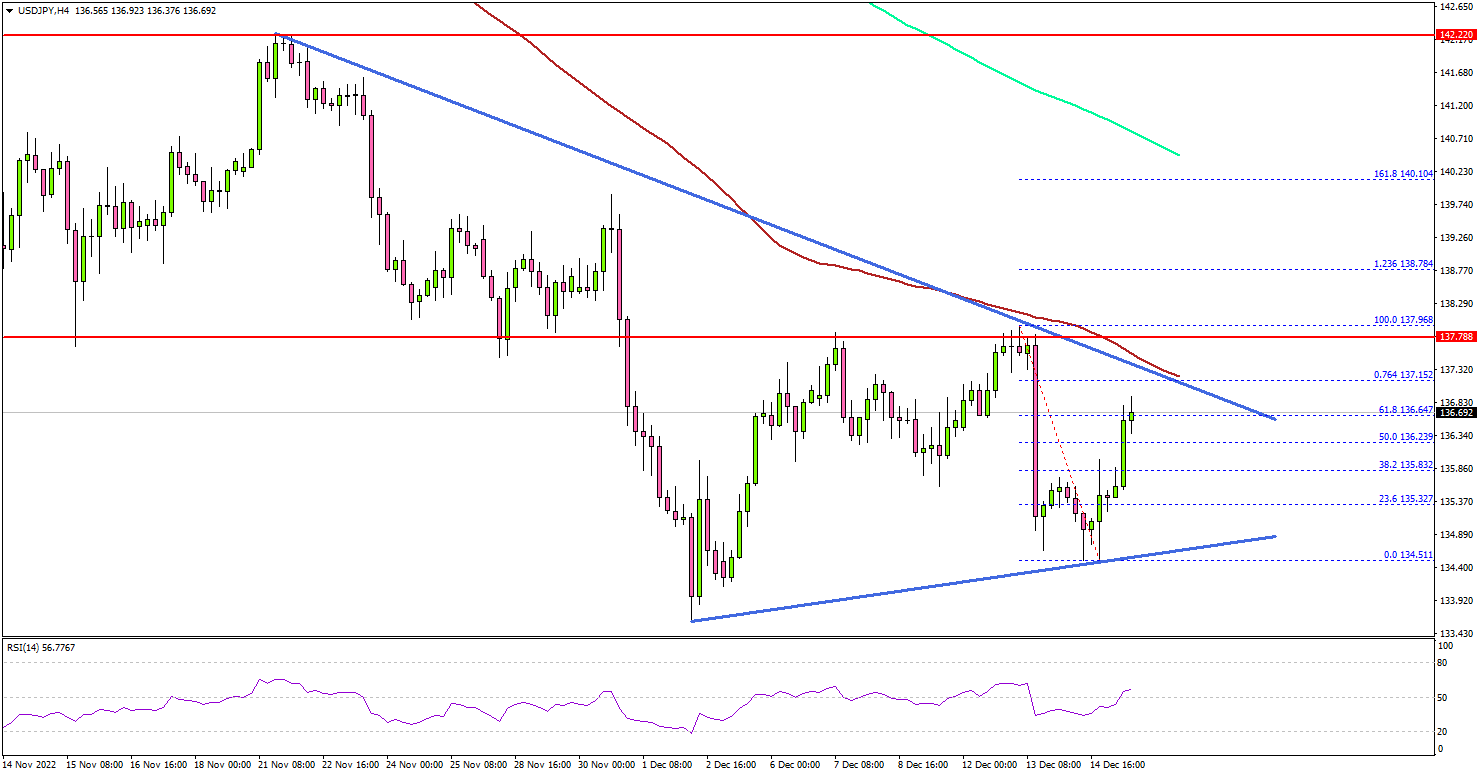
Like previous pairs, USD/JPY reacted to both US inflation data and statements by the Fed Chairman. But, unlike EUR/USD and GBP/USD, this pair has not gone beyond the side corridor for the last two weeks. Its boundaries can be designated as 134.25-137.85, and timid attempts to break through in one direction or another can be ignored. This balance is most likely due to the fact that both the dollar and the yen are safe-haven currencies. Of course, the global advantage, thanks to the difference in interest rates, is on the side of the dollar. But, having carried out a number of foreign exchange interventions, the Bank of Japan (BoJ) has managed in recent months not only to stop the advance of the American currency, but also to significantly push it back.
As we have already mentioned, the future of the pair will continue to depend on the difference in interest rates between the US and Japan. If the Fed remains at least moderately hawkish and the BOJ remains ultra-dovish, the dollar will continue to dominate the yen. The threat of new foreign exchange intervention by the Ministry of Finance of Japan, the same as it was on November 10, seems unlikely at current levels. Raising the key rate could help, but it is very likely that the Bank of Japan (BoJ) will leave it unchanged at its meeting on December 20: at the negative level of -0.1%. A radical change in monetary policy can be expected only after April 8 next year. It is on this day that Haruhiko Kuroda, the head of the Bank of Japan, will end his term, and he may be replaced by a new candidate with a tougher position. Although this is not a fact.
Another hope is for renewed concerns about China's economic prospects. By the way, the People's Bank of China will also make its decision on the interest rate on the yuan on Tuesday, December 20.
USD/JPY finished at 136.70 on Friday, December 16. Analysts' forecast for the near future is exactly the same as the forecast for GBP/USD: 45%/45%/10%. For oscillators on D1, the picture looks like this: 25% look south, 40% look north, and 35% look east. Among the trend indicators, the ratio is 60% versus 40% in favor of the red ones. The nearest support level is located at 136.00 zone, followed by levels and zones 134.40, 133.60, 131.25-131.70, 129.60-130.00, 128.10-128.25, 126.35 and 125.00. Levels and resistance zones are 137.50-137.70, 138.00-138.30, 139.00, 139.50-139.75, 140.60, 142.25, 143.75. The goal of the bulls to renew the October 21, 2022 high, and to gain a foothold above the height of 152.00 seems realistic only in a very distant future.
In addition to the mentioned interest rate decision by the Bank of Japan, the calendar also includes Friday, December 23, when the Report from the BoJ Monetary Policy Committee meeting will be published. Market participants will try to catch at least small hints of changes in this policy. However, the chances of this happening are close to zero.
CRYPTOCURRENCIES: Santa Claus Is the Only Hope
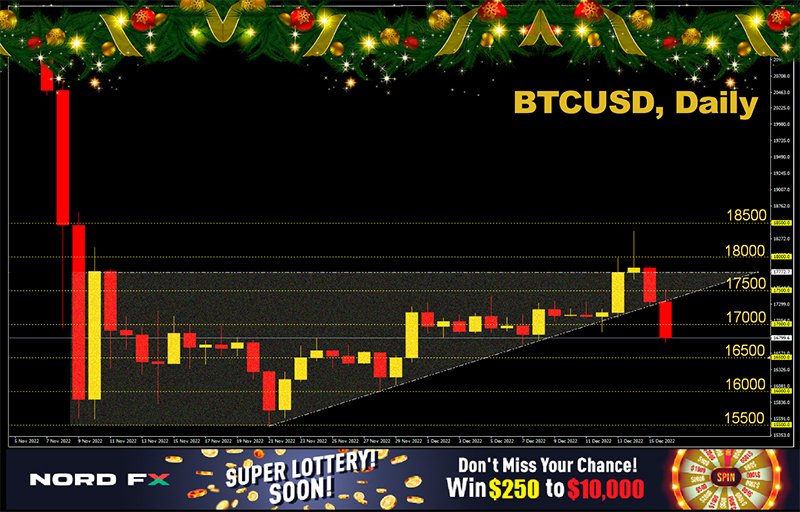
The results of the Fed meeting seem to have greatly tempered investors' risk appetites. If stock indices (S&P500, Dow Jones, Nasdaq) were growing throughout the first half of the week, and after the publication of inflation data in the US, they just soared up, dragging crypto asset prices, they all went into the red after the Fed meeting, on Wednesday evening, November 14. Amid fears of a global recession, the decline continued on Thursday and Friday. The local maximum for BTC/USD was fixed at $18.381, but it met the end of the working week much lower, in the $16.830 zone.
The general situation in the crypto industry does not help the growth of prices either. Recall that, in addition to the bankruptcy of FTX in November, it has experienced a number of major shocks this year. First of all, this is the collapse of the Terra ecosystem in May. Compute North, Voyager Digital, Celsius Network, Three Arrows Capital, and Blockfi also filed for bankruptcy. According to some estimates, approximately several million customers lost billions of dollars as a result of all these events.
The events of recent days are not encouraging either. Sam Bankman-Fried, founder of crypto exchange FTX, has been arrested in the Bahamas after U.S. Attorney's Office filed eight felony charges against him. According to the representative of the prosecutor's office, Bankman-Fried faces up to 115 years in prison in the aggregate of all criminal cases. Market participants were also alarmed by the strange, to put it mildly, financial report by FTX's main competitor, the Binance exchange. It contained only three indicators, which caused bewilderment and criticism from representatives of the accounting community.
There is very little time left until the end of this year, and it is only Santa Claus Rally, a phenomenon when stock indices suddenly begin to go up at the very end of December, that can help the growth of bitcoin and the crypto market as a whole. This Rally usually starts on the last Monday of the month and lasts for seven trading days. However, sometimes Santa Claus decides to help not risky assets at all, but the dollar. And then, instead of the North Pole, they head south. (You can read more about Santa Claus Rally on NordFX's Useful Articles section).
Some experts hope that bitcoin will still be able to gain a foothold above the $18,000 area in the coming days. Then, in their opinion, it will most likely reach an extreme of $20,000 by the end of the year.
In such a situation, the price of the flagship cryptocurrency will again be on a growth parabola, according to a well-known analyst under the nickname Plan B. According to their latest forecast, BTC could reach $100,000 in 2023. Jim Wyckoff, Senior Analyst at Kitco News, also believes BTC is close to developing a sustained bullish rally in the current environment as strong buyers have stepped in.
Arthur Hayes, the former CEO of BitMEX, expressed a similar point of view, although his arguments differ from those of Jim Wyckoff. Hayes believes that the first cryptocurrency has reached the low of the current cycle, as almost all "irresponsible organizations" have run out of coins to sell. He explained that when facing financial difficulties, centralized credit companies often borrow first and then sell off their BTC holdings, followed by a collapse. "When you look at the balance of any of these 'heroes', you won't see bitcoin there. They sold it before they went bankrupt." That is why, according to Hayes, the fall in the quotes of the first cryptocurrency precedes such bankruptcies. At the same time, the expert believes that the period of large-scale liquidations is over.
ARK Invest CEO Catherine Wood also spoke negatively about centralized companies and positively about DeFi. In her opinion, DeFi will be further developed, as investors have learned how important fully transparent decentralized networks are thanks to the crisis. "When centralized crypto companies went bankrupt, investors who invested in transparent distributed networks saw what was happening. They were able to withdraw their assets on time. Even those who used a large margin leverage were able to survive," said Catherine Wood. And she added that Sam Bankman-Fried has always disliked bitcoin because it is transparent and decentralized, and he could not control it, including during the crisis provoked by opaque centralized players.
According to former BitMEX CEO Arthur Hayes, the digital asset market expects a partial recovery in 2023 amid another launch of the US Federal Reserve's printing press. Mike McGlone, senior strategist at Bloomberg Intelligence, also expects new flows of cash liquidity from the Central Bank, he called next year the bitcoin market and a time of shine after a year and a half of direct downward trends. However, at the same time, the analyst added that if the easing of monetary policy does not happen, the world may plunge even deeper into a recession with negative consequences for all risky assets.
Max Keiser, a former trader and now TV host and filmmaker, also believes that BTC will certainly catch up in 2023 and may stage an epic rally before the 2024 halving. In his opinion, the growth of the flagship cryptocurrency will continue over the next decade. And, as Cathie Wood stated, it will reach a price of $1 million per coin by 2030.
In the meantime, at the time of writing this review (Friday evening, December 16), ETH/USD is trading around $1,200, while BTC/USD is trading at $16,830. The total capitalization of the crypto market for the week decreased by almost 4.0% and amounted to $0.818 trillion ($0.852 trillion a week ago). The Crypto Fear & Greed Index has grown by only 3 points in seven days, from 26 to 29, and still remains in the Fear zone.