Sample Category Title
Gold Wave Analysis
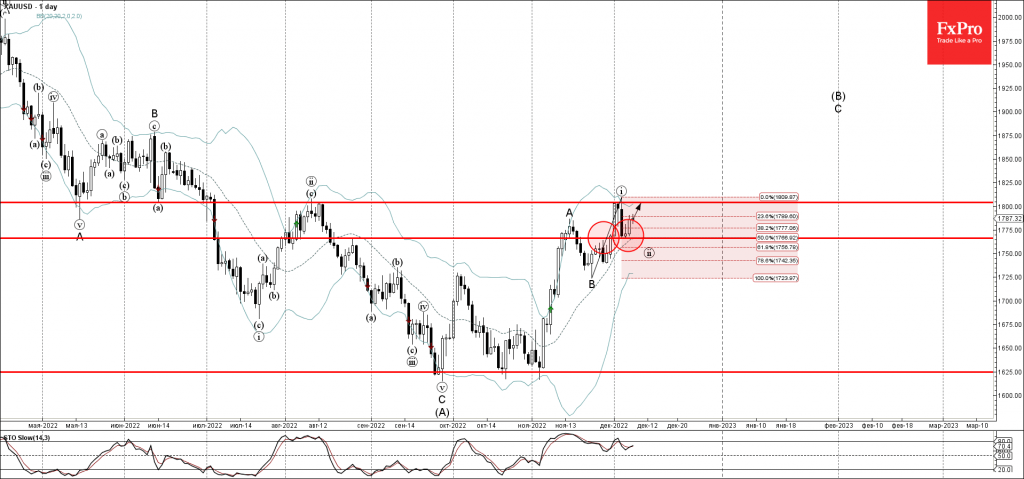
- Gold reversed from support level 1765.00
- Likely to rise to resistance level 1805.00
Gold earlier reversed up from the support level 1765.00 (former minor resistance from the end of November).
The support level 1765.00 was further strengthened by the nearby 50% Fibonacci correction of the upward impulse wave (i) from the end of last month.
Given the improving sentiment across the precious metal markets, Gold can be expected to rise further toward the next resistance level 1805.00 (former top of waves (ii) and (i)).
EURAUD Wave Analysis
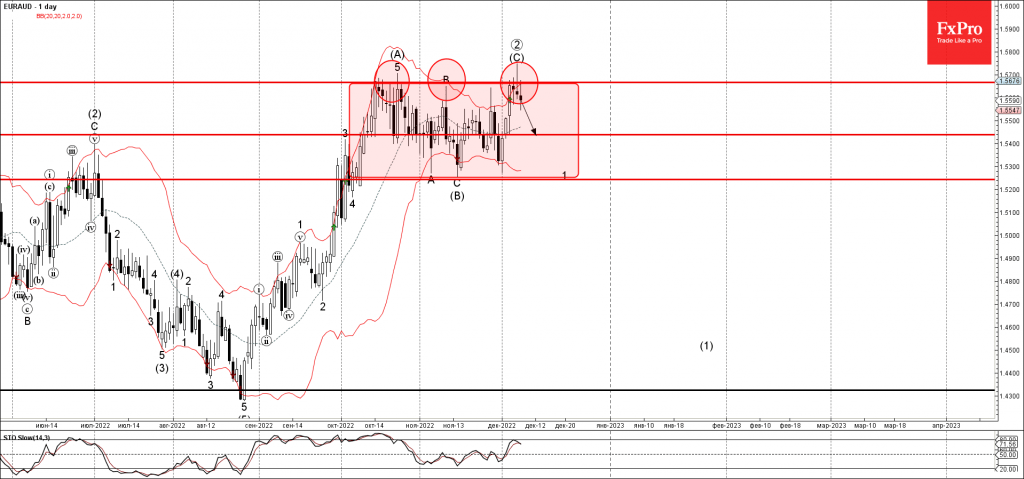
- EURAUD reversed from resistance level 1.5665
- Likely to fall to support level 1.5440
EURAUD recently reversed down from the key resistance level 1.5665 (which is the top border of the sideways price range inside which the pair has been moving from October), standing near the upper daily Bollinger Band.
The downward reversal from the resistance level 1.5665 created the daily candlesticks reversal pattern Shooting Star – which stopped the earlier impulse wave (C).
EURAUD can be expected to fall further toward the next support level 1.5440 (cater of this sideways price range).
Fed Preview – Tightening Pressure Persists into 2023
- Despite the strong November Jobs Report and ISM Services, market seems convinced that Fed will deliver a 50bp hike in its meeting next week.
- While we acknowledge our earlier call for a larger hike seems unlikely, we continue to expect a hawkish message regarding the policy stance in 2023.
- We think the recent easing in financial conditions is premature, and further hikes will be needed. We expect Fed to reach a terminal rate of 5.00-5.25% in March.
Last week, we argued that markets could be underestimating the strength in the US economy and that a 75bp hike in December is a non-zero probability event (see Research US - 50 or 75bp? Fed's December Checklist, 30 November). While we still think the former might be true, and both the November Jobs Report and ISM Services caused sharp reactions in the broader markets, pricing for next week's meeting remained stable near 50bp.
While we see upside risks to the consensus forecast of November CPI, which combined with higher Univ. of Michigan inflation expectations could still spark some near-term volatility, the focus has already shifted towards the monetary policy stance in 2023.
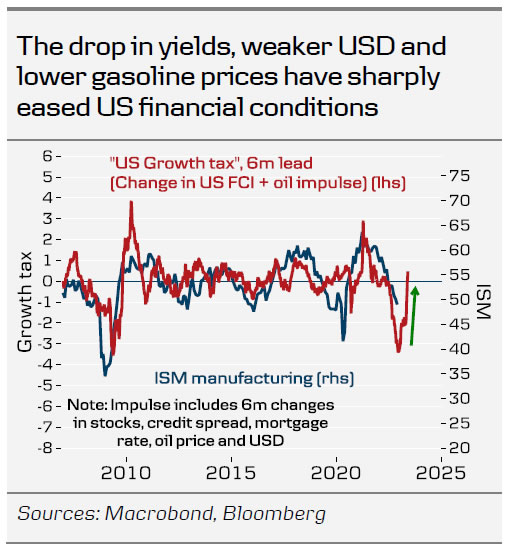
Since early November, the positive sentiment in bond markets, the inversion on the US yield curve and weakening broad USD have reflected easing financial conditions. We think the move is premature, as private consumption and especially the services sector are still holding up well. Fed needs to close the positive output gap to bring inflation down, but with ISM business activity at the highest level since December 2021 and labour supply stagnating since last March, further tightening will still be needed.
While the weak household survey suggests that the nonfarm payrolls could overstate the strength of US employment growth, even modest job gains are enough to tighten the labour market if supply does not grow at all. Alternative indicators, such as JOLTs job openings, or conference board's Jobs Plentiful index confirm, that labour demand remains elevated. FOMC members have noted several times that the current wage inflation is far from levels consistent with the 2% inflation target, and the latest data suggests that Fed is hardly making progress towards bringing the market back into balance.
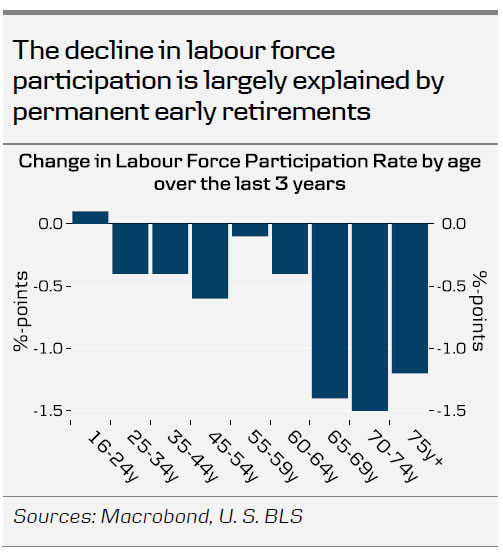
In his final speech ahead of the blackout, Powell noted that risk management does not only refer to calming inflation anymore, but also avoiding a recession. Markets have responded by pricing in the first cuts as early as November next year, which we consider too early.
US economy remains on a path of modest growth in Q4, and Fed needs to force a moderate recession next year to avoid prolonging inflation from here. Getting demand lower requires broad financial conditions to retighten again, which likely includes a combination of more rate hikes in Q1, still elevated longer real yields and stronger USD.
We acknowledge that our earlier call of a 75bp hike next week appears unlikely, but do not think the need to tighten monetary policy further has disappeared. We adjust our Fed call, and now expect 50bp hike next week, followed by 50bp in February and 25bp in March. Thus, we maintain our call for a terminal rate of 5.00-5.25% unchanged.
Sunset Market Commentary
Markets
No surprises today. The near-empty eco calendar and (near) blackout periods for central banks delivered the feared-for dull trading day. Not the slightest diversion to trigger some directional action. The only release worth mentioning were US weekly jobless claims. The traditionally volatile number printed… bang in line with forecasts at 230k with last week’s number upwardly revised from 225k to… 226k. German and US yields (10y tenors) arrived at next support levels in yesterday’s low volume rally and remain above them. Technical action sent them somewhat higher again. US yields add 3.2 bps to 6.9 bps in a daily perspective with the belly of the curve underperforming the wings. The US 10-yr yield holds above 3.42% which is 50% retracement on the August to October yield move higher. German yields rise by up to 4 bps with the 10-yr yield holding north of the October low at 1.77%. European stock markets are mixed with EUR/USD steady near 1.05.
Tomorrow doesn’t look that better. Chinese CPI inflation numbers will show that the country bucks the major global trend with analysts expecting a slowdown from 2.1% Y/Y to 1.6% Y/Y. They finally seemed to gently turn the corner to their very string zero-Covid policies, but this extreme stance since the start of the outbreak came at an economic cost. Absence of price pressure leaves scope for more fiscal and monetary stimulus even as growth could finally start picking up. European attention turns to the second early TLTRO redemption figure. Banks repaid €296bn on the first occasion (Nov 23) with over €1.8tn still outstanding. Recent changes to TLTRO modalities make them less attractive to hold to maturity. A faster wind down of TLTRO’s, together with the end to APP reinvestments from early next year onwards, will help shrink the central bank’s balance sheet and reduce excess liquidity in the system. From a policy normalization point of view, this is the elephant in the room next year rather than the pace of ECB rate hike and their peak levels. During US dealings, December University of Michigan consumer confidence is an harbinger for data points ahead. Especially consumer inflation expectations caught attention this year. They are expected unchanged at 4.9% and 3% for 1y and 5-10y respectively.
News Headlines
Hungarian inflation accelerated from 21.1% y/y to 22.5%, surpassing the 22% consensus estimate. Monthly dynamics remain very strong at 1.8% m/m. Core inflation rose from 22.3% to 23.9%. Price increases are bound to accelerate even further, if only because the government was forced to ditch a costly fuel price cap this week following nationwide gasoline shortages. Economic Development Minister Nagy said it may add 2-2.3 ppts to inflation. The room for Hungary’s central bank to lower the de facto policy rate, currently at 18%, anytime soon is non-existent. This is even more true with the government’s ongoing fiscal support. Apart from keeping the price caps on a range of other goods (staples, mortgages and student loans), it announced late yesterday a new 1.5tn HUF subsidized corporate loan programme offering loans at 5% max in order to avert a recession. Hungarian swap yields shot up between 48 and 84 bps with the front end underperforming after the CPI release. The forint gets a beating. EUR/HUF opened at 410.92, surged beyond resistance around 415.6 and is currently changing hands at 418.68.
Dutch officials are planning new export controls of chipmaking equipment to China, Bloomberg reported citing people familiar with the matter. An agreement could come next month already and would align Dutch trade rules more with the US with both sharing similar national-security concerns, they said. The latter has unveiled new efforts a few months ago to restrict Chinese access to its high-end technology. Next to the US, the Netherlands and Japan are world’s top suppliers of machinery and know-how needed to make advanced semiconductors. Dutch PM Rutte said that his country is coordinating the matter between the three as well as South-Korea.
EUR/USD Mid-Day Outlook
Daily Pivots: (S1) 1.0449; (P) 1.0500; (R1) 1.0556; More...
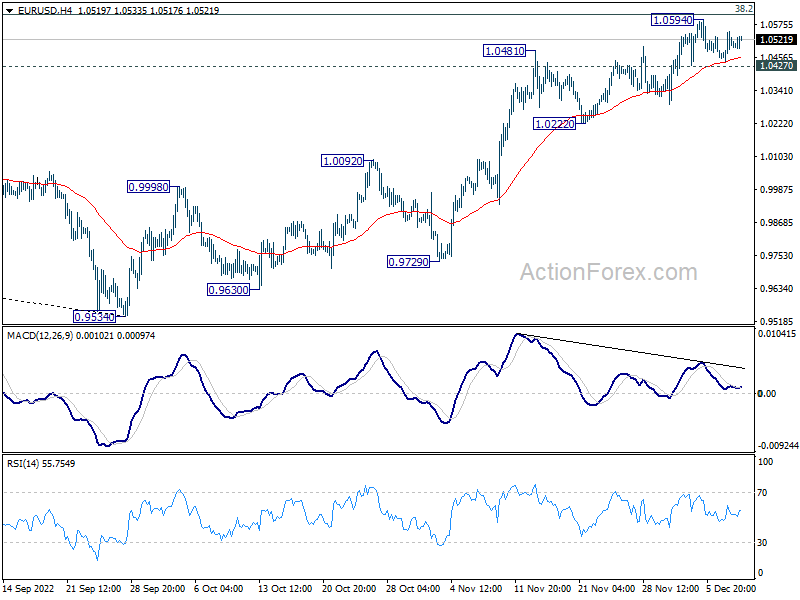
Intraday bias in EUR/USD stays neutral as range trading continues. Considering bearish divergence condition in 4 hour MACD, break of 1.0427 minor support will indicate short term topping at 1.0594, after rejection by 1.0609 fibonacci level. Intraday bias will be turned back to the downside for 1.0222 support and possibly below. Nevertheless, firm break of 1.0594 will resume larger rally from 0.9534.
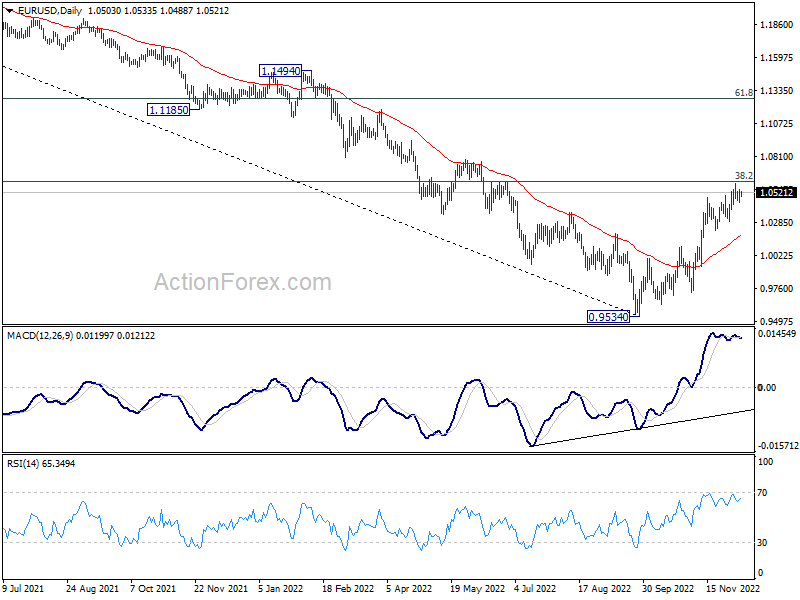
In the bigger picture, a medium term bottom was in place at 0.9534, on bullish convergence condition in daily MACD. Even as a corrective rise, rally from 0.9534 should target 38.2% retracement of 1.2348 (2021 high) to 0.9534 at 1.0609. Sustained trading above 55 week EMA (now at 1.0557) will raise the chance of trend reversal and target 61.8% retracement at 1.1273. However, rejection by 1.0609 will retain medium term bearishness for down trend resumption at a later stage.
GBP/USD Mid-Day Outlook
Daily Pivots: (S1) 1.2133; (P) 1.2184; (R1) 1.2261; More...
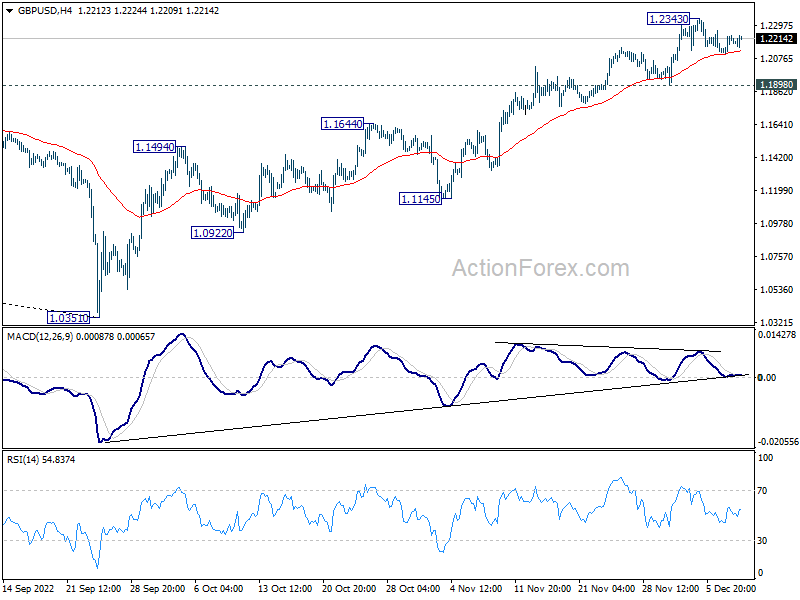
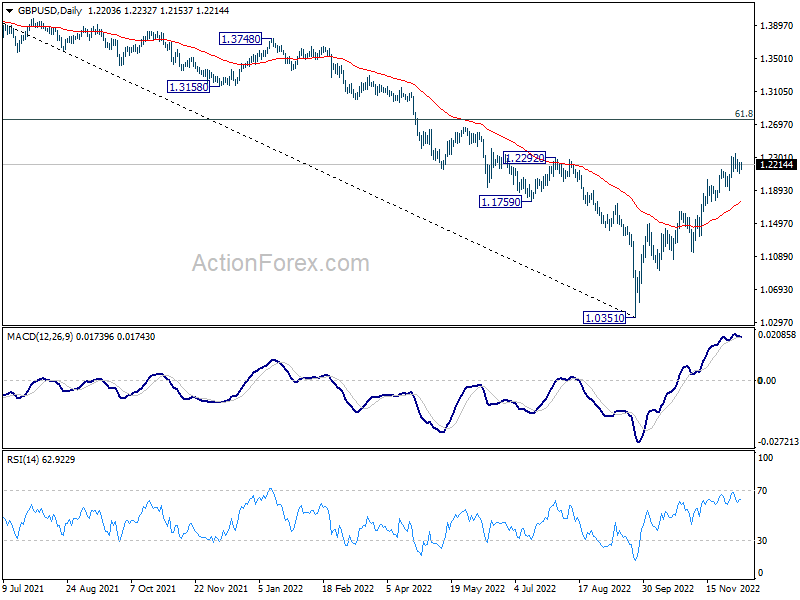
No change in GBP/USD's outlook as range trading continues. Intraday bias stays neutral. Further rise remains mildly in favor as long as 1.1898 support holds. On the upside, break of 1.2343 will resume the rally from 1.0351 and target 1.2759 medium term fibonacci level next. However, firm break of 1.1898 support will confirm short term topping and turn bias back to the downside.
In the bigger picture, rise from 1.0351 medium term bottom is at least correcting whole down trend from 1.4248 (2021 high). Further rise is expected as long as 1.1644 resistance turned support holds. Next target is 61.8% retracement of 1.4248 to 1.0351 at 1.2759. Sustained break there will pave the way back to 1.4248.
USD/CHF Mid-Day Outlook
Daily Pivots: (S1) 0.9369; (P) 0.9403; (R1) 0.9443; More...
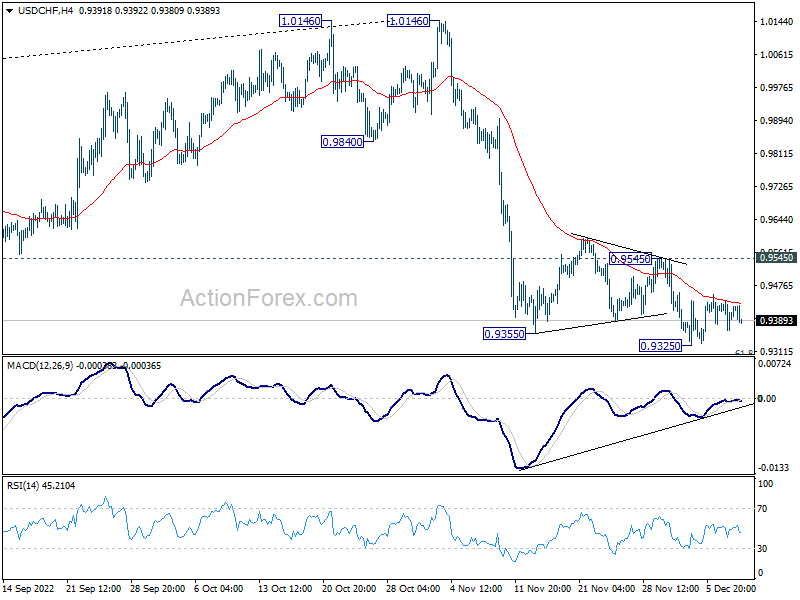
Intraday bias in USD/CHF stays neutral as range trading is still in progress. Considering bullish convergence condition in 4 hour MACD, break of 0.9545 will indicate short term bottoming at 0.9325. Intraday bias will be back on the upside for 55 day EMA (now at 0.9642). On the downside, below 0.9325 will resume the near term decline and target 0.9287 fibonacci level.
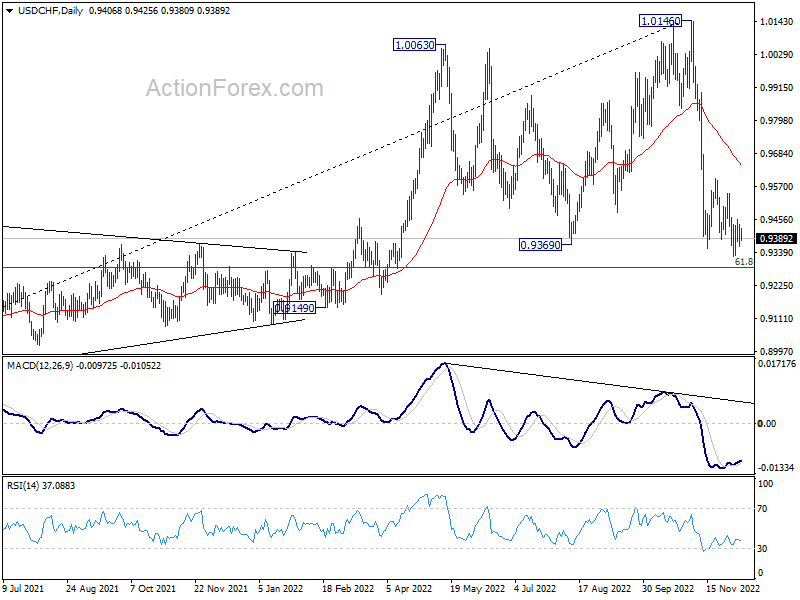
In the bigger picture, rise from 0.8756 (2021 low) has completed at 1.0146, well ahead of 1.0342 long term resistance (2016 high). Based on current downside momentum, fall from 1.0146 might be a medium term down trend itself. Break of 61.8% retracement of 0.8756 to 1.0146 at 0.9287 will pave the way to 0.8756. In any case, risk will stay on the downside as long as 55 day EMA (now at 0.9690) holds.
USD/JPY Mid-Day Outlook
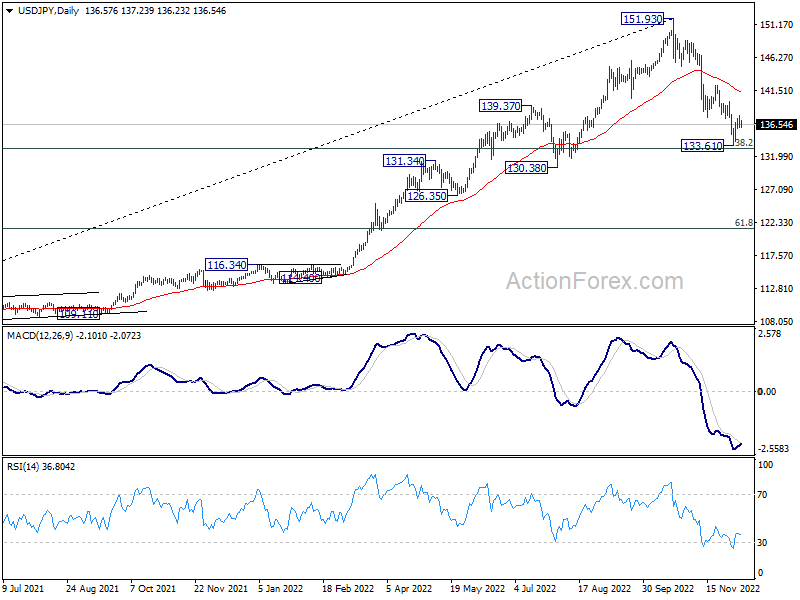
Daily Pivots: (S1) 135.93; (P) 136.89; (R1) 137.57; More...
Intraday bias in USD/JPY is turned neutral with 4 hour MACD crossed below signal line. On the downside, break of 135.95 minor support will indicate rejection by 4 hour 55 EMA, and turn bias back to the downside for retesting 133.61 low. On the upside, above 137.84 will resume the rebound to 55 day EMA (now at 141.20).
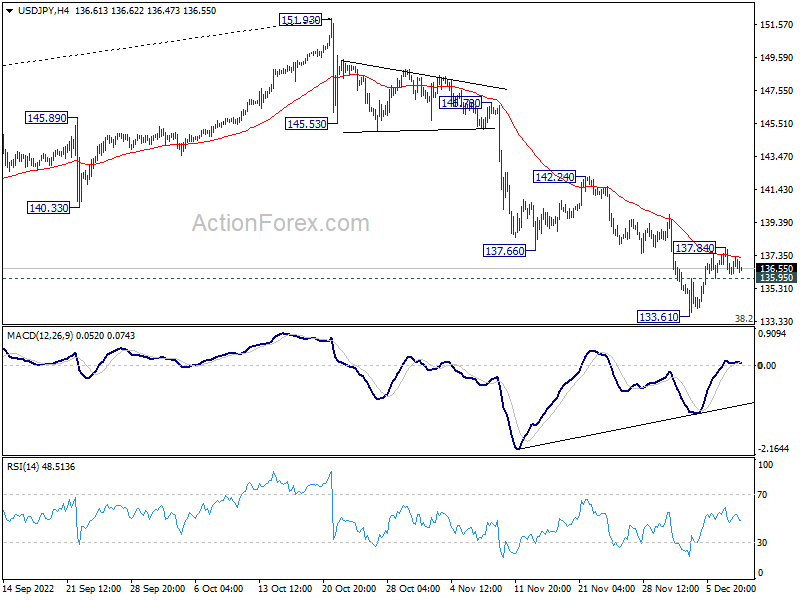
In the bigger picture, a medium term top should be formed at 151.93. Fall from there is correcting larger up trend from 102.58. It's too early to call for bearish trend reversal. But even as a corrective move, such decline should target 38.2% retracement of 102.58 to 151.93 at 133.07, or further to 55 week EMA (now at 131.33). Some support should be seen around this zone to bring rebound. However, sustained break of 55 week EMA will pave the way to 61.8% retracement at 121.43.
AUD/USD Mid-Day Report
Daily Pivots: (S1) 0.6682; (P) 0.6712; (R1) 0.6755; More...
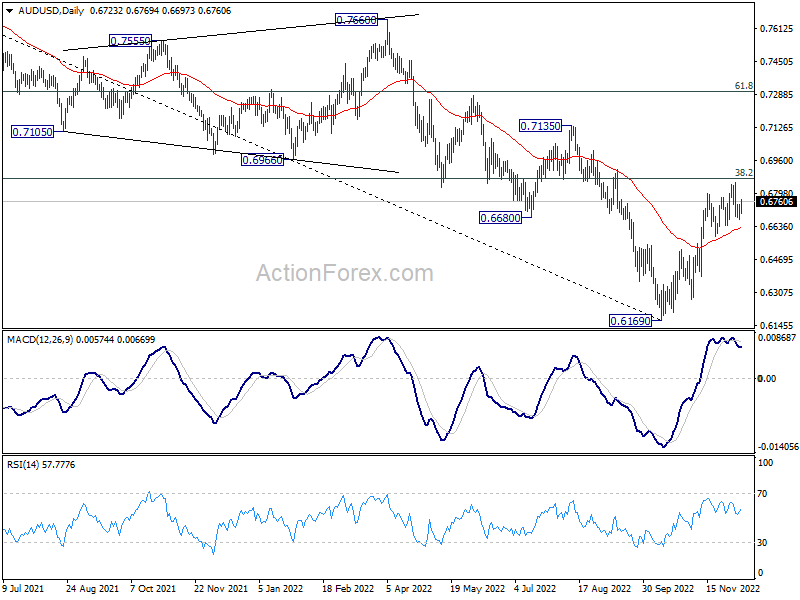
AUD/USD recovers ahead of 0.6641 resistance but stays below 0.6850 resistance. Intraday bias remains neutral first. Again, considering bearish divergence condition in 4 hour MACD, break of 0.6641 support should indicate short term topping, following rejection by 0.6871 fibonacci level. Intraday bias will be back on the downside for 0.6521 resistance turned support first. However, sustained break of 0.6871 will extend the rise from 0.6169 towards 55 week EMA at 0.6922.
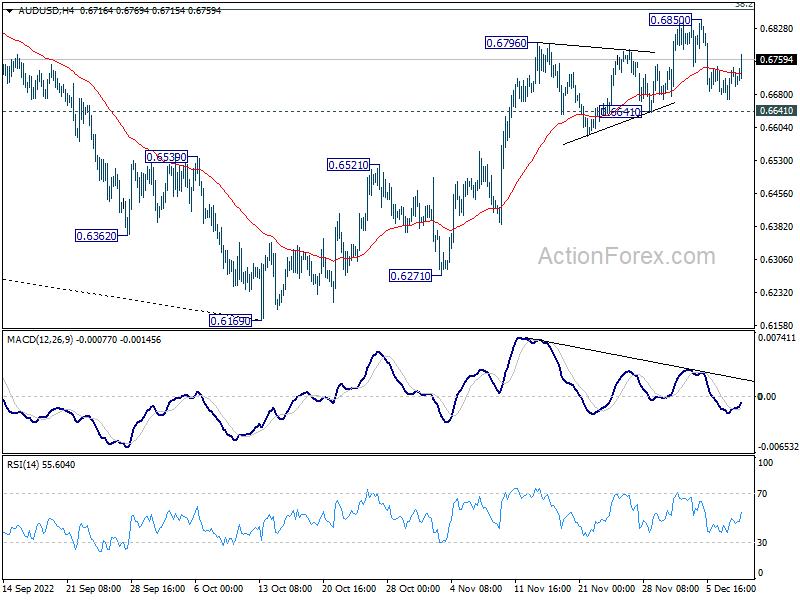
In the bigger picture, a medium term bottom is in place at 0.6160 already. But it's too early to call for trend reversal. Nevertheless, even as a corrective move, rise from 0.6169 should target 38.2% retracement of 0.8006 to 0.6169 at 0.6871. Sustained trading above 55 week EMA (now at 0.6922) will raise the chance of the start of a bullish up trend. However, rejection by 0.6781 or 55 week EMA, followed by 0.6521 resistance turned support and retain medium term bearishness.