

Sample Category Title
Weekly Economic & Financial Commentary: Is This the Peak?
Summary
United States: Payrolls Beat Expectations, but Signs of Moderation on the Horizon
- Total payrolls rose by 263K in November, with the unemployment rate holding steady at 3.7% and average hourly earning rising by 0.6%. Personal income and spending increased 0.7% and 0.8%, respectively, in October, while the core PCE deflator increased 0.2% (MoM) and 5.0% (YoY). The ISM manufacturing index fell to 49 in November, while construction spending slipped 0.3% in October.
- Next week: ISM Services Index (Mon), Trade Balance (Tue)
International: Is This the Peak?
- There have been recent signs that inflation might have peaked in some countries. In November, Eurozone price pressures cooled for the first time in over a year, as headline CPI slowed to a 10% year-over-year rate, from 10.6% in October. In addition to the Eurozone, Australian inflation data also showed an unexpected softening in price pressures. In October, headline CPI receded to 6.9% year-over-year.
- Next week: Reserve Bank of Australia (Tue), Bank of Canada (Wed), Mexico CPI (Thu)
Interest Rate Watch: FOMC Set to Hike by 50 bps on December 14
- Fed Chair Powell indicated in a speech this week that the FOMC likely will hike rates by 50 bps, instead of its recent pace of 75 bps, on December 14. But Powell also suggested that rates need to go even higher and remain in restrictive territory for quite some time.
Credit Market Insights: The Beige Book Brings A Mixed Bag
- Economic activity was slightly up on balance. Employment continued to grow and prices continued to disinflate across most regions.
Topic of the Week: China Inching Toward a Reopening?
- While our base case scenario remains unchanged in that we continue to believe Zero-COVID will remain the overarching policy in China, we do recognize that authorities have started to ease restrictions and further action toward reopening could be taken going forward.
Bank of Canada Hiking Cycle Could Be Drawing to a Close
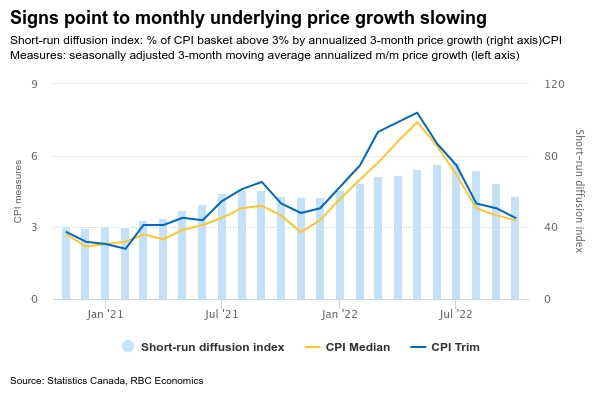
The Bank of Canada won’t hit the brakes on interest rate increases next week, but it is likely to slow them down. And we believe next week’s increase could be the last in this cycle. We expect a 25 basis point increase in the overnight rate to 4.0% from the central bank—smaller than the 50 basis point hike in October. The BoC has been clear that another larger 50 bps hike is also a possibility. But there are tentative signs that broader inflation pressures have peaked. And these have emerged even before the full impact of earlier rate hikes on the economy has been felt. It takes time, for example, for higher interest rates to feed through to household mortgage payments as fixed-rate contracts are renewed. Governor Macklem in October highlighted the need to balance the risks of both under- and over-tightening monetary policy—and the economic growth backdrop is widely expected to deteriorate. Our outlook foresees a moderate recession in the first half of next year.
Perhaps more important than the size of next week’s interest rate hike is how many more could follow. The answer to that question depends on inflation. Both the BoC’s preferred median and trim ‘core’ CPI measures have shown signs of moderation in recent months, and the breadth of inflation pressures has slowed. Canadian Q3 GDP growth surprised on the high side (2.9%) compared to BoC expectations (1.5%) but looked much softer in September and October than over the summer. Inflation is still running well above the 2% target rate, but a 4.00% overnight rate is likely enough to slow economic growth and inflation pressures further. The BoC will almost certainly (and correctly) keep the option to hike interest rates further if necessary. But our own base case expectation is that December will mark the last rate hike of this cycle.
Week ahead data watch
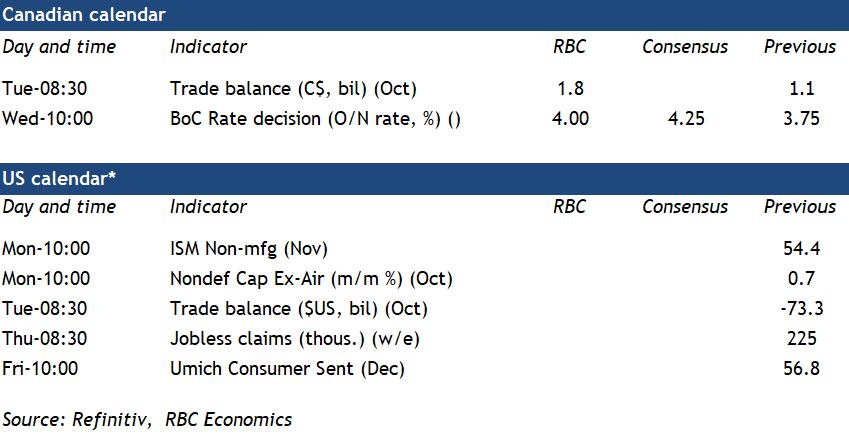
- Canada’s net trade surplus likely widened in October as an increase in oil prices boosted the energy trade balance. That is despite a 2.8% drop in the value of the Canadian dollar relative to the U.S. dollar boosted import costs, although the weaker currency also increases export prices for products, like oil, that are typically traded in U.S. dollars. A pull-back in Canadian motor vehicle production in October likely weighed on both export and import volumes
- The U.S. October trade balance likely declined sharply, given a reported US$7 billion deterioration in the advance estimate of the merchandise trade balance. That’s broadly consistent with expectations for net trade to shift to a significant decline in GDP growth in Q4.
Gold Wave Analysis
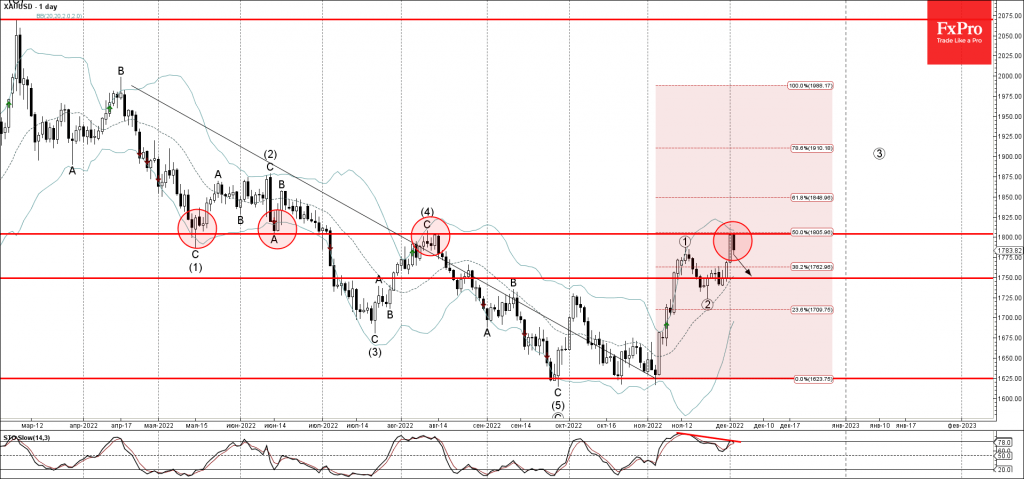
- Gold reversed from key resistance level 1800.00• Likely to fall to support level 1750.00
Gold today reversed down sharply from the powerful multi-month resistance level 1800.00 (which has been reversing the price from the middle of May).
The resistance level 1800.00 was further strengthened by the nearby upper daily Bollinger Band and by the 50% Fibonacci correction of the downward impulse from April.
Given the prevailing daily downtrend and the bearish Stochastic divergence, Gold can be expected to fall further toward the next support level 1750.00.
USDCHF Wave Analysis
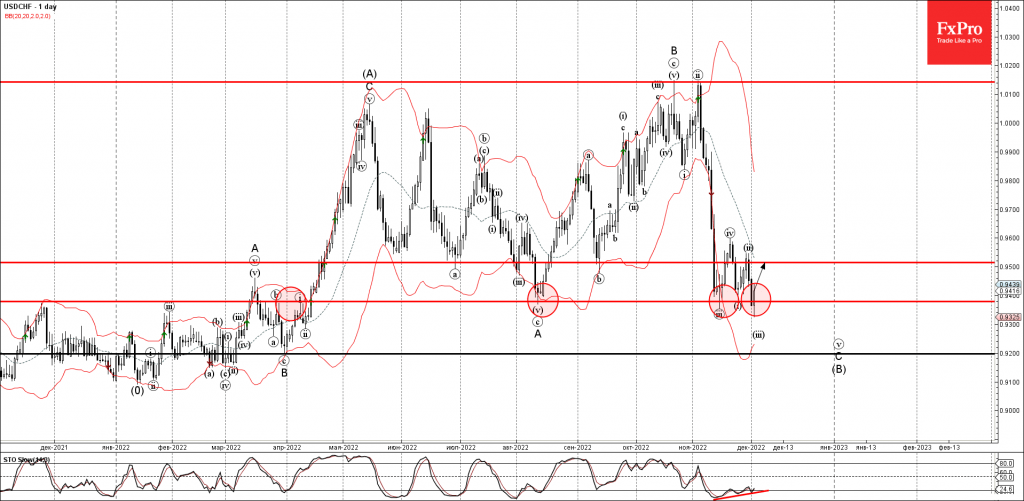
- USDCHF reversed from support level 0.9380
- Likely to rise to resistance level 0.9500
USDCHF currency pair just reversed up sharply from the key multi-month support level 0.9380 (which has been reversing the pair from the start of April).
The upward reversal from the support level 0.9380 stopped the earlier short-term impulse wave (iii).
Given the clear bullish divergence on the daily Stochastic, USDCHF can be expected to rise further toward the next resistance level 0.9500 (which stopped wave (ii)).
Natural Gas Wave Analysis
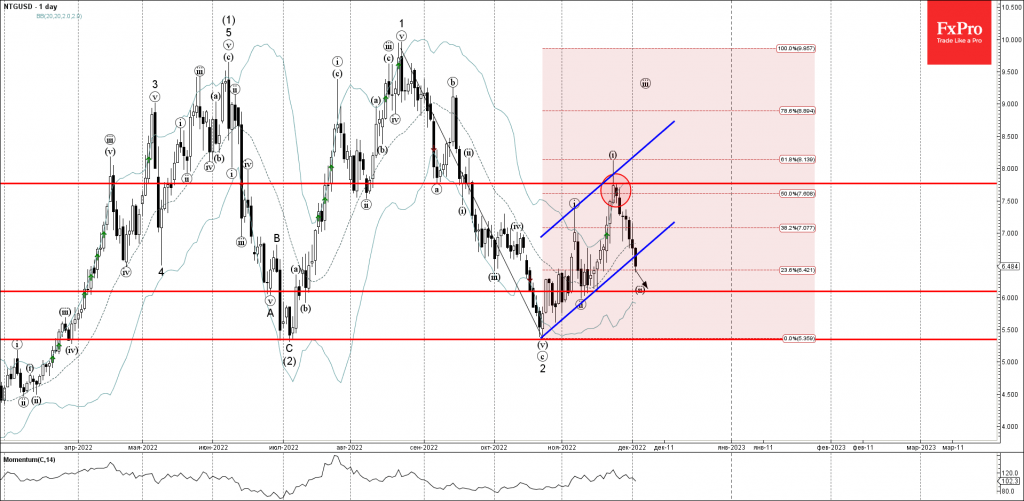
- Natural gas broke daily up channel
- Likely to fall to support level 6.0000
Natural gas under the bearish pressure after the earlier breakout of the support trendline of the daily up channel from October.
The breakout of this up channel accelerated the active short-term corrective wave (ii) from the end of November.
Given the clear daily downtrend, Natural gas can be expected to fall further toward the next round support level 6.0000 (target for the completion of the active wave (ii)).
Week Ahead – Australia and Canada Kick Off Central Bank Bonanza
A litany of central bank meetings lies ahead in the first half of December. The ball will get rolling with the Reserve Bank of Australia and the Bank of Canada next week, both of which are expected to raise interest rates again, albeit at a slower pace. Meanwhile in America, business surveys and producer prices will shape expectations around Fed policy, helping investors decide whether the dollar’s best days are behind it.
RBA shifts into lower gear
The Australian economy continues to fire on most cylinders, setting the stage for another rate increase when the Reserve Bank concludes its meeting early on Tuesday. Markets currently assign a 75% probability for a quarter-point rate hike and a 25% chance for no change at all.
Economic developments since the RBA last met have been favorable. The labor market remains extremely tight, with the unemployment rate having fallen back to a half-century low. Meanwhile, wage growth fired up last quarter, which is usually a sign that inflationary forces are becoming entrenched.
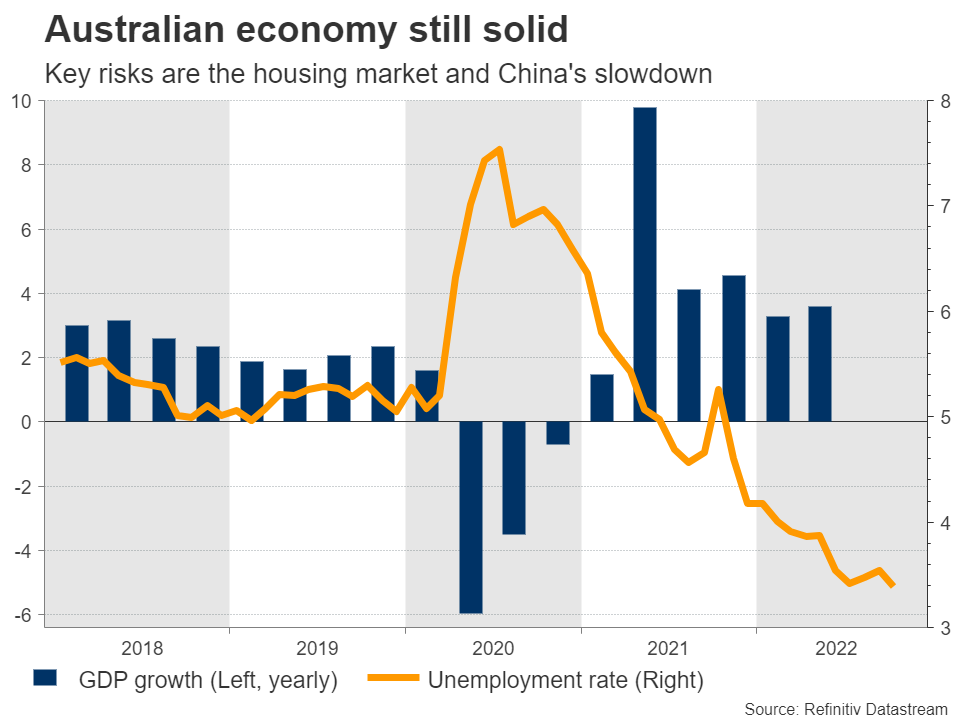
Yet, investors are saying the tightening cycle could come to a pause this month already. That's mainly because inflation unexpectedly cooled in October, fueling hopes that the worst has passed. With house prices also on the decline and external risks intensifying as the Chinese economy loses steam, there’s a solid case for the RBA to slow down.
One way to balance everything is to raise rates but softly open the door for a pause next year, buying some time to monitor the effects of all its previous actions and how the global economy will evolve. In the markets, this could translate into a positive FX reaction initially, which might then reverse fairly quickly as the terminal rate gets calibrated lower.
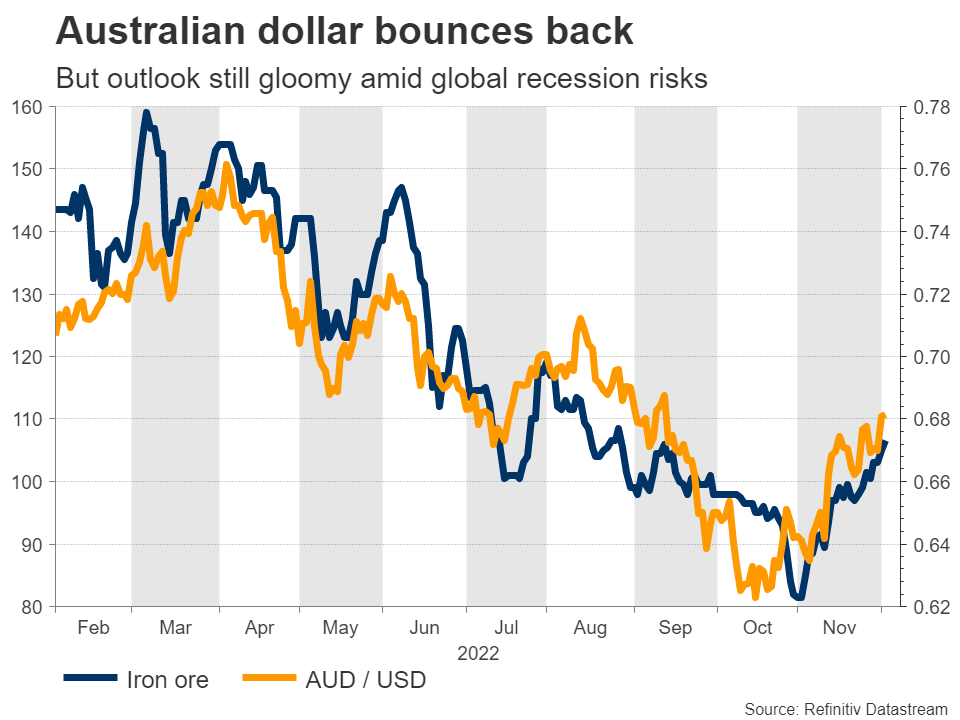
Overall, the outlook for the aussie remains gloomy, despite the latest relief rally. The coming year will likely feature recessions in several economies, and even if Australia dodges one, it might still suffer collateral damage from reduced trade flows and commodity demand. With China slowing down and stock market valuations looking unrealistic too, it’s tough to be optimistic on a risk-sensitive currency like the Australian dollar.
On the data front, Australia’s GDP stats for Q3 will be released on Wednesday. A few hours later, China’s trade stats for November will hit the markets ahead of the nation’s inflation stats on Friday, both of which could be important for the aussie.
BoC - Almost there
Over in Canada, there’s a sense that the tightening cycle is about to conclude. Markets have fully priced in a quarter-point rate increase for Wednesday, which is expected to be repeated next month, before the Bank of Canada takes the sidelines for good.
The economy is doing fine, at least on the surface. Growth exceeded expectations last quarter, the labor market is still in good shape, and inflation is running at more than three times the BoC’s target, all of which argues for further rate increases.
What’s making the BoC cautious is the notion of policy lags, as the full impact of the rate increases that have already been rolled out hasn’t been felt yet. Coupled with a housing bubble that has started to pop and extremely high private debt levels, the officials are concerned that if they keep pressing ahead, they could spark a financial ‘accident’.
Therefore, from a risk management perspective, it’s prudent for the BoC to play some defense here with just a quarter-point rate hike. Since the market is pricing in around a 15% chance for an even bigger, half-point rate increase, this could come as a minor disappointment for the Canadian dollar.
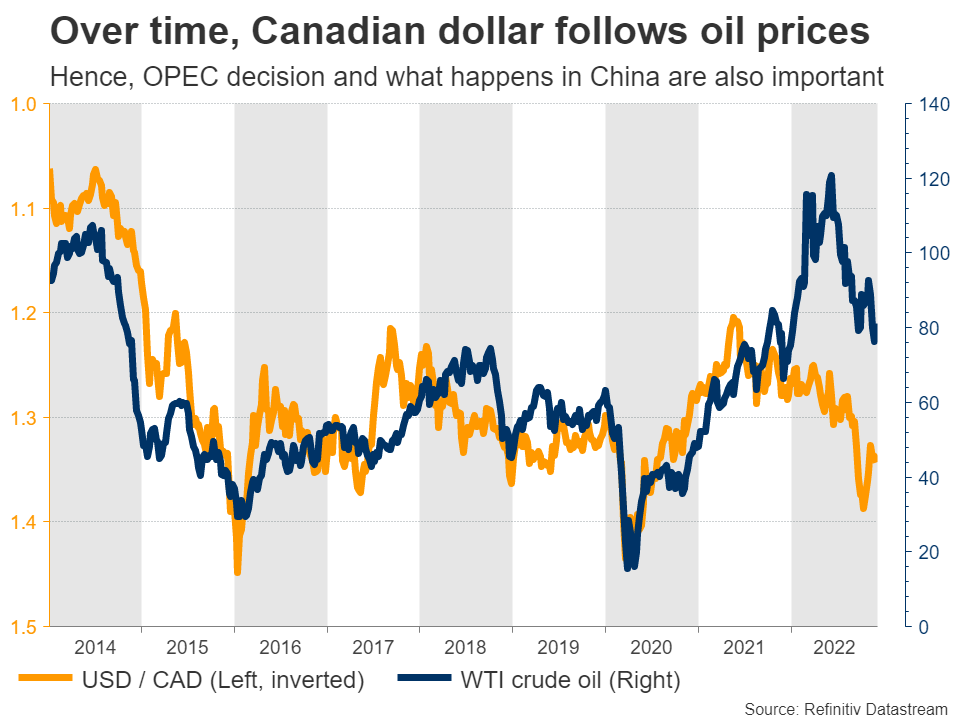
Ahead of the BoC decision, there’s an OPEC meeting on Sunday that could also prove crucial for the loonie, given its sensitivity to oil prices.
Dollar awaits key US data
In America, the spotlight will fall on the ISM services survey on Monday, ahead of the latest batch of producer prices on Friday. Both will be crucial pieces of the puzzle as investors mull how high the Fed will raise rates and how long it will keep them there.
Market pricing currently implies a half-point rate increase this month, followed by a similar move early next year that pushes rates to 4.85%. At that point, the Fed is expected to stay on hold for several months, before cutting rates a notch towards the end of the year.
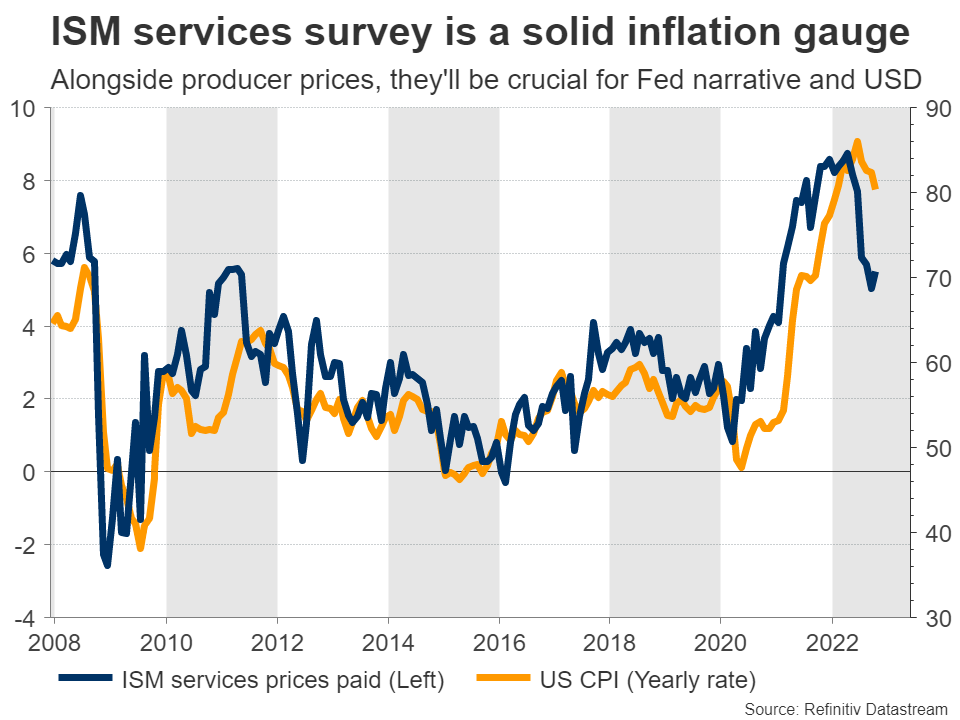
Economic data validate this narrative. Even though official US data remains solid with consumption and the labor market still in good shape, forward-looking indicators warn of trouble ahead. Hence, the Fed has to keep going for now, especially since inflation is still running hot, but is likely to encounter growth problems by the middle of next year.
As for the dollar, all this suggests that it’s too early to call for a bearish trend reversal just yet as the outlook for other major economies is even worse, but the rally is likely in its final chapters. A softer Fed profile is usually not enough to turn the tide in the dollar - it also requires an improving economic outlook in the rest of the world to draw capital outside the US, which is currently not the case.
Weekly Focus – Easing Rate Hike Fears Support Market Sentiment
This week, we published our latest global economic forecasts for 2023 and 2024 in The Big Picture - Recession with different undercurrents, 28 November. We expect the western economies to fall into a recession next year, but the drivers and length of the weakness vary between different areas. The euro area is on the brink of a recession already now, as the high inflation from energy supply shortages weighs on real incomes. Furthermore, we expect a 'double-dip' recession also on the H2 of 2023, as the impact from tighter financial conditions and the slowdown in the US weigh on growth. Colder weather has once again lifted natural gas and electricity prices from mid-November, highlighting how the energy supply situation still remains tight. While we forecast a modest recovery in 2024, limited energy supply will remain a structural hurdle constraining growth for years to come.
The near-term outlook for US remains somewhat more upbeat although some of the leading indicators, including Chicago PMIs released this week, have already fallen to recessionary levels as well. We expect US economy the fall into a recession starting from Q2 next year, but compared to the euro area, the US recession will be more traditional policy-driven slowdown. After aggregate demand has cooled down into equilibrium with supply, the economy can start to recover towards its potential growth pace by H2 2024.
We expect both ECB and Fed to maintain financial conditions restrictive well into 2023. In contrast however, Fed's chair Powell appeared more confident in Fed's ability to eventually cool down inflation back to target in his speech this week. Powell highlighted not just inflation risks, but also that Fed wants to avoid overtightening the economy into a recession, sparking a rally in the risk markets. As FOMC's December meeting is less than two weeks away and the blackout period begins on Saturday, consensus and markets seem well aligned for a 50bp hike. That said, we discuss some of the reasons and data releases which could still tilt the balance towards a larger hike in Research US - 50 or 75bp? Fed's December Checklist, 30 November.
The ECB also received some preliminary positive news this week, as euro area flash HICP eased from the October peak to 10.0%. That said, past rises in especially energy prices are still feeding into consumer prices. We also expect core inflation to only return to ECB's target by H2 2024 (see details from Euro inflation notes - A 'sticky' problem, 30 November). The expectation of persistent inflation and further tightening in financial conditions is also reflected in our FX Top Trades 2023 - Our guide on how to position for the year ahead, 2 December, where we expect the broad USD strength to continue.
Next week will be quiet in terms of key data releases as markets await the final ECB and Fed meetings of the year 14th and 15th of December. In euro area, October Retail Sales will be released on Monday, but focus will mostly remain on final ECB comments ahead of blackout starting on Thursday. In the US, ISM services index will be key to gauging if private consumption has truly cracked in November after PMIs signalled clearly weakening growth earlier. In China, Caixin Services PMI will be released on Monday, but focus remains on any new signals around the Covid and economic policies. The Reserve Bank of Australia will have a monetary policy meeting, we expect a 25bp hike.
Sunset Market Commentary
Markets
SCREEEEEECH! The core bond rally came to a screeching halt at the end of this week. In defiance of the slightly disappointing ADP job report, November US payrolls easily surpassed consensus estimates. US yields propel between 8.9 bps (30y) and 13.5 bps (2y) higher. The critical 10y yield support at 3.5% was saved by the bell. German yields in the US slipstream swapped intraday losses of more than 6 bps for gains up to 3 bps. Over there, the 10y was at risk of losing 1.77% support. But that October interim low lives to fight another day. US Job creation in November came in at 263k vs 200k expected. This was accompanied by an upward revision for October by 23k. Job growth remains thus far in excess of the pace needed to accommodate population growth over time, which Powell during his speech on Wednesday estimated at 100k per month. The unemployment rate stabilized at a historically low 3.7%. The still-tight labour market puts upward pressure on wages, intensified by a rather low participation rate (fell from 62.2% to 62.1%). Wage growth accelerated from 0.5% m/m to 0.6% to be up 5.1% y/y. It’s the first year-over-year increase in three months and follows an even upwardly revised 4.9% in October. Powell on Wednesday outlined four conditions for inflation to return to the 2% inflation target. Three of them are (close in being) fulfilled. The fourth reads: “Finally, the labor market, which is especially important for inflation in core services ex housing, shows only tentative signs of rebalancing, and wage growth remains well above levels that would be consistent with 2 percent inflation over time”. Today’s job report surely does not meet this final prerequisite and suggests the inflation fight may take longer than some expect. To this end, it serves as a reality check for markets who were running way ahead of themselves in seeing the US central bank lift rates to no more than 5% and expecting rate cuts already in the second half of next year – disregarding guidance from almost every Fed member. Food for thought as they head into the weekend.
The dollar snapped a heavy two-day losing streak. DXY rebounded above the 105(.3) support. A weekly close above that level may be important from a technical point of view. EUR/USD aborts its adventure north of 1.05 to trade around 1.047. Cable limits losses to just below 1.22, with a little help of the 200dMA. Sterling against other currencies trades muted, including EUR. EUR/GBP is changing hands just south of 0.86 with 0.857 serving as important support. On other markets, equities staged a knee-jerk drop post-payrolls. European stocks ease half a percent. Wall Street opens 0.7-1.3% lower.
News Headlines
According to the Czech statistical office, Q3 GDP contracted 0.2% Q/Q to be still 1.7% higher compared to the same quarter last year. The outcome was slightly better that the first estimate and less negative than the Czech national bank expected. The details show a sharp contraction in household consumption (-2.4% Q/Q), which the CNB attributes to a sharp fall in real income and a worse sentiment among consumers. Government consumption also declined more than the CNB expected (-0.8% Q/Q and -1.2%Y/Y). Still, these deviations were overall slightly outweighed by a higher-than-expected contribution of net exports. Growth in both exports and imports was faster than forecasted. Gross capital formation (-0.4% Q/Q, 5.1% Y/Y) was as the CNB expected, with the quarterly decline reflecting a deteriorating situation of companies. According the CNB autumn forecast the Czech economy will switch to a year-on-year decline end this year and then continue to decline for several quarters. In whole-year terms, Czech output next year will lower than this year. A positive contribution of net exports and recovering household consumption will be the main factors behind renewed economic growth in 2024. After losing modest ground this week, the koruna today trades little changed near 24.37.
At the same time of the all-important US payrolls reported, Statistics Canada also reported its monthly labour market data. After an impressive net gain in employment of 108.3k in October, job growth slowed to the expected 10k. The unemployment rate declined from 5.2% to 5.1%, but coincided with a slight decline in the participation rate. Growth in the average hourly wages of employees remained above 5% for a sixth consecutive month, rising 5.6% Y/Y. The loonie lost modestly against the USD (USD/CAD 1.348) but this was mainly due to strong US payrolls.
Canada’s Labour Market Adds Jobs in November
The Canadian labour market added 10.1k positions in November, with full-time employment up 50.7k and part-time employment down 40.6k.
The unemployment rate fell by 0.1 percentage points, to 5.1%. The participation rate also fell to 64.8% (down 0.1 percentage points).
By industry, employment was up in finance, insurance, real estate, rental and leasing (+21k), manufacturing (+19k), and information, culture and recreation (+16k). Losses were seen in construction (-25k), wholesale and retail trade (-23k), and professional, scientific and technical services (-15k).
Lastly, total hours worked were up 0.1% month-on-month and wages were up 5.6% year-on-year.
Key Implications
The labour market is still hot. Following October's mammoth jobs gain, we were expecting some stabilization in today's report. With another 10 thousand jobs gained, and full-time work dominating the underlying figures, the labour market continues to heat up. This is also apparent in the regional breakdown. With Ontario and Quebec leading the way, this is an encouraging bounce back from the weakness seen over the summer months. All this points to a likely improvement in overall consumer spending in the fourth quarter.
Today's report reinforced expectations that the Bank of Canada will continue hiking its policy rate at its meeting next week. With the rate likely to get to 4.25%, the BoC will have undoubtedly reached restrictive territory. Though we haven't seen it in the labour market data as of yet, the impact of the BoC's aggressive moves will eventually cool the labour market. With the recent momentum, this is expected to take pace in mid to late 2023.
US: Employment Shows Further Signs of Cooling, But Elevated Wages Will Keep Fed on the Defensive
The U.S. economy added 263k jobs in November, coming in above the consensus forecast of 200k. Overall, revisions to the two prior months were negative, subtracting 23k from the previously reported figures.
Employment gains on the service-side (+184k) were largely concentrated in health care & social assistance (+68k), leisure & hospitality (+88k), other services (+24k) and information (+19k). Meanwhile, retail (-29.9k) & wholesale (-15.1k) trade lost jobs on the month. Hiring in professional & business services (+6k) was also noticeably weak, though this is partially related to a pullback in hiring of temporary help services (-17.2k). Goods producing industries (+37k) had another solid month, with gains concentrated across both construction (+20k) and manufacturing (+14k). The public sector added 42k jobs in November.
In the household survey, civilian employment recorded another month of declines, falling by 138k, while the labor force shed 186k workers. As a result, the unemployment rate remained unchanged at 3.7%. The participation rate edged lower by 0.1 percentage point (pp), falling to 62.1% and is now 0.1 pp below where it was at the beginning of the year.
Average hourly earnings rose 0.6% month-over-month (m/m) – an acceleration from the 0.5% m/m gain recorded in October. Compared to November 2021, wage growth is up 5.1%. Aggregate hours worked declined by 0.2% m/m.
Key Implications
Non-farm employment continues to show some signs of slowing, having now fallen short of its three-month moving average in each of the last four months. Moreover, the pullback in hiring across select service industries alongside the continued weakness in the household measure of employment suggests labor demand is starting to cool – albeit from elevated levels.
After having shown some tentative signs of easing, average hourly earnings have accelerated sharply in recent months, with the year-ago measure up 5.1% and the three-month (annualized) growth rate sits even higher at 5.8%. With job openings still historically elevated and growth in the labor force appearing to have stalled, wage growth is likely to continue to remain elevated until we see a meaningful normalization in labor demand.
In a speech earlier this week, Fed Chair Powell hinted that the FOMC may start to dial back on the pace of rate hikes at its next meeting later this month. While we believe the time has come for the Fed to pivot, today's employment report reaffirms the view that the Fed's job is far from done. More rate hikes will be required through next year to restore price stability and normalize the current imbalances in the labor market.