Sample Category Title
Corrective Rally on Crude Oil Can Cause Resistance on USD/CAD
In this article we will talk about Crude oil and USDCAD + their relationship, from technical point of view and from Elliott wave perspective.
Crude oil has been trading bearish since March this year, but we see it now finishing a leading diagonal pattern from the highs with potentially completed 5th wave that can cause a new corrective rally at the end of 2022 into 2023 back towards 100 resistance area.
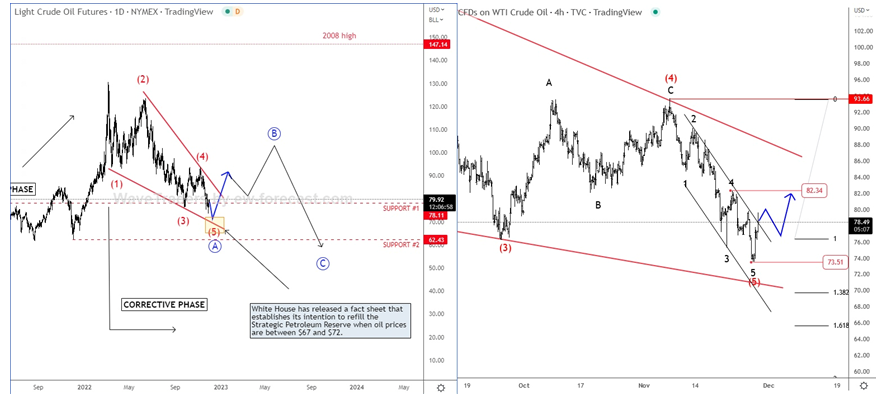
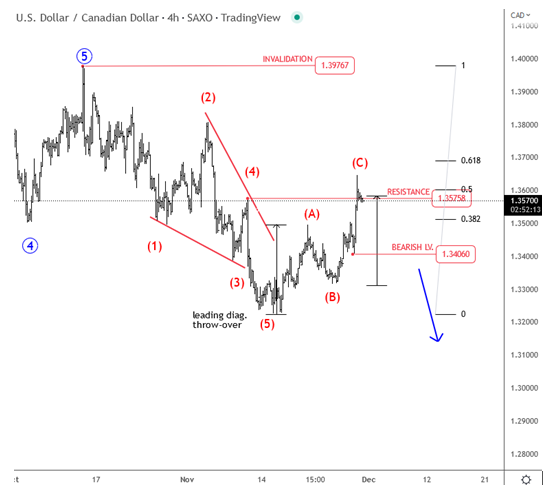
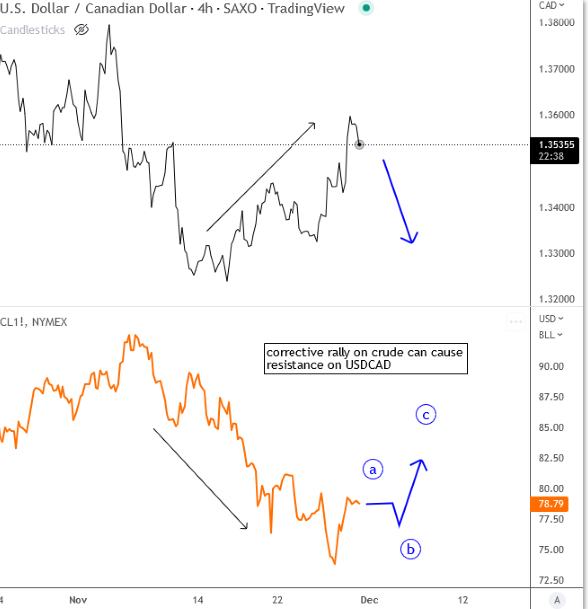
We know that Crude oil is in negative correlation with USDCAD currency pair due to huge oil reservers in Canada. So, if Crude oil is about to stabilize, which can be already happening with a recent turn up, then USDCAD could stops at current 1.36 resistance and potential face more weakness, especially if pair drops back beneath 1.3400 level, while it's below 1.39 invalidation level. Keep in mind that even if recovery on crude is going to be in three waves, that's still only wave A from the low, so more upside after B into C, can make CAD stronger as shown on correlated chart below.
GBP/JPY Mid-Day Outlook
Daily Pivots: (S1) 165.28; (P) 165.98; (R1) 166.42; More...
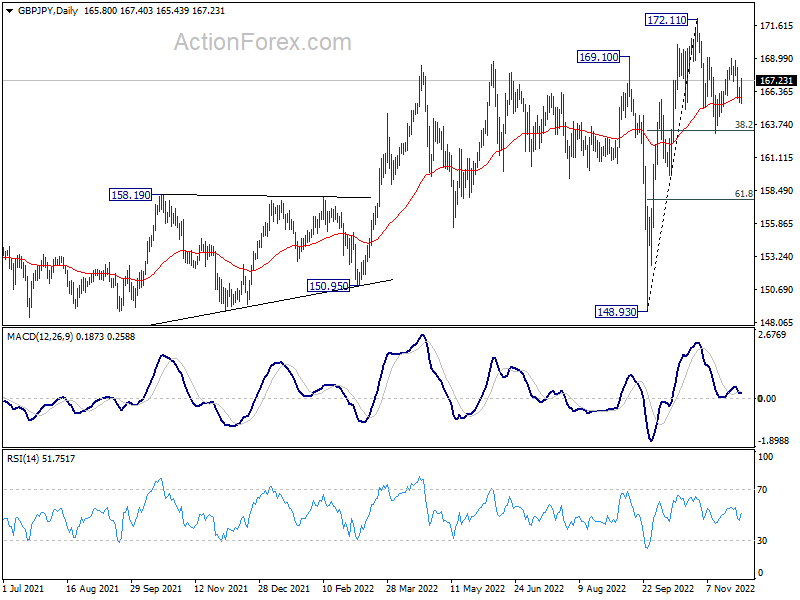
Intraday bias in GBP/JPY is turned neutral first with today's recovery. On the downside, below 165.43 will bring deeper fall to retest 163.02 support. On the upside, break of 168.99 will resume the rebound from 163.02 to retest 172.11 high.
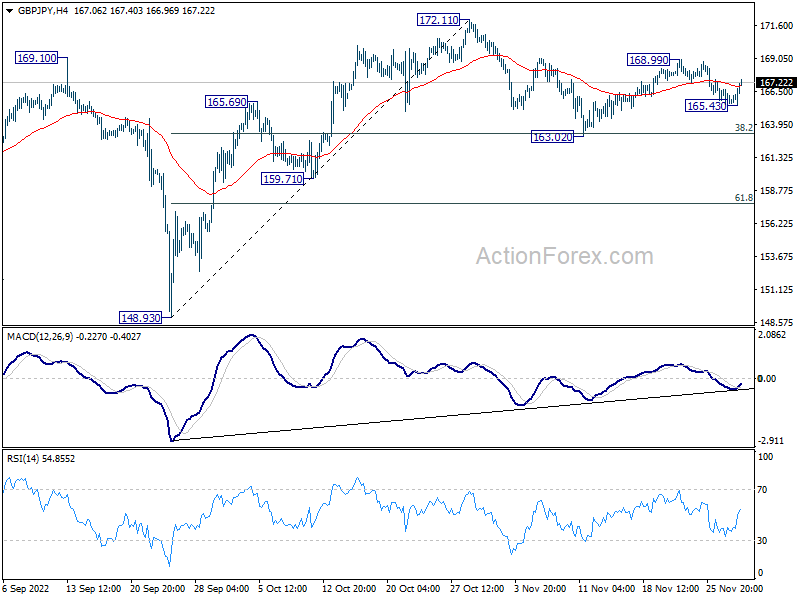
In the bigger picture, there is no clear sign of medium term topping yet. Up trend from 123.94 (2020 low) could still resume through 172.11 high at a later stage. However, firm break of 159.71 support will argue that it's already in correction to the up trend from 123.94, and deeper decline would be seen back towards 148.93 support.
USD/CAD Mid-Day Outlook
Daily Pivots: (S1) 1.3443; (P) 1.3545; (R1) 1.3680; More....
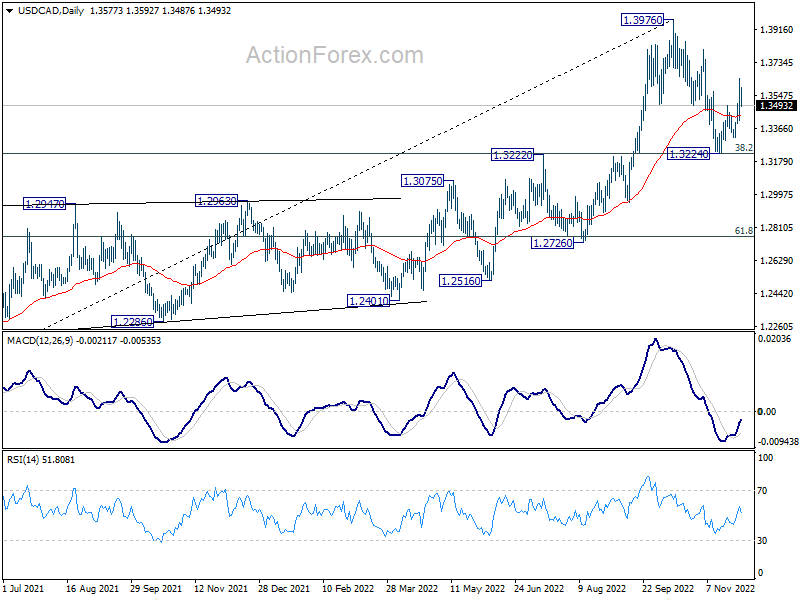
Intraday bias in USD/CAD is turned neutral first with today's deep retreat. Outlook is unchanged that correction from 1.3976 should have completed at 1.3224. On the upside, above 1.3644 will resume the rise from 1.3224 to 1.3807 resistance next. This will remain the favored case as long as 1.3315 support holds, in case of retreat.
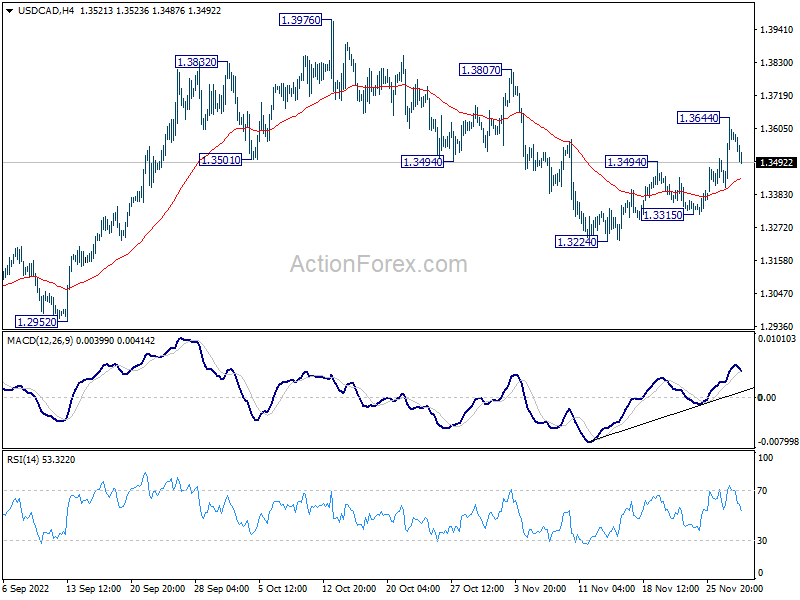
In the bigger picture, as long as 1.3222 cluster support (38.2% retracement of 1.2005 to 1.3976 at 1.3223) holds, larger up trend from 1.2005 (2021 low) is still expected to resume through 1.3976 high at a later stage. However, firm break of 1.3222/3 will indicate that the trend might have reversed. Deeper fall would be seen to next cluster support at 1.2726 (61.8% retracement at 1.2758).
EUR/USD Mid-Day Outlook
Daily Pivots: (S1) 1.0302; (P) 1.0348; (R1) 1.0376; More...
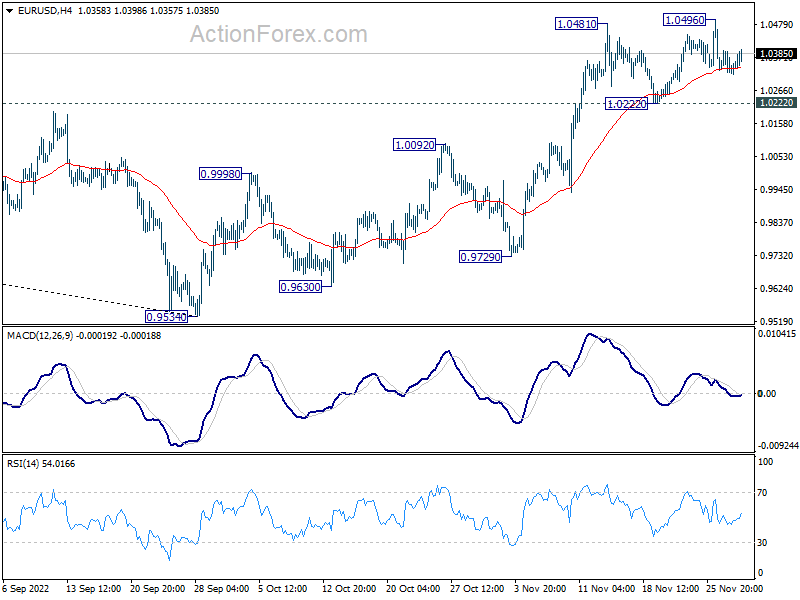
EUR/USD is staying in consolidation from 1.0496 and intraday bias remains neutral at this point. Further rally is expected as long as 1.0222 support holds. Break of 1.0496 will resume the rise from 0.9534 to 1.0609 fibonacci level. However, firm break of 1.0222 will turn bias back to the downside for 1.0092 resistance turned support.
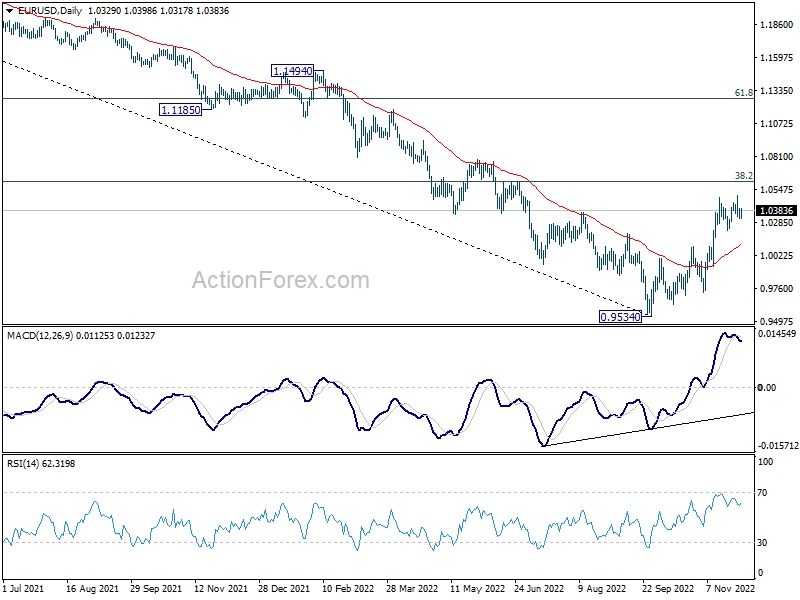
In the bigger picture, a medium term bottom was in place at 0.9534, on bullish convergence condition in daily MACD. Even as a corrective rise, rally from 0.9534 should target 38.2% retracement of 1.2348 (2021 high) to 0.9534 at 1.0609. Sustained trading above 55 week EMA (now at 1.0566) will raise the chance of trend reversal and target 61.8% retracement at 1.1273. This will now remain the favored case as long as 1.0092 resistance turned support holds.
GBP/USD Mid-Day Outlook
Daily Pivots: (S1) 1.1911; (P) 1.1987; (R1) 1.2029; More...
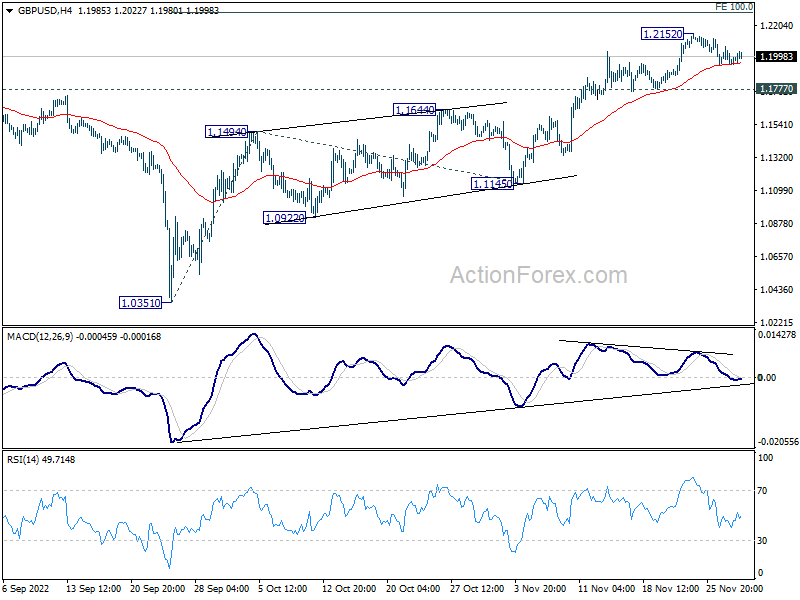
GBP/USD is extending the consolidation from 1.2152 and intraday bias stays neutral. Further rally is expected with 1.1777 support intact. Break of 1.2152 will target 100% projection of 1.0351 to 1.1494 from 1.1145 at 1.2288 first. Sustained break there will pave the way to 1.2759 medium term fibonacci level.
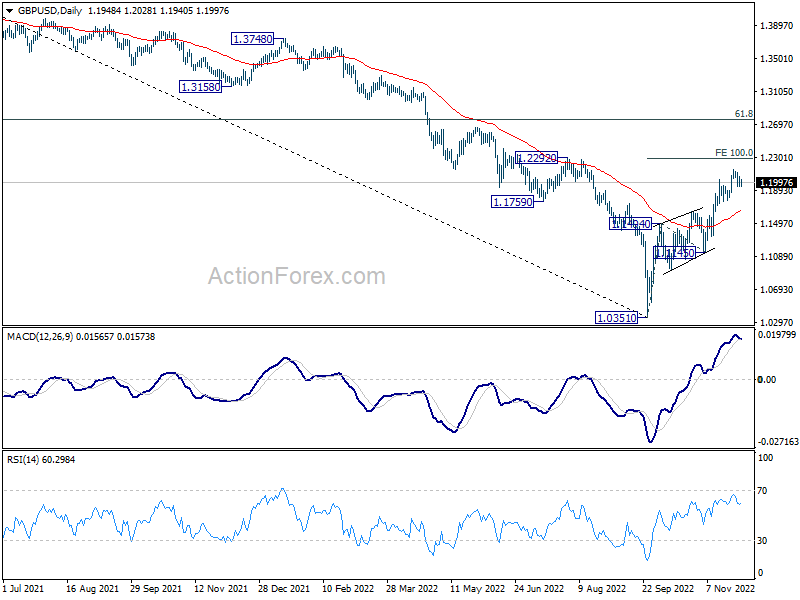
In the bigger picture, rise from 1.0351 medium term bottom is at least correcting whole down trend from 1.4248 (2021 high). Further rise is expected as long as 1.1145 support holds. Next target is 61.8% retracement of 1.4248 to 1.0351 at 1.2759. Sustained break there will pave the way back to 1.4248.
USD/CHF Mid-Day Outlook
Daily Pivots: (S1) 0.9485; (P) 0.9515; (R1) 0.9571; More...
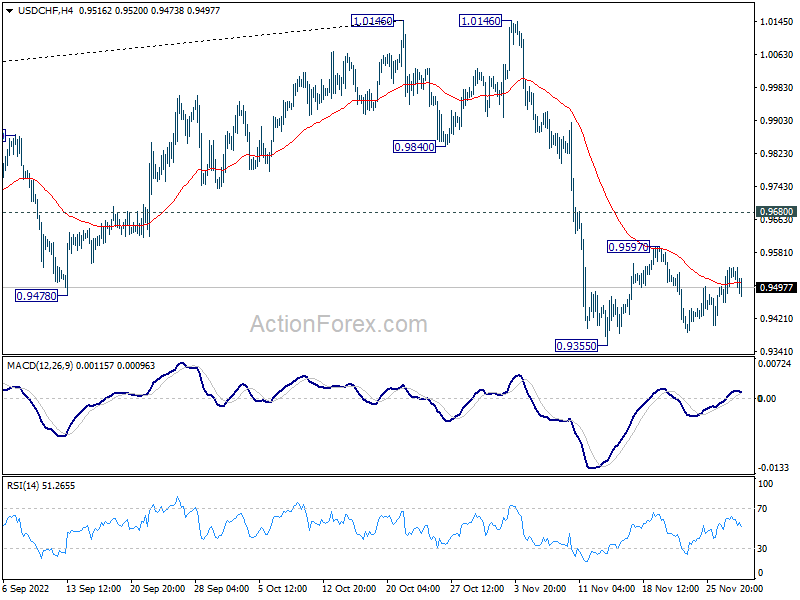
Intraday bias in USD/CHF remains neutral as sideway consolidation is extending. On the downside, firm break of 0.9355 will resume the decline from 1.0146 to 0.9287 fibonacci level. Near term outlook will remain bearish as long as 0.9680 minor resistance holds, in case of another recovery.
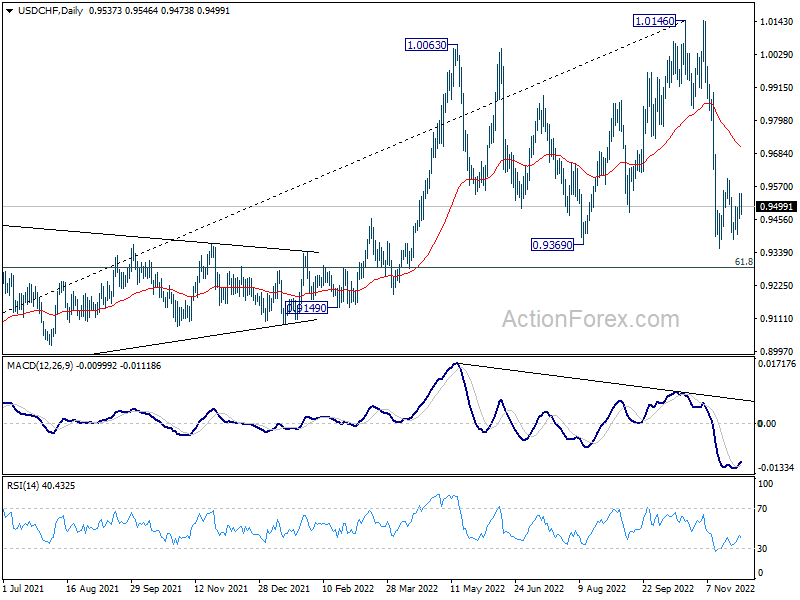
In the bigger picture, rise from 0.8756 (2021 low) has completed at 1.0146, well ahead of 1.0342 long term resistance (2016 high). Based on current downside momentum, fall from 1.0146 might be a medium term down trend itself. Break of 61.8% retracement of 0.8756 to 1.0146 at 0.9287 will pave the way to 0.8756. In any case, risk will stay on the downside as long as 55 day EMA (now at 0.9726) holds.
USD/JPY Mid-Day Outlook
Daily Pivots: (S1) 137.93; (P) 138.64; (R1) 139.42; More...
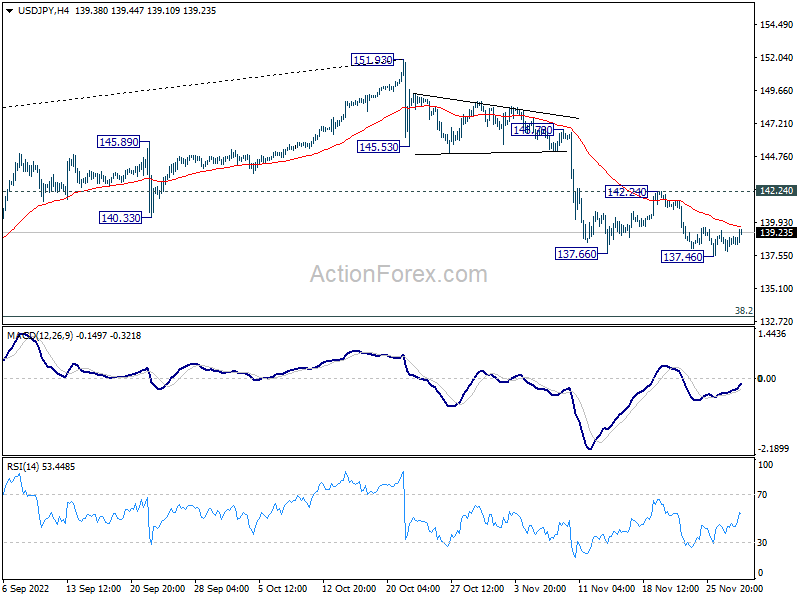
Intraday bias in USD/JPY is turned neutral first with today's recovery. Further decline will remain in favor as long as 142.24 resistance holds. Break of 137.36 will resume the fall from 151.93 to 133.07 medium term fibonacci level. However, firm break of 142.24 will indicate short term bottoming, and turn bias back to the upside for stronger rebound.
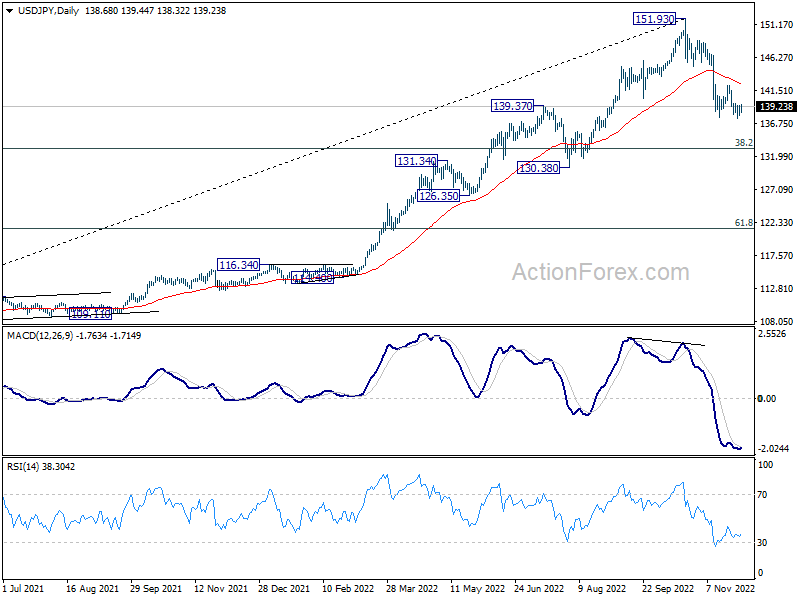
In the bigger picture, a medium term top should be formed at 151.93. Fall from there is correcting larger up trend from 102.58. It's too early to call for bearish trend reversal. But even as a corrective move, such decline should target 38.2% retracement of 102.58 to 151.93 at 133.07, or further to 55 week EMA (now at 131.51).
Little Reaction to US ADP and Eurozone CPI Miss, Consolidations Continue
Overall markets remain steady in consolidative trading today. There is little reaction to lower than expected Eurozone CPI and US ADP job data. Fed Chair Jerome Powell's speech might trigger some volatility, or traders will have to wait for non-farm payrolls on Friday. For now, Dollar is the strongest for the week, followed by Yen and Euro. Canadian remains the weakest followed by Sterling and Swiss Franc. Aussie and Kiwi are mixed.
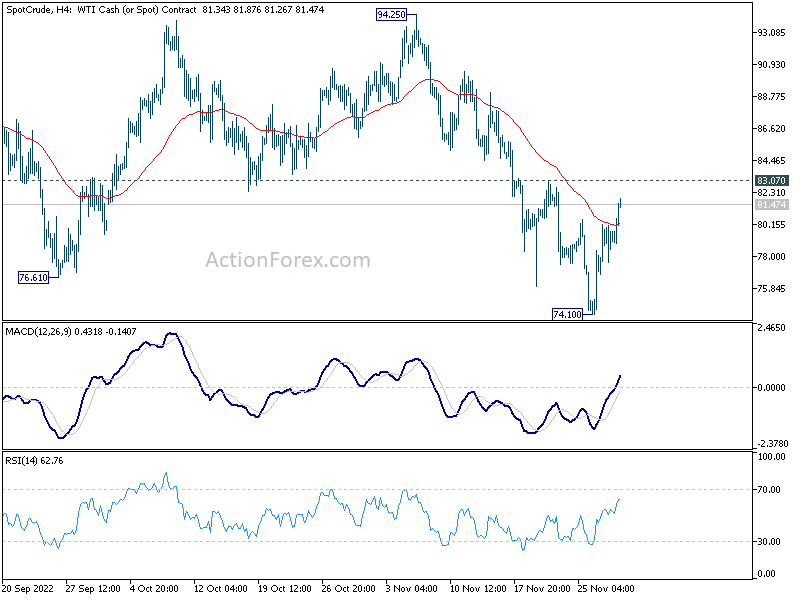
Technically, WTI crude oil staged a notably rebound this week after dipping to 71.40 initially. But it has yet to break through 83.07 minor resistance. Thus, another fall is in favor to resume the larger down trend. However, firm break of 83.07 will firstly confirm short term bottoming, and secondly open up further rise towards 94.25 resistance. Canadian Dollar could be give a lift if that happens.
In Europe, at the time of writing, FTSE is up 1.02%. DAX is up 0.26%. CAC is up 0.79%. Germany 10-year yield is up 0.030 at 1.954. Earlier in Asia, Nikkei dropped -0.21%. Hong Kong HSI rose 2.16%. China Shanghai SSE rose 0.05%. Singapore Strait Times rose 0.43%. Japan 10-year JGB yield dropped -0.0033 to 0.251.
US ADP employment grew 127k, Fed tightening having impact
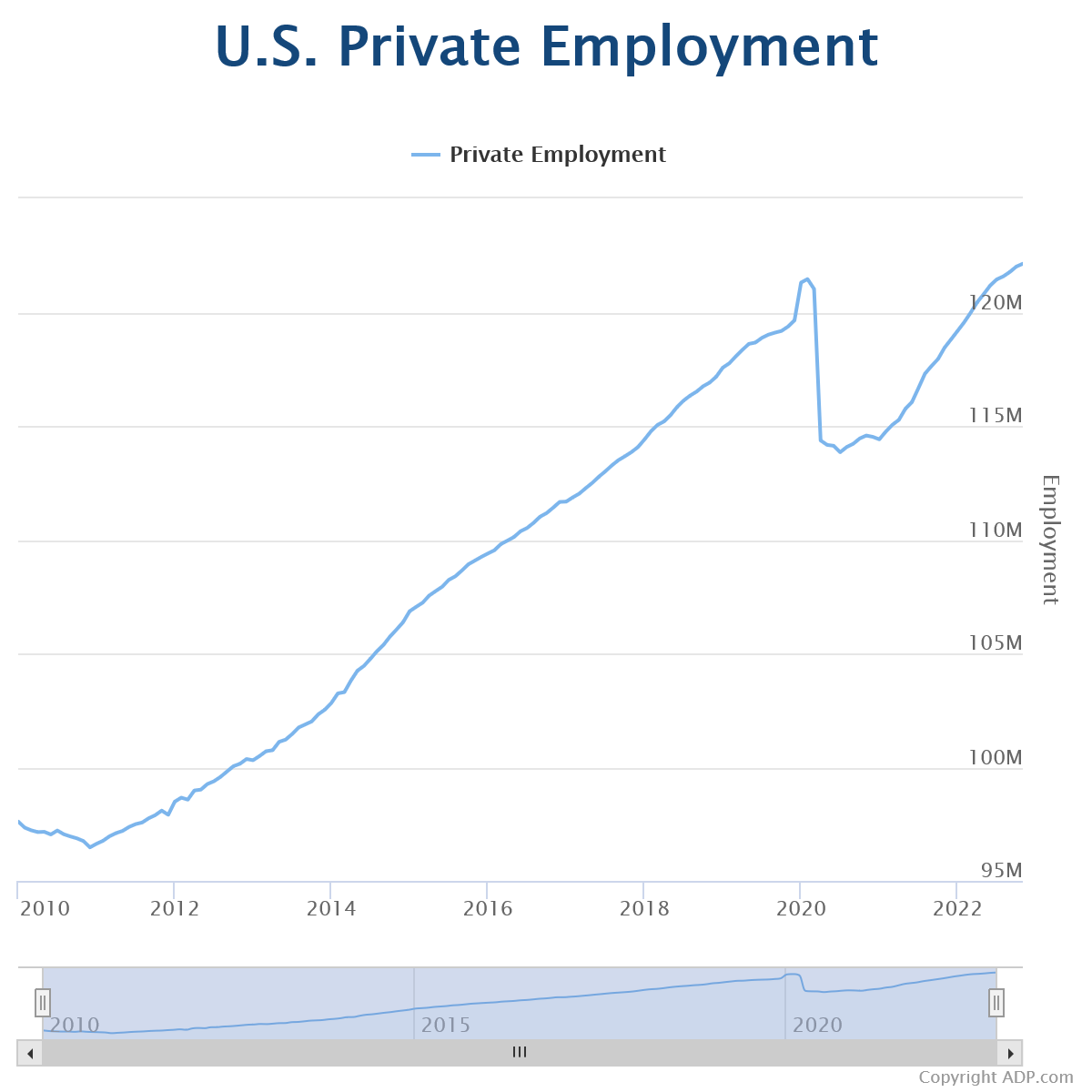
US ADP private employment grew 127k in November, below expectation of 195k. By sector, goods- producing jobs dropped -86k. Service-providing jobs rose 213k. By establishment size, small companies lost -51k jobs. Medium companies added 246k. Large companies lost -68k.
Turning points can be hard to capture in the labor market, but our data suggest that Federal Reserve tightening is having an impact on job creation and pay gains. In addition, companies are no longer in hyper-replacement mode. Fewer people are quitting and the post-pandemic recovery is stabilizing.
Also released, US Q3 GDP growth was revised up to 2.9% annualized, price index revised up to 4.3%. Goods trade deficit widened to USD -99.0B.
BoE Pill expects headline inflation to tail off in 2nd half of next year quite rapidly
BoE Chief Economist Huw Pill said at a conference, "we are expecting to see headline inflation tail off in the second half of next year, in fact quite rapidly, on account of those base effects." But, "there's a lot of uncertainty around the outlook for gas price developments," he added.
"Very low levels of unemployment and the association with the mid-1970s is not entirely reassuring from an inflection point of view," Pill said. "People in the 50 to 65 age group, relative to pre-COVID levels, are having a higher level of inactivity not being in a job and not looking for work."
Eurozone CPI slowed to 10% yoy in Nov
Eurozone CPI slowed from 10.6% yoy to 10.0% yoy in November, below expectation of 10.4% yoy. CPI ex-energy rose from 6.9% yoy to 7.0% yoy. CPI ex-energy, food, alcohol and tobacco was unchanged at 5.0% yoy.
Looking at the main components, energy is expected to have the highest annual rate in November (34.9%, compared with 41.5% in October), followed by food, alcohol & tobacco (13.6%, compared with 13.1% in October), non-energy industrial goods (6.1%, stable compared with October) and services (4.2%, compared with 4.3% in October).
Swiss KOF dropped to 89.5, economic outlook remains subdued
Swiss KOF Economic Barometer dropped from 90.9 to 89.5 in November, matched expectations. KOF said, "This is the fifth time in a row that the barometer has fallen. The outlook for the Swiss economy therefore remains subdued in the coming months."
KOF added: "The negative development of the barometer is primarily driven by indicator bundles for the sector other services. Indicators for the accommodation and food service activities sector and private consumption are also weakening. In contrast, indicator bundles covering foreign demand record a slight positive development."
France household consumption dropped sharply by -2.8% yoy in Oct
France household consumption dropped sharply by -2.8% mom in October, much worse than expectation of -0.9% mom. That's also the largest decline since April 2021, primarily due to the sharp drop in energy consumption (-7.9%), but also stems from the decline in purchases of manufactured goods (-1.7%) and in food consumption (-1.4%).
All item CPI was unchanged at 6.2% yoy in November. Food price accelerated from1 2.0% yoy to 12.2% yoy. Energy prices slowed from 19.1% yoy to 18.5% yoy. Manufacturing products rose from 4.2 yoy to 4.4% yoy while services dropped from 3.1% yoy to 3.0% yoy.
Q3 GDP grew 0.2% qoq, unrevised.
China PMI manufacturing dropped to 48.0, non-manufacturing down to 46.7
China NBS PMI Manufacturing dropped from 49.2 to 48.0 in November, below expectation of 49.2. PMI Non-Manufacturing dropped from 48.7 to 46.7, below expectation of 48.0. Both readings were the lowest in seven months.
"In November, impacted by multiple factors including the wide and frequent spread of domestic outbreaks, and the international environment becoming more complex and severe, China's purchasing managers' index fell," NBS senior statistician Zhao Qinghe said in a statement.
Zhao said domestic outbreaks in November caused "production activity to slow down and product orders to fall", noting "increased fluctuation in market expectations".
Japan industrial production dropped -2.6% mom in Oct, but bounce back expected
Japan industrial production dropped -2.6% mom in October, worse than expectation of -1.8% mom.
The seasonally adjusted production index for the manufacturing and mining sectors stood at 95.9 against 100 for the base year of 2015. The shipment index stood at 94.1, down -1.1%, and the inventory index at 103.0, down -0.8%.
The Ministry of Trade, Economy and Industry expects production to rise 3.3% in November and then 2.4% in December.
METI cut its assessment of industrial output for the first time in five months, saying "production is gradually picking up, but some weaknesses are observed."
Australia monthly CPI slowed to 6.9% yoy in Oct, food inflation eased
Australia monthly CPI slowed from 7.3% yoy to 6.9% yoy in October. The most significant contributors to the annual rise were new dwellings (+20.4%), automotive fuel (+11.8%) and fruit and vegetables (+9.4%).
"High levels of building construction activity and ongoing shortages of labour and materials contributed to the rise in new dwellings" Michelle Marquardt, ABS Head of Prices Statistics said.
Automotive fuel prices accelerated from 10.1% to 11.8% as the government's temporary cut to the fuel excise ended on September 29. Annually, prices for fruit and vegetables rose by 9.4%, down from 17.4% in September.
NZ ANZ business confidence dropped to -57.1, strain showing for businesses
New Zealand ANZ Business Confidence dropped from -42.7 to -57.1 in November. Looking at some details, own activity outlook dropped from -2.5 to -13.7, just 8 pts shy of 2009 lows. Export intentions dropped from -4.3 to -5.4. Investment intentions dropped from 1.1 to -8.1. Employment intentions dropped from 5.0 to -4.0. Pricing intentions dropped from 64.5 to 58.5. Cost expectations ticked up from 88.6 to 88.7. Inflation expectations rose from 6.13 to 6.39.
ANZ said, "The strain is showing for kiwi businesses. Cost increases remain relentless and margins are squeezed, firms are chronically understaffed, and they're waiting for the hammer to fall as the impact of relentless monetary policy tightening eventually kicks in. There are a lot of dark clouds on the horizon, and this month's survey reflects that."
USD/JPY Mid-Day Outlook
Daily Pivots: (S1) 137.93; (P) 138.64; (R1) 139.42; More...
Intraday bias in USD/JPY is turned neutral first with today's recovery. Further decline will remain in favor as long as 142.24 resistance holds. Break of 137.36 will resume the fall from 151.93 to 133.07 medium term fibonacci level. However, firm break of 142.24 will indicate short term bottoming, and turn bias back to the upside for stronger rebound.
In the bigger picture, a medium term top should be formed at 151.93. Fall from there is correcting larger up trend from 102.58. It's too early to call for bearish trend reversal. But even as a corrective move, such decline should target 38.2% retracement of 102.58 to 151.93 at 133.07, or further to 55 week EMA (now at 131.51).
Economic Indicators Update
| GMT | Ccy | Events | Actual | Forecast | Previous | Revised |
|---|---|---|---|---|---|---|
| 21:45 | NZD | Building Permits M/M Oct | -10.70% | 3.80% | 3.60% | |
| 23:50 | JPY | Industrial Production M/M Oct P | -2.60% | -1.80% | -1.70% | |
| 00:00 | NZD | ANZ Business Confidence Nov | -57.1 | -42.7 | ||
| 00:01 | GBP | BRC Shop Price Index Y/Y Oct | 7.40% | 6.60% | ||
| 00:30 | AUD | Private Sector Credit M/M Oct | 0.60% | 0.60% | 0.70% | |
| 00:30 | AUD | Building Permits M/M Oct | -6.00% | -2.00% | -5.80% | -8.10% |
| 00:30 | AUD | Construction Work Done Q3 | 2.20% | 2.00% | -3.80% | -2.00% |
| 01:00 | CNY | Manufacturing PMI Nov | 48 | 49.2 | 49.2 | |
| 01:00 | CNY | Non-Manufacturing PMI Nov | 46.7 | 48 | 48.7 | |
| 05:00 | JPY | Housing Starts Y/Y Oct | -1.80% | -0.50% | 1.00% | |
| 07:45 | EUR | France Consumer Spending M/M Oct | -2.80% | -0.90% | 1.20% | |
| 07:45 | EUR | France GDP Q/Q Q3 | 0.20% | 0.20% | 0.20% | |
| 08:00 | CHF | KOF Leading Indicator Nov | 89.5 | 89.5 | 90.9 | |
| 08:55 | EUR | Germany Unemployment Change Nov | 17K | 10K | 8K | |
| 08:55 | EUR | Germany Unemployment Rate Nov | 5.60% | 5.50% | 5.50% | |
| 09:00 | CHF | Credit Suisse Economic Expectations Nov | -57.5 | -53.1 | ||
| 10:00 | EUR | Eurozone CPI Y/Y Nov P | 10.00% | 10.40% | 10.60% | |
| 10:00 | EUR | Eurozone CPI Core Y/Y Nov P | 5.00% | 4.90% | 5.00% | |
| 13:15 | USD | ADP Employment Change Nov | 127K | 195K | 239K | |
| 13:30 | USD | GDP Annualized Q3 P | 2.90% | 2.60% | 2.60% | |
| 13:30 | USD | GDP Price Index Q3 P | 4.30% | 4.10% | 4.10% | |
| 13:30 | USD | Wholesale Inventories Oct P | 0.80% | 0.50% | 0.60% | |
| 13:30 | USD | Goods Trade Balance (USD) Oct P | -99.0B | -90.2B | -92.2B | -91.9B |
| 14:45 | USD | Chicago PMI Nov | 45.4 | 45.2 | ||
| 15:00 | USD | Pending Home Sales M/M Oct | -5.80% | -10.20% | ||
| 15:30 | USD | Crude Oil Inventories | -3.2M | -3.7M |
China Slows Sharper than Expected
In addition to the riots against tight covid restrictions since the weekend, China is also facing broader adverse effects of the strict anti-Covenant policy, PMI data shows.
The official survey showed the manufacturing index falling from 49.2 to 48.0 – well below the median forecast of 49.0. The non-manufacturing sector activity index fell from 48.7 to 46.7 against the expected 48.8. This is the lowest level since April when the fall was also due to covid restrictions.
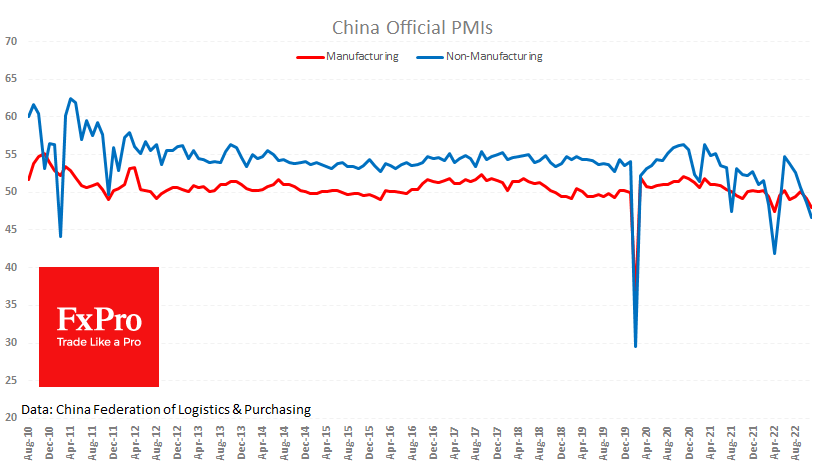
We recall that values below 50 indicate a contraction in activity, and Chinese manufacturing activity indices have marginally and sporadically exceeded this waterline since August 2021. The service sector is more energetic, but the PMI is also more volatile. The latest dip in the indices signals that the economy is choking on excessive austerity policies.
At the same time, markets are betting that the government has picked up on this signal by announcing small relaxations in regulations time after time since the start of the week.
Separately, the Chinese government is trying to cautiously improve the investment climate by allowing distressed developers to raise capital via equity issues and lowering the reserve requirement rate last week. So, while the IMF warns that it will reduce China’s GDP forecasts, markets are waving off hopes for a turnaround after more than a year and a half of negativity.
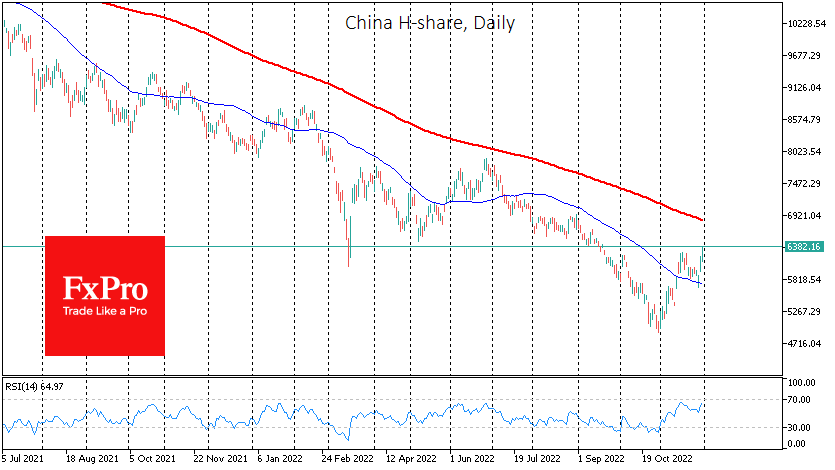
China’s equity markets posted their most substantial monthly gain in years in November, turning strictly to the upside on the first day of November. An upbeat end to the month, with the Hang Seng and H-share indices rallying more than 10% from the opening week and recovering to September levels, sets a positive tone. The strong rally after 20 months of a down-trend suggests that the beginning of the new month will also be bullish. From here on, however, China will have to provide demand from investors with improved data or progress in policy.
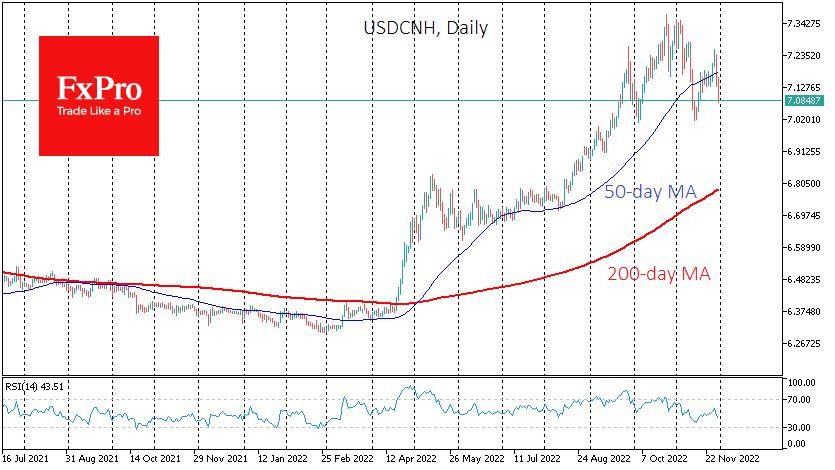
The Chinese renminbi has gained over 2.4% against the dollar in the last two days, indicating further capital inflows into domestic assets. Interestingly, the dollar has generally strengthened in the global market these days. The performance of the renminbi reinforces expectations of a worldwide change in the dollar trend from bullish to bearish.
However, a longer-term view of PMI trends clearly shows how the Middle Kingdom’s economy is fading with the start of trade wars in 2018. With a solution for this issue, China is likely to accelerate sharply.
US ADP employment grew 127k, Fed tightening having impact
US ADP private employment grew 127k in November, below expectation of 195k. By sector, goods- producing jobs dropped -86k. Service-providing jobs rose 213k. By establishment size, small companies lost -51k jobs. Medium companies added 246k. Large companies lost -68k.
Turning points can be hard to capture in the labor market, but our data suggest that Federal Reserve tightening is having an impact on job creation and pay gains. In addition, companies are no longer in hyper-replacement mode. Fewer people are quitting and the post-pandemic recovery is stabilizing.