Sample Category Title
France household consumption dropped sharply by -2.8% yoy in Oct
France household consumption dropped sharply by -2.8% mom in October, much worse than expectation of -0.9% mom. That's also the largest decline since April 2021, primarily due to the sharp drop in energy consumption (-7.9%), but also stems from the decline in purchases of manufactured goods (-1.7%) and in food consumption (-1.4%).
All item CPI was unchanged at 6.2% yoy in November. Food price accelerated from1 2.0% yoy to 12.2% yoy. Energy prices slowed from 19.1% yoy to 18.5% yoy. Manufacturing products rose from 4.2 yoy to 4.4% yoy while services dropped from 3.1% yoy to 3.0% yoy.
Q3 GDP grew 0.2% qoq, unrevised.
NZDUSD Consolidates after the 200-day SMA Rejects Advance
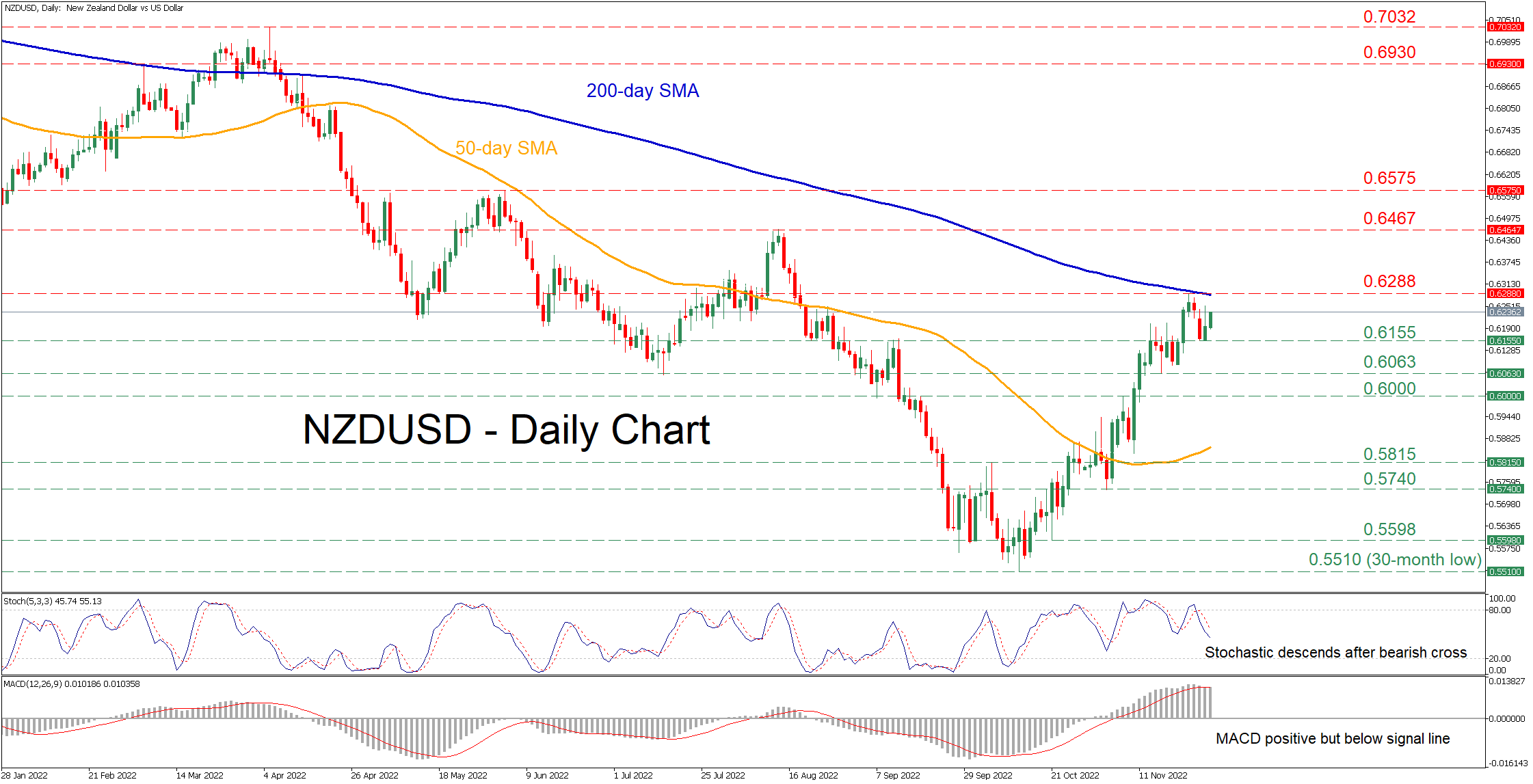
NZDUSD has been trending lower since March, generating a profound structure of lower highs and lower lows. Even though the pair has posted a moderate recovery after finding its feet at the 30-month low of 0.5510, the 200-day simple moving average (SMA) has curbed further advances.
The momentum indicators suggest that bullish forces are subsiding. Specifically, the stochastic oscillator is descending after posting a bearish cross, while the MACD histogram has fallen below its red signal line but remains in the positive zone.
To the downside, the recent support of 0.6155 could act as the first line of defense. Sliding beneath that floor, the bears could target 0.6063 before the crucial 0.6000 psychological mark appears on the radar. Violating this zone, the price might retreat towards the inside swing high of 0.5815.
Alternatively, should buyers regain control, the pair may test the recent rejection point of 0.6288, which overlaps with the 200-day SMA. Conquering this barricade, the price might ascend towards the August peak of 0.6466. Failing to halt there, any further advances could cease at the June peak of 0.6575.
Overall, NZDUSD has managed to erase a substantial part of its steep decline, but the rebound has stalled at the 200-day SMA. Hence, a clear break above the latter could open the door for further recovery.
Official Chinese November PMIs Disappointed
Markets
First releases of EMU November CPI in several EMU members states fueled the debate whether or not EMU inflation has reached its peak. Spanish headline inflation dropped faster than expected (HICP -0.5% M/M and 6.6% Y/Y, from 7.1% Y/Y). Belgian CPI showed a similar picture (-0.23% M/M to 10.63% Y/Y, from 12,27%). However, in both cases core inflation continued to rise. German regional inflation data suggested a substantial slowdown, but in the end, the harmonized measure only eased to 0.0% M/M and 11.3% Y/Y (from 11,6%), a result very close to expectations. German yields initially dropped about 15 bps at the short end of the curve and 10+ bps for longer maturities, but part of this decline was recouped later. In a (modest) steepening move, German yields closed between 8.7 bps (2-y) and 7 bps (10/30-y) lower. Despite persistent high underlying inflation, markets discount a >80% probability for the ECB to shift to a 50 bps rate hike instead of 75 bps. US yield initially were dragged lower in lockstep with Europe, but changed course in US dealings, rising between 3.5 bps (2-y) and 8 bps (30-y). Markets apparently considered that the US bond rally had gone far enough given recent persistent hawkish Fed speak (continue hiking in 2023 and rates to stay higher for longer). US consumer confidence was close to expectations and didn’t add much to the debate. The dollar slightly outperformed (DXY close 106.82; EUR/USD 1.033 from 1.034 on Monday), but gains again were not impressive given divergence in the interest rate markets (and a higher US real rate). US equities closed between unchanged (Dow) and 0.59% lower (Nasdaq).
Asian markets show a mixed picture this morning, with small losses for mainland China and Japan, while most other regional indices are trading in positive territory. At least for now, investors don’t draw any further conclusions about the impact to the (new?) China Covid policy. Chinese PMI disappointed but with little market impact (see infra). US yields and the dollar are ceding modest ground. (EUR/USD 1.0345; USD/JPY 138,5).
The first estimate of the EMU November CPI will be published today. An easing to 0.2% M/M and 10.4% Y/Y (from 1.5% and 10.6% ) is expected. Core inflation is seen unchanged at 5%. Stubbornly higher core inflation probably leaves little room of a further dovish market positioning. In the US, the ADP job report (200k), JOLTS job openings and Chicago PMI are interesting, but the market focus is on Fed Powell’s speech later this evening. We expect him to reconfirm that demand remains strong and the labour market tight, supporting the case for the Fed to raise rates further and keep them at an elevated level for longer. His comments in theory could support a bottoming out process after recent setback both in US yields and the dollar.
News Headlines
Australian October inflation eased unexpectedly from 7.3% to 6.9% y/y, missing the bar for a further acceleration to 7.6%. The trimmed mean inflation, excluding the 15% tails of the CPI component distribution, eased from 5.4% to 5.3% vs the 5.7% expected. Increased fruit & vegetables supplies and eased costs of holiday travel & accommodation helped to cool down the October number. Housing (20.4% y/y) and fuel costs (11.8%) still keep inflation at elevated levels. Australian swap yields decline between 6.9-8.2 bps across the curve. Money markets are further paring bets for even a 25 bps rate RBA hike next week. Instead they currently assume a 15 bps move that would bring the policy rate from 2.85% to a more “standard” level of 3%. The impact on the Australian dollar, if any, was only temporary. AUD/USD ekes out small gains on the back of a slightly weaker USD. The pair is trading around the 0.67 big figure.
Official Chinese November PMI’s disappointed. The manufacturing gauge fell from 49.2 to 48. Non-manufacturing PMI ventured two points deeper in contraction territory at 46.7, bringing the composite indicator to 47.1 – the lowest since April’s Shanghai lockdown. Both output and demand weakened, again due to Covid and the strict measures to contain it. While China is exploring ways to live with the virus without a zero-Covid strategy, a recovery in sentiment and economy will probably only be very gradually. The government and the central bank recently offered more support (property stimulus package and lower RRR). China’s yuan this morning trades a tad stronger against an overall weaker USD. USD/CNY nudges lower from 7.157 to 7.144.
XAU/USD Consolidates Gains
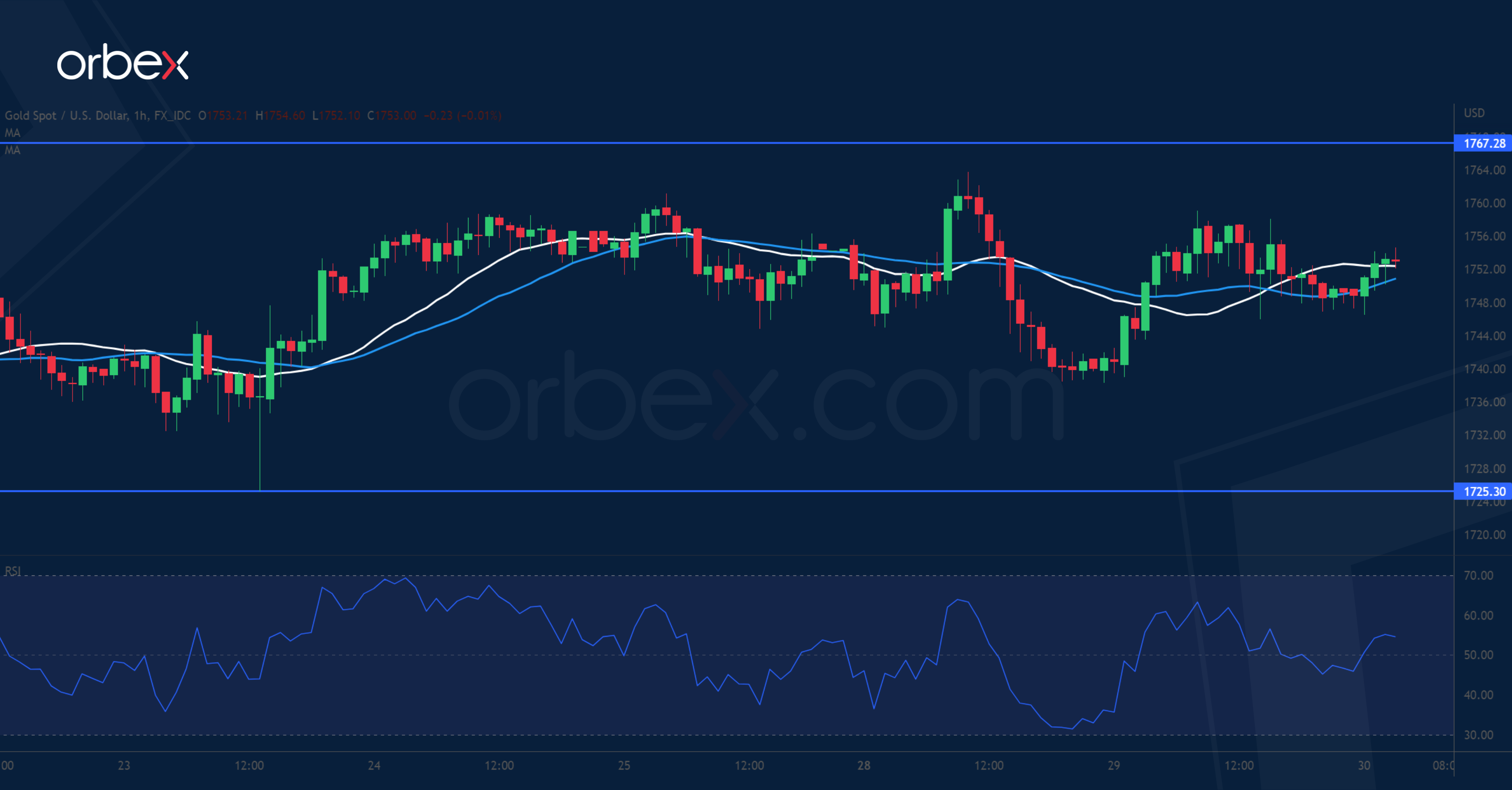
Gold struggles as the US dollar bounces due to repositioning ahead of the job report. The price has been consolidating above the previous double top formed by September’s and October’s highs near 1725, which sits over the 20-day moving average. Sentiment has turned upbeat following the breakout and a bullish MA cross on the daily chart. 1767 is the closest resistance and its breach would extend the rally to August’s peak at 1805. A drop below 1725, however, could trigger a liquidation below the psychological level of 1700.
USD/CAD Breaks Resistance
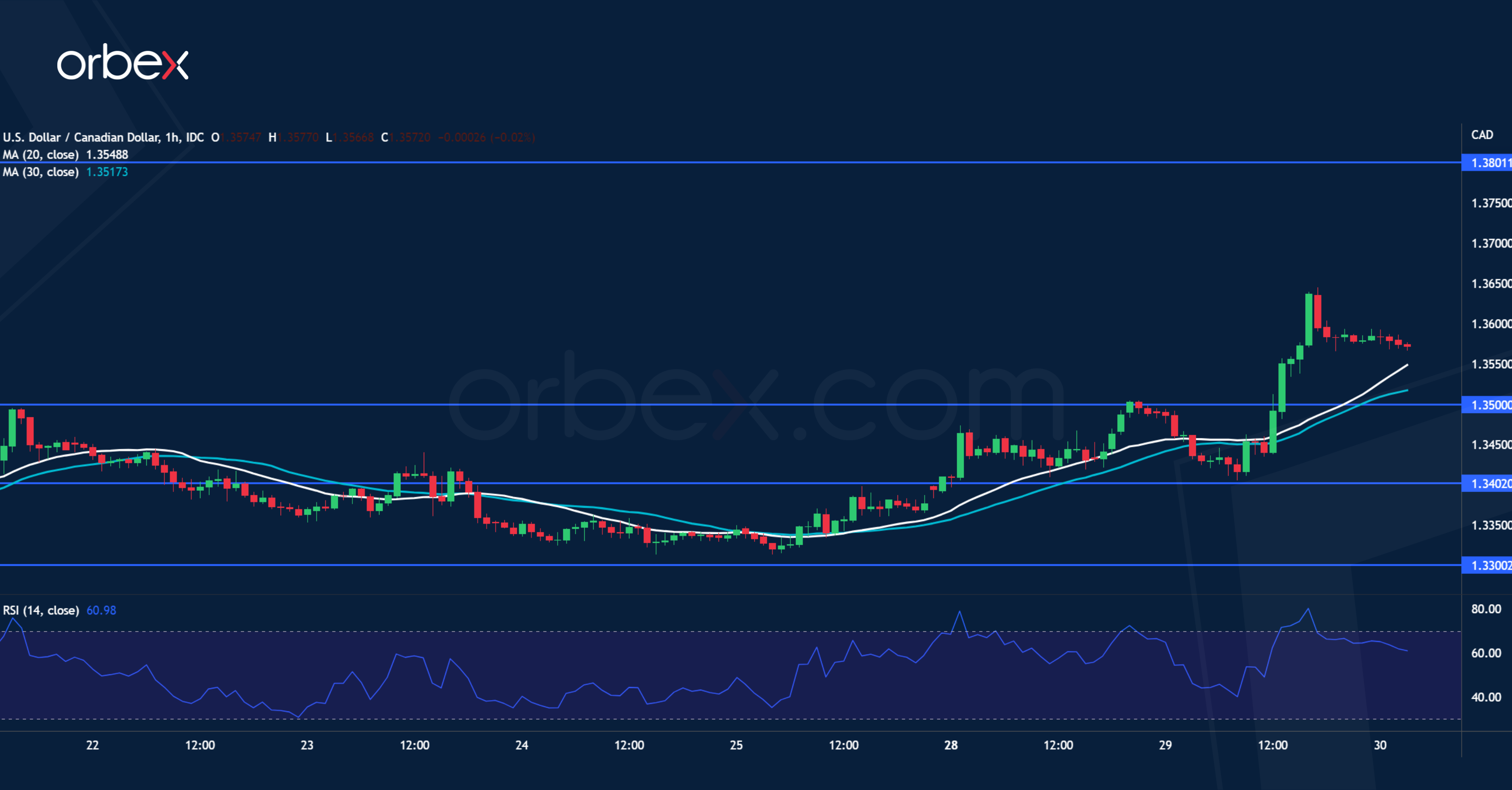
The Canadian dollar tumbled over a deceleration in the Q3 GDP. A series of higher lows had already shown growing buying pressure. A break above 1.3570, a support-turned-resistance from a sell-off earlier this month may help the pair regain traction and extend to November’s peak of 1.3800. A close above this hurdle could pave the way for a bullish continuation above 1.4000. 1.3500 has become a fresh support in case the momentum fades. 1.3400 is the bulls’ second line of defence in case of a deeper correction.
USD/CHF Attempts to Bounce Back
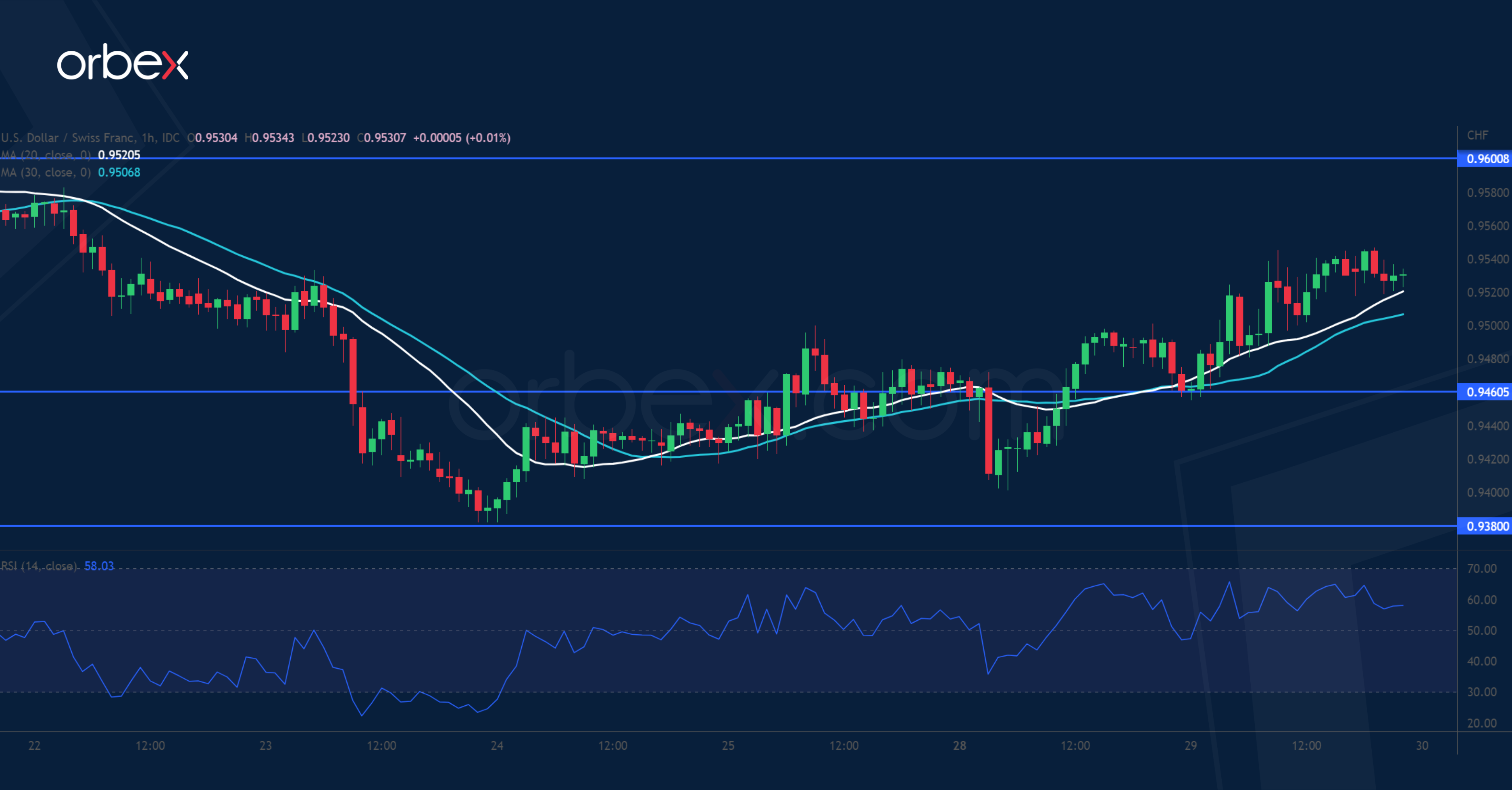
The Swiss franc weakened after the Q3 GDP fell short of expectations. A tentative break below last August’s low of 0.9380 further put the bulls on the defensive. Multiple tests at this level show strong interest in keeping the greenback steady. The recent high at 0.9600 is a key resistance which coincides with the 20-day moving average, making it a congestion area. A bullish breakout would send the pair to 0.9750. 0.9460 is a fresh support and the price could be vulnerable to a new round of sell-off if it falls through 0.9380.
GBP/JPY Daily Outlook
Daily Pivots: (S1) 165.28; (P) 165.98; (R1) 166.42; More...
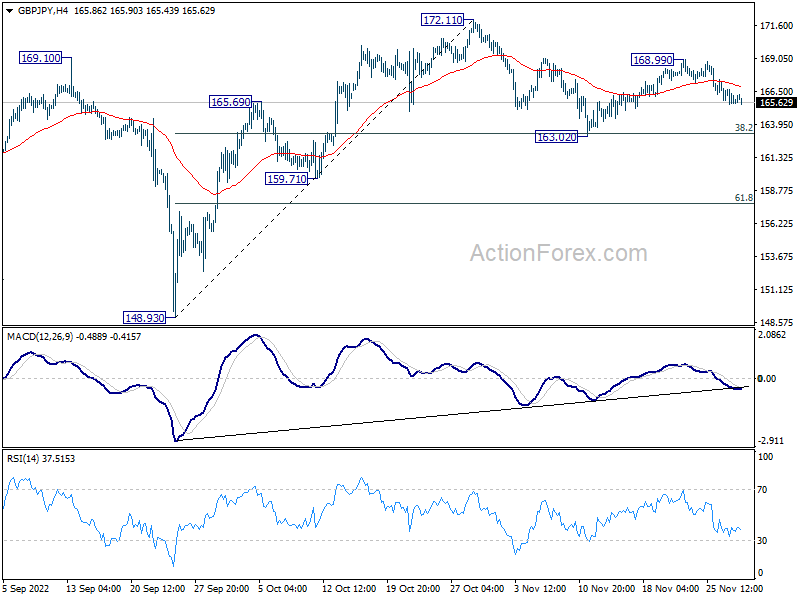
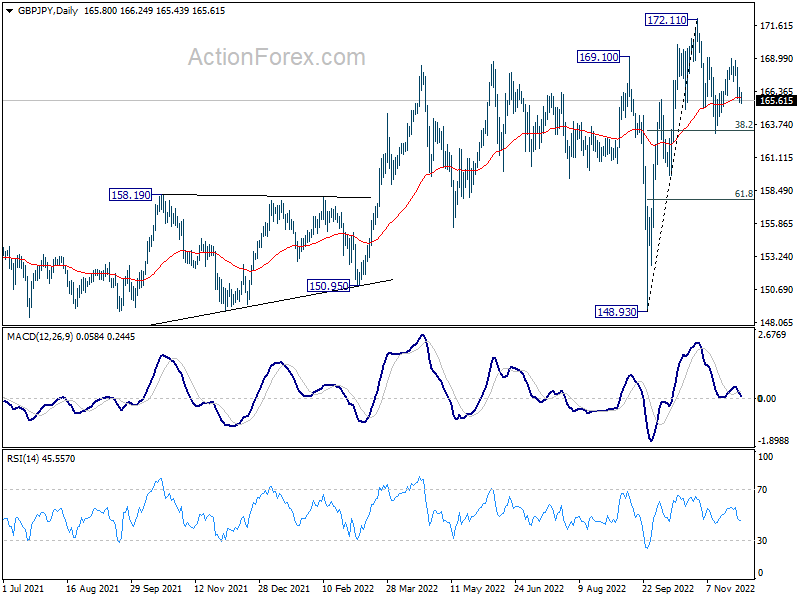
Intraday bias in GBP/JPY stays mildly on the downside for retesting 163.02 support. Break there will resume whole decline from 172.11 to 159.71 support next. For now, risk will stay on the downside as long as 168.99 resistance holds.
In the bigger picture, there is no clear sign of medium term topping yet. Up trend from 123.94 (2020 low) could still resume through 172.11 high at a later stage. However, firm break of 159.71 support will argue that it's already in correction to the up trend from 123.94, and deeper decline would be seen back towards 148.93 support.
EUR/JPY Daily Outlook
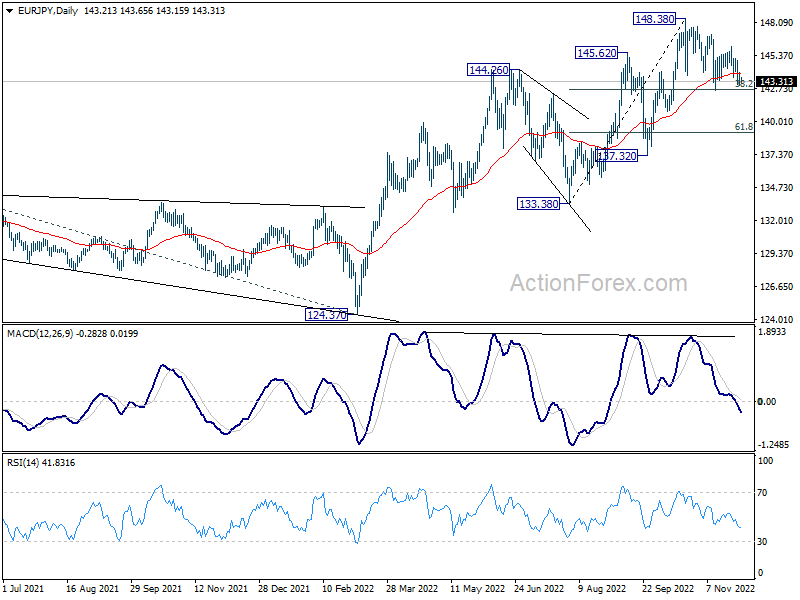
Daily Pivots: (S1) 142.83; (P) 143.43; (R1) 143.84; More....
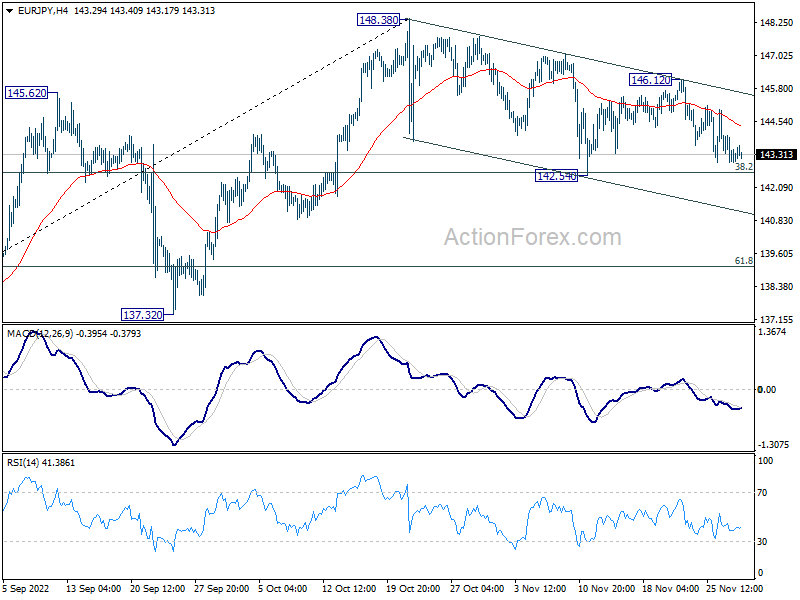
Intraday bias in EUR/JPY remains neutral for the moment. On the downside, break of 142.52 support will extend the decline from 148.38, to 61.8% retracement of 133.38 to 148.38 at 139.11. On the upside, though, above 146.12 minor resistance will bring stronger rebound back to retest 148.38 high instead.
In the bigger picture, there is no clear sign of medium term topping yet. Up trend from 114.42 (2020 low) could still resume through 148.38 to 149.76 (2014 high). However, break of 137.32 support argue that a medium term correction has already started to correct the whole up trend from 114.42.
EUR/GBP Daily Outlook
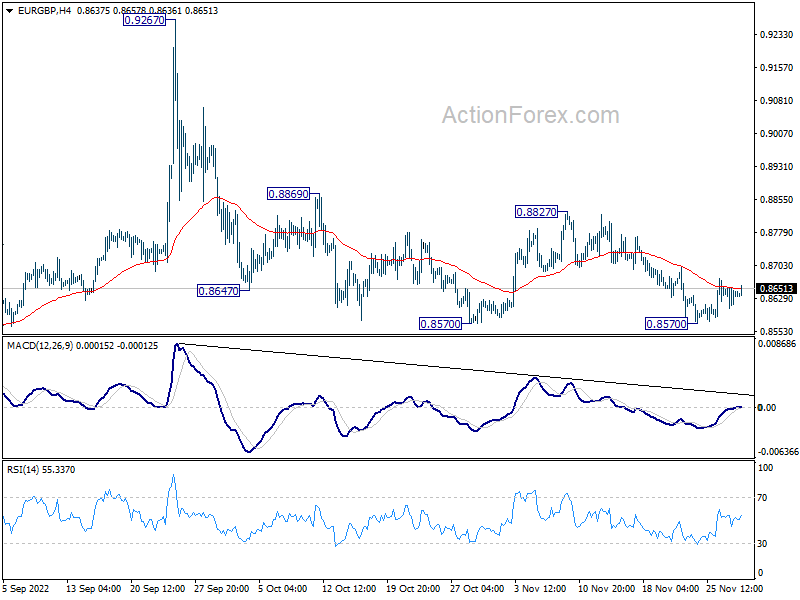
Daily Pivots: (S1) 0.8617; (P) 0.8634; (R1) 0.8661; More...
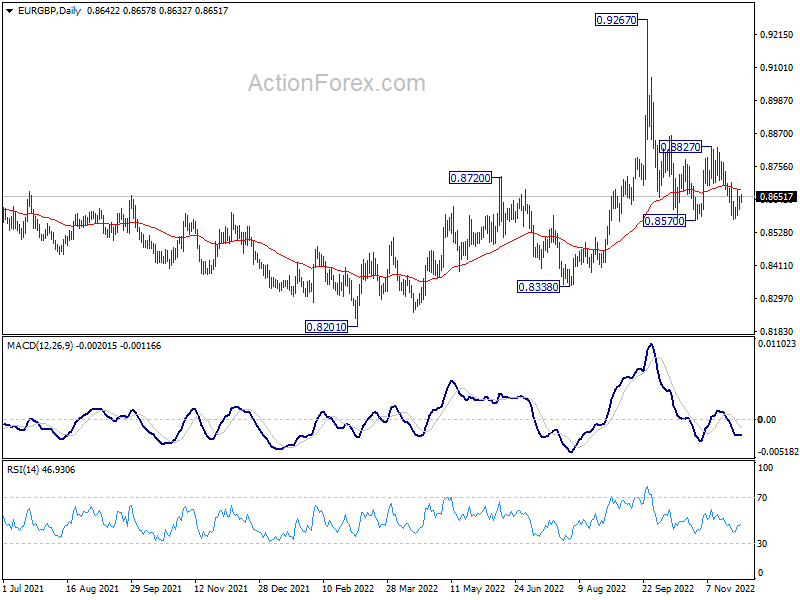
Intraday bias in EUR/GBP is mildly on the upside for stronger recovery. But overall outlook will remain bearish as long as 0.8827 resistance holds. Firm break of 0.8570 will resume the decline from 0.9267, towards 0.8338 support.
In the bigger picture, current development suggests that fall from 0.9267 is a down leg inside long term range pattern. Deeper fall could be seen towards 0.8201/8338 support zone. But strong support should be seen there to bring reversal. Nevertheless, firm break of 0.8827 resistance will turn favor to the case that such decline is merely a correction in the up trend from 0.8201. That is, further rally would be seen at a later stage through 0.9267.
EUR/AUD Daily Outlook
Daily Pivots: (S1) 1.5355; (P) 1.5460; (R1) 1.5548; More...
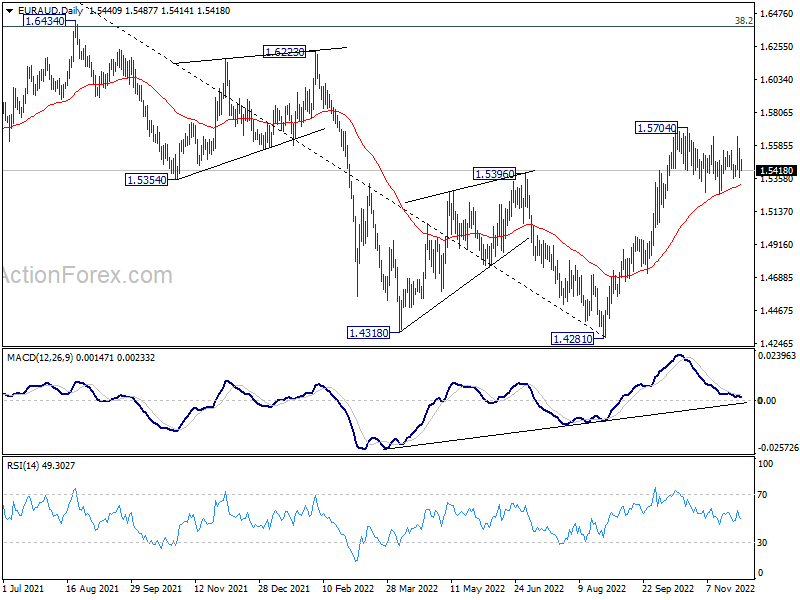
Consolidation from 1.5704 is extending and intraday bias in EUR/AUD remains neutral first. . In case of another fall, downside should be contained by 55 day EMA (now at 1.5318) to bring rebound. On the upside, decisive break of 1.5704 resistance will resume whole rally from 1.4281.
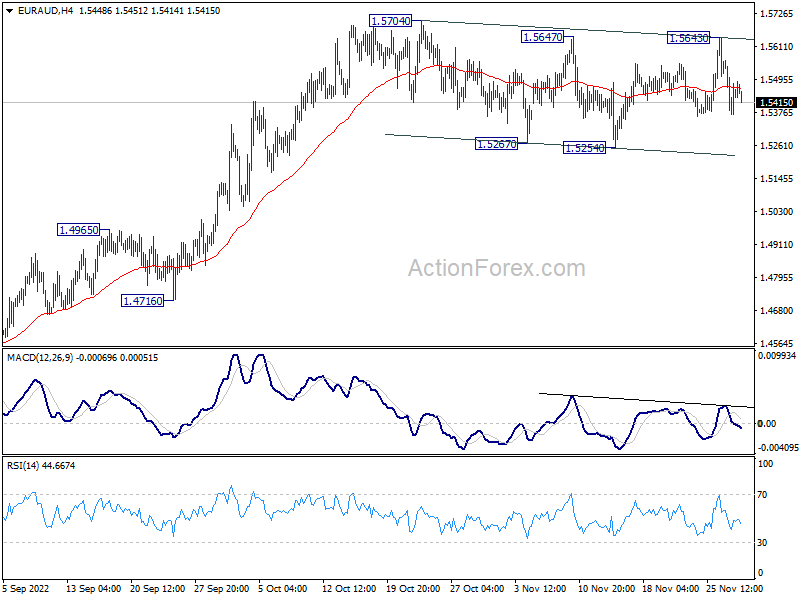
In the bigger picture, a medium term bottom should be in place at 1.4281, on bullish convergence condition in daily MACD. Further rise would be seen back to 1.6434 key resistance next. Break of 1.4965 resistance turned support is needed to indicate reversal. Otherwise, further rally will remain in favor.