

Sample Category Title
EUR/USD Daily Outlook
Daily Pivots: (S1) 0.9939; (P) 0.9987; (R1) 1.0068; More...
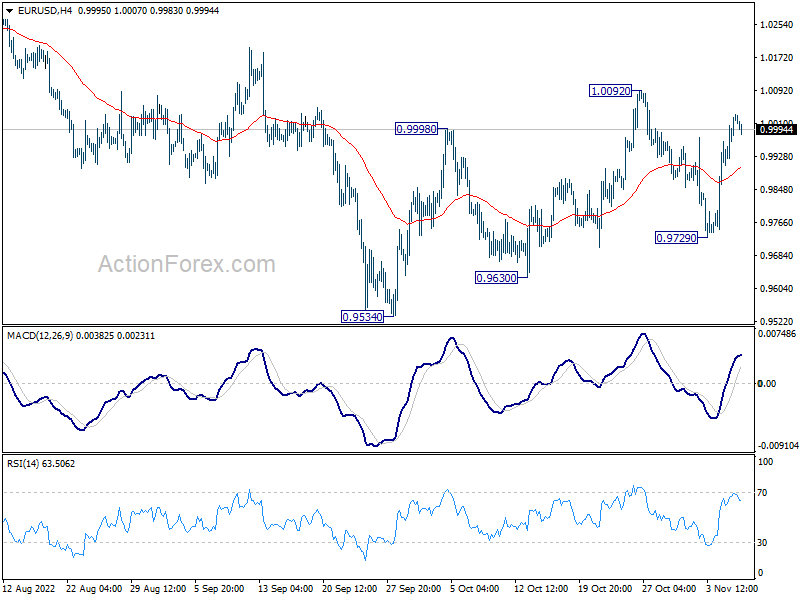
Intraday bias in EUR/USD remains neutral for the moment. On the upside, firm break of 1.0092 will resume the rebound from 0.9534. Next target is 1.0368 resistance. On the downside, break of 0.9729 will reaffirm the case the corrective rise from 0.9534 has completed at 1.0092. Deeper fall would then be seen to retest 0.9534 low next.
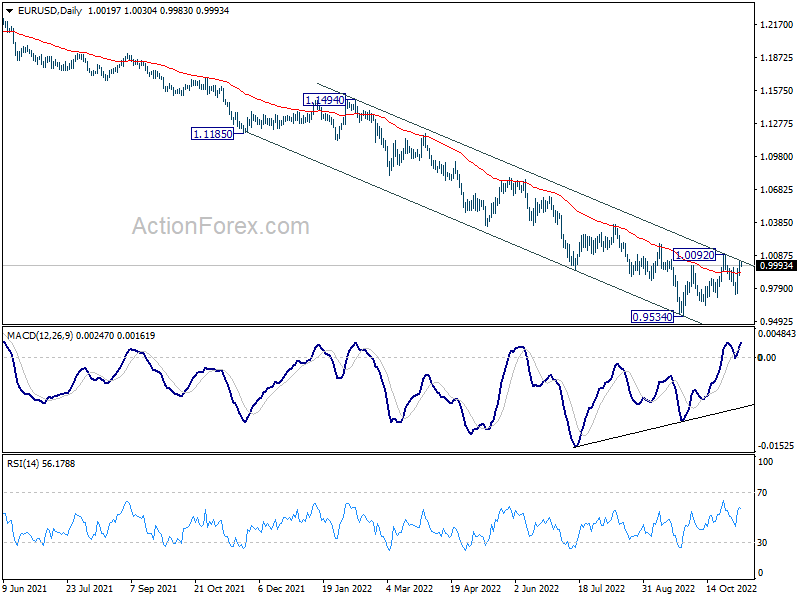
In the bigger picture, medium term outlook stays bearish with trading inside the falling channel. That is larger down trend from 1.2348 (2021 high) is still in progress. Firm break of 0.9534 low will confirm this bearish case. However, break of 1.0092 will add to the case of medium term bottoming, on bullish convergence condition in daily MACD, and bring further rally towards 55 week EMA (now at 1.0583).
GBP/USD Daily Outlook
Daily Pivots: (S1) 1.1356; (P) 1.1449; (R1) 1.1607; More...
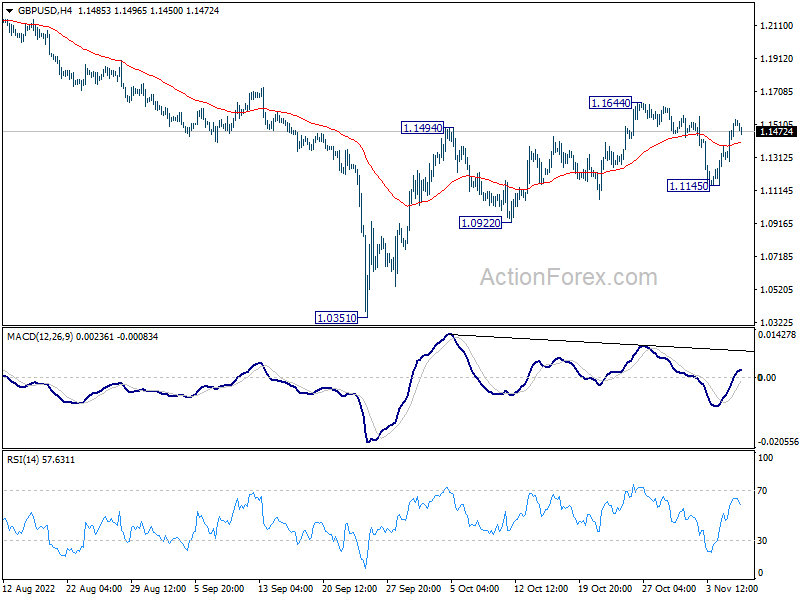
Intraday bias in GBP/USD stays neutral at this point. On the upside, break of 1.1644 will resume the whole rise from 1.0351 and target 1.1759/2292 resistance zone. On the downside, break of 1.1145 will reaffirm the case that corrective rise from 1.0351 has completed at 1.1644. Deeper fall would then be seen back to 1.0922 support and below.
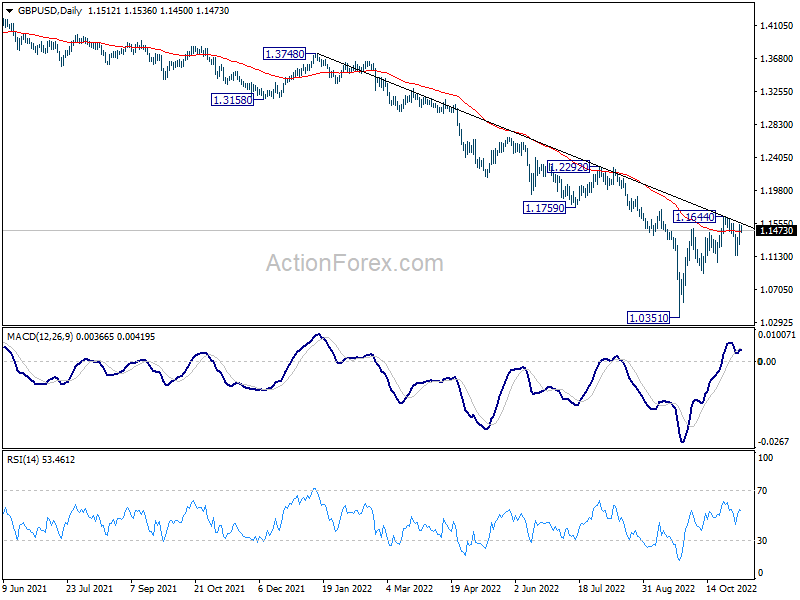
In the bigger picture, fall from 1.4248 (2018 high) is part of the long term down trend from 2.1161 (2007 high). Outlook will stay bearish as long as 1.1759 support turned resistance holds. Parity would be the next target on resumption. Nevertheless, firm break of 1.1759 will confirm medium term bottoming, and open up stronger rise back to 55 week EMA (now at 1.2357).
USD/JPY Daily Outlook
Daily Pivots: (S1) 146.02; (P) 147.21; (R1) 147.86; More...
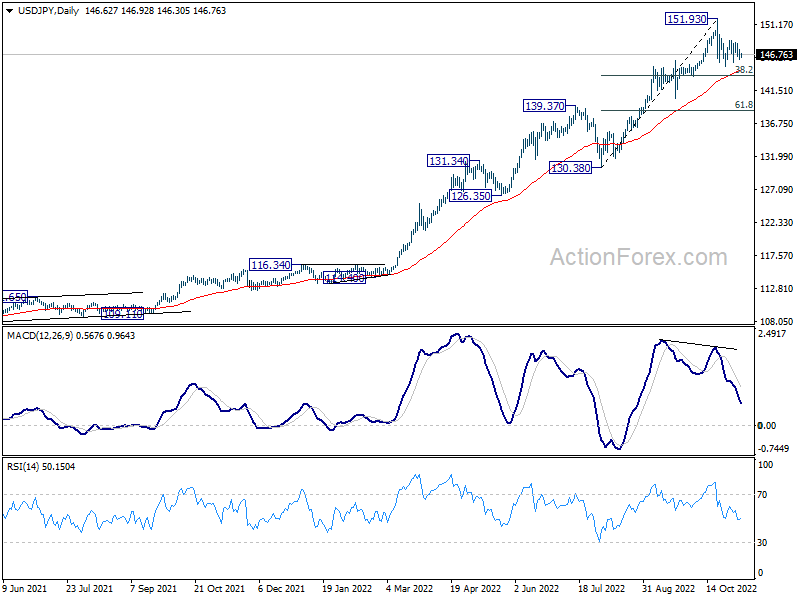
Intraday bias in USD/JPY stays neutral as consolidation from 151.93 is still extending. In case of deeper fall, downside should be contained by 38.2% retracement of 130.38 to 151.93 at 143.69 to bring rebound. On the upside, above 149.69 minor resistance will bring stronger rebound back towards 151.93 high. But upside should be limited there to continue the corrective pattern.
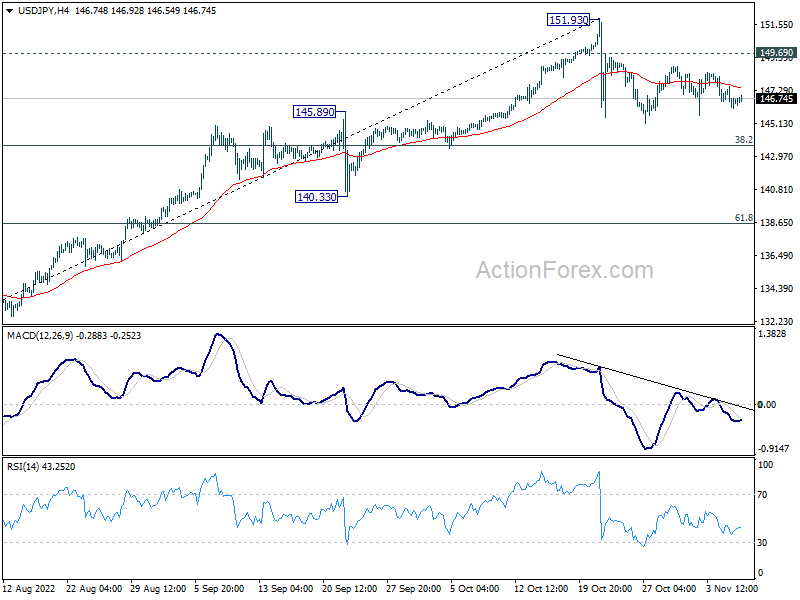
In the bigger picture, up trend from 101.18 is still in progress, as part of the whole up trend from 75.56 (2011 low). 147.68 (1998 high) was already met and there is no clearly sign of topping yet. In any case, break of 140.33 support is needed to be the first sign of medium term topping. Otherwise, further rise is in favor to next target at 160.16 (1990 high).
US 30 Grinds Higher
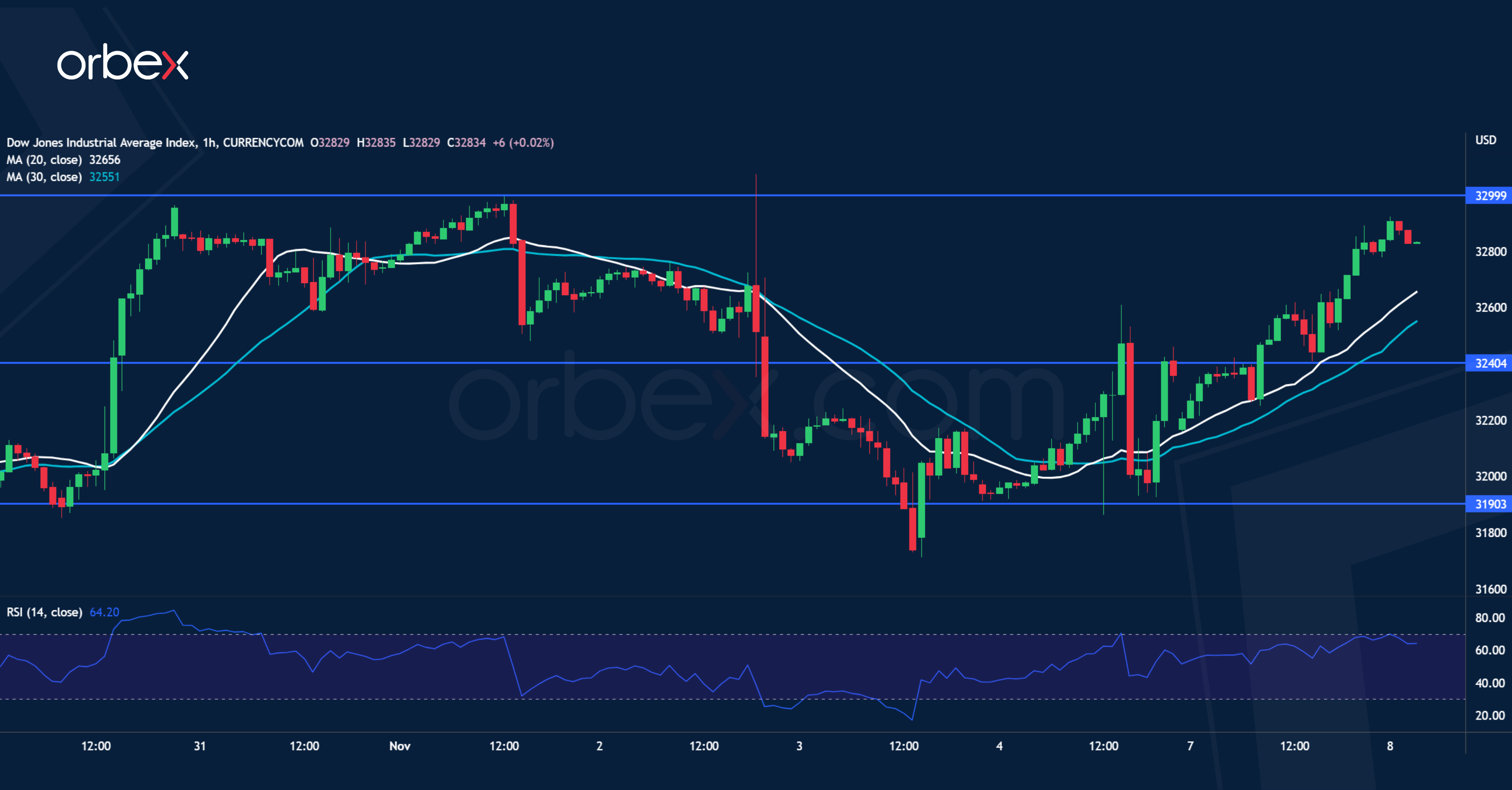
The Dow Jones 30 rallies as Republicans are favoured to win the midterm elections. The index slowed down near 33000, at the start of a sell-off in late August. Profit-taking was not enough to drive the price south, which suggests robust pressure from the buy side. A close above 33000 would shake out remaining selling interests and pave the way for a rally to August’s peak at 34200, which is the boundary between a bear and a bull market. In the meantime, an overbought RSI may limit the upside with 32400 as the closest support.
EUR/GBP Consolidates Gains
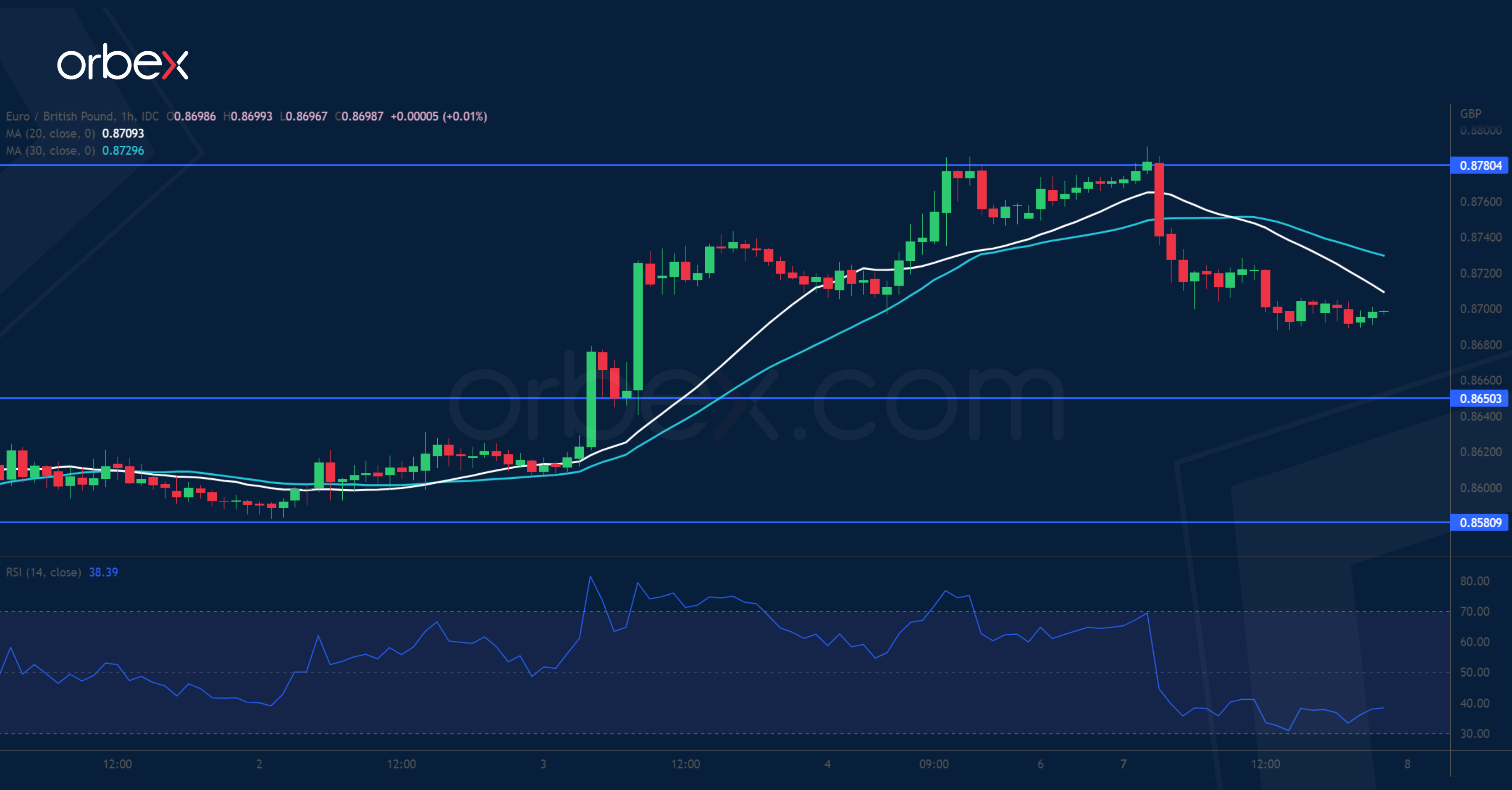
The euro steadies as a survey showed that investor morale in the euro zone improved. A sharp rise is a sign of short-covering and a close above the supply zone around 0.8760 may have eased the pressure on the single currency. This might offer the bulls hopes that the uptrend is still intact in the medium-term. The RSI’s double top in the overbought area caused a pullback as intraday buyers took profit. 0.8650 is an important level to expect follow-up interests. A rally back above 0.8780 would confirm a bullish continuation.
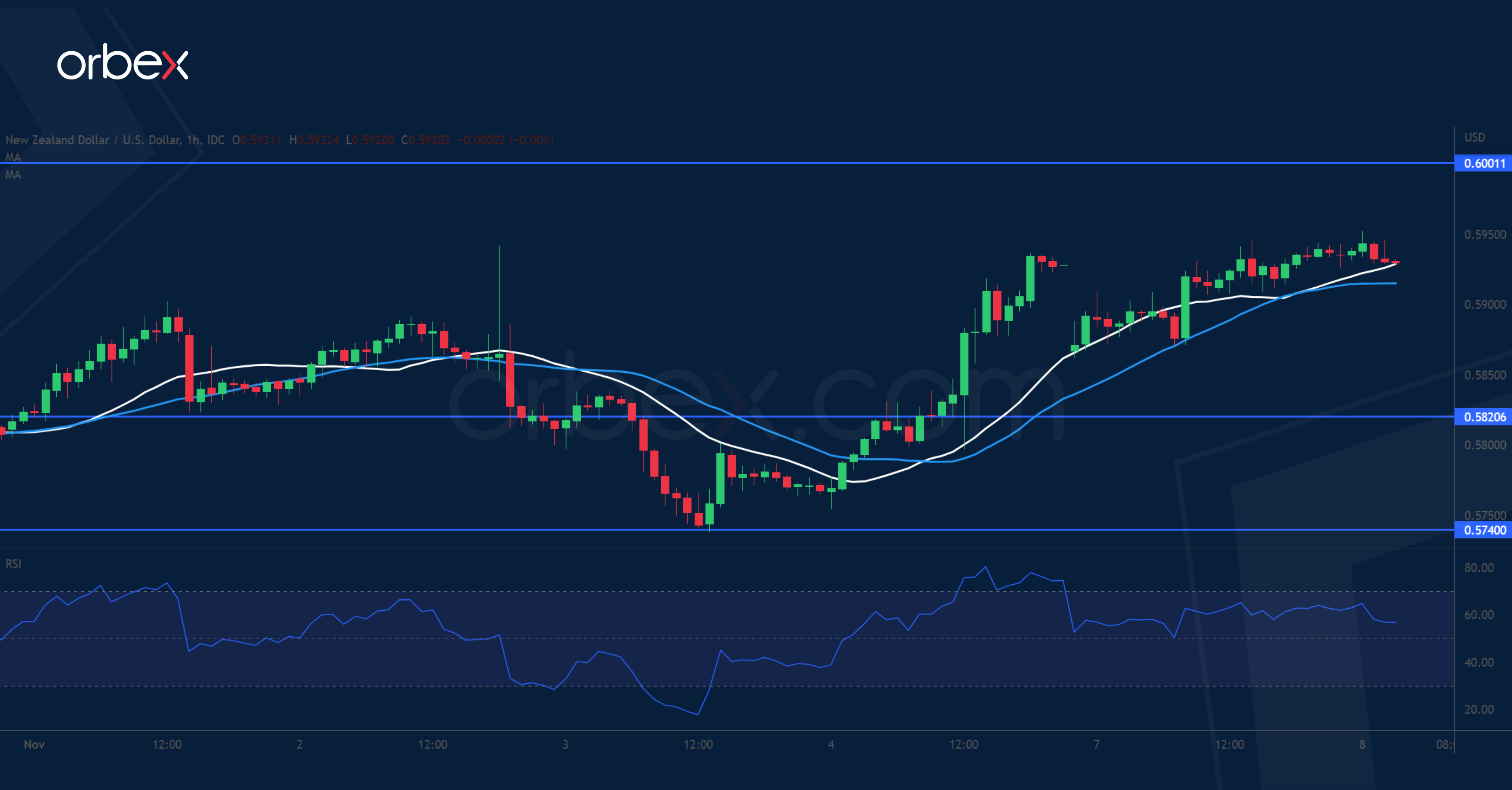
NZD/USD Pushes Higher
The New Zealand dollar inches higher over rising inflation expectations. The latest pullback has found solid support over 0.5740, near the base of a bullish breakout. A higher high above 0.5900 indicates that the bulls have retained control of the direction. A bullish MA cross on the daily chart foreshadows an acceleration to the upside. The psychological level of 0.6000 is a key hurdle ahead. Its breach could trigger an extended rally towards 0.6160. 0.5820 is the first support in case the kiwi needs some breathing room.
Caution Ahead of Midterms and Inflation Data
A cautious start to trading on Tuesday, with investors seemingly having one eye on midterm results in the US and another on Thursday's inflation data.
It's hard to see past both of these things this week. The question for many is whether investors will respond positively to the deadlock in Washington. On the one hand, the prospect of less spending could be viewed as aiding the inflation fight but on the other, the economy could be headed for recession, and inaction in government won't help the situation.
The Republicans are strongly favoured to take back control of the House and with the Senate currently split, they are likely to edge that as well meaning Biden's economic agenda will come to a standstill ahead of the 2024 election.
Arguably the most important takeaway from the midterms will be how Trump-supporting Republicans fare, particularly those so fiercely sticking to the "stolen election" line, among others. With Trump himself due to make a "big announcement" soon, it would appear he's about to throw his hat into the ring and declare any victories a show of support for his own nomination.
With the US likely heading for recession, whoever wins the Republican race stands a good chance of winning the race in 2024. It may now become a question of how much of a grip Trump still has on the Republican party and whether the manner of his exit will prove to be a barrier or a supportive factor within the base.
Of course, the more pressing issue in the near term is inflation and so, regardless of the midterm results, we may still see some trepidation in the markets ahead of Thursday's release. The Fed has made clear it intends to slow the pace of tightening in December and this data could either throw that into question or start to build the case for a lower terminal rate than the central bank hinted at last week.
Oil pares gains as China COVID-19 cases jump
Oil prices are easing a little on Tuesday, a day after Brent crude came within a whisker of $100 again. It's traded below this major psychological level since July but recent developments have propelled the price higher again, up more than 20% from the September lows.
OPEC+ had a big hand to play in that but speculation around China's zero-Covid commitment may also be a factor in recent gains. That said, those rumours still haven't been confirmed and in fact, outbreaks in Guangzhou and other major cities have led to increased restrictions. It may be a little early to get carried away with speculation, especially when any significant change in policy would represent an enormous shift from the status quo. Still, the performance of Chinese stocks suggests there's a belief that there's no smoke without fire, which may also be enabling the continued rise in crude.
Gold edges lower amid a stronger the Dollar
The dollar is staging a small recovery around its recent lows which is weighing a little on gold this week. The yellow metal surged late last week following the jobs report before stumbling around $1,680 which has previously been a notable level of resistance. Still, it's holding onto the bulk of those gains quite well which suggests traders are anticipating some good news from the inflation data on Thursday, at least good enough to convince the Fed of the need to slow the pace of tightening next month.
Anything that suggests they won't need to rise as high as the Fed indicated could give gold another boost. Although given what the central bank said last week, you have to wonder if they are in fact anticipating another stubborn reading.
Bitcoin plunges below $20,000
It's been a rough couple of days for bitcoin which finds itself back below $20,000 and down more than 4% on the day. It has recovered a little after previously being off more than 6% but this is a far more severe decline than we're seeing in other risk assets which may be a worrying sign for crypto bulls. The declines may be linked to the plunge in FTT which nosedived amid reported concerns over Alameda's balance sheet. We've seen this kind of situation have ripple effects on prices before and this may explain the sharper declines we're seeing this week.
Markets Clearly Looking for a New Unequivocal Driver
Markets
Markets clearly are looking for a new unequivocal driver as established trends, especially in interest rate markets, are meeting short term resistance. Maybe the outcome of the US mid-term elections or Thursday’s October CPI release will be able to do so. However, yesterday markets had to rely on their own internal dynamics as there were no data to provide any directional input for trading. US yields reversed most of Friday’s dovish reaction to a payrolls report that we still consider as supporting the case further tightening/demand reduction. US yields gained 5/6 bps points across the curve. Maybe it’s a bit strange to call a it a dovish yield rise. Even so, the move was solely driven by a rise in inflation expectations. The 10-y US real yield (1.67%) maintained Friday’s correction. Whatever the reason, this (temporary) consolidation in the real yields apparently also facilitated a rather mild sentiment on other markets, including equities and the dollar. US equities gained between 1.31% (Dow) and 0.85% (Nasdaq). The dollar showed rather broad-based losses. DXY declined to close just north of the 110 barrier. The decline in USD/JPY was more modest (close 146.63). EUR/USD finished the day north of parity (1.002). The mild global sentiment also often favoured smaller currencies, with remarkably strong performance of CE currencies (EUR/CZK close 24.26 from 24.39 on Friday, EUR/HUF close 400.7 from 402.5 and EUR/PLN close 4.67 from 4.6875). German yields also stayed upwardly oriented gaining between 8.1 bps (2-y) and 3.4 bps (30-y). Especially yields at shorter maturities are only a whisker away from the cycle peak levels, but no clear break occurred yet. Bunds substantially underperformed swaps. For now we don’t draw firm conclusions from yesterday’s trading session, even as underlying optimism remains a bit remarkable post Powell’s hawkish press conference last week.
This morning most Asian markets are trading in positive territory, but often don’t fully capture to WS momentum. China underperforms (CSI 300 -1.27%) as uncertainty on the countries Covid strategy persists. The dollar gains modestly (DXY 110.42, EUR/USD 1.000). US yields also rise marginally this morning. Later today, the calendar is again thin. US NFIB small business confidence (expected to ease from 92.1 to 91.4) is an interesting pointer on the broader health of the US economy but for sure won’t be a game changer. The US Treasury will start a new bond auction cycle with a sale of $40 bln of 3-year notes, the followed by 10 & 30-year auctions later this week. Central bank speakers include ECB’s Wunsch, SNB’s Jordan and BoE’s Pill. We stay cautious to already jump on any broader risk-on repositioning annex sustained USD decline. EUR/USD 1.0094 remains a first ST reference on the technical charts.
News Headlines
Poland is about to sell its first dollar-denominated bonds in six years. The country faces rising borrowing needs ahead of general elections expected in October next year, following amongst others increased military spending. But borrowing in its own currency comes at a significant cost with Polish yields having risen to the highest level in 20 years. At the same time the EU is still withholding some €35bn of post-pandemic aid over a conflict concerning changes in the Polish judiciary. The sale, expected for today, includes a 5-year and a 10-year dollar bond.
Adrian Orr has been appointed for another 5-year term as governor of the Reserve Bank of New Zealand. This provides the opportunity of completing one of the most aggressive tightening cycles in history as the RBNZ tries to get a grip on spiraling inflation (7.2% y/y in Q3). New Zealand was one of the first in October 2021 to start raising policy rates and paved the way for bigger-sized rate hikes. In exactly one year time, the RBNZ’s cumulative tightening amounted to 325 bps (from 0.25% to 3.50%). It is expected to continue the process: according to a quarterly survey published this morning, 2-year inflation expectations have jumped to 3.62% from 3.07%. NZ money markets currently see the terminal rate between 5.25 and 5.50%.
US Midterm Elections Today
Market movers today
Today, the focus is on US midterm elections. Republicans are favoured to win control of both House and Senate, although the Senate race remains a close call. If republicans win the Senate by a slim margin or if Democrats are able to retain the Senate, market reaction should be quite muted, as major changes in fiscal policy would be difficult to pass.
On data front, we get euro area September retail sales and US NFIB small business optimism index from October. Chinese October PPI is due for release overnight.
ECB's Nagel and Wunsch are also in the wires, while the Fed's Barkin is due to discuss inflation overnight.
The 60 second overview
US midterms: Both betting markets and the latest polls suggest that Republicans are the favourites to win control of both Senate and House in the midterm elections today. Senate race will be tighter, however, while betting markets see almost 90% probability of Republicans winning at least the House.. The high inflation has steered both parties away from campaigning for clearly increased spending, and rather the focus has been more on non-economic themes such as abortion rights. As such, we do not expect the election result to be a major market mover in the near term, as the republican congress would most likely be unable to pass dramatic changes to US fiscal policies with Biden still remaining the president. The (modest) risk-scenario for markets would be a clear victory for Republicans also in the Senate, as this could increase the risk of more expansionary (and inflationary) fiscal policies amid the looming recession. Some are already focusing on the upcoming presidential elections, as Trump stated yesterday that he could announce running in 2024 as early as next week.
Risk sentiment: Equity markets rose yesterday as the outlook for a divided US government and hopes of some easing in Chinese Covid-policies supported risk sentiment. We remain sceptical that a turnaround in the strict zero-Covid stance is coming anytime soon, and continue to think EUR/USD will decline back below parity despite the most recent uptick. The Euro Area November Sentix index released yesterday showed a modest rise in investor confidence both in terms of current situation and future expectations, although from a low level. But with recession risks still looming towards the winter, US CPI likely illustrating another month of fast and broad-based rise in prices later this week and Fed still firmly on the tightening mode, we think the optimism might be too early.
Equities: The bear market rally continued on Monday. Investors bought the dip in growth stocks (tech, communication services) despite higher yields. In the Nordics, industrials continued to rally with Sandvik and SKF +4%. However, real estate the big gainer, up 5% and 25% the last month. We prefer to take risk with yield-sensitive sectors rather than earnings-sensitive sectors to leverage in bear market rallies. S&P500 up 1% and futures somewhat lower today.
FI: Core European rates ended 5bp higher on the day, primarily due to a sell-off in the very late part of day (10y Germany touching 2.34%), coinciding with the announcement of the relatively poor cover in the BoE's sales operations. Money markets also sold off, adding 3bp to ECB hikes now pointing to a local high of 3.07%. French governor Villeroy said that ECB would hike rates until core inflation had peaked. Spreads tightened, led by the periphery.
FX: Benign risk sentiment in general supported the SEK, but it is also fair to assume that the news of the Swedish Match M&A now being good to go might have helped push SEK crosses lower.
Credit: Credit markets were broadly positive yesterday with iTraxx Main going 2bp tighter to 107.4bp while Xover tightened by 12.9bp to 521.3bp. In addition, the primary markets seem to be wide open this week with several financial and corporate issuers active with new deals across the Eurobond Market. The largest transaction was from Volkswagen International Finance with a 3-part Green Bond of EUR2.5bn, this was well received with strong book interest and final terms notably below indicated initial price talk.
All Eyes on US Midterm Elections
Investors are tense and undecided into the US midterm elections today.
US President Joe Biden didn’t have an easy mandate. The Covid pandemic, the war in Ukraine, the global energy crisis, the skyrocketing inflation, a pitilessly tighter Federal Reserve (Fed) policy, rising mortgage rates… all these factors will weight on the wrong side of the balance for Democrats at today’s election.
The consensus expectation is a divided government between White House and Congress. Republicans are favoured to take the House and have at least 50/50 seats at Senate.
What does that mean for the US monetary and fiscal policies, the financial markets, and the dollar?
Nothing will change for the Fed
The midterm elections won’t change anything for the Fed policy. The Fed will continue fighting inflation on its end. It will continue tightening its policy, raising the rates - by slower increments but as high as needed to bring inflation back on – at least – a healthy path toward its 2% policy target.
The divergence between a strongly hawkish Fed stance, and reasonably hawkish other central bank stances should continue tilting the balance toward a strong US dollar.
How strong the dollar will be against the majors will depend on how hawkish the central banks of other currencies are, and what shape the US fiscal policy will take.
Fiscal policy will get impacted
The changing landscape in the government will of course have an impact on the way the political decisions are made in the US, and on the way the US debt is managed.
The Fed’s aggressive rate hikes make the huge US debt more expensive by the day. The US debt to GDP ratio stood at a touch below the 125% mark in June this year. And it’s increasing steadily – something Republicans don’t like.
Therefore, the US debt burden could stop the Democrats from putting in place many economic reforms that they would’ve otherwise, if Republicans are sufficiently crowded to block them moving forward. Hence, slowing debt under GOP could slow growth.
Therefore, if Republicans win control of both House and Senate, we should see the US treasuries rally and the dollar soften, whereas if the Democrats hold on to the House and Senate, we shall continue seeing a positive pressure on the dollar.
Every outcome is better for stocks than a Democrat majority
A Republican majority in both chambers should boost equities, more than a Republican majority in both chambers, or a split government.
On the other hand, empirical data shows that the US stock markets performed better with a divided government in the years following a same party controlling the Senate, the House and the Presidency.
That means that even a divided government would be better than a Democrat majority for the US stocks.