Sample Category Title
ECB Preview – Focus on the Technicalities
Next week's ECB meeting is set to bring another 75bp rate hike in all three policy rates. We expect Lagarde to say that the probability of the ECB staff's downside risk scenario from the September projection exercise is becoming more likely, but fall short of giving new significant policy signals. We expect the ECB to continue to hike its policy rates until early next year, with the risk of potential further hikes if fiscal initiatives support the growth outlook in such a way that inflation remains too high over the medium-term.
Markets will focus on the risk of the ECB ending its APP reinvestments, which will complement the liquidity tightening that will take place as TLTROs mature next year. We do not expect the ECB to present a roadmap on how to end reinvestments at this meeting, but we expect the ECB to announce a change in its reserve remuneration system, which may initially cause some market jitters. We expect the ECB to calibrate the new system in such a way that the market relevant policy rate will continue to be the deposit rate, but we acknowledge risks to short-end credit spreads.
What the US Midterm Elections Mean for the Dollar and Stocks
On November 8, American citizens will head to the polls to elect their new Congress. Opinion polls and prediction markets argue the Republicans will take back at least one chamber, setting the stage for two years of political deadlock. Such an outcome could spark a relief rally in equity markets, and perhaps some profit-taking in the mighty dollar.
Power shift
With less than three weeks to go, investors are grappling with how this election could impact US government policy and financial markets. The Democrats currently hold a slim majority in the House of Representatives while the Senate is split 50-50, with Vice President’s Harris’s tiebreaker vote giving the Democrats control. Most prognostications suggest it would be a miracle if they keep control of both chambers.
Opinion polls clearly favor the Republicans to win back the House. According to simulation models by FiveThirtyEight, the probability of this scenario is around 70%, while betting odds in most prediction websites are even higher at 85%. The Senate is a much closer call, with both opinion surveys and bookmakers viewing it almost as a coin toss.
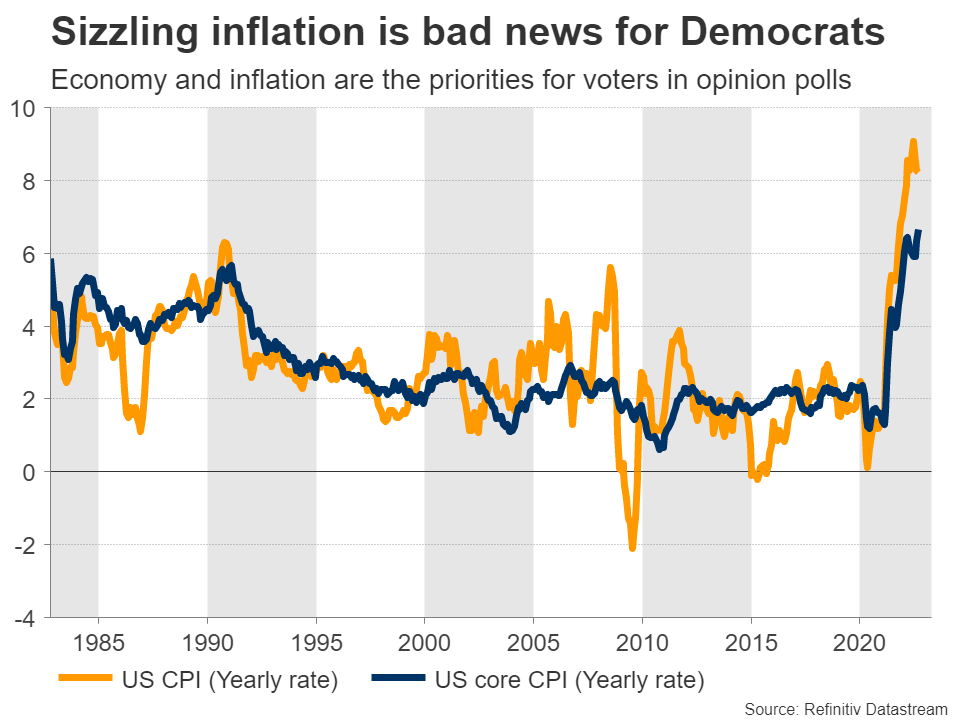
There is a long list of contentious issues at the heart of this election including abortions rights, climate policy, and threats to democracy. Nonetheless, the economy could still steal the spotlight amid the worst cost of living crisis in decades and rising concerns that a recession is on the horizon.
Stocks like a divided Congress
Historically speaking, stock markets tend to perform poorly in the months heading into midterm elections, but then stage sharp rallies after the event has passed. The logic behind this pattern is that investors often hedge or cut their market exposure because of the political uncertainty, and then unwind those hedges once they have clarity of the outcome.
Over the last seven decades, stock markets have always been higher six months after a midterm election. Of course that doesn’t mean much in a year as rocky as this one. Markets will be driven mostly by how inflation evolves, how high the Fed raises interest rates, and whether a recession actually hits. Still, it’s useful to look at the historical precedent.
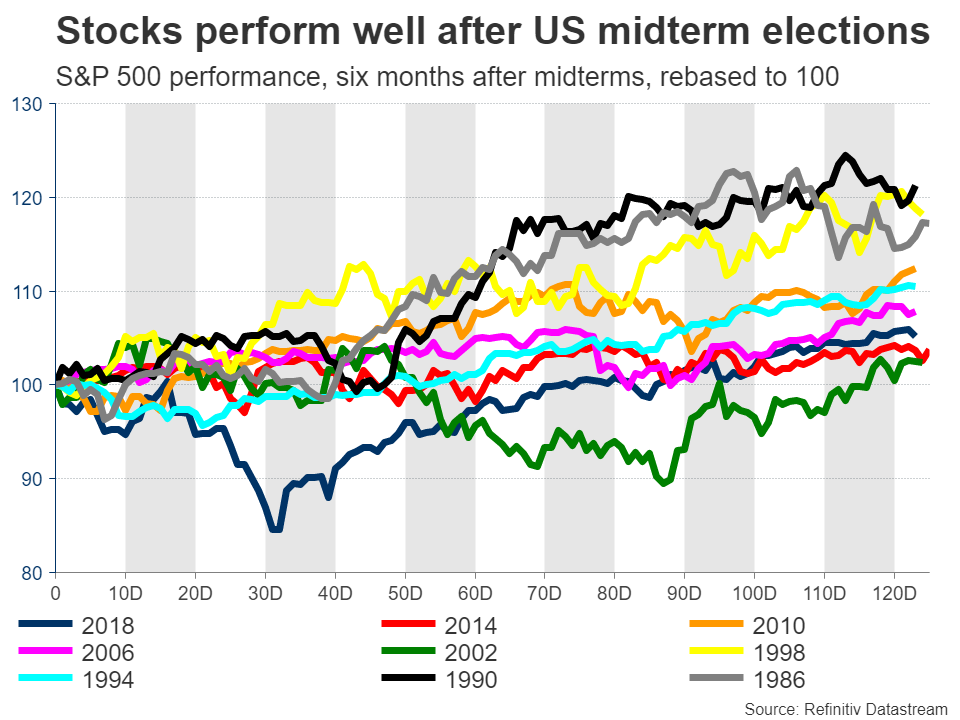
A divided Congress may prove beneficial for equity markets because it would strip President Biden’s power, limiting the scope for enacting anti-business legislation such as raising corporate taxes or tightening regulations. Even if the Republicans gain control of one chamber, they would almost certainly veto such laws, eliminating one risk facing investors.
The risk is that a split Congress is already the market’s baseline scenario. Hence, if the Democrats manage to pull off the upset victory and keep both chambers, that could spark a substantial selloff, although the likelihood seems quite low.
What about the dollar?
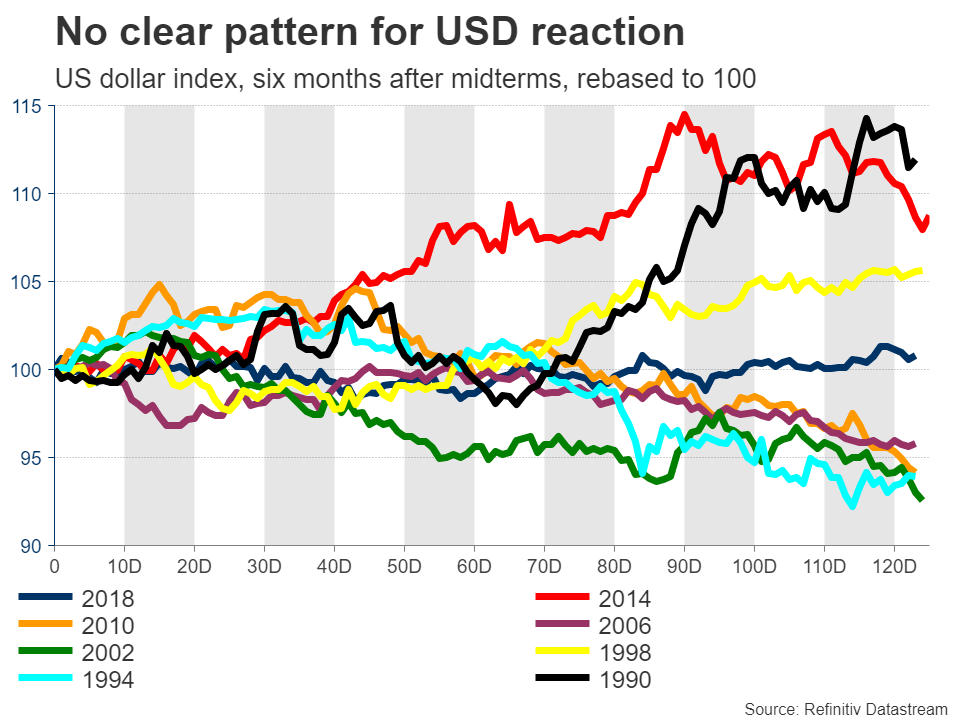
Turning to the US dollar, there is no clear historic pattern after midterms. The market reaction will boil down to how the election affects the trajectory of Fed policy. In this respect, a split Congress would probably limit the federal government’s ability to roll out new spending.
If the Republicans seize control, they will use their new powers to push back against recent decisions by the Biden administration such as forgiving student debt, and block any future initiatives that involve heavy spending.
With fiscal spending being slashed in an environment of slowing economic activity, the next couple of years might be characterized by slower growth and softer inflation, which argues for the federal funds rate to peak at a lower level.
Market pricing currently suggests the peak will be just under 5%. This might be dialed down a notch if the Democrats lose Congress, igniting a pullback in the mighty US dollar.
Big picture
All told, this election is unlikely to be a game-changer for markets. It might be the trigger for a short-squeeze in stocks and a round of profit-taking in the dollar, but ultimately those are likely to be relief moves, not trend reversals.
Stock markets are still far too ‘expensive’. Valuations haven’t fully adjusted to the rapid spike in real rates yet, and with the economic data pulse slowing, particularly in Europe and China, the risk of an earnings recession is becoming increasingly realistic.
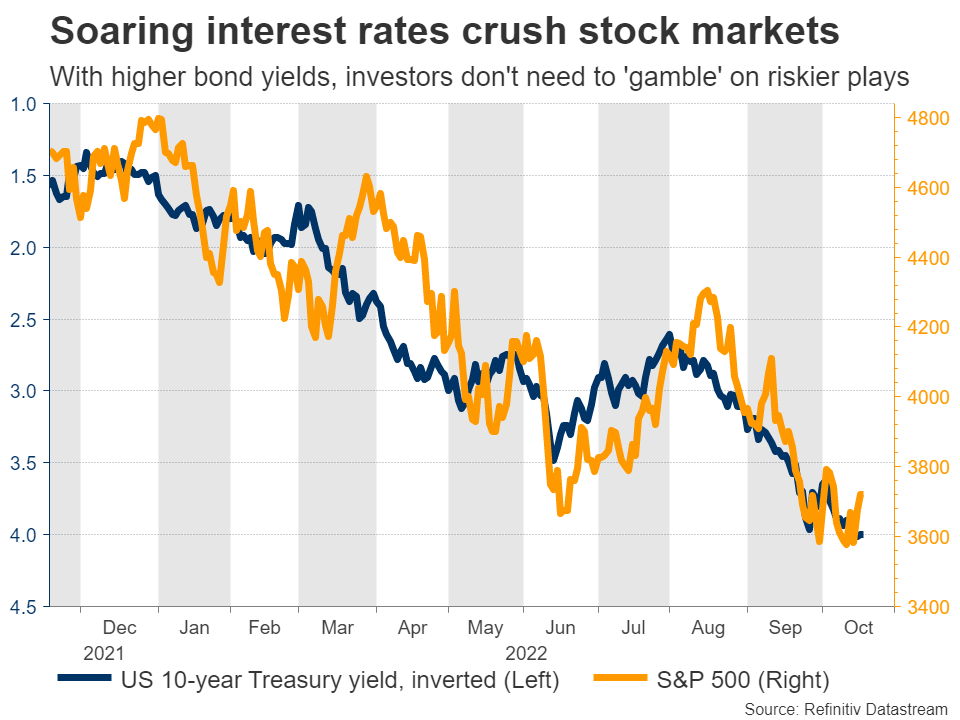
As for the dollar, the dynamics that fueled this spectacular rally are still very much in play. Inflation is scorching-hot and the US labor market remains in good shape, giving the Fed cover to keep raising rates aggressively. Meanwhile, every other major currency is battling its own demons, so there is hardly any competition.
There’s a Fed meeting almost one week ahead of the midterms, which could prove to be equally important for the dollar as investors try to decipher when the central bank might hit the pause button.
Sunset Market Commentary
Markets
As was the case yesterday and on Monday, eco data still were second tier today. EMU September inflation was revised out of double digit territory (9.9% Y/Y from 10.0% preliminary reading), but with metrics of core inflation trending decisively higher, this doesn’t change the conclusion that the ECB still has plenty of work to do. US housing starts surprised to the downside confirming other evidence that rising yields are weighing on activity in the sector. Admittedly, permits were marginally better than expected. Even so, after a tentative pause earlier this week, core bond yields resumed their ‘natural drift north’. Fed’s Kashkari yesterday warned that, if core inflation continues to rise, it’s no option for the Fed to stop its tightening cycle at 4.50% or 4.75%. This leaves room for markets to reprice the peak Fed policy rate beyond the 4.875% forecast of the MPC hawks at last month’s Fed’s dot plot. US yields are gaining between 10 bps (2-y) and 5 bps (30-y) with bond yields across the whole curve touching new cycle peak levels intraday. The German yield curve also bear flattened. Bunds hugely underperform EMU swaps. German yields are gaining between 10 bps (2-y). The 30-y trades marginally lower (-1 bp). The 2-y bund yield also touched a new cycle top at 2.12%. ECB’s Nagel yesterday evening reiterating that the ECB should soon start reducing its bond portfolio maybe partially explains the bund underperformance versus swaps. Will the ECB already give some hints on this topic at next week’s policy meeting? Whatever, QT is on the radar of European bond markets, too. For now, the impact on intra-EMU spreads remains manageable. The 10-y Italian spread vs Germany even eases slightly (- 2bps). The resumption of the yield uptrend also caps this weeks tentative ‘rebound’ of equities. The EuroStoxx 50 (+ 0.3%) returned most of an intra-day uptick. US indices open mixed to modestly lower (S&P -0.2%).
Higher real yields and the risk-rebound running into resistance again changed fortunes in favour of the dollar. DXY jumped from the 112 area in Asia this morning to currently trade at 112.8. EUR/USD dropped back below the 0.98 handle (0.978). USD/JPY (149.75) is nearing the 150 psychological barrier with markets still pondering Japanese authorities’ strategy on the protracted decline of their currency (hidden interventions?). Sterling reversed a poor start (against the euro) after September UK CPI again printed in double digit territory (10.1). Still, EUR/GBP finally drooped back below the 0.87 handle in calm trading. News Headlines
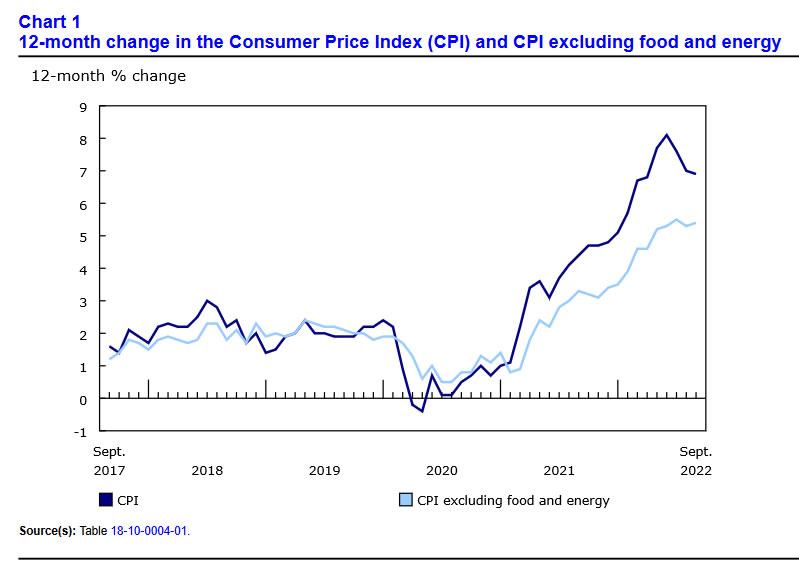
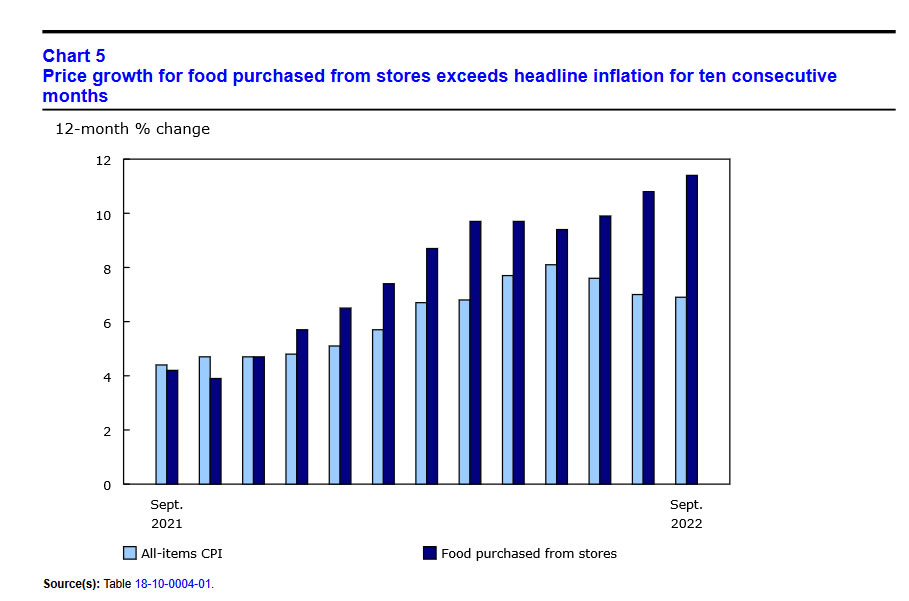
Canadian inflation rose by 0.1% M/M in September with the headline number marginally slowing down from 7% Y/Y to 6.9% Y/Y. Consensus expected a bigger fall (-0.1% M/M & 6.7% Y/Y). Lower gasoline prices were mostly responsible for the deceleration (-7.4% M/M). Prices for food purchased from stores (+11.4%) grew at the fastest pace Y/Y since August 1981 (+11.9%). Unfavorable weather, higher prices for important inputs such as fertilizer and natural gas, as well as geopolitical instability stemming from Russia's invasion of Ukraine contributed to the rise in food and beverage prices. Excluding food and energy, prices rose 5.4% in September (from 5.3% Y/Y). The cost of services accelerated from 5.5% Y/Y to 5.6% Y/Y. Mortgage interest costs also continued to put upward pressure on overall inflation. Average hourly wages rose 5.2% Y/Y. The upward inflation surprise suggests that the BoC will need to stick to the September 75 bps rate hike pace instead of slowing down to 50 bps. The policy rate currently stands at 3.25%. Canadian swap yields rise by 8.5 bps to 13.5 bps today with the belly of the curve underperforming the wings. The loonie fails to profit with USD/CAD a tad higher near 1.3770.
Polish consumer confidence dropped to its lowest level on record in October (-45.5 from -44.2) with underlying details showing a deterioration in both the current situation and future expectations. Polish citizen’s became much more concerned on job security, the general economic situation in the country and the potential to save money.
EUR/USD Mid-Day Outlook
Daily Pivots: (S1) 0.9759; (P) 0.9805; (R1) 0.9891; More...
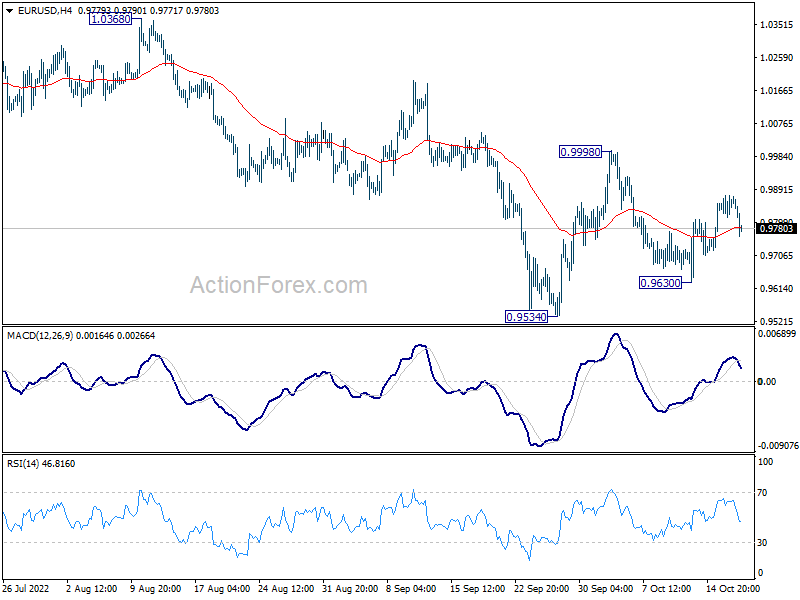
Intraday bias in EUR/USD stays neutral and outlook is unchanged. Deeper decline is expected with 0.9998 resistance intact. Below 0.9630 will bring retest of 0.9534 low first. Firm break there will resume larger down trend. However, break of 0.9998 will confirm short term bottoming and turn bias back the upside for stronger rebound.
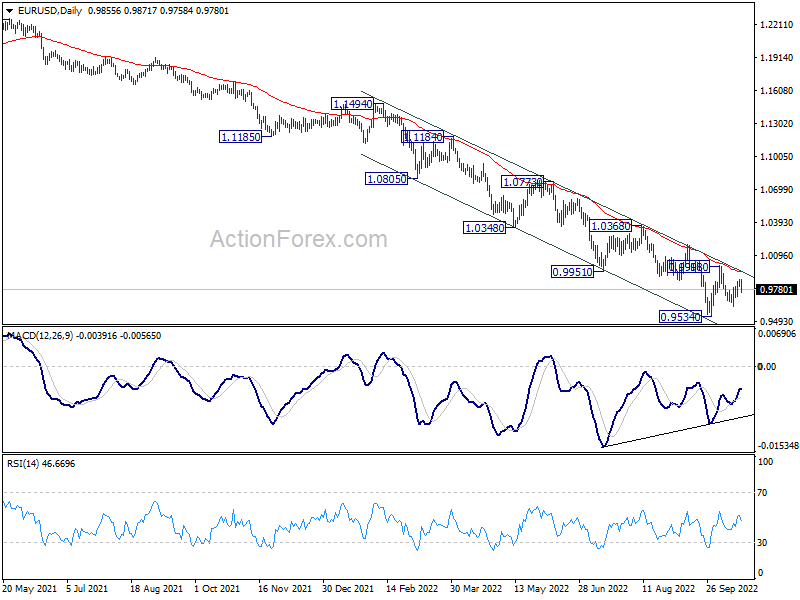
In the bigger picture, down trend from 1.6039 (2008 high) is still in progress. Next target is 100% projection of 1.3993 to 1.0339 from 1.2348 at 0.8694. In any case, break of 0.9998 resistance is needed to be the first sign of medium term bottoming. Otherwise, outlook will stay bearish even with strong rebound.
GBP/USD Mid-Day Outlook
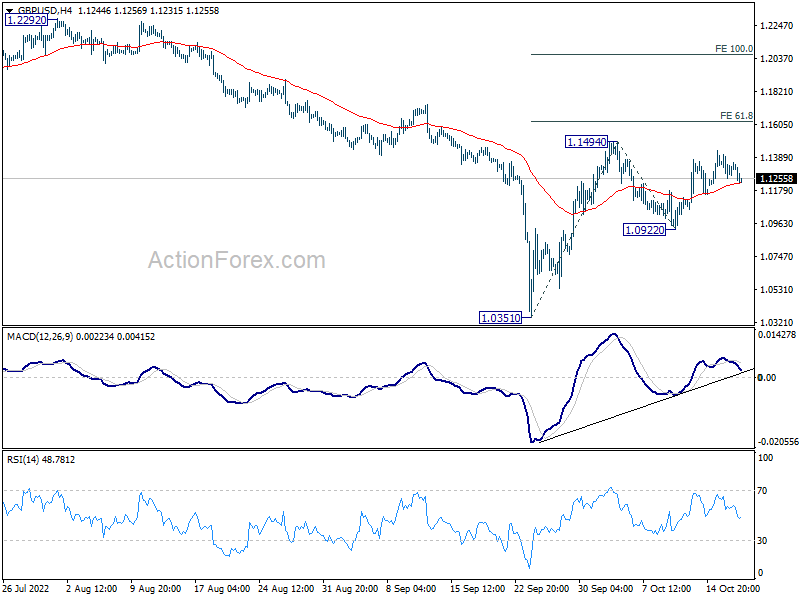
Daily Pivots: (S1) 1.1247; (P) 1.1329; (R1) 1.1401; More...
Intraday bias in GBP/USD remains neutral for the moment. On the upside, break of 1.1494 will resume the rise from 1.0351 to 61.8% projection of 1.0351 to 1.1494 from 1.0922 at 1.1628. On the downside, below 1.0922 will turn bias back to the downside for 1.0351 low instead.
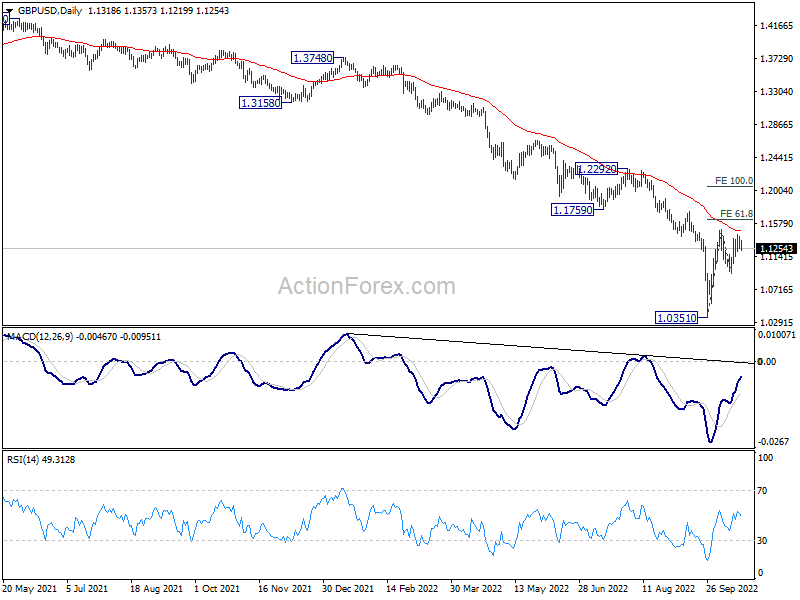
In the bigger picture, fall from 1.4248 (2018 high) is resuming long term down trend from 2.1161 (2007 high). Next target is 100% projection of 2.1161 to 1.3503 from 1.7190 at 0.9532. There is no scope of a medium term rebound as long as 1.1759 support turned resistance holds.
USD/CHF Mid-Day Outlook
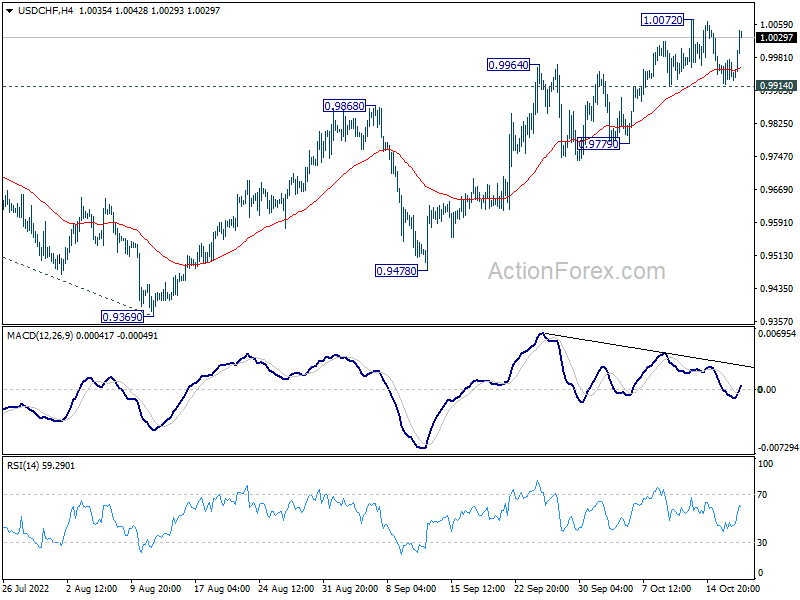
Daily Pivots: (S1) 0.9915; (P) 0.9986; (R1) 1.0027; More...
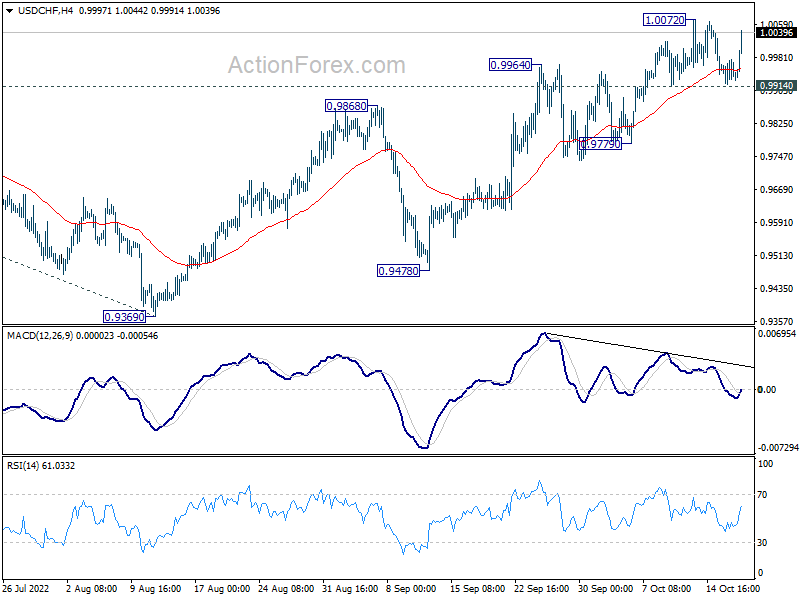
USD/CHF rebounds notably today but stays below 1.0072 resistance. Intraday bias remains neutral first. Further rise is still mildly in favor. On the upside, break of 1.0072, and sustained trading above 1.0063, will confirm larger up trend resumption. Next target is 1.0283 projection level. However, break of 0.9914 support will indicate rejection by 1.0063, and turn bias back to the downside for 0.9779 support first.
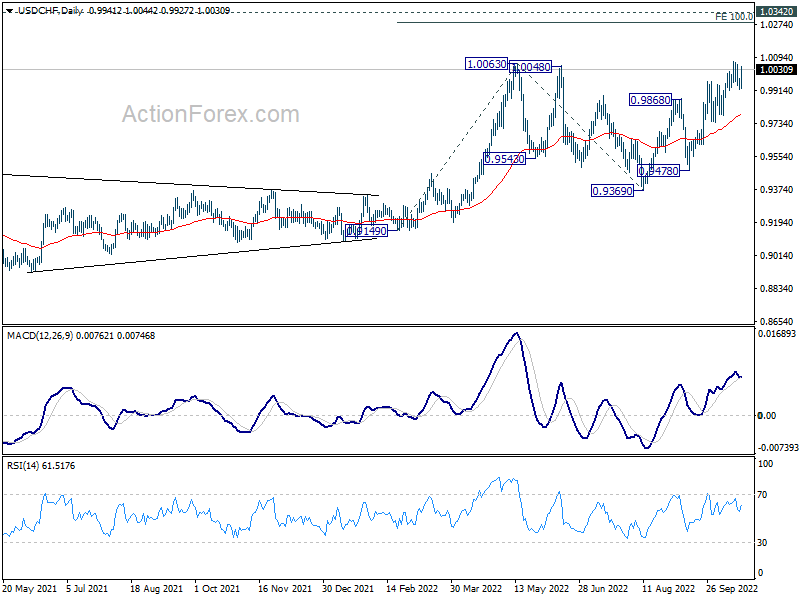
In the bigger picture, current development suggests that up trend from 0.8756 (2021 low) is still in progress. Sustained break of 1.0063 will target 100% projection of 0.9149 to 1.0063 from 0.9369 at 1.0283, and then 1.0342 (2016 high). For now, this will remain the favored case as long as 0.9369 support holds, even in case of deep pull back.
Canada: Cooler Headline Inflation Belies Hotter Core Reading in September
Consumer price inflation took another small step in the right direction in September, easing to 6.9% year-on-year (y/y), down from 7.0% in August.
Lower gasoline prices were mainly responsible for the cooling in headline inflation. Consumers got some relief at the pump, with prices down 7.4% in September, and are now up 13.2% y/y.
Unfortunately, there is no relief at the grocery store. Food purchased from stores cost 11.4% more than a year ago, up from August's 10.8% y/y pace – the fastest pace since 1981.
Core inflation was also a little hot under the collar. CPI ex-food and energy ticked up to a 5.4% y/y pace in September, from 5.3% y/y in August. Shelter inflation, which carries a heavy weight in the CPI was up 6.8% y/y in September, two ticks higher than August's pace. Within shelter, the uptick was driven by higher mortgage interest costs (+8.3% y/y) outweighed the deceleration in homeowner's replacement cost (+7.7% y/y) and other owned accommodation expenses (+5.8%).
Durable goods inflation heated up again in September (+6.7% y/y) from a 6% y/y pace in August. Vehicle prices were up 8.4% y/y, and furniture was up 13.3% y/y, both faster than August's pace.
The Bank of Canada's core inflation metrics were unchanged from August. CPI-trim held steady at 5.2% y/y, CPI-common was 6.0% y/y, and CPI-median was 4.7%. The average of the three core measures was 5.3% y/y in September.
Key Implications
It is great that headline inflation took a small step in the right direction in September, but underlying inflation pressures in core measures showed no signs of cooling down. The BoC has hiked interest rates 300 basis points so far this year, and the impact of that is starting to be felt in the economy, from housing to consumer spending. But, with the Bank of Canada's (BoC) core measures of inflation more than 2 percentage points from the target range of 1-3%, more cooling in demand is required.
Today's report emphasizes the need for a hefty 50 basis point hike next week in the BoC's overnight rate. We expect the bank is getting closer to a pause on rate hikes, once it reaches 4% by the end of the year.
USD/JPY Mid-Day Outlook
Daily Pivots: (S1) 148.80; (P) 149.09; (R1) 149.52; More...
USD/JPY's rally continues today and intraday bias stays on the upside for 61.8% projection of 130.38 to 140.33 from 145.89 at 149.91. There Japan might intervene again to defend 150 psychological level. On the downside, break of 148.11 minor support will turn bias to the downside for pull back towards 145.89 resistance turned support. However, sustained trading above 150 could pave the way to 100% projection at 155.84 next.
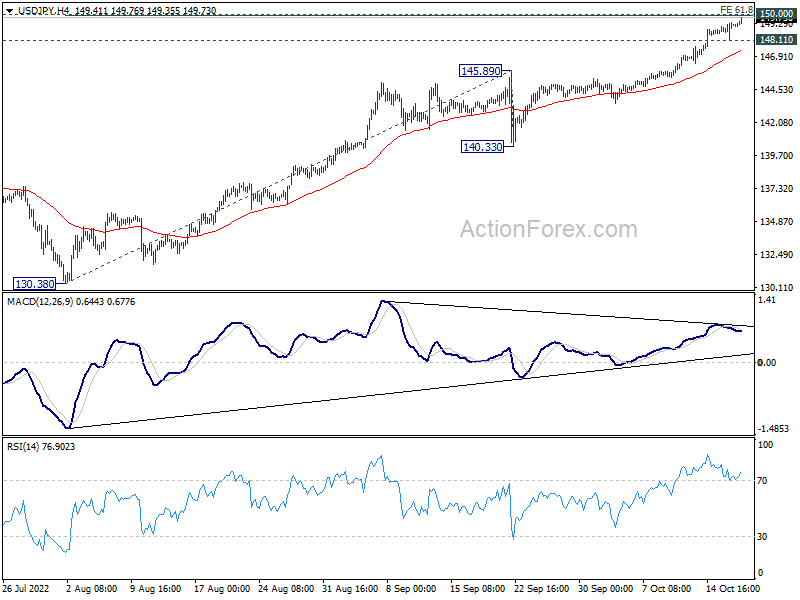
In the bigger picture, up trend from 101.18 is still in progress, as part of the whole up trend from 75.56 (2011 low). 147.68 (1998 high) was already met and there is not clearly sign of topping yet. In any case, break of 139.37 resistance turned support is needed to be the first sign of medium term topping. Otherwise, further rise is in favor to next target at 160.16 (1990 high).
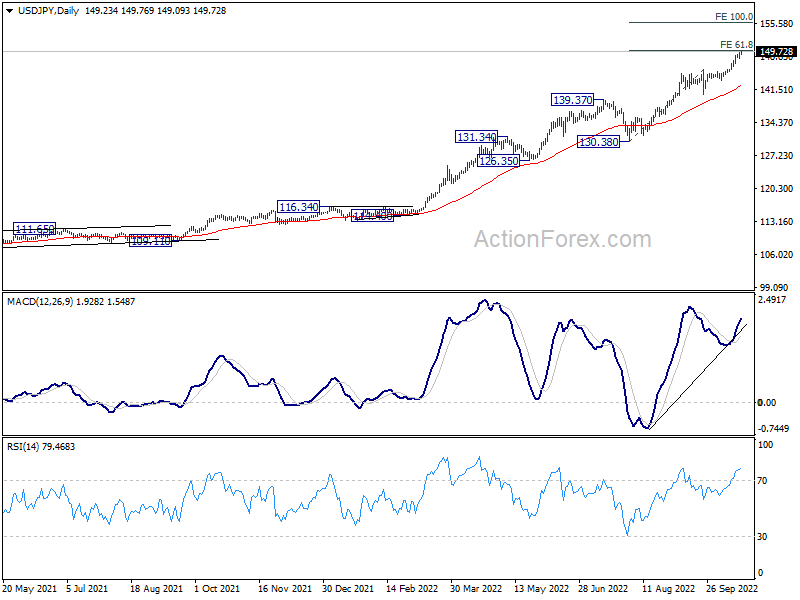
USD/JPY Marching to 150 as Dollar Rises With Yields
Dollar rises broadly today, with help from bonds as 10-year yield tops 4.1% in pre-market. Canadian Dollar is also slightly firmer after CPI report. Other parts of the markets are mixed. Yen is dropping towards 150 with Dollar, but recovers elsewhere. Swiss Franc is weakening against both Euro and Sterling but loss is limited. Aussie and Kiwi turned softer as this week's recovery lost steam.
Technically, one focus is on Japan's intervention as USD/JPY approaches 150 handle, and on whether Dollar bears would finally jump in (which is unlikely). On the other hand, another focus in on USD/CHF's reaction to 1.0072 temporary top. Decisive break there will confirm up trend resumption, which could be a early signal of more Dollar buying elsewhere.
In Europe, at the time of writing, FTSE is down -0.26%. DAX is down -0.21%. CAC is down -0.02%. Germany 10-year yield is up 0.0597 at 2.353. Earlier in Asia, Nikkei rose 0.37%. Hong Kong HSI dropped -2.38%. China Shanghai SSE dropped -1.19%. Singapore Strait Times dropped -0.10%. Japan 10-year JGB yield dropped -0.0051 to 0.254.
Canada CPI ticked down to 6.9% yoy in Sep, food inflation rose to 11.4% yoy
Canada CPI slowed from 7.0% yoy to 6.9% yoy in September, slightly above expectation of 6.8% yoy. Food prices inflation rose to 11.4% yoy, the fastest rate since 1981's 11.9% yoy. Also, prices for food purchases from stores have been increasing at a faster rate than all-items CPI for 10 consecutive months. Excluding food and energy, CPI accelerated from 5.3% yoy to 5.4% yoy.
CPI median dipped from 4.8% yoy to 4.7% yoy, versus expectation of 4.8% yoy. CPI trimmed was unchanged at 5.2% yoy, above expectation of of 5.1% yoy. CPI common accelerated from 5.7% yoy to 6.0% yoy, above expectation of 5.6% yoy.
Eurozone CPI finalized at 9.9% yoy in Sep, core at 4.8% yoy
Eurozone CPI was finalized at 9.9% yoy in September, up from August's 9.1% yoy, but revised down from flash reading of 10.0% yoy. CPI core (all items excluding energy, food, alcohol & tobacco) was finalized at 4.8% yoy, up from August's 4.3% yoy
The highest contribution to the annual Eurozone inflation rate came from energy (+4.19%), followed by food, alcohol & tobacco (+2.47%), services (+1.80%) and non-energy industrial goods (+1.47%).
EU CPI was finalized at 10.9% yoy, up from August's 10.1% yoy. The lowest annual rates were registered in France (6.2%), Malta (7.4%) and Finland (8.4%). The highest annual rates were recorded in Estonia (24.1%), Lithuania (22.5%) and Latvia (22.0%). Compared with August, annual inflation fell in six Member States, remained stable in one and rose in twenty.
UK CPI rose to 10.1% yoy in Sep, Food prices up 14.6% yoy
UK CPI rose 0.5% mom in September, above expectation of 0.4% mom. In the 12 months to September, CPI accelerated from 9.9% yoy to 10.1% yoy, above expectation of 10.0% yoy. That's the highest level since around 1982 based on modelled estimates. CPI core also rose from 6.3% yoy to 6.5% yoy, above expectation of 6.4% yoy.
ONS said: "Rising food prices made the largest upward contribution to the change in both the CPIH and CPI annual inflation rates between August and September 2022. The continued fall in the price of motor fuels made the largest, partially offsetting, downward contribution to the change in the rates."
Food and non-alcoholic beverage prices accelerated from 13.1% yoy to 14.6% yoy. After 14 consecutive months of acceleration, current rate is estimated to be the highest since 1980.
Also released, RPI came in at 0.7% mom, 12.6% yoy versus expectation of 0.5% mom, 12.4% yoy. PPI input was at 0.4% mom, 20.0% yoy. PPI output was at 0.2% mom, 15.9% yoy. PPI output core was at 0.7% mom, 14.0% yoy.
BoJ Kuroda: Recent depreciation of Yen was sharp and one-sided
BoJ Governor Haruhiko Kuroda told a parliamentary committee that recent depreciation of Yen was sharp and one-sided "This kind of yen weakening makes it difficult for companies to set their business plans and raises uncertainties in their outlook," he said. "This is negative for our economy and not desirable."
Separately, board member Seiji Adachi said, "When looking at the global financial and economic environment surrounding Japan, downside risks are building up rapidly... When downside risks are so high, we should be cautious of shifting toward monetary tightening."
Australia Westpac leading index points to material loss in momentum heading into 2023
Australia Westpac leading index six-month annualized growth rate declined from -0.33% to -1.15% in September. It's now at the weakest level since the pandemic first hit in 2020, and prior to that, since early 2016. The index continued to point to a "material loss in momentum to a below-trend growth pace heading into 2023."
Westpac added that the signal in broadly in line with forecast that economic growth will slow from 3.4% in 2022 to 1.0% in 2023, with sharp slowdown in consumer spending. It said, "that slowdown is likely to intensify through 2023 as rising interest rates and a softening labour market take their toll."
On RBA policy, Westpac pointed to minutes of October meeting, which noted, "drawing out policy adjustments would also help to keep public attention focused for a longer period on the Board's resolve to return inflation to target." The thinking was in line with Westpac's forecast that RBA will have a series of 25bps rate hikes in the future months of November, December, February, and March.
USD/JPY Mid-Day Outlook
Daily Pivots: (S1) 148.80; (P) 149.09; (R1) 149.52; More...
USD/JPY's rally continues today and intraday bias stays on the upside for 61.8% projection of 130.38 to 140.33 from 145.89 at 149.91. There Japan might intervene again to defend 150 psychological level. On the downside, break of 148.11 minor support will turn bias to the downside for pull back towards 145.89 resistance turned support. However, sustained trading above 150 could pave the way to 100% projection at 155.84 next.
In the bigger picture, up trend from 101.18 is still in progress, as part of the whole up trend from 75.56 (2011 low). 147.68 (1998 high) was already met and there is not clearly sign of topping yet. In any case, break of 139.37 resistance turned support is needed to be the first sign of medium term topping. Otherwise, further rise is in favor to next target at 160.16 (1990 high).
Economic Indicators Update
| GMT | Ccy | Events | Actual | Forecast | Previous | Revised |
|---|---|---|---|---|---|---|
| 23:30 | AUD | Westpac Leading Index M/M Sep | 0.00% | -0.10% | -0.20% | |
| 06:00 | GBP | CPI M/M Sep | 0.50% | 0.40% | 0.50% | |
| 06:00 | GBP | CPI Y/Y Sep | 10.10% | 10.00% | 9.90% | |
| 06:00 | GBP | Core CPI Y/Y Sep | 6.50% | 6.40% | 6.30% | |
| 06:00 | GBP | RPI M/M Sep | 0.70% | 0.50% | 0.60% | |
| 06:00 | GBP | RPI Y/Y Sep | 12.60% | 12.40% | 12.30% | |
| 06:00 | GBP | PPI Input M/M Sep | 0.40% | -0.40% | -1.20% | -0.90% |
| 06:00 | GBP | PPI Input Y/Y Sep | 20.00% | 17.20% | 20.50% | 20.90% |
| 06:00 | GBP | PPI Output M/M Sep | 0.20% | 0.60% | -0.10% | 0.10% |
| 06:00 | GBP | PPI Output Y/Y Sep | 15.90% | 15.00% | 16.10% | 16.40% |
| 06:00 | GBP | PPI Core Output M/M Sep | 0.70% | 0.90% | 0.30% | 0.50% |
| 06:00 | GBP | PPI Core Output Y/Y Sep | 14.00% | 12.70% | 13.70% | 13.90% |
| 09:00 | EUR | Eurozone CPI M/M Sep F | 9.90% | 10.00% | 10.00% | |
| 09:00 | EUR | Eurozone CPI Core Y/Y Sep F | 4.80% | 4.80% | 4.80% | |
| 12:30 | USD | Building Permits Sep | 1.56M | 1.55M | 1.54M | |
| 12:30 | USD | Housing Starts Sep | 1.44M | 1.46M | 1.58M | |
| 12:30 | CAD | Raw Material Price Index Sep | -3.20% | -3.50% | -4.20% | |
| 12:30 | CAD | Industrial Product Price M/M Sep | 0.10% | -0.90% | -1.20% | |
| 12:30 | CAD | CPI M/M Sep | 0.10% | -0.10% | -0.30% | |
| 12:30 | CAD | CPI Y/Y Sep | 6.90% | 6.80% | 7.00% | |
| 12:30 | CAD | CPI Median Y/Y Sep | 4.70% | 4.80% | 4.80% | |
| 12:30 | CAD | CPI Trimmed Y/Y Sep | 5.20% | 5.10% | 5.20% | |
| 12:30 | CAD | CPI Common Y/Y Sep | 6.00% | 5.60% | 5.70% | |
| 14:30 | USD | Crude Oil Inventories | 2.5M | 9.9M | ||
| 18:00 | USD | Fed's Beige Book |
Canada CPI ticked down to 6.9% yoy in Sep, food inflation rose to 11.4% yoy
Canada CPI slowed from 7.0% yoy to 6.9% yoy in September, slightly above expectation of 6.8% yoy. Food prices inflation rose to 11.4% yoy, the fastest rate since 1981's 11.9% yoy. Also, prices for food purchases from stores have been increasing at a faster rate than all-items CPI for 10 consecutive months. Excluding food and energy, CPI accelerated from 5.3% yoy to 5.4% yoy.
CPI median dipped from 4.8% yoy to 4.7% yoy, versus expectation of 4.8% yoy. CPI trimmed was unchanged at 5.2% yoy, above expectation of of 5.1% yoy. CPI common accelerated from 5.7% yoy to 6.0% yoy, above expectation of 5.6% yoy.