

Sample Category Title
Weekly Economic & Financial Commentary: Inflation Is the Name of the Game
Summary
United States: Inflation Is the Name of the Game
- Thursday's highly anticipated Consumer Price Index report surprised to the upside. Headline CPI rose 0.4% in September, and core CPI increased 0.6%. Even with some easing on a year-ago basis, the details of the report suggest inflation still has plenty of momentum and remains broad-based.
- Next week: Industrial Production (Tue.), Existing Home Sales (Thu.), Leading Index (Thu.)
International: Increasing Signs of an Impending U.K. Slowdown
- This week's U.K. data offered increasing evidence of a slowing economy. August GDP unexpectedly fell 0.3% month-over-month and services activity dipped 0.1%, while industrial output dropped 1.8%. With GDP likely to also fall further in September, the U.K. economy is on course to contract for Q3 as a whole. The GDP data was not the only sign of softness, as labor market figures showed a decline in employment for the June-August period.
- Next week: China GDP (Tue.), U.K. CPI (Wed.), Canada CPI (Wed.)
Interest Rate Watch: CPI Keeps Pressure on FOMC to Be Aggressive
- If there were any question that the FOMC would not raise its target range for the fed funds rate by 75 bps at its next meeting on Nov. 2, those doubts were forcibly put to rest by the higher-than-expected CPI data this week.
Topic of the Week: China's Economy and the Start of the 20th National Party Congress
- Against a slowing growth backdrop, China will host its 20th National Party Congress starting this weekend. By most accounts, Xi Jinping, current general secretary of the Chinese Communist Party, will be named to a precedent-defying third term as head of the CCP.
The Weekly Bottom Line: Looking for Silver Linings
U.S. Highlights
- This week’s Consumer Price Index report was another disappointing print, as inflation continues to be stubbornly high.
- Not all of it was bad news as core goods price inflation continued to moderate in September.
- Tighter financial conditions, improving supply chains, and eroding disposable incomes should work to weigh on demand and help the Fed in its fight against inflation.
Canadian Highlights
- Following a brief pause in August, the house price correction resumed in September. Average home prices declined 1.2% on the month, while resale activity was down 3.9% m/m.
- TD’s debit and credit card spending data showed that consumers are starting to pare back spending on recreation and entertainment. Spending on goods stabilized in August following declines in the prior to months, pointing to a modest gain in retail sales next week.
- Next week’s inflation report is expected to show that headline inflation continued to ease in September, but core inflation is likely to remain hot.
U.S. - Looking for Silver Linings
Equity markets are in positive territory on the week despite the disappointment in the September inflation data. The Fed is struggling to contain inflation, and September’s reading was hotter than expected once again. The Fed still has its work cut out for it in bringing inflation back down. However, there were a few silver linings in inflation’s gray cloud that give some reasons to believe that the fight against inflation may be turning.
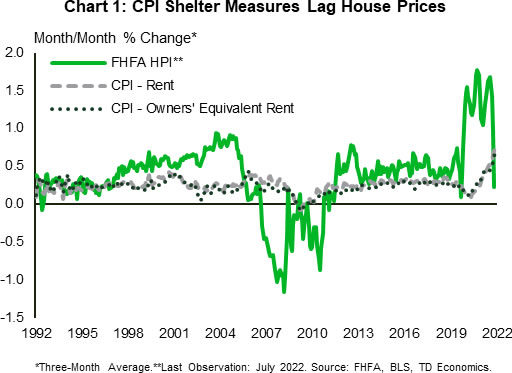
First up, the bad news. Consensus expectations for a +0.2% month-over-month (m/m) reading on headline inflation were shattered by the +0.4% increase, while expectations for core inflation of 0.4% were also handily beat by the 0.6% uptick. Underpinning the rise were strong price growth in core services (+0.8% m/m), and food (+0.8% m/m). The core services print is what’s of interest as these prices are notoriously sticky. Shelter costs (+0.7% m/m), medical care services (+1.0% m/m), and transportation services (+1.9% m/m) were all well above what the Fed would like to see. Of these, the shelter component is, by far, the largest contributor to the basket and will be crucial to tempering inflation. To this end, the rate hikes are working, as evidenced by the plateau in home prices. That said, this will take time to translate into the CPI’s measure of homeowner’s equivalent rent (Chart 1), but things are moving in the right direction.
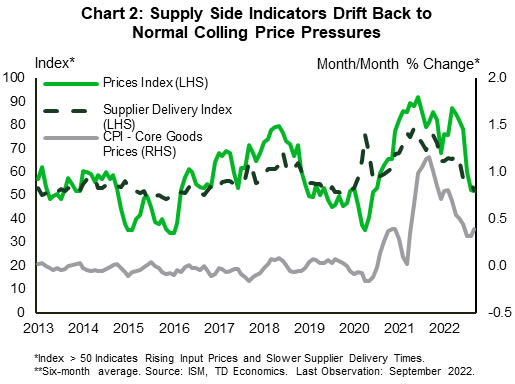
Indeed, core goods price inflation continued to moderate in September (+0.0% m/m), after having risen 0.5% in August. Helping keep a lid on things were a 1.1% m/m pull-back in used vehicles prices and a 0.3% decline in apparel prices. After the run-up over the past year, supply chain improvements are helping ease price pressures (Chart 2). These developments are important as they were always going to be among the first signs that inflation was moderating. Layer in this week’s NFIB report that showed a slightly smaller share of firms anticipating further wage gains and price increases, and the evidence for moderating inflation builds.
The Fed will welcome the signs of improvement, but if this week’s retail sales report shows anything it’s that even though things may be trending in the right direction there is still ample demand out there. The flat monthly reading registered below expectations for a modest 0.2% m/m gain but was weighed down by falling gasoline prices. The core control group (that goes into the GDP calculation) rose a solid 0.4% m/m, showing consumers are still very active.
Given that things are approaching a turning point, the Fed will be considering any weakness in the data. Indeed, FOMC member Lael Brainard highlighted that “output has decelerated more than anticipated” and emphasized the importance of “moving forward deliberately and in a data-dependent manner” amid “elevated global economic and financial uncertainty”. It would seem she is laying the groundwork for an eventual slowing in the pace of rate hikes. After 300 basis points of tightening this year, a slowing will be warranted soon. Looking forward, higher prices and diminished excess savings will help cool demand for goods and services. Coupled with improving supply-side conditions this will work to temper inflation. With other factors now starting to help the Fed in its mission, we anticipate this rate hiking cycle will top out at 4.5%.
Canada - All Eyes on Inflation and Consumers
The economic data calendar was sparse this week, but the next one will more than make up for it as we get the much-anticipated reading on inflation, Bank of Canada surveys on consumer and business outlooks, and retail sales. On the inflation front, analysts are expecting headline inflation to cool moderately on account of further easing in gasoline prices in September. However, as inflation data from the U.S. showed this week, while headline inflation may be decelerating, core inflation – which strips out food and energy – remains white-hot. Inflationary pressures emanating from goods prices are now ebbing, but services inflation – which tends to lag – is still hot, adding fuel to core. This trend is also underway in Canada, which is expected to keep the Bank of Canada on a hiking path for the rest of this year.
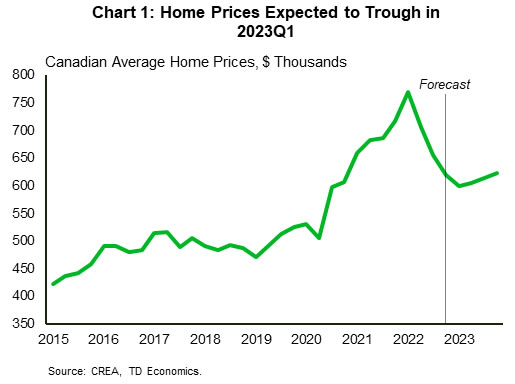
With inflation putting up a fight, the punches keep on coming for the housing market as interest rates march higher. Following a brief pause in August, the house price correction resumed in September with average home prices declining 1.2% on the month, bringing the cumulative drop since February to 17%. Resale activity also continued to cool in a hurry, with home sales down 3.9% m/m. With more rate hikes expected, the housing market will remain under pressure in the coming months, with home sales and prices expected to bottom out in the first quarter of 2023 (Chart 1). At that point, home prices are expected to be 22% lower than they were in the first quarter of this year, roughly at the level seen at the end of 2020.
In addition to inflation, we will also receive important signals on consumer sentiment and spending next week. These will shed light on how consumers are dealing with high inflation, falling home prices and rising interest rates. The Bank of Canada Survey of Consumer Expectations will reveal whether or not near-term inflation expectations are starting to come back down, after having increased for several quarters in a row. This would augur well for the Bank, indicating that tight monetary policy is helping to re-anchor households' inflation expectations. The survey will also provide a year-ahead outlook on consumer spending intentions and expected wage gains – hopefully those will also show signs of easing.
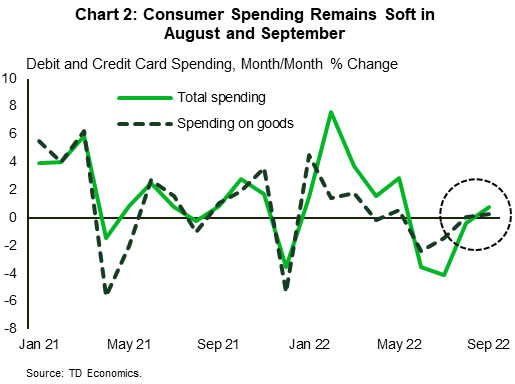
Lastly, next Friday's retail sales report is expected to show a modest uptick in store sales in August, after a hefty drop in July. This is also consistent with TD's credit and debit card spending data, which is showing that spending on goods – mainly captured in the retail report – fared better in August and September relative to the prior months, however, the overall spending momentum remained soft (Chart 2). The Equifax Consumer Pulse survey released this week showed that more consumers have been cutting back on discretionary spending as financial headwinds intensified. TD's spending data is similarly showing a drop in spending on recreation and entertainment in September – the first monthly decline since January when COVID-19 restrictions were in place.
Week Ahead – Earnings Season Heats Up
After a hot inflation report, the focus shifts to how policymakers will change their tune on how aggressive the Fed should now be. On Tuesday, we will hear from the Fed’s Bostic and Kashkari. Wednesday contains the release of the Beige Book and an appearance by Kashkari again, as well as speeches from Evans and Bullard. On Thursday, we will hear from Jefferson, Cook, and Bowman, while Friday brings an appearance from Williams.
Wall Street will pay close attention to the latest round of Fed regional surveys. Both the Empire Manufacturing Survey and Philly Fed business outlook are expected to remain in contraction territory and possibly signal some easing of price pressures, but that might be limited as energy costs have rebounded. Another round of housing data should show the market is cooling as mortgage rates surge to the highest level in 20 years.
Earnings season heats up as we hear from Bank of America, Goldman Sachs, Netflix, and Tesla. After this round of results, we will have a good handle on how healthy the consumer is and if we are starting to see further signs inflation is easing.
EU
Christine Lagarde will speak at the IMF/World Bank event over the weekend which could shed some light on what we can expect on 27 October. Markets are pricing in a high chance of a 75 basis point rate hike which suggests the possibility of Lagarde saying anything groundbreaking is slim. Final inflation data next week could change things but it’s probably not going to as revisions are not common and when they do come, they’re typically very marginal.
There’s an abundance of drama in the UK right now and unsurprisingly the markets are not embracing it. In sacking Kwasi Kwarteng and replacing him with Jeremy Hunt as Chancellor, Prime Minister Liz Truss may have been hoping to regain some faith in the markets and take the heat off herself but neither of those has happened. The vultures are circling and Truss faces the near-impossible task of restoring confidence and trust in her leadership.
There are also some pretty significant economic data releases next week including inflation on Wednesday which is expected to confirm annual price rises are back into double digits. Retail sales will also be released on Friday.
Andrew Bailey is in attendance at the IMF/World Bank meeting and is due to speak on Saturday.
Russia
No major economic or monetary events next week so the focus will remain on the war in Ukraine. PPI data on Wednesday may be of some interest.
South Africa
Inflation and retail sales data on Wednesday will be of interest, with the central bank previously hiking by 75 basis points and some policymakers even favouring 100. The tightening cycle is clearly not over yet; the question is how aggressive they still need to be.
Turkey
A new “disinformation” law adds a bit of extra spice to writing about Turkey’s economic situation and the unconventional approach of the central bank. With inflation running above 80% – as per official data – the central bank is expected to cut rates by another 100 basis points next week to 11%, as it continues to refuse to accept responsibility for soaring prices. The currency continues to trade near record lows amid these policy moves, with inflation expected to remain extraordinarily high barring a sudden and unlikely change of heart on interest rates.
Switzerland
No economic data of note next week but markets are very focused on the next monetary policy meeting on 15 December, with 50 basis points almost fully priced in. The question is whether they’ll wait that long. Chairman Thomas Jordan speaks in Washington on Tuesday.
China
The focus will shift to the 20th National Congress of the Chinese Communist Party, which starts this weekend. The conference is held every five years and is the most important forward-looking guidance of the Chinese government on economic development, COVID strategies, tech ambitions, and people’s livelihood planning.
The PBOC is also expected to keep its one-year medium-term lending facility rate steady at 2.75%.
It will be a busy week with Chinese activity data. Production data is expected to steady, investments to improve, and retail sales to be sluggish.
India
No major economic releases or speeches are expected.
Australia & New Zealand
Australia’s September labour report should show employment trends are moderating. Expectations are for 20,000 jobs to be created, lower than the prior month’s 35,000 gain.
In New Zealand, the focus will be on third-quarter inflation data that is expected to ease to 6.5%, as gasoline prices declined. Inflation trends are somewhat mixed as coal and gas prices posted increases. Price pressures are still high and the RBNZ is expected to remain aggressive with rate increases at the November 23rd policy meeting.
Japan may need to intervene in the FX market again as the yen depreciation continues. Core inflation data is expected to rise, but is unlikely to change the BOJ’s easing stance.
Singapore
Markets will continue to digest the MAS tightening and recentering of the currency band. It will be mostly a quiet week, with the exception of one economic release, domestic export data, which is expected to improve.
Economic Calendar
Saturday, Oct. 15
Economic Events
- The annual meetings of the International Monetary Fund and World Bank continue
- Fed’s Bullard and ECB Chief Economist Lane discuss inflation on a panel hosted by the Reinventing Bretton Woods Committee in Washington
- BOE Governor Bailey gives opening remarks at the Group of 30’s international banking seminar in Washington
Sunday, Oct. 16
Economic Events
- China’s Communist Party kicks off its twice-a-decade Congress in Beijing
- World Health Summit begins with appearances by German Chancellor Scholz and French President Macron
Monday, Oct. 17
Economic Data/Events
- US empire manufacturing
- China medium-term lending
- Italy CPI
- Japan tertiary index, industrial production, capacity utilization
- New Zealand performance services index
- Singapore trade
- Turkey budget balance
- UK Rightmove house prices
- ECB’s de Guindos gives a speech on the 20th anniversary of the euro, organized by the Consejo General de Economistas in Madrid
- ECB’s Chief Economist Lane participates in a discussion, “For a New European Fiscal Framework,” organized by Bocconi University and Deutsche Bank in Milan
- EU foreign ministers meet in Luxembourg
Tuesday, Oct. 18
Economic Data/Events
- US industrial production, NAHB housing market index, cross-border investment
- Minutes of RBA policy meeting
- Canada housing starts
- China Q3 GDP, retail sales, industrial production, surveyed jobless
- Eurozone new car registrations
- Germany ZEW survey expectations
- Italy trade
- Mexico international reserves
- New Zealand CPI
- Philippines BoP
- South Korea money supply
- Spain trade balance
- Thailand car sales
- Turkey house prices
- RBA Deputy Governor Bullock speaks at the Australian Finance Industry Association annual conference in Sydney
- Fed’s Kashkari discusses the economy at a Women Corporate Directors Minnesota Chapter event
- Earnings Reports from Goldman Sachs and Netflix
Wednesday, Oct. 19
Economic Data/Events
- US MBA mortgage applications, building permits, housing starts, Fed Beige Book
- Australia leading index
- Canada CPI
- China new home prices
- Colombia trade
- Eurozone CPI
- Russia weekly CPI/monthly PPI
- South Africa CPI, retail sales
- UK CPI, PPI, RPI, retail price index, house price index
- EIA crude oil inventory report
- Hong Kong Chief Executive John Lee delivers his first policy address
- BOJ’s Adachi speaks at a meeting with local leaders in Toyama
- Fed’s Kashkari takes part in a moderated Q&A hosted by Travelers
- Fed’s Evans discusses the economic outlook during an event hosted by the Jefferson Scholars Foundation in Charlottesville, Virginia
- Fed’s Bullard gives welcome remarks at the Homer Jones Memorial Lecture hosted by his bank
Thursday, Oct. 20
Economic Data/Events
- US existing home sales, initial jobless claims, Conference Board leading index
- Australia unemployment, business confidence
- China loan prime rates, Swift global payments
- Germany PPI
- Hong Kong jobless rate
- Japan trade
- Russia FX/gold reserves
- Taiwan export orders
- Turkey rate decision: Expected to cut one-week repo rate by 100bps to 11.00%
- UK GfK consumer confidence
- European Union leaders summit in Brussels through Friday
- Norges Bank Governor Wolden Bache speaks at the Centre for Monetary Economics, BI Norwegian Business School
Friday, Oct. 21
Economic Data/Events
- Japan CPI
- Canada retail sales
- Euro area consumer confidence
- Italy Bank of Italy quarterly economic bulletin
- New Zealand trade, credit card spending
- Thailand foreign reserves, forward contracts
- Turkey consumer confidence
- UK retail sales
Sovereign Rating Updates
- Czech Republic (Fitch)
- Germany (Fitch)
- Greece (S&P)
- Italy (S&P)
- Netherlands (S&P)
- United Kingdom (S&P)
- United Kingdom (Moody’s)
Canadian Core Inflation Likely Grew Again in September
Canadian inflation will dominate the data calendar next week. The backward-looking September CPI numbers should confirm that current price pressures are still too high and broadly based to take the Bank of Canada off its rate hiking path. The central bank’s business and consumer outlook surveys will also be scrutinized for any changes in future inflation expectations.
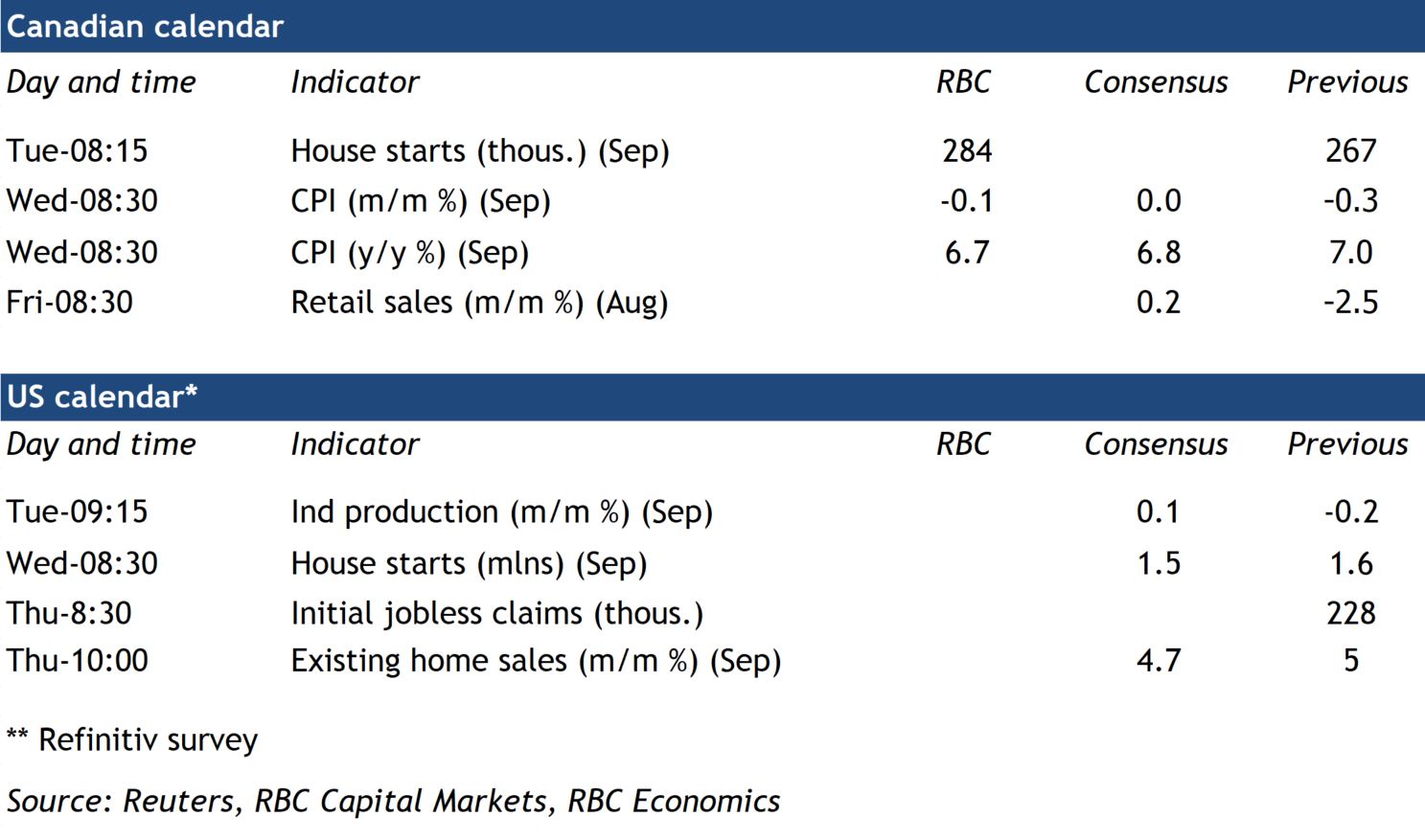
Headline inflation readings have been declining since early summer as gasoline and oil prices retrench. We expect the rate to tick lower again, to 7% in September. But measures of ‘core’ inflation (measures designed to provide a better gauge of underlying inflation pressures) were likely stickier. We expect year-over-year price growth excluding food and energy products increased in September and the Bank of Canada’s preferred ‘median’ and ‘trim’ core CPI measures are not expected to repeat the small dip in August. That contrast between ‘headline’ and ‘core’ inflation measures will persist in the near-term as resurgent consumer demand for services, especially those that are travel and leisure related, prop up price pressure even as goods inflation eases. Indeed, core inflation isn’t likely to meaningfully slow until December.
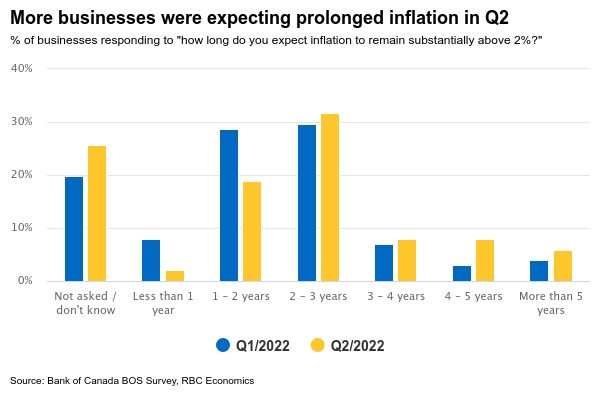
Also on deck for next week is the Bank of Canada’s Business Outlook Survey and accompanying Canadian Survey on Consumer Expectations. Changes to inflation expectations are at least as important to watch as actual inflation data as we look for hints on how much further the central bank will go with interest rate hikes. Evidence that high inflation rates were creeping into longer-run businesses’ inflation expectations were a key reason behind the central bank’s decision to go with an outsized 100 basis point hike in July and follow that up with another 75 bp September hike. Those longer-run price expectations likely ticked lower in the latest update. Indeed, separate surveys from the Canadian Federation of Independent Businesses suggest that wage and price plans already peaked earlier this summer.
Upon a gloomier economic outlook for 2023, we also expect business hiring and investment plans to ease from very high levels in earlier quarters. But that won’t be enough to prevent further aggressive rate hikes. Our base case expectation is for another 50 basis point increase in the overnight rate later this month and for the terminal rate to reach 4% by end of year. Upside surprises next week, either from little improvements in inflation expectations or a worsening reading in the actual CPI, risk tilting that to a bigger 75 basis point increase.
Week ahead data watch:
We don’t expect August retail sales to deviate significantly from StatCan’s preliminary estimate of a 0.4% month over month increase. Actual sales volume was likely stronger than that, given offsets from lower prices at gas stations during the month. Sales in September however are expected to flatten out a bit more, according to data from our own debit and credit spending tracker.
Next week’s housing starts data is expected to show another increase, to 284,000 (annualized) in September following near-term strength in building permit issuance.
Will Q3 NZ Inflation Affect the Hawkish RBNZ?
New Zealand’s CPI inflation readings for the third quarter will make headlines on Monday at 21:45 GMT. Estimates suggest that growth in consumer prices slowed down, though unlike its Australian peer, the RBNZ has poured cold water on dialing back plans for aggressive rate hikes. Nevertheless, some volatility in the kiwi cannot be ruled out if any surprises spark another debate about the size of the next rate hike.
NZ inflation to slow but remain in uncomfortable zone
After beating forecasts to rise at the fastest pace of 7.3% y/y in three decades, inflation in New Zealand is expected to have eased significantly to 6.7% in the three months to September. The quarterly change is estimated lower as well at 1.6% q/q from 1.7% and 1.9% previously.
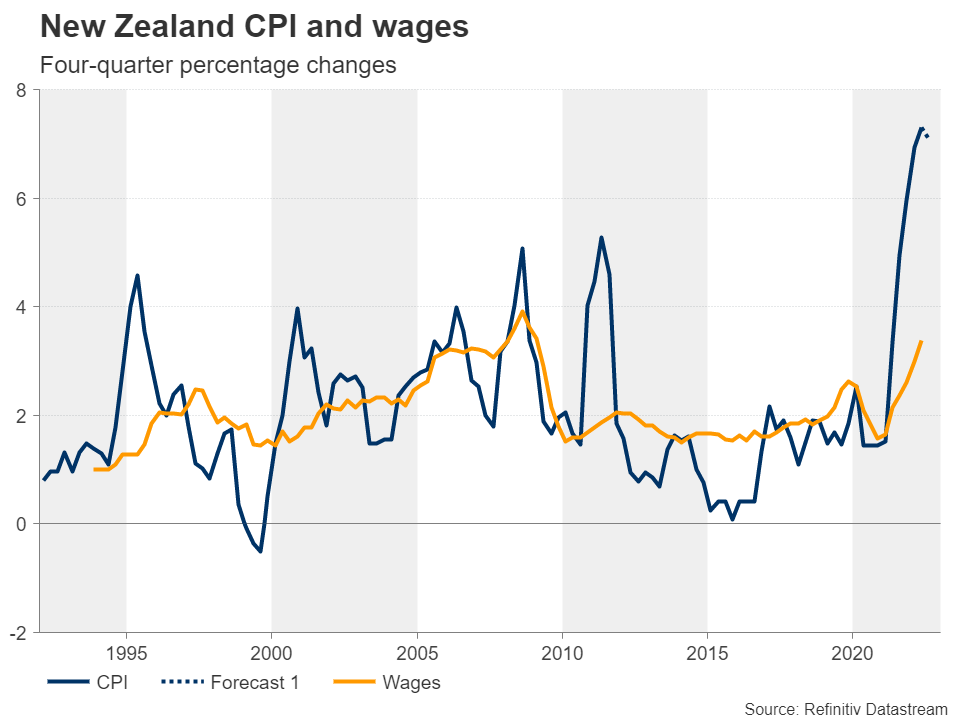
Such an outcome would still be far above the RBNZ’s 1-3% price target after eight straight rate increases, prompting additional tightening actions. Minutes from September’s meeting revealed that policymakers had even been discussing the possibility of a bolder 75bps rate increase before they agreed on a half-point move. That scenario could come back into play if inflation rises above expectations. Besides, the relatively low estimates leave room for an upside surprise.
Consequently, the kiwi may extend its recovery against its Australian cousin, which pivoted southwards after the RBA surprisingly switched to a more moderate 25 bps rate hike earlier this month. Currently, futures markets are certain for a softer 50 bps rate increase to 4.0% in November.
New Zealand economy is vulnerable
The lifting of travel and other covid restrictions prevented a technical recession in the June quarter and the Deputy Prime Minister brought some relief after saying that the economy can avoid a recession even in the face of a global slowdown. He also projects a return to a current account surplus in 2025.
In reality, however, the economic picture is still sluggish. The trade deficit widened sharply to the largest ever in August despite the depreciation in the kiwi. Also, its biggest trade partner China remains exposed to numerous challenges, from business shutdowns due to zero-covid restrictions, to a housing bubble, and to a fresh escalation of tensions with the US.
Internally, wage growth remains more than halfway below inflation despite its latest pickup, and higher borrowing costs will inevitably bring more mortgage pain as household debt to income is still among the highest in the world. The housing market continued to cool down in September, with turnover below average and prices falling lower according to Westpac’s latest report. Consumer sentiment deteriorated near record lows too. Having said that, signs of weakening demand lowering high prices are perhaps what the central bank wants to achieve after all.
RBNZ to stay hawkish; AUD/NZD outlook
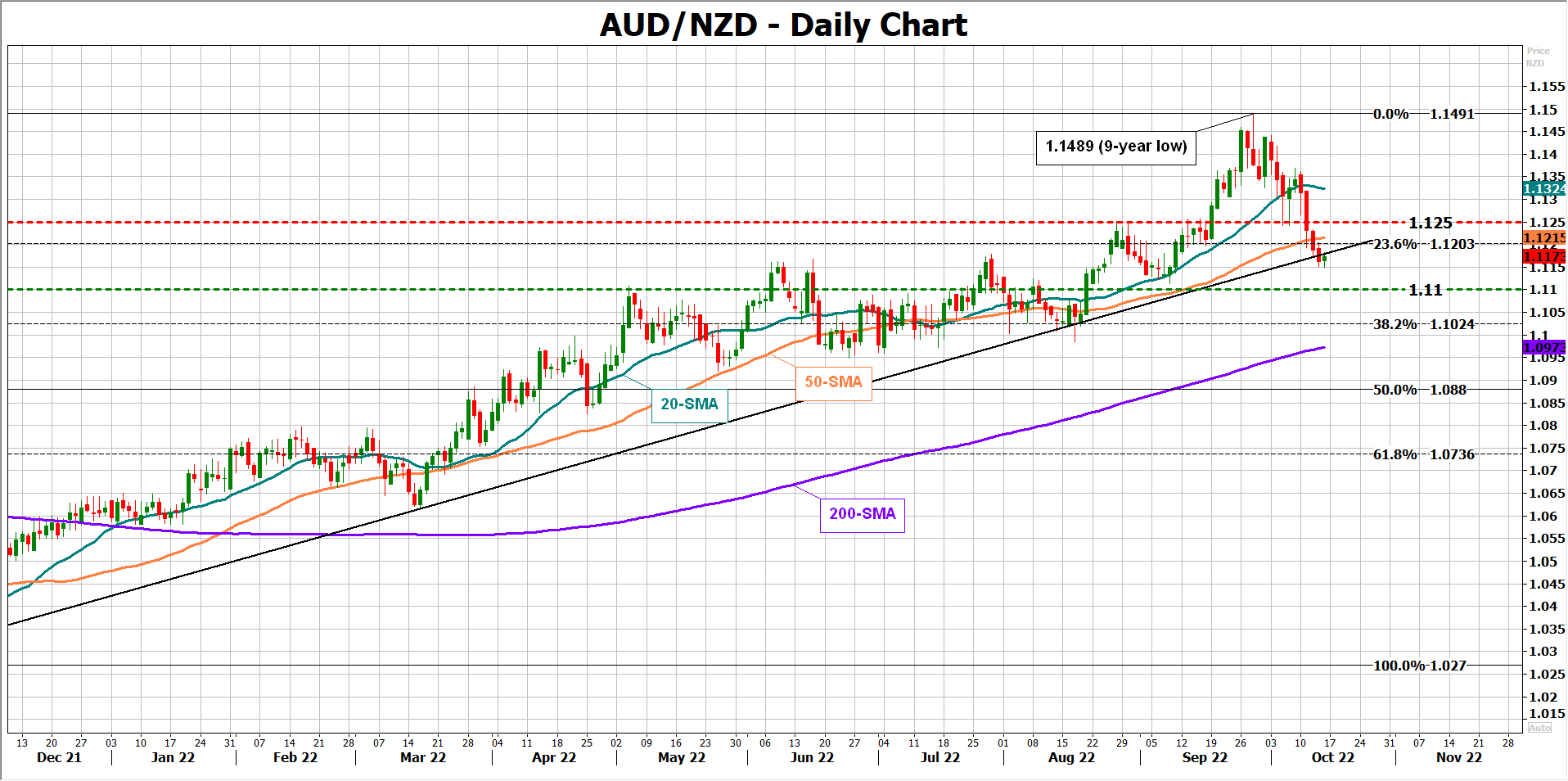
All in all, the RBNZ seems to follow in the Fed's footsteps, making the RBA's unexpected pivot look premature for now. Perhaps the data could raise the debate between a 50bps and 75 bps rate hike once again if inflation arrives stronger than investors expected. In this case, aussie/kiwi could slide towards the 1.1100 psychological mark. Even lower, the 1.1025 region, which coincides with the 38.2% Fibonacci retracement of the 1.0276—1.1489 upleg, may next attract attention. The 200-day simple moving average (SMA) may also come in sight in the event of steeper declines.
Should inflation miss forecasts, traders will probably remain confident for a 50 bps rate increase, likely leaving the kiwi stable. From a technical perspective, aussie/kiwi needs a break above the 1.1200—1.1250 nearby restrictive region to reach the 20-day SMA at 1.1324.
Week Ahead – Inflation Data May Keep Pound in the Firing Line, China GDP on Tap
Inflation will dominate the market theme again in the coming week as, after the United States, it will be the turn of others to face their inflation demons. With the risk of recession growing by the day but not a lot changing with the inflation dynamics, UK CPI figures will attract the most attention, while a modest pickup in Japan is unlikely to spur any policy shifts at the Bank of Japan. China will also come under the spotlight as it releases GDP estimates for the third quarter and its leaders convene for the National Congress of the Communist Party.
Pound battles soaring inflation and budget mess
The pound has been rocked to its core by the recent loss of investor confidence in the UK government’s macroeconomic policy credentials. The Bank of England’s intervention to address the distress in the gilts market threw a much-needed lifeline to the currency but that support is set to end on October 14. Hence, come Monday, there is a very big risk that bond yields could surge again should investors decide to dump UK bonds and other assets. Without BoE support, a sharp jump in gilt yields could trigger a collapse in pension and other liability-driven investment funds. Although it’s unlikely that the Bank would allow this to happen, any fresh turmoil would again undermine sterling.
Even if the week gets off to a calm start, there could be trouble for the pound on Wednesday when the latest CPI numbers are due. UK inflation moderated slightly to 9.9% y/y in August but is forecast to edge back up to 10.1% in September. The core rate is also expected to rise again to 6.4% y/y.
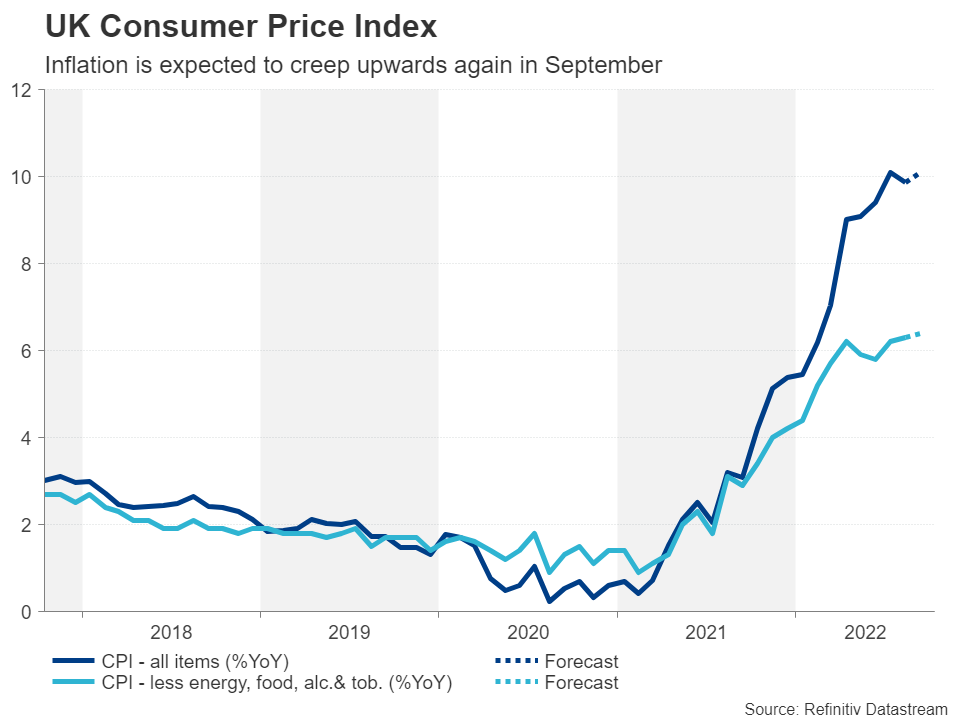
However, whether inflation is a few percentage points above or below the forecasts, it won’t change the overall picture that consumer prices are expected to continue rising well above the Bank of England’s 2% target over the next year as the risks are to the upside. Energy bills are set to go up in October and the pound’s recent devaluation is certain to push up import costs.
The BoE will probably ramp up the pace of its rate hikes in November but no amount of catchup to the Fed will be able to offer meaningful support to sterling when the economic outlook for Britain is so much gloomier than America’s – something that has been exacerbated by Prime Minister Liz Truss’s dangerous economic policies.
Friday’s retail sales data for September are not anticipated to inject much optimism either. But there are increasing signs that Truss is about to abandon the most reckless parts of the tax cuts announced in the mini budget after sacking Chancellor Kwasi Kwarteng. This would help restore some confidence in the UK’s finances and stabilize the pound.
Chinese GDP rebound may not allay slowdown worries
Another country where there’s been a marked deterioration in the outlook lately is China. Nevertheless, with fewer large-scale lockdowns in the September quarter compared to the prior three months and a rebound in consumption, GDP is expected to have expanded by 3.5% over the quarter, while year-on-year growth is projected at 3.4%.
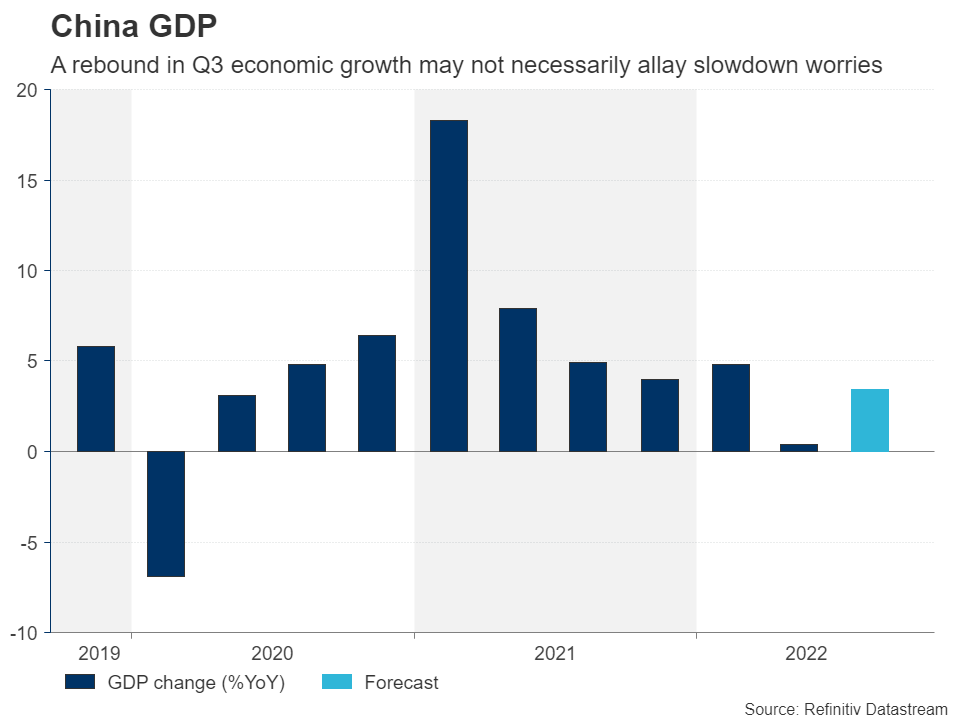
Other data that will be released alongside the GDP numbers on Tuesday are the monthly readings on industrial production and retail sales. An overall upbeat set of figures might help ease concerns about a worsening slowdown in the world’s second largest economy, but only marginally.
Investors worry that the government is not doing enough to tackle the deepening property crisis, while its zero-Covid policy is causing widespread business disruptions across the country, as well as constraining consumer spending.
There were some hopes that President Xi Jinping would have a rethink about this zero-tolerance approach once he secures a rare third term as general secretary of the Communist party, and in effect, as the country’s leader. But those hopes have now been dashed in state media.
China’s Communist Party starts its once-every-five-years national congress on Sunday where Xi is expected to be confirmed for a third term. But whilst there’s not going to be any changes at the top, investors will be keeping an eye on who will be joining the economic team for clues on any shifts in the policy direction amid the many headwinds facing the global economy right now.
Can jobs numbers stop the aussie’s bleeding?
Positive headlines out of China might help the Australian dollar break its losing streak. The aussie has been plumbing fresh two-and-a-half year lows versus the US dollar on concerns about China and the impact of slowing demand globally on commodity prices. If risk appetite remains dampened over the next few days, the aussie’s best chance for some reprieve might come from Thursday’s employment report.
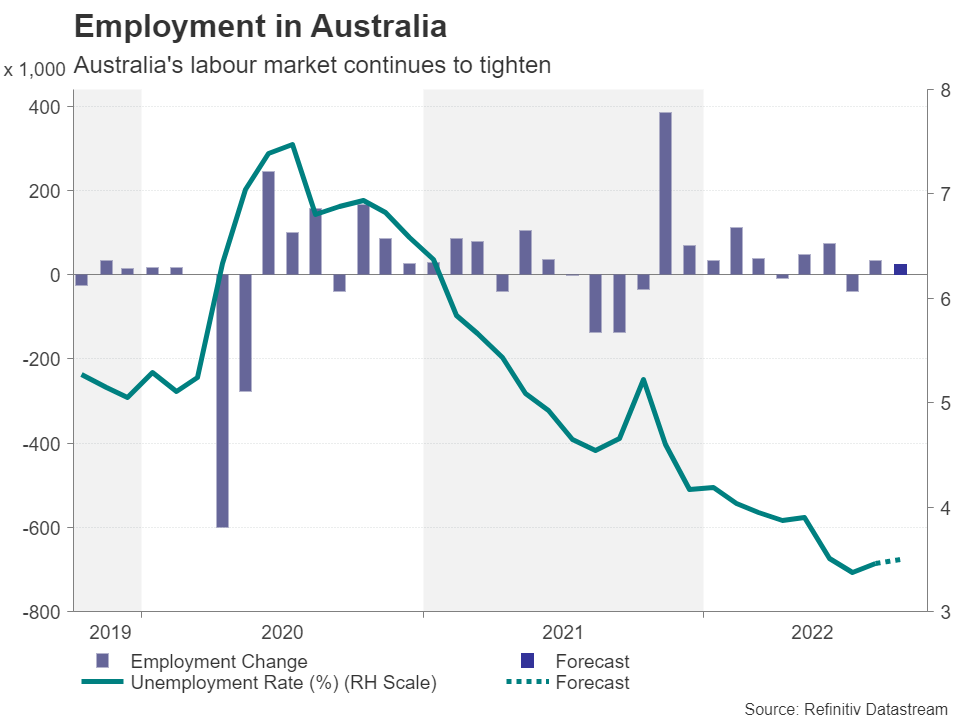
Another factor contributing to the aussie’s selloff is the Reserve Bank of Australia’s recent dovish tilt, which comes despite relatively healthier economic fundamentals than most of Australia’s peers. The RBA decided to go into lower gear at its last meeting, switching to 25-basis-point rate increases. Should the incoming data cast doubt on the need to slow the pace of tightening, the aussie would be in line for some gains.
Kiwi, loonie, yen on inflation watch
The New Zealand dollar is fast approaching its virus crisis lows of March 2020 and several 50-bps hikes by the Reserve Bank of New Zealand have only gone so far in taking the pressure off. Tuesday’s quarterly CPI readings might not do the kiwi any favours, however, as the year-on-year rate is expected to moderate from 7.3% to 6.6%, potentially raising speculation that the RBNZ could soon join the slow lane like the RBA.
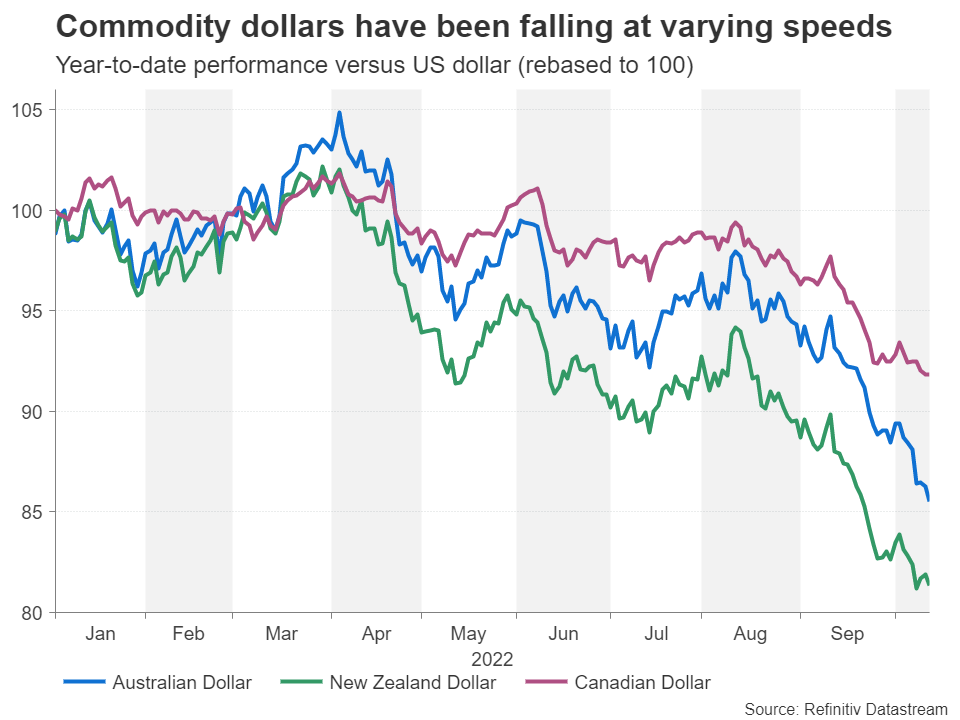
The Canadian dollar has not been immune either to the greenback’s turbocharged rally of the past month, with the rebound in oil prices providing only minimal support. Still, the loonie remains one of the better performing currencies of 2022 thanks to a very hawkish Bank of Canada. Next week’s September CPI print on Wednesday and retail sales numbers on Friday probably won’t have a huge bearing on the near-term policy stance. Although, the loonie may benefit from stronger-than-expected inflation figures if there is some softness in the US dollar.
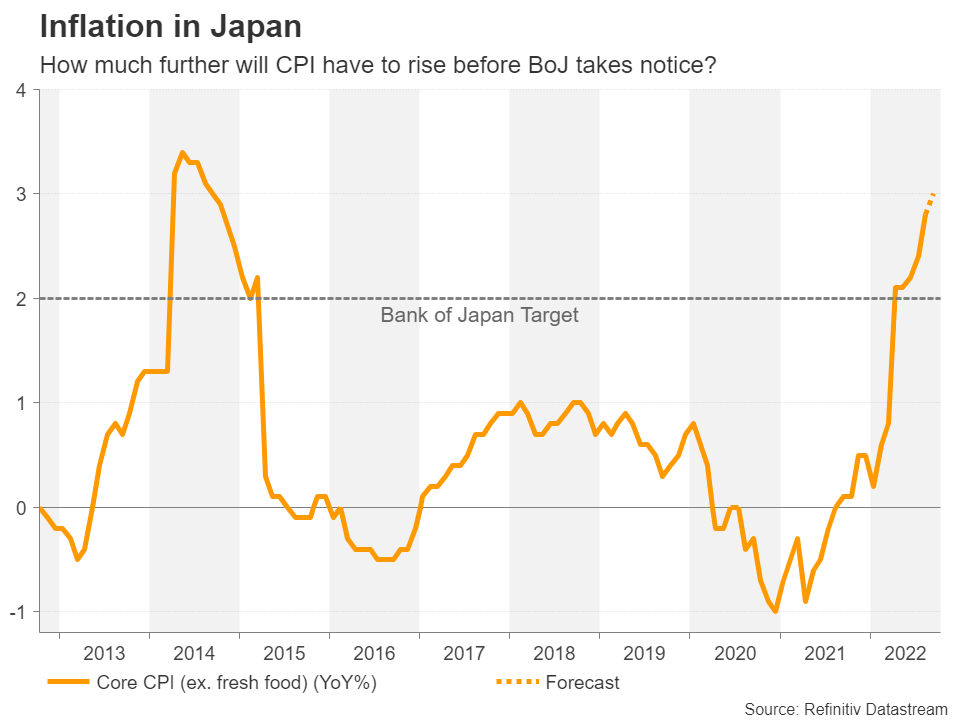
In Japan, inflation will also be the focal point, with the September data due on Friday. The core CPI rate, which unusually only excludes fresh food prices but includes energy and is the measure targeted by the Bank of Japan for its inflation goal, has been steadily rising this year. But at 2.8% y/y, it’s still far below the rate of other countries and not high enough in the BoJ’s eyes to spur wage growth. Nonetheless, any upside surprises to the expected 3.0% could provide policymakers the excuse to start planning for their exit strategy out of stimulus. Yet, the yen is likely to stay under pressure until there is an official signal and traders will be on alert for any further intervention by the Bank to defend its currency.
Earnings will be eyed in the US more than the data
Over in the United States, it will be somewhat of a quieter week following another red-hot inflation report. The Empire State manufacturing index by the New York Fed is out on Monday, followed by industrial production data on Tuesday. Building permits and housing starts are due Wednesday. Existing home sales will round up the housing stats on Thursday, alongside the Philly Fed’s manufacturing gauge.
In the absence of any cooling off in prices, economic growth indicators are unlikely to temper rate hike bets as many now see it as inevitable that the Fed will be forced to tighten into a recession. However, there’s still a chance markets might cheer up if the Q3 earnings season, which just kicked off, isn’t as disastrous as feared, especially if the likes of Netflix and Tesla report encouraging results. An earnings-led improvement in risk sentiment could spark a rebound on Wall Street but would probably be negative for the dollar.
Sunset Market Commentary
Markets
The UK just won’t leave the spotlights these days. It started today with overnight news of Chancellor Kwarteng hurrying to jump on the final flight from Washington DC to London to salvage his unraveling minibudget. Little did he know it was to get sacked. Kwasi Kwarteng out, Jeremy Hunt in. At the time of writing, prime minister Truss is addressing the press with some changes to the budget in an attempt to restore badly bruised investor confidence in the UK. The developments today are the culmination of three weeks of political poker and unnecessary market volatility, at times outright panic. Credit where credit is due: the Bank of England stood by its intentions to end the temporary bond buying programme later today. It twisted the arm of the UK government, forcing it to backtrack on way too lavish spending plans. UK Gilts outperform peers with yields still adding 1.9 bps at the front end but losing 7-15 bps in the middle and long segment. Declines during the day were (more than) double that though, suggesting markets are still wary of UK politics/economics going forward and are awaiting Truss’ press conference. Sterling for this reason is unable to profit. EUR/GBP even ekes out a small gain to 0.867. Cable moves south from 1.132 to 1.126.
The UK bond surge set the tone for peers, although trading is very choppy. US and German bonds build modestly on yesterday’s impressive intraday comeback. European rates inch 2.1 bps higher at the back-end but lose a few bps at the front and belly of the curve. Yields in the US change between -4.4 bps and +1.4 bps in a similar curve move. September retail sales were met with indifference, being spot on analyst estimates. Headline sales flatlined 0.0%, a little below the 0.2% rise expected but came with a small upward revision for the month before. The control group (a proxy for private consumption in GDP calculations) rose 0.4% vs 0.3% consensus. Michigan consumer confidence has market moving potential but is due after the publication of this report. European stock markets in a catch-up move with yesterday’s WS rally rise 2%+. US indices open with gains less than 1%. The dollar is surprisingly resilient given risk-on circumstances. EUR/USD and DXY are trading unchanged around 0.978 and 112.49. The rule to the exception – you guessed it – USD/JPY. The pair is at the verge of closing beyond the 1998 high, at 147.78.
News Headlines
The National Bank of Hungary (MNB) returned to ‘emergency modus’. At the September meeting, the MNB raised its policy rate to 13% and signaled the end of its tightening cycle. Markets considered this premature, especially as inflation jumped north of 20.0%. The forint dropped to a new all-time low above EUR/HUF 430. After an emergency policy meeting the MNB this morning announced new measures to restore stability on the (FX) market and to make market conditions contributing to the price stability objective. The MNB launched a one day FX swap, currently with a yield of 17% and overnight deposit quick tenders (currently yielding 18%) aiming to further tightening financial conditions. The MNB also raised the O/N collateralized lending rate from 15.5% to 25%. Still vice-governor Virag indicated that for now, the 13% base rate is considered as in line with current MNB assessment on inflation. The MNB will also provide foreign currency from its reserves to help address the current account deficit caused by the sharp rise in energy prices. The forint rebounded from an opening level near EUR/HUF 428 to EUR/HUF 416 earlier today, the strongest intraday rebound of the forint in more than 10 years (currently EUR/HUF 418.75).
According data from Eurostat, the EMU in August posted a trade deficit for the 10th consecutive month, rising to €50.9 bln from €34 bln in July. This is a striking change as the region since 2012 succeeded a surplus on a 12 month average basis. Exports in August rose 24% to 282.1 bln, but this was more than offset by a 54% rise in imports. For the Jan/August period the EMU switched from a 124 bln surplus to a 228.8 bln deficit. The deficit is for an important part due to the rise in the energy bill. In a YTD perspective only the Netherlands, Germany and Ireland within the EMU posted a trade surplus. France posted the largest trade deficit (including intra-EU trade) of €123.8 bln.
BoE to Contain Gilt Crash and Save Sterling
GBP/USD slides amid gilts firesale
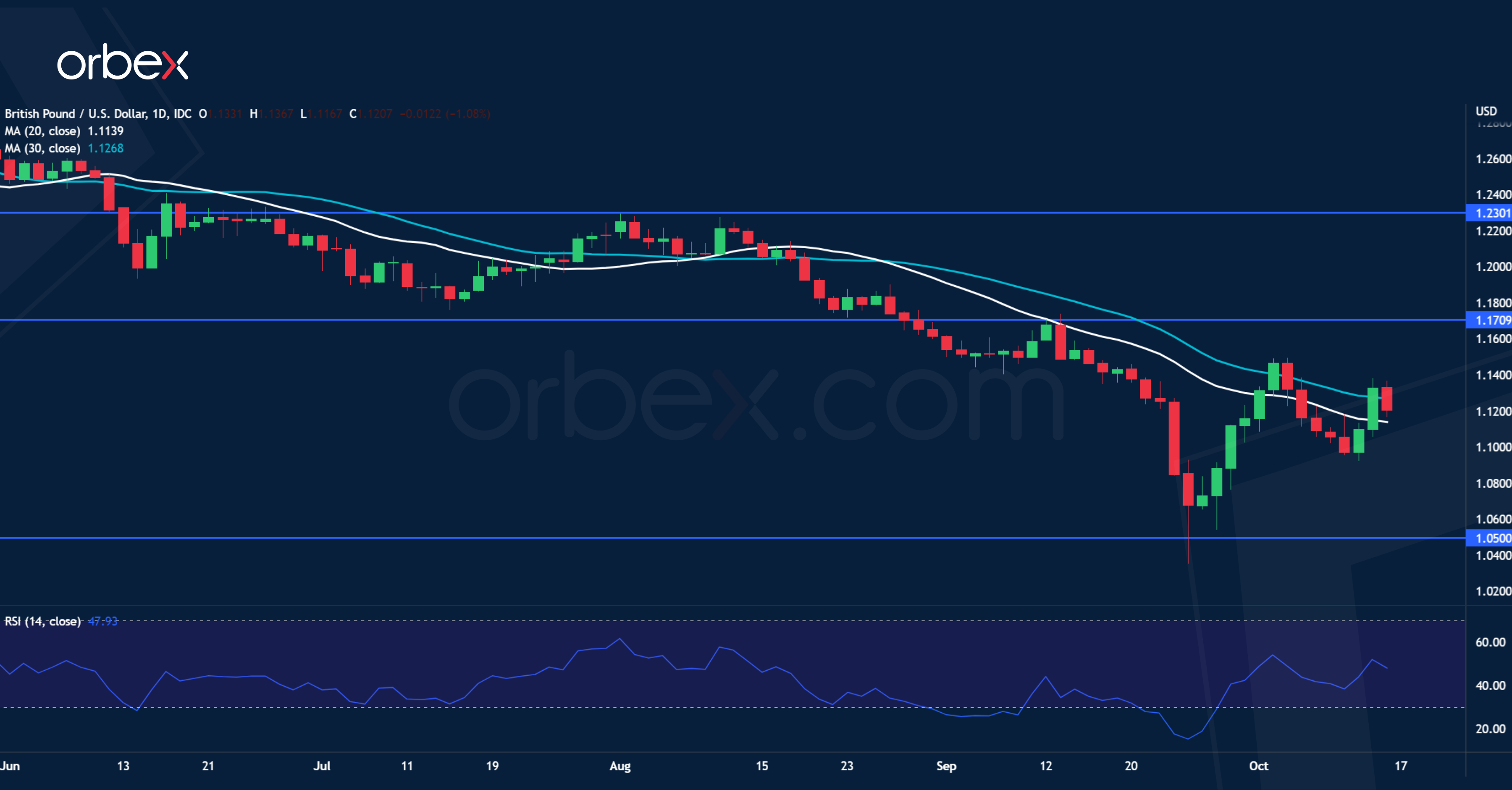
Sterling drifts lower amid a liquidity crunch in the UK’s gilt market. In an attempt to prevent the market’s collapse, the Bank of England has been forced to step in to buy back bonds owned by the country's major pension funds. The systemic risk is yet to dissipate and investors would rather cut their pound exposure. Reduced liquidity and headline catalysts mean that extreme volatility could be expected ahead. Governor Andrew Bailey has called for an end to the emergency support. But traders hope the central bank will extend the lifeline or another market rout may push the pound below 1.0500. 1.1700 is the first resistance.
USD/CAD rises on safe-haven demand
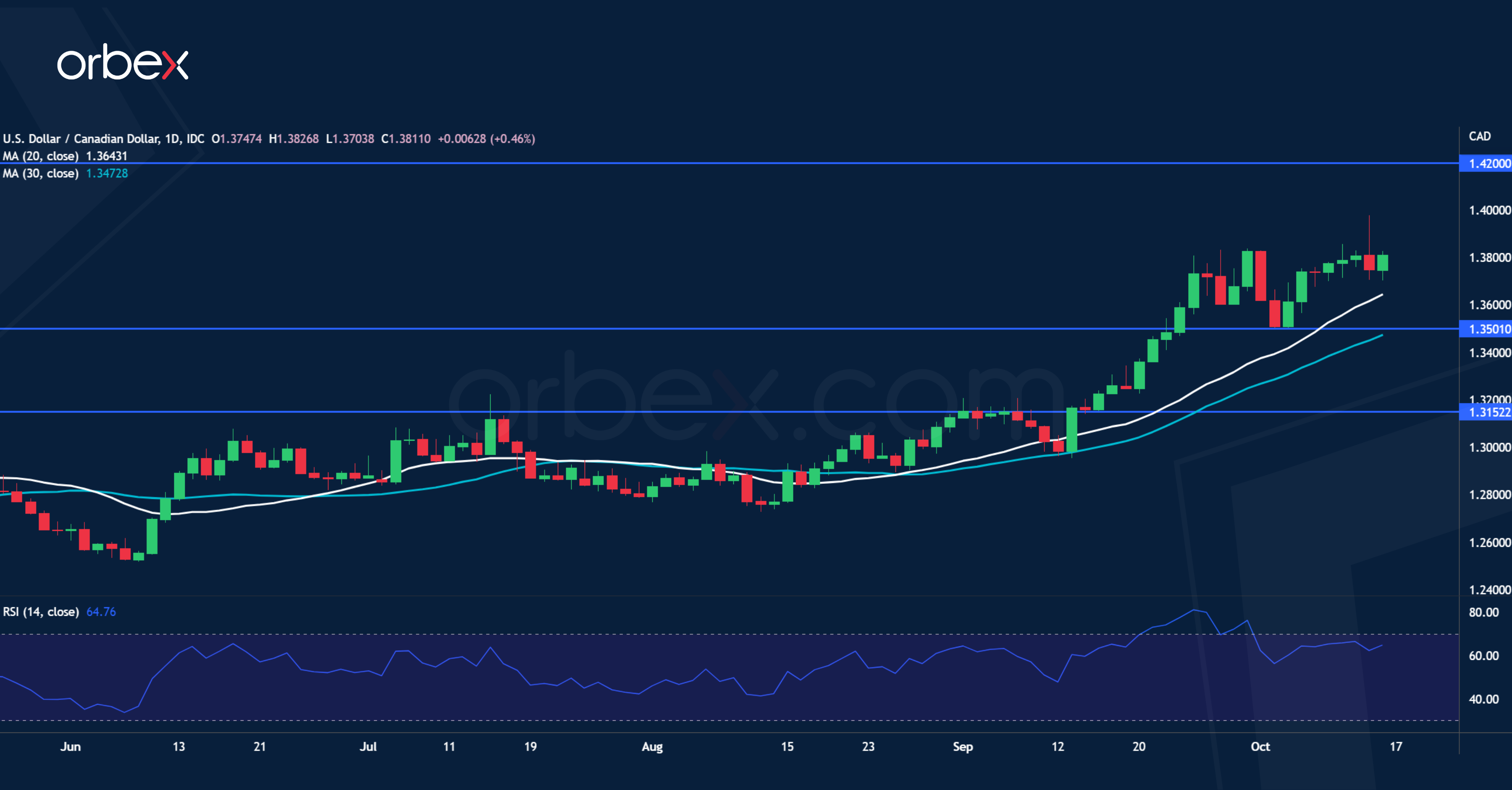
The Canadian dollar slips as markets’ pessimism takes a toll on risk-sensitive currencies. Canada's falling unemployment rate would encourage the BoC to ramp up interest rate increases. Another hot inflation reading this week may offer some support to the loonie. However, Canada is a major producer of oil, and its currency highly depends on the global economic outlook. Worries of a widespread recession engineered by central banks would dampen the prospect of a swift recovery. The risk-off environment would continue to favour the safe-haven greenback which is heading towards 1.4200. 1.3500 is a fresh support.
XAU/USD weakens as cash yield soars
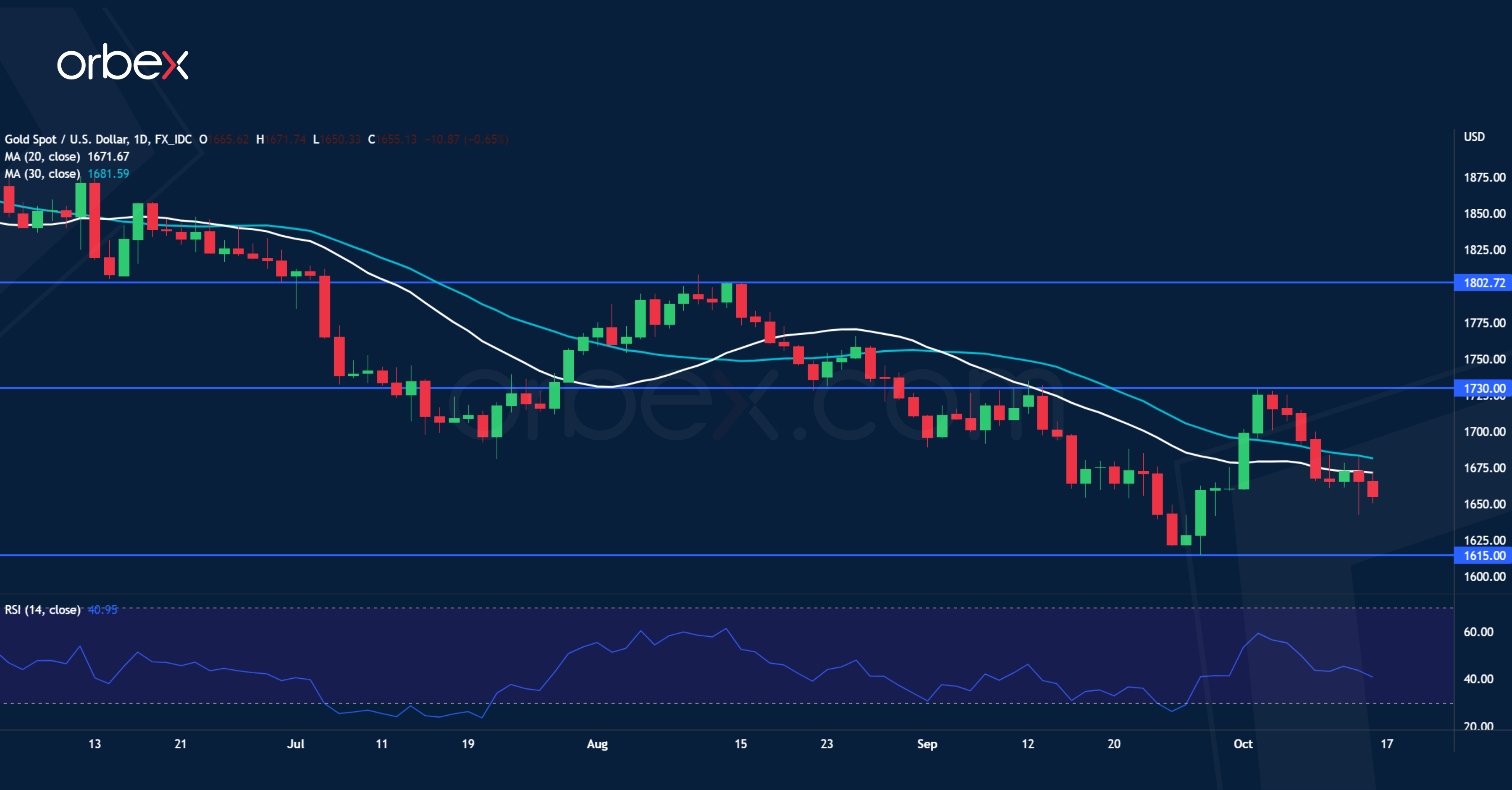
Bullion struggles as the US dollar hits a 20-year high. The precious metal has definitely failed its traditional role as an inflation hedge which ironically has been fulfilled by cash these days. Investors have rotated into cash to capture soaring interest rates. As US inflation remained near 40-year highs, there is no sign of a slowdown in the tightening. Calling a top in the dollar would be tantamount to standing in front of a train. Repeated statements from Fed officials to maintain the course of action would keep casting a cloud over anything commodity-related. The bounce off 1615 might be short-lived and 1730 is the closest resistance.
NAS 100 slips as uncertainties compound
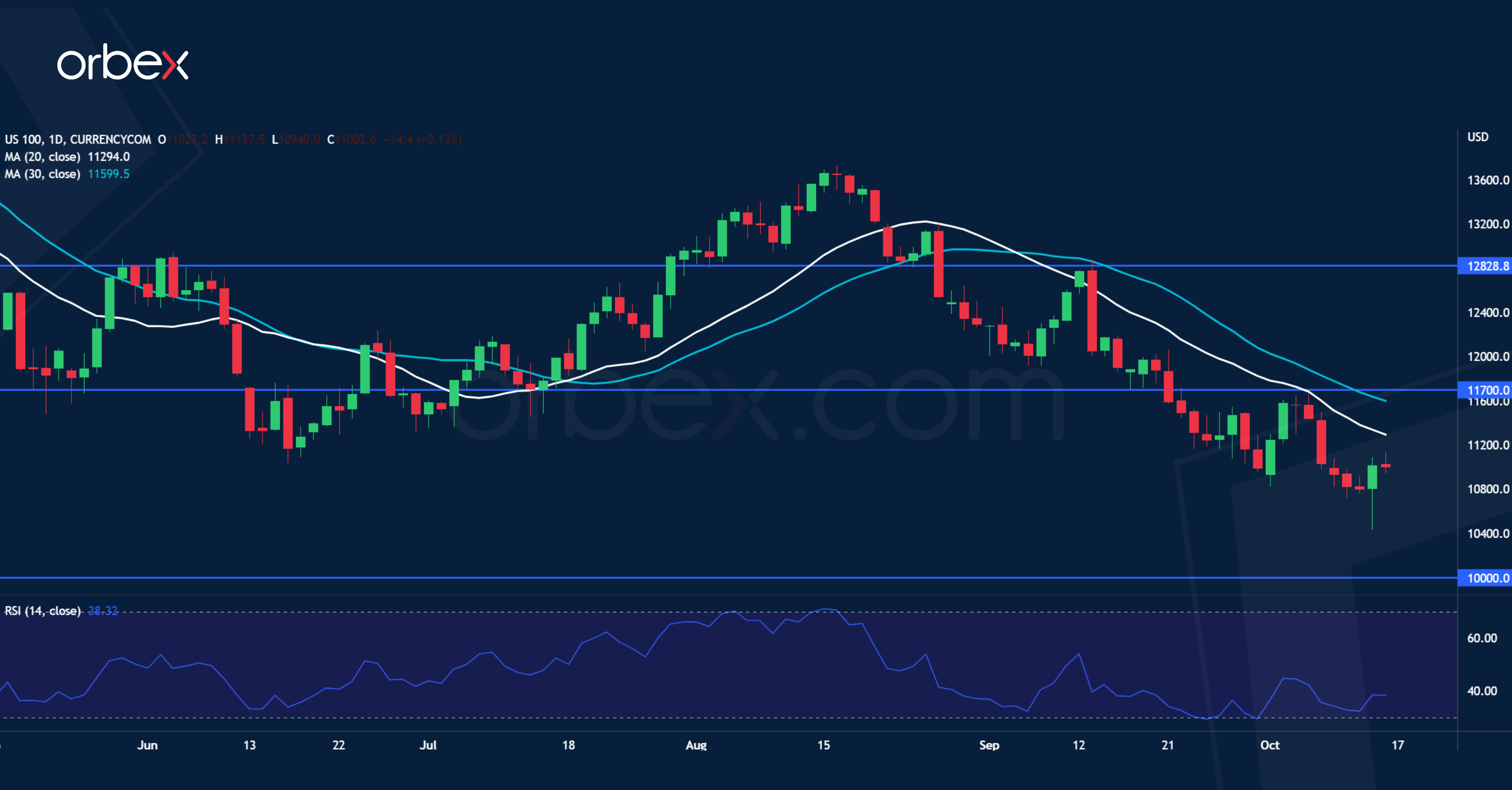
The Nasdaq 100 stays under pressure as the Fed would not yield. In a textbook ‘buy the rumour, sell the news' equity markets clawed back some losses following higher-than-expected US CPI. Another 75bp rate hike seems to be a done deal. The negativity already had been priced in, triggering short-covering instead. More volatility could be expected ahead as the market's grim fundamentals remain unchanged. The IMF has warned that compounding pressures from inflation, geopolitical instability and high interest rates could cause a global recession. Uncertainties may drive the index to 10000 and 11700 is the first resistance.
Why UK Bond Crisis Spooked Other Central Bankers
The sudden drop in the pound and the emergency intervention by the BOE is largely attributed to the release of Chancellor Kwarteng's "mini-budget", at least in the media. That gives the impression that the issue is exclusively a UK problem, derived from fiscal policy. But, that doesn't explain why other central banks, such as the RBA and, most recently, members of the ECB's governing council, would consider modifying their policy because of what is going on in the UK.
Although the precipitating event was the uncertainty in UK finances brought to light by the "mini-budget", it brought to light another significant problem: Lack of liquidity. And that goes beyond the UK. With the BOE facing down hedge funds backed up by the Chancellor, the risk of a "black swan" event that could trigger a broader global financial crisis has become elevated.
The surprising remarks
At its last meeting, the RBA didn't raise rates as much as expected, citing several reasons. Among them was the situation in the UK bond market. It didn't really cause much alteration in the market, as the consensus at the time was that the BOE would handle the situation.
Earlier today, however, a prominent ECB hawk came out to downplay the aggressiveness of future rate hikes in the EuroZone. He suggested that a neutral rate could be around 2.0% for the ECB, well below rates already achieved by the peers. Although he didn't comment on the UK situation directly, he echoed words by Spain's de Cos yesterday, who warned that shocks for the downside scenario had materialized. What are those?
Where's the money
European financial markets have already been facing a major issue that has necessitated bailouts: The energy crisis. Energy firms had hedged future contracts to maintain steady supply by collateralizing their holdings. The sudden spike in energy prices drained substantial amounts of liquidity as energy firms were forced to increase collateral to avoid margin calls.
A similar situation happened with the pension funds, which were forced to put up more liquidity to defend their hedges that were collateralized by UK debt. However, the sudden spike in interest rates suggested that there was very little interest in buying bonds. The combination of global uncertainty and high inflation makes holding debt paying relatively low rates for extended periods of time a bad investment.
The potential crisis
"Liquidity" is what keeps the markets going. It means that if someone needs to sell an asset, there is someone who wants to buy it. That maintains stability. Because, if there isn't anyone to buy an asset that's for sale, then the price gets lowered until someone is willing to buy.
Rising interest rates drain liquidity, because it encourages people to not hold cash. If there is a crisis of liquidity, it means that markets could suddenly fall, as the lack of buyers triggers stops, forcing the market down.
Typically, talk of lack of liquidity precedes a major market collapse, and the need for central banks to step in. That might not be the situation at the moment, but given concerns over liquidity, central bankers might be more hesitant to continue tightening. Even if the data (such as inflation) indicate that rates should keep rising.
US: Retail Sales Remained Flat in September
Retail sales were flat in September month-on-month (m/m), below market expectations for a modest gain of 0.2% m/m. The level of sales was revised 0.4% higher in August (vs. 0.3% reported earlier).
Sales at autos & parts dealers declined by 0.4% m/m after growing 2.8% m/m in August.
Gasoline station receipts were the major drag in today's report, down 1.4% m/m. Sales at building materials and garden equipment were down 0.4% m/m.
Retail sales in the "control group," which exclude autos, gas stations and building materials and are used in estimating personal consumption expenditures, rose a healthy 0.4% m/m.
- Sales were solid at department stores (+0.7% m/m), while health stores, clothing stores and non-store retailers all registered a 0.5% m/m gain. Food & beverage stores were right behind them with a 0.4% m/m gain.
- Food services and drinking places – the only services category in today's report – made a relatively strong gain of 0.5% m/m in September
- Two categories that reported losses in September were miscellaneous stores retailers (-2.5% m/m) and furniture & electronics/appliance stores (-0.7% m/m).
Key Implications
With the final month's sales, the third quarter gained 2.6% (annualized) – higher than we expected. However, removing price effects, this translates into 2.0% quarter-on-quarter annualized loss. As a result, we now expect personal consumer expenditures to come in just below 1% (annualized) in Q3.
More headwinds are on tap for consumers as they are entering a holiday sales. Over the coming months, several forces will weigh on retail sales. First, elevated inflation will force consumers to avoid more expensive and discretionary items. Second, the cumulative effect of tighter financial conditions will become a more prominent restraining force. Lastly, annual revisions to National Accounts reported on September 29th suggest that consumers have around 25% less spending power in the form of excess savings than we estimated in our recent report. Together, these factors tilt demand risks to the downside, suggesting that the fourth quarter rebound in real durables spending will be half of what we forecast in September.