Sample Category Title
ECB survey shows inflation expectations might have peaked
According to ECB's Consumer Expectations Survey (CES) in August, inflation expectations were largely unchanged comparing with July. Nevertheless, mean inflation expectations for the 12 month ahead dropped slightly, and could have peaked. Growth expectations also improved.
On inflation:
- Mean expectations for 12 months ahead dropped from 7.1% to 6.9 (compares to 6.6% in June).
- Median expectations for 12 months ahead was unchanged at 5.0%.
- Mean expectations for 3 years ahead was unchanged at 4.7%.
- Median expectations for 3 years ahead was unchanged at 3.0%.
On growth:
- Mean growth expectations for next 12 months improved from -1.9% to -1.7%.
- Median growth expectations for next 12 months improved from -0.1% to 0.0%.
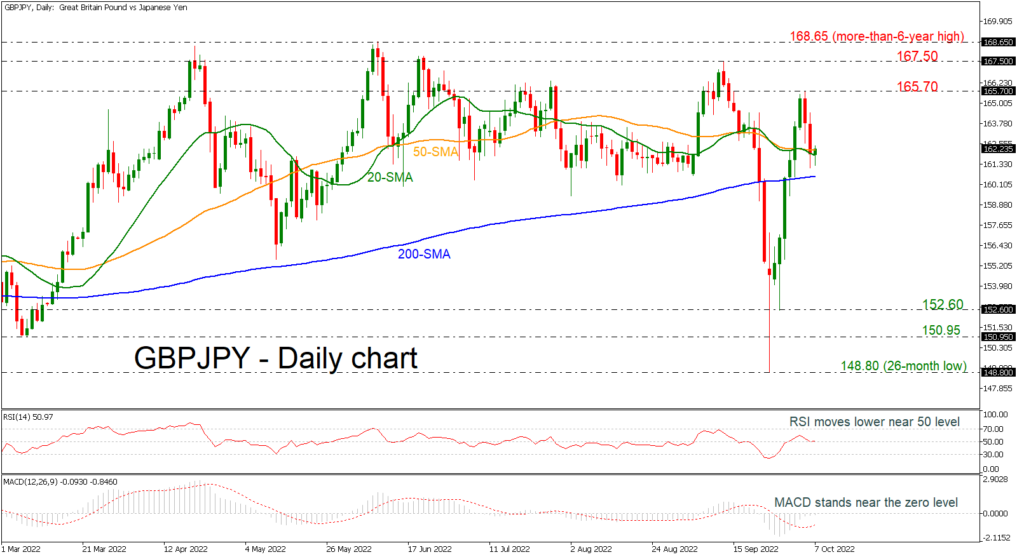
GBPJPY Flirts With short-Term SMAs after Declining Move
GBPJPY is posting a bearish correction after the 11% gain and the rebound off the 26-month low of 148.80. Currently, the price is testing the 20- and 50-day simple moving averages (SMAs) and slightly lower the 200-day SMA is acting as significant support. The RSI is consolidating near the 50 level, while the MACD is standing near the zero level.
To the downside, immediate support could come from the 200-day SMA at 160.50 before diving towards the 152.60 barrier. The next hurdles could come at the 150.95 and the 26-month trough of 148.80.
Otherwise, if buyers push above the moving averages, initial resistance could come from the 165.70 barrier ahead of the 167.50 line. Climbing higher, the more-than-six-year high of 168.65 could interrupt the test of a key region of 175.00, reached in April 2015.
Summarizing, the very short-term bias has turned bearish but if the price shifts above the 165.70 mark, and especially beyond 168.65 the picture could turn positive.
Price Rises in Germany Not Causing a Surge in Retail Sales
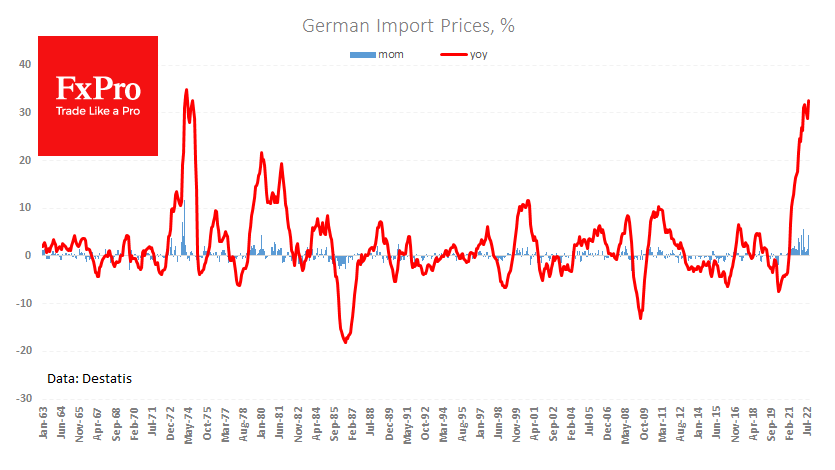
Import prices in Germany jumped by 4.3% in August, dashing hopes of waning inflationary pressures. The year-on-year growth rate has accelerated from 28.9% to 32.7%, marking a new record since 1974 – another consequence of the single currency’s weakness.
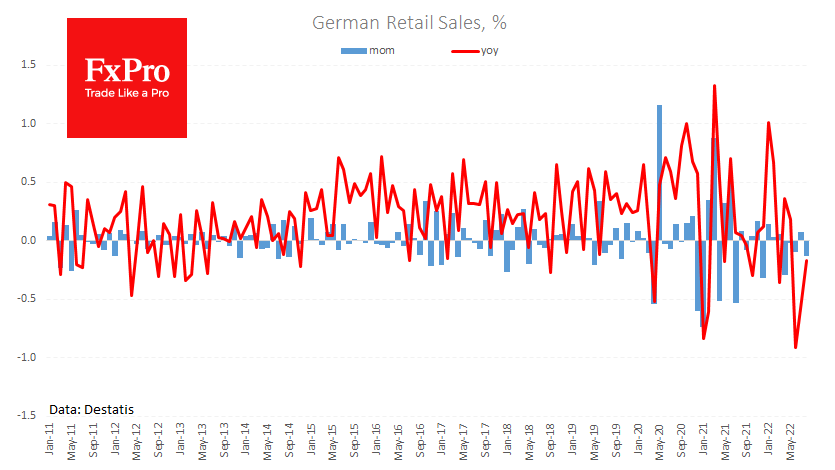
Retail sales for the same month declined by 1.3% m/m and 4.3% y/y on an inflation-adjusted basis. A logical reaction of consumers to the increase is to increase their purchases to spend the money before it loses its value. However, this theory is more suitable for periods of an economic boom in developed and poor developing countries with a high proportion of necessities in the consumer basket.
The persistence of the inflation shock, which can be seen in the development of import prices, may also be pushing the euro region’s monetary watchdogs to accelerate their rate hikes.
The EURUSD, after an initial 35-pip slide following the German statistics package, returned to the upside, reaching new highs for the day above 0.98.
EUR/USD: Euro May Fall Further on Robust US Jobs Data
The Euro edges higher in European trading on Friday, consolidating a sharp fall on Wed/Thu (2.04%).
Renewed risk aversion which dragged the euro lower, is likely to gain pace as markets expect a robust US jobs report that would give a fresh signal to the US central bank for further aggressive tightening.
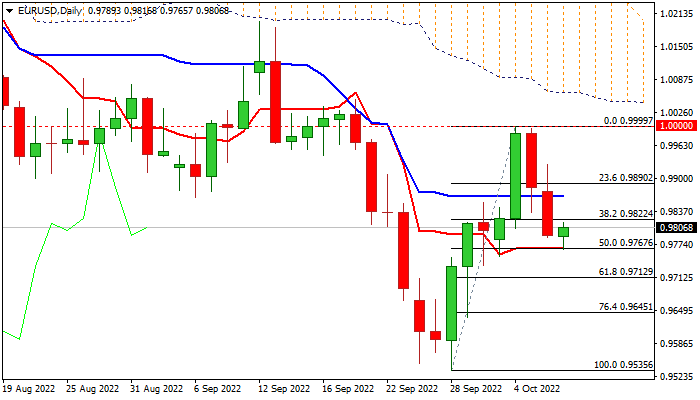
Bearish signals on daily chart from a double-top at parity level and a bull-trap above 0.9949 (Fibo 61.8% of 1.0197/0.9535) weigh on Euro along with weak daily studies, in addition to continuing pressure from a gap between the Fed/ECB interest rates.
Upticks should be ideally capped by broken Fibo 38.2% (0.9822), though near-term action is expected to remain biased lower while holding below daily Kijun-sen (0.9866).
Bearish continuation through temporary footstep at 0.9767 (50% of 0.9935/0.9999 / daily Tenkan-sen) would expose targets at 0.9712 (Fibo 61.8% of 0.9935/0.9999 and 0.9645 (Fibo 76.4%) with stronger bearish acceleration on positive NFP surprise to risk retest of 20-year low at 0.9535.
Res: 0.9822; 0.9866; 0.9890; 0.9926
Sup: 0.9767; 0.9712; 0.9645; 0.9585
USD/JPY Eyes US Nonfarm Payrolls
USD/JPY has been hovering close to the 145 line most of the week, and the trend has continued today. In the European session, USD/JPY is trading at 144.81, down 0.21%.
The US releases nonfarm payrolls later today. The release once received massive coverage and was usually a market-move, but the new era of high inflation and global tightening has stolen much of NFP’s thunder. Still, the indicator is an important bellwether of the health of the US economy and could provide insights into future rate moves from the Federal Reserve.
The consensus for the September nonfarm payrolls stands at 250,000, lower than the 315,000 recorded in August. The US labour market has been very robust, and investor reaction will likely be muted if the consensus is not wide of the mark. The markets will be more focussed on hourly earnings and the participation rate – soft readings would raise speculation that the Fed could ease up sooner rather than later, which would be bearish for the US dollar. Conversely, hot readings would support the Fed remaining hawkish, which would give the US dollar a boost.
Will the Ministry of Finance intervene again?
Japan will also be keeping a close eye on today’s US jobs reports. The Ministry of Finance (MOF) has shown that is willing to intervene to prop up the Japanese yen, and a stronger-than-expected NFP could be the trigger for another round of intervention. Since the dramatic intervention on September 22nd, the yen has moved only slightly above the 145 level, which could well be a ‘line in the sand’ for the MOF. The MOF intervention, which was meant as a warning against speculators, likely cost 2.84 trillion yen. The move led to Japan’s foreign currency reserves falling to their lowest level since 2017. With the Bank of Japan capping JGB yields and the Fed continuing to deliver oversize rate hikes, the US/Japan rate differential is widening, which means the yen will likely continue to lose ground, barring another currency intervention by the MOF.
USD/JPY Technical
- There is resistance at 145.36 and 145.97
- USD/JPY has support at 144.29 and 143.68
Dollar Index: Dollar Index Keeps Firm Tone ahead of Key US Jobs Data
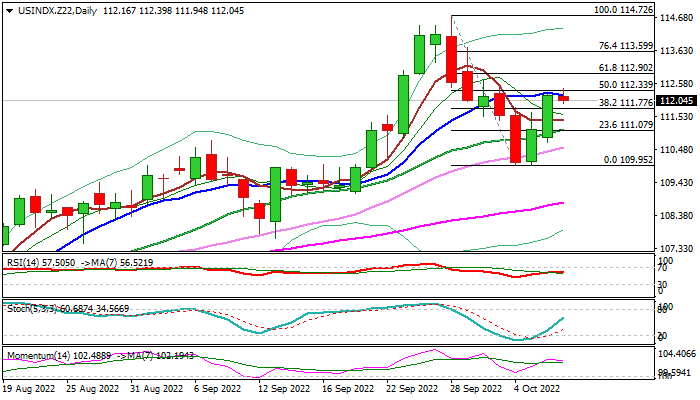
The dollar index is holding within a narrow consolidation in early Friday, following strong rally in past two days (up almost 2%) which retraced 50% of 114.72/109.95 pullback, adding to signals that corrective phase from new 20-year high might be over.
Daily studies returned to bullish setup and a bear-trap under 110.81 (Fibo 38.2% of 104.49/114.73) contribute to positive near-term outlook, with today’s close above 112.33 pivot (50% retracement of 114.72/109.95 / daily Tenkan-sen) to boost bullish signals.
Markets focus on US labor data as a key event today, with solid numbers to add to positive dollar’s sentiment, strongly underpinned by signals that the Fed remains on track for aggressive policy tightening.
US unemployment is expected to remain unchanged at 3.7% in September (close to the lowest since 2019) while non-farm payrolls are forecasted at 250K, down from August’s 315K, but seen positive while holding above 200K.
Only a shock from significantly weaker than expected US labor figures would derail dollar bulls.
Res: 112.33; 112.66; 112.90; 113.59.
Sup: 111.94; 111.77; 111.40; 111.18.
USDCAD Seems to Return to Gains; Nearby Resistance Eyed for Confirmation
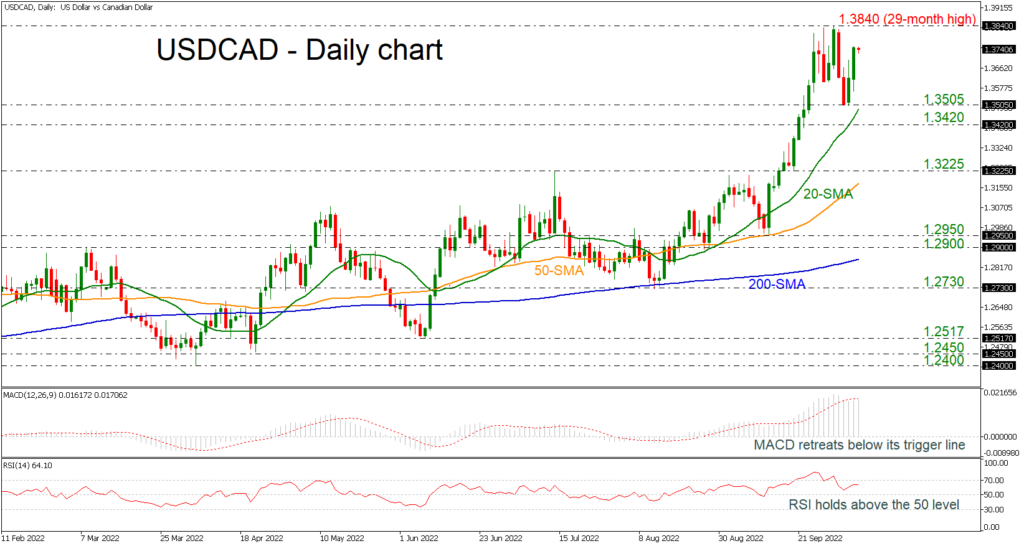
USDCAD is gaining sustainable ground, finding support at the 1.3505 barrier. The 20- and 50-day simple moving averages (SMAs) are following the upward movement; however, the technical oscillators are weakening their momentum. The MACD is standing beneath its trigger line in the positive area, while the RSI is flattening above the neutral threshold of 50.
Traders would be more eager to engage in buying activities if the price manages to surpass the nearby resistance at 1.3840, where the 29-month high is placed. If this is successfully breached, then the rally may next rest somewhere near the 1.4170 resistance, taken from the highs in March 2020.
On the flipside, the selling pressure could accelerate if the market deteriorates below the 1.3505 former strong support area, which stands near the 20-day SMA. Such a move could next bring the 1.3420 barrier under the spotlight, which if violated could trigger sharper losses probably towards the 1.3225 line.
In the long-term timeframe, the pair is in a bullish trend and only a move beneath the 200-day SMA would put the market in a sideways path.
USD/CNH: We Expect a Second Rise to the Maximum of 7.268
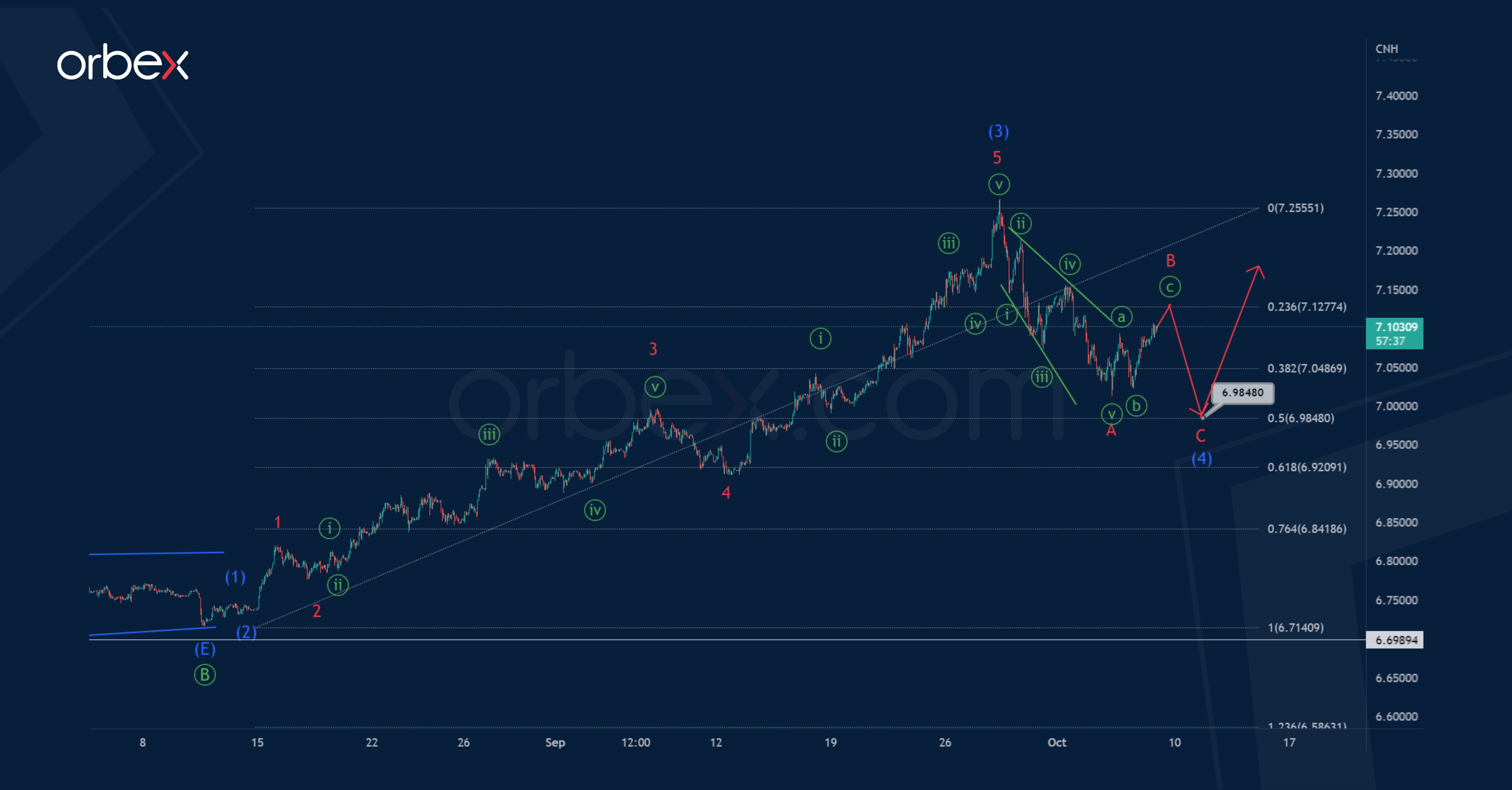
The current chart of the USDCNH currency pair shows the development of the correction pattern - the primary zigzag Ⓐ-Ⓑ-Ⓒ. This primary construction today looks completed in two parts out of three.
The last bullish wave Ⓒ seems to take the form of an intermediate 5-wave impulse (1)-(2)-(3)-(4)-(5).
It is possible that the last intermediate wave (5) is currently under development. It may take an impulse form, or the form of an ending diagonal. The growth in this wave is likely to continue to 7.268.
The indicated level is the maximum, which was marked by the previous impulse sub-wave (3).
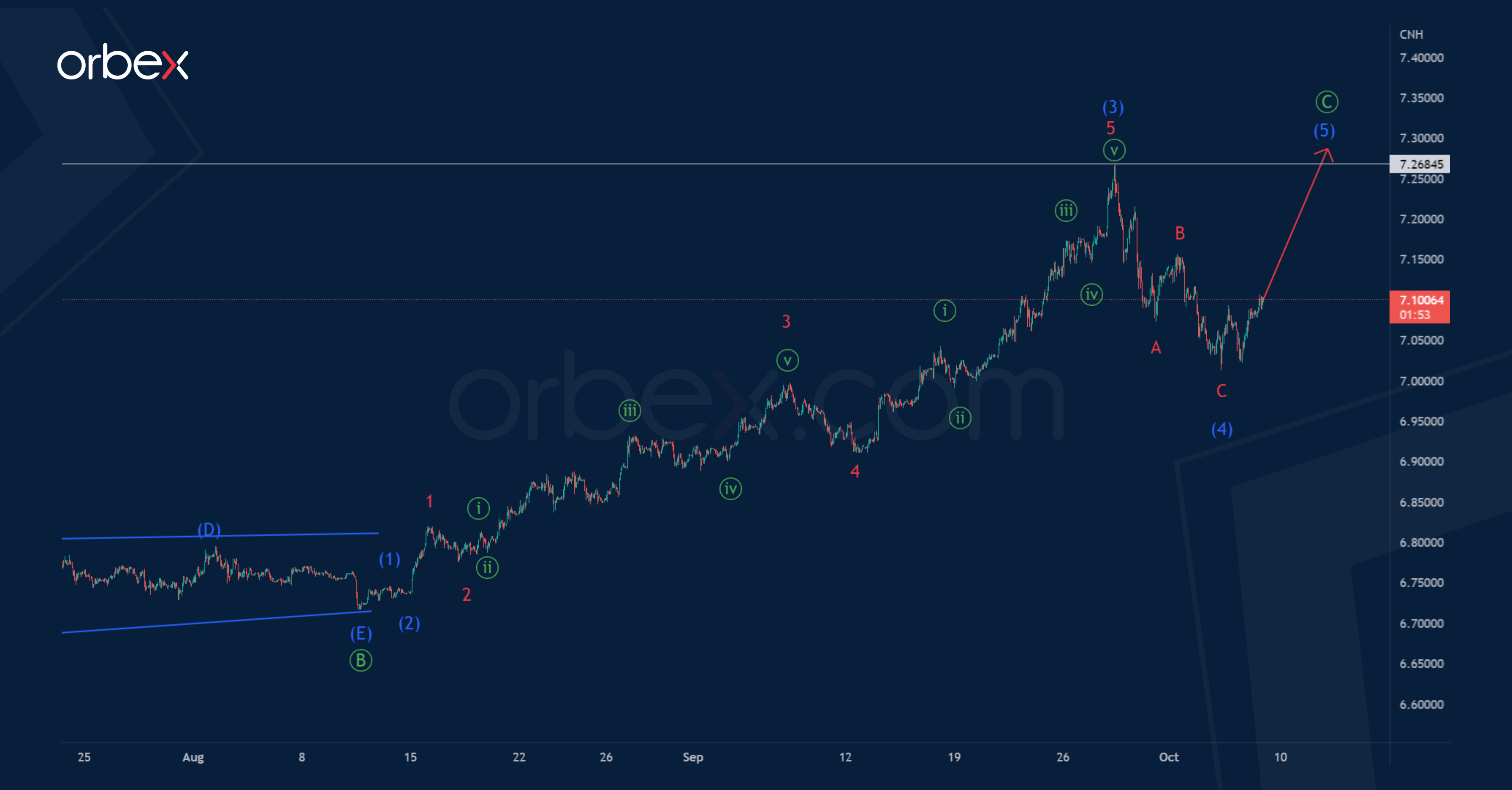
An alternative scenario shows that the currency pair may continue the correction wave (4) of the intermediate degree. It is assumed that it will take the form of a standard minor zigzag A-B-C, where wave A is the leading diagonal.
Using the Fibonacci line tool, we can predict the end of wave (4). Most likely, it will be at 50% of bullish impulse wave (3), which, according to statistics, is most often found in impulse patterns. Therefore, its end can be expected near 6.984.
An approximate scheme of possible future movement is shown on the chart.
S&P 500 Attempts to Bounce
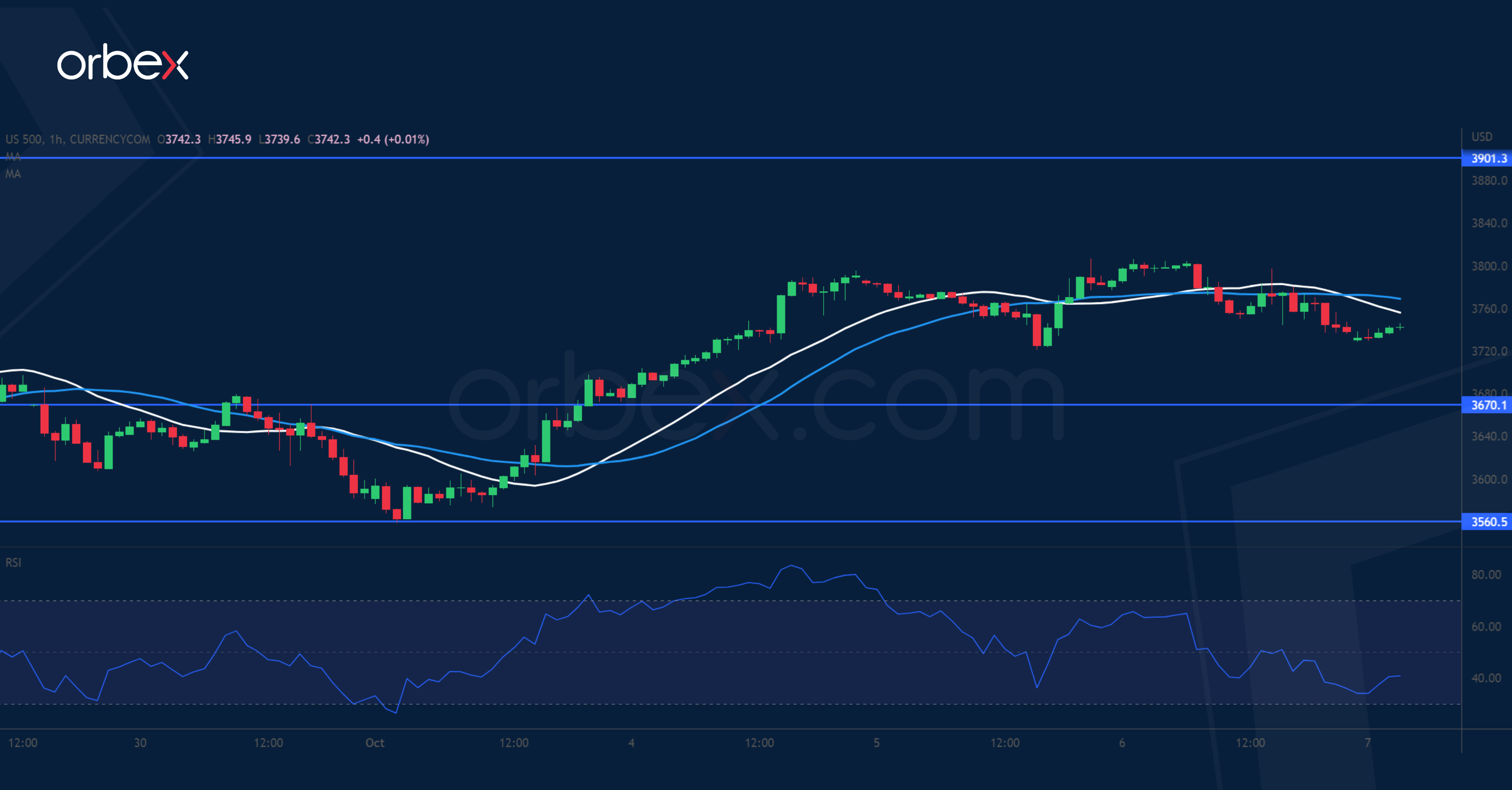
The S&P 500 treads water ahead of the nonfarm payrolls report in September. The index has been looking to claw back some losses after its drop below the critical floor at 3750. Sentiment remains downbeat though there could be short-term opportunities in the current recovery. A rally above 3670 has eased the selling pressure, turning it into a fresh support. 3900 is a major hurdle where the bears could be expected to double down. The bulls will need to clear this supply area before a rebound could gain traction.
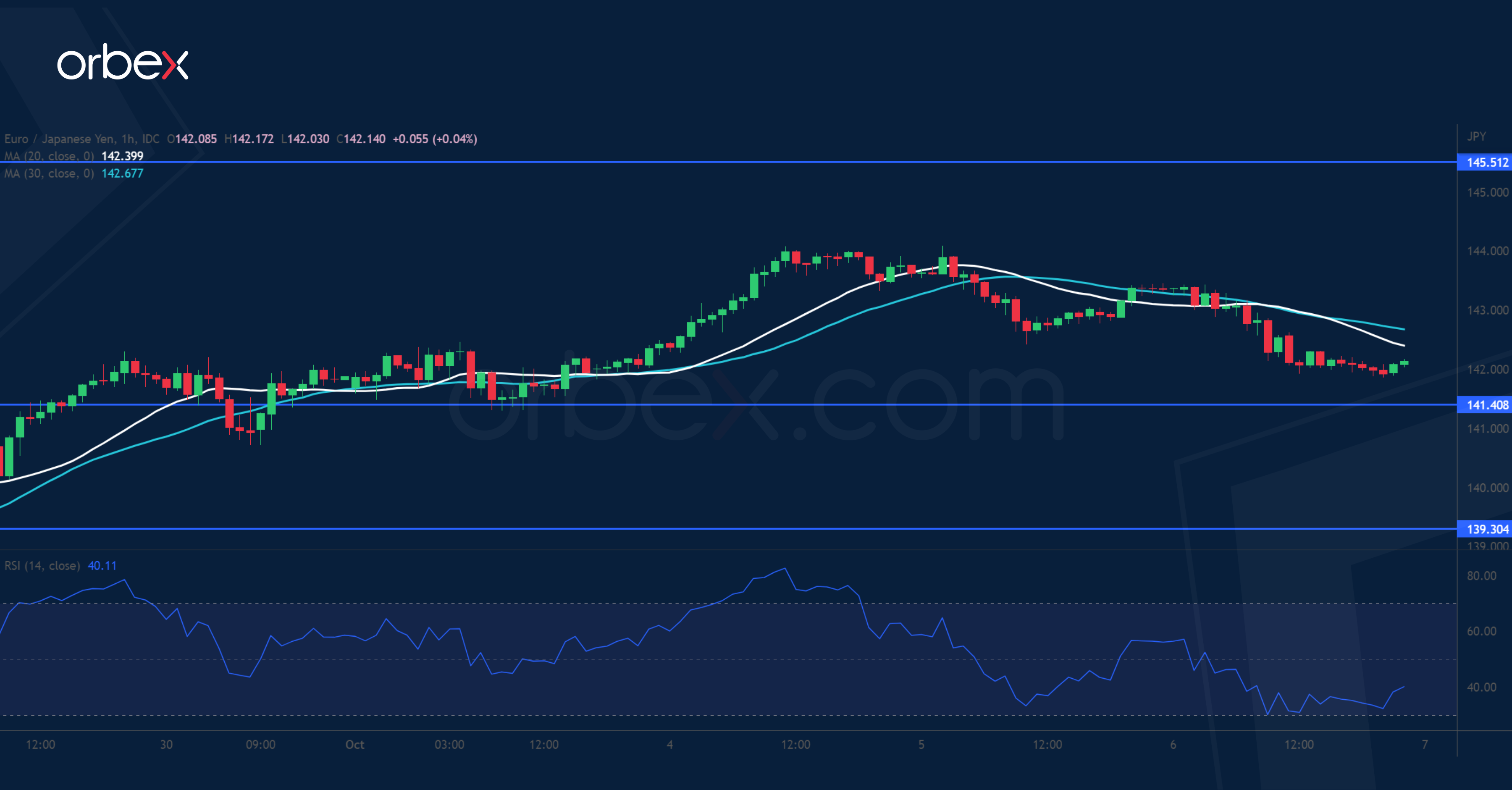
EUR/JPY Seeks Support
The euro weakened after the ECB minutes showed that a recession was "increasingly likely". A break above 143.50 the origin of a previous liquidation has prompted sellers to cover their bets. This is an indication of strong interest in maintaining the euro’s lead. As the RSI drops back to the neutral area, the former supply zone around 141.40 is the first level to gauge follow-up bids. A bounce would carry the single currency to the recent peak at 145.50. Otherwise, the pair may drift towards 139.30.