

Sample Category Title
The Weekly Bottom Line: Canada – More Work to be Done
U.S. Highlights
- The last jobs report before the Federal Reserve’s November meeting showed that 263k jobs were added in September, bringing the unemployment rate back down to 3.5%.
- ISM Manufacturing and Services PMIs indicate that demand for goods is slowing swiftly, while demand for services is slowing more gradually and has yet to yield substantial ground.
- Oil supply reductions signaled by OPEC+ this week will raise energy prices, creating another headache for the Federal Reserve.
Canadian Highlights
- The OPEC+ decision to scale back output jolted oil prices and supported the energy intensive TSX equity index. We still see limited upside for oil moving forward, amid a weakening global economy.
- In a speech this week, BoC Governor Macklem delivered a hawkish message. He noted that more work needs to be done to cool inflation, and that it’s still too soon to take a decision-by-decision approach to policy.
- This morning’s Labour Force Survey flashed some signs of cooling conditions (hours worked declined), but still reinforced that job markets are tight and wage growth is robust.
U.S. - More Jobs, Less Oil, No Pivot
The first week of the third quarter was largely centered around labor market conditions and their potential impact on the policy stance of the Federal Reserve at their November meeting in four weeks’ time. Lower job openings, higher jobless claims, and slowing job growth all provided some evidence of a softening labor market, but a lower unemployment rate and solid wage growth clouded the aggregate outlook. Equity markets rallied to start the week with hopes of a ‘Fed pivot’ before retreating on Friday as the jobs report drove yields higher and dampened the prospect of a less aggressive Fed. As of the time of writing, the S&P 500 is still up 2.5% for the week, while the ten-year treasury yield sits at 3.9% - 10bps higher than it was to start the day.
Non-farm payrolls capped the week, coming in slightly above market expectations with 263k jobs added in September. The unemployment rate ticked down by 0.2 percentage points, back to its July low of 3.5% as the labor force was virtually unchanged from its August level. Combined with steady growth in average hourly earnings of 0.3% month-over-month (m/m), it is clear that the labor market remains strong – a sentiment that is not lost on financial markets which are now pricing in a fourth 75bps hike by the Fed in November with 80% probability.
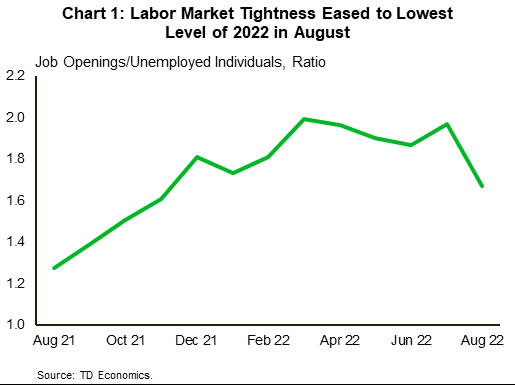
Earlier in the week, we saw job openings for August decline by 10% to reach their lowest level since June 2021. This brought the ratio of job openings to unemployed individuals down to 1.67 - its lowest level since November 2021 (Chart 1). This will be welcomed by Jerome Powell who noted that this ratio was exceptionally high in his September press conference. Jobless claims also displayed signs of softening with a 15.3% increase last week, although this only brings the level of claims back to where it was a month ago. On aggregate, the labor market will need to soften further in order for inflation to sustainably return to the Fed’s target range.
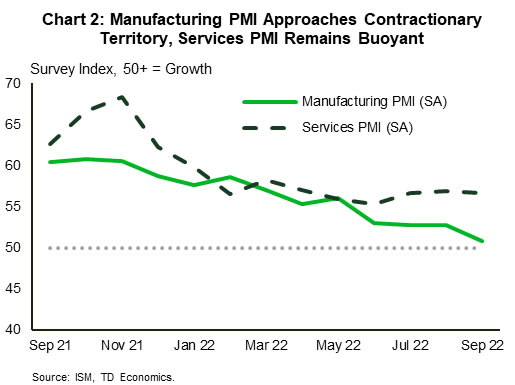
One sector which is showing clear signs of slowing is manufacturing, with the ISM Manufacturing PMI quickly approaching contractionary territory (Chart 2). The index dropped by 1.9 percentage points to 50.9 in September, reaching its lowest level since May 2020. Slowing demand was a leading contributor to the lower reading, with both new orders and new export orders contracting. Some of this demand has shifted into the service sectors, with the ISM Services PMI remaining well in expansionary territory, though it too is showing some signs of slowing. While the reading for September was slightly above expectations at 56.7, a slowdown in the backlog of orders as well as new orders could be indicative of the early signs of peak demand for services.
International events this week will serve to further complicate the Fed’s already difficult position, with OPEC+ signaling that it will curtail oil production by 2 million barrels-per-day (bpd). National gas prices, which have been rising for the past few weeks, will likely rise further and return to making positive contributions to headline inflation. Next week’s CPI data for September will provide a better picture of recent developments on the prices front, but as it stands now the Fed will likely remain resolute in its current hawkish stance.
Canada - More Work to be Done
Following another difficult month September, it was a turbulent week for Canadian equity markets. Bourses bounced higher to begin the week, with the TSX up 5% through Tuesday. Ironically, some weak economic data, and the recent rout in financial markets were big drivers for this brief turnaround. Investors figured that these signals would be enough for central banks around the globe to at least consider some adjustments to their aggressive tightening campaigns. However, this hope faded later in the week, as this morning's employment report indicated that Canadian job markets remained tight, reinforcing hawkish messaging from BoC Governor Macklem earlier in the week.
The energy heavy TSX index was given another jolt by the steep climb in oil prices. WTI shot 15% higher this week (as of writing), buoyed by the OPEC+ decision to scale back global oil output by 2 million barrels per day in order to shore up prices after several weeks of declines. However, the actual reduction in output should work out to something closer to 900k barrels. Ultimately, even with this week's rally, we see limited upside potential for WTI heading into 2023 as the global economic backdrop continues to soften.
Our assumption that oil prices will trend lower next year is a key factor underpinning our forecast for slowing inflation. This view is also cultivated by the additional 75 bps of tightening we think is in the cards for the Bank of Canada. In a speech this week, Governor Macklem reinforced that more tightening is on the way.
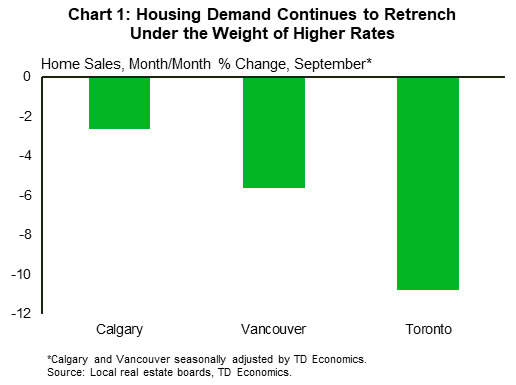
Additional rate hikes will erode housing affordability that's already stretched-thin, further weighing on demand. In this vein, we've recently downgraded our forecasts for Canadian home sales and average home prices, and September data from local boards released this week reinforced our view. Most notably, home sales tumbled 11% m/m in Toronto, while prices were down nearly 3% m/m last month (Chart 1).
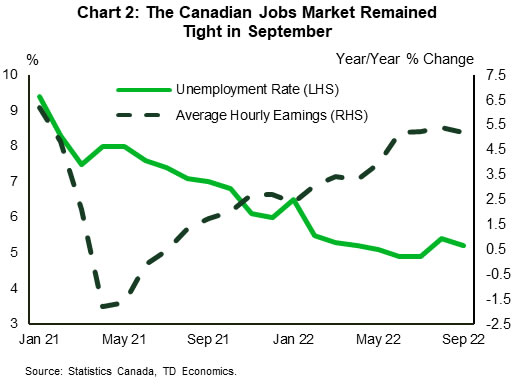
In his speech, Governor Macklem also remarked that it's still too soon to take a "decision-by-decision" approach to policy. This latter remark could signal that the Bank is considering a higher endpoint for the policy rate than the 4% level we expect. However, this will depend on how the broader growth outlook evolves. This morning's jobs report confirmed that the economy is cooling, but that labour markets remain tight and wage growth is robust (Chart 2). The Canadian economy added 21k jobs last month, bang on consensus. However, this was due to a rebound in the educational sector, which may have been "artificially" depressed by difficulties in seasonally adjusting the data in the month prior. Removing this sector yields a clearer picture – Canadian employment is softening, while hours worked also tumbled in September. However, the unemployment rate remains near a multi-decade low and wage growth is running at 5%. The latter is simply too high for a central bank hell-bent on returning inflation to its 2% target.
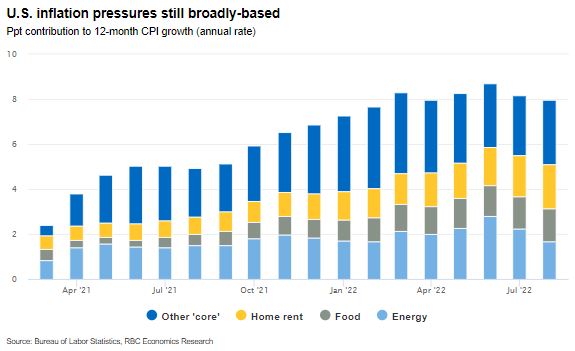
Forward Guidance: U.S. Core Inflation to Tick Higher in September Despite Slower Energy Price Growth
U.S. headline inflation likely fell for a third consecutive month in September as oil prices dropped (by 8.6% month-over-month). Gasoline prices were up more than 16% from a year ago, easing down from a 26% year-over-year jump in August.
While headline inflation began its descent in June, food price growth has kept climbing—hitting a new multi-decade high in August. And core price growth (excluding food & energy products) likely ticked higher in September, reflecting price pressures that remain very broad. Indeed, while wholesale used vehicle prices fell in September, shelter costs have exhibited considerable and persistent strength.
We expect underlying price growth to slow more sustainably. But this will play out amid a weaker economy with higher unemployment rate as the U.S. Federal Reserve continues to hike interest rates aggressively.
Week ahead data watch:
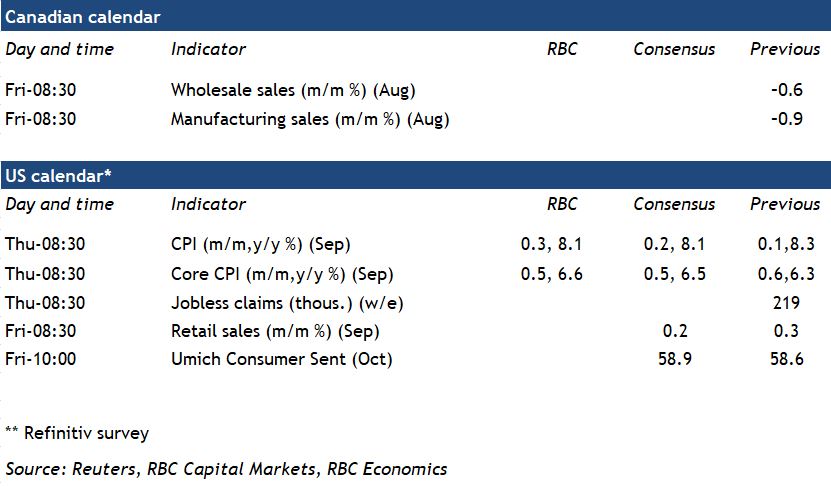
- U.S. retail sales likely trended up in September (+0.2%), with higher sales of motor vehicles and parts offsetting a price-led drop in sales at gasoline stations.
- Statistics Canada’s flash estimate for August manufacturing sales indicated a 1.8% decline. Roughly half of that is likely explained by a drop in prices led by petroleum products.
- Canadian wholesale trade likely rose 0.8% in August, due to higher sales of food, beverage, and tobacco items, thanks to continued food and beverage product inflation.
Week Ahead – Earnings Season is Back
US
It is now all about inflation data. The focus was temporarily on the labour market but everyone knows that the Fed is primarily concerned with what is happening with inflation.
Wall Street will first get a look at producer prices on Wednesday and then CPI the next day. August data showed high inflation remains well-entrenched as shelter and food prices surged, while gas prices softened. Expectations for the September inflation report are for inflation pressures to remain hot. The consumer price index is expected to increase by 0.2% for the month and 8.1% over the past year.
Traders will also pay close attention to the FOMC minutes that should show a consistent hawkish stance to fight persistently high inflation. It will also be another busy week of Fed speak as seven FOMC members will be making appearances. Evans and Brainard speak on Monday. On Tuesday, Mester speaks to the Economics Club of NY. Wednesday sees Kashkari and Barr speak before the minutes are released. Cook makes the last Fed appearance on Friday.
Earnings season also begins with the big banks. This earnings season will likely be filled with hiring freezes/layoff announcements, cost-cutting saving measures, and mostly downbeat outlooks. The health of the consumer is weakening, and Wall Street will want to see how bad banks assess the health of the consumer.
Three weeks to go until the next ECB meeting and it’s still not clear whether the central bank will opt for 75 basis points or 100. The decision to super-charge the tightening cycle is not an easy one as policymakers are desperately concerned about the economic ramifications and the risk of going too far too quickly. Final inflation readings combined with various ECB appearances – including President Christine Lagarde – could shed further light on which way the central bank is currently leaning.
Where do we begin? The key event next week may well be the expiry of the BoE’s gilt-buying intervention on 14 October which some fear could spark another exodus from UK government bonds as the backstop is removed. Those fears may be overblown but investors may only be able to relax again once successfully removed.
We’ll hear from a variety of BoE policymakers next week, all of whom will likely face a barrage of questions related to its bond-buying, the government and its mini-budget and of course the economy. On top of that, there’s a selection of economic data including the jobs report on Tuesday, and GDP and industrial production on Wednesday.
Another week of question dodging and scripted “answers” is on the cards for the government as it desperately scrambles to clear up the mess it so rapidly created.
Russia
The focus remains on Ukraine as Russia continues to lose ground in territories it previously captured. Meanwhile, the West is working towards fresh sanctions and potential caps on Russian energy prices in response to the illegal annexation of four regions it currently partially controls in Ukraine.
South Africa
Another quiet week with only tier three data scheduled for release.
Turkey
It’s that time of the week when I rant about Turkey’s ridiculous monetary policy experiment and its damaging consequences at a time of global tightening. Inflation rose above 83% in September, a victory for President Erdogan no doubt as forecasts put it closer to 85%. Next week we’ll get labour market figures on Monday and current account on Tuesday (spoiler, it hasn’t been fixed by soaring inflation and the weakest ever exchange rate).
Switzerland
Further rate hikes are coming, the question is when and how much. Markets are pricing in a coin flip between 50 and 75 basis points but will the SNB wait until 15 December to pull the trigger? Inflation eased to 3.3% in September, a level Chairman Thomas Jordan suggested the central bank won’t tolerate (anything above target, in fact). We’ll hear from him again on Tuesday.
China
Next Friday, China’s CPI data will be released and is expected to be around 2.5%, comfortably within target. Against the backdrop of a sharp correction from a recent peak in the US dollar, USD/CNH fell by 3.44%, easing pressure on the currency. The 20th National Congress of China will be held next Sunday, 16 October. The market generally expects that adjusting the pandemic prevention and control policy may be one of the important themes of this meeting.
India
WPI inflation data for September is expected to show price pressures easing next week, which could enable the RBI to consider slowing its tightening cycle.
Australia
A quiet week following the RBA decision to slow the pace of tightening last week with a 25 basis point hike. This was below market expectations of 50bps and made the RBA the first major central bank to ease off the brake. Consumer inflation expectations on Thursday may be of some interest.
New Zealand
In New Zealand the central bank did not ease off the brake, opting instead to maintain its pace with another 50bps hike, taking the cash rate to 3.5%. The market expects the central bank’s final interest rate target for this round to be around 4.5% according to the Refinitiv rate probability tracker. A tight labour market and lower immigration are creating more sustained domestic inflation pressures and the RBNZ believes there’s still more work to do. On the data front, the BusinessNZ manufacturing index will be released on Thursday.
Japanese FX intervention is a hot topic once more as it trades around 145 to the dollar. This is just shy of where the Ministry of Finance intervened a couple of weeks ago and around the level the BoJ conducted a rate check the week prior. Another hot US jobs report on Friday may have made intervention more likely.
The BoJ is unlikely to tweak its yield curve control policy any time soon. Governor Haruhiko Kuroda said it would continue to adhere to the easing policy and keep the yield curve ceiling at 0.25% and the benchmark interest rate at -0.1 %. No changes are expected until after Kuroda’s term ends in March 2023. Still, PPI data on Thursday may be of interest.
Singapore
GDP data on Friday is the only notable economic release. Growth is seen slowing to 3.4% in Q3.
Economic Calendar
Sunday, Oct. 9
Economic Data/Events
- China aggregate financing, money supply, new yuan loans expected this week
- Austria holds its presidential election
Monday, Oct. 10
Economic Data/Events
- US bond market is closed in observance of Columbus Day/Indigenous People’s Day. The stock market will be open.
- Norway CPI
- Greece CPI
- Australia foreign reserves
- Singapore MAS monetary policy statement, GDP
- Canadian financial markets are closed in observance of Thanksgiving
- China’s financial markets open after Golden Week Holiday
- The 2022 annual meetings of the International Monetary Fund and World Bank kick off in Washington. Through Oct. 16
- Fed’s Brainard and Evans speak at the NABE annual meeting in Chicago
- ECB chief economist Lane gives opening remarks at the online ECB Conference on Monetary Policy
- ECB’s Centeno speaks at a meeting in Lisbon of central banks from Portuguese-speaking countries
- Scotland’s First Minister Sturgeon delivers the keynote speech to Scottish National Party’s National Conference in Aberdeen
Tuesday, Oct. 11
Economic Data/Events
- Australia consumer confidence, business conditions, household spending
- China FDI
- Italy industrial production
- Japan BoP current account
- Mexico international reserves
- New Zealand truckometer heavy traffic index, card spending
- South Africa manufacturing production
- Turkey current account
- UK jobless claims, unemployment
- IMF publishes its World Economic Outlook and Global Financial Stability Report
- Fed’s Mester speaks at a webinar hosted by the Economic Club of New York
- BOE Governor Bailey speaks at the Institute of International Finance annual meeting in Washington. Deputy Governor Jon Cunliffe speaks on a panel on global payments at the IIF meeting
- ECB chief economist Lane delivers the keynote speech at the 7th SUERF, CGEG, EIB and Societe Generale conference on “EU and US Perspectives: New Directions for Economic Policy” in New York
- SNB President Jordan delivers the annual O. John Olcay Lecture at the Peterson Institute in Washington
- The Bretton Woods Committee International Council meeting begins. Through Oct. 14
- BOJ announces the outright purchase amount of government securities
Wednesday, Oct. 12
Economic Data/Events
- US PPI, FOMC minutes, mortgage applications
- Eurozone industrial production
- India CPI, industrial production
- Japan machinery orders
- Mexico industrial production
- New Zealand home sales, net migration
- Thailand foreign reserves, forward contracts
- Turkey industrial production
- UK industrial production, trade, monthly GDP
- IMF publishes its Fiscal Monitor report
- The OPEC Monthly Oil Market Report is published
- EU energy ministers meet in Prague
- Fed’s Bowman speaks at a Money Marketeers event in New York
- Fed’s Kashkari participates in a town hall discussion at an economic development summit in Rhinelander, Wisconsin
- ECB’s Christine Lagarde, de Cos and Knot speak at the IIF annual meeting in Washington. Knot also speaks at the IMF meeting in Washington
- BOE’s Haskel delivers the keynote speech at the 7th World KLEMS conference in investment and productivity at the University of Manchester
- BOE’s Mann speaks at a webinar hosted by the Canadian Association for Business Economics titled “Global Macro Conjuncture and Challenges Facing Small Open Economies.”
- BOE chief economist Pill speaks at an event hosted by the Scottish Council for Development and Industry in Glasgow
- RBA’s Ellis speaks at Citi Australia & New Zealand Investment Conference in Sydney
- Hong Kong Chief Executive John Lee delivers the opening keynote speech at the two-day BritCham Hong Kong Summit
- Bloomberg Invest New York two-day conference begins
Thursday, Oct. 13
Economic Data/Events
- US CPI, initial jobless claims
- Germany CPI
- Sweden CPI
- Australia inflation expectations
- China medium-term lending
- Japan PPI
- New Zealand food prices
- Mexico central bank releases minutes from its Sept. 29 meeting
- ECB’s de Guindos speaks at the “Mercado de Fusiones y Adquisiciones en España y Europa” conference organized by PwC and Expansión
- Riksbank’s Breman speaks in a roundtable on the economic outlook for Sweden at the Citi Macro Forum in Washington
- G-20 finance ministers and central bankers meet in Washington
- Italy’s newly elected parliament convenes for the first time
- IEA publishes its oil market report
- EIA oil inventory report
Friday, Oct. 14
Economic Data/Events
- US retail sales, business inventories, University of Michigan consumer sentiment
- US banks kick off earnings season: JPMorgan, Wells Fargo, and Morgan Stanley report
- China CPI, PPI, trade
- France CPI
- Poland CPI
- Canada existing home sales, manufacturing sales
- India wholesale prices, trade
- Japan money stock
- New Zealand PMI
- Philippines overseas remittances
- UK RICS home prices
- BOE emergency bond buying is set to end
- BOE publishes its quarterly bulletin
- ECB’S Holzmann speaks at a conference hosted by the OECD and Austrian National Bank in Vienna
- Australia ends mandatory Covid-19 isolation requirements
Sovereign Rating Updates
- Czech Republic (S&P)
Pound Licks Wounds as Uncertainty Persists
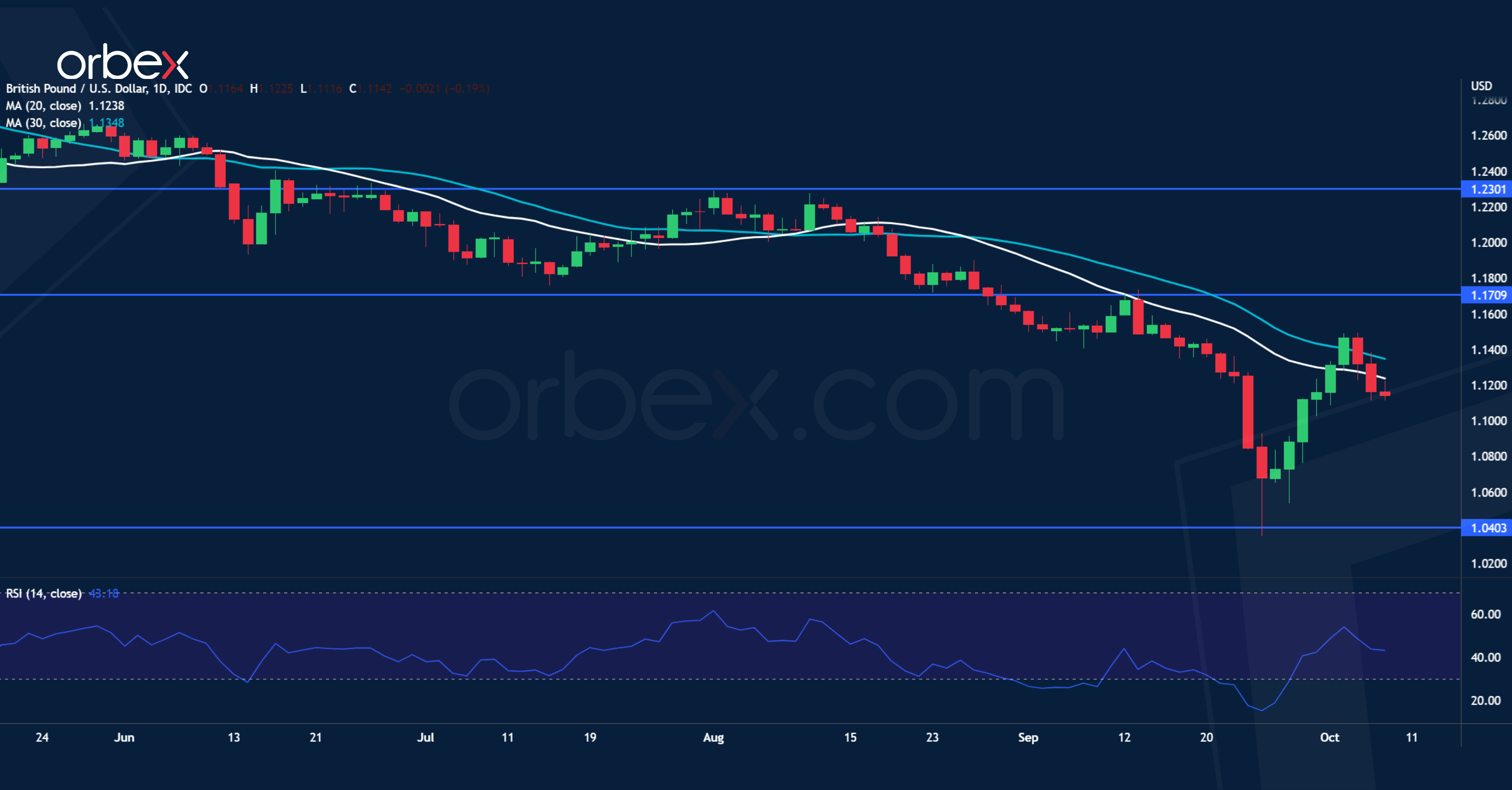
GBP/USD bounces after government U-turn
Sterling recouped losses after investors found relief in Britain’s reversal on tax cuts. The original plan of a largely unfunded fiscal package had triggered a flight to safety. But buyers of Sterling-denominated assets were quick to return to the table after the government was forced into an awkward U-turn. Meanwhile, the BoE’s emergency intervention in the bond market offered some support. Temporary weakness in the US dollar also helped the pound regain all the lost ground. Still, few would bet on a sustained recovery of the pound as its fundamentals remain fragile. 1.1700 is a fresh resistance and 1.0400 a new low.
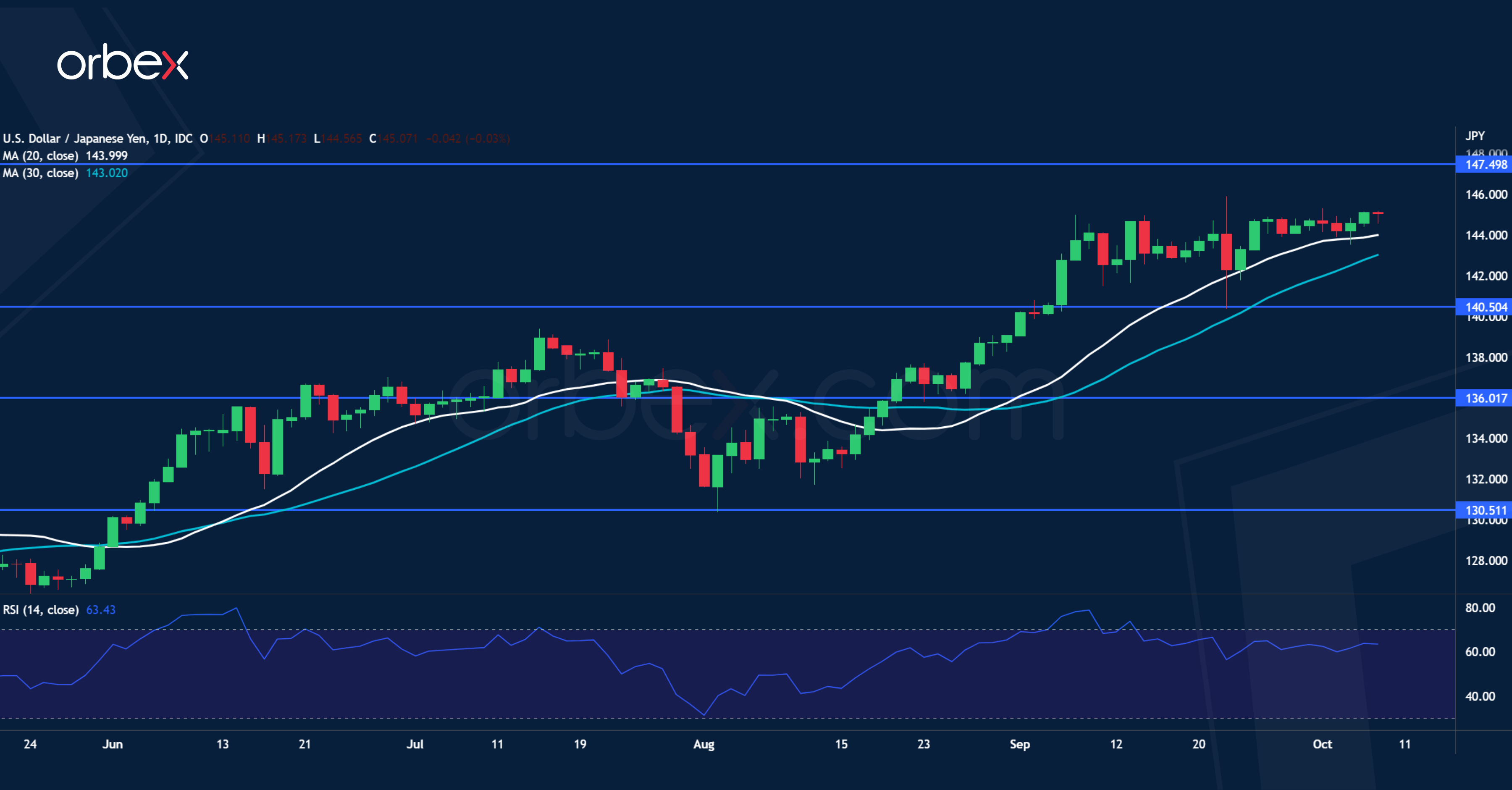
USD/JPY rallies over policy divergence
The Japanese yen softens as the intervention effect wears off. Its fall is yet to end against the backdrop of monetary normalisation on a global scale. Japanese authorities have signalled more willingness to defend their currencies. However, such measures may only have limited effect. Artificially popping up the yen would not be a game changer as long as the differentials in inflation and interest rates keep widening, and to the extent that US yields outperform Japanese ones. Instead, heightened volatility could further fuel speculative moves. The pair is still on its way to a 24-year high at 147.50. 140.50 is the closest support.
UK oil recovers on OPEC supply cut
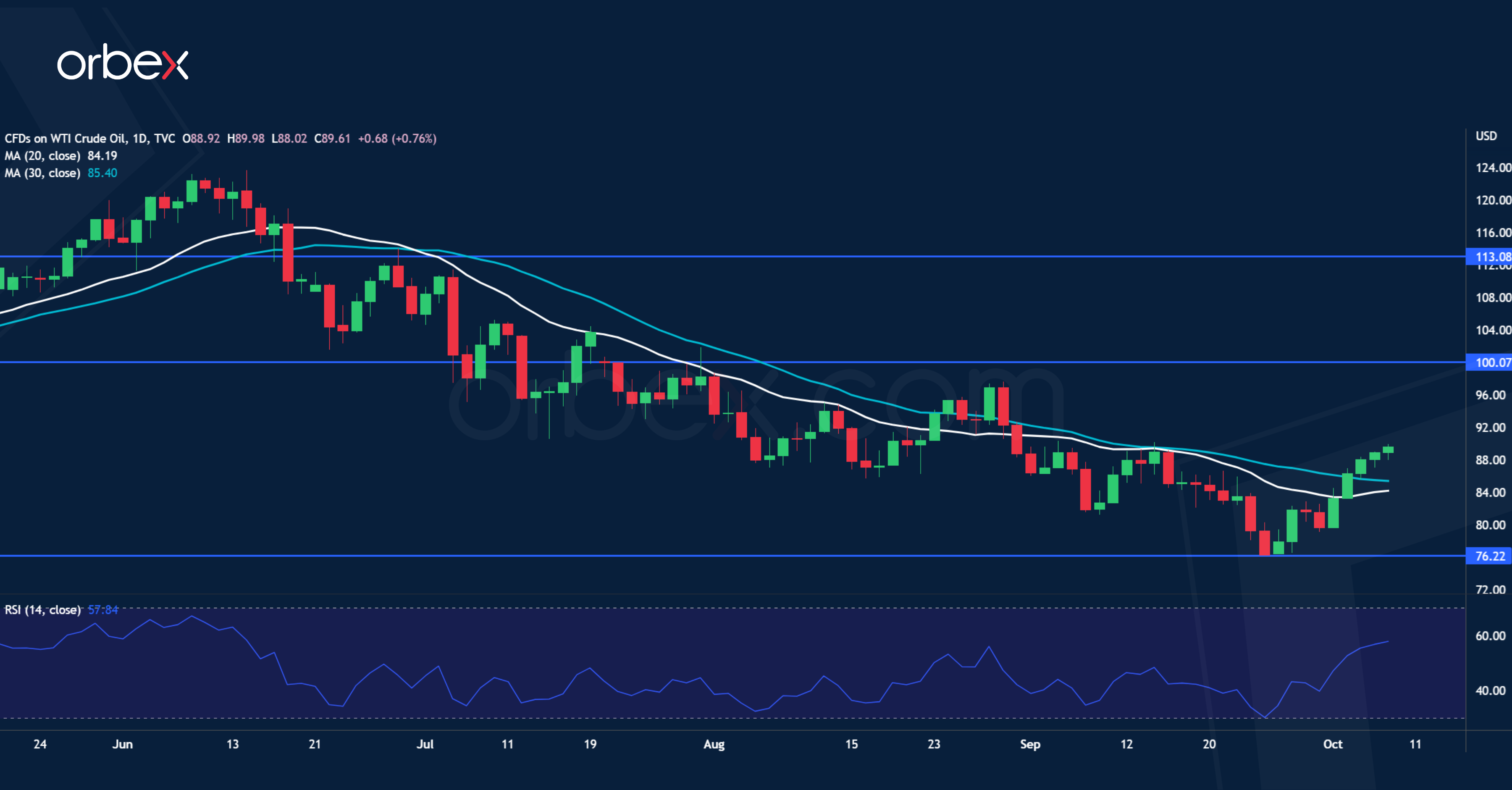
Brent crude rose to a three-week high after OPEC+ agreed the largest output reduction since 2020. A cut of 2 million barrels per day just ahead of peak winter season may put a brake on the downtrend. The surprise decision comes at odds with major economies’ efforts to contain soaring energy costs. The White House may respond by releasing further strategic oil stocks ahead of the midterm elections in November. One major repercussion is that a resurgence in oil prices could dim chances of the US Fed pivoting to a slower pace in rate hikes. The commodity would climb towards 100.00 past 90.00. 76.00 is a fresh support.
US 30 weakens as Fed committed
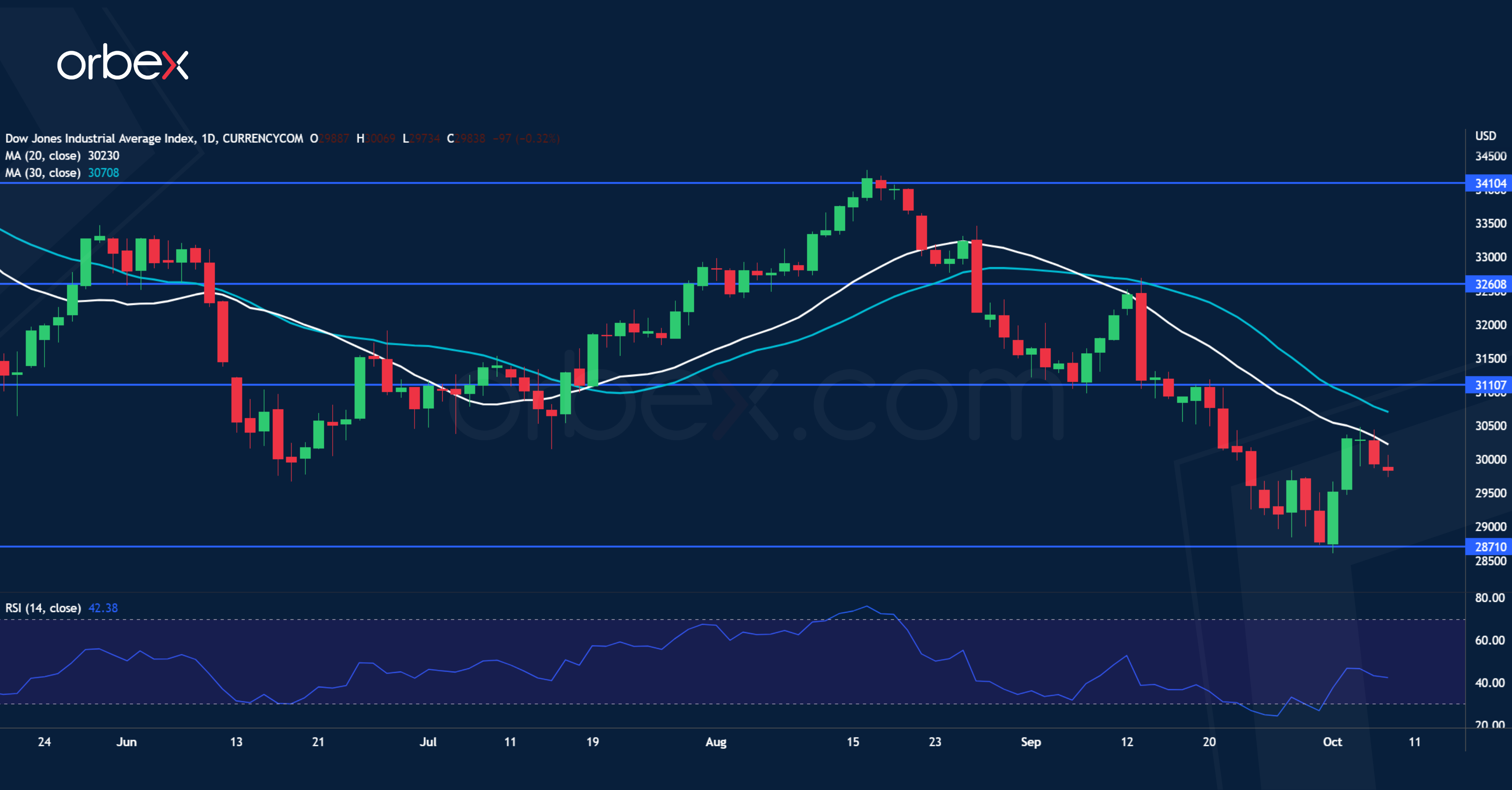
The Dow Jones 30 struggles as a strong US labour market would support the Fed’s hawkish stance. A drop in US yields following a slowdown in the US manufacturing sector in September briefly eased the downward pressure on risk assets. However, the central bank is widely expected to raise rates and keep them in restrictive territory for a while. Portfolio rebalancing in a high interest rate environment is likely to weigh on equities. After all, why would investors risk their skins for stock alphas when the bond market can return 4% a year? The index bounced off 28700 and is testing the former support at 31100.
What Will It Take for the US Dollar to Lose its Crown?
The US dollar has had a stunning run, gaining more than 15% against a basket of other major currencies – according to the DXY calculation – since the start of the year. For some developing countries though, the greenback’s surge has made servicing dollar-denominated debts a herculean task, and with several currencies, even major ones, hitting new record lows or lows last seen decades ago, there is a question that’s maybe popping more often into investors’ heads nowadays: What will it take for the US dollar to lose its crown?
The post-covid chronicles
Before answering that question, one must first understand what has been constantly fueling the greenback’s tanks, at least for the last year, and actually, it hasn’t been a single force or catalyst, rather than a blend of interconnected developments, ranging from very high inflation and monetary policy responses to anxiety over the global economic performance.
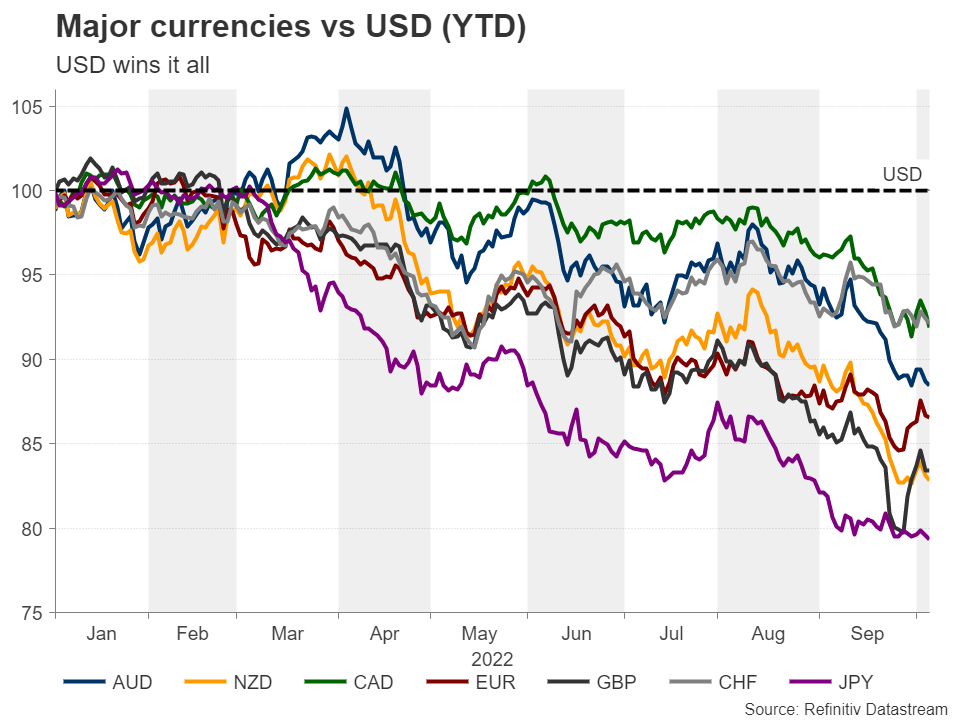
With many economies still licking their wounds after their reopening from strict covid-related lockdowns, supply shortages led to a spike in consumer prices, which central bankers mistakenly dismissed as transitory. They were thereby caught off guard when inflation continued to persistently accelerate, forced to respond around a year ago, with the central bank to first press the hike button being the RBNZ. And if covid-traumatized economies and accelerating inflation were not enough for central banks to deal with, in February Russia invaded Ukraine, adding to the already elevated uncertainty.
With Russia curtailing energy supplies to Europe in response to the imposition of sanctions, oil and gas prices skyrocketed, adding even more fuel to inflation’s flames, and thereby deepening the global economic wounds, especially in Europe and the UK. Combined with a battered property sector and renewed lockdowns in China, this left central bankers no other choice than to raise rates faster and more aggressively.
Mon. policy and safe-have flows keep the dollar’s tank full
In this race, the frontrunner is the Fed, raising rates faster and to higher levels than other major central banks. Currently, interest rates in New Zealand are higher than in the US, but that’s because the RBNZ already hiked in October and the Fed still hasn’t. According to market pricing, there is an 85% chance for another 75bps hike by the Fed at its upcoming gathering, but even a smaller 50bps increment is enough to place it back first. Rates in Canada are on the same level with the US, but Canadian policymakers are now expected to slow down their hikes from here onwards.
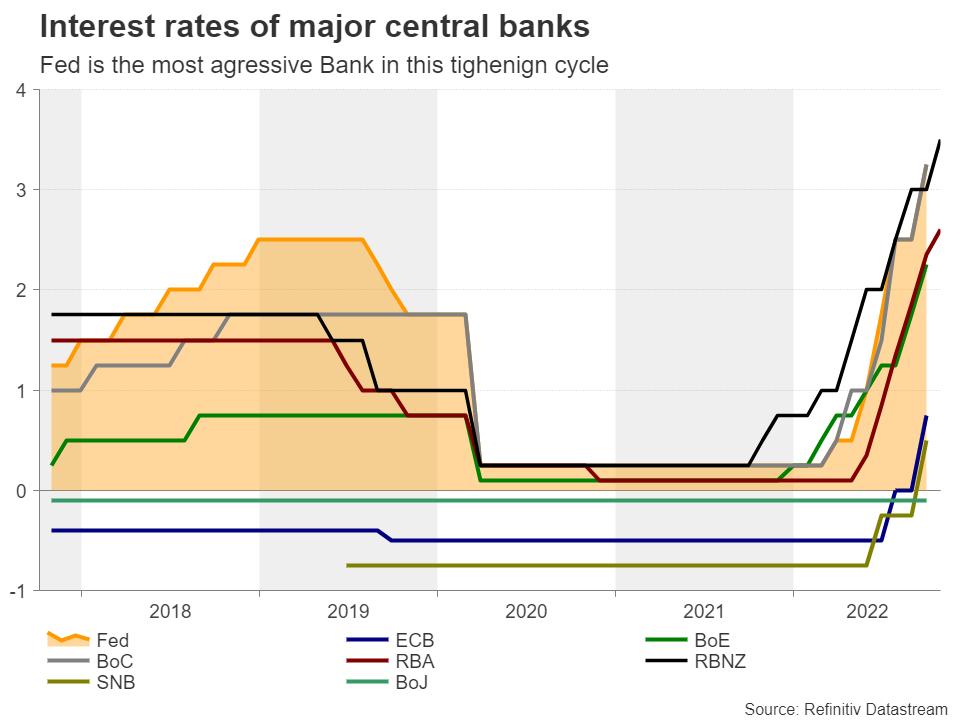
So, higher interest rates – and thereby Treasury yields – in the US compared to other major economies have been the main driver behind the greenback’s current uptrend. The co-driver is safe haven flows. The US dollar is the world’s reserve currency and the denomination of many international business deals, which makes it the default safe-haven currency. A safe haven is an asset that investors seek shelter in during periods of anxiety and market turbulence; and as already mentioned, there has been plenty of that lately. With major central banks around the world raising interest rates fast to tame inflation, investors’ anxiety worsened due to fears that tighter financial conditions will add to the likelihood of a global recession, prompting them to sell other currencies and buy dollars.
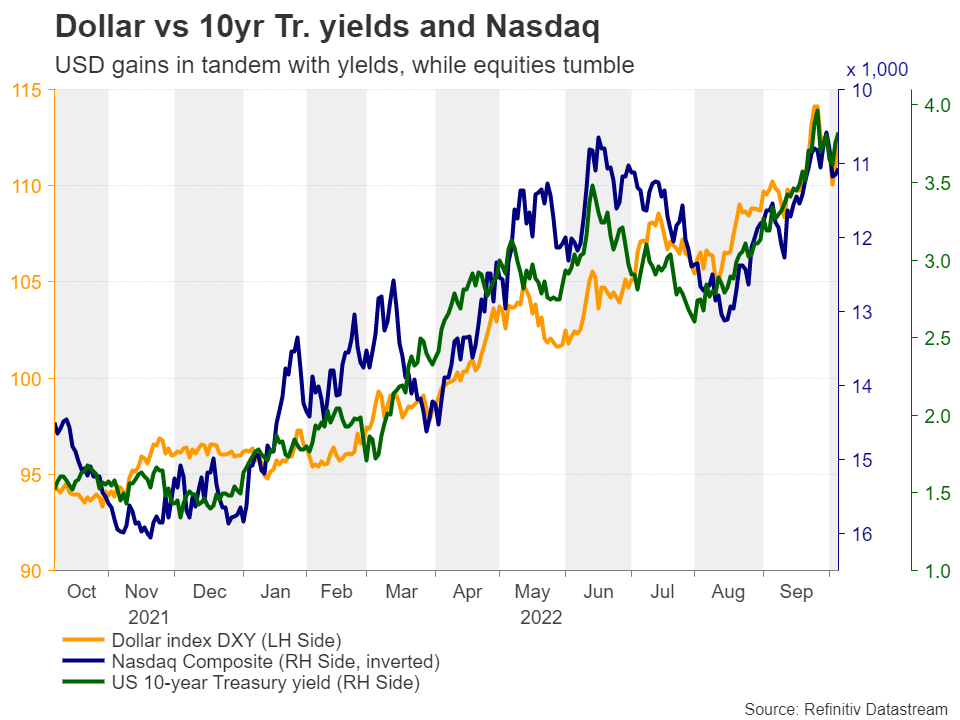
Market vs Fed: one must give in
Having all that in mind, it now becomes much easier to identify what may need to happen for the US dollar to run out of fuel and reverse its uptrend.
Getting the ball rolling with monetary policy, investors believe that the Fed will stop raising interest rates in March at around 4.6%, inline with the Fed’s own projection for 2023. But still, despite Fed officials keep sounding ultra-hawkish, pushing against the case of a rate cut next year, market participants continue to see rates 20bps lower by November.
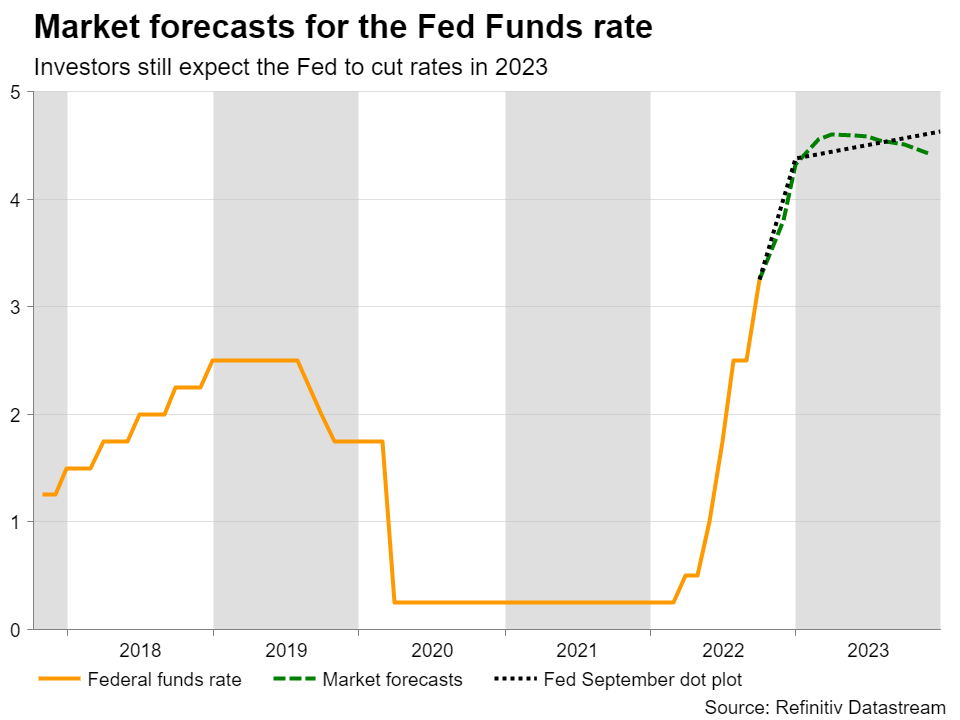
This divergence between the market and the Fed near the end of next year is the room that the dollar has for strengthening further if indeed Fed officials keep appearing in their hawkish suits. So, for the greenback to trade significantly lower one must give in. Either the Fed softens and admits that interest rates could be reduced next year, or the market brings up its projections and stops pricing in any 2023 cuts.
The former case appears to be straightforward, but if the market revises up its rate-path projections, it is reasonable to expect more dollar strength rather than a sell-off. Therefore, if the Fed retains its current hawkish plans, the only additional boost the dollar would receive would come from the market revising its rate expectations higher, to catch-up with those of the Fed. But following such a boost, there would be no reason for future hikes to drive the dollar higher, if those hikes have already been discounted by the market.
Improving economics and geopolitics also needed
But will this be enough for the king to be dethroned? Probably not. Changes on the global-growth front and geopolitical landscape are also required. Oil and gas prices may have come off their highs, but with the war in Ukraine still raging and Russia supplying very little to Europe, a harsh winter could boost demand for heating energy, resulting in a rebound and thereby more inflationary pressures. In turn, central banks could eventually harden their efforts to bring inflation to heel, raising rates even faster and hurting their economies even more.
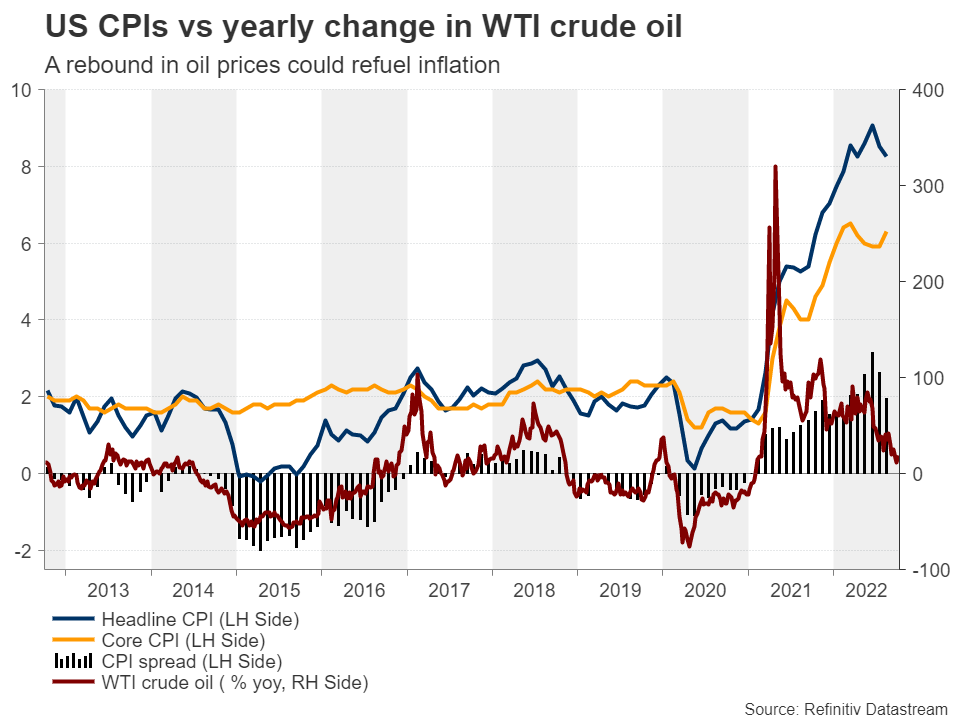
For investors to abandon their safe-haven positions and start building up risk exposure, either the conflict in Ukraine needs to end with Russia restoring to full capacity supply to Europe, or the winter ends up softer than expected. But any of these scenarios needs to also be accompanied by encouraging economic data, not only in terms of improving economic growth, but also in terms of meaningful easing in inflation around the globe.
For now, the uptrend remains intact
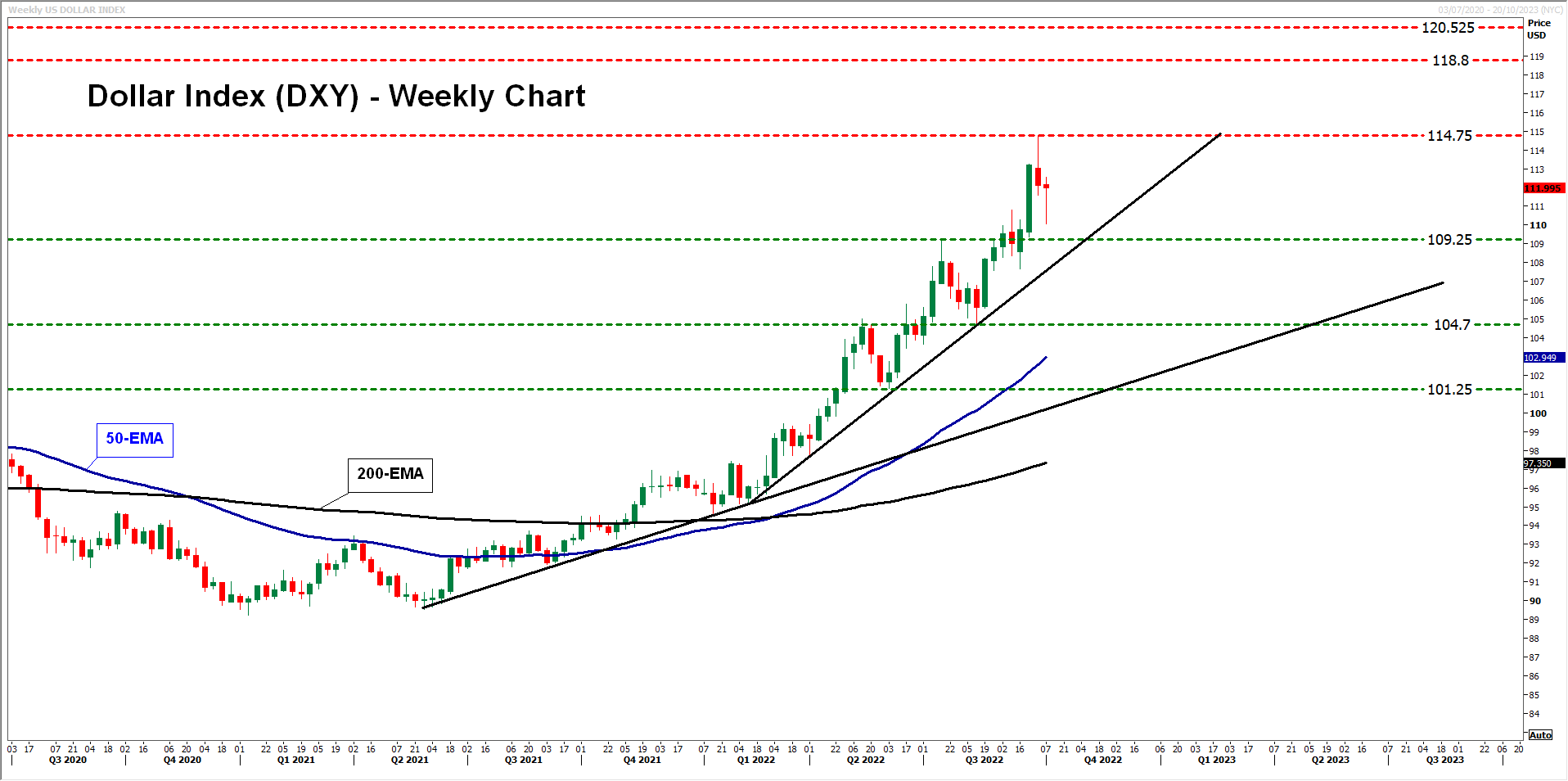
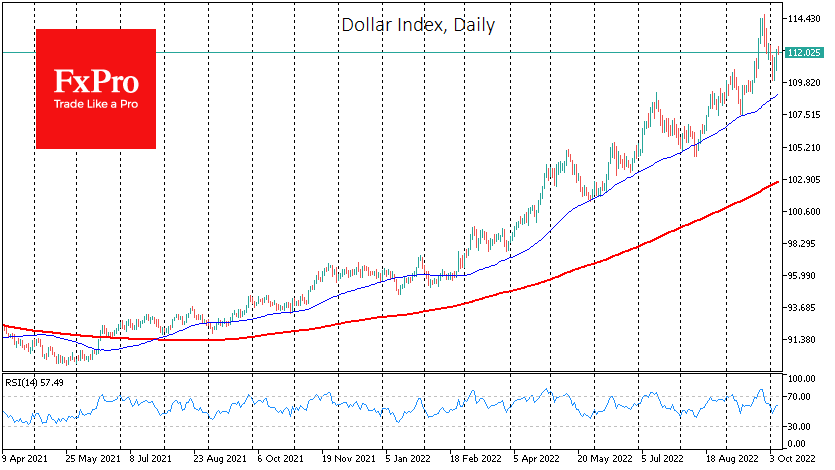
For now, the uptrend in the dollar index remains intact. Although the index pulled back after hitting a new 20-year high last week, it remains above the uptrend line drawn from the low of February 6, as well as above the 109.25 barrier marked by the high of July 10. A rebound from around there could result in another test at the 20-year high of 114.75, the break of which would confirm a higher high and perhaps pave the way towards the 118.80 zone, marked by the high of June 2002.
The move signaling that the bears have gained the upper hand in the near term may be a dip below the 109.25 zone and a break below the aforementioned uptrend line. This could allow the bears to dive towards the low of August at 104.70. If they are not willing to stop there, they could then aim for the 101.25 area, marked by the low of May.
Synopsis
Putting everything under one roof, if there comes a time when central banks do not need to hike by 50, 75 or 100bps, the economies are showing signs of recovery and geopolitics have taken the back seat, global equities could rebound, yields could come off their highs and thereby, the dollar may lose its crown.
Week Ahead – The Calm Before Another US Inflation Storm
An electrifying week is coming up, featuring another crucial US inflation report and minutes of the latest Fed meeting. Both will be key pieces of the puzzle for the dollar and risk assets, as traders grapple with whether the Fed will pause its tightening cycle anytime soon. Even in case of a softer inflation print though, this type of speculation seems premature.
Fed bets
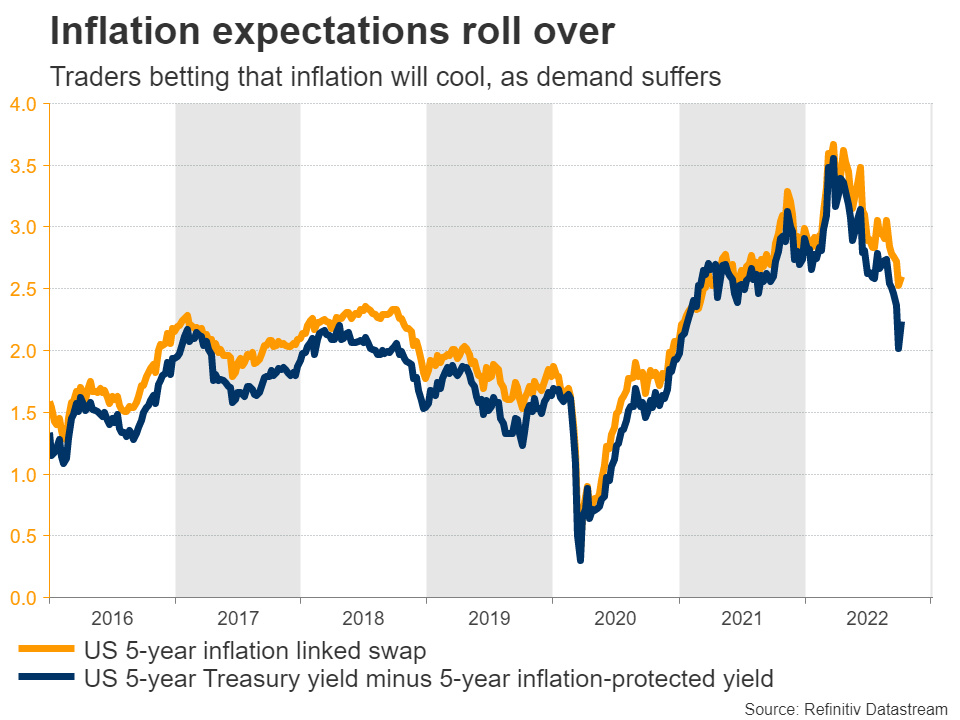
Investors have been playing with the idea that the Fed might pause its rate increases soon, because of worries the economy is about to roll over. The expected peak in interest rates has been revised down a notch while inflation expectations have declined severely, which allowed stock markets to stage a fierce comeback.
While some leading indicators such as housing and business surveys indeed point to a softer economy, this hasn’t been reflected in the ‘hard’ data yet. The labor market is exceptionally tight with fewer people filing for unemployment benefits in recent months, inflation is still running at four times the Fed’s target, and the Atlanta Fed GDPNow model suggests growth fired up in the third quarter.
Since the real impact of the rate increases has not shown up, the Fed cannot even think about a pause. Any signal that a pivot is possible would see financial conditions loosen again, with bond yields declining and equity markets rallying. This would counteract the tightening measures that have already been rolled out, making it harder to cool inflation.
Fed officials have spoken at length about avoiding the mistakes of the 1970s, when the central bank eased off the brakes too early and allowed inflation to become entrenched in society. They seem determined to break inflation, even if it means causing a recession.
The coming week is loaded with US economic releases, with the highlight being Thursday’s inflation report. On a yearly basis, the CPI rate is expected to have declined two ticks to reach 8.1% in September, from 8.3% previously. In contrast, the core rate is expected to have risen to 6.5%, from 6.3% in August.
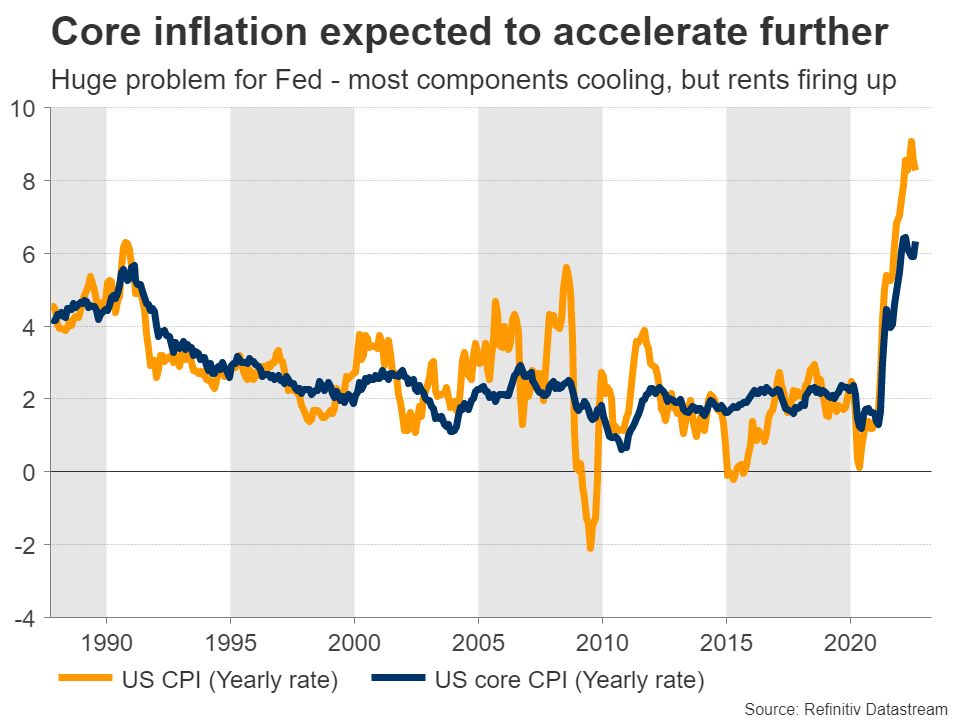
Business surveys from S&P Global suggest that US companies raised their selling prices in September at the slowest pace in almost two years. Gasoline prices also kept falling, alongside used car prices and container shipping fees. The problem is that rents are still booming. Rents account for around one third of the entire CPI basket, and take several quarters to reflect any shifts in home prices.
Minutes of the latest FOMC meeting are out Wednesday, ahead of the inflation report. This is when the Fed raised rates by 75bps for a third consecutive time, projecting it will keep them elevated throughout next year. Then on Friday, retail sales for September and the Michigan consumer sentiment survey will hit the markets.
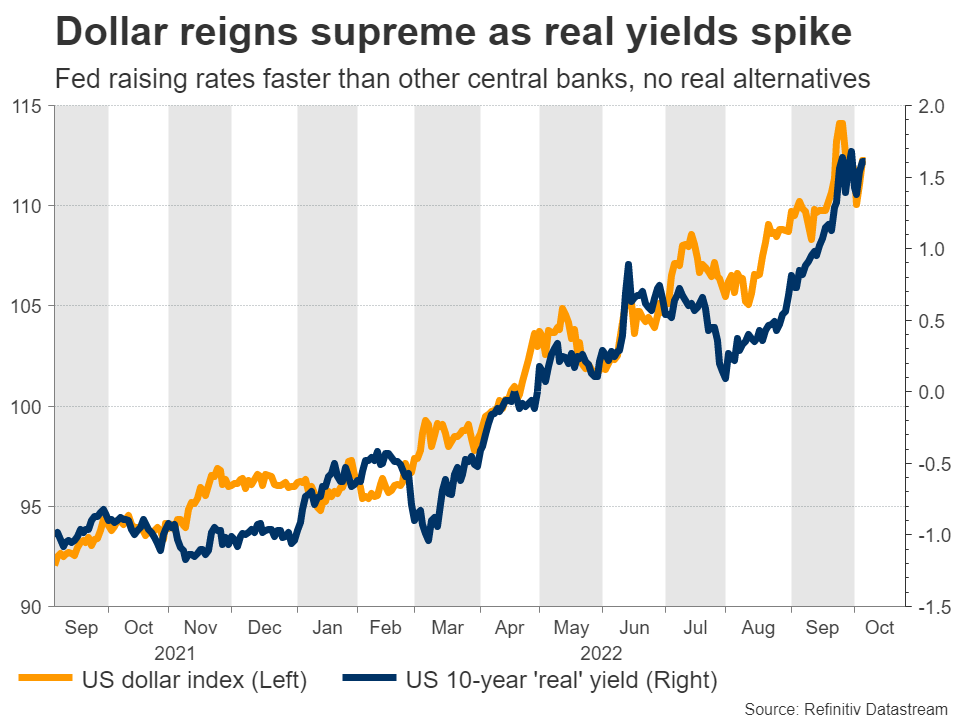
As for the dollar, there’s no sign of a trend reversal yet. Even if inflation cools a little, it would still remain miles above the Fed’s target, keeping policymakers on the warpath. Meanwhile, the prospects for other currencies are even worse. Europe is headed for a deep recession as the energy crisis bites, the British pound has been decimated by irresponsible politics, and the Bank of Japan has left the yen for dead.
Something dramatic needs to change in this power dynamic before ‘king dollar’ loses its crown.
Bruised pound awaits UK data
Over in the United Kingdom, the meltdown in the nation’s currency and bond markets was enough for the government to dial back some of its plans to cut taxes for the upper class. Along with the intervention by the Bank of England, this helped restore some calm.
Alas, the outlook for sterling remains negative. The nation’s twin deficits continue to balloon and the BoE is reluctant to raise rates with any real force, concerned that it might deepen the recession it already expects and cause more instability in the financial system.
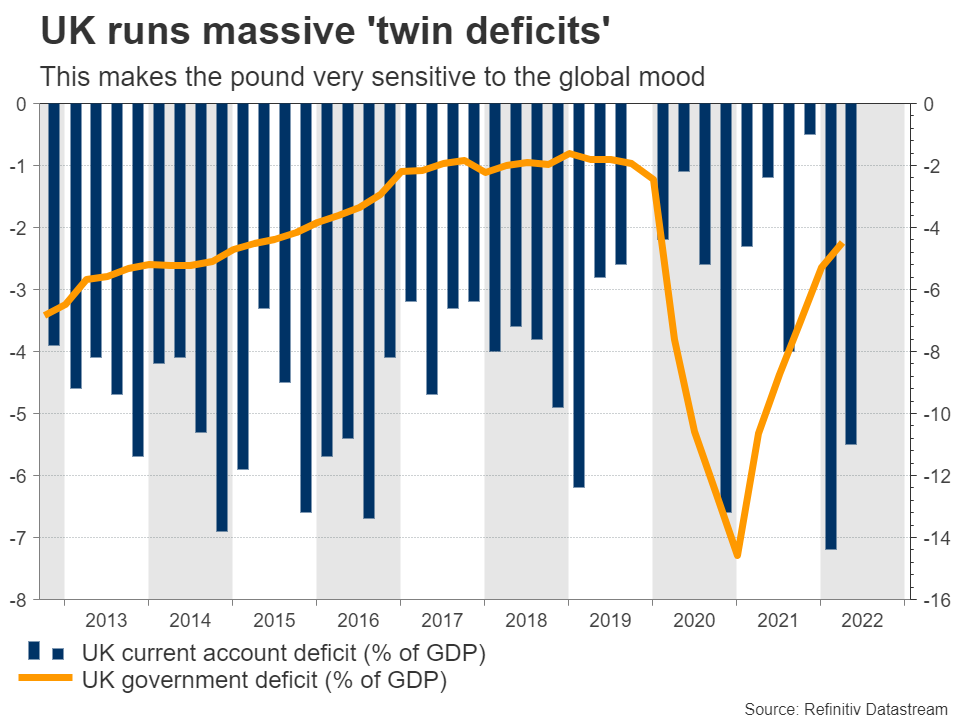
When a nation runs massive deficits, it essentially relies on funding from abroad to finance them. This funding becomes harder to come by when there’s panic globally, so the pound has transformed into a proxy of global risk sentiment. The correlation between Cable and the S&P 500 over the last month is running at almost 90%.
As such, forecasting the pound requires a view of what stock markets will do, and that’s where the negativity really kicks in. Equity valuations are still far too expensive for this level of interest rates, quantitative tightening has doubled in speed lately, and the economic data pulse is weakening rapidly - especially in Europe and China.
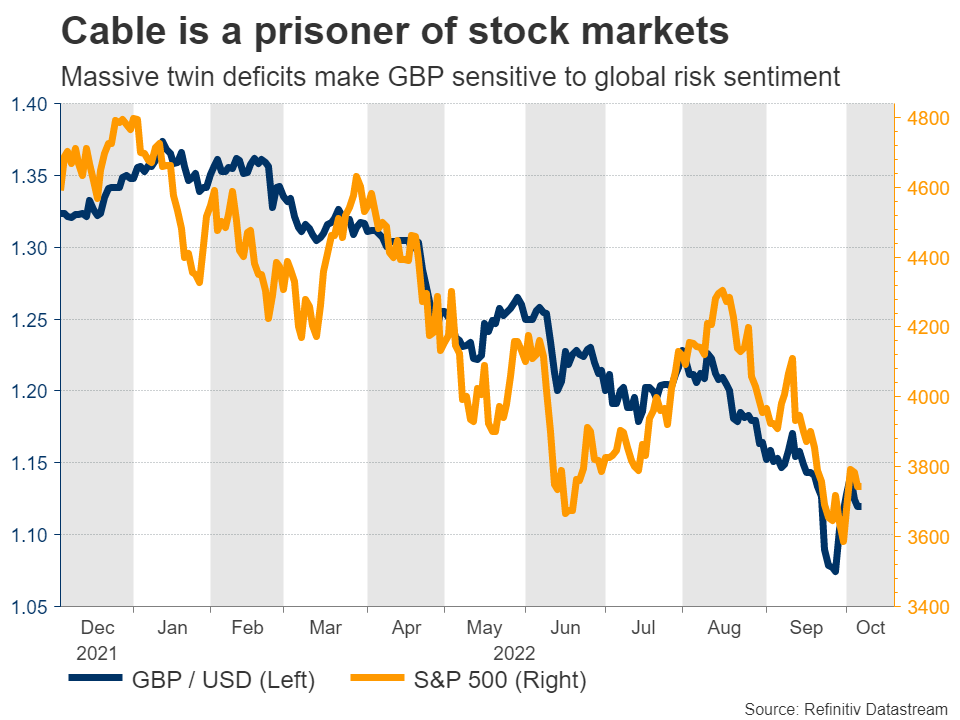
In the coming week, the spotlight will fall on the jobs data for August, out on Tuesday, ahead of the GDP print for the same month on Wednesday. There’s also a flurry of speeches by BoE officials on the schedule throughout the week.
Chinese data - slowing down
In the world’s second largest economy, the situation seems to be deteriorating as the property market continues to implode while authorities are still enforcing draconian lockdowns that have ravaged growth. The stimulus response from the central bank and government have been underwhelming so far, with the measures that have been rolled out being grossly insufficient.
Over the weekend, the latest Caixin services PMI will give investors a glimpse into the nation’s economic performance as it closed the third quarter, ahead of inflation and trade data on Friday. As always, producer prices might attract special attention, since they are considered a gauge of global factory demand.
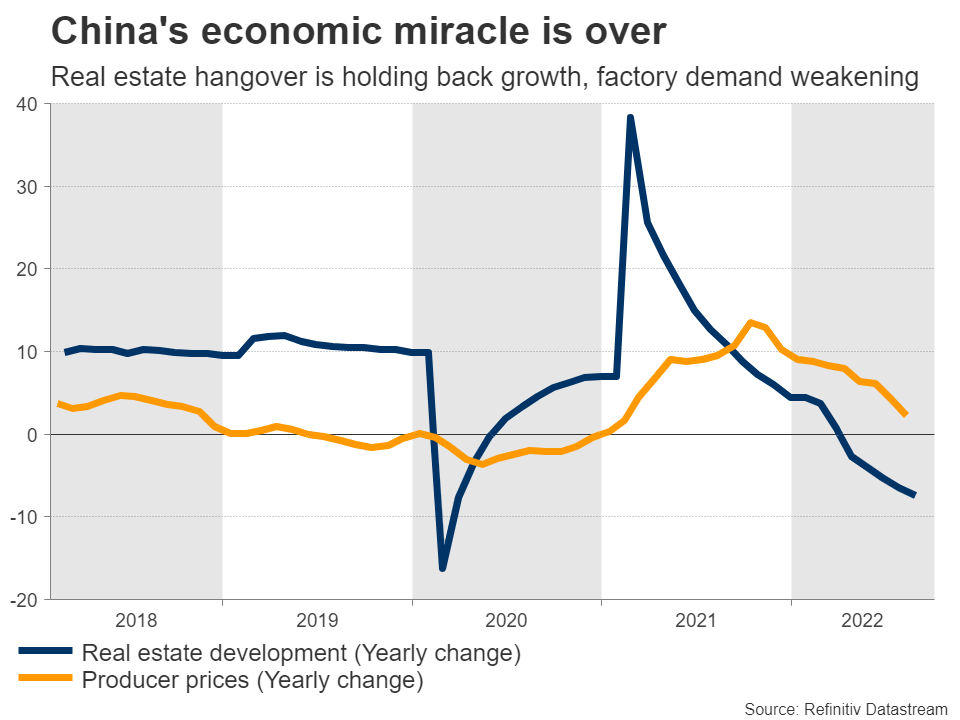
A persistent slowdown in China could keep chipping away at the Australian and New Zealand dollars, which rely on Chinese demand to absorb their commodity exports.
Weekly Focus – Is the ‘Central Bank Pivot’ Here?
It's been another eventful week with focus on the timing of the 'central bank pivot', UK budget mess, a large OPEC production cut and rising tensions in the Ukraine war. Especially the possible pivot of central banks towards a slower pace of rate hike have been in focus and drove a decent rally in global bonds as well as equities in the middle of the week. It got more fuel with the dovish surprise by Reserve Bank of Australia reducing the hiking rates 25bp rather than the 50bp seen in the previous four meetings and which analysts were looking for again this week. The Polish central bank also surprised by refraining from lifting rates after being on a steady path of tightening monetary policy over the past year taking the policy rate to 6.75% from the starting point of 0.1%.
Will the Fed follow in the footsteps soon? We believe it is still too early, although there are some signs that the labour market is softening with job openings in August showing the biggest decline in a long time (non-farm payrolls arrived after deadline). However, with core inflation still elevated and the labour market overall still tight despite the moderate loosening, we believe it is too early for the Fed to allow an easing of financial conditions, which would immediately follow a more dovish signal from them. This week showed that any hint that a pivot is here, triggers a rally in both bonds and equity markets and also lifts commodity prices. For this reason, we think the Fed will have to strike a fairly hawkish tone until it is convinced that inflation pressures are indeed easing on a sustained basis. The same goes for the ECB, which struggles with inflation at 10% now and concerns about a price-wage spiral. Policy makers also seem increasingly eager to ease fiscal policy to cushion the hit to consumers, which adds to the burden for central banks. A prime example was the new British governments' fiscal easing but also Germany's up to EUR200bn package to cushion the economic hit shows politicians feel a rising pressure to respond to the crisis. However, as the recession becomes more visible, we believe inflation pressures will come down as unemployment begins to rise amid interest rates moving into restrictive territory. This will eventually make both the Fed and the ECB stop hiking and then the market will likely start to price in more cuts in late 2023 and 2024. Key data to watch for gauging when the pivot is here will be labour market as well as core inflation data.
Goods price inflation pressures are easing in the US as oil and metal prices are lower, freight rates are almost back to pre-pandemic levels and inventories are rising. But in Europe the rising costs from electricity and gas prices keep inflation pressures high. OPEC+ didn't show much willingness to help on easing inflation as they decided to cut production by two million barrels to counterweight a decline in demand. While in practice it will only amount to one million barrels it will, all else equal, delay a decline in inflation back to 2%.
Economic data was a mixed bag. ISM manufacturing for September was weaker than expected with the new orders index dropping to a low 47.1 from 51.3 but ISM service fell less than expected to a still robust 57.7 from 57.9. Euro retail sales (volumes) for August dropped 0.3% m/m adding to a decline of 0.4% in July. But while consumer spending is clearly weakening it could have been worse given the massive hit to real wage growth.
In the coming week, the key data release will be US CPI for September. It surprised to the upside again last month and has proved very sticky despite the easing pressures on goods. IMF will publish new forecasts and it will be interesting to see how much they revise down growth and what they see on the inflation front.
AUDJPY Escapes Rising Wedge Formation
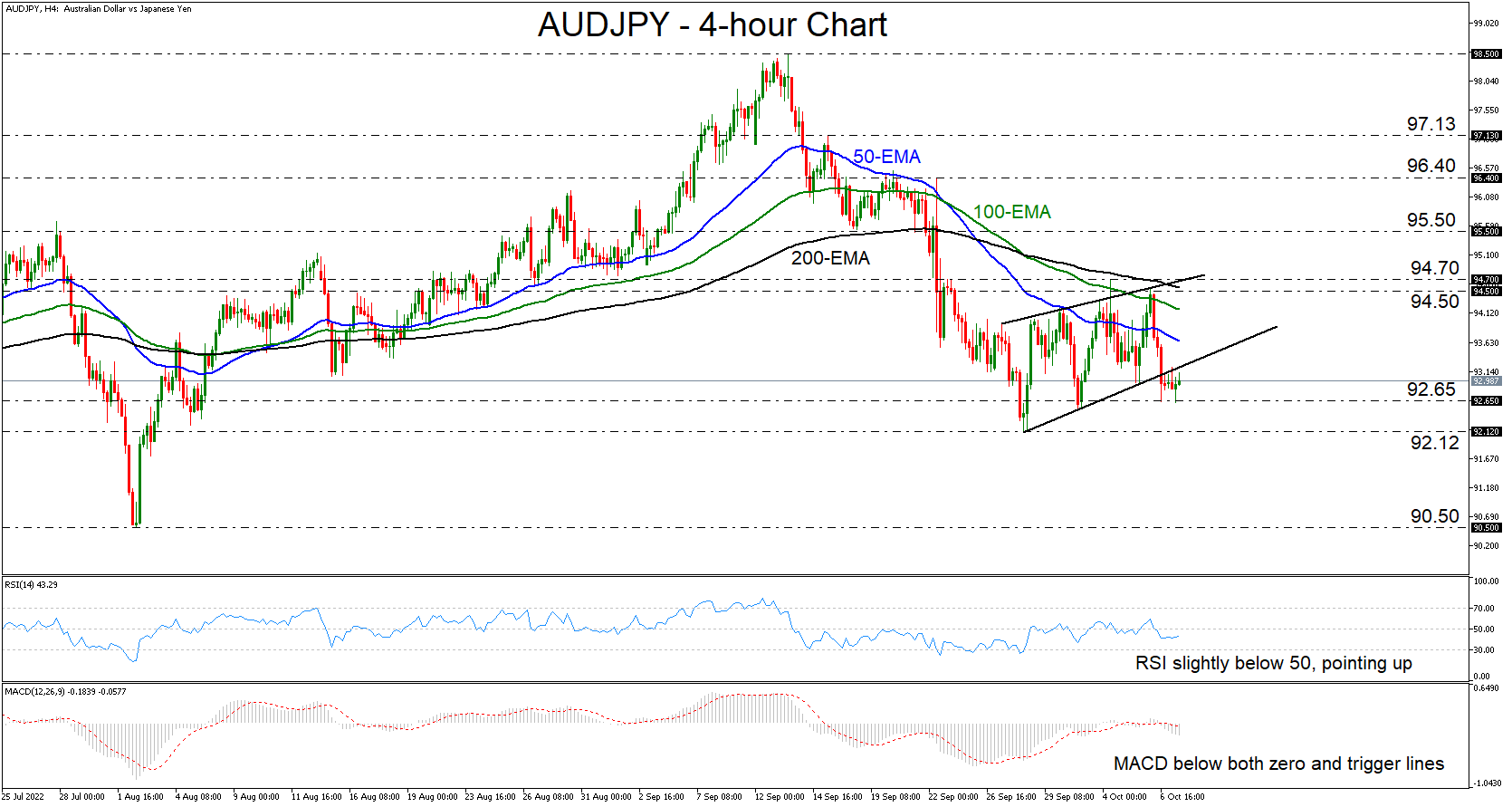
AUDJPY tumbled yesterday, after hitting resistance at the crossroads of the 94.50 level and the upper bound of a rising wedge formation that had been containing the price action since September 27. The slide resulted in the break below the lower end of the pattern but thereafter, the pair began oscillating slightly above 92.65. This paints a negative picture, but a break below 92.65 may be needed for more declines to materialize.
Both the RSI and the MACD are lying within their bearish territories, with the latter also running below its trigger line. That said, the RSI has turned up again, which implies that another small recovery may be on the cards before the bears steal all the bulls’ swords, perhaps to test the lower end of the wedge as a resistance this time.
A break below 92.65 could initially target the low of September 28 at 92.12, the break of which could carry larger bearish implications, as the next territory to play the role of a support may be all the way down to 90.50, marked by the low of August 2.
On the upside, a break above the high of October 4 at 94.70 could signal a short-term bullish reversal as the pair would be above all the plotted exponential moving averages (EMAs). This could encourage buyers to take the action up to the inside swing low of September 16 at 95.50, where another break could extend the advance towards the high of the day before at 97.13.
To sum up, AUDJPY exited a rising wedge formation yesterday, which is a bearish sign, but for the picture to get uglier, the pair may still need to break below a couple of imminent support zones.
More and More Central Banks are Fighting the Dollar
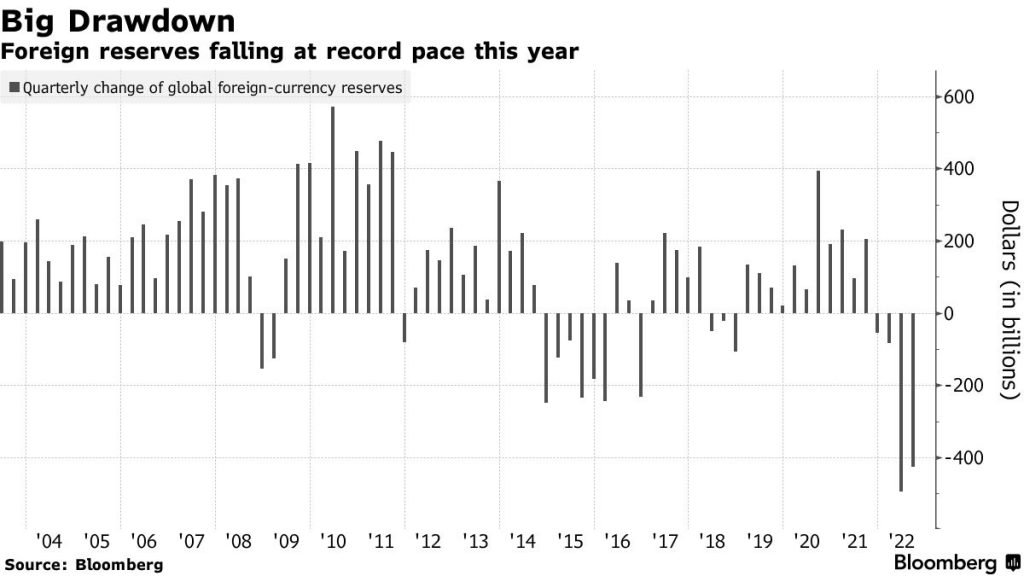
More and more of the world’s central banks are turning to currency interventions to keep their currencies from weakening. While each central bank is saving its currency, they are all working together to undermine the Dollar’s value by increasing its global supply.
Bloomberg calculates that global foreign exchange reserves have fallen by 1 trillion to 12 trillion since the start of the year, only about half of which is due to a rising dollar, with the other half coming from dollar sales.
For the last two weeks, Japan has been protecting the yen from further weakening by keeping the USDJPY above 145. At the same time, the Bank of Japan is not changing its ultra-soft monetary policy. Given Japan’s deep pocket of more than 1 trillion US treasuries, this promises to be an extended play, attracting speculators’ interest in buying into the pair on the downside.
The Bank of England reportedly entered the market last week to keep the pound from collapsing. Record lows in the Indian rupee also forced the country’s central bank to intervene in the market. There is little information on China, but there is also a large force there, reversing the rate on the rise above 7.20, as it has done since 2019. Hong Kong and the Czech Republic have been injecting dollars into the markets.
We are seeing more and more countries standing up to national currencies to contain inflation. If this trend continues to gather momentum, multiple streams promise to become a full-flowing river, raising the overall level of dollar liquidity.
Interestingly, the trend towards defensive interventions is detrimental to Fed policy, so the latter can only strengthen and extend its active steps to tighten monetary policy. And this game is against the interests of the majority in the world, so developments promise to be fascinating.
Even if a host of smaller central banks fail to prevent the Dollar from renewing the highs reached at the end of last month, further US currency growth promises to be much more complex and slower. The 16-month dollar growth trend promises to stop being a one-way street.
Sunset Market Commentary
Markets
The US labour market hums along. Companies in September added 263k jobs. The biggest contributing sectors were education & health (+90k), leisure & hospitality (+83k) and professional business services (+46k). Some point at seasonal effects distorting the reading in a negative way and said that removing these, pushes up the actual job growth by some 30k higher. The unemployment rate fell from 3.7% back to 3.5% again - matching the five-decade low seen in July. This came on the back of a marginally declining participation rate though. That labour market metric rose unusually strong in August to 62.4% but eased a bit last month to 62.3%. The pre-pandemic multi-year average of around 62.8% thus remains some way off. Fewer people available for work helps explain why wages keep rising the way they do. Pay growth shows no signs of slowing down materially so far, coming in at 0.3% m/m and 5% y/y (5.2% in August). The payrolls follow a mixed bag of US data earlier this week. The US manufacturing ISM on Monday and a sharp setback in the JOLT reports on Wednesday shaped expectations (hopes, rather) for the Fed to take it down a notch. A strong US non-manufacturing ISM yesterday followed by the numbers today tells it’s much too premature for such a conclusion. It is also what an avalanche of Fed speeches, from Mester over Cooke to Bostic and Waller, suggested all week. US CPI is due next week but it’s already clear: a 75 bps hike at next month’s Fed policy meeting is a done deal and more tightening is to come. The remaining doubters in the market are forced (once again) to put the idea off the table. US yields were already rising going into the payrolls release and add to that momentum afterwards. Changes range between 4.2 bps (2y) to 6.8 bps (30y). These may be small moves compared to what we’re used to but we’ve been spoiled these last few months. We do note that the likes of the 2y yield (4.3%) intraday tested the previous cycle high at 4.34%. But a break higher may be tricky given the long weekend for bond markets (Columbus Day on Monday). The downleg in US Treasuries pulls German Bunds in its slipstream. Yields in Germany rise 6.3 to 10.2 bps in a steepener. The European swap curve steepens in similar fashion. Stock markets react as one could have expected. European equities drop 0.9%, Wall Street opens between 1-1.7% lower.
The dollar advances marginally. EUR/USD loses the 0.98 big figure going into the weekend (0.976 at the time of writing). The trade-weighted index ekes out a slight gain to 112.37. USD/JPY is on track for a close above 145 for a second day straight. Japanese authorities are probably digging up reserves as we speak. Keeping monetary policy extremely easy may cost a thing or two. Sterling is going nowhere. EUR/GBP holds steady just south of 0.88.
News Headlines
The FAO food price index in September declined for a sixth consecutive month. Prices eased 1.1%. Still, the FFPI remained 5.5% above its value in the corresponding month last year. The decline was driven by a sharp fall in vegetable oils (-8.6% M/M) and moderate decreases in those of sugar, meat and dairy products, more than offsetting a rebound in the cereal price sub-index. The cereal price index rose 1.5% M/M to be up 11.2% Y/Y as wheat prices rebounded, underpinned by heightened uncertainty about Ukraine exports and concerns regarding dry conditions in Argentina and the US.
After declining three months in a row, Canadian employment again rose by a net 21 000 jobs in September. The outcome was close the expectations. Gains were mainly in part-time employment. The unemployment rate dropped from 5.4% to 5.2%. However, this decline was mainly the result of fewer people looking for a job as the labour force became smaller. The participation rate continues its declining trend, easing from 64.8% to 64.7%. Wage growth for permanent employees slowed to 5.2% Y/Y from 5.6% Y/Y, the fourth consecutive 5.0% + reading. The report probably won’t change the policy assessment of the Bank of Canada. The loonie gains marginally with USD/CAD easing to 1.371. However the cycle peak of 1.3838 reached late last week stays within reach on broad USD strength.