

Sample Category Title
US Expanded Technology Curbs on China’s Access to American Technology
Markets
Friday’s strong US jobs report dashed any hopes – fueled by weaker data at the beginning of last week – that the Fed is able to ease the tightening pace any time soon. Especially the drop in the unemployment rate back to a 50-year low caught the eye. US stock markets reacted negatively; good news is bad news in the current environment. Equities slid between 2.11% (DJI) and 3.80% (Nasdaq). The S&P500 closed at the June lows. Core bonds took a hit and, with it, erased virtually all gains made earlier in the week. US yields rose between 5.1 and 7.5 bps across the curve. The 2y yield tested the previous cycle high of 4.34%. German yields fell in lockstep. The curve steepened with daily changes between 6.8 bps (2y) and 10.9 bps (10y). European swap yields added about 2 bps on top of that. Dollar strength was name of the game in currency markets. EUR/USD eased from 0.979 to 0.974. The trade-weighted dollar index extended gains beyond 112(.8). USD/JPY closed above 145 for a second day straight in a move that makes the Japanese Ministry of Finance feel very uneasy. Sterling shed ground during the risk-off session. Cable (GBP/USD) retreated from 1.116 to 1.109. EUR/GBP knocked on 0.88 but that door stayed shut for now.
Stocks in Asia trade heavy in the wake of WS’s sell-off amid thinner-than-usual liquidity (Japanese markets closed). Chinese/Hong Kong tech stocks tumbled 4% after the US expanded technology curbs on China’s access to American technology (see below). Broader Chinese markets slide too after returning from a week-long holiday (Golden Week). Private (Caixin) Chinese PMIs unexpectedly dropped in contraction territory on a setback in the services sector (fell from 55 to 49.3). The onshore yuan opens unchanged after the week off, around USD/CNY 7.11. USD/JPY inches further north of 145 amid general dollar strength. Core bond futures trend gently higher. UST cash markets won’t open today for Columbus Day. Wall Street is open for business though.
The annual meeting of the Institute of International Finance and the IMF & World Bank kicks off while the ECB holds an online conference on monetary policy. The avalanche of high-profile speakers scheduled for today and the rest of the week serve as a wildcard for trading. Russian president Putin accused Ukraine of a terrorist attack on the Crimean bridge over the weekend and called for a meeting of his security council today. It’s unclear whether it marks another escalation in the conflict with possible retaliatory countermeasures as a result but it sure won’t help an already fragile risk sentiment. The economic calendar later this week is well-filled with FOMC meeting minutes on Wednesday, September US CPI on Thursday and US retail sales and consumer confidence (Michigan University) due on Friday.
News Headlines
US President Biden on Friday announced new chip technology curbs against China. They aim to prevent China from developing their own semiconductor industry and to slowdown development of military capabilities. The measures include export restrictions for some chips related to AI and supercomputing and tighter rules for semiconductor manufacturing equipment sales to any Chinese company. The new rules enter into force this month and already drew a reaction from the Chinese foreign ministry. A spokeswoman said that the curbs deal a blow to global industrial and supply chains and world economic recovery. In this respect, they will also hurt the interests of US companies, she added.
Rating agency Fitch revised the outlook on Austria’s AA+ rating from stable to negative because of downside risks to the nation’s macroeconomic outlook and public finances stemming from energy supply and prices. A prolonged supply cut from Russia leaves the country vulnerable given its limited domestic alternatives and the sizeable gas needs of the manufacturing sector. Fitch now expects a 0.2% GDP contraction next year (compared to 2.4% expansion prediction in April). The fiscal deficit will reach 3.2% this year and widen to 3.4% next. The public debt ratio is expected to slide further towards 76% by end 2024, coming from a 83% peak in 2020. S&P and Moody’s have a similar rating on the Alpine nation, but for now keep the outlook stable.
US Jobs Market is too strong to cheer investors up
Friday’s US jobs data wasn’t exactly what investors had wished for. The US economy added 263’000 new nonfarm jobs in September (slightly higher than 250’000 expected), the wages grew 0.3% over the month (as expected), but the unemployment rate surprisingly fell to 3.5%, as the participation rate fell slightly.
That was the exact opposite of what could’ve been great for the Federal Reserve (Fed) expectations.
But alas, the US unemployment rate printed last Friday was the lowest number since 1969 and came as another proof that whatever the Fed does, the US jobs data remains robust.
As a result, the Fed hawks came back in force following the US jobs data on Friday. The US yields rose, the S&P 500 slumped 2.80%, and erased most of the gains it recorded earlier in the week, while Nasdaq slumped 3.80% and closed the week flat, a touch above the 11’000 level.
Today’s is bank holiday in the US and Canada; investors will have another day to digest the Fed-unfriendly US jobs data, but then, inflation figures will be under the spotlight for the rest of the week.
Wednesday’s PPI, and Thursday’s CPI figures are of utmost importance for the Fed expectations. The US producer prices are expected to have eased from 8.7% to 8.3% in September, while the consumer prices may have slowed to 8.1% from 8.3% on the back of a retreat in energy prices during last month. But core inflation may have continued rising
Activity on Fed funds futures gives around 77% chance for a 75bp hike in FOMC’s November meeting. The US dollar continues pushing higher, while other major and emerging market currencies continue diving deeper into the mud. The EURUSD kicks off the week below 0.9750, as Cable is again on its way to meet the 1.10 mark. The British gilt market is shaky on fear of what will happen when the BoE stops buying the bonds.
No more safe haven
In what used to be the safe haven space, the appetite remains less than ideal as well. The dollar-swissy is flirting with parity even with the escalation of tensions in Ukraine following the explosion of the bridge between Russia and Crimea.
Gold is back below $1700, after having bumped into solid resistance near the 50-DMA last week. The US dollar remains too strong, and US yields too appetizing to let gold move any higher.
We can say that another week kicks off with the King dollar, leaving all, including gold and the Swiss franc under its big, dark shadow, except oil.
Oil climbs before Biden’s - and the world’s - desperate eyes
Crude oil continues its journey north, since OPEC announced to trim production by 2 million barrels last week. The barrel of American crude spiked to $93.50 last Friday, and consolidates around $92 at the time of writing.
We know that US President Joe Biden will to anything and everything in his power to pull the prices lower, at least before the mid-term elections due November. But he is running out of options.
After releasing millions from the US’ strategic oil reserves and trying to be friends with Saudi again, in vain, he is now looking to release even more from the reserves, limit exports, scale down sanctions on Venezuela and gather a NOPEC bill – No Oil Producing and Exporting Cartels – to reduce OPEC’s influence in global oil markets. And If nothing works, he is trying to get some sympathy by pardoning Americans who were convicted of possession of pot.
Let’s see if any of that – except from pot bill, could give cold feet to oil bulls, looking toward the 200-DMA that stands around $98 per barrel, as a next natural target.
The rising oil prices also fuels inflation expectations and Fed hawks, and weigh on global risk appetite and equity valuations, except for oil stocks. Though a bit softer on Friday, Exxon closed last week above the $100 per share. While Tilray jumped 30% on Biden’s marijuana news, but tanked near 19% on Friday.
The US earnings season kicks off with big bank earnings due this week. Strong earnings is the only thing that could relieve the Fed pain for equity investors.
Slow Start to an Important Inflation Week
Market movers today
- It is the big inflation week with US CPI being the main mover coming on Thursday. If it comes out high again it will seal a 75bp hike by the Fed later this month. We also get CPI in Denmark (today), Norway (today) and Sweden (Thursday).
- This morning we get the Euro Sentix indicator for September, which has often given a good indication of PMIs. Consensus is a further decline from already low levels.
- Later this week we look forward to FOMC minutes (Wednesday) and US retail sales (Friday).
The 60 second overview
The US labour market report on Friday came in on the strong side with NFP printing at 263k vs. consensus of +250k. While this recorded a minor slowdown from 315k in August, the additional jobs kept wage inflation high at 0.3% mom amid labour force participation decline. The employment gains were broad-based across sectors. All things equal, this is hawkish for the Fed and nothing that indicates that Fed is about to pivot. Fed members continued its hawkish comments with Mester saying that they will not be cutting rates at all next year.
On Friday, the EU energy ministers met and as a result they committed to 1) reducing electricity demand by 10%, 2) cap the €180/MWh on electricity, while some countries wanted to go further than this. At the informal EU Summit in Prague, EC president Charles Michel said that the common goal is to reduce energy prices, where von der Leyen also said that a more detailed proposal will be presented 'in the coming weeks'.
Geopolitical tensions are intensifying after a bridge linking Crimea and mainland Russia was attacked during the weekend. While so far no one has taken responsibility for the attack, it is said to be a blow to Putin who has called for a security council meeting today.
China: During the weekend, the Caixin PMI's were surprisingly weak as the services component fell to 49.3 from 55 in the previous month. The composite dropped to 48.5 vs. 53 in August.
Equities: Equities did not like the strong demand and weak supply in the NFP report Friday. US markets dropped like a stone and finished close to day-low driven by cyclical growth stocks. Please note the drops came after a very solid start to the week and hence global equities finished last week in positive territory. Despite a lift to stocks last week, we still saw defensives outperforming cyclicals and VIX increasing further. This is a fine picture how equity investors are currently caught between a rock and a hard place. If demand data like PMI orders or retail sales come out weak, equities drop because of recession fear. If labour market data like NFP comes out strong, equities drop because of Fed over tightening fear. This game will continue for some time and with a negative correlation between bond yields and equities. In US Friday, Dow -2.1%, S&P 500 -2.8%, Nasdaq -3.80% and Russell 2000 -2.9%. Negative sentiment from Wall Street Friday has carried over to Asia this morning with equity indices being lower across the continent. US and European futures are lower this morning but off their early trading lows.
FI: Global rates jumped on the strong US labour market report on Friday, as the US added 263k jobs in September and recorded 0.3% mom wage growth which does not suggest a Fed pivot is imminent. European rates followed suit and ended the day 10bp higher at 2.19%. European rates markets have entered a full blown stagflation narrative, as markets have to weigh the inflation and recession themes. Ultimately, we believe that the recession theme will take over, but not for the imminent future as inflation keeps printing too high for central banks to accept. After two days of no Gilt purchases on Tuesday and Wednesday, the BoE bought more than GBP 900m in the past two days.
FX: The strong US jobs report completed the turnaround in sentiment and having almost tested parity earlier in the week, EUR/USD closed Friday's session substantially below. Similar but opposite pattern for the SEK, which saw a benign start to the week turn into a weak close, with EUR/SEK above 10.90 and USD/SEK above 11.20 once more. NOK, on the other hand, found some support in higher oil prices.
Credit: Credit markets were weak on Friday where iTraxx Xover widened 23bp while Main widened 4bp. Cash bonds held up better with both IG and HY bonds closing more or less unchanged.
Nordic macro
At 11.45 CET the recipients of the Nobel Memorial Prize in Economics will be revealed. The Riksbank's Henry Ohlsson will participate in a discussion panel Monday evening in conjunction to the Nobel Prize announcement, but we do not expect to hear any comments regarding current monetary policy given the setting.
Norwegian core inflation surprised strongly to the upside over the summer. Costs are probably still rising fast, but we think the slowdown in demand will gradually make it harder to pass on cost increases to customers. We therefore expect underlying price pressures to remain considerable but not mount further, and forecast core inflation of 4.8% y/y in September. This is slightly below Norges Bank's forecast of 5.0% in the September monetary policy. We expect headline (CPI) inflation to ease from 6.5% to 6.0% y/y in September.
EUR/USD Daily Outlook
Daily Pivots: (S1) 0.9706; (P) 0.9761; (R1) 0.9797; More...
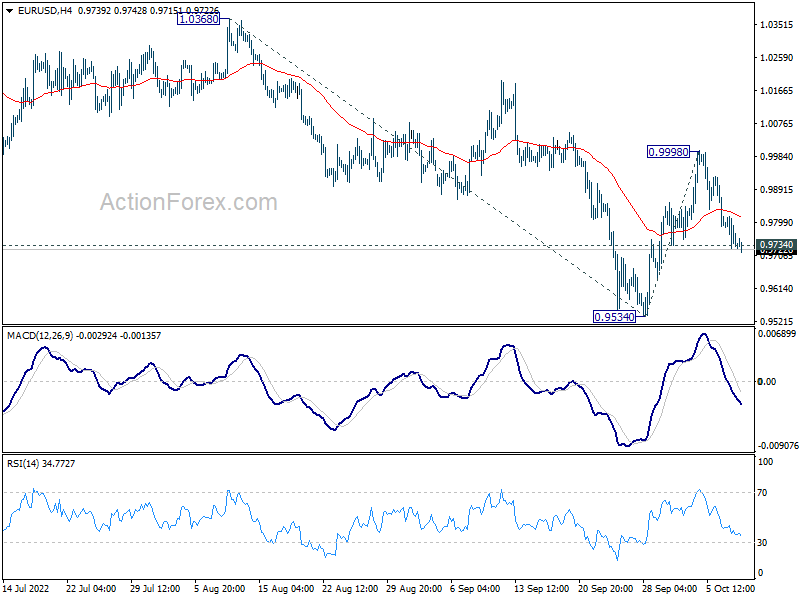
EUR/USD's break of 0.9734 minor support should indicate that rebound from 0.9534 has completed at 0.9998. Larger down trend is ready to resume. Intraday bias is back on the downside for 0.9534 first. Firm break there will target 100% projection of 1.0368 to 0.9534 from 0.9998 at 0.9163. For now, risk will stay on the downside as long as 0.9998 resistance holds, in case of recovery.
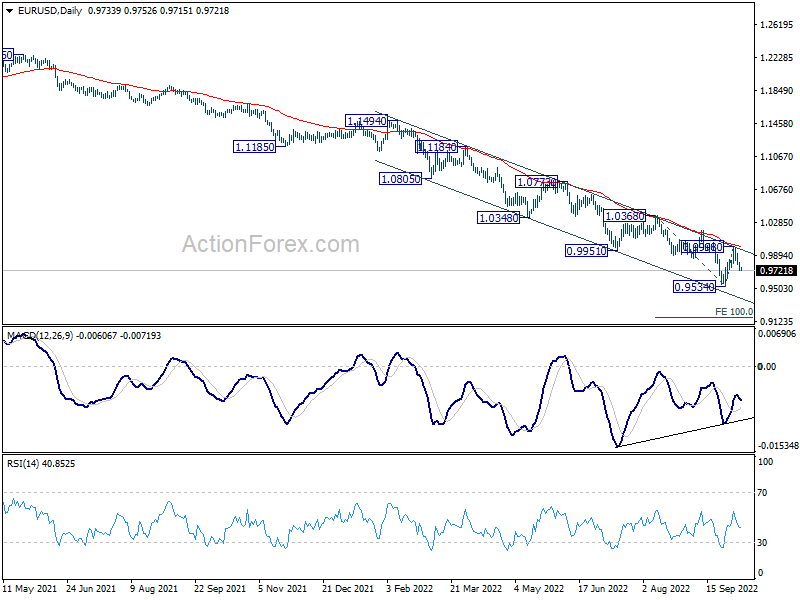
In the bigger picture, down trend from 1.6039 (2008 high) is still in progress. Next target is 100% projection of 1.3993 to 1.0339 from 1.2348 at 0.8694. In any case, break of 0.9998 resistance is needed to be the first sign of medium term bottoming. Otherwise, outlook will stay bearish even with strong rebound.
GBP/USD Daily Outlook
Daily Pivots: (S1) 1.1024; (P) 1.1125; (R1) 1.1193; More...
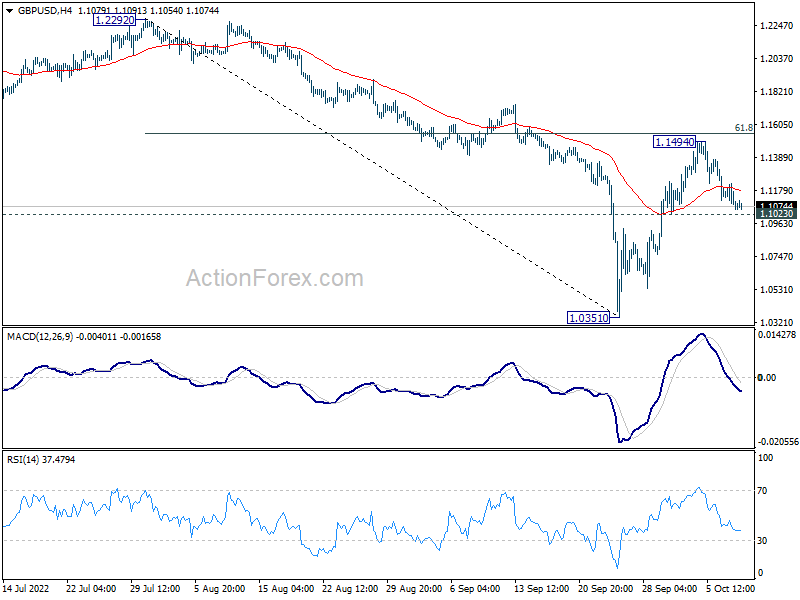
Intraday bias in GBP/USD remains neutral for the moment. On the downside, break of 1.1023 minor support will indicate that rebound from 1.0351 is over. Intraday bias will be back on the downside for retesting 1.0351. On the upside, firm break of 61.8% retracement of 1.2292 to 1.0351 at 1.1551 will pave the way to 1.2292 resistance.
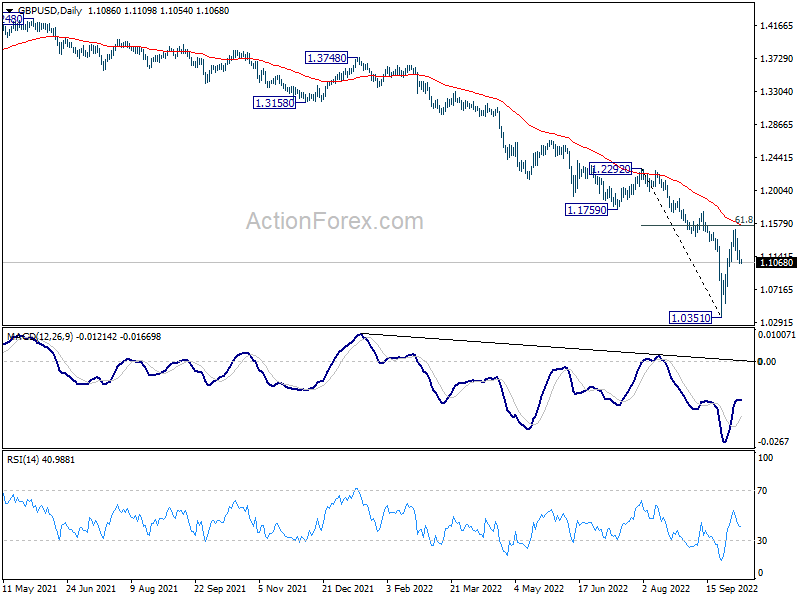
In the bigger picture, fall from 1.4248 (2018 high) is resuming long term down trend from 2.1161 (2007 high). Next target is 100% projection of 2.1161 to 1.3503 from 1.7190 at 0.9532. There is no scope of a medium term rebound as long as 1.1759 support turned resistance holds.
USD/CHF Daily Outlook
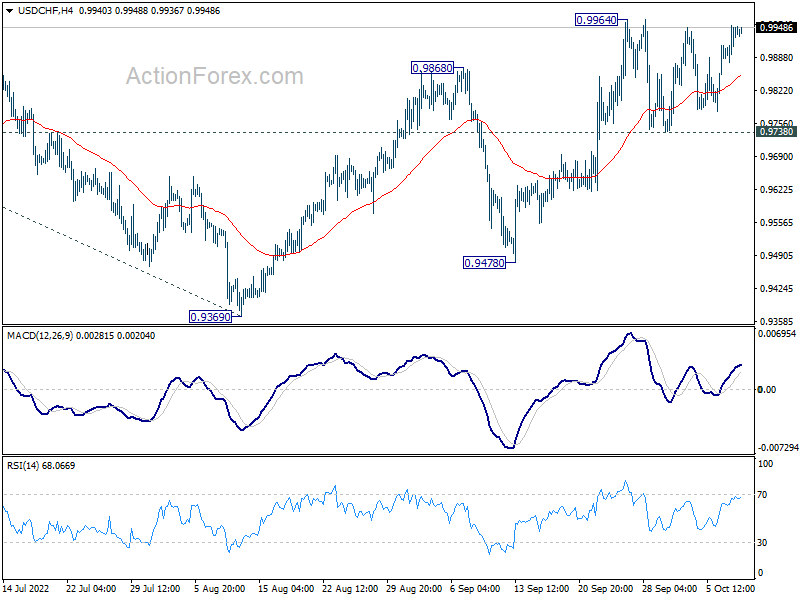
Daily Pivots: (S1) 0.9897; (P) 0.9926; (R1) 0.9976; More...
USD/CHF is still bounded in consolidation from 0.9964 and intraday bias remains neutral. On the upside, above 0.9964 will resume the rally from 0.9369 to retest 1.0063 high. For now, outlook will stay bullish as long as 0.9738 support holds, in case of retreat.
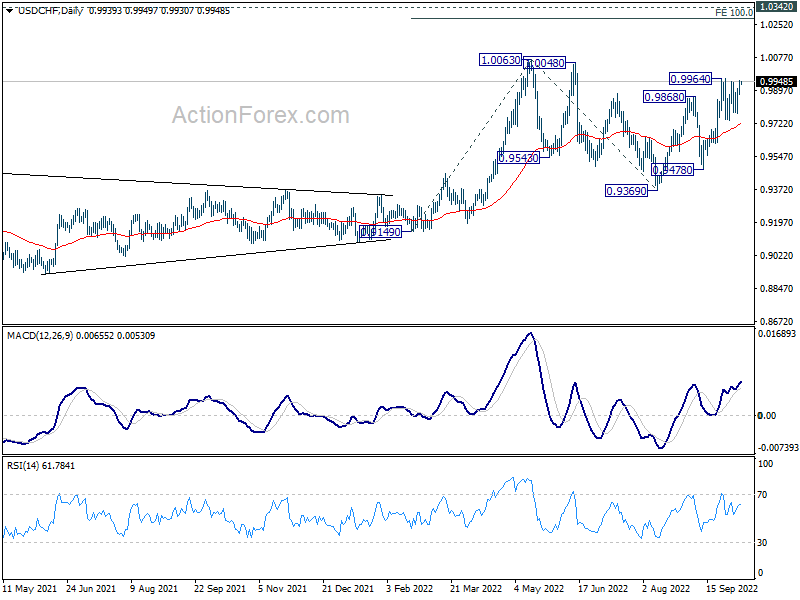
In the bigger picture, current development suggests that up trend from 0.8756 (2021 low) is still in progress. Sustained break of 1.0063 will target 100% projection of 0.9149 to 1.0063 from 0.9369 at 1.0283, and then 1.0342 (2016 high). For now, this will remain the favored case as long as 0.9369 support holds, even in case of deep pull back.
USD/JPY Daily Outlook
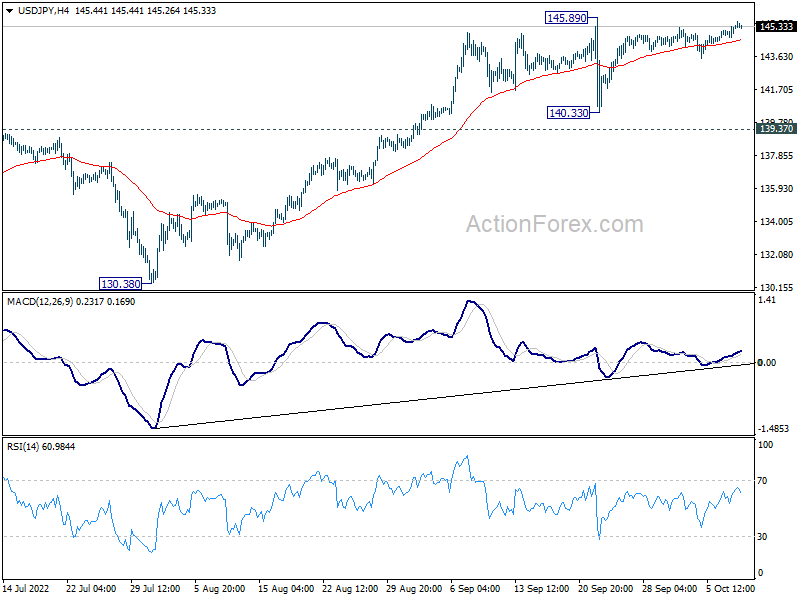
Daily Pivots: (S1) 144.93; (P) 145.18; (R1) 145.65; More...
Intraday bias in USD/JPY stays neutral as consolidation from 145.89 could still extend. Further rally is expected as long as 139.37 resistance turned support holds. Break of 145.89 will target 147.68 long term resistance. On the downside, however, decisive break of 139.37 will confirm short term topping. Deeper decline would be seen back towards 130.38 support.
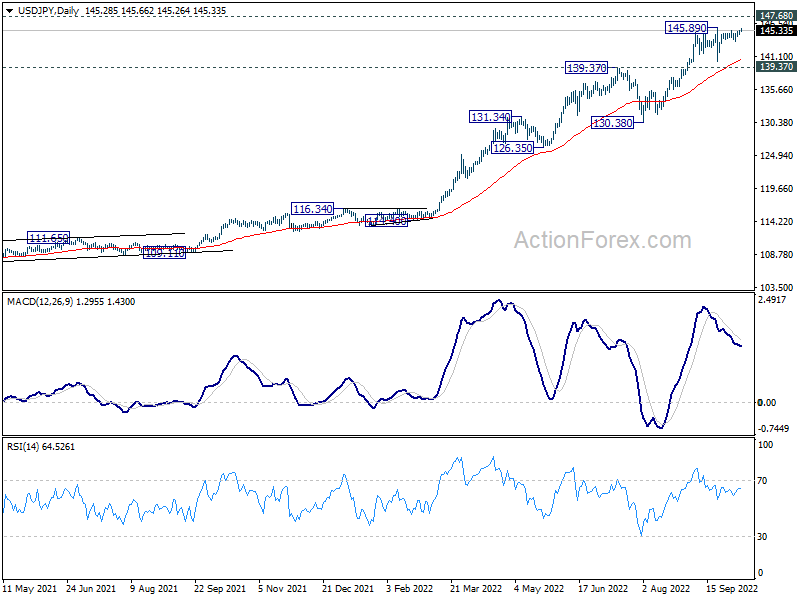
In the bigger picture, up trend from 101.18 is still in progress, as part of the whole up trend from 75.56 (2011 low). Further rise should be seen to 147.68 (1998 high). For now, break of 130.38 support is needed to be the first indication of medium term topping. Otherwise, outlook will stay bullish even in case of deep pull back.
USD/CAD Daily Outlook
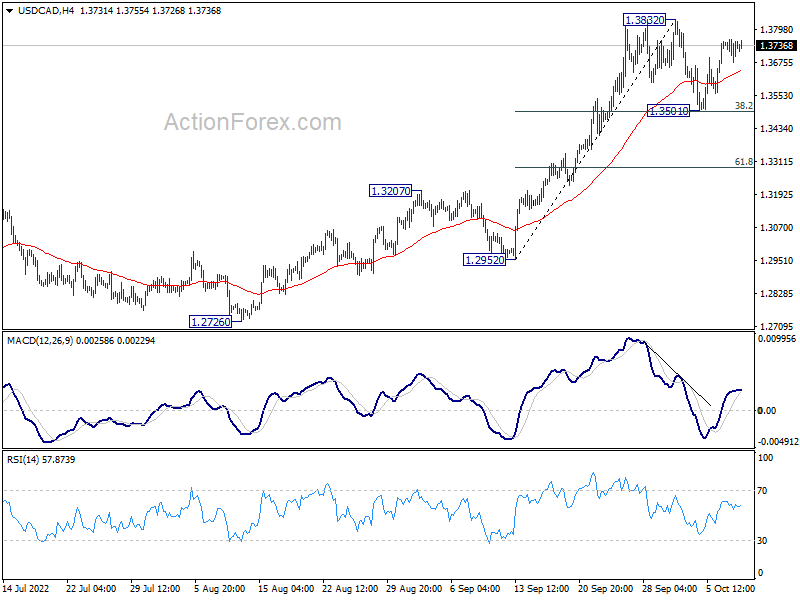
Daily Pivots: (S1) 1.3687; (P) 1.3723; (R1) 1.3771; More...
Intraday bias in USD/CAD remains neutral as consolidation from 1.3832 is extending. On the upside, firm break of 1.3832 will resume larger up trend. Next target is 161.8% projection of 1.2005 to 1.2947 from 1.2401 at 1.3925. In case of another fall, downside should be contained by 38.2% retracement of 1.2952 to 1.3832 at 1.3496 to bring rebound.
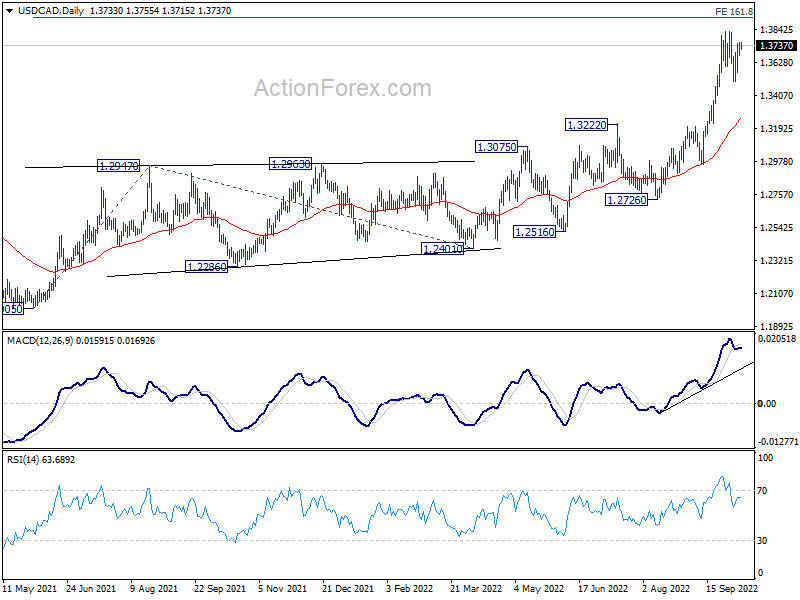
In the bigger picture, up trend from 1.2005 (2021 low) is still in progress. Based on current impulsive momentum, it could be resuming long term up trend from 0.9056 (2007 low). Whether it is or it isn't, retest of 1.4689 (2016 high) should be seen next. This will now remain the favored case as long as 1.3222 resistance turned support holds.
AUD/USD Daily Report
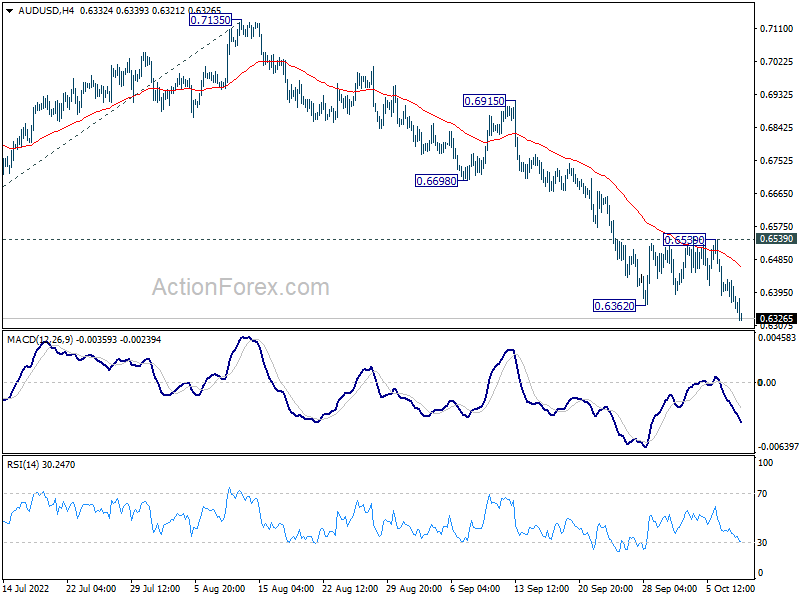
Daily Pivots: (S1) 0.6338; (P) 0.6385; (R1) 0.6416; More...
Intraday bias in AUDUSD stays on the downside this week. Current down trend should target 100% projection of 0.7660 to 0.6680 from 0.7135 at 0.6155 next. On the upside, break of 0.6539 resistance is needed to indicate short term bottoming. Otherwise, outlook will stay bearish in case of recovery.
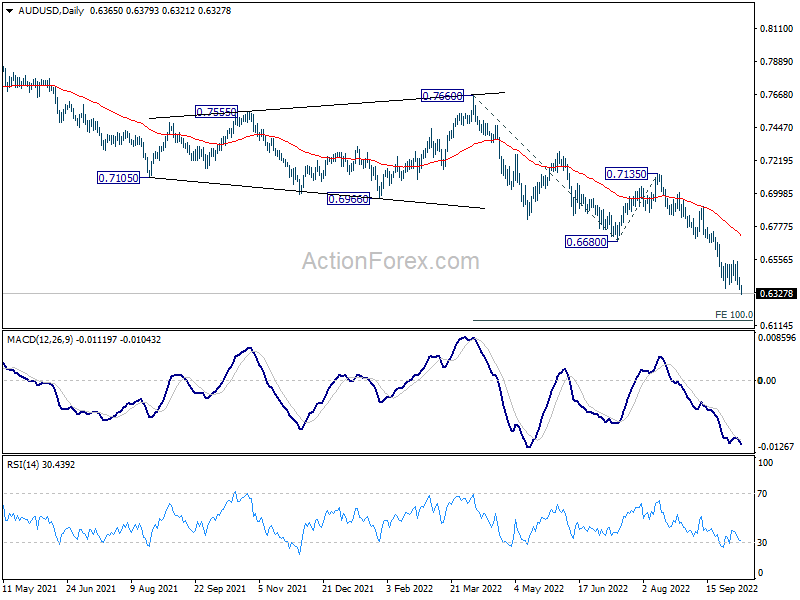
In the bigger picture, down trend form 0.8006 (2021 high) is expected to continue as long as 0.6680 support turned resistance holds. Next target is 0.5506 low. Medium term momentum will now be closely monitored to gauge the chance of break of 0.5506.
Aussie Down on Risk Aversion, Poor Service Data
Asian markets trade broadly lower today, extending the risk-selloff late last week. Dollar, Yen and Swiss Franc are trading higher on risk-aversion, as usual. Aussie is currently worst performer, while Kiwi and Sterling are trailing. Euro is mixed for now, but looks vulnerable too.
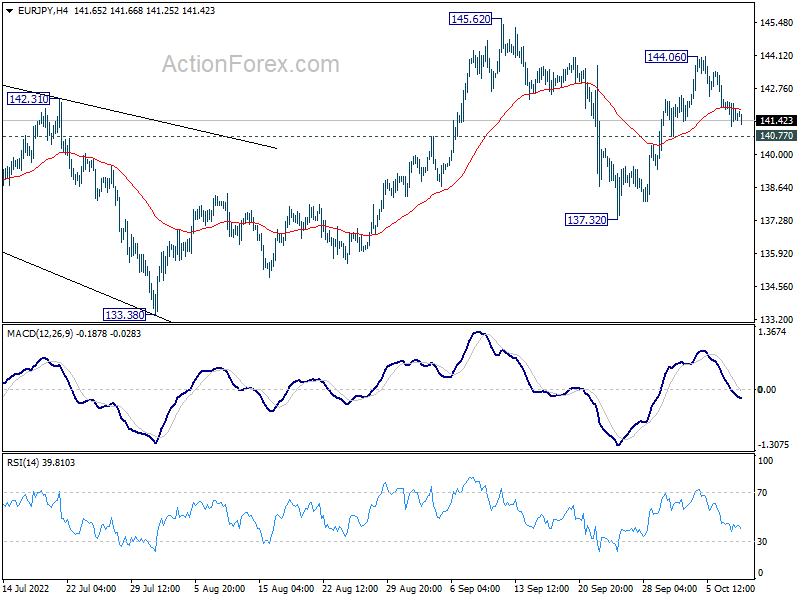
Technically, one focus is whether EUR/USD would finally make up its mind and break through 0.9734 minor support firmly, and head back to 0.9534 low. To confirm Dollar's strength against Europeans, GBP/USD will have to break through 1.1023 minor support while USD/CHF should break through 0.9964 resistance. Or, to confirm Euro's weakness, EUR/JPY has to break through 140.77 minor support while EUR/CHF should break through 0.9641 minor support. Let's see.
In Asia, Hong Kong HSI is down -3.03%. China Shanghai SSE is down -1.13%. Singapore Strait Times is down -1.12%. Japan is on holiday.
Australia AiG services dropped to contraction at 48
Australia AiG Performance of Services Index dropped sharply by -5.3 pts to 48.0 in September, back in contraction. Looking at some details, sales tumbled by -10.1 to 41.8. Employment edged down by -0.6 to 52.6. New orders dropped -7.1 to 50.2. Input prices rose 4.7 to 73.4. Selling prices dropped -2.9 to 58.3. Average wages dropped -1.7 to 65.9.
Innes Willox, Chief Executive of Ai Group, said: "The increasingly uncertain economic environment is dragging on service industries. The sector has fallen into contraction in September, and all services activity indicators have worsened in the last month. Low consumer and business confidence – following repeated interest rate rises and persistent inflation – were major factors in this decline. The indicators for sales, new orders, and selling prices all fell, while input prices continued their upward march adding to inflationary pressures.
AUD/JPY downside breakout, targets 90
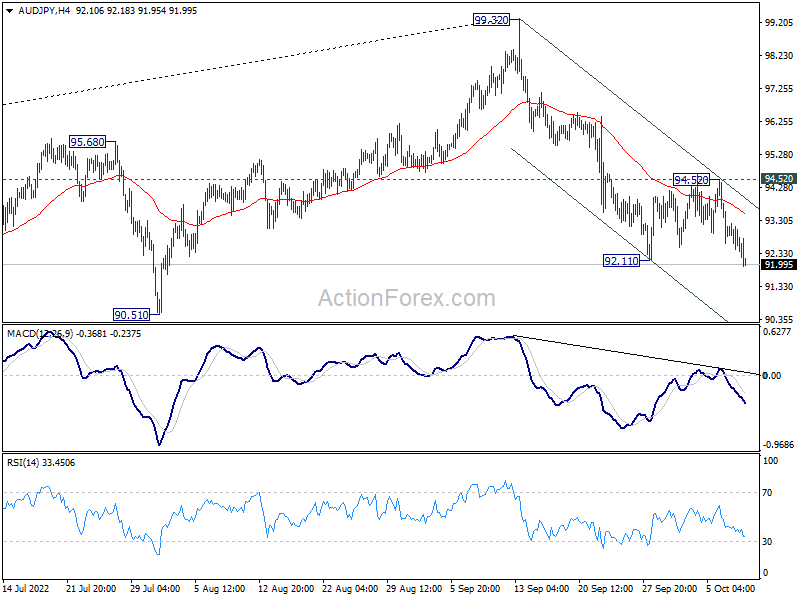
Australian Dollar falls broadly in Asian session, after release of poor service sector data, and on the back of risk aversion. AUD/JPY's break of 92.11 temporary low confirms down resumption of decline from 99.32. Near term outlook will stay bearish as long as 94.52 resistance holds, even in case of recovery. Next target is 90.51 support first.
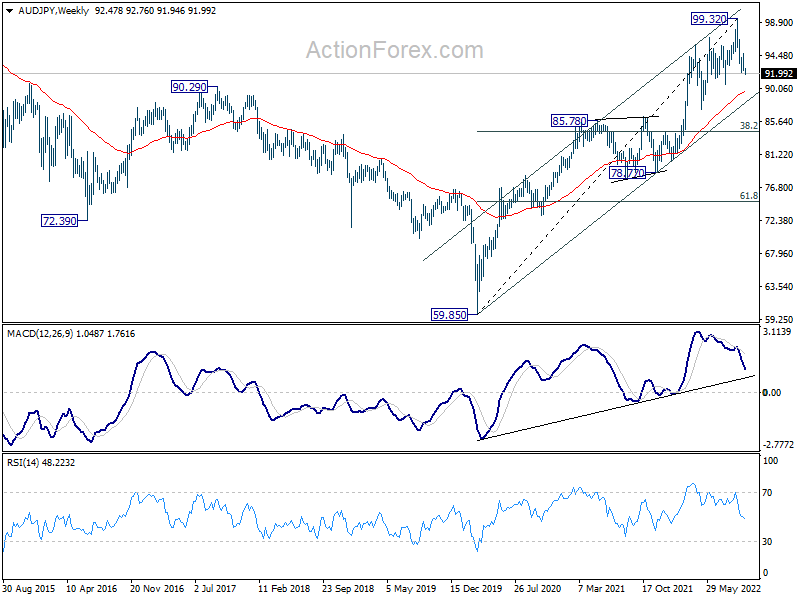
For now, it's unsure whether fall from 99.32 is corrective the up trend from 78.77 only, or that from 59.85. Reaction to 55 week EMA (now at 89.60) should reveal which case it is. In the bearish case, AUD/JPY could fall further to 38.2% retracement of 59.85 to 99.32 at 84.24 before bottoming.
US CPI and retail sales; UK GDP to highlight the week
US CPI and retail sales are one of the focuses in the week. In particular, consumer inflation data could seal the case for another 75bps Fed hike in early November. FOMC minutes will also be published, but it's unlikely to reveal more than what the markets know. UK GDP and employment will also be closely watched. They would help shape new economic forecasts of BoE in November, which is the basis for the next policy move.
Here are some highlights for the week:
- Monday: Australia AiG services; Eurozone Sentix Investor Confidence.
- Tuesday: Australia Westpac consumer sentiment, NAB business confidence; Japan current account; UK employment.
- Wednesday: Japan machine orders; UK GDP, production, trade balance, NIESR GDP estimate; US PPI, FOMC minutes.
- Thursday: Japan PPI, Australia inflation expectations; Germany CPI final; Swiss PPI; US CPI, jobless claims.
- Friday: New Zealand BusinessNZ manufacturing; China CPI, PPI, trade balance; Eurozone trade balance; Canada manufacturing sales, wholesales sales; US retail sales, import prices, U of Michigan consumer sentiment, business inventories.
AUD/USD Daily Report
Daily Pivots: (S1) 0.6338; (P) 0.6385; (R1) 0.6416; More...
Intraday bias in AUDUSD stays on the downside this week. Current down trend should target 100% projection of 0.7660 to 0.6680 from 0.7135 at 0.6155 next. On the upside, break of 0.6539 resistance is needed to indicate short term bottoming. Otherwise, outlook will stay bearish in case of recovery.
In the bigger picture, down trend form 0.8006 (2021 high) is expected to continue as long as 0.6680 support turned resistance holds. Next target is 0.5506 low. Medium term momentum will now be closely monitored to gauge the chance of break of 0.5506.
Economic Indicators Update
| GMT | Ccy | Events | Actual | Forecast | Previous | Revised |
|---|---|---|---|---|---|---|
| 22:30 | AUD | AiG Performance of Services Index Sep | 48.0 | 53.3 | ||
| 08:30 | EUR | Eurozone Sentix Investor Confidence Oct | -30.8 | -31.8 |