Sample Category Title
AUDUSD Consolidates in Short-term; Broader Outlook is Bearish
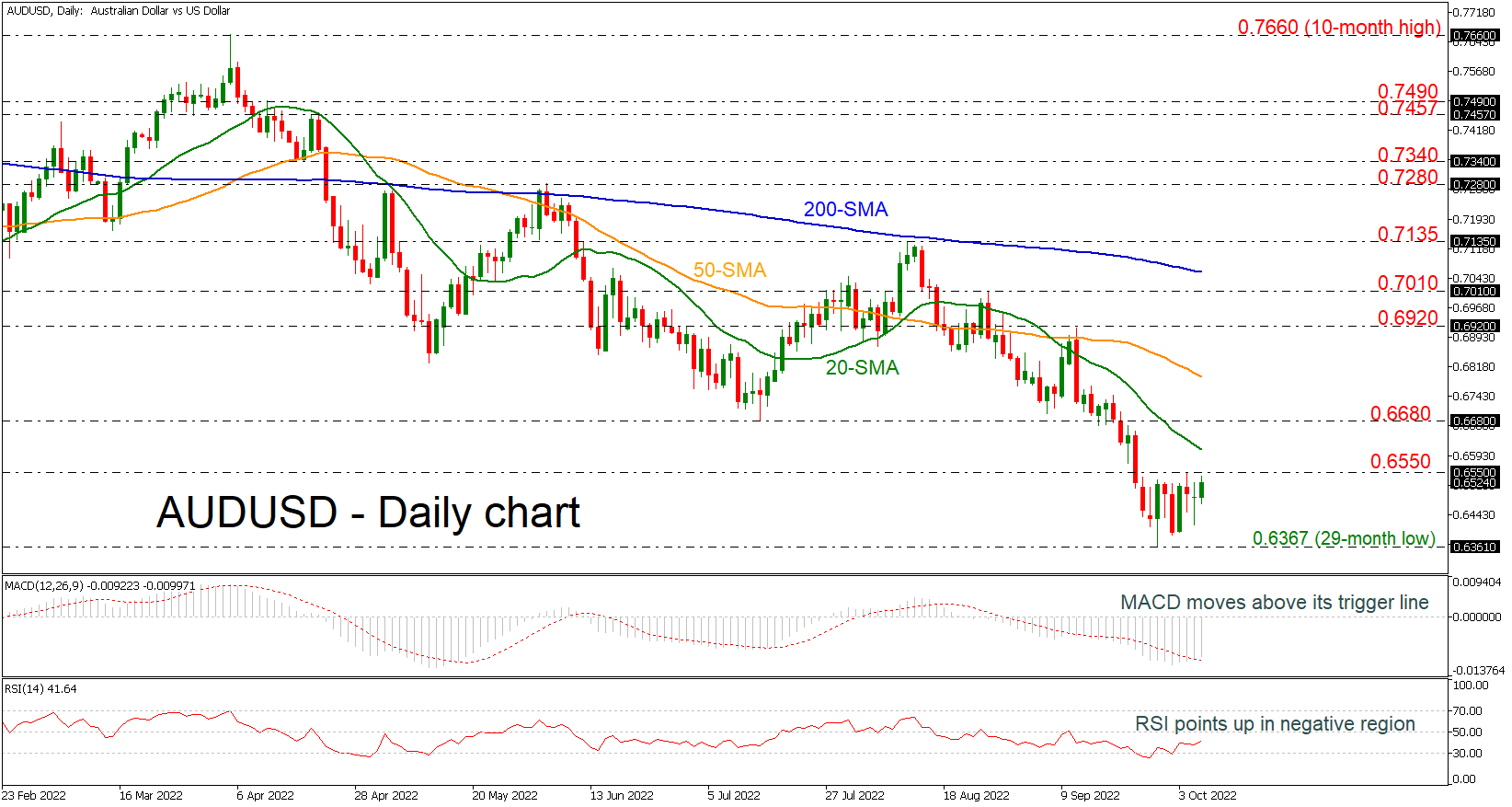
AUDUSD has been moving sideways over the last week, consolidating within the 0.6367 support and the 0.6550 resistance. In trend indicators, the 20- and 50-day simple moving averages (SMAs) are heading south, confirming the long-term bearish outlook, while the MACD is holding above its trigger line in the negative region and the RSI is sloping up below the neutral threshold of 50.
A failure to overcome the 0.6550 resistance level could send the price down to the 29-month low of 0.6367. Lower, support could next be found around the 0.5505 barrier, registered in March 2020.
Alternatively, if 0.6550 proves easy to get through, the spotlight will turn to the 20-day SMA at 0.6605. On top of that, the bulls would need to clear the 0.6680 obstacle to push the rally towards the 50-day SMA at 0.6790.
In the short-term picture, AUDUSD is currently neutral after violating the 0.6680 level. Should the market continue the downward pattern, the outlook may worsen, posting a lower low.
NZD/USD: A Pullback in the Bullish Correction to 0.593 is Expected
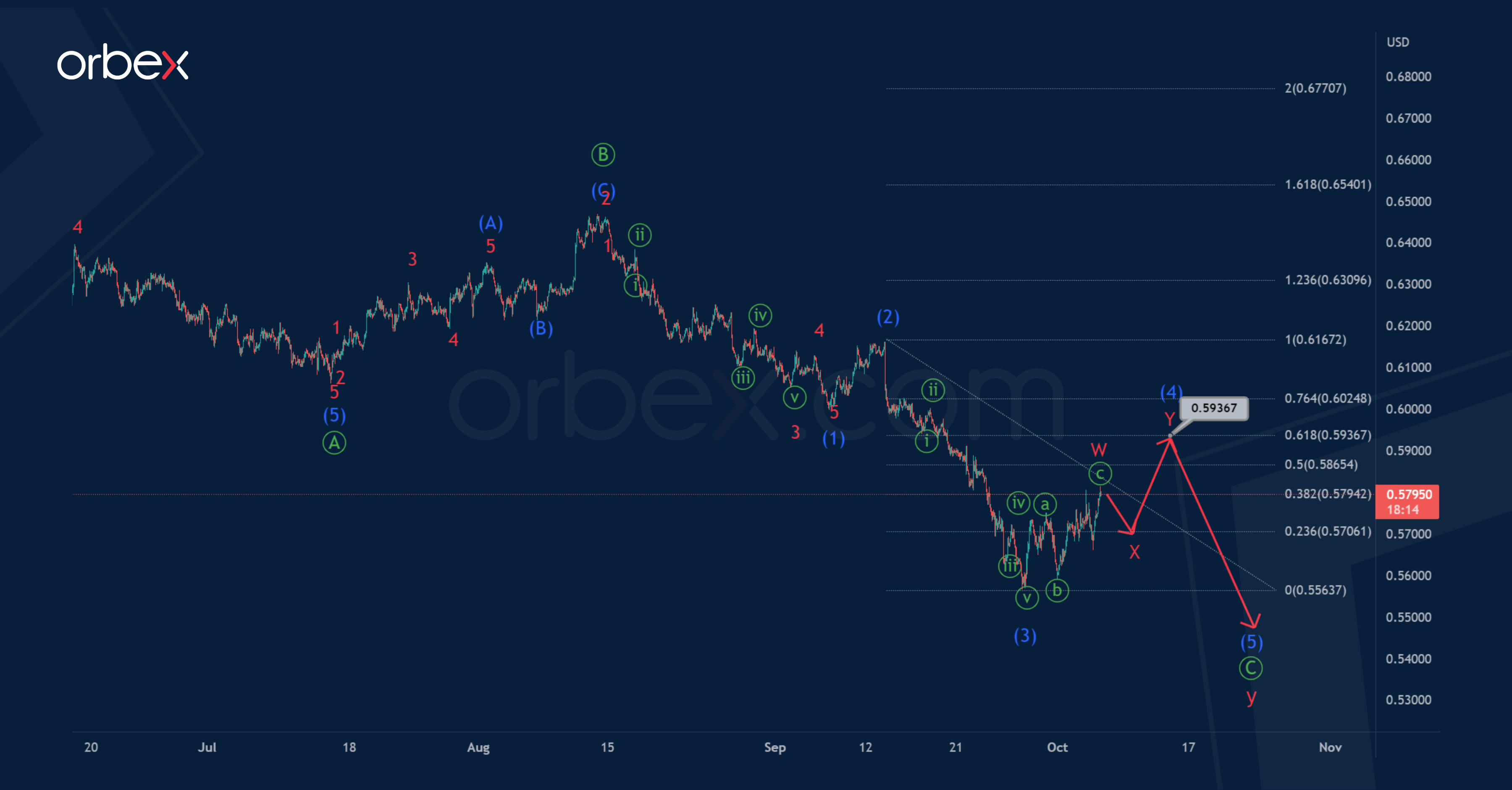
On the 1H timeframe, NZDUSD seems to be forming a bearish trend, which may take the form of a double zigzag w-x-y of the cycle degree. The current chart shows the structure of the final wave y, which assumes a primary zigzag Ⓐ-Ⓑ-Ⓒ.
Most likely, the primary impulse wave Ⓐ and the bullish correction Ⓑ are fully completed, and the last impulse wave Ⓒ is currently under construction. Perhaps, after the end of the impulse decline in the intermediate wave (3), the development of an intermediate correction (4) began, the initial part of which hints at a double zigzag.
The end of the potential double zigzag is expected to reach 0.593. At that level, correction (4) will be at 61.8% of impulse (3).
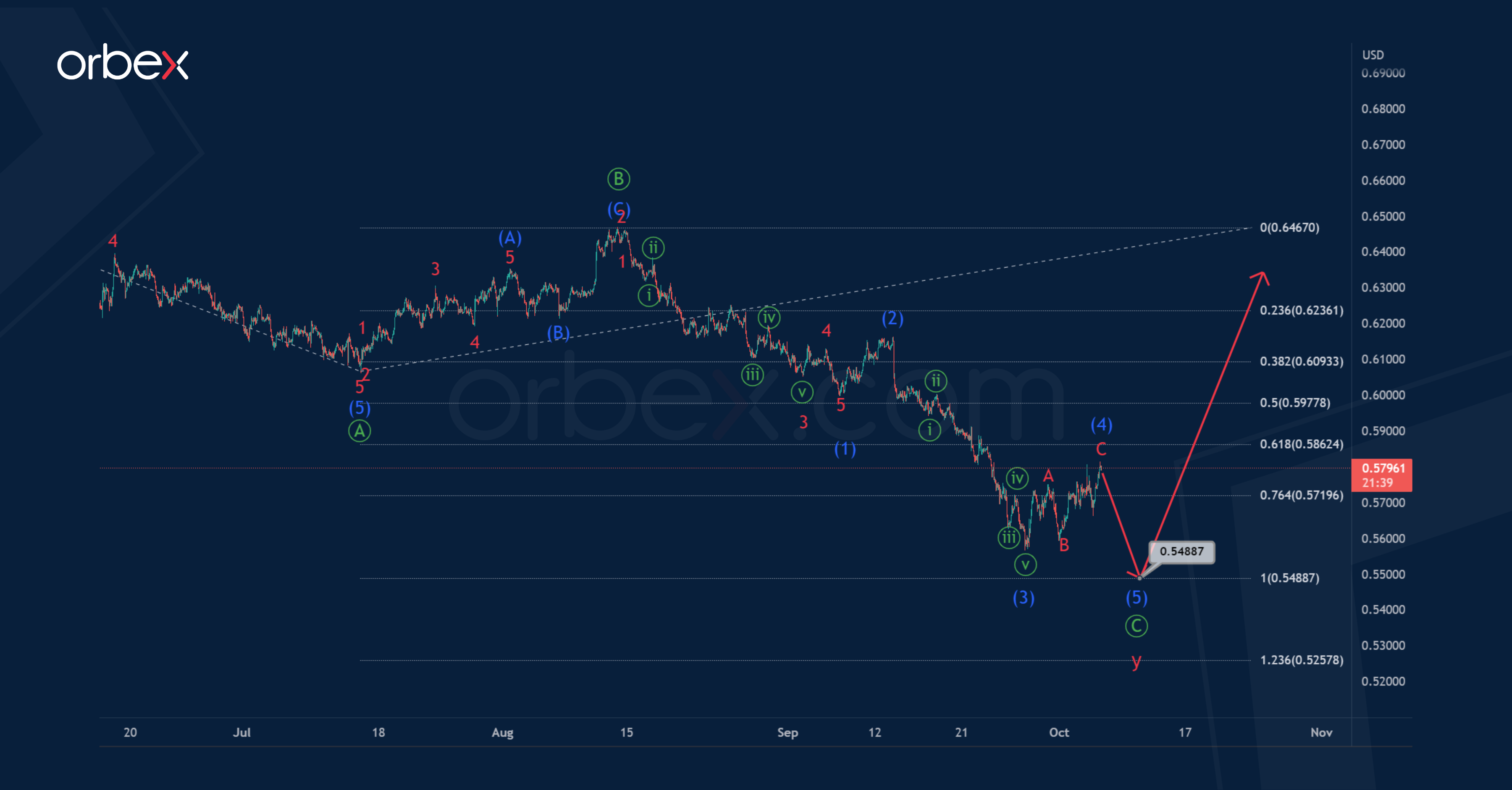
Alternatively, it is assumed that the market has already completed the formation of an intermediate correction (4), it has a standard zigzag shape.
Thus, once the correction has been completed, we can expect the development of a bearish final wave (5) of the intermediate degree.
The price within wave (5) may fall to 0.548. At that level, primary impulse waves Ⓐ and Ⓒ will be equal.
An approximate scheme of possible future movement is shown on the chart.
US Oil Tests Key Resistance
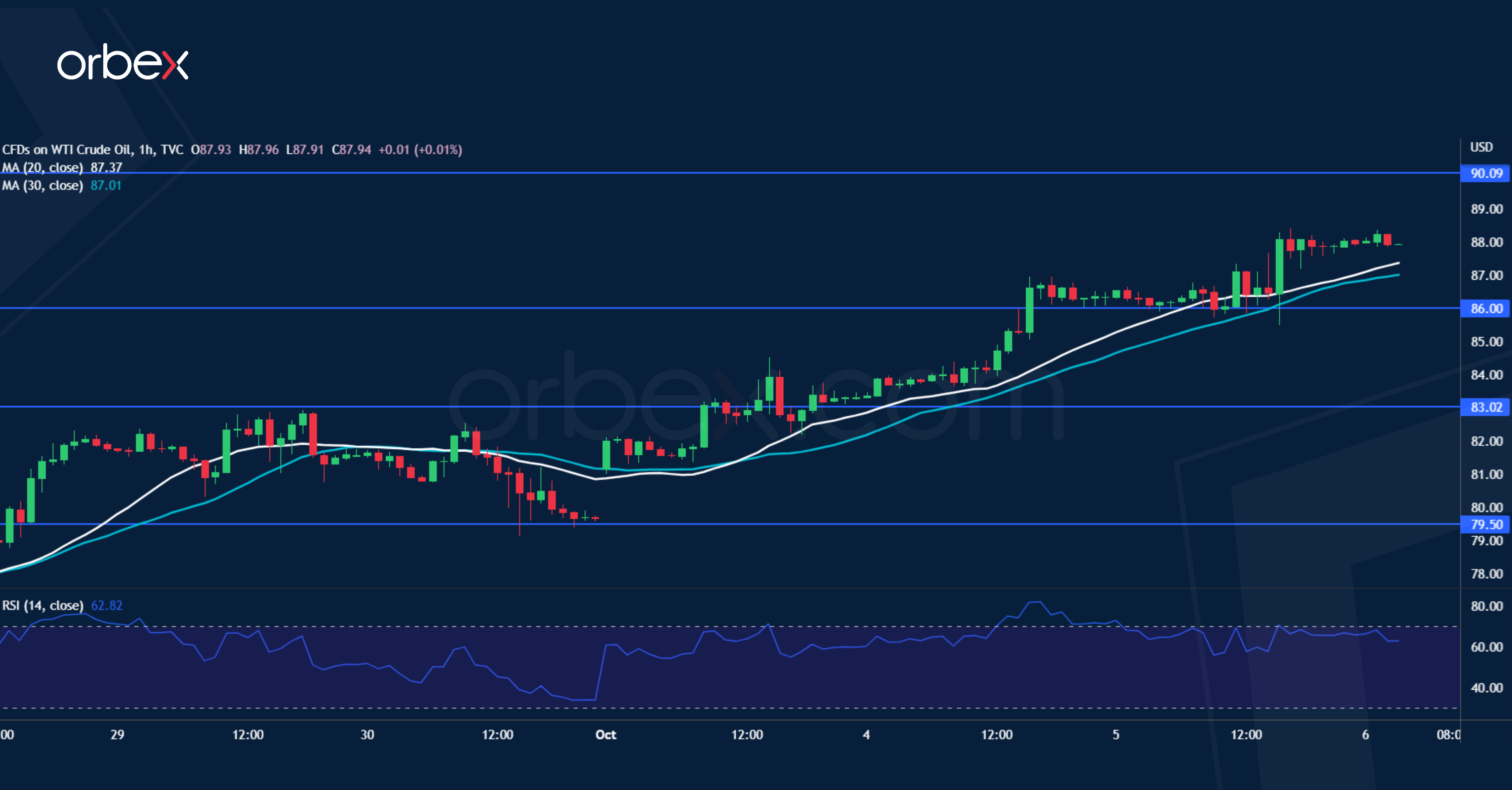
WTI crude bounced higher after OPEC+ agreed to cut output. The rebound has gained a foothold after it cleared the supply zone around 83.00. The price is testing the daily resistance and psychological level of 90.00 and stiff pressure could be expected from the sell side. However, sentiment may brighten up in the short-term if the bulls manage to push past this ceiling, clearing the path towards 97.00. As the RSI inches back into overbought territory, 86.00 has turned into a support in case of a pullback.
XAU/USD Hits Resistance
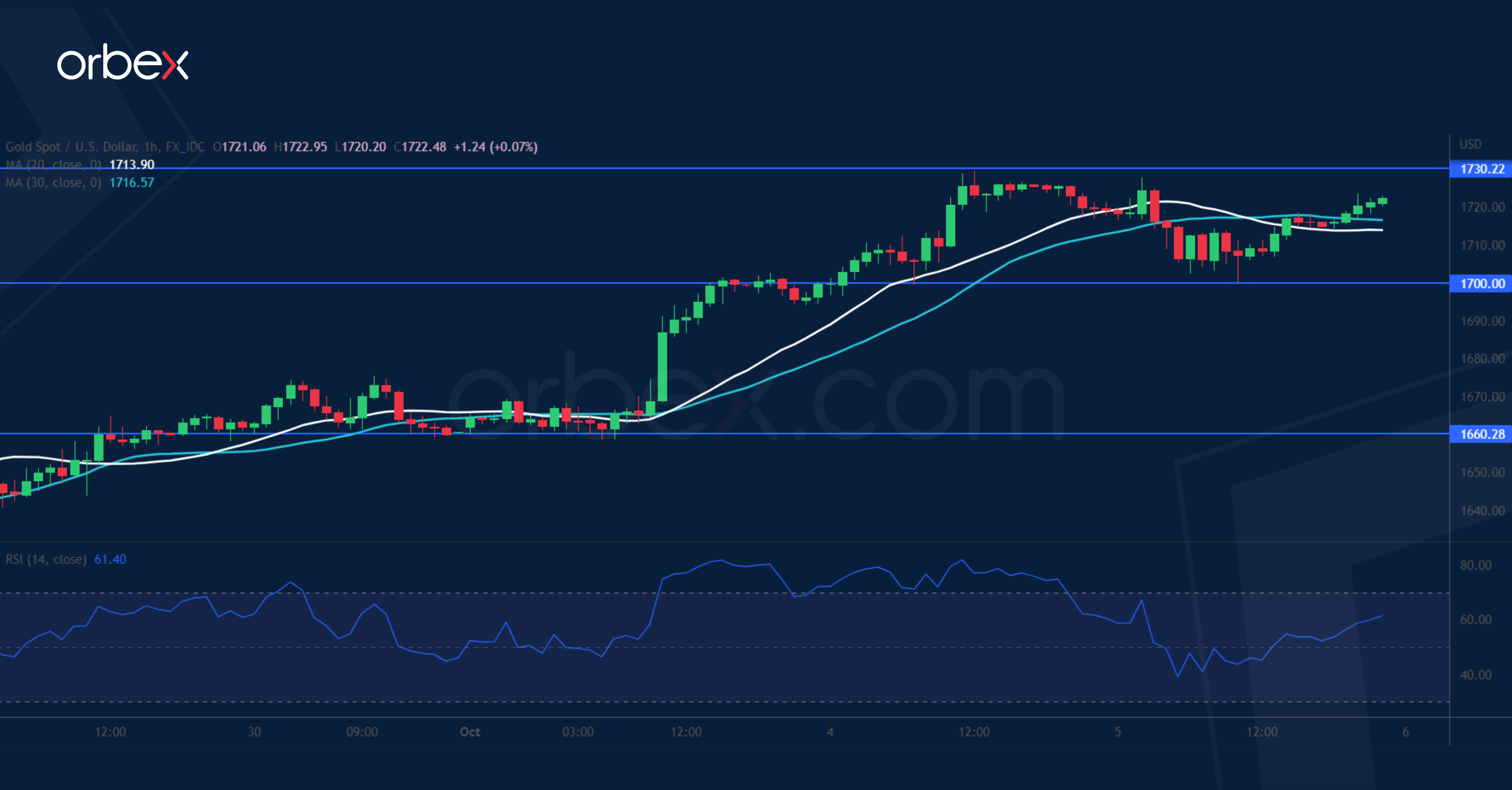
Gold clawed back losses as the dollar index bounces higher. A sharp recovery has lifted bullion back to September’s high at 1730 which is an important level on the daily chart. As the RSI soared into the overbought area, fresh selling from trend followers in conjunction with profit-taking has kept the rally in check. A bullish breakout would force the short side to cover, stirring up volatility in the process. The psychological level of 1700 is a fresh support and its breach may extend losses to 1660.
USD/CAD Consolidates
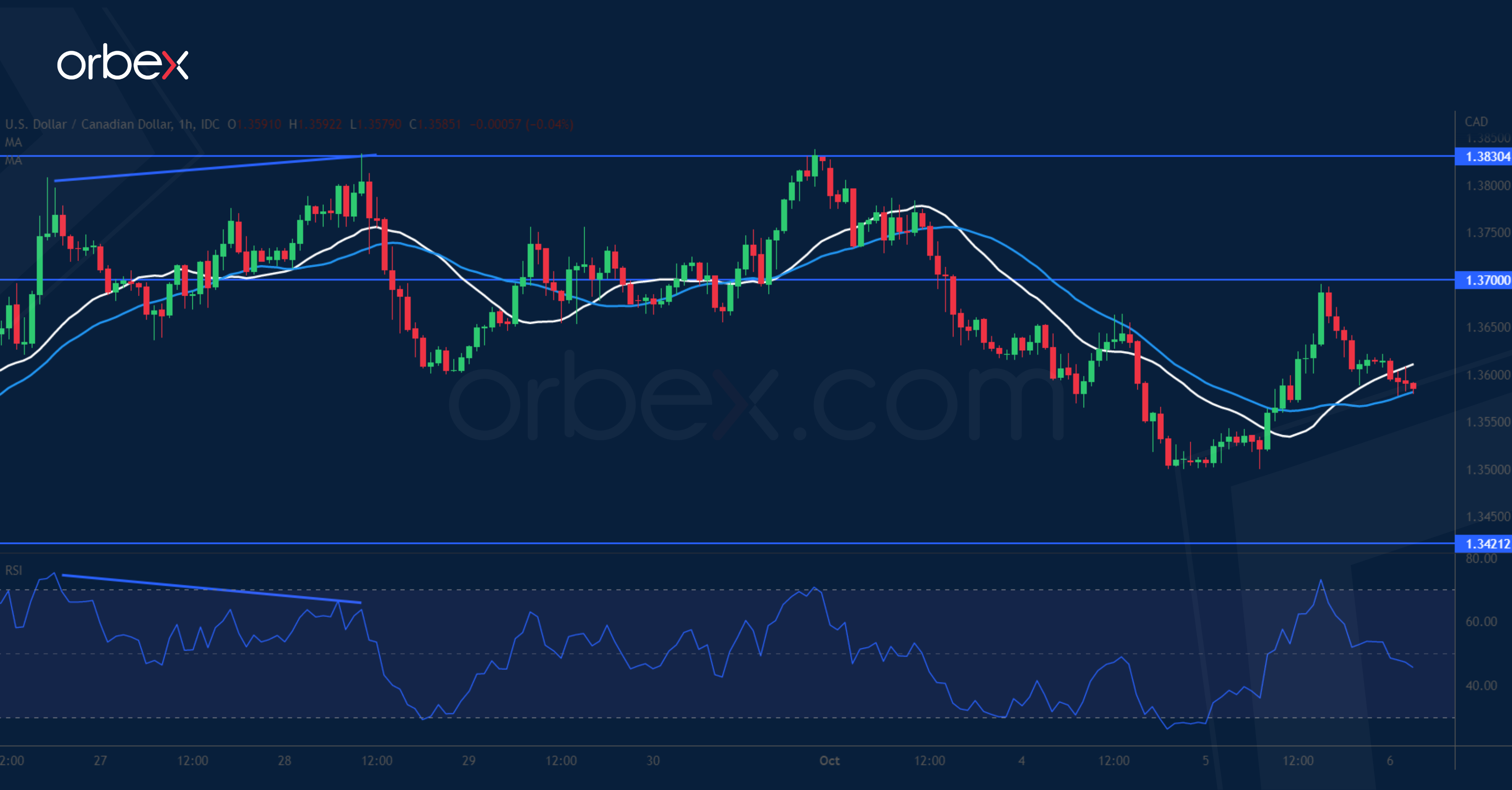
The Canadian dollar struggles over lacklustre August export data. A bearish RSI divergence showed a slowdown in the upward momentum while a double top at 1.3830 further suggested exhaustion in the current rally. The pair is prone to a correction after it fell below 1.3600. The uptrend remains intact but the recent parabolic rise could use some breathing room to let the bulls accumulate again. 1.3420 on the 20-day moving average is an area of interest. The support-turned-resistance at 1.3700 is the first hurdle.
Investors Will Simply Count Down to Tomorrow’s Official Job Report
Markets
US data came in strong yesterday. The September ADP job report hit the bar (208k with a 53k upward revision for August). The US non-manufacturing ISM stabilized at a strong 56.7 (vs 56 expected), contrasting with the below-consensus outcome of Monday’s manufacturing gauge. The numbers came amid hawkish Fed speech from the likes of SF Fed Daly and Atlanta Fed Bostic. This helped sustain a rebound in core bond yields after a few days correcting lower, although most tenors (in the US) finished below their intraday highs. US yields rose between 5.6 and 12.3 bps with the belly of the curve underperforming. Bund yields added 12.2-16.3 bps across the curve. The 10y yield took out the 2% mark again. Italy significantly underperformed regional peers. The 10y yield soared 30 bps and spreads vs Germany’s 10y shot up 13 bps. It followed ECB data showing less support for BTP’s in August via its flexible PEPP reinvestments (as compared to July) and Moody’s surprise warning for a potential downgrade after the right-wing election victory. Higher rates pushed stocks in the defensive, declining 1% in Europe. US equities slumped up to 2.4% before staging a rebound that capped losses to just 0.2%. Energy companies rallied following a big 2m b/d OPEC+ production cut. Brent oil rose 1.7% to $93.4. The dollar appreciated, with the technical deities helping a hand. EUR/USD reversed course after hitting the top of the downward trend channel. The pair slipped from 0.998 to 0.988. Trade-weighted DXY bounced off 110 to 111.21. USD/JPY sticks south of 145. Sterling was sold. GBP/USD dropped from 1.15 to 1.132. EUR/GBP bottomed out further with gains to 0.873 and capturing lost support at 0.8721 again.
Asian news flow is thin this morning and that may not change today. The ECB meeting minutes usually don’t contain as much clues as those from the Fed do but it’s worth mentioning anyway. Other than that investors will simply count down to tomorrow’s official job report (payrolls) to check whether it chimes with their recent repositioning for a slightly softer Fed. Current market mood is cautiously optimistic. Asian equities put comfort from WS’s intraday reversal. South Korea outperforms (+3%). European stock market futures point to a higher opening to the tune of 1.5%. Core bonds inch higher but conviction is low. The dollar takes a breather after surging yesterday. EUR/USD recoups some losses to trade around 0.992. The British pound is not much affected by Fitch’s cut in the outlook of the UK (see below). EUR/GBP is currently running a three-day winning streak (0.874).
News Headlines
The National bank of Poland yesterday unexpectedly left its policy rate unchanged. A majority of market participants and analysts expected a rate hike to 7.0%. Inflation in Poland in September remained elevated at 17.2% Y/Y. ‘The Council assessed, that the hitherto significant monetary policy tightening by NBP and the expected economic activity growth slowdown … will contribute to curbing demand growth in the Polish economy, which will support a decline in inflation in Poland towards the NBP inflation target’. However, given persistence of the current shocks that remain beyond the impact of domestic monetary policy, a return of inflation towards the NBP inflation target will be gradual. A zloty appreciation more in line with the fundamentals of the Polish economy also could ease inflationary pressures. Further policy steps will be data dependent. The NBP also reiterates that it may intervene in the currency market to limit fluctuations of the zloty that are inconsistent with the direction of monetary policy. The zloty initially weakened to the EUR/PLN 4.84 area, but regained part of that loss later to close near EUR/PLN 4.82.
Rating agency Fitch lowered the outlook on its UK’s long term Long Term foreign currency rating from stable to negative. The credit rating stands at AA-. The revision amongst others was driven by the large and unfunded fiscal package announced as part of the government’s growth plan which could lead to a significant increase in fiscal deficits over the medium term. Without compensatory measures, the agency sees the government deficit at an elevated 7.8% of GDP in 2022, increasing to 8.8% in 2023. The general government debt to GDP ratio might go to 109% in 2024 from 101% this year. The rating agency also mentions increased policy uncertainty as the large fiscal stimulus and the inconsistency between fiscal and monetary policy stance, according the agency, negatively impacted financial markets’ confidence and credibility of the policy framework.
OPEC Cuts, Oil and USD Up, Equities Down
It has been another volatile and undecided trading session yesterday.
OPEC did cut its oil production target by 2 million barrels per day. It was the biggest cut since 2020, it was expected, it saw a morose reaction by Joe Biden - who said it was ‘shortsighted’, but a well better enthusiasm than what I expected by the oil bulls.
The barrel of US crude ended the session 1.90% higher, yet, the 50-DMA offers haven’t been cleared just yet.
The oil bulls’ camp focus on the restricted output due to capacity contraints, the OPEC’s push to keep prices high, the Russian threat that there will be less Russian oil due to the European sanctions that include a price cap on Russian oil, the gas to oil switch due to the Ukrainian war – which increases demand for oil, the upcoming winter, the fact that we haven’t heard more about the Iran-US nuclear deal, and the expectation that China will recover and demand more oil at some point.
The skeptics, on the other hand, point that OPEC did announce a cut of 2mbpd yesterday, but many OPEC countries have been failing to meet their quotas recently due to capacity restrictions, and that in reality, the real impact of OPEC decision should be a fall of less than 2mbpd. And more importantly, the bears outweigh the fact that the world has stepped into an aggressive central bank tightening cycle, and that the recession worries, and prospect of lower demand should keep the upside in oil prices limited.
WTO warns
The World Trade Organization gave a scary forecast for the global trade next year. The WTO raised its trade growth estimate from 3 to 3.5% for this year, but they slashed their expectation for next year to 1%, from around 3-4%. They said that ‘major central banks are already raising rates in a bid to tame inflation but overshooting on tightening could trigger recessions in some countries’. They added that their forecasts have a high degree of uncertainty as they don’t know how hard the central banks would push, and how long the war in Ukraine will last. But some countries will suffer, and it’s not going to be the emerging markets only. The Eurozone and the UK economies are also on the chopping block, while the US economy is… actually doing not too bad on the trade front, despite the STRONG US dollar.
The US trade deficit continues falling thanks to a visible surge in exports, as the US is exporting plenty of energy to Europe and allies to replace their Russian supplies.
Where to?
Yesterday, the investor sentiment was rather bearish. The major indices were under a decent selling pressure, following a strong two-day rally. Therefore, it wasn’t a surprise to see them give back a part of the early-week gains. Yet one giant options transaction is apparently the reason why we saw a U-turn in the US session, and help the S&P500 erase a 1.8% decline. The index closed the session 0.20% down only, while Nasdaq finished almost flat at 11573 mark, and the Dow Jones closed above the 30’000 for the second day.
The data from the US was not very mood-friendly, but it was ok. The ISM services index showed a faster than expected expansion in the US services sector, and the ADP report printed a slightly higher number than the expectations. It showed that the US economy added some 207’000 jobs last month, versus around 200’000 expected by the market. Both figures did not match the idea that the Fed would slow its rate hikes, but the market reaction remained rather mild. Now all eyes are on Friday’s NFP number, and wages growth data.
Dollar rebounds, again
In the FX, the dollar index tested the 110 support for the second day but failure to clear it is now sending the dollar higher this morning. The US yields also rebound, as the positive impact of the Bank of England (BoE) intervention in the British sovereign markets is now fading.
As a result, the advance in EURUSD remained capped below parity, and the critical 50-DMA, and Cable is back to 1.1350 after having tested the 1.15 resistance this week.
On the political front, Liz Truss said her government remains ‘on course’ for the huge spending that they are about to throw out, and it is highly unlikely that the £2 billion concession on high earners’ tax cuts would do anything to improve the investor mood.
But the good news is, she will certainly abandon the idea of going after the BoE for now, as she well understood that shooting the BoE down would cost her big; ff the BoE wasn’t there to save the day last week, she would be in a bigger trouble today. So, Liz Truss will back the BoE’s authority to set interest rates independently, and the BoE will unlikely hesitate to hike the rates by more than she would love to. That should help keeping sterling’s head above water, for now.
OPEC+ Production Cuts Hit Global Risk Sentiment
Market movers today
Another quiet day on data front. The euro area retail sales for August are expected to reflect a fall in household real income with consensus expecting a 0.4% drop from July.
Also, the ECB minutes are out this afternoon. There we will get a bit more colour on why the Governing Council decided to hike rates by 75bp in September and also what their expectations are for further rate hikes ahead.
We also have Fed Evans, Cook and Kashkari speaking in the evening.
The Norwegian 2023 fiscal budget will be published today (see more details in Nordic section).
The 60 second overview
OPEC+ yesterday decided on relatively large output cuts, planning to collectively reduce production by 2 million barrels a day, equivalent to about 2% of global consumption. The actual cut may however be smaller, probably closer to 1 million barrels as many smaller members such as Nigeria are already producing below their targets. The intended production cuts drew criticism from the US, fearing that higher oil prices will hit the global economy at a fragile moment. Oil prices continued their rise yesterday to USD 93 per barrel and have now increased almost 10% over the past week. We see the Brent oil price hovering around USD 100 per barrel in Q4.
The higher oil prices were one of the key drivers behind weaker global risk sentiment after the last few days' strong sessions, sending equities lower while global bond yields rose on the back of higher market implied inflation expectations. The hit to risk sentiment also supported the USD with EUR/USD falling back below 99 but the cross has rebounded somewhat this morning. Credit markets also reflected market concerns with the iTraxx Xover widening 18bp while Main widened 3.5bp.
In equity markets, defensives back in style, especially the energy sector after the OPEC+ production cut. Interestingly, growth- and quality stock outperformed despite long-end yields ticking higher. Health care and tech were among the best sectors, while banks were among the worst. Dow, S&P and Nasdaq closed down -0.2%. US futures are somewhat higher again this morning.
In fixed income markets, the volatility in the financial markets continue as shown by yesterday's significant rise in the interest rates across markets as well as the rebound in the 5y5y EUR forward inflation swap. The change in the 5y5y inflation swap is most likely to due to the rise in the oil price on the back of the production cut from OPEC. Furthermore, the spread between Italy and Germany widened on the back of rating concerns given the recent comments from Moody's regarding a possible downgrade of Italian debt. The German ASW-spreads also widened on the back of the higher rates and wider credit spreads.
FX: The cross-asset rally came to an end yesterday as noticeably EUR/USD failed to break through 1.00 and fell back to the 0.98-levels; equally, equities soured a tad. The OPEC+ meeting ended with an agreement to cut production by 2m barrels/day. Naturally, oil equities saw some support and the Biden administration is publicly criticising the OPEC+ decision.
Credit: Following the last days' substantial tightening, credit indices changed direction yesterday and iTraxx Xover widened 18bp while Main widened 3.5bp.
Nordic macro
The Danish Prime Minister yesterday called a general election for November 1. Polls point to a close race between the main blocks, much depends on whether some smaller parties will make the threshold and it is not clear what coalitions are possible. Still, there appears to be broad agreement about the macroeconomic framework among the main parties, so there should be no near-term market impact. It was widely expected that an election would be called this autumn.
The Norwegian 2023 fiscal budget will be published today. The signals from the government ahead of the publication have been crystal clear: the government plans to cover all the extraordinary expenses, not only for the electricity subsidy, but also for other extraordinary expenses. The funding is of course made easier by the fact that a significant proportion is covered by taxing the profits in the power industry. But in any case, the fiscal policy in Norway will most likely contribute to ease the pressure on Norges Bank.
GBP/JPY Daily Outlook
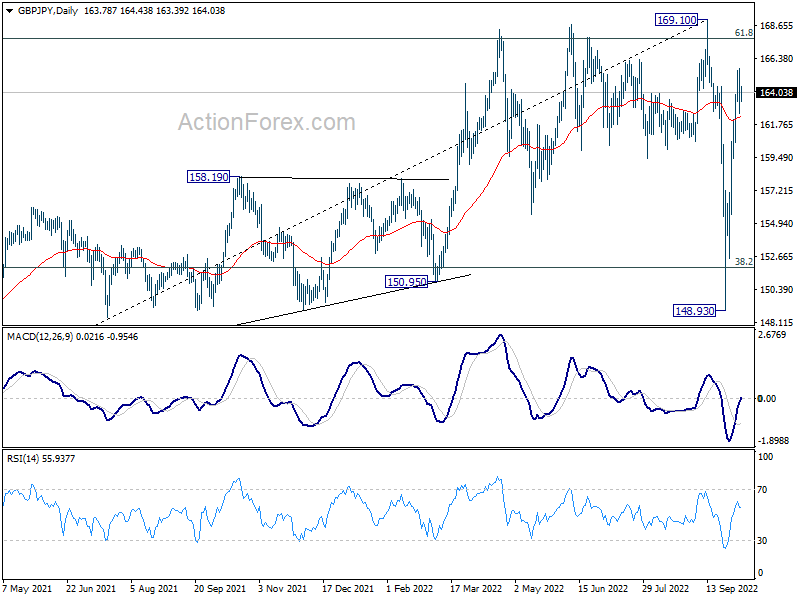
Daily Pivots: (S1) 162.41; (P) 164.06; (R1) 165.51; More...
Intraday bias in GBP/JPY is turned neutral with current retreat. While further rise could be seen, strong resistance might be seen from 169.10 high to limit upside, at least on first attempt. On the downside, below 159.41 minor support will turn bias back to the downside for 148.93 again. However, firm break of 169.10 will confirm resumption of larger up trend.
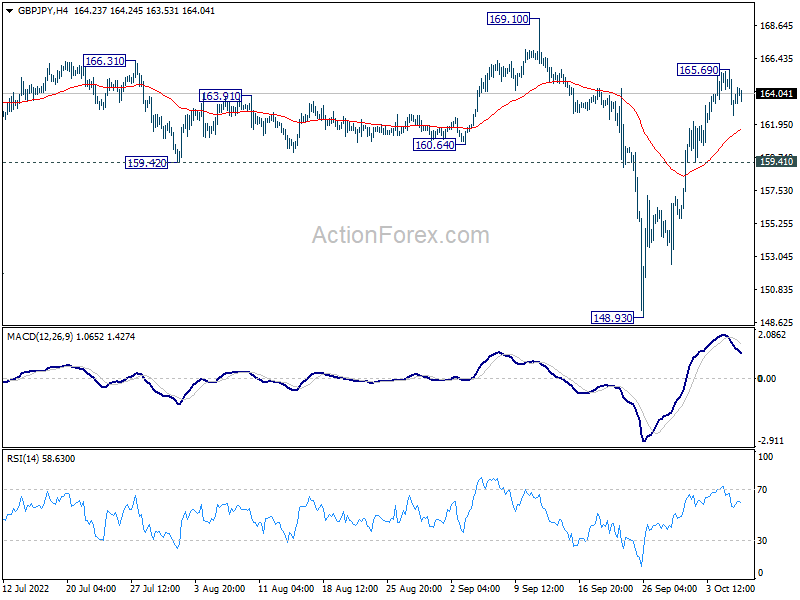
In the bigger picture, strong support from 38.2% retracement of 123.94 to 169.10 at 151.84 suggests that price actions from 169.10 are developing into a corrective pattern only. That is, rise from 123.94 (2020 low) should resume at a later stage. This will now remain the favored case as long as 148.93 support holds.
EUR/JPY Daily Outlook
Daily Pivots: (S1) 142.27; (P) 143.18; (R1) 143.92; More....
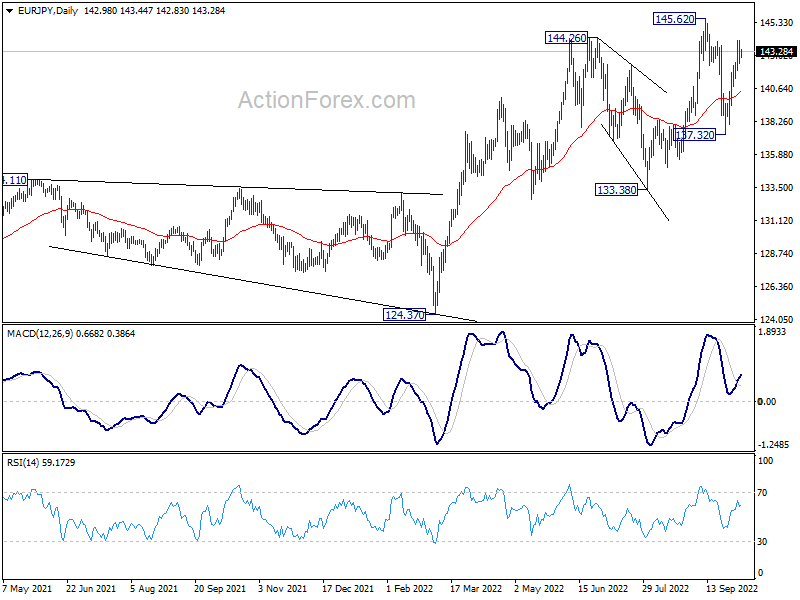
Intraday bias in EUR/JPY is turned neutral with current retreat. On the upside, firm break of 145.62 resistance will resume larger up trend. However, break of 140.77 minor support will turn bias back to the downside, to extend the corrective pattern from 145.62 with another falling leg.
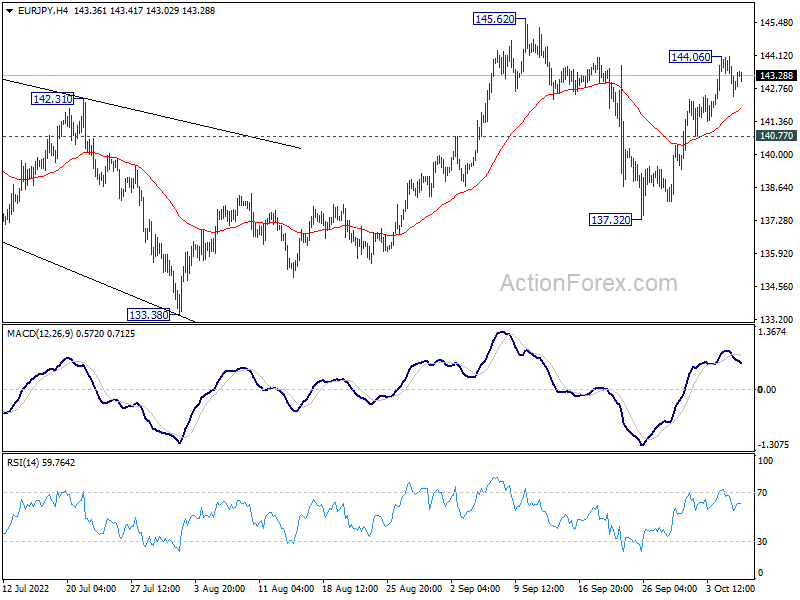
In the bigger picture, as long as 133.38 support holds, the up trend from 114.42 (2020 low) could still extend through 145.62 high. In that case, next target is 149.76 (2015 high). However, sustained break of 133.38 will be a sign of medium term bearish reversal and bring deeper fall to 124.37 support first.