

Sample Category Title
Sunset Market Commentary
Markets
The heavy UK Gilt sell-off triggered a response by the Bank of England. They consider the repricing, especially at the very long end of the curve, as a material risk to UK financial stability especially should dysfunction in the market continue or worsen. In order to restore market functioning and reduce any risks from contagion to credit conditions for UK households and businesses, the BoE will carry out temporary purchases of long-dated UK bonds on whatever scale is necessary. The UK central bank also decided to postpone by one month last week’s decision to actively conduct gilt sale operations (QT) with the aim of reducing the (QE) stock by £80bn annually (sales + redemptions). To put things in context: the BoE launches some kind of operation twist in the midst of its normalization cycle which should heavily invert the UK Gilt curve and highlights difficulties central banks run into following years of lavish policy easing. Putting the pedal to the metal while slamming the breaks. The UK 30-yr yield drops a full percentage point on a daily basis after rising from 3.5% to over 5% since last week’s mini budget by UK Chancellor Kwarteng which caused the troubles. The UK 2- and 10-yr yields drop 31 bps and 44 bps respectively. Sterling temporary lost out on the decision with EUR/GBP spiking from 0.8950 to 0.9050, before returning to 0.90.
ECB talk filled today’s agenda. ECB Lagarde struck again a hawkish tone: “Our primary goal is not to create a recession. Our primary objective is price stability and we have to deliver on that. If we were not delivering, it would hurt the economy far more.” Therefore additional rate hikes are necessary at the next several meetings. ECB Rehn called a 50 bps hike in October the minimum while hawkish ECB Holzmann thinks its too early to accelerate to a 100 bps move. Markets discount the in-between repeat of the 75 bps September rate hike. By the end of the year, ECB rates will hit neutral levels, allowing for the a start of QT (balance sheet roll-off) which should be part of the normalization process as well. EU interest rate markets trade extremely volatile today with hourly swings of 10 bps more rule than exception. If any, we reckon an intraday outperformance of the front end of the curve. We also retain the German Finanzagentur announcement to increase Q4 bond issuance by €10.5bn to €47.5bn. Real rates remain the driver at the (very) long end of the curve. The German 10-yr real yield closes in on positive marks for the first time since 2014. The US 10-yr real rate exceeds 1.5% for the first time since 2011. Both are testament to markets embracing that central banks won’t backdown if economies hit recessions and that restrictive policies will be with us for way longer than originally expected. Weaker stock markets (-0.5%) and a (slightly) stronger dollar remain part of the current market playbook.
News Headlines
The economic tendency index of the Swedish Konjuntur Institutet dropped 6.4 points in September to 90.8. All sectors contributed to the decline. Consumer confidence fell further to a new record low. All questions included in the indicator contributed to the decline, in particular how consumers view the outlook for their personal finances over the coming year. The confidence indicator for the manufacturing industry dropped 5.7 points to 110.0 and has now fallen for four months in a row. The confidence indicator for the retail shows a much weaker situation than normal and this is also the case for the services sector, even as employment plans remain optimistic. Poor domestic demand was illustrated by a further decline in August retail sales (-0.4% M/M and -5.1% Y/Y). Despite a sharp deceleration in activity, the Riksbank last week raised its policy rate by 1.0% to 1.75. The central bank also suggested that the peak policy rate next year could be 2.5%+ rather than 2.0% guided in June. The SEK 2-y swap over the previous days rose further to 3.5%, in line with the repricing in EMU. At EUR/SEK 10.90, the krone continues to trade near the weakest levels since the spring of 2020. On a separate topic, the Swedish national debt office said it proposes to gradually phase out foreign currency exposure of the central government debt. Analysis of the debt office concluded that currency exposure involved a higher risk without lowering the cost over time.
Australian Dollar Extends Losses
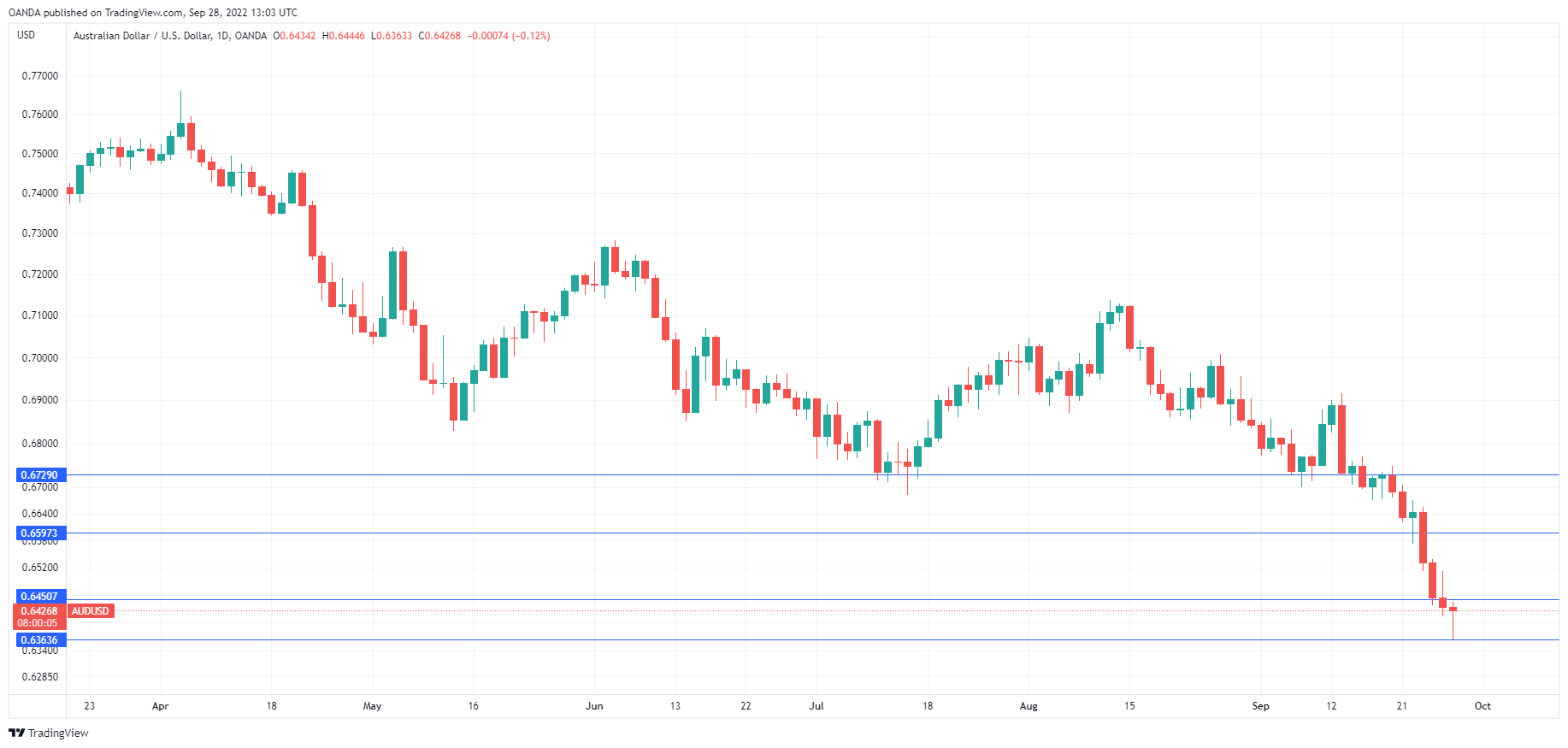
The Australian dollar can’t find its footing and continues to lose ground against the surging US dollar. AUD/USD was down considerably earlier today but has pared most of these losses. In the North American session, AUD/USD is trading at 0.6425, down 0.14%.
Australia retail sales higher than expected
Australia’s retail sales for August rose 0.6% MoM, above the consensus of 0.4%. This was slower than the super-strong gain of 1.3% in July, but household spending appears to be holding well, despite the Reserve Bank’s rate-tightening cycle and high inflation. The RBA hiked rates by 0.50% earlier this month, bringing the cash rate to 2.35%.
The RBA isn’t done with the current tightening cycle, but some Bank officials had signalled that the pace of tightening would slow after a series of large 0.50% rate increases. The strong retail sales release puts such a scenario in doubt since it’s unlikely that inflation has peaked if retail sales remain strong. The central bank has designated inflation as public enemy number one and needs the economy to slow in order to curb inflation, even if that means the price is a recession. The RBA meets on October 4th and may have to deliver another 0.50% and hold off from easing on rates until the data shows that the economy is slowing.
Fed officials have signalled that the current cycle may soon come to a close, but the markets don’t expect any easing until there are clear signs that inflation has peaked. Although CPI dropped in August, inflation was higher than expected, which poured cold water on any hopes of the Fed easing up on policy.
The war in Ukraine has seen some worrying developments, which is weighing on risk sentiment. The Nord Stream pipeline system, although inactive, was hit by explosions that appear to have been deliberate. This follows the sham referendums in Russian-occupied Ukraine, which Moscow expected to formally annex the territories on Friday. This double-whammy of a hawkish Federal Reserve and a loss of risk appetite due to the escalation of the war in Ukraine has pushed the Aussie to its lowest levels since April 2020.
AUD/USD Technical
- AUD/USD has support at 0.6623 and 0.6523
- There is resistance at 0.6769 and 0.6869
USD/JPY Mid-Day Outlook
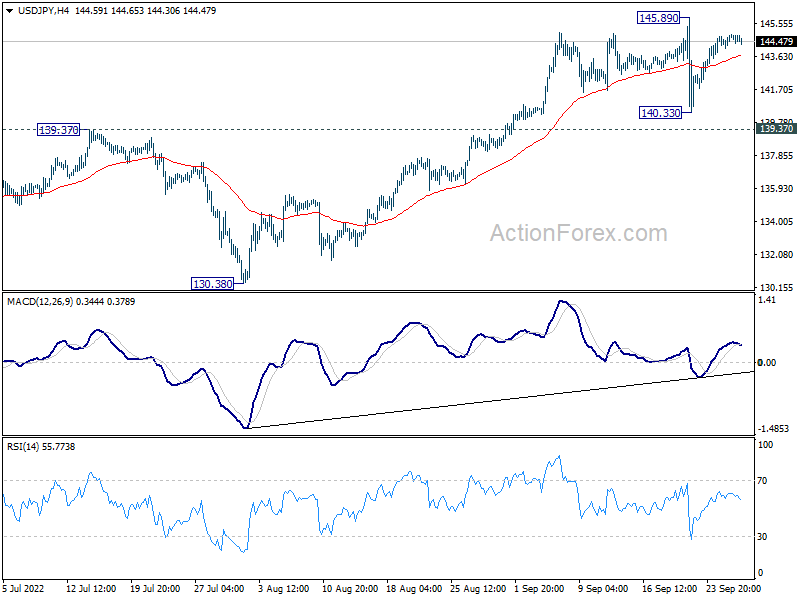
Daily Pivots: (S1) 144.29; (P) 144.60; (R1) 145.14; More...
No change in USD/JPY's outlook as consolidation continues. Intraday bias remains neutral first. Further rally is expected as long as 139.37 resistance turned support holds. Break of 145.89 will target 147.68 long term resistance. On the downside, however, decisive break of 139.37 will confirm short term topping. Deeper decline would be seen back towards 130.38 support.
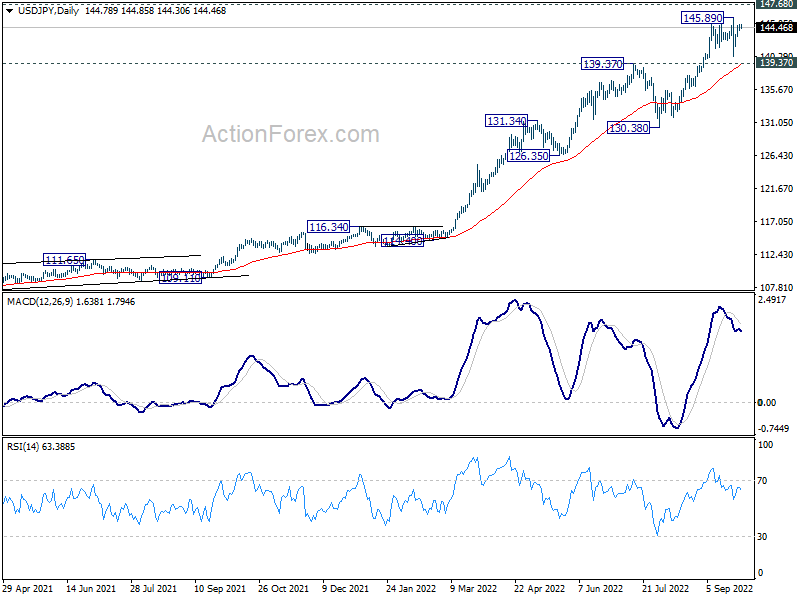
In the bigger picture, up trend from 101.18 is still in progress, as part of the whole up trend from 75.56 (2011 low). Further rise should be seen to 147.68 (1998 high). For now, break of 130.38 support is needed to be the first indication of medium term topping. Otherwise, outlook will stay bullish even in case of deep pull back.
USD/CHF Mid-day Outlook
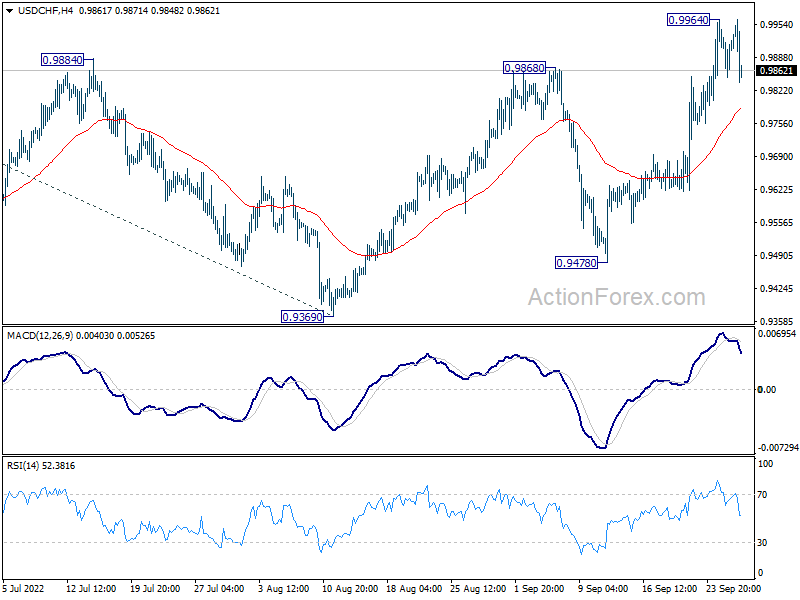
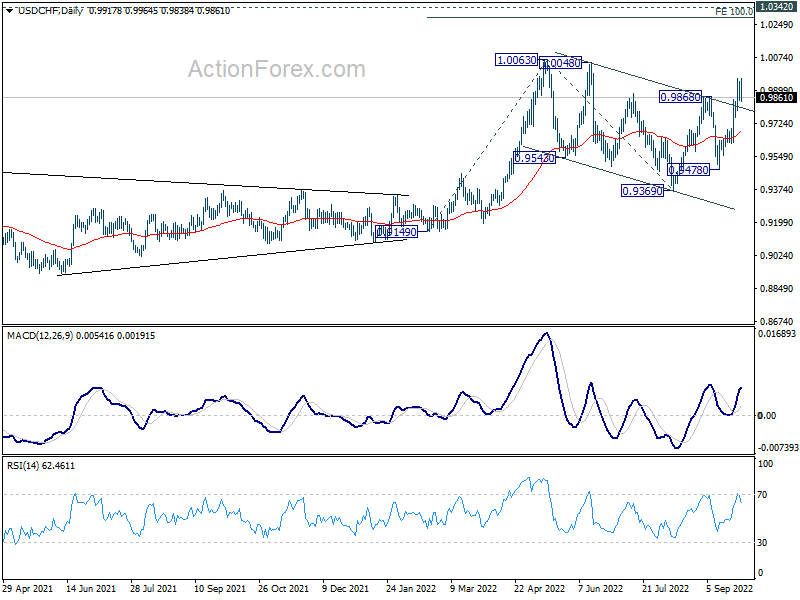
Daily Pivots: (S1) 0.9852; (P) 0.9912; (R1) 0.9975; More
USD/CHF is staying in consolidation from 0.9964 and intraday bias stays neutral. In case of another retreat, downside should be contained by 4 hour 55 EMA (now at 0.9783). Break of 0.9964 will target 1.0063 high. Decisive break there will confirm resumption of larger up trend.
In the bigger picture, current development suggests that up trend from 0.8756 (2021 low) is still in progress. Sustained break of 1.0063 will target 100% projection of 0.9149 to 1.0063 from 0.9369 at 1.0283, and then 1.0342 (2016 high). For now, this will remain the favored case as long as 0.9369 support holds, even in case of deep pull back.
EUR/USD Mid-Day Outlook
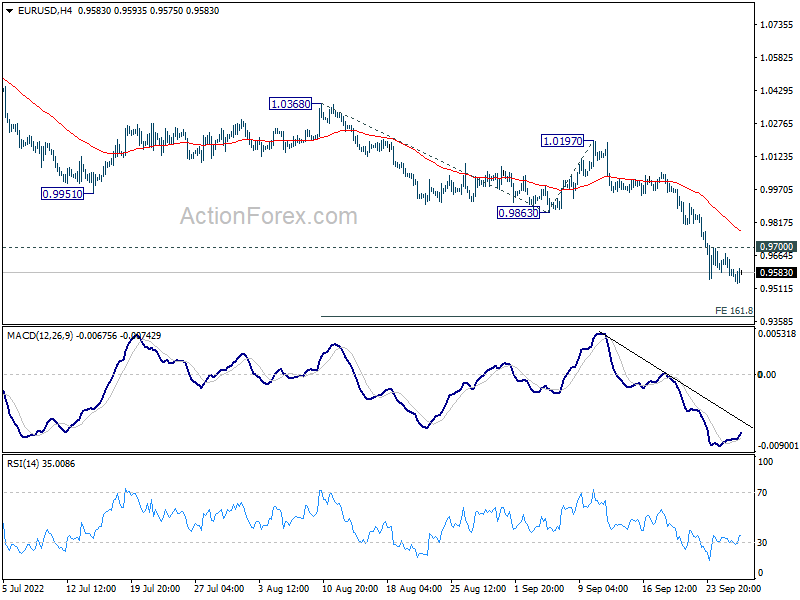
Daily Pivots: (S1) 0.9551; (P) 0.9610; (R1) 0.9652; More...
Intraday bias in EUR/USD stays mildly on the downside despite loss of downside momentum. Current down trend should target 161.8% projection of 1.0368 to 0.9863 from 1.0197 at 0.9380 next. On the upside, above 0.9700 minor resistance will turn intraday bias neutral again first, and bring consolidations again, before staging another decline.
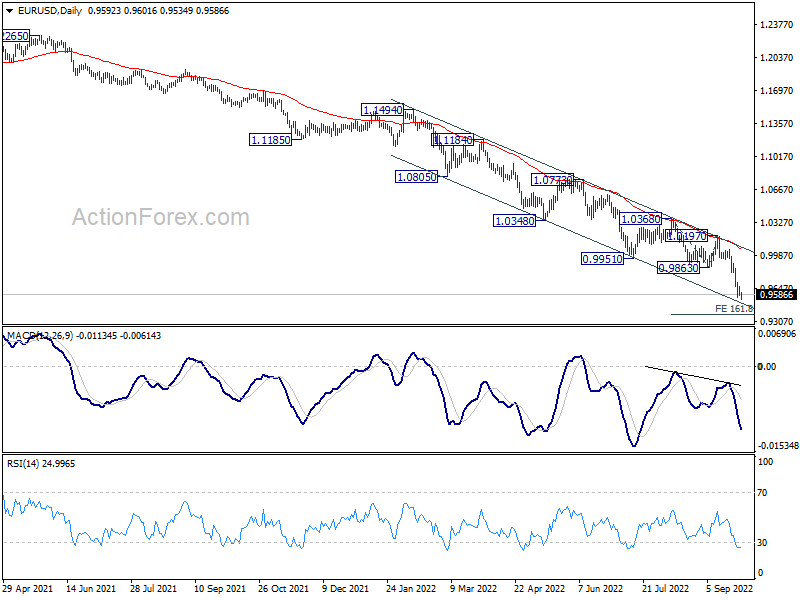
In the bigger picture, down trend from 1.6039 (2008 high) is still in progress. Next target is 100% projection of 1.3993 to 1.0339 from 1.2348 at 0.8694. In any case, break of 1.0197 resistance is needed to be the first sign of medium term bottoming. Otherwise, outlook will stay bearish even with strong rebound.
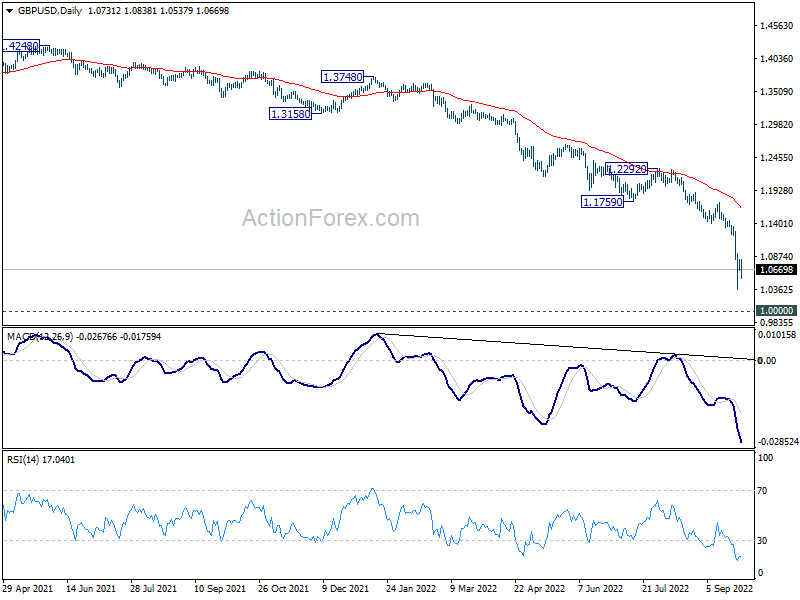
GBP/USD Mid-Day Outlook
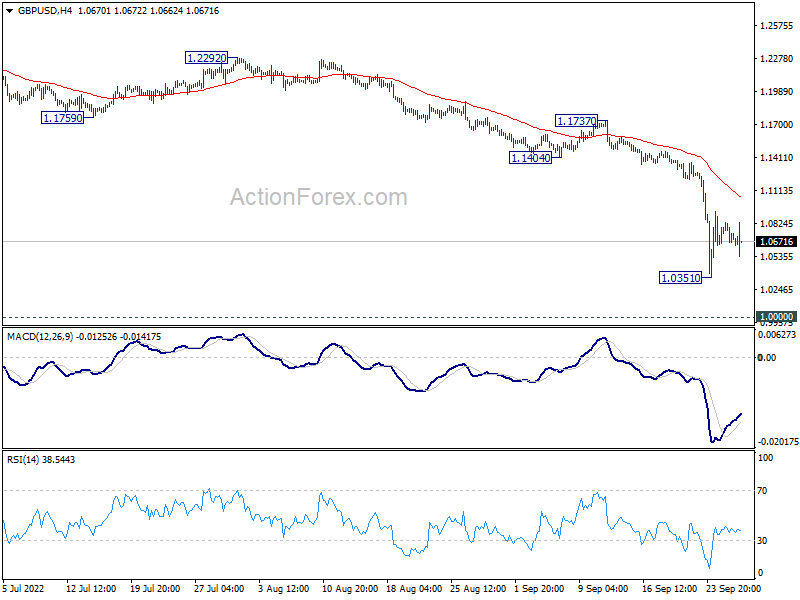
Daily Pivots: (S1) 1.0645; (P) 1.0742; (R1) 1.0829; More...
GBP/USD is staying in consolidation above 1.0351 temporary low and intraday bias remains neutral. While stronger recovery cannot be ruled out, upside should be limited by 4 hour 55 EMA (now at 1.1051). On the downside, break of 1.0351 will resume larger down trend towards parity next.
In the bigger picture, fall from 1.4248 (2018 high) is resuming long term down trend from 2.1161 (2007 high). Next target is 100% projection of 2.1161 to 1.3503 from 1.7190 at 0.9532. There is no scope of a medium term rebound as long as 1.1759 support turned resistance holds.
BoE Intervention Couldn’t Pop Sterling Up
In a surprised move, BoE announced to intervene in the gilt markets. While 10-year gilt yield drops notably on the news, the recovery in FTSE is just mild. Sterling also just fluctuates and it's trading as the weakest one for the day. On the other hand, Swiss Franc buyers jump in on worsening energy crisis in Europe, while Yen also firms up slightly. Dollar, Euro and Aussie are on the softer side.
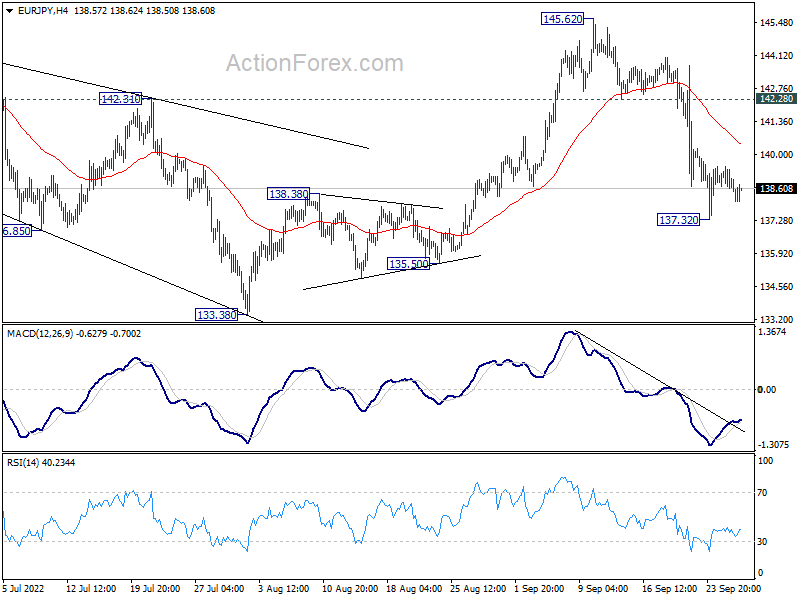
Technically, as US 10-year yield appears to be rejected by 4% handle for now, there is prospect of further rebound in Yen. So far, EUR/JPY's recovery from 137.32 has bee rather weak, and deeper decline is in favor. Break of 137.32 will resume the fall from 145.62 towards 133.38 key support. That, if happens, would also be followed by break of 148.93 temporary low in GBP/JPY.
In Europe, at the time of writing, FTSE is down -0.63%. DAX is down -0.69%. CAC is down -0.81%. Germany 10-year yield is down -0.018 at 2.212. UK 10-year yield is down -0.377 at 4.131. Earlier in Asia, Nikkei dropped -1.50%. Hong Kong HSI dropped -3.41%. China Shanghai SSE dropped -1.58%. Singapore Strait Times dropped -1.55%. Japan 10-year JGB yield dropped -0.0028 to 0.252.
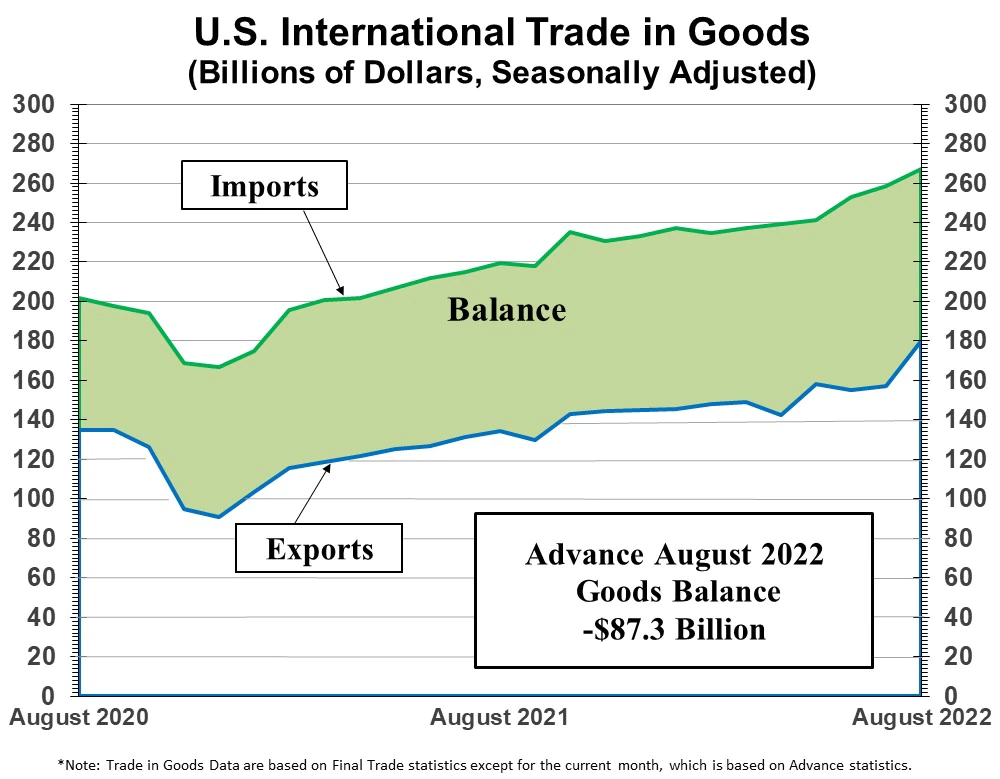
US goods exports dropped -0.9% mom in Aug, imports dropped -1.7% mom
US goods exports dropped -0.9% mom to USD 179.8B in August. Goods imports dropped -1.7% mom to USD 267.1B. Trade deficit came in at US D-87.3B, comparing with July's USD -90.2B.
Wholesale inventories rose 1.3% mom to USD 913.1B. Retail sales rose 1.4% mom to USD 741B.0B.
BoE announces gilt operation to restore orderly market conditions
BoE announced today to carry out temporary purchases of long-dated UK government bonds, to "restore orderly market conditions". It warned that the significant repricing of UK and global financial assets "has become more significant in the past day", particularly affecting long-dated government debt. Continuing or worsening dysfunction would be a "material risk" to financial stability.
The purchases will be carried out on "whatever scale is necessary" to effect this outcome. However, they will be "strictly time limited" with auctions taking place from today until October 14.
BoE also reiterated that a full assessment of the government's mini budget will be done at its "next scheduled meeting". BoE "will not hesitate to change interest rates by as much as needed to return inflation to the 2% target sustainably in the medium term, in line with its remit."
UK BRC shop price reported another record increase
UK BRC shop price index accelerated from 5.1% yoy to 5.7% yoy in August, hitting another record high since the index began in 2005. Food inflation surged from 9.3% yoy to 10.6% yoy. Non-food inflation also rose from 2.9% yoy to 3.3% yoy.
Helen Dickinson, Chief Executive, British Retail Consortium: "Retailers are battling huge cost pressures from the weak pound, rising energy bills and global commodity prices, high transport costs, a tight labour market and the cumulative burden of government-imposed costs."
Mike Watkins, Head of Retailer and Business Insight, NielsenIQ: "NielsenIQ data shows that 76% of consumers are saying they expect to be moderately or severely affected by the cost-of-living crisis over the next 3 months, up from 57% in the summer."
ECB Holzmann: 50 minimum, 75 a good guess, 100 too fast, for Oct meeting
ECB Governing Council member Robert Holzmann said "50 may be the minimum" rate hike at next meeting in October. He added, "could it be 100? It could but I don't see the necessity now to go as fast. I think 75 would be a good guess."
Holzmann also noted that ECB is still "some way" from neutral interest rate. He said lifting deposit rate from current 0.75% to 2.50% would definitely take it beyond neutral.
Regarding quantitative tightening, he said it's part of the normalization process, and will be discussed at a non-monetary-policy meeting next week in Cyprus.
ECB Lagarde: First destination is neutral rate
ECB President Christine Lagarde said in a conference today, "we have to return inflation to 2% in the medium term, and we will do what we have to do, which is to continue hiking interest rates in the next several meetings."
"Our primary goal is not to create a recession. Our primary objective is price stability and we have to deliver on that. If we were not delivering, it would hurt the economy far more," she said, adding that the "first destination" of rate hikes will be to reach neutral rate.
Separately, Governing Council member Peter Kazimir indicated that ECB may need to hike again by 75bps next month as inflation remains unacceptably high.
Germany Gfk Consumer Sentiment dropped to -42.5, new record low
Germany Gfk Consumer Sentiment for October dropped from -36.5 to -42.5, below expectation of -38.8. That's also a new record low. In September, economic expectations dropped from -47.6 to -21.9, lowest since 2009. Income expectations dropped from -45.3 to -67.7, a record low since 1991. Propensity to buy dropped from -15.7 to -19.5, lowest since 2008.
"The current very high inflation rates of almost eight percent are leading to large real income losses among consumers and thus to significantly reduced purchasing power," explains Rolf Bürkl, GfK consumer expert.
"Many households are currently forced to spend significantly more money on energy or to set money aside for significantly higher heating bills. Accordingly, they need to cut back on other expenses, such as new purchases. This is sending consumer sentiment plummeting to a new record low."
Australia retail sales rose 0.6% mom in Aug
Australia retail sales turnover rose 0.6% mom to AUD 34.88B in August, slightly above expectation of 0.5% mom. That's the eighth consecutive monthly increase.
Ben Dorber, head of retail statistics at the ABS, said: "This month's rise was driven by the combined increase in food related industries, with cafes, restaurants and takeaway food services up 1.3 per cent and food retailing up 1.1 per cent."
"While households continue to spend, non-food industry results were mixed and only contributed a small amount to the total rise in retail turnover."
GBP/USD Mid-Day Outlook
Daily Pivots: (S1) 1.0645; (P) 1.0742; (R1) 1.0829; More...
GBP/USD is staying in consolidation above 1.0351 temporary low and intraday bias remains neutral. While stronger recovery cannot be ruled out, upside should be limited by 4 hour 55 EMA (now at 1.1051). On the downside, break of 1.0351 will resume larger down trend towards parity next.
In the bigger picture, fall from 1.4248 (2018 high) is resuming long term down trend from 2.1161 (2007 high). Next target is 100% projection of 2.1161 to 1.3503 from 1.7190 at 0.9532. There is no scope of a medium term rebound as long as 1.1759 support turned resistance holds.
Economic Indicators Update
| GMT | Ccy | Events | Actual | Forecast | Previous | Revised |
|---|---|---|---|---|---|---|
| 23:01 | GBP | BRC Shop Price Index Y/Y Sep | 5.70% | 5.10% | ||
| 23:50 | JPY | BoJ Minutes | ||||
| 01:30 | AUD | Retail Sales M/M Aug | 0.60% | 0.50% | 1.30% | |
| 06:00 | EUR | Germany Gfk Consumer Confidence Oct | -42.5 | -38.8 | -36.5 | |
| 08:00 | CHF | Credit Suisse Economic Expectations Sep | -69.2 | -56.3 | ||
| 12:30 | USD | Goods Trade Balance (USD) Aug P | -87.3B | -88.0B | -90.2B | |
| 12:30 | USD | Wholesale Inventories Aug P | 1.30% | 0.40% | 0.60% | |
| 14:00 | USD | Pending Home Sales M/M Aug | -0.70% | -1.00% | ||
| 14:30 | USD | Crude Oil Inventories | 1.1M |
US goods exports dropped -0.9% mom in Aug, imports dropped -1.7% mom
US goods exports dropped -0.9% mom to USD 179.8B in August. Goods imports dropped -1.7% mom to USD 267.1B. Trade deficit came in at US D-87.3B, comparing with July's USD -90.2B.
Wholesale inventories rose 1.3% mom to USD 913.1B. Retail sales rose 1.4% mom to USD 741B.0B.
EUR/USD Falls to New 20-year Low
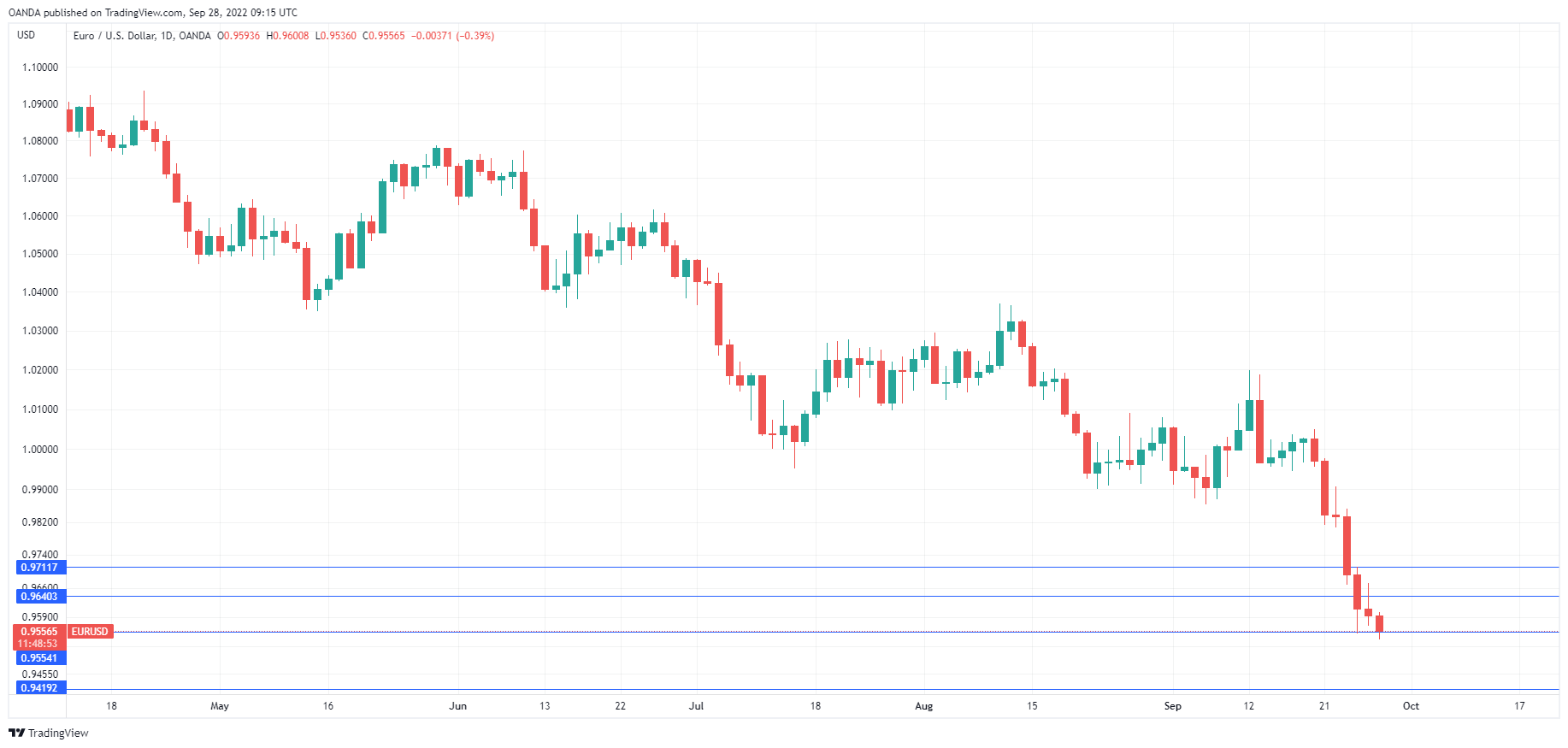
The euro is in negative territory today, after posting six straight days of losses. EUR/USD is trading at 0.9553 in Europe, down 0.41%.
Referendums, Nord Stream explosions weigh on euro
September can’t end fast enough for the euro, which has declined a massive 4.8% against the dollar. Earlier today, EUR/USD fell to 0.9536, its lowest level since June 2002. With the war in Ukraine escalating and Nord Stream reporting that its pipeline was deliberately damaged, it’s hard to be optimistic about the euro’s outlook.
The sham referendums in Russian-occupied Ukraine have ended and predictably, the vote to join Russia was close to 100%. Moscow is expected to declare on Friday that the territories are being annexed to the Russian Federation, sparking fears that Russia could resort to nuclear weapons to defend what it claims is Russian territory.
There was a further escalation in the Ukraine war last week, as explosions at the Nord Stream 1 and 2 pipelines are suspected to have been sabotaged. Nord Stream 2 has been shelved and Nord Stream 1 has been shut down for weeks, and any faint hopes that Russia might renew gas exports through Nord Stream have been dashed. European natural gas prices have jumped in response to the news.
The US dollar continues to rally, and 10-year Treasury yields pushed above 4.00% earlier today, for the first time since 2008. The markets are showing a healthy respect for Fed hawkishness, even after inflation weakened in the past two inflation reports. There is some optimism that the current rate-tightening cycle is reaching its end, with Fed member Evans stating that it will be appropriate to slow the pace of tightening at some point. For now, the US dollar has momentum, driven by an aggressive Fed and weak risk appetite.
EUR/USD Technical
- EUR/USD is testing support at 0.9554. Next, there is support at 0.9419
- There is resistance at 0.9640 and 0.9711
ECB Holzmann: 50 minimum, 75 a good guess, 100 too fast, for Oct meeting
ECB Governing Council member Robert Holzmann said "50 may be the minimum" rate hike at next meeting in October. He added, "could it be 100? It could but I don't see the necessity now to go as fast. I think 75 would be a good guess."
Holzmann also noted that ECB is still "some way" from neutral interest rate. He said lifting deposit rate from current 0.75% to 2.50% would definitely take it beyond neutral.
Regarding quantitative tightening, he said it's part of the normalization process, and will be discussed at a non-monetary-policy meeting next week in Cyprus.