Sample Category Title
What Now for Sterling after Investors Lose Confidence in the UK Economy?
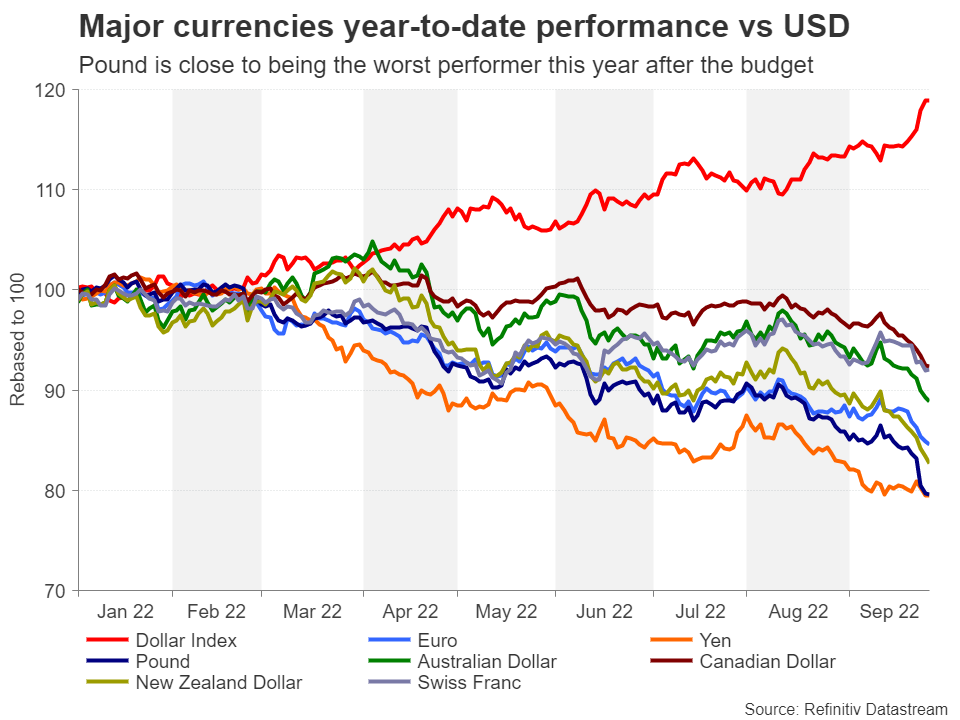
The pound crashed to an all-time low versus the US dollar this week as investors fled the UK after losing confidence in the new government’s economic vision. Having already been the second worst performing currency this year, sterling’s year-to-day losses now stand at 20%. But as the selloff shows some signs of easing and the currency stabilizing in FX markets, did the budget mark a permanent downgrade of UK assets, or was this a natural overreaction given the economic uncertainties and Britain’s twin-deficit problem?
Betting on trickle-down economics
It is not often that tax cuts spark such a massive risk-off episode as investors generally cheer growth-boosting measures by governments. So why did markets react so badly to Chancellor Kwasi Kwarteng’s mini budget, or ‘fiscal event’ as he dubbed it, which turned out to be a full budget in all but name? After all, there is no disputing that the UK economy is in serious need of a kickstart and in theory, Kwarteng’s historically large tax cuts should accomplish that.
The reality is that Britain’s current economic woes are not quite so simple that big tax cuts would solve everything. The government is betting on trickle-down economics – something championed by Margaret Thatcher in the 1980s – to create wealth from the top, which would then ‘trickle down’ to lower income groups.
A budget oblivious to high inflation
Back then, the policy proved to be the right remedy and was credited for triggering an economic boom. But investors have overwhelmingly decided that Liz Truss and her chancellor have vastly misjudged the present economic environment. The biggest flaw in the government’s thinking is that it ignores the single most pressing issue facing the country right now – high inflation.
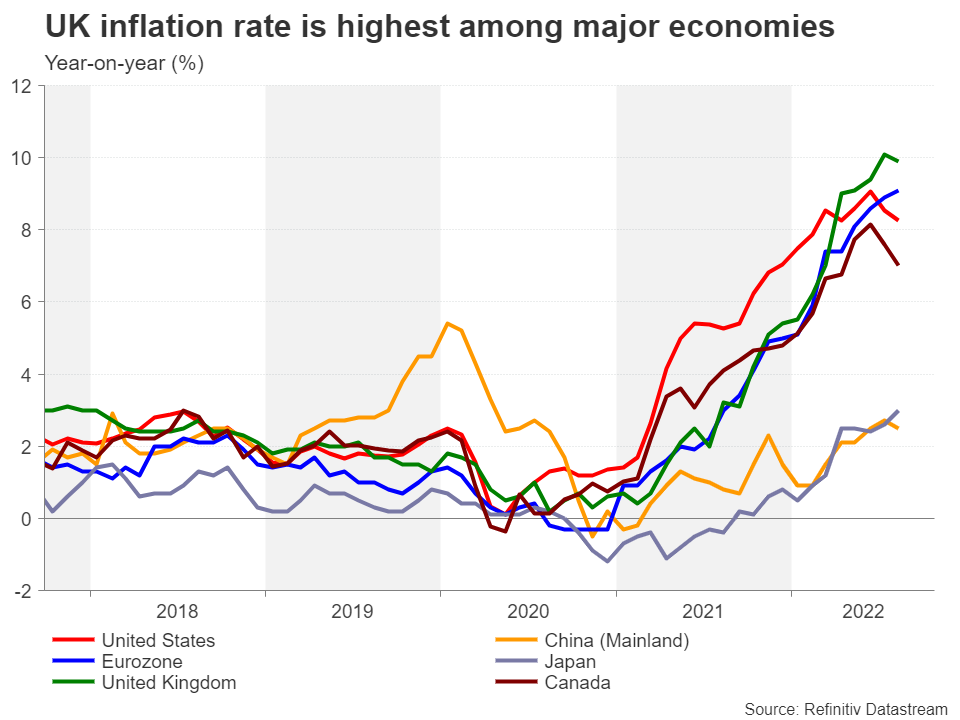
It is universally accepted that spiralling prices are undesirable for achieving economic stability and the Bank of England has a legal obligation to keep inflation around 2%. Yet, slashing taxes at a time when inflation is so hot only serves to fuel price pressures even further as lower taxes tend to increase household incomes, boosting consumption.
Bad timing
The Bank of England would then be forced to raise interest rates even more aggressively than it is doing so right now to meet its inflation target. This not only increases the odds of the economy falling off a cliff, but it also raises the cost for the government to borrow to fund the gap between spending and tax revenue.
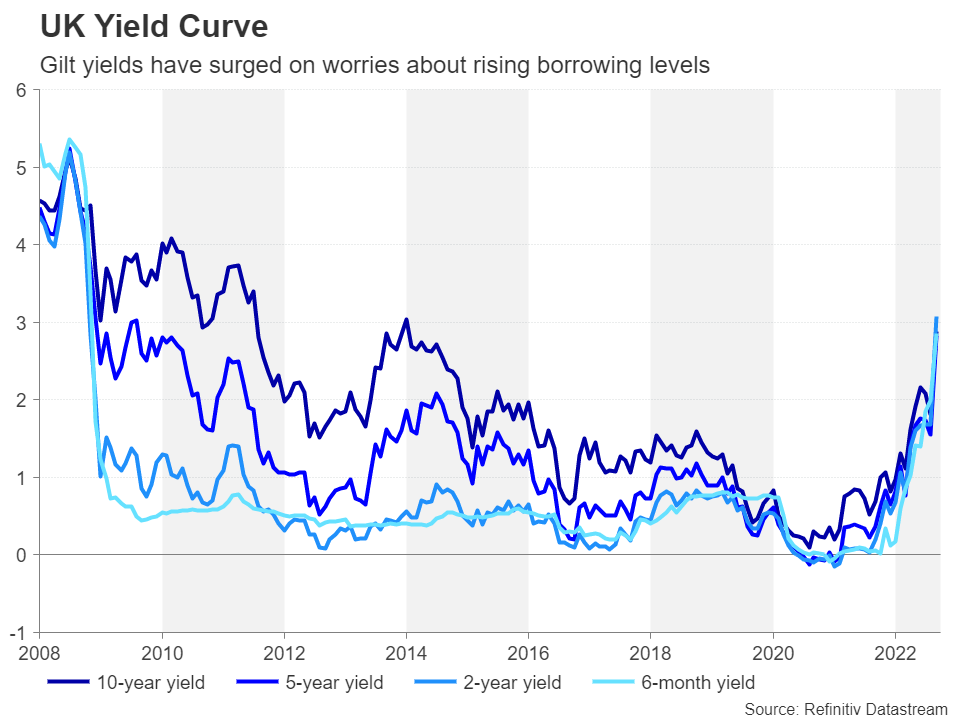
It seems that the Truss team has based its economic calculations on the bygone post-financial crisis era when inflation was non-existent, interest rates were at rock bottom and central banks were printing money, all of which pinned bond yields near zero despite heavy borrowing by governments. But that is no longer the case as UK government bond, or gilt, yields have skyrocketed to pre-financial crisis levels and the Bank of England is now engaged in quantitative tightening.
Moreover, if there ever was any possibility of the pandemic-induced inflation being transitory, those hopes were dashed when the energy crisis unfolded after Russia invaded Ukraine. Thus, high inflation is here to stay, at least through to 2023, meaning monetary policy is unlikely to be loosened before then.
A debt crisis in the making?
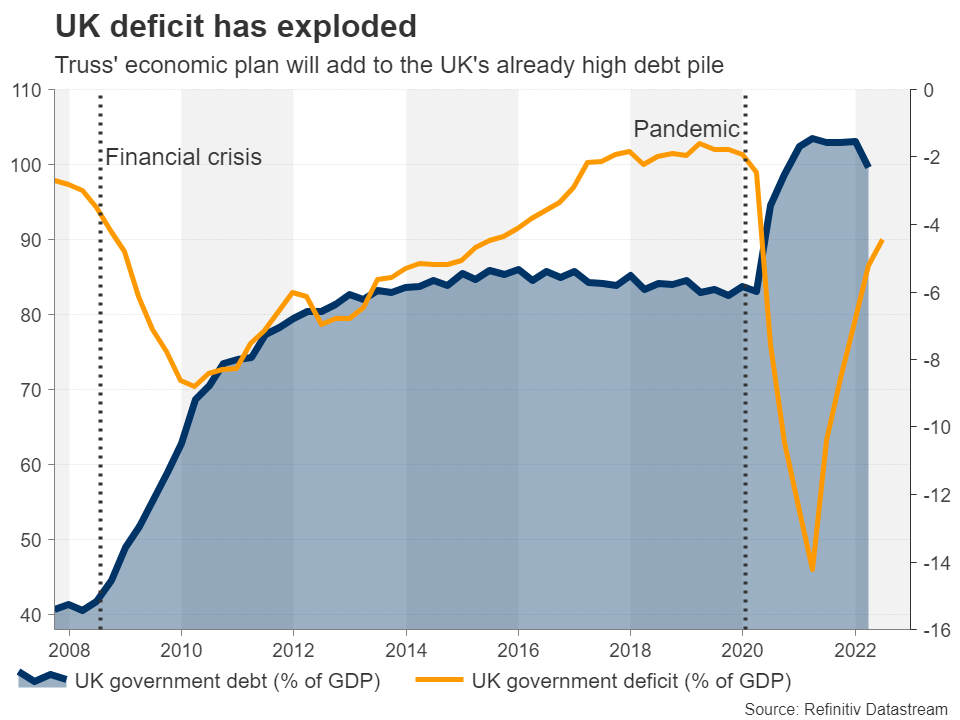
Investors fear that by borrowing excessively during a period of rising lending costs, the government will become overburdened with its interest payments, risking some kind of a debt crisis in the future. Exacerbating the issue about the sustainability of Britain’s soaring debt level is the fact that the government already had to borrow a lot during the pandemic and most recently, announced an energy relief package worth up to £150 billion to help households with high energy bills.
Economists would argue that the tax cuts could have been saved for a later date as the energy package alone, which is amongst the most generous in Europe, is expected to go a long way in easing the pain for consumers as well as keeping electricity and gas prices capped. Within this context, many would conclude that Truss’ and Kwarteng’s economic plan is nothing short of reckless and motivated purely by securing a victory at the next general election.
Voters are concerned about inequality
But even voters don’t seem too impressed, as the opposition Labour party has widened its lead over the Conservatives after the budget. In yet another miscalculation, the government couldn’t have picked a worse time during the cost-of-living crisis to introduce radical tax reforms that set to benefit the richest the most. Of course, it’s too soon to assume that the gamble won’t pay off and come the next election, as long as low- and middle-income workers are earning more, they might not care if the gap with the wealthiest has widened or not.
The problem is, can the government and Bank of England avert economic disaster before then? Kwarteng tried to calm market nerves by confirming that he will outline a medium-term fiscal plan on November 23 on how to lower borrowing as a share of GDP. But investors aren’t holding their breath.
How will the Bank of England respond?
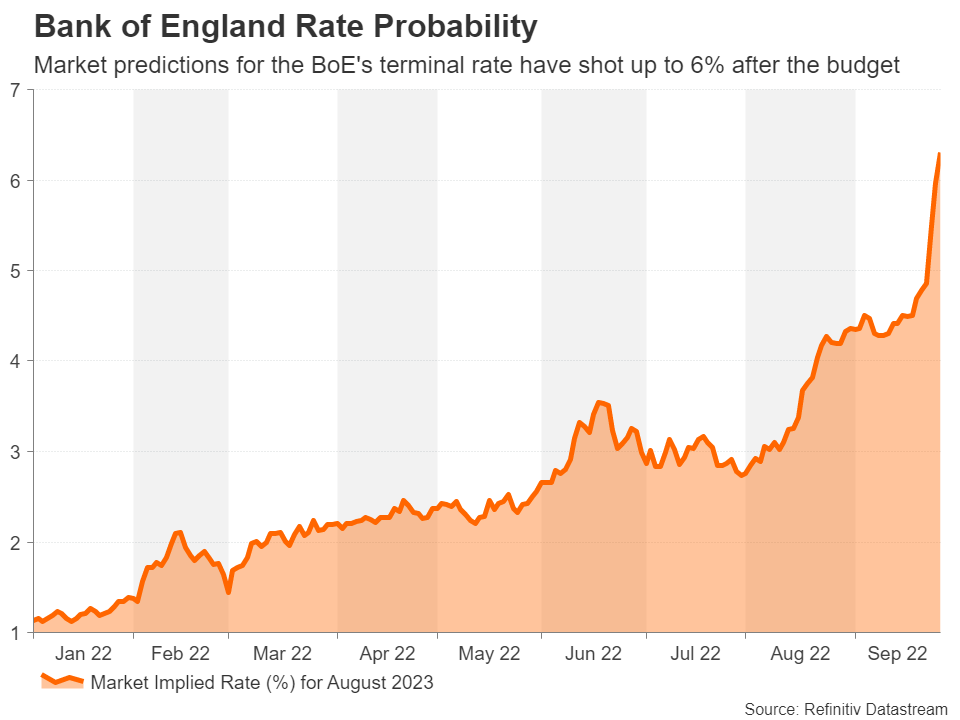
On its part, the Bank of England has hinted that it will respond fully to the market fallout, but not before its next meeting on November 3. In the meantime, it has decided to make temporary purchases of long-dated gilts in a bid to prevent yields from surging any further. Markets have priced in a 125-basis point rate hike for November, with about one in three probability of a 150-bps increase. What is even more significant, though, is how high markets have pushed up the projected terminal rate.
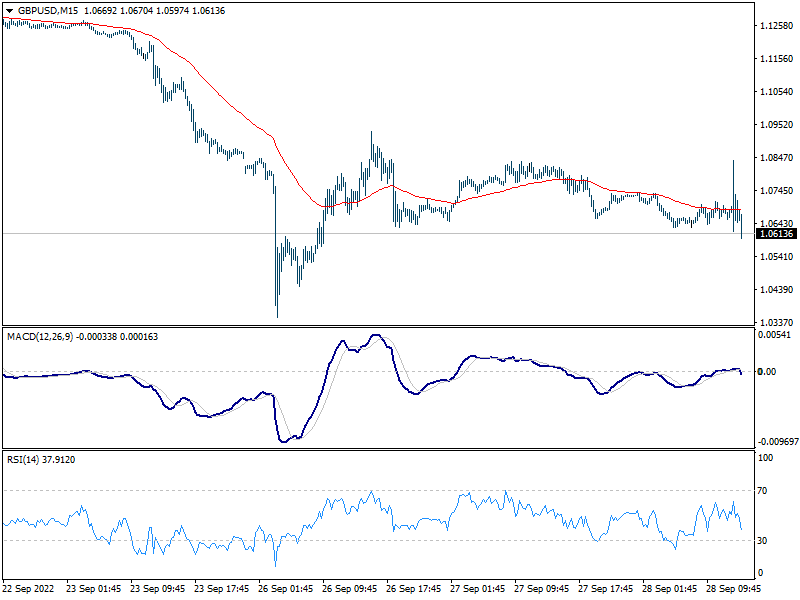
Prior to the budget, investors saw the Bank Rate peaking around 4.75%. It has since shot up to slightly more than 6.0% by August 2023. However, this has done little in defending the pound, which on Monday plummeted to an all-time low of $1.0382. This trough is just above the 361.8% Fibonacci extension of the July-August rebound at $1.0354, suggesting it may take some effort to pierce below this barrier, after which, the parity level of $1.00 would come into scope for traders.
However, if the market mood improves further in the coming days, the current recovery could extend until the 200% Fibonacci of $1.1221, otherwise, it may stall around the $1.07 area.
Pound’s fate depends on UK restoring its credibility
A jumbo-sized rate hike of more than 100-bps in November and a signal that more are on the way should help cable claw back its latest losses, but ultimately, it will be up to the government to restore the UK’s credibility in financial markets. Come November 23, Kwarteng will have to do a lot more than simply talk up the economy and hope that his ambitious 2.5% growth target is both feasible and sufficient enough to reduce debt as a ratio of GDP over the next few years.
Investors, though, will be wishing that the government goes back to the drawing board and returns with fresh ideas on raising additional revenue and finding new sources of savings. At the very least, markets will be on the lookout for some sort of a contingency plan. However, with Truss hell-bent on delivering the pledges she made in her leadership campaign, a U-turn doesn’t seem very likely.
There’s a strong chance therefore that the pound stays mired in uncertainty until the winter cloud has lifted over Europe. By which point, if the energy crisis hasn’t deepened and Truss’ policies begin to have some positive effect, there would be grounds for a meaningful rebound. But before then, BoE rate hikes will at best put a halt to the pound’s slide rather than lift it, while the UK’s large twin fiscal and current account deficits will ensure that it remains at the mercy of global risk sentiment.
BoE announces gilt operation to restore orderly market conditions
BoE announced today to carry out temporary purchases of long-dated UK government bonds, to "restore orderly market conditions". It warned that the significant repricing of UK and global financial assets "has become more significant in the past day", particularly affecting long-dated government debt. Continuing or worsening dysfunction would be a "material risk" to financial stability.
The purchases will be carried out on "whatever scale is necessary" to effect this outcome. However, they will be "strictly time limited" with auctions taking place from today until October 14.
BoE also reiterated that a full assessment of the government's mini budget will be done at its "next scheduled meeting". BoE "will not hesitate to change interest rates by as much as needed to return inflation to the 2% target sustainably in the medium term, in line with its remit."
GBP/USD was lifted briefly after the announcement, and turned south quickly.
EUR/USD Outlook: Bears Likely to Travel Further as Conditions Continue to Worsen
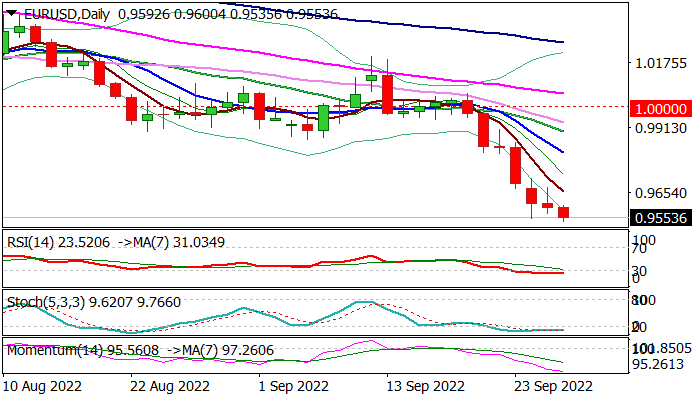
The Euro hit new marginally lower 20-year low in early Wednesday, as risk assets fell in Asia, lifting the dollar to new high.
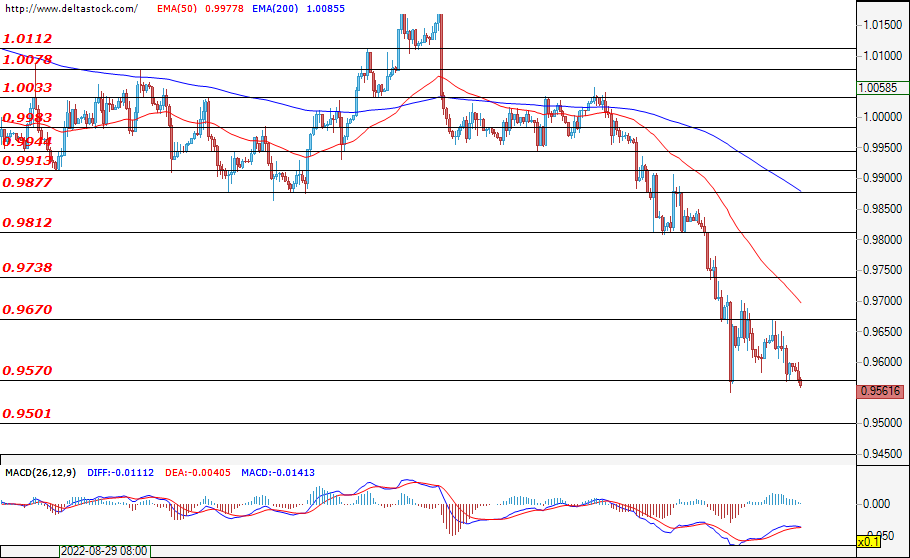
Technical studies show indicators on daily chart in full bearish setup, with oversold conditions likely to slow bears for consolidative/corrective actions, before accelerating towards targets at 0.9301 /0.9000 (June 2002 low/psychological).
Falling 5DMA offers initial resistance at 0.9655, ahead of more significant Fibo barrier at 0.9691 (23.6% of 1.0197/0.9535), violation of which would signal correction and expose pivotal barriers at 0.9788/96 (Fibo 38.2%/falling daily Tenkan-sen).
Fundamentals are also not working in favor of Euro, as inflation in the EU is expected to rise further in September (Sep f/c 9.7% vs Aug 9.1%) and probably reach a double-digit levels in the near future, while the latest polls showed that the Federal Reserve will likely raise its key interest rate much higher than recently predicted, that would additionally boost dollar and further darken Euro’s outlook.
Res: 0.9600; 0.9655; 0.9691; 0.9788.
Sup: 0.9535; 0.9402; 0.9325; 0.9301.
NZDUSD Plummets to Fresh 30-Month Lows
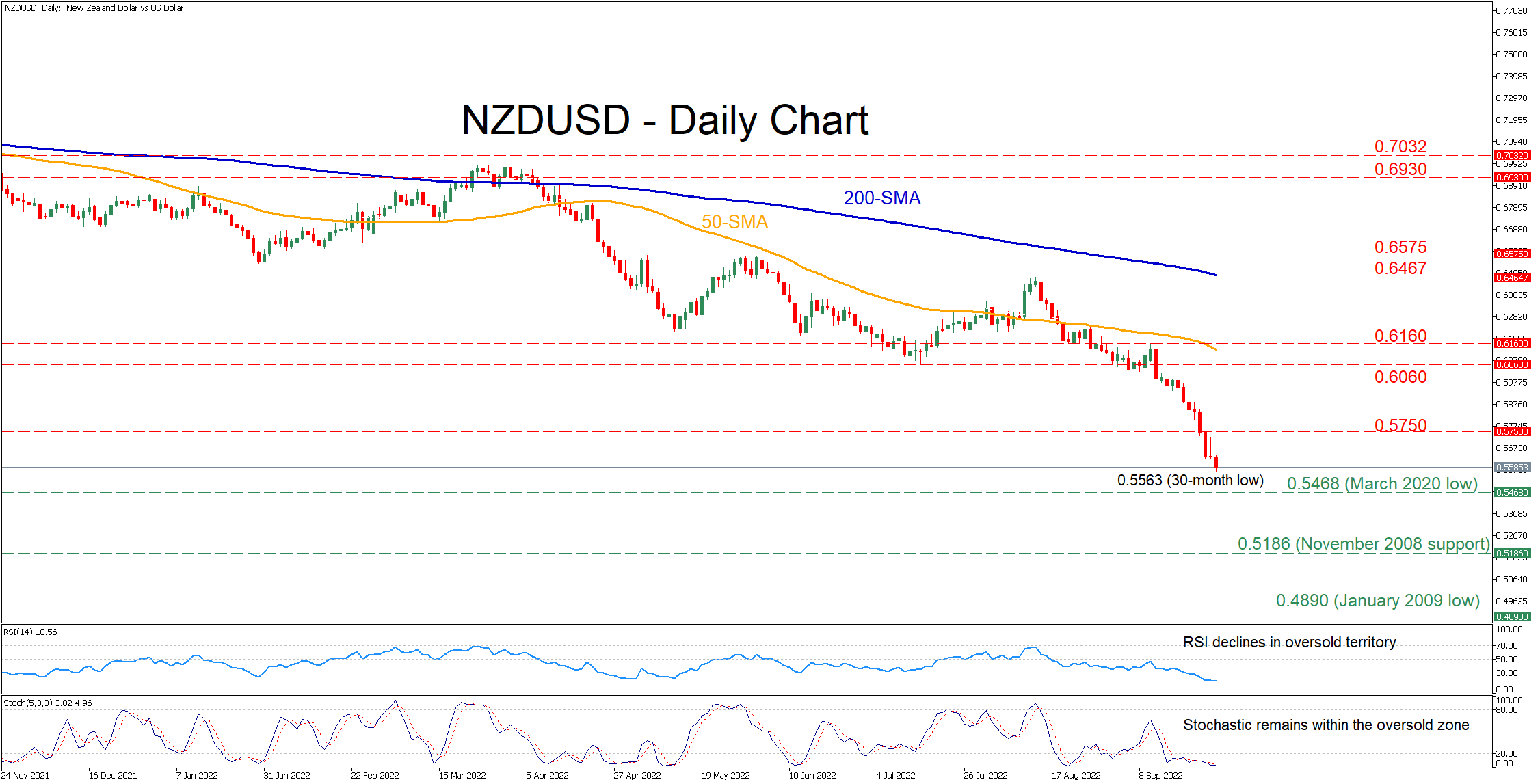
NZDUSD has been trending lower since March, generating a profound structure of lower highs and lower lows. Moreover, in the past few sessions, the technical picture has deteriorated even further, with the price recording a fresh 30-month low of 0.5563.
The momentum indicators are currently deep within their bearish areas, which could also signal that a rebound is imminent. The RSI is descending in the 30-oversold zone, while the stochastic oscillator has eased within its 20-oversold territory.
Should selling pressures intensify, the price could encounter support at the March 2020 bottom of 0.5468. If that floor collapses, the pair will dive towards levels not seen in the past 13 years, where the November 2008 support of 0.5186 could provide downside protection. Failing to halt there, the January 2009 low of 0.4890 may halt any further drops.
To the upside, bullish actions could send the price to test 0.5750. Crossing above this region, the pair might ascend towards the July low of 0.6060 or higher to challenge the recent resistance zone of 0.6160. Piercing through the latter, the August high of 0.6457 could prove to be a tough obstacle for the pair to overcome.
Overall, even if NZDUSD has come under tremendous downside pressure, the momentum indicators currently suggest that the market has reached oversold levels. Therefore, it wouldn’t be a surprise if the pair experienced an upside correction soon.
ECB Lagarde: First destination is neutral rate
ECB President Christine Lagarde said in a conference today, "we have to return inflation to 2% in the medium term, and we will do what we have to do, which is to continue hiking interest rates in the next several meetings."
"Our primary goal is not to create a recession. Our primary objective is price stability and we have to deliver on that. If we were not delivering, it would hurt the economy far more," she said, adding that the "first destination" of rate hikes will be to reach neutral rate.
Separately, Governing Council member Peter Kazimir indicated that ECB may need to hike again by 75bps next month as inflation remains unacceptably high.
USDJPY on a Mission to Claim 145.00; Bias Cautiously Bullish
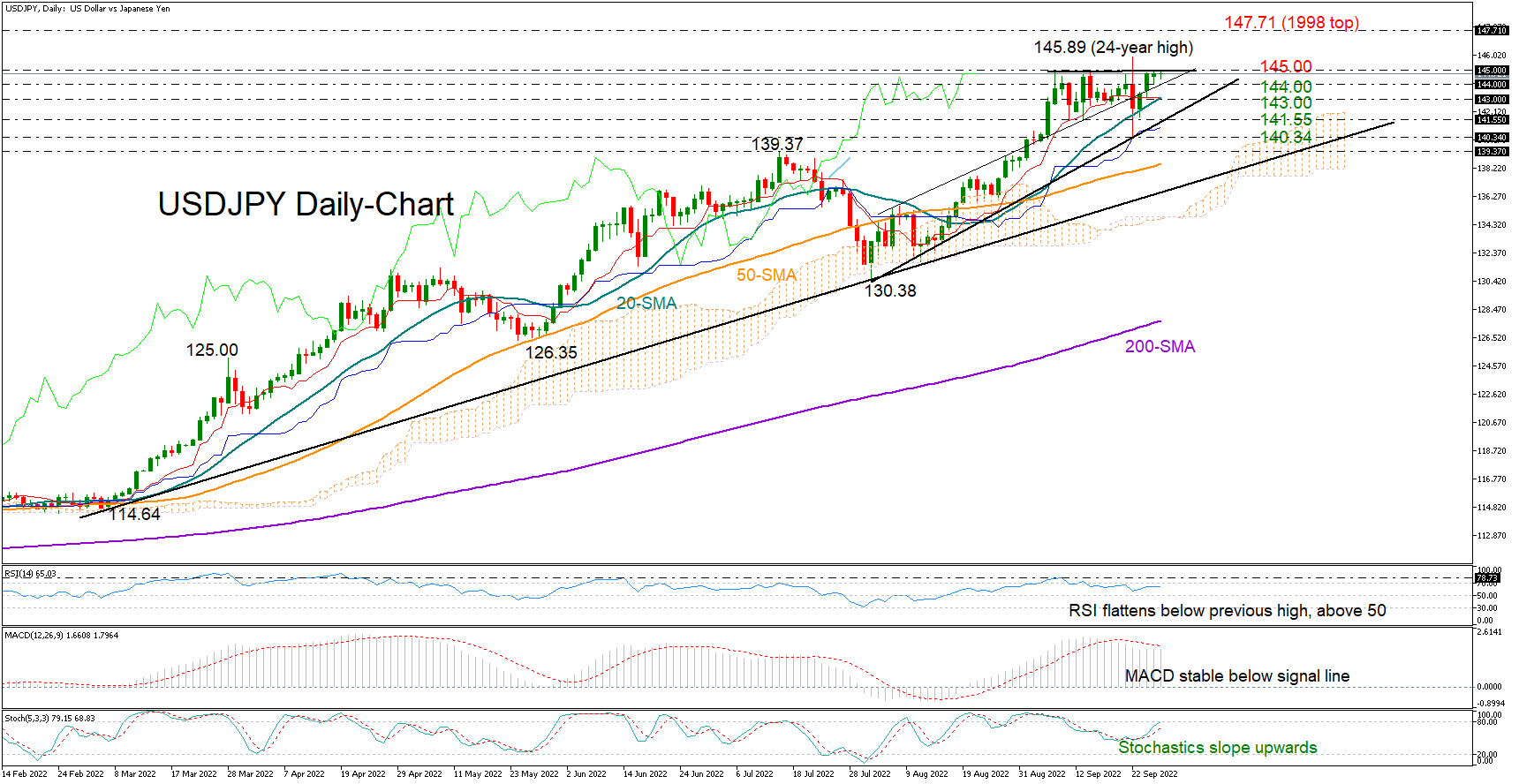
USDJPY is back on the mission to fight against the 145.00 crucial ceiling after fully recouping the Bank of Japan-led decline to 140.34 last week.
Even though the stochastics are positively charged, the RSI and the MACD are mirroring some skepticism among investors as the former seems to be struggling to post a higher high within the bullish area, while the latter remains stable below its red signal line.
Nevertheless, if the pair manages to secure a foothold around the 144.00 level, the pair may pierce through the 145.00 wall to meet the 1998 top of 147.71. The 149.00 -150.00 region could next come on the radar if the ascent grows further.
Should the bears drive the price below 144.00, the 20-day simple moving average (SMA) at 143.00 could cancel any extensions towards the 141.55 support zone, where the ascending trendline from 130.38 is positioned. Falling lower, the price may retest last week’s low of 140.34 ahead of the key 139.37 region, a break of which would signal the end of the bullish trend.
In brief, USDJPY is looking cautiously bullish in the short-term picture. The next episode of volatility is expected to start either above 145.00 or below 144.00.
Daily Technical Analysis
EUR/USD
The bulls’ attempts to limit the sell-offs remain unsuccessful and the sellers are currently testing the support at 28952. If they manage to successfully breach it, then their next move would be for an attack on the critical support at 28500. In this falling market and clear downtrend, the bears would definitely prevail, thus the buyers need to be extremely cautious when entering the market. It is so far deemed that only a confirmed breach of the resistance at 29658 may suggest a positive outlook – for an increase in the price of the index towards the psychological level at 30000.
USD/JPY
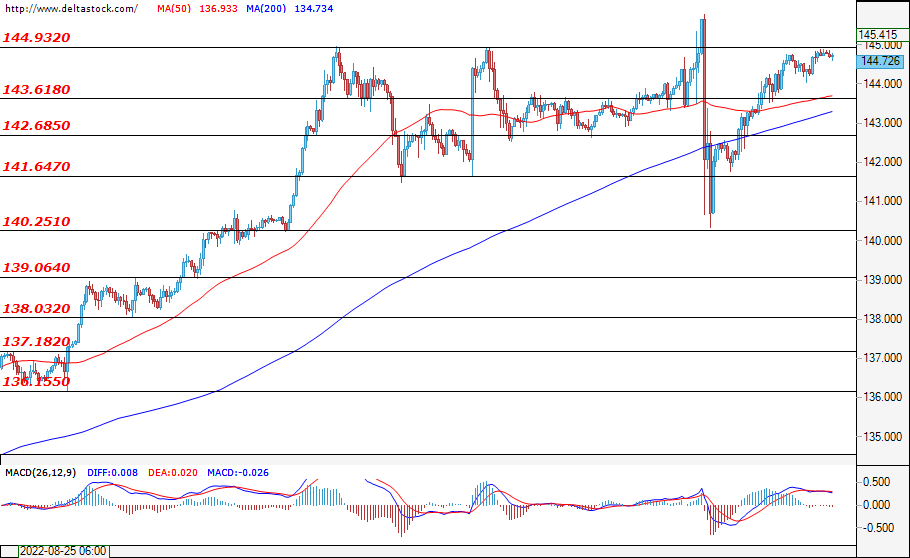
Despite the strong U.S. dollar, the resistance zone at 145.00 seems to be a strong barrier for the bulls to break out from in order to lead the pair towards new highs. The expectations for today’s trading session are for the pair to bounce back from this level and to test the support at 143.60, where a successful breach may lead to further sell-offs heading the pair towards the next key support at 142.68. In an alternative scenario, in which the bulls manage to overcome the mentioned resistance and hold the pair above 145.00, we may expect an impulsive upward movement and a continuation of the long-term uptrend that would lead the Ninja towards new highs.
GBP/USD
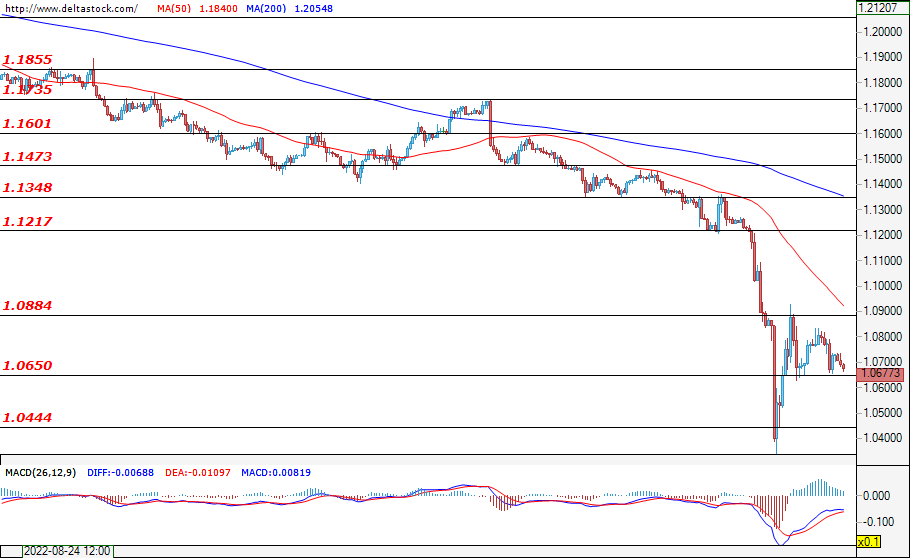
After the pair rebounded from the support at 1.0400, the bulls prevailed and the corrective move deepened, reaching the resistance at 1.0880. At the time of writing, the pair is hovering just above the support at 1.0650 and the forecasts for today’s trading session are for the bears to regain control over the market, and in case of a confirmed breach of the local support at 1.0650, for them to follow up with an attack on the next key support at 1.0444. A breach of the mentioned support may be considered a signal for a resumption of the downtrend, which would pave the way for the pair towards the low at 1.0300. In the opposite direction, only a confirmed breach of the resistance at 1.0884 may suggest a further upward movement, with the upper limit being the resistance at 1.1217.
EUGERMANY40
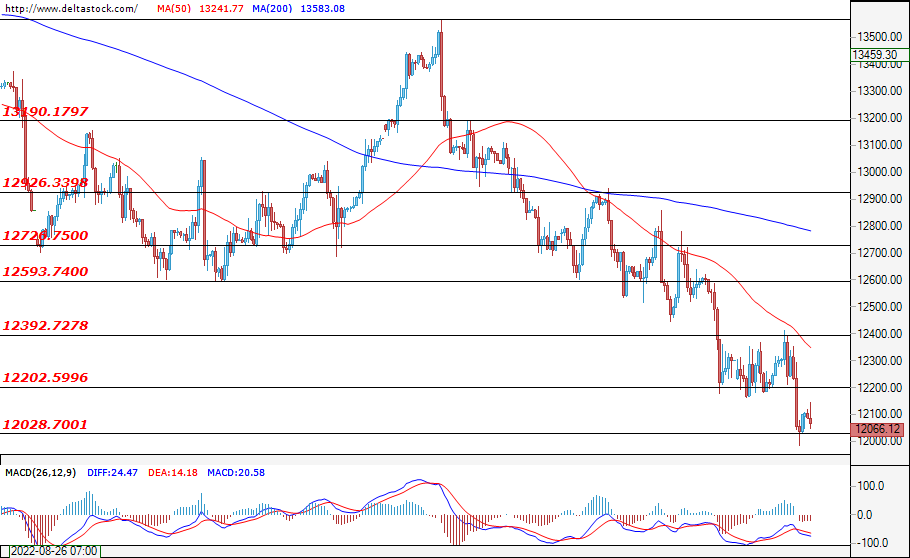
In the early hours of today’s trading session the bears are striving to violate the support at 12000. In case they manage to push and hold the price below 12000, then the most probable scenario for today’s trading session is the downtrend to continue and to witness further decrease in the price towards the next key support at around 11500. Investors do not have any signs for a reversal of the downtrend, thus staking on further losses for the index. In the opposite direction, only a successfully breach of the resistance at 12400 may be considered as a strong signal for changing the negative market sentiments.
US30
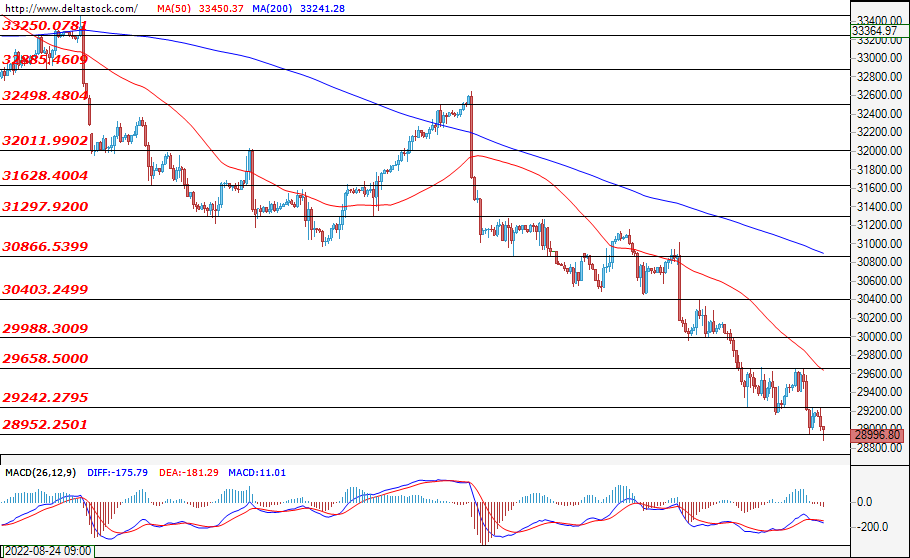
The bulls’ attempts to limit the sell-offs remain unsuccessful and the sellers are currently testing the support at 28952. If they manage to successfully breach it, then their next move would be for an attack on the critical support at 28500. In this falling market and clear downtrend, the bears would definitely prevail, thus the buyers need to be extremely cautious when entering the market. It is so far deemed that only a confirmed breach of the resistance at 29658 may suggest a positive outlook – for an increase in the price of the index towards the psychological level at 30000.
XAU/USD: Gold is Ready for a Bullish Trend Towards 1865.77
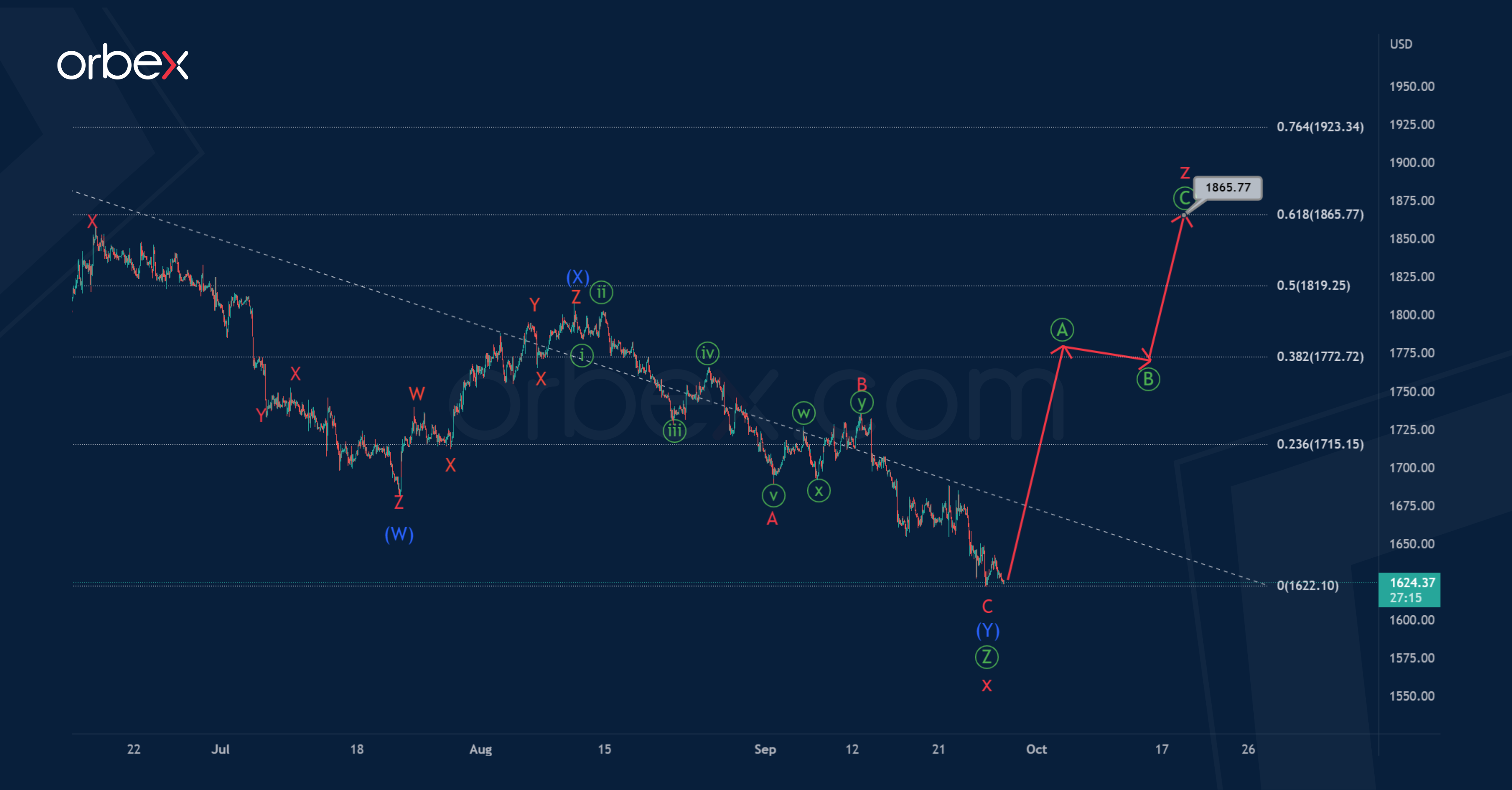
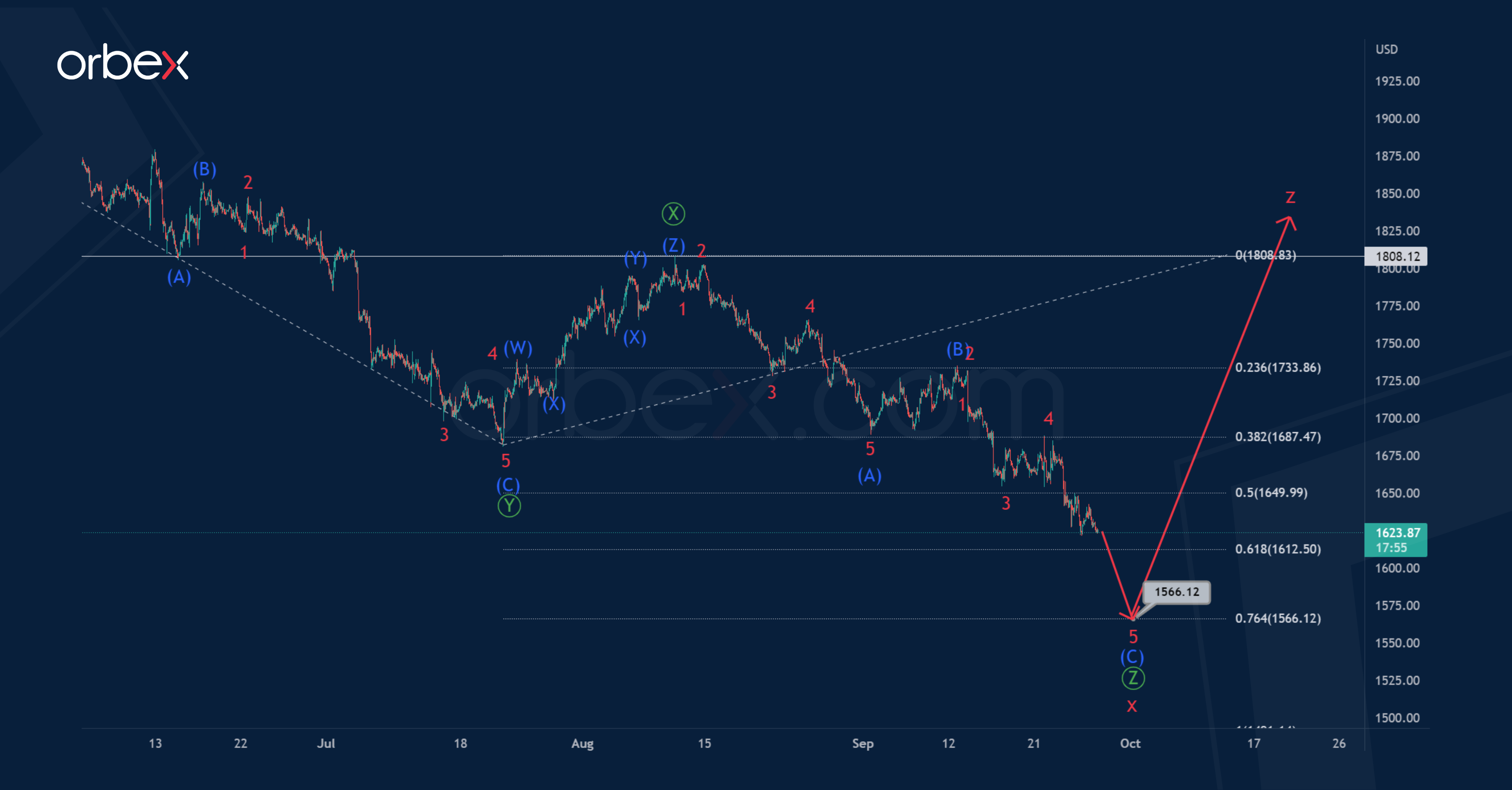
The current Gold chart shows a large correction pattern, which takes the form of a cycle triple zigzag.
The last section of the chart shows the structure of the bearish cycle intervening wave x, which looks completed in the form of a primary triple zigzag Ⓦ-Ⓧ-Ⓨ-Ⓧ-Ⓩ.
Perhaps in the next coming trading days, the market will turn around and start moving up, in the initial part of the cycle wave z. It may take the form of a primary standard zigzag Ⓐ-Ⓑ-Ⓒ, as shown in the chart.
The price of gold in the wave z may rise to the price mark of 1865.77. At that level, it will be at 61.8% of previous actionary wave y.
Let's consider the second scenario, where the downward movement of the pair continues in the cycle wave x. The final primary wave is under development.
Thus, a downward movement of XAUUSD is expected in the near future. The primary wave Ⓩ may take the form of an intermediate zigzag (A)-(B)-(C).
The final of the correction pattern zigzag (A)-(B)-(C) is possible near 1566.12. At that level, primary wave Ⓩ will be at 76.4% of primary wave Ⓨ.
Only after reaching the specified level, the development of the cycle wave z will begin.
UK 100 Breaks Critical Support
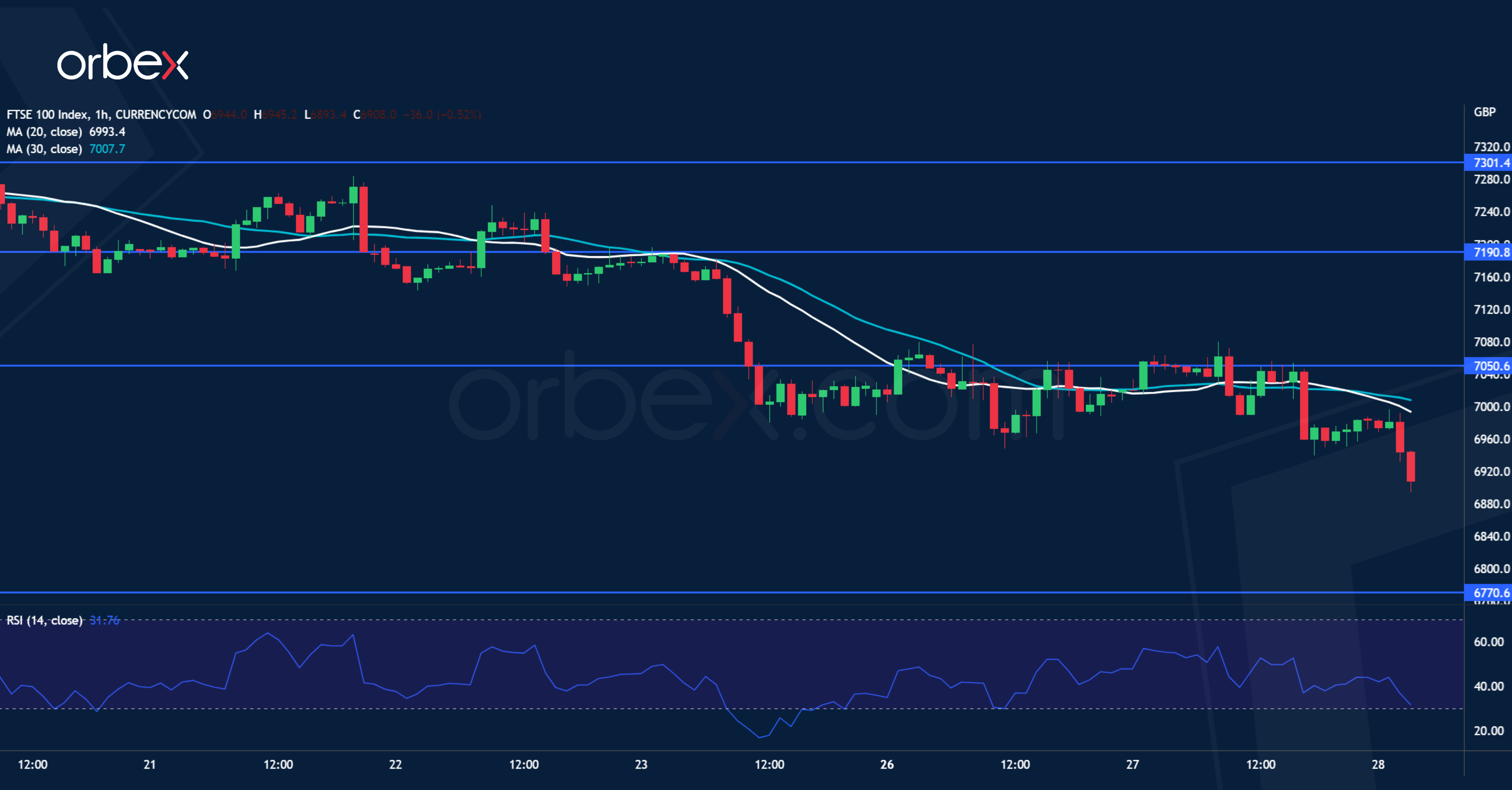
The FTSE 100 struggles over UK rate rise worries to support a battered pound. A fall below the critical area and psychological level of 7000 is a strong signal that the market has slipped into bearish territory. After the RSI recovered into the neutral zone, a brief consolidation could be the last chance for the bulls to bail out before another round of sell-off. Waning buying has met stiff selling near the fresh resistance at 7050. A bearish MA cross suggests an acceleration to the downside. Last March’s low at 6770 would be next.
AUD/USD Fails to Bounce Back
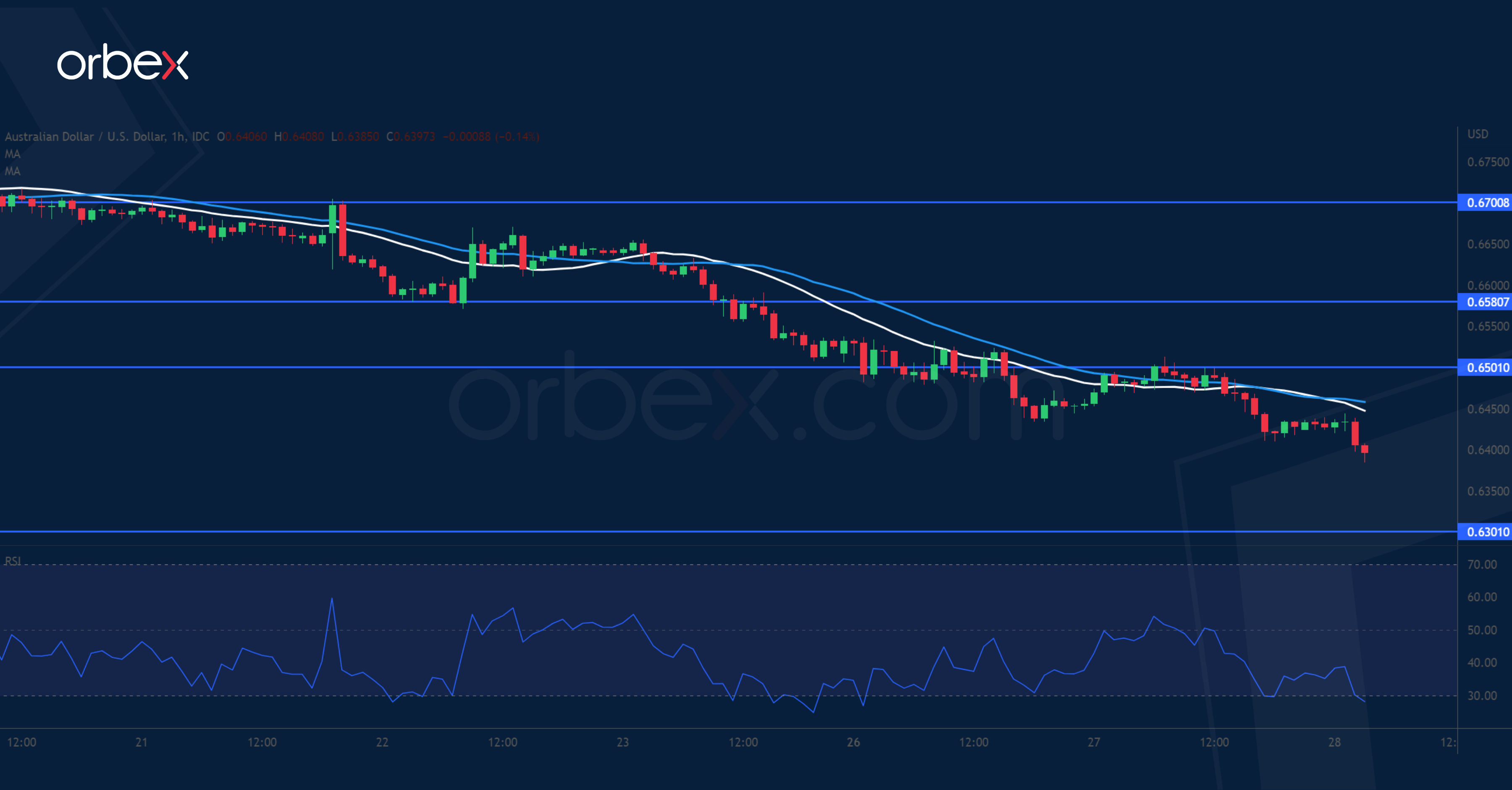
The Australian dollar falls as risk appetite remains subdued across assets. The pair went into a free fall after it broke last summer’s lows near 0.6700. The bearish mood still prevails and may continue to attract trend followers to depress the price action. 0.6300 is the next level to see whether the buy side could make its way back. The RSI’s oversold condition might cause a bounce and 0.6500 would be the first obstacle. The support-turned-resistance 0.6700 on the 20-day moving average could offer strong downward pressure.