

Sample Category Title
Dollar Up on Risk-Off Sentiment, Yuan Accelerating Down
Risk-off sentiment dominates Asian markets today, as the Chinese Yuan's free fall accelerates. The steep depreciation could limit the room for the government to ease monetary policy further to help the economy that's still troubled by pandemic measures. Yen and Dollar are currently the stronger ones in the currency markets, followed by Swiss Franc. Kiwi and Aussie are the worst together with Sterling, while Euro and Canadian are mixed.
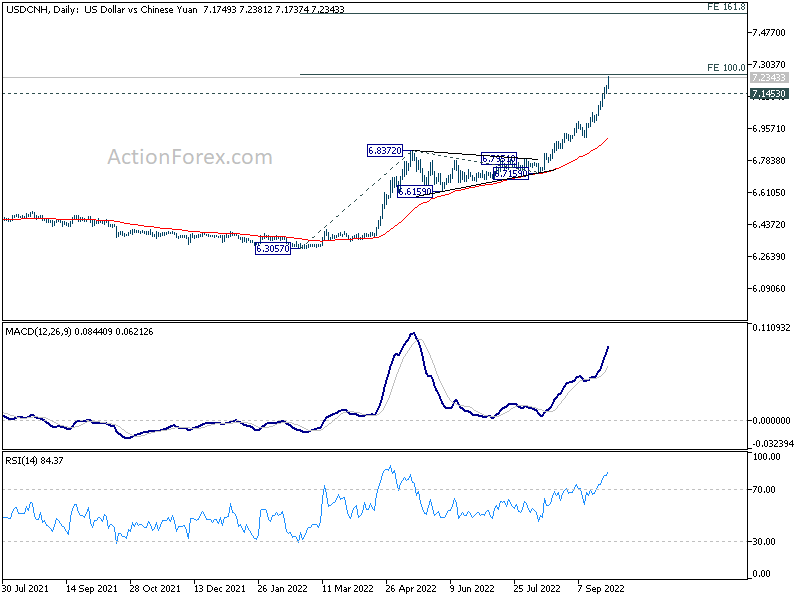
Technically, USD/CNY (onshore Yuan) hit the highest level since 2008 while USD/CNH (offshore Yuan) hits a record high since 2011. As for USD/CNH, it's now close to 100% projection of 6.3057 to 6.8372 from 6.7159 at 7.2474. There is prospect of topping around current level and break of 7.1453 support will suggest that a correction is underway. However, barring government intervention, decisive break of 7.2474 could prompt further upside acceleration towards 161.8% projection at 7.5759, which would add more pressure on Asian sentiment.
In Asia, at the time of writing, Nikkei is down -2.05%. Hong Kong HSI is down -2.34%. China Shanghai SSE is down -0.75%. Singapore Strait Times is down -1.24%. Japan 10-year JGB yield is flat at 0.254. Overnight, DOW dropped -0.43%. S&P 500 dropped -0.21%. But NASDAQ rose 0.25%. 10-year yield rose 0.086 to 3.964, after hitting 3.992, just shy of 4% handle.
Fed Kashkari: We are moving at an appropriately aggressive pace
Minneapolis Fed Bank President Neel Kashkari said yesterday, "We are moving very aggressively. There's a lot of tightening in the pipeline. We are committed to restoring price stability but we also recognize given these lags there is a risk of overdoing it."
"We are committed to restoring price stability, but we also recognize, given these lags, there is the risk of overdoing it on the front end, and so I think we are moving at an appropriately aggressive pace," he said.
"The economy is sending us a lot of mixed signals right now," Kashkari said. "We need to keep tightening policy until we see some compelling evidence that core inflation is actually having peaked and is on its way down,"
"And then I think we need to sit there and we need to pause and wait and let the tightening work its way through the economy to see at that point, have we done enough?"
Fed Harker: Shelter inflation and food particularly alarming
Philadelphia Fed President Patrick Harker said in an article, "inflation is far too high across most goods and services in our economy. But I find shelter inflation, along with food inflation, particularly alarming.... We must do everything we can to get shelter inflation under control."
"Monetary policy has a role to play here, and the Federal Reserve is working to stabilize inflation and put the economy on a firmer footing for the long haul," he said. "But getting shelter inflation under control will require action not just by the Fed, but also by federal, state, and local governments."
UK BRC shop price reported another record increase
UK BRC shop price index accelerated from 5.1% yoy to 5.7% yoy in August, hitting another record high since the index began in 2005. Food inflation surged from 9.3% yoy to 10.6% yoy. Non-food inflation also rose from 2.9% yoy to 3.3% yoy.
Helen Dickinson, Chief Executive, British Retail Consortium: "Retailers are battling huge cost pressures from the weak pound, rising energy bills and global commodity prices, high transport costs, a tight labour market and the cumulative burden of government-imposed costs."
Mike Watkins, Head of Retailer and Business Insight, NielsenIQ: "NielsenIQ data shows that 76% of consumers are saying they expect to be moderately or severely affected by the cost-of-living crisis over the next 3 months, up from 57% in the summer."
Australia retail sales rose 0.6% mom in Aug
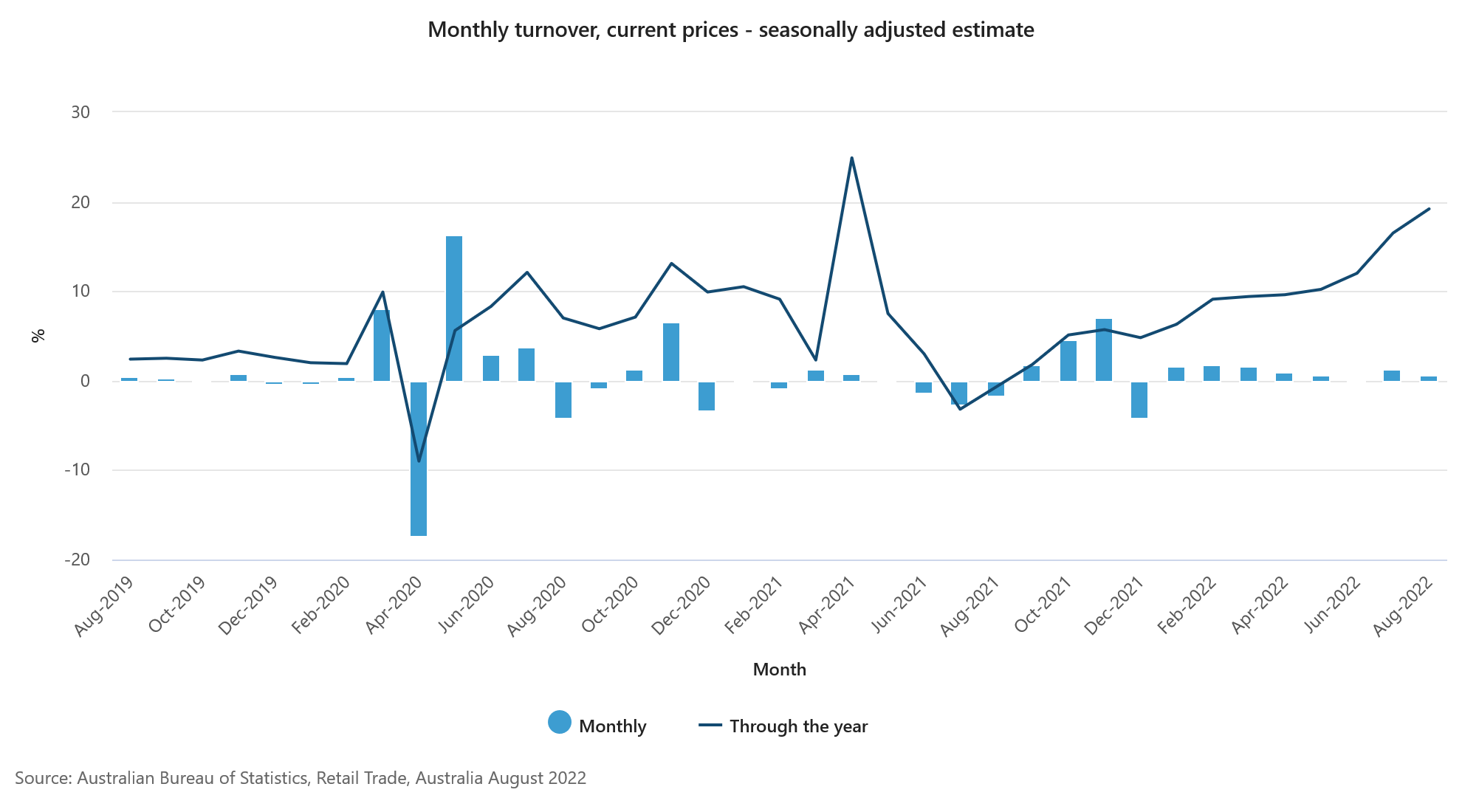
Australia retail sales turnover rose 0.6% mom to AUD 34.88B in August, slightly above expectation of 0.5% mom. That's the eighth consecutive monthly increase.
Ben Dorber, head of retail statistics at the ABS, said: "This month's rise was driven by the combined increase in food related industries, with cafes, restaurants and takeaway food services up 1.3 per cent and food retailing up 1.1 per cent."
"While households continue to spend, non-food industry results were mixed and only contributed a small amount to the total rise in retail turnover."
Looking ahead
Germany Gfk consumer sentiment and Swiss Credit Suisse economic expectations will be released in European session. Later in the day, US will release goods trade balance and pending home sales.
AUD/USD Daily Report
Daily Pivots: (S1) 0.6395; (P) 0.6454; (R1) 0.6494; More...
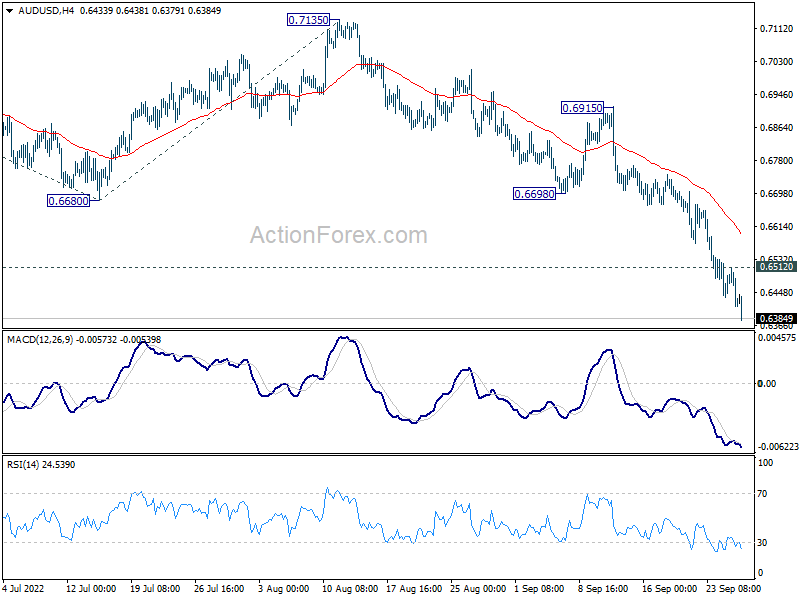
AUD/USD's down trend continues today and hits as low as 0.6379 so far. Intraday bias stays on the downside. Next target is 100% projection of 0.7660 to 0.6680 from 0.7135 at 0.6155. On the upside, above 0.6512 minor resistance will turn intraday bias neutral and bring consolidations first, before staging another decline.
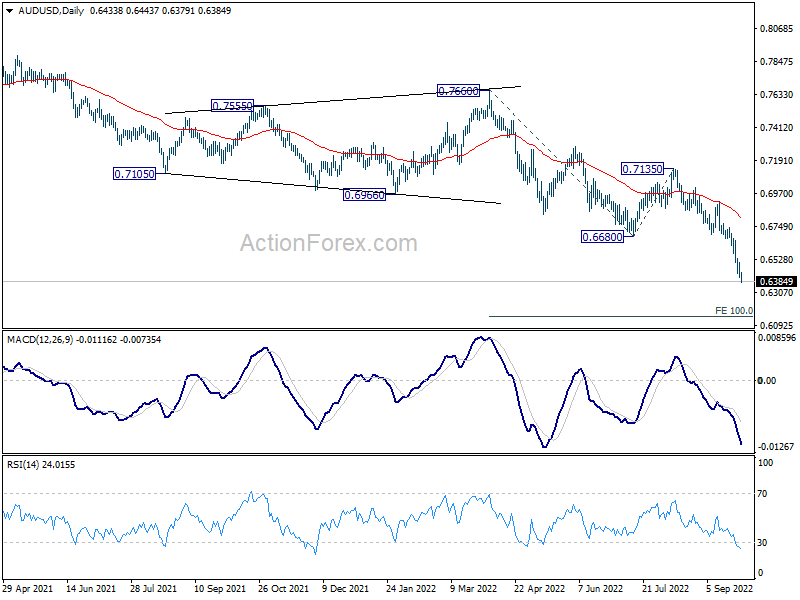
In the bigger picture, down trend form 0.8006 (2021 high) is expected to continue as long as 0.7135 resistance holds. With 61.8% retracement of 0.5506 (2020 low) to 0.8006 at 0.6461 firmly taken out, next target is 0.5506 low. Medium term momentum will now be closely monitored to gauge the chance of break of 0.5506.
Economic Indicators Update
| GMT | Ccy | Events | Actual | Forecast | Previous | Revised |
|---|---|---|---|---|---|---|
| 23:01 | GBP | BRC Shop Price Index Y/Y Sep | 5.70% | 5.10% | ||
| 23:50 | JPY | BoJ Minutes | ||||
| 01:30 | AUD | Retail Sales M/M Aug | 0.60% | 0.50% | 1.30% | |
| 06:00 | EUR | Germany Gfk Consumer Confidence Oct | -38.8 | -36.5 | ||
| 08:00 | CHF | Credit Suisse Economic Expectations Sep | -56.3 | |||
| 12:30 | USD | Goods Trade Balance (USD) Aug P | -88.0B | -90.2B | ||
| 12:30 | USD | Wholesale Inventories Aug P | 0.40% | 0.60% | ||
| 14:00 | USD | Pending Home Sales M/M Aug | -0.70% | -1.00% | ||
| 14:30 | USD | Crude Oil Inventories | 1.1M |
Australia retail sales rose 0.6% mom in Aug
Australia retail sales turnover rose 0.6% mom to AUD 34.88B in August, slightly above expectation of 0.5% mom. That's the eighth consecutive monthly increase.
Ben Dorber, head of retail statistics at the ABS, said: "This month's rise was driven by the combined increase in food related industries, with cafes, restaurants and takeaway food services up 1.3 per cent and food retailing up 1.1 per cent."
"While households continue to spend, non-food industry results were mixed and only contributed a small amount to the total rise in retail turnover."
UK BRC shop price reported another record increase
UK BRC shop price index accelerated from 5.1% yoy to 5.7% yoy in August, another record increase since the index began in 2005. Food inflation surged from 9.3% yoy to 10.6% yoy. Non-food inflation also rose from 2.9% yoy to 3.3% yoy.
Helen Dickinson, Chief Executive, British Retail Consortium: "Retailers are battling huge cost pressures from the weak pound, rising energy bills and global commodity prices, high transport costs, a tight labour market and the cumulative burden of government-imposed costs."
Mike Watkins, Head of Retailer and Business Insight, NielsenIQ: "NielsenIQ data shows that 76% of consumers are saying they expect to be moderately or severely affected by the cost-of-living crisis over the next 3 months, up from 57% in the summer. "
Fed Harker: Shelter inflation and food particularly alarming
Philadelphia Fed President Patrick Harker said in an article, "inflation is far too high across most goods and services in our economy. But I find shelter inflation, along with food inflation, particularly alarming.... We must do everything we can to get shelter inflation under control."
"Monetary policy has a role to play here, and the Federal Reserve is working to stabilize inflation and put the economy on a firmer footing for the long haul," he said. "But getting shelter inflation under control will require action not just by the Fed, but also by federal, state, and local governments."
Fed Kashkari: We are moving at an appropriately aggressive pace
Minneapolis Fed Bank President Neel Kashkari said yesterday, "We are moving very aggressively. There's a lot of tightening in the pipeline. We are committed to restoring price stability but we also recognize given these lags there is a risk of overdoing it."
"We are committed to restoring price stability, but we also recognize, given these lags, there is the risk of overdoing it on the front end, and so I think we are moving at an appropriately aggressive pace," he said.
"The economy is sending us a lot of mixed signals right now," Kashkari said. "We need to keep tightening policy until we see some compelling evidence that core inflation is actually having peaked and is on its way down,"
"And then I think we need to sit there and we need to pause and wait and let the tightening work its way through the economy to see at that point, have we done enough?"
US Housing Data, Core PCE Inflation Next on the Calendar
With the Fed trying to get on top of inflation no matter what it takes and showing no interest to come to investors’ rescue, traders will keep looking for any cracks within the US economy this week. US housing data will feature the calendar on Tuesday and Wednesday at 14:00 GMT, while the Fed’s favorite core PCE inflation report will provide extra details about consumption on Friday at 12:30 GMT. The king US dollar has proved resilient to recession risks so far, therefore it might barely react to the data.
Recession watch
The slowing US housing market is rekindling some memories from the 2007-2009 Great recession but there is some confusion about whether it’s a red flag for the economy nowadays. New home sales have been trending downwards so far this year and the August reading is expected to mark a new low at 500k from 511k previously, the lowest in six years. Pending home sales due on Wednesday could show a steeper contraction of -1.4% from -1.0% previously, remaining negative for the third consecutive month.
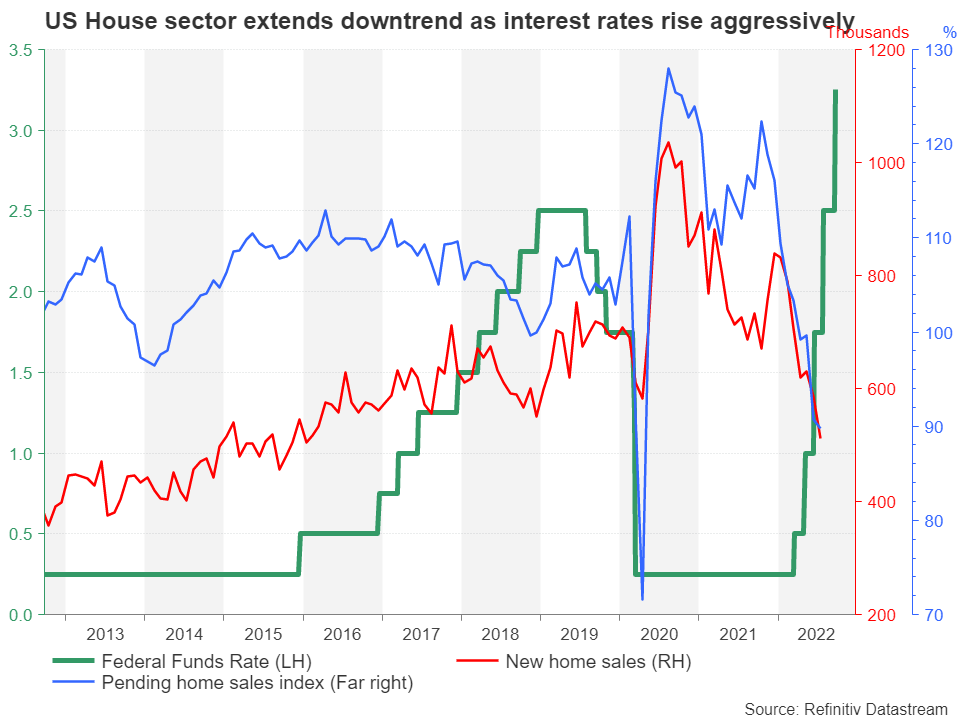
The period of lockdowns lifted home sales to a 13-year high, but the uptrend took a halt after the government terminated the pandemic-related subsidies and the Fed started to hike interest rates in the face of rising inflation. With the average mortgage rate for a 30-year loan jumping to 6.29% recently and big property companies raising prices by 50% in the second quarter, households are reluctant to expose their finances to more expensive loans. Of course, selling existing houses could boost profits, but buying a new property at a significantly higher interest rate would eat up those benefits.
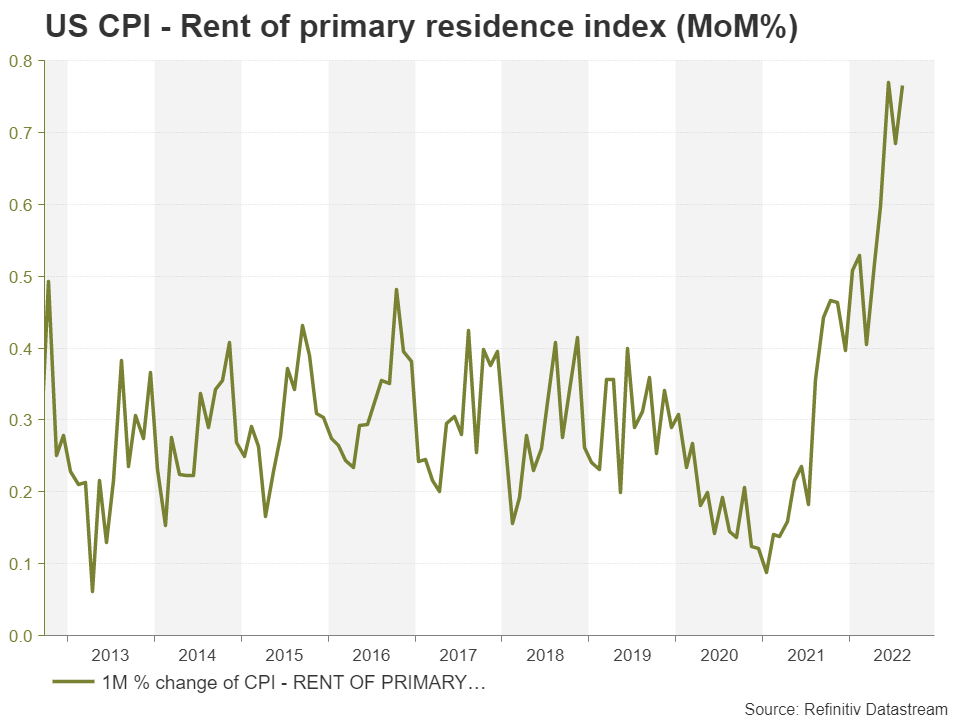
A stabilization in the red-hot rent market in August, perhaps on the back of state limits in some regions, was probably a catalyst to a softer house demand too. Though, more than half of renters are still facing elevated prices year-on-year and given the inflation in construction materials as well as the tight supply of houses, there is little prospect for a significant slowdown in the market.
Eyes on consumption
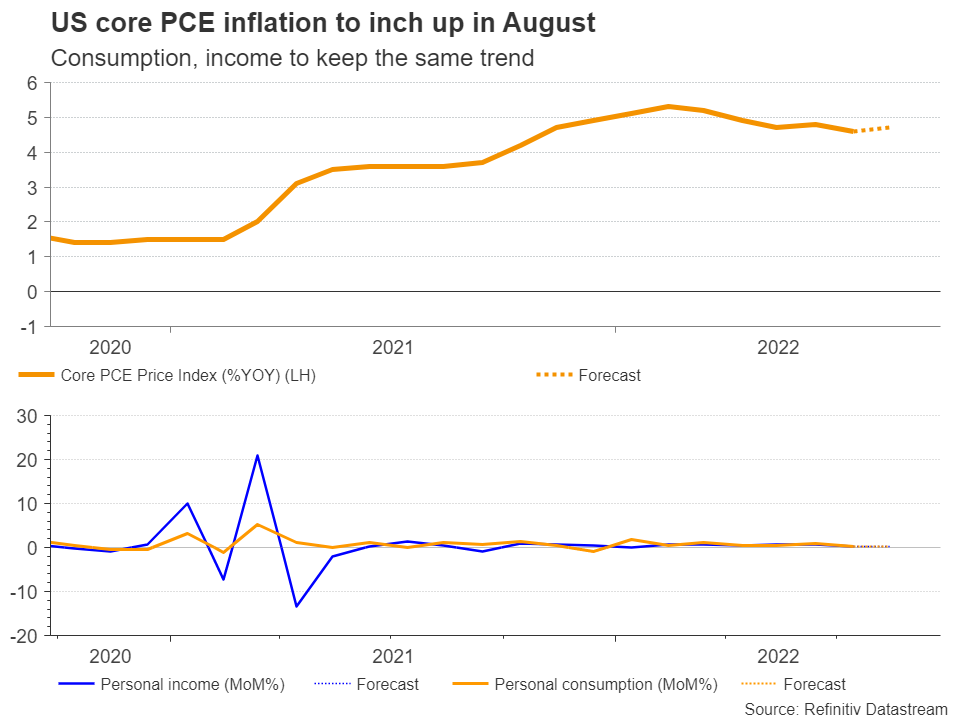
The strength in the labor market is also a tailwind for the real estate sector, delaying any defaults in loan payments. Personal income and consumption figures accompanying the core PCE inflation on Friday could provide some updates on that front. Although expectations are for a minor monthly pickup to 0.3% and 0.2% respectively, the indicators may not raise any concerns if they stay within normal levels. A potential mild increase in the core PCE inflation to 4.7% y/y would not be something new either after a similar pace in the core CPI inflation reading.
Fed comments are more important
Hence, unless a significant negative deviation from forecasts takes place, this week’s dataset may not have the power to shake the dollar. It’s obvious that monetary policy is the main player in town in global markets, therefore investors may appear more sensitive to speeches from Fed policymakers in the rest of the week, especially if comments shed more light on how big the size of future rate hikes will be. Chairman Jerome Powell, as well as Charles Evans and James Bullard will be commenting at events today, while James Bullard, Loretta Mester and John Willams will follow next later in the week.
USD/JPY
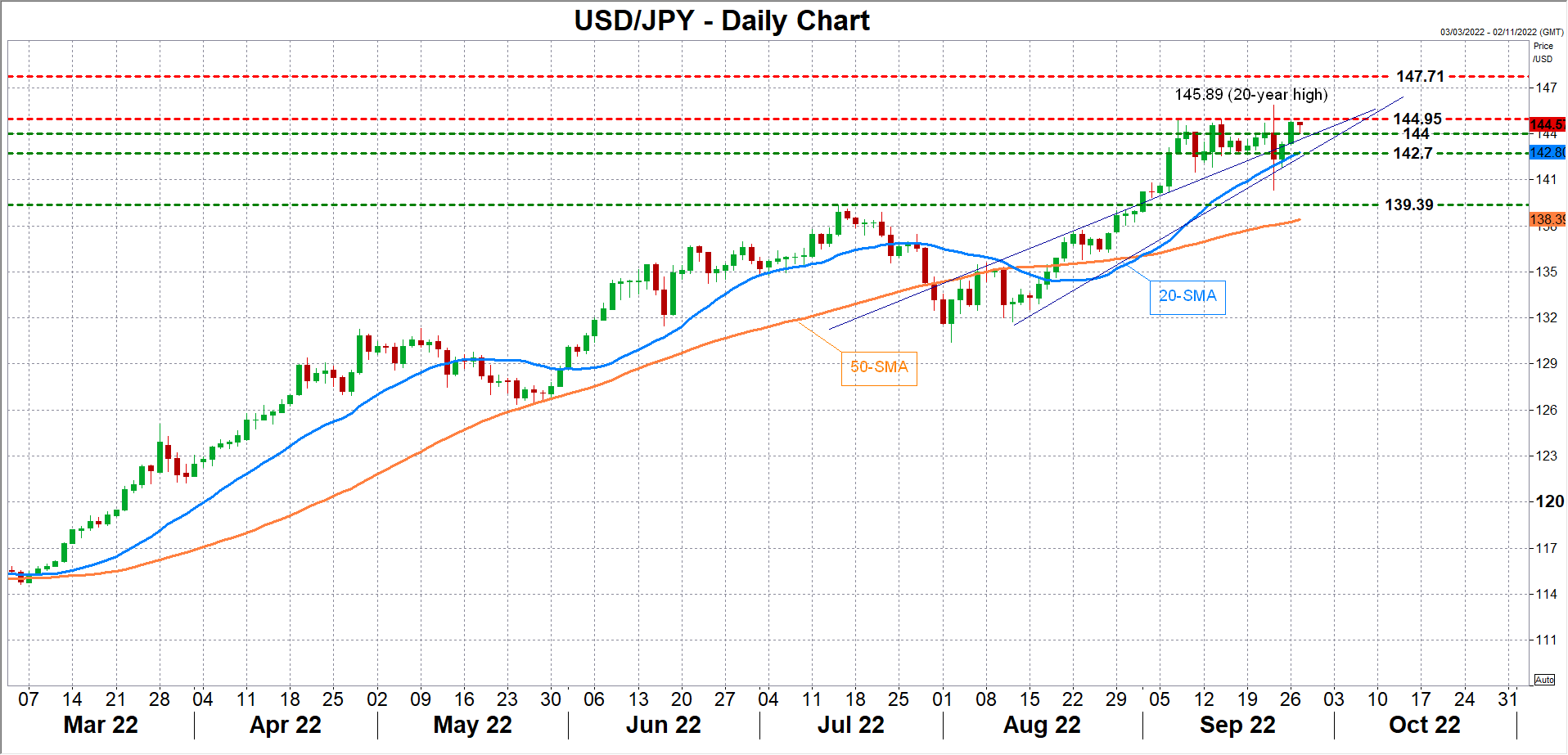
Looking at charts, all eyes are back on the 144.95 ceiling in dollar/yen following the full recovery from last week’s low of 140.34. Although the continuous depreciation in other major currencies is feeding speculation for a coordinated Japan-style FX intervention against the greenback, any downfalls could be short-lived as long as the US is magnetizing investors' interest by leading monetary tightening and through its relatively safer geopolitical and economic conditions. The Fed will need to enhance its hawkish tone if it aims to reach the 1998 peak of 147.71 this week.
Otherwise, a surprisingly conservative communication could see the pair testing the 144.00 round level ahead of the 20-day simple moving average (SMA) at 142.78. Yet, only a freefall below July's high of 139.39 would ruin the bullish trend in the market.
Gold Price Turns Red Below $1,650, Upsides Capped
Key Highlights
- Gold price extended losses below the $1,650 support.
- A major bearish trend line is forming with resistance near $1,650 on the 4-hours chart.
- EUR/USD and GBP/USD might start a fresh downward move.
- USD/JPY could clear the last high at 145.90 and continue higher.
Gold Price Technical Analysis
Gold price remained in a bearish zone below the $1,688 resistance against the US Dollar. The price declined below the $1,665 support level to move into a bearish zone.
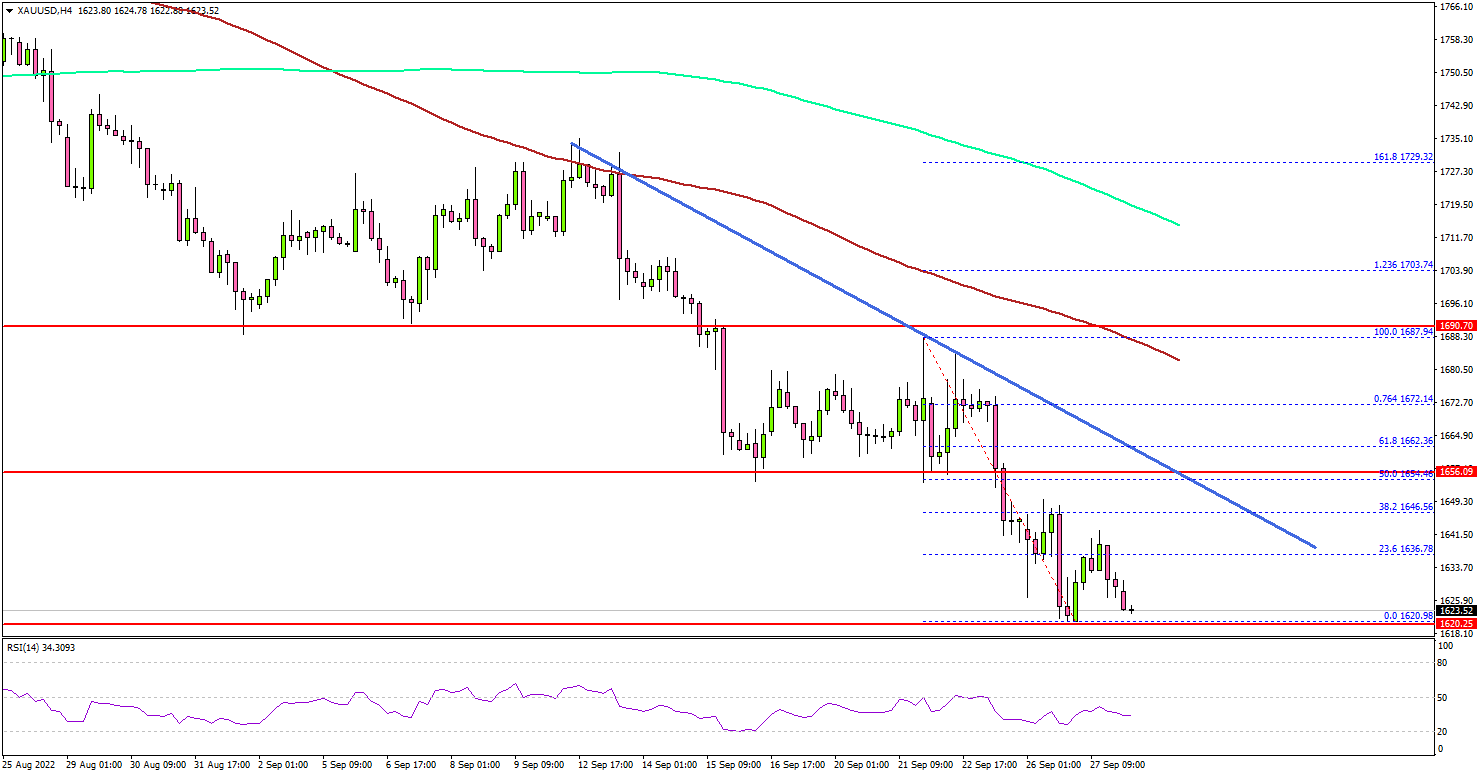
The 4-hours chart of XAU/USD indicates that the price extended losses below the $1,650 support, the 100 simple moving average (red, 4-hours), and the 200 simple moving average (green, 4-hours).
The price even spiked below the $1,625 level and traded as low as $1,620. It is now consolidating losses above the $1,620 level. On the upside, the price might face sellers near the $1,646 level. There is also a major bearish trend line forming with resistance near $1,650 on the same chart.
The next major resistance is near the $1,662 level. Any more gains might send the price towards the $1,688 resistance level.
On the downside, an initial support is near the $1,620 level. The next major support is near the $1,600 level, below which the price could accelerate lower. In the stated case, the price may perhaps decline towards the $1,580 level.
Looking at EUR/USD, the pair is facing resistance near the 0.9680 and 0.9700 levels. If the bears remain in action, the pair could decline below 0.9550.
Economic Releases to Watch Today
- US Pending Home Sales for August 2022 (YoY) - Forecast -1.4%, versus -1.0% previous.
- Federal Reserve Chair Jerome Powell Speech.
AUDUSD Wave Analysis
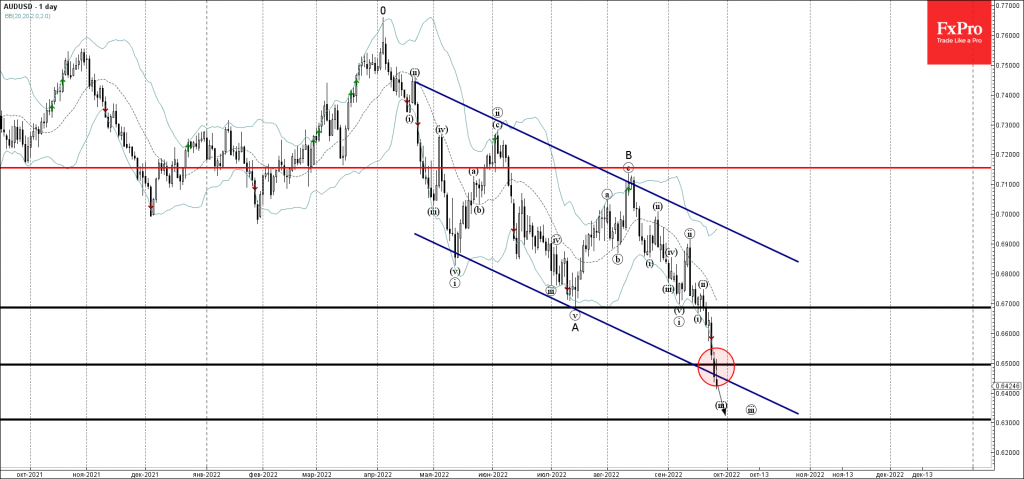
- AUDUSD broke key support level 0.6500
- Likely to fall to support level 0.6300
AUDUSD currency pair recently broke the key support level 0.6500 coinciding with the support trendline of the wide down channel from the middle of April.
The breakout of the support level 0.6500 accelerated the active short-term impulse waves iii and (iii) – which belongs to the sharp impulse wave C from the start of August.
Given the overriding daily downtrend, AUDUSD can be expected to fall further toward the next support level 0.6300 (target for the completion of the active short-term impulse waves iii).
Eco Data 9/28/22
[php_everywhere instance="1"]
Sunset Market Commentary
Markets
The sell-everything-trade took a breather today. Stock markets eke out a small gain of about half a percent. It’s not a lot but at least they stop dropping for a moment. The EuroStoxx50 remains in the technical danger zone though. Core bonds surged in Asian and European dealings. It shouldn’t come as a big surprise that UK notes outperformed US and European/German peers. British yields at some point tanked 37 bps but still found a bottom soon. Current changes range between -11.7 bps for the 2y – an impressive 25 bps intraday comeback – and +10.2 bps (10y) to another massive +28.3 bps (30y). The long end is still adding basis points amid a combo of expectations that the central bank will have to keep policy rates higher for longer, the idea that lavish fiscal stimulus blunts the sharp edges of a recession and increased risk premia. We see curves steepen in the US and Europe too. American yields ease 5.9-8 bps at the front while losing 2.6 bps in the 10y and adding 2.1 bps at the longest tenor. Durable goods orders/shipments more or less matched expectations and had little impact on trading dynamics. Bund rates swing between -3.1 bps and +7.8 bps. The 10y European swap yield (3.03%, +3.8 bps) does not intend to let its recently captured 3% target go. Commodities recover a bit as well. Brent oil prices rise 2% to $85.77/b. Natural gas jumps 7.5% (€186.5/MWh) following reports of leaks in the Nord Stream pipelines. There have been no gas flows through this route over the past month but it adds to the uncertainty of future Russian supplies.
In line with the dust settling a bit on markets, we also see the US dollar taking it down a notch or two in uneventful trading. It loses out against all G10 peers. The move is the sharpest vs the pound. Again no surprise here after the violent GBP dump. Cable rebounds from 1.069 to 1.078, recouping a mere fraction of what it lost on Friday and yesterday. Sterling performs better against the euro too. EUR/GBP erases Monday’s daily gain to trade at 0.892. Back to the dollar then. The trade-weighted DXY fell from 114.1 to 113.3. But underscoring its fundamental strength, DXY clawed back and pared losses to 113.84 currently. EUR/USD is going nowhere just north of 0.96. In USD/JPY, markets are close in testing the Japanese governments’ resolve. The pair neared 145 yesterday and is only marginally backing away (144.54) from that line in the sand officials drew last week by intervening in FX markets.
News Headlines
According to the German IFO export expectations survey, sentiment among German exporters has cooled further in September. Export expectations dropped to -6.0, down from -2.8 in August, bringing it to the lowest level since May 2020. IFO currently sees no sign of export growth and expects no major change in the medium term as the global economy is slowing. Export expectations are negative in most manufacturing industries. The chemical and furniture industry expect a significant further decline. The metal industry has also become considerably more pessimistic. Beverage producers are turning more positive and the automotive industry also expects exports to rise in Q4.
The National bank of Hungary today raised its main policy rates by 125 bps, bringing the base rate to 13.00%. Most analysts expected another additional 100 bps step. A minority expected an even smaller step. In the statement published after the decision, the MNB says ‘by the current level of the base rate, interest rate conditions have become sufficiently strict, which ensures the achievement of the inflation target. The Monetary Council has decided to stop the cycle of base rate hikes after the step in September.’ Tightening liquidity and further enhancing monetary transmission will be in the MNB’s focus. The forint strengthened from EUR/HUF 408 to below 405 upon the announcement of the decision, but returned part of this gain after the MNB statement formally announced the end of the hiking cycle. EUR/HUF currently trades again near 406.