Sample Category Title
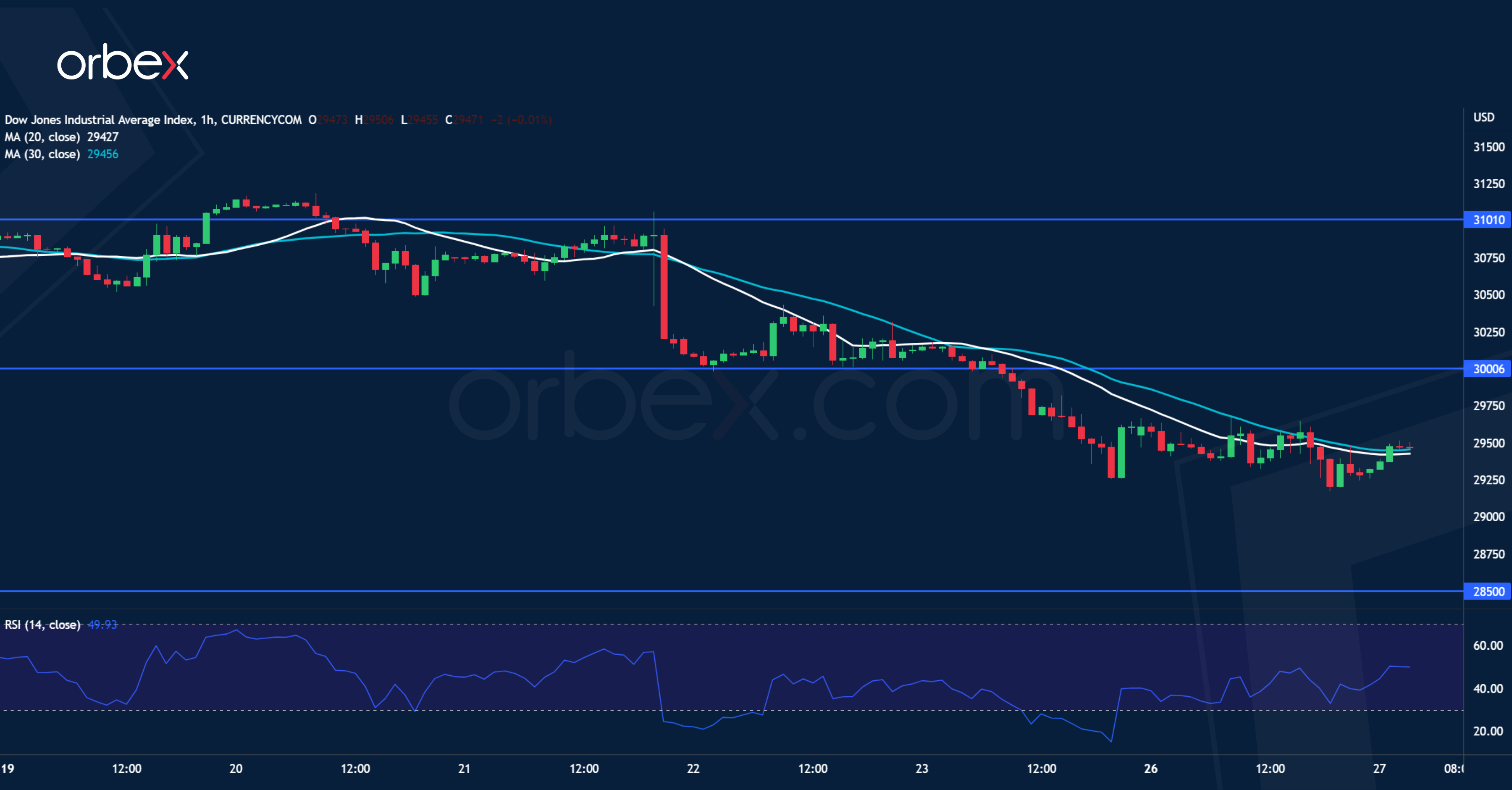
Dow Jones 30 Breaks Critical Floor
The Dow Jones 30 slips over concerns of a Fed tightening overdose. A break below June’s low at 29800 may have sealed the fate of the index by putting it on a bearish track. The breakout also confirms the bearish MA cross on the daily chart, indicating an acceleration to the downside. 28500 could be the next target. A brief bounce may draw more selling interests as the downtrend resumes its course, while trapped bulls may seek to bail out in the supply zone near the psychological level of 30000, exacerbating volatility in the process.
NZD/USD Remains Under Pressure
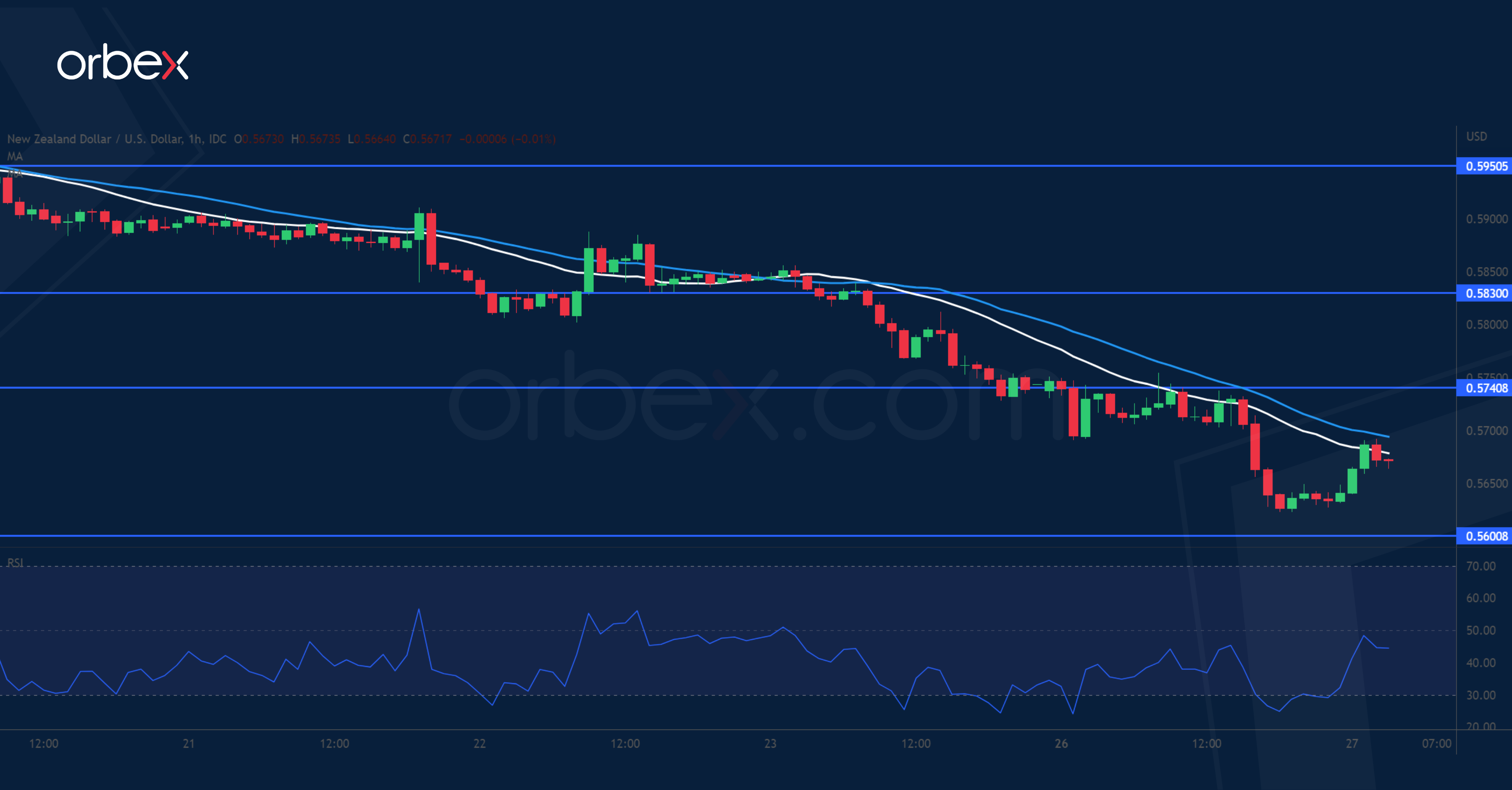
The New Zealand dollar softens as markets remain gripped by growth fears. The fall accelerated following the kiwi’s failure to bounce at May 2020’s low (0.5930). The bearish inertia and pessimism may continue to drive the price south. The RSI’s oversold condition could trigger sporadic bounces. 0.5740 is a resistance where the bears could be eager to sell into strength. A struggle to break higher would show a lack of sustained buying interest and the pair may drift towards 0.5600 and then March 2020’s lows around 0.5500.
GBP/USD Finds Limited Relief
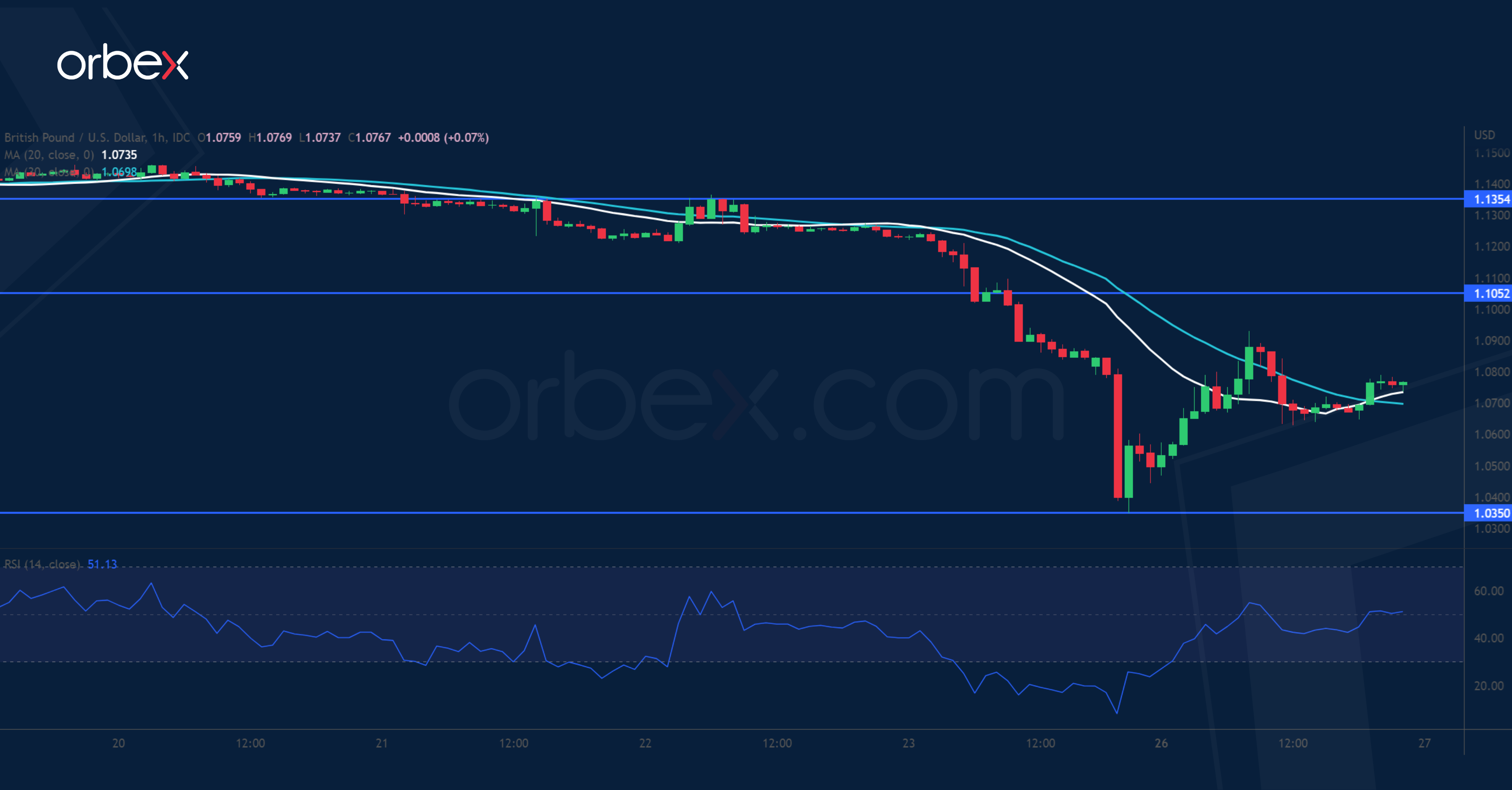
The pound recoups losses over speculations of an emergency rate hike by the BoE. After breaking below March 2020’s lows near 1.1500 Sterling sank to an all-time low at 1.0350. An extremely oversold RSI on the daily chart prompted intraday traders to take some chips off the table. However, strong selling pressure could be expected from trend followers as the pound probes resistance overhead. 1.1050 would be the first hurdle and 1.1350 over the 20-hour moving average a major level that may keep the bounce in check.
“Ever-Stronger” Dollar Taking a Well-Deserved Breather
Markets
We cannot but kick off with the UK again. Aggressive selling in UK bonds and the pound prompted a coordinated response by Treasury and the Bank of England. Markets were all but impressed. UK yields again soared 41.6 (10y) to 55.4 bps (2y). All segments of the curve are now well above 4%. Sterling got whacked in thin Asian dealings but recouped most of the losses afterwards. It even traded with daily gains amid speculation the BoE would come up with an inter-meeting hike. But it only reiterated its commitment to bring back inflation to 2% and said it would assess the (fiscal) situation at the November meeting. Money markets do bet on a super-duper-sized rate hike then to the tune of 150 bps. EUR/GBP eventually finished at 0.899, up from 0.893. Cable closed lower at 1.069. US yields were very eager to join the UK. The curve shifted north with changes between 13.4 (30y) and 23.9 bps (7y). Real yields (10y) added no less than 31 bps. Fed’s Mester put it very clear: “rates are not coming down next year”. German yields rose 3.3 bps to 9.1 bps with the long end underperforming. ECB president Lagarde before the EU Parliament said the central bank will consider quantitative tightening once rates have hit the neutral level. Assuming this is somewhere around 2%, we’ll get there already by the end of the year so that QT in theory could start in Q1 2023. The dollar remained the indisputable number one on FX markets. The trade-weighted DXY closed above 114, a new two-decade high. EUR/USD tumbled to just north of 0.96.
That “ever-stronger” dollar is however taking a well-deserved breather in Asian dealings this morning though. Sterling rebounds from the two-day beating and shares the top place on the G10 scoreboard with the kiwi dollar, even as RBNZ governor Orr said the tightening cycle is getting very mature (see below). The dollar retreat provides some relief for stocks. Wall Street yesterday fell another 1% and the EuroStoxx50 set a new YtD low with support from the downward sloping trendline connecting March-July troughs kicking in. But futures this morning suggest a green opening. Asian equities trade mixed. Core bonds lick their wounds, resulting in a 5 bps decline in US Treasury yields.
Today’s economic calendar contains US data only, ranging from durable goods orders over housing data to consumer confidence (Conference Board). We think they’ll play second fiddle in the run-up to other interesting data including European HICP (Thursday and Friday). The latest aggressive repositioning in core bonds, FX markets (dollar especially) and equities may ease somewhat in a daily perspective. The avalanche of central bank speakers serve once again as a wildcard. Worth mentioning is today’s Hungarian central bank policy decision that comes with updated forecasts. Another rate hike is expected (100 bps to 12.75%). Vice-governor Virag last week said the MNB will assess from today’s meeting on whether hikes should be stopped.
News Headlines
New Zealand Central Bank governor Adrian Orr admitted that the RBNZ still has some work to do to bring inflation back under control but that the tightening cycle is already very mature as the bank has already done much. The Reserve Bank has “a little bit more to do before we can drop to our normal happy place, which is to watch, worry and wait for signs of inflation up or down,” he was quoted. The RBNZ governor felt comfortable on employment, but said real wages are still being challenged by inflation, which the central bank has to bring down. He attributed the decline of the kiwi dollar due to the broader increase of the USD. The RBNZ raised its policy rate to 3.00% as inflation stands at 7.3%. NZD/USD yesterday touched 0.5625 coming close to the March 2020 corona low just below 0.55.
The 2023 budget draft as approved by Czech government yesterday sees a budget deficit of CZK 295 bln compared to earlier plans for CZK 270 bln target. Amongst others, the Czech government raised spending to mitigate the impact of higher energy prices by imposing caps on energy prices. The government also proposes an increase in defense spending and investments in infrastructure. For this year the government has a budget target of CZK 330 bln. The draft budget now has to be approved by Parliament.
Strong Dollar is Brits and Europeans’ Fault
We had a bearish start to the week on Monday and the price action across several asset classes remains volatile and chaotic - and that’s especially true for the FX markets shaken by the freefall in sterling.
Last week’s ‘mini budget’ announcement didn’t spur growth expectations, but rather fueled debt worries for Britain.
After Cable tanked to 1.0350, some British lawmakers, including people from Tories, said that the Bank of England (BoE) should intervene in the market to stop the pound’s freefall.
For a while, we saw a rapid recovery in sterling on speculation that the BoE would opt for an emergency rate hike to reverse the course of the falling pound. But then… the BoE battered the pound once again, saying that ‘the MPC will not hesitate to change interest rates as necessary to return inflation to the 2% target sustainable in the medium term’ but that they ‘will make a full assessment at its next SCHEDULED meeting of the impact of demand and inflation from the Government’s announcements, and the fall in sterling, and act accordingly’.
Holy
Bloomberg writes that Britain needs an adult in the room and Bailey could be that person. But Bailey acts like a mom seeing her child with an open forehead bleeding out, and says ‘oh honey, we will go to the hospital when daddy is back home, I have to finish cooking diner!’
If the selloff on sterling continues, the BoE can't afford to wait until the next scheduled meeting to do something. It must act now! Therefore, the market will certainly force the BoE to deliver an emergency 100bp rate hike in the next couple of hours, as the threat of ‘acting accordingly when they meet again’ won’t be enough for the BoE to stop the sterling’s meltdown, especially when the rest of the market is boiling as well, and the US dollar keeps pushing higher.
Money’s next stop
Investors sell assets, and sit on cash. It is reported that $4.6 trillion is now sitting in US money-market mutual funds, which pay 2% or more, with some pockets even paying up to 3-4%. 3-4% return on risk-free investment is very sweet when there is a storm in the market. But of course, the rising sovereign yields are also becoming attractive. The US 2-year paper now yields around 4.30%, whereas the S&P500’s dividend yield is just around 1.7%.
Therefore, what we will most likely see as a next step is: cash leaving the US dollar, and moving into better yielding sovereign bonds. The US papers will certainly lead the game, but the dollar is expensive, and allows investors to buy more of the other sovereign bonds, so the ‘back to sovereigns’ will also benefit to other countries’ debt. That would be the first step in healing from the actual crisis.
FX, commo roundup
The US dollar remains king, on the back of a heavy sterling meltdown due to irresponsible UK government / lazy BoE, and euro selloff on the back of Italy turning right / cautious ECB.
The USDJPY spiked to almost 146 at yesterday’s dollar rally, as if the Bank of Japan (BoJ never intervened last week. The BoJ head says that he supports intervention in the yen. In vain.
Gold is set for a deeper decline to $1600 per ounce, while US crude will likely extend losses to $70 per barrel on the back of rising recession worries and shattered global demand.
Central Bank Talks
Market movers today
Focus remains on central banks, and not least on the UK outlook following yesterday's volatility. Several speeches from key central bankers are scheduled for today, including ECB's Lagarde, Panetta and de Guindos, Fed's Powell, Evans and Bullard as well as Riksbank's Ingves.
Consensus expects the National Bank of Hungary to hike rates by 100bp in its meeting this afternoon.
On the economic data front, US August durable goods orders, Conference Board's consumer conference as well as new home sales volumes will be released.
The 60 second overview
UK: The BoE released a statement stating "as the MPC has made clear, it will make a full assessment at its next scheduled meeting ... and act accordingly", seemingly ruling out a near-term intermeeting hike. To start with, we look for a reaction from the MPC members during the coming week to intervene verbally.
Oil: Oil prices dropped sharply the past week - Brent fell to the lowest level since January. The sell-off owes to a sharp rise in USD, weak risk sentiment and demand concerns amid growing recession risks in US and Europe.
ECB: President Christine Lagarde said ECB would consider reducing its bond portfolio after it completes normalisation of interest rates. The governing council plans to discuss details at a non-monetary policy meeting next week.
Equities: Equities in another roller-coaster ride and once again finishing lower and thereby bringing September 2022 down among the worst on record. Yes, macro numbers were not impressive yesterday but a massive rise in bond yields is not only killing the economy right now it also puts pressure on the current level of equity risk premium. UK is the centre of the chaos with unprecedented moves, yesterday the 2-year yield ticking 50bp higher. In that light one could argue equity markets held up reasonably well yesterday. One could easily be tempted to think of value outperformance under these circumstances. However, that was the case yesterday as growth outperformed value and quality took yet another day with outperformance. Energy, materials and financials all underperforming and hence underscoring how the move in yields does not reflect higher inflation but rather indicating how the insane lift to yields is increasing the likelihood of recession. In US yesterday, Dow -1.1%, S&P 500 -1.0%, Nasdaq -0.6%, Russell 2000 -1.4%. A bit more calmness in yields and FX markets this morning (so far at least) brings back some gains in Asian equities while both European and US futures are higher.
FI: The massive sell-off in UK government bonds continued on Monday with the 2Y UK government bond yield rising some 50bp. This is driven by the soft fiscal policy as introduced last week by the new UK finance minister and the risk of more tightening from Bank of England relative to previously expected. This had a spill-over effect to Europe and Italian government bonds came under further pressure yesterday with a widening of the BTPS-Bund spread on the back of the right-wing election victory at the general election on Sunday given the risk of fiscal easing in Italy.
FX: EUR/GBP briefly rose above 0.92 yesterday as the market assess the effect of tax cuts etc. in the UK. EUR/USD dropped further towards 0.9600 level and USD/JPY rose above 144.
Credit: Credit markets saw further widening on Monday as iTraxx Main was wider by 4bp to 134bp, while Crossover widened 18bp to 655bp. Issuance returned in the Euro corporate segment with Electrolux in the market with a 4Y EUR 500m senior unsecured transaction, while FIG issuance was confined to a single covered bond issue.
GBP/JPY Daily Outlook
Daily Pivots: (S1) 150.00; (P) 153.60; (R1) 158.32; More...
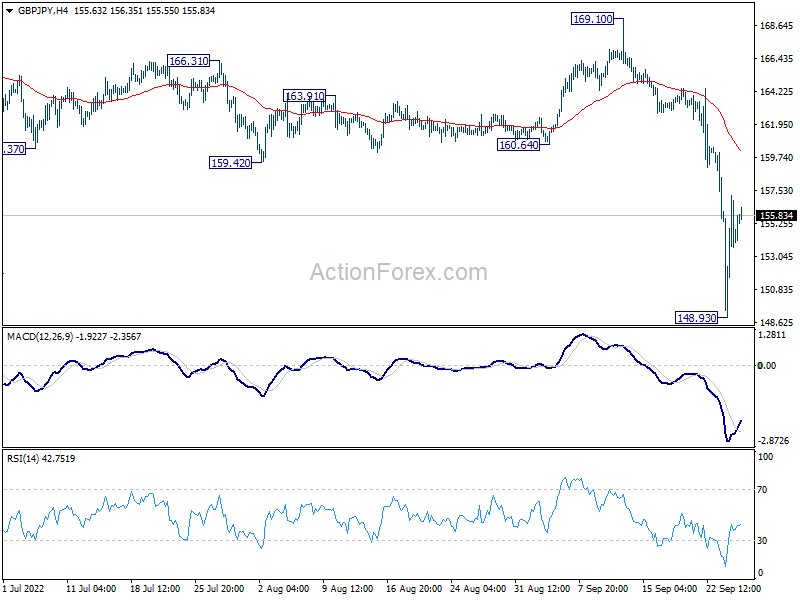
Intraday bias in GBP/JPY remains neutral for consolidation above 148.93. For now, risk will stay on the downside as long as 160.64 support turned resistance holds. Break of 148.93 will resume the decline from 169.10 towards 141.19 fibonacci level.
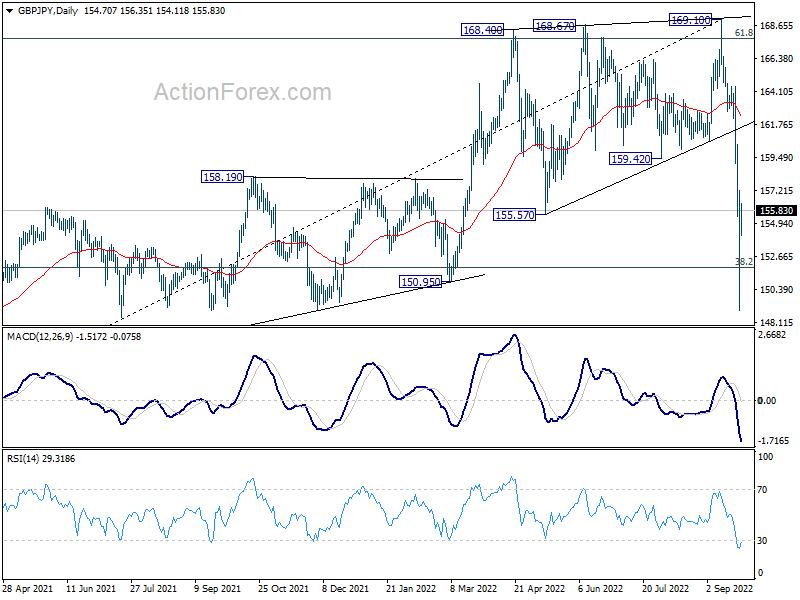
In the bigger picture, rise from 123.94 (2020 low) has completed at 169.10. 38.2% retracement of 123.94 to 169.10 at 151.84 is already met, and there could be some support from there for rebound. But risk will now stay on the downside as long as 169.10 resistance holds. Sustained trading below 151.84 will target 61.8% retracement at 141.19.
EUR/JPY Daily Outlook
Daily Pivots: (S1) 137.79; (P) 138.65; (R1) 139.91; More....
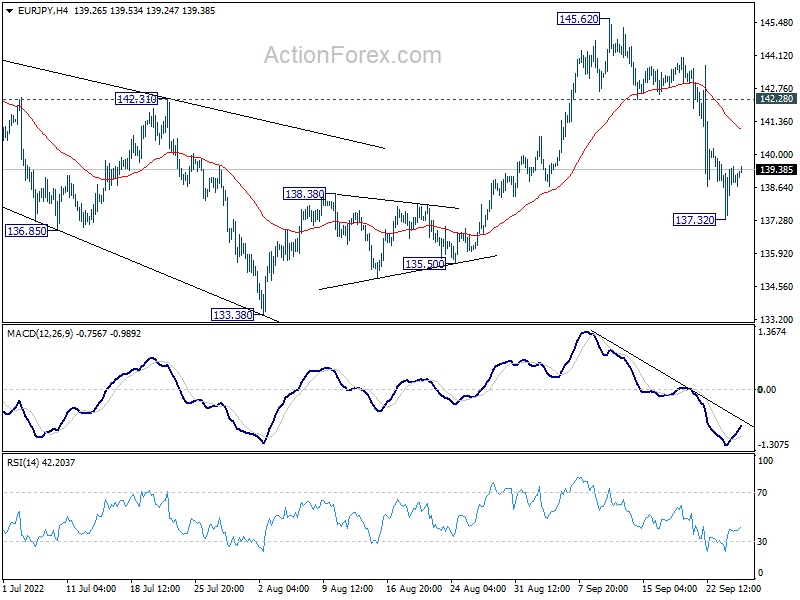
Intraday bias in EUR/JPY stays neutral first, as it lost momentum after hitting 137.32. On the downside, break of 137.32 will resume the decline from 145.62 to 133.38 key support next. On the upside, though, break of 142.28 will turn bias back to the upside for retesting 145.62 high.
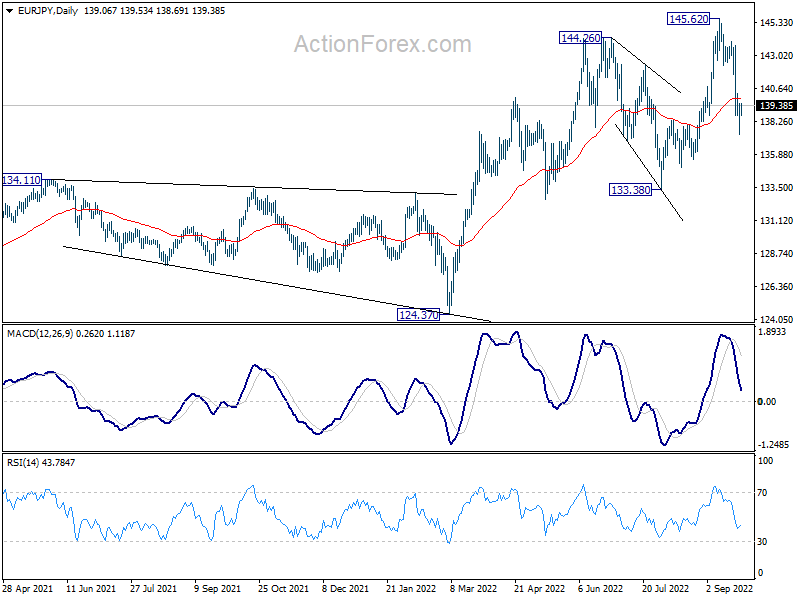
In the bigger picture, as long as 133.38 support holds, the up trend from 114.42 (2020 low) could still extend through 145.62 high. In that case, next target 149.76 (2015 high). However, sustained break of 133.38 will be a sign of medium term bearish reversal and bring deeper fall to 124.37 support first.
EUR/GBP Daily Outlook
Daily Pivots: (S1) 0.8812; (P) 0.9031; (R1) 0.9205; More...
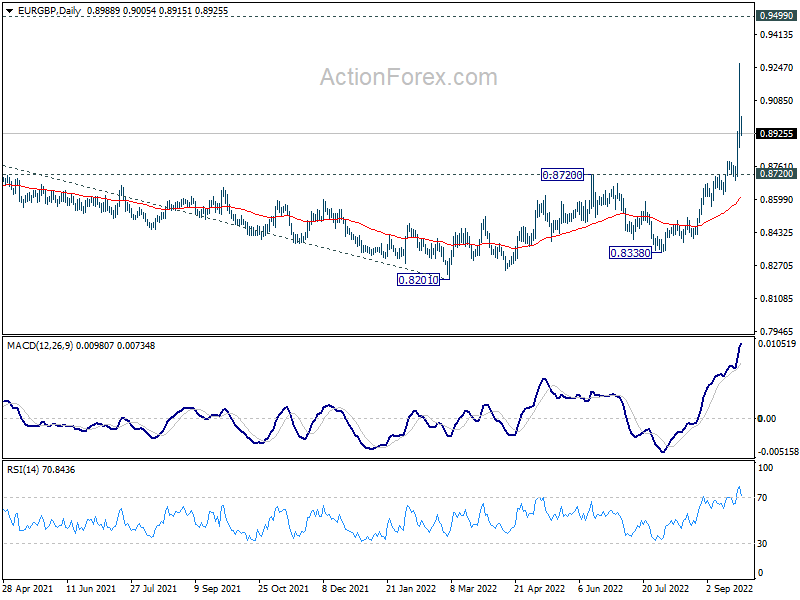
Intraday bias in EUR/GBP remains neutral at this point. Further rally is expected as long as 0.8720 resistance turned support holds. Above 0.9267 will target 0.9499 long term resistance. However, break of 0.8270 support will mix up the near term outlook.
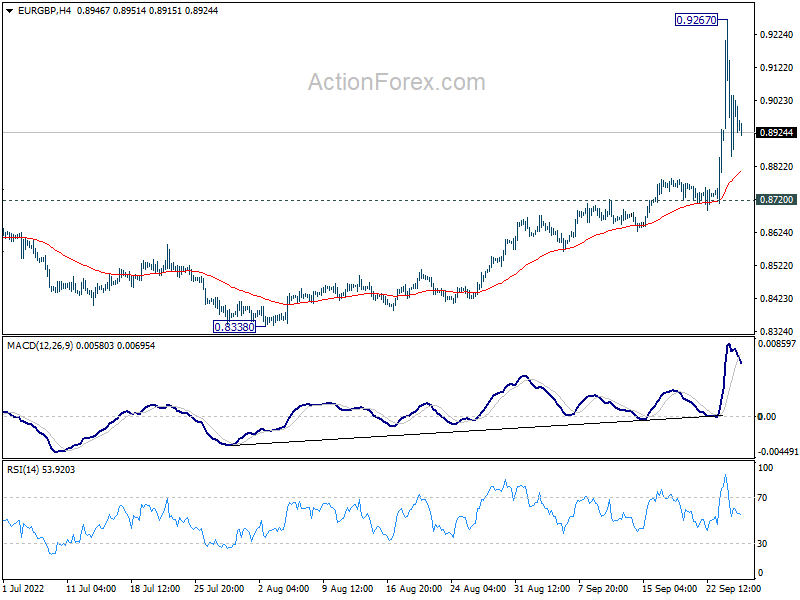
In the bigger picture, rise from 0.8201 is in progress targeting 0.9499 (2020 high) next. Based on current momentum, such rally should be resuming the up trend from 0.6935 (2015 low). Firm break of 0.9499 will target 61.8% projection of 0.6935 to 0.9499 from 0.8201 at 0.9786, which is close to 0.9799 (2008 high). This will now remain the favored case as long as 0.8720 resistance turned support holds.
EUR/AUD Daily Outlook
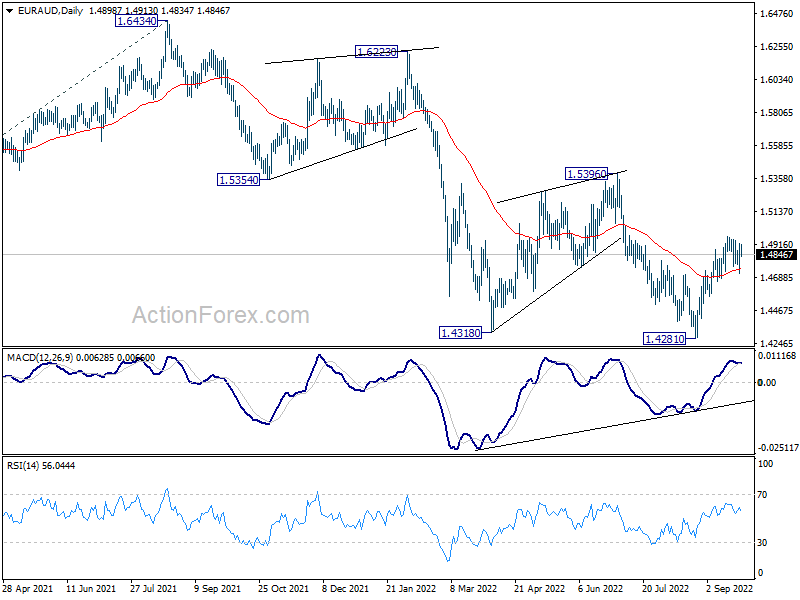
Daily Pivots: (S1) 1.4761; (P) 1.4843; (R1) 1.4963; More...
Intraday bias in EUR/AUD remains neutral as consolidation from 1.4965 is extending. Further rally is in favor as long as 1.4663 minor support holds. On the upside, break of 1.4965 will resume the rise from 1.4281 towards 1.5396 resistance. On the downside, however, break of 1.4663 minor support will turn bias back to the downside for retesting 1.4281 low.
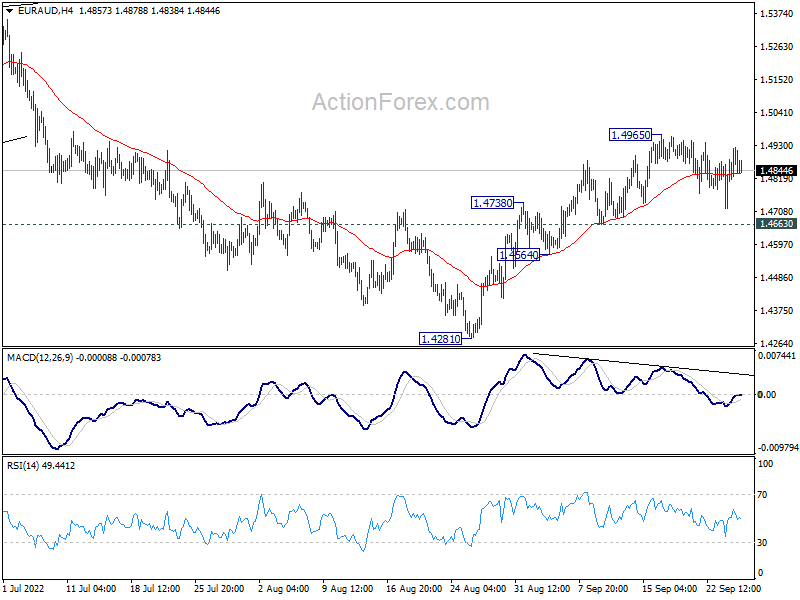
In the bigger picture, down trend from 1.9799 is still in progress. Break of 1.4318 low will target 61.8% projection of 1.9799 to 1.5250 from 1.6434 at 1.3623, which is close to 1.3624 long term support (2017 low). This will remain the favored case now as long as 1.5396 resistance holds.