Sample Category Title
Germany’s Business Climate Worsens Further
Business sentiment in Germany continued its substantial deterioration in September. The Ifo says the business climate index fell from 88.6 to 84.3 this month. The index has only been lower for two months in its history – in April and May 2020. The actual figures were weaker than expected, at 86.9 and marked a deterioration in the current assessment and economic expectations.
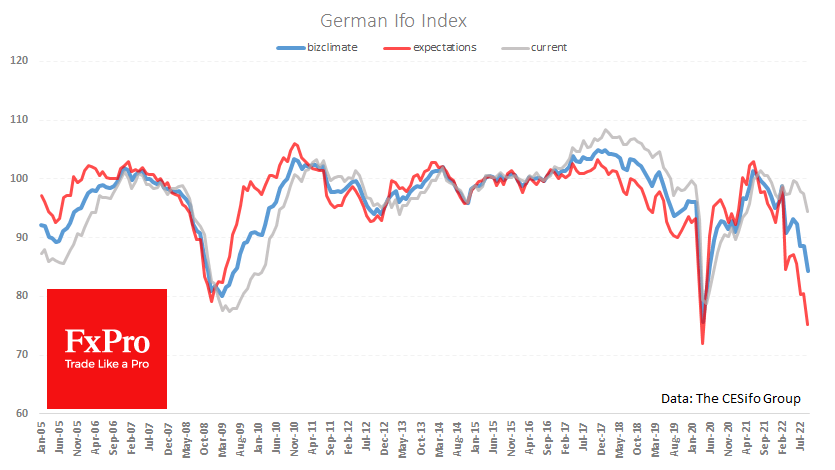
As usual, forward-looking markets pay more attention to the development of the expectations component, which recorded its second-lowest fall in history in September from 80.5 to 75.2. However, optimists may note that the current conditions did not deteriorate too sharply. The Index of Current Conditions in September fell from 97.5 to 94.5 against a historical average since 2005 of 96.7.
From the latter, it can be concluded that the brunt of the crisis in Germany is still only in the “heads” of the businessmen but could quickly become a self-fulfilling prophecy if expectations do not turn sharply upwards in the coming months.
Brent Dropped to Its February Lows
The commodity market is now experiencing a huge stress due to concerns of the reduction in demand for energies. Early in the week, Brent dropped to $85.35 and no other negative factors have appeared since then. However, those that are already here are enough for investors to remain worried. The key aspect is a progressive decline in the global economy, which might cause a serious drop in demand for commodities in general, and in oil in particular.
The Dollar index has reached its multi-year highs and may yet continue to improve. For the commodity market, it’s a negative signal.
In addition, there is a technical factor – when the asset was trying to break $90, bears immediately became more active and the price fell.
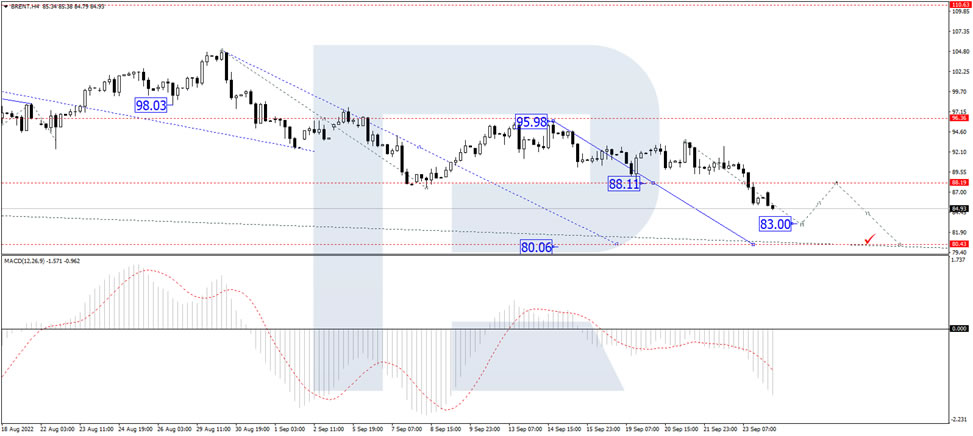
On the H4 chart, having broken 88.20 to the downside, Brent continues to fall towards 80.50 and may soon reach 83.00. Later, the market may correct to test 88.20 from below and then start another decline with the closest target at 80.50. From the technical point of view, this scenario is confirmed by the MACD Oscillator: its signal line is moving below 0 and may later continue trading to reach new lows.
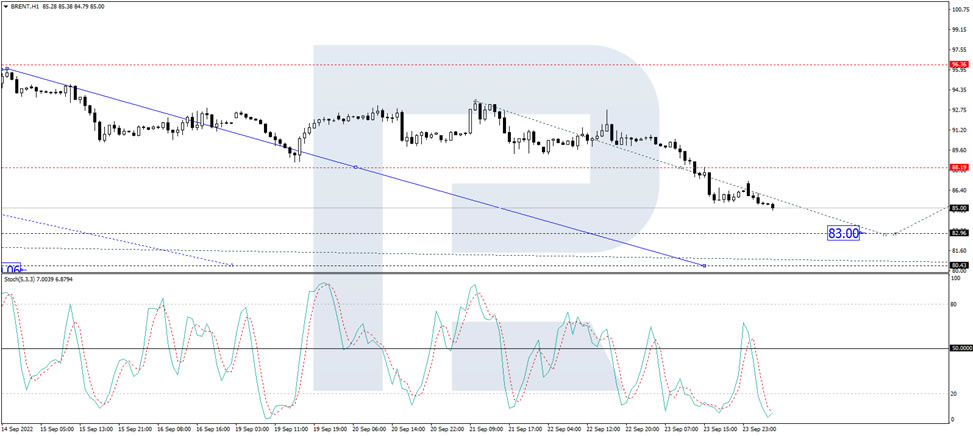
As we can see in the H1 chart, after forming a new consolidation range around 88.20 and breaking it to the downside, Brent is still moving downwards with the short-term target at 83.00. Later, the market may correct to return to 88.20 and then resume falling towards 80.50. From the technical point of view, this idea is confirmed by the Stochastic Oscillator: its signal line is moving near the lows below 20. Later, the line may grow to rebound from 50 and resume falling to return to 20.
BoE to assess the government’s growth plan at “next scheduled meeting”
BoE Governor Andrew Bailey said in a statement that it's "monitoring developments in financial markets very closely in light of the significant repricing of financial assets.
He pointed to the UK government's Growth Plan announced on Friday and he "welcome the Government's commitment to sustainable economic growth".
The MPC will make a full assessment "at its next scheduled meeting" of the impact of the plan on demand and inflation, and the fall in Sterling, and "act" accordingly.
Fed Collins: A more modest slowdown is achievable
Boston Fed President Susan Collins said, "I do anticipate that accomplishing price stability will require slower employment growth and a somewhat higher unemployment rate." But she added that "the goal of a more modest slowdown, while challenging, is achievable."
"A significant economic or geopolitical event could push our economy into a recession as policy tightens further," she warned. "Moreover, calibrating policy in these circumstances will be complicated by the fact that some effects of monetary policy work with a lag."
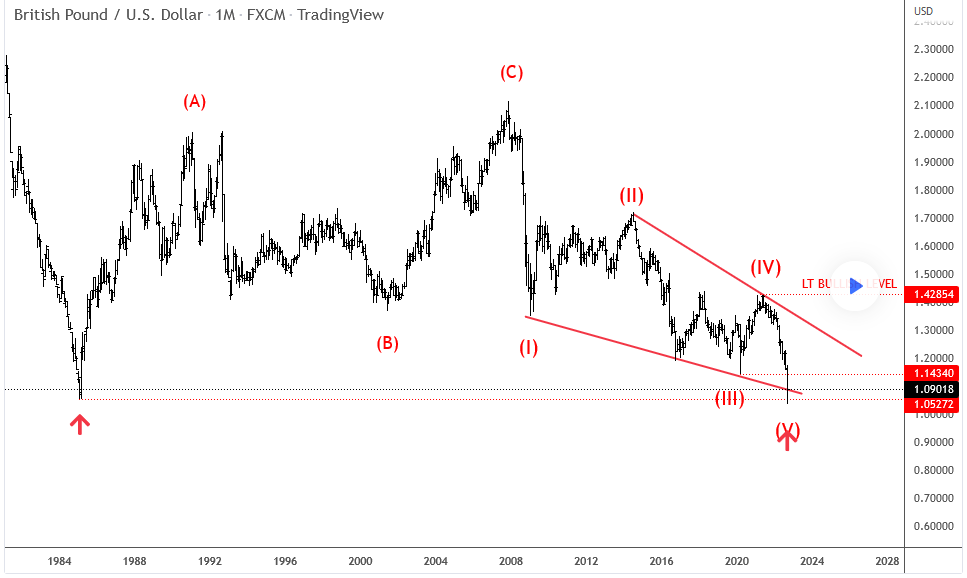
Cable, the Big Wedge Pattern
Cable is breaking down hard after British finance minister Kwasi Kwarteng's announced tax cuts on energies. The plan is for households to save some money and to expand the supply side of the economy, but investors seem pessimistic about that, at least for the short-term period.
We see cable coming down hard, but price is moving into 1985 low with a potential throw-over formation with the current wedge pattern, so from a long-term perspective, the multiyear support may not be far away.
We will see what will the BoE response, but intervention or hawkish view can try to be supportive for the pound. Traders are already pricing 200bp of BOE hike by November this year.
WTI Oil: Bears are Pausing Above New Multi-Month Low
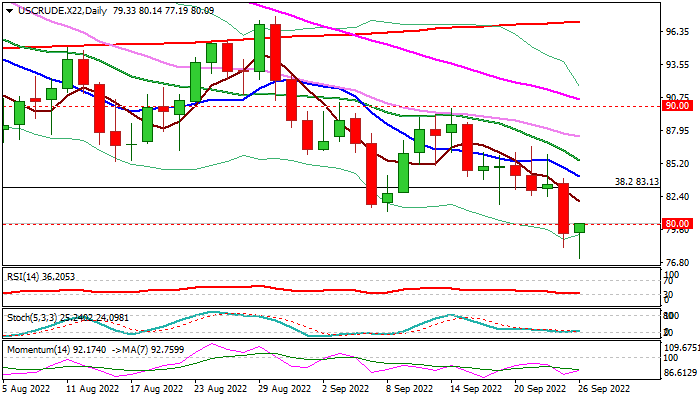
WTI oil price falls to new multi-month low on Monday ($77.19, the lowest since Jan 5), in extension of last Friday’s 5.1% drop and a weekly loss of 6.5%, on track for the fourth consecutive strong monthly fall.
Near-term action is consolidating above new low, but so far remains capped by broken psychological $80 support, which reverted to solid resistance.
Oil is in steep downtrend since mid-June, as stronger dollar and growing fears that large economies are sliding into recession that would strongly hurt demand, offset concerns about supply shortage on the shockwaves that the conflict in Ukraine send through the energy markets and economies.
Strong bearish signal has been generated on a weekly close below key supports at $83.13/$80.00 (Fibo 38.2% of post-pandemic $6.52/$130.48 rally / psychological) adding to previous signal on completion of failure swing pattern on weekly chart.
The downtrend was so far contained by rising 100WMA ($77.78), which may provide a temporary base and allow larger bears to consolidate.
Technical studies remain bearish on daily chart and turning to negative setup on weekly, while momentum indicator on monthly chart is pressuring the centreline, on track to break into negative territory, complementing weak fundamentals.
Repeated daily close below $80 level would keep immediate bears intact, though extended upticks cannot be ruled out, but expected to stall under falling 10 DMA ($84.00) to keep larger bears unharmed.
Res: 81.17; 81.73; 83.13; 84.00
Sup: 78.48; 77.78; 77.19; 74.25
Sunset Market Commentary
Markets
UK yield markets remain a barometer for broader trends. UK yields again jump between 50 (+)bps (2-y) and 20 bps (30-y). The government’s voluntary fiscal policy aimed at supporting growth and shielding citizens’ purchasing power is on collision course with the BoE’s aim to cope with inflation via a slowdown in demand. This institutional collision between the fiscal and monetary authority triggered selling both in UK gilts and sterling. UK risk prima are mounting. Cable before the open of UK markets briefly dropped below the 1.0520 1985 low. EUR/GBP filled offers in the 0.9265 area. Tensions in FX markets gradually ‘eased’ throughout the session. EUR/GBP returned below the 0.90 handle (0.892). Some investors maybe took profit on sterling shorts as the interest rate differential makes sterling shorts more costly. Still the huge swings in Gilts suggest that the confidence crisis in the UK economy and its fiscal position is far from over. ‘Sources’ said the BoE might come with a statement later, but this isn’t confirmed yet.
The UK isn’t the only country to make difficult choices between keeping growth afloat and combating inflation. The German IFO business climate index dropped much more than expected (84 from 88.6). All subsectors (manufacturing, services, trade and construction) turned more negative both on current conditions and even more on expectations. Ifo concludes that the German economy is slipping into recession. Contrary to the market paradigm that reigned until this summer, recession fears don’t trigger expectations on CB support anymore. With September EMU and German inflation this week expected near 10%, interest rates continue their march north. EMU swap yields are rising up to 13 bps (5-y). The EMU 10-y swap yield touched 3.0% for the first time since 2011. European investors also faced the outcome of the Italian parliamentary elections as the rightwing coalition secured a majority. Markets still have to wait for details on the new coalition’s (reform and EU) agenda. Even so, with the 10-y Italian spread vs Germany rising ‘only’ 5 bps, any potential ‘Italian problem’ for now is seen as ‘secondary’ to the growth/inflation balance. US yields simply extend their uptrend rising between 6 bps (10-y) and 3/2 bps (2/30-y). Despite sharp swings on yield markets, the sell-off on equity markets is shifting into a lower gear. The EuroStoxx50 is switching between gains and losses. Still Friday’s close below the 3357 June low isn’t reversed yet. On FX markets, the dollar firmly stays in pole position after touching a new multi-year top in Asia this morning (DXY top 114.52). However, the rush on the US currency gradually eased during the day. DXY currently trades near 113.35. EUR/USD rebounds off this morning’s low at 0.9554 to currently trade near 0.9665. Even so, the EUR/USD downtrend remains firmly in place. It’s much too early to already consider the idea of some kind of an exhaustion move.
News Headlines
Czech September confidence indicators deteriorated further. The composite index fell from 1.7 to -2.6, the lowest since March 2021. Business confidence dropped from 9.6 to 5.2 with industry, selected service sectors and trade all contributing negatively. Sentiment in construction improved slightly. Consumer confidence crashed from -29.8 to -33.8, the lowest level since monitoring began back in 2016. According to CSO respondents are more worried about the overall economic situation and their own financial situation. The Czech National Bank on Thursday is expected to keep the policy at 7%, giving more weight to the economic backdrop than to inflation given their frontloading efforts since last Summer. The CNBis currently avoiding a weakening of the CZK beyond EUR/CZK 24.70 via FX interventions.
Belgian business confidence crashed from -5.8 to -11.8, the lowest level since November 2020. Manufacturing fell from -7.2 to -13.9, trade from -11.9 to -24.1 and building industry from -5.6 to -6. The loss of confidence was particularly abrupt in the retail sector. Demand forecasts collapsed, after having recovered in August, and those for orders placed with suppliers fell again. The downward revision of the employment outlook was somewhat less marked. Last week, Belgian consumer confidence plummeted from -11 to -27 in September, dropping below the Covid-lows of -26, to the weakest level since August 1985.
GBP/JPY Mid-Day Outlook
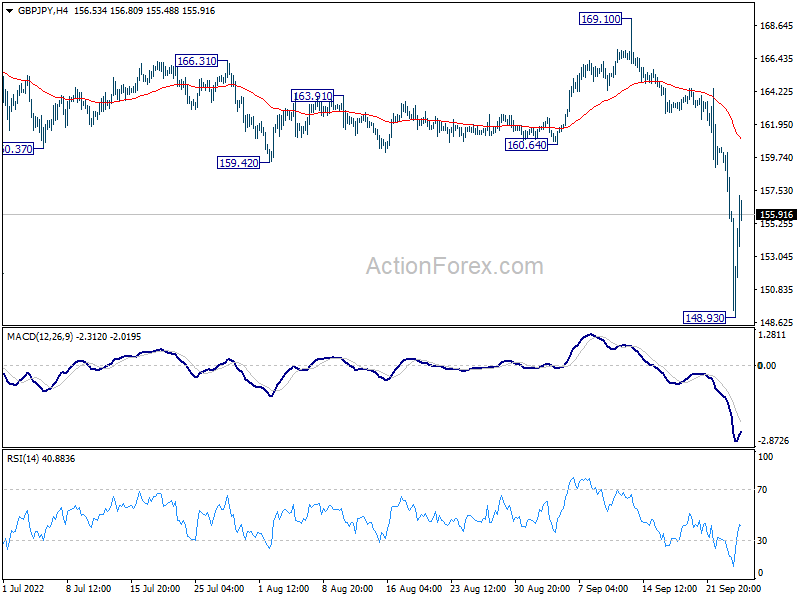
Daily Pivots: (S1) 153.81; (P) 157.13; (R1) 158.80; More...
GBP/JPY recovered strongly after diving to 148.93. Intraday bias is turned neutral first. For now, risk will stay on the downside as long as 160.64 support turned resistance holds. Break of 148.93 will resume the decline from 169.10 towards 141.19 fibonacci level.
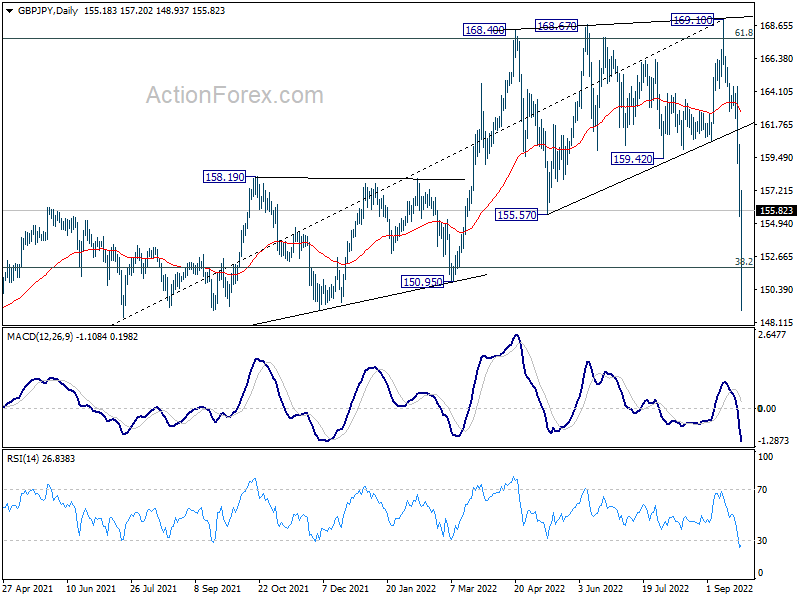
In the bigger picture, rise from 123.94 (2020 low) has completed at 169.10. 38.2% retracement of 123.94 to 169.10 at 151.84 is already met, and there could be some support from there for rebound. But risk will now stay on the downside as long as 169.10 resistance holds. Sustained trading below 151.84 will target 61.8% retracement at 141.19.
EUR/GBP Mid-Day Outlook
Daily Pivots: (S1) 0.8784; (P) 0.8860; (R1) 0.9008; More...
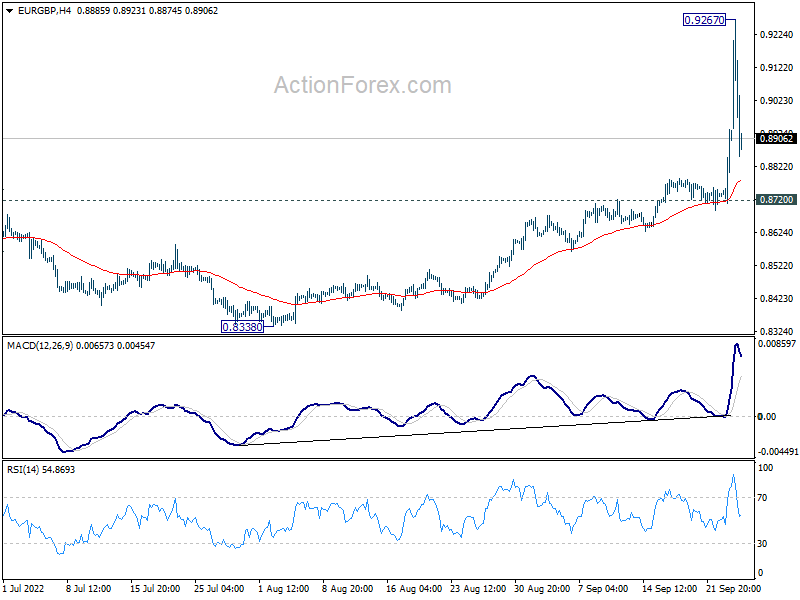
EUR/GBP retreated sharply after rising to 0.9267. Intraday bias is turned neutral first. Further rally is expected as long as 0.8720 resistance turned support holds. Above 0.9267 will target 0.9499 long term resistance. However, break of 0.8270 support will mix up the near term outlook.
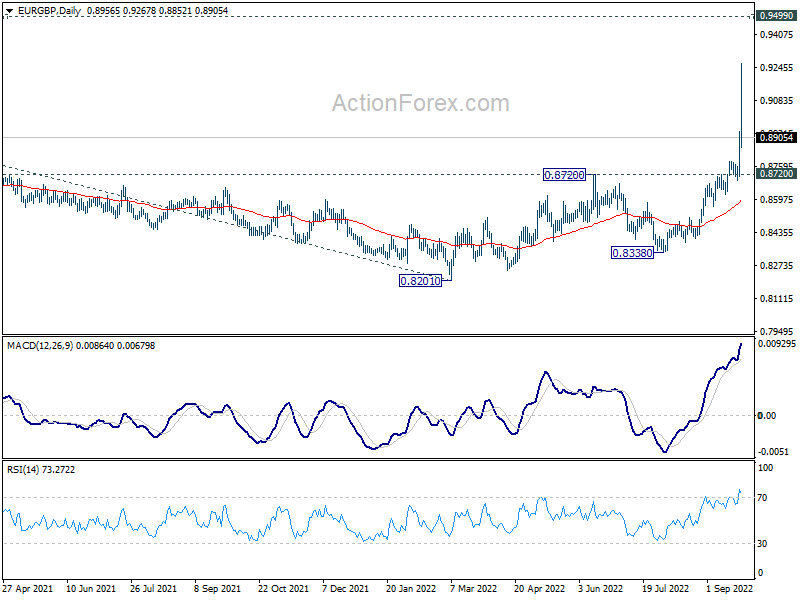
In the bigger picture, rise from 0.8201 is in progress targeting 0.9499 (2020 high) next. Based on current momentum, such rally should be resuming the up trend from 0.6935 (2015 low). Firm break of 0.9499 will target 61.8% projection of 0.6935 to 0.9499 from 0.8201 at 0.9786, which is close to 0.9799 (2008 high). This will now remain the favored case as long as 0.8720 resistance turned support holds.
USD/JPY Mid-Day Outlook
Daily Pivots: (S1) 142.27; (P) 142.87; (R1) 143.96; More...
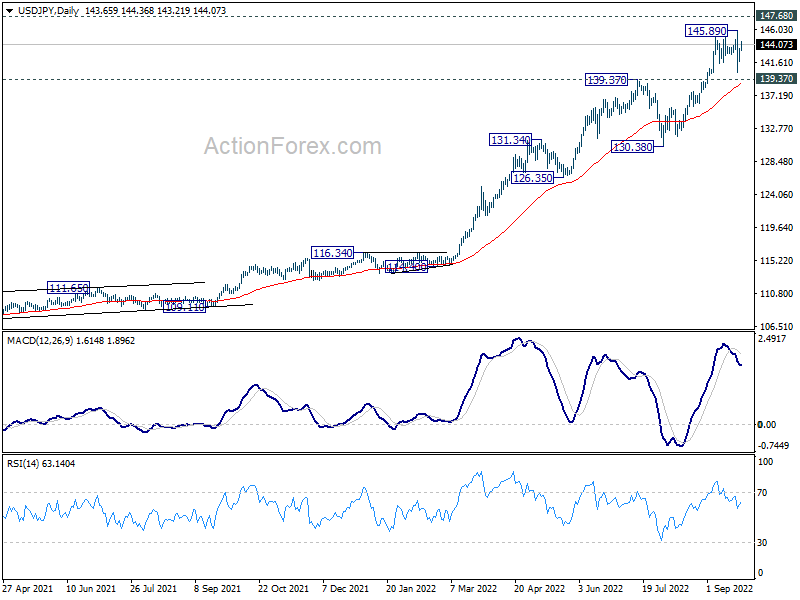
Intraday bias in USD/JPY stays neutral for consolidation below 145.89. Further rally is expected as long as 139.37 resistance turned support holds. Break of 145.89 will target 147.68 long term resistance. On the downside, however, decisive break of 139.37 will confirm short term topping. Deeper decline would be seen back towards 130.38 support.
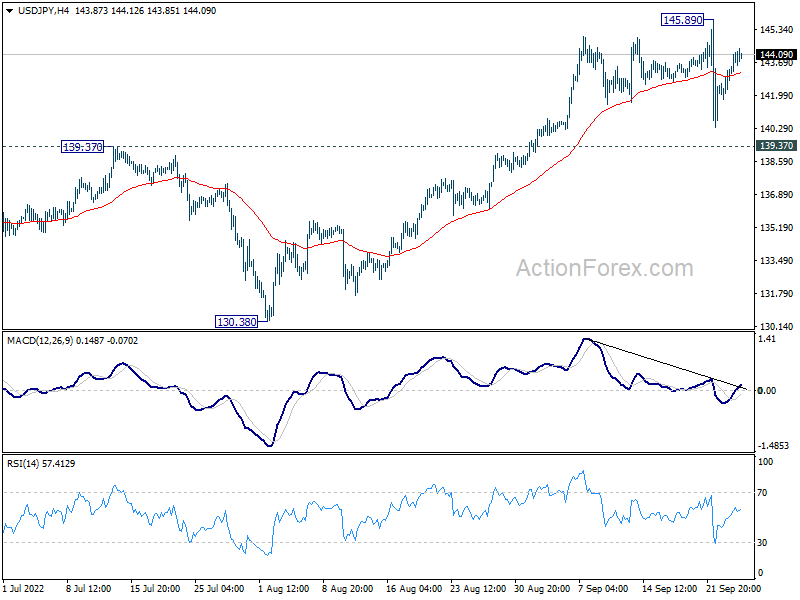
In the bigger picture, up trend from 101.18 is still in progress, as part of the whole up trend from 75.56 (2011 low). Further rise should be seen to 147.68 (1998 high). For now, break of 130.38 support is needed to be the first indication of medium term topping. Otherwise, outlook will stay bullish even in case of deep pull back.