Sample Category Title
DAX 40 Falls Through Critical Floor
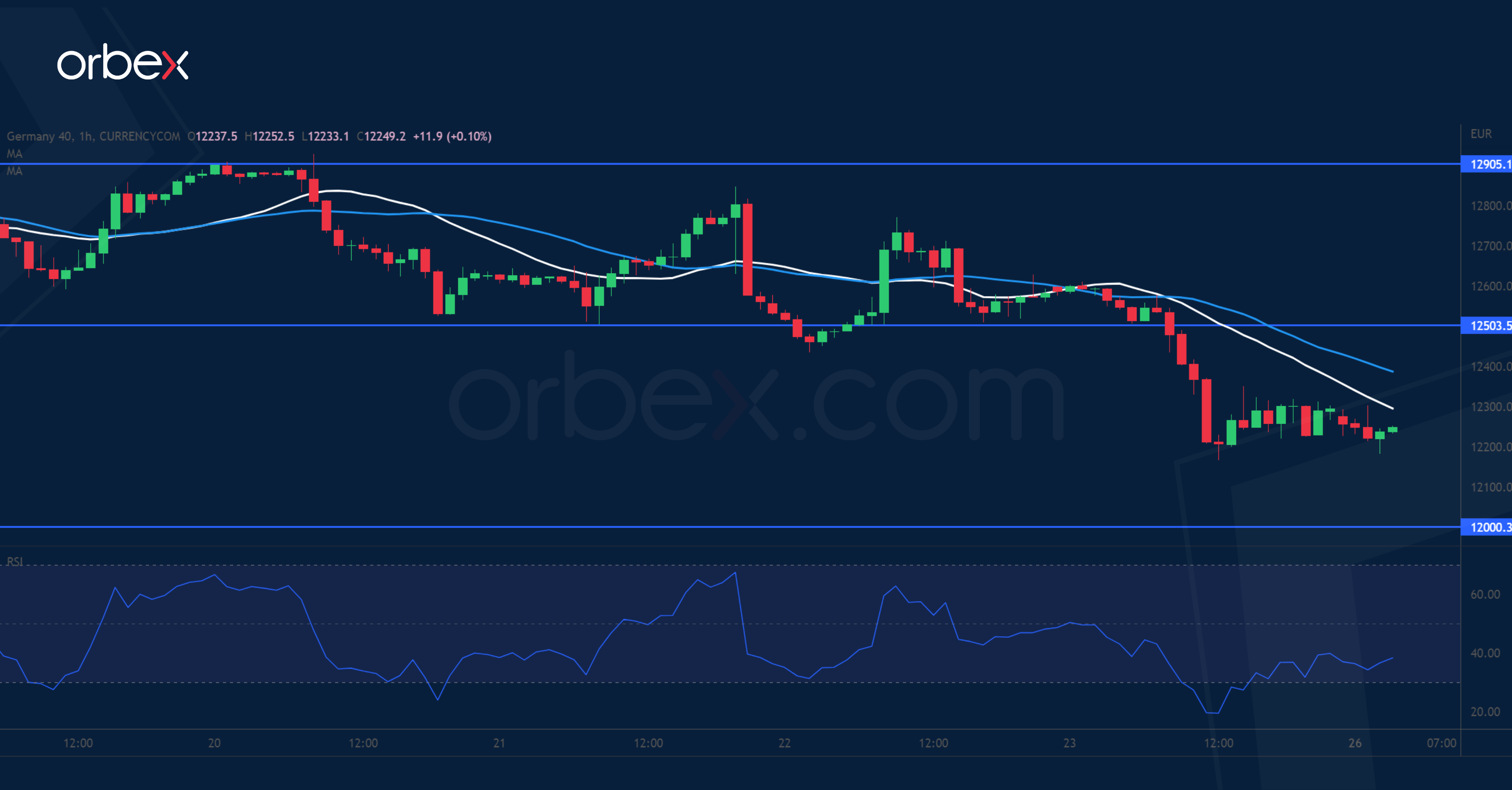
The Dax 40 plunged over wide-spread unease about the direction of inflation and rate hikes. A fall below the double bottom at 12420 invalidated the bounce over the past few months and signalled a return to the bear market. Strong momentum is a sign of liquidation as the last bulls rush to the exit. As the RSI sank into the oversold area, the psychological level of 12000 may see some buying. However, bounces may be capped below 12500 where the bears could double down and push towards October 2020’s low around 11400.
EUR/GBP Breaks Higher
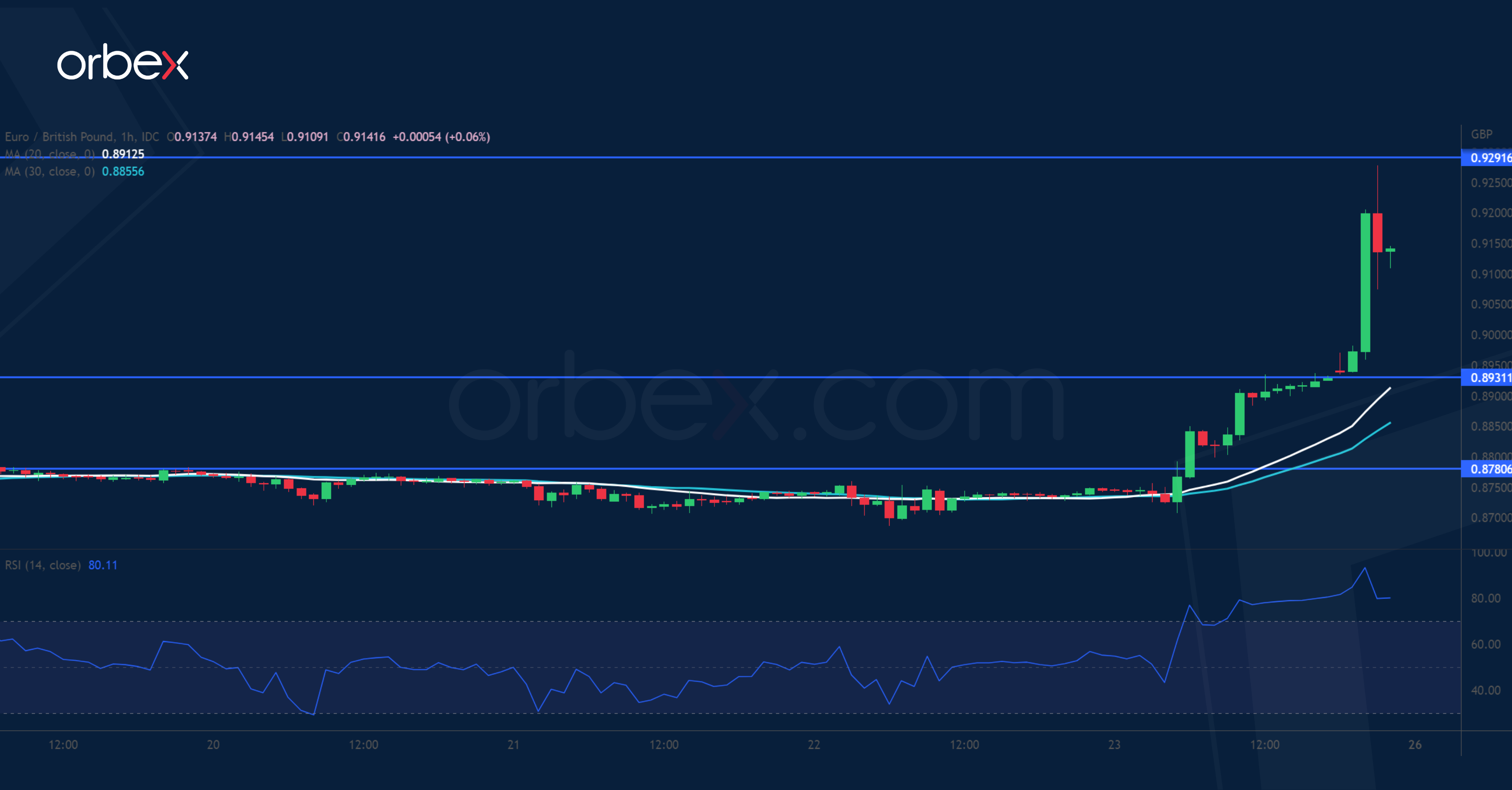
The pound tumbles as Britain’s new fiscal stimulus raises doubts about its debt burden. A previous break above June’s high at 0.8720 had flushed out the remaining selling interest. Following a brief consolidation, the euro’s surge above 0.8780 triggered a runaway rally to a two-year high at 0.9290. The RSI’s extreme overbought condition may cause profit-taking with 0.8930 near the base of the momentum and the 20-hour moving average as a fresh support. Further extension may carry the pair to March 2020’s high at 0.9500.
USD/CAD Breaks Major Resistance
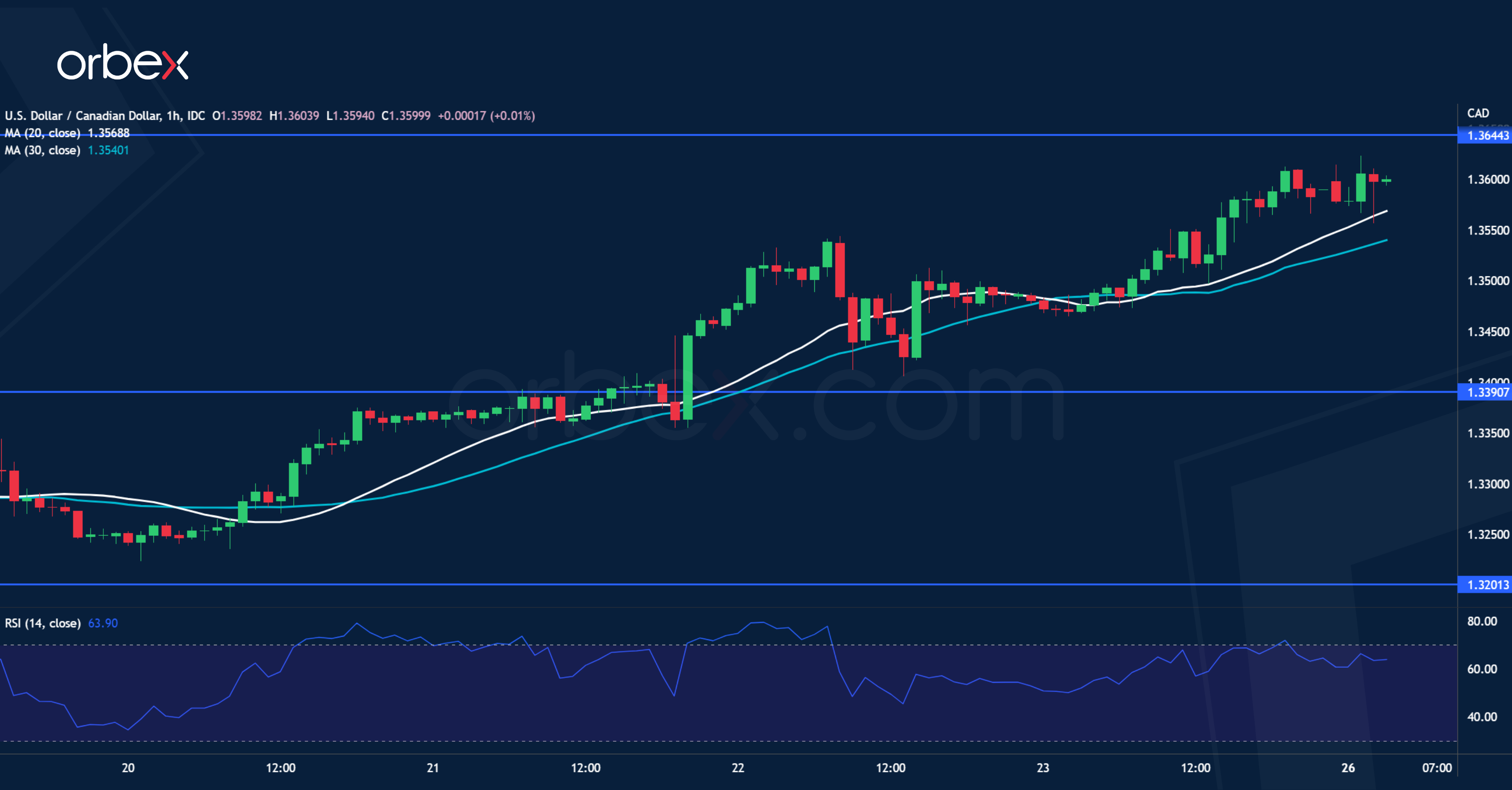
The Canadian dollar slipped after July’s retail data fell short of expectations. The current rally continues to accelerate after the US dollar rose to a fresh two-year high above 1.3420. A lack of selling pressure enables the bulls to push towards July 2020’s high at 1.3640. Though short-term price action could use a little breathing room after the RSI ventured into overbought territory multiple times. 1.3390 would be the first support in case of pullback, and strong interest could be expected from bullish trend followers.
UK Kwarteng Said There’s More to Come
Markets
UK (core?!) bonds got an incredible beating on Friday. Markets didn’t take the country’s borrowing and spending spree as presented by Min Fin Kwarteng well. Risk premia (gaping deficits) as well as BoE tightening bets sharply rose, leading to yield changes of a whopping 43.3 bps at the short end of the curve and 26.9 bps further out.
Money markets expect a terminal policy rate near 5.5%, 100 bps more than just one week ago. European bonds were caught in the slipstream, unhindered by slightly weaker-than-expected PMIs. Swap yields surged 0.6 bps to 13.4 bps in a flattener, further inverting the curve. The 2y yield touched the 3% mark for the first time since 2008. US yields added 8.3 bps in the 2y tenor. Longer maturities again lost a few bps.
The sharp repricing triggered an equity sell-off. The EuroStoxx50 set a new 2022 low (3348). The S&P 500 narrowly prevented a close below the June troughs. Needless to say that sterling was the biggest loser in FX. EUR/GBP skyrocketed from the low 0.87 area to 0.893, the highest since early 2021. Cable dropped four full big figures to 1.086. EUR/USD tanked from 0.984 to just south of 0.97 as it went into Italian election weekend. Signs of nervousness were visible in the Italian/German spread (+11 bps).
Kwarteng in a BBC interview yesterday said that when it comes to tax cuts, “there’s more to come”. His comments spark a huge rout in the pound amid thinner trading. EUR/GBP briefly shot up to 0.927 before paring gains to 0.911 currently. GBP/USD hit an intraday low of 1.035, temporarily losing the 1985 support level at 1.0520. There’s market talk of an in-between BoE emergency meeting, just two days after its regular one.
The euro isn’t feeling well either, especially against USD, following the Italian election result. The right-wing coalition consisting of Brothers of Italy, Forza Italia and League are projected to secure 114 seats in the Senate, where 104 are needed for a majority. Meloni (BoI) is on track to become the first female Italian prime minister. She attacked the EU in her days as an activist. Although she moderated the tone, markets remain on edge. It’s also unclear still whether Meloni will deviate from Draghi’s reform plan, potentially hampering EU fund flows. For a moment, EUR/USD slipped below 0.96, testing the lower bound of the downward trend channel and the 2001 support.
Asian currencies including JPY and CNY (see below) are under pressure too. Today’s eco calendar is packed with central bank speeches with ECB’s Lagarde appearance before the Committee on Economic and Monetary affairs as the highlight. If anything, they are only to support the ongoing moves on markets, i.e. higher core bond yields, stronger dollar and weaker equities.
News Headlines
The People’s Bank of China will impose a risk reserve requirement of 20% on banks’ foreign-exchange forward rate agreements with clients. The measure aims to stabilize foreign exchange market expectations and to strengthen macro prudential management. De facto, the measure is raising the cost of buying dollars via forward contracts which should support/ease pressure on the yuan. The CNY continues to lose further ground this morning against a broadly stronger dollar. USD/CNY trades at 7.164 and is nearing the 2019 top of 7.1876. A break above that level would bring the Chinese currency to the weakest level since 2008.
The finance minister of South Korea indicated that the government is preparing more measure to stabilize the foreign exchange market after it secured a currency swap agreement with the Korean Central bank and a pension fund on Friday. The finance minister left open the option of a currency swap deal between the Bank of Korea and the Fed, but indicated that it isn’t necessary yet. USD/KRW currently trades at 1434, the weakest level for the won since 2009.
According to property website Rightmove, UK house prices rose further by 0.7% M/M to be up 8.7% Y/Y (was 8.2% in August). Rightmove also indicated that Friday’s announcement of UK Chancellor of the Exchequer Kwasi Kwarteng to cut the stamp duty on home buyers is likely to simulate demand further.
The Day after Draghi
The FX markets kick off the week on an extremely chaotic note. Both the pound and the euro are being severely punished for the political decisions that are taken in the UK and in Italy respectively.
Italy turns right
As expected, the far-right candidate Giorgia Meloni won a clear majority in Italy at yesterday’s election, with Brothers of Italy gaining more than 25% of the votes, versus only 4.4% back in 2018. And Meloni’s right-wing alliance with Salvini’s League and Berlusconi’s Forza Italia got around 43% of the votes: the terrible consequence of the pandemic, the war and the energy crisis.
It’s clear that Meloni’s future government will face a bumpy road as the energy crisis is looming, inflation is skyrocketing, the interest rates will be rising steeply, while the euro keeps falling – a part of it being due to Italy itself – and cherry on top, recession is where the continent is headed to.
Of course, Italy’s most problems are true for any leader that would take the reins of the country, but the biggest concern for investors regarding Meloni, is whether the new far-right Italian government would deviate from the reforms that Draghi put in place, which actually helped Italy get the EU on its side – given that Draghi knew well how to dance with the rest of the Europe. The same is not true for Meloni.
Britain has been an excellent example of the lone sheep being in danger of the wolf.
The EURUSD has been shattered this morning. The pair dived to 0.9550, and will certainly remain under the pressure as the Italian yields will likely detach from the rest of the EZ and run toward the north. The wider yield spread between Italian and German bonds will likely continue pressure the euro lower.
As a result, the European Central Bank should get more aggressive on its rate policy to stop the euro’s crumbling. But it may not get the euro’s back fast enough to avoid inflation spiral higher.
And the cherry on top, the PMI figures released last Friday were less than unpromising. The euro-area private-sector activity shrank for the third straight month due to rising inflation, and energy costs. And the latest PMI suggests that the European economy will shrink 0.1% this quarter, and the things get uglier to the end of the year.
Across the Channel, it rains even more
But it’s almost worst across the Channel, if that’s any consolation. Investors really hated the ‘mini budget’ announced in UK last Friday. Investors were expecting to hear about a huge spending package from Liz Truss government, but the package has been even HUGER than the market expectations.
The UK announced a £161 billion package that includes the biggest tax cuts since 1972 - around 50% more than what investors anticipated. The energy bill will cost the UK around £60 billion within the next 6 months, to hopefully provide the UK with a 2.5% annual growth rate.
This is what the politicians are telling.
What the market is hearing is: who will finance this spending? UK’s 10-year yield jumped more than 20% since last week.
If the reaction in the sovereign yields is normal, the market reaction in equities and in pound are disquieting.
Normally, you would’ve expected a huge fiscal spending package from one of the biggest economies in the world to at least boost the equities and the pound. It could’ve boosted equities because the amount of money that will be pushed into the system should start going around the economy, and in businesses’ pockets, and spur growth. But the FTSE dived near 2% on the news.
And it should’ve boosted sterling, because such a huge fiscal spending would result in a decent response from the Bank of England, which is now expected to respond with a 100bp hike at its next meeting to make sure that inflation doesn’t go out of control due to tens of billions of pounds that will flood the system. But the pound’s just gone under the water. Cable tanked below 1.0350 in Asia this morning. Parity is seen as almost certain.
And what does the UK’s Chancellor of Exchequer say to investors? ‘The market will do what they will’!
The only hope here is to see at least a sugar rush in the British economy to help investors digest information, but the next couple of years will probably be harsh for the UK.
Has anyone seen the US dollar?
The dollar index took a lift, and the dollar index is just crossing above the 114 mark at the time of talking.
Gold dived to $1626 on the back of soaring US dollar.
US crude oil plunged below $80 per barrel on the back of rising recession worries as the European continent seems to be going into a coma before winter. Of course, OPEC can do nothing about the cheaper oil, as what’s driving the market south is the worry of a bad recession looming.
The S&P500 tanked to the lowest levels since this summer but is still above the summer dip, whereas the Dow Jones has cleared the 30’000 support and is now below the summer dip, and is now at the lowest levels since November 2020.
The futures hint mostly at a bearish start, even though the FTSE futures are slightly in the positive this morning. But the mood is sour. Goldman Sachs slashed its year-end estimate for the S&P500 to 3600 from 4300.
I now start thinking, if both the equity and sovereign markets fall this dramatically, the Federal Reserve (Fed) will not be given the choice to continue tightening as aggressively as planned, even if inflation doesn’t come down at the speed the US policy makers are aiming for.
Italy Turns Right
Market movers today
A fairly quiet start to the week in terms of economic data, German September Ifo is expected to decline further in line with the PMIs released last Friday.
Markets will also focus on several central bank speeches throughout the week following the September meetings. Today, ECB's Lagarde, de Guindos and Panetta as well as Fed's Bostic and Mester will be on the wires.
Later in the week, we will get the Euro Area Flash HICP on Friday, which is expected to accelerate further. Official Chinese PMIs and US private consumption expenditures will also be released on Friday.
This morning we published our latest global update Big Picture - Chilling prospects for the global economy, 26 September. The German economy is very likely to fall into a recession already this year, while the euro area is also at risk. The US economy is seeing a near-term recovery, but tight financial conditions will increasingly weigh on the economy, leading to a mild recession in H1 2023. Thanks to policy stimulus and waning COVID-19 lockdowns, the Chinese economy will grow slightly above 5% in 2023. Risks to growth are clearly tilted to the downside from higher than anticipated inflation and more abrupt and prolonged policy tightening, especially in Europe.
The 60 second overview
Italy: Italy's election brought a resounding win for the right-wing coalition of Brothers of Italy, League and Forza Italy gaining about 44% of the vote, enough for a majority in both chambers of parliament (but falling short of a super majority that could have triggered constitutional changes). With the election outcome broadly in line with previous polls, the market reaction was muted and markets will now focus on the composition of the new government (especially the crucial finance ministry) which will likely not be in place at least until end October. A technocratic finance minister would help calm market fears about fiscal expansion, as would reassurances that the new government will continue to abide by EU fiscal rules. However, a difficult balancing act awaits, just as Italy is heading into the crucial 2023 budget season, with a slowing economy and calls for additional support for households and firms growing louder. Any attempts for big revisions to Italy's recovery and resilience plans and accompanying structural reforms will be seen as negative by the market, as it could endanger continued NGEU fund disbursements and any future activation of the ECB's TPI programme.
UK: UK Chancellor Kwarteng presented a tax cut package estimated at GBP 45bn (2% of UK GDP), making it the biggest tax cutting event since 1972. The UK economy already struggles with high inflation and a large current account deficit - tax cuts are likely to make matters worse in the near-term.
Equities: Equities in another steep drop Friday, bringing MSCI World down 4% last week and close to 20% lower year to date. VIX in a big jump higher to 30 and investors offloading risk across asset classes. Noteworthy, oil plunging and taking the energy sector down more than 6% Friday. Growth quality and Min vol outperforming but not in a full blown recession way as yields are not mowing lower. The sell-off last week initially triggered by higher yields not least in the US, but the Friday sell-off rooted in massive FX moves away from sterling and into especially the dollar. As UK announced another round of massive fiscal stimulus, UK gilt yields explode upwards, CDS spread widened and the energy crisis suddenly got a new layer of confidence crisis. Negative spill-over to with Dow -1.6%, S&P 500 -1.7%, Nasdaq -1.8%, and Russell 2000 -2.5%. Asian market in red this morning across the region while both US and European futures are lower.
FI: Global rates were in the hands of the UK on Friday amid the mini-budget presented by Chancellor Kwarteng. 5-10y Gilts led the sell-off (5y Gilts were 50bp higher on the day) that left the 5y and 10y EUR swap higher by 12bp and 8bp respectively, while the 30y point was broadly unchanged on the day. The 5s30s EUR swap curve is at record inverted levels at -77bp (-11bp on Friday).
FX: GBP fell sharply on Friday after UK announced tax cuts of 2% of GDP. EUR/GBP rose above 0.89. EUR/USD dropped below 0.97 and EUR/SEK came close to 11.00 level.
Credit: Credit markets closed a volatile week significantly wider and CDS indices trade at levels similar to spring 2020. Friday continued the weak risk sentiment with iTraxx Main 4.9bp wider to 130.4bp and iTraxx Crossover 18bp wider to 637.2bp.
Nordic macro
Nothing on the agenda in Sweden today, but later during the week we will get the minutes from the Riksbank meeting last week, where the board decided to hike the rate by 100bp but otherwise sending a rather dovish signal with a relatively flat rate path and continued QE reinvestments during Q4. The week is also full of Riksbank speeches starting Tuesday (Ingves, Jansson, Ohlsson and Flodén). In terms of data, we will especially focus on the NIER survey on economic confidence released on Wednesday. Consumer confidence is at the lowest level since early 1990s as rate hikes, energy prices and inflation erodes purchasing power. Manufacturing confidence has so far held up well but we have started to see signs of a deterioration which we expect to continue.
EUR/USD Daily Outlook
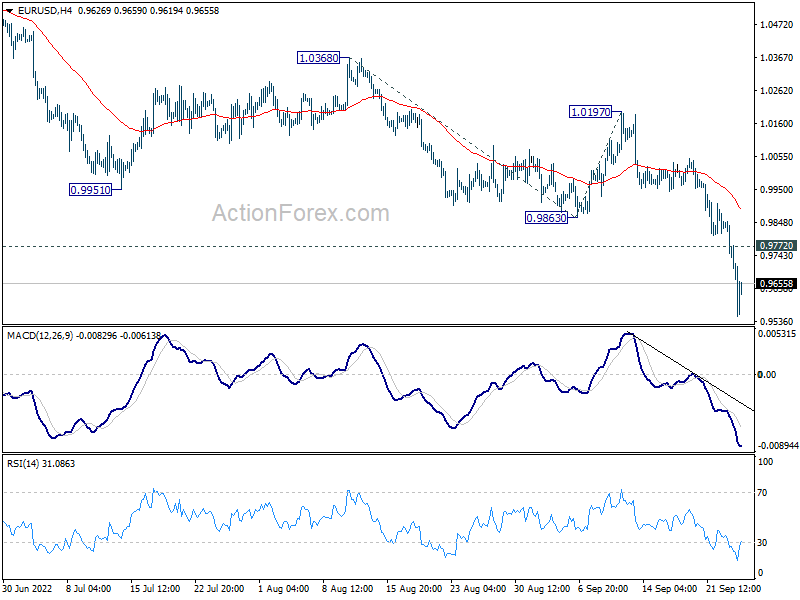
Daily Pivots: (S1) 0.9620; (P) 0.9736; (R1) 0.9804; More...
EUR/USD's down trend continues today and intraday bias stays on the downside. Next target is 161.8% projection of 1.0368 to 0.9863 from 1.0197 at 0.9380. On the upside, above 0.9772 minor resistance will turn intraday bias neutral and bring consolidations first, before staging another decline.
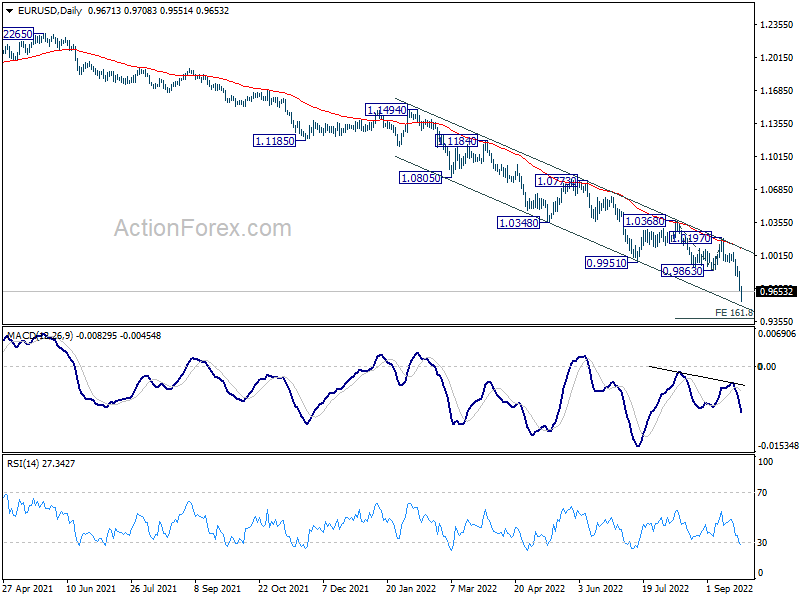
In the bigger picture, down trend from 1.6039 (2008 high) is still in progress. Next target is 100% projection of 1.3993 to 1.0339 from 1.2348 at 0.8694. In any case, break of 1.0197 resistance is needed to be the first sign of medium term bottoming. Otherwise, outlook will stay bearish even with strong rebound.
USD/JPY Daily Outlook
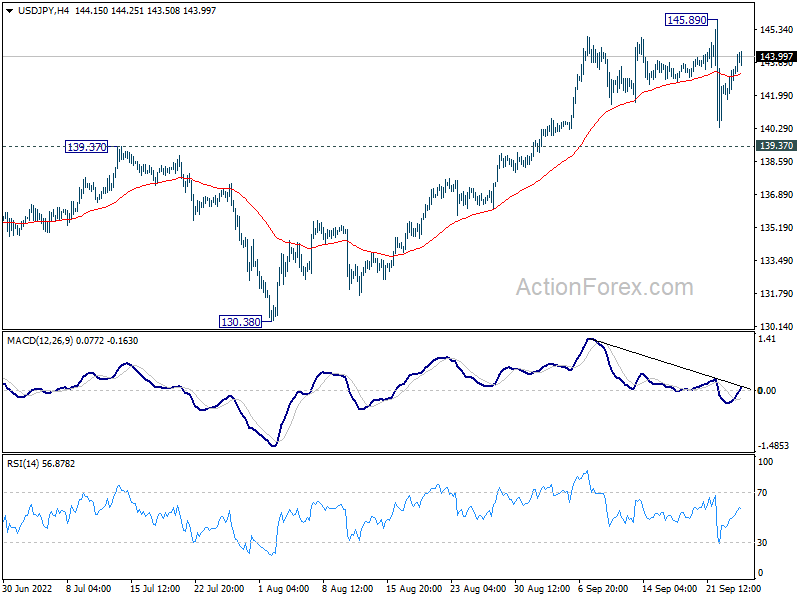
Daily Pivots: (S1) 142.27; (P) 142.87; (R1) 143.96; More...
Intraday bias in USD/JPY remains neutral and consolidation continues below 145.89. Further rally is expected as long as 139.37 resistance turned support holds. Break of 145.89 will target 147.68 long term resistance. On the downside, however, decisive break of 139.37 will confirm short term topping. Deeper decline would be seen back towards 130.38 support.
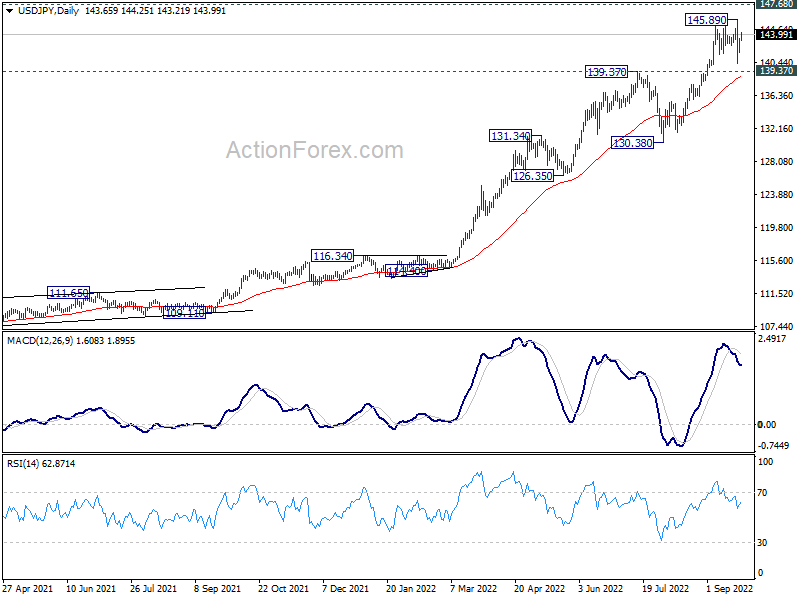
In the bigger picture, up trend from 101.18 is still in progress, as part of the whole up trend from 75.56 (2011 low). Further rise should be seen to 147.68 (1998 high). For now, break of 130.38 support is needed to be the first indication of medium term topping. Otherwise, outlook will stay bullish even in case of deep pull back.
GBP/USD Daily Outlook
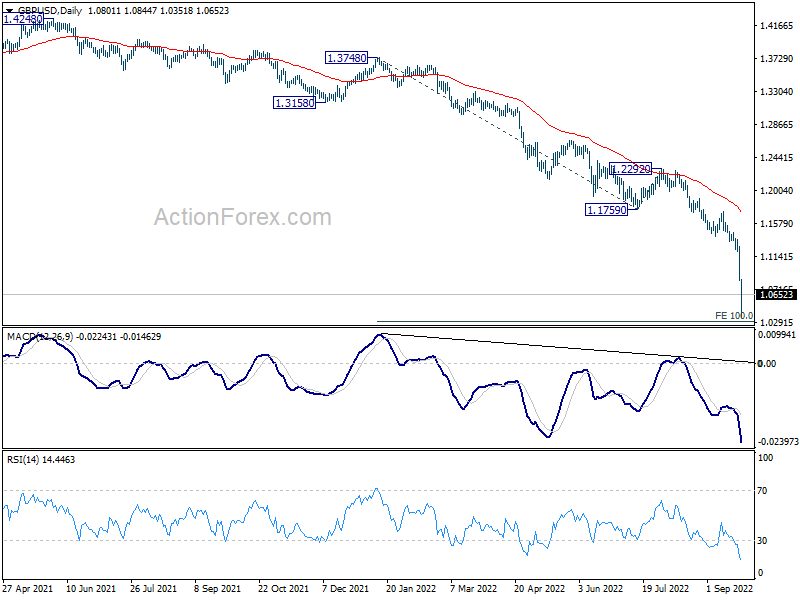
Daily Pivots: (S1) 1.0706; (P) 1.0990; (R1) 1.1140; More...
GBP/USD's decline continues today and reached as long as 1.0351. Intraday bias stays on the downside but some support could be seen from 100% projection of 1.3748 to 1.1759 from 1.2292 at 1.0303 to bring rebound. On the upside, break of 1.0844 minor resistance will turn intraday bias neutral first. However, sustained break of 1.0303 will target parity next.
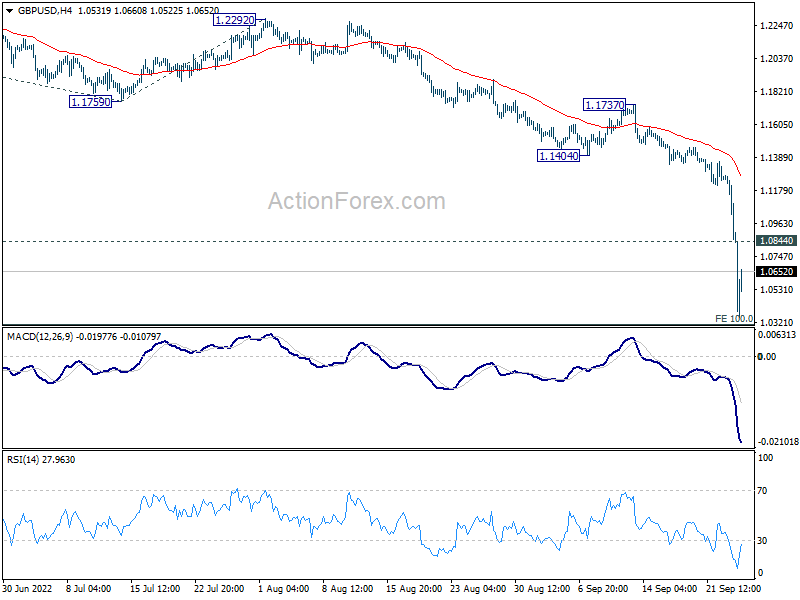
In the bigger picture, fall from 1.4248 (2018 high) is resuming long term down trend from 2.1161 (2007 high). Next target is 100% projection of 2.1161 to 1.3503 from 1.7190 at 0.9532. There is no scope of a medium term rebound as long as 1.1759 support turned resistance holds.
USD/CHF Daily Outlook
Daily Pivots: (S1) 0.9768; (P) 0.9804; (R1) 0.9854; More
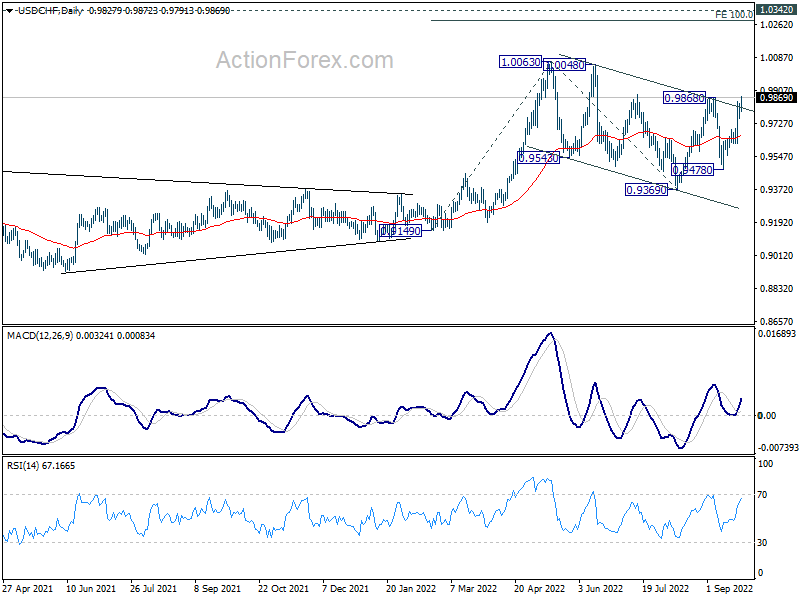
USD/CHF's break of 0.9868 resistance argues that larger up trend is resumed to resume. Intraday bias stays on the upside for retesting 1.0063 high first. Decisive break there will confirm this bullish case. on the downside, below 0.9754 minor support will turn intraday bias neutral and bring consolidations, before staging another rally.
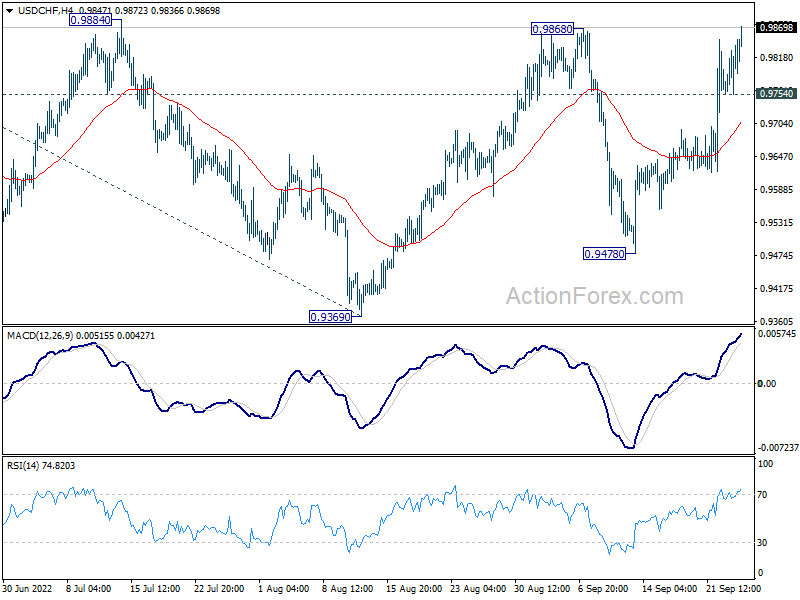
In the bigger picture, current development suggests that up trend from 0.8756 (2021 low) is still in progress. Sustained break of 1.0063 will target 100% projection of 0.9149 to 1.0063 from 0.9369 at 1.0283, and then 1.0342 (2016 high). For now, this will remain the favored case as long as 0.9369 support holds, even in case of deep pull back.