Sample Category Title
USD/CHF Mid-Day Outlook
Daily Pivots: (S1) 0.9768; (P) 0.9804; (R1) 0.9854; More
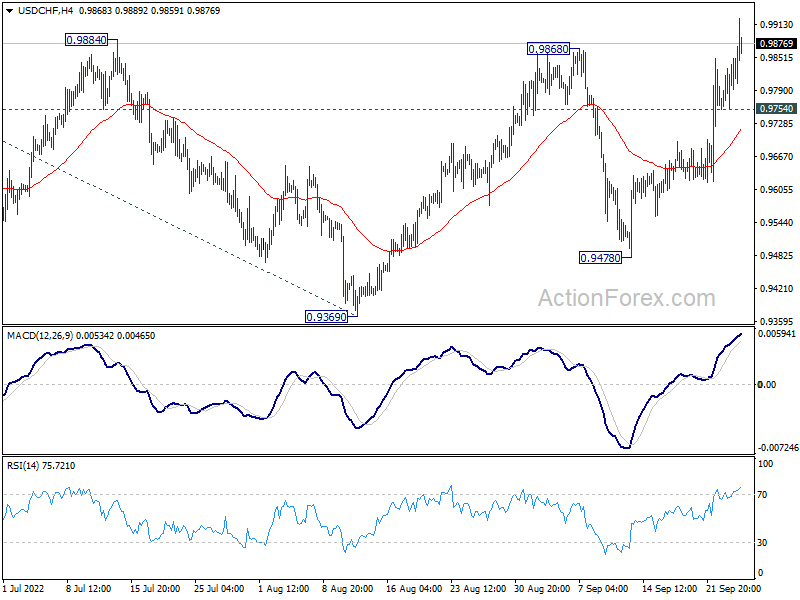
Intraday bias in USD/CHF remains on the upside for retesting 1.0063 high. Decisive break there will confirm resumption of larger up trend. On the downside, below 0.9754 minor support will turn intraday bias neutral and bring consolidations, before staging another rally.
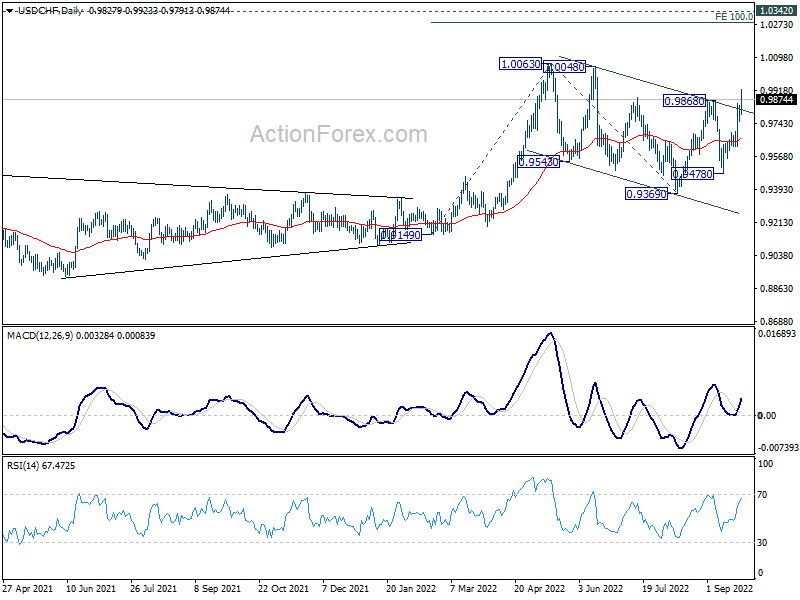
In the bigger picture, current development suggests that up trend from 0.8756 (2021 low) is still in progress. Sustained break of 1.0063 will target 100% projection of 0.9149 to 1.0063 from 0.9369 at 1.0283, and then 1.0342 (2016 high). For now, this will remain the favored case as long as 0.9369 support holds, even in case of deep pull back.
EUR/USD Mid-Day Outlook
Daily Pivots: (S1) 0.9620; (P) 0.9736; (R1) 0.9804; More...
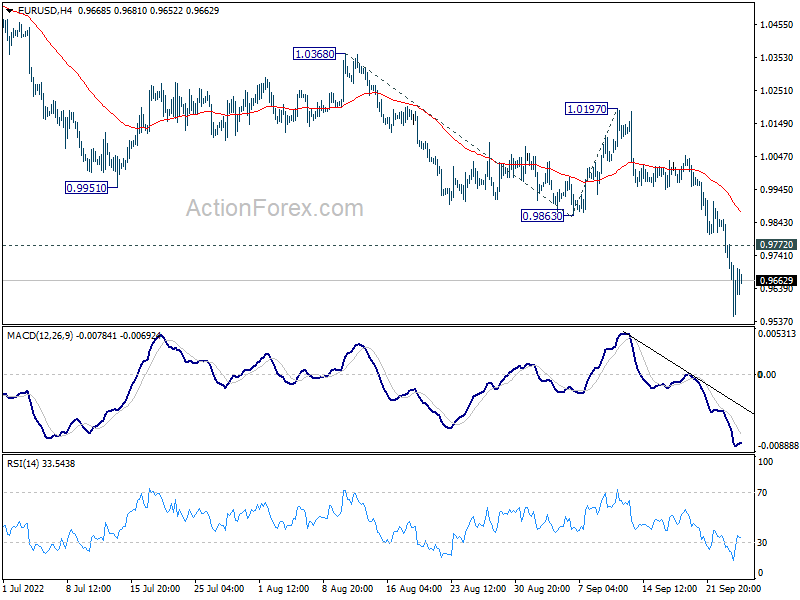
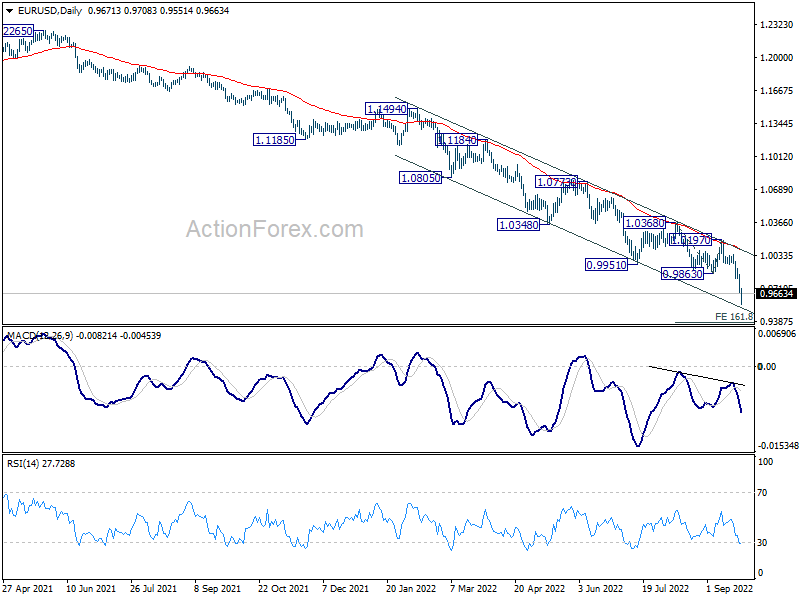
Intraday bias in EUR/USD stays on the downside at this point. Current down trend should target 161.8% projection of 1.0368 to 0.9863 from 1.0197 at 0.9380 next. On the upside, above 0.9772 minor resistance will turn intraday bias neutral and bring consolidations first, before staging another decline.
In the bigger picture, down trend from 1.6039 (2008 high) is still in progress. Next target is 100% projection of 1.3993 to 1.0339 from 1.2348 at 0.8694. In any case, break of 1.0197 resistance is needed to be the first sign of medium term bottoming. Otherwise, outlook will stay bearish even with strong rebound.
GBP/USD Mid-Day Outlook
Daily Pivots: (S1) 1.0706; (P) 1.0990; (R1) 1.1140; More...
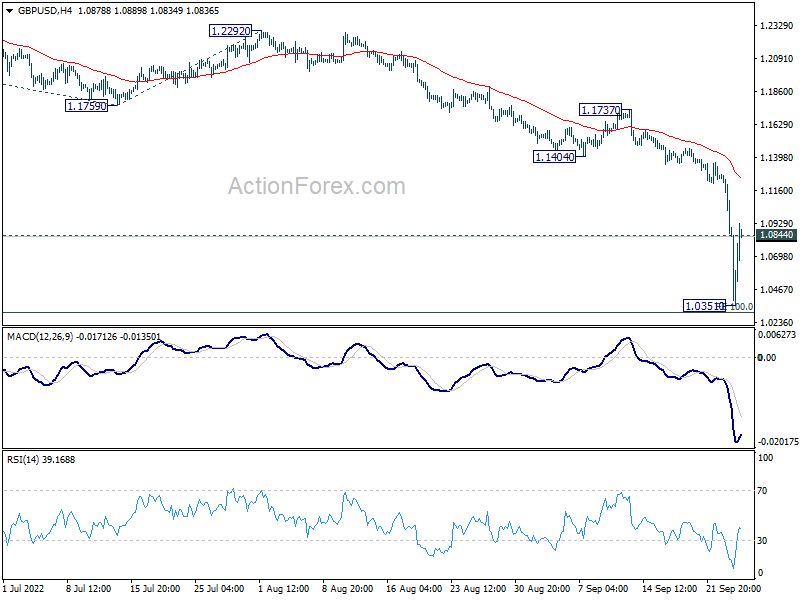
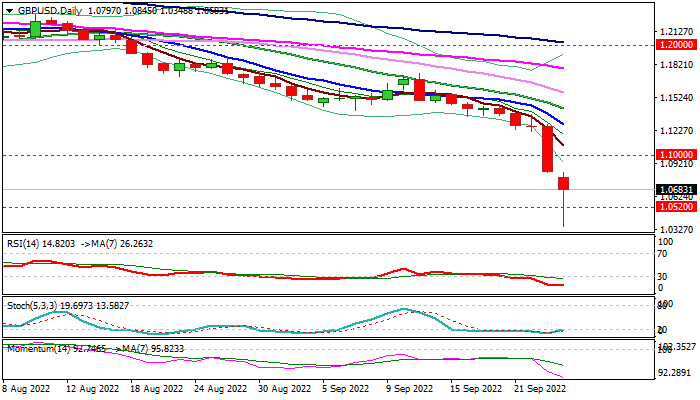
Break of 1.0844 minor resistance suggests that a temporary low is formed at 1.0351, ahead of 100% projection of 1.3748 to 1.1759 from 1.2292 at 1.0303. Intraday bias in GBP/USD is turned neutral for some consolidations. But risk will stay on the downside as long as 1.1404 support turned resistance holds. Sustained break of 1.0303 will pave the way to parity.
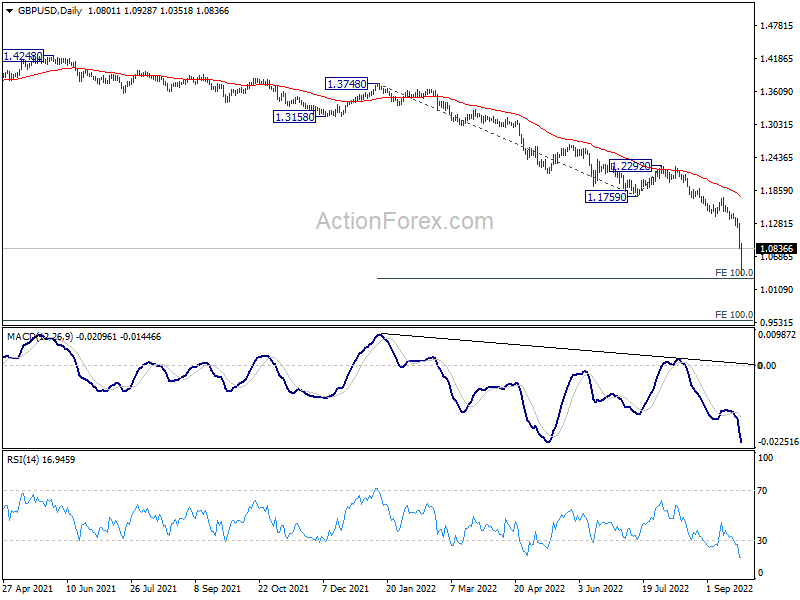
In the bigger picture, fall from 1.4248 (2018 high) is resuming long term down trend from 2.1161 (2007 high). Next target is 100% projection of 2.1161 to 1.3503 from 1.7190 at 0.9532. There is no scope of a medium term rebound as long as 1.1759 support turned resistance holds.
Sterling Stabilizes and Recovers, But Too Soon to Confirm Bottoming
Dollar is extending its broad-based rally today. But other positions are somewhat changing. Sterling is now recovering as traders take profit, while awaiting an unconfirmed statement from BoE. Euro is also paring some recent losses. Meanwhile, Swiss Franc, Yen and Canadian soften in general. Australian and New Zealand Dollar are mixed.
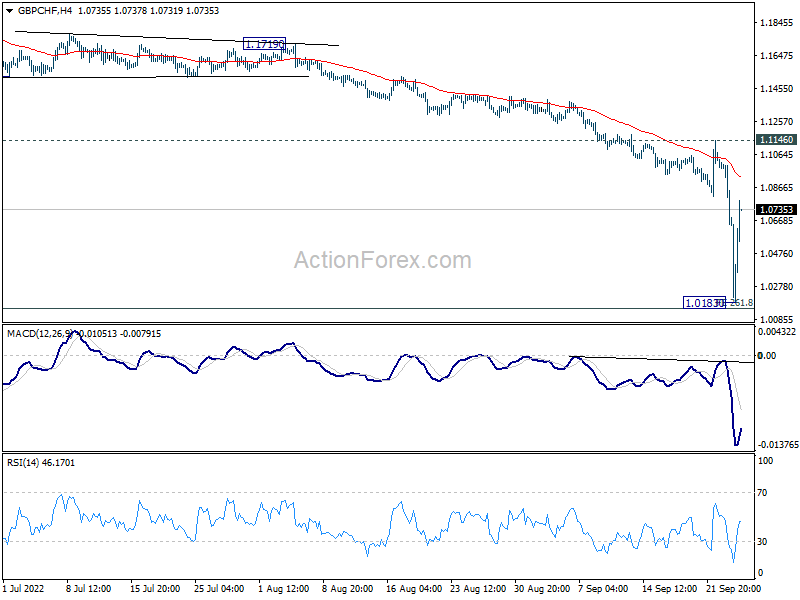
Technically, while Sterling recovers, it's too soon to call for bottoming. The levels to watch included 1.1404 support turned resistance in GBP/USD, and 0.8720 resistance turned support in EUR/GBP. As for GBP/CHF, break of 1.1146 resistance is needed to confirm bottoming at 1.0183. Otherwise, price actions from there are viewed as part of a corrective pattern only. Down trend would resume for another low after the correction completes.
In Europe, at the time of writing, FTSE is down -0.89%. DAX is down -0.05%. CAC is down -0.11%. Germany 10-year yield if up 0.059 at 2.084. Earlier in Asia, Nikkei dropped -2.66%. Hong Kong HSI dropped -0.44%. China Shanghai SSE dropped -1.20%. Singapore Strait Times dropped -1.40%. Japan 10-year JGB yield rose 0.0082 to 0.253.
ECB Lagarde expects to raise interest rates further over next several meetings
In the hearing of a European Parliament committee, ECB President Christine Lagarde said, "most measures of longer-term inflation expectations currently stand at around two per cent. However, signs of recent above-target revisions to some indicators warrant continued monitoring."
"The risks to the inflation outlook are primarily on the upside, mainly reflecting the possibility of further major disruptions in energy supplies," she said. "While these risk factors are the same for growth, their effect would be the opposite: they would increase inflation but reduce growth."
"We expect to raise interest rates further over the next several meetings to dampen demand and guard against the risk of a persistent upward shift in inflation expectations... Our future policy rate decisions will continue to be data-dependent and follow a meeting-by-meeting approach," she said.
ECB de Guindos sees significant slowdown in Q3 and Q4
ECB Vice President Luis de Guindos said in a conference today, "we are seeing that in the third and fourth quarters there is a significant slowdown and we may find ourselves with growth rates close to zero." He also noted that inflation in becoming increasingly broad and further rate hike will depend on incoming data.
Separately, Governing Council member Boris Vujcic said this months' 75bps hike was "the right way to go". "Inflation, if it's persistently strong, has to be the clearly dominant goal," he added. "Paying much attention to lower growth now, at the expense of fighting inflation, is often luring. But letting inflation become entrenched always has a higher cost than a temporary decline in GDP."
Germany Ifo dropped to 84.3, slipping into recession
Germany Ifo Business Climate dropped from 88.6 to 84.3 in September, below expectation of 87.1. That's the lowest level since May 2020. Current Assessment index dropped form 97.5 to 94.5, below expectation of 96.0. Expectations index dropped from 80.3 to 75.2, below expectation of 78.6.
Ifo said: "Companies assessed their current business as clearly worse. Pessimism regarding the coming months has grown decidedly; in retail, expectations have fallen to a record low. The German economy is slipping into recession."
By sector, manufacturing dropped from -6.8 to -14.2. Services dropped from 1.4 to -8.9. Trade dropped from -25.8 to -32.3. Construction dropped from -14.8 to -21.6.
BoJ Kuroda: It's highly likely for economic recovery to continue
BoJ Governor Haruhiko Kuroda said today that rapid currency moves were undesirable as they would have a negative impact on the economy. He added that intervention to address exchange volatility was the appropriate move.
Also, he pledged in a speech that BoJ will "continue with monetary easing so as to firmly support Japan's economy from wage increases."
Kuroda also noted, it's "highly likely" for the economy to continue recovering following three factors. The first is improvement in exports, production, and business fixed investment. The second factor is solid private consumption. he third factor is that, with the government relaxing entry restrictions, inbound tourism demand is expected to recover. But he also pointed out risks from COVID-19, and developments in overseas economic activity and prices.
Japan FM Suzuki: Will take action against speculations on Yen if needed
Japanese Finance Minister Shunichi Suzuki reiterated that the government is "strongly concerned" about one-sided, rapid yen moves.
"We took appropriate action against excessive volatility driven by speculators. The intervention has had a certain effect," he said, referring to last week's intervention to support Yen. "There is no change in our stance that we will take (further) action if needed."
"Governor Kuroda expressed Thursday in his remarks his strong concerns about the rapid depreciation of the yen. We have a shared view on this with the BOJ," Suzuki added.
Former top currency diplomat Naoyuki Shinohara, however, said, "it's unlikely Japan will continue intervening to defend a certain line, such as 145 yen to the dollar... It's impossible to reverse the market's broad trend with intervention alone." Shinohara oversaw Japan's currency policy during the global financial crisis in 2008.
Japan PMI manufacturing dipped to 51.0, services rose to 51.9
Japan PMI Manufacturing dropped slightly from 51.5 to 51.0 in September, below expectation of 51.1. That's the lowest reading since January 2021. Manufacturing Output Index dropped from 49.2 to 48.9. PMI Services, on the other hand, rose from 49.5 to 51.9. PMI Composite rose from 49.4 to 50.9.
Joe Hayes, Senior Economist at S&P Global Market Intelligence, said: "Business are reporting concerns around the economic outlook amid steep cost pressures and the rising likelihood of a global economic downturn. The remarkable weakness we've seen in the year-to-date in the yen continues to push up price pressures, with companies struggling to fully pass on these higher costs burdens to clients. Subsequently business confidence slumped to a 13-month low".
GBP/USD Mid-Day Outlook
Daily Pivots: (S1) 1.0706; (P) 1.0990; (R1) 1.1140; More...
Break of 1.0844 minor resistance suggests that a temporary low is formed at 1.0351, ahead of 100% projection of 1.3748 to 1.1759 from 1.2292 at 1.0303. Intraday bias in GBP/USD is turned neutral for some consolidations. But risk will stay on the downside as long as 1.1404 support turned resistance holds. Sustained break of 1.0303 will pave the way to parity.
In the bigger picture, fall from 1.4248 (2018 high) is resuming long term down trend from 2.1161 (2007 high). Next target is 100% projection of 2.1161 to 1.3503 from 1.7190 at 0.9532. There is no scope of a medium term rebound as long as 1.1759 support turned resistance holds.
Economic Indicators Update
| GMT | Ccy | Events | Actual | Forecast | Previous | Revised |
|---|---|---|---|---|---|---|
| 00:30 | JPY | Manufacturing PMI Sep P | 51 | 51.1 | 51.5 | |
| 08:00 | EUR | Germany IFO Business Climate Sep | 84.3 | 87.1 | 88.5 | |
| 08:00 | EUR | Germany IFO Current Assessment Sep | 94.5 | 96 | 97.5 | |
| 08:00 | EUR | Germany IFO Expectations Sep | 75.2 | 78.6 | 80.3 |
ECB Lagarde expects to raise interest rates further over next several meetings
In the hearing of a European Parliament committee, ECB President Christine Lagarde said, "most measures of longer-term inflation expectations currently stand at around two per cent. However, signs of recent above-target revisions to some indicators warrant continued monitoring."
"The risks to the inflation outlook are primarily on the upside, mainly reflecting the possibility of further major disruptions in energy supplies," she said. "While these risk factors are the same for growth, their effect would be the opposite: they would increase inflation but reduce growth."
"We expect to raise interest rates further over the next several meetings to dampen demand and guard against the risk of a persistent upward shift in inflation expectations... Our future policy rate decisions will continue to be data-dependent and follow a meeting-by-meeting approach," she said.
The Pound’s Collapse Could Trigger Its Reversal
Last week, we said there has not yet been a final capitulation in many markets. However, we have seen such a capitulation in the pound, often followed by global market reversals. We could see both the interest of long-term investors and the activation of speculators with the bet that such volatility will encourage politicians to take action.
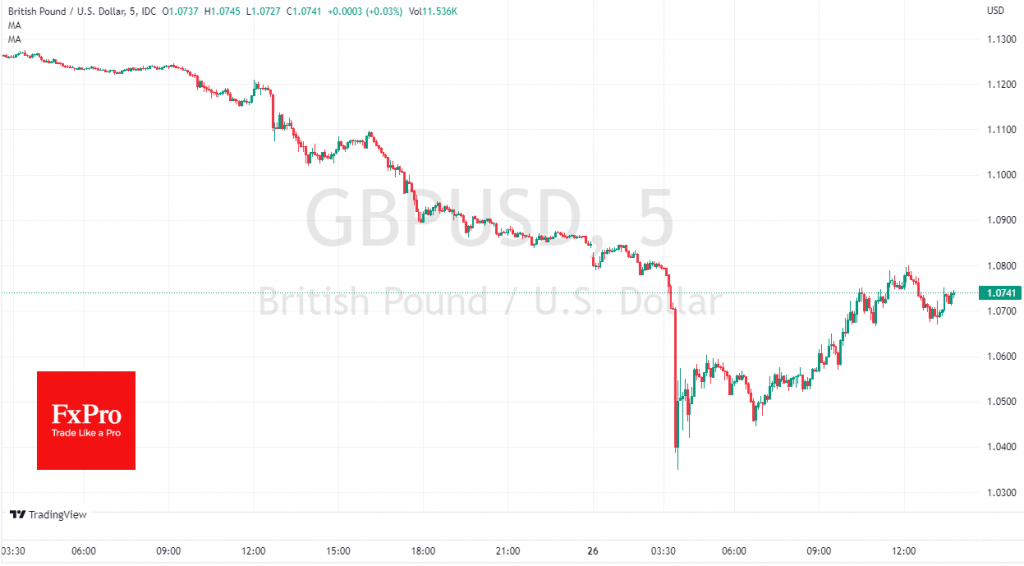
GBPUSD was down to 1.0330 at the start of trading on Monday, although it started Friday’s trading near 1.1250, losing more than 8%. Investors were disappointed by both the Bank of England’s measured pace of rate hikes and the government’s budget initiatives announced on Friday.
As GBPUSD had already been rewriting lows since 1985, the week before, the markets quickly approached the point of a massive and poorly controlled liquidation of positions on the pound, and the reduced liquidity in trading in Asia further amplified this.
As high market volatility could further damage the economy, such currency fluctuations generate enough attention for politicians to awaken to their actions. Debt markets are now pricing in an unscheduled rate hike by the Bank of England, although the previous one was as recently as Thursday. Locally, the pound has a supporting hand from market pricing that BoE will raise Bank Rate to 6% in this cycle. This is higher than in the US, and these hopes seem to fuel local buying by long-term investors.
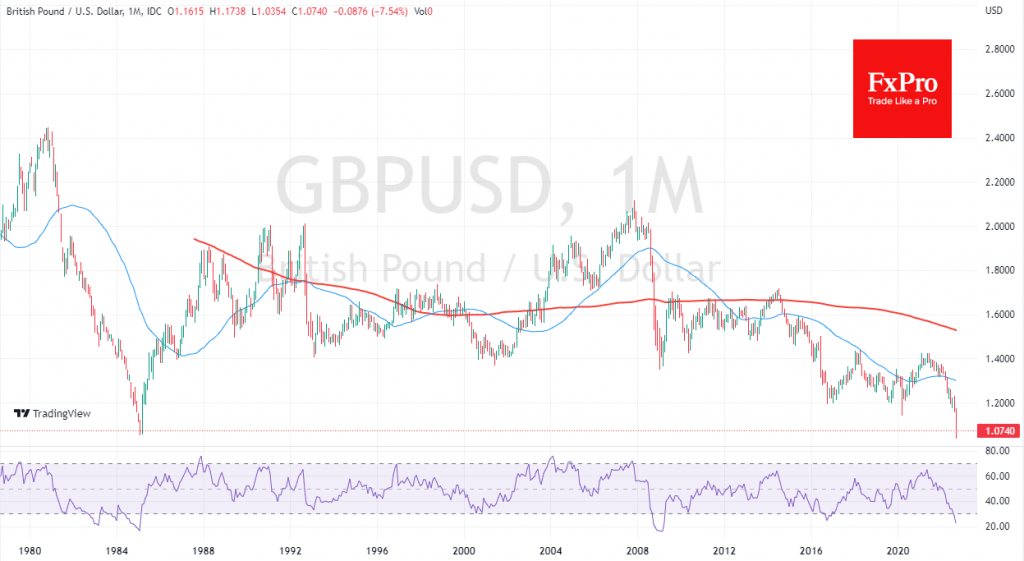
It will take broad and proactive steps by politicians, both the Bank of England and the government, to convince markets of a trend reversal. These steps are vital, not just desirable: a weaker pound is no longer working to improve export competitiveness but is making imports more expensive and undermining financial stability.
In 1985, the so-called Plaza Accord – an agreement on coordinated currency interventions by the world’s major central banks to weaken the dollar – stopped excessive dollar strengthening. For now, however, it is in the interest of the US to continue to allow the dollar to rise, to knock down the country’s inflation and commodities prices. Therefore, in our view, at this stage, we should expect the use of market-to-market currency interventions. Britain could follow Japan’s example by supporting the pound with direct purchases.
USDJPY Defies Intervention, Heads Towards 145.00 Again
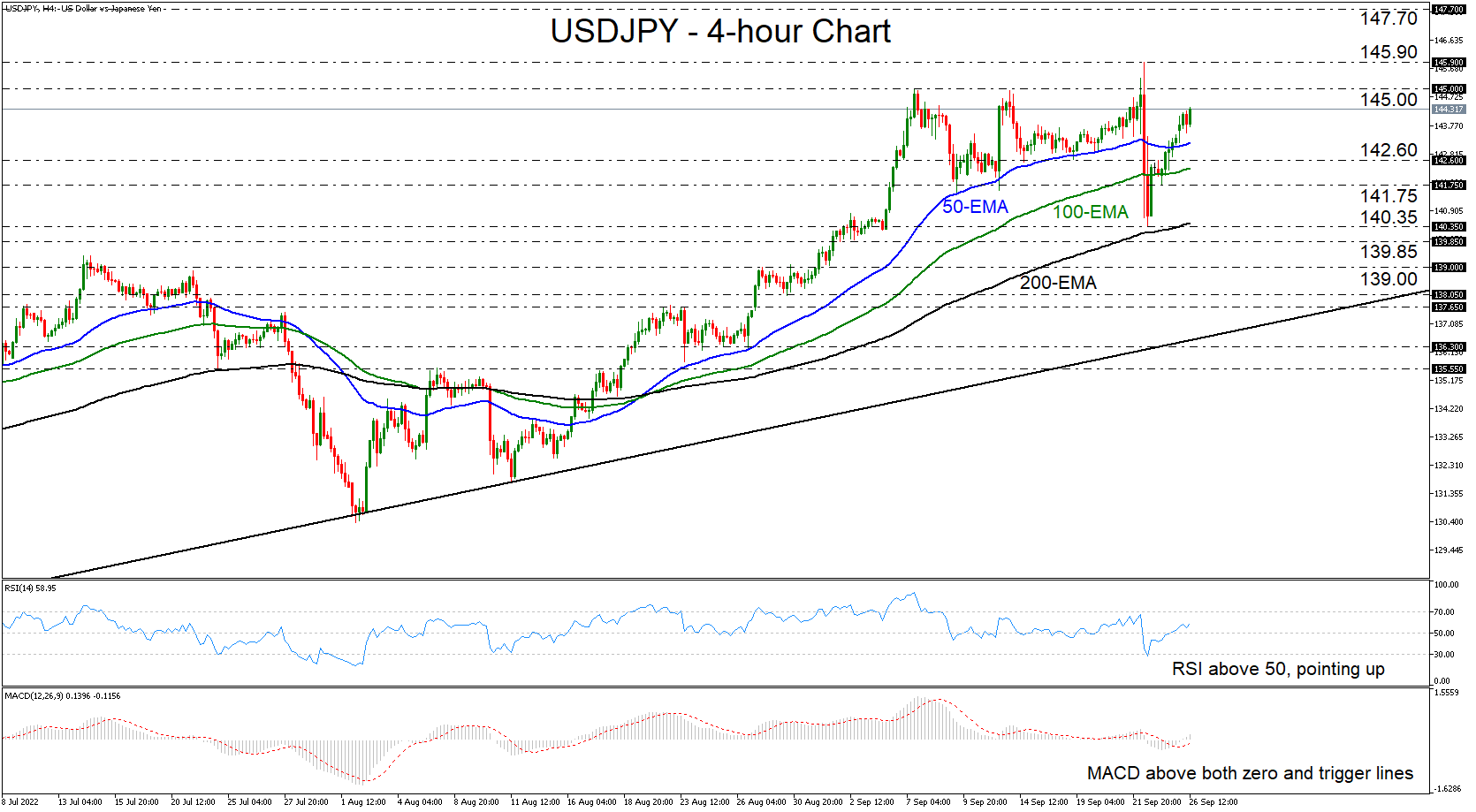
USDJPY has been in a recovery mode since Thursday, just hours after it tumbled more than 500 pips due to the BoJ’s intervention. The pair triggered some buy orders near 140.35, and it has since then recovered more of the intervention-related losses. In the bigger picture, the pair remains above the upside support line drawn from the low of March 4, which implies that the prevailing uptrend remains intact.
Both the short-term oscillators detect upside momentum, supporting the notion that the recovery will continue, at least for a while more. The RSI is lying above 50 and is pointing up, while the MACD is running above both its zero and trigger lines, pointing north as well.
The bulls may soon once again challenge the 145.00 hurdle, but the big test may come if and when they manage to overcome it. The last time they did, the BoJ decided to step in and tried to support its currency. However, if nothing similar happens this time around and the bulls manage to climb above Thursday’s peak of 145.90, then they may get encouraged to stay in the game until they get to the 147.70 zone, marked as a resistance by the peak of August 11, 1998.
The move that could trigger another decent correction may be a dip below 141.75, which was proven as a decent support before the intervention episode and just the day after. Such a break may initially allow declines towards Thursday’s low of 140.35 or the low of September 2, at 139.85. If the bears do not stop there, they may then extend their march towards the 139.00 territory, marked by the inside swing highs of August 29, 30 and 31.
To sum up, USDJPY has already recovered a large portion of its intervention-related losses, and with the prevailing uptrend staying intact, there is a decent chance for further advances and perhaps another break above the 145.00 territory.
Dollar Index: Bulls Taking a Breather Under New 20-year High
The dollar is consolidating under new 20-year high, hit in Asia on Monday, as Fed signaled it will maintain its hawkish stance and go for another large rate hikes, that makes the greenback attractive, while traders continue to move into safety on growing uncertainty.
The dollar index peaked at 114.42 on Monday (the highest since May 2002), in extension of last Friday’s 1.6% rally and 3.2% advance of the last week, being on track for the fourth straight strong monthly rally. Subsequent easing on strongly overbought conditions was so far limited by Fibo support at 112.82 (23.6% of 107.65/114.42 upleg) keeping bulls intact.
Overall structure remains very bullish as a cocktail of negative factors continues to pressure the most of major currencies and the greenback remains strongly underpinned by hawkish Fed and safe haven flows.
Extended consolidation is likely to precede fresh push higher, with dips to ideally stay above 112.82 support, but extended downticks cannot be ruled out as conditions are still overbought.
Key supports at 111.83/73 (Fibo 38.2%/rising daily Tenkan-sen) need to contain and keep bulls in play.
Res: 114.42; 115.08; 115.81; 117.00.
Sup: 112.82; 112.00; 111.73; 111.03.
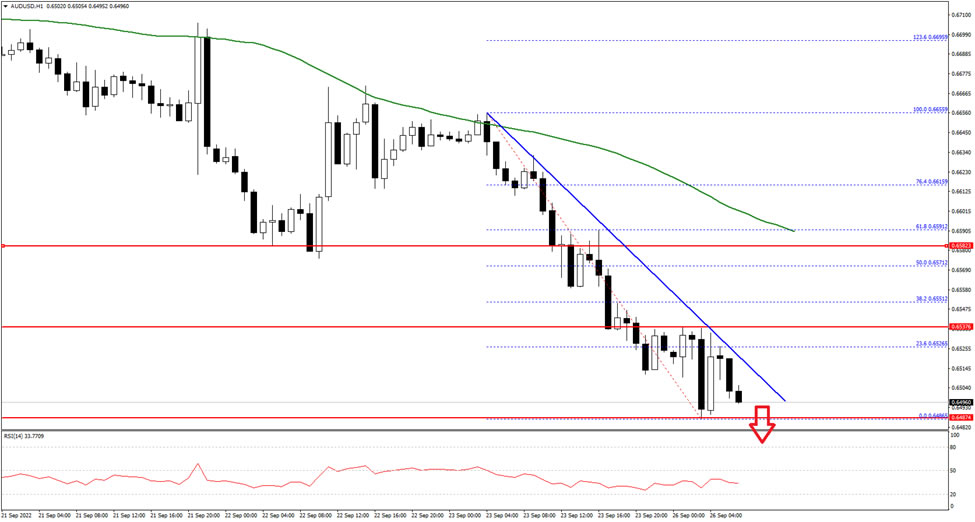
AUD/USD Pair Declined Below $0.6600 to Move into a Bearish Zone
The Aussie Dollar started a fresh decline from the 0.6660 resistance zone against the US Dollar. The AUD/USD pair declined below the 0.6600 level to move into a bearish zone.
There was a clear move below the 0.6550 zone and the 50 hourly simple moving average. The pair traded as low as 0.6486 and is currently correcting losses. An immediate resistance on the upside is near the 0.6515 level.
There is also a connecting bearish trend line with resistance near 0.6515 on the hourly chart. If there is an upside break above the 0.6515 level, the pair could rise steadily towards the 0.6550 level in the near term. The main resistance now sits near 0.6600 on FXOpen.
An immediate support is near the 0.6480 level. The next key support is near the 0.6450 level. A downside break below the 0.6450 support could lead the pair towards the 0.6420 support.
US 500 Index is in Free-Fall Near 1½-Year Low
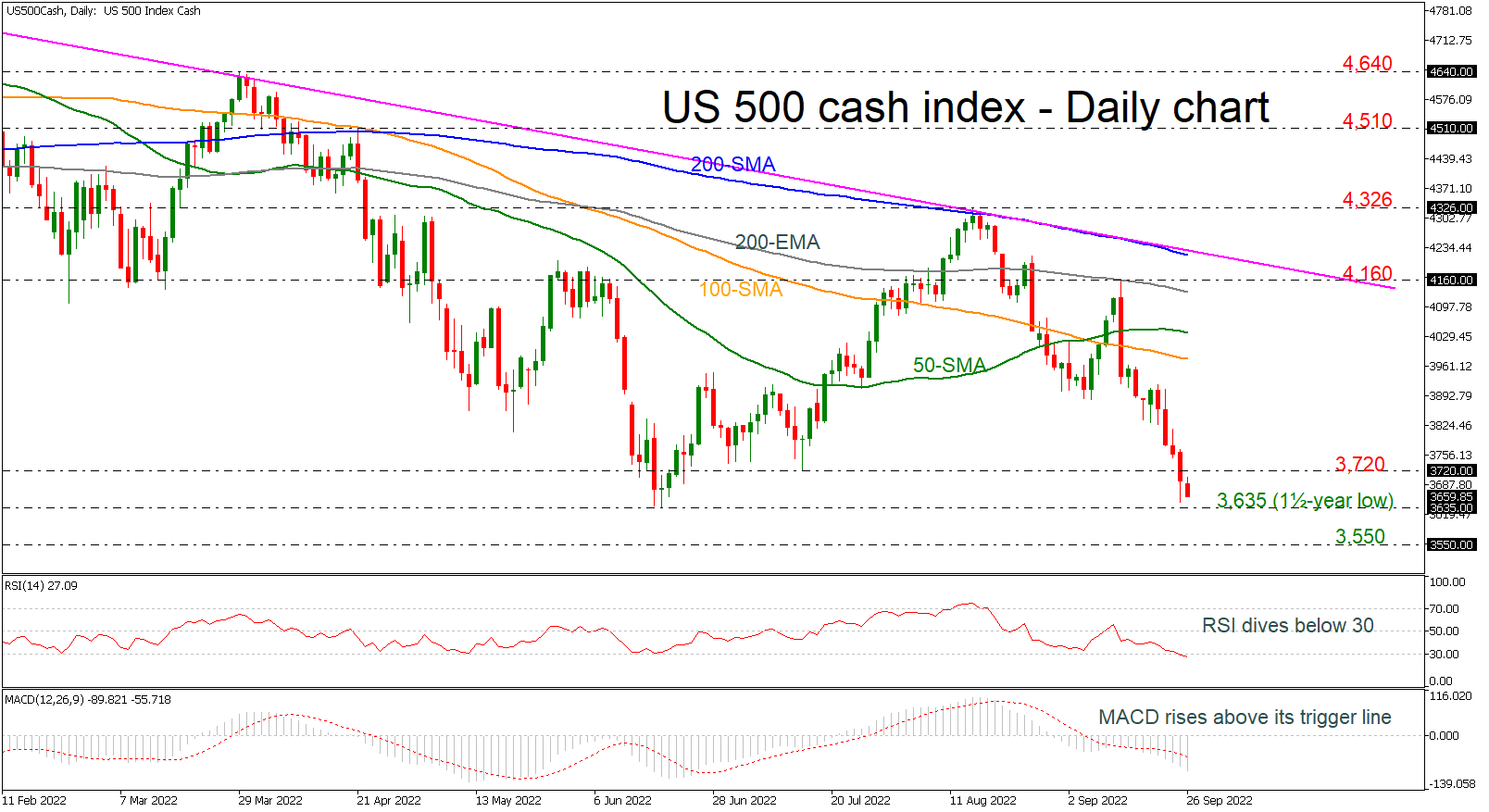
The US 500 cash index has been underperforming over the last five daily sessions, but the strong negative momentum started after the pullback off the 200-day exponential moving average (EMA). The price is approaching the one-and-a-half-year low of 3,635, endorsing the long-term bearish structure.
The momentum indicators, are currently encouraging that sell-off as the RSI is declining beneath the 30 level, entering the oversold territory, while the MACD is extending its bearish movement below its trigger and zero lines.
In the event of a downfall underneath the 3,635 support, the next level to have in mind is the inside swing high from October 2020 at 3,550, while even lower the 3,233 mark could come in focus.
However, a closing price above 3,720 could boost buying interest and confirm additional gains towards the 100- and then the 50-day simple moving averages (SMAs) at 3,978 and 4,040 correspondingly. Above that, the 200-day EMA 4,132 and the 4,160 barrier could also react as resistance ahead of the long-term descending trend line, which overlaps with the 200-day SMA at 4,220.
Meanwhile in the medium-term picture, the outlook remains strongly bearish following this month's free-fall, with traders waiting a rally above the 200-day SMA to eliminate fears of a down-trending market.