

Sample Category Title
World Bank cut China growth forecasts to 2.8% in 2022
For 2022, the World Bank downgraded China's growth forecasts sharply from 5.0% (April's) to just 2.8%. On the other hand, ASEAN-5 growth forecasts was upgraded from 4.9% to 5.4%. East Asia & Pacific (excluding China) growth was upgraded from 4.8% to 5.3%. However, East Asia & Pacific as a whole was down graded from 5.0% to 3.2%,
The World Bank said in the release: "Growth in much of East Asia and the Pacific has been driven by recovery in domestic demand, enabled by a relaxation of COVID-related restrictions, and growth in exports. China, which constitutes around 86% of the region's output, uses targeted public health measures to contain outbreaks of the virus, inhibiting economic activity."
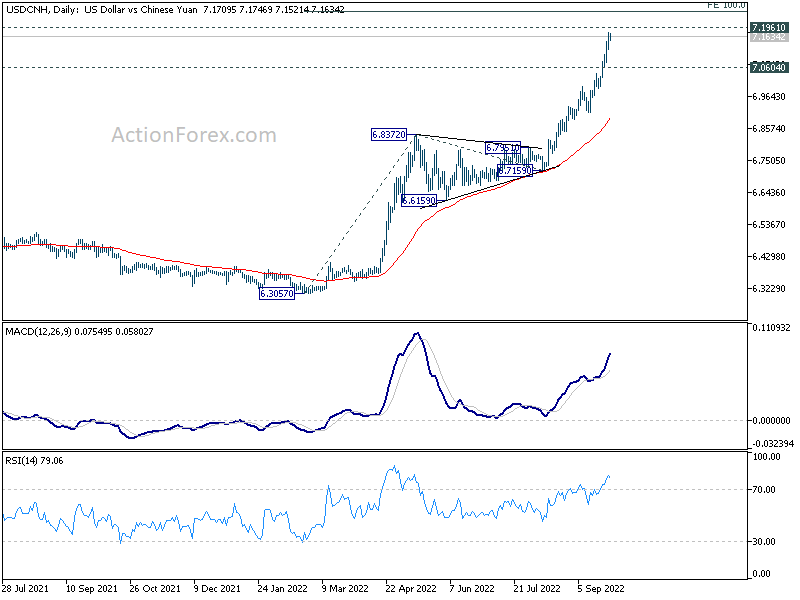
Selloff in Yuan is still in force, with USD/CNH approaching 2020 high at 7.1961. There is so far no clear support for the Yuan at 7 psychological level. Break of 7.1961 will mark the highest level for the pair, lowest for offshore Yuan, since 2008. Technically, USD/CNH might top only after hitting 100% projection of 6.3057 to 6.8372 from 6.7159 at 7.2474.
RBNZ Orr said tightening cycle very mature, AUD/NZD topping soon?
RBNZ Governor Adrian Orr today, "We believe we still have some work to do, but the good news is because we've done so much already, the tightening cycle is very mature, it's well advanced."
There's s "a little bit more to do before we can drop to our normal happy place, which is to watch, worry and wait for signs of inflation up or down," he said.
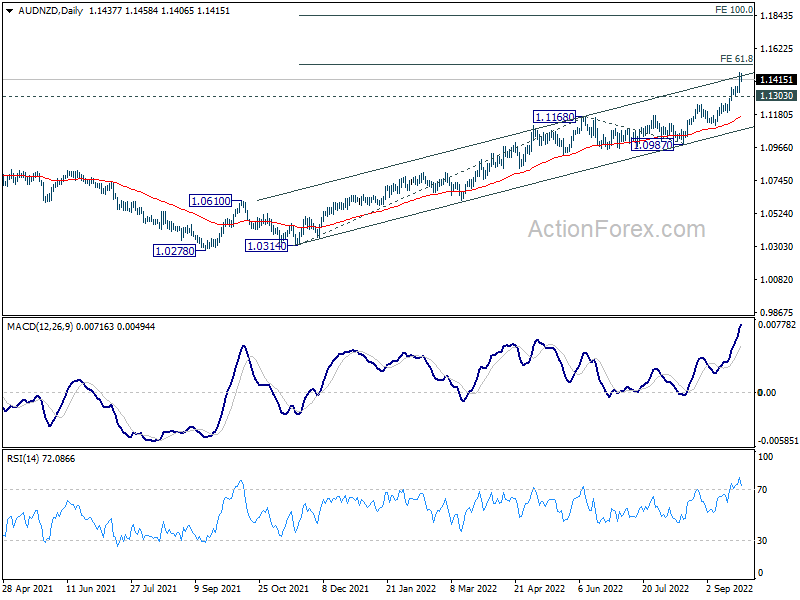
AUD/NZD's rally picks up some momentum recently on expectations that RBA is catching up with RBNZ on tightening. However, the cross is now pressing medium term channel resistance, and in proximity to 61.8% projection of 1.0314 to 1.1168 from 1.0987 at 1.1515. Overbought condition could finally limit upside. Break of 1.1303 will argue that it has turned into a corrective phase.
Nevertheless, firm break of 1.1515 could prompt further upside acceleration to 100% projection at 1.1841.
SNB Maechler: More signs that price increases are spreading
SNB board member Andrea Maechler said yesterday, "We have tightened monetary policy and raised interest rates to send a clear signal that we will do everything to bring down inflation over time."
"There are ever more signs that price increases are spreading to goods and services which have not been affected so far," she said. "We are acting to make sure that inflation does not become entrenched."
On the question of further rate hike, she said, "I never speak of interest rate expectations. I can only say what the market expects, and it expects the SNB and other central banks to further increase their rates."
Fed Mester: Monetary policy needs to be in a restrictive stance
Cleveland Fed President Loretta Mester said yesterday, "when there is uncertainty, it can be better for policymakers to act more aggressively because aggressive and pre-emptive action can prevent the worst-case outcomes from actually coming about."
"Further increases in our policy rate will be needed," Mester said. "In order to put inflation on a sustained downward trajectory to 2%, monetary policy will need to be in a restrictive stance, with real interest rates moving into positive territory and remaining there for some time."
"There will be some pain and bumps along the way as the growth in output and employment slow and the unemployment rate moves up," Mester said. "But the current persistent high inflation is also very painful for many households and businesses. "
Fed Bostic: UK growth plan adds uncertainty to the economy
Atlanta Fed President Raphael Bostic said market reaction to UK government's new growth plan, with sharp volatility in Sterling, was a "real concern". There's "a fear that the new actions will add uncertainty to the economy."
The key question will be what does this mean for ultimately weakening the European economy, which is an important consideration for how the U.S. economy is going to perform," he added.
But for now, Bostic gave no indication on how Fed could respond to the development in the UK. "The more important thing is that we need to get inflation under control," he said. "Until that happens, we're going to see I think a lot of volatility in the marketplace in all directions."
GBP/USD Recovery Could Face Hurdles, Dollar Remains Supported
Key Highlights
- GBP/USD traded to a new low at 1.0340 before it corrected higher.
- A major bearish trend line is forming with resistance near 1.1050 on the 4-hours chart.
- EUR/USD corrected higher, but it is facing many hurdles.
- AUD/USD and NZD/USD at risk of more downsides.
GBP/USD Technical Analysis
The British Pound started a major decline from well above 1.1000 against the US Dollar. GBP/USD tumbled over 500 pips to set a new low.
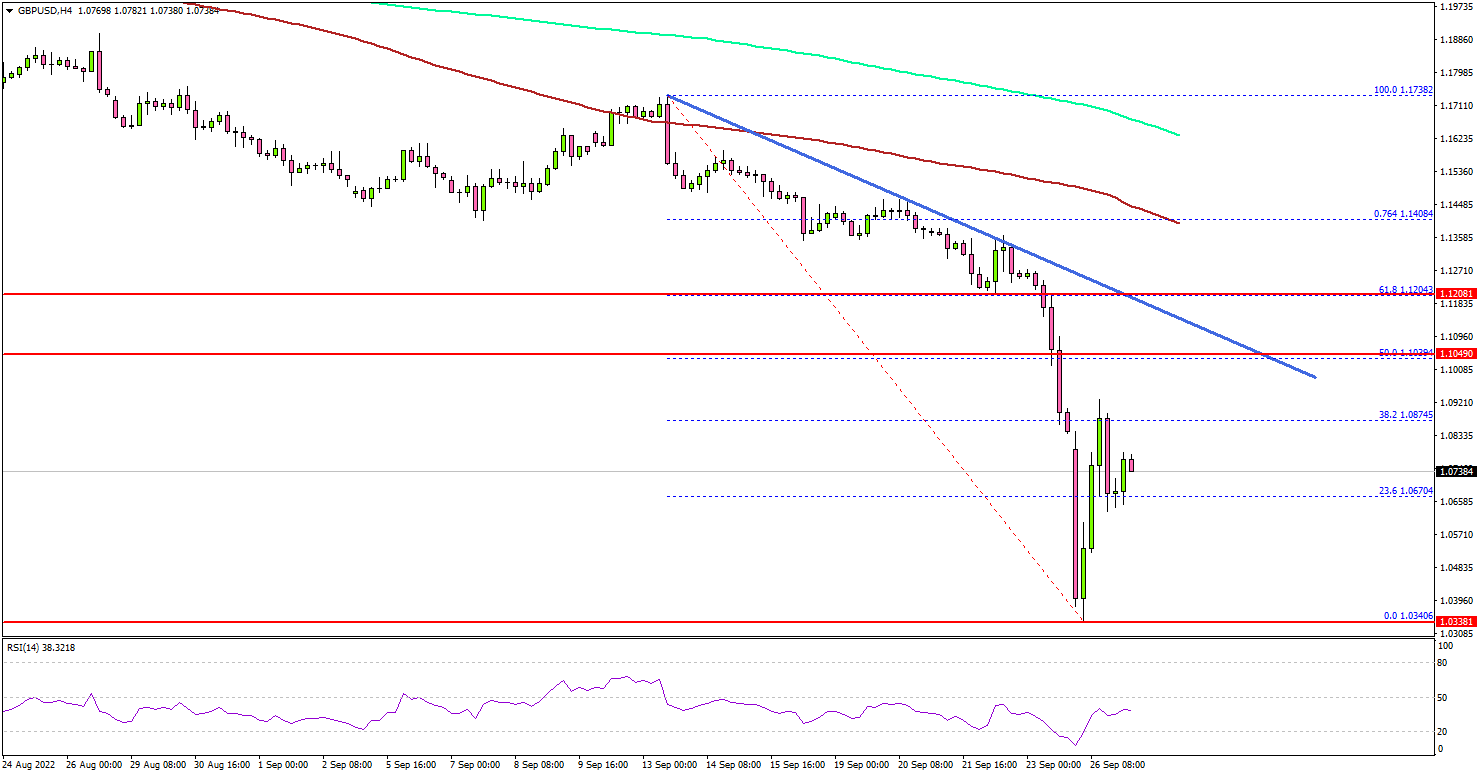
Looking at the 4-hours chart, the pair traded below the 1.0650 support level to move further into a bearish zone. The pair settled well below the 1.1000, the 100 simple moving average (red, 4-hours), and the 200 simple moving average (green, 4-hours).
A new low was formed near 1.0340 before the pair started an upside correction. There was a minor increase above the 1.0650 level.
The pair climbed above the 23.6% Fib retracement level of the downward move from the 1.1738 swing high to 1.0340 low. On the upside, an initial resistance sits near the 1.0950 zone.
The first major resistance is near the 1.1000. There is also a major bearish trend line forming with resistance near 1.1050 on the same chart. The trend line is near the 50% Fib retracement level of the downward move from the 1.1738 swing high to 1.0340 low.
A clear move above the trend line resistance could open the doors for a fresh increase to 1.1200. Any more gains might send the pair towards the 1.1400 resistance level.
On the downside, an initial support is near the 1.0650 level. The main support sits at the 1.0550 level. A downside break below the 1.0550 zone might send the pair towards the 1.0500 level. The next major support is near the 1.0340 level, below which the pair could even test the 1.0200 level.
Looking at EUR/USD, the pair started a short-term upside correction from the 0.9550 low, but it is facing many hurdles on the upside near 0.9750 and 0.9850.
Economic Releases
- US New Home Sales for Aug 2022 (MoM) – Forecast -4.9% versus -12.6% previous.
- US Durable Goods Orders for Aug 2022 – Forecast -1.1% versus -0.1% previous.
Eco Data 9/27/22
[php_everywhere instance="1"]
USDCAD Wave Analysis
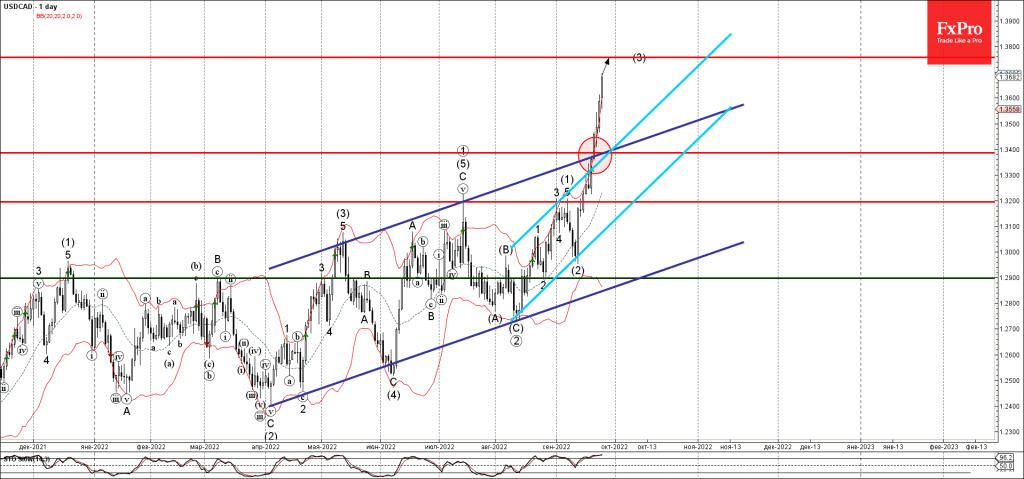
- USDCAD rising inside impulse wave (3)
- Likely to reach resistance level 1.3760
USDCAD currency pair continues to rise inside the sharp intermediate impulse wave (3), which previously broke the two intersecting up channels from April and August.
The pair is under the bullish pressure due to the simultaneous strong bullish USD sentiment and the weak CAD sentiment (on oil losses).
USDCAD can be expected to rise further toward the next resistance level 1.3760 (target price for the completion of the active intermediate impulse wave (3)).
USDJPY Wave Analysis
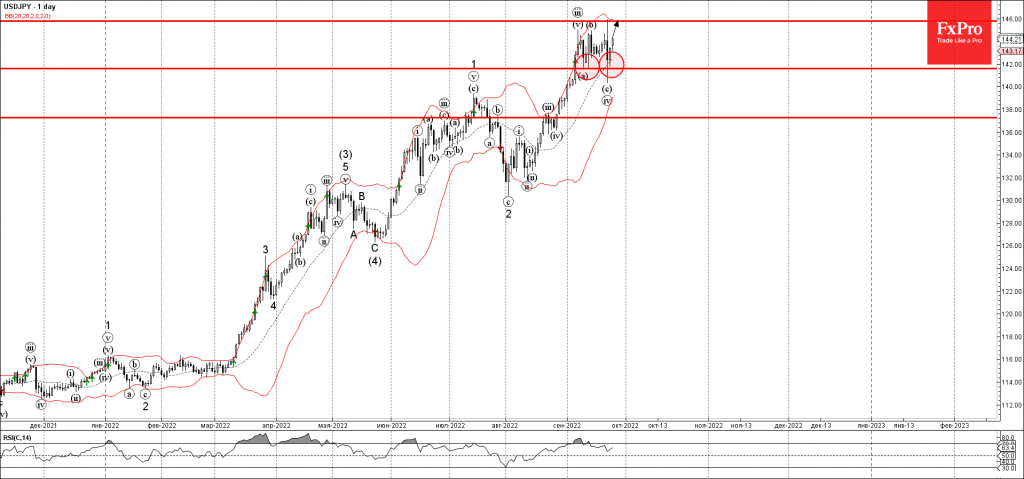
- USDJPY reversed from key support level 142.00• Likely to rise to resistance level 148.00
USDJPY currency pair recently reversed up from the key support level 142.00 (lower boundary of the sideways price range inside which the pair has been moving from the start fop September).
The upward reversal from the support level 142.00 started the active short-term impulse wave (v) – which belongs to waves 3 and (5).
Given the powerful daily uptrend, strong USD bullishness seen today, USDJPY can be expected to rise further toward the next resistance level 148.00 (which reversed the pair earlier this month).
Germany’s Business Climate Worsens Further
Business sentiment in Germany continued its substantial deterioration in September. The Ifo says the business climate index fell from 88.6 to 84.3 this month. The index has only been lower for two months in its history – in April and May 2020. The actual figures were weaker than expected, at 86.9 and marked a deterioration in the current assessment and economic expectations.
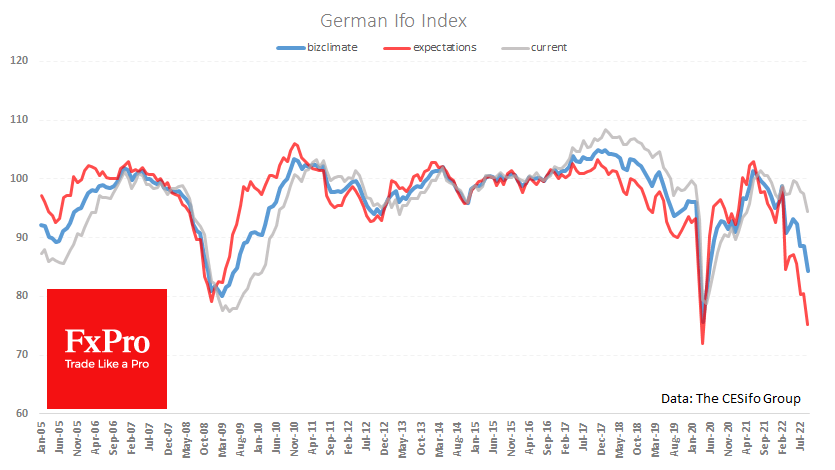
As usual, forward-looking markets pay more attention to the development of the expectations component, which recorded its second-lowest fall in history in September from 80.5 to 75.2. However, optimists may note that the current conditions did not deteriorate too sharply. The Index of Current Conditions in September fell from 97.5 to 94.5 against a historical average since 2005 of 96.7.
From the latter, it can be concluded that the brunt of the crisis in Germany is still only in the “heads” of the businessmen but could quickly become a self-fulfilling prophecy if expectations do not turn sharply upwards in the coming months.