Sample Category Title
Elliott Wave View: Nasdaq (NQ) Further Downside Expected
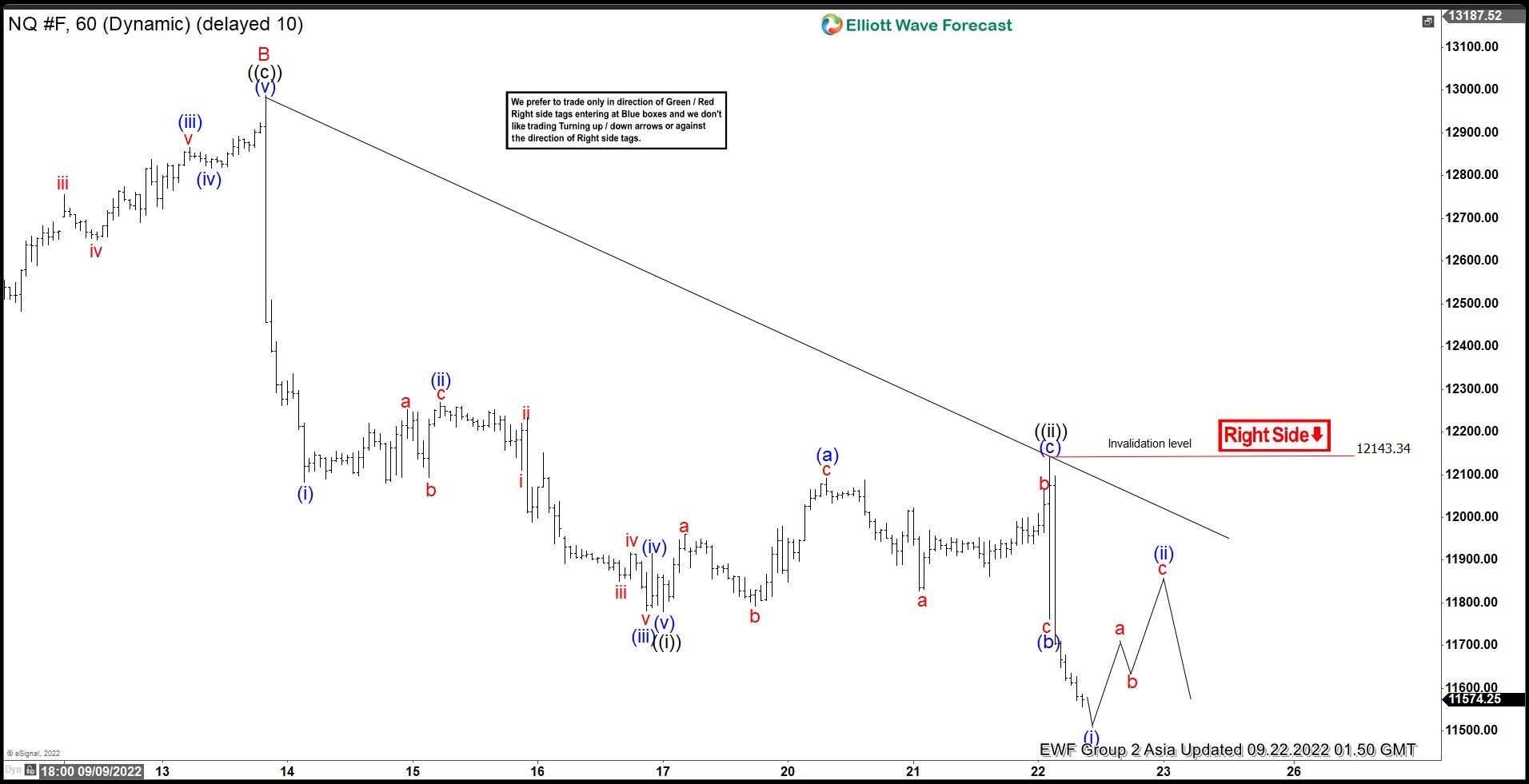
Short term Elliott Wave view on Nasdaq (NQ) suggests the decline from 8.17.2022 high is unfolding as a zigzag Elliott Wave structure. Down from 8.17 high, wave A ended at 12017.75. Wave B ended at 12986.74 with internal subdivision as an expanded flat. Up from wave A, wave ((a)) ended at 12461.50 and dips in wave ((b)) ended at 11921.50. Wave ((c)) higher ended at 12986.74 which also completed wave B.
Index has turned lower in wave C with internal subdivision as a 5 waves impulse. Down from wave B, wave ((i)) ended at 11778.50 and rally in wave ((ii)) ended at 12143.34. Internal subdivision of wave ((ii)) unfolded as an expanded flat. Up from wave ((i)), wave (a) ended at 12092.50, wave (b) ended at 11763.25, and wave (c) ended at 12143.34. This completed wave ((ii)) of C. Index has resumed lower in wave ((iii)). Near term, expect wave (i) of ((iii)) to end soon. Index should then rally in wave (ii) to correct cycle from 9.22.2022 high (12143.34) before it resumes lower. As far as pivot at 12143.34 stays intact, expect rally to fail in 3, 7, or 11 swing for further downside. Potential target lower is 100% – 161.8% Fibonacci extension of wave ((i)) which comes at 10195 – 10938.
Nasdaq 60 Minutes Elliott Wave Chart
The Fed Fights On
Summary
The FOMC further stepped up its inflation-fighting game in September. The Committee hiked the fed funds target range by 75 bps, as was widely expected, but delivered a more hawkish projected path for short-term rates through this year and next. The median FOMC participant now expects the fed funds rate to rise an additional 125 bps in the two remaining meetings of this year. The FOMC sees rates staying high through next year, with the median estimate for the fed funds rate ending 2023 at 4.6%.
The stricter policy stance expected by the FOMC comes as the Committee sees above target inflation as becoming increasingly entrenched. FOMC members now expect core PCE to remain above 3% through next year and above 2% all the way through 2025. The good news is that policymakers expect inflation to steadily slow over the next few years, but higher rates are also expected to inflict greater pain on the economy. Estimates for real GDP growth next year were revised lower and, with a median of 1.2%, are more clearly below the economy's potential growth rate. More telling, however, was the upward adjustment to unemployment rate projections in 2023. The median estimate among participants rose to 4.4%, which would be nearly a percentage point above the low of the current cycle. All told, the Committee appears to be inching toward our own view that it will take a mild recession to get inflation firmly back to the 2% target.
A Hawkish 75
In an effort to rein in decades-high inflation, the Federal Open Market Committee (FOMC) delivered another massive 75 bps increase in the federal funds rate at the conclusion of its September meeting today. The move brings the fed funds target range to 3.00-3.25%, the highest level in 15 years. In addition, the FOMC reaffirmed its plan to up the pace of balance sheet reduction this month. From September onward, the Fed will allow up to $60 billion of Treasury securities and $35 billion of mortgage-backed securities to roll off its balance sheet, which is double the June-August pace and significantly faster than the pace of quantitative tightening in 2017-2019.
The aggressive move to combat inflation was widely expected. Chair Powell delivered a clear and concise message that inflation is the FOMC's "overarching focus" right now and that the Committee will do what is necessary to restore price stability, a sentiment that has been echoed by one FOMC member after another. In today's statement the Committee reiterated that it is "strongly committed to returning inflation to its 2% objective" and "highly attentive to inflation risks".
How much more the FOMC believes it will need to tighten to achieve that objective became clearer with an update to the Summary of Economic Projections (SEP). The median participant's expectation of where the fed funds rate would end this year rose to 4.4%, implying about an additional 125 bps of tightening in the two remaining meetings of the year (Figure 1). Not only was that more hawkish than in June (when the median expectation for the fed funds rate for year-end registered 3.4%), but it was more aggressive than both pre-meeting market pricing as well as our own most recent forecast. In addition to a faster pace of tightening in the near term, most FOMC participants saw the federal funds rate staying high through 2023 and 2024. The median year-end estimates for the federal funds rate in 2023 and 2024 were 4.6% and 3.9%, respectively. Only in 2025 does the FOMC expect the fed funds rate to be back to a level that is more in line with its "longer-run" estimate of 2.5% for short-term interest rates.
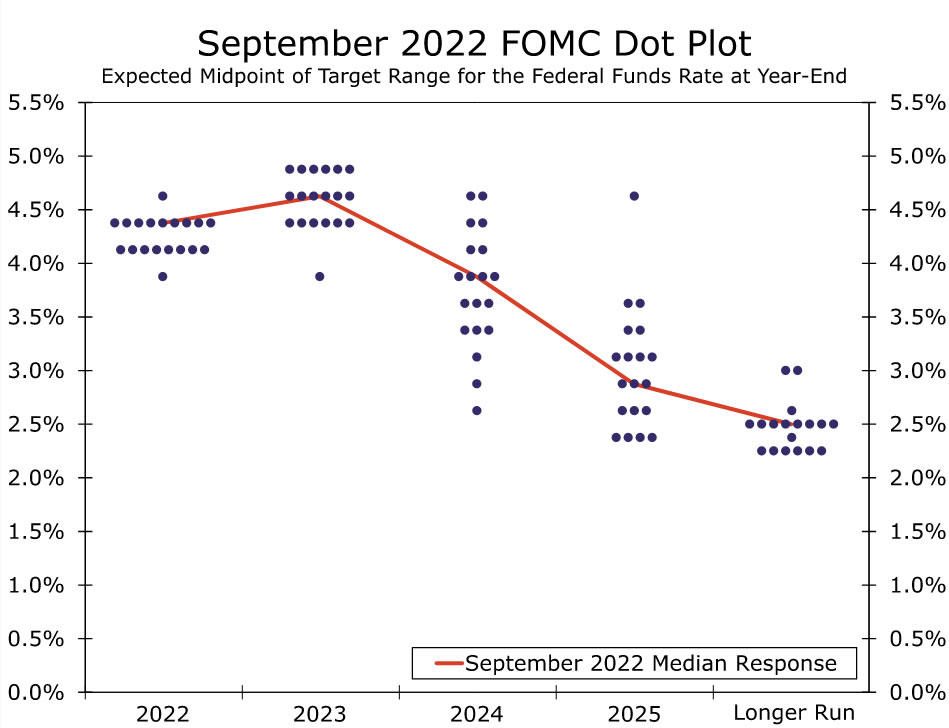
Interestingly, there appeared to be a significant amount of agreement among FOMC participants on how tight monetary policy will need to be in 2023. All but one participant saw the federal funds rate finishing 2023 between 4.4% and 4.9%. However, the 2024 dots exhibit a significantly wider range of outcomes, with the lowest projection for the fed funds rate (2.625%) 200 bps below the highest projection (4.625%).
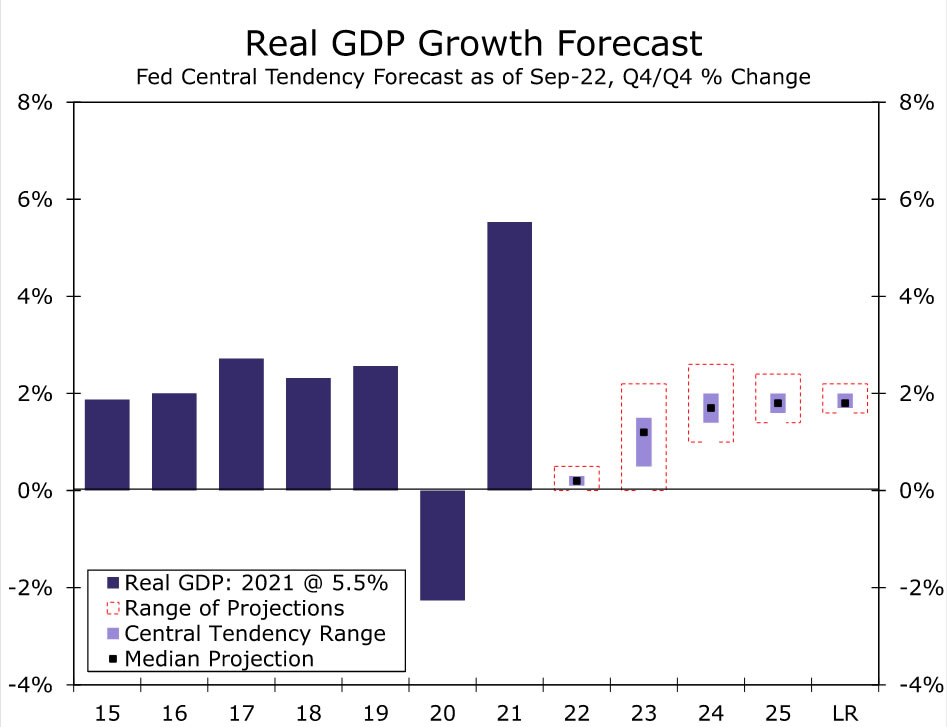
The FOMC's economic projections make clear that this restrictive stance of monetary policy will not be costless. The median participant looks for real GDP growth of just 0.2% this year and 1.2% next year (Figure 2). Unemployment is also anticipated to climb more significantly next year; the median unemployment rate estimate among participants rose to 4.4% from 3.9% in the June SEP (Figure 3). Such an outcome could still be construed as a "soft-ish" landing for the economy, but the Committee appears to be inching toward our own view that it will take a mild recession to get inflation firmly back to the 2% target.
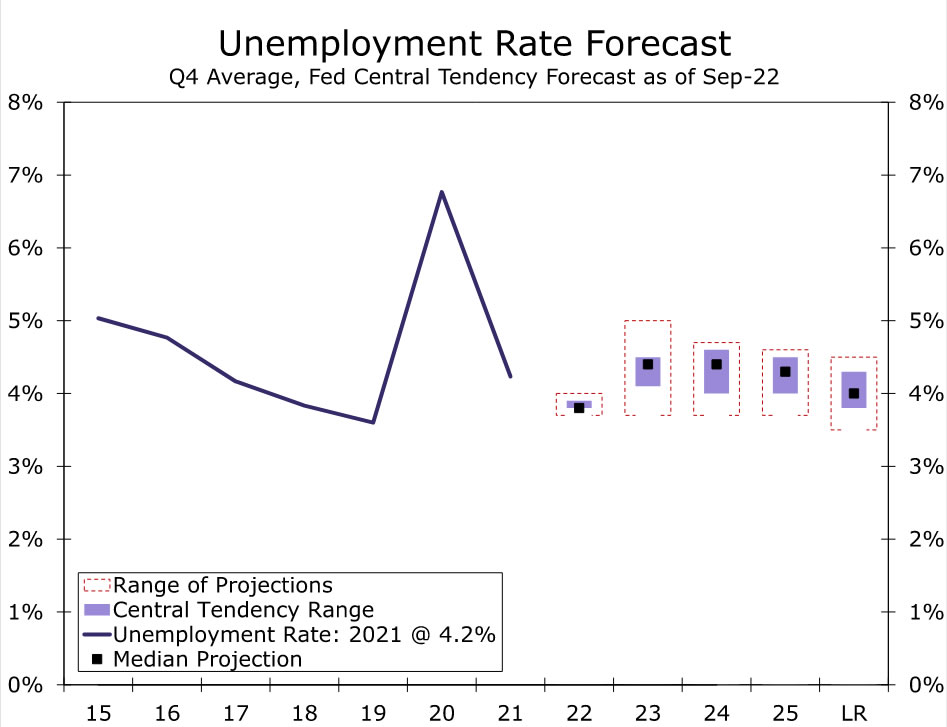
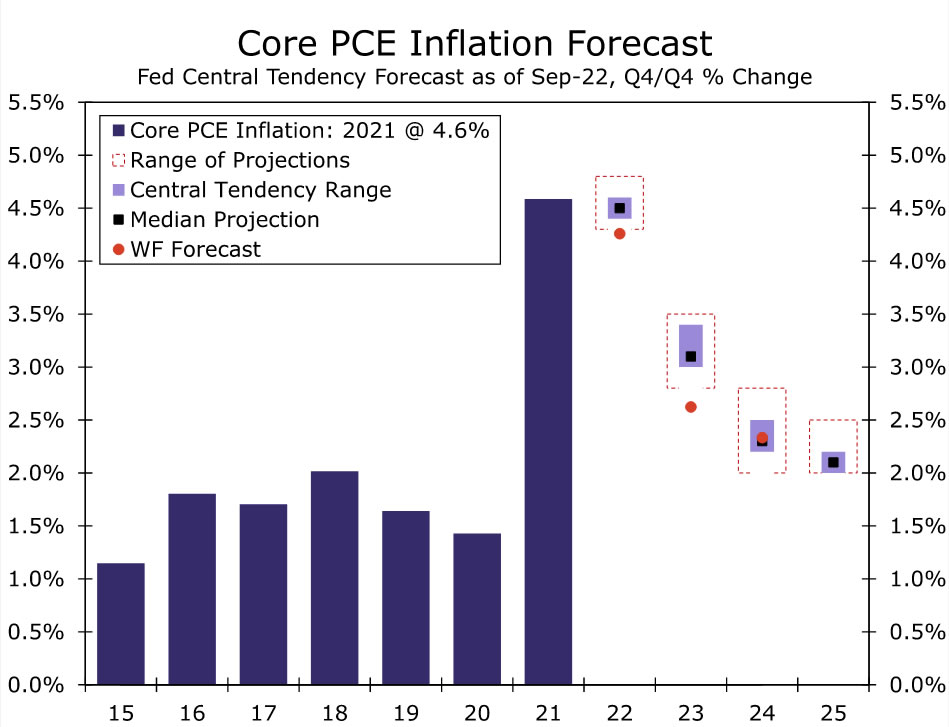
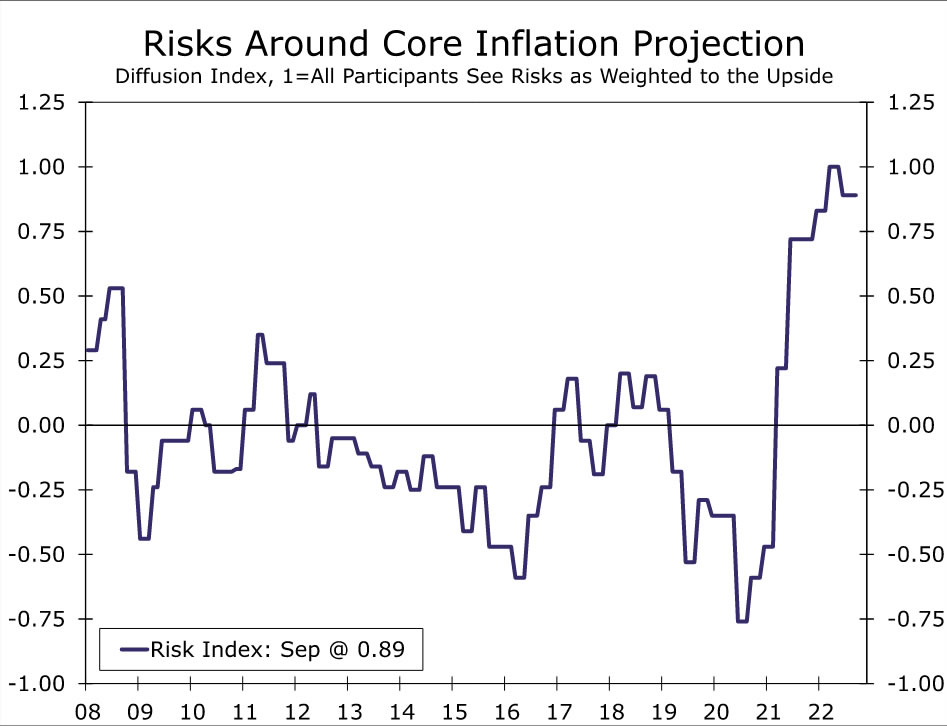
Clearly by the FOMC's reckoning, inflation is becoming more entrenched. Officials bumped up estimates for core PCE inflation in the fourth quarter of this year, with the median projection rising to 4.5% from 4.3% in June. And despite expectations for a materially higher fed funds rate and slower growth in the year ahead, the median estimate for core PCE at the end of 2023 was raised to 3.1% from 2.7% in the prior SEP. Even with the upward revisions to inflation estimates, all but two of the 19 officials are wary that risks to the inflation outlook remain tilted to the upside, suggesting the Fed is far from giving up its hawkish bent. Through 2025, the majority of FOMC participants do not see core PCE returning all the way back to 2.0%.
Another 75 bps Rate Hike on the Table in November
At the start of the year, the Federal Reserve was still easing monetary policy via purchases of Treasury securities and mortgage-backed securities. Just nine months later, the median FOMC participant expects the federal funds rate to finish the year 4.4%, a rate not seen since 2007. In his speech at Jackson Hole, Chair Powell made clear that the ongoing fight against inflation will not be won easily, and today's FOMC meeting reinforces that policymakers are prepared for restrictive policy well beyond 2022. At some point, the FOMC will feel comfortable enough to slow the pace of tightening from 75 bps per meeting to 50 bps or 25 bps. We expected a downshift to 50 bps at the November FOMC meeting, but with today's dot plot in hand and just one CPI report between now and the November meeting, another 75 bps rate hike is squarely on the table. The balance of risks are clearly tilted to the upside for our current forecast of a peak fed funds rate of 4.00%-4.25%.
Eco Data 9/22/22
[php_everywhere instance="1"]
FOMC Hikes Policy Rate by 75 Basis Points, Signals Many More to Come
The Federal Reserve Open Market Committee (FOMC) lifted the federal funds rate to the 3.0% to 3.25% range and reaffirmed a continuation of its balance sheet runoff.
The Fed updated its language stating that "recent indicators point to modest growth in spending and production. Job gains have been robust in recent months, and the unemployment rate has remained low. Inflation remains elevated, reflecting supply and demand imbalances related to the pandemic, higher food and energy prices, and broader price pressures."
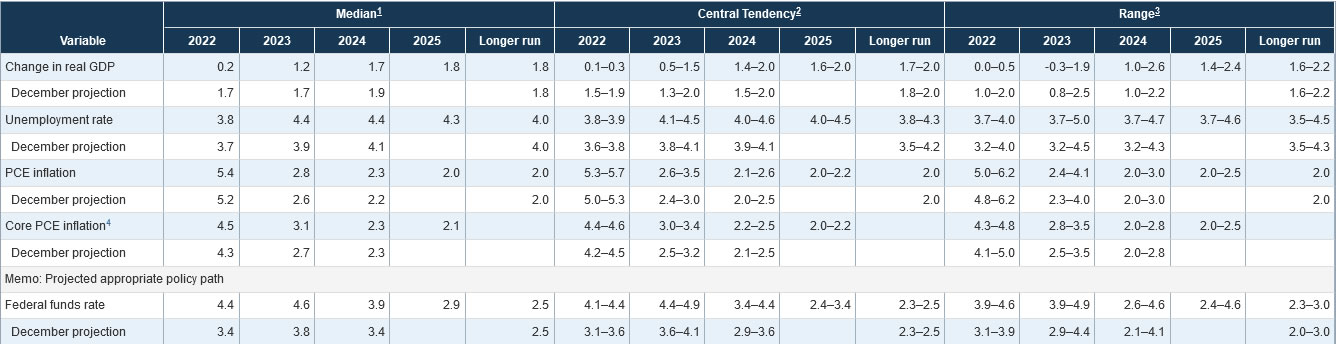
The Fed's Summary of Economic Projections was updated from June:
- The median projection for real GDP growth was downgraded in 2022 (0.2% from 1.7%). The forecast for 2023, 2024, 2025 and the longer run came in at 1.2%, 1.7%, 1.8%, and 1.8, respectively.
- The median unemployment rate forecast was 3.8% (3.7%) for 2022, 4.4% (3.9%) for 2023, 4.4% (4.1%) in 2024, and 4.3% in 2025. The longer-run estimate of the unemployment rate stayed the same at 4.0%.
- On inflation, the median estimate for core PCE was assumed to be 4.5% in 2022, 3.1% in 2023, 2.3% in 2024, and 2.1% in 2025.
- The median projection for the fed funds rate was lifted to 4.4% in 2022, 4.6% in 2023, 3.9% in 2024, and 2.9% in 2025. The long-run neutral rate was assumed to be 2.5%.
All of the members of the FOMC voted in favor of the decision.
Key Implications
Another Fed meeting, another 75 basis point hike. Even though headline inflation has shown signs of peaking, underlying measures of core inflation have yet to turn decisively enough for the Fed to slow the pace of rate hikes. With Fed members now expecting that core inflation will remain above 3% through 2023, they have signaled even more hikes are on deck over the next few months and into 2023. This has Treasury yields rising, with the U.S. 2-year yield now having well eclipsed 4%.
Today's statement echoes the hawkishness from Chair Powell's Jackson Hole speech, where he highlighted that the Fed wasn't going to back down from the inflation fight "until the job is done." This implies a willingness to bring rates into restrictive territory in order to break the current inflation cycle even if it means making a considerable sacrifice to economic growth. It is for this reason that we have recently downgraded our forecast for U.S. GDP growth over the remainder of this year and next as the economy struggles to adjust to the weight of rising rates and stubbornly high inflation.
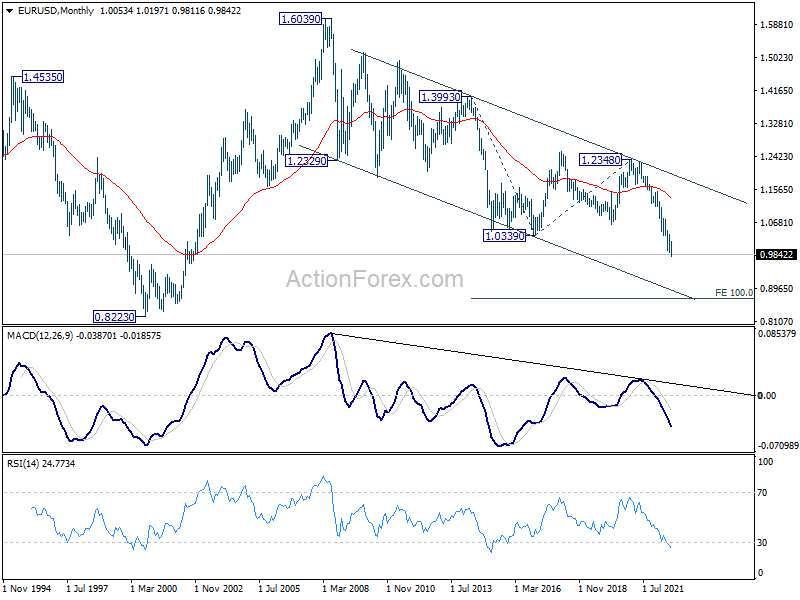
EUR/USD downside breakout after Fed rate hike
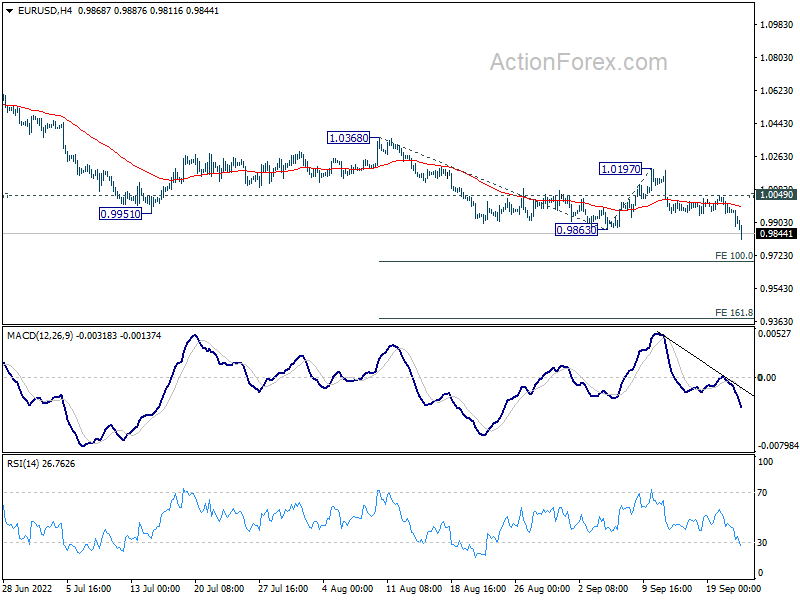
EUR/USD finally breaks out to the downside after Fed hikes 75bps and projects interest rate to hit 4.4% by year end. For the near term, EUR/USD's next target is 100% projection of 1.0368 to 0.9863 from 1.0197 at 0.9692, and then 161.8% projection at 0.9380.
For the medium term, next target is 100% projection of 1.3993 to 1.0339 from 1.2348 at 0.8694.
In any case, break of 1.0049 minor resistance is needed to indicate short term bottoming. Or, outlook will stay bearish even in case of recovery.
FOMC press conference live stream
https://www.youtube.com/watch?v=ukFnKCtptX4
Fed hikes 75bps, rate to reach 4.4% by year end
Fed raises interest rate by 75bps to 3.00-3.25% as widely expected, by unanimous vote. In the accompanying statement, Fed said job gains have been "robust" with unemployment rate "remained low". Inflation remains "elevated". FOMC would be " prepared to adjust the stance of monetary policy as appropriate if risks emerge that could impede the attainment of the Committee's goals."
In the new economic projections, Fed projects (median) interest rates to reach 4.4% in 2022, 4.6% in 2023, before falling back to 3.9% in 2024, and then 2.9% in 2025. GDP growth is projected to be at 0.2% in 2022, 1.2% in 2023, 1.7% in 2024, and then 1.8% in 2025. Unemployment rate is projected to be at 3.8% in 2022, 4.4% in 2023, 4.4% in 2024, and then 4.3% in 2025. Core PCE inflation is projected to be at 4.5% in 2022, 3.1% in 2023, 2.3% in 2024, and then 2.1% in 2025.
(FED) Federal Reserve Issues FOMC Statement
Recent indicators point to modest growth in spending and production. Job gains have been robust in recent months, and the unemployment rate has remained low. Inflation remains elevated, reflecting supply and demand imbalances related to the pandemic, higher food and energy prices, and broader price pressures.
Russia's war against Ukraine is causing tremendous human and economic hardship. The war and related events are creating additional upward pressure on inflation and are weighing on global economic activity. The Committee is highly attentive to inflation risks.
The Committee seeks to achieve maximum employment and inflation at the rate of 2 percent over the longer run. In support of these goals, the Committee decided to raise the target range for the federal funds rate to 3 to 3-1/4 percent and anticipates that ongoing increases in the target range will be appropriate. In addition, the Committee will continue reducing its holdings of Treasury securities and agency debt and agency mortgage-backed securities, as described in the Plans for Reducing the Size of the Federal Reserve's Balance Sheet that were issued in May. The Committee is strongly committed to returning inflation to its 2 percent objective.
In assessing the appropriate stance of monetary policy, the Committee will continue to monitor the implications of incoming information for the economic outlook. The Committee would be prepared to adjust the stance of monetary policy as appropriate if risks emerge that could impede the attainment of the Committee's goals. The Committee's assessments will take into account a wide range of information, including readings on public health, labor market conditions, inflation pressures and inflation expectations, and financial and international developments.
Voting for the monetary policy action were Jerome H. Powell, Chair; John C. Williams, Vice Chair; Michael S. Barr; Michelle W. Bowman; Lael Brainard; James Bullard; Susan M. Collins; Lisa D. Cook; Esther L. George; Philip N. Jefferson; Loretta J. Mester; and Christopher J. Waller.
USDJPY Wave Analysis
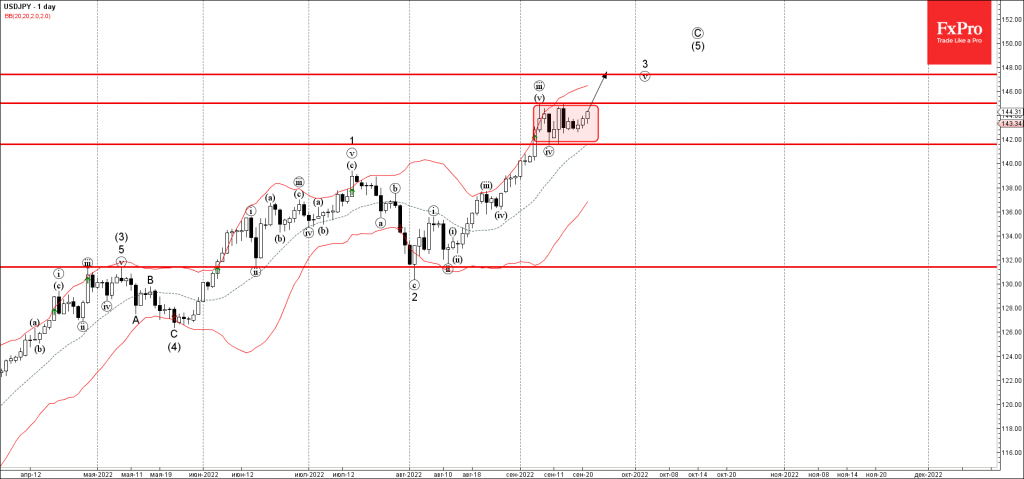
- USDJPY rising inside impulse waves (v) and 3
- Likely to test resistance level 148.00
USDJPY currency pair continues to rise in the direction of the resistance level 145.00 (top boundary of the narrow sideways price range inside which the pair has been moving from the start fop September).
The lower boundary of this price range stands at the support level 142.00, which started the active short-term impulse wave (v).
Given the strong daily uptrend, USDJPY can be expected to rise further toward the next resistance level 148.00 (forecast price for the completion of the active impulse waves (v) and 3).
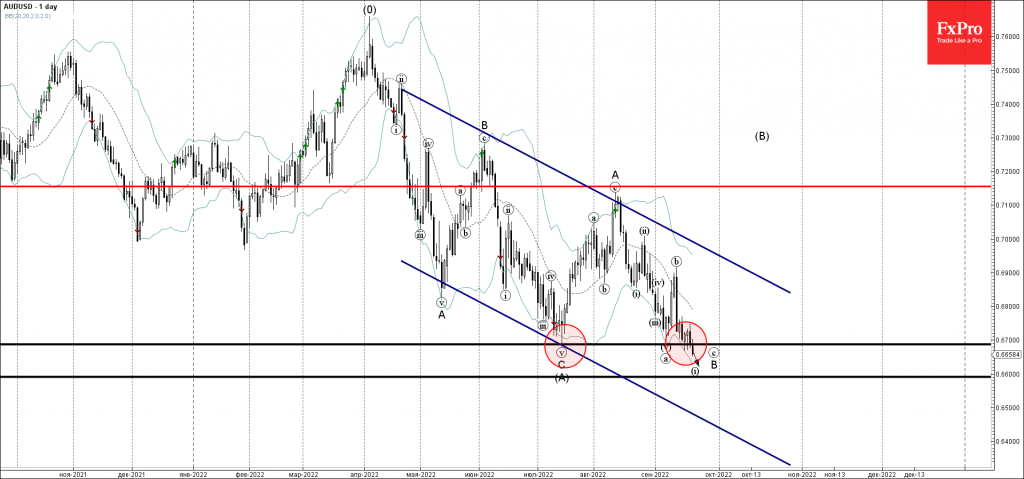
AUDUSD Wave Analysis
- AUDUSD broke key support level 0.6700
- Likely to fall to support level 0.6600
AUDUSD currency pair recently broke the key support level 0.6700 (previous monthly low from July, which also reversed the pair earlier this month).
The breakout of the support level 0.6700 continues the (c)-wave of the intermediate B-wave from the start of last month.
Given the clear daily downtrend, AUDUSD can be expected to fall further toward the next support level 0.6600 (target for the completion of the active sub-impulse wave (i)).