Sample Category Title
GBP/USD Mid-Day Outlook
Daily Pivots: (S1) 1.2057; (P) 1.2121; (R1) 1.2222; More...
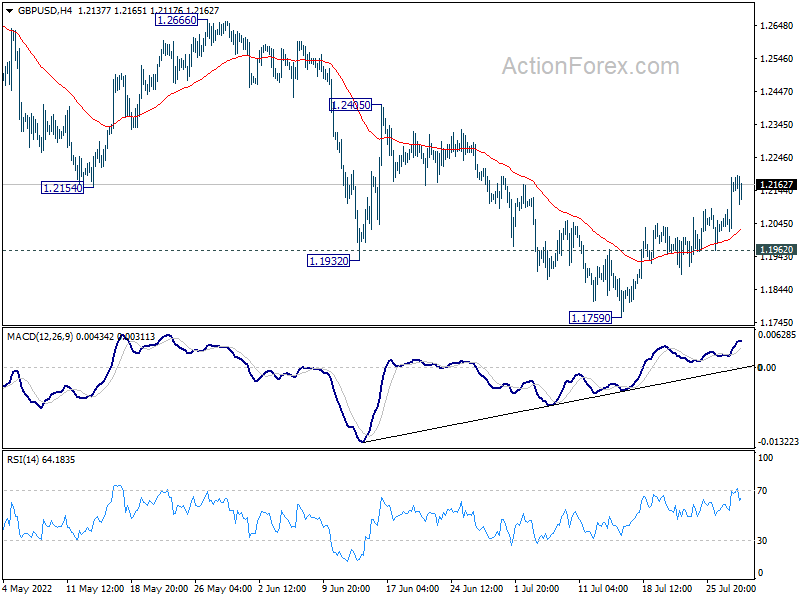
Intraday bias in GBP/USD remains on the upside at this point. Rebound from 1.1759 should target 1.2405 resistance first. Firm break there will target 1.2666 key resistance next. On the downside, break of 1.1962 minor support will turn bias back to the downside for retesting 1.1759 low instead.
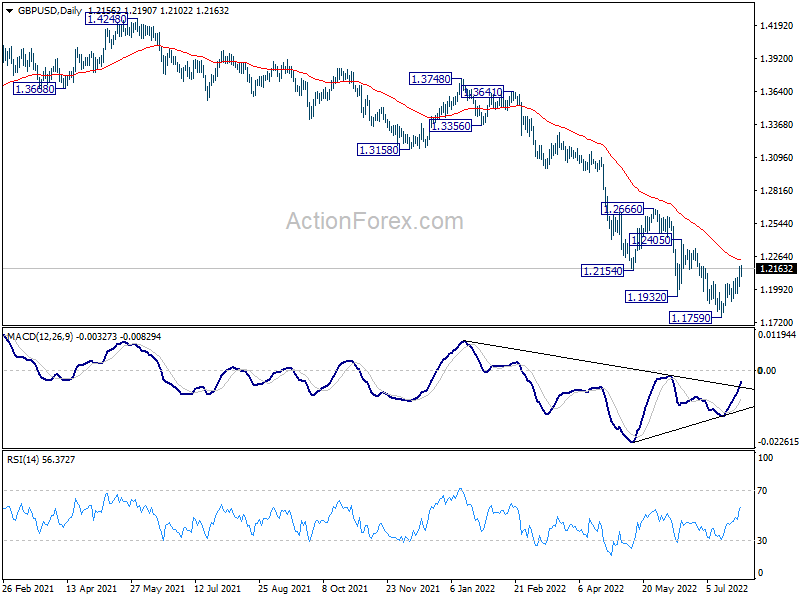
In the bigger picture, fall from 1.4248 (2018 high) could be a leg inside the pattern from 1.1409 (2020 low), or resuming the longer term down trend. Deeper decline is expected as long as 1.2666 resistance holds. Next target is 1.1409 low. However, firm break of 1.2666 will bring stronger rise back to 55 week EMA (now at 1.2986).
USD/CHF Mid-Day Outlook
Daily Pivots: (S1) 0.9567; (P) 0.9613; (R1) 0.9642; More...
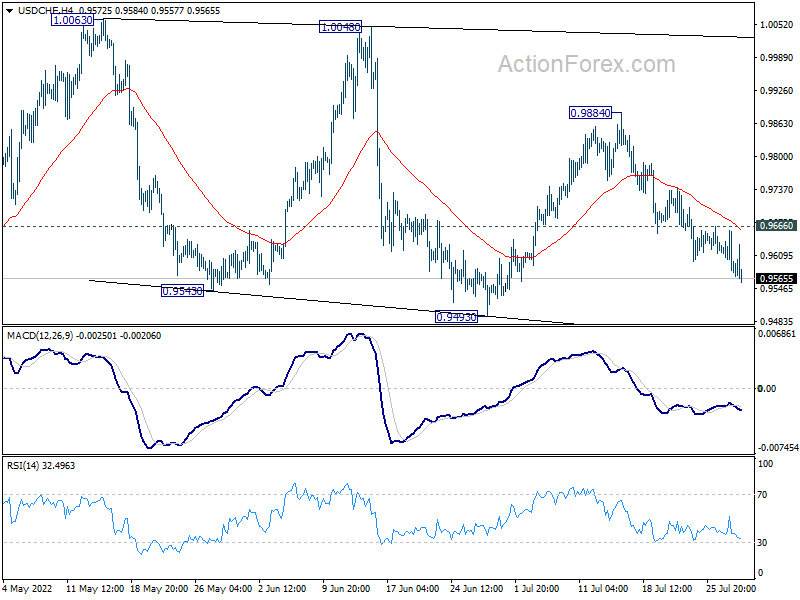
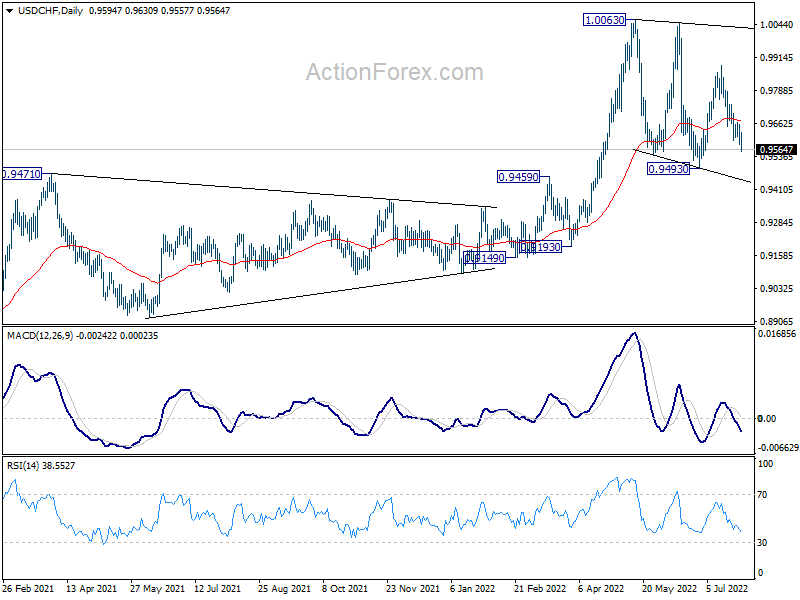
USD/CHF's fall from 0.9884 is still in progress and intraday bias stays on the downside. Such decline is seen as a falling leg of the consolidation from 1.0063. Deeper decline would be seen to 0.9493 support. On the upside, though, above 0.9666 minor resistance will turn bias back to the upside for 0.9884 resistance.
In the bigger picture, medium term up trend from 0.8756 (2021 low) is still in progress. On resumption, next target is 1.0342 (2016 high). Sustained break there will resume long term up trend from 0.7065 (2011 low). This will remain the favored case as long as 0.9471 resistance turned support holds.
USD/JPY Mid-Day Outlook
Daily Pivots: (S1) 136.15; (P) 136.80; (R1) 137.28; More...
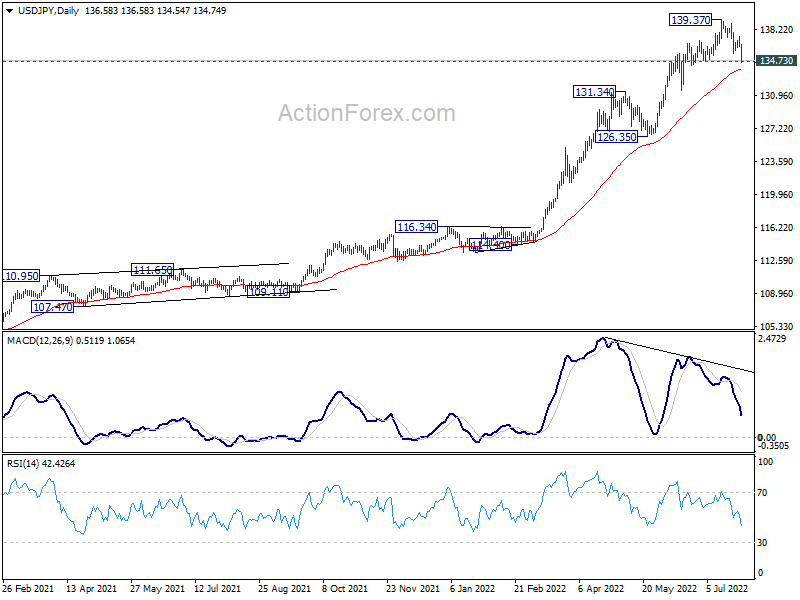
USD/JPY's break of 134.73 support now suggests that 139.37 is a medium term top, on bearish divergence condition in daily MACD. Fall from there is seen as a correction to medium term up trend. Intraday bias is on the downside for 55 day EMA (now at 133.84) first. Sustained break there will target 126.35/131.34 support zone. On the upside, break of 137.44 resistance is needed to indicate completion of the decline. Otherwise, risk will stay on the downside in case of recovery.
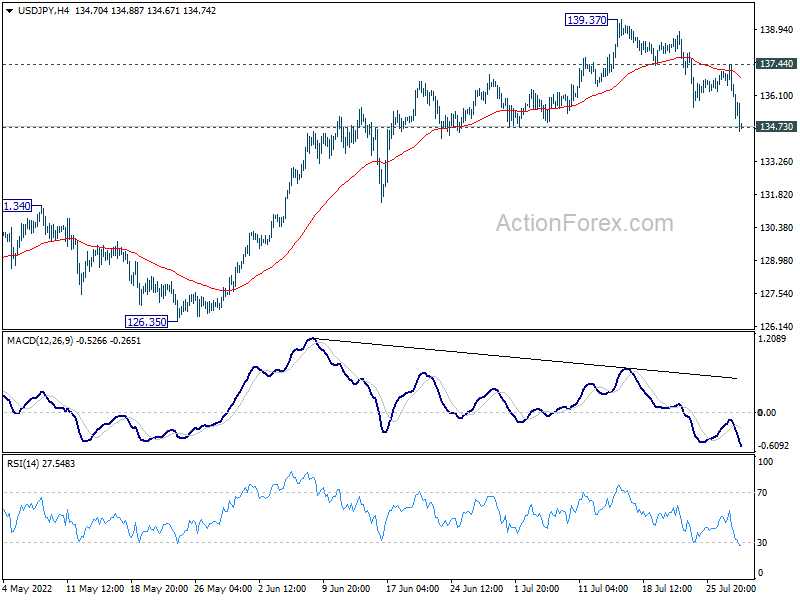
In the bigger picture, current rally is seen as part of the long term up trend from 75.56 (2011 low). Next target is 100% projection of 75.56 (2011 low) to 125.85 (2015 high) from 98.97 at 149.26, which is close to 147.68 (1998 high). This will remain the favored case as long as 126.35 support holds.
Yen Surges after Shocking US GDP Data
Yen rises strongly today, and buying intensifies in early US session, after surprisingly poor US GDP data. Benchmark treasury yield in both the US and Germany tumble sharply, aiding Yen's advance. Swiss Franc is also strong For now, Euro is the worst performer for today, as selling started earlier in European session already, while Sterling is playing catch-up. Dollar is mixed while commodity currencies look indifferent.
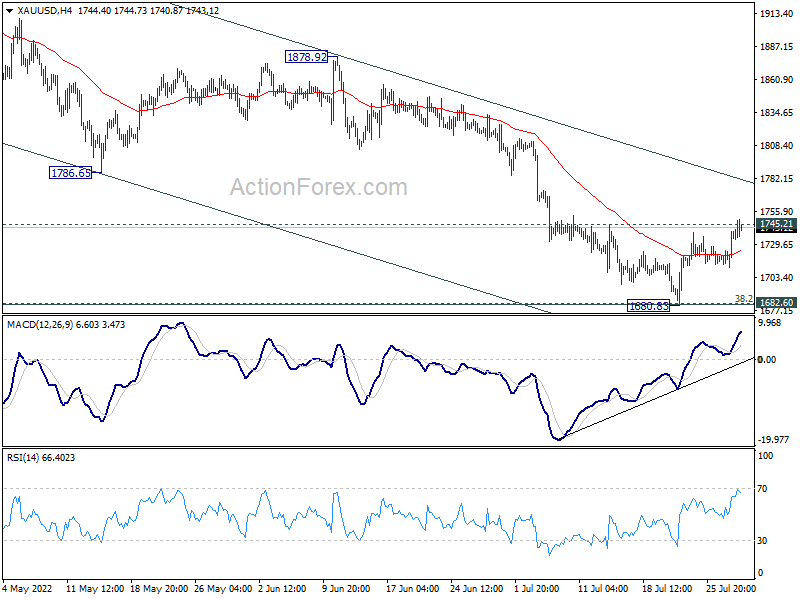
Technically, USD/JPY's break of 134.73 support argues that it's already in correction to medium term up trend. Deeper fall could be seen to 126.35/131.34 support zone. Gold is also pressing 1745.21 minor resistance. Sustained break there will add to the case of bullish trend reversal, after hitting 1682.60 long term cluster support. That, if happens, would be verification of Dollar weakness.
In Europe, at the time of writing, FTSE is down -0.09%. DAX is up 0.18%. CAC is up 0.42%. Germany 10-year yield is down -0.072 at 0.874, below 0.9% handle. Earlier in Asia, Nikkei rose 0.36%. Hong Kong HSI dropped -0.23%. China Shanghai SSE rose 0.21%. Singapore Strait Times rose 0.48%. Japan 10-year JGB yield rose 0.0134 at 0.209.
US GDP contract -0.9% in Q2, second quarter of contraction
US GDP contracted an annualized -0.9% in Q2, much worse than expectation of 0.4% rise. That's the second quarter of contraction, after Q1's -1.6% annualized.
BEA said: "The decrease in real GDP reflected decreases in private inventory investment, residential fixed investment, federal government spending, state and local government spending, and nonresidential fixed investment that were partly offset by increases in exports and personal consumption expenditures (PCE). Imports, which are a subtraction in the calculation of GDP, increased"
US initial jobless claims dropped to 256k
US initial jobless claims dropped -5k to 256k in the week ending July 23, versus expectation of 248k. Four-week moving average of initial claims rose 6.25k to 249.25k.
Continuing claims dropped -25k to 1359k in the week ending July 16. Four-week moving average of continuing claims rose 8.75k to 1362m.
Eurozone economic sentiment dropped to 99.0 in Jul
Eurozone Economic Sentiment Indicator dropped from 103.5 to 99.0 in July. Industrial confidence dropped from 7.0 to 3.5. Services confidence dropped from 104.1 to 10.7. Consumer confidence dropped from -23.8 to -27.0. Retail trade confidence dropped from -5.2 to -6.8. Construction confidence dropped from 103.5 to 99.0. Employment Expectations Indicator dropped from 110.2 to 107.0.
EU Economic Sentiment Indicator dropped from 101.8 to 97.6. Employment Expectations Indicator dropped from 110.2 to 106.6. In the EU, the drop in the ESI in July was due to significant losses in industry, services, retail trade and consumer confidence, whereas confidence in construction decreased more mildly. The ESI fell markedly in four out of the six largest EU economies, Spain (-5.0), Germany (-4.9), Italy (-3.4) and Poland (-3.2), while it remained broadly stable in France (-0.1) and the Netherlands (+0.2).
BoJ Amamiya: We need to support economic activity with accommodative monetary policy
Deputy Governor Masayoshi Amamiya said, "Japan's economy hasn't recovered yet to pre-pandemic levels... The foundations for an economic recovery remain weak and the outlook for wages is highly uncertain. As such, we need to support economic activity with accommodative monetary policy."
"Achieving our price target means having consumer inflation hit 2% on average over the business cycle, not a temporary rise to that level driven by exogenous factors such as increasing energy import costs," he emphasized.
Japan's CPI core (all-item ex fresh food), has been above BoJ's 2% target for three straight months. But officials are seeing it as temporary, at least until wage pressures build up.
Australia retail sales rose 0.2% mom in Jun, sixth-straight monthly rise
Australia retail sales rose 0.2% mom to AUD 34.2B in June, below expectation of 0.4% mom. Through the year, sales rose 12.0% yoy.
Ben Dorber, head of retail statistics at the ABS, said: "While the 0.2 per cent rise in June 2022 was the sixth-straight rise in retail turnover, it was also the smallest so far this year....
"Given the increases in prices we've seen in the Consumer Price Index, it will also be important to look at changes in the volumes of retail goods, in next week's release of quarterly data."
NZ ANZ business confidence improved to -56.7, business feeling apprehensive
New Zealand ANZ business confidence improved from -62.6 to -56.7 in July. Own activity outlook rose from -9.1 to -8.7. Employment intentions rose from 0.7 to 1.1. Pricing intentions rose from 73.7 to 74.0. Inflation expectations rose from 6.02 to 6.23.
ANZ said that most activity indicators were little changed, but residential construction intentions plummeted again to a fresh record low (-73.7). Inflation pressures remain intense, but may be topping out.
It added: "New Zealand businesses are well aware that the Reserve Bank is on a mission to reduce customer demand for their wares in order to reduce inflation. No wonder they're feeling apprehensive."
USD/JPY Mid-Day Outlook
Daily Pivots: (S1) 136.15; (P) 136.80; (R1) 137.28; More...
USD/JPY's break of 134.73 support now suggests that 139.37 is a medium term top, on bearish divergence condition in daily MACD. Fall from there is seen as a correction to medium term up trend. Intraday bias is on the downside for 55 day EMA (now at 133.84) first. Sustained break there will target 126.35/131.34 support zone. On the upside, break of 137.44 resistance is needed to indicate completion of the decline. Otherwise, risk will stay on the downside in case of recovery.
In the bigger picture, current rally is seen as part of the long term up trend from 75.56 (2011 low). Next target is 100% projection of 75.56 (2011 low) to 125.85 (2015 high) from 98.97 at 149.26, which is close to 147.68 (1998 high). This will remain the favored case as long as 126.35 support holds.
Economic Indicators Update
| GMT | Ccy | Events | Actual | Forecast | Previous | Revised |
|---|---|---|---|---|---|---|
| 01:00 | NZD | ANZ Business Confidence Jul | -56.7 | -62.6 | ||
| 01:30 | AUD | Import Price Index Q/Q Q2 | 4.30% | 1.90% | 5.10% | |
| 01:30 | AUD | Retail Sales M/M Jun | 0.20% | 0.40% | 0.90% | |
| 09:00 | EUR | Eurozone Economic Sentiment Indicator Jul | 99 | 102 | 104 | 103.5 |
| 09:00 | EUR | Eurozone Industrial Confidence Jul | 3.5 | 6.9 | 7.4 | 7 |
| 09:00 | EUR | Eurozone Services Sentiment Jul | 10.7 | 14.5 | 14.8 | 14.1 |
| 09:00 | EUR | Eurozone Consumer Confidence Jul F | -27 | -27 | -27 | |
| 12:00 | EUR | Germany CPI M/M Jul P | 0.90% | 0.60% | 0.10% | |
| 12:00 | EUR | Germany CPI Y/Y Jul P | 7.50% | 7.40% | 7.60% | |
| 12:30 | USD | Initial Jobless Claims (Jul 22) | 256K | 248K | 251K | 261K |
| 12:30 | USD | GDP Annualized Q2 P | -0.90% | 0.40% | -1.60% | |
| 12:30 | USD | GDP Price Index Q2 P | 8.70% | 7.20% | 8.30% | 8.20% |
| 14:30 | USD | Natural Gas Storage | 19B | 32B |
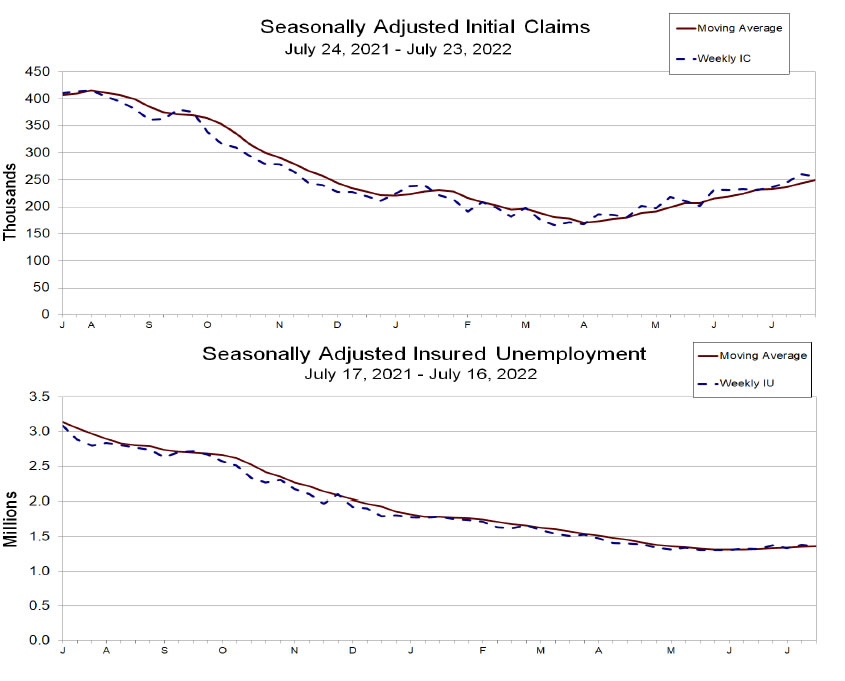
US initial jobless claims dropped to 256k
US initial jobless claims dropped -5k to 256k in the week ending July 23, versus expectation of 248k. Four-week moving average of initial claims rose 6.25k to 249.25k.
Continuing claims dropped -25k to 1359k in the week ending July 16. Four-week moving average of continuing claims rose 8.75k to 1362m.
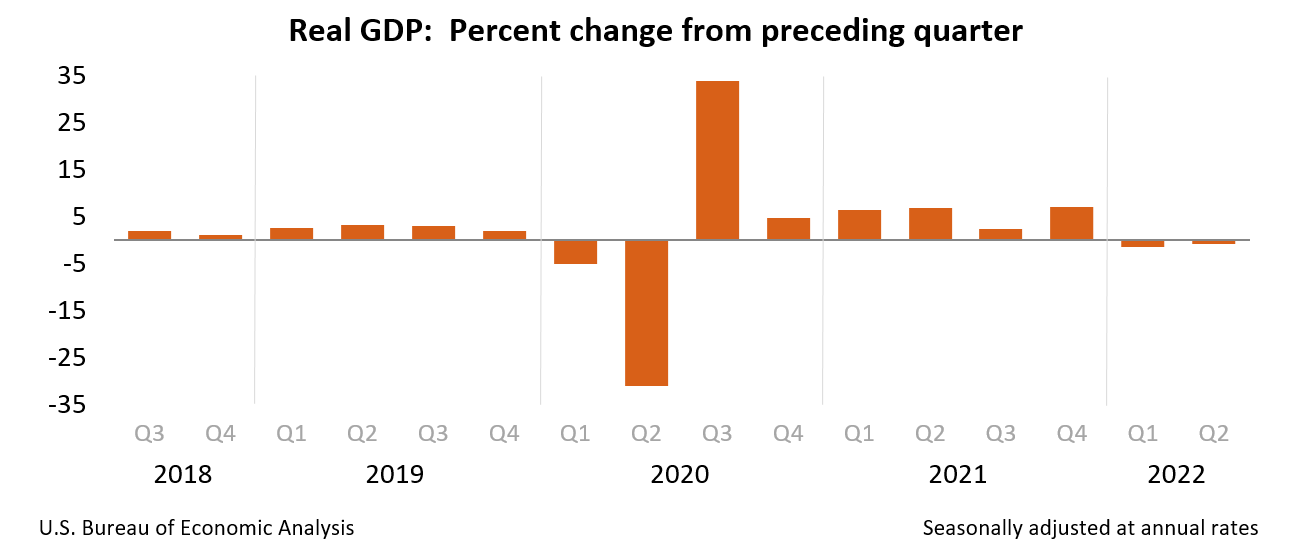
US GDP contract -0.9% in Q2, second quarter of contraction
US GDP contracted an annualized -0.9% in Q2, much worse than expectation of 0.4% rise. That's the second quarter of contraction, after Q1's -1.6% annualized.
BEA said: "The decrease in real GDP reflected decreases in private inventory investment, residential fixed investment, federal government spending, state and local government spending, and nonresidential fixed investment that were partly offset by increases in exports and personal consumption expenditures (PCE). Imports, which are a subtraction in the calculation of GDP, increased"
Aussie Joins Post-FOMC Rally, US GDP Looms
US dollar sinks after FOMC rate hike
There were no surprises from the Federal Reserve, which delivered a second straight 0.75% hike on Wednesday. The markets had priced in this move, although it was a live meeting, as there was an outside chance of the Fed firing a massive 1.00% salvo in order to curb runaway inflation. The US dollar beat a hasty retreat against the majors, as the markets jumped on Fed Chair Powell’s post-meeting comments. Powell stated that it might be appropriate to reduce the pace of rate hikes moving forward and each rate decision would be made on a meeting-to-meeting basis. In effect, this ditches forward guidance. The equity markets were in a “buy everything” (and sell US dollars) mood after Powell’s remarks, and the Aussie jumped on the bandwagon, climbing 0.76% and hitting a six-week high.
This stance of throwing away forward guidance appears contagious – at the ECB meeting last week, ECB President Lagarde also announced that rate decisions would be made at each meeting. Ahead of that ECB meeting, forward guidance was for a 0.25% increase, but in the end, the ECB went with a 0.50% hike, with investors puzzled as to why the ECB ignored its forward guidance. By keeping mum until the meeting, central banks can avoid being criticized for making a rate move that doesn’t match its forward guidance.
In Australia, retail sales fell sharply in June to 0.2% MoM, down from 0.9% in May (0.5% exp). The RBA has embarked on an aggressive rate-tightening cycle, which has taken a toll on Australian consumers, who are grappling with higher mortgage payments, in addition to soaring inflation. Even with the drop in consumer spending, the RBA is likely to press ahead with a 0.50% rate increase at its meeting on August 2nd.
The markets will now shift attention to US GDP, which will be released later today. The markets are forecasting a small gain of 0.5% for the second quarter. The economy contracted by 1.6% in Q1, and a negative reading today would technically mark a recession, which could shake up the markets, which are always allergic to the “R” word.
AUD/USD Technical
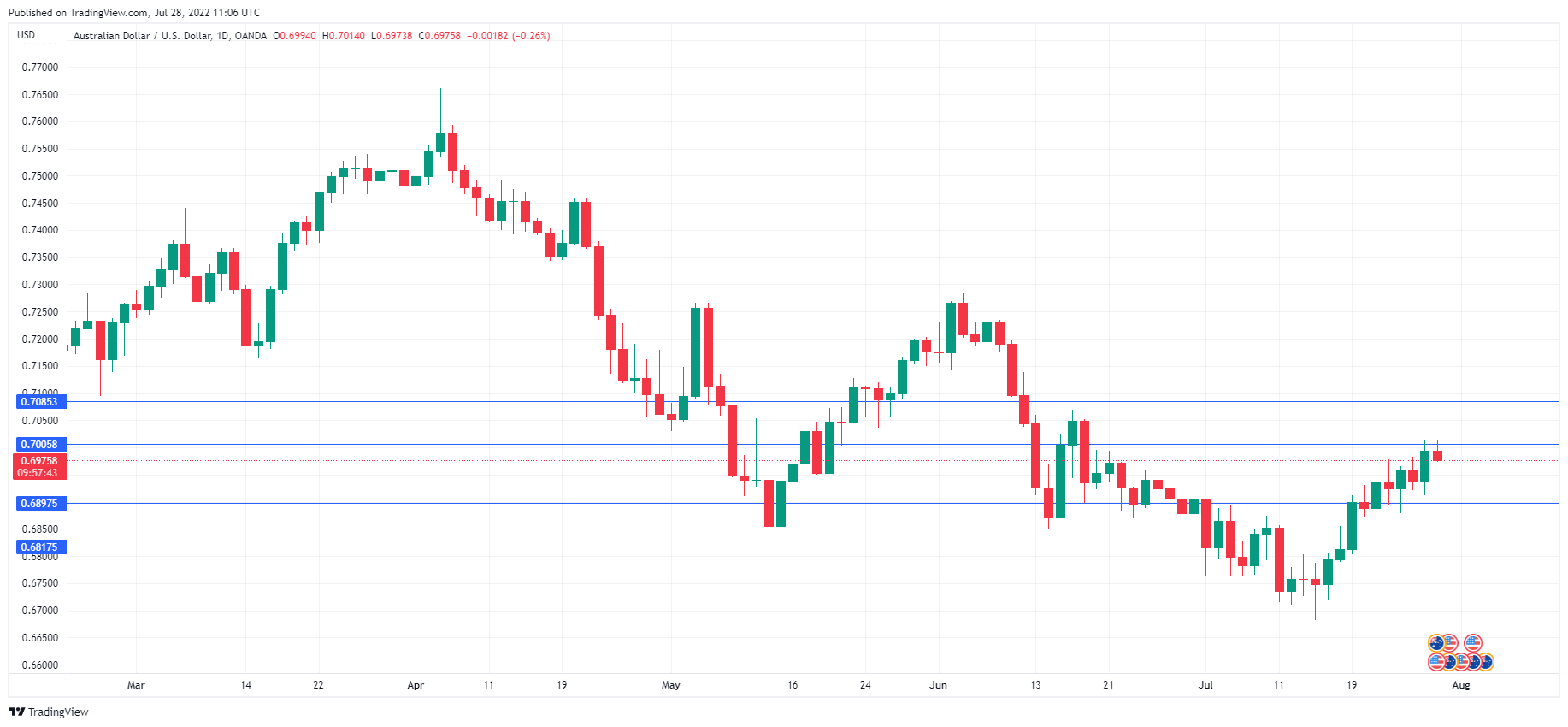
- AUD/USD is testing resistance at 0.7005. Above, there is resistance at 0.7085
- 0.6897 is providing support, followed by 0.6817
GBP/USD Outlook: Bulls Start to Lose Traction after Post-Fed 1% Rally
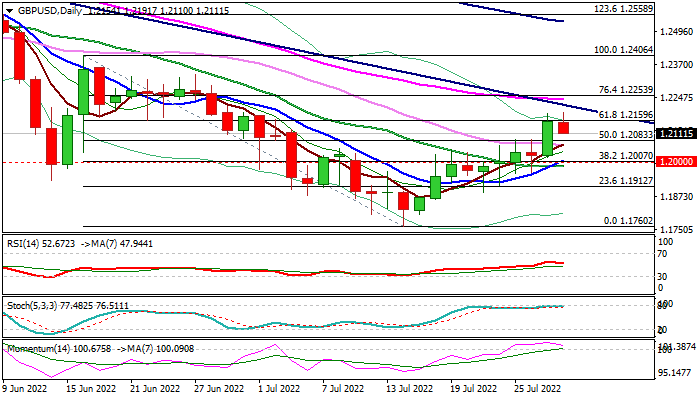
Cable eases from one-month high in European trading on Thursday after being inflated by fresh risk appetite on unclear signals from Fed that prompted investors out of dollar.
Although the Fed raised interest rates by 0.75% as expected, Chief Powell missed to deliver an information about the size of the next rate hike that made a number of traders to believe that the period of aggressive approach to policy tightening is likely over and the US central bank is going to start reducing the size of hikes.
The action is struggling at pivotal Fibo resistance at 1.2159 (61.8% of 1.2406/1.1760), despite Wednesday’s 1.07% rally and threatening of recovery stall here that would complete a bull-trap and increase downside risk.
Negative scenario, however, would require more evidence to be confirmed, with initial bearish signal expected on break of Fibo support at 1.2089 (23.6% of 1.1760/1.2191 recovery leg), with extension through key support at 1.2026 (Fibo 38.2% / daily Tenkan-sen to signal lower top at 1.2191 and reversal.
Conversely, sustained break of Fibo barrier at 1.2159 would strengthen near-term structure, but bulls would face more headwinds from the base of thick daily cloud (1.2235).
Res: 1.2191;1.2235; 1.2253; 1.2332.
Sup: 1.2089; 1.2000; 1.1976; 1.1925.
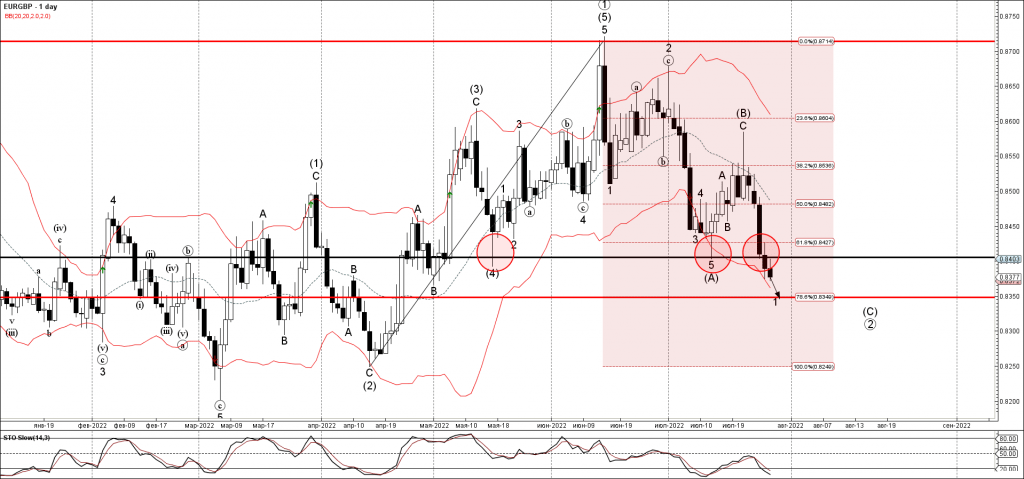
EURGBP Wave Analysis
- EURGBP broke key support level 0.8400
- Likely to fall to support level 0.8350
EURGBP currency pair recently broke the key support level 0.8400 (which has been reversing the pair from the middle of May) intersecting with the 61.8% Fibonacci correction of the upward price move from April.
The breakout of the support level 0.8400 accelerated the active minor impulse wave 1 – which belongs to the higher order impulse wave (C) from last week.
EURGBP can be expected to fall further toward the next support level 0.8350 (target price for the completion of the active minor impulse wave 1).
AUDNZD Wave Analysis
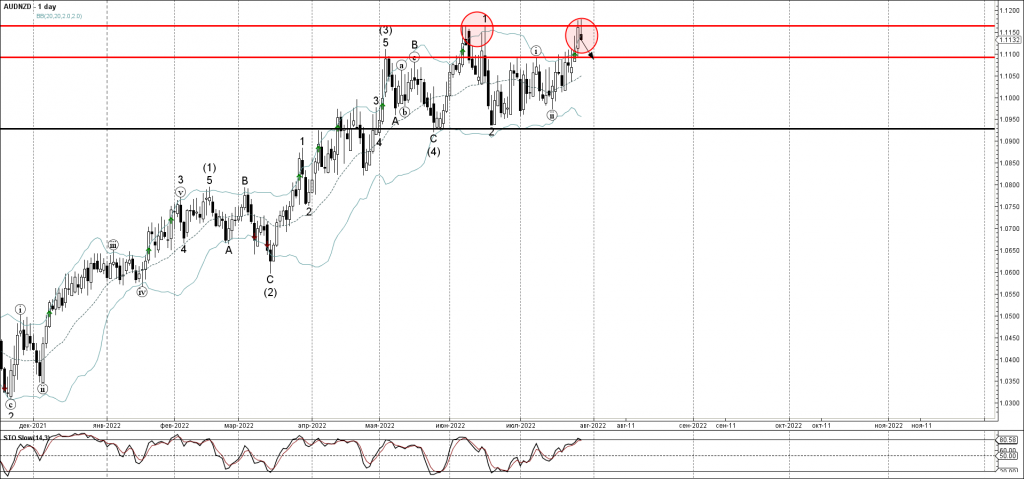
- AUDNZD reversed from resistance level 1.1165
- Likely to fall to support level 1.1100
AUDNZD currency pair recently reversed down from the pivotal resistance level 1.1165 (former strong resistance from the start of June).
The downward reversal from the resistance level 1.1165 stopped the earlier minor impulse wave 3 – which belongs to the higher order impulse sequence (5) from May.
Given the strength of the resistance level 1.1165, AUDNZD can be expected to fall further toward the next support level 1.1100.