Sample Category Title
NZD/USD Finds Support
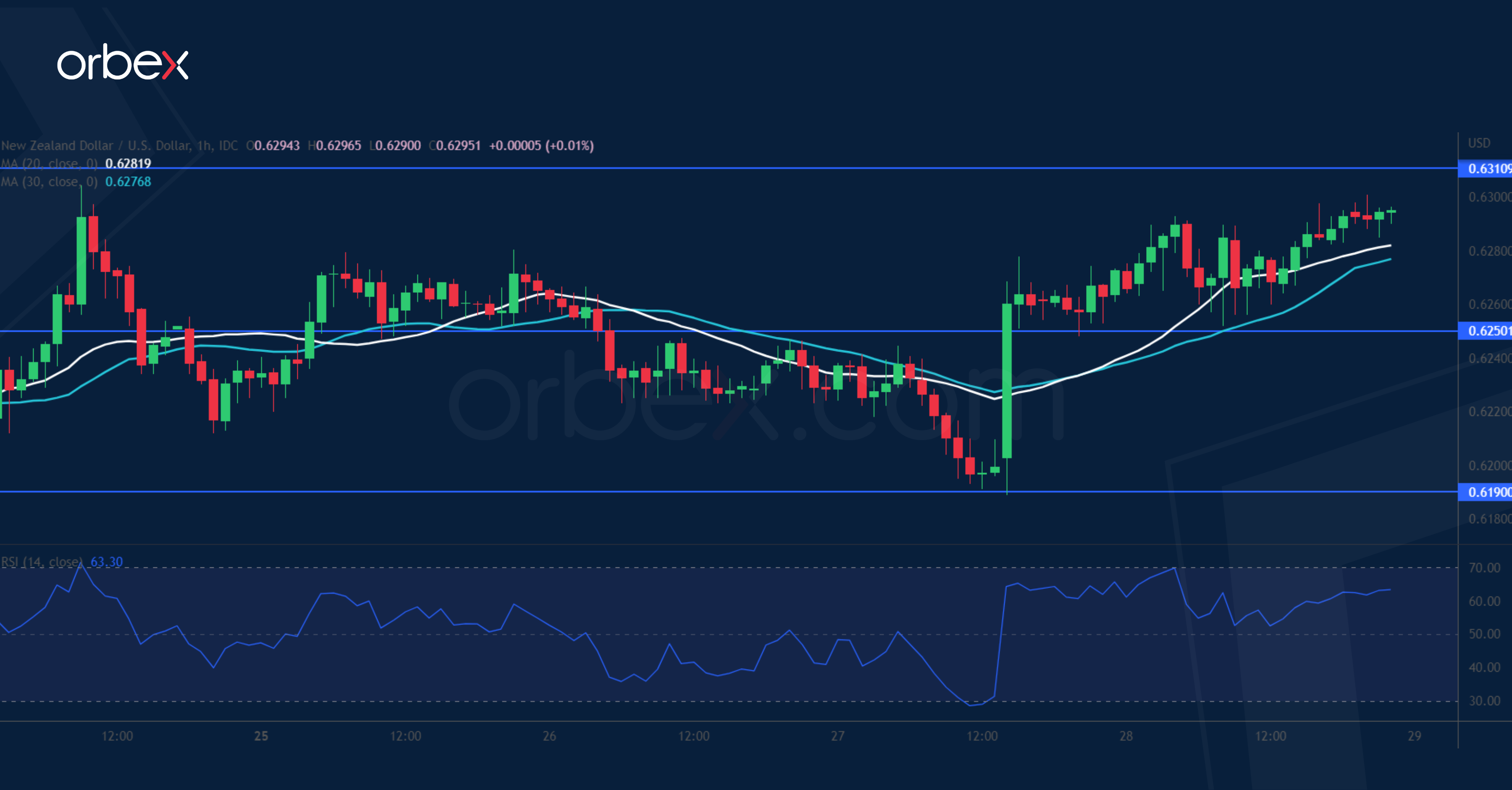
The New Zealand dollar edges higher as risk appetite makes a comeback across markets. The pair previously came under pressure at 0.6310 next to the origin of the sell-off in late June. The kiwi subsequently found support at 0.6190, suggesting strong interest in maintaining the current recovery. A bullish MA cross shows acceleration to the upside. A break above 0.6310 could flush out the remaining sellers and pave the way for an extended rally above the daily resistance at 0.6390. 0.6250 is the first support should the pair fall back.
USD/JPY Struggles for Bids
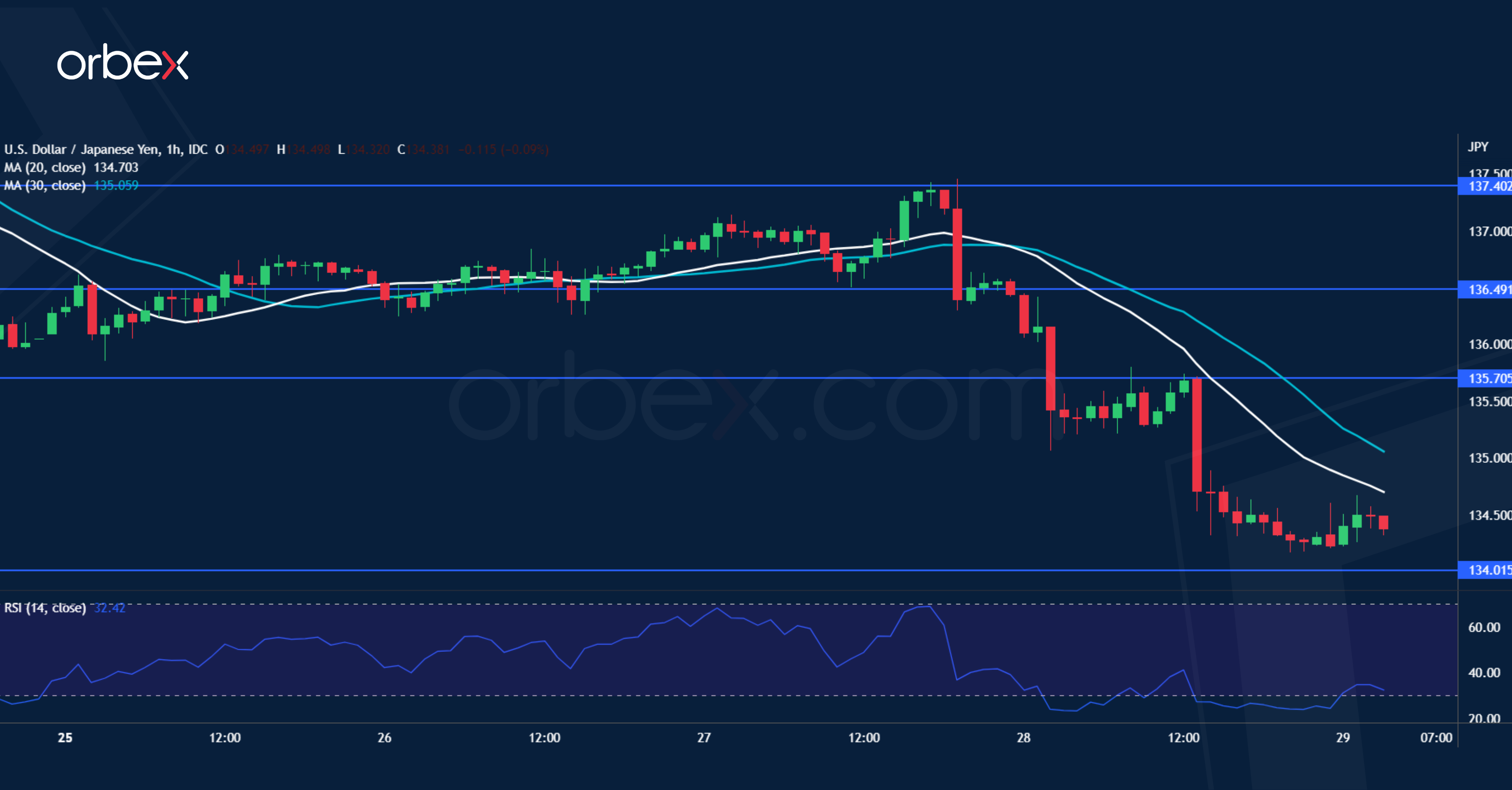
The Japanese yen rallied after July’s CPI exceeded expectations. A lack of support from the 30-day moving average (136.50) has put the dollar bulls on the defensive. Then a drop below the demand zones around 136.00 then 135.00 triggered rounds of liquidation with buyers rushing to the exit. As the RSI dips into the oversold area, the greenback may find some respite over 134.00. 135.70 is the first resistance in case of a bounce. A bearish breakout would deepen the correction towards the daily support at 132.00.
Daily Technical Analysis
EUR/USD
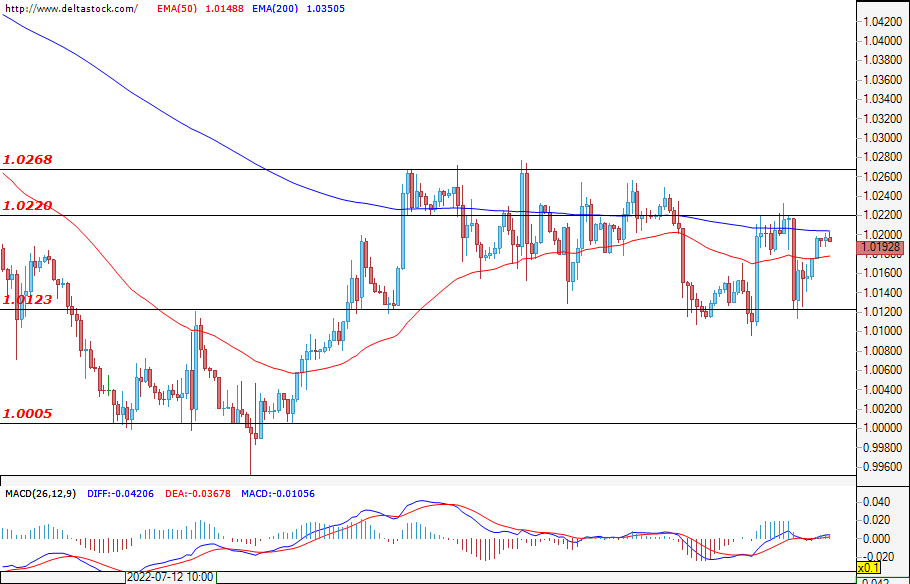
The pair ended yesterday's volatile session without significant changes. Data on the declining U.S. GDP kicked off a technical recession in the country, which in turn supported the euro. Nevertheless, expectations remain negative, and the downtrend is not broken yet. Prices continue to move in a range with support at 1.0120 and resistance at 10270. First daily resistance for the bulls is the area at 1.0220. A break above 1.0270 will be needed for a change in sentiment, but fundamentals for a stronger euro are also missing. A more likely scenario is another bear attack towards 1.0120. The zone has already been breached this week and a breakout is not out of the question. This would pave the way for a new test of 1.0000 and a parity between the euro and the U.S. dollar. Today, on the economic radar is data coming from the Eurozone - German GDP (07:00 GMT) and Eurozone Consumer Price Index (10:00 GMT)
USD/JPY
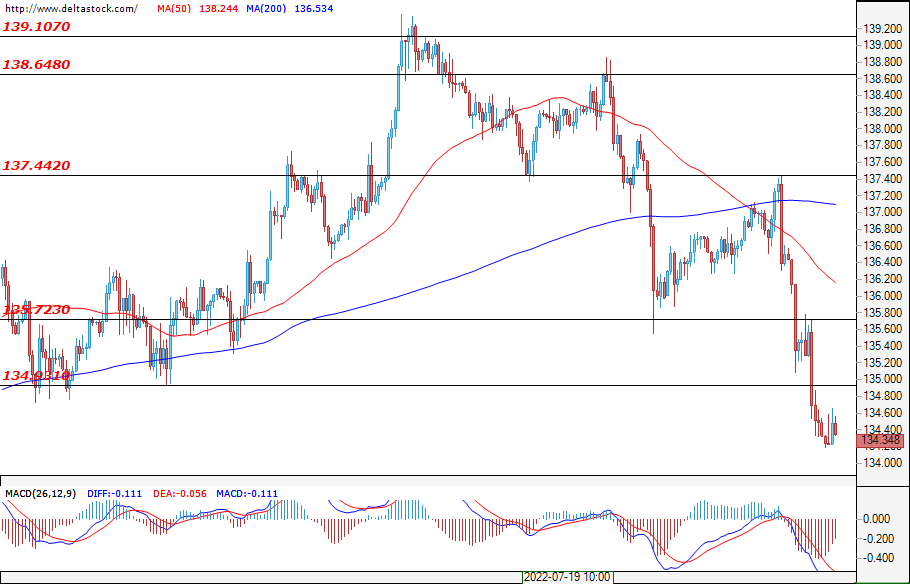
The pair has lost over 2% since the U.S. interest rate announcement earlier this week. It seems the market is entering a long-awaited correction. The main support at 139.93 was broken without much difficulty for the bears. Prices are approaching support coming from the higher time frames - 134.20. It is likely that the declines will slow and the market will correct some of the recent losses. On a possible breakout, the next area expected to offer support is 131.50. The uptrend is still in place and a failed peak on the larger time frames will be needed to change sentiment. For today, the first support for the bulls is 134.20 and the first resistances are 134.93 and 135.70.
GBP/USD
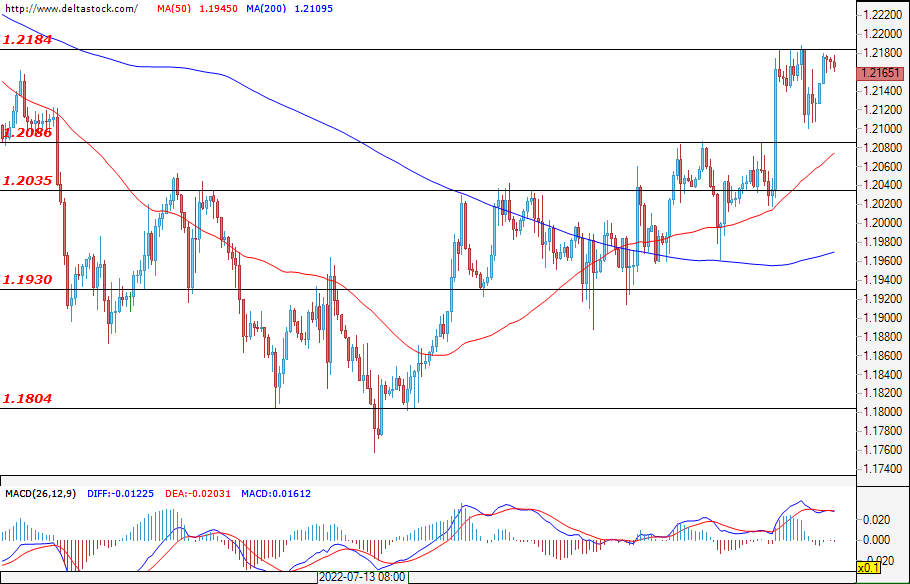
In recent days, the Sterling managed to recover to the resistance around 1.2170-1.2184. The zone comes from the larger frames and may not be overcome on the first time. Expectations are that the market will remain in a corrective phase with main support around 1.2040. First support for the day bulls can expect around 1.2100-1.2086. A possible break of 1.2170 could open the way to the next resistance around 1.2300.
EUGERMANY40
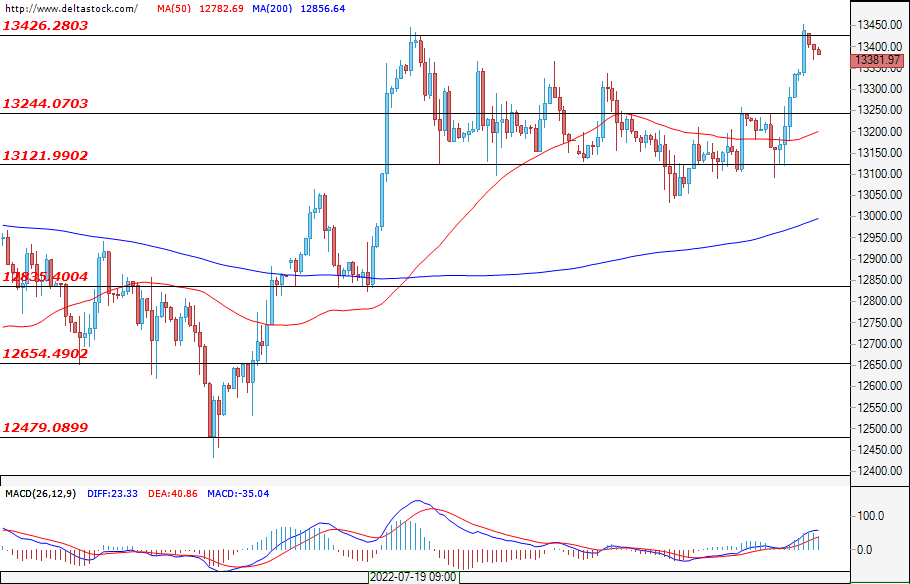
The German index once again tested the support around 13120, then the bulls took control for the rest of the day and the session closed around the highs. The 13430-13450 bear zone has not been breached yet and declines from the current levels are not ruled out. A breakout by the bulls, however, could liquidate short positions in the zone and prices could head towards the next resistance at 13680. First support for the day is 13240. Failure of the bulls today to capture 13430 could allow for further dips below 13120 or a continuation of trading in the current range.
US30
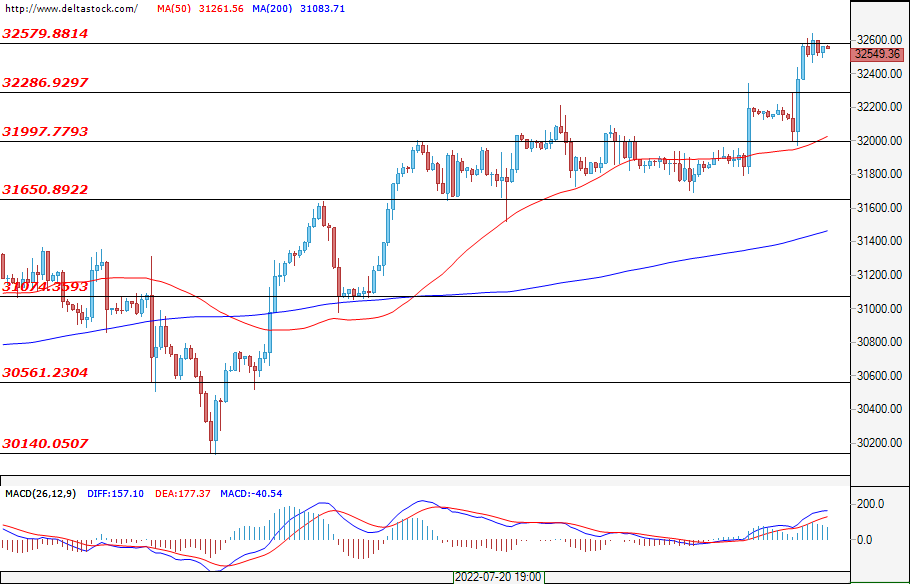
US30 managed to reach the key resistance at 32600 after once again "bad news is good news" for the market. Short squeeze and FOMO fear could push the U.S. markets higher, with the next major resistance for the index at 33100. First support for the bulls is at 32280. The zone has yet to be tested and confirmed, so corrective moves are not out of the question. Sentiment around current levels is mixed, and volatility is expected to remain high due to deteriorating liquidity.
10y Yield’s Technical Picture Risks Deteriorating Dramatically
Markets
Core bonds went through the roof yesterday. The US yield curve bull steepened with changes varying between -15.1 bps (5y) to -4.3 bps (30y). The 10y yield’s technical picture risks deteriorating dramatically if the drop below the lower bound of the sideways 2.70/3.50% trading range gets confirmed in coming days. German Bunds outperformed, losing a stunning 18.5-19.6 bps in the 2y/5y segment and 8.9y further out. That happened even as inflation in the country surprised to the upside (8.5% vs a decline to 8.1% expected). But markets were/are in a different state of mind since the Fed meeting. The focus was on a potential slowdown of the Fed tightening cycle, and this also affected expectations for the ECB even as it only just started normalizing. A bigger-than-expected drop in EC economic confidence to the lowest since early 2021 and especially in US GDP (-0.9%) only strengthened that market thinking. Needless to say rate moves yesterday were exclusively driven by the real yield component. This brought comfort to stock markets. Equities in Europe and the US added up to 1.2% despite facing a (or for the US: being in a technical) recession. US GDP numbers restored the balance in EUR/USD. The pair rebounded from intraday lows around 1.011 to close around 1.02. Revealing how this was dollar weakness and not euro strength was EUR/CHF, which closed at a new record low. The yen outperformed. USD/JPY dropped below 135 for the first time since end June. EUR/JPY loses no less than 2.5 big figures (136.9). Sterling did well, once again, both against USD and the euro. EUR/GBP extended a trip south of 0.84.
Currency markets trade a pattern similar to yesterday in Asian dealings this morning. The dollar, euro are weak, CHF and especially JPY gain the most. Equities rise except in Japan (yen strength) and China (Politburo gives a downbeat eco assessment). Futures point to a green open in Europe and the US thanks to solid big tech earnings. Core bonds extend a rally. Today’s economic calendar is focused on Europe with inflation for July and Q2 GDP numbers due. Risks are tilted to the upside for the former, we have a neutral bias on the latter. Also keep an eye at the US employment cost index. Powell referred to it as being an important indicator on Wednesday. Any downward surprise in the current environment could be considered as an enough reason for central banks to be less aggressive. That said, yields have declined materially already and are on the verge being out of touch with the actual central bank intentions, regardless of the growth slowdown, so we look out for/hope to see a bottom forming going into the weekend. We remain structurally cautious on EUR/USD. The dollar is rapidly losing interest rate support but in a context of recession fears, its safe haven status may soon resurface.
News Headlines
Economic data published in Japan this morning painted a mixed picture. Industrial output rebounded sharply in June by a much stronger than expected 8.9% M/M. Easing Covid restrictions in Shanghai reduced supply disruptions for several industries, including the automobile industry, electronics and communication equipment. June retail sales unexpectedly dropped 1.4% M/M causing Y/Y growth to slow to 1.5% from 3.7% Y/Y in May. Higher prices probably slowed consumer spending. In this respect, the July Tokyo CPI rose slightly faster than expected. Headline CPI came in at 2.5% Y/Y from 2.3% Y/Y in June. The core measure (ex fresh food and energy) accelerated from 1.0%Y/Y to 1.2%. The unemployment rate stabilized at 2.6%. The yen strengthens further this morning to USD/JPY 133.4, but this is mainly due to recessionary fears in the US and a sharp decline in US yields rather than the Japanese data.
According to sources spoken by Reuters, OPEC and its allies when meeting next week will consider keeping oil output unchanged in September. Some sources suggested that a modest increase also could be discussed. By August, OPEC+ will have reversed the production cuts that were installed since 2020 due to the pandemic. The debate on a stable OPEC production comes as President Biden at his latest visit to Saudi Arabia called on country to step up production to address high oil prices and their impact on global/US inflation. After a brief drop below $100 p/b earlier this month, Brent oil currently again trades near $ 108 p/b even as markets are pondering growing risks to global growth.
Technical Recession Equals Buy Stocks
US GDP had a nasty surprise for everybody overnight, unexpectedly falling by 0.90%, when market expectations were for a modest 0.50% gain. That marked two consecutive negative quarters of US growth, meaning that for many economists, the US is now in a technical recession. Off course, if you put a group of economists in a room today and ask them what two plus two is, none of them will agree with each other. And so, it is with the definition of a recession.
I am not an economist, but I did note something very interesting last night. Two economics research houses that we subscribe to here at OANDA, full of very brainy people, had two different opinions on the US economy for the rest of this year, post that GDP number. One said other indicators such as unemployment would catch up with the GDP, confirming a real and not academic recession. The other said that this is the worst it should get, and the US economy will improve in Q4. So basically, nobody has a clue what is going to happen.
I am not an economist, and a regression is something the wife says to me, amongst other words like potato, as I head out to rugby practice on Tuesdays. Here at “Voice of Reason Research,” I am struggling to join the gloom and doom mob while US employment and job opening metrics remain robust. We may get more clarity on the direction of travel of that piece of the puzzle at next Friday’s US Non-Farm Payrolls.
Still, the weak US GDP data did produce an entirely predictable reaction by markets in the current climate. US bond yields headed lower, and the US Dollar retreated. Notable was the continued culling of the USD/JPY long trade, the pair fell by 1.73% to 134.25 overnight, and the thinning of the herd looks like it still has plenty in it. Asian currencies finally started rising versus the greenback as well. For the FOMO gnomes of Wall Street, the calculation was easy. Lower US GDP equals recession equals fewer Fed hikes, a lower terminal rate, equals buy stocks. That arcane logic will be tested at some stage in the future, but not just yet.
US equity index futures are on fire in Asia today as well, rising impressively after Apple announced robust earnings and Amazon knocked it out of the park, both after the closing bell. US equity markets find themselves in a situation where a US recession is a buy signal for stocks, and decent technology earnings are a buy signal for stocks. Don’t feel bad if none of that makes sense; just respect the momentum.
Bucking the trend, South Korean Industrial Production rose by 1.90% MoM in June, and Japan's Industrial Production jumped by 8.90% MoM in June. The year-on-year data still looks soggy, but the shorter-term data suggests it’s not all doom and gloom out there in Asia and that demand for semiconductors and high-end manufactured products remains strong. The problem remains on the consumer side, with Retail Sales in June for South Korea and Japan disappointing, falling 0.90% MoM, and rising 1.50% YoY, respectively. Both were quite bad misses and appear to reflect the impact of rising costs of living.
Australia’s PPI came in slightly lower at 1.40% QOQ Q2, potentially easing some RBA hiking nerves in the lucky country. And even New Zealand’s Consumer Confidence rose slightly in July to 81.90. Strange days indeed.
China’s Politburo reiterated its 5.50% GDP target for 2022 while reiterating its covid zero policy at the same time. But China’s Commerce stated that the domestic consumption recovery is not yet solid and more measures to boost it would be necessary. They also said that foreign trade faced high risks, difficulties, and uncertainties, according to Reuters. How that all coincides with a 5.50% GDP growth this year, I know not, and neither do China markets either, it seems. Chinese equity markets are sharply lower today.
For the rest of the day, German and Eurozone GDP Growth Flash for Q2 and Eurozone Inflation will take centre stage. The GDP data has downside risks for obvious reasons, but Inflation has upside risks, and a print above 8.60% will have the words stagflation and Europe used in a lot of sentences. The Euro has been unable to exploit a weaker US Dollar and rally meaningfully. Lower GDP and higher inflation numbers could see the Euro, and European equities, end the week on a sour note.
US Personal Income and Expenditure MOM for June round out the week, expected to rise by 0.50% and 0.90%, respectively. If the US consumer is still alive and well and the data is strong, the FOMO gnomes of Wall Street may temporarily pause for breath. Conversely, weak data probably sees another wave of buy everything as Wall Street prices in the now data-dependant Fed hiking less aggressively.
Happy Friday, everybody. I will be away for next week from Monday to Thursday next week, as Mrs Halley and I travel from Jakarta to Bali, where we will be reunited with both of our girls for the first time in over three years for a family holiday.
Another mixed day for Asian equities
The soft US GDP data saw Wall Street pricing in a more dovish future Fed, lifting Wall Street higher overnight. The S&P 500 rose by 1.21%, the Nasdaq gained 1.08%, and the Dow Jones added 1.01% in a robust session. Aftermarket earnings releases from Apple were slightly higher than forecast, while Amazon released well above forecast earnings. That has sparked a sharp rise in Nasdaq and S&P 500 futures in Asia, while the value-centric Dow has lagged. S&P 500 futures are 0.65% higher, Nasdaq futures have leapt 1.45% higher, and Dow futures are unchanged.
The US stock market performance has once again had uneven follow-throughs in Asia. The Nikkei 225 is now down 0.20% after the overnight Yen rally continued unabated in Asia today, impacting exporters. However, South Korea’s Kospi has managed a 0.50% gain, with Taipei also adding 0.35%.
On Mainland China markets, things look rather grimmer after economic warnings today from the China Commerce Ministry. The Shanghai Composite has fallen by 0.72%, with the CSI 300 losing 1.10%. Hong Kong’s Hang Seng has slumped by 2.25%.
China and Japan’s performance seem to be tempering sentiment elsewhere in Asia as well. Singapore is 0.50% lower, Kuala Lumpur is 0.30% higher, and Jakarta is 0.45% higher. Bangkok is closed, but Manila has fallen by 1.08%. Australian markets are more closely tracking US markets today. The All Ordinaries have rallied by 0.90%, while the ASX 200 has gained 0.80%.
The mixed performance by Asia, and especially the China comments, mean European markets are unlikely to repeat yesterday’s positive session in early trading. Much will depend on the Germany/Eurozone GDP data and the Eurozone inflation data. Softer GDPs and high inflation prints will likely see European equity markets head south, especially with weekend risk beckoning.
USD/JPY slump dominates Asian trade
The US Dollar selloff continued overnight after weak US GDP data saw it enter a technical recession. However, the US Dollars losses were unevenly distributed. With US yields moving lower post-data, USD/JPY plummeted by over 200 points as long US positions were routed, but EUR/USD remained unchanged, only able to reverse its pre-US data selloff.
That left the dollar index just 0.24% lower at 106.24 overnight, losing another 0.24% to 105.95 in Asia. Notably, the dollar index has now taken out the rising wedge support is at 106.45, which becomes initial resistance. The daily close under 106.45 overnight is a significant technical development, signalling deeper losses towards 1.0500 and 1.0350 and potentially extending to the initial 102.50 longer-term breakouts. Resistance is at 107.45 and 108.00.
EUR/USD slumped to near 1.0100 intraday pre US GDP but reversed all those losses after finishing the day unchanged at 1.0195. EUR/USD remains rangebound, with a weaker dollar offset by geopolitical and recession fears in Europe itself. EUR/USD is steady at 1.0210 in Asia. The multi-day resistance around 1.0275 remains formidable. Only a sustained break above 1.0360 now suggests a longer-term low is in place. Meanwhile, EUR/USD has traced out a series of daily lows around 1.0100. The 1.0100 to 1.0300 range is unlikely to fail into the weekend.
GBP/USD has booked only modest gains overnight and today, holding steady at 1.2185 but well clear of its technical breakout at 1.2100. Sterling looks likely to test 1.2200 imminently, signalling a further rally towards longer-term resistance at 1.2400. Support is now at 1.2100, and then 1.1960, followed by 1.1900 and 1.1800.
Softer US GDP data sent, US yields lower overnight, sparking a capitulation sell-off in USD/JPY as heavy long positioning was aggressively culled. USD/JPY collapsed by 1.73% to 134.25, and the selloff has continued in Asia. USD/JPY has slumped another 0.70% to 133.30, and my initial boundary for this occurrence, at 132.50, could be seen by the end of today. The selling in USD/JPY is further capping gains in EUR, GBP, AUD, and NZD as cross/yen positions are liquidated. Support lies at 132.50, 132,20 and then 131.50, but I am not ruling out a deeper decline as panic sets in. Resistance is at 135.50 and 137.50 but short of a reversal higher by US yields; risks remain skewed to the downside.
AUD/USD and NZD/USD are only slightly higher over the past 24 hours at 0.7005 and 0.6310, as AUD/JPY and NZD/JPY selling limits gains. But the technical picture for both remains constructive as both currencies staged upside breakouts higher a fortnight ago. They remain well above their breakout lines at 0.6790 and 0.6145.
Asian currencies finally started strengthening versus the US Dollar overnight after weak US data pushed US yields lower as recession fears heightened. The Korean Won led gains, falling to 1295.00 overnight, but THB, SGD, and INR also booked decent gains. Some profit taking this morning has seen USD/KRW and USD/THB climb 0.30% higher. It does look like some regional central banks are taking advantage of a weak US Dollar today to push their currencies higher. As Dennis Gartman says, always throw your rocks in the wettest paper bag.
USD/IDR plunged below 15,000.00 to 14,955.00 overnight and has mysteriously tumbled another 0.70% to 14,850.00 today. USD/PHP has plunged by 1.05% to 55.22 this morning. I am assuming that both BI and BSP are selling US Dollars, and I wouldn’t be surprised to see the RBI doing the same this afternoon. Timing, after all, is everything. With China, European, and US recession risks multiplying, the jury is still out as to whether we have seen the worst of the Asian FX sell-off.
Oil is surprisingly steady
Oil prices edged higher overnight as the volatility in currency, bond and equity markets passed it by; most of the oil-related data had already been released for the week. So, although the intraday ranges were as wide as ever, ultimately, oil booked only small gains. It has given those back in Asia today as regional traders react negatively to the China Commerce Ministry's comments. Oil looks set to range trade into the US data, and with the OPEC+ meeting next week, it may consolidate its recent gains over the next few sessions.
Brent crude rose 0.40% overnight to $107.60 overnight, falling by 0.75% to $106.80 in Asia. Resistance at $108.00 survived overnight, but a close above would be a significant bullish technical development, targeting the 100-day moving average (DMA) at $110.15. That is followed by $115.00 a barrel. Support is at $106.00, $104.00 and then 101.50 a barrel.
WTI traded in another giant four-dollar range overnight, finishing 0.90% lower at $97.25 a barrel as recession fears gripped US markets. It has fallen another 0.70% in Asia to $96.60 a barrel. WTI has resistance at $100.00, it's overnight high. Support is at $96.00, the overnight low, followed by the 200-day moving average (DMA) at $95.00. WTI continues to look like the weaker of the two contracts on a technical analysis basis.
Gold rises on weak US Dollar, medium-term low in place
Another fall in US yields on weak US GDP data was enough to inspire a decent rally in gold overnight, aided by a generally weaker US Dollar. Gold surged 1.25% higher to $1756.00 an ounce, adding another 0.40% to $1763.00 in Asia.
The chart has been suggesting, albeit unconvincingly, that gold has been trying to trace out a medium-term low since testing and bouncing off longer-term support at $1780.00 an ounce on the 21st of July. The price action since hasn’t been convincing, with the larger technical picture suggesting gold remained in danger. However, having taken our formidable resistance at $1745.00 an ounce overnight, the technical picture has convincing swung higher.
Gold should now trade back towards $1800.00 over the coming weeks if US yields remain soft. The breakout at $1745.00 now becomes support, followed by $1700.00 and $1680.00. Failure of $1675.00 would signal that the mother of all whipsaws has occurred. Resistance is now at $1780/85.00 an ounce, followed by $1800.00 an ounce.
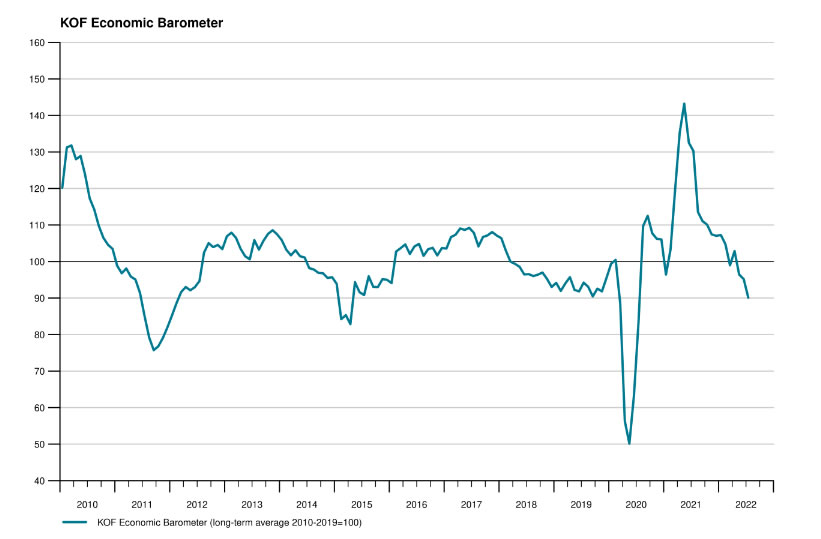
Swiss KOF dropped to 90.1, economy to develop sluggishly in Autumn
Swiss KOF Economic Barometer dropped sharply from 95.2 to 90.1 in July, well below expectation of 95.2. That's also the third decline in a row, with the value below its long-term average by almost 10 pts. KOF said the Swiss economy is likely to "develop sluggishly in autumn".
KOF said: "The retreat in July is led by the bundle of indicators for manufacturing. But the outlook is also much less favourable than before in accommodation and food service activities, other services, and financial and insurance services. The negative tendency is also evident in the bundle of indicators for private consumption in general. The decline is dampened somewhat by the indicators for construction and foreign demand."
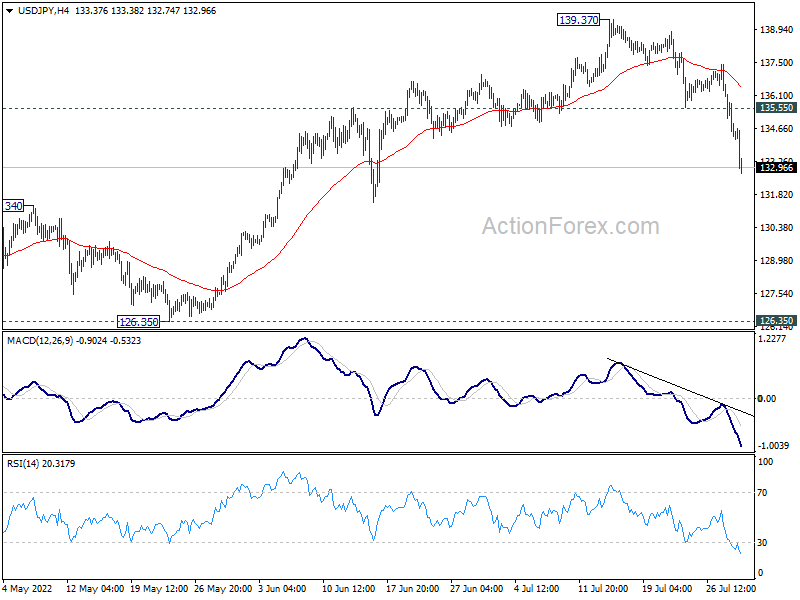
USD/JPY Daily Outlook
Daily Pivots: (S1) 133.42; (P) 135.02; (R1) 135.84; More...
USD/JPY's decline from 139.37 medium term top continues today and hit as low as 132.74 so far. It's now seen as in correction to medium term up trend. Intraday bias stays on the downside for 131.34 resistance turned support and below. But strong support is expected above 126.35 to contain downside, at least on first attempt, to bring rebound. But for now, risk will stay on the downside as long as 135.55 support turned resistance holds, in case of recovery.
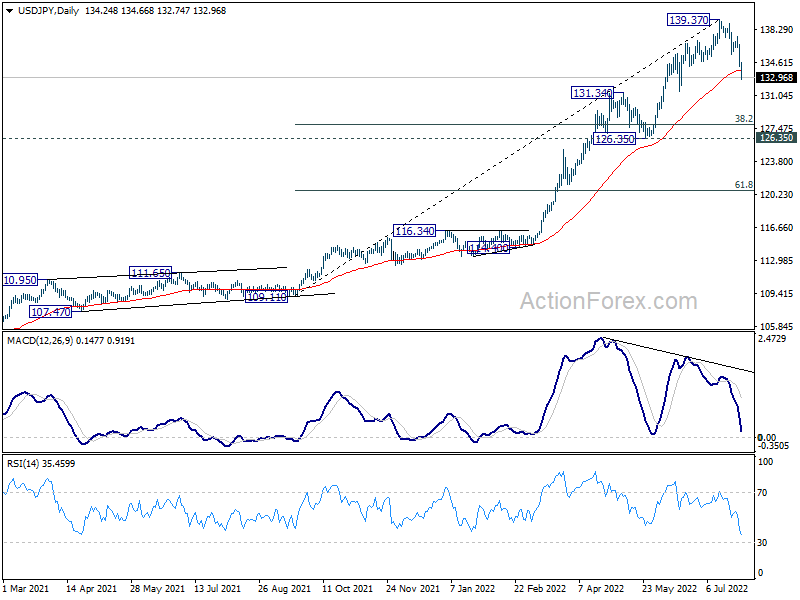
In the bigger picture, current rally is seen as part of the long term up trend from 75.56 (2011 low). Next target is 100% projection of 75.56 (2011 low) to 125.85 (2015 high) from 98.97 at 149.26, which is close to 147.68 (1998 high). This will remain the favored case as long as 126.35 support holds.
Yen Rallies Further on Falling Yields, Dollar and Euro Weak
Yen's rally intensified overnight and continues in Asian session. The move came in particular as US 10-year yield tumbled following the poor GDP report. For now, Dollar and Euro are the worst performing ones for the week, followed by Canadian. Sterling is following Yen as the second strongest and then Aussie. A large batch of economic data will be released today including GDP and inflation data from Eurozone, GDP from Canada and more inflation data from the US. These have the potential to solidify the current trends.
Technically, EUR/USD is so far very reluctant to breakout from range. An upside breakout is still mildly in favor, and break of 1.0277 minor resistance will target 1.0348 support turned resistance and above. But even it happens, such development is unlikely to help Euro elsewhere, and pairs like EUR/CHF, EUR/GBP, EUR/JPY and EUR/AUD should continue to stay pressured.
In Asia, Nikkei dropped -0.20%. Hong Kong HSI is down -2.25%. China Shanghai SSE is down -0.63%. Singapore Strait Times is down -0.52%. Japan 10-year JGB yield is down sharply by -0.035 at 0.178. Overnight, DOW rose 1.03%. S&P 500 rose 1.21%. NASDAQ rose 1.08%. 10-year yield dropped -0.053 to 2.681.
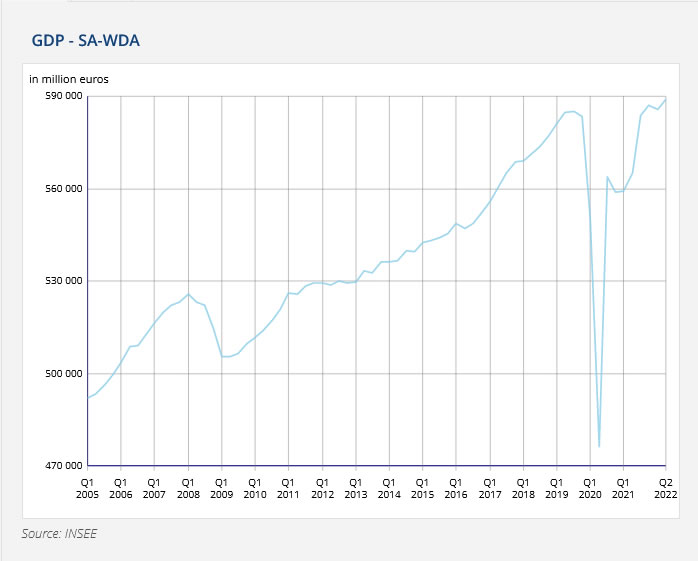
France GDP grew 0.5% qoq in Q2 on dynamism of exports
France GDP grew 0.5% qoq in Q2, better than expectation of 0.2% qoq.
Foreign trade contributed to +0.4 points to GDP growth this quarter, after +0.1 points in the previous quarter. This large contribution is due to the dynamism of exports (+0.8% after +1.6% in Q1 2022), coupled with the decline of imports (-0.6% after +1.2%).
The contribution of final domestic demand (excluding inventories) to GDP growth was null this quarter. Household consumption expenditure fell again, but more moderately than in the previous quarter (-0.2% after -1.3%). Gross fixed capital formation (GFCF) continued to grow at a rather vigorous pace (+0.5%, as in the previous quarter).
Finally, the contribution of inventory changes to GDP growth was weakly positive this quarter (+0.1 points after +0.2 points in Q1).
BoJ opinions: Appropriate to encourage wage increases through monetary easing
In the Summary of Opinions at BoJ's July 20 and 21 meeting, it's noted that, "Bank should support financing, mainly of firms, and maintain stability in financial markets, and should not hesitate to take additional easing measures if necessary." Additionally, it is "appropriate for the Bank to maintain the current forward guidance for the policy rates."
"While Japan's economy is on its way to recovery from the pandemic, it has been under downward pressure due to an outflow of income from Japan caused by high commodity prices," one member noted. "In this situation, it is appropriate that the Bank encourage wage increases through monetary easing, aiming to achieve the price stability target in a sustainable and stable manner".
Japan industrial production rose record 8.9% mom in Jun, recovery to continue
Japan industrial production rose strongly by 8.9% mom in June, well above expectation of 3.7% mom. That's also the biggest monthly rise since data become available in 2013. Car production jumped 14.0% mom thanks to easing of lockdowns in Shanghai of China. Manufacturers surveyed by the Ministry of Economy, Trade and Industry (METI) expected output to extend its recovery by 3.8% in July and 6.0% in August.
Also released, retail sales rose 1.5% yoy in June, below expectation of 2.8% yoy. Unemployment rate was unchanged at 2.6% in June. Housing starts dropped -2.2% yoy in June, versus expectation of -1.2% yoy. Consumer confidence dropped from 32.1 to 30.2 in July, below expectation of 33.0. Tokyo CPI core accelerated from 2.1% yoy to 2.3% yoy in July, above expectation of 2.2% yoy.
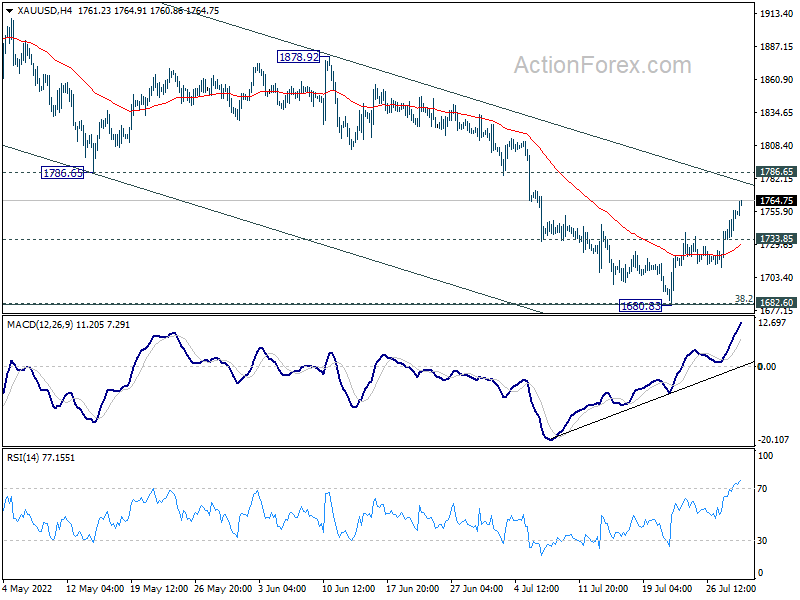
Gold tentatively bullish but 1800 region as key hurdle
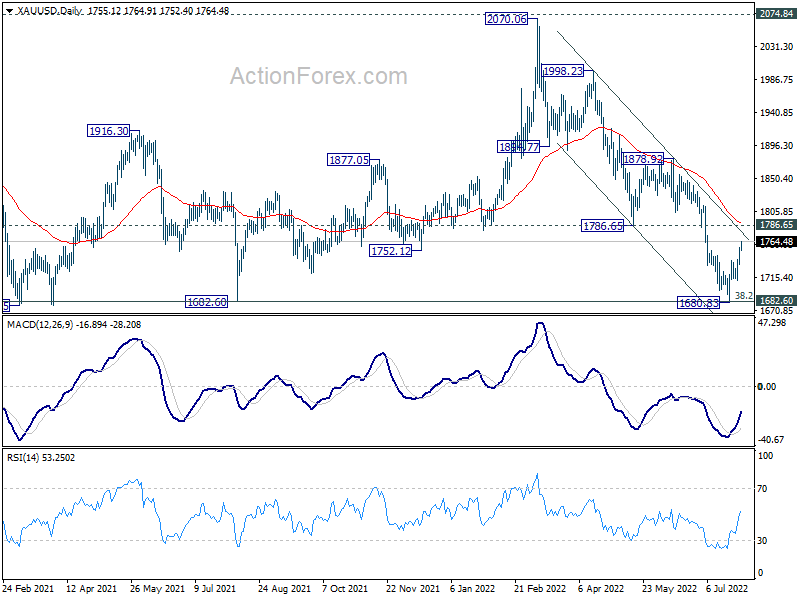
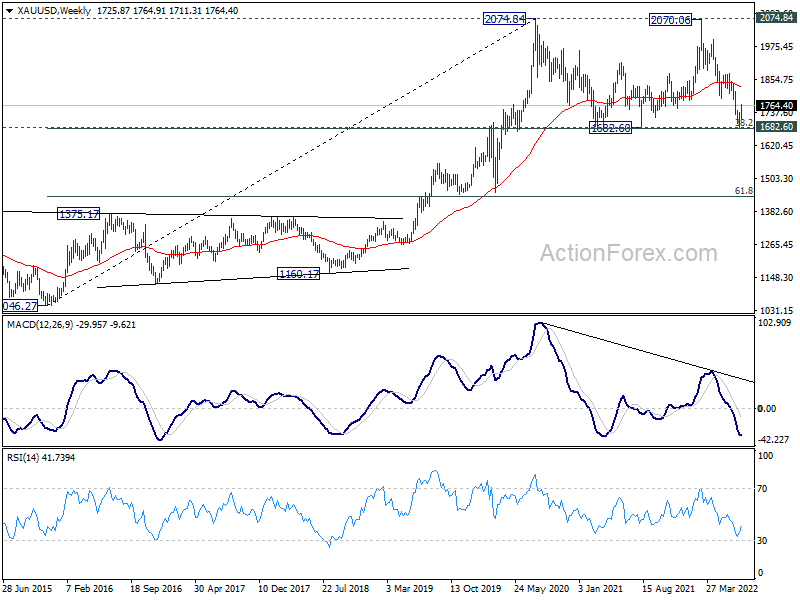
Gold's rebound from 1680.83 short term bottom picks up further momentum on broad based Dollar selling. Further rise is now expected as long as 1733.85 minor support holds, for channel resistance at 1778.91. But there are a couple of hurdles to overcome ahead, including, 1786.65 support turned resistance, 55 day EMA (now at 1791.10), 1800 psychological level, and 55 week EMA (now at 1831.13).
In the bigger picture, the view is unchanged that price actions from 2074.84 (2020 high) are in form of a three wave consolidation pattern, with fall from 2070.06 as the third leg. Strong support is expected at 1682.60, with 38.2% retracement of 1046.27 to 2074.84 at 1681.92, to complete the pattern. This is what has been happening so far. Sustained break of the above mentioned resistance zone between 1786.65 and 1831.13 will solidify this view and bring stronger rally back to retest 2074.84 high.
USD/JPY Daily Outlook
Daily Pivots: (S1) 133.42; (P) 135.02; (R1) 135.84; More...
USD/JPY's decline from 139.37 medium term top continues today and hit as low as 132.74 so far. It's now seen as in correction to medium term up trend. Intraday bias stays on the downside for 131.34 resistance turned support and below. But strong support is expected above 126.35 to contain downside, at least on first attempt, to bring rebound. But for now, risk will stay on the downside as long as 135.55 support turned resistance holds, in case of recovery.
In the bigger picture, current rally is seen as part of the long term up trend from 75.56 (2011 low). Next target is 100% projection of 75.56 (2011 low) to 125.85 (2015 high) from 98.97 at 149.26, which is close to 147.68 (1998 high). This will remain the favored case as long as 126.35 support holds.
Economic Indicators Update
| GMT | Ccy | Events | Actual | Forecast | Previous | Revised |
|---|---|---|---|---|---|---|
| 23:30 | JPY | Tokyo CPI Core Y/Y Jul | 2.30% | 2.20% | 2.10% | |
| 23:50 | JPY | BoJ Summary of Opinions | ||||
| 23:30 | JPY | Unemployment Rate Jun | 2.60% | 2.50% | 2.60% | |
| 23:50 | JPY | Industrial Production M/M Jun P | 8.90% | 3.70% | -7.50% | |
| 23:50 | JPY | Retail Trade Y/Y Jun | 1.50% | 2.80% | 3.60% | 3.70% |
| 01:30 | AUD | Private Sector Credit M/M Jun | 0.90% | 0.80% | 0.80% | |
| 01:30 | AUD | PPI Q/Q Q2 | 1.40% | 0.80% | 1.60% | |
| 01:30 | AUD | PPI Y/Y Q2 | 5.60% | 3.80% | 4.90% | |
| 05:00 | JPY | Housing Starts Y/Y Jun | -2.20% | -1.20% | -4.30% | |
| 05:00 | JPY | Consumer Confidence Index Jul | 30.2 | 33 | 32.1 | |
| 05:30 | EUR | France Consumer Spending M/M Jun | 0.20% | -1.00% | 0.70% | 0.40% |
| 05:30 | EUR | France GDP Q/Q Q2 P | 0.50% | 0.20% | -0.20% | |
| 06:00 | EUR | Germany Import Price Index M/M Jun | 1.00% | 0.80% | 0.90% | |
| 06:30 | CHF | Real Retail Sales Y/Y Jun | 1.40% | -1.60% | ||
| 07:00 | CHF | KOF Leading Indicator Jul | 95.2 | 96.9 | ||
| 07:55 | EUR | Germany Unemployment Rate Jul | 5.30% | 5.30% | ||
| 07:55 | EUR | Germany Unemployment Change Jul | 15K | 133K | ||
| 08:00 | EUR | Germany GDP Q/Q Q2 P | 0.10% | 0.20% | ||
| 08:00 | EUR | Italy GDP Q/Q Q2 P | 0.30% | 0.10% | ||
| 08:30 | GBP | Mortgage Approvals Jun | 64K | 66K | ||
| 08:30 | GBP | M4 Money Supply M/M Jun | 0.70% | 0.50% | ||
| 09:00 | EUR | Eurozone GDP Q/Q Q2 P | 0.10% | 0.60% | ||
| 09:00 | EUR | Eurozone CPI Y/Y Jul P | 8.70% | 8.60% | ||
| 09:00 | EUR | Eurozone CPI Core Y/Y Jul P | 3.80% | 3.70% | ||
| 12:30 | CAD | GDP M/M May | -0.20% | 0.30% | ||
| 12:30 | USD | Personal Income M/M Jun | 0.50% | 0.50% | ||
| 12:30 | USD | Personal Spending Jun | 0.90% | 0.20% | ||
| 12:30 | USD | PCE Price Index M/M Jun | 0.50% | 0.60% | ||
| 12:30 | USD | PCE Price Index Y/Y Jun | 6.70% | 6.30% | ||
| 12:30 | USD | PCE Core Price Index M/M Jun | 0.50% | 0.30% | ||
| 12:30 | USD | PCE Core Price Index Y/Y Jun | 4.70% | 4.70% | ||
| 12:30 | USD | Employment Cost Index Q2 | 1.20% | 1.40% | ||
| 13:45 | USD | Chicago PMI Jul | 56 | 56 | ||
| 14:00 | USD | Michigan Consumer Sentiment Index Jul F | 51.1 | 51.1 |
Gold tentatively bullish but 1800 region as key hurdle
Gold's rebound from 1680.83 short term bottom picks up further momentum on broad based Dollar selling. Further rise is now expected as long as 1733.85 minor support holds, for channel resistance at 1778.91. But there are a couple of hurdles to overcome ahead, including, 1786.65 support turned resistance, 55 day EMA (now at 1791.10), 1800 psychological level, and 55 week EMA (now at 1831.13).
In the bigger picture, the view is unchanged that price actions from 2074.84 (2020 high) are in form of a three wave consolidation pattern, with fall from 2070.06 as the third leg. Strong support is expected at 1682.60, with 38.2% retracement of 1046.27 to 2074.84 at 1681.92, to complete the pattern. This is what has been happening so far. Sustained break of the above mentioned resistance zone between 1786.65 and 1831.13 will solidify this view and bring stronger rally back to retest 2074.84 high.
France GDP grew 0.5% qoq in Q2 on dynamism of exports
France GDP grew 0.5% qoq in Q2, better than expectation of 0.2% qoq.
Foreign trade contributed to +0.4 points to GDP growth this quarter, after +0.1 points in the previous quarter. This large contribution is due to the dynamism of exports (+0.8% after +1.6% in Q1 2022), coupled with the decline of imports (-0.6% after +1.2%).
The contribution of final domestic demand (excluding inventories) to GDP growth was null this quarter. Household consumption expenditure fell again, but more moderately than in the previous quarter (-0.2% after -1.3%). Gross fixed capital formation (GFCF) continued to grow at a rather vigorous pace (+0.5%, as in the previous quarter).
Finally, the contribution of inventory changes to GDP growth was weakly positive this quarter (+0.1 points after +0.2 points in Q1).