Sample Category Title
USD/JPY Mid-Day Outlook
Daily Pivots: (S1) 138.20; (P) 138.67; (R1) 138.94; More...
Intraday bias in USD/JPY remains neutral as correction from 139.37 is extending. Downside of retreat should be contained by 134.73 support. On the upside, break of 139.37 will resume larger up trend to 100% projection of 114.40 to 131.34 from 126.35 at 143.29.
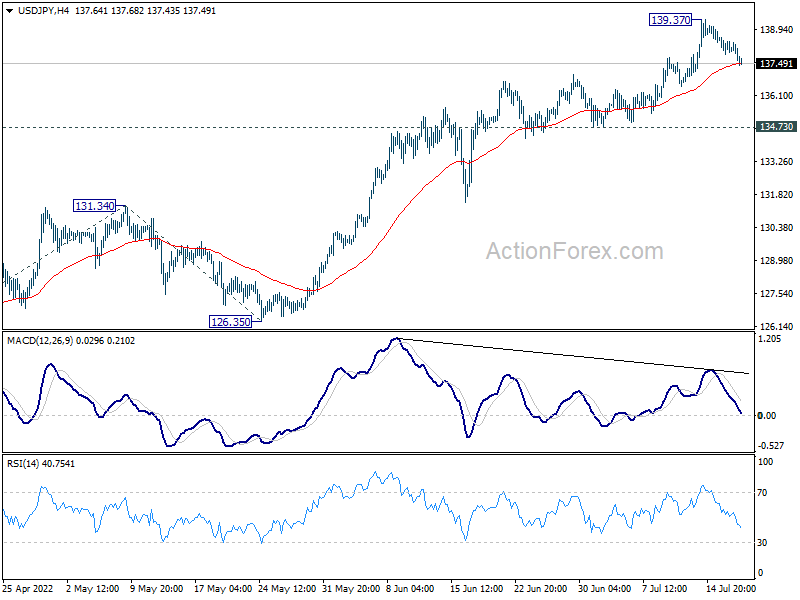
In the bigger picture, current rally is seen as part of the long term up trend from 75.56 (2011 low). Next target is 100% projection of 75.56 (2011 low) to 125.85 (2015 high) from 98.97 at 149.26, which is close to 147.68 (1998 high). This will remain the favored case as long as 126.35 support holds.
USD/CHF Mid-Day Outlook
Daily Pivots: (S1) 0.9740; (P) 0.9765; (R1) 0.9799; More...
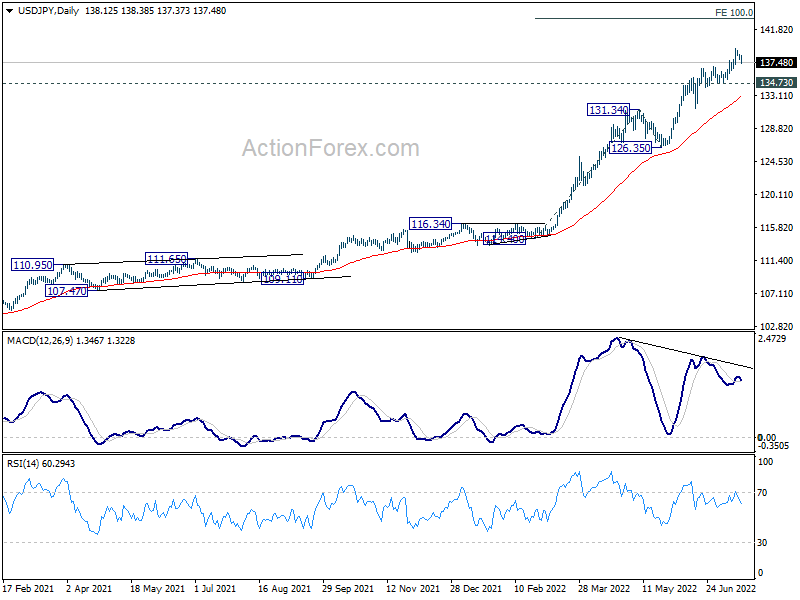
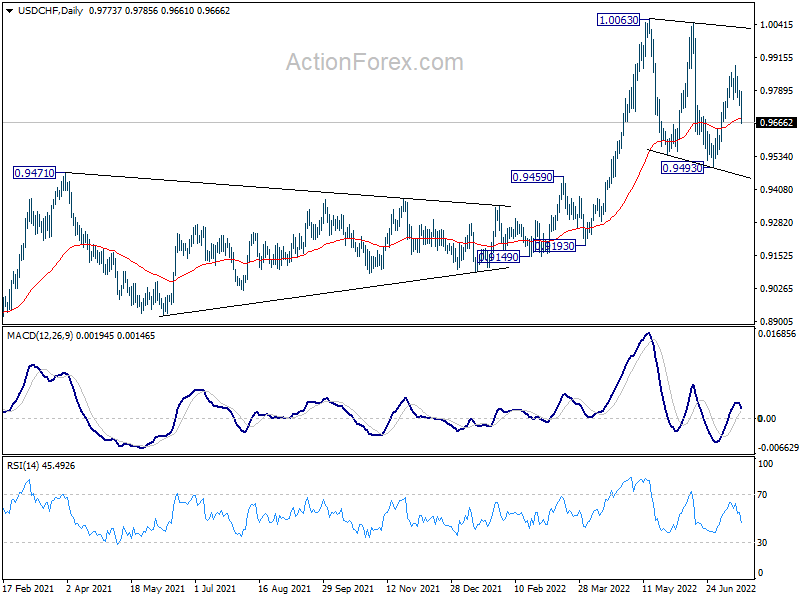
Intraday bias in USD/CHF stays on the downside. Fall from 0.9884 is seen as a falling leg of the consolidation from 1.0063. Sustained trading below 55 day EMA (now at 0.9682) will target 0.9493 support again. On the upside, above 0.9788 minor resistance will turn bias back to the upside for 0.9884 resistance.
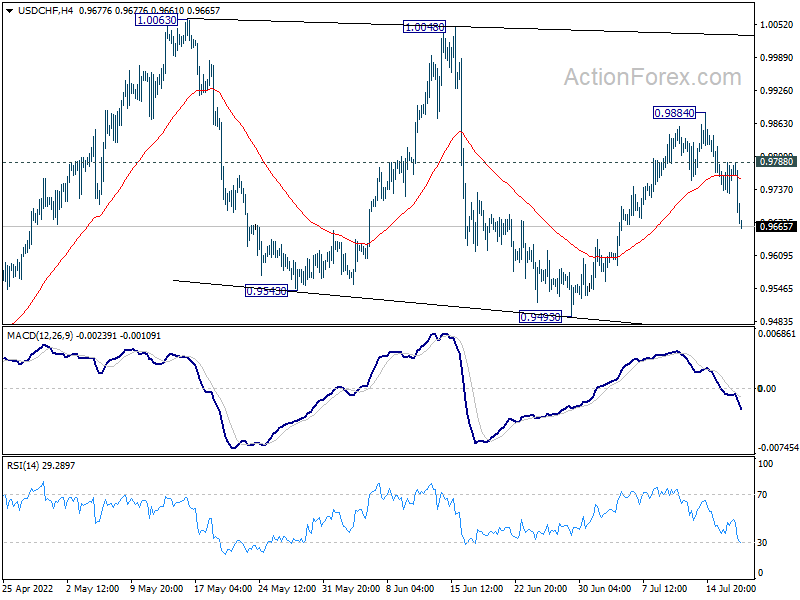
In the bigger picture, medium term up trend from 0.8756 (2021 low) is still in progress. Next target is 1.0342 (2016 high). Sustained break there will resume long term up trend from 0.7065 (2011 low). This will remain the favored case as long as 0.9471 resistance turned support holds.
GBP/USD Mid-Day Outlook
Daily Pivots: (S1) 1.1866; (P) 1.1950; (R1) 1.2036; More...
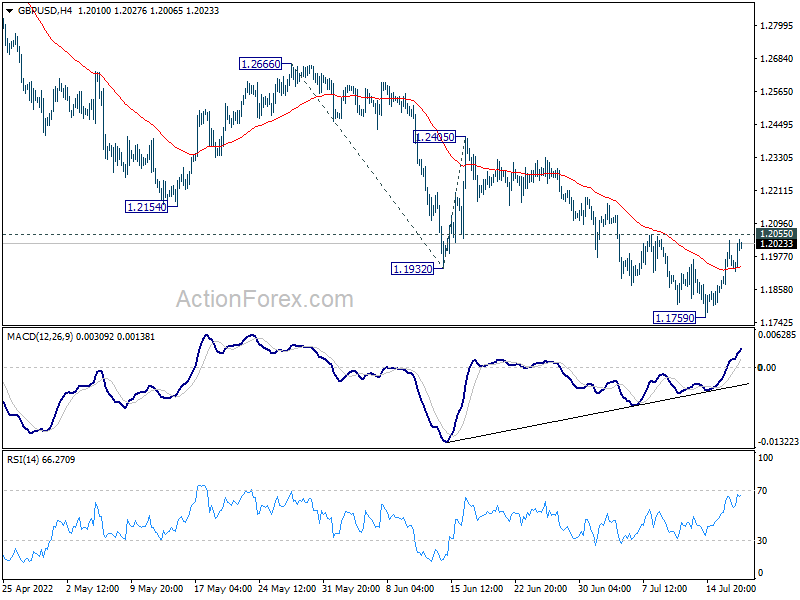
Intraday bias in GBP/USD stays neutral at this point. Focus remains on 1.2055 minor resistance. Firm break there will confirm short term bottoming at 1.1759. Bias will be turned back to the upside for 1.2405 resistance next. On the downside, below 1.1759 will resume larger down trend to 100% projection of 1.2666 to 1.1932 from 1.2405 at 1.1671.
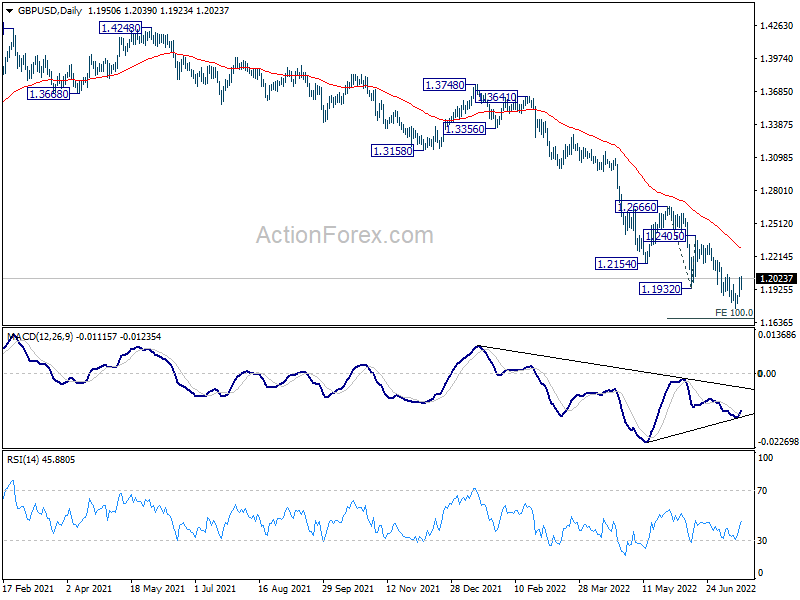
In the bigger picture, fall from 1.4248 (2018 high) could be a leg inside the pattern from 1.1409 (2020 low), or resuming the longer term down trend. Deeper decline is expected as long as 1.2666 resistance holds. Next target is 1.1409 low. However, firm break of 1.2666 will bring stronger rise back to 55 week EMA (now at 1.3065).
EUR/USD Mid-Day Outlook
Daily Pivots: (S1) 1.0082; (P) 1.0141; (R1) 1.0204; More...
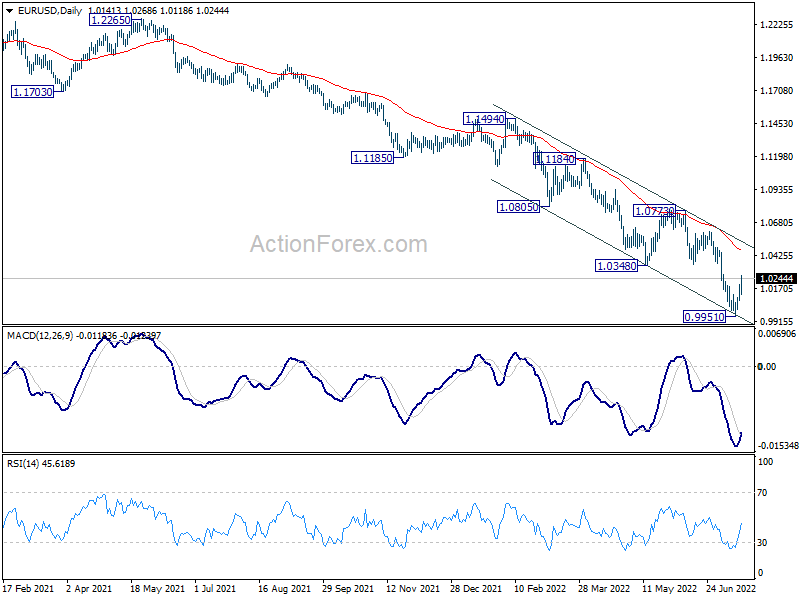
EUR/USD's rebound from 0.9951 is still in progress and intraday bias stays on the upside for 1.0348 support turned resistance. Break there will target channel resistance at 1.0514. On the downside, below 1.0118 minor support will bring retest of 0.9951 low instead.
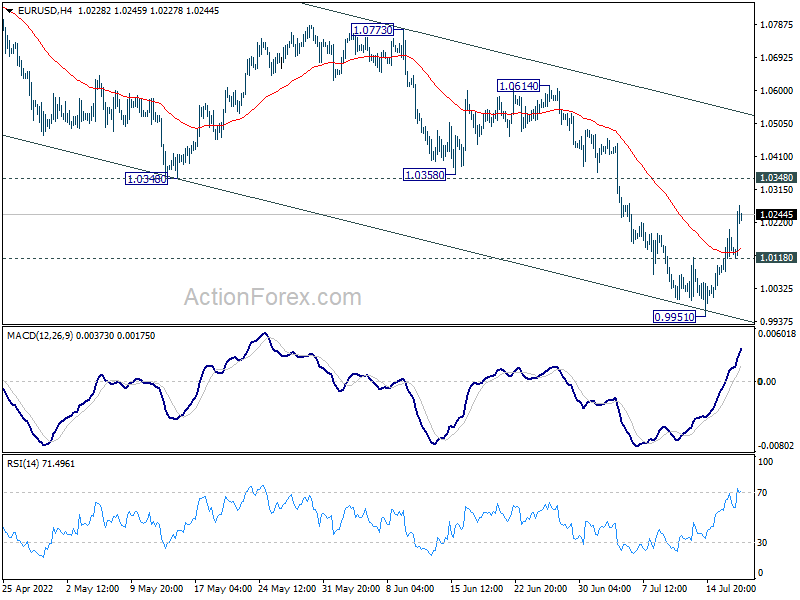
In the bigger picture, down trend from 1.6039 (2008 high) is still in progress. Next target is 100% projection of 1.3993 to 1.0339 from 1.2348 at 0.8694. In any case, outlook will stay bearish as long as 1.0773 resistance holds, in case of rebound.
Dollar Continues to Correct Lower, Euro Lifted by ECB Talks
Dollar's correction continues today and falls broadly. US stocks point to stronger extended rebound. Yen is also weak. Kiwi is currently the strongest, followed by Australian. Euro and Swiss Franc are next. In particular, Euro is lifted by reports that ECB would consider both a 25bps and 50bps hike this Thursday. Sterling also follows Euro higher.
Technically, AUD/USD's break of 0.6873 minor resistance confirms short term bottoming at 0.6680 and further rise would be seen to 55 day EMA (now at 0.6973). Now, it's GBP/USD's turn and break of 1.2055 will also confirm short term bottoming at 1.1759. However, if EUR/GBP could break through 0.8552 minor resistance, such development could cap Sterling's rally.
In Europe, at the time of writing, FTSE is up 0.47%. DAX is up 0.44%. CAC is up 0.40%. Germany 10-year yield is up 0.048 at 1.263. Earlier in Asia, Nikkei rose 0.65%. Hong Kong HSI dropped -0.89%. China Shanghai SSE rose 0.04%. Singapore Strait Times dropped -0.13%. Japan 10-year JGB yield rose 0.0077 to 0.242.
Eurozone CPI finalized at 8.6% yoy in Jun, core CPI at 3.7% yoy
Eurozone CPI was finalized at 8.6% yoy in June up from May's 8.1% yoy. Excluding energy, food, alcohol & tobacco, CPI was finalized at 3.7% yoy, down form May's 3.8% yoy. The highest contribution to the annual Eurozone inflation rate came from energy (+4.19%), followed by food, alcohol & tobacco (+1.88%), services (+1.42%) and non-energy industrial goods (+1.15%).
EU CPI was finalized at 9.6% yoy, up from May's 8.8% yoy. The lowest annual rates were registered in Malta (6.1%), France (6.5%) and Finland (8.1%). The highest annual rates were recorded in Estonia (22.0%), Lithuania (20.5%) and Latvia (19.2%). Compared with May, annual inflation fell in two Member States and rose in twenty-five.
UK payrolled employees rose 31k in Jun, unemployment rate unchanged at 3.8% in May
UK number of payrolled employees rose 31k in the month of June to a record 29.6m. Comparing with June 2021, payrolled employees rose 3.0% or 874k. Claimant count dropped -20k in the month, versus expectation of -41.2k.
Unemployment rate in the three months to May dropped was unchanged at 3.8%, matched expectations. Over the previous quarter, unemployment rate was down -0.1%, employment rate rose 0.4%, economic inactivity rate dropped -0.4%, hours worked rose 6.5m.
Average earnings including bonus rose 6.2% 3moy in may, below expectation of 6.8%. Average earnings excluding bonus rose 4.3% 3moy, matched expectations.
RBA minutes: Arguments for 50bps hike stronger than 25bps in Jul
In the minutes of the July 5 meeting, RBA noted that members considered raising interest rates by 25bps or 50bps. The arguments for a 50bps hike were "stronger".
"The level of interest rates was still very low for an economy with a tight labour market and facing a period of higher inflation," the minutes noted. "Members viewed it as important that inflation expectations remained well anchored and that the period of higher inflation be temporary."
Also, board members agreed that "further steps would need to be taken to normalise monetary conditions in Australia over the months ahead," The "size and timing" of future hikes will be guided by "incoming data" and assessment of the outlook for "inflation and labor market".
RBA Bullock: Households in fairly good position for rate hikes
In a speech, RBA Deputy Governor Michelle Bullock said households are in a "fairly good position" for interest rate increases. It's "unlikely" that there will be substantial financial stability arising from the household sector, but risks are "a little elevated".
The household sector has "large liquidity buffers", with "substantial equity" in housing assets. Much of the debt is held by "high-income households" while low fixed rate loans have give time for preparation for high rates. But rate hikes could impact households' debt servicing burden and cash flow. Risk play out will also be included by future path of employment growth.
"This, along with the Board's assessment of the outlook for inflation, will be important considerations in deciding the size and timing of future interest rate increases," she concluded.
EUR/USD Mid-Day Outlook
Daily Pivots: (S1) 1.0082; (P) 1.0141; (R1) 1.0204; More...
EUR/USD's rebound from 0.9951 is still in progress and intraday bias stays on the upside for 1.0348 support turned resistance. Break there will target channel resistance at 1.0514. On the downside, below 1.0118 minor support will bring retest of 0.9951 low instead.
In the bigger picture, down trend from 1.6039 (2008 high) is still in progress. Next target is 100% projection of 1.3993 to 1.0339 from 1.2348 at 0.8694. In any case, outlook will stay bearish as long as 1.0773 resistance holds, in case of rebound.
Economic Indicators Update
| GMT | Ccy | Events | Actual | Forecast | Previous | Revised |
|---|---|---|---|---|---|---|
| 01:30 | AUD | RBA Meeting Minutes | ||||
| 06:00 | CHF | Trade Balance (CHF) Jun | 3.80B | 3.05B | 3.12B | |
| 06:00 | GBP | Claimant Count Change Jun | -20.0K | -41.2K | -19.7K | -34.7K |
| 06:00 | GBP | ILO Unemployment Rate (3M) May | 3.80% | 3.80% | 3.80% | |
| 06:00 | GBP | Average Earnings Including Bonus 3M/Y May | 6.20% | 6.80% | 6.80% | |
| 06:00 | GBP | Average Earnings Excluding Bonus 3M/Y May | 4.30% | 4.30% | 4.20% | |
| 09:00 | EUR | Eurozone CPI Y/Y Jun F | 8.60% | 8.60% | 8.60% | |
| 09:00 | EUR | Eurozone CPI Core Y/Y Jun F | 3.70% | 3.70% | 3.70% | |
| 12:30 | USD | Housing Starts Jun | 1.56M | 1.60M | 1.55M | 1.59M |
| 12:30 | USD | Building Permits Jun | 1.69M | 1.69M | 1.70M |
Will UK June CPI Change BOE’s Rate Trajectory?
The BOE has a problem, and tomorrow's data could make things worse. As the market looks for guidance for where the pound could be heading, this means traders also have a problem. The BOE was the first of the major central banks to start raising rates, which should have given them an edge when it came to tamping down inflation.
But Britain still has one of the highest CPI growth rates among the major economies. The BOE's policy of steadily increasing the interest rate has been met with steadily increasing inflation. The interest rate gap with the Fed has flipped, as the largest central bank in the world increases rates by multiples at each meeting. Now even the ECB is talking about hiking rates by 50bps at their September meeting.
Getting things in control
There have been voices calling for a more aggressive stance within the BOE, but they are a minority. The dissenters at policy meetings are those calling for 50bps. The next meeting is still a couple of weeks away, and after the Fed's meeting where another 75bps hike is broadly expected. So, can the upcoming data push expectations towards the BOE making a bigger hike this time around?
June UK inflation is projected to tick higher to 9.2% from 9.1% in the prior month, another multi-decade high. But the BOE pays more attention to the core rate, which discounts the effects of fuel and food prices. That is expected to slow a bit to 5.8% from 5.9% prior. Even if food and fuel costs are what most impact consumers, the BOE is still going to prefer to look at long-term price stability.
A possible tie-breaker?
At the same time as the CPI data, we also get another figure that is often ignored by traders: PPI. Typically, it doesn't have much of an impact on markets, but the costs paid by businesses to buy products will ultimately filter through to inflation. And since CPI is the big deal now, any leading indicator is likely to get more attention.
Even if core inflation is technically slowing, PPI output is expected to accelerate to 15.1% from 14.8% in May. That implies that UK businesses are still facing substantial pricing pressures, and that high inflation might still be prevalent for some time. That might be enough to shift consideration towards a larger hike.
Getting everyone on the same page
With the political issues going on as well, it makes it harder for the government and the BOE to work together on policies that might be unpopular but lead to more economic stability. Across the board, candidates for the Conservative leadership are promising tax cuts (but not spending cuts), in an effort to put more cash in the hands of consumers. This comes on the heels of a relief program of increased government spending to provide more spending capacity for lower income homes.
A more aggressive stance by the BOE would be expected to drain more liquidity from the markets and raise borrowing costs. Perhaps once the political uncertainty is over, the BOE and No 10 will find it easier to reach a consensus.
EUR/USD: Recovery Accelerates on Signs of More Aggressive ECB
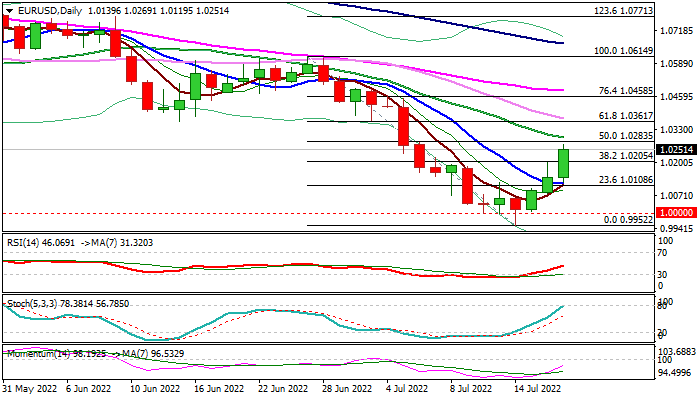
Bounce from new 20-year low, after larger bears got trapped under parity level, extends into third straight day and accelerates on Tuesday.
The Euro was lifted by weaker dollar and received fresh support on signals that the ECB, at their policy meeting on Thursday will discuss the size of a rate hike, as rising inflation prompted policymakers to consider more aggressive steps, bringing on the table the possibility of 50 basis points hike, against the central bank’s initial decision to start tightening policy with 25 basis points raise.
Although the ECB remains cautious and doesn’t want to choke the economic growth by a stronger rise of the borrowing cost, the conditions are worsening that prompts policymakers to act accordingly.
In addition to high inflation, the other major concerns for the ECB is the gap between the monetary policies of the US and EU central banks.
The gap has opened after the Fed started to raise interest rates, while the ECB remained on hold and has tripled until now, with worries that it will widen as the Fed is expected to double its interest rate to 3.5% by the end of the year, while the ECB rates are seen just over 1%.
The darkening economic outlook also heavily weighs on the single currency, as the EU is facing a huge problem with a gas supplies from Russia, which are currently lowered due to maintenance, but fears are growing that supply cut may become permanent that would have strong negative impact on the whole economy.
Inflation in the Eurozone rose to 8.6% in June, in line with expectations, adding to possible more aggressive ECB’s action on Thursday.
Technical picture has improved, as indicators on daily chart are heading north and the latest acceleration broke above important Fibo level at 1.0205 (38.2% of 1.0614/0.9952 bear-leg), though positive signals still require confirmation on lift above 1.0283 (50% retracement /daily Kijun-sen).
Res: 1.0283; 1.0349; 1.0361; 1.0400.
Sup: 1.0220; 1.0205; 1.0175; 1.0108.
Sterling Hits 1.20 after UK Job Data
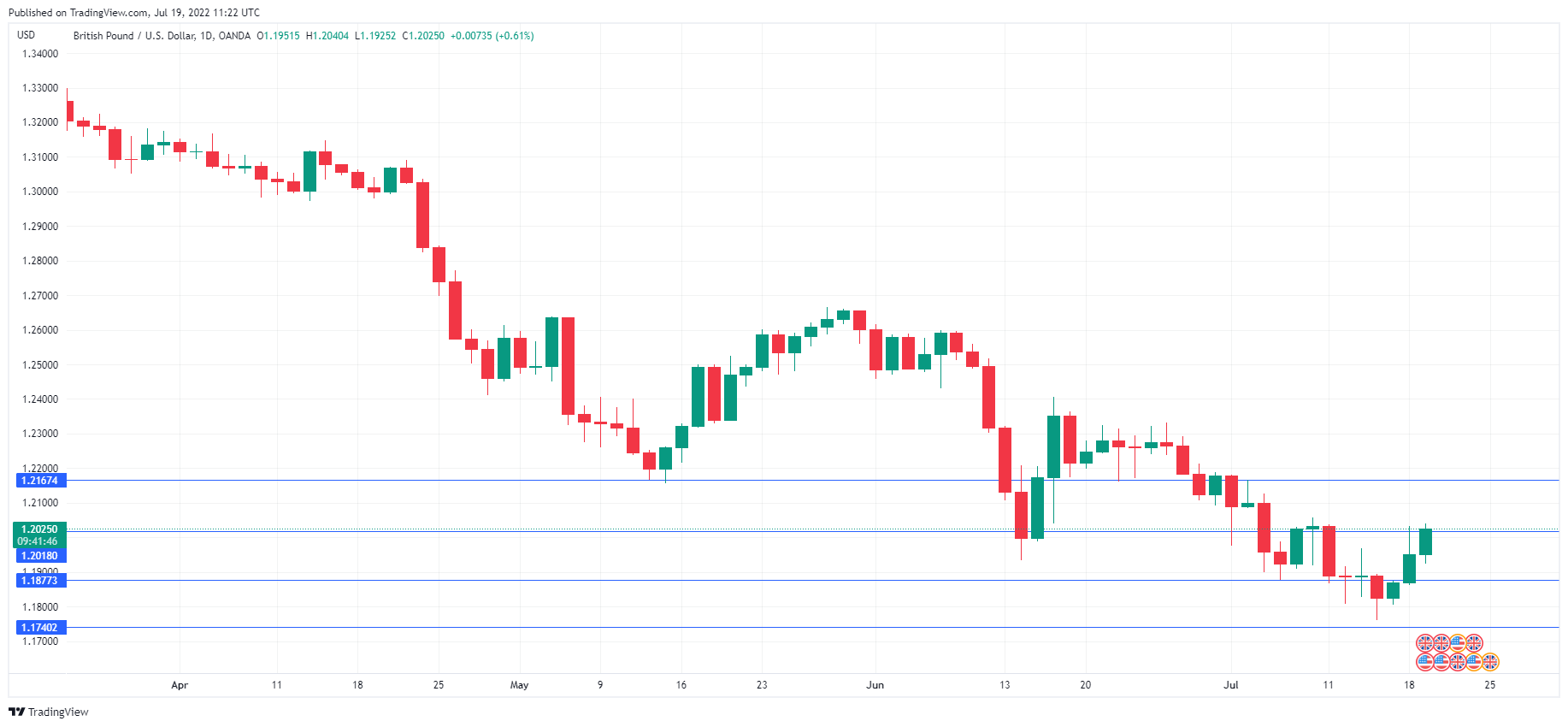
The British pound has extended its gains on Tuesday. GBP/USD is currently trading at 1.2010, up 0.50%.
The US dollar continues to retreat across the board, as the greenback remains in a downward correction. The dollar index continues to fall and is at 106.58, down 0.73%. The next support level is at 1.0585, followed by 1.0500.
The downward pressure on the dollar is a result of an improvement in risk appetite, ahead of the FOMC meeting on July 27th. We have seen plenty of fluctuation in the pricing of a 75bp vs. 100bp move by the Fed. Currently, the markets are betting on a 75bp increase, even though last week’s US retail sales bolsters the case that the economy is robust enough to withstand a 100bp move. The FOMC is currently in a blackout period and last week’s comments from FOMC members Bostic and Bullard in favor of a 75bp move appear to have gone a long way to convince the markets that the Fed won’t go with a massive 100bp hike. This has reduced the attractiveness of the US dollar and the pound is in positive territory after two straight winning days.
UK jobs report positive, inflation next
The UK economy added 296 thousand jobs over the past three months, blowing the consensus estimate of 170 thousand out of the water. The unemployment rate remained at 3.8%, beating the forecast of 3.9%, and unemployment rolls fell by 20.0 thousand after a decline of 34.7 thousand. This points to a solid labour market which will raise pressure on the BoE to consider raising rates more drastically, after the paltry 0.25% increase in June. Wednesday’s inflation report is expected to indicate that inflation accelerated to 9.3%, up from 9.1%, which will put further pressure on the BoE to be more aggressive in the coming months with regard to rate policy.
GBP/USD Technical
- GBP/USD tested resistance at 1.2018 earlier in the European session. Above, there is resistance at 1.2167
- There is support at 1.1887 and 1.1740
Pound Cuts Oversold Against the Dollar But Must Fight Economic Headwinds
The British pound is trying to return to levels above 1.2000. The pressure on the pound intensified on Monday evening, along with the reduced demand for risk assets after the US market. Today the pound will have to fight new headwinds in the form of local macroeconomic statistics on the UK labour market.
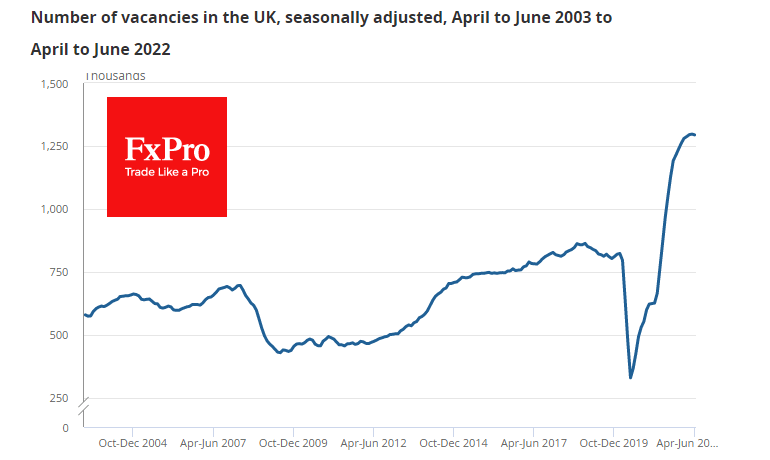
The number of people receiving unemployment benefits fell by 20k in June, half the number expected and 34.7k a month earlier. The number of job openings for the three months to June was 1,294k compared to 1,297k for March-May and 1,295k for February-April. The overheated labour market has begun to cool down.
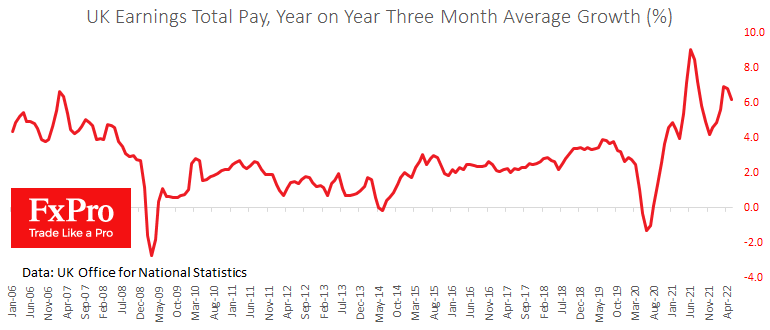
Wage figures also indicate this. Earnings including bonuses rose 6.2% in the three months through June compared to the same period a year earlier. Official inflation data showed a 9.1% YoY increase in May, while June’s data, released on Wednesday, is expected to accelerate to 9.3%, marking an acceleration of the fall in workers’ actual earnings. In addition, these statistics came out weaker than expected, which may additionally work to weaken the pound against its competitors.
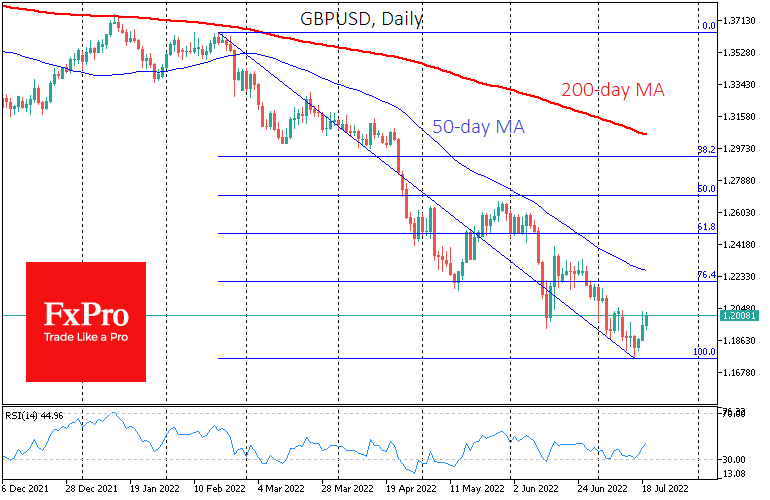
Despite unimpressive labour market data, GBPUSD is gaining for the third trading session, which should be attributed to the market’s desire to take profits from the previous rally in the dollar.
The US currency rose too far too fast and is now subject to short-term technical pressures. Until the Fed meeting on July 27, we may see a corrective rebound capable of flattening market positioning and providing the potential for a two-way move at the outcome of the critical FOMC meeting.
Locally, despite weak data today and potentially worrisome inflation readings on Wednesday and retail sales on Friday, GBPUSD may not have significant headwinds for a rebound up to 1.2200 – a support area in May and a 76.4% Fibonacci retracement level from the February-July downtrend. This would relieve some of the pair’s oversold position but is hardly enough to break the pair’s medium-term downtrend as the UK economy is slowing more quickly than the US, suffering from high imported commodity and energy prices.
Dollar Index: Dollar Remains at the Back Foot on Calmer Tones from Fed
The dollar index holds in red for the third consecutive day and extends pullback from new 20-year high, to hit one-week low in European trading on Tuesday.
The sentiment softened after US policymakers cooled down the speculation that the US central bank may opt for a massive 1% hike in the policy meeting later this month, after the latest inflation report showed that consumer prices continue to rise despite several rate hikes in past few months.
FOMC members said that the central bank will likely stick to its decision for 0.75% hike that prompted traders to collect profits, pushing the price lower.
The latest comments that the European Central Bank will discuss whether to raise interest rates by 0.25% or 0.5% at their meeting on Thursday, to fight soaring inflation, lifted the euro and added pressure on dollar.
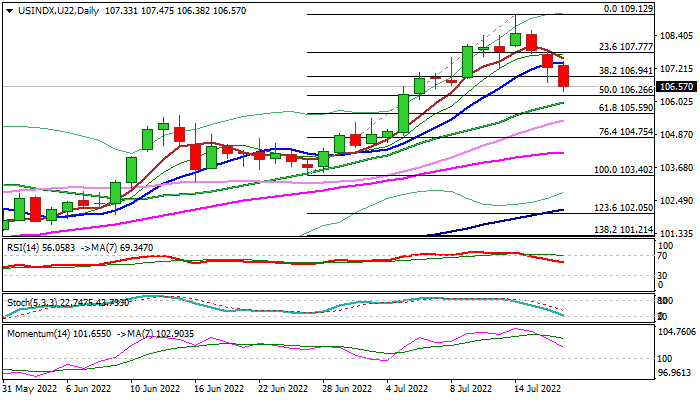
Daily chart studies show strong loss of bullish momentum, as pullback closed below 10DMA (107.43) on Monday and extended through pivotal Fibo support at 106.94 (38.2% of 103.40/109.12 upleg), generating bearish signals.
Bears pressure next key Fibo level at 106.26 (50% retracement) break of which would further weaken near-term structure and risk deeper drop.
However, worsening global economic situation in light of expected deterioration of gas supplies for Europe and signs of further slowdown in economic activity, remain supportive for safe-haven greenback that may limit dips.
US housing data are in focus today and expected to provide fresh signals.
Res: 106.94; 107.44; 107.77; 108.40.
Sup: 106.26; 105.98; 105.59; 105.35.