Sample Category Title
New Zealand Dollar Soars on Risk Appetite
US dollar retreat continues
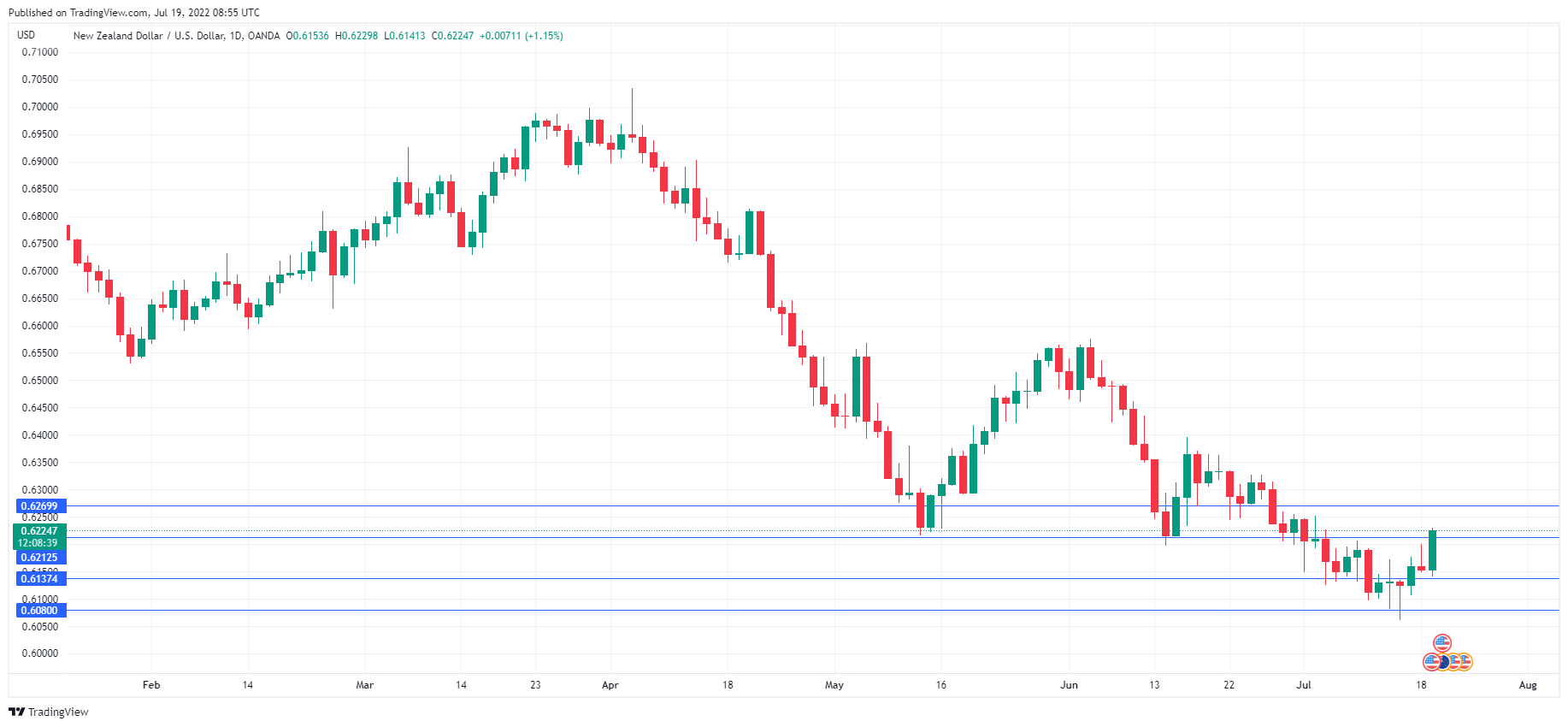
The New Zealand dollar is enjoying a banner day. NZD/USD has jumped 1.14% and is trading at 0.6224, its highest level in two weeks.
The US dollar continues to retreat across the board, as the greenback remains in a downward correction. The dollar index continues to fall and is at 106.62, down 0.70%.
The markets are showing more appetite for risk, ahead of the FOMC meeting on July 27th. We have seen plenty of fluctuation in the pricing of a 75bp vs. 100bp move by the Fed. Currently, the markets are betting on a 75bp increase, even though strong US retail sales last week could bolster the argument that the economy can withstand a 100bp move. The FOMC is currently in a blackout period and last week’s comments from FOMC members Bostic and Bullard in favor of a 75bp move appear to have gone a long way to convince the markets that the Fed won’t go with a massive 100bp hike. This has reduced appetite for the US dollar and risk-related currencies like the Australian and New Zealand dollars have made the most of stronger risk sentiment.
Despite this week’s gains, the risk for the New Zealand dollar remains tilted to the downside. The RBNZ has raised rates aggressively, bringing the cash rate to 2.50%. With inflation rising to 7.3% in Q2, (6.9% prior), the central bank is likely to keep raising rates. Even so, NZD/USD has fallen around 10 per cent since the central bank began raising rates in October. Global growth is expected to fall and domestic demand will likely slip if the housing market continues to cool due to higher rates.
The RBNZ is expected to continue to raise rates, but the Fed could be even more aggressive than the RBNZ in the coming months, which means that the US/New Zealand rate differential will widen and the kiwi, putting more pressure on the New Zealand currency. This paints an unfavorable picture for the New Zealand dollar, which could fall below the 60.00 line in the third or fourth quarters.
NZD/USD Technical
- NZD/USD is testing resistance at 0.6212. Above, there is resistance at 0.6269
- There is support at 0.6137 and 0.6080
Eurozone CPI finalized at 8.6% yoy in Jun, core CPI at 3.7% yoy
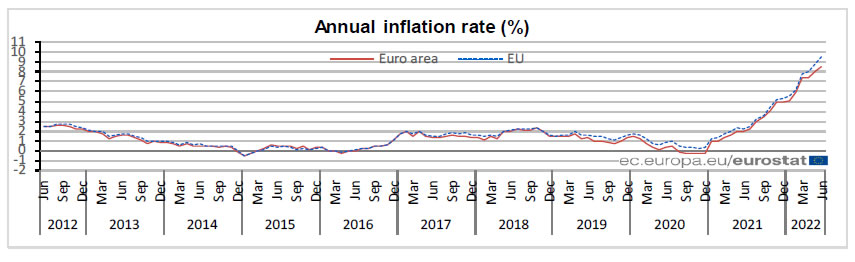
Eurozone CPI was finalized at 8.6% yoy in June up from May's 8.1% yoy. Excluding energy, food, alcohol & tobacco, CPI was finalized at 3.7% yoy, down form May's 3.8% yoy. The highest contribution to the annual Eurozone inflation rate came from energy (+4.19%), followed by food, alcohol & tobacco (+1.88%), services (+1.42%) and non-energy industrial goods (+1.15%).
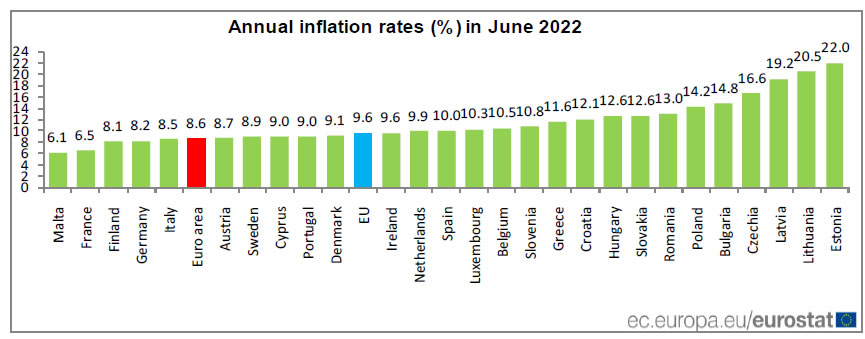
EU CPI was finalized at 9.6% yoy, up from May's 8.8% yoy. The lowest annual rates were registered in Malta (6.1%), France (6.5%) and Finland (8.1%). The highest annual rates were recorded in Estonia (22.0%), Lithuania (20.5%) and Latvia (19.2%). Compared with May, annual inflation fell in two Member States and rose in twenty-five.
Bitcoin’s Attempt to Break the Downtrend
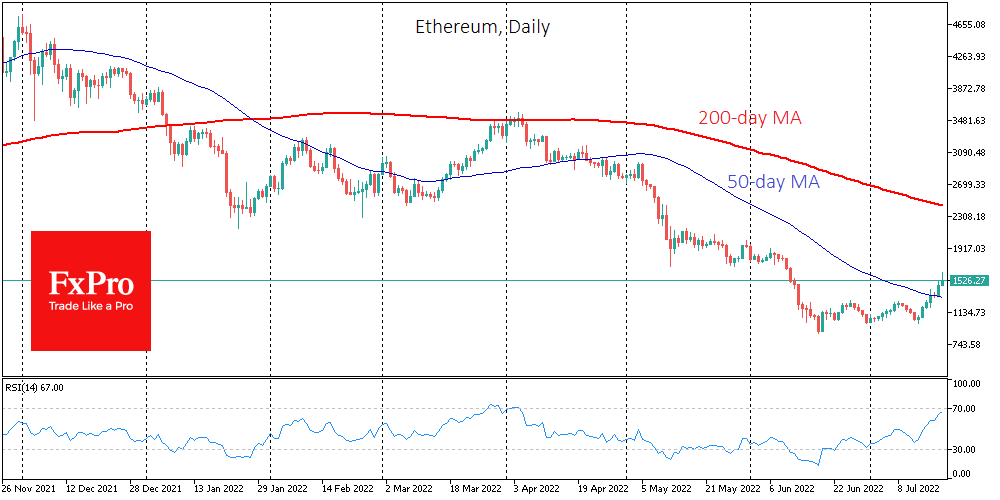
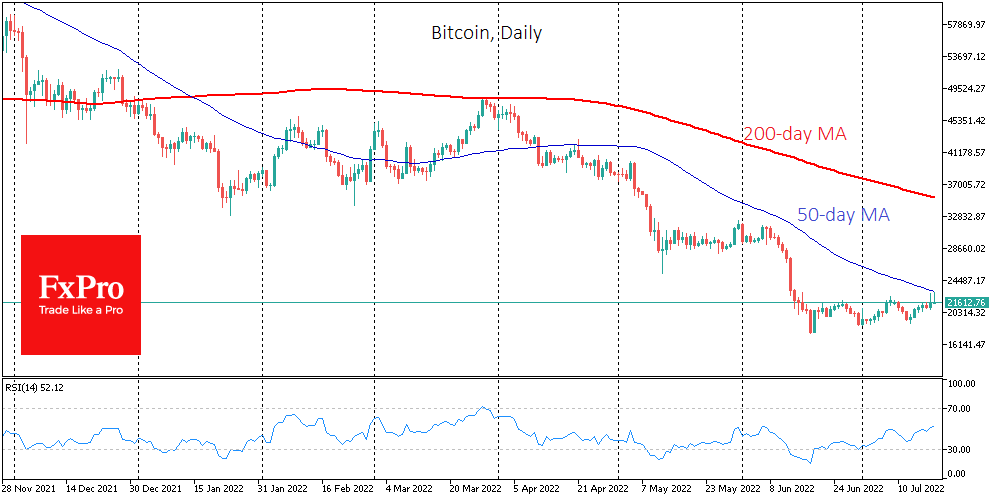
Bitcoin rose 2.9% on Monday, ending the day around $21.5K, and continuing to test the $22K level on Tuesday morning. So far, we are seeing an intensification of selling as buyers push the price up into the 23K area.
Ethereum jumped 9.9% to $1480 and is already above $1500 in early Tuesday trading. The rise in recent days is almost a mirror image of the decline from June 10 to 18.
Except for XRP, which is down 1.5%, the top altcoins add between 0.6% (BNB) and 4.3% (Solana). The total capitalisation of the crypto market, according to CoinMarketCap, rose 2% overnight to $1.02 trillion.
Bitcoin is encountering increased resistance to its 50-day simple moving average approach. This line often acts as an indicator of a short-term trend in the markets. Notably, the Nasdaq100 sold off profusely on Monday night to climb above its line but closed the day below it.
The market dynamics so far suggest a continued bearish trend in the financial markets’ most closely monitored retail investors and media sectors.
Nevertheless, it is worth noting that Ethereum has successfully surpassed its 50-day average, while the dollar index is losing for the third consecutive trading session, indicating a timid recovery in demand for risky assets.
The cryptocurrency Fear and Greed Index climbed 10 points to 30, its highest level since April 11 and moving away from ‘extreme fear’ territory to ‘fear’.
A June report by Coinbase indicates that speculators were behind the fall in the crypto market, taking massive loans. In addition, according to Arcane Research, miners sold about a quarter of their bitcoin holdings last month to cover running costs. At the same time, long-term holders of bitcoin hardly ever sell it.
Former top Blackrock executive Edward Dowd said that, over time, Bitcoin might surpass gold due to its unique characteristics, such as ease of transaction, transparency, and decentralisation.
EURJPY Pauses Bullish Course; Focus Still on the Upside
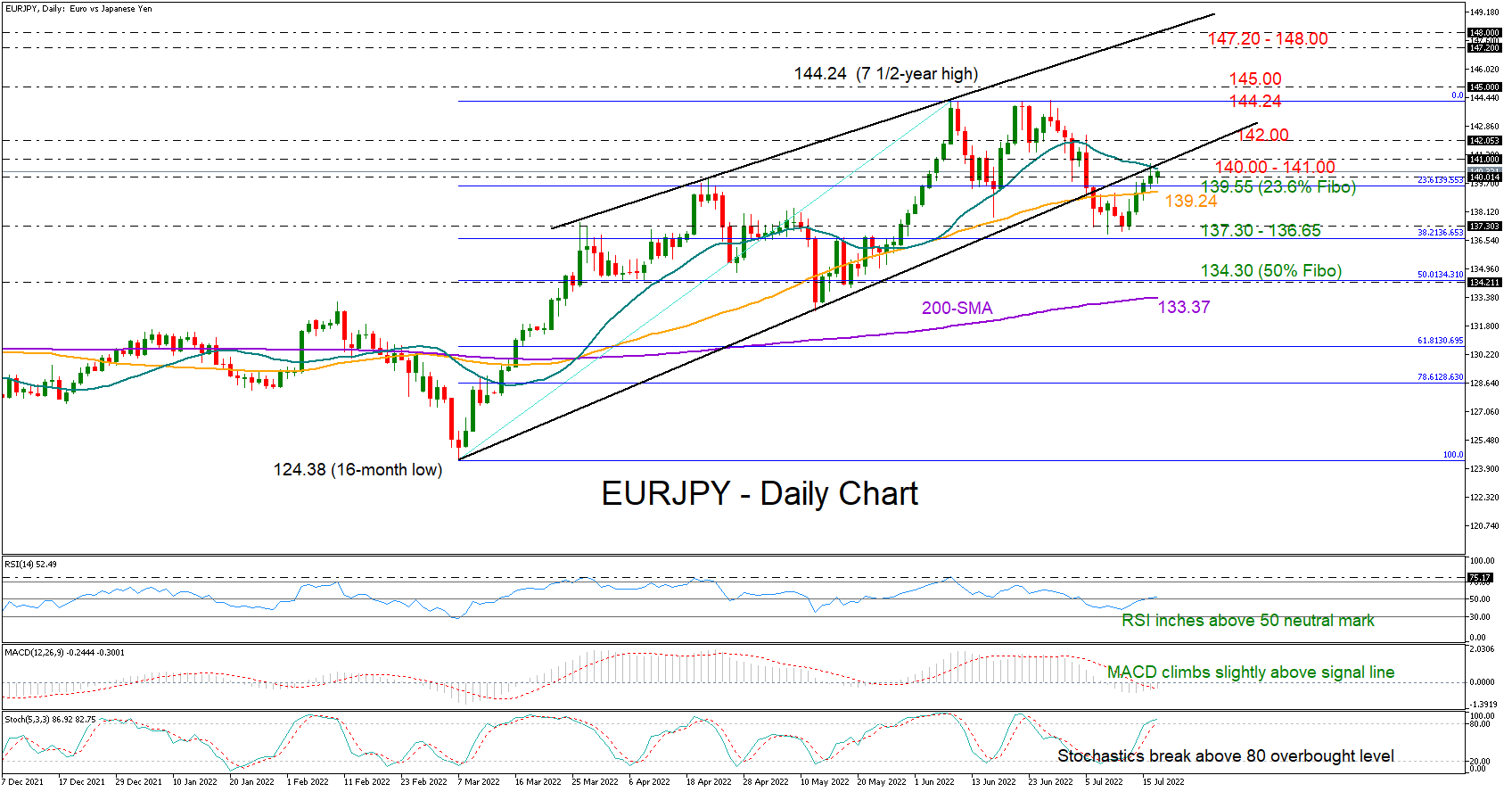
EURJPY paused its short-term bullish sequence near a two-week high of 140.78 and below the 20-day simple moving average (SMA) on Monday as the broken support trendline from March came to block the way higher.
The technical signals reflect a weak bullish bias at the moment. The RSI has barely risen above its 50 neutral mark, the MACD is trying to deviate above its red signal line in the negative region, while the Stochastics are entering the overbought area above 80.
Hence, given the above encouraging signs, the pair is expected to keep pressuring the 140.00 – 141.00 region in the short term. A successful penetration of that bar could initially stall around the 142.00 psychological mark before stretching towards the crucial ceiling of 144.24. Beyond that, the rally could face another acceleration towards the constraining zone of 147.20 – 148.00, last examined during the end of 2014.
In the event upside forces fade immediately, with the price sliding below the 139.55 – 139.20 area, which encapsulates the 23.6% Fibonacci retracement of the 124.38 – 144.24 upleg, the bears may try to reach July's base of 137.70 - 136.65. Failure to bounce here would raise fears of a down-trending market, likely producing another sharp downfall towards the 50% Fibonacci of 134.30 and the 200-day SMA at 133.35.
Summarizing, the short-term risk for EURJPY is softly tilted to the upside, with buyers waiting for a clear spike above the 140.00 – 141.00 zone to drive the market higher.
Markets Shaky ahead of ECB Meeting
A sense of caution has taken hold of financial markets as investors adopt a guarded stance ahead of another week packed with key economic reports and risk events. Asian shares got no love this morning, following overnight declines on Wall Street after Apple announced plans to slow hiring and spending growth next year. Renewed fears around Covid-19 outbreaks in China added to the negative vibe, fanning concerns about slowing economic growth.
With downbeat sentiment likely to send investors rushing towards safety, risk assets could be in store for a rough and rocky week ahead. European futures are trading lower ahead of the highly anticipated ECB meeting on Thursday. Regarding commodities, oil bulls seem to have shifted into a lower gear this morning after yesterday’s rally, while gold wobbles above $1700.
In the currency space, the dollar hovered above a one-week low against a basket of major currencies while the euro extended its recovery from parity. The Aussie has appreciated against every other G10 currency this morning, gaining roughly 0.6% versus the dollar after the RBA minutes for July struck a hawkish tone. The central bank hiked rates by 50bps at this meeting and agreed that further steps would need to be taken to tighten monetary conditions down the road. Taking a quick look at the technical picture, AUDUSD is pressing against the 0.6850 level. A strong breakout above this resistance could encourage a move back towards 0.7000.
Euro above parity ahead of ECB meeting
After hitting parity for the first time in 20 years last week, the euro remains a hot talking point across markets. All eyes will be on the European Central Bank rate decision and President Christine Lagarde’s press conference on Thursday. The bank is expected to raise interest rates for the first time since 2011 with markets fully pricing in a 25bp move. However, this would still keep rates in the Eurozone in negative territory despite inflation soaring to a record high of 8.6%.
Given how the quarter point move has already been priced in, the euro’s fortunes could be influenced by Christine Lagarde’s comments and the ECB’s anti-fragmentation policy tool. Certainly, the euro could be in trouble if the ECB’s plans disappoint, Lagarde’s conference underwhelms or uncertainty in Italy intensifies. Alternatively, a surprise 50bp rate hike, firmly hawkish Lagarde and a positive reaction to the ECB’s new tool could support euro bulls. Whatever happens on Thursday, the meeting is set to be an historic one and potentially have a lasting impact on the single currency.
Currency spotlight – GBP/USD
The British pound may be volatile this week as we have a stack of UK domestic data on tap. First up was the labour market data this morning which showed it remains tight, even if it is no longer tightening. According to the office for National Statistics, the unemployment rate stayed steady at 3.8% in May, but earnings missed expectations with growth of 6.2%, less than the expected 6.7% and down from 6.8% witnessed in April. With real wages in the United Kingdom falling, this is likely to fuel concerns over slowing economic growth as consumption falls.
UK inflation is at its highest level in 40 years and British households are facing severe pressure from rising living costs. The Bank of England is expected to raise interest rates by 50bps in August to tame the inflation beast. With buying sentiment towards the pound haunted by recession fears and political uncertainty, the currency could remain on a slippery decline. GBPUSD remains under pressure with sustained weakness below 1.2000 promising a decline back towards 1.1760 and lower.
USD/CNH: A Minor Wave Y Needed to Complete the Intermediate Correction (4)
The internal structure of the USDCNH pair hints at the primary zigzag pattern Ⓐ-Ⓑ-Ⓒ, which in the long term forms a cycle correction IV. The correction model today looks completed in two parts out of three.
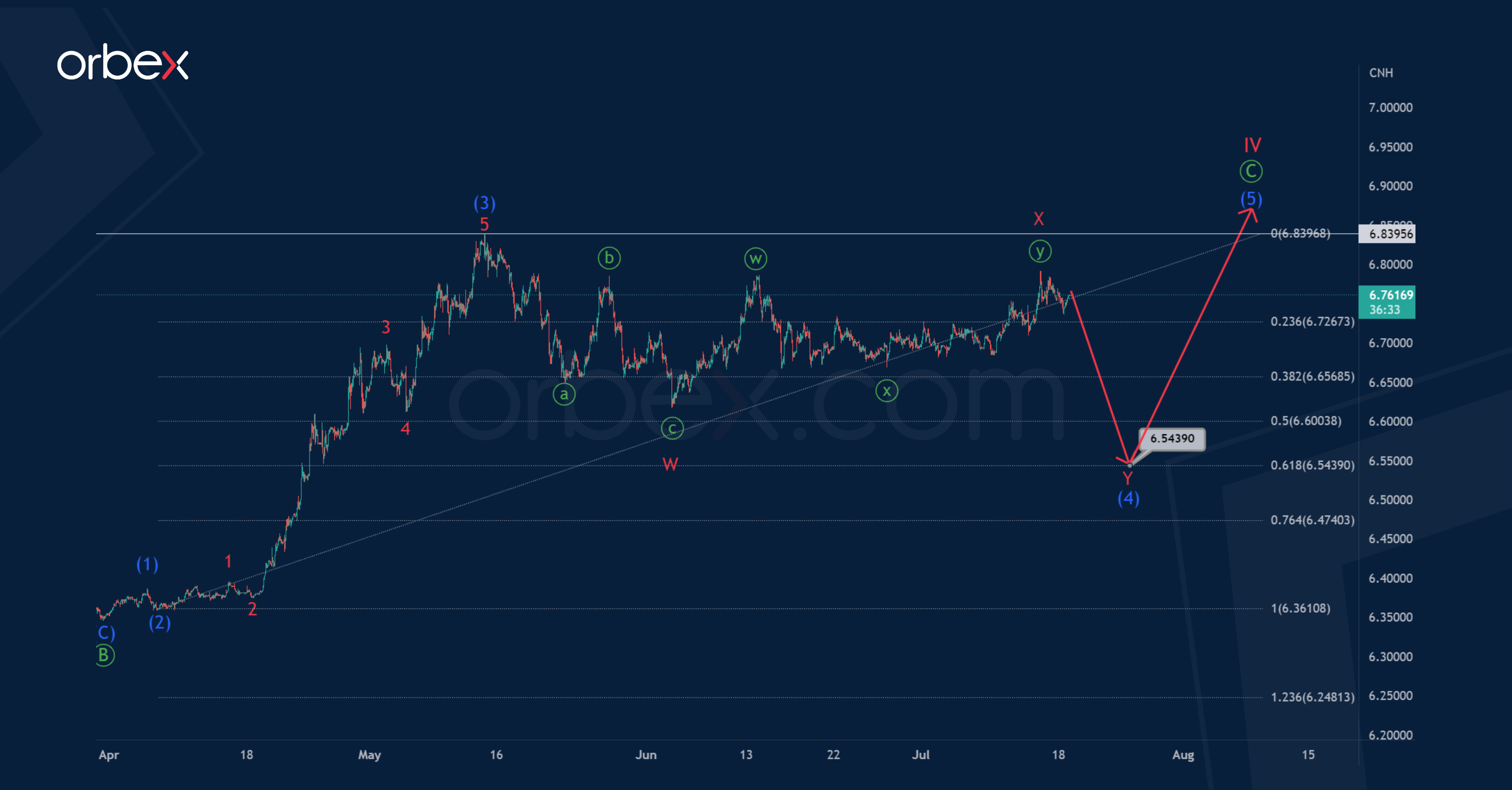
The last primary wave Ⓒ takes the form of an intermediate 5-wave impulse (1)-(2)-(3)-(4)-(5).
The current structure may indicate that the market has completed the construction of a bullish intermediate impulse (3), and at the moment an intermediate correction (4) is forming in the market, taking the form of a minor double zigzag W-X-Y near 6.543. At that level, intermediate correction will be at 61.8% of impulse (3).
After the end of the correction (4), the market growth may resume within the final sub-wave (5) above the level of 6.839 marked by impulse (3).
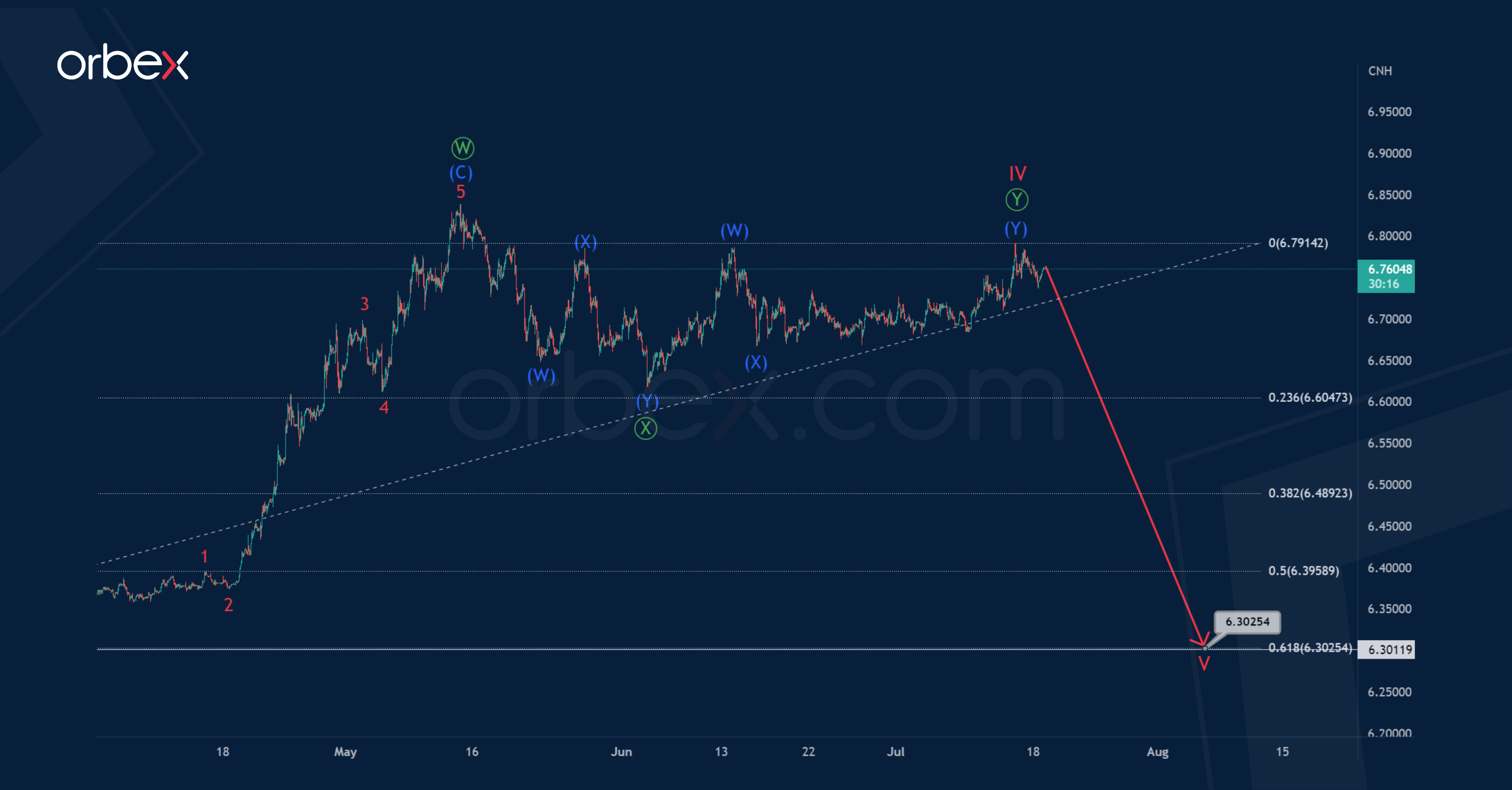
An alternative scenario shows that the construction of the entire cycle correction IV could already be completed. It took the form not of a simple zigzag, but of a double zigzag consisting of primary sub-waves Ⓦ-Ⓧ-Ⓨ.
Thus, if this assumption is correct, the market may begin to move in a downward direction, forming the final cycle wave V.
Most likely, wave V will complete its development in the area of the previous minimum of 6.302, marked by impulse III. Moreover, at that level, wave V will be at 61.8% of impulse III. Therefore, the probability of achieving this coefficient is high.
GBP/USD Outlook: Solid UK Jobs Data Additionally Support Recovery
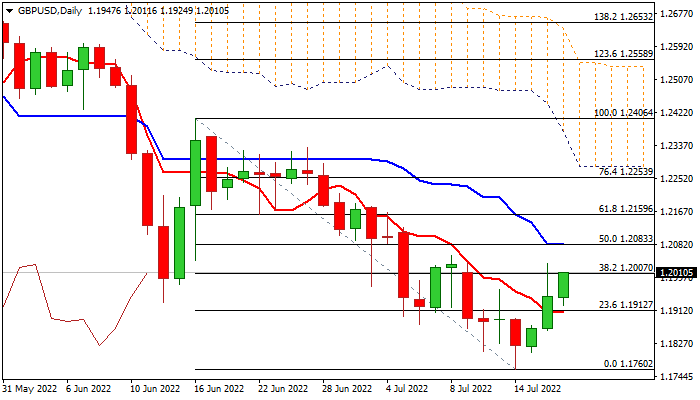
Cable keeps positive tone and attacks again pivotal 1.20 resistance zone (psychological / Fibo 38.2% of 1.2406/1.1760 bear-leg / trendline resistance), after Monday’s action spiked to 1.2033 but failed to sustain gains and closed below 1.20.
Sterling received fresh support from strong UK jobs data (unemployment remained unchanged at 3.8% vs 3.9% f/c and the number of people in employment rose by 296,000 in 3 months to May, strongly overshooting forecast for 170,000 increase) which signal that UK labor market is tightening that adds to confidence of the Bank of England about raising interest rates further next month.
Although positive fundamentals and weaker dollar continue to underpin recovery, technical studies on daily chart remain bearishly aligned and warn of limited correction before larger bears re-take control.
Fresh bulls face headwinds from 1.20 zone, which guards next pivotal barrier at 1.2083 (daily Kijun-sen / 50% retracement of 1.2406/1.1760).
Repeated failure to close above 1.20 barrier would generate initial signal of recovery stall, while extended upticks should be capped by 1.2083 resistance to keep larger bears in play.
Res: 1.2000; 1.2055; 1.2083; 1.2125.
Sup: 1.1861; 1.1804; 1.1760; 1.1700.
ECB said to consider 50bps hike this week, EUR/CAD rising towards 1.3383
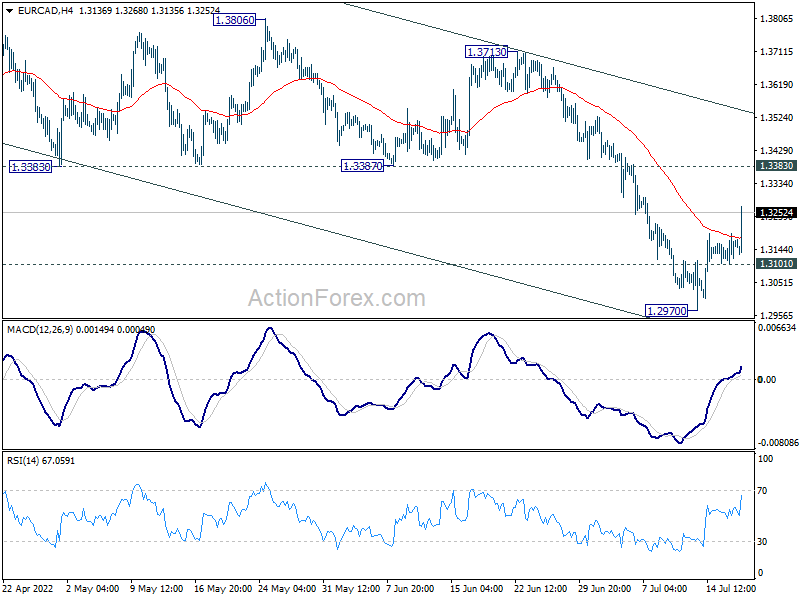
Euro jumps broadly after Reuters reported that ECB policymakers will discuss whether to raise interest rate by 50bps this Thursday, as a option to the pre-committed 25bps hike. But ECB spokesperson declined to comment so far.
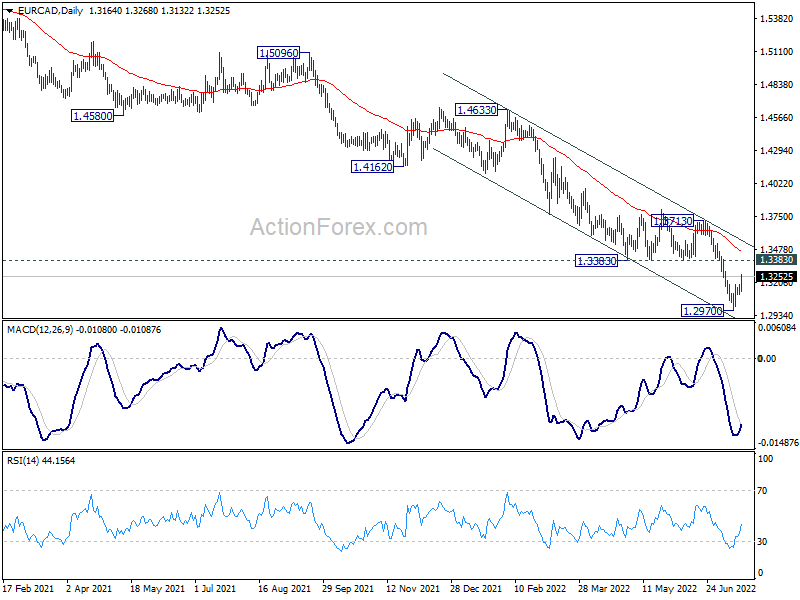
Similar to EUR/USD, EUR/CAD should have formed a short term bottom at 1.2970. Further rise is expected to 1.3383 support turned resistance fist. Firm break there will target channel resistance (now at 1.3535). On the downside, below 1.3101 minor support will bring retest on 1.2970 low instead.
GBP/JPY Daily Outlook
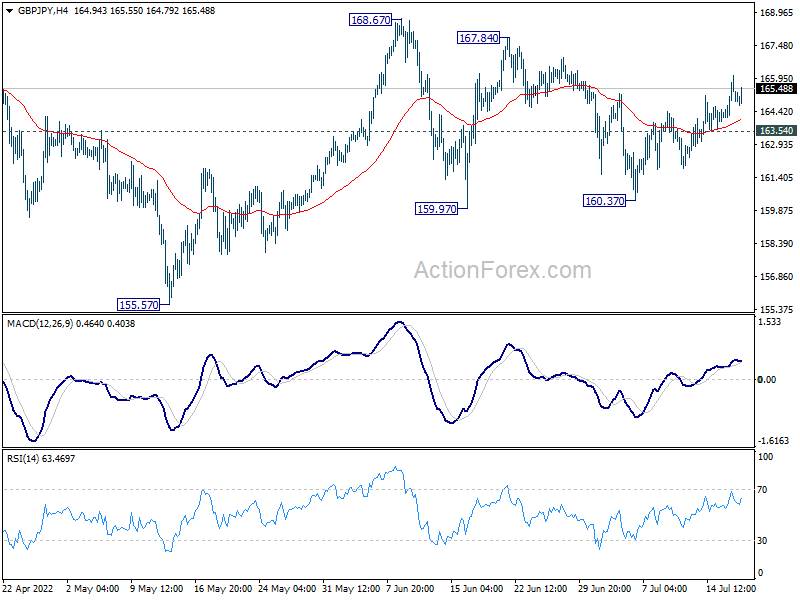
Daily Pivots: (S1) 164.16; (P) 165.13; (R1) 166.08; More...
Intraday bias in GBP/JPY stays on the upside at this point. Consolidation from 168.67 should have completed with three waves to 160.37. Further rally should be seen to retest 168.67 high. Firm break there will resume larger up trend. On the downside, below 163.54 minor support will dampen this bullish view and turn bias back to the downside for 160.37 support instead.
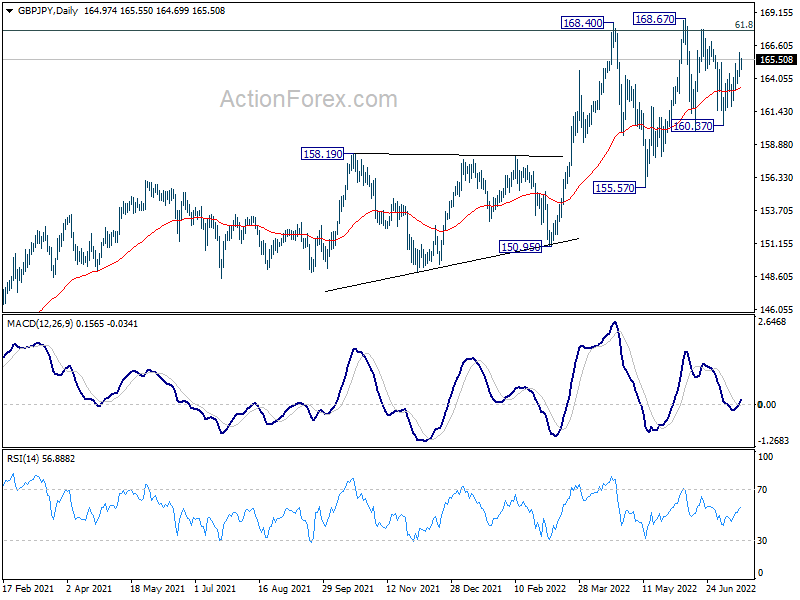
In the bigger picture, up trend from 123.94 (2020 low) is still in progress. Sustained break of 61.8% retracement of 195.86 (2015 high) to 122.75 (2016 low) at 167.93 will be a long term bullish signal, and could pave the way back to 195.86 high. This will now remain the favored case as long as 155.57 support holds, even in case of deep pull back.
EUR/JPY Daily Outlook
Daily Pivots: (S1) 139.42; (P) 140.11; (R1) 140.84; More....
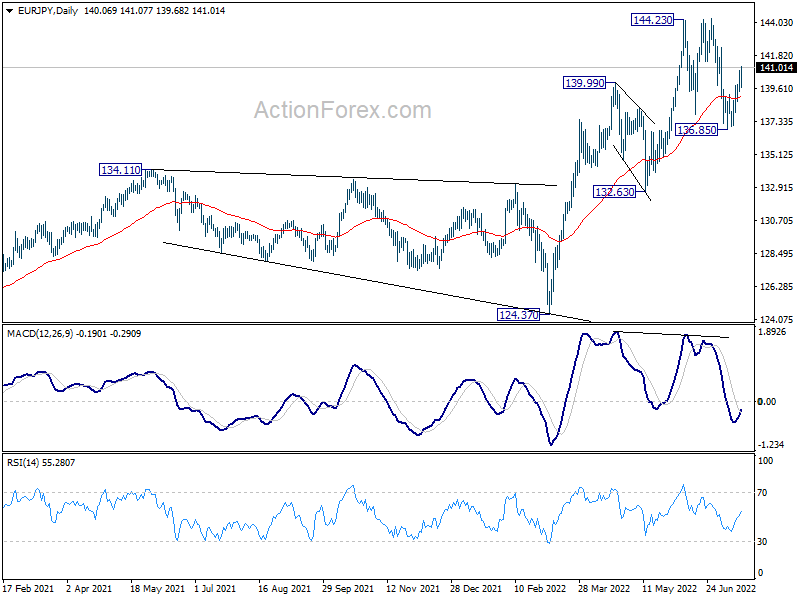
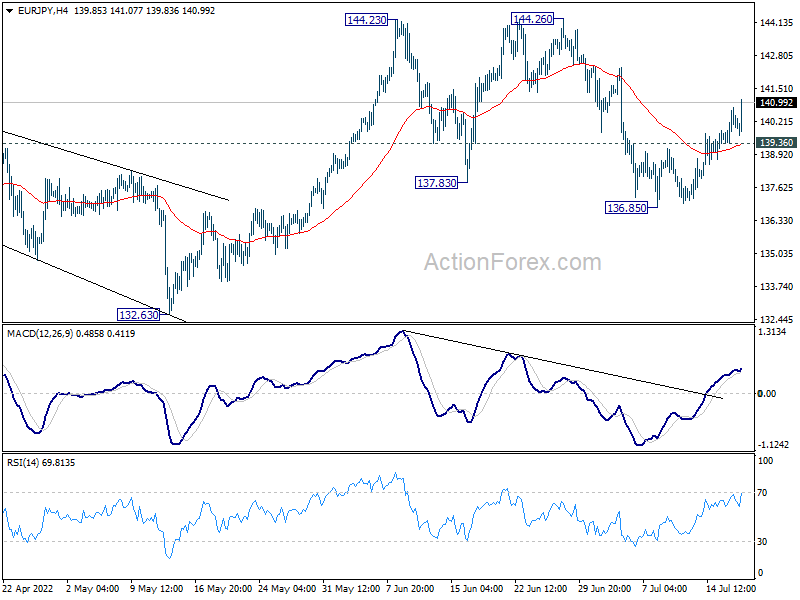
Intraday bias in EUR/JPY remains on the upside at this point. Consolidation pattern from 144.23 should have completed with three waves to 136.85. Further rally should be seen to retest 144.26 resistance first. Firm break there will resume larger up trend. On the downside, below 139.36 minor support will dampen this bullish view and bring retest of 136.85 instead.
In the bigger picture, up trend from 114.42 (2020 low) is seen as the third leg of the pattern from 109.30 (2016 low). Further rally is in favor as long as 134.11 resistance turned support holds, even in case of deep pull back. Firm break of 139.78 will target 149.76 (2015 high. However, sustained break of 134.11 will be a sign of medium term bearish reversal and turn focus to 124.37 support for confirmation.