

Sample Category Title
UK Oil Tests Resistance
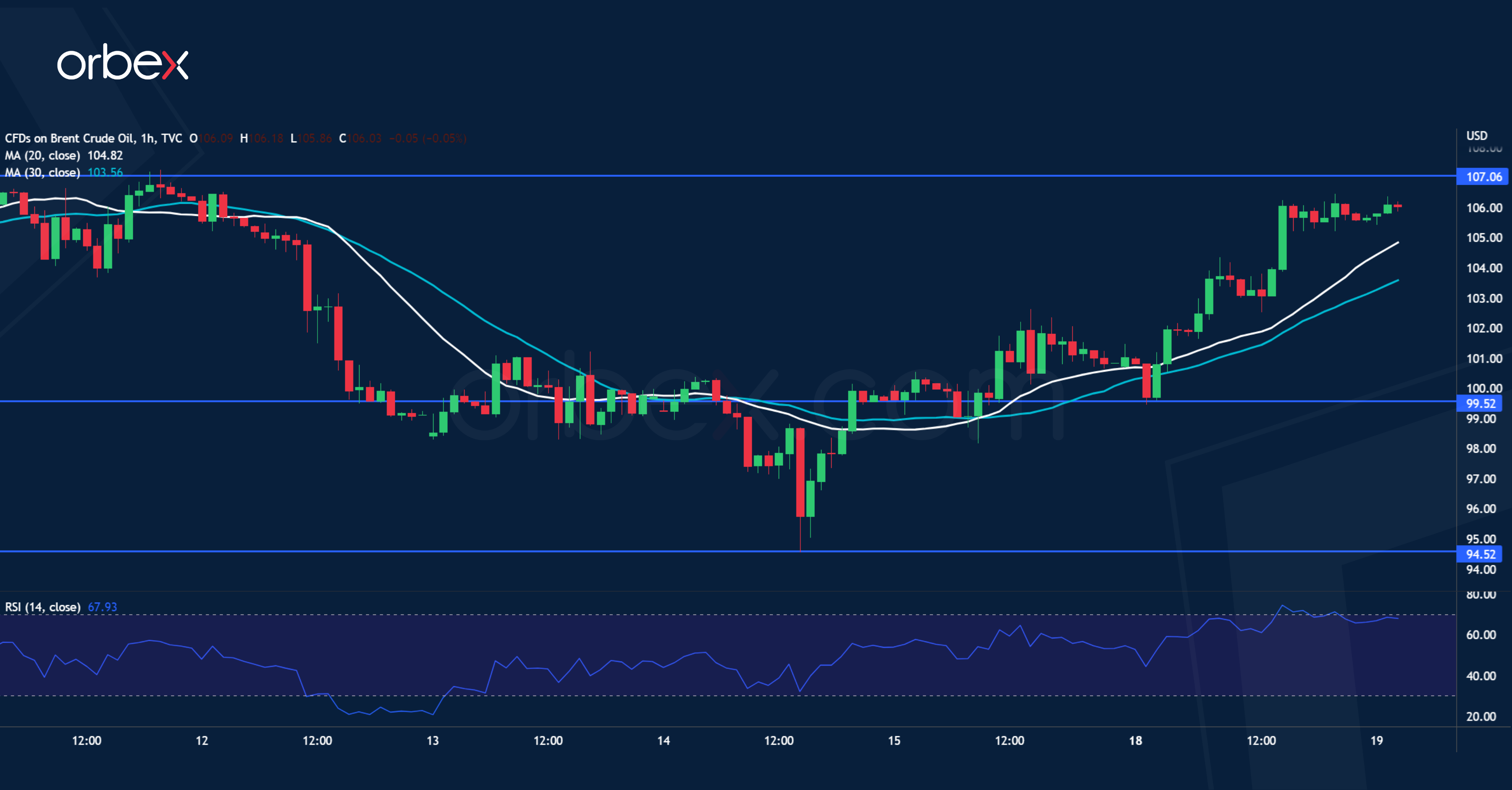
Oil markets rallied as Saudi Arabia did not yield to pressure from US President Biden's to boost supply. A fall below the psychological level of 100.00 and a bearish MA cross on the daily chart have put a dent to the two-year long uptrend. Rebounds could come under pressure as the bias shifted to the downside. The price action is testing 107.00 and its breach would carry it to the origin of July’s sell-off at 104.00 which is a major resistance. 99.50 is the immediate support and a deeper correction could send Brent crude below 94.50.
AUD/USD Attempts to Rebound
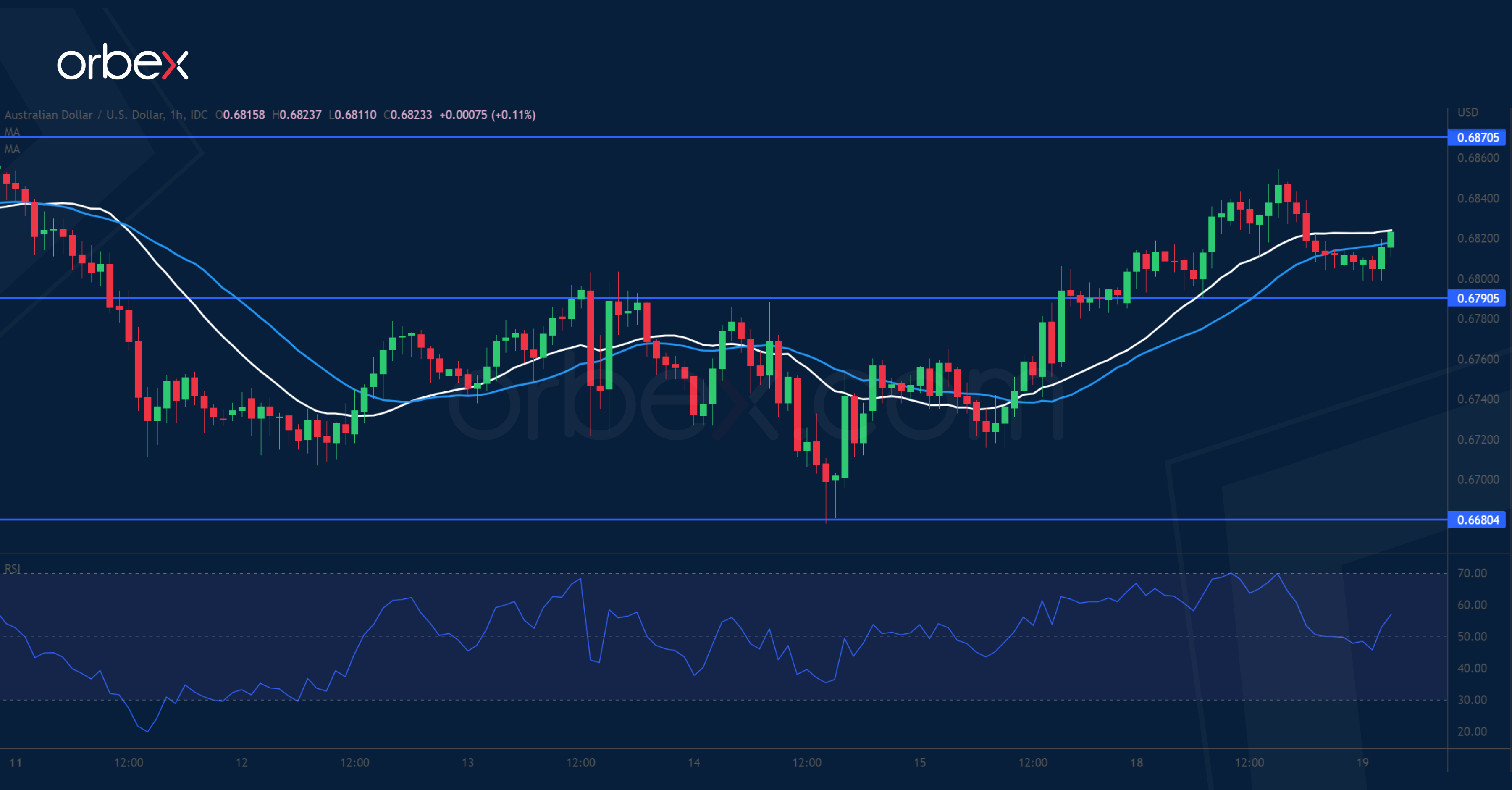
The Australian dollar finds support from upbeat RBA meeting minutes. A break above 0.6790 has prompted some sellers to cover their bets, easing the downward pressure for now. The former resistance has turned into a support. 0.6870 is a congestion area as it coincides with the 30-day moving average. The bears may look to fade the rebound as the RSI inches into the overbought zone. However, a bullish breakout could trigger an extended rally towards 0.6960 and pave the way for a potential recovery in the days to come.
Daily Technical Analysis
EUR/USD
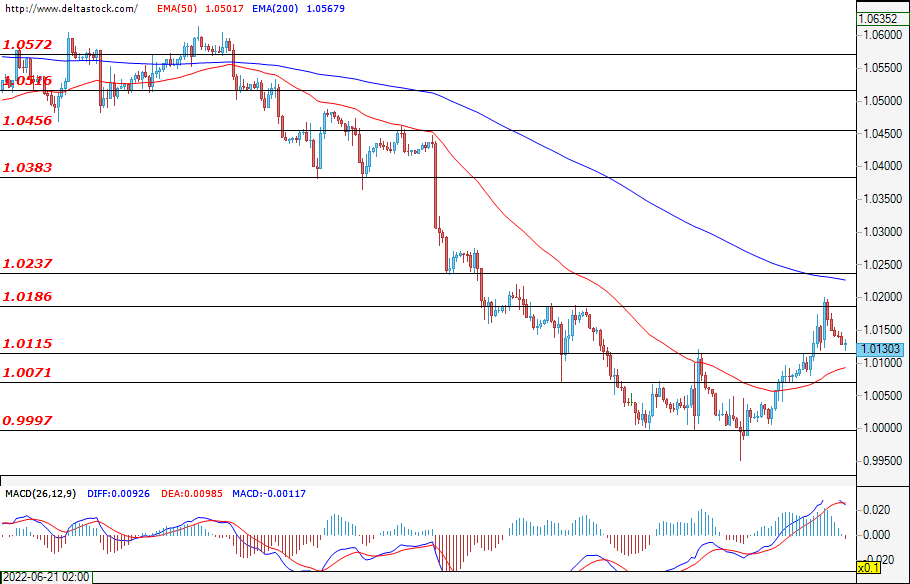
During yesterday's trading session, the bulls' attack was thwarted around the resistance level at 1.0186. The buyers lost their momentum and the bears in turn took control over the market, paving their way towards the first significant support at 1.0115. Although the bulls took control at the end of last week, we still can't talk about an end of the bearish push just yet. A breach of the levels at around 1.0400 – 1.0500 could be the only event signalling the calming down of the sell-off and a possible end of the bearish trend. There is no economic news for today that could impact the volatility as investors are looking forward to the European Central Bank's interest rate decision (Thursday; 12:15 GMT).
USD/JPY
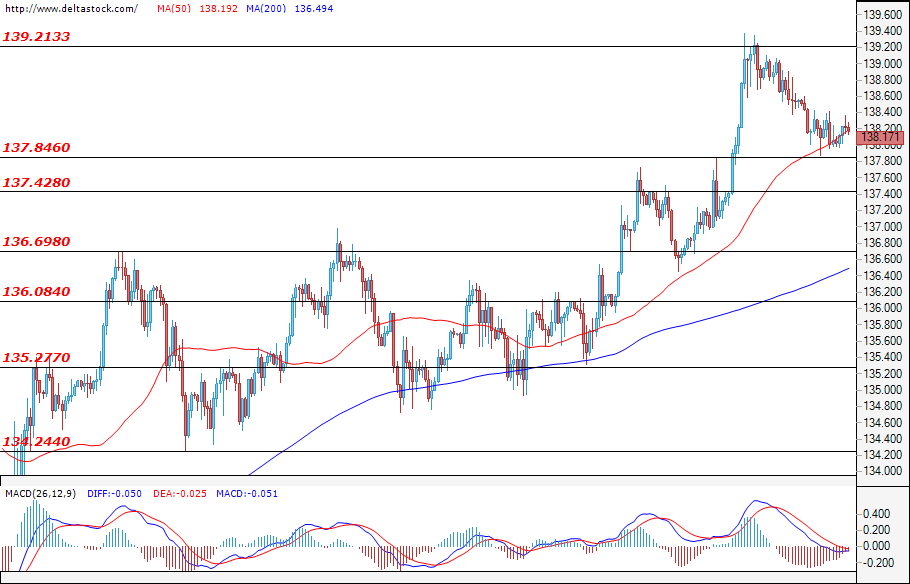
The situation with the Ninja remains unchanged from the previous session. The pair consolidated just above the support area at 137.84 as the bulls gave up control to the bears and lost some of their gains to the U.S. dollar. This, in turn, could be seen as a fleeting correction and an attempt to find better entry levels before we witness another attack on the resistance and also a key psychological level at around 140.00. The main support remains at the mentioned level at 137.84.
GBP/USD
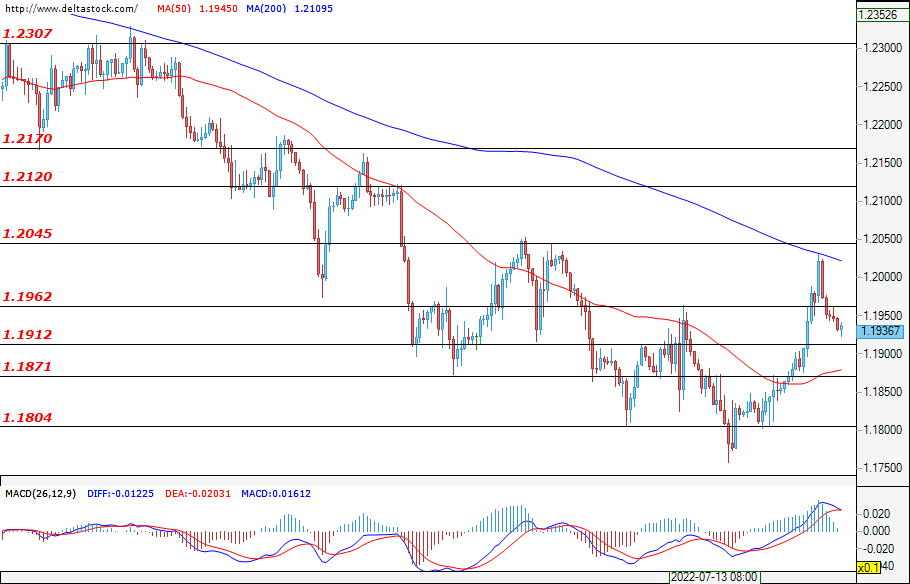
The bears thwarted the bulls' attack at the 1.2045 resistance, then managed to breach the first support at 1.1962 and lead the trade towards the 1.1900 support area. A possible deepening of the sell-off could create conditions for reaching the local minimum at around 1.1800. In the positive direction, the mentioned resistance at 1.2045 is a major obstacle for the bulls if they wish to reverse the bearish trend. Тhe Claimant Count unemployment change data (today; 06:00 GMT) could have an impact on the volatility of the currency pair.
EUGERMANY40
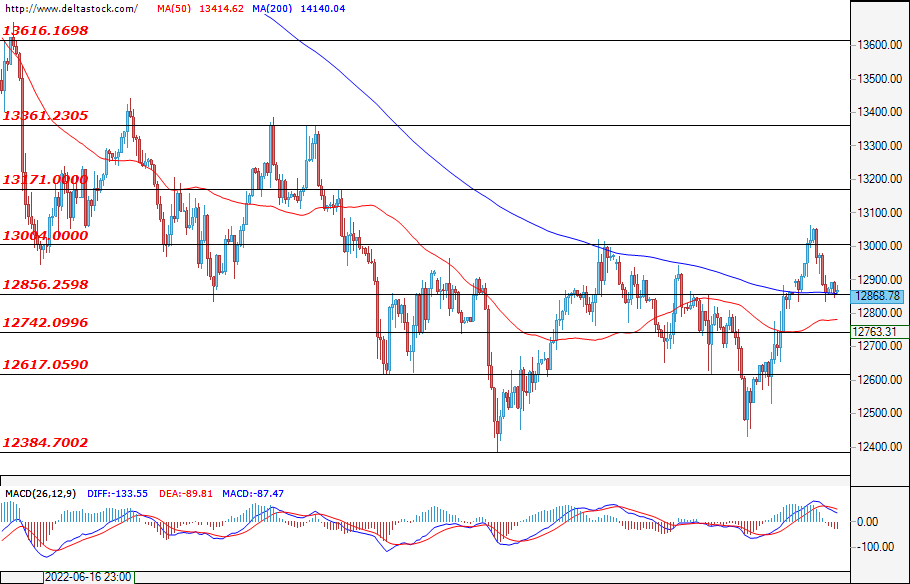
After the German index opened with a positive gap at the start of yesterday's trading session, the bulls were able to gain momentum and take the trade towards a test of the resistance zone at 13000. The breakout failed, allowing the bears to take control and they led the index towards the levels from the end of the past week – the one at 12856, which currently plays the role of major support. The range move for the moment remains intact between 12384 – 13000.
US30
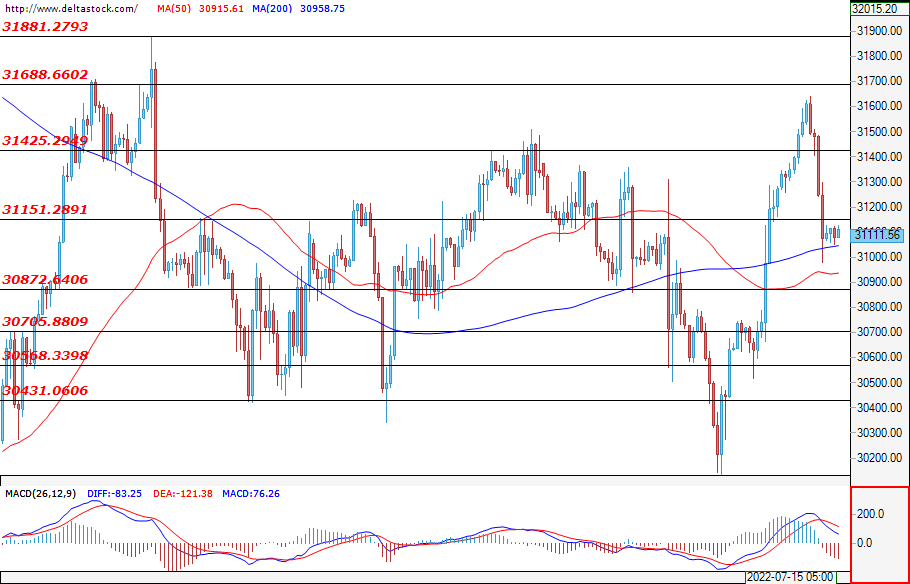
Similarly to the German index, the U.S. blue-chip stock index started the week in the green, reaching gains of just over 1%, but during the second half of yesterday's trading session, the bears prevailed and the index ended up recording a day of losses. At the time of writing, the US30 is located just below the resistance at 31151, and a possible successful breach could give the buyers the necessary incentive for another attack on the level of 31425, and then the next resistance at 31700. On the other hand, a potential deepening of the sell-off would take the index towards a test of the next significant support at 30872.
Markets Assessing a Potential Top in Fed Rate Hike cycle
Markets
Especially European markets yesterday showed a remarkable risk-on mood despite multiple event risks (ECB meeting, Italian political crisis, Russian gas supply to Europe, EMU PMI’s) looming large over the next days. Several (also hawkish) governors last week indicating the Fed won’t step up the pace of rate hikes to 100 bps provided some comfort for risk-takers globally. European equities (including Italy) mostly gained about 1.0%. US indices opened with a similar but gain but reversed gains on Bloomberg headlines that Apple is considering to slow hiring and spending to cope with an economic downturn. US equities eased between 0.69% (Dow) and 0.84% (S&P). Still, US yields maintained most of their intraday gains rising between 5.4 bps (2-y) and 8.0 bps (30-y). In a broader perspective, US yields across the curve are still captured in sideways consolidation pattern around the 3.0% pivot as markets are assessing a potential top in the Fed rate hike cycle in case the US central bank would get more evidence on an economic slowdown later this year. European interest rates showed a similar move with German yields adding between 5.5 bps and 8 bps (10 & 30-y). European yields avoided a sustained break below key technical levels (Euro 2-y swap 1.05/1.10% area, Euro 10-y swap 2.0% area, 10-y bund 1.12/1.18% area). However, for now the downside (in yields) still looks less solid compared to the US. The 10-y Italian spread over Germany eased 7 bps, despite persistent political uncertainty. Brent oil jumped north of $ 100 p/b (close $106+). Market apparently aren’t convinced that Saudi Arabia/OPEC+ will be able to add supply as asked for by US President Biden. The DXY USD index dropped below 107 on the early session risk rebound, but bottomed later (close 107.37). EUR/USD tested the 1.02 but closed off the intraday peak at 1.015. Sterling initially outperformed the dollar and the euro as BoE’s Saunders advocated to raise the policy rate north of 2% next year even as growth slows. However, sterling couldn’t maintain the initial momentum. EUR/GBP closed at 0.8487 holding recent ST 0.8403/0.8515 consolidation pattern.Asian equities mostly trade with modest losses after yesterday’s intraday setback on WS. US yields are easing 1/2bps. The dollar struggles to avoid further correction (DXY 107.35; EUR/USD 1.015, USD/JPY 138). The eco calendar contains the final June EMU CPI and US housing starts and permits. The US housing market recently cooled down as higher interest rates are feeding through. Another negative surprise might weigh on US yields and the dollar intraday. For now we don’t see a strong case for sustained euro strength. The EUR/USD 1.0201/21 mark first resistance. A break would probably signal a further ST repositioning on the USD rather than anything else. This morning UK labour market data (unemployment rate 3.8%) were OK but close to expectations in general. We don’t expected any lasting impact on sterling. Keep an eye at the speech of UK Governor Bailey at Mansion House.
News Headlines
A study by polling forms YouTrend and Cattaneo Zanetto & Co showed that the bloc of Italy’s conservative parties is likely to win a clear majority at the next elections. These might come as early as September should PM Draghi fulfill his threat to quit when he addresses parliament tomorrow. The polling firms calculated that the rightist bloc, including League Party, Forza Italia and Brothers of Italy would win up to 221 seats out of the 400 in the lower house and 108/200 in the Senate. Brothers of Italy currently tops the polls, garnering support of more than 22%. This would launch party leader Meloni, or the person she nominates, in pole position to become the new prime minister.The European Commission in a draft plan estimates the total cut-off of Russian gas supply would cut growth by 1.5 ppts in case of a cold winter. An average winter would lower GDP between 0.6 and 1%, Bloomberg reported citing the document. But in case of early and coordinated action by member states, this may be reduced to just 0.4%pt. The EU is scrambling to top up natural gas stock levels ahead of the winter. There is much uncertainty at what volume the Nord Stream 1 pipeline will resume after maintenance works are scheduled to finish July 21. Fears are that it will remain closed for an unspecified period. Storage levels are currently above 63%, in line with the historic average. This should be 80% at the start of November.
Slower Hiring, Force Majeure, and Recession Worries
The US dollar was softening, and equities were recovering, when the market mood suddenly turned sour on news that Apple would slow hiring and cut spending in some businesses due to the recession fears, and Gazprom declared force majeure.
Elon Musk recently announced he would cut 10% of jobs in Tesla, because he has a bad feeling about the economy. Alphabet, Amazon, Meta, Snap and even Goldman announced they would need less people to work for them as businesses would slow.
And the slowing jobs news is feeding into recession worries, worries that the economy will really start slowing this time, as a result of tighter monetary conditions from the Federal Reserve (Fed), to fight inflation.
The S&P500 reversed early-session losses to close the session 0.84% lower on Monday. Nasdaq lost 0.81%. Apple, the main responsible for yesterday’s selloff closed the session more than 2% down, after having advanced past the $150 per share for the first time since the beginning of June.
Crude oil kicked off the week on a positive note, as Joe Biden’s visit to Saudi Arabia only served to escalate tensions between the two nations, instead of melting ice following Khashoggi’s murder in 2018.
As a result, OPEC said that they will rely on their market logic to decide how much oil they would pump. The barrel of crude is above $100 level.
But, even if OPEC decided to remain timid on its oil production, the higher oil prices is the main reason that investors are preparing for recession. And the recession worries are what pull the oil prices lower. Therefore, we expect to see solid resistance into the $108/110 area, near 50 and 100-DMA respectively.
A bizarre force majeure
Another reason that hit the market sentiment yesterday was the news that Gazprom declared force majeure starting from June 14th on the back of a gas turbine, that is stuck in Canada following repairs due to sanctions.
Canada said it will release the part, but the news suggests that there’s no chance of the turbine being returned before July 21, to allow Nordstream 1 operate again this Thursday.
In the camp of more vicious predictors, Russia will restore the German gas supply this week, to prove the Europeans wrong, earn some more revenue, then cut the gas.
In all cases, Europe will unlikely bypass a worsening energy crisis and avoid recession. Plus, the euro zone will possibly experience another debt crisis, and the political landscape will likely deteriorate as the European economies sink into darkness.
The EURUSD is better bid since Monday, not because there is more faith in the euro but, because the dollar is broadly softer. The EURUSD could consolidate and extend gains, if and only if the dollar kept softening.
Today
We don’t have much on today’s economic calendar that would send the US dollar sharply higher, the FOMC members are also at their quiet period before next week’s meeting.
So, what will matter are the next earnings. Today, Netflix will release its latest earnings, and will likely reveal further weakness in subscriptions. If that’s the case, we could see the Netflix shares take another hit. But, because the expectations are low, we could also see a positive surprise this quarter.
More Tail Chasing
Wall Street did another U-turn overnight, finishing lower as the dearth of tier-1 data and the pre-FOMC media blackout left the FOMO gnomes chasing their tails once again. Wall Street closed modestly lower, ostensibly because Apple said it would slow hiring, joining its other tech-giant brethren. That was despite Goldman Sachs and Bank of America producing decent earnings results, although investment banking revenue took a hit as IPOs and SPACs have dried up. More than likely, the stock market pullback was just noise on a slow news day. The losses overnight have been dwarfed by the gains from Friday, so the bear market rally thesis still has life; it just won’t be a linear progression.
Elsewhere, currency markets ignored Wall Street, with the US Dollar falling again overnight. Once again, the greenback mostly retreated versus the majors, while Asian FX booked only modest gains. The greenback was long overdue a correction, and this is playing out nicely. The interest rate differential play remains real in Asia. Readers should beware of the “dollar smile”; running into the FOMC, the US Dollar’s grin may get wider again. US yields also edged higher overnight, but it seems like noise, nothing special. Gold remains in an induced coma near $1700.00 an ounce, and risks remain skewed towards more gold bugs getting squashed.
Oil had another frisky session, Brent and WTI rallying by around 5.0% overnight. That seems to be becoming the norm for oil prices these days, and with intraday vol like that, risk managers are probably telling the trading desk to cut position sizes intraday, creating a negative feedback loop on the liquidity front. It's hard to say what made New York want to push oil higher, but I suspect they belatedly realised that Joe Biden came away with nothing from the Saudis. The + in OPEC+ is clearly more important to OPEC at the moment. Gazprom also announced some force majeures on European gas customers overnight, apparently, something that doesn’t bode well for the reopening of Nord Stream 1 on Thursday this week. Gas-margeddon Thursday is clearly playing its part in the oil rally, and it makes the European stock market rally even more surprising overnight.
The major news flow washing over Asia today appears to be China’s announcement overnight that it may allow mortgage payment holidays for local buyers on uncompleted housing projects. Although the structure isn’t at all clear yet, it appears that local authorities and state-owned banks making will be “invited” to take up the slack. It appears to be a response to the mortgage payment protest by citizens in China, something the CCP is acutely sensitive to, and may mark the first steps by government entities to take on the credit risk from developers to get projects completed.
China markets seem to be interpreting the announcement as a quasi-stimulus to backstop the property market. I won’t disagree with that, as trying to quietly work out the developer debt problem under the radar over time clearly hasn’t worked. Shanghai industrial commodity futures are on fire in early trading; nickel, aluminium, coking coal (to make steel), and rebar prices, amongst others, are all between three and six per cent higher today, suggesting markets believe government intervention is about to unlock the construction sector. That’s a bit of a reach, given have no concrete details of the plan yet, but one must respect the momentum.
It is a desert on the data front in Asia today, but the China developments should see some positive spill over into Asian markets, which could well shrug off the noise from Wall Street overnight. This afternoon, Eurozone inflation data for June looks set to print at 8.60%. Given that it is final and not flash or preliminary, I expect that to be priced in. UK employment and earnings this afternoon could throw a recession curve ball if both surprise to the upside. That will lead to some recalculations on BOE tightening and could support the sterling.
US Housing Starts and Building Permits for June look to be the day’s data highlights. I wouldn't rule out an upside surprise today with retail sales and consumer confidence data holding up nicely last week. Since stock markets rallied after that higher data last week, I wouldn’t bet against the same thing happening again tonight.
Finally, the only release of note in Asia today, the RBA Minutes, has dropped. The RBA members noted that rates were well below the neutral rate, given the conditions in the economy. You could probably leave a blank space in that sentence and put – insert central bank name here – at the moment. The Australian Dollar is sharply unmoved this morning, suggesting the minutes revealed nothing that wasn’t already priced in.
A day of headline-watching beckons.
Asian equities are trading soft
Asian equity markets are a very mixed picture today. Price action appears to be erring on the negative side after Wall Street fell overnight, with the rise in energy and commodity prices also weighing on the sentiment of the major importing countries. Balancing that, the impending China property support measures appear to be taking the edge of the negative sentiment.
Overnight, Wall Street finished lower after Apple said it would limit hiring. On a slow news day, with no important data, that was enough for the ever-flighty Wall Street to unwind some of the previous day’s gains. The S&P 500 fell by 0.84%, the Nasdaq by 0.83%, and the Dow Jones by 0.69%. US futures have rebounded in Asia, unwinding some of the overnight session losses. S&P 500 futures have gained 0.35%, Nasdaq futures have jumped by 0.60%, and Dow futures have added 0.15%.
Given the rebound in US futures this morning, the negative edge to early Asia equity trading is slightly surprising. I suspect the 5.0% rise in oil prices overnight is weighing on sentiment in energy-hungry Asia. Japan returns from holiday, with the Nikkei 225 rising by 0.73%, but South Korea’s Kospi has edged 0.30% lower. In China, the Shanghai Composite is unchanged, but the narrower Shanghai 50 has fallen by 0.75%. The CSI 300 is down by 0.55%, while Hong Kong’s Hang Seng has fallen by 0.95%.
In regional markets, Singapore and Taipei are 0.30% lower, with Kuala Lumpur falling by 0.55%, but Jakarta has rallied by 0.50%. Manila is unchanged, with Bangkok falling by 0.90%. Australian markets have edged lower, with commodity price rises offsetting a negative Wall Street session. The ASX 200 and All Ordinaries are down slightly by 0.20%.
European markets booked another impressive day of gains overnight, but with Wall Street lower and Asia looking very mixed, the rebound may struggle for traction this afternoon. I expect nerves around Russian gas flows on Thursday to start eroding sentiment as the week progresses.
US Dollar correction continues
The US Dollar fell once again against the major currencies as its downward correction continued. Notably, Asia FX made very limited gains overnight, and this US Dollar move seems very much contained to the major currency space. The dollar index closed 0.53% lower at 107.41 overnight but traded in a very choppy 115-point range between 106.90 and 108.05. These mark initial support/resistance today. Above that, resistance is at 108.70, 109.30, and then 110.00. The drop to 106.90 overnight may have taken out many of the weak long positions, but should it fail again, the next target is the 1.0585 breakout point, followed by 1.0500. In Asia, the dollar index is 0.12% higher at 107.53.
EUR/USD rallied to test 1.0200 intraday, only to retreat, finishing 0.56% higher at 1.0145. In Asia, it has edged lower to 1.0130. The technical picture still suggests a correction back towards 1.0200 is possible, but only a sustained break above 1.0360 would suggest a longer-term low is in place. EUR/USD has support at 1.0000 and 0.9900/25. The single currency faces serious event risk in the latter half of the week, firstly from the ECB policy decision, and secondly, from Russian natural gas flows which are due to resume after pipeline maintenance.
GBP/USD rallied by 0.70% overnight to 1.1952, testing 1.2030 intraday. Like the Euro, the extent of the intraday rally suggests that quite a lot of the weaker shorts were taken out, leaving positioning more balanced. It has support at 1.1870, 1.1800 and 1.1760, while resistance at 1.2060 and 1.2200 remains intact. A rise above 1.2060 suggests a larger rally to the 1.2400 regions, but it would take a sustained break of 1.2400 to call for a longer-term low by sterling. It is unchanged in Asia.
USD/JPY fell by 0.28% overnight at 138.15, where it remains in Asia as Japan returns from holiday. Thursday’s high around 139.40 is initial resistance, followed by 140.00. Support is at 137.40 and 136.00. Given the sentiment in the market this week, a fall in US yields this week could finally translate to a meaningful downside correction by USD/JPY, which is a crowded trade.
AUD/USD and NZD/USD finished sideways overnight, testing and failing ahead of resistance at 0.6850 and 0.6200, respectively, price action that mirrored EUR/USD and GBP/USD. AUD/USD has risen 0.25% to 0.6830 today, while NZD/USD gained 0.15% to 0.6165. Both currencies are showing falling wedge formations and a sustained break above 0.6850 or 0.6200 signals more gains ahead this week by the antipodeans.
The overnight retreat by the US Dollar bypassed Asian currencies once again, which posted only modest gains. That suggests that China's growth fears, and the impending widening of the US interest rate differential at the short end of the curve, continue to weigh on AsiaFX performance. Today, USD/Asia is barely changed from their overnight closes.
Oil prices explode higher
Brent crude and WTI prices exploded higher overnight after Gazprom declared a backdate force majeure on some major European customers. That raised fears that gas flows would not return through the Nord Stream 1 pipeline to Germany at the end of the week, causing a knock-on impact on oil prices. Markets also seem to have concluded that President Biden effectively returned from Saudi Arabia empty-handed from his weekend visit.
Brent crude leapt 4.80% higher to $105.65 overnight, adding another 0.35% to $106.00 a barrel in muted Asian trading. Brent crude has nearby resistance at $106.50, followed by $108.00 a barrel. Support is distant at $99.50.
WTI leapt 4.55% higher overnight to $102.05, adding 0.45% to $102.45 a barrel in Asia. It has now-distant support at $96.00 a barrel, with resistance nearby at $103.00 and $105.00 a barrel.
The intraday volatility in oil prices is rendering technical levels somewhat meaningless for now, and it seems that extra volatility is feeding into less intraday liquidity, exacerbating movements in a negative feedback loop. I note that both contracts have held and rallied from their 200-day moving averages on a daily closing basis. When combined with the fact the futures curves are still in backwardation, a bullish set-up for prices that reinforces that despite speculative volatility, the underlying supply/demand imbalance is as tight as ever. Oil prices may have peaked, but they certainly don’t look like they’re going materially lower from here unless we get a huge surprise from OPEC+.
Stubbornly firm economic data from the US and improving data from China are other supportive factors. Risks remained skewed to the upside if Russian gas does not start flowing back to Europe at the end of this week.
Gold’s remains unimpressive
Gold has another unimpressive session overnight, peeping above $1720.00 intraday but closing almost unchanged at $1709.00 an ounce by the session's close. It has edged 0.10% lower to $1708.00 an ounce in another comatose session in Asia.
Gold’s inability to hold onto even modest rallies in prices, even as the US Dollar falls and US bonds trade sideways, is a major concern in my option. It suggests that risks remain heavily skewed towards the downside. The US Dollar index is over 150 points off its peak from last Friday, yet gold remains glued to 11-month lows. It seems that only a much deeper correction lower by the US Dollar will grant gold a stay of execution.
Gold has initial support at $1700.00, followed by the more important $1675.00 an ounce zone. A sustained failure of $1675.00 will signal a much deeper move lower, targeting the $1450.00 to $1500.00 an ounce regions in the weeks ahead. Gold has resistance nearby at $1725.00 and then $1745.00 an ounce.
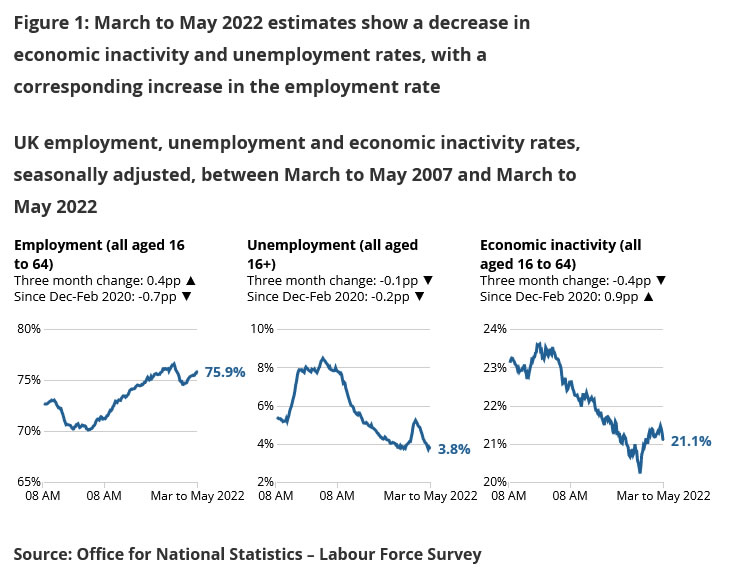
UK payrolled employees rose 31k in Jun, unemployment rate unchanged at 3.8% in May
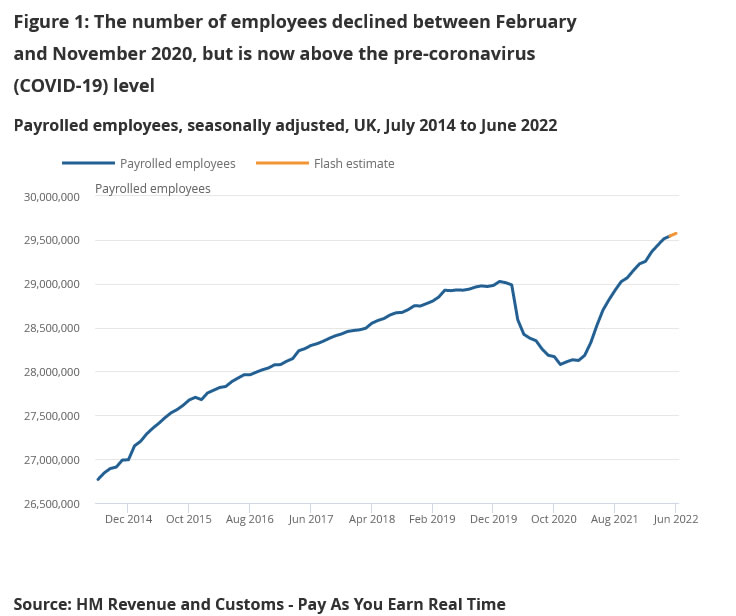
UK number of payrolled employees rose 31k in the month of June to a record 29.6m. Comparing with June 2021, payrolled employees rose 3.0% or 874k. Claimant count dropped -20k in the month, versus expectation of -41.2k.
Unemployment rate in the three months to May dropped was unchanged at 3.8%, matched expectations. Over the previous quarter, unemployment rate was down -0.1%, employment rate rose 0.4%, economic inactivity rate dropped -0.4%, hours worked rose 6.5m.
Average earnings including bonus rose 6.2% 3moy in may, below expectation of 6.8%. Average earnings excluding bonus rose 4.3% 3moy, matched expectations.
AUD/USD Daily Report
Daily Pivots: (S1) 0.6783; (P) 0.6819; (R1) 0.6848; More...
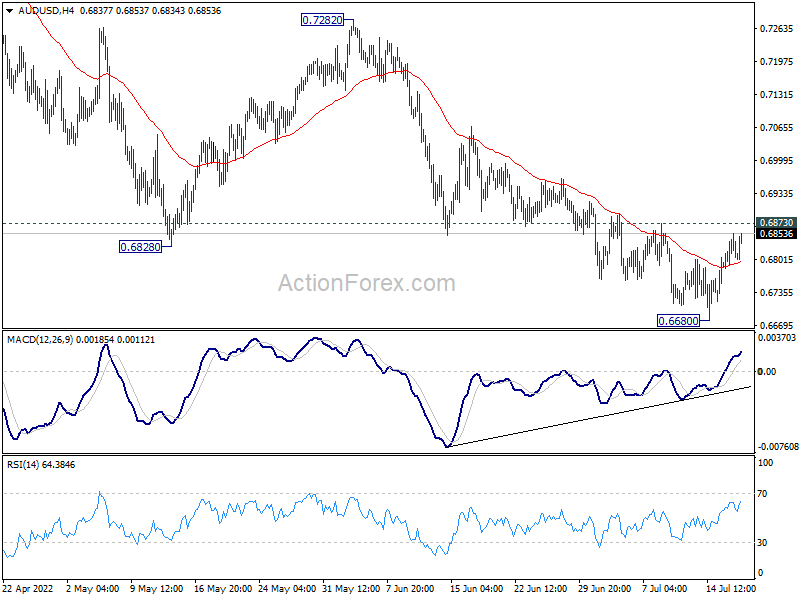
Intraday bias in AUD/USD remains neutral with focus on 0.6873 minor resistance. Firm break there should confirm short term bottoming at 0.6680, on bullish convergence condition in 4 hour MACD. Stronger rebound should then be seen to 55 day EMA (now at 0.6982) and above. On the downside, though, break of 0.6680 will resume larger down trend to next fibonacci level at 0.6461.
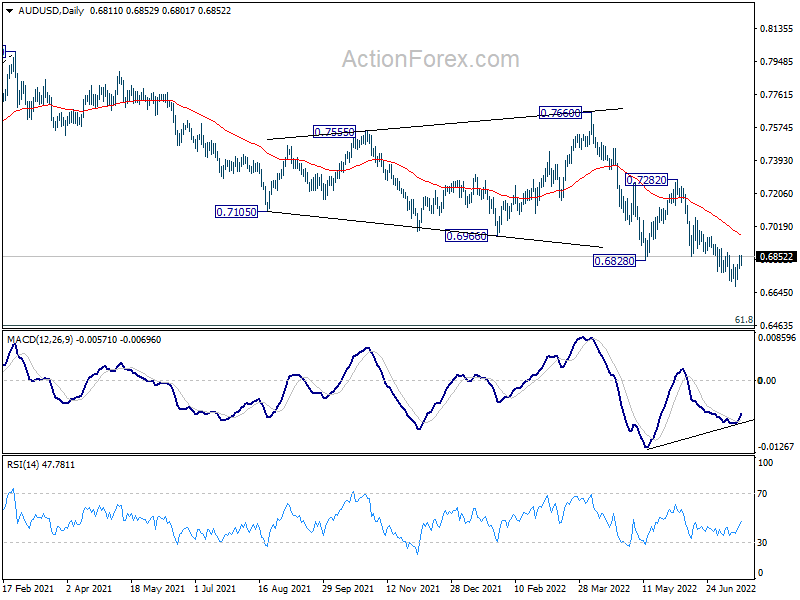
In the bigger picture, price actions from 0.8006 could still be a corrective pattern to rise from 0.5506 (2020 low). But current downside acceleration is raising the chance that it's a bearish impulsive move. In either case, outlook will remain bearish as long as 0.7282 resistance holds. Next target is 61.8% retracement of 0.5506 to 0.8006 at 0.6461.
Aussie Mildly Higher After RBA Minutes, Dollar Continues to Soften
Australian Dollar trades mildly higher in Asian session, after RBA minutes affirmed that further tightening is underway. New Zealand is also supported by somewhat steady risk sentiment. Canadian Dollar is also limited after WTI crude oil rebounded and regained 100 handle. Euro and Dollar are the softer ones for now, followed by Sterling, which awaits UK job data.
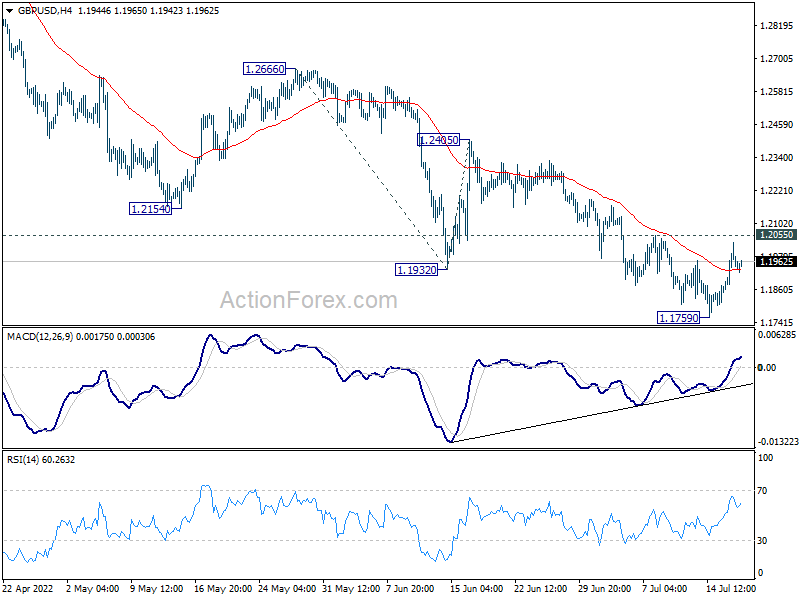
Technically, the case of a deeper near term pull back in Dollar is building up. Attention will be on 1.2055 minor resistance in GBP/USD and 0.6873 minor resistance in AUD/USD. Firm break of these levels will confirm short term weakness in the greenback, which should be quick broad-based, except versus Yen.
In Asia, at the time of writing, Nikkei is up 0.56%. Hong Kong HSI is down -1.21%. China Shanghai SSE is down -0.51%. Singapore Strait Times is down -0.12%. Japan 10-year JGB yield is up 0.0024 at 0.237. Overnight, DOW dropped -0.69%. S&P 500 dropped -0.84%. NASDAQ dropped -0.81%. 10-year yield dropped -0.03 to 2.930.
RBA minutes: Arguments for 50bps hike stronger than 25bps in Jul
In the minutes of the July 5 meeting, RBA noted that members considered raising interest rates by 25bps or 50bps. The arguments for a 50bps hike were "stronger".
"The level of interest rates was still very low for an economy with a tight labour market and facing a period of higher inflation," the minutes noted. "Members viewed it as important that inflation expectations remained well anchored and that the period of higher inflation be temporary."
Also, board members agreed that "further steps would need to be taken to normalise monetary conditions in Australia over the months ahead," The "size and timing" of future hikes will be guided by "incoming data" and assessment of the outlook for "inflation and labor market".
RBA Bullock: Households in fairly good position for rate hikes
In a speech, RBA Deputy Governor Michelle Bullock said households are in a "fairly good position" for interest rate increases. It's "unlikely" that there will be substantial financial stability arising from the household sector, but risks are "a little elevated".
The household sector has "large liquidity buffers", with "substantial equity" in housing assets. Much of the debt is held by "high-income households" while low fixed rate loans have give time for preparation for high rates. But rate hikes could impact households' debt servicing burden and cash flow. Risk play out will also be included by future path of employment growth.
"This, along with the Board's assessment of the outlook for inflation, will be important considerations in deciding the size and timing of future interest rate increases," she concluded.
Looking ahead
UK employment, Swiss trade balance and Eurozone CPI final will be released in European session. Later in the day, US will publish housing starts and building permits.
AUD/USD Daily Report
Daily Pivots: (S1) 0.6783; (P) 0.6819; (R1) 0.6848; More...
Intraday bias in AUD/USD remains neutral with focus on 0.6873 minor resistance. Firm break there should confirm short term bottoming at 0.6680, on bullish convergence condition in 4 hour MACD. Stronger rebound should then be seen to 55 day EMA (now at 0.6982) and above. On the downside, though, break of 0.6680 will resume larger down trend to next fibonacci level at 0.6461.
In the bigger picture, price actions from 0.8006 could still be a corrective pattern to rise from 0.5506 (2020 low). But current downside acceleration is raising the chance that it's a bearish impulsive move. In either case, outlook will remain bearish as long as 0.7282 resistance holds. Next target is 61.8% retracement of 0.5506 to 0.8006 at 0.6461.
Economic Indicators Update
| GMT | Ccy | Events | Actual | Forecast | Previous | Revised |
|---|---|---|---|---|---|---|
| 01:30 | AUD | RBA Meeting Minutes | ||||
| 06:00 | CHF | Trade Balance (CHF) Jun | 3.05B | 3.12B | ||
| 06:00 | GBP | Claimant Count Change Jun | -19.7K | |||
| 06:00 | GBP | ILO Unemployment Rate (3M) May | 3.80% | 3.80% | ||
| 06:00 | GBP | Average Earnings Including Bonus 3M/Y May | 6.80% | 6.80% | ||
| 06:00 | GBP | Average Earnings Excluding Bonus 3M/Y May | 4.30% | 4.20% | ||
| 09:00 | EUR | Eurozone CPI Y/Y Jun F | 8.60% | 8.60% | ||
| 09:00 | EUR | Eurozone CPI Core Y/Y Jun F | 3.70% | 3.70% | ||
| 12:30 | USD | Housing Starts Jun | 1.60M | 1.55M | ||
| 12:30 | USD | Building Permits Jun | 1.69M | 1.70M |
RBA Bullock: Households in fairly good position for rate hikes
In a speech, RBA Deputy Governor Michelle Bullock said households are in a "fairly good position" for interest rate increases. It's "unlikely" that there will be substantial financial stability arising from the household sector, but risks are "a little elevated".
The household sector has "large liquidity buffers", with "substantial equity" in housing assets. Much of the debt is held by "high-income households" while low fixed rate loans have give time for preparation for high rates. But rate hikes could impact households' debt servicing burden and cash flow. Risk play out will also be included by future path of employment growth.
"This, along with the Board's assessment of the outlook for inflation, will be important considerations in deciding the size and timing of future interest rate increases," she concluded.