

Sample Category Title
USD/JPY Mid-Day Outlook
Daily Pivots: (S1) 138.20; (P) 138.67; (R1) 138.94; More...
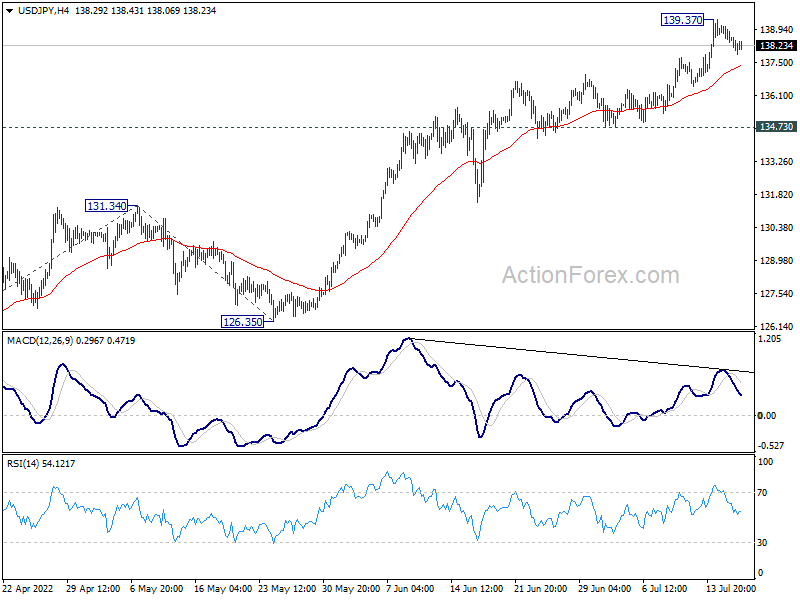
Intraday bias in USD/JPY remains neutral for consolidation below 139.37. Downside of retreat should be contained by 134.73 support. On the upside, break of 139.37 will resume larger up trend to 100% projection of 114.40 to 131.34 from 126.35 at 143.29.
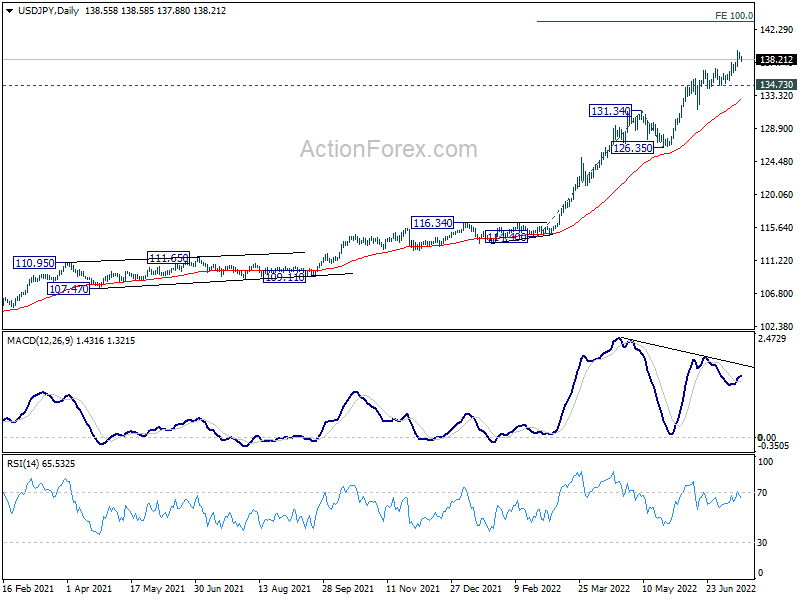
In the bigger picture, current rally is seen as part of the long term up trend from 75.56 (2011 low). Next target is 100% projection of 75.56 (2011 low) to 125.85 (2015 high) from 98.97 at 149.26, which is close to 147.68 (1998 high). This will remain the favored case as long as 126.35 support holds.
USD/CHF Mid-Day Outlook
Daily Pivots: (S1) 0.9731; (P) 0.9789; (R1) 0.9818; More...
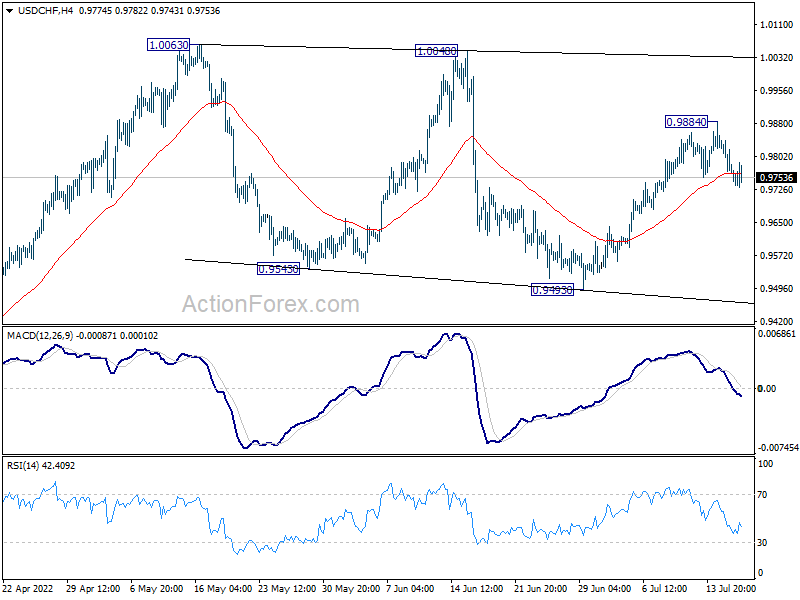
Intraday bias in USD/CHF stays mildly on the downside. It's in another falling leg of the the consolidation from 1.0063. Deeper decline would be seen to 55 day EMA (now at 0.9680). Firm break there will target 0.9493 support again. On the upside, above 0.9884 will resume the rebound to retest 1.0063 high.
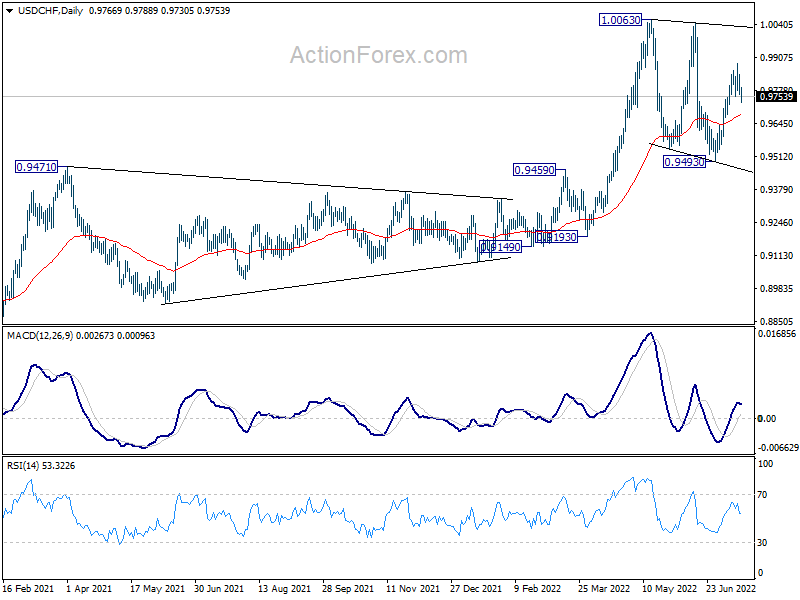
In the bigger picture, medium term up trend from 0.8756 (2021 low) is still in progress. Next target is 1.0342 (2016 high). Sustained break there will resume long term up trend from 0.7065 (2011 low). This will remain the favored case as long as 0.9471 resistance turned support holds.
GBP/USD Mid-Day Outlook
Daily Pivots: (S1) 1.1824; (P) 1.1850; (R1) 1.1894; More...
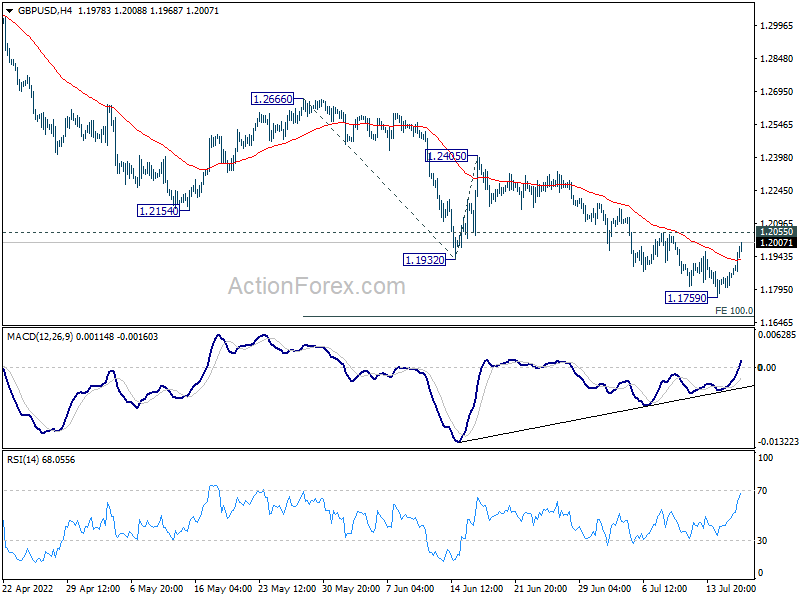
Intraday bias in GBP/USD remains neutral at this point. On the upside, break of 1.2055 resistance will confirm short term bottoming at 1.1759. Bias will be turned back to the upside for 1.2405 resistance next. on the downside, below 1.1759 will resume larger down trend to 100% projection of 1.2666 to 1.1932 from 1.2405 at 1.1671.
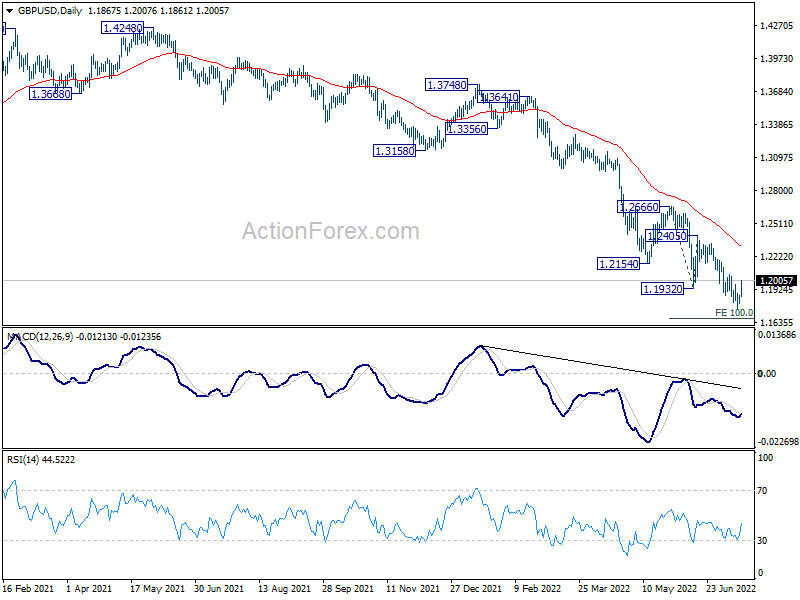
In the bigger picture, fall from 1.4248 (2018 high) could be a leg inside the pattern from 1.1409 (2020 low), or resuming the longer term down trend. Deeper decline is expected as long as 1.2666 resistance holds. Next target is 1.1409 low. However, firm break of 1.2666 will bring stronger rise back to 55 week EMA (now at 1.3065).
EUR/USD Mid-Day Outlook
Daily Pivots: (S1) 1.0031; (P) 1.0064; (R1) 1.0122; More...
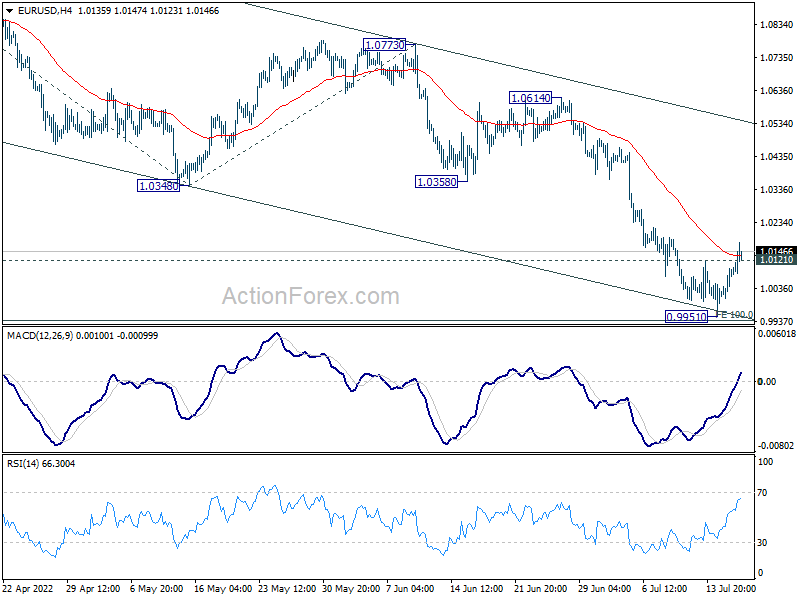
EUR/USD's break of 1.0121 minor resistance suggests short term bottoming at 0.9951. That comes after breaching parity and missing 100% projection of 1.1184 to 1.0348 from 1.0773 at 0.9937. Intraday bias is now mildly on the upside for 1.0348 support turned resistance. Break will target channel resistance at 1.0514. On the downside, firm break of 0.9951 will resume larger down trend to 161.8% projection at 0.9420.
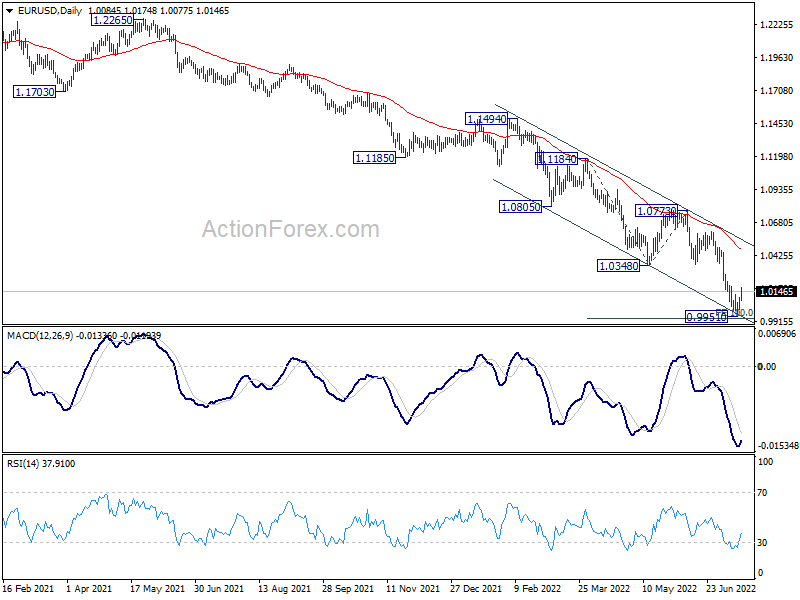
In the bigger picture, down trend from 1.6039 (2008 high) is still in progress. Next target is 100% projection of 1.3993 to 1.0339 from 1.2348 at 0.8694. In any case, outlook will stay bearish as long as 1.0773 resistance holds, in case of rebound.
EUR/USD Extending Rebound as Dollar Continues Pullback
Dollar, Yen and Swiss Franc are both under some selling pressure today, as overall risk sentiment improved. Sterling is currently the winner and Euro is not too far behind. Canadian Dollar leads commodity currencies, as Kiwi is somewhat lagging despite strong inflation data. The picture will depend on whether stock markets in the US could extend Friday's strong rebound, in sustainable way.
Technically, EUR/USD's break of 1.0121 minor resistance suggests that a short term bottoming is formed at 0.9951, after defending parity. Further rebound is in favor towards 1.0348 support turned resistance. Such development could also help GBP/USD through 1.2055 minor resistance and AUD/USD through 0.6873 minor resistance to confirm short term bottoming. Let's see.
In Europe, at the time of writing, FTSE is up 0.99%. DAX is up 0.82%. CAC is up 1.05%. Germany 10-year yield is up 0.0885 at 1.221. Earlier in Asia, Japan was on holiday. Hong Kong HSI rose 2.70%. China Shanghai SSE rose 1.55%. Singapore Strait Times rose 0.73%.
BoE Saunders: Tightening cycle may still have some way to go
BoE MPC member Michael Saunders said in a speech, "my own view is that further monetary tightening is likely, and indeed, as evident from my votes at the MPC's recent policy meetings, my preference has been to tighten relatively quickly."
"This partly reflects my view that risks are tilted on the side of a more persistent period of excess demand and domestic inflation pressures than implied by the most recent MPR forecast (published in early May)," he said.
"Unless restrained by tighter monetary policy, the relatively high level of longer-term inflation expectations implies that domestic cost growth and firms' pricing strategies may remain above target-consistent rates even if capacity pressures ease to more normal levels."
Also, the cost of "not tightening promptly enough – would be relatively high at present", and "such an outcome would increase the costs of returning inflation to target in coming years."
"rather than focus on a precise forecast for Bank Rate over the next year, the key point is that the tightening cycle may (in my view) still have some way to go."
New Zealand BusinessNZ services rose slightly to 55.4, sustained improvement
New Zealand BusinessNZ Performance of Services Index ticked up from 55.3 to 55.4 in June, staying above long term average of 53.6 or the survey. Activity/sales dropped from 59.4 to 56.5. But employment improved notably from 49.0 to 53.1. New orders/business rose from 62.0 to 61.7. Stocks/inventories dropped from 54.7 to 54.1. Supplier deliveries rose from 45.6 to 47.8.
BNZ Senior Economist Craig Ebert said that "the move to traffic light Orange in mid-April, along with the expedited opening of the border, is clearly providing a basis for sustained improvement in New Zealand's services sector".
New Zealand CPI jumped to 32-yr high at 7.3% yoy in Q2
New Zealand CPI rose 1.7% qoq, 7.3% yoy in Q2, above expectation of 1.5% qoq, 7.1% yoy. The annual inflation accelerated from 6.9% yoy to 7.3%, a 32-year high, after 7.6% in Q2 1990.
StatsNZ said, "the main driver for the 7.3 percent annual inflation to the June 2022 quarter was the housing and household utilities group, due to rising prices for construction and rentals for housing... Transport was also a main driver of the quarterly rise, driven by petrol and diesel."
EUR/USD Mid-Day Outlook
Daily Pivots: (S1) 1.0031; (P) 1.0064; (R1) 1.0122; More...
EUR/USD's break of 1.0121 minor resistance suggests short term bottoming at 0.9951. That comes after breaching parity and missing 100% projection of 1.1184 to 1.0348 from 1.0773 at 0.9937. Intraday bias is now mildly on the upside for 1.0348 support turned resistance. Break will target channel resistance at 1.0514. On the downside, firm break of 0.9951 will resume larger down trend to 161.8% projection at 0.9420.
In the bigger picture, down trend from 1.6039 (2008 high) is still in progress. Next target is 100% projection of 1.3993 to 1.0339 from 1.2348 at 0.8694. In any case, outlook will stay bearish as long as 1.0773 resistance holds, in case of rebound.
Economic Indicators Update
| GMT | Ccy | Events | Actual | Forecast | Previous | Revised |
|---|---|---|---|---|---|---|
| 22:30 | NZD | Business NZ PSI Jun | 55.4 | 55.2 | 55.3 | |
| 22:45 | NZD | CPI Q/Q Q2 | 1.70% | 1.50% | 1.80% | |
| 22:45 | NZD | CPI Y/Y Q2 | 7.30% | 7.10% | 6.90% | |
| 08:00 | EUR | Italy Trade Balance (EUR) May | -0.01B | -2.32B | -3.67B | -3.64B |
| 12:15 | CAD | Housing Starts Y/Y Jun | 274K | 285K | 287K | 282K |
| 14:00 | USD | NAHB Housing Market Index Jul | 68 | 67 |
Euro Rallies to 1-Week High
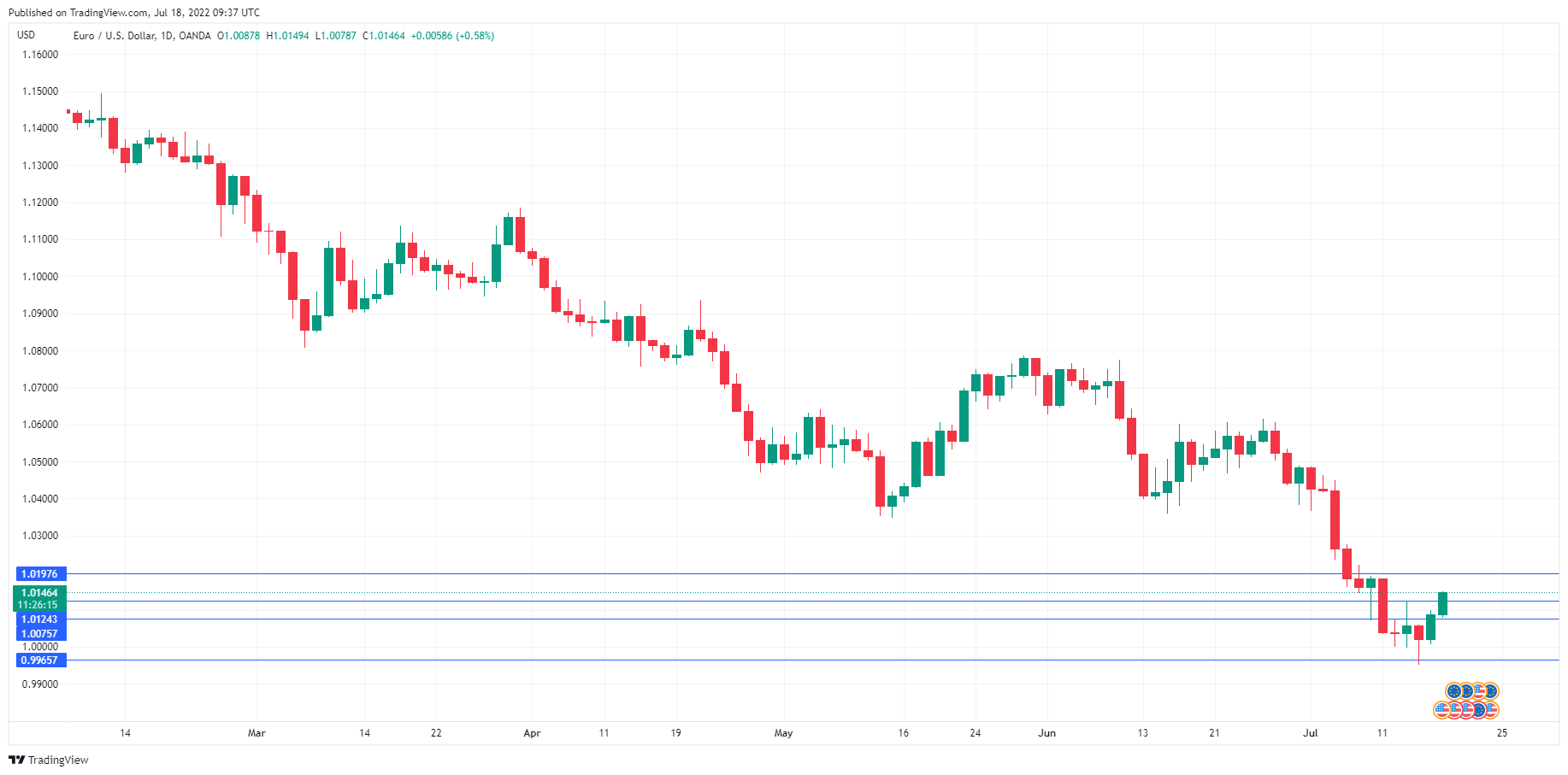
The euro is showing some strength, after posting a winning week for the first time in a month. EUR/USD is trading at 1.0143, up 0.55% on the day.
After a dramatic drop below the parity line last week, for the first time in 20 years, the euro has rebounded and is trading above the 1.01 level. The euro rode on the coattails of a rally in the US equity markets, which gave a thumbs up to solid US data on Friday. Headline retail sales and core retail sales both posted a gain of 1.0% MoM in June, above the forecast and an improvement from the May numbers. As well, UoM Consumer Sentiment improved slightly to 51.0, above the consensus for a contraction at 49.0.
The fickle stock markets rallied on the US numbers, despite the fact that strong data could increase the likelihood of a whopping 100bp hike by the Fed this week. The Fed is determined to stamp out spiralling inflation, which rose to 9.1% in June, and positive data points to a resilient economy which can withstand sharp rate hikes. There is a pre-meeting blackout out of the FOMC ahead of Thursday’s meeting, but the likelihood of a 75bp vs. a 100bp hike stands at 70/30, according to the CME Group. It will be interesting to see if the markets change their pricing ahead of the meeting, even with a blackout in place.
As for the euro, there are two key events on Thursday which could have a dramatic impact on the movement of the currency. First, the ECB is widely expected to lift-off rate hikes at a policy meeting, after years of an accommodative policy. This will mark the first rate hike in 11 years, but a modest 0.25bp rise, the most likely scenario, will have little impact on soaring inflation. If, however, the ECB delivers a hawkish surprise are raises rates by 50bp, the euro could respond with gains.
On the same day, the Nord Stream 1 gas pipeline, the conduit for Russian gas exports to Germany, is scheduled to restart after a short break for maintenance. If Moscow doesn’t turn on the gas tap before the weekend, we could see the markets take fright over a potential energy crunch in Europe and send the euro back towards the parity line.
EUR/USD Technical
- EUR/USD is testing support resistance at 1.0124. Above, there is resistance at 1.0197
- The pair has support at 1.0075 and 0.9965
USD/JPY: Shallow Dips to Precede Fresh Push Higher
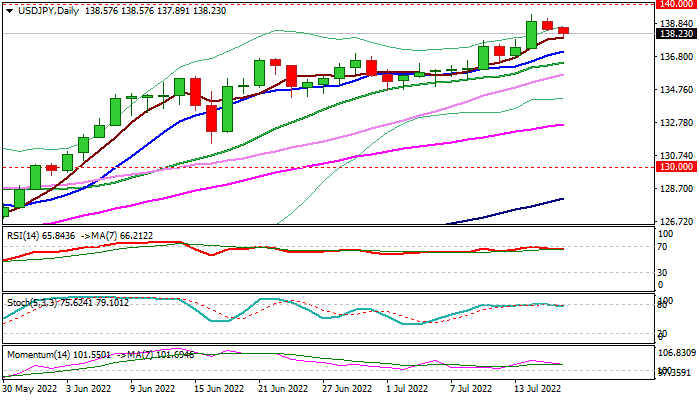
The USDJPY extends pullback from new 24-year high on Monday, as dollar bulls take a breather, but the action so far looks like adjustment which should provide better levels to re-enter firmly bullish market.
The greenback was deflated calmer tones from the US central bank, which suggested that initially announced 75 basis points hike, rather than lately speculated 1% increase, though the sentiment remains bullish.
Daily techs show MA’s in bullish setup and strong negative momentum, while overbought conditions support scenario of shallow correction.
Good supports lay at 137.42 and 137.10 (Fibo 38.2% of 134.36/139.39 upleg / rising 10DMA) and should contain dips to keep bullish structure intact.
Bulls eye targets at 139.92 (Sep 1998 high) and 140.00 (psychological), violation of which would spark fresh acceleration.
Res: 138.39; 139.12; 139.39; 139.92
Sup: 137.89; 137.42; 137.10; 136.43
EUR/USD: Recovery Accelerates But Underlying Bears Warn of Limited Correction
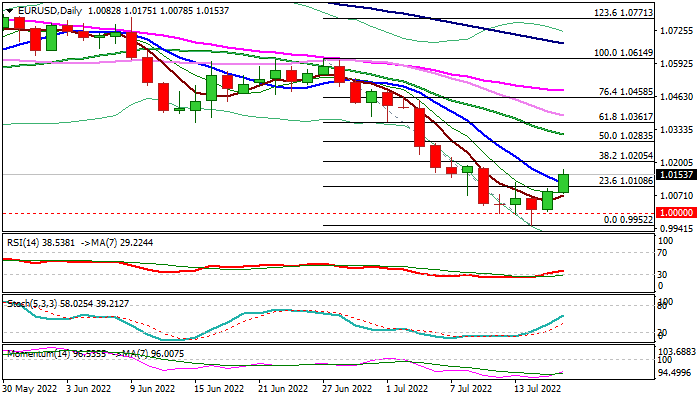
The extends rebound from new 20-year low (0.9952) int second consecutive day, following failure to clearly break below parity level that left a hammer candle last Thursday and generated initial reversal signal.
The Euro was boosted by fresh risk appetite that deflated the dollar and a bear-trap under parity level, with lift above falling 10 DMA, adding to positive signals, which would be boosted by extension and close above pivotal Fibo barrier at 1.0205 (38.2% of 1.0614/0.9952).
Overall structure remains bearish and current move is seen as correction of larger downtrend, which is expected to provide better selling levels for renewed attack at parity.
Caution on failure to clear 1.0205 pivot that would generate an initial signal of recovery stall.
Res: 1.0175; 1.0205; 1.0283; 1.0311.
Sup: 1.0108; 1.0078; 1.0000; 0.9952.
Euro Area Final CPI ahead of ECB’s Interest Rate Decision on Thursday
Tomorrow we get the release of the final June CPI figures for the Euro Area. Since we already had the preliminary numbers at the start of the month, it's much less likely to catch the market by surprise. But, there could be a lot more attention on the figure ahead of the ECB's meeting on Thursday.
The consensus of expectations is that the data will confirm what has already been released: Inflation of 8.6% compared to 8.1% in May. That would be the highest rate since the beginning of the Euro. Core inflation is expected to show a mild deceleration to 3.7% compared to 3.8% in May. The question now is, what will the ECB do about it?
The context matters
Last week, the EC updated its economic forecasts for the year, which it does only every six months. Not surprisingly, the governing body cut its economic growth forecast, and raised its expectations for inflation.
But what is significant is the magnitude and the duration. The EC is currently expecting inflation this year to average 6.1% and to still average above target at 2.7% next year. This seems to suggest that they don't see peak inflation yet, and that it will take a long time for the ECB to get inflation under control. And that this effort to control inflation will impact economic growth both this year and the next. Effectively, the EC is forecasting a year and a half of stagflation.
Silence leads to speculation
ECB members are in the blackout period ahead of the interest rate decision. The last member to comment might be pivotal to understand where policy is going: Findlan's Rhein. Normally he's understood to have a neutral position. So, traders noticed his most recent comments that he expected a 25bps rate hike at the next meeting, followed by another 50bps in September.
With the Fed widely expected to raise rates by at least 150bp in that same period, this doesn't do much to close the interest rate gap between the world's two largest economies with the most traded currency. But, it does seem to be enough to help slow the fall of the Euro vs the dollar. With inflation in the US outpacing inflation in Europe, it's expected that the US will be more aggressive in monetary policy. Consequently, the shared currency might continue to be weaker, even if the ECB delivers on the expectation of rate hikes.
It's not just the interest rate
The market expects a rate hike, but where there is more concern is around the so-called "anti-fragmentation" package. This is a tool the ECB is looking to use in order to prevent higher interest rates in the periphery.
The problem is that the periphery has higher inflation. The usual counter for that higher inflation is higher interest rates. But the anti-fragmentation tool would presumably get in the way of that, and potentially allow higher inflation in the periphery while tamping down inflation in the central region. The end result could be a different kind of fragmentation, and less effectiveness in getting inflation under control. That, on top of taking a much more restrained approach on interest rates than other central banks such as the BOE and Fed.
BoE Saunders: Tightening cycle may still have some way to go
BoE MPC member Michael Saunders said in a speech, "my own view is that further monetary tightening is likely, and indeed, as evident from my votes at the MPC's recent policy meetings, my preference has been to tighten relatively quickly."
"This partly reflects my view that risks are tilted on the side of a more persistent period of excess demand and domestic inflation pressures than implied by the most recent MPR forecast (published in early May)," he said.
"Unless restrained by tighter monetary policy, the relatively high level of longer-term inflation expectations implies that domestic cost growth and firms' pricing strategies may remain above target-consistent rates even if capacity pressures ease to more normal levels."
Also, the cost of "not tightening promptly enough – would be relatively high at present", and "such an outcome would increase the costs of returning inflation to target in coming years."
"rather than focus on a precise forecast for Bank Rate over the next year, the key point is that the tightening cycle may (in my view) still have some way to go."