Sample Category Title
NZD/USD Tests Supply Zone
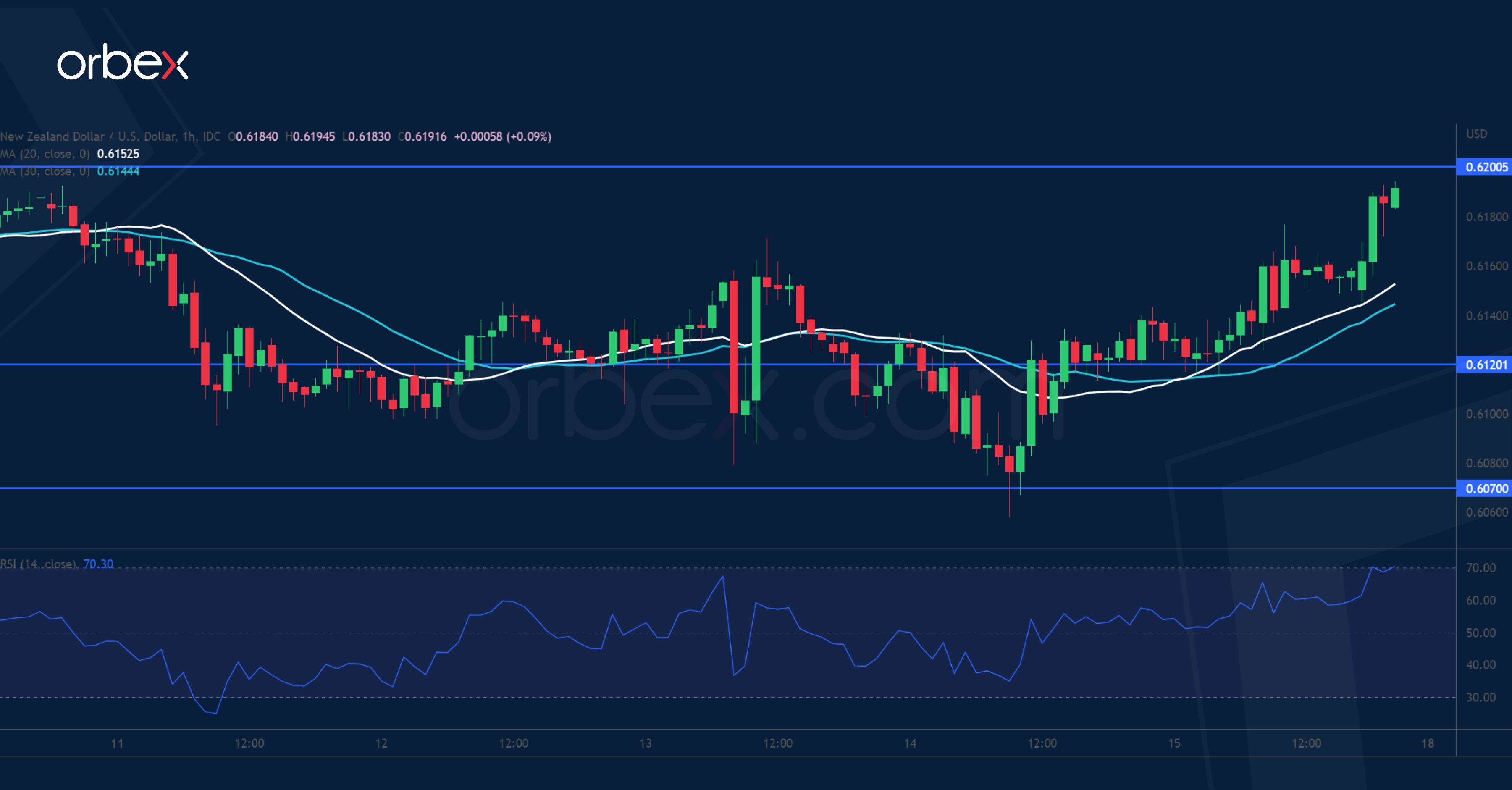
The New Zealand dollar bounces higher after Q2 CPI exceeded expectations. Despite a choppy price action, general sentiment remains downbeat. Trend followers have been eager to sell into strength. The latest rebound lifted offers at 0.6160, prompting some short-term sellers to cover. The bulls will need to clear the supply area around 0.6200 before they could push for a meaningful recovery. 0.6120 is the closest support. A breakout could cause a sell-off below 0.6070 and then send the kiwi to the psychological level of 0.6000.
Negative Scenario on (European) Energy Supply Largely Discounted
Markets
Markets on Friday closed a volatile week on a positive note. The move was at least partially inspired by investors taking a more guarded approach on next week’s Fed meeting. The FOMC for sure still will debate both a 75 and 100 bps step. However, several Fed governors including Bullard, Waller, Bostic and George suggested that the bar of a 1.0%pt hike is quite high. Friday’s US data weren’t enough for markets to further embrace the idea of such a step. US retail sales were solid (headline 0.9% M/M, control group + 0.8% M/M). The headline figure of the Empire Manufacturing survey also unexpectedly improved from -1.2 to +11.1. Still, forward looking indicators pointed to difficult times ahead. Consumer confidence of the U. of Michigan improved slightly but stays near multi-year lows. The closely watched measures of inflation expectations eased to 5.2% (from 5.3%) and 2.8% (from 3.1%) for the 1-y and 5/10-y expectations respectively. Markets concluded this mix isn’t enough for the Fed to deliver another hawkish surprise. US yields declined between 1.2 bps (2-y) and 4.4 bps (10-j). Money markets discount only a +/- 20 % chance of a 100 bps hike. German Bunds outperformed with yields easing between 5.6 bps (2-y) and 2.3 bps (30-y). The German 10-y yield still struggles not to fall below the key 1.12/1.18% support area. Despite persistent fears for a sharp slowdown (US) or even a recession (Europe), the decline in yields provided some breathing space for equities. US indices gained up to 2.16% (Dow). The EuroStoxx50 rebounded 2.37%. The risk revival also capped further USD gains. DXY retreated off Thursday’s multi-year top to close near 108.06. USD/JPY eased from the 139 area to close at 138.57. EUR/USD rebounded off the 1.00 reference to finish at 1.008. Still, this was a USD correction rather than a euro rebound.Today’s calendar is almost empty. Markets will look forward to key events later this week including the ECB policy meeting, the restart of Russian gas supply via the Nord Stream 1 gas pipeline and the political crisis in Italy. US and EMU data only will play second fiddle with Friday’s EMU PMI’s the exception to the rule. Risk sentiment in Asia is constructive. US and European futures also suggest a positive open. Short-term, investors apparently concluded that a negative scenario on (European) energy supply is largely discounted. Question is whether this is enough a reason for a sustained euro comeback. At least the news flow from Italy doesn’t sound positive with center-right parties (Lega & Forza Italia) no longer backing the Draghi government. On interest rate markets, US yields entered consolidation pattern off recent lows going into upcoming event risk/next week’s Fed meeting. European long term yields are testing key support (German 10-y 1.12%, Euro 10-y swap 2.0% area). The picture looks fragile, but we’re reluctant to anticipate a sustained break lower going into the start of the ECB hiking cycle.
News Headlines
Inflation in New Zealand sped up to the fastest in more than three decades. In Q2 this year, prices rose faster-than-expected 1.7% q/q or 7.3% y/y. Stats New Zealand identified housing and the household utilities group as the main driver, followed by transport due to higher petrol and diesel prices. “Supply-chain issues, labour costs, and higher demand have continued to push up the cost of building a new house,” general manager Attewell said. The Reserve Bank of New Zealand last week raised policy rates to 2.5%. By doing so, it entered neutral-to-slightly-restrictive territory as the central bank tries to ease inflationary pressures. The RBNZ said it will keep tightening “at pace”. Markets expect the policy rate to peak around 4% with swap yields adding a few more bps after the CPI release this morning. The kiwi dollar tested NZD/USD resistance at 0.62 but failed to push through.China is looking to stem the mortgage payment boycott by urging banks to increase lending to developers so they can complete unfinished housing projects, a newspaper published by the China Banking and Insurance Regulatory Commission reported on Sunday. Homebuyers across the country have ceased to pay their mortgages on stalled projects. The phenomenon sparked fears of the property sector crisis spilling over into the financial sector even though banks repeatedly said the amount of loans affected is limited and controllable. It may also affect confidence and could keep potential homebuyers on the sidelines, posing risks for the broader housing market.
An Important Week for Europeans
The week starts on a positive note, after the major US and European indices ended up last Friday on a good rebound. The S&P500 jumped almost 2%, as Nasdaq gained 1.80% to close a week which, however, saw the US inflation hit 9.1% and the producer prices advance past the 11% level, unexpectedly.
Investors remain focused on earnings this week, to determine which companies are in a better position to weather the difficult macroeconomic environment, and the rising interest rates.
Good news is that, the week starts with improved odds of seeing a 75bp hike at the next FOMC meeting, rather than a 100bp hike. The probability of a 75bp hike is back to 70%, up from around 20% following the scary inflation report that was released last week in the US.
The fact that the Federal Reserve (Fed) doves have been quick to make a comeback hints that the Fed expectations are hawkish enough, and that more hawkishness doesn’t see a sustainable market reaction.
The US dollar bounced lower from a fresh 20-year high on Friday and is softer against most majors this morning. This week, the dollar traders will be watching the US housing data and the Philly Fed manufacturing index, and good data will likely be bad news for the Fed watchers, as it would revive the odds of a 100bp hike at next Fed meeting.
Three important events in Europe
There are three important events to watch.
One, Mario Draghi will address lawmakers on Wednesday, when he’ll declare his intention to either give his coalition another chance or quit government.
If quits, we will see a further positive pressure in Italian bond yields, and a negative pressureon the euro. The latter will put the European Central Bank (ECB) in a challenging position to hike the interest rates to tame inflation
Second, the ECB is expected to raise the interest rates by 25bp at this Thursday’s meeting. No matter if Italy goes into turmoil or not, the ECB will have to hike rates this week, and say that they will do more if needed in the coming meetings. The market already prices in a 50bp hike at the ECB’s September meeting, therefore there is little hope for a more hawkish accompanying statement. The EURUSD’s only chance to avoid another attempt below parity is a softer US dollar.
And finally, we will get to know whether the Nordstream 1 pipeline will open or not. There is a lot of speculation that the pipeline, which was closed last week for maintenance, would be kept shut by the Russians as a retaliation to Western sanctions. Seeing the gas flow reestablish to Germany will give a sigh of relief to the European gas markets but won’t eliminate the risk that Russians could cut the European gas anytime.
Biden goes to Mid East
The barrel of US crude is flirting with $98 per barrel this morning, but the upside potential remains limited as 1. The recession talks and prospects of lower global demand tilt the balance in favour of the bears these days, and 2. Joe Biden visits Middle East this week to ask the oil producer countries to pump more oil to bring these prices lower, for God’s Sake!
Bear Market Rally Back On?
It says something about the level of confusion in the markets right now (American markets anyway), that having wrung their hands all last about inflation, 100 basis point rate hikes by the Fed, and an impending recession, that strong US Retail Sales and Michigan Consumer Sentiment on Friday saw Wall Street rally impressively. If that data had come out on Tuesday or Wednesday last week, we would probably have had a meltdown. And yet here we are, Wall Street’s S&P 500, Nasdaq and Dow Jones booking roughly 2.0% gains on Friday.
Last Fridays Wall Street price action was enough to spark risk sentiment rallies on forex markets, led by the usual suspects, the Euro, and the Australian Dollar, although not much love permeated into the Asian currency space. Oil held steady, but gold found no solace and remains near $1700.00. We also saw a modest rally in commodity prices. Bitcoin has wound its way back to $21,000.00 this morning in the crypto space, although it has been grinding higher all last week. Even US yields fell slightly on Friday after that US data; go figure?
My bear market rally theory postulated on Wednesday, got a beating on Thursday, and now looks quite clever again this morning after another day where Wall Street forgot to take their medication. I’ll stick my neck out again and say that with a relatively thin US data calendar this week, the FOMO gnomes of Wall Street may enjoy a week in the sun. This morning missive is heading into its last two full weeks of life before I head off to pastures new, and one thing I won’t miss, is trying to find something intelligent to explain Wall Street’s short-term price actions.
I suspect that Europe and its travails will be front and centre this week, with a smattering of China covid zero and property market nerves thrown in for good measure. The European Central Bank meets on Thursday to decide whether to hike its policy rates for the first time in 11 years, by a mighty 0.25%... That would take the Refinancing Rate to an inflation-fighting 0.25%, and the Deposit Rate to -0.25%, which I am sure will leave the Eurozone CPI quaking in its boots. We should also get some insight into its antifragmentation tool, intended to keep Eurozone sovereign spreads “on message,” but is really their there to support Italy’s debt, because they clearly can’t do it themselves if one glanced at the weekend news. Europe is a classic example of the perils of easy monetary policy and QE; it's easy to take it out of the box, but as you get the financial system addicted to a zero per cent cost of capital, it’s hard to put it back. Europe isn’t alone here of course, and at least they can say “look at Japan.” High fives mes Ami's.
The reason we can discount a 0.50% hike from the ECB when that is the minimum clearly needed, is something far more important for Europe. Thursday the 21st is gas-mageddon day for the Nord Stream 1 gas pipeline from Russia to Germany. Scheduled annual maintenance is due to finish that day, and the gas is supposed to start flowing again. I’ll give it another day because it's Russia. But if flows don’t resume on Friday, that bear market rally by the Euro and European equities could well evaporate like the pipeline flows.
About energy, it is pleasing to see that sense is prevailing somewhere, and that Japan is restarting several mothballed nuclear power stations in preparation for the winter. Nations everywhere should be looking at this solution right now. Especially as North America looks as far away as ever from getting its act together on gas and oil, pipelines to move it, and refineries to make it into energy and fertiliser etc for the world. Japan’s moves are likely to bear more fruit than US President Biden’s visit to Saudi Arabia for a fist pump with MBS this weekend. Mr Biden emerged confident that Saudi Arabia and the UAE would pump more oil; Saudi Arabia emerged and said that’s up to OPEC+. Oil prices are sharply unchanged today in Asia, which tells you who the market believes.
China officials from the PBOC promised more support for the economy over the weekend. And it appears that behind the scenes, the wheels are turning to engineer a funding vehicle for beleaguered property developers to continue and complete the construction of residential projects. The alleged Chinese mortgage payment strike by homebuyers seems to have been the catalyst to spur faster action. Conversely, covid-19 cases appear to be creeping higher around the Mainland, with Macau’s full lockdown extended by four days. The threat of covid-zero Part Deux in Shanghai and other large urban centres will temper bullish spirits among China equity investors. Robust loan demand, and decent economic data last week, should mean that Wednesday's one and five-year Loan Prime Rates remain unchanged.
Thursday also sees the Bank of Japan’s latest policy decision. With USD/JPY finding a cap ahead of 140.00 for now, some pressure will ease on the BOJ, which will also be watching the country's supply/demand energy balance and the spiralling Covid-19 caseload with concern. With the FOMC meeting not until the end of the month as well, there is little incentive for the BOJ to spring a shock and markets to change any monetary settings.
The policy decision from Bank Indonesia, also on Thursday, is far more interesting. With Singapore and the Philippines announcing unscheduled rate hikes last week, and South Korea, Malaysia, and Taiwan hiking rates at recent meetings, it is going to get harder for BI to stand against the wind. With the FOMC expected to hike by at least 0.75% at the end of the month, and Asian currencies wilting under US Dollar strength, the uber-dove BI is likely to hike by at least 0.25%. BI is clearly capping USD/IDR at 15,000.00 now, and despite a surging current account surplus as palm oil exports resume, currency pressures are going to force BI’s hand. The question is, is 0.25% enough? I have my doubts.
Like North America and Europe, Asia’s data calendar is fairly thin once you strip out the discussion points above. With the FOMC in a pre-meeting news blackout, markets will be left to the tender mercies of headlines and geopolitical developments. One benefit is that, excluding any shocks and a lack of Fed speaker rate-hike bombs, and annoying data that has to be ignored when it doesn’t tell the story the FOMO gnomes want to hear, it could give the aforementioned bear market rally, room to breathe.
Asian equities track Wall Street higher
Wall Street staged an impressive rally after better than expected retail sales and consumer sentiment data from the US on Friday, as markets focused on a still-robust US consumer while ignoring its ominous warnings for the trajectory of Fed monetary policy. With a dearth of tier-1 data this week, and the FOMC in a pre-meeting media blackout, the equity rally could potentially extend throughout the week. Looking at the S&P 500 chart today, the technical picture certainly suggests that. The S&P 500 could rally back to 4,050.00, its March downtrend line, and still, be in a bear market. To start saying the worst was over for equity markets would require a sustained break of that level and preferably, the 100-day moving average (DMA) at 4,140.00.
Friday, saw the S&P 500 rally by 1.92%, the Nasdaq rally by 1.79%, with the Dow Jones the session’s outperformer, leaping higher by 2.15%. US futures are performing well in Asia today. S&P 500 futures are up 0.40%, while Nasdaq futures have jumped 0.95% higher, with Dow futures gaining 0.20%. Banking heavyweights, Bank of America and Goldman Sachs are releasing earnings today, although I believe it would take nightmare results and outlooks from both to give markets pause for thought.
Asian markets are content to track Wall Street this morning, helped along by hopes of more aggressive stimulus measures in China to resolve its property market wobbles. Japan’s Nikkei 225 is 0.55% higher, with South Korea’s tech-centric Kospi leaping 1.75% higher. In China, The Shanghai Composite has leapt 1.50% higher, with the CSI 300 rallying by 1.20%, and Hong Kong’s Hang Seng gaining an impressive 2.55%.
Across regional markets, better Singapore NODX data has lifted the Straits Times 0.65% higher, with Taipei adding 0.60%, while Kuala Lumpur is lagging at unchanged. Jakarta added 0.20%, Bangkok 0.25%, and Manila eased by 0.25% as the Peso remains under pressure. Australian markets are also higher after the Wall Street rally, the All Ordinaries rising by 0.90%, and the ASX 200 gaining 0.85%.
European markets also enjoyed a very positive session on Friday. But with the ECB looming on Thursday and the scheduled resumption of Russian gas deliveries, European equities may struggle to replicate Friday’s gains this week.
Wall Street rally pushes US Dollar lower
The US Dollar fell heavily on Friday, versus the developed market space, as Wall Street's impressive rally spilt over into a broader sentiment rally in other asset classes. That saw the dollar index make a long-overdue correction lower. The dollar index fell 0.60% to 107.98 on Friday, easing another 0.17% lower to 107.80 in Asia as US Dollar weakness continued. Resistance is at 109,30, the overnight highs, and then 110.00. Support is at 107.50 and then the 1.0585 breakout point, followed by 1.0500. The relative strength index indicator (RSI) has moved out of the overbought territory, but the technicals suggest the US Dollar correction could continue through the week.
EUR/USD rallied by 0.67% to 1.0088 on Friday, rising another 0.17% to 1.0115 in Asia. The technical picture suggests a correction back towards 1.0200 is possible, but only a sustained break above 1.0360 would suggest a longer-term low is in place. EUR/USD has support at 1.0000 and 0.9900/25. The single currency faces serious event risk in the latter half of the week, firstly from the ECB policy decision, and secondly, from Russian natural gas flows which are due to resume after pipeline maintenance.
GBP/USD followed the Euro overnight, finishing 0.37% higher at 1.1870, rising 0.23% to 1.1895 in Asia. It has support at 1.1800 and 1.1760, with resistance at 1.1965, followed by 1.2060 and 1.2200. A rise above 1.2060 suggests a larger rally to the 1.2400 regions, but it would take a sustained break of 1.2400 to call for a longer-term low by sterling.
USD/JPY fell on Friday by 0.38% at 138.50, easing another 0.15% to 138.30 in Asia. Thursday’s high around 139.40 is initial resistance, followed by 140.00. Support is at 137.40 and 136.00. Given the sentiment in the market this week, a fall in US yields this week could finally translate to a meaningful downside correction by USD/JPY, which is a crowded trade.
AUD/USD and NZD/USD rallied on Friday as investor sentiment ended the week on a high note. NZD/USD leapt higher on higher-than-expected inflation data today, but those early gains have since been eroded. AUD/USD and NZD/USD are both 0.25% higher at 0.6810 and 0.6175. Both currencies are showing falling wedge formations. A sustained break above 0.6850 or 0.6200 signals more gains ahead this week by the antipodeans.
Asian currencies had another noisy session on Friday, but as the dust settled, were mostly unchanged versus the US Dollar. The price action merely reversed their intraday losses from earlier in the session. The positive news headlines from China over the weekend on stimulus to support the property sector has allowed Asian currencies to book modest gains in Asia. However, despite a slew of recent policy tightenings in the region, fears of a widening interest rate differential with the US continue to cap gains by Asian currencies. That suggests markets will continue to call Asian central bank’s bluffs, the first being Indonesia on Thursday. Notably, the Philippine Peso and Indian Rupee continue to remain under pressure, USD/PHP rising 0.15% today to 29.913, with USD/INR rising 0.10% to 79.770. Across the rest of the region USD/Asia has fallen modestly by between 0.10% and 0.20%.
Oil prices edge higher
Both Brent crude and WTI rose modestly on Friday as they continued to unwind the mid-week slump. In Asia, hopes of more China stimulus, and a lack of concrete production promises from President Biden’s Middle East visit have seen Brent crude prices climb in Asian trading.
Brent crude finished Friday’s session 1.25% higher at $100.80, having tested $102.50 intraday. In Asia, it has added another 1.25% to 101.80 a barrel. WTI rose by 1.17% to $97.60 on Friday, edging 0.3% to $97.90 a barrel in Asia today.
Brent crude has resistance at $102.50, and then 104.00 a barrel, followed by a now distant $106.00 a barrel. It has support at $98.30 and then 97.00, the 200-DMA. WTI has support at $94.30, the 200 DMA, and then $90.60 a barrel. Resistance is at $99.00, followed by 101.00 a barrel.
Supply risks remain evident in international markets, and futures curves remain in backwardation. Despite the ructions in the speculative futures markets, the real-world dynamic remains as supportive of oil prices as ever. If Russian doesn’t switch gas exports back on to Europe at the end of the week, Brent crude could once again, find itself back near $110.00 a barrel.
Gold’s remains unimpressive
Gold was notable on Friday; it felt no positive spillover impact from the risk sentiment rally that swept other asset classes. Gold finished Friday’s session 0.15% lower at $1707.50 an ounce. In Asia, continued US Dollar weakness has allowed it to show some belated gains, rising 0.50% to $1715.70 an ounce in yet another quiet Asian session.
Overall, gold’s price action continues to be uninspiring with recoveries limited in scope, while the falls, when they do occur, are much larger and faster in scope. Gold’s fate this week rests on the hopes that the investor sentiment rally seen elsewhere, inspires more US Dollar weakness this week.
Gold has initial support at $1700.00, followed by the more important $1675.00 an ounce zone. A sustained failure of $1675.00 will signal a much deeper move, targeting the $1450.00 to $1500.00 an ounce regions in the weeks ahead. Gold has resistance nearby at $1720.00, then $1745.00, now a triple top. That is followed by $1780.00, $1800.00, its June downward trendline.
GBP/JPY Daily Outlook
Daily Pivots: (S1) 163.78; (P) 164.25; (R1) 164.84; More...
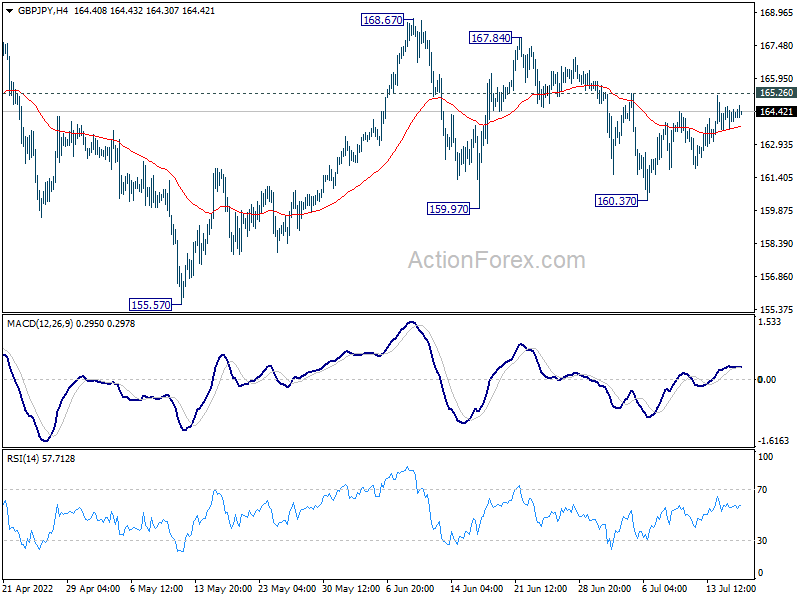
Intraday bias in GBP/JPY remains neutral for the moment. On the upside, firm break of 165.26 minor resistance will argue that corrective pattern from 168.67 has completed. Further rise should be seen to retest 168.67 high next. On the downside, break of 160.37 will bring deeper fall back towards 155.57 support.
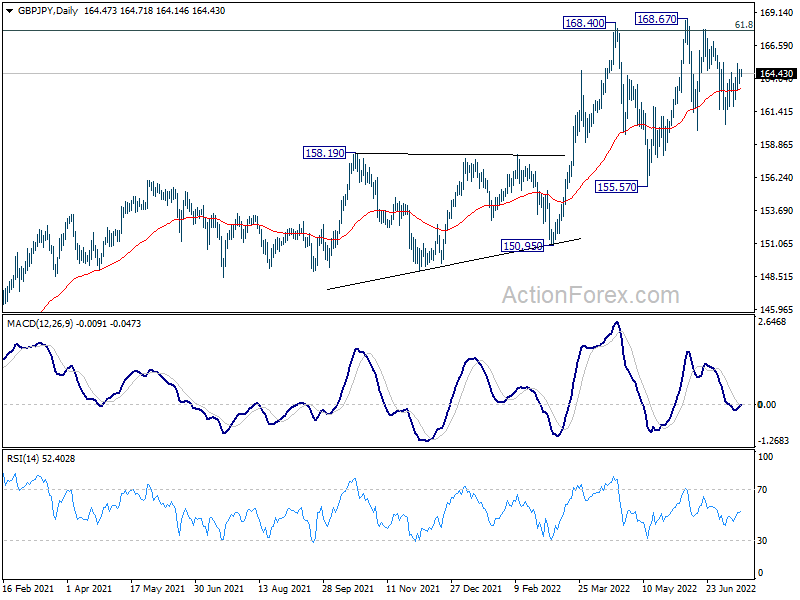
In the bigger picture, up trend from 123.94 (2020 low) is still in progress. Sustained break of 61.8% retracement of 195.86 (2015 high) to 122.75 (2016 low) at 167.93 will be a long term bullish signal, and could pave the way back to 195.86 high. This will now remain the favored case as long as 155.57 support holds, even in case of deep pull back.
EUR/JPY Daily Outlook
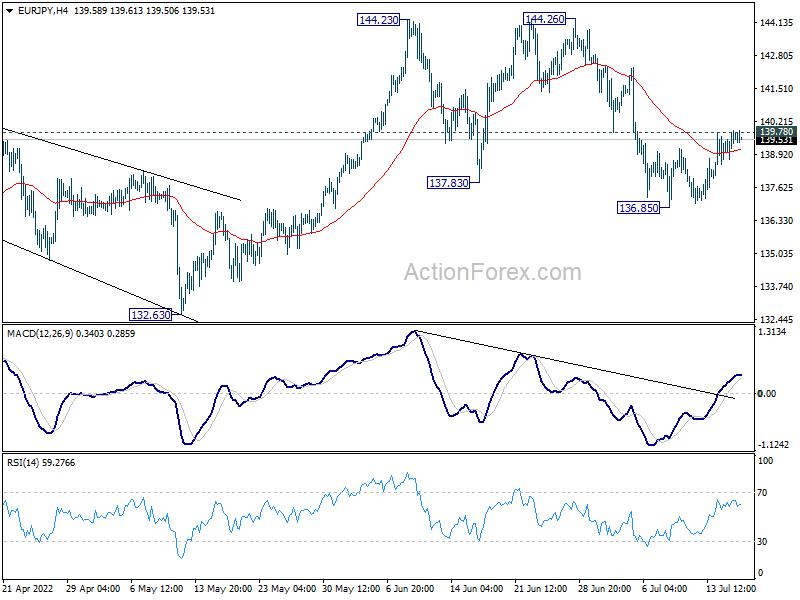
Daily Pivots: (S1) 139.03; (P) 139.46; (R1) 140.17; More....
Focus stays on 139.78 minor resistance in EUR/JPY. Firm break there will argue that pull back from 144.26 has completed at 136.85. Further rally would be seen back to retest 144.26 high. On the downside, though, below 136.85 will resume the fall back to 132.63 support.
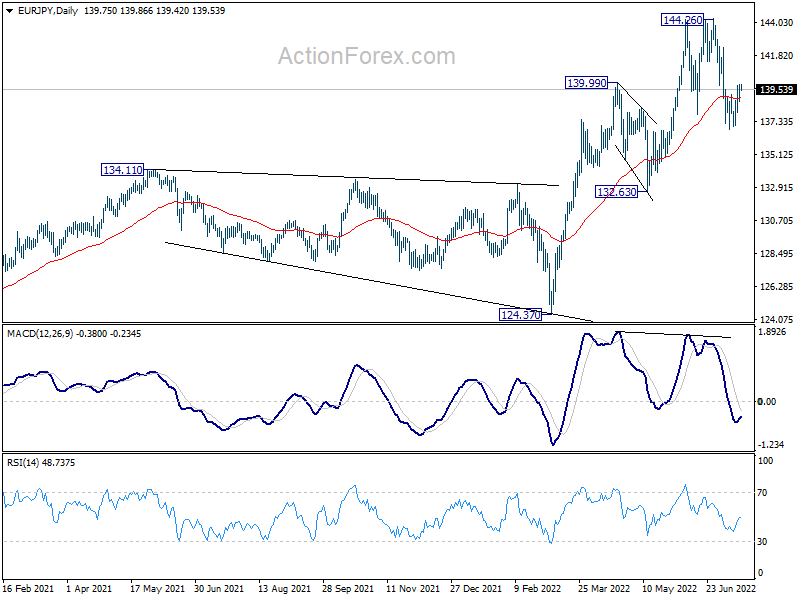
In the bigger picture, up trend from 114.42 (2020 low) is seen as the third leg of the pattern from 109.30 (2016 low). Further rally is in favor as long as 134.11 resistance turned support holds, even in case of deep pull back. Firm break of 139.78 will target 149.76 (2015 high. However, sustained break of 134.11 will be a sign of medium term bearish reversal and turn focus to 124.37 support for confirmation.
EUR/GBP Daily Outlook
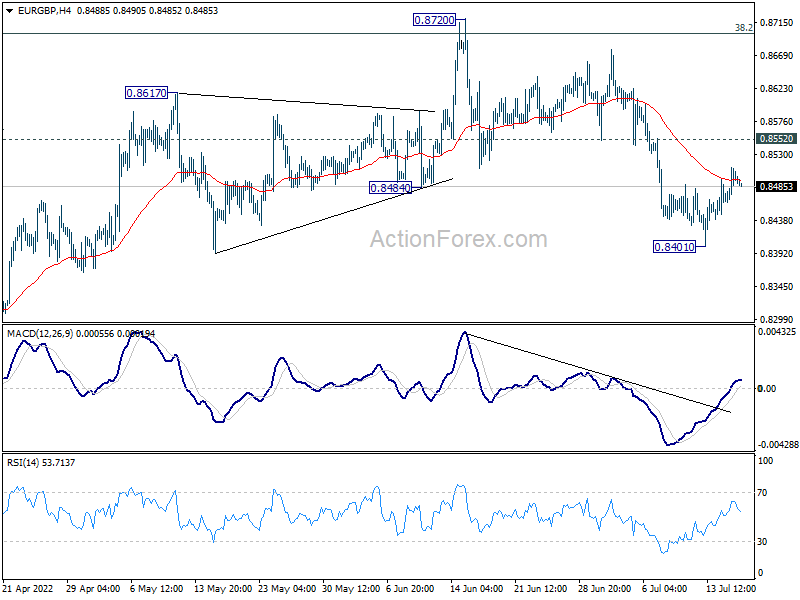
Daily Pivots: (S1) 0.8473; (P) 0.8493; (R1) 0.8522; More...
Intraday bias in EUR/GBP remains neutral and further fall is in favor with 0.8552 minor resistance intact. Rebound from 0.8201 should have completed at 0.8720, after rejection by 0.8697 medium term fibonacci level. Below 0.8401 will resume the fall from 0.8720 and target a test on 0.8201/48 support zone next. Nevertheless, break of 0.8552 will dampen this bearish view and bring retest of 0.8720 resistance instead.
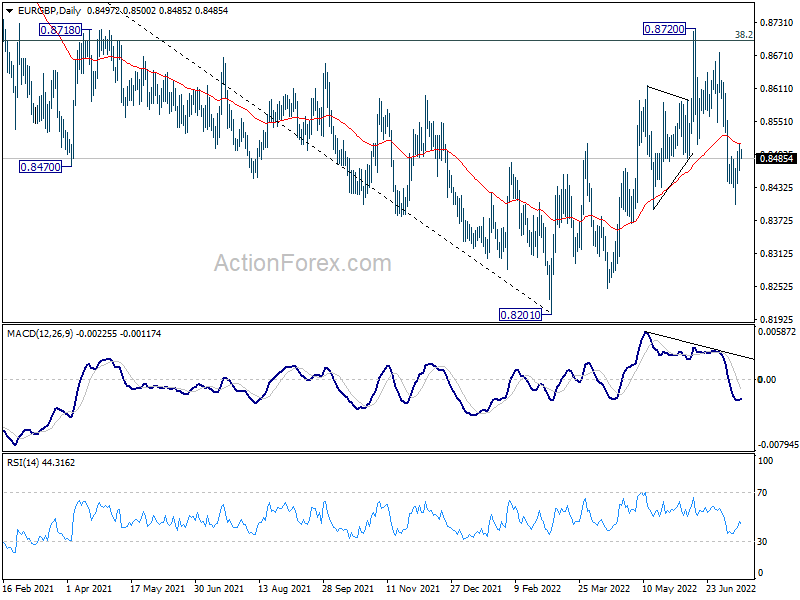
In the bigger picture, rejection by 38.2% retracement of 0.9499 to 0.8201 at 0.8697 argues that rebound from 0.8201 is merely a corrective move. That is, down trend from 0.9499 (2020 high) is now over. Sustained break of 0.8201 will resume such decline and target 61.8% retracement of 0.6935 to 0.9499 at 0.7917. This will now remain the favored case as long as 0.8720 resistance holds.
EUR/AUD Daily Outlook
Daily Pivots: (S1) 1.4805; (P) 1.4865; (R1) 1.4909; More...
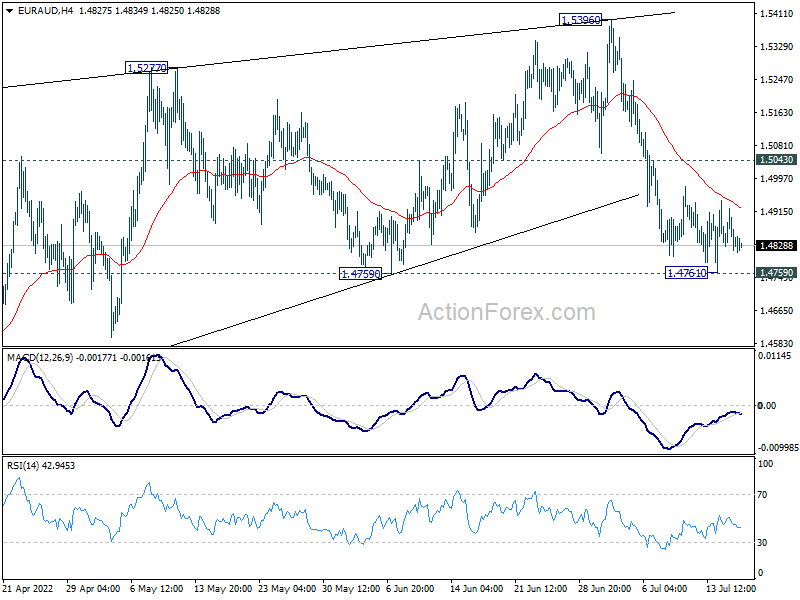
Intraday bias in EUR/AUD remains neutral for the moment. For now, further decline is in favor with 1.5043 resistance intact. On the downside, decisive break of 1.4759 support should confirm that corrective rise from 1.4318 has completed at 1.5396 after rejection by 1.5354 support turned resistance. Deeper fall should then be seen back to retest 1.4318 low. On the upside, however, break of 1.5043 will bring stronger rebound back towards 1.5396.
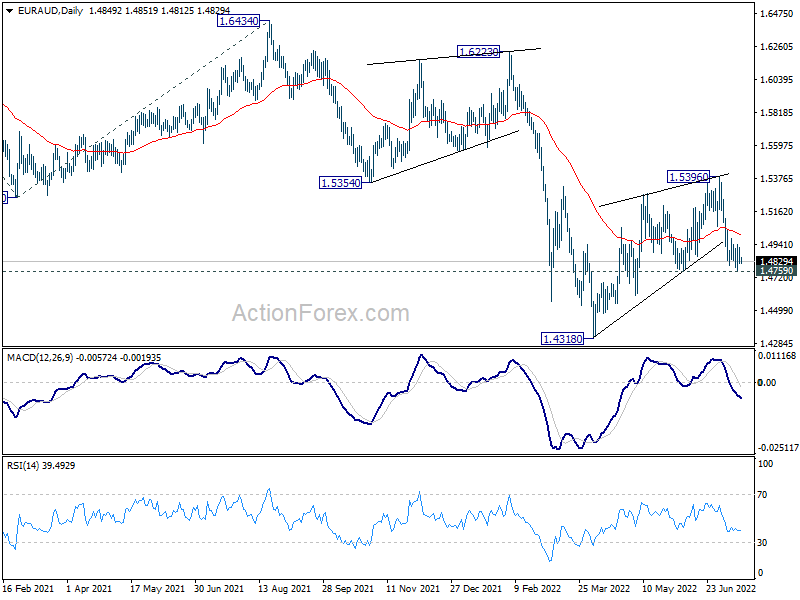
In the bigger picture, rejection by 1.5354 support turned resistance, as well as 55 week EMA (now at 1.5378), maintain medium term bearishness. That is, larger down trend from 1.9799 is not completed yet. Break of 1.4318 low will target 61.8% projection of 1.9799 to 1.5250 from 1.6434 at 1.3623, which is close to 1.3624 long term support (2017 low). This will remain the favored case now as long as 1.5396 resistance holds.
EUR/CHF Daily Outlook
Daily Pivots: (S1) 0.9826; (P) 0.9850; (R1) 0.9874; More....
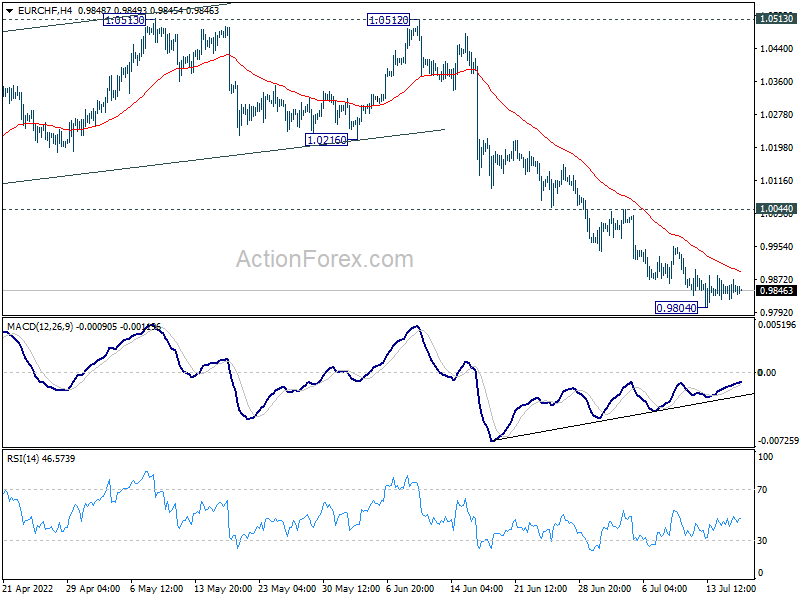
Intraday bias in EUR/CHF remains neutral for consolidation above 0.9804 temporary low. Upside of recovery should be limited by 1.0044 resistance. Break of 0.9804 will resume larger down trend to 0.9650 long term projection level.
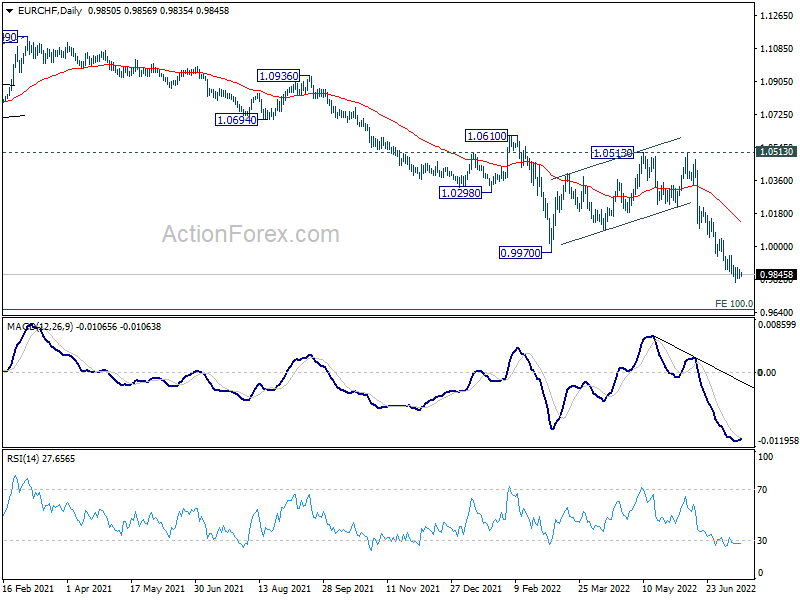
In the bigger picture,long term down trend from 1.2004 (2018 high) is expected to target 100% projection of 1.2004 to 1.0505 to 1.1149 at 0.9650. On the upside, break of 1.0513 resistance is needed to indicate medium term bottoming. Otherwise, outlook will stay bearish in case of strong rebound.
USD/CAD Daily Outlook
Daily Pivots: (S1) 1.2979; (P) 1.3058; (R1) 1.3101; More...
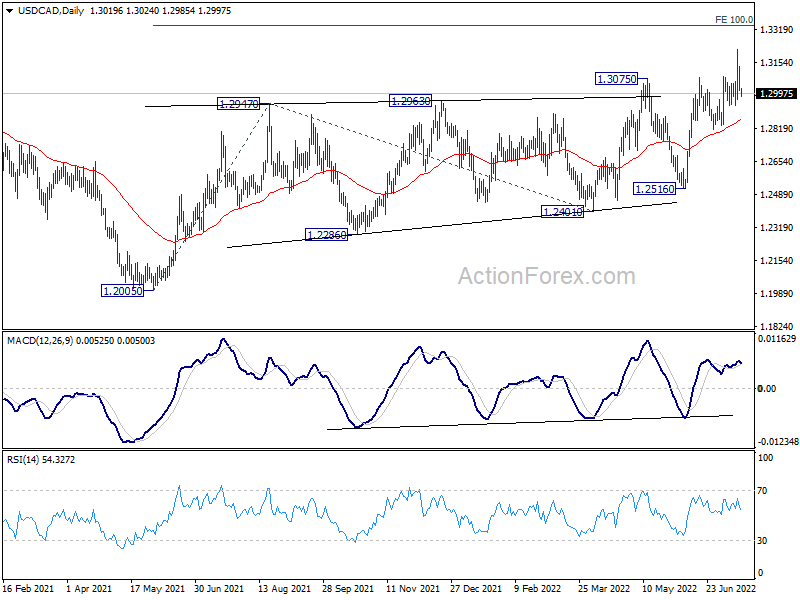
Intraday bias in USD/CAD remains neutral for the moment. Further rise will remains in favor as long as 1.2935 support holds. Break of 1.3222 will target 100% projection of 1.2005 to 1.2947 from 1.2401 at 1.3343. However, firm break of 1.2935 will dampen this bullish case and turn bias to the downside for 1.2818 support.
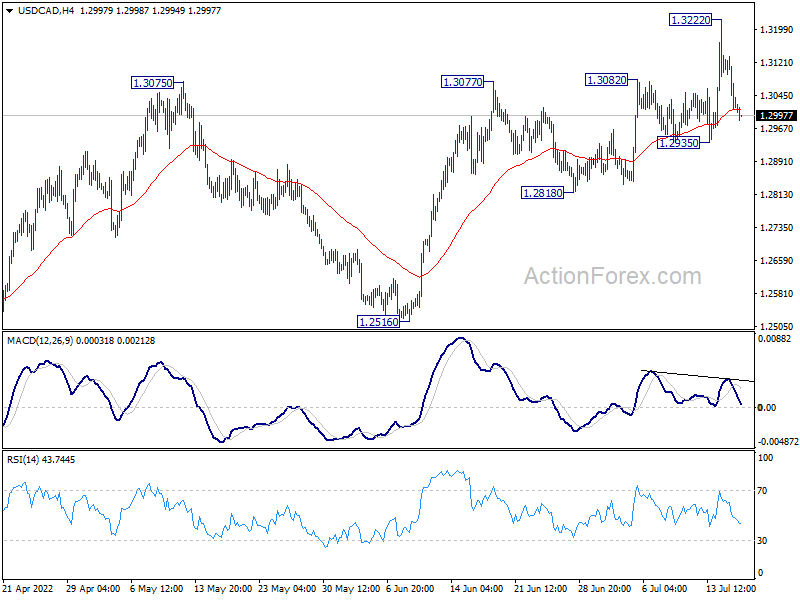
In the bigger picture, down trend from 1.4667 (2020 high) should have completed at 1.2005, after defending 1.2061 long term cluster support. Rise from there should target 61.8% retracement of 1.4667 to 1.2005 (2021 low) at 1.3650. This will remain the favored case now as long as 1.2516 support holds.