Sample Category Title
RBA Lowe: Further increase in rates required over the month ahead
RBA Governor Philip Lowe said in a speech that the robust post-COVID recovery is "now behind us" given that inflation is high and labor market is very tight. RBA thus have withdrawn some emergency insurance and raised cash rate by 125bps over the past three meetings to 1.35%.
RBA "expects that further increase will be required over the months ahead", to ""help establish a more sustainable balance between demand and supply in the Australian economy.
Will the Bank of Japan Tweak Its Policy After Yen’s Freefall?
Investors will have their eyes on the Bank of Japan during Thursday’s policy meeting as the yen keeps melting while the inflation peak is nowhere in sight yet, making everyone wonder how long the central bank will stick with its outlier stance. Besides a tweak in quarterly projections, however, policymakers may not move the needle, maintaining a super accommodative policy once again, and therefore leaving the yen under the US dollar’s command.
BoJ remains the dovish outlier
The freefall in the yen broke past 139.00 against the US dollar last week for the first time since 1998 in the wake of a hotter-than-expected US inflation. The nasty data instantly stoked bets for an extraordinary 100 bps rate hike by the Fed following a similar shocking increase from the Bank of Canada, adding more fuel to the dollar rally. But Fed officials immediately played down that scenario, shifting the odds back to a 75bps rate hike for July, and therefore preventing the dollar from crawling up to 140.00.
Meanwhile, in a parallel universe, the BoJ is still stubbornly refusing to enter the tightening club, even though the ECB’s hawkish shift and the SNB’s surprise 50-bps rate increase last month put it out of sync with its global counterparts. Also, the latest commentary from BoJ's chief Kuroda during his quarterly meeting with the central bank’s branch managers last week, came as a reminder that there are no plans for a radical shift and nor will the option of a more stimulative policy leave the table.
Fundamentals don't call for policy change yet
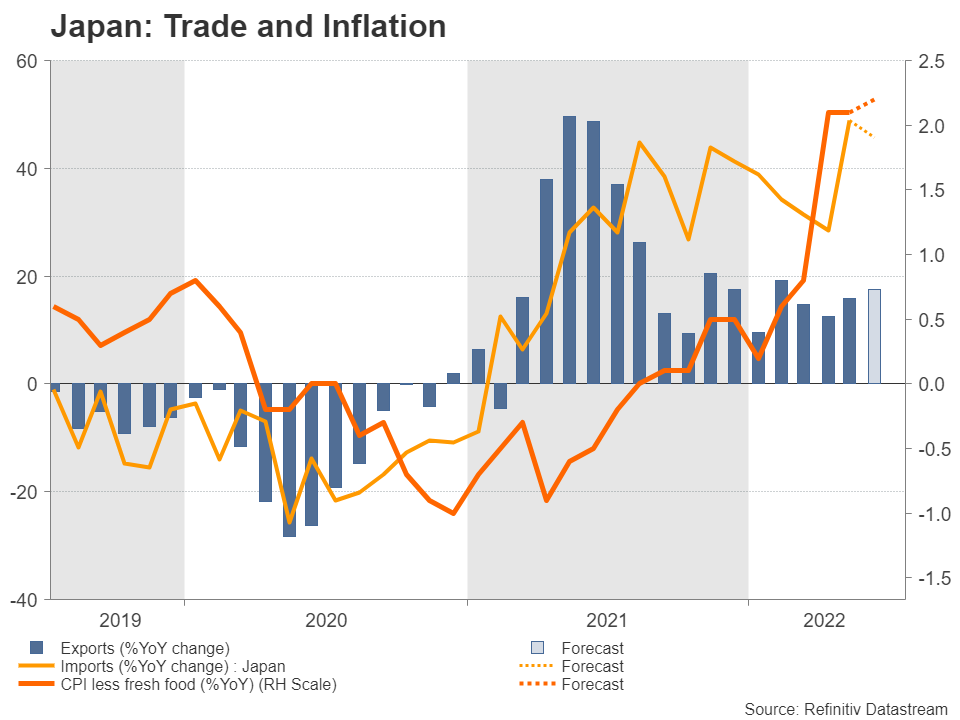
On the one hand, the BoJ faces no urgency to alter its strategy since the nationwide core CPI inflation, which was muted for more than a decade, has barely surpassed its 2.0% target in May, while a new update on Thursday is expected to reveal a slight increase to 2.2% in June. In addition, inflation expectations have deviated little from current CPI readings, moving only up to 2.4% in the second quarter.
Apparently, consumers may face higher prices in the coming months as imported goods prices surged at a record pace of 46.3% in June from a year earlier in the face of a sinking yen. Usually, Japanese businesses change price tags at the start of each quarter; therefore, July’s CPI release may experience a pickup given that the economy heavily depends on fuel imports, whose costs may not easily slow down because of the ongoing war in Ukraine. That would justify a pickup in the central bank’s inflation projections.
Other indicators are not hinting a swift change in policy either. The latest data releases for May have been rather gloomy, showing household spending tumbling for the third consecutive month. chip shortages worsened from China’s lockdowns weighed on car sales, and wage growth remained subdued.
Although constantly missing expectations over the past five months, exports kept growing at double digits in May, remaining the highest since 2018. Moreover, despite the depreciation in the yen over the previous months, imports expanded at the fastest pace since the 1980s, elevating the trade deficit to the highest since 2014. June's figures will probably show a stronger expansion in exports on Wednesday and a soft downturn in imports.
A potential hawkish tweak
The yield curve control is becoming tougher to maintain as every time US rate expectations boost global bond yields, it forces the central bank to buy a bulk amount of Japanese government bonds, which it otherwise would not obtain.
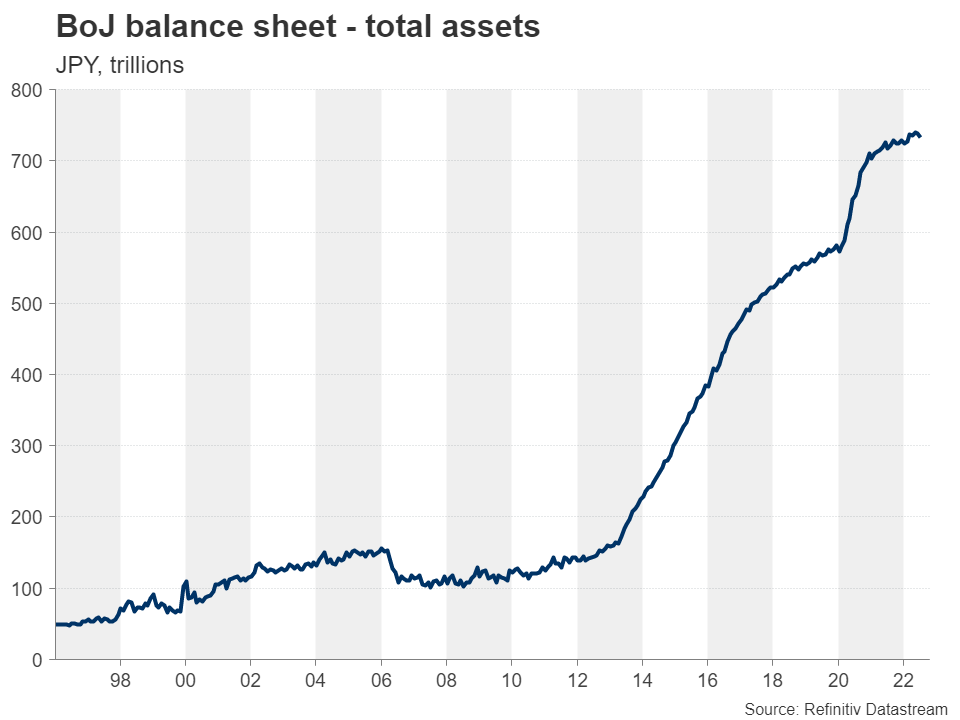
Nevertheless, with the economy still operating below its pre-pandemic levels and inflation, not justifying an immediate policy response yet, the central bank is expected to stick to its guns for another month. Perhaps that will make more time for thinking as the recession risk is still under examination and could come to the yen’s rescue without cost if it becomes reality. Hence, unless the tough yield curve control stresses the need for a shift, the only hawkish adjustment this week could be a switch to a more data-dependent approach.
USD/JPY
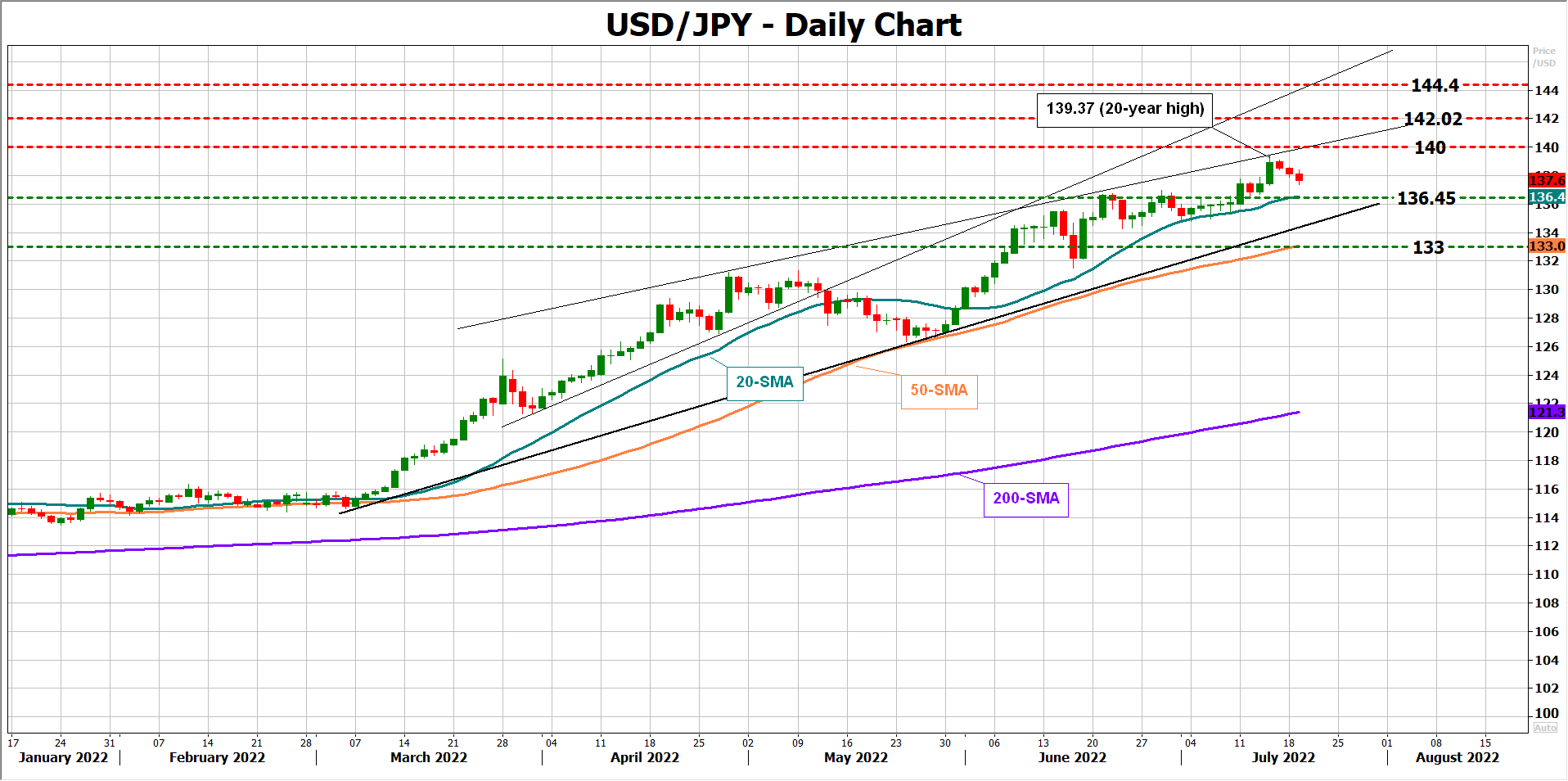
If the central bank places the future of its decade-long accommodative policy subject to data consideration, signaling a potential end to the stimulus era in the foreseeable future, dollar/yen may stretch this week’s decline towards its 20-day simple moving average (SMA) at 136.45. A steeper decline could pivot around the support trendline and the 50-day SMA at 133.00, keeping the broad uptrend intact.
Otherwise, if the BoJ repeats the same story and sentiment over the US economy becomes brighter, the 140.00 mark will come back under the spotlight near the resistance line. A step higher from here may target the 142.00 psychological mark.
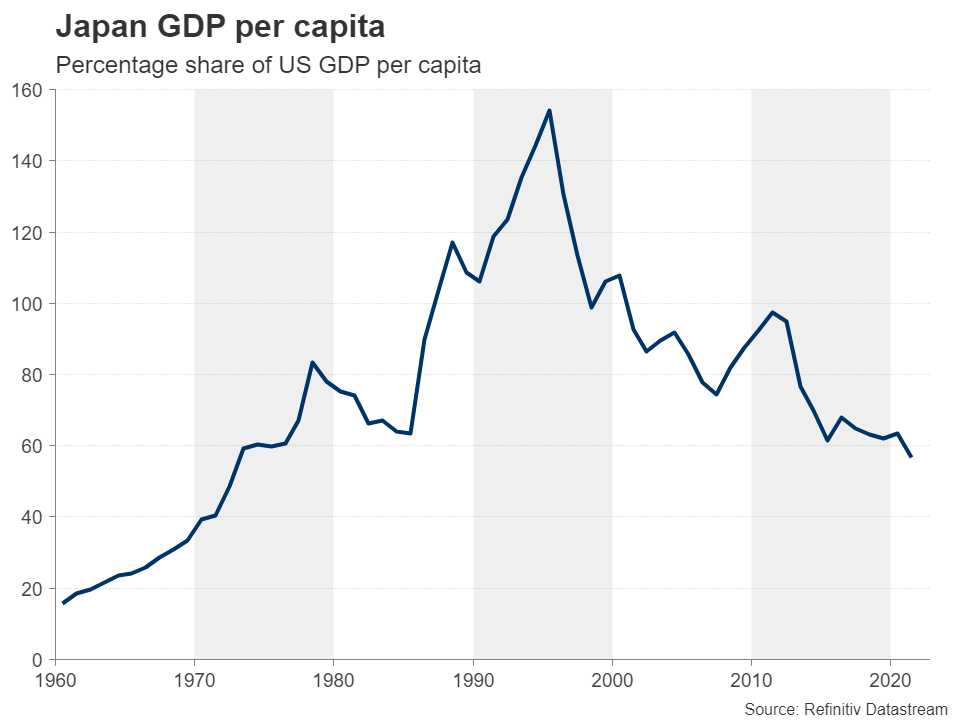
Overall, the next few months could be critical. The devastating death of Abenomics’s father, who had still potent influence within the expansionary fiscal policy despite his resignation and was a firm supporter of Kuroda, could reduce commitment to ultra-loose policies. Although backing BoJ's policy thinking, the current prime minister, Fumio Kishida, has sought to distance himself from Abe’s economic legacy while gaining more popularity.
AUDUSD Wave Analysis
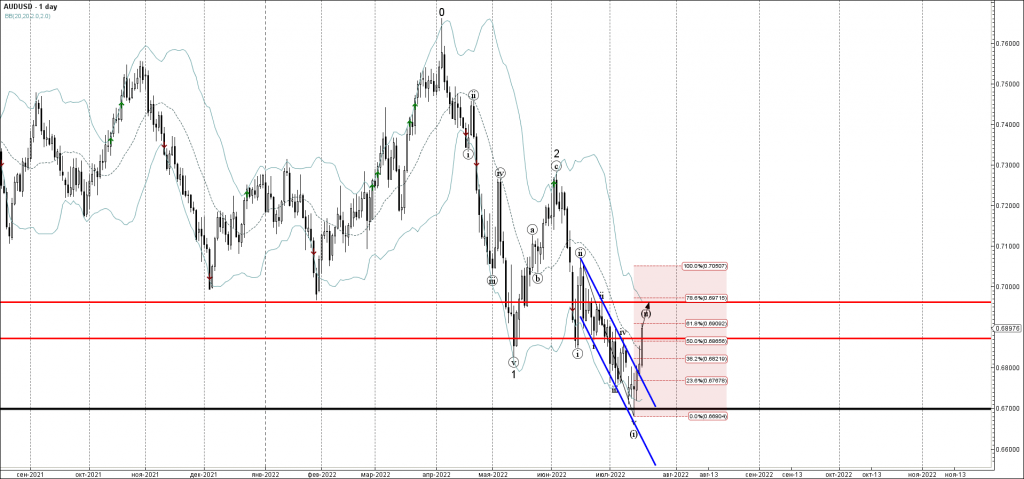
- AUDUSD broke key resistance level 0.6870
- Likely to rise to resistance level 0.6960
AUDUSD currency pair recently broke above the key resistance level 0.6870 (which stopped wave (iv) at the start of this month).
The breakout of the resistance level 0.6870 coincided with the breakout of the 50% Fibonacci correction of the downward impulse from June.
AUDUSD can be expected to rise further toward the next resistance level 0.6960 (target price for the completion of the active correction (ii)).
FTSE 100 Wave Analysis
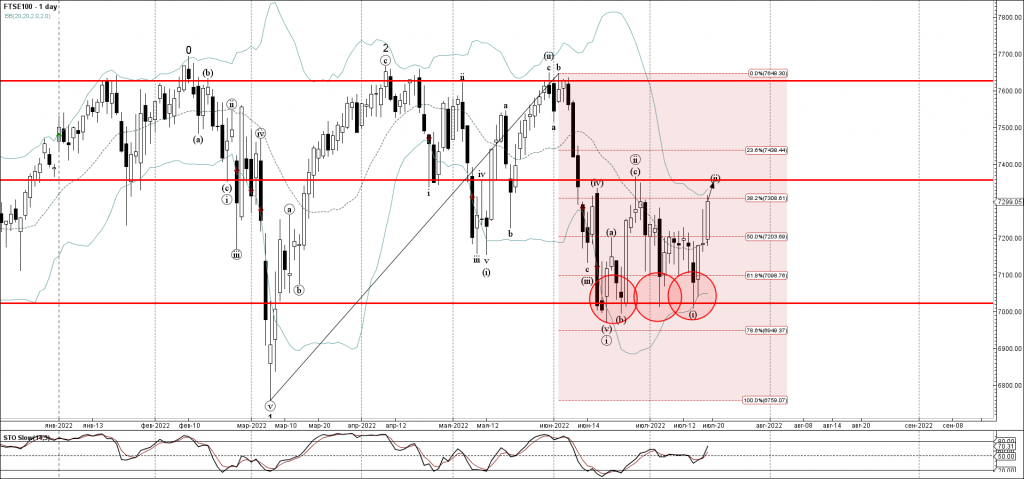
- FTSE 100 reversed from support level 7020.00
- Likely to rise to resistance level 7357.00
FTSE 100 index recently reversed up from the key support level 7020.00 (which has been reversing the pair from the middle of June), strengthened by the lower daily Bollinger Band.
The upward reversal from the support level 7020.00 started the active short-term correction (ii).
FTSE 100 can be expected to rise further toward the next resistance level 7357.00 (top of wave ii from the end of last month, target price for the completion of the active correction (ii)).
Eco Data 7/20/22
[php_everywhere instance="1"]
AUD/USD: Hawkish RBA and Fresh Risk Appetite Lift Aussie Dollar
Recovery picked up on Tuesday, boosted by fresh risk appetite and hawkish stance from the Reserve Bank of Australia.
The minutes of RBA’s July policy meeting, released today, showed the central bank is on track for more policy tightening, as interest rates, despite recent hikes, are still low to curb rising inflation.
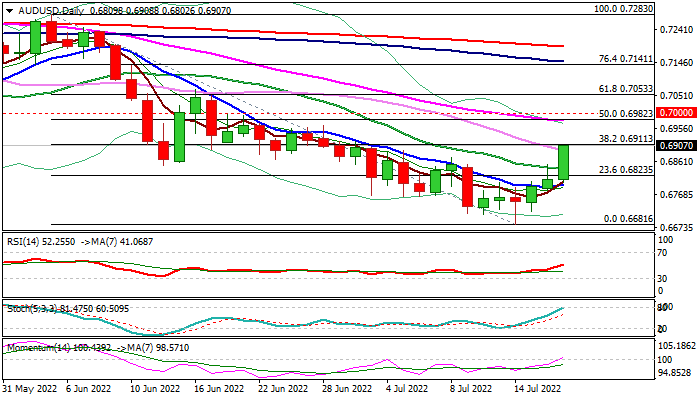
Fresh bullish acceleration broke above daily Kijun-sen (0.6875) and cracked pivotal Fibo resistance at 0.6911 (38.2% of 0.7283/0.6681 bear-leg), with break here to add to bullish signals and strengthen near-term bullish stance.
Rising 14-d momentum is breaking into positive territory that underpins the action, along with 5/10/20DMA’s in bullish setup.
Broken 20DMA (0.6840) reverted to support which should keep the downside protected and maintain positive near-term bias.
Res: 0.6911; 0.6964; 0.6982; 0.7000
Sup: 0.6874; 0.6840; 0.6823; 0.6797
BoE Bailey: 50bps hike on the table for next meeting, but not locked in
In a speech, BoE Governor Andrew Bailey said, " 50 basis point increase will be among the choices on the table when we next meet". But "50 basis points is not locked in, and anyone who predicts that is doing so based on their own view".
Also, at next meeting, "it is also time for the MPC to discuss the strategy for beginning to sell the gilts held in our Asset Purchase Facility portfolio," he added. "We will publish, alongside the Monetary Policy Report, more detail on how we will do this, to allow financial market participants to make the necessary preparations."
ECB to Hike Rates Amid Energy Worries, Anti-Fragmentation Tool Eyed as Euro Bounces Back
The European Central Bank is expected to embark on its first rate hike cycle in more than a decade on Thursday. The Bank will announce its decision at the new time of 12:15 GMT, followed by a press conference from President Christine Lagarde at 12:45 GMT. After years of ultra-accommodative policy, the long-awaited shift to policy normalization has failed to spur significant bullish sentiment towards the flagging single currency, which last week had a brush with parity versus the US dollar. Is there anything the ECB can do to lift the euro’s long-term prospects?
A 50-bps rate hike comes into play
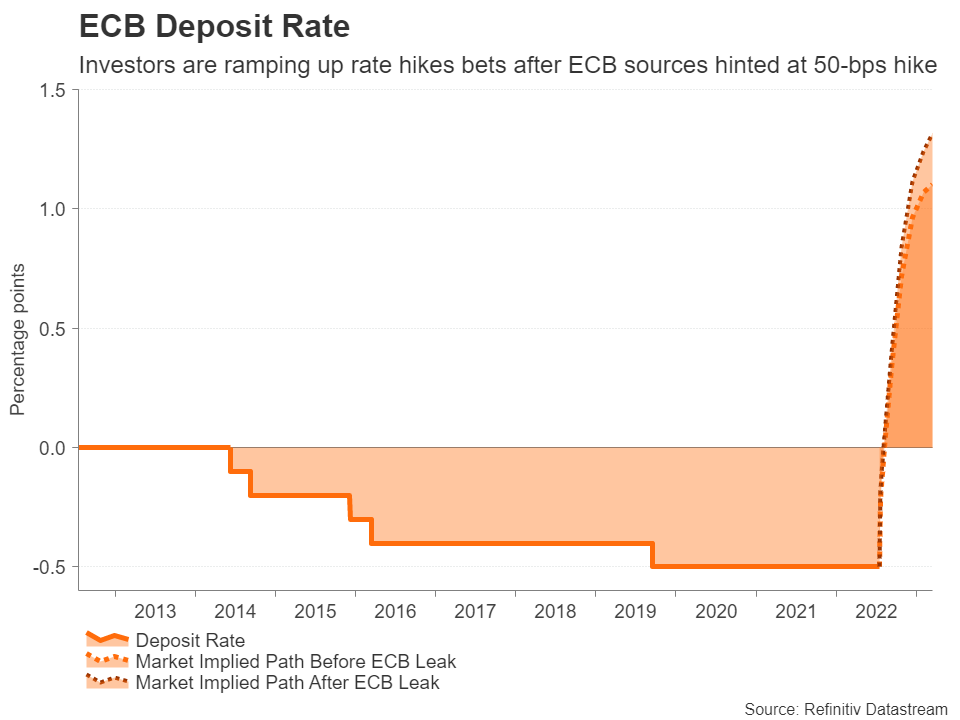
Barely three weeks after the unprecedented pandemic stimulus has been finally wound down, the ECB is set to raise its three main lending rates on Thursday. The refinancing and marginal lending rates have been stuck at zero and 0.25 percent, respectively, since March 2016, while the deposit rate has been negative for the past eight years.
However, just days before the decision, the size of the first rate hike has been cast into doubt. Although policymakers had clearly telegraphed a 25-basis point increase, 50 bps is now apparently under consideration according to ECB sources.
Eurozone economy is slowing
What the Governing Council ultimately decides will very much be the focus of attention for investors amid growing doubts about how high rates can go in the euro area when economic growth is decelerating at an alarming rate. The flash PMI estimates for July out on Friday are expected to show overall business activity expanded at the slowest pace since February 2021.
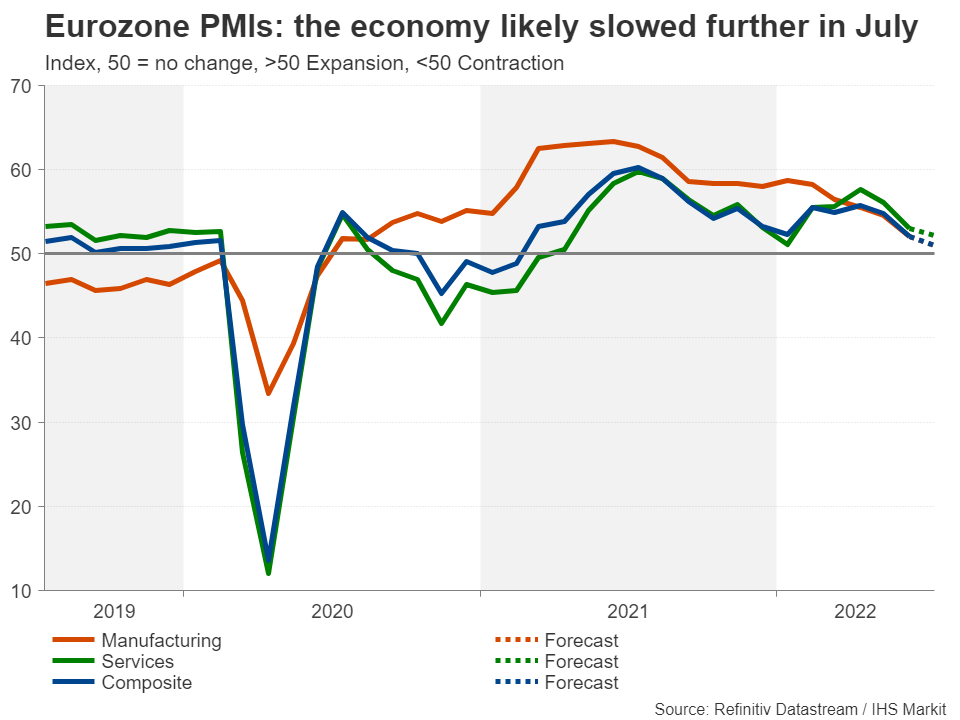
Worries that the Eurozone is headed for a recession have been exacerbated by the deepening energy crisis. Although there’s been some relief from the recent pullback in oil prices, Europe is facing the added threat of natural gas supplies being cut off by Russia. The main gas pipeline supplying Germany is currently closed for planned annual maintenance and fears are running high that Russia will not allow gas flows to resume when the works are scheduled to be completed on the same day as the ECB decision.
Italian political risks add to ECB headaches
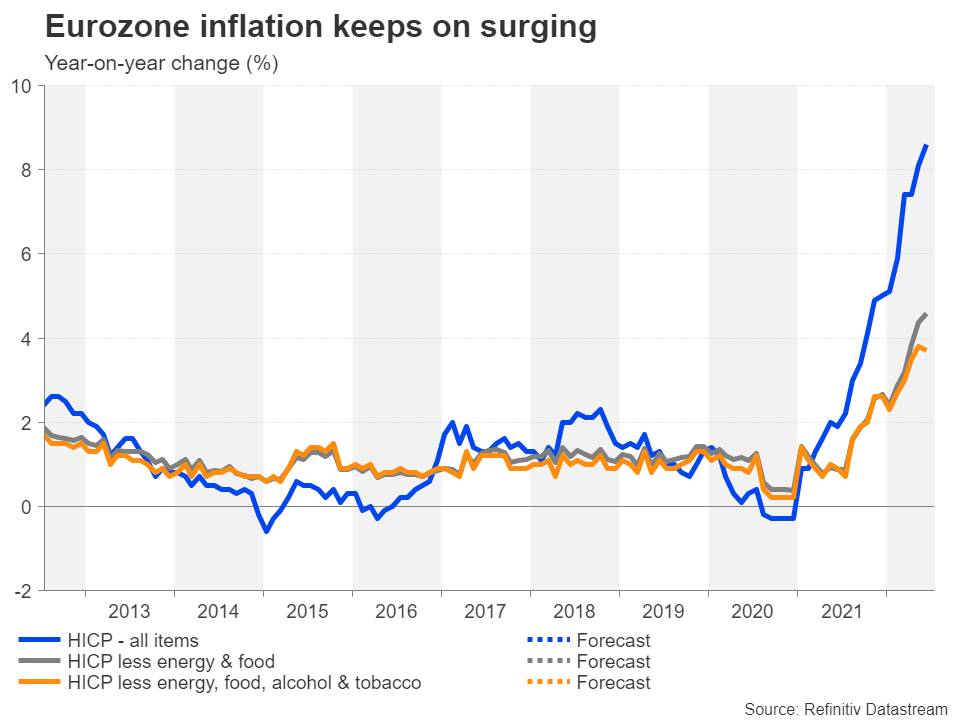
The problem is, when inflation has surged to a record high of 8.6% y/y, it will be hard for the ECB to factor in a steep German recession before it has actually happened. Another risk that will be difficult for policymakers to access is the renewed political turmoil in Italy. Prime Minister Mario Draghi – who has been a source of confidence during the country’s post-pandemic bout of political instability – could attempt to resign again on Wednesday if the row between the 5-Star Movement and its coalition partners isn’t resolved.
But the ECB may have something up its sleeve to prevent crises like the one in Italy right now from turning into a volatility episode in the markets. Widening spreads between core and peripheral bond yields has long been a concern for the ECB and is one of the reasons why policymakers were hesitant about withdrawing stimulus sooner.
Can anti-fragmentation tool boost the euro?
Back in June, the Bank said it will reinvest the redemptions from PEPP purchases flexibly, allocating a greater share of the reinvestments to member states that have higher spreads. However, markets were not impressed by the move and the ECB has since been in a rush to put together a new tool that would act as a safety net against fragmentation in Eurozone bond markets, with the aim of preventing unwarranted spikes in periphery yields.
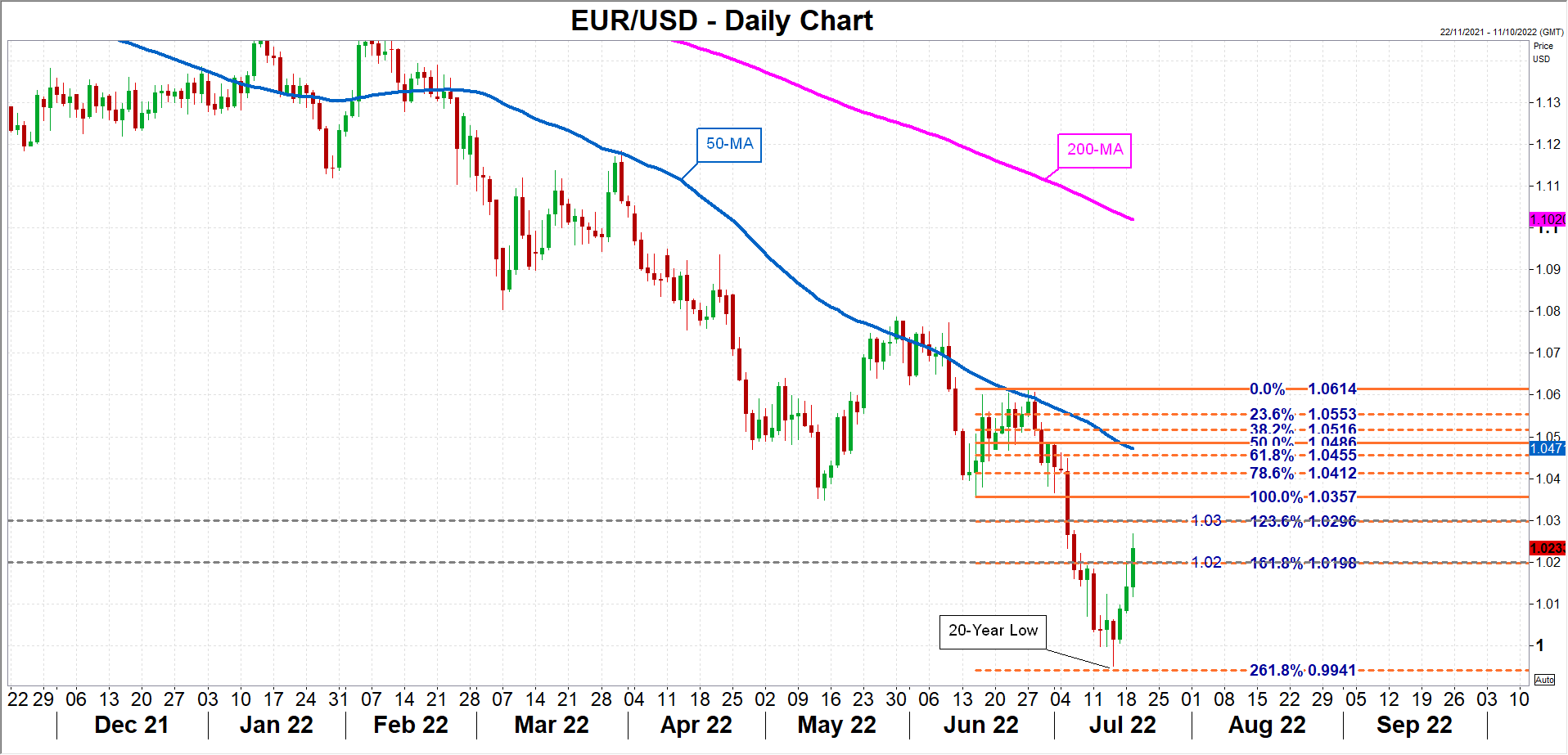
If the ECB is able to pull a rabbit out of the hat, the euro might be able to stage a more sustained rally, extending its rebound against the US dollar. Having bounced off last week’s two-decade low of $0.9950 to test the $1.02 level, the euro could next aim for $1.03, which also happens to be the 123.6% Fibonacci extension of the June upleg, after which the 61.8% Fibonacci of $1.0455 would come into view.
The risk of sounding too hawkish
However, even if policymakers are able to allay concerns about a full-blown bond market panic, recession jitters won’t go away that easily, especially if they raise rates by 50 bps instead of 25 and signal that further large increments are likely in September and subsequent meetings. Any hawkish surprises that are translated into an aggressive rate path could roil investors.
For instance, if the ECB takes a leaf out of the Fed’s book and wants to show its resolve in containing inflation, it might not go down quite so well with the markets because of the underlying weakness of the Eurozone economy, not to mention the dangers Italy and Germany are facing at present. Hence, an overly hawkish tone might backfire and the euro could come under fresh selling pressure, tumbling back towards parity again.
It's also possible, though, that the ECB may not want to commit to the size and frequency of rate hikes beyond September, which would leave investors rummaging for clues in the latest staff projections and Lagarde’s press briefing. Under the circumstances, the latter may in fact be more effective at maintaining some upside pressure on the euro.
Money Markets Price in a Fifty-Fifty Chance for a Bolder ECB Move
Markets
The debate about a 25 or 50 bps ECB rate hike is at least as hot as temperatures outside today. It is the central bank itself, or rather “people familiar with the discussions”, that fueled speculation just two days ahead of the policy meeting this Thursday. Citing those sources, Reuters reported that ECB policymakers are looking more closely at a half-point rate increase this week instead of the 25 bps move ECB president Lagarde and many others flagged earlier. It has a Fed flair all over it. Back in June, it nudged markets during the quiet period towards a 75 bps hike. It also used its contacts in specialized press to have the word out. Shortly after the 50 bps rumours, quotes rolled over the screen that Lagarde is doubling down on having the Transmission Protection Mechanism ready by Thursday. Governors are said to negotiating its conditionality and legality still. It feels as a quid pro quo: a stronger rate lift-off in return for a new bond buying program. European bond markets in any case were quick to pick it up. German yields shot up with the front end of the curve underperforming as money markets price in a fifty-fifty chance for a bolder ECB move. Yields changes range between 0.3 bps (30y) and 8.5 bps (2y). European swap yields add 1.6 bps to 9.9 bps in a similar bear flattener. US yields continue to consolidate. They ease up to 2.5 bps with the wings outperforming the belly. The US10y yield is hovering around the 3% barrier. European stocks dipped to intraday lows but soon found their composure. A gradual bottoming out turned losses of 1% into gains of 0.8% for the EuroStoxx50. Wall Street opens with gains of some 1%.Euro bulls also liked the Reuters report. The common currency strengthened, not least against the US dollar. EUR/USD is on track for a close north of 1.02 for the first time in two weeks. That still leaves the first meaningful resistance at 1.035 at some distance. Capturing that level is needed to call off the immediate downside alert. There is definitely dollar weakness involved too though. The trade-weighted DXY’s slide extends to 106.67. USD/JPY retreats further from cycle highs to 137.62. EUR/GBP also rose. The British labour report was near expectations and deprived sterling of means to counter euro vigor. The pair (0.8516) is currently testing 0.8509/12 (23.6% recovery of the March 2020 - 2022 decline/March 2022 interim high) resistance level. Perhaps Bank of England governor Bailey and UK Chancellor Zahawi come the pound to the rescue when they speak at the annual financial and professional services dinner at Mansion House tonight. Cable (GBP/USD) extends a bottoming out pattern to north of 1.20.
News Headlines
The Hungarian parliament today approved the Government budget for 2023. The Government of PM Orban aims to reduce next year’s budget deficit to 3.5% of GDP compared to an expected shortfall of 4.9% this year. The budget assumes only a modest slowdown in economic growth to 4.1% from 4.7% expected this year. The National bank of Hungary expects growth between 2-3% next year. The budget sees inflation at 5.2% in 2023. MNB June forecasts range between 6.8% and 9.2%. Amongst other measures a windfall tax on big companies and removing a cap on utility prices should contribute to a lower budget deficit. Lower government demand also should help reducing the current account deficit which is a negative factor for the Hungarian forint. A milder global risk sentiment, first steps of fiscal consolidation and last week’s aggressive MNB 200 bps rate hike are taking some pressure off the forint. EUR/HUF currently trades near 400, compared with last week’s historic low levels near EUR/HUF 415.
The US housing market continues to slow down as higher interest rates are filtering through in activity in the sector. Housing starts dropped another 2.0% to an annual rate of 1559k, the lowest level since September last year. The June decline comes on the back of a sharp fall of 11.9% in the previous month. Building permits eased a more modest 0.6% M/M in June after declining 7.0% the previous month. Last week Fed’s Waller indicated that he would also take housing data into account in assessing excesses demand at the July 27 policy decision.
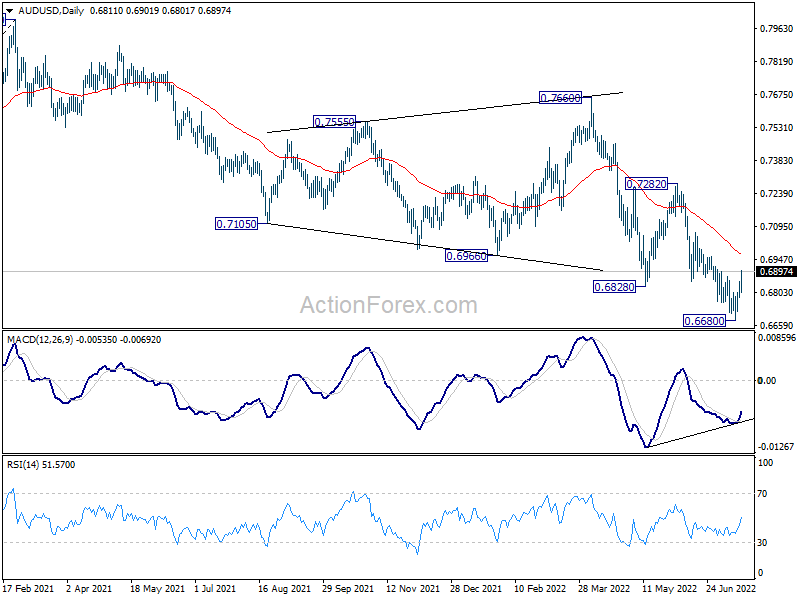
AUD/USD Mid-Day Report
Daily Pivots: (S1) 0.6783; (P) 0.6819; (R1) 0.6848; More...
AUD/USD's break of 0.6873 minor resistance confirms short term bottoming at 0.6680, on bullish convergence condition in 4 hour MACD. Intraday bias back on the upside for 55 day EMA (now at 0.6982) and above. On the downside, below 0.6801 minor support will turn bias back to the downside for retesting 0.6680 low instead.
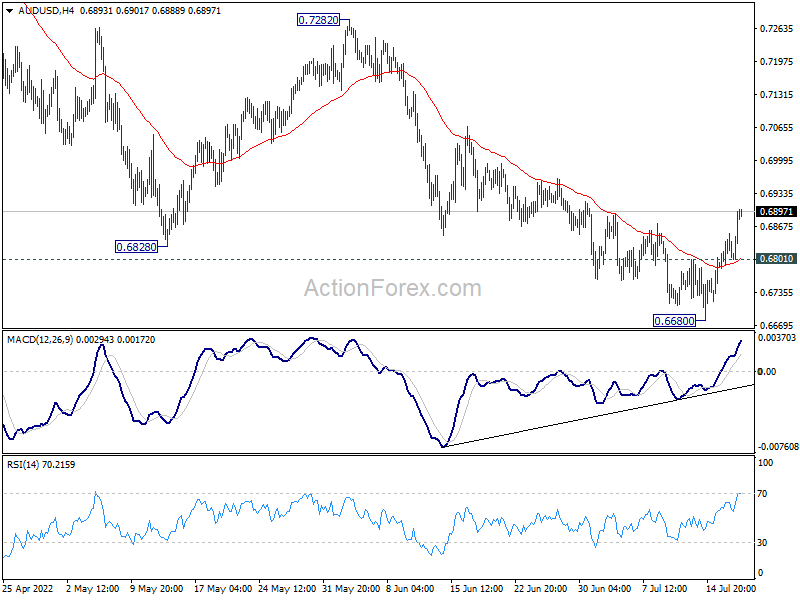
In the bigger picture, price actions from 0.8006 could still be a corrective pattern to rise from 0.5506 (2020 low). But current downside acceleration is raising the chance that it's a bearish impulsive move. In either case, outlook will remain bearish as long as 0.7282 resistance holds. Next target is 61.8% retracement of 0.5506 to 0.8006 at 0.6461.