

Sample Category Title
USD/JPY Consolidates Gains
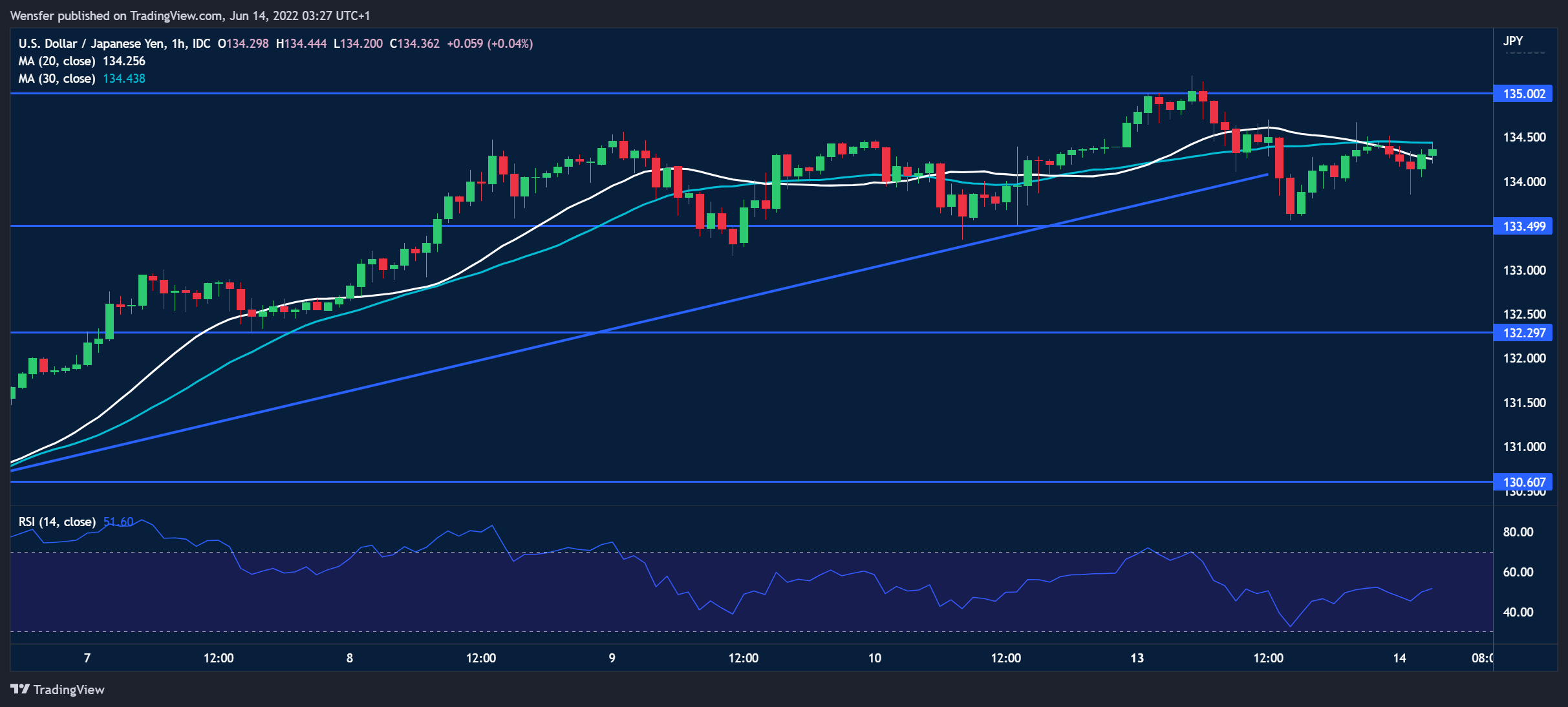
The Japanese yen clawed back losses after BoJ boss Kuroda raised concerns about the yen's sharp decline. The pair has been climbing along a rising trend line. The lack of supply zone means that there is little resistance on the upside. The RSI’s overbought situation on the daily chart has caused a pullback and a fall below the trend line indicates that the greenback could use some breathing room. 133.50 is the first level to gauge the strength of the bullish momentum. A bounce above 135.00 would carry the price to 137.00.
EUR/USD Daily Outlook
Daily Pivots: (S1) 1.0366; (P) 1.0443 (R1) 1.0486; More...
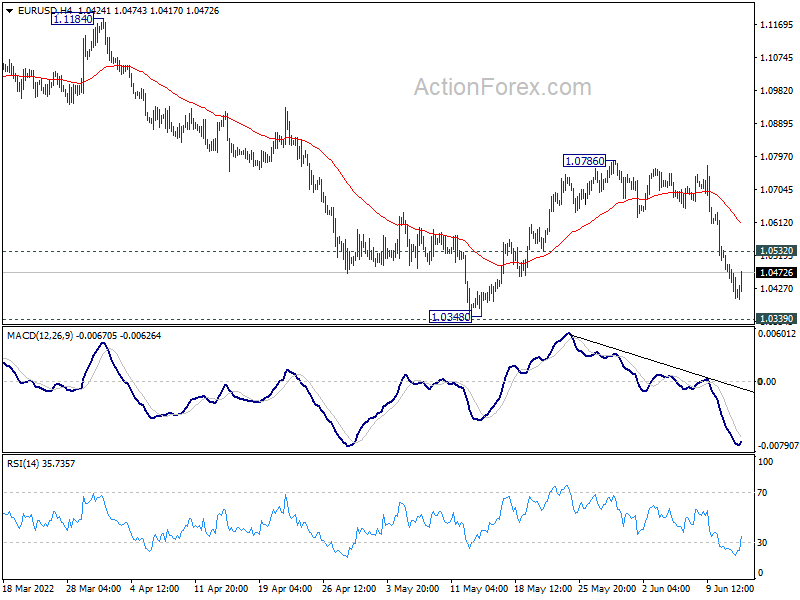
Intraday bias in EUR/USD stays on the downside for retesting 1.0348 and 1.0339 long term support. Decisive break there will resume larger down trend. Next target is long term projection level at 1.0090. On the upside, above 1.0532 minor resistance will delay the bearish case, and turn intraday bias neutral first.
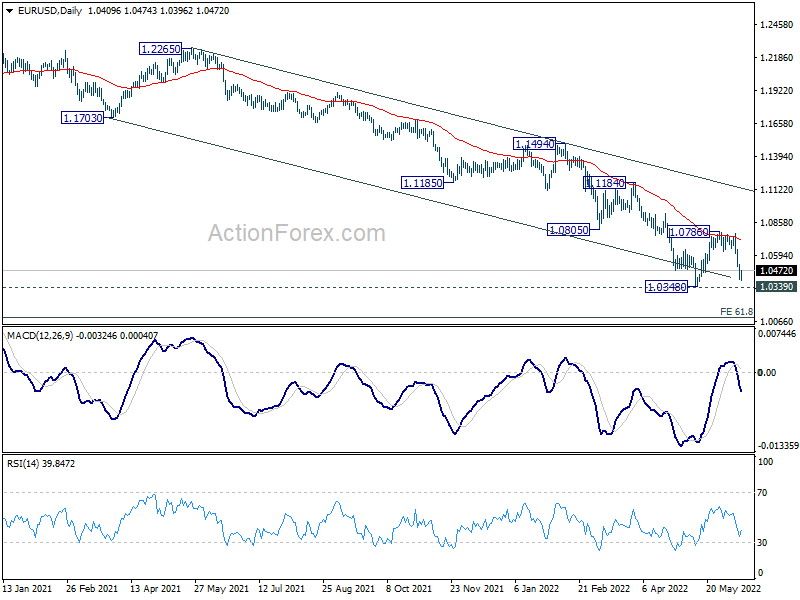
In the bigger picture, focus stays on 1.0339 long term support (2017 low). Decisive break there will resume whole down trend from 1.6039 (2008 high). Next target is 61.8% projection of 1.3993 to 1.0339 from 1.2348 at 1.0090. However, firm break of 1.0805 support turned resistance will delay this bearish case, and bring stronger rebound first.
Dollar Rally Still Indecisive Despite Expectations of 75bps Fed Hikes
Dollar is paring some gains today as markets digest near term moves. But the greenback remains the strongest for the week, as markets are adding bets to more aggressive rate hikes by Fed this week, and at next month's meeting. Yen is so far the next strongest, as supported by risk aversion. Aussie is so far the worst performing one, followed by Sterling and Kiwi. Euro and Swiss Franc are mixed. While the greenback should continue to be strong, the dynamics between other currencies would be depend on the outcome of other central bank meetings including BoE, SNB and BoJ.
Technically, GBP/USD's break of 1.2154 support confirmed down trend resumption. But EUR/GBP is holding below 0.8617 resistance. So the Pound's weakness is not too overwhelming yet. On the other hand, EUR/USD is holding above 1.0348 support. USD/CHF is staying below 1.0063 resistance. Thus, Dollar's strength is also not too decisive yet. Let's see how things go.
In Asia, Nikkei dropped -1.32%. Hong Kong HSI is down -0.23%. China Shanghai SSE is up 1.02%. Singapore Strait Times is down -0.83%. Japan 10-year JGB yield rose 0.0073 to 0.262. Overnight, DOW dropped -2.79%. S&P 500 dropped -3.88%. NASDAQ dropped -4.68%. 10-year yield rose 0.21 to 3.366, and broke through 2018 high at 3.248.
Markets expecting 75bps Fed hikes this week and in Jul
US stocks closed sharply lower overnight with DOW, S&P 500 and NASDAQ making new lows of the year. As continued aftermath of last week's CPI data, markets are now adding bets to more aggressive tightening by Fed. The original plan of 50bps hike per meeting seems out of favor.
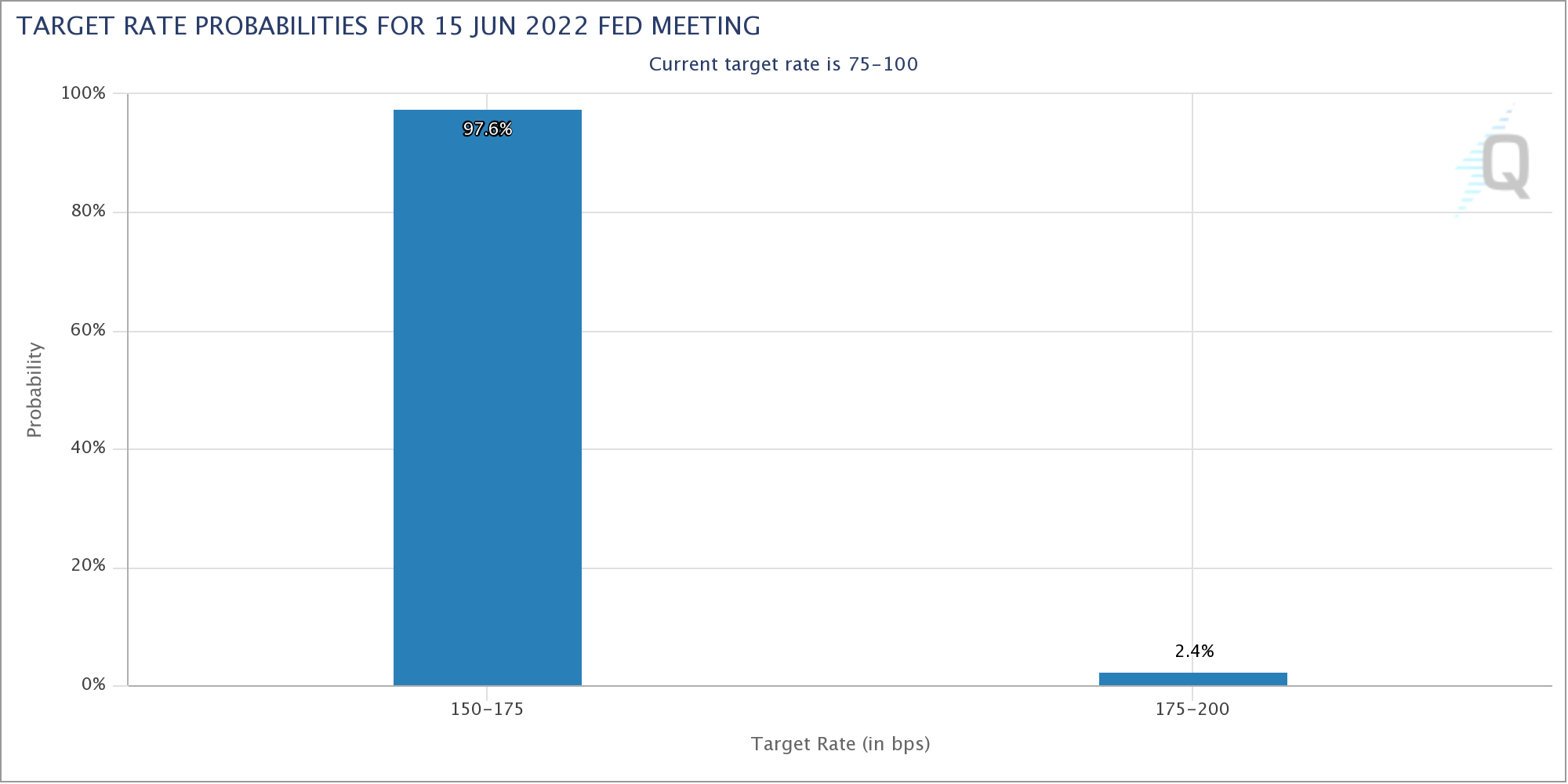
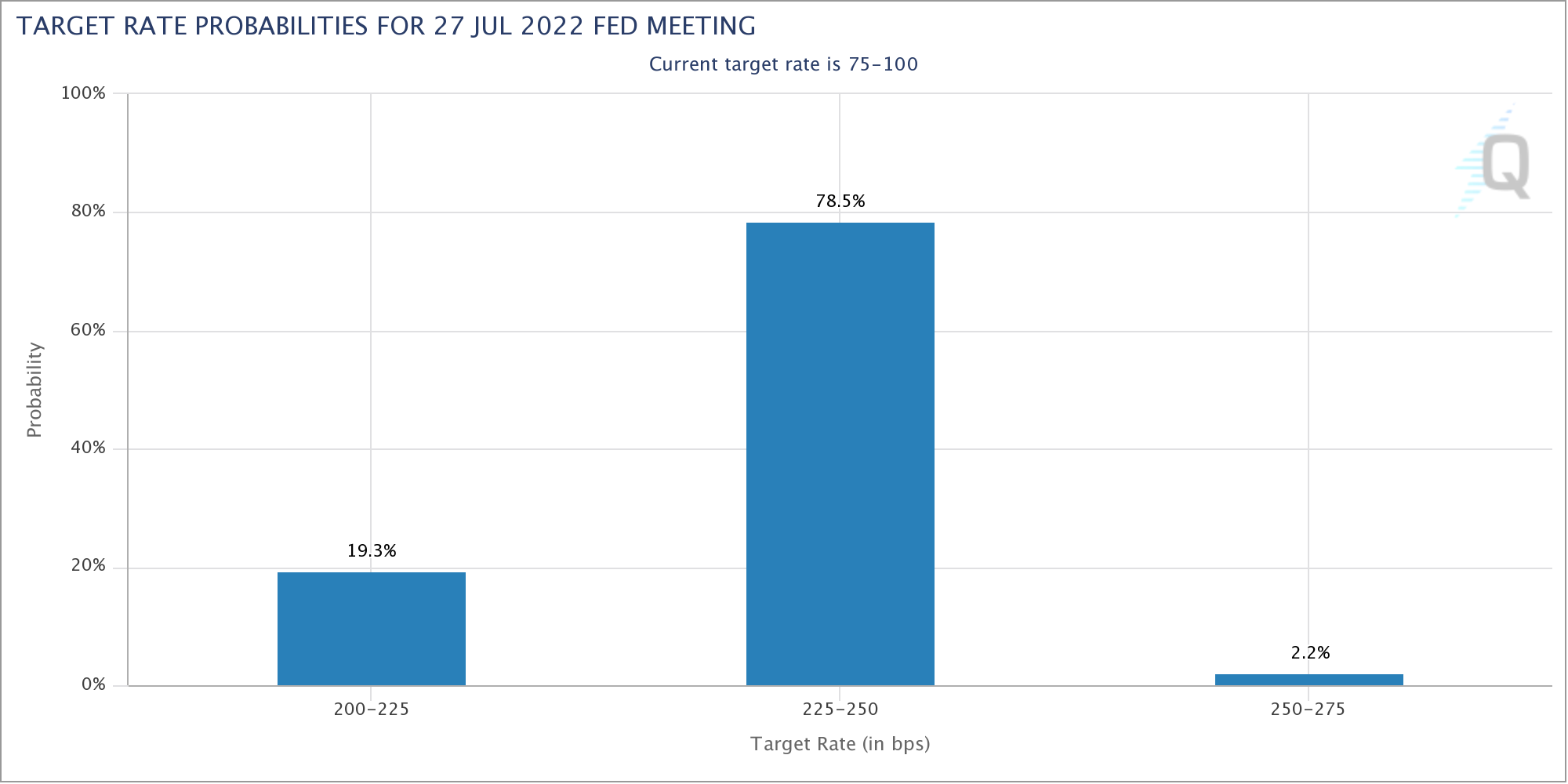
Fed fund futures are now pricing in 99.4% chance of a 75bps hike this week (Wed) to 1.50-1.75%. Further, there is 79.9 chance of another 75bps hike in July to 2.25-2.50%. A pause in September is now a definite no, as markets are expecting another 50bps hike.
Still, the overall expectations would be reshaped by the updated economic projections and the dot plot to be published along with the rate decision.
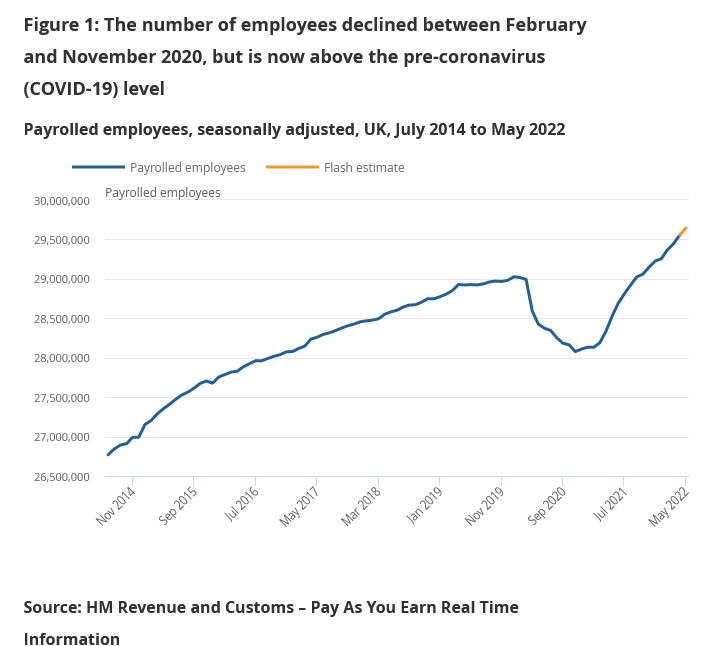
UK payrolled employees rose 90k in May, unemployment rate unchanged at 3.8% in Apr
UK payrolled employees rose 90k, or 0.3% mom in May. Claimant count dropped -19.7k, versus expectations of -42.5k. Median monthly pay rose 5.4% yoy to GBP 2076.
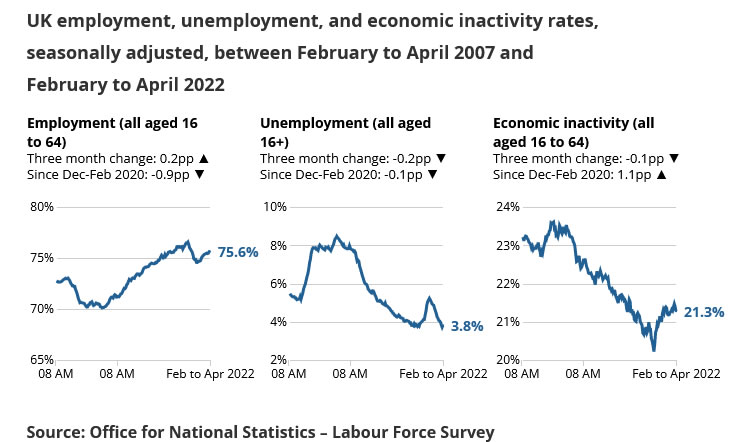
In the three months to April, unemployment rate was unchanged at 3.8%. Economic inactivity rate dropped -0.1% to 21.3%. Average earnings including bonus rose 6.8% over the year, below expectation of 7.6%. Average earnings excluding bonus rose 4.2% over the year, above expectation of 4.0%.
Australia NAB business confidence dropped to 6 in May, conditions dropped to 16
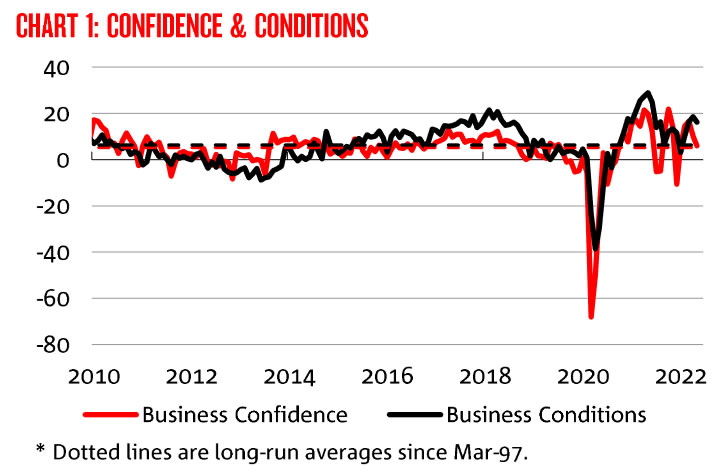
Australia NAB business confidence dropped from 10 to 6 in May. Business conditions dropped from 19 to 16. Looking at some details, trading conditions dropped from 27 to 24. Profitability conditions dropped from 21 to 17. Employment conditions rose from 11 to 12.
"Lower confidence in May likely reflects a range of risks on the horizon," said NAB Group Chief Economist Alan Oster. "Businesses are facing a new environment of higher inflation, rising interest rates, and risks to global growth. However, confidence is still at a fairly robust level all things considered."
Looking ahead
Germany ZEW is a major focus in European session. US will release PPI while Canada will release manufacturing sales.
EUR/USD Daily Outlook
Daily Pivots: (S1) 1.0366; (P) 1.0443 (R1) 1.0486; More...
Intraday bias in EUR/USD stays on the downside for retesting 1.0348 and 1.0339 long term support. Decisive break there will resume larger down trend. Next target is long term projection level at 1.0090. On the upside, above 1.0532 minor resistance will delay the bearish case, and turn intraday bias neutral first.
In the bigger picture, focus stays on 1.0339 long term support (2017 low). Decisive break there will resume whole down trend from 1.6039 (2008 high). Next target is 61.8% projection of 1.3993 to 1.0339 from 1.2348 at 1.0090. However, firm break of 1.0805 support turned resistance will delay this bearish case, and bring stronger rebound first.
Economic Indicators Update
| GMT | Ccy | Events | Actual | Forecast | Previous | Revised |
|---|---|---|---|---|---|---|
| 01:30 | AUD | NAB Business Confidence May | 6 | 10 | ||
| 01:30 | AUD | NAB Business Conditions May | 16 | 20 | ||
| 04:30 | JPY | Industrial Production M/M Apr F | -1.50% | -1.30% | -1.30% | |
| 06:00 | GBP | Claimant Count Change May | -19.7K | -42.5K | -56.9K | -65.5K |
| 06:00 | GBP | ILO Unemployment Rate (3M) Apr | 3.80% | 3.60% | 3.70% | |
| 06:00 | GBP | Average Earnings Including Bonus 3M/Y Apr | 6.80% | 7.60% | 7.00% | |
| 06:00 | GBP | Average Earnings Excluding Bonus 3M/Y Apr | 4.20% | 4.00% | 4.20% | |
| 06:00 | EUR | Germany CPI M/M May F | 0.90% | 0.90% | 0.90% | |
| 06:00 | EUR | Germany CPI Y/Y May F | 7.90% | 7.90% | 7.90% | |
| 09:00 | EUR | Germany ZEW Economic Sentiment Jun | -27.5 | -34.3 | ||
| 09:00 | EUR | Germany ZEW Current Situation Jun | -31 | -36.5 | ||
| 09:00 | EUR | Eurozone ZEW Economic Sentiment Jun | -24.3 | -29.5 | ||
| 10:00 | USD | NFIB Business Optimism Index May | 93.1 | 93.2 | ||
| 12:30 | USD | PPI M/M May | 0.80% | 0.50% | ||
| 12:30 | USD | PPI Y/Y May | 10.90% | 11.00% | ||
| 12:30 | USD | PPI Core M/M May | 0.60% | 0.40% | ||
| 12:30 | USD | PPI Core Y/Y May | 8.60% | 8.80% | ||
| 12:30 | CAD | Manufacturing Sales M/M Apr | 2.10% | 2.50% |
Markets expecting 75bps Fed hikes this week and in Jul
US stocks closed sharply lower overnight with DOW, S&P 500 and NASDAQ making new lows of the year. As continued aftermath of last week's CPI data, markets are now adding bets to more aggressive tightening by Fed. The original plan of 50bps hike per meeting seems out of favor.
Fed fund futures are now pricing in 99.4% chance of a 75bps hike this week (Wed) to 1.50-1.75%. Further, there is 79.9 chance of another 75bps hike in July to 2.25-2.50%. A pause in September is now a definite no, as markets are expecting another 50bps hike.
Still, the overall expectations would be reshaped by the updated economic projections and the dot plot to be published along with the rate decision.
UK payrolled employees rose 90k in May, unemployment rate unchanged at 3.8% in Apr
UK payrolled employees rose 90k, or 0.3% mom in May. Claimant count dropped -19.7k, versus expectations of -42.5k. Median monthly pay rose 5.4% yoy to GBP 2076.
In the three months to April, unemployment rate was unchanged at 3.8%. Economic inactivity rate dropped -0.1% to 21.3%. Average earnings including bonus rose 6.8% over the year, below expectation of 7.6%. Average earnings excluding bonus rose 4.2% over the year, above expectation of 4.0%.
Australia NAB business confidence dropped to 6 in May, conditions dropped to 16
Australia NAB business confidence dropped from 10 to 6 in May. Business conditions dropped from 19 to 16. Looking at some details, trading conditions dropped from 27 to 24. Profitability conditions dropped from 21 to 17. Employment conditions rose from 11 to 12.
"Lower confidence in May likely reflects a range of risks on the horizon," said NAB Group Chief Economist Alan Oster. "Businesses are facing a new environment of higher inflation, rising interest rates, and risks to global growth. However, confidence is still at a fairly robust level all things considered."
It Might be Difficult for Fed Not to Further Frontload Tightening
Markets
Last week’s aggressive repositioning simply continued and even intensified yesterday even as there were no data or official central bank communication. Initially, the rise in European yields outpaced the US. Later US bonds were captured in an outright free-fall. Press articles (WSJ) indicated that the Fed could step up the pace of rate hikes to 75 bps (or even more) already at this week’s meeting. Evidently, this is not the standard/preferred procedure outlined in CB ‘forward guidance’. Even so, with 75 bps hikes for this week and next month largely discounted, it might be difficult for the Fed not to further frontload tightening in the wake of last week’s inflation data.
The US yield curve showed an impressive bear flattening with the 2-y yield jumping 29.1 bps, the 5-y 22.2 bps, the 10-y 20.4 bps and the 30-y still gaining 15.4 bps. Yields at all maturities up to 10-y are surpassed the 2018 top! The 10-y US real yield also jumped an unseen 30+ bps. German bonds also remained in sell-off modus with yields rising between 17.6 bps (2-y), 11.6 bps for the 10-y and 5.8 bps for the 30-y.
The sharp rise in (real) yields also caused big collateral damage in many asset markets. US equities lost between 2.79% (Dow) and 4.68% (Nasdaq). The S&P dropped below the 38% retracement level of 2020/22 rally, entering bear market territory (>20% decline from top).
The DXY USD index surpassed the 105 May top. The risk-off temporarily gave the yen some relief. However with USD/JPY closing (134.42) less than 1 big figure from the multidecade top, it hardly can be labeled as real outperformance. Recent rise in EMU yields still doesn’t help the euro with a further widening in peripheral spreads (10-y Italy +15 bps) an additional negative (EUR/USD close 1.0409). Sterling lost big against the dollar (cable YTD low close at 1.2134). The government’s proposal to unilaterally change the protocol (cfr infra) is an additional source of uncertainty. Even so, the damage for sterling could have been bigger with EUR/GBP’s rise again blocked just south of 0.86.Today, German ZEW investor confidence is expected to improve/bottom out both for the expectations and the current situation measure, but it won’t be a game-changer for sentiment given recent market repositioning. US May PPI might further color the inflation debate. Even so, with further Fed frontloading for June and July largely discounted, we assume some consolidation as markets look forward to more concrete Fed guidance tomorrow. This might also slow the USD-rally. However, recent impressive rise in real yields probably gives solid downside protection for the US currency short-term as other CB’s including the ECB still have work to do to match the Fed credibility on inflation.
News Headlines
Czech National Bank member Benda told Lidove Noviny newspaper he thinks even an 0.75 bps rate increase (currently 5.75%) might be too little. Benda is on the hawkish side of the aisle and already called for a 100 bps rate hike at the previous CNB-meeting. It’s his final meeting before a dovish rotation on the CNB board. He believes credibility of the CNB is at stake which could trigger an unwanted weakening of the Czech Koruna. Outgoing CNB President Rusnok this weekend put the range of CNB option between +50 bps and +100 bps. The May inflation print last Friday added to market positioning for a profound rate hike. CPI accelerated by 1.8% M/M to 16% Y/Y. CZK holds firm despite the huge market sell-off, trading around EUR/CZK 24.70. Other CE currencies took a beating with EUR/PLN jumping from the 4.55 support area (to 4.65) and HUF recording an all-time low above EUR/HUF 400.UK PM Johnson yesterday published the government’s proposal to fix the Northern Ireland Protocol. The bill still needs to pass UK Parliament. It claims to introduce durable solutions to fix four key issues with the Protocol (burdensome customs processes, inflexible regulation, tax and spend discrepancies, democratic governance issues) and remove unnecessary costs and paperwork for businesses. European brexit commissioner Sefcovic immediately threatened to restart legal proceedings against the UK for (wanting to) breach the substantive provisions of the Protocol as well as the good faith obligation under the Withdrawal Agreement (ie infringement procedure).
The Bears Come Out to Play
Things didn’t improve from Friday overnight in New York, as the market scrambled to price in a 0.75% by the FOMC, whose two-day meeting starts today. Among the biggest casualties was the bond market, where yields soared, and the 2/10-year tenor spent part of the day inverted. 20+ basis point increases across the curve were the norm. Equities had another awful session, led by the Nasdaq and S&P 500, home to some of the most pimped-up valuations from the pandemic largesse. With the risk-free 10-year yield at 3.38% now and growth forecasts sure to be reigned in as the Fed moves harder on inflation, it's hard to see that outlook improving this week.
The crypto space has been particularly hard hit with Bitcoin falling 15.50% overnight and down 5.0% to 21,370.00 this morning. Celsius suspending withdrawals yesterday gave extra downside momentum. I’ve always been confused about how the DeFi space can conjure up 17/20% returns from crypto “lending” activities. For a start, who in their right mind would pay that rate for financing? Two things have stuck with me over the decades though. Firstly, if something looks too good to be true, it always is. Secondly, each generation into the markets brings a tranche of bright young things saying, “this time it’s different.” In the end, it never is. (if I ever write a book about my time, that will probably be the title) I can only assume the next big level for Bitcoin psychologically will be $20,000. It will be interesting to see if that level, should it fail, spurs another wave of cross-margining selling.
The US Dollar has soared once again overnight and the dollar index, having broken out of a 5-year triangle earlier this year at 102.30, appears to be on the march again, having corrected back just below that level in mid-May. The technical target is somewhere in the 116.00 to 117.00 area, and if the Fed is going to start hiking rates harder and for longer, it is not unreasonable to assume a prolonged period of US Dollar strength lies ahead.
Although all the focus will be on the Federal Reserve this week, for Asia, perhaps the biggest risk is the usually sleepy Bank of Japan meeting on Friday. The 10-year JGB yield cap at 0.25% has been under severe pressure this week and the BOJ is tendering to buy a lot of JGBs across the curve today to maintain that cap. USD/JPY sitting at 20-year highs just under 135.00, and frankly, I’m a little suspicious that the 135.00 area has capped USD/JPY these past four sessions, as the US Dollar bulldozes all before it in the currency space. I guess it could be Yen repatriation by defensive Japanese investors, but I’m not completely buying it.
Anyway, with the Yen on its knees, Japan’s imported energy bill looking uglier than ever, and 10-year JGBs edging through 0.25%, a 0.75% to 1.0% hike by the Fed tomorrow evening (SGT), along with a very hawkish dot plot and statement, could be enough to get Tokyo to adjust the rate cap slightly higher. Given the weight of long USD/JPY positioning out there, we could see a very violent correction lower. Definitely, something to keep an eye on this Friday.
Asia could also get some temporary solace from China, which may choose to trim the 1-year MTF rate this week. That decision was due between the 13-16th of June, so that announcement could come at any time. A perception that China is getting serious about broader stimulus could help spare Asia’s blushes temporarily. However, I remain adamant that the greater risk in the medium term remains a return to omicron lockdowns under the covid-zero policy.
Looking ahead at today’s data calendar, Japan Industrial Production is unlikely to move the needle today, with markets more focused on the JGB and stock markets. India’s WPI Inflation for May should hold steady at 15.0% YoY and won’t be enough to shake the RBIs hawkish resolve. Germany’s ZEW Survey will still remain negative for a plethora of obvious reasons, but slightly less so. German Inflation later today has upside risks after last Friday’s US number and could see European bonds sold once again today. Eurozone yields have shot up this week along with US ones, another headwind for the European economic outlook and the Euro.
The US releases its PPI data this evening, with May headline PPI MoM expected to rise by 0.80%, and Core MoM by 0.60%. Herein lies an opportunity for markets to catch their breath if the PPI numbers come in below those forecasts. I don’t believe the buy-the-dippers have gone away, and softer PPI might be the chance for those 1.0% hiking expectations by the Fed we heard about so much overnight, to be pared back somewhat. It's that sort of market and softer PPIs may bring temporary relief to equity and bond markets desperate for some good news.
Asian equities fall once again
Overnight, panic around rate hike expectations by the Fed increased and US bond yields rose aggressively across the curve. Recessionary fears increased and in the self-fulfilling negative feedback loop created, US equities were once again crushed. The S&P 500 slumped by 3.87%, the Nasdaq tumbled by 4.68%, and the Dow Jones lost 2.73% as the least ugly value horse in the glue factory. In Asia, some short-covering has lifted US futures slightly higher, but the gains pale in comparison to the overnight losses. Futures on all three main indexes are around 0.35% higher today.
The small gains by US futures seem to have taken the edge off the negativity in Asian markets today, although they are still in the red. One notable loser was Australia, where the ASX 200 and All Ordinaries have lost 5.0%. But for context, Australia was closed yesterday, and thus local markets were playing catch-up to the losses internationally on Friday and yesterday.
Elsewhere, Japan’s Nikkei 225 has fallen by 2.0%, with South Korea’s Kospi losing 1.20%. Mainland China’s Shanghai Composite is down by 1.70%, while the CSI 300 has lost 2.0%, with Hong Kong’s Hang Seng down just 1.10%, a surprisingly robust performance.
The more value-orientated regional APAC markets have also been spared the worst of the selling. Singapore is 1.0% lower, Kuala Lumpur and Jakarta have actually recorded 0.50% in what I can only assume is a resource play. Thailand is down just 0.40%, with Manila easing 0.65% lower.
European markets also fell heavily yesterday, coat-tailing US markets south as Eurozone yields also squeezed higher. That should continue this afternoon, although Asia’s performance today should mean the panic of yesterday subsides. In the US, lower PPI prints this evening could give Wall Street to unwind some shorts into the FOMC decision tomorrow.
Higher yields, safety first, sends US Dollar higher
The dollar index soared overnight, driven by risk aversion, higher yields and ramped-up hiking expectations from the FOMC this week. The dollar index finished 0.97% higher at 105.20, easing slightly in Asia to 105.10. Asia seems content to adopt a wait-and-see attitude among the major currencies today after the ructions overnight. Having taken out resistance at 105.00, the technical picture remains constructive. The dollar index has nearby support at 105.00 and then 104.00, with nothing on the charts until the 108.00 area.
EUR/USD slumped again overnight, finishing 1.05% lower to 1.0420 before edging slightly higher to 1.0420 in Asia. With the ECB only likely to hike by a total of 0.50% by September, with all bets off as far as the Fed goes, the single currency remains under serious pressure. Arguably the economic picture looks much darker for Europe than the US anyway. The fact that EUR/USD never seriously attempted to regain its multi-decade breakout around 1.0800 suggests that a medium-term high is now in place. EUR/USD’s last support ahead of parity is at 1.0350, with resistance at 1.0600.
Sterling fell by 1.50% to 1.2130 overnight, continuing its grim week. US Dollar strength aside, the UK published soft GDP data overnight and seems intent on provoking an economic conflict with the European Union over the Northern Island Protocol. Markets are also still expecting only a 0.25% hike from the Bank of England this week. That should all ensure the pressure stays on Sterling, despite climbing 40 points to 1.2170 on short-covering in Asia. The next support is at 1.2070 and then 1.2000.
USD/JPY continues to top out at 135.00, despite a massive increase in US yields over the past two sessions. Yen repatriation and perhaps some fears that the Bank of Japan is going to do “something” regarding monetary policy this Friday seem to be adding a note of caution to USD/JPY longs. USD/JPY is ranging between 134.00 and 135.00 for now with risks still skewed to the upside as the Bank of Japan aggressively intervenes on the yield curve this week.
Risk aversion sentiment pummelled AUD/USD and NZD/USD overnight, both falling by over 1.50%. Some stability in US equity futures in Asia today has allowed them both to stage a modest recovery, gaining 0.45% to 0.6960 and 0.6285 respectively. The technical picture remains challenging for both, which are at the mercy of swings in sentiment by global investors.
USD/Asia rose overnight, but by and large, Asian currencies are proving quite resilient to the US Dollar rally. USD/MYR, USD/PHP, and USD/INR showed only modest gains, while USD/KRW rose 0.85% to 1290.00 and USD/CNH rose 0.70% to 6.7815 before giving all those gains back today, falling to 6.7410. Neutral PBOC CNY fixes are adding some stability, but I suspect there are a few regional central banks around on the topside selling US Dollars. Some cracks are showing on the periphery though, USD/IDR has risen from 14,420.00 to 14,715.00 over the last couple of sessions. The technical picture suggests that further Asian currency weakness remains a case of when, and not if.
The supply-side squeeze keeps oil prices elevated
Oil prices remained almost unchanged overnight, with Brent crude finishing at $122.10, and WTI closing at 121.10 a barrel. The continuing squeeze on refined products globally, as well as a lack of investment to bring online more supplies from OPEC members, or other sources, means lost Russian production is nowhere near being covered by global markets. Adding to the noise is news that Libyan production has fallen from 1.1 million bpd to just 0.10 million bpd. Not a game-changer in normal times, but with the current situation, it is certainly enough to keep prices elevated.
In Asia, prices have climbed once again as regional buyers get impatient waiting for a risk-aversion dip to arrive. Brent crude has climbed 0.70% to $123.95, with WTI adding 0.40% to $121.60. In the near-term, Brent crude has support at $119.50 and $118.50, with resistance at 123.60 and a triple top at $124.40 a barrel. WTI has support at $118.00 ad $117.00 a barrel, with resistance at $122.25 and $123.00 a barrel.
Gold’s slumps
Gold has once again teased gold bugs, only to whip the rug from under their feet. The huge rise in both US yields and the US Dollar was too much for gold to endure yesterday as it collapsed by 2.80% to $1819.50. The 50-dollar-an-ounce collapse hinted that once again, the fast money longs were shown the exit door. In line with price moves in other asset classes in Asia, stability in US equity futures has prompted a 0.50% gain to $1828.25 an ounce.
The inverse correlation to the US Dollar is as strong as ever it seems and the technical picture for gold has turned murky. Only a sharp US Dollar correction lower is likely to alleviate selling pressure on gold. Gold has resistance at $1840.00 and $1880.00, the latter appearing an insurmountable obstacle for now. Support is at $1805.00 and then $1780.00 an ounce. Failure of the latter sets in motion a much deeper correction.
All Down, Dollar Up
The post-US inflation selloff accelerated yesterday. All assets were heavily sold, and the money piled into the US dollar, as a sign of extreme stress in the market.
No one wants to take a chance in any asset other than the US dollar before tomorrow’s FOMC decision; even the traditional safe haven assets are suffering right now. Gold, for example, dropped $60 per ounce in a single session and the USDCHF flirted with parity, as the S&P500 ditched 3.88% and Nasdaq dived 4.68%.
Even though the US futures trade in the positive this morning, the risk sentiment is poor, and the fear of seeing the Federal Reserve (Fed) become more aggressive on its rate policy to tame inflation is omnipresent.
More importantly, we know that Jerome Powell knows that he may not avoid pushing the US economy into recession to fight inflation. The 2-10-year of the US yield curve invested yesterday for the first time since April.
What will happen now?
The Fed will start its two-day meeting in this absolutely beautiful market environment, after having a hint the recent policy tightening to tame inflation has not worked effectively so far and more needs to be done.
‘More’ means a 75bp hike in one of the next three meetings. It could be today, it could be next month, or in two months.
Looking at the market pricing, the probability of a 75bp hike at this week’s meeting was around 5% on Friday, before the inflation data fell like a bomb to the market. Then it soared to above 50% at Monday open, and now it’s around 95%.
This means that, what would be surprising in terms of market pricing would be a no 75-bp hike, and not the contrary. This is relatively good news. An eventual 75bp hike at today’s meeting would upset investors but a good part of it is certainly factored in the prices.
Yet, if the Fed decided to proceed with a 50bp hike, as planned, we could see some relief rally posterior to the decision. We don’t know on which foot the Fed will dance, but tomorrow’s decision will probably be nothing more than ripping the band aid off, unless the Fed has a further hawkish surprise in its hat.
Crypto winter
Cryptocurrencies took a severe hit on the combination of general market panic and industry-wise discomfort. Bitcoin dived below the $22K mark, confirming once again its high positive correlation with Nasdaq. Ethereum retreated below $1200 mark.
The selloff in cryptocurrencies got certainly uglier on news that Celsius, which is one of the biggest crypto lending firms, stopped withdrawals, and even transfers between accounts, due to ‘extreme market conditions’.
That’s bad. If people won’t be able to withdraw their cash when they want to, or when they need to, and especially when the market is falling this sharply, it could trigger a ‘bank run’ on cryptocurrency firms. Coinbase shares dived more than 11% yesterday and Celsius token lost some 20%.
Cryptocurrencies stand at a vulnerable place right now for two reasons. First, they act like risk assets and the fact that they have different fundamentals are not reflected in the market pricing, and the market remains heavily risk-off. And two, we start seeing some ref flags in some parts of this new market: the terra-luna’s collapse, the Coinbase warnings about ‘unsecured creditors’, and Celsius’ decision to halt activity on accounts are signs that the industry may not be ready for the storm.
S&P 500 Enters Bear Market Territory
Market movers
The main focus is on the Fed meeting tomorrow and the continued bond rout which pushed S&P500 into bear market territory yesterday.
Sweden CPI today is expected to overshoot Riksbank expectations and pave the way for a 50bp hike in two weeks. We look for CPIF to rise 5.2% y/y, four tenths above the Riksbank but in line with consensus. In Scandi, we also get the Norway regional network survey.
German ZEW will add more information on whether the German economy is heading for recession. After falling sharply in March and April, the index increased slightly in May and consensus looks for a small further rise in todays' June reading.
In the US we get the NFIB small business optimism index for May, which also provides key inputs on price expectations and labour shortage. US producer prices are also due out.
The 60 second overview
Market wrap-up: Bond yields continued higher yesterday with US 2-year yields rising more than 20bp, which drove the US 2-10 yield curve into negative territory. The money market now prices a more than 90% probability of a 75bp hike from the Fed tomorrow and above 50% probability of another 75bp hike on one of the following meetings. US equities dropped another 3.9% pushing the S&P500 into bear market territory being down more than 20% from the peak. Markets have settled down a bit in Asia with the S&P future up 1% and yields coming off the highs. Asian stocks are lower in a catch-up move with US US markets last night.
Oil: Despite the sharp sell-off in risk markets, oil prices are holding steady around USD 121 per barrel (Brent future). It points to a very tight oil market with more travelling and Chinese post-lockdown rebound pushing up demand. The White House yesterday confirmed that US President Joe Biden is going to visit Saudi Arabia but refrained from giving details on the timing and played down that the talks were aimed at getting the kingdom to pump more oil.
FI: It has been a dramatic few days after the ECB meeting and US inflation data last week with global bond yield rising significantly and spreads widening. The ECB meeting opened up for a more aggressive hiking path from ECB and the US inflation data has created expectations for a potential 75bp hike at the this week's FOMC meeting rather than the 50bp that was consensus. Hence, the curves have flattened significantly in both US and Euro.
FX: Cyclically-sensitive assets that rhyme with short vol got hammered yesterday. This also extended to FX where everything took a beating except for USD and JPY. NOK leads losses in majors space. EUR/USD was not far from falling below 1.04. EUR/NOK rose to above 10.30.
Equities: Inflation-fear, Fed-fear and recession fear sent European and US session to new-year-to-date lows. Equities were in sharp sell-off, accelerating into the US session. S&P 500 plunged another -4% (-20% from peak) and Nasdaq -5% (-30% from peak). The sell-off was more broad based than the Friday session as the sharp jump in yields governed sector performance, rather than recession fears. Hence, financials and staples were most resistant while energy and real estate sold off the most. US futures are however rebounding roughly 1% this morning.
Credit: In line with equities, the sentiment in credit markets were very negative yesterday. iTraxx main widened 6.4bp to 106.1bp while Xover widened 33.2bp to 534.2bp. These levels are in line with the levels recorded on 15 May 2020, where the initial COVID-19 chocks were still rattling the market. We also note that the liquidity in the cash market remains extremely thin.
Nordic macro
Today, Swedish CPIF data taked centre stage as one of the final pieces of information before the Riksbank's June meeting. Our core CPIF estimate at 5.2% yoy is four tenths above the Riksbank but in line with consensus, which all in all suggest limited impact on the cross if materialised. That said, such a big surprise on the upside compared to the Riksbank forecast surely bolsters expectations of a bolder, 50bp, move in June - which by the way is already fully priced.
In Norway, the February edition of Norges Bank's regional network survey somewhat surprisingly saw firms report a stronger growth outlook despite increasing problems sourcing labour and other resources. Capacity constraints appear to have worsened since then, so the big question now is whether this will impact on growth expectations. Construction firms in particular but also manufacturers will probably report weaker growth prospects, and it is possible that retailers will join them. Otherwise, we will naturally be looking to see whether expectations for wage growth this year have risen from 3.7% last time around. A marked upward revision here would be the most important catalyst for more aggressive signals from Norges Bank at its June meeting. It will also be interesting to see what happens to firms' profitability expectations. Slower revenue growth and faster cost growth have put margins under pressure. This increases the risk of firms passing on higher costs to customers, further fuelling inflation. But it could also ease the pressure on wage growth from a tight labour market and put a damper on investment.