

Sample Category Title
WTI Futures Extend Advance as Positive Momentum Strengthens
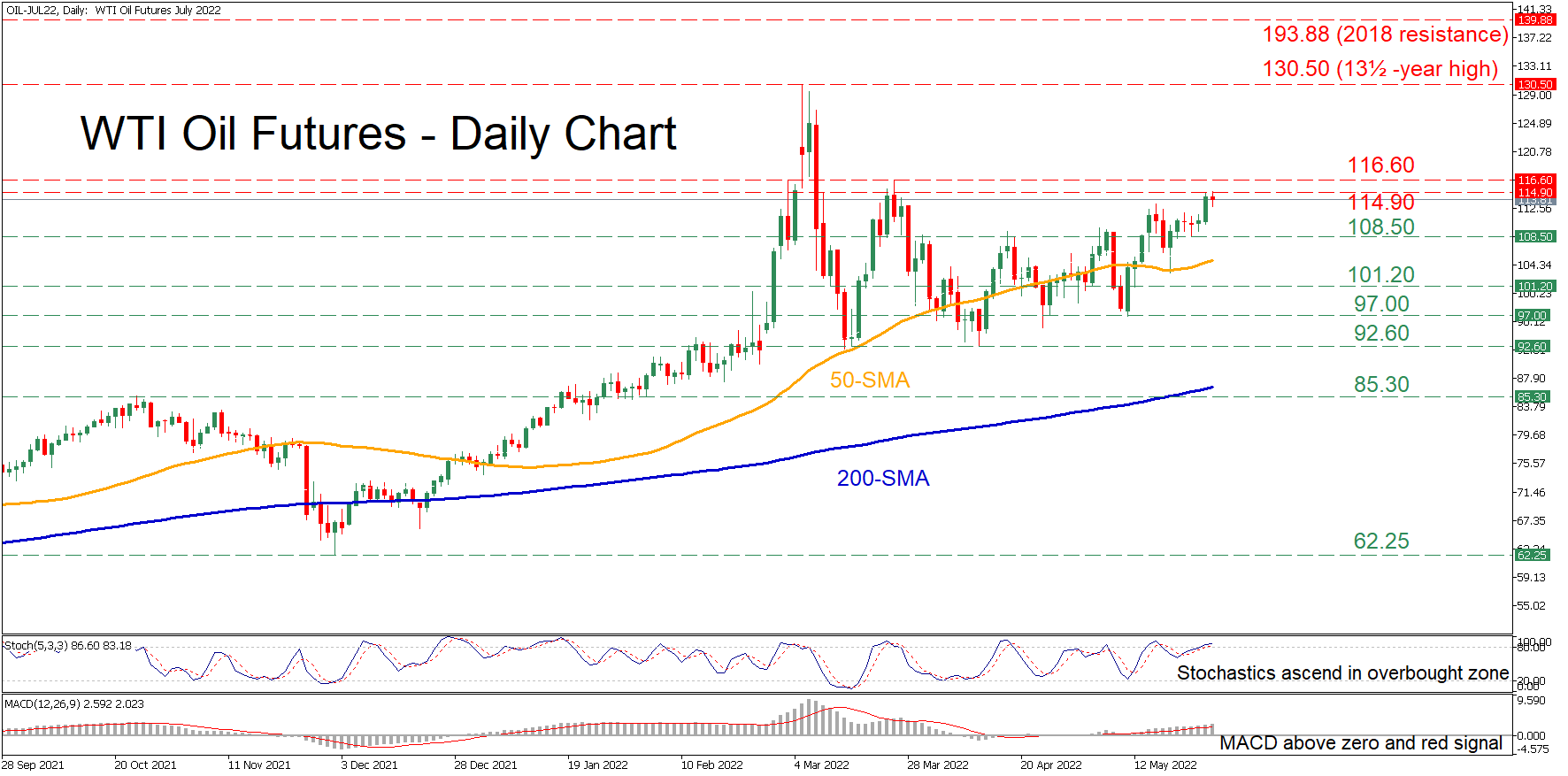
WTI oil futures (July delivery) have been in a sustained uptrend since the 92.60 region rejected any further dip, generating a profound structure of higher highs and higher lows. Moreover, the ascending 50- and 200-day simple moving averages (SMAs) endorse the commodity’s positive bearing.
The momentum indicators suggest that bullish forces are in control. Specifically, the stochastics are charging higher in the overbought zone, while the MACD histogram has crossed above its red signal line in the positive region.
To the upside, immediate resistance could be encountered at the most recent peak of 114.90. Slashing through this region, the price might ascend towards 116.60, a violation of which would pave the way for the 6½-year high of 130.50. Further up, the 2018 resistance of 193.88 could prove a tough obstacle for the bulls to overcome.
Alternatively, should positive bias wane and the price reverse downwards, the 108.50 hurdle could act as the first line of defence. Breaching this region, the spotlight may turn to 101.20 before the 97.00 barricade appears on the radar. Failing to halt there, the bears could then aim at 92.60, which has rejected further declines multiple times in 2022.
In brief, WTI futures appear to have the necessary momentum to resume their long-term upside trajectory. Nevertheless, a break beneath the 92.60 floor could turn its short-term picture back to bearish.
USD/JPY Mid-Day Outlook
Daily Pivots: (S1) 126.56; (P) 127.07; (R1) 127.59; More...
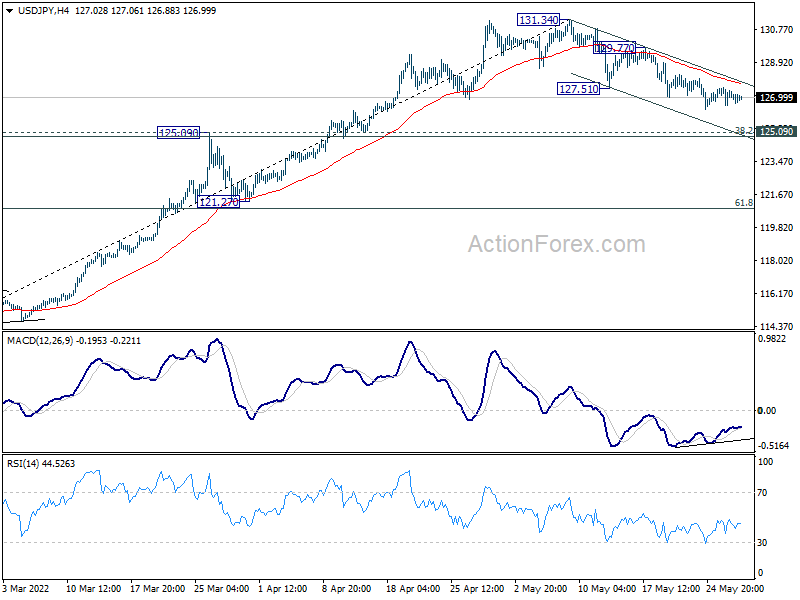
While USD/JPY's correction from 131.34 could extend lower, downside should be contained by 125.09 cluster support (38.2% retracement of 114.40 to 131.34 at 124.86) to bring rebound. On the upside, break of 129.77 minor resistance will suggest that the correction is finished and bring retest of 131.34.
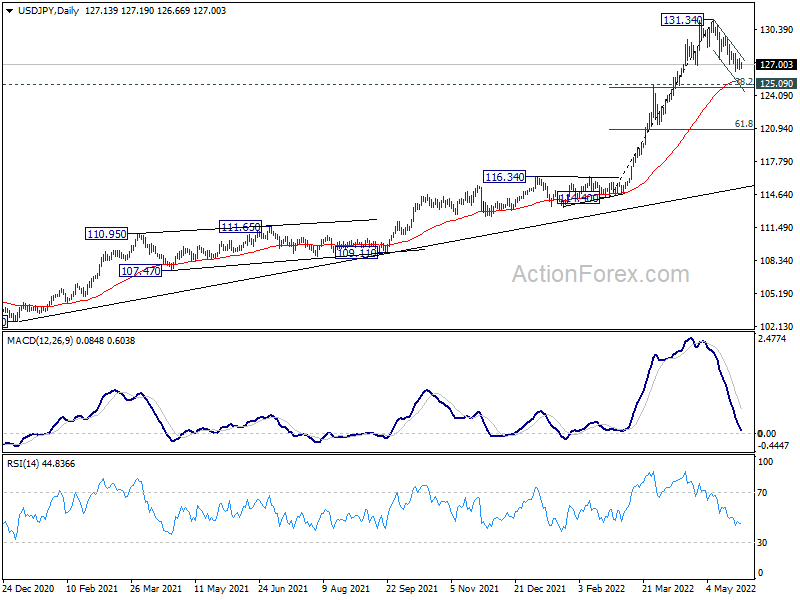
In the bigger picture, current rally is seen as part of the long term up trend form 75.56 (2011 low). Sustained trading above 61.8% projection of 75.56 (2011 low) to 125.85 (2015 high) from 98.97 at 130.04 will pave the way to 100% projection at 149.26, which is close to 147.68 (1998 high). For now, this will remain the favored case as long as 121.27 support holds.
USD/CHF Mid-Day Outlook
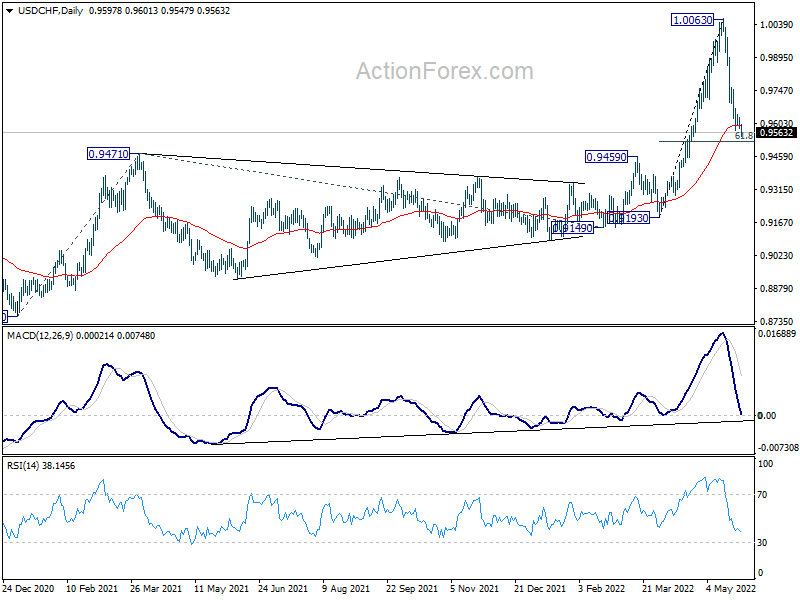
Daily Pivots: (S1) 0.9570; (P) 0.9602; (R1) 0.9620; More...
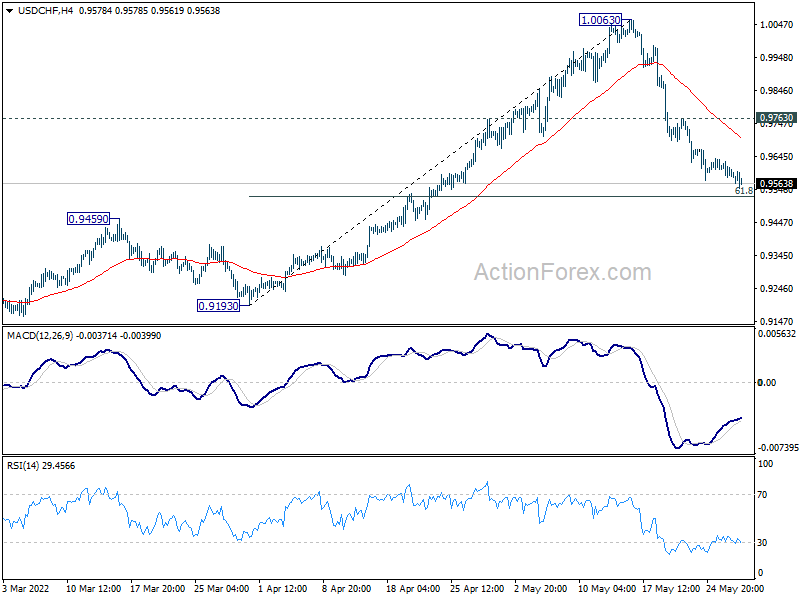
While deeper fall could be seen in USD/CHF, downside should be contained by 61.8% retracement of 0.9193 to 1.0063 at 0.9525 to bring rebound. On the upside, above 0.9763 minor resistance will turn bias back to the upside for recovery. However, sustained break of 0.9525 will bring deeper decline to 0.9459 support.
In the bigger picture, down trend from 1.0342 (2016 high) should have completed with three waves down to 0.8756 (2021 low) already. Rise from 0.8756 is likely a medium term up trend of its own. Next target is 161.8% projection of 0.8756 to 0.9471 from 0.9149 at 1.0306, which is close to 1.0342 (2016 high). This will remain the favored case as long as 0.9459 resistance turned support holds.
GBP/USD Mid-Day Outlook
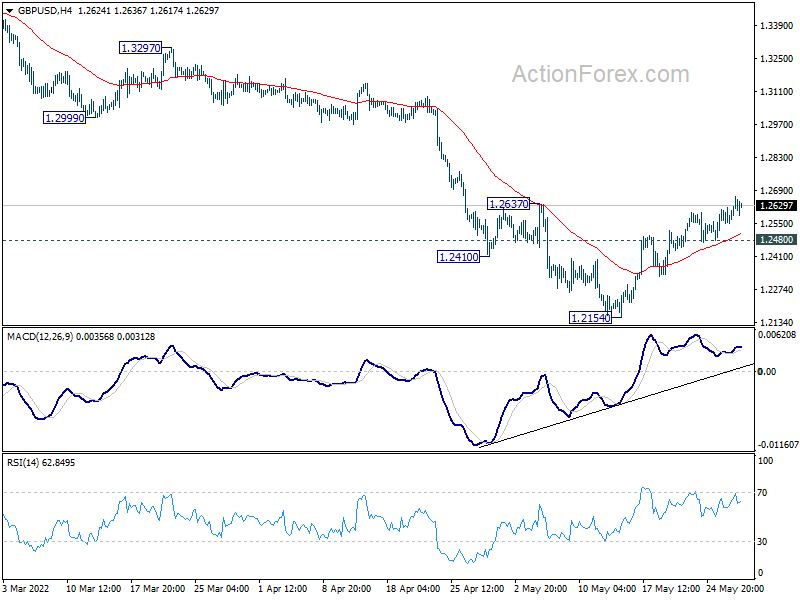
Daily Pivots: (S1) 1.2567; (P) 1.2594; (R1) 1.2636; More...
Intraday bias in GBP/USD remains on the upside at this point. Current rise from 1.2154 would target 55 day EMA (now at 1.2756). Sustained break there will target 1.2999 support turned resistance next. On the downside, though, break of 1.2480 minor support will turn bias back to the downside for retesting 1.2154 low instead.
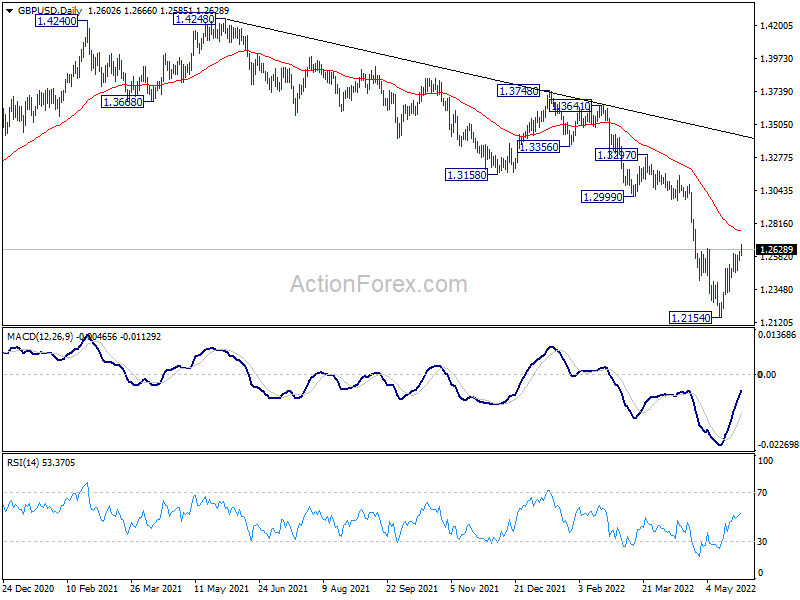
In the bigger picture, based on current momentum, fall from 1.4248 (2018 high) at least at the same degree as the rise from 1.1409 (2020 low). That is, fall from 1.4248 could be a leg inside the pattern from 1.1409, or resuming the longer term down trend. In either case, deeper decline is expected as long as 1.2999 support turned resistance holds. Next target is 1.1409 low.
EUR/USD Mid-Day Outlook
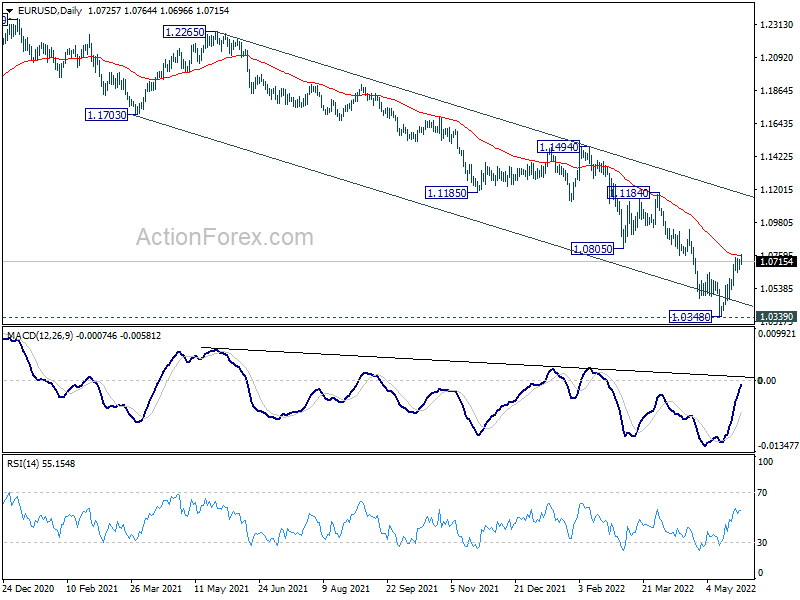
Daily Pivots: (S1) 1.0685; (P) 1.0709 (R1) 1.0755; More...
Intraday bias in EUR/USD stays mildly on the upside, as rebound from 1.0348 is in progress. Firm break of 55 day EMA (now at 1.0758) will target 1.0935 resistance next. On the downside, however, break of 1.641 minor support will turn bias back to the downside for retesting 1.0348 low instead.
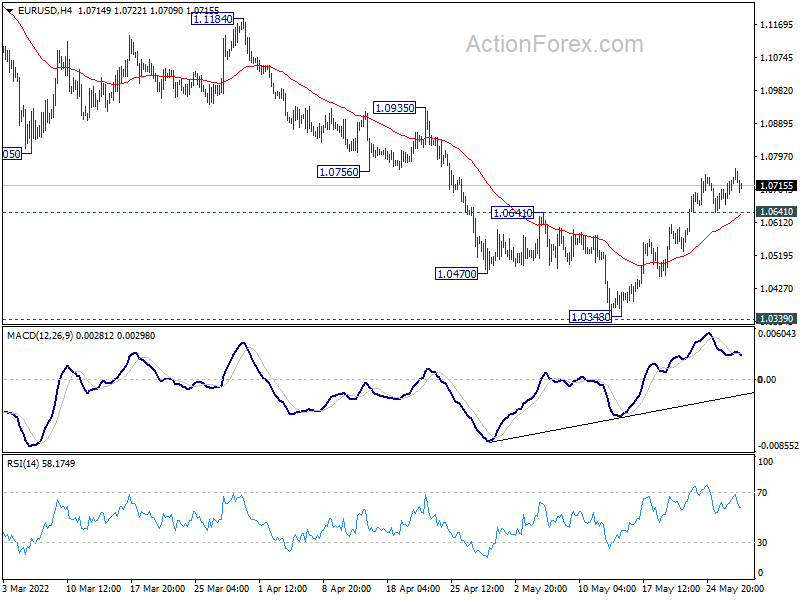
In the bigger picture, focus stays on 1.0339 long term support (2017 low). Decisive break there will resume whole down trend from 1.6039 (2008 high). Next target is 61.8% projection of 1.3993 to 1.0339 from 1.2348 at 1.0090. However, firm break of 1.0805 support turned resistance will delay this bearish case and bring medium term corrective rebound first.
Dollar Pressured as PCE Inflation Slowed, Commodity Currencies Jump
Dollar stays broadly pressured today and it's set to end as the worst performer for the week. PCE data offered some hope that inflation has finally topped. Broad risk sentiment is steady as US stocks could extend rebound in the final session of the week. Benchmark treasury yields are also trading slightly lower. Buying focus has turned to commodity currencies today, as led by Aussie. European majors are also slightly weaker with Yen.
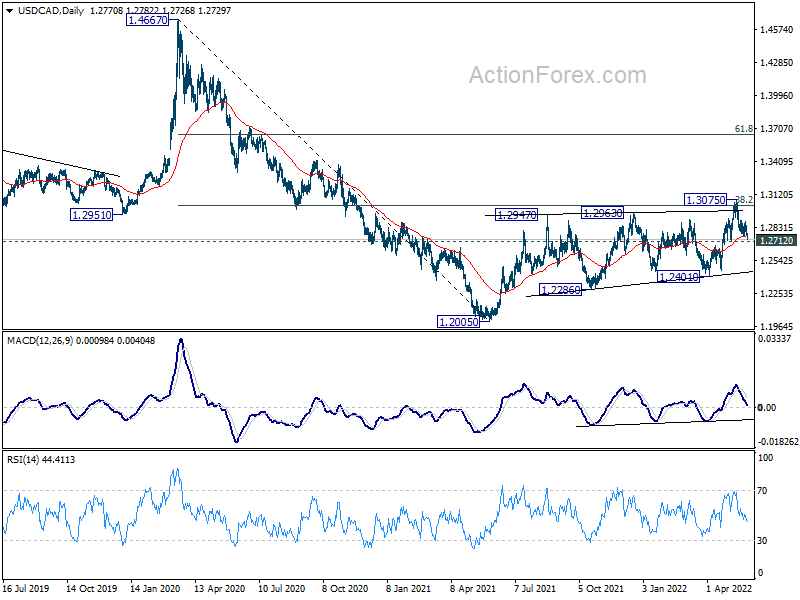
Technically, 1.2712 support in USD/CAD is an immediate focus, as WTI crude oil is also extending rally too. Break of 1.2712 will argue that rise from 1.2401 has completed at 1.3075. More importantly, that came after rejection by 1.3022 long term fibonacci resistance. Deeper fall could be seen back towards 1.2401, and rise the chance that whole rebound from 1.2005 has finished. That, if happens, would be a bad sign for the greenback.
In Europe, at the time of writing, FTSE is up 0.38%. DAX is up 1.01%. CAC is up 1.09%. Germany 10-year yield is down -0.051 at 0.945. Earlier in Asia, Nikkei rose 0.66%. Hong Kong HSI rose 2.89%. China Shanghai SSE rose 0.23%. Japan 10-year JGB yield dropped -0.0053 to 0.230.
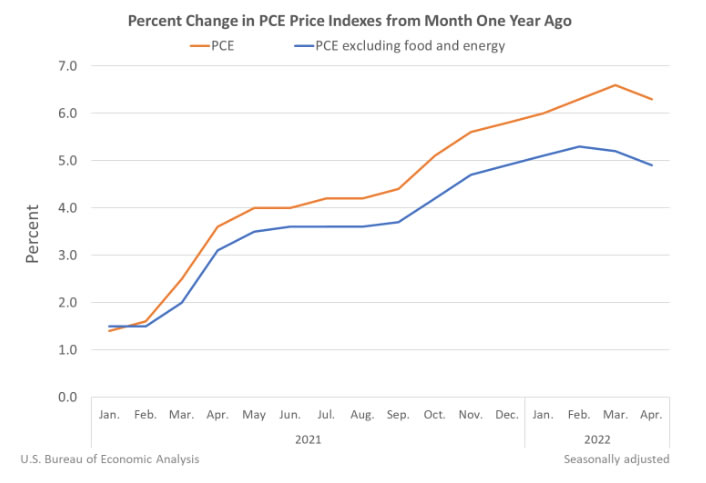
US PCE inflation slowed to 6.3% yoy, core PCE down to 4.9% yoy
US personal income rose 0.5% mom, or USD 89.3B, in April, below expectation of 0.6% mom. Personal spending rose 0.9% mom, or USD 152.3B, above expectation of 0.7% mom.
Headline PCE price index slowed from 6.6% yoy to 6.3% yoy, below expectation of 6.6% yoy. Core PCE price index slowed from 5.2% yoy to 4.9% yoy, matched expectations. Energy prices rose 30.4% yoy while food prices rose 10.0% yoy.
Bundesbank Nagel: We must make the first rates move in July
In a Der Spiegel interview, Bundesbank President Joachim Nagel said, "in our June meeting we must send a clear signal where we're going. From my current perspective, we must then make the first rates move in July and have others follow in the second half of the year."
Earlier this week, ECB President Christine Lagarde has already indicated, "we're moving (deposit rate) very likely into positive territory at the end of the third quarter... When you're out of negative (rates) you can be at zero, you can be slightly above zero. This is something that we will determine on the basis of our projections and … forward guidance."
BoJ Kuroda: Prices won't rise sustainably without wage hikes
BoJ Governor Haruhiko Kuroda told the parliament today that core inflation (all items excluding fresh food) is "likely to remain around 2% for about 12 months", unless energy prices drop sharply.
However, he emphasized that "prices won't rise sustainably, stably unless accompanied by wage hikes." That's seen as in indication that recent rise in inflation is not enough to lead to exit of the ultra-loose monetary policy.
Also from Japan, Tokyo CPI core was unchanged at 1.9% yoy in May, below expectation of 2.0% yoy.
Australia retail sales rose 0.9% mom in Apr, driven by higher food prices
Australia retail sales rose 0.9% mom in April, slightly below expectation of 1.0% mom. For the 12-month period, sales rose 9.6% yoy.
New South Wales was the only state or territory to record a fall, down -0.3%. Queensland had the largest rise in retail turnover, up 1.6%. Turnover also rose in Victoria (1.1%), Western Australia (2.2 %), South Australia (1.4%), Tasmania (2.0%), the Australian Capital Territory (0.5%) and the Northern Territory (0.7%).
ABS said: "The strength in retail turnover is being driven by spending across the food industries. High food prices have combined with increased household spending over the April holiday period as more people are travelling, dining out and holding family gatherings.
EUR/USD Mid-Day Outlook
Daily Pivots: (S1) 1.0685; (P) 1.0709 (R1) 1.0755; More...
Intraday bias in EUR/USD stays mildly on the upside, as rebound from 1.0348 is in progress. Firm break of 55 day EMA (now at 1.0758) will target 1.0935 resistance next. On the downside, however, break of 1.641 minor support will turn bias back to the downside for retesting 1.0348 low instead.
In the bigger picture, focus stays on 1.0339 long term support (2017 low). Decisive break there will resume whole down trend from 1.6039 (2008 high). Next target is 61.8% projection of 1.3993 to 1.0339 from 1.2348 at 1.0090. However, firm break of 1.0805 support turned resistance will delay this bearish case and bring medium term corrective rebound first.
Economic Indicators Update
| GMT | Ccy | Events | Actual | Forecast | Previous | Revised |
|---|---|---|---|---|---|---|
| 23:30 | JPY | Tokyo CPI Core Y/Y May | 1.90% | 2.00% | 1.90% | |
| 01:30 | AUD | Retail Sales M/M Apr | 0.90% | 1.00% | 1.60% | |
| 08:00 | EUR | Eurozone M3 Money Supply Y/Y Apr | 6.00% | 6.30% | 6.30% | |
| 12:30 | USD | Personal Income M/M Apr | 0.40% | 0.60% | 0.50% | |
| 12:30 | USD | Personal Spending Apr | 0.90% | 0.70% | 1.10% | 1.40% |
| 12:30 | USD | PCE Price Index M/M Apr | 0.20% | 0.80% | 0.90% | |
| 12:30 | USD | PCE Price Index Y/Y Apr | 6.30% | 6.60% | 6.60% | |
| 12:30 | USD | Core PCE Price Index M/M Apr | 0.30% | 0.40% | 0.30% | |
| 12:30 | USD | Core PCE Price Index Y/Y Apr | 4.90% | 4.90% | 5.20% | |
| 12:30 | USD | Goods Trade Balance (USD) Apr P | -105.9B | -114.8B | -127.1B | -125.9B |
| 12:30 | USD | Wholesale Inventories Apr P | 2.10% | 2.00% | 2.30% | 2.70% |
| 14:00 | USD | Michigan Consumer Sentiment Index May F | 59.1 | 59.1 |
Dollar: Brief Correction or the Beginning of a Downswing?
The Dollar is continuing its retreat, which started precisely two weeks ago. Over this period, the Dollar Index has retreated 3.5% from the 20-year highs, losing about half of the gains from the last leg of the rally since late March.
And now the big question for investors and traders is whether we see a correction before a new wave of US currency strength or whether the highs reached were a peak for years to come, as they were in 2017 and 2020.
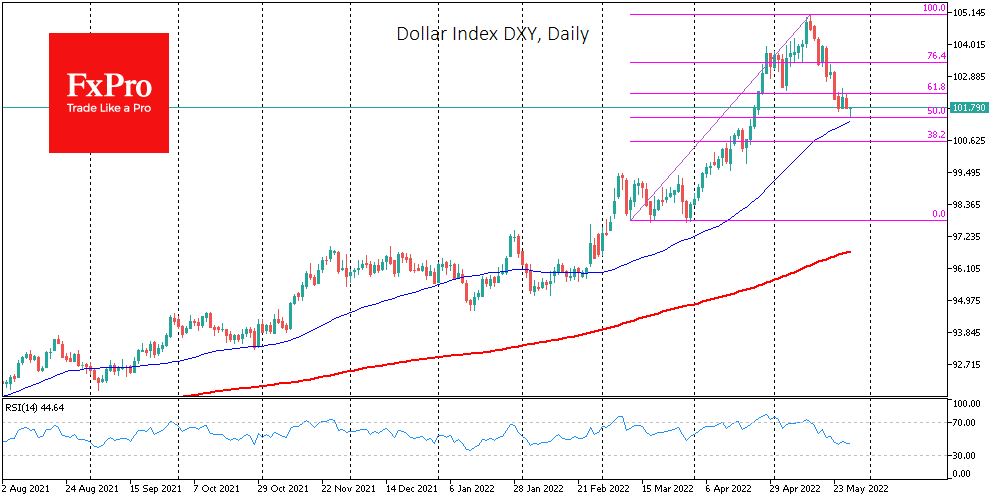
While the picture is mixed, there are more factors in favour that buying the Dollar at current levels is not good.
Many of the major central banks have verbally (Bank of England and ECB) or already actually (RBNZ, Bank of Canada) come out at the pace of the Fed’s rate hikes. Consequently, short-term bond yield spreads, which had driven the demand for the Dollar in the previous few months, are no longer driving the prices.
The latest Fed minutes have indicated a “flexible approach” – a hint of willingness to reduce the pace of rate hikes in the event of economic problems.
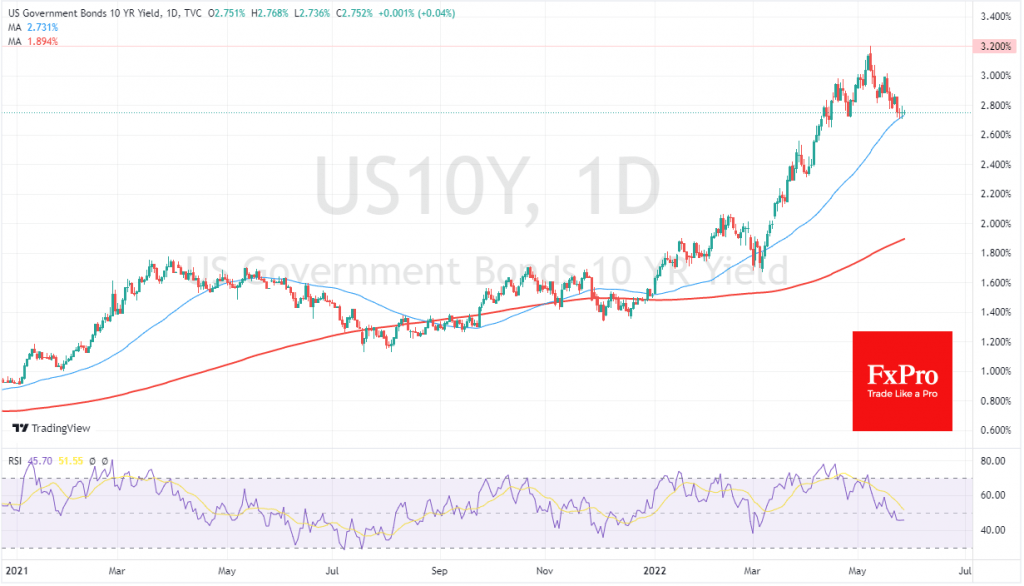
Before the Dollar’s retreat, there was a peak in 10-year Treasury yields, which declined from 3.2% to 2.8%. Yields have been hovering around that level for the last three days, falling back to the 50-day moving average. A pullback below this line could be the first signal of a break in the uptrend. In that case, be prepared for increased pressure on the Dollar.
Elsewhere, there are rumours that China is cutting its more than trillion-euro investments in US Treasuries, following the Russian experience with blocking the Central Bank reserves. However, China may be reducing its holdings for another reason: capital outflows and pressure on the currency due to the economic slowdown.
The current uncertainty in the US debt market and the currency market is likely to resolve in the next few days and has a high chance of sending important signals to all markets, from FX and debt to cryptocurrency and commodities, over the coming weeks or even months.
AUD Hits 3-Week High, Retail Sales Climb
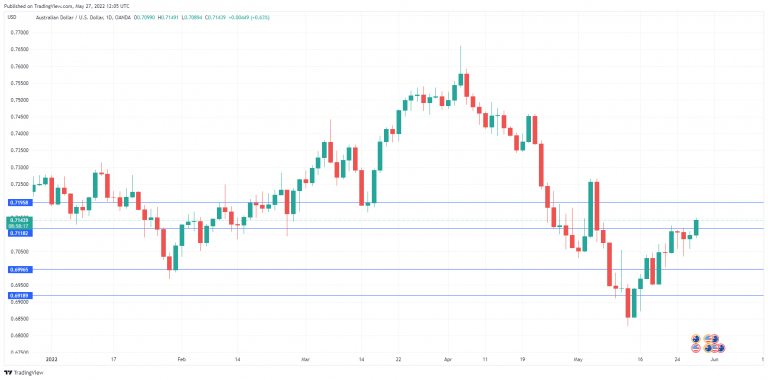
The Australian dollar is showing strong gains today. In the European session, AUD/USD is trading at 0.7145, up 0.66% on the day.
Australia released retail sales earlier today, salvaging what had been a lacklustre week for Australian releases. April retail sales were up 0.9%, just shy of the 1.0% forecast. This marked a fourth straight month of sales gains, which points to resilient consumer spending in the face of rising inflation, which hit 5.1% in the first quarter.
Many businesses are planning to raise prices, raising the concern that inflation is broadly based across the economy. This has raised concerns that consumer spending, although currently on an upswing, will not be sustainable if inflation doesn’t start to ease soon. As well, the RBA, which has embarked a rate-tightening cycle, will have a difficult task reducing inflation and inflation expectations if inflationary pressures are broad-based.
The US economy contracted more than expected in Q1, although market reaction was muted. Second-estimate GDP came in at -1.5% QoQ, shy of the estimate of -1.3% and revised downwards from the initial estimate of -1.4%. Growth in Q1 was hampered by a surge in Omicron as well as the Ukraine war. Investors took the news in stride, and appear to be counting on a rebound in the second quarter. Still, US growth is likely to be moderate and much lower than the sharp expansion we saw after the US economy reopened.
One bright spot was solid consumer spending, which remains strong in the face of spiralling inflation. Consumer spending, as gauged by PCE expenditures, rose 3.1% in Q1, up from 2.7% prior. The markets are keeping a close eye on Personal Spending and Personal Income, which will be released later today. As well the PCE Price Index, which is the Fed’s preferred inflation gauge, will be released later today.
AUD/USD Technical
- 0.7118 is a weak resistance line. Above, there is resistance at 0.7196
- There is support at 0.6996 and 0.6918
US PCE inflation slowed to 6.3% yoy, core PCE down to 4.9% yoy
US personal income rose 0.5% mom, or USD 89.3B, in April, below expectation of 0.6% mom. Personal spending rose 0.9% mom, or USD 152.3B, above expectation of 0.7% mom.
Headline PCE price index slowed from 6.6% yoy to 6.3% yoy, below expectation of 6.6% yoy. Core PCE price index slowed from 5.2% yoy to 4.9% yoy, matched expectations. Energy prices rose 30.4% yoy while food prices rose 10.0% yoy.
Bundesbank Nagel: We must make the first rates move in July
In a Der Spiegel interview, Bundesbank President Joachim Nagel said, "in our June meeting we must send a clear signal where we're going. From my current perspective, we must then make the first rates move in July and have others follow in the second half of the year."
Earlier this week, ECB President Christine Lagarde has already indicated, "we're moving (deposit rate) very likely into positive territory at the end of the third quarter... When you're out of negative (rates) you can be at zero, you can be slightly above zero. This is something that we will determine on the basis of our projections and … forward guidance."