

Sample Category Title
US: Inflation Shows Some Signs of Cresting in April
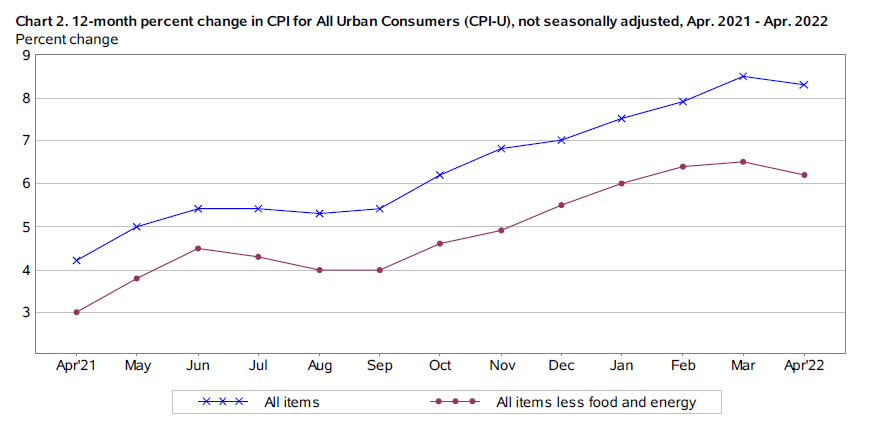
Consumer price inflation decelerated in April, rising by 0.3% month-on-month (m/m) – a meaningful slowdown from March's 1.2% m/m gain. On a year-over-year (y/y) basis, inflation was up 8.3% – down 0.2 percentage points (pp) from March.
After having increased by over 30% in the last twelve months, energy prices fell by 2.7% m/m – largely a result of gasoline prices declining by 6.1% m/m. Conversely, food prices rose 0.9% m/m – the seventeenth month of consecutive increases – and are up 9.4% from year-ago levels.
Core (excludes food and energy) inflation rose 0.6% m/m, which was an acceleration from the 0.3% m/m gain in March. On a year-over-year basis, inflation ticked down 0.3 pp, rising by 6.2% y/y.
Shelter costs matched March's gain, rising 0.5% m/m with the rent index (0.6% m/m), owners' equivalent rent (0.5% m/m) and lodging away from home (1.7% m/m) all notching gains on the month. Looking across other service categories, price growth remained relatively broad-based, with transportation (3.1% m/m), medical (0.5% m/m), and recreation (0.4% m/m) services all up in April. Airfares continued to rise sharply – up a whopping 18.6% m/m.
After having declined in March, core goods prices were higher by 0.2% m/m. This was mainly a result of new vehicle prices rising by 1.1% m/m. Conversely, used vehicle prices (-0.4% m/m), apparel (-0.8% m/m) and education and communication goods (-2.6% m/m) were all lower on the month.
Key Implications
After having steadily increased over the past year, inflationary pressures are finally showing signs of cresting, as both the headline and core measures decelerated when compared to year-ago levels. Indeed, base effects are playing a favorable role, as price pressures stemming from supply chain disruptions first started to manifest in March and April of last year.
The modest pullback in April energy prices will do little to ease the pain that consumers are currently experiencing at the pump. Relative to year-ago levels, gasoline prices are up over 43%, equating to an increase of more than $1.25 per-gallon. To make matters worse, weekly data released by the Energy Information Administration has shown that gasoline prices have already turned meaningfully higher through the first part of May, with the average price of regular grade gasoline surpassing its mid-March high.
The lift in core goods prices in April was entirely due to new vehicle prices. However, the Bureau of Labor Statistics implemented a change in how they track new vehicle prices last month, replacing its own dealership survey-based data with transaction data reported by J.D. Power. The methodology may be contributing some noise to the underlying reading. If we were to abstract from this, core goods prices would have continued to decline in April.
Even though modest, the deceleration in price pressures will come as a welcome development to policymakers. Still, the FOMC has its work cut out for them over the remainder of the year, as they quickly move to swing the monetary pendulum from accommodative to outright restrictive in an effort to guide inflation back to target without causing a recession.
USD/JPY Mid-Day Outlook
Daily Pivots: (S1) 129.97; (P) 130.27; (R1) 130.75; More...
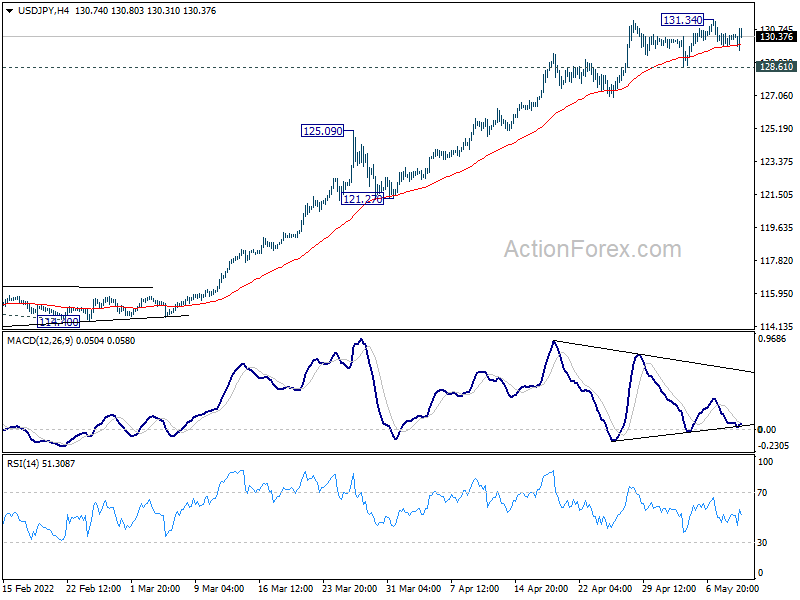
Intraday bias in USD/JPY remains neutral as consolidation from 131.34 is extending. Further is expected as long as 128.61 support holds. Above 131.34 will target 261.8% projection of 109.11 to 116.34 from 114.40 at 133.26. However, firm break of 128.61 will indicate short term topping, and turn bias to the downside for deeper pull back.
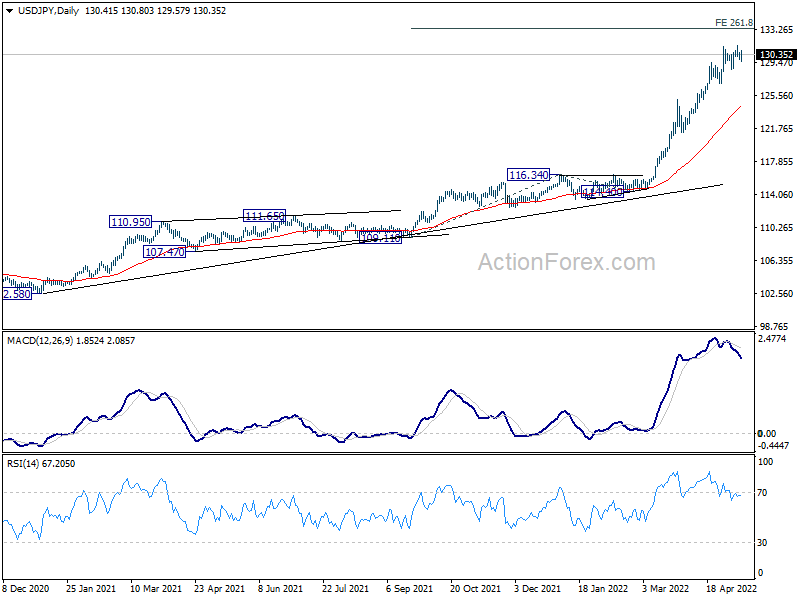
In the bigger picture, current rally is seen as part of the long term up trend form 75.56 (2011 low). Sustained trading above 61.8% projection of 75.56 (2011 low) to 125.85 (2015 high) from 98.97 at 130.04 will pave the way to 100% projection at 149.26, which is close to 147.68 (1998 high). For now, this will remain the favored case as long as 121.27 support holds.
EUR/USD Mid-Day Outlook
Daily Pivots: (S1) 1.0509; (P) 1.0547 (R1) 1.0569; More...
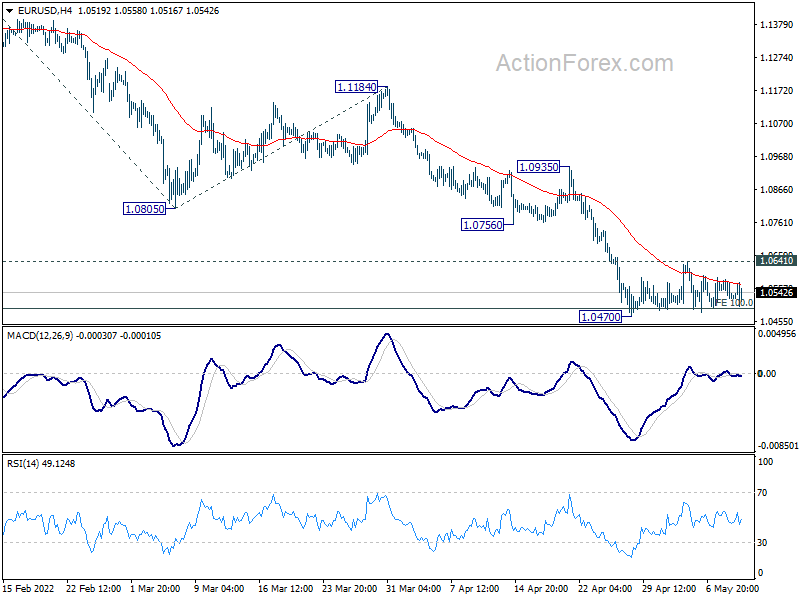
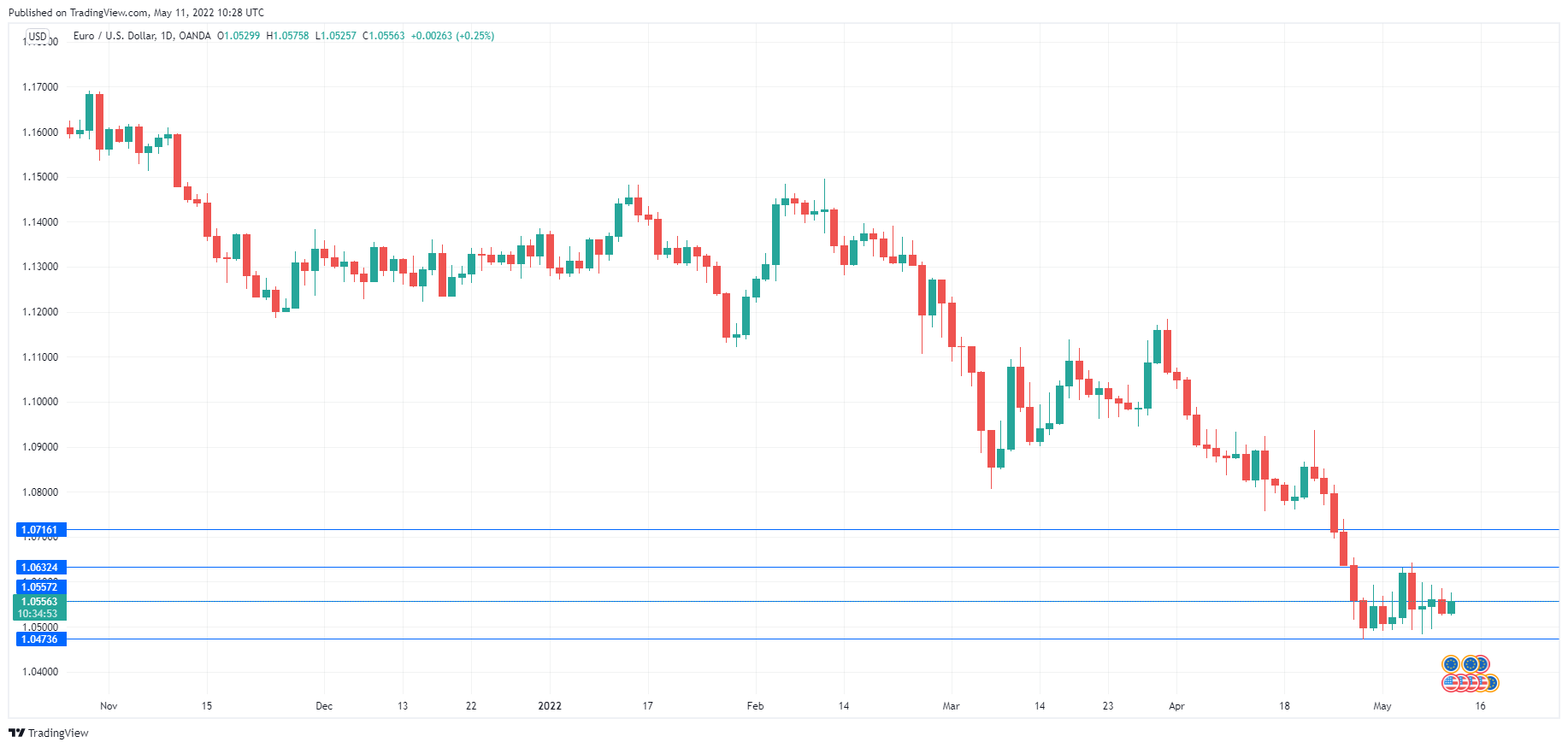
EUR/USD is staying in consolidation above 1.0470 temporary low and intraday bias remains neutral. Further decline is in favor as long as 1.0641 minor resistance holds. Break of 1.0470 will resume larger down trend to 161.8% projection of 1.1494 to 1.0805 from 1.1184 at 1.0069. On the upside, break of 1.0641 will turn bias to bring stronger rebound instead.
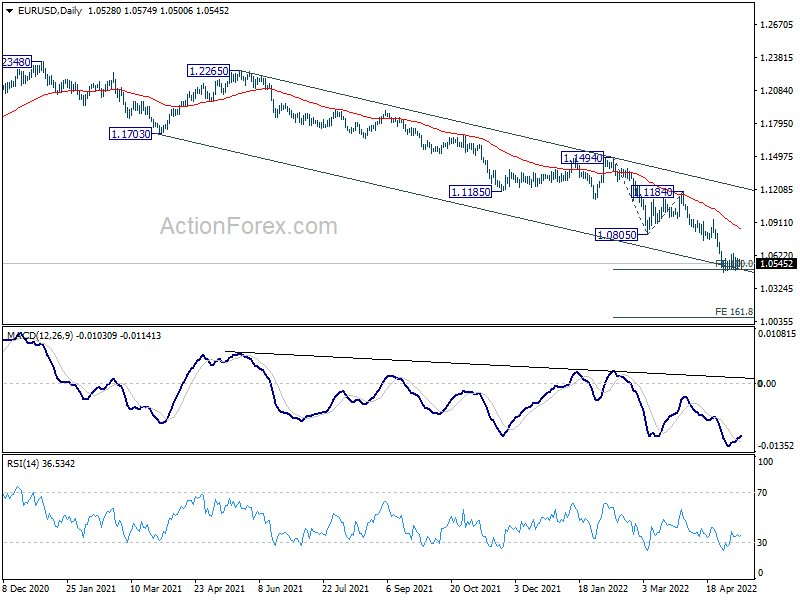
In the bigger picture, the decline from 1.2348 (2021 high) is expected to continue as long as 1.1185 support turned resistance holds. The break of 1.0635 (2020 low) now raises the chance that it's resuming long term down trend from 1.6039 (2008 high). Retest of 1.0339 (2017 low) low should be seen next. Decisive break there will confirm this bearish case.
GBP/USD Mid-Day Outlook
Daily Pivots: (S1) 1.2280; (P) 1.2327; (R1) 1.2363; More...
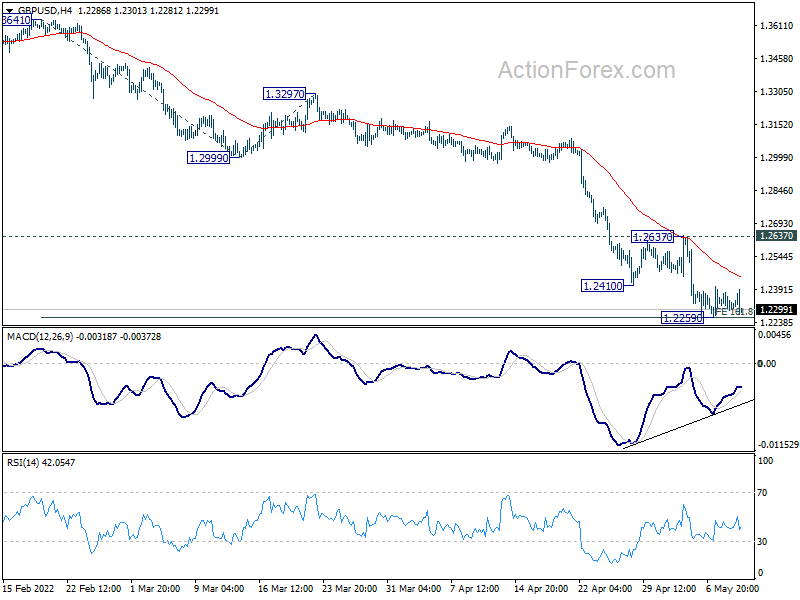
GBP/USD is still bounded in right range above 1.2259 temporary low. Intraday bias remains neutral and some more consolidations could still be seen. In case of another recovery, upside should be limited by 1.2637 resistance to bring fall resumption. On the downside, firm break of 161.8% projection of 1.3641 to 1.2999 from 1.3297 at 1.2258 will extend recent down trend to 200% projection at 1.2013 next.
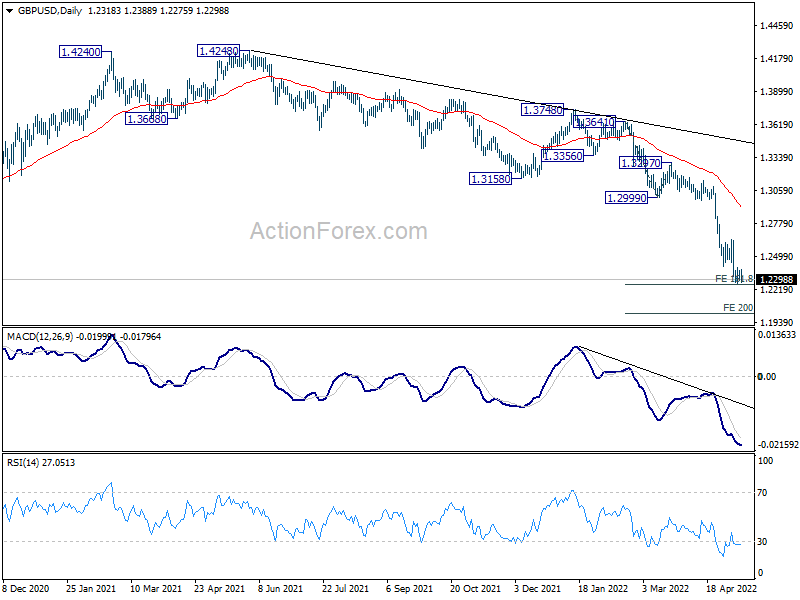
In the bigger picture, based on current momentum, fall from 1.4248 (2018 high) at least at the same degree as the rise form 1.1409 (2020 low). That is, fall from 1.4248 could be a leg inside the pattern from 1.1409, or resuming the longer term down trend. In either case, deeper decline is expected as long as 1.2999 support turned resistance holds. Next target is 1.1409 low.
Dollar Trying to Rally Again after CPI, Euro Shrugs Hawkish ECB
As initial reactions to higher than expected headline and core CPI readings, Dollar is trying to resume its near term advance, which stocks futures are paring gains. The question is how sustainable the rally could be. Euro was rather indifferent to hawkish comments from ECB officials, who continued to talk up the chance of a July ECB hike.
So far, Dollar, Yen and Euro are still the strongest ones for the week. Commodity currencies are the worst performers. The trend will likely continue for a while after US inflation data. Still, Dollar traders will need to make up their mind on whether to bid the greenback up against Euro and Yen. Technically, the levels to watch remain 1.0470 support in EUR/USD and 131.34 resistance in USD/JPY.
In Europe, at the time of writing, FTSE is up 0.28%. DAX is up 0.34%. CAC is up 0.91%. Germany 10-year yield is up 0.077 at 1.083. Earlier in Asia, Nikkei rose 0.18%. Hong Kong HSI rose 0.97%. China Shanghai SSE rose 0.75%. Singapore Strait Times rose 0.75%. Japan 10-year JGB yield rose 0.0004 to 0.248.
US CPI slowed to 8.3% yoy, core CPI down to 6.2% yoy, but food index surged
US headline CPI rose 0.3% mom in April, above expectation of 0.2% mom. CPI core rose 0.6% mom, above expectation of 0.4% mom. Food index rose 0.9% mom. Energy index declined -2.8% mom.
Over the 12-month period, headline CPI slowed from 8.5% yoy to 8.3% yoy, but beat expectation of 8.1% yoy. CPI core slowed from 6.5% yoy to 6.2% yoy, also beat expectation of 6.0% yoy. Food index rose 9.4% yoy, highest since April 1981. Energy index rose 30.3% yoy.
ECB Lagarde: First hike could come only few weeks after early Q3
ECB President Christine Lagarde indicated in a speech that the asset purchases could end "early" in Q3, and interest rate hikes could start "only a few weeks" after that.
"We will end net purchases under the asset purchase programme. Judging by the incoming data, my expectation is that they should be concluded early in the third quarter," she said.
"The first rate hike, informed by the ECB's forward guidance on the interest rates, will take place some time after the end of net asset purchases," she reiterated.
"We have not yet precisely defined the notion of 'some time', but I have been very clear that this could mean a period of only a few weeks. After the first rate hike, the normalisation process will be gradual," she added.
ECB Muller: We may get to positive rate by end of the year
ECB Governing Council member Madis Müller said the central bank could already outline its interest rate expectations for the coming months at the June meeting. He added that the first step is to end asset purchases in early July, but "we could even discuss if we should end purchases a few weeks earlier."
"The real issue is interest rate increases and we shouldn't have much of a delay there either," Müller added. "The recent data confirm that the monetary policy stance is not appropriate given where inflation is and given inflation expectations,"
"Even if we go by 25 basis point increments, we may get to a positive rate by the end of the year. For the time being, 25 basis points would be an appropriate increment."
Separately, another Governing Council member Francois Villeroy de Galhau told France Inter radio today, "I think that from this summer onwards, the ECB will gradually raise its interest rates." The Ukraine war provided a "negative shock" for the French economy. He added, "inflation is the principal concern of companies and citizens."
Another Governing Council member Bostjan Vasle said, "what started as a one-off shock has now become a more broad-based phenomenon. When the circumstances change, the policy response must follow."
Australia Westpac consumer sentiment dropped to 90.4 in May, lowest since Aug 2020
Australia Westpac-MI consumer sentiment index dropped from 95.8 to 90.4 in May. That's the lowest level since August 2020. The reading was also -8.4% below the average seen in 2019. The -5.6% decline was the largest since the -6.9% fall in June 2016.
Looking at some details, family finances for the next 12 months dropped from 105.1 to 93.3. Economic conditions for the next 12 months dropped from 95.9 to 90.4. Unemployment expectations rose from 99.2 to 109.6.
Westpac said two "stunning developments are clearly unnerving consumers". Firstly, headline inflation surged above 5% for the first time since 2007. Secondly, RBA raised interest rate for the first time since 2010.
Regarding RBA policies, Westpac said "having now begun its tightening cycle the Board is almost certain to follow up the move in May with a further move in June". It added, "the need to avoid an over-shoot later in the cycle is why, despite this disturbing tumble in Consumer Sentiment, we believe the prudent approach in June would be to lift rates by 40bps rather than the 25 bps that is currently favoured by most analysts.
GBP/USD Mid-Day Outlook
Daily Pivots: (S1) 1.2280; (P) 1.2327; (R1) 1.2363; More...
GBP/USD is still bounded in right range above 1.2259 temporary low. Intraday bias remains neutral and some more consolidations could still be seen. In case of another recovery, upside should be limited by 1.2637 resistance to bring fall resumption. On the downside, firm break of 161.8% projection of 1.3641 to 1.2999 from 1.3297 at 1.2258 will extend recent down trend to 200% projection at 1.2013 next.
In the bigger picture, based on current momentum, fall from 1.4248 (2018 high) at least at the same degree as the rise form 1.1409 (2020 low). That is, fall from 1.4248 could be a leg inside the pattern from 1.1409, or resuming the longer term down trend. In either case, deeper decline is expected as long as 1.2999 support turned resistance holds. Next target is 1.1409 low.
Economic Indicators Update
| GMT | Ccy | Events | Actual | Forecast | Previous | Revised |
|---|---|---|---|---|---|---|
| 00:30 | AUD | Westpac Consumer Confidence May | -5.60% | -0.90% | ||
| 01:30 | CNY | CPI Y/Y Apr | 2.10% | 1.90% | 1.50% | |
| 01:30 | CNY | PPI Y/Y Apr | 8.00% | 7.80% | 8.30% | |
| 05:00 | JPY | Leading Economic Index Mar P | 101 | 100.4 | 100 | |
| 06:00 | EUR | Germany CPI M/M Apr F | 0.80% | 0.80% | 0.80% | |
| 06:00 | EUR | Germany CPI Y/Y Apr F | 7.40% | 7.40% | 7.40% | |
| 12:30 | USD | CPI M/M Apr | 0.30% | 0.20% | 1.20% | |
| 12:30 | USD | CPI Y/Y Apr | 8.30% | 8.10% | 8.50% | |
| 12:30 | USD | CPI Core M/M Apr | 0.60% | 0.40% | 0.30% | |
| 12:30 | USD | CPI Core Y/Y Apr | 6.20% | 6.00% | 6.50% | |
| 14:30 | USD | Crude Oil Inventories | -1.0M | 1.3M |
US CPI slowed to 8.3% yoy, core CPI down to 6.2% yoy, but food index surged
US headline CPI rose 0.3% mom in April, above expectation of 0.2% mom. CPI core rose 0.6% mom, above expectation of 0.4% mom. Food index rose 0.9% mom. Energy index declined -2.8% mom.
Over the 12-month period, headline CPI slowed from 8.5% yoy to 8.3% yoy, but beat expectation of 8.1% yoy. CPI core slowed from 6.5% yoy to 6.2% yoy, also beat expectation of 6.0% yoy. Food index rose 9.4% yoy, highest since April 1981. Energy index rose 30.3% yoy.
GBP/USD Pair Started a Fresh Decline from $1.2500
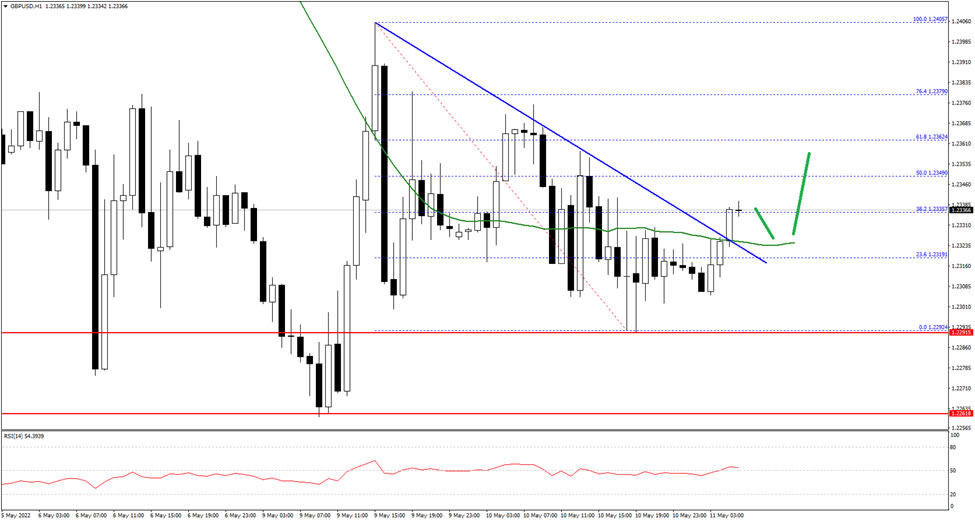
The British Pound started a fresh decline from the 1.2500 resistance against the US Dollar. The GBP/USD pair traded below the 1.2320 support zone, but the bulls appeared near 1.2295 on FXOpen.
A low was formed near 1.2292 and the pair is now correcting higher. It traded above the 1.2320 level and the 50 hourly simple moving average. Besides, there was a move above a bearish trend line at 1.2325 on the hourly chart.
The pair is now facing resistance near the 1.2350 level. If there is a clear upside break above the 1.2350 resistance, the pair could rise steadily towards the 1.2400 level in the near term. The next major resistance sits near the 1.2450 level.
On the downside, an initial support is near the 1.2320 level. The main support is forming near the 1.2300 level. A break below the 1.2300 support could even push the pair below the 1.2280 support.
Inflation on the Mind of NZ Dollar
The New Zealand dollar has posted strong gains on Wednesday. In the European session, NZD/USD is trading at 0.6339, up 0.76% on the day.
NZD/USD has been on a nasty slide, with only one winning session since April 20th. The US dollar has flexed its muscles lately, particularly against risk currencies like the New Zealand dollar. This is a result of rising risk aversion as well as the Fed tightening its monetary policy.
Investors have plenty to worry about on the global scene, with a slowdown in China and the ongoing Ukraine war among the most pressing problems. China has stubbornly stuck to its zero-Covid policy and put massive numbers of residents under lockdown. This has caused a downturn in the Chinese economy and has also spilt over and is causing significant disruptions to global supply chains. China is New Zealand’s largest export market by far, and the deterioration in China’s growth is taking a toll on New Zealand’s economy.
New Zealand, US inflation data next
Inflation has been spiralling in New Zealand. CPI hit 6.9% in Q1, the highest level since 1990. The RBNZ has responded with a series of rate hikes, and the central bank is clearly concerned about inflation expectations becoming embedded. Inflation Expectations have accelerated over seven straight quarters and hit 3.27% in Q1, up from 2.96% in the Q4 of 2020. We’ll get a look at the Q2 data on Thursday – if the upward trend continues, there will be additional pressure on the RBNZ to aggressively raise interest rates.
The US releases April inflation numbers later today. Headline CPI is expected to drop from 8.50% to 8.1%, and Core CPI is forecast to fall from 6.50% to 6.0%. If the estimates prove accurate, I expect to see headlines proclaiming that inflation has peaked. This would seem to be a premature conclusion based on just one reading, but it would increase risk appetite and the US dollar would likely weaken as a result. On the other hand, stronger than expected numbers will likely boost the greenback, on concerns that the Fed could respond with faster tightening.
NZD/USD Technical
- 0.6391 is under strong pressure in support, as NZD/USD is sharply lower. Below, there is support at 0.6325
- There is resistance at 0.6519 and 0.6648
Euro Edges Up, Eyes US Inflation
Lagarde signals a rate hike
ECB President Christine Lagarde spoke today at an event sponsored by the Slovenia Central Bank, but what was of most interest were her remarks on future rate hikes. The ECB remains in dovish mode, but with inflation hitting 7.5% in the eurozone, the ECB will be tightening the monetary screws. More ECB members are publicly urging the central bank to raise rates and in her speech, Lagarde appeared to heed these calls, in her clearest signal yet that a rate hike is coming later in the year.
Lagarde stated that the ECB will end asset purchases under its QE programme, likely in Q3. This will be followed by a rate hike “some time” later. She acknowledged that “some time” was imprecise but added that it could be as little as several weeks. Lagarde added that the normalisation process would be “gradual”, which means investors shouldn’t expect an aggressive rate-hike cycle such as we’re seeing with the Fed and the BoE.
US inflation next
All eyes are on the US inflation report for April. Headline CPI is expected to drop from 8.50% to 8.1%, and Core CPI is forecast to fall from 6.50% to 6.0%. The inflation report is likely to produce a binary outcome. If inflation does drop significantly, as expected, we will see headlines trumpeting that inflation has peaked, and the US dollar will likely lose ground. Conversely, higher numbers than expected will lead to expectations of faster Fed tightening and should give the dollar a boost.
EUR/USD Technical
- 1.0557 remains a weak resistance line, followed by resistance at 1.0632
- There is support at 1.0473 and 1.0398
ECB Lagarde: First hike could come only few weeks after early Q3
ECB President Christine Lagarde indicated in a speech that the asset purchases could end "early" in Q3, and interest rate hikes could start "only a few weeks" after that.
"We will end net purchases under the asset purchase programme. Judging by the incoming data, my expectation is that they should be concluded early in the third quarter," she said.
"The first rate hike, informed by the ECB's forward guidance on the interest rates, will take place some time after the end of net asset purchases," she reiterated.
"We have not yet precisely defined the notion of 'some time', but I have been very clear that this could mean a period of only a few weeks. After the first rate hike, the normalisation process will be gradual," she added..