Sample Category Title
Slumping Euro Drops Below 1.05
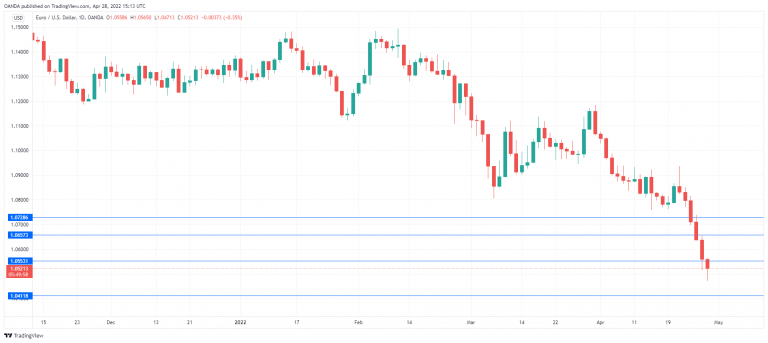
The euro has extended its slide on Thursday and fell as low as 1.0471 in the European session, before clawing back above the 1.05 line.
Wobbly euro extends slide
It has been a nasty ride for the euro, which can’t seem to get a break. EUR/USD is down for a sixth successive day. The euro is struggling at levels not seen since March 2017, and is down over 5 per cent in the month of April. News out of Russia is compounding the currency’s fall. Russia has banned gas exports to Poland and Bulgaria after they refused to pay in Russian roubles, as Moscow continues to weaponize its energy supplies in order to combat sanctions. The plot thickens, with reports that some European energy companies have agreed to pay Russia in roubles. This could be a violation of sanctions and would put those companies on a collision course with their governments and that could spell trouble for the euro.
Aside from the grim news out of Russia, the hawkish Federal Reserve is also weighing on the euro, as the US/Europe rate differential continues to widen. US Treasury yields rose on Thursday, and even a shock contraction in US GDP didn’t stop yields from rising, with the 10-year yield edging higher to 2.85%. The CME’s Fed Watch has pegged the odds of a half-point rate hike at 96%, and the Fed has telegraphed to the markets that more half-point increases are on the table.
With the war in Ukraine showing no signs of ending and the Fed in full throttle, the outlook for the euro looks bleak, with the currency on track to break below 1.03 and perhaps fall to parity.
EUR/USD Technical
- EUR/USD has broken through support at 1.0553. Below, there is support at 1.0411
- There is resistance at 1.0657 and 1.0728
ETHUSD Pauses Retreat But Negative Bias Holds
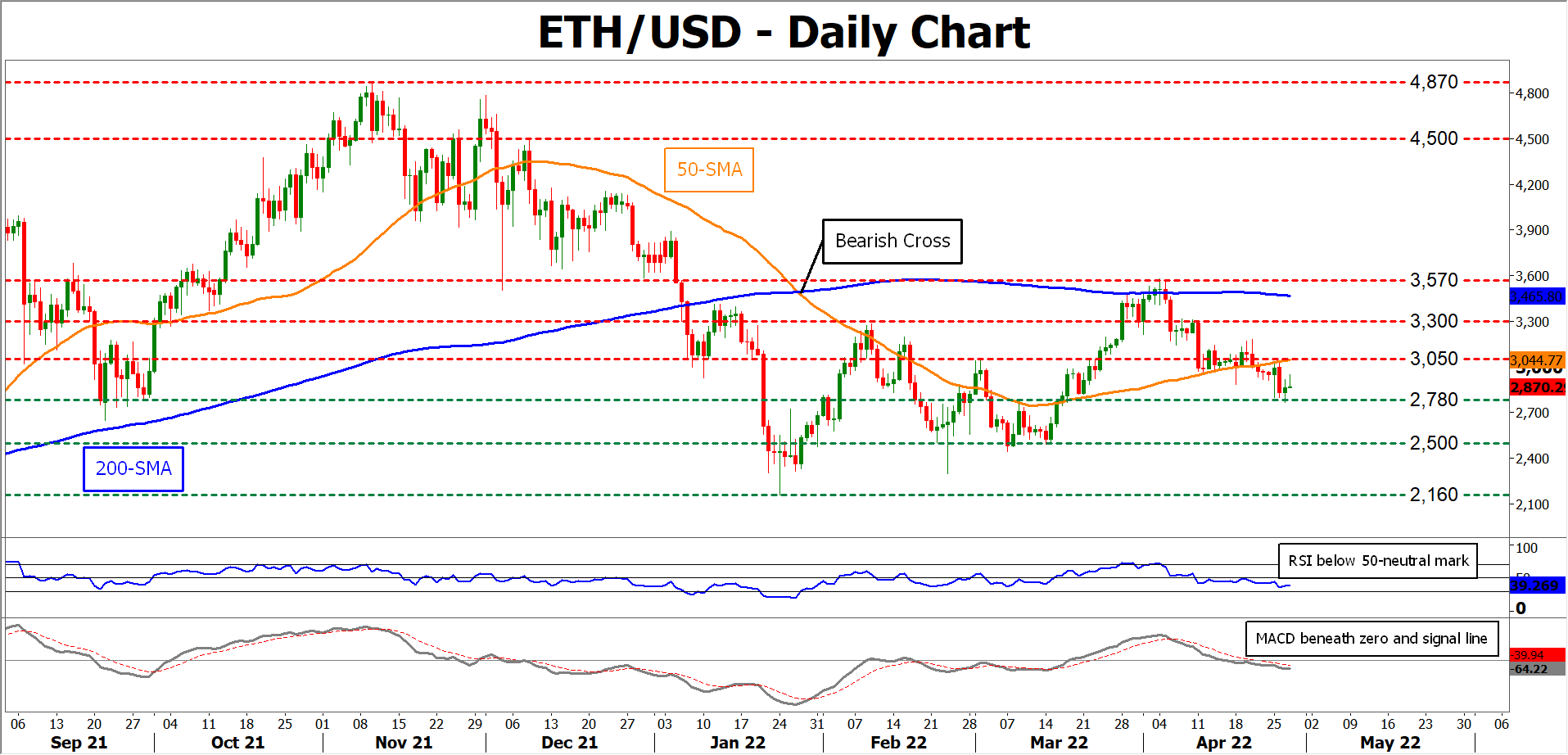
ETHUSD (Ethereum) has been trending downwards since early April when the 3,570 region rejected its upside impetus. Although the cryptocurrency found its feet in the last couple of sessions, it currently appears to be lacking the necessary momentum to storm higher.
The short-term oscillators reflect that the bearish forces are retaining control. The MACD histogram is currently below both zero and its red signal line, while the RSI is hovering beneath its 50-neutral threshold.
Should negative momentum intensify further, the price could challenge the recent low of 2,780. Piercing through this level, the bears might aim for the March strong support region of 2,500. If that floor collapses, further downside moves could reverse at the 2,160 hurdle, which is the lowest price level observed in 2022.
On the flipside, if bullish forces emerge and regain the upper hand, immediate resistance could be met at the 3,050 region, which overlaps with the 200-day simple moving average (SMA). Conquering this barricade, the spotlight may turn to 3,300 before the price tests its recent reversion point of 3,570. A jump above the latter obstacle could pave the way for the 4,500 barrier.
Overall, even if ETHUSD managed to halt its decline, the overall outlook remains bearish. For that negative tone to alter, the price needs to initially jump beyond the 3,050 mark.
Fed Research – Preview: 50bp Rate Hike
Key takeaways
- We expect the Federal Reserve to hike the target range by 50bp, a view shared by consensus and market pricing. We expect the Fed to signal that more 50bp rate hikes are likely in coming months in order to get quicker back to neutral.
- We expect the Fed to announce the balance sheet runoff to start in mid-May. We expect the cap to be set at USD95bn as outlined in the minutes.
- Our current Fed call is that the Fed will hike by 50bp in May, June and July and 25bp in September, November and December (a total of 225bp). We still see risks skewed towards faster rate hikes, as monetary policy remains too accommodative.
- FX: At present, we forecast EUR/USD in 1.05 in 12M and we see downside risks to this estimate.
- FI: We forecast that 10Y UST yields will move above 3% over the next three months. We have a 3.10% six months target.
Sunset Market Commentary
Markets
There’s still no other place to look today, but to the FX market. The trade-weighted dollar gains a big figure, surging from 103 to nearly 104, the highest level since 2002 and coming from 100 only last week. The test of 103.82 (2017) is ongoing. EUR/USD briefly dipped below 1.05 , being lured by the 2017 bottom at 1.0341. The high stakes energy game between the EU and Russia doesn’t help the euro, but isn’t its biggest issue. Price pressure, de-anchored inflation expectations and an ignorant ECB are. Spanish April headline inflation today fell by 0.2% M/M to 8.3% Y/Y from 9.8% Y/Y as electricity prices came off record levels. It shows that the ECB is right that elevated energy would eventually drop out of the equation. The surge in core inflation from 3.4% Y/Y to 4.4% however highlights the cost of sticking to the transitory narrative for too long. A more or less similar story is true for Belgian inflation numbers (see headline). German April inflation still set a new multiyear high in April (despite fuel duty cuts by the government), rising more than forecast by 0.7% M/M from 7.6% Y/Y to 7.8% Y/Y. Markets greet the new batch of inflation numbers with their by now known vote of no confidence in ECB policy. Apart from the weaker euro, long term bond yields rise by 10bps+. The move is entirely due to a new spike in inflation expectations. After the Swedish Riksbank’s sudden U-turn, the ECB in its policy stance is now only flanked by the Swiss National Bank and the Bank of Japan. The latter decided to even add stimulus this morning. By deploying, daily, unlimited bond purchases they want to keep the Japanese 10-yr yield below 0.25% at any cost. The Japanese yen, you guessed it, again lost more than one big figure, trading temporary at 131 against the dollar for the first time since 2002.
The US eco calendar centered around first quarter GDP numbers. GDP unexpectedly declined by 1.4% Q/Qa while consensus expected a slowdown from 6.9% Q/Qa to 1% Q/Qa. Details painted a more optimistic picture as net exports (imports 17.7% Q/Qa vs exports -5.9% Q/Qa) and inventories deducted headline growth by 4 percentage points. Government spending fell as well (-2.7% Q/Qa) pointing to good consumer spending (2.7% Q/Qa according to Commerce department) and business investments (2.3% Q/Qa). US markets didn’t really respond to the GDP print. It in any case won’t derail the Fed’s hawkish plans. The US yield curve flattens with yields rising by 3.2 bps at the front end and ceding 1 bp at the very long end.
News Headlines
Sweden’s Riksbank raised policy rates for the first time since 2019 by 25 bps to 0.25%. The likes of Ingves took a verbal U-turn over the previous weeks but today’s action still came as a surprise to some. High and way above-target inflation will last for some time. The Riksbank seeks to prevent that from entrenching in price and wage-setting by kicking of a rate hike cycle. It will also start the balance sheet roll-off from the second half of this year. Two or (more probable) three more hikes this year are penciled in. At the end of the policy horizon (2025Q2), the policy rate may have risen to <2% but the current state of (inflation) affairs suggest upside risks. The central bank in any case keeps the option of raising rates faster. The Swedish krona initially appreciated to EUR/SEK 10.25 but couldn’t maintain gains (currently trading near 10.34). Short-term swap yields jump 10 bps in the wake of the decision.
Belgian GDP growth slowed from 0.4% q/q to 0.3% in the first three months of the year. Compared to the same period last year, GDP was up 4.6%. Growth in services (0.5%) and construction (0.8%) was partially offset by a decline in the industrial sector (-0.8%), the NBB reported. It may suggest a first impact from the war in Ukraine. Data from Statbel showed consumer inflation stabilized at 8.31% y/y in April with monthly price dynamics slowing from 0.52% to 0.33%. It’s the first time since January 2021 y/y inflation doesn’t accelerate even as the likes of food showed large price jumps again. Core inflation however still quickened from 3.75% to 4.08%. Services inflation also rose from 3.78% to 3.96%.
US: Q1 GDP Contracts, But Domestic Demand Accelerated
Real GDP contracted by 1.4% quarter-over-quarter (q/q) in the first quarter of 2022 – a significant slowdown from Q4's 6.9% (annualized).The reading came in below the consensus forecast, which called for a modest gain to 1.0% q/q.
Consumer spending grew by a healthy 2.7% – up from last quarter's 2.5%. Spending on services (4.3%) and durables (4.1%) were both higher last quarter, while non-durables (-2.5%) fell. COVID sensitive categories of services spending (i.e., transportation & recreation services, food & accommodation and other services) all continued to recover in the first quarter – contributing about a third of the rise in services spending.
Business investment rose 9.2%, led by a strong gain in equipment (15.3%) spending. Intellectual property products (8.1%) was also up on the quarter. Investment in structures (-0.9%) continued to slide – now recording declines in each of the last four quarters.
Residential investment was also higher by 2.1%, as housing construction continued to surprise to the upside through the first quarter.
Government spending fell for the second consecutive quarter, as spending at both the federal (-5.9%) and state & local (-0.9%) level were lower. In terms of federal spending, both defense and non-defense were down.
Imports surged by 17.7% in the first quarter, which came atop a solid 17.9% gain in Q4. Gains were primarily concentrated in the import of goods (20.5%), though service imports (4.1%) were also higher. Conversely, exports fell by 5.6% – entirely the result of goods exports (-9.6%). This led to a significant widening in the trade deficit, resulting in net trade subtracting a meaningful 3.2 percentage points (pp) from headline growth.
After contributing more the 5pp to Q4 GDP growth, inventory investment was down in the first quarter – subtracting 0.8pp from the headline.
Price pressures continued to accelerate in Q1. The core PCE deflator rose 5.2% on a quarter-over-quarter annualized basis – up from 5.0% in Q4.
Key Implications
The advance estimate of first quarter GDP showed that economic growth was weaker than we had anticipated. However, the details show that demand remained much stronger than the headline suggests. Growth was pulled lower by a sharp widening in the trade deficit and a pullback in inventory investment, shaving a combined 4pp from headline growth. Abstracting from this, domestic demand expanded by a healthy 2.6%, a big improvement from its 1.5% pace in the second half of 2021.
Chatter about recession has been building, and the negative print on this morning's GDP is likely to further fan those fears. While the possibility of a 2023 recession can't be ruled out, current momentum in the economy remains too strong for things to suddenly sputter out. The labor market remains as tight as ever, which is manifesting in healthy wage gains helping to partially insulate households from higher food and energy costs. Moreover, recent data points on housing construction, industrial production and durable goods orders all point to continued momentum on the domestic demand front as we move into the second quarter. We look for GDP to rebound to over 2% (annualized) in Q2.
This morning's number will do nothing to dissuade the FOMC from raising interest rates at next week's meeting. We expect the Fed to lift the benchmark rate by 50 basis points (bps), and telegraph another 50bps move at its June meeting – consistent with Fed Chair Powell's recent comments on the importance of "front-end loading" the reduction of monetary stimulus. We also look for the FOMC to give firm guidance with respect to the timing of when they will begin the process of normalizing its balance sheet over the coming months.
Dollar Staying Firm Despite Unexpected US GDP Contraction
Dollar's broad based rally continues into US session. The unexpected contraction of Q1 US GDP might give the greenback a little jitter. But it's unlikely to alter the up trend for now. As for today, Canadian Dollar is the second strongest Yen is the worst performing one on post-BoJ selloff. But Kiwi and Sterling also also weak. Euro and Swiss Fran are mixed together with Aussie.
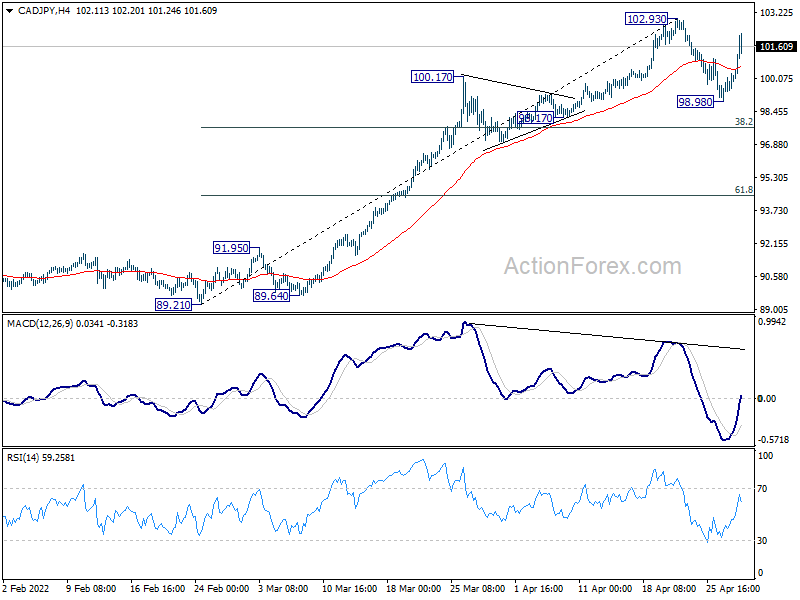
Technically, as Yen is back under pressure, some focus will be on CAD/JPY. The pull back from 102.93 should have completed at 98.98 already. Retest of 102.93 should be seen next and break will resume larger up trend. That could be a sign of more broad based selling in Yen, the should be followed by break of 95.73 high in AUD/JPY and 139.99 high in EUR/JPY.
In Europe, at the time of writing, FTSE is up 0.85%. DAX is up 1.38%. CAC is up 1.22%. Germany 10-year yield is up 0.079 at 0.883. Earlier in Asia, Nikkei rose 1.75%. Hong Kong HSI rose 1.65%. China Shanghai SSE rose 0.58%. Singapore Strait Times rose 0.43%. Japan 10-year JGB yield dropped -0.0307 to 0.219.
US GDP dropped -1.4% annualized in Q1, first contraction since Q2 2020
US GDP unexpectedly contracted -1.4% annualized in Q1, much worse than expectation of 1.1% growth. That's also the first contraction reading since Q2 2020.
The decrease in real GDP reflected decreases in private inventory investment, exports, federal government spending, and state and local government spending, while imports, which are a subtraction in the calculation of GDP, increased. Personal consumption expenditures (PCE), nonresidential fixed investment, and residential fixed investment increased.
US initial jobless claims dropped to 180k, continuing claims down to 1.408m
US initial jobless claims dropped -5k to 180k in the week ending April 23, slightly above expectation of 178k. Four-week moving average of initial claims rose 2k to 180k.
Continuing claims dropped -1k to 1408k in the week ending April 16. That's the lowest level since February 7, 1970, when it was 1397k. Four-week moving average of continuing claims dropped -24.5k to 1455k, lowest since March 14, 1970 when it was 1435k.
ECB de Guindos: Russia invasion casts a dark shadow over Europe
In remarks to a Committee of the European Parliament, ECB Vice President Luis de Guindos said, Russian invasion of Ukraine has "cast a dark shadow over" Europe, as a human tragedy and affecting the economy. Economic activity is expected to continue to growth this year, "albeit at a slower pace than was expected ". The war has "amplified the impact on consumer energy prices".
The surge in energy prices is "reducing demand and raising production costs" while the war is "weighing heavily on business and consumer confidence and has created new bottlenecks." These developments point to slower growth in the period ahead.
Prices increased will "most likely remain high over the coming months". Medium term inflation expectations indicates inflation ares around the 2% target. But, " inflation expectations have been rising in recent months though and initial signs of above-target revisions in those measures warrant close monitoring."
He reiterated that the APP will be concluded in Q3 and changes to interest rates will follow "some time after" the end of the net purchases, and will be "gradual".
BoJ stands pat, maintains dovish bias
BoJ left monetary policy unchanged as widely expected, by 8-1 vote, with dove Goushi Kataoka dissented again. Under the yield curve control framework, short-term policy interest rate is held at -0.10%. 10-year JGB yield target is kept at around 0%, without upper limit on JGB purchases. BoJ also clarified that it will offer to purchase 10-year JGBs at 0.25$ every business day through fixed-rate purchase operations.
The central bank also reiterated that it will "expanding the monetary base until the year-on-year rate of increase in the observed consumer price index (CPI, all items less fresh food) exceeds 2 percent and stays above the target in a stable manner."
It also pledged that it "will not hesitate to take additional easing measures if necessary; it also expects short- and long-term policy interest rates to remain at their present or lower levels."
In the new economic projections, GDP is forecast to grow:
- 2.9% in fiscal 2022 (revised down from 3.8%)
- 1.9% in fiscal 2023 (revised up from 1.1%)
- 1.1% in fiscal 2024 (new).
CPI (all items less fresh food) is expected to be at:
- 1.9% in fiscal 2022 (revised up from 1.1%).
- 1.1% in fiscal 2023 (unchanged).
- 1.1% in fiscal 2024 (new).
Also released from Japan, industrial production rose 0.3% mom in March, below expectation of 0.5% mom. Retail sales rose 0.9% yoy in march, below expectation of 0.4% yoy.
New Zealand ANZ business confidence ticked down to -42 in Apr
New Zealand ANZ business confidence dropped slightly from -41.9 to -42.0 in April. Own activity outlook rose from 3.3 to 8.0. Export intentions rose from 7.9 to 9.5. Investment intentions dropped from 5.2 to 3.1. Employment intentions dropped from 12.3 to 9.4. Cost expectations dropped from 95.9 to 95.5. Inflation expectations rose further from 5.51 to 5.92.
ANZ said: "With plenty of wage and other cost inflation in the pipeline, it'll be some time before the RBNZ can conclude that they're getting ahead of the inflation game. We continue to expect another 50bp hike in May, and steady 25bp increases thereafter taking the OCR to a peak of 3.5%."
NZ goods exports rose 17% yoy in Mar, imports rose 25% yoy
New Zealand goods exports rose 17% yoy to NZD 6.7B in March. Goods imports rose 25% yoy to NZD 7.1B. Trade balance was a deficit of NZD -392m, versus expectation of NZD -648m.
As a result of the monthly deficit in March 2022, the annual goods trade deficit has further widened to reach NZD -9.1B for the March 2022 year.
USD/CHF Mid-Day Outlook
Daily Pivots: (S1) 0.9635; (P) 0.9669; (R1) 0.9722; More....
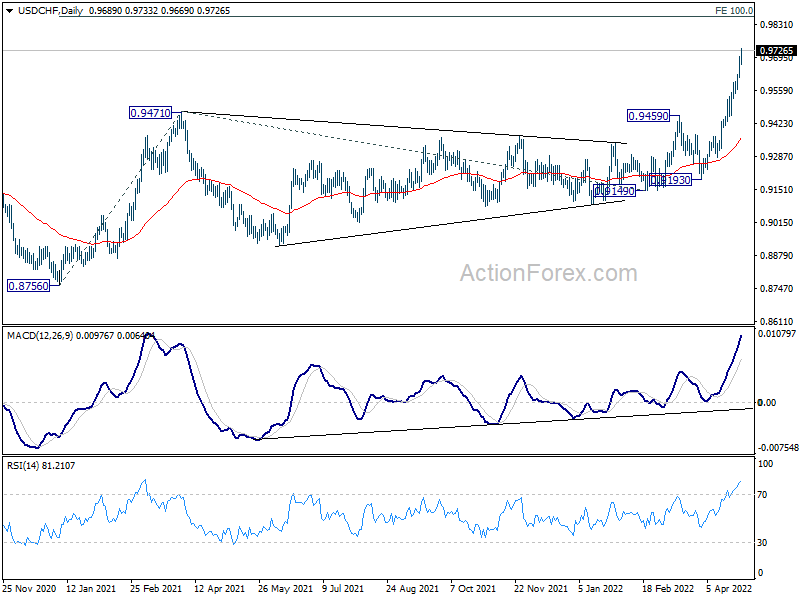
USD/CHF's rally continues today and intraday bias remains on the upside. Current up trend should target next medium term projection level at 0.9864. On the downside, below 0.9669 minor support will turn intraday bias neutral and bring consolidations. But downside of retreat should be contained above 0.9459 resistance turned support to bring another rally.
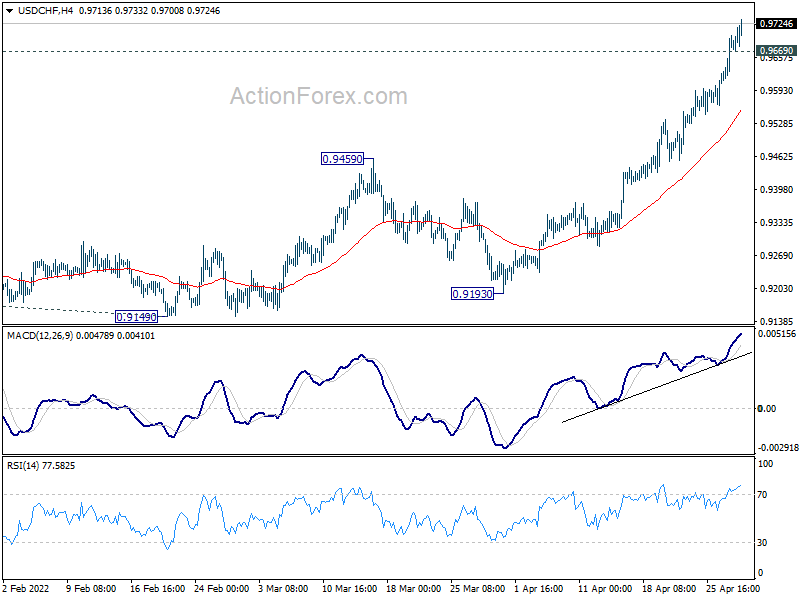
In the bigger picture, down trend from 1.0342 (2016 high) should have completed with three waves down to 0.8756 (2021 low) already. Rise from 0.8756 is likely a medium term up trend of its own. Next target is 100% projection of 0.8756 to 0.9471 from 0.9149 at 0.9864. This will now remain the favored case as long as 0.9459 resistance turned support holds.
Economic Indicators Update
| GMT | Ccy | Events | Actual | Forecast | Previous | Revised |
|---|---|---|---|---|---|---|
| 22:45 | NZD | Trade Balance (NZD) Mar | -392M | -648M | -385M | -691M |
| 23:50 | JPY | Industrial Production M/M Mar P | 0.30% | 0.50% | 2.00% | |
| 23:50 | JPY | Retail Trade Y/Y Mar | 0.90% | 0.40% | -0.80% | -0.90% |
| 01:00 | NZD | ANZ Business Confidence Apr | -42 | -41.9 | ||
| 01:30 | AUD | Import Price Index Q/Q Q1 | 5.10% | 7.10% | 5.80% | |
| 03:00 | JPY | BoJ Interest Rate Decision | -0.10% | -0.10% | -0.10% | |
| 05:00 | JPY | Housing Starts Y/Y Mar | 6.00% | -0.50% | 6.30% | |
| 08:00 | EUR | ECB Economic Bulletin | ||||
| 12:00 | EUR | Germany CPI M/M Apr P | 0.80% | 1.70% | 2.50% | |
| 12:00 | EUR | Germany CPI Y/Y Apr P | 7.40% | 7.30% | 7.30% | |
| 12:30 | USD | Initial Jobless Claims (Apr 22) | 180K | 178K | 184K | 185K |
| 12:30 | USD | GDP Annualized Q1 P | -1.40% | 1.00% | 6.90% | |
| 12:30 | USD | GDP Price Index Q1 P | 8.00% | 6.00% | 7.10% | |
| 14:30 | USD | Natural Gas Storage | 39B | 53B |
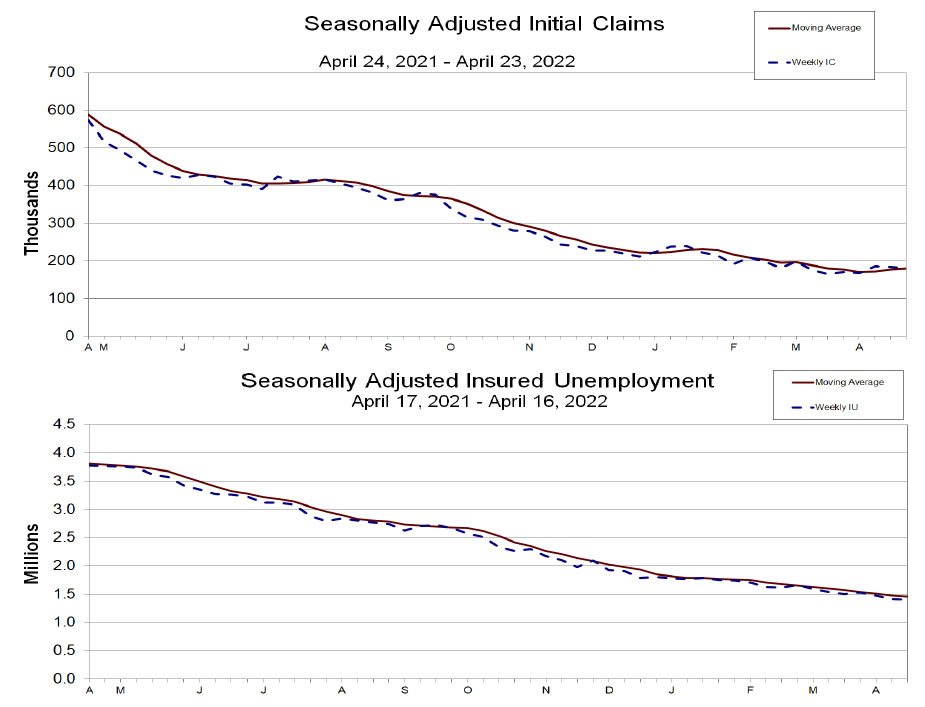
US initial jobless claims dropped to 180k, continuing claims down to 1.408m
US initial jobless claims dropped -5k to 180k in the week ending April 23, slightly above expectation of 178k. Four-week moving average of initial claims rose 2k to 180k.
Continuing claims dropped -1k to 1408k in the week ending April 16. That's the lowest level since February 7, 1970, when it was 1397k. Four-week moving average of continuing claims dropped -24.5k to 1455k, lowest since March 14, 1970 when it was 1435k.
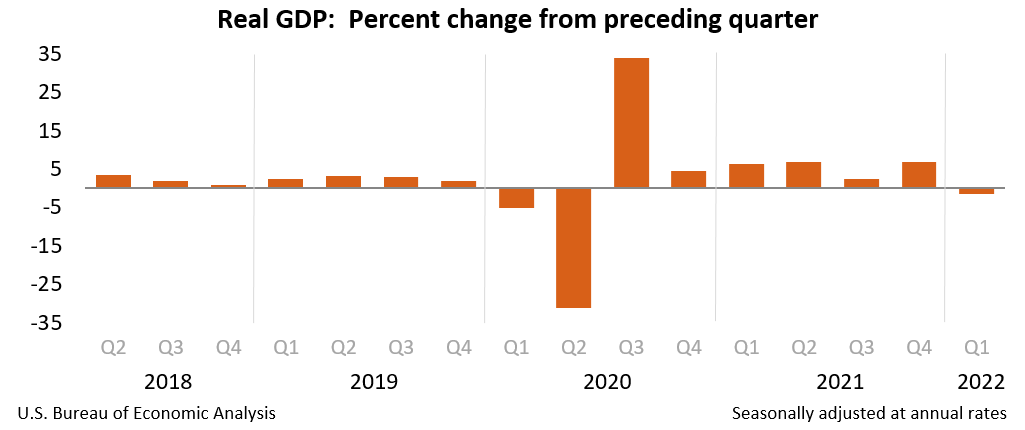
US GDP dropped -1.4% annualized in Q1, first contraction since Q2 2020
US GDP unexpectedly contracted -1.4% annualized in Q1, much worse than expectation of 1.1% growth. That's also the first contraction reading since Q2 2020.
The decrease in real GDP reflected decreases in private inventory investment, exports, federal government spending, and state and local government spending, while imports, which are a subtraction in the calculation of GDP, increased. Personal consumption expenditures (PCE), nonresidential fixed investment, and residential fixed investment increased.
GBP/JPY Mid-Day Outlook
Daily Pivots: (S1) 160.04; (P) 160.72; (R1) 161.78; More...
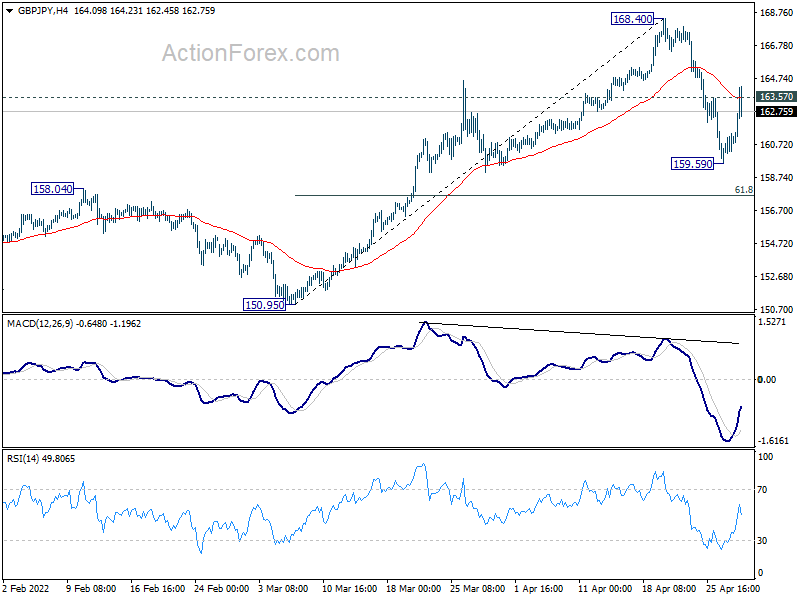
GBP/JPY's break of 163.67 minor resistance suggests that pull back from 168.40 has completed at 159.59 already. Intraday bias is back on the upside for retesting 168.40 first. Firm break there will resume larger up trend. On the downside, in case of another fall, downside should be contained by 61.8% retracement of 150.95 to 168.40 at 157.61 to bring rebound.
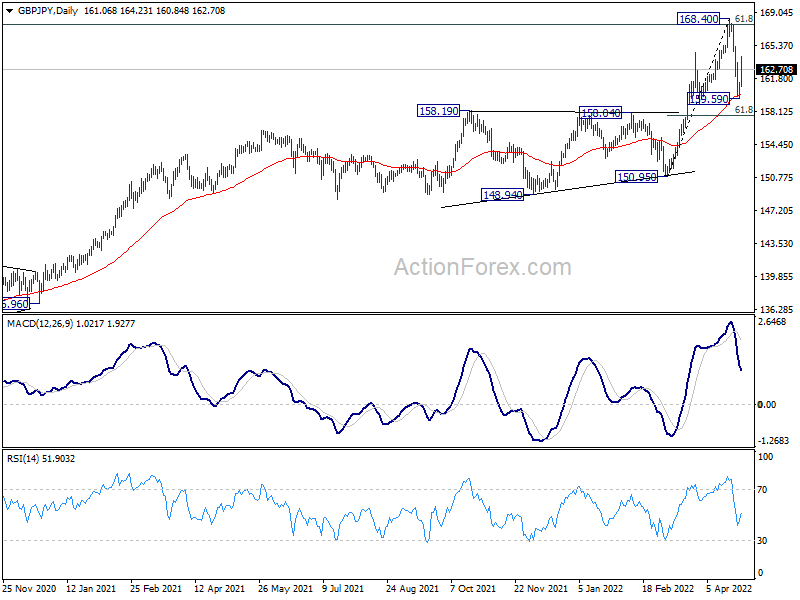
In the bigger picture, up trend from 123.94 (2020 low) is still in progress. Sustained break of 61.8% retracement of 195.86 (2015 high) to 122.75 (2016 low) at 167.93 will be a long term bullish signal, and could pave the way back to 195.86 high. This will now remain the favored case as long as 150.95 support holds, even in case of deep pull back.
EUR/JPY Mid-Day Outlook
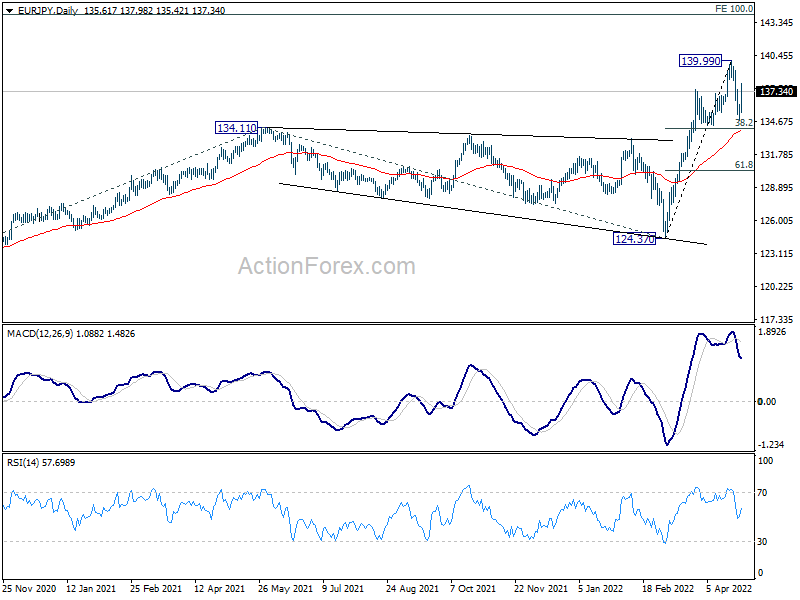
Daily Pivots: (S1) 134.89; (P) 135.53; (R1) 136.26; More....
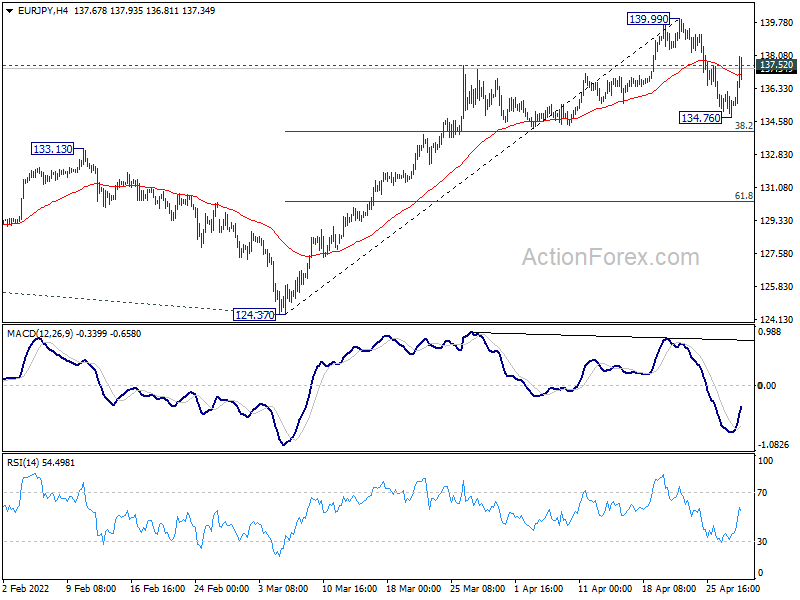
EUR/JPY's break of 137.52 minor resistance argues that pull back from 139.99 has completed at 134.76 already. Intraday bias is back on the upside for retesting 139.99 high first. Firm break there will resume larger up trend. In the downside, in case of another fall, downside should be contained by 38.2% retracement of 124.37 to 139.99 at 134.02 to bring rebound.
In the bigger picture, up trend from 114.42 (2020 low) is in progress. Such rise is seen as the third leg of the pattern from 109.30 (2016 low). Next target will be 100% projection of 114.42 to 134.11 from 124.37 at 144.06. In any case, outlook will now remain bullish as long as 124.37 support holds, in case of deep pull back.