Sample Category Title
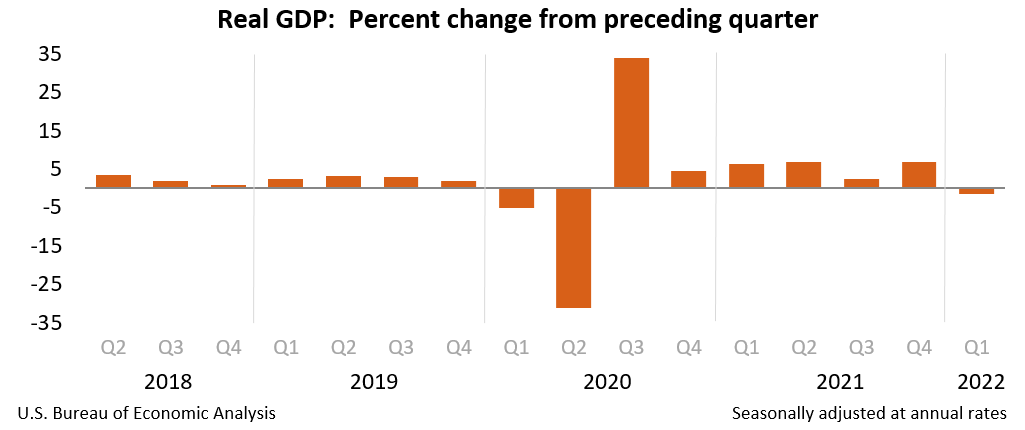
US GDP dropped -1.4% annualized in Q1, first contraction since Q2 2020
US GDP unexpectedly contracted -1.4% annualized in Q1, much worse than expectation of 1.1% growth. That's also the first contraction reading since Q2 2020.
The decrease in real GDP reflected decreases in private inventory investment, exports, federal government spending, and state and local government spending, while imports, which are a subtraction in the calculation of GDP, increased. Personal consumption expenditures (PCE), nonresidential fixed investment, and residential fixed investment increased.
GBP/JPY Mid-Day Outlook
Daily Pivots: (S1) 160.04; (P) 160.72; (R1) 161.78; More...
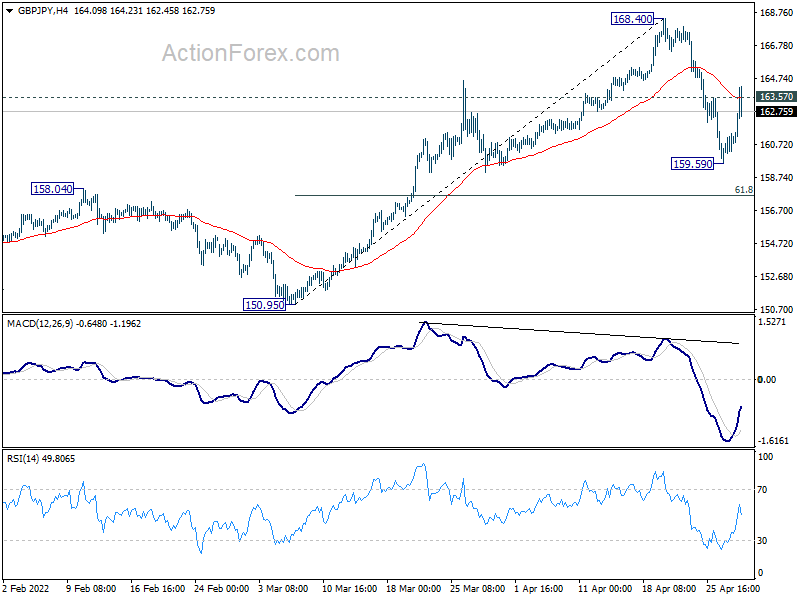
GBP/JPY's break of 163.67 minor resistance suggests that pull back from 168.40 has completed at 159.59 already. Intraday bias is back on the upside for retesting 168.40 first. Firm break there will resume larger up trend. On the downside, in case of another fall, downside should be contained by 61.8% retracement of 150.95 to 168.40 at 157.61 to bring rebound.
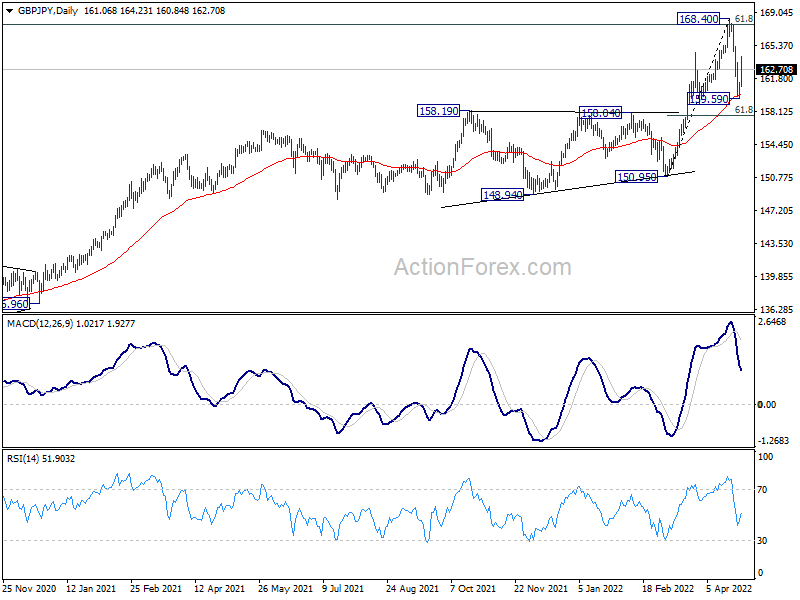
In the bigger picture, up trend from 123.94 (2020 low) is still in progress. Sustained break of 61.8% retracement of 195.86 (2015 high) to 122.75 (2016 low) at 167.93 will be a long term bullish signal, and could pave the way back to 195.86 high. This will now remain the favored case as long as 150.95 support holds, even in case of deep pull back.
EUR/JPY Mid-Day Outlook
Daily Pivots: (S1) 134.89; (P) 135.53; (R1) 136.26; More....
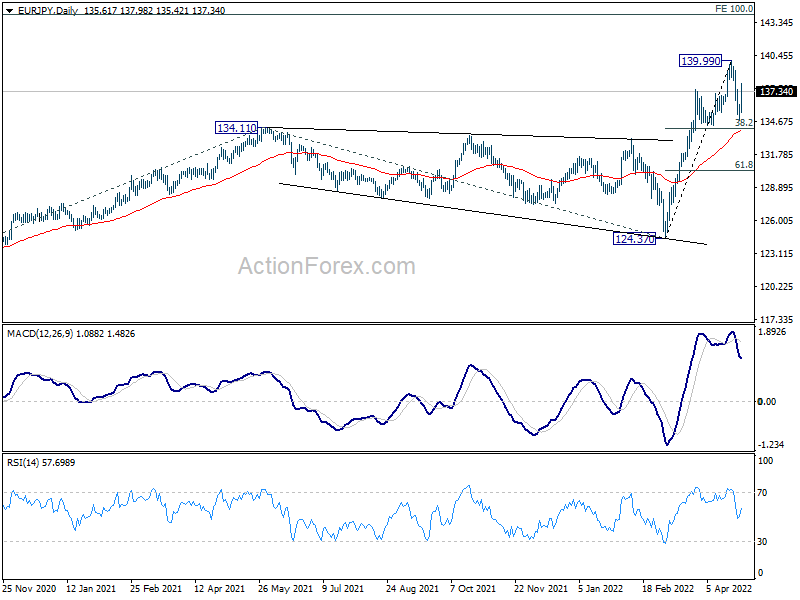
EUR/JPY's break of 137.52 minor resistance argues that pull back from 139.99 has completed at 134.76 already. Intraday bias is back on the upside for retesting 139.99 high first. Firm break there will resume larger up trend. In the downside, in case of another fall, downside should be contained by 38.2% retracement of 124.37 to 139.99 at 134.02 to bring rebound.
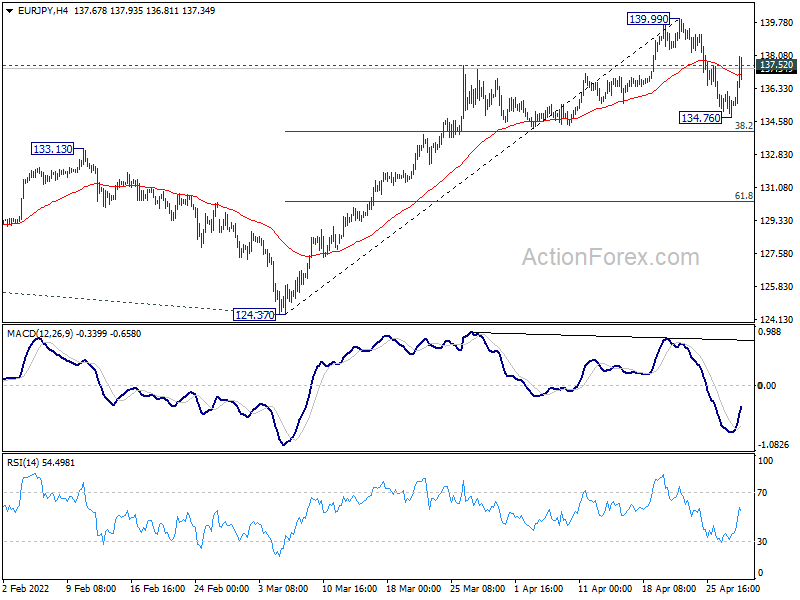
In the bigger picture, up trend from 114.42 (2020 low) is in progress. Such rise is seen as the third leg of the pattern from 109.30 (2016 low). Next target will be 100% projection of 114.42 to 134.11 from 124.37 at 144.06. In any case, outlook will now remain bullish as long as 124.37 support holds, in case of deep pull back.
EUR/USD Mid-Day Outlook
Daily Pivots: (S1) 1.0498; (P) 1.0577 (R1) 1.0638; More...
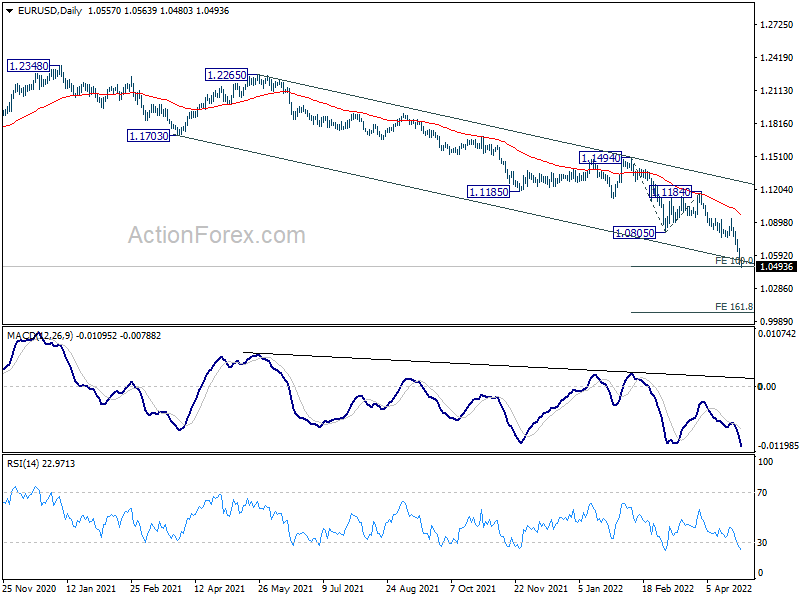
EUR/USD's decline is still in progress and intraday bias remains neutral. Sustained break of 100% projection of 1.1494 to 1.0805 from 1.1184 at 1.0495 will pave the way to 161.8% projection at 1.0069. On the upside, above 1.0654 minor resistance will turn bias neutral and bring consolidations. But upside should be limited by 1.0756 support turned resistance to bring fall resumption.
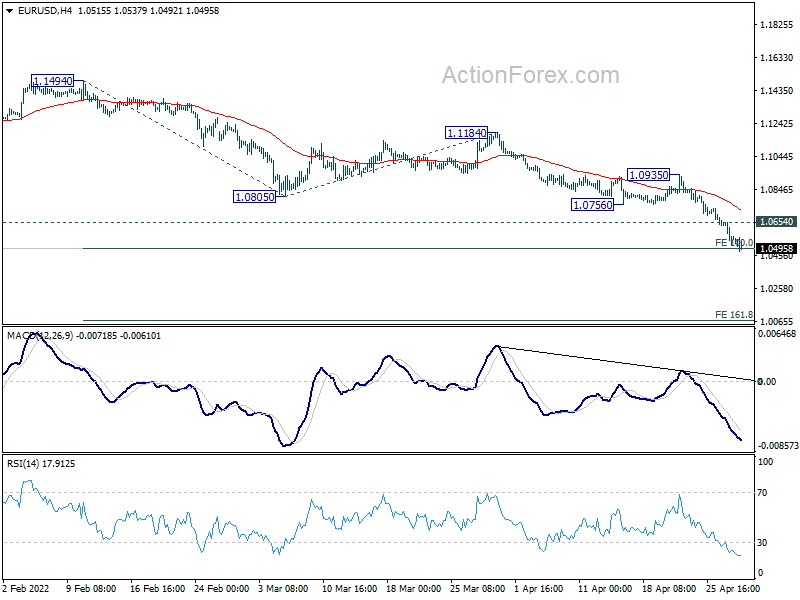
In the bigger picture, the decline from 1.2348 (2021 high) is expected to continue as long as 1.1185 support turned resistance holds. The break of 1.0635 (2020 low) now raises the chance that it's resuming long term down trend from 1.6039 (2008 high). Retest of 1.0339 (2017 low) low should be seen next. Decisive break there will confirm this bearish case.
GBP/USD Mid-Day Outlook
Daily Pivots: (S1) 1.2499; (P) 1.2550; (R1) 1.2598; More...
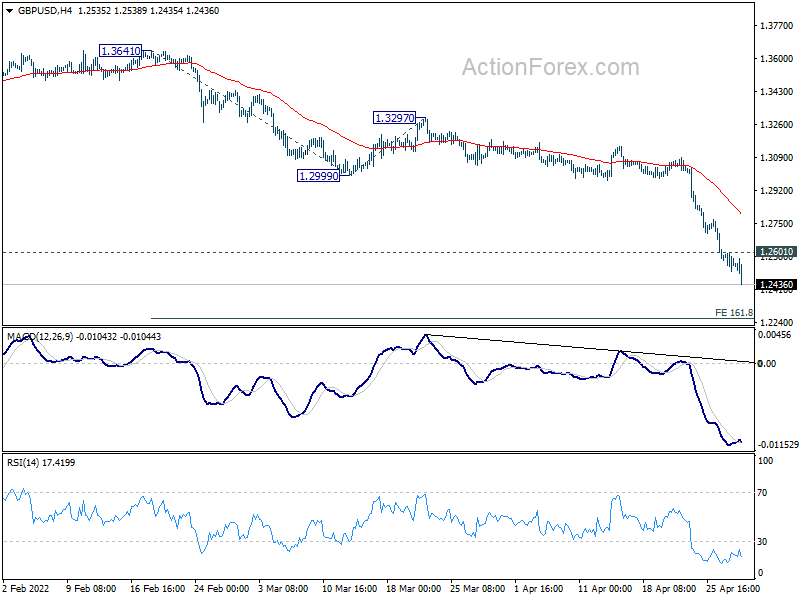
GBP/USD's down trend is in progress and intraday bias stays on the downside for 161.8% projection of 1.3641 to 1.2999 from 1.3297 at 1.2258. On the upside, above 1.2601 minor resistance will turn intraday bias neutral and bring consolidation first. Upside of recovery should be limited below 1.2999 support turned resistance to bring another fall.
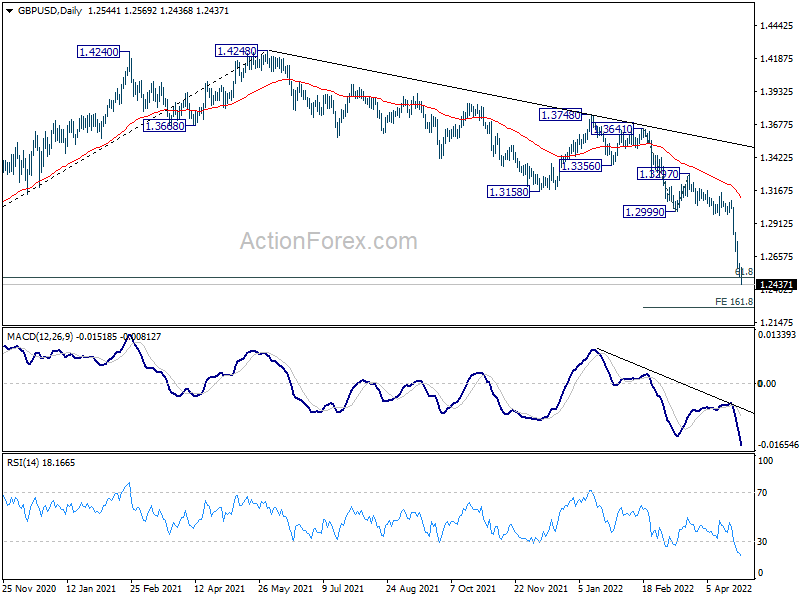
In the bigger picture, rise from 1.1409 (2020 low) has completed at 1.4248, ahead of 1.4376 long term resistance (2018 high). Based on current momentum, fall from 1.4248 is probably the start of a long term down trend. The break of 61.8% retracement of 2.1161 to 1.1409 at 1.2493 is affirming this bearish case too. For now, deeper decline would be seen as long as 1.3158 support turned resistance holds. Next target is 1.1409 low.
USD/JPY Mid-Day Outlook
Daily Pivots: (S1) 127.39; (P) 127.99; (R1) 129.03; More...
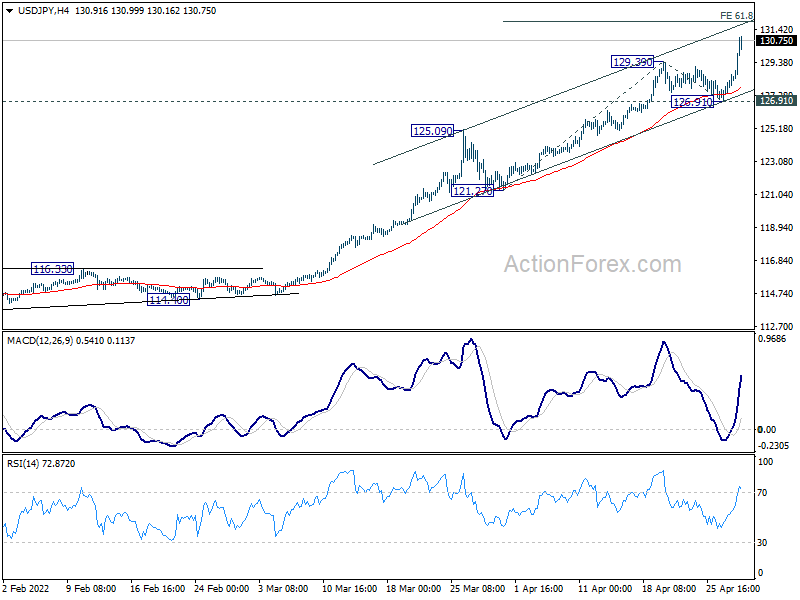
Intraday bias in USD/JPY remains on the upside for the moment. Next near term target is 61.8% projection of 121.27 to 129.39 from 126.91 at 131.92. Firm break there will pave the way to 100% projection at 135.03. On the downside, break of 126.91 support is needed to indicate short term topping. Otherwise, outlook will stay bullish in case of retreat.
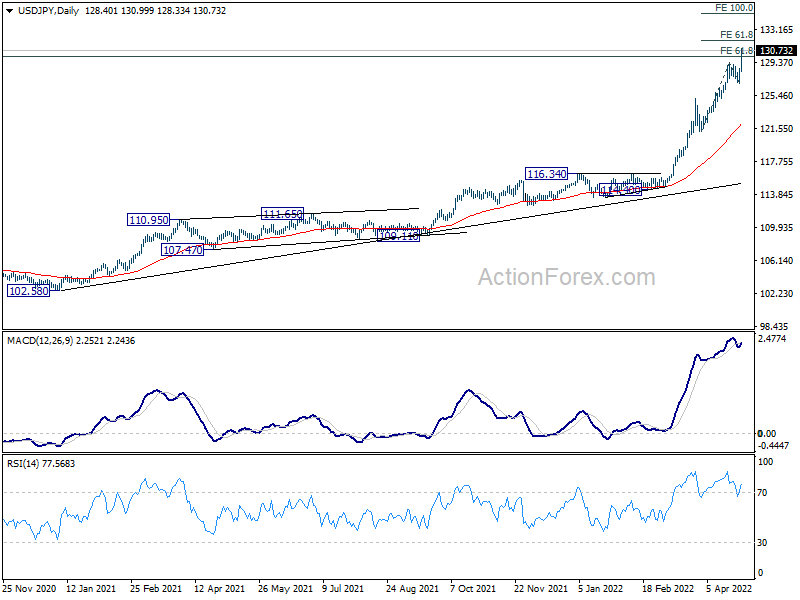
In the bigger picture, current rally is seen as part of the long term up trend form 75.56 (2011 low). Sustained trading above 61.8% projection of 75.56 (2011 low) to 125.85 (2015 high) from 98.97 at 130.04 will pave the way to 100% project at 149.26, which is close to 147.68 (1998 high). For now, this will remain the favored case as long as 121.27 support holds.
USD/CHF Mid-Day Outlook
Daily Pivots: (S1) 0.9635; (P) 0.9669; (R1) 0.9722; More....
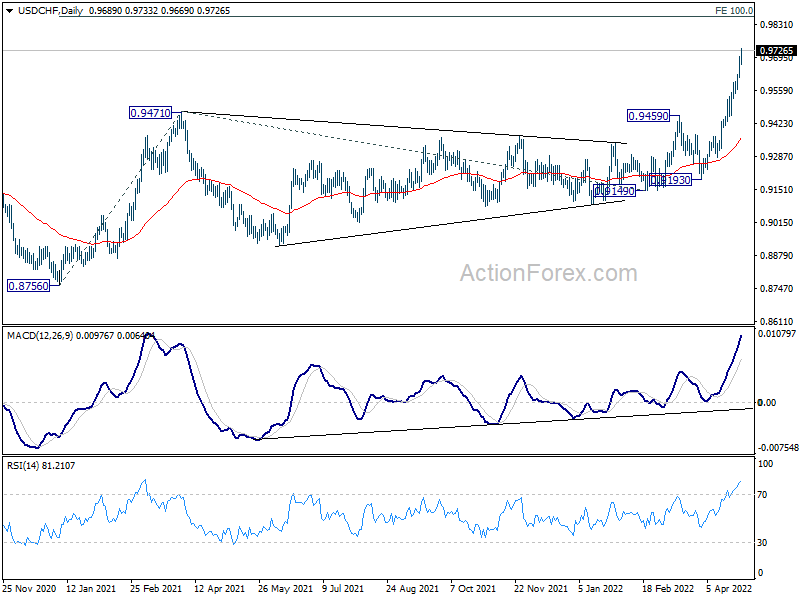
USD/CHF's rally continues today and intraday bias remains on the upside. Current up trend should target next medium term projection level at 0.9864. On the downside, below 0.9669 minor support will turn intraday bias neutral and bring consolidations. But downside of retreat should be contained above 0.9459 resistance turned support to bring another rally.
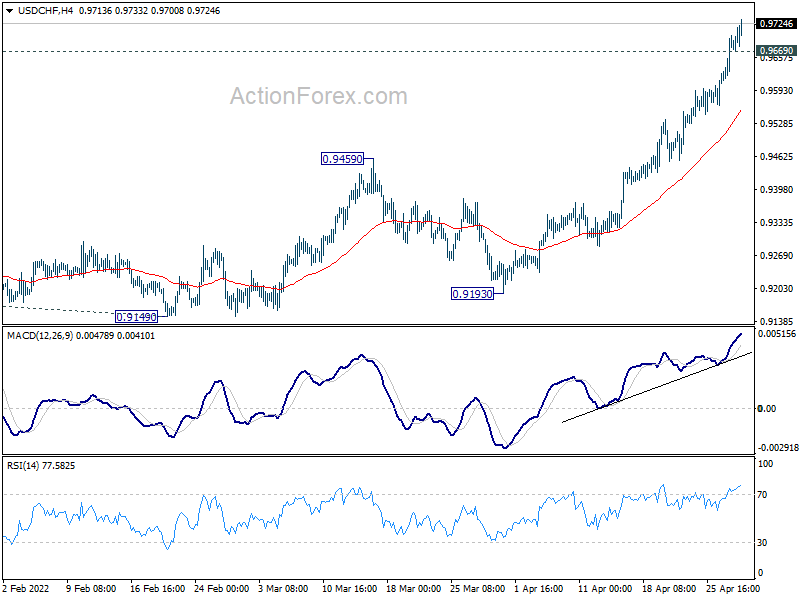
In the bigger picture, down trend from 1.0342 (2016 high) should have completed with three waves down to 0.8756 (2021 low) already. Rise from 0.8756 is likely a medium term up trend of its own. Next target is 100% projection of 0.8756 to 0.9471 from 0.9149 at 0.9864. This will now remain the favored case as long as 0.9459 resistance turned support holds.
USD/CAD Mid-Day Outlook
Daily Pivots: (S1) 1.2779; (P) 1.2816; (R1) 1.2855; More...
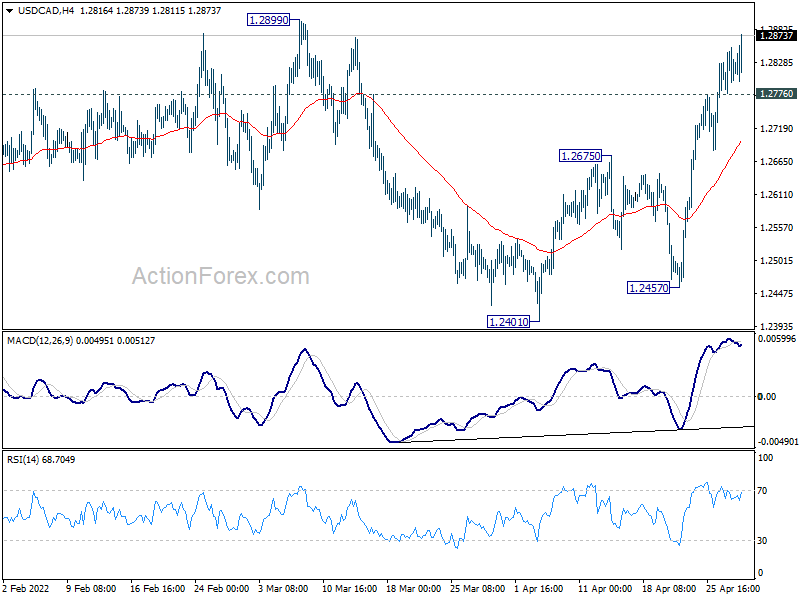
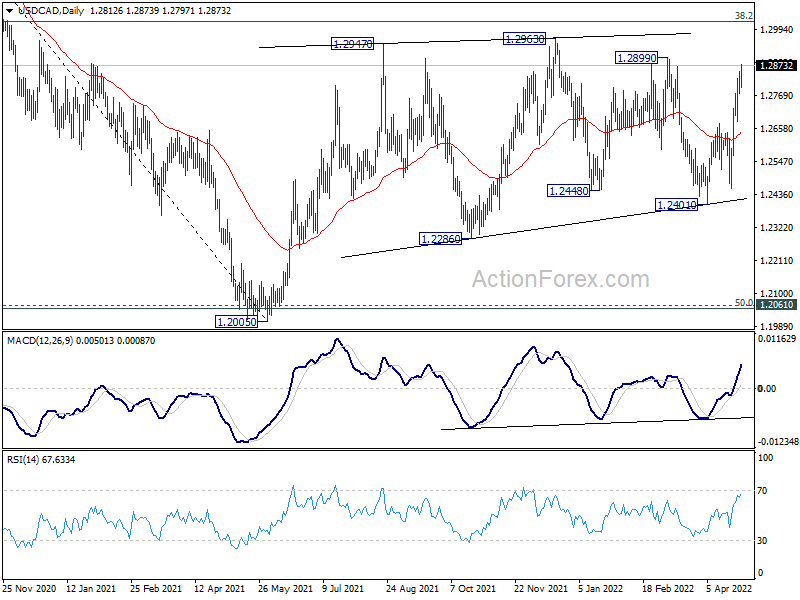
USD/CAD's rally continues today and intraday bias remains on the upside for 1.2899 resistance. Break there should resume the larger rise from 1.2005 to 1.3022 fibonacci level. Decisive break there will carry larger bullish implications. On the downside, below 1.2776 minor support will turn intraday bias neutral and bring consolidations. But further rally will remain in favor as long as 1.2675 resistance turned support holds.
In the bigger picture, focus stays on 38.2% retracement of 1.4667 (2020 high) to 1.2005 (2021 low) at 1.3022. Sustained break there should confirm that the down trend from 1.4667 has completed after defending 1.2061 long term cluster support. Further rise would then be seen towards 61.8% retracement at 1.3650. However, rejection by 1.3022 will maintain medium term bearishness. Break of 1.2005 will resume the down trend from 1.4667 and that carries larger bearish implications too.
Dollar/Yen Barrels Past 130
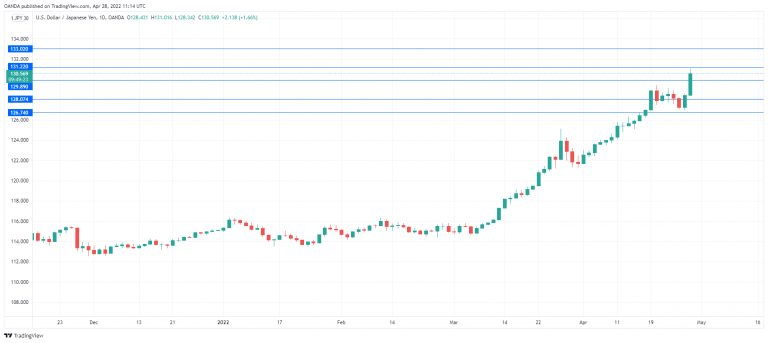
It’s up, up and away for dollar/yen, which has punched above the symbolic 130 today, the first time that has occurred since 2002. USD/JPY is trading at 130.40, up 1.53% on the day.
Japan MOF issues warning over yen
The Bank of Japan reiterated its commitment to ultra-low rates at its policy meeting on Thursday. The BoJ pledged to keep interest rates at “present or lower levels”. Notably, the central bank said it would continue to buy unlimited amounts of 10-year JGBs daily, rather than on an ad-hoc basis, in order to cap yields at 0.25%. The move to cap yields has worked, but the price has been a plunge in the yen’s value. USD/JPY rose as high as 131.01 earlier in the day, and has risen a staggering 7.11% in the month of April.
The BoJ and Japanese Ministry of Finance (MOF) have done little more than jawbone about the slide in the yen, but there has been speculation that the 130 level could be the ‘line in the sand’ which would trigger intervention in the currency markets. The MOF responded on Thursday with a strong warning, saying that the recent moves are “extremely worrying” and that the government would take “appropriate action”. Perhaps the MOF ought to take a look at BoJ’s Governor Kuroda’s statement after the policy meeting that a weak yen was good for Japan’s economy. This has been Kuroda’s view all along, but it’s hard to get worked up about MOF threats when the BoJ is winking to the markets that it’s fine with a weak yen.
The BoJ is projecting that CPI will rise to 2% in April, but the main drivers of inflation are fuel costs and mobile phone fee cuts, rather than wage growth or stronger demand. The BoJ is viewing inflationary pressures as transitory and plans to maintain its ultra-loose policy.
USD/JPY risk remains heavily tilted higher, primarily because of the US/Japan rate differential, which continues to widen. The Federal Reserve is in a very aggressive mode, with an oversize half-point hike almost a given at next week’s policy meeting. Fed Chair Powell and other FOMC members have telegraphed that further 0.50% hikes are on the table, as the Fed prepares to come out swinging in order to subdue inflation.
USD/JPY Technical
- USD/JPY has broken above resistance at 129.87. Above, there is resistance at 129.89 and 131.22
- USD/JPY has support at 128.07 and 126.74
Will the RBA Raise Interest Rates after a Surprise in Inflation?
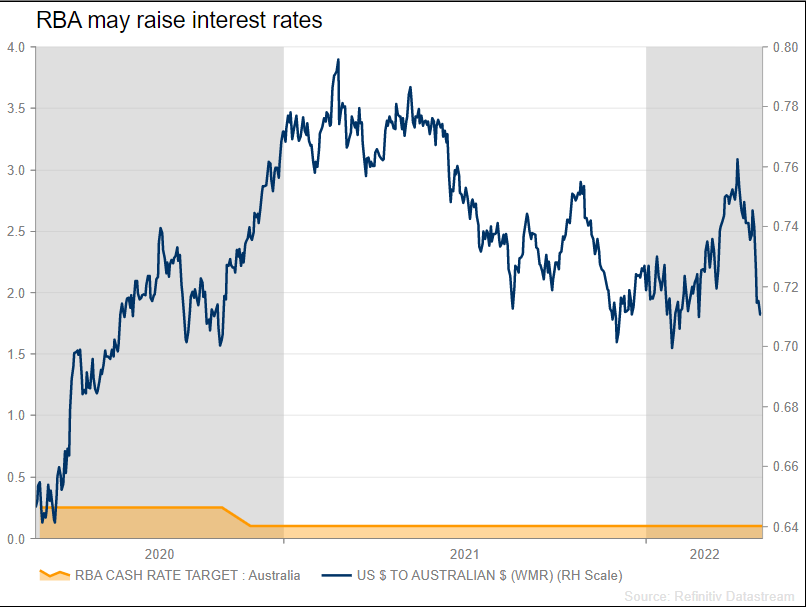
The Reserve Bank of Australia announces its policy decision on Tuesday at 04:30 GMT. Australia's currency was on the verge of collapsing Thursday owing to fears of an impending European financial crisis and a weakening in China's economy. Even if the domestic economy is strong, it's difficult to imagine the RBA will hike rates recklessly in the face of China's economic crisis.
Will the RBA raise rates or not?
A 15-basis-point rise in the Australian cash rate is all but guaranteed for next week's meeting, according to the futures market, and with the inflation report suggesting that the central bank may be 'behind the curve', they may feel driven to act. How much higher will the RBA's cash rate be if they do move? There are two options: 15% to 0.25%, or 40% to 0.50%.
However, the former will just confirm what the market has already priced in, while also sending a signal that the RBA appears to be moving more quickly than expected before the release of the inflation report. Having said that, larger rate hikes have already been priced in for the future, making it difficult to see much upside for the Australian dollar in this regard at this point.
As a result, there are two possibilities which will have a significant response. The first is that a 40-basis point rate hike will assist to support the Australian dollar, although the momentum may be moderated by more negative risk sentiment if this is indeed the case. The second option is that the RBA decides to postpone the decision until June, which will most likely have a minimal impact on the aussie.
Two out of Australia's main four banks predict that the benchmark cash rate will be raised next week, with a third predicting that the likelihood of an increase will increase following Wednesday's unexpectedly high inflation data.
Inflation surprises earlier in the week
Australian inflation hit 5.1% in the first quarter, leading to speculation that the Reserve Bank may panic and hike interest rates more quickly. The RBA has already delivered a quarter-point rate increase, and markets forecast another nine before the year is over.
In any event, investors are more anxious about Chinese stock market lockdowns and falling stock markets than they are about the Reserve Bank of Australia's (RBA) rate hikes, which have already been factored into their valuations.
Aussie turns higher after 11-week low
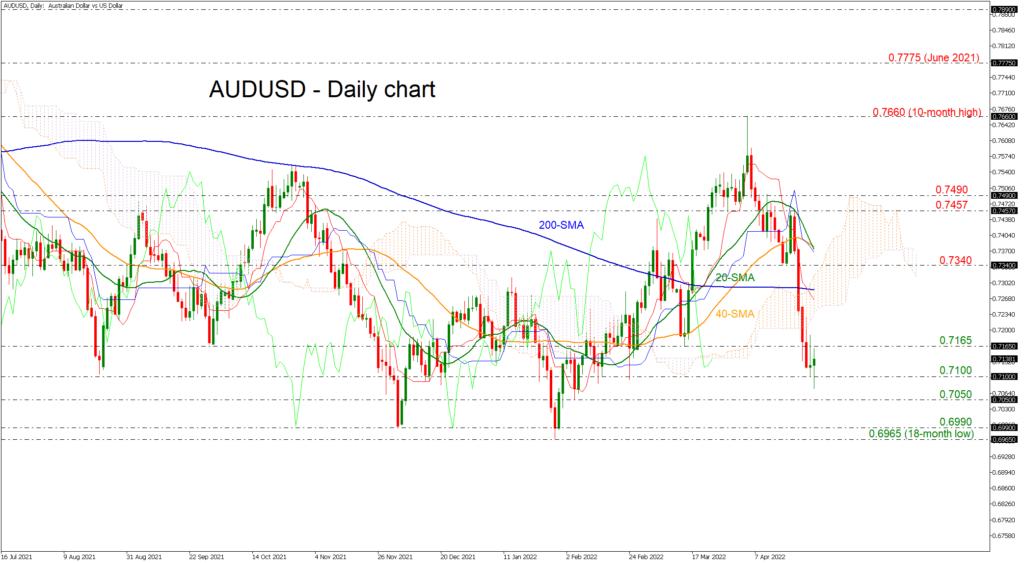
Against the US dollar, the aussie is currently holding above the eleven-week low of 0.7074 that posted earlier in the day. If the RBA doesn’t bring forward its rate hike, a move back towards the 0.7050-0.6990 area is very possible ahead of the 18-month low of 0.6965.
In the bullish scenario, aussie/dollar could make a push up towards the 0.7165 resistance before attempting to reach the 200-day simple moving average (SMA) at 0.7287. Even higher, the market could meet the 0.7457 hurdle.
All in all, if there is a drop below the 18-month low, the market will switch to bearish in the medium-term.