

Sample Category Title
EUR/USD Mid-Day Outlook
Daily Pivots: (S1) 1.0997; (P) 1.1058; (R1) 1.1113; More...
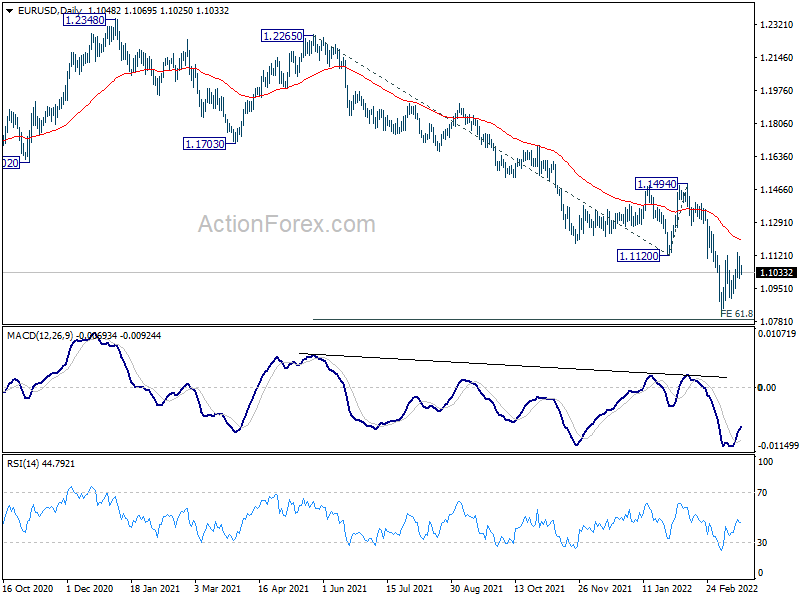
Intraday bias in EUR/USD remains neutral and outlook is unchanged. On the downside, below 1.0899 minor support will turn bias back to the downside for 61.8% projection of 1.2265 to 1.1120 from 1.1494 at 1.0786. However, firm break of 1.1120 will confirm short term bottoming at 1.0805. Bias will be back on the upside for 55 day EMA (now at 1.1204) and above.
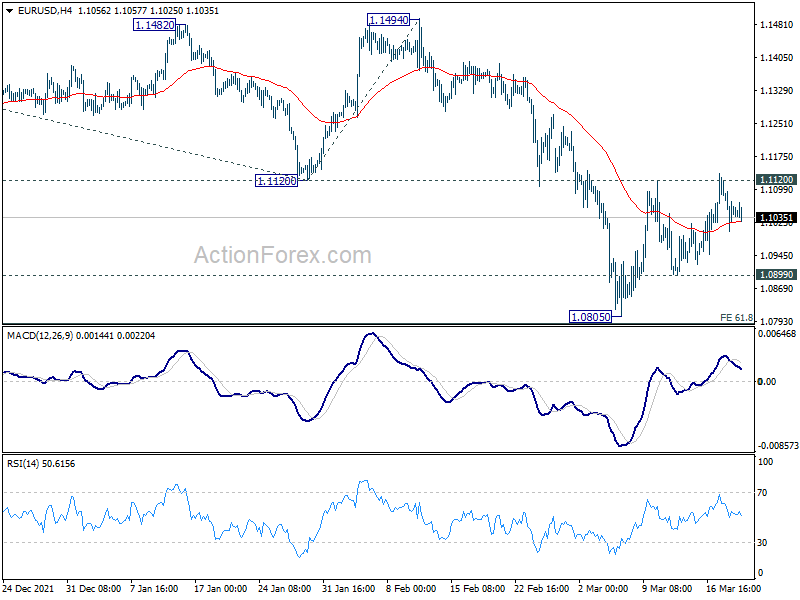
In the bigger picture, the decline from 1.2348 (2021 high) is expected to continue as long as 1.1494 resistance holds. Firm break of 1.0635 (2020 low) will raise the chance of long term down trend resumption and target a retest on 1.0339 (2017 low) next. Nevertheless, break of 1.1494 will maintain medium term neutral outlook, and extending term range trading first.
USD/CHF Mid-Day Outlook
Daily Pivots: (S1) 0.9295; (P) 0.9338; (R1) 0.9363; More....
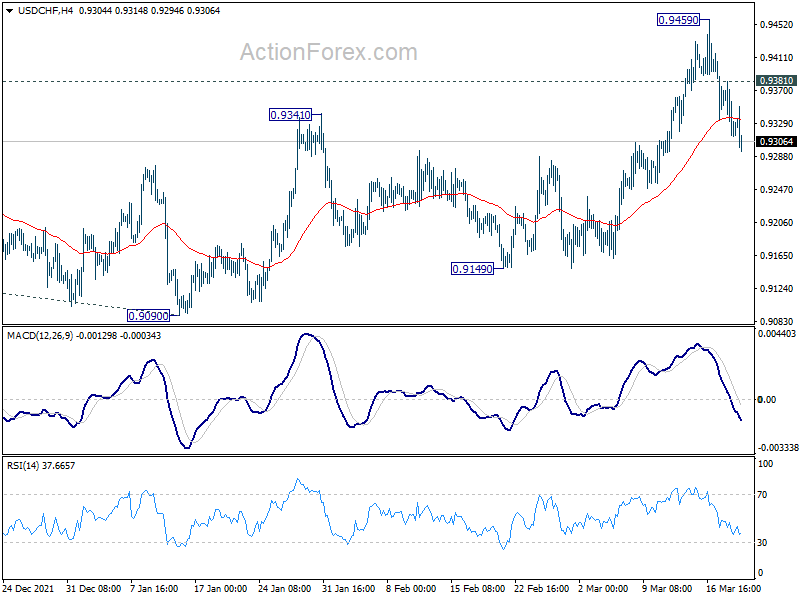
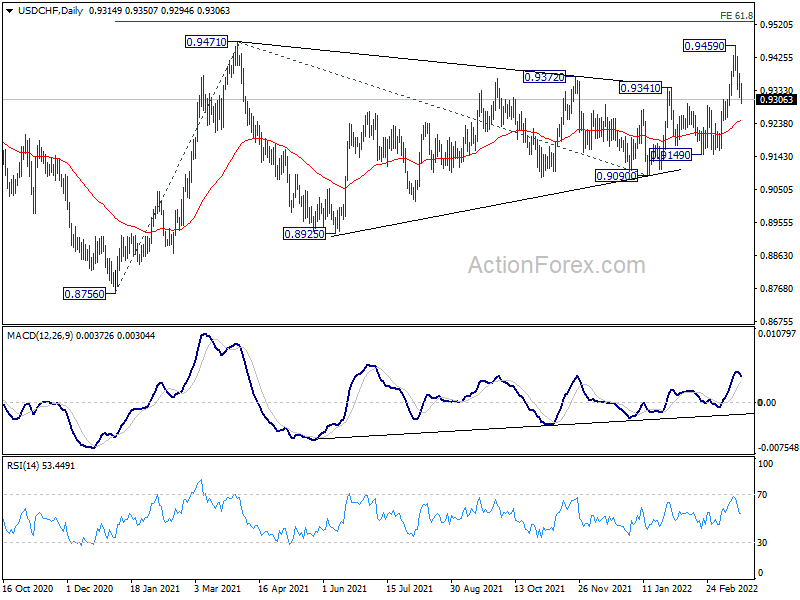
USD/CHF's pull back from 0.9459 is in progress. Intraday bias stays on the downside for 55 day EMA (now at 0.9248). On the upside, above 0.9381 minor resistance will flip bias back to the upside. Firm break of 0.9471 will resume the rise from 0.8756 to 61.8% projection of 0.8756 to 0.9471 from 0.9090 at 0.9532.
In the bigger picture, medium term outlook will be neutral at best as long as 0.9471 resistance holds. Larger down trend could still extend through 0.8756 (2021 low). However, firm break of 0.9471 will argue that whole down trend form 1.0342 (2016 high), has completed with waves down to 0.8756. A medium term up trend should be set up to target 1.0237/0342 resistance zone.
USD/JPY Mid-Day Outlook
Daily Pivots: (S1) 118.62; (P) 119.01; (R1) 119.55; More...
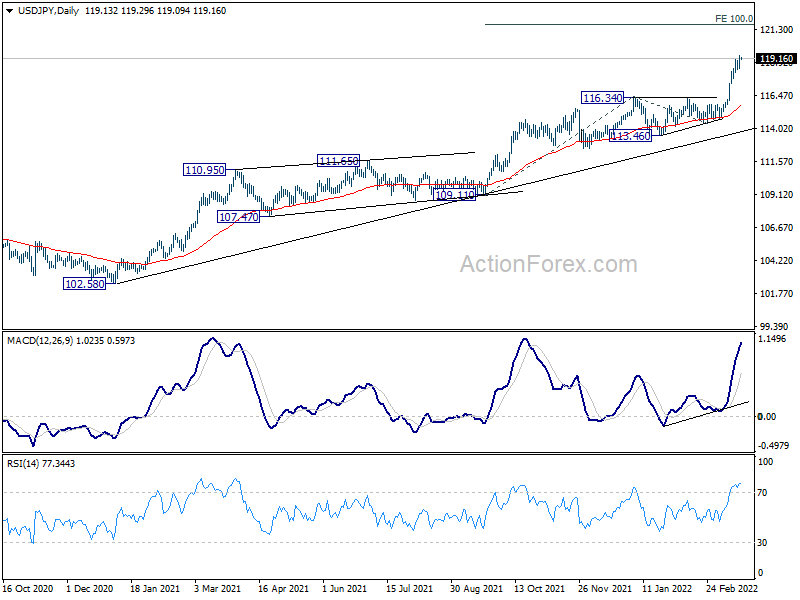
USD/JPY's rally is still in progress and intraday bias stays on the upside. Current up trend should target 100% projection of 109.11 to 116.34 from 114.40 at 121.63 next. On the downside, below 118.35 will turn intraday bias neutral again and bring retreat. But downside should be contained above 116.34 resistance turned support to bring another rally.
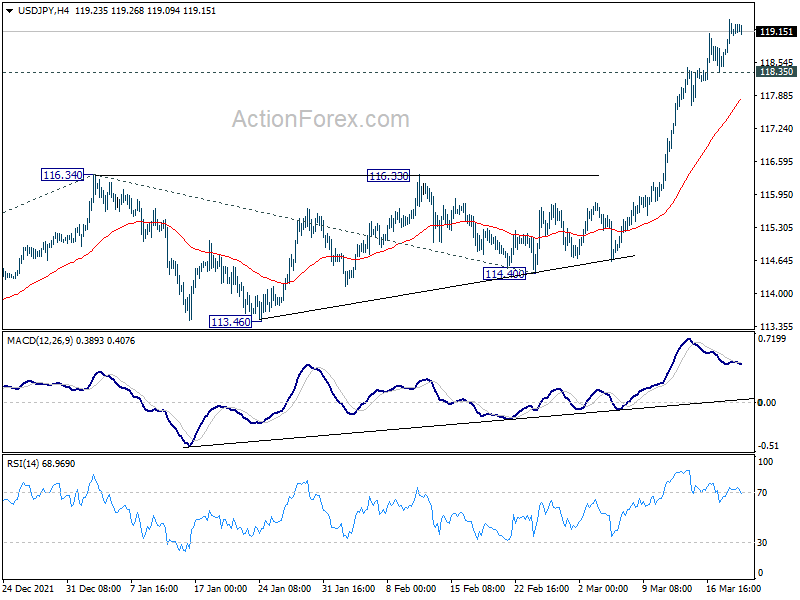
In the bigger picture, the break of 118.65 resistance (2016 high) suggest that up trend from 98.97 (2016 low) is resuming, with rise from 101.18 (2020 low) as the third leg. Medium term outlook will remain bullish as long as 113.46 low. Sustained trading above 118.65 will pave the way to 125.85 (2015 high).
GBP/USD Mid-Day Outlook
Daily Pivots: (S1) 1.3127; (P) 1.3162; (R1) 1.3213; More...
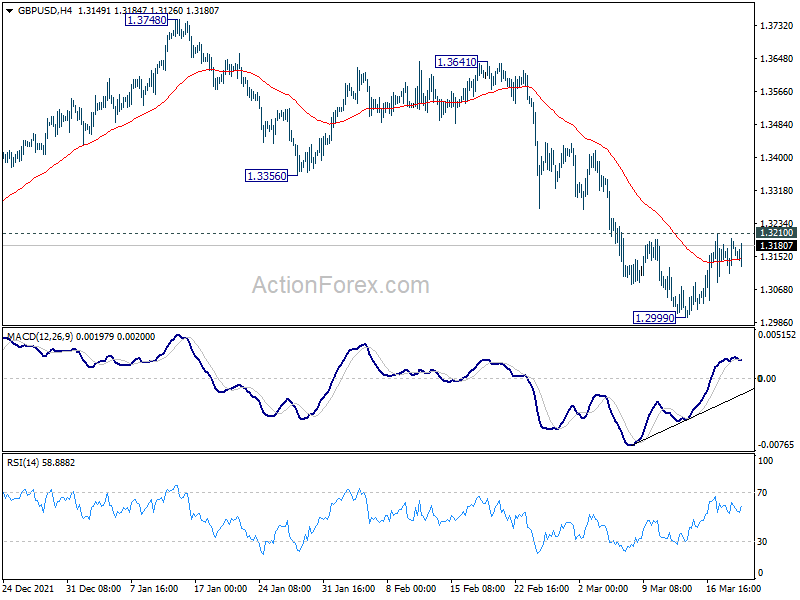
Intraday bias in GBP/USD remains neutral at this point. Some more consolidation could be seen. On the downside, break of 1.2999 will resume larger down trend from 1.4248. However, firm break of 1.3210 should confirm short term bottoming. Stronger rise should be seen back to 55 day EMA (now at 1.3361).
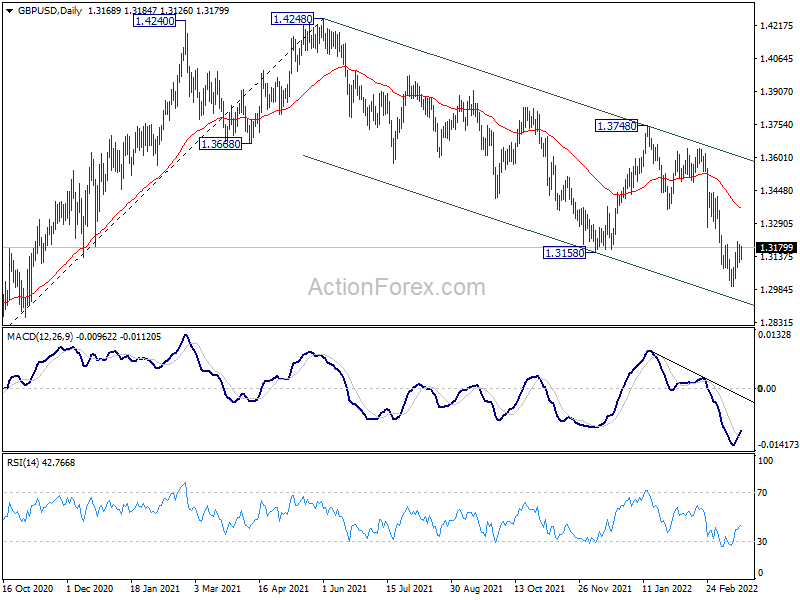
In the bigger picture, current development suggests that the up trend from 1.1409 (2020 low) has completed at 1.4248. Decline from 1.4248 could still be a corrective move, or it could be the start of a long term down trend. In either case, deeper decline would be seen back to 61.8% retracement of 2.1161 to 1.1409 at 1.2493. In any case, break of 1.3748 resistance is needed to indicate medium term bottoming, or outlook will stay bearish.
EUR/GBP Turning Softer, But Overall Markets Tread Water
The forex markets are mixed in rather quiet trading today. Swiss Franc apparently stronger but there isn't much follow through buying yet. Euro could be turning weaker again but it has to dip more to confirm downside momentum. Other major pairs and crosses are still stuck inside Friday's range. Global benchmark treasury yields are on the rise again but there is much movement in Yen.
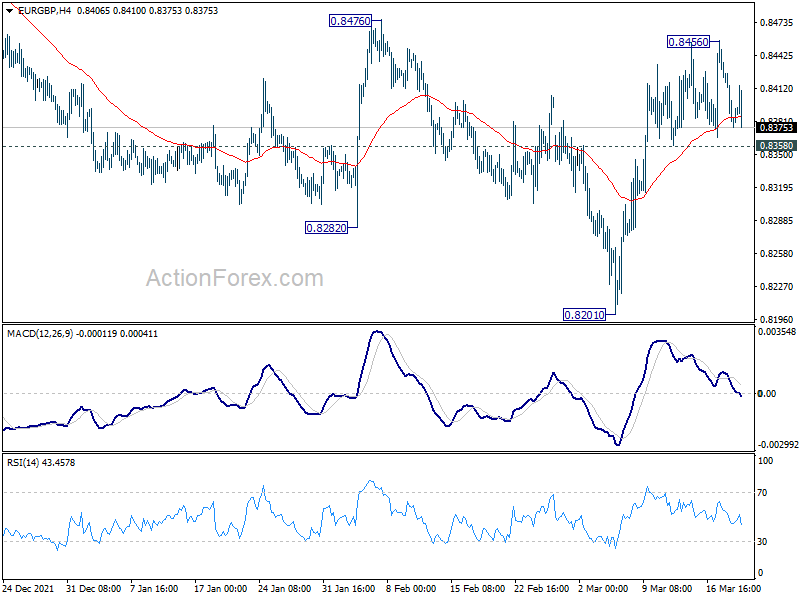
Technically, attentions stays in some Euro crosses including 0.8358 minor support in EUR/GBP. Break there will suggest completion of rebound from 0.8201, and bring deeper fall back to retest this low. The question is, if that happens, whether EUR/USD would be dragged through 1.0899 minor support, or, GBP/USD would be pushed through 1.3210 minor resistance. Let's see.
In Europe, at the time of writing, FTSE is up 0.44%. DAX is down -0.01%. CAC is down -0.14%. Germany 10-year yield is up 0.0718 at 0.443. Earlier in Asia, Hong Kong HSI dropped -0.89%. China Shanghai SSE rose 0.08%. Singapore Strait Times rose 0.75%. Japan was on holiday.
Fed Bostic penciled in only six hikes this year
Atlanta Fed President Raphael Bostic said, "I penciled in six rate hikes for 2022 and two more for 2023,"
"I recognize that I am toward the bottom of the distribution relative to my colleagues, but the elevated levels of uncertainty are front forward in my mind and have tempered my confidence that an extremely aggressive rate path is appropriate today," he added.
"The risks go both ways," Bostic said. "Should demand falter in the face of economic uncertainty or removal of monetary policy accommodation, then the appropriate path may be shallower than I currently project. But there are other developments, such as shifts in supply strategies, that could mean higher costs and thus motivate a steeper policy path than I expect."
ECB Lagarde: Even in the bleakest scenario, there is no stagflation
ECB President Christine Lagarde said that Russia invasion of Ukraine will have "consequences" for growth. However, "even in the bleakest scenario, with second-round effects, with a boycott of gas and petrol and a worsening of the war that goes on for a long time -- even in those scenarios we have 2.3% growth." Hence, "we are not seeing elements of stagflation now," she said.
Lagarde also reiterated that the US and Eurozone are in "difference universes", at a "different stage" in the economic cycle, with "different starting points". "We in the euro area are at negative rates, while the U.S. never went below zero."
ECB de Guindos: No stagflation but inflation to remain higher for longer
In an interview with Handelsblatt, ECB Vice President Luis de Guindos said Eurozone is not heading towards stagflatoin. "In the most recent projections, even in our most adverse scenario for the current year, we still foresee growth of more than 2%, so no stagflation," he said. "Inflation, however, is likely to remain higher for a longer period than expected before the war."
De Guindos also said what matters for the central bank now is the extent to which wages respond. "If wage increases are too high, they can push prices up even more and contribute to persistently higher inflation." But he added, "We have not seen any signs of that yet".
He added last week's statement "delink the potential interest rate hikes from the asset purchase programme". The timing of rate hike "all depends on the data". "The price shock in energy and commodities that we're currently experiencing is making many firms and workers worse off. Fiscal policy should provide temporary, targeted support to help reduce the burden. This would also reduce the danger of a wage-price spiral," he said.
Bundesbank: Significantly weaker recovery expected in Q2
In the monthly report, Bundesbank said "significantly weaker recovery expected in the second quarter". The effects of Russia's attack on Ukraine are "likely to have a noticeable impact on economic activity in Germany from March". Supply chain problems are likely to "intensify again", and energy prices have "risen massively".
"From today's perspective, the strong recovery planned for the second quarter is likely to be significantly weaker". Also, the extent of the effects of war is "very uncertain and depends on how events unfold".
Germany PPI up 1.4% mom, 25.9% yoy in Feb, Russia invasion impact not yet included
Germany PPI rose 1.4% mom, 25.9% yoy in February, below expectation of 1.7% mom, 26.1% yoy, comparing to January's 2.2% mom, 25.0% yoy.
Destatis said, "the recent price development in the context of Russia's attack on Ukraine are not yet included in the results... Mainly responsible for the increase of producer prices compared to February 2021 still was the price increase of energy."
Energy prices as a whole rose 68.0% yoy. Price of intermediate goods rose 21.0% yoy. Prices of non-durable consumer goods rose 7.4% yoy. Prices of durable consumer goods rose 6.7% yoy. Capital goods prices rose 5.5% yoy.
New Zealand goods export rose 22% yoy in Feb, imports rose 37% yoy
New Zealand goods exports rose 22% yoy to NZD 5.5B in February. Goods imports rose 37% yoy to NZD 5.9B. Trade deficit came in at NZD -385m, smaller than expectation of NZD -808m.
Exports to all top destinations increased, including China (up NZD 80m or 5.4%), Australia (up NZD 119m or 22.0%), US (up NZD 37m or 7.4%), EU (up NZD 62m or 25%), and Japan (up NZD 71m or 34%).
Imports from all top partners also rose, including China (up NZD 490m or 45%), EUR (up NZD 209m or 32%), Australia (up NZD 137m or 26%), US (up NZD 105m or 29%), and Japan (up NZD 167m or 60%).
GBP/USD Mid-Day Outlook
Daily Pivots: (S1) 1.3127; (P) 1.3162; (R1) 1.3213; More...
Intraday bias in GBP/USD remains neutral at this point. Some more consolidation could be seen. On the downside, break of 1.2999 will resume larger down trend from 1.4248. However, firm break of 1.3210 should confirm short term bottoming. Stronger rise should be seen back to 55 day EMA (now at 1.3361).
In the bigger picture, current development suggests that the up trend from 1.1409 (2020 low) has completed at 1.4248. Decline from 1.4248 could still be a corrective move, or it could be the start of a long term down trend. In either case, deeper decline would be seen back to 61.8% retracement of 2.1161 to 1.1409 at 1.2493. In any case, break of 1.3748 resistance is needed to indicate medium term bottoming, or outlook will stay bearish.
Economic Indicators Update
| GMT | Ccy | Events | Actual | Forecast | Previous | Revised |
|---|---|---|---|---|---|---|
| 21:45 | NZD | Trade Balance (NZD) Feb | -385M | -808M | -1082M | -1126M |
| 14:01 | GBP | Rightmove House Price Index M/M Mar | 1.70% | 2.30% | ||
| 02:00 | EUR | Germany PPI M/M Feb | 1.40% | 1.70% | 2.20% | |
| 07:00 | EUR | Germany PPI Y/Y Feb | 25.90% | 26.10% | 25.00% |
Fed Bostic penciled in only six hikes this year
Atlanta Fed President Raphael Bostic said, "I penciled in six rate hikes for 2022 and two more for 2023,"
"I recognize that I am toward the bottom of the distribution relative to my colleagues, but the elevated levels of uncertainty are front forward in my mind and have tempered my confidence that an extremely aggressive rate path is appropriate today," he added.
"The risks go both ways," Bostic said. "Should demand falter in the face of economic uncertainty or removal of monetary policy accommodation, then the appropriate path may be shallower than I currently project. But there are other developments, such as shifts in supply strategies, that could mean higher costs and thus motivate a steeper policy path than I expect."
Canadian Dollar Posts Best Week of 2022
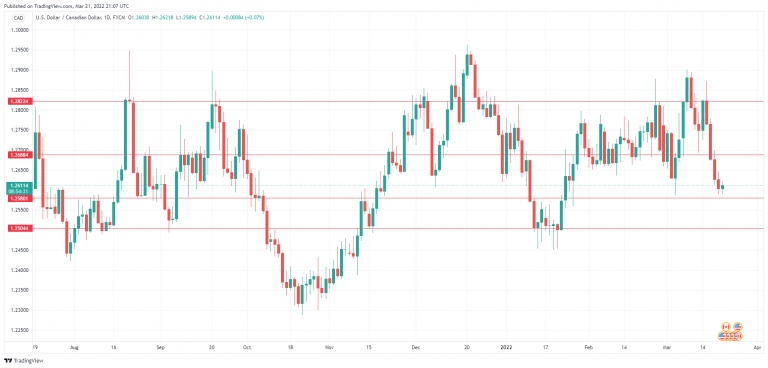
The Canadian dollar is coming off its best week of the year, in which it gained 1.14%. The currency has posted slight gains on Monday, dropping below the 1.26 line for the first time since late January.
Retail sales rebound
The Canadian dollar has extended its rally on Monday, after posting four straight winning days. USD/CAD fell 1.14% last week, as the Canadian dollar enjoyed its best week this year. The week ended on a positive note, as retail sales for January bounced back after sharp losses in December. Headline retail sales rose 3.2% MoM, smashing the estimate of 2.4%. Core retail sales rose 2.5%, above the estimate of 2.4%. In December, the headline figure fell by -2.0% and core retail sales by -2.7%.
The Fed finally hit the rate trigger last week, raising interest rates for the first time since December 2018. The Bank of Canada is expected to keep pace with a rate hike in April, after raising rates from 0.25% to 0.50% at the March meeting. The markets are expecting the BoC to be aggressive in its fight against high inflation and have priced in up to six more hikes this year. Similar to the Fed, the BoC is concerned with stagflation and will have to be cautious as it raises rates, in order not to choke growth as the economy emerges from Covid.
The war in Ukraine has raged for a month, and the Russian invasion has stalled in the face of stiff Ukrainian resistance. Civilian casualty figures continue to rise as Russia has stepped up its campaign of hitting civilian targets. Over the weekend, the Turkish foreign minister said that the two sides were making progress on a peace agreement, but previous such announcements all proved to be premature. If there are tangible signs of progress towards a ceasefire, the Canadian dollar would likely continue its upswing.
USD/CAD Technical
- USD/CAD faces resistance at 1.2688 and 1.2822
- 1.2580 is under pressure in support. Below, there is support at 1.2504
Oil and Gold Paths Diverged
Gold has remained in a one-and-a-half per cent range since last Thursday. The correction from a peak of $2070 to values below $1900 caused a brief aftershock, but it was not sustained. Gold has now stabilised above the peaks of May and June last year and is currently searching for further meaningful momentum.
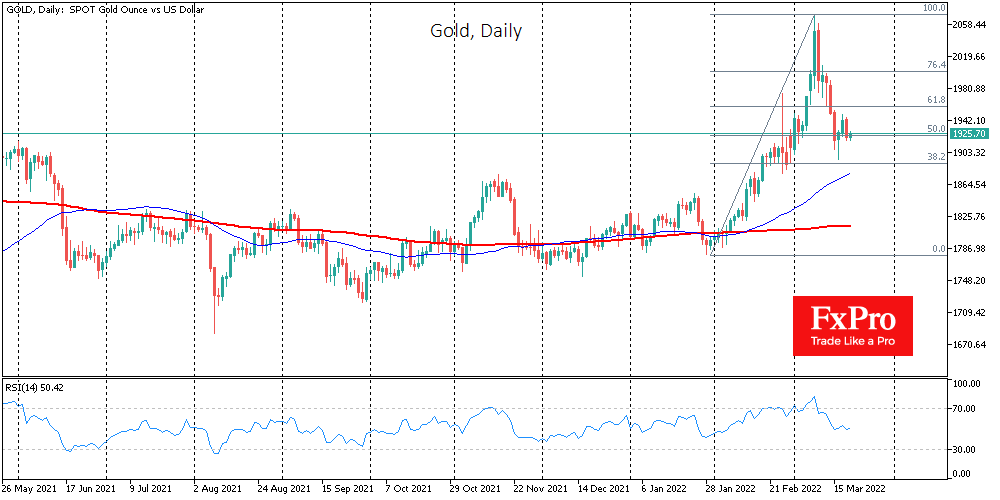
For short-term traders, gold has taken a back seat as markets try to assess the impact of disrupted supply chains and the amount of supply shortfall in raw materials and food. At the same time, medium-term traders should not lose sight of the fact that the current situation will not allow central banks to act adequately. As a result, the supply of fiat money will increase faster than the supply of commodities. In other words, we should expect greater tolerance for higher inflation from the CBs.
In addition, governments should also be expected to provide financial support to the economy. In practice, that means more money supply and a higher level of public debt to GDP. And that is another disincentive for monetary policy, which is negative for the currency. It is also favourable for gold, which is used as protection against capital depreciation.
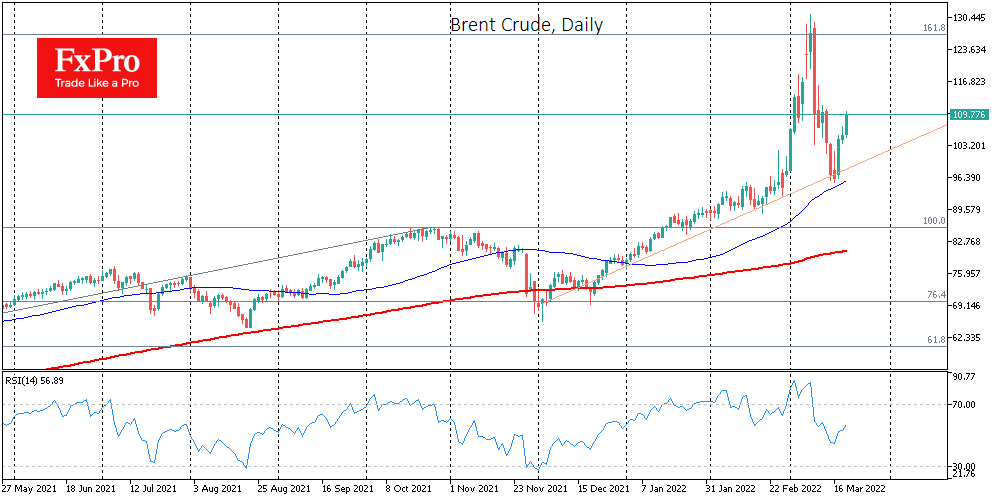
Oil is gradually becoming the opposite of gold. After bouncing back to the trend support level of the last four months, Brent got back above $100 reasonably quickly and is adding 4% on Monday, trading at $109.
Speculative demand for oil is picking up again amid discussions of a Russian energy divestment, which could be the agenda for the EU leaders and Biden meeting later this week. In addition, the US oil supply has been slow to rise, with data on Friday showing that the number of working oil drilling rigs declined a week earlier.
Oil producers appear to be cautious about demand prospects with record fuel prices and are in no hurry to flood the market. This will fuel prices in the short term but is becoming an increasing drag on the economy in the medium term.
Locally, we also risk suggesting that Europe will once again make it clear that it cannot substitute Russian energy, preferring to focus on sanctions against other sectors. And that could prove to be a dampening factor for oil later in the week. Oil prices above $110 still look unsustainably high, and a range with support at $85 looks more adequate for the coming months.
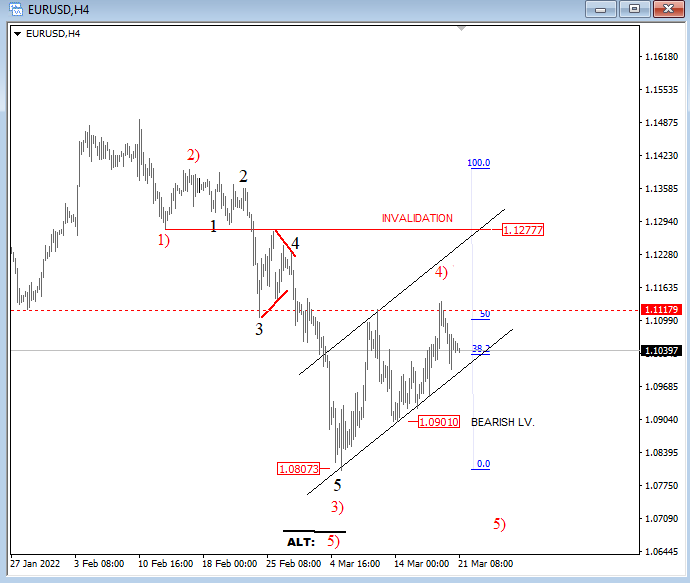
EUR/USD Elliott Wave Analysis: More Weakness Ahead
Stocks are higher since the FED decision last week, so buy the rumor sell the news is what caused a turn. We see commodity currencies doing well, with more upside in view in the very near term. If you favor the USD strength then track it vs EUR as this one can stay weak due to the situation in Ukraine.
Technically we see EURUSD making a corrective rise from the low, so more weakness can be seen, especially when trendline is support broken.
EUR/USD 4h Elliott Wave analysis
Bundesbank: Significantly weaker recovery expected in Q2
In the monthly report, Bundesbank said "significantly weaker recovery expected in the second quarter". The effects of Russia's attack on Ukraine are "likely to have a noticeable impact on economic activity in Germany from March". Supply chain problems are likely to "intensify again", and energy prices have "risen massively".
"From today's perspective, the strong recovery planned for the second quarter is likely to be significantly weaker". Also, the extent of the effects of war is "very uncertain and depends on how events unfold".