

Sample Category Title
Dollar Attempting to Rally While Euro Licks Wounds
Sentiment is mixed in Asia with heavy selling seen in stock markets of Hong Kong and China, while Nikkei and Singapore Strait Times are recovering. US President Joe Biden announced to impose an immediate ban on imports of Russian Energy. Commercial big names like McDonald's, Coca-Cola, and Pepsi also finally joined to halt businesses in Russia.
Gold failed to break through all-time high in first attempt but stays firm at around 2050 for now. WTI crude oil's rally attempt is also capped by 131.82 temporary top, but looks ready to have another take any time. In the currency markets, Euro remains in consolidative mode, digesting recent losses, together with Sterling. Yen, Aussie and Kiwi are the softer ones for today so far. Dollar is attempting to stage a broad based rally, but momentum is not too convincing yet.
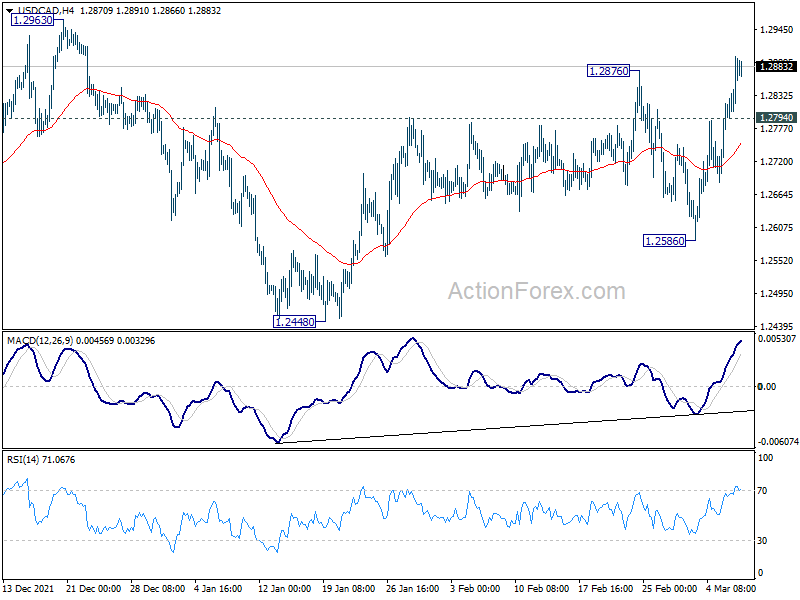
Technically, USD/CAD's break of 1.2876 resistance suggests resumption of rise from 1.2448, and further rally should be seen to 1.2963. AUD/USD is holding well above 0.7093 near term support despite a deep retreat, and so there is no sign of bearish reversal. USD/CHF and USD/JPY are both bounded in familiar range. Hence, while the greenback remains strong against Euro and Sterling, there is no sign of broad based strength yet, at least until range breakout in USD/CHF and USD/JPY.
In Asia, at the time of writing, Nikkei is up 0.74%. Hong Kong HSI is down -1.76%. China Shanghai SSE is down -0.77%. Singapore Strait Times is up 0.84%. Japan 10-year JGB yield is up 0.0148 at 0.170. Overnight, DOW dropped -0.56%. S&P 500 dropped -0.72%. NASDAQ dropped -0.28%. 10-year yield rose 0.121 to 1.872.
RBA Lowe: A rate hike this year is plausible
RBA Governor Philip Lowe reiterated in a speech that Australia has the "scope to wait and assess incoming information" before working on interest rates.
He highlighted two issues that policymakers are "paying close attention to". The first is the "persistence of supply-side price shocks" and the extent of impact from Russia's invasion of Ukraine. Secondly, that's "how labor costs in Australia evolve".
He noted that "given the outlook, though, it is plausible that the cash rate will be increased later this year." There is both a risk to "waiting too long" and "moving too early". But Low finished with the point that "it is only possible to achieve a sustained period of low unemployment if inflation remains low and stable". And, "recent developments in Europe have added to the complexities here."
Australia Westpac consumer sentiment dropped to 96.6 in Mar, worst since Sep 2020
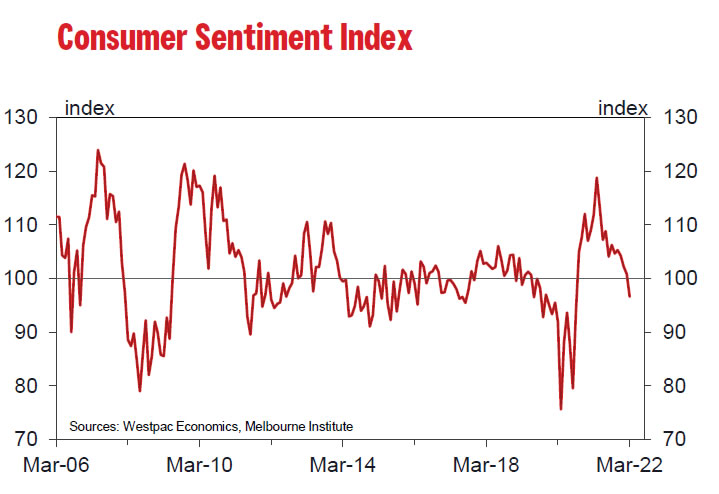
Australia Westpac consumer sentiment index dropped -4.2% to 96.6 in March, down from 100.8. That's the worst reading since September 2020, which was also the last time thee index was below the 100-level.
Westpac said: "The latest monthly fall comes as no surprise. The war in Ukraine; the floods in south- east Queensland and Northern NSW; ongoing concerns about inflation and higher interest rates were all likely to impact confidence, although the size of the decline is still notable."
Westpac maintained the view that the first RBA rate hike in the tightening cycle will start on August 2, following two more inflations reports of Q1 and Q2.
China PPI slowed to 8.8% yoy in Feb, CPI unchanged at 0.9% yoy
China PPI slowed from 9.1% yoy to 8.8% yoy in February, above expectation of 0.8% yoy. Senior National Bureau of Statistics statistician Dong Lijuan said, PPI was "affected by the increased commodity prices globally such as crude oil and non-ferrous metals".
CPI was unchanged at 0.9% yoy, above expectation of 0.8% yoy. affected by the Chinese New Year holiday and the fluctuation of international energy prices, CPI saw a bigger month on month increase," added Dong after CPI rose by 0.6 per cent month on month.
Fitch downgrades Russia rating to C, sovereign default is imminent
Fitch Ratings has downgraded Russia's Long-Term Foreign Currency Issuer Default Rating (IDR) to 'C' from 'B'. The 'C' rating reflects Fitch's view that a sovereign default is imminent.
The rating agency said developments since March 2, the last downgrade to "B", "further undermined Russia's willingness to service government debt."
It added, "the further ratcheting up of sanctions, and proposals that could limit trade in energy, increase the probability of a policy response by Russia that includes at least selective non-payment of its sovereign debt obligations.
Elsewhere
New Zealand manufacturing sales rose 12.0% in Q4. Japan GDP growth was finalized at 1.1% qoq in Q4, below expectation of 1.4% qoq.
Looking ahead, Italy industrial output and US oil inventories are the major releases in a light day.
USD/CAD Daily Outlook
Daily Pivots: (S1) 1.2823; (P) 1.2862; (R1) 1.2928; More...
USD/CAD's break of 1.2876 resistance suggests that rise from 1.2448 has resumed, and revives near term bullishness. Intraday bias is back on the upside for 1.2963 resistance first. Break there will target key long term fibonacci level at 1.3022. On the downside, below 1.2794 minor support will turn intraday bias neutral and mix up the outlook again.
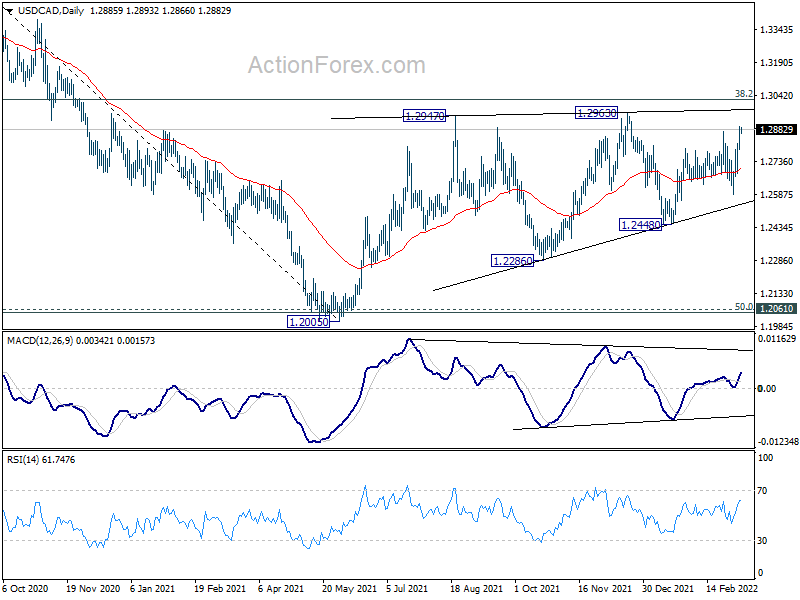
In the bigger picture, focus stays on 38.2% retracement of 1.4667 (2020 high) to 1.2005 (2021 low) at 1.3022. Sustained break there should confirm that the down trend from 1.4667 has completed after defending 1.2061 long term cluster support. Further rise would then be seen towards 61.8% retracement at 1.3650. However, rejection by 1.3022 will maintain medium term bearishness. Break of 1.2005 will resume the down trend from 1.4667 and that carries larger bearish implications too.
Economic Indicators Update
| GMT | Ccy | Events | Actual | Forecast | Previous | Revised |
|---|---|---|---|---|---|---|
| 21:45 | NZD | Manufacturing Sales Q4 | 12.00% | -2.20% | ||
| 23:30 | AUD | Westpac Consumer Confidence Mar | -4.20% | -1.30% | ||
| 23:50 | JPY | GDP Q/Q Q4 F | 1.10% | 1.40% | 1.30% | |
| 23:50 | JPY | GDP Deflator Y/Y Q4 F | -1.30% | -1.30% | -1.30% | |
| 23:50 | JPY | Money Supply M2+CD Y/Y Feb | 3.60% | 3.50% | 3.60% | |
| 01:30 | CNY | CPI Y/Y Feb | 0.90% | 0.80% | 0.90% | |
| 01:30 | CNY | PPI Y/Y Feb | 8.80% | 8.70% | 9.10% | |
| 06:00 | JPY | Machine Tool Orders Y/Y Feb | 61.40% | |||
| 09:00 | EUR | Italy Industrial Output M/M Jan | 0.00% | -1.00% | ||
| 15:30 | USD | Crude Oil Inventories | -1.1M | -2.6M |
China PPI slowed to 8.8% yoy in Feb, CPI unchanged at 0.9% yoy
China PPI slowed from 9.1% yoy to 8.8% yoy in February, above expectation of 0.8% yoy. Senior National Bureau of Statistics statistician Dong Lijuan said, PPI was "affected by the increased commodity prices globally such as crude oil and non-ferrous metals".
CPI was unchanged at 0.9% yoy, above expectation of 0.8% yoy. affected by the Chinese New Year holiday and the fluctuation of international energy prices, CPI saw a bigger month on month increase," added Dong after CPI rose by 0.6 per cent month on month.
Australia Westpac consumer sentiment dropped to 96.6 in Mar, worst since Sep 2020
Australia Westpac consumer sentiment index dropped -4.2% to 96.6 in March, down from 100.8. That's the worst reading since September 2020, which was also the last time thee index was below the 100-level.
Westpac said: "The latest monthly fall comes as no surprise. The war in Ukraine; the floods in south- east Queensland and Northern NSW; ongoing concerns about inflation and higher interest rates were all likely to impact confidence, although the size of the decline is still notable."
Westpac maintained the view that the first RBA rate hike in the tightening cycle will start on August 2, following two more inflations reports of Q1 and Q2.
RBA Lowe: A rate hike this year is plausible
RBA Governor Philip Lowe reiterated in a speech that Australia has the "scope to wait and assess incoming information" before working on interest rates.
He highlighted two issues that policymakers are "paying close attention to". The first is the "persistence of supply-side price shocks" and the extent of impact from Russia's invasion of Ukraine. Secondly, that's "how labor costs in Australia evolve".
He noted that "given the outlook, though, it is plausible that the cash rate will be increased later this year." There is both a risk to "waiting too long" and "moving too early". But Low finished with the point that "it is only possible to achieve a sustained period of low unemployment if inflation remains low and stable". And, "recent developments in Europe have added to the complexities here."
Fitch downgrades Russia rating to C, sovereign default is imminent
Fitch Ratings has downgraded Russia's Long-Term Foreign Currency Issuer Default Rating (IDR) to 'C' from 'B'. The 'C' rating reflects Fitch's view that a sovereign default is imminent.
The rating agency said developments since March 2, the last downgrade to "B", "further undermined Russia's willingness to service government debt."
It added, "the further ratcheting up of sanctions, and proposals that could limit trade in energy, increase the probability of a policy response by Russia that includes at least selective non-payment of its sovereign debt obligations.
How Could the Dollar React to Another Inflation Spike?
US CPI inflation readings for February will be out on Thursday at 12:30 GMT, likely generating more anxiety for Fed policymakers amid the Ukrainian geopolitical nightmare as price pressures are expected to have intensified further. The US dollar is trading in secure territory and another upbeat inflation report could strengthen calls for a faster monetary tightening once again, making the reserve currency shine brighter.
Powell previews March rate decision
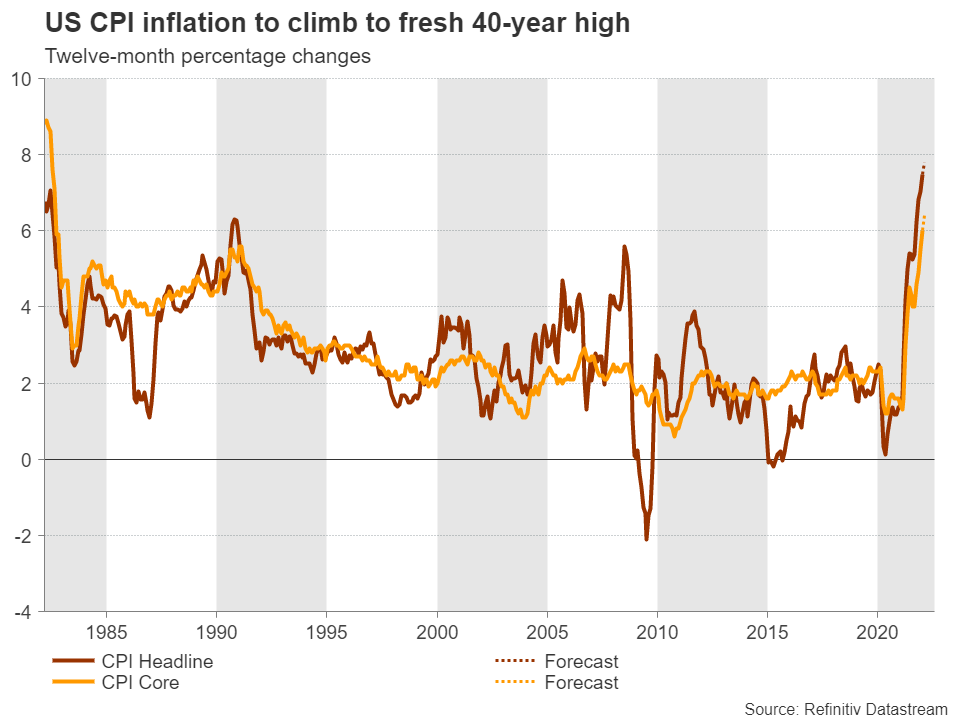
US consumer prices experienced their highest annual growth in 40 years in January, led by energy, electricity, and transportation costs. Other essential sectors such as food also posted considerable price increases, while the core CPI measure, which excludes volatile food and energy prices, surged to 6.0% y/y, flagging that what looked to be a pandemic-led price distortion is now developing to a broader inflation problem, which requires an immediate monetary action.
Indeed, speaking before a House panel, Fed chief Jerome Powell admitted he would propose a quarter-percentage point rate increase when the central bank’s voting committee meets next week, clearly revealing to investors how the policy gathering will play out. While that had initially curbed speculation for a more aggressive start to the tightening cycle, Powell kept that prospect open for the foreseeable future, indicating that the central bank would not hesitate to intervene drastically with non-traditional rate hikes even if such an action would sacrifice some economic growth.
How exposed is the US to Russia?
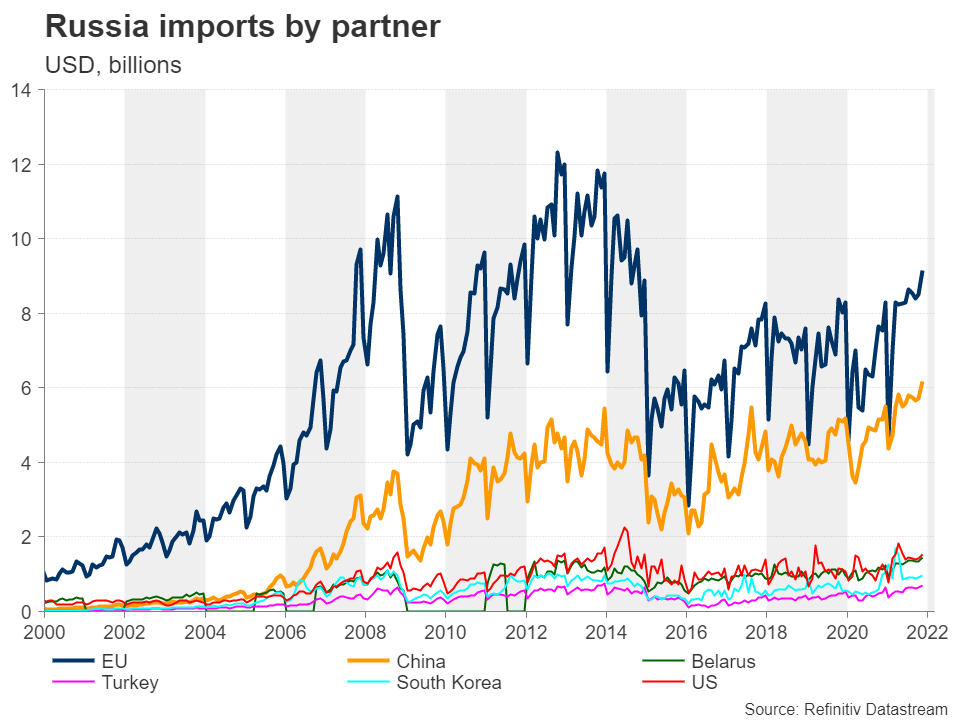
It would not be a big surprise if Fed policymakers enter long debates over any tightening actions which could derail the economic expansion at a time when the tit-for-tat sanction war between Ukraine’s Western allies and Russia is moving from bad to worst, testing the interconnectedness of the global economy. That said, the US is less exposed to the Ukrainian crisis than its European rivals, given its small reliance on Russian exports and imports including the energy sector as well. Hence, the Fed could remain concentrated on cooling down inflation for now, and as long as the US economy keeps printing healthy data and the Ukrainian geopolitical crisis does not generate severe global economic shock waves.
US inflation to print fresh 40-year high
Hence, after February’s upbeat employment report, which revealed a stronger-than-expected hiring spree and an unemployment rate closer to pre-pandemic levels, the new CPI inflation report could raise again the stakes for a more aggressive Fed response. The headline measure is expected to edge up to a new 40-year high of 7.8% y/y and the gauge which excludes volatile food and energy prices is forecast to jump to 6.4% y/y, further deviating above the Fed’s 2.0% symmetrical price target.
How could the dollar react to another inflation spike?
As regards the dollar’s reaction, an upside surprise in the CPI data could bolster buying appetite for the world’s reserve currency, which is also extracting benefits from its safe-haven feature. Yet gains could appear moderate as investors are already aware that the sanction fight could make inflation stickier than analysts thought at the start of the year, and the Fed’s next policy decision is also well telegraphed. Moreover, futures markets are currently reflecting certainty for three additional 25 bps rate hikes by July, which makes February’s inflation data look less important but still a key indicator to influence rate expectations.
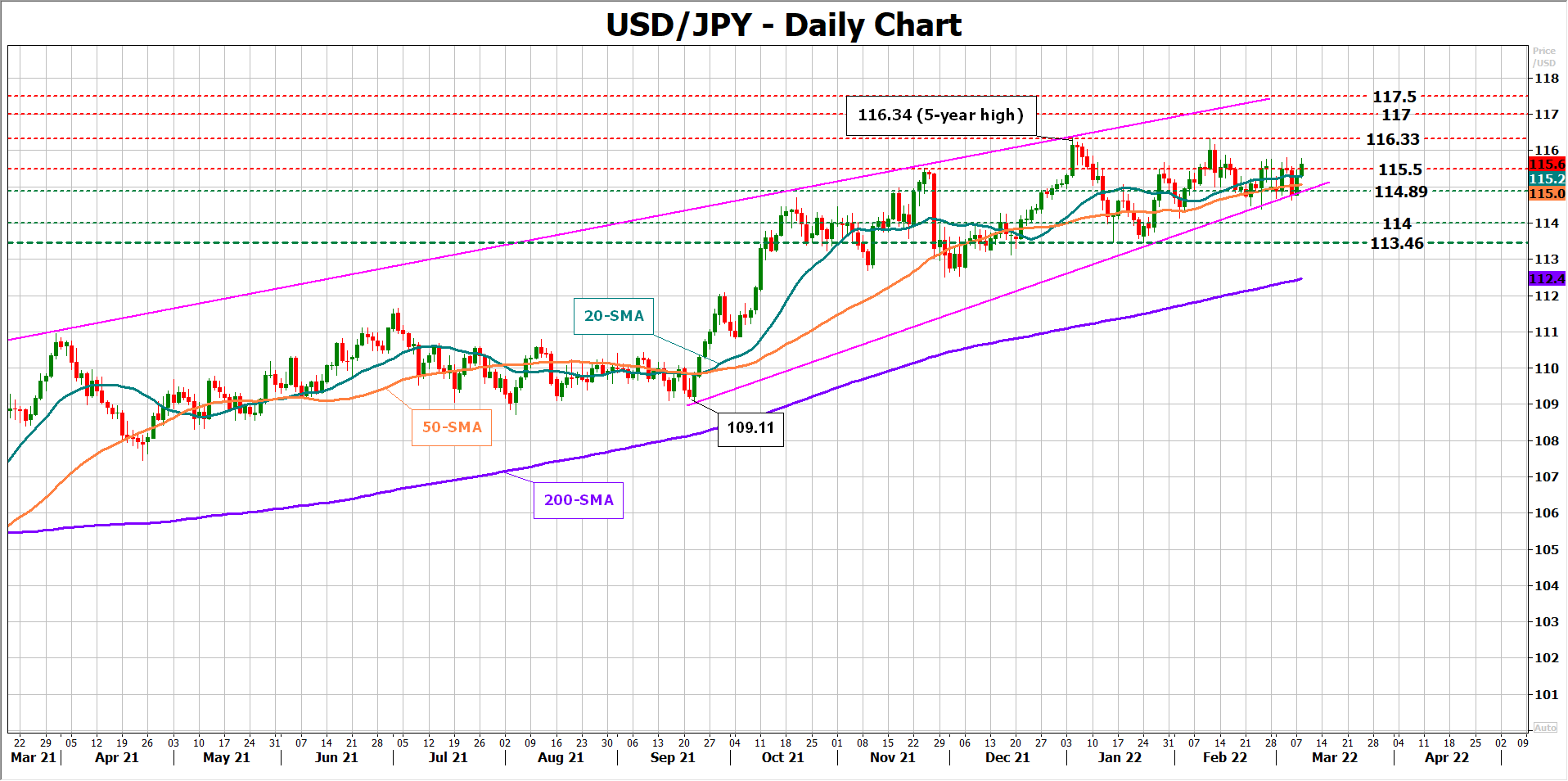
Looking at dollar/yen, the 115.50 level keeps balancing bullish moves for the second consecutive week. Should the CPI report push the pair above that boundary, traders may not rush to raise exposure to the market, unless the price climbs sustainably above the nearby ceiling of 116.33 and towards the 117.00 – 117.50 region.
In the case the CPI readings miss expectations, all attention will turn to the ascending trendline at 114.89, which has been supporting the market since September. Failure to bounce here could press the price towards the 114.00 level and January’s low of 113.46.
AUDUSD Upside Risks Linger Despite Heavy Retreat
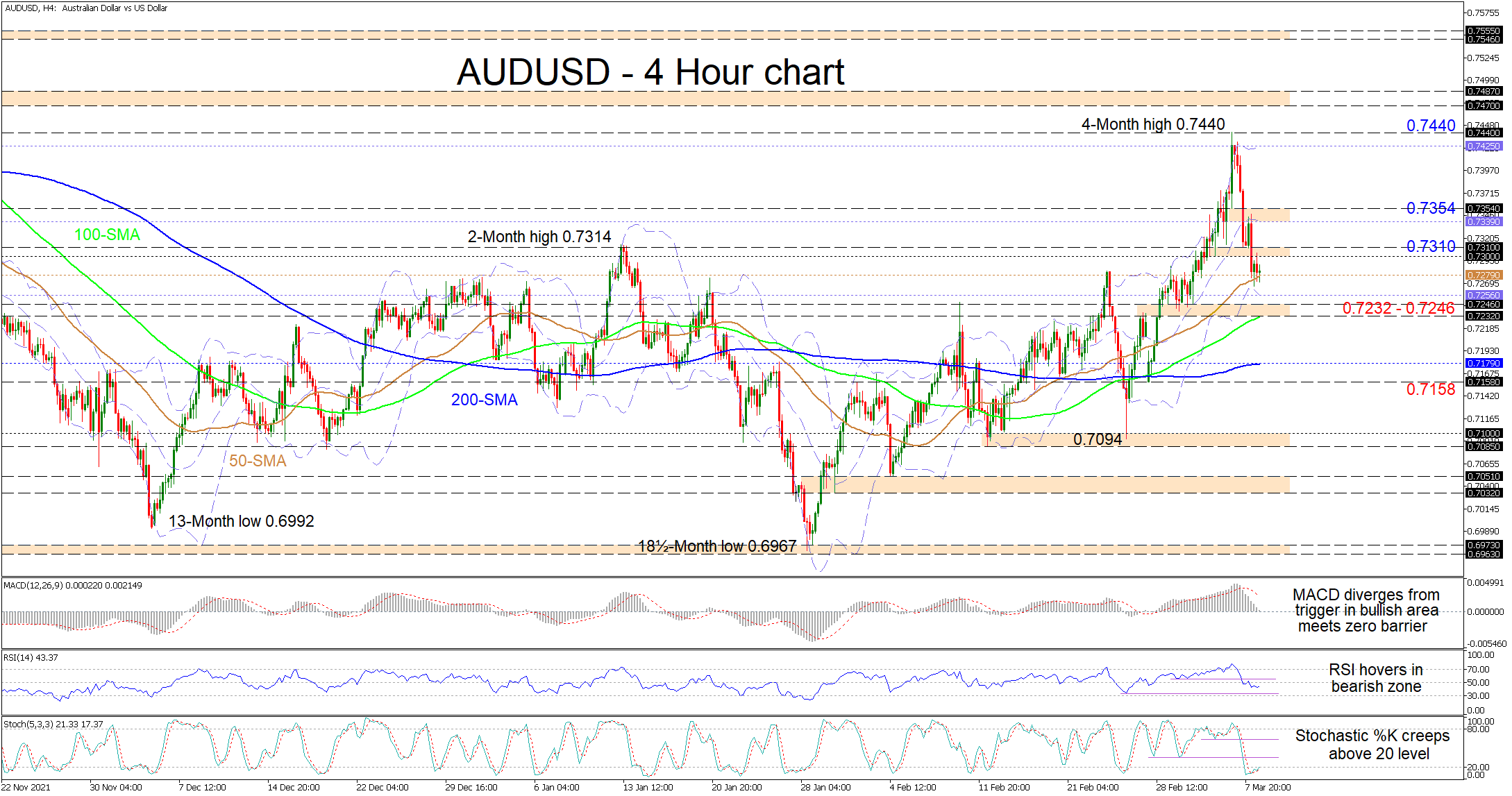
AUDUSD has snagged around the ascending 50-period simple moving average (SMA) around 0.7279 after its latest deep retracement from a four-month high of 0.7440. The SMAs are essentially defending the rally that began from the February 24 trough of 0.7094.
The short-term oscillators are endorsing the bearish drop and have yet to convincingly signal a shift in momentum to the upside. The MACD looks set to pierce into negative territory after accelerating far beneath its red trigger line, while the RSI is hinting of a pause in bearish momentum. The stochastic %K line is marginally above its %D line and is flirting with the 20 oversold level, indicating that buyers are finding some footing at the 50-period SMA.
In the positive scenario, traction off the 50-period SMA would need to initially overcome the 0.7300-0.7310 nearby upside constraint before tackling the region of resistance from the mid-Bollinger band at 0.7339 until the 0.7354 inside swing low. Conquering the latter obstacle too, the bulls could then propel to test the upper Bollinger band at 0.7425 and the adjacent four-month high of 0.7440.
Alternatively, the 50-period SMA at 0.7279 is the immediate support hindering additional developments to the downside. That said, for sellers to sustain the downward trajectory in the pair, they would need to drive the price below the lower Bollinger band at 0.7256 and the neighbouring 0.7232-0.7246 support border. Successfully breaching this key barrier, which is reinforced by the 100-period SMA, the bears could then target the 200-period SMA at 0.7179 before eyeing the 0.7158 trough.
Summarizing, AUDUSD has retraced around 50.0% of its recent rally but the bullish bearing remains active above the 0.7232-0.7246 boundary. That said, a price descent below the 0.7158 trough could spark growing worries about negative tendencies in the pair.
EURCAD Wave Analysis
- EURCAD reversed from support area
- Likely to rise to resistance level 1.41
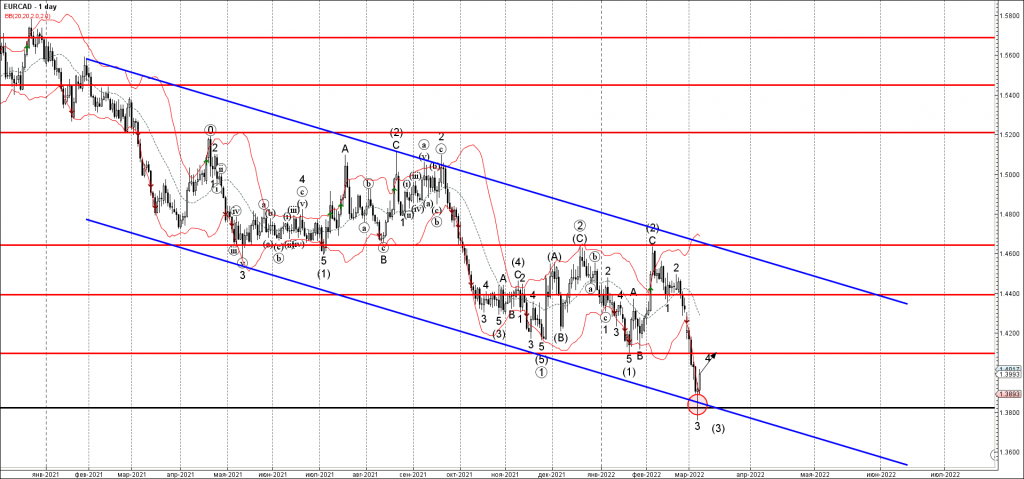
EURCAD recently reversed up sharply from the support area located between the key support level 1.3800, weekly down channel from 2021 and the lower daily Bollinger Band.
The upward reversal from this support area created the daily Japanese candlesticks reversal pattern Hammer.
EURCAD can be expected to rise further toward the next resistance level 1.41 (target price for the completion of the active wave 4).
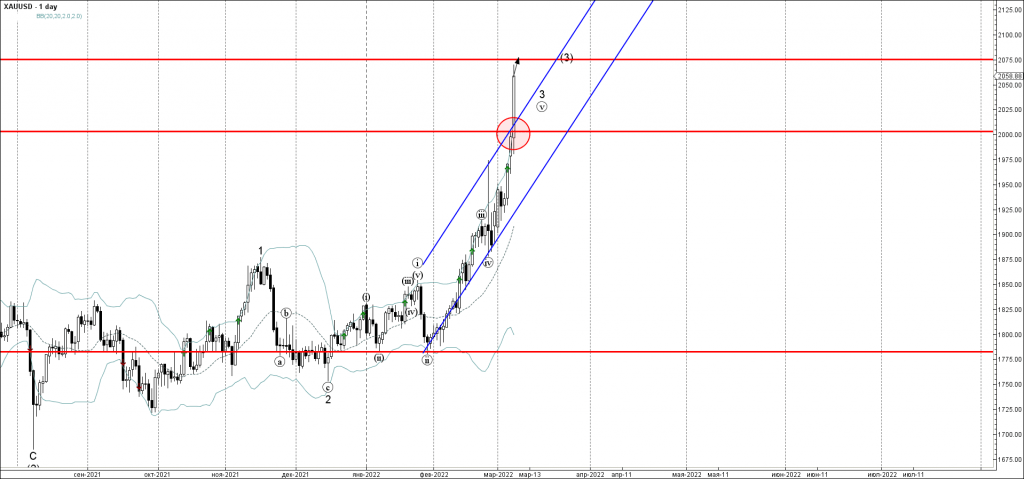
Gold Wave Analysis
- Gold broke round resistance level 2000.00
- Likely to rise to resistance level 2075.00
Gold recently broke through the major resistance area located between the round resistance level 2000.00 and the resistance trendline of the sharp daily up channel from October.
The breakout of this resistance area accelerated the active impulse waves 3 and (3).
Gold can be expected to rise further toward the next resistance level 2075.00 (target price for the completion of the active wave (3)).
Eco Data 3/9/22
[php_everywhere instance="1"]