Sample Category Title
Week Ahead – ECB to Lay Out ‘Patient’ Stimulus Exit; Another Eye-Watering US CPI Print Expected
The European Central Bank’s much anticipated policy meeting and the latest consumer price index out of the United States will take centre stage next week amid the ongoing conflict in Ukraine. The crisis may not necessarily derail the ECB’s plans to normalize policy and a middle ground will likely be plotted. An expected jump in US inflation might have less impact this time following Jerome Powell’s endorsement for a 25-basis-point rate rise in March. Canadian employment numbers will also gather some attention as the loonie finally attracts some upside traction.
ECB meets as stagflation fears grow
There can be little doubt that the war in Ukraine has thrown a spanner in the works for central bankers’ plans to tighten monetary policy in their fight against decades-high inflation. But the ECB is possibly facing the biggest dilemma out of all central banks as the economic pain in the euro area will doubtlessly be the most acute given its proximity to sanction-hit Russia.
The crisis couldn’t have come at a worse time for policymakers as inflation is soaring in the Eurozone. The bloc’s harmonized CPI index jumped to a new all-time peak of 5.8% year-on-year in February and further increases are almost certain now that energy prices are scaling fresh highs. The ECB is anticipated to revise up its inflation forecasts when it meets on Thursday. At the same time, however, the latest growth projections will probably incorporate the potential hit from the Ukraine conflict so this should provide a strong enough case for the doves to argue for a patient response to the inflation shock.
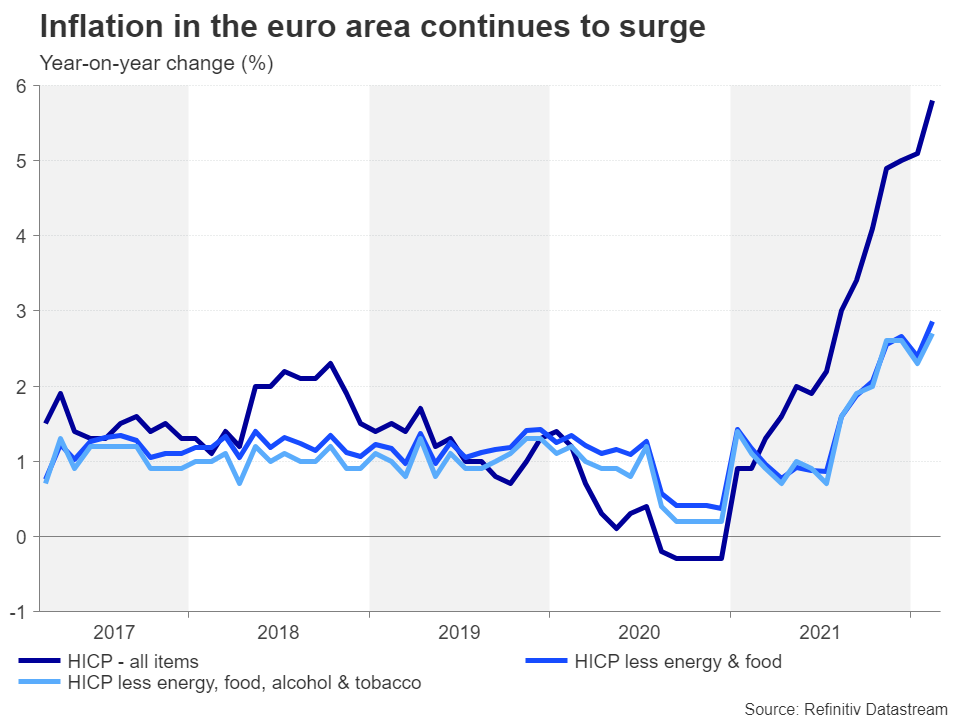
Nevertheless, the ECB will need to be seen to be taking some steps to stem the surge in price pressures and will likely signal the end of asset purchases either in Q3 or Q4. The latter would be the dovish outcome and could worsen the euro’s woes as it would imply that rates won’t start to go up until early 2023.
On the data front, the revised estimate of Q4 GDP on Thursday and German industrial orders and production on Monday and Tuesday, respectively, will be the only notable releases.
Bruised pound might shrug off UK data barrage
Another currency that’s taken a tumble from the geopolitical uncertainties is the British pound. Like the Eurozone, UK growth will be negatively affected from the war as Western sanctions on Russia are compounding the energy crisis. Although this magnifies the risk to higher inflation, some market participants are betting that the subsequent weaker growth from the squeeze on consumers will soon drain the excess demand out of the economy, reducing the upwards pressure on prices.
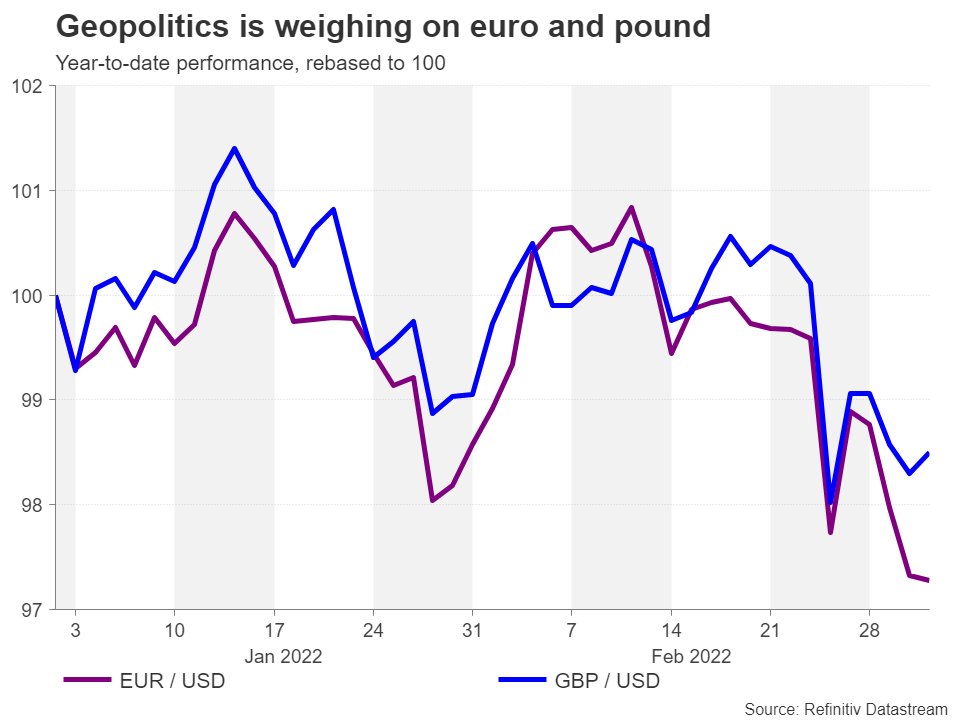
Accordingly, investors have priced out about one 25-bps rate hike for the Bank of England, pushing the pound lower.
Next week, the key monthly readings on GDP, industrial and manufacturing output, and the trade balance for January due Friday are unlikely to spur much reaction as the BoE has already indicated that a rate hike is on the cards at its next policy decision. In addition, there will be no updated economic forecasts at the March meeting so investors will have to wait a bit longer to get a clearer idea of how big an impact Russia’s invasion of Ukraine will have on growth, and ultimately, on the BoE policy path.
Spiralling US CPI to set sights on 8% mark
The inflation story will not be escaping the limelight at all next week as the US CPI report for February is due on Thursday. The headline CPI print is expected to inch higher to 7.8% y/y to yet another fresh 40-year high. Core CPI is also forecast to keep climbing, rising from 6.0% to 6.4% y/y.
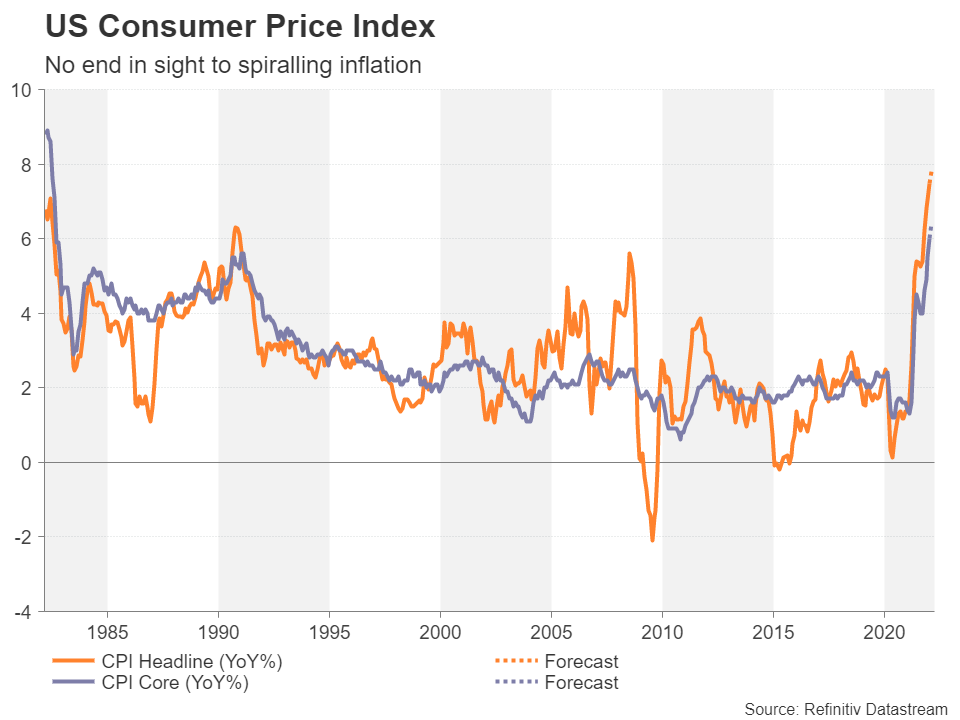
While it’s quite possible that the trend of positive CPI shocks will not end with the February data, the speculation of whether there will be a 25 or 50 bps rate increase has already been resolved courtesy of Fed Chair Powell in remarks he made at his Congressional hearing. So the markets’ response to any surprises will likely be limited, unless it’s a negative one.
Thus, safe-haven flows look set to remain in the driving seat for the US dollar as the Ukraine fallout continues to weigh on riskier assets.
In other US data, the JOLTS job openings on Wednesday and the University of Michigan’s preliminary reading of consumer sentiment on Friday will also be watched.
Loonie hoping for employment boost
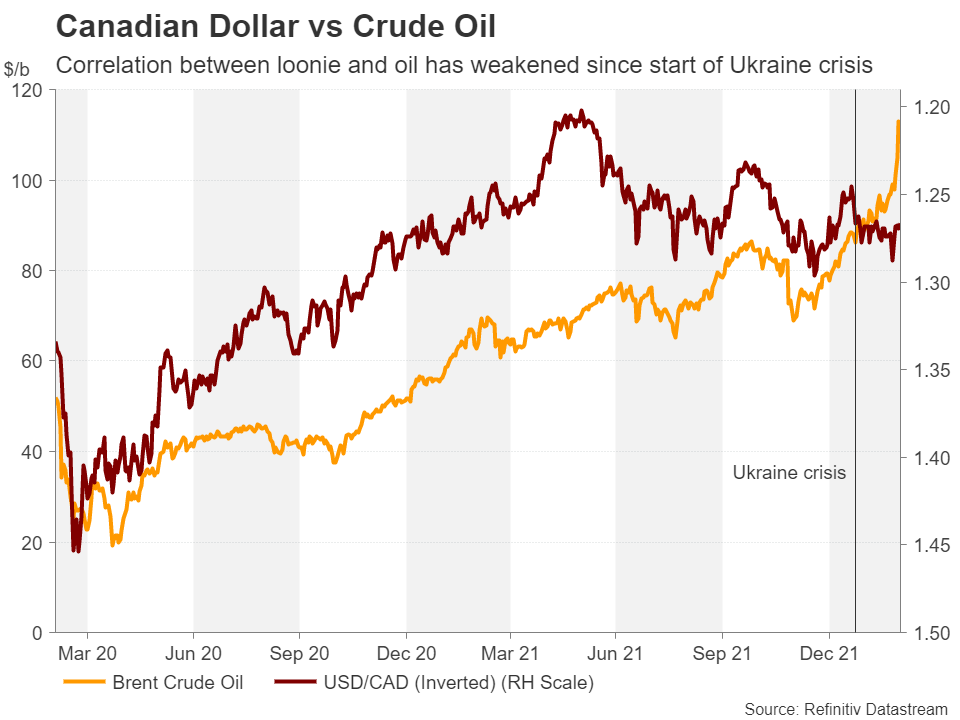
North of the border, the Canadian dollar has been having somewhat of a tougher time since the onset of the troubles in Ukraine despite the massive rally in oil prices. Investors had been worried that the Bank of Canada would turn more cautious but that changed after policymakers proceeded with the first post-pandemic rate hike on Wednesday and signalled that more are on the way.
The loonie has since risen to one-month highs against its US counterpart, restoring its positive correlation with oil prices.
There could be a further boost in store next Friday from the February employment report. Canada’s economy shed 200k jobs in January amid fresh virus curbs brought on by the Omicron wave. A strong bounce back in February could aid the loonie to extend the past week’s gains.
Market sentiment to stay hostage to Ukraine headlines
In Asia, trade numbers out of China could help shape the market tone on Monday. Chinese consumer and producer prices will follow on Wednesday. If the data point to slowing growth in the world’s second biggest economy, it could dent sentiment, especially if the geopolitical headlines only deteriorate in the coming days.
Unusually, the risk-sensitive Australian and New Zealand dollars have defied the global flight to safety to instead stretch their rebound versus the greenback. The broad rally in commodity prices is the main explanation for this divergence, plus the fact that the Antipodean economies are not likely to suffer much from the war turmoil.
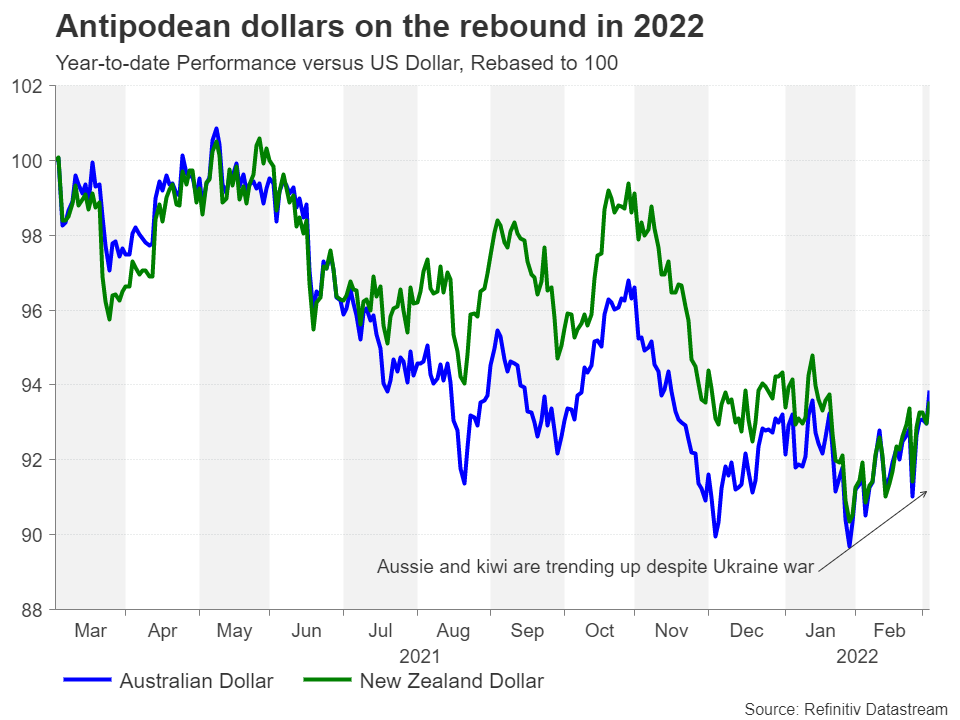
With not a lot on the agenda next week other than Australian business surveys and New Zealand electronic card retail sales, the aussie and kiwi will probably take their cues from the developments in commodity markets.
As for the yen, it’s hard to see the safe-haven currency becoming unaligned from risk averse trades anytime soon even as there is some evidence that inflation has started to creep into the Japanese economy. Figures on overtime pay on Tuesday and corporate goods prices on Thursday might show some build-up of inflationary pressures, but they’re unlikely to have any immediate policy impact for the Bank of Japan.
Weekly Focus – Rising Stagflation Risks from Surge in Commodity Prices
The war in Ukraine intensified further this week and concerns mounted about the humanitarian situation in Ukraine and what the end game will be in Ukraine. Fighting around Europe's largest nuclear plant that caused a fire to break out stoked fears over a possible nuclear accident. However, the fire was put out.
Financial markets have seen a further risk-off move throughout the week with especially European stocks taking a big hit. Euro Stoxx 50 has dropped 9% this week at the time of writing and are down 16% from the peak. German 10-year bond yields have dropped 30bp over the past 2-3 weeks and now trade around zero again. The USD and CHF have gained further on flight to safety and EUR/USD has also moved lower on overall EUR weakness as the euro area is most exposed to the economic fall-out from the war in Ukraine.
Commodity prices have surged with not least oil and gas prices accelerating higher. Brent oil hit USD118 this week before falling back to USD111 but it's still a rise of 40% compared to late last year. Food and metals prices are also moving higher as Russia is a big exporter of wheat and many metals. Food prices also see spill-over from higher gas prices as it is an input in fertilizer production. The CRB food stuff index is up 20% over the past three months. Apart from being inflationary it also adds to vulnerabilities among emerging and developing countries on top of continued struggle with covid in some of these countries.
The crisis has led to renewed downside risks to global growth with Europe being most exposed. Inflation could rise even further on the commodity price surge, which in turn erodes purchasing power. Underlying inflation is also likely to move up due to second round effects on wage growth and higher inflation expectations.
The inflationary effect of the crisis is keeping central banks on a hiking path despite the risks to growth. Fed Chairman Jerome Powell this week said he supported a 25bp hike at the meeting on 16 March and that 50bp hikes could be necessary later in the year if inflation failed to come down as projected. A similar message was given from other Fed members. We also expect the ECB to still hike in December, which is in line with market pricing. Inflation for February released this week surprised to the upside again hitting 5.8% (consensus 5.6%).
Looking into next week, the war in Ukraine will remain the most important thing to follow. Among other things, focus is on a possible siege of Kyiv by Russian forces. Otherwise the ECB meeting will be key for not least fixed income markets. We expect ECB to formally put an end date to the APP programme (in September this year), due to the high inflation pressure, but fall short of giving a firm indication of a coming rate hike, see ECB Preview - Inflation forces normalisation process to continue, 3 March. The US releases CPI inflation for February, which will also be key to gauge current inflation pressures. The Fed's blackout period starts Saturday so we'll get no further comments after that ahead of the 16 March meeting. In China, the annual National People's Congress begins tomorrow. It starts with read-out of the work report, which outlines policies for the coming year including a growth target. We expect a target of 5+% or 5½%.
Sunset Market Commentary
Markets
Headlines this morning that Russian shelling caused a fire at the territory of a major Ukraine nuclear power plant was the trigger for an outright risk-off session, especially on European markets. In volatile trading, European indices currently are mostly losing between 3.0% and almost 5.0%! Commodities continue their ascent. Even so, Brent oil ($ 114 p/b), while still sharply higher in a weekly perspective, is trading off yesterday’s peak levels near $120. Evidently this didn’t give any comfort. German bunds are again attracting a strong safe haven bid, yields declining between 13.5 bps (2-y) and 10 bps (10-y). The Germany real yield dropped to an all-time low as inflation expectations continue to set new cycle peaks. EMU swaps are ceding between 4 bps and 7.0 bps. Contrary to what temporarily occurred at the start of the week, the decline in core yields doesn’t help peripheral bonds. 10-y EMU spreads versus Germany are widening up to 7-8 bps (Greece/Italy). The US yield curve also developed a defensive bull flattening with yields declining between 7.75 bps (2-y) and 11 bps (10-y). US February payrolls (cf infra) again printed strong, confirming that the US economy is ready for the Fed taking back policy stimulus. However, the report hardly left any traces on the US bond market. Losses of US equities are more modest compared to Europe with indices declining about 1.25%.
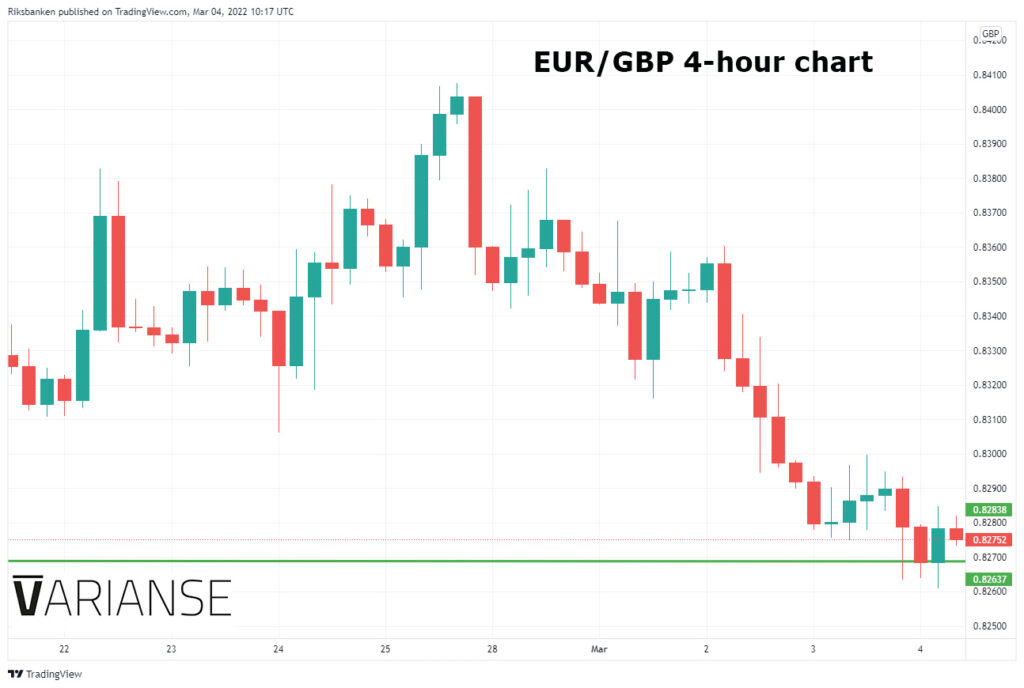
On the FX market, the euro is rolling over into some kind of free-fall. After breaking the EUR/USD 1.10 barrier this morning, the pair already filled bids below 1.09 this afternoon. Similar picture in most other major euro cross rates. EUR/CHF at 1.0035 is coming very close to the symbolic parity level. Sterling, which usually is also quite sensitive to a risk-off sentiment, also strongly outperforms the single currency with EUR/GBP (0.8255) breaking the key end 2019 December low of 0.8277. EUR/JPY also fell off a cliff (125.85). However, yen gains against the dollar remain modest (USD/JPY 115.25). The dollar remains in pole position with DXY jumping from the 98.00 area to currently 98.70.
CE markets/currencies are facing heavy fallout from the war in Ukraine. Central banks are stepping up their defense to a avoid that sharp currency deprecation would exacerbate an already sky-high inflation being reinforced by overheated commodity/import prices. Yesterday, the Hungarian central bank sharply raised the weekly deposit rate from 4.60% to 5.35% in an attempt to slow the free-fall of the forint. For now with little success. EUR/HUF today touched a new all-time high near 391.75 (currently 385). The National Bank of Poland over the previous two days and today did FX currency interventions to support the zloty. The NBP defense yielded no obvious result either, except probably that it avoided even bigger damage. After a brief pause, EUR/PLN already touched a new multi-year top currently trading near 4.86. The Czech national bank(CNB) today joined the NBP as it reported buying koruna in the market. This is a logical step as the CNB has ample FX reserves. The krona also lost part of the post-interventions gains, but EUR/CZK currency holds more or less stable compared to yesterday (currently 25.76 area).
News Headlines
US payrolls are symbolically downgraded to the headlines section this month as they – for once – were of secondary importance for markets. Job creation in the US surprised to the upside. 678k jobs were added in February vs 423k expected and come on top of an upwardly revised 481k in January. The bulk was created in the services sector with leisure & hospitality (+179k), education & health (112k) and trade & transport (103k) accounting for about 60% of the gains. The goods-producing sector was also on fire, adding 105k jobs. There’s now just over 2 mln people less at work compared to before pandemic. The unemployment rate ticked lower to 3.8% from 4% while the participation rate unexpectedly rose from 62.2% to 62.3% - a new post-pandemic high and a sign more people moved off the sidelines. Wage growth is the odd one out this month. Year-on-year wages still rose 5.1% but there was no increase on a monthly basis. Some pointed out the big influx of workers in low-wage sectors this month, depressing the mean/median figure. The market reaction stayed muted with US bond yields sticking to earlier losses across the curve. EUR/USD tested the 1.09 big figure on sustained euro weakness.
US: Payrolls Surge in February, Unemployed Rate Narrows in on Pre-pandemic Low
The U.S. economy gained an impressive 678k jobs in February, on top of an upward revision to the prior two months totaling +92k. Payrolls are still 1.4% below their pre-pandemic level, or about 2.1 million jobs. The unemployment rate fell to 3.8% -- a new post-pandemic low.
All major industries saw job growth in February. Employment rose 179k in the hard-hit leisure and hospitality sector, where employment remains 9% below February 2020 levels (1.5 million jobs). Gains were also seen in professional and business services (+95k), health care (+64k), construction (+60k), retail (+37k), transportation and warehousing (+48k), manufacturing (+36k), financial services (+35k), social assistance (+31k), other services (31k), wholesale trade (+18k) and mining (+9k).
The unemployment rate fell as 548k more people got jobs, outstripping a solid 304k gain in the labor force. The participation rate ticked up slightly from 62.2% to 62.3%. The number of unemployed fell to 6.3 million, now only 600k higher than February 2020. The number of people not in the labor force who currently want a job also fell to 5.4 million, up 400k versus pre-pandemic levels. At the current pace of employment growth it would only take a couple of months to take up the remaining slack in the labor market as measured by the household survey.
Average hourly earnings were up 5.1% from a year ago in February, down from 5.7% in January. February's pace was likely biased upwards by lower average hours.
Key Implications
Payrolls impressed once again in February. With the unemployment rate getting very close to its pre-pandemic low of 3.5%, the labor market is getting tighter and tighter. It is certainly tight enough for the Fed to take interest rates higher. At the current rate of job creation, it will not take long for the labor market to re-attain its pre-pandemic vigor.
The knock-on economic impacts of Russia's invasion of Ukraine, are likely to exert an economic drag on the U.S. economy. Most obviously through higher prices for energy (among other goods). With substantial excess savings, and strong income growth, consumers are in a good position to absorb higher prices, but they will still weigh on economic activity. Alongside greater risk aversion and tighter financial conditions, this could result in fewer Fed hikes in the coming quarters than markets had been expecting prior to the war.
Has War in the Ukraine Crash Landed EUR/GBP?
Who knows is the honest answer! War in Ukraine has dominated markets since the 24 February and unfortunately war, especially this one, can prove unpredictable. Obviously, currency markets have played to the euro area’s greater geographic and economic linkages to Russia and the Ukraine. But the United Kingdom, despite Brexit, is still geographically and economically tied to Europe.
At the time of writing, EUR/GBP has shed nearly 1.30% of its value since all out war broke out in the Ukraine. But the pair has also failed to make a sustained break below 0.82637, which is the bottom end of its long-held range I discussed back in February.
Interest rate markets in the United Kingdom, however, are woke to the potential for economic trouble ahead. Bank of England base rate expectations for the end of this year have been pared back to 1.5% versus a peak of 2.25% prior to the breakout of war.
Now everyone is second guessing whether the Bank of England will really raise base rate by 50 bps on 17 March or only 25 bps! Still, a lot can happen in terms of the war in Ukraine between now and then. The euro is already pricing in quite a bit of negative news, so if the conflict were concluded there is every possibility that ultimately proves positive for the currency.
Bear Market Territory
European markets are closing in on bear market territory in heavy selling at the end of the week as investors grow increasingly fearful of recessionary and escalation risks.
The sell-off has gathered pace as the morning has progressed and I can't expect the mood will improve as we head into another highly uncertain weekend. The fact that Vladimir Putin is showing no desire to de-escalate despite crippling economic sanctions says everything about his mentality and that is bad news for everyone.
Europe is coming under considerable pressure as investors fret about the bloc's exposure to the conflict and the risk that it may be dragged into recession. Sanctions were never going to come without an element of self-harm and we're seeing evidence of that this week. With Putin clearly undeterred, further measures will be demanded which will come at a further cost.
The day started on the backfoot following reports of a fire breaking out at the Zaporizhzhia plant in southeastern Ukraine, Europe's largest, following Russian shelling. Reports that followed confirmed that it was now under control and radiation levels hadn't increased which should have calmed nerves but it's done nothing of the sort.
It obviously doesn't help that we're heading into the weekend, during which a lot can happen before the open next week. But such reckless attacks on a nuclear plant compounds fears about just how far Putin is prepared to go in Ukraine. There is a real fear that the worst is yet to come which is obviously deeply worrying.
A Fed-friendly jobs report
The Federal Reserve will be quite happy with the latest jobs report as they prepare to start aggressively raising interest rates. The US created 678,000 jobs last month which far exceeded expectations, not to mention Wednesday's ADP number which has never been reliable. What's more, the unemployment rate fell to 3.8% while participation rose to 62.3%, beating expectations of a drop to 62% and the highest since the pandemic began. Wages were strong again but shy of expectations at 5.1% annually and 0% compared with January. The Fed couldn't have realistically asked for more.
The dollar softened a little after the report but remained much higher on the day, while US futures pared losses. It's a strong report but does little to shift interest rate expectations ahead of the meeting in a couple of weeks. The next three meetings will probably deliver 75 basis points of hikes, after which the picture should be much clearer.
Oil climbing again after another volatile session
Oil prices remain extremely volatile given the backdrop of huge uncertainty around Russian exports as a result of Western sanctions. Brent came within a whisker of $120 on Thursday before falling more than 8%. And that was just within European trading hours. It's trading higher again today, up around 3% and it's hard to imagine that it's peaked. We could well be heading for recessionary oil prices.
We keep hearing that a nuclear deal between the US and Iran is close but another day passes without an agreement. A deal would bring around 1.3 million barrels per day back to the market quickly, which would go some way to alleviating the imbalance. Unless of course, Russia weaponizes oil exports in response to Western sanctions, something that still looks unlikely at this stage. It could soften the blow of unintentional disruptions though and perhaps take some of the heat out of the market.
Gold remains in demand
Gold saw some profit-taking around $1,950 again ahead of the payrolls report but it's clear that there's plenty of support for the yellow metal. Uncertainty, recession-fears, and high inflation tick all the boxes as far as gold is concerned and there's little to suggest any of those things are going to improve in the near term.
The dollar pared gains on the back of the jobs report which gave gold a bit of a boost. It remains a little short of $1,950 but there's no shortage of momentum. Gold is the ultimate safe haven and there's plenty of demand for those at the minute.
Bitcoin less aligned with risk-assets
Bitcoin has continued to pare gains at the end of the week but it looks in a very healthy position. We saw strong moves earlier in the week on the belief that the crisis in Ukraine and Russian sanctions will lead to increased use of cryptos. While it once again saw resistance at $45,500, that narrative should continue to support bitcoin and see it become less tied to other high-risk assets, alone. It will be interesting to see how it trades around $40,000 as a rotation off here could see it propel higher.
USD/JPY Mid-Day Outlook
Daily Pivots: (S1) 115.30; (P) 115.55; (R1) 115.72; More...
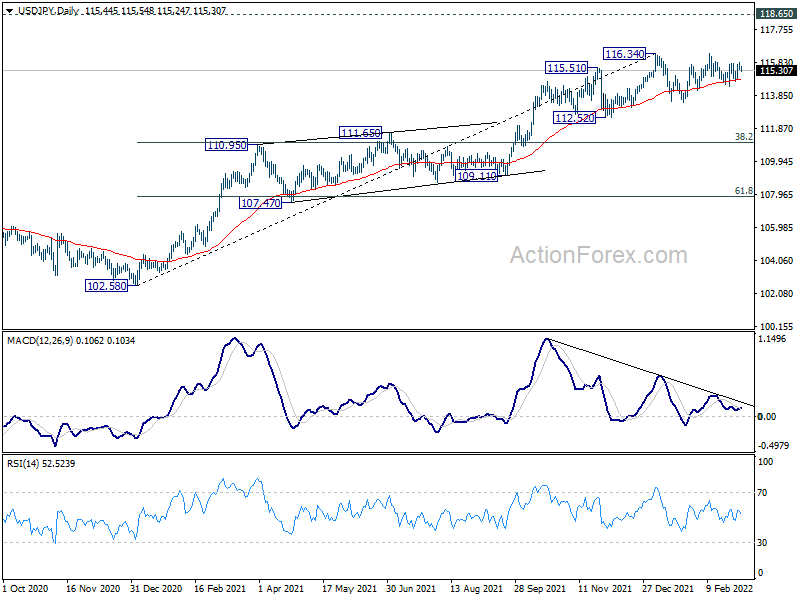
Intraday bias in USD/JPY remains neutral for the moment. On the upside, firm break of 116.34 will resume larger up trend from 102.58 to 118.65 long term resistance next. On the downside, though, break of 114.40 will continue the corrective pattern from 116.34 with another fall to 113.46 support.
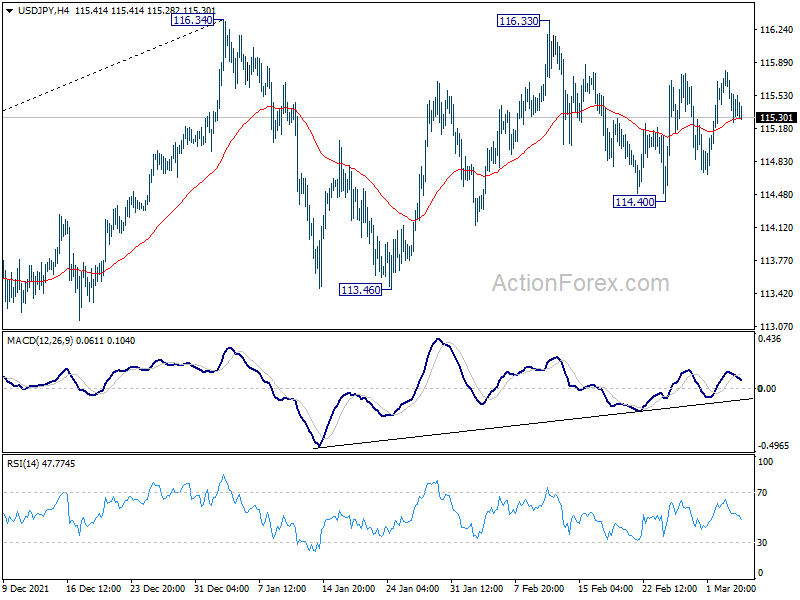
In the bigger picture, no change in the view that rise from 102.58 is the third leg of the up trend from 101.18 (2020 low). Such rally should target a test on 118.65 (2016 high). Sustained break there will pave the way to 120.85 (2015 high) and raise the chance of long term up trend resumption. This will remain the favored case as long as 55 week EMA (now at 111.64) holds.
USD/CHF Mid-Day Outlook
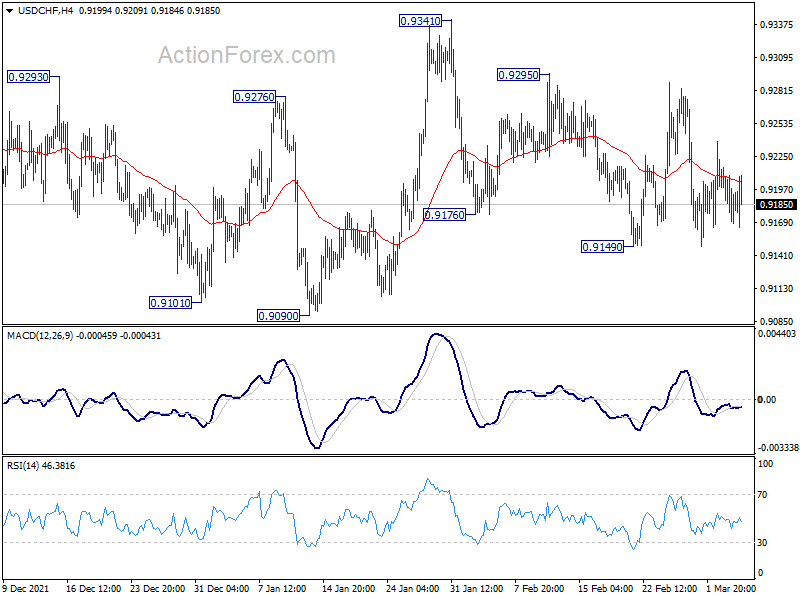
Daily Pivots: (S1) 0.9161; (P) 0.9189; (R1) 0.9203; More....
Intraday bias in USD/CHF remains neutral for the moment. Choppy rise from 0.8925 would still be in favor to extend higher as long as 0.9090 support holds. Break of 0.9341 will target 0.9372 resistance and then 0.9471. On the downside, however, break of 0.9090 will bring deeper fall back to 0.8925 support.
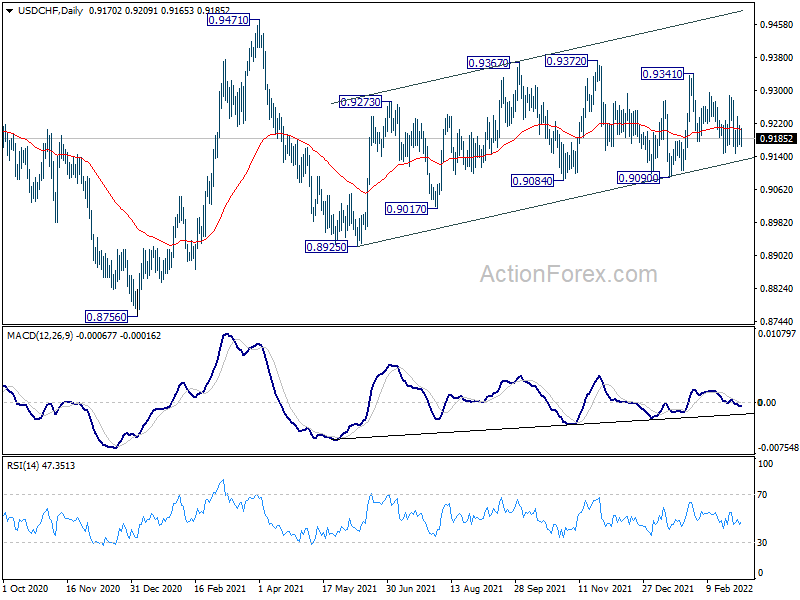
In the bigger picture, medium term outlook will be neutral at best as long as 0.9471 resistance holds. Larger down trend could still extend through 0.8756 (2021 low). However, firm break of 0.9471 will argue that the trend has already reversed and rebound the rally from 0.8756 with another impulsive move.
GBP/USD Mid-Day Outlook
Daily Pivots: (S1) 1.3305; (P) 1.3362; (R1) 1.3405; More...
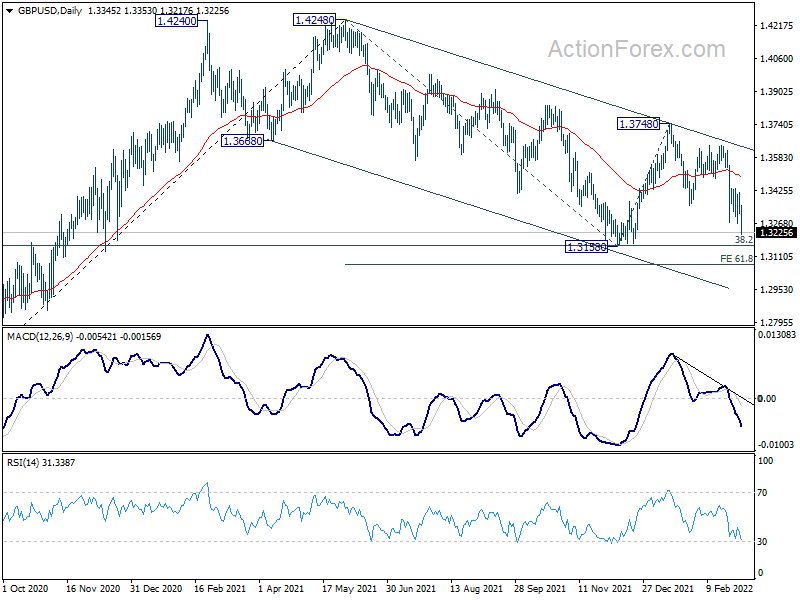
GBP/USD's decline resumes by breaking 1.3272 temporary low. Intraday bias is back on the downside for 1.3158 low. Further break there will resume larger down trend from 1.4248. For now, outlook will stay bearish as long as 1.3416 resistance holds, in case of recovery.
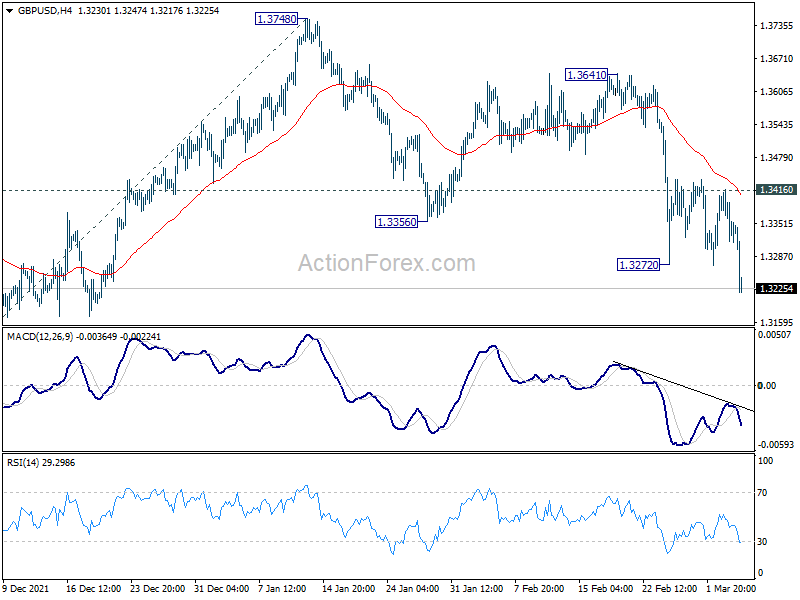
In the bigger picture, as long as 38.2% retracement of 1.1409 to 1.4248 at 1.3164 holds, up trend from 1.1409 (2020 low) is still in progress. On resumption, next target will be 38.2% retracement of 2.1161 to 1.1409 at 1.5134. Nevertheless sustained break of 1.3164 will argue that whole rise from 1.1409 has completed and bring deeper fall to 61.8% retracement at 1.2493.
EUR/USD Mid-Day Outlook
Daily Pivots: (S1) 1.1026; (P) 1.1074; (R1) 1.1114; More...
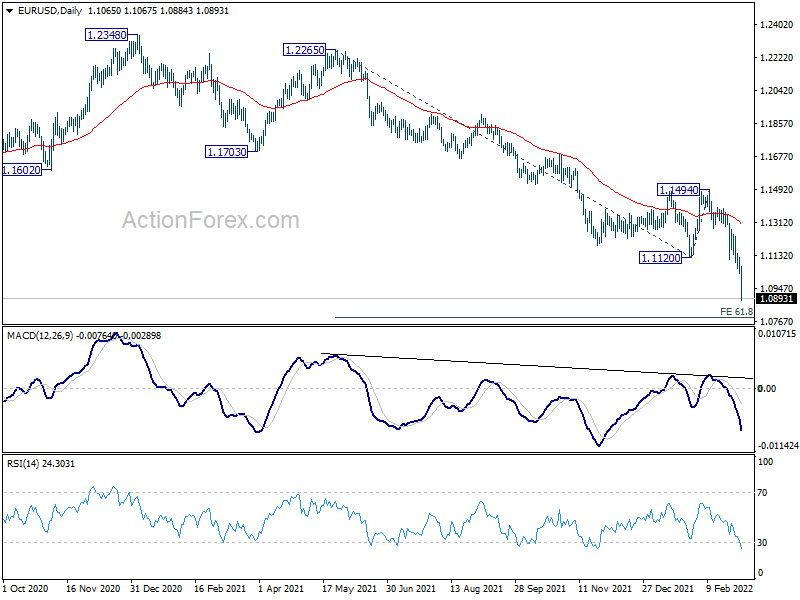
EUR/USD's decline accelerates further to as low as 1.0888 and intraday bias remains on the downside. Current down trend should target 61.8% projection of 1.2265 to 1.1120 from 1.1494 at 1.0786 next. On the upside, above 1.1038 minor resistance will turn intraday bias neutral and bring consolidations first, before staging another decline.
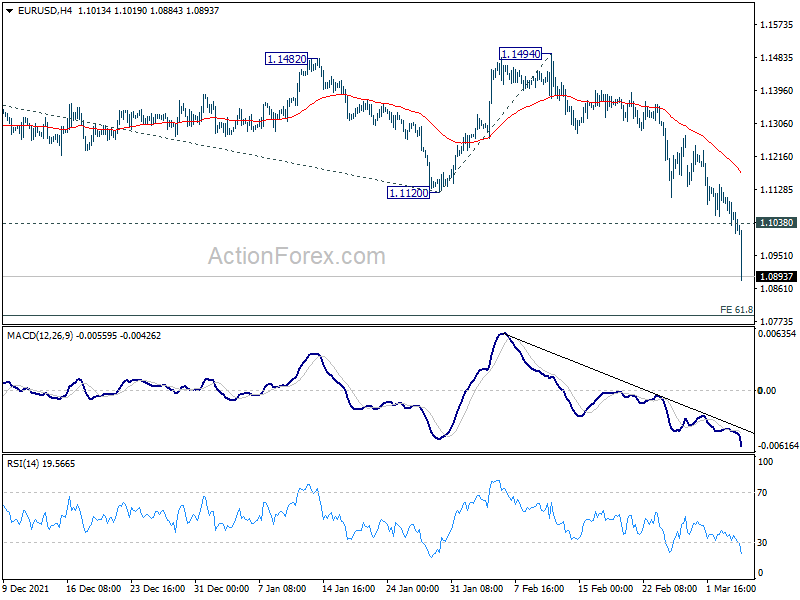
In the bigger picture, the decline from 1.2348 (2021 high) is expected to continue as long as 1.1494 resistance holds. Firm break of 1.0635 (2020 low) will raise the chance of long term down trend resumption and target a retest on 1.0339 (2017 low) next. Nevertheless, break of 1.1494 will maintain medium term neutral outlook, and extend range trading first.