

Sample Category Title
EUR/JPY Weekly Outlook
EUR/JPY dropped sharply to as low as 125.06 last week and there is no sign of bottoming yet. Initial bias stays on the downside this week for 121.94 medium term fibonacci level. On the upside, above 127.28 minor resistance will turn intraday bias neutral and bring consolidation first, before staging another fall.
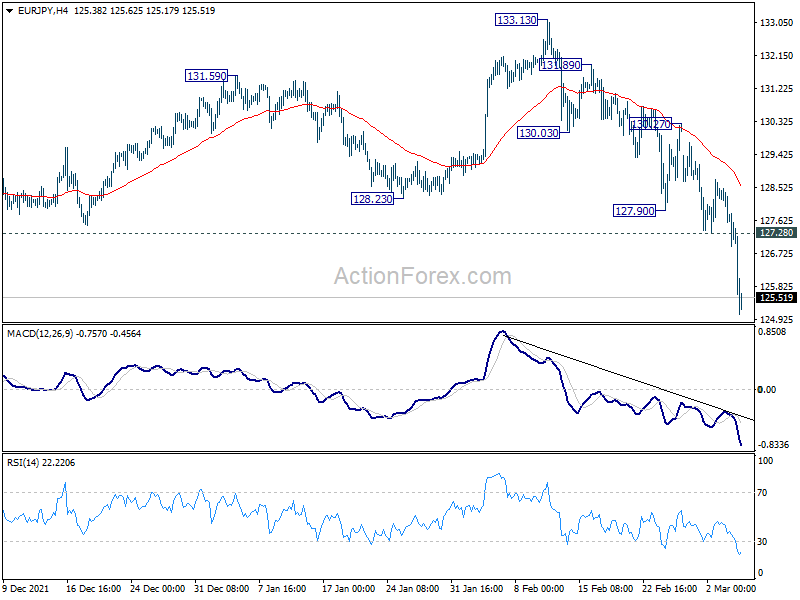
In the bigger picture, current development suggests that whole rise from 114.42 (2020 low) has completed 134.11 already. Fall from there is developing into a medium term down trend. Next target is 61.8% retracement of 114.42 to 134.11 at 121.94. On the upside, firm break of 127.36 support turned resistance is needed to be the first sign of medium term bottoming. Otherwise, outlook will stay bearish in case of recovery.
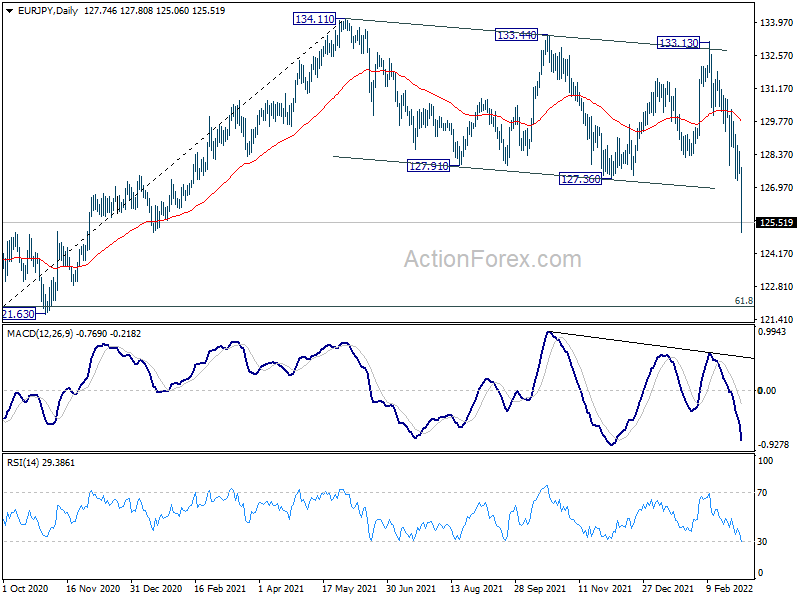
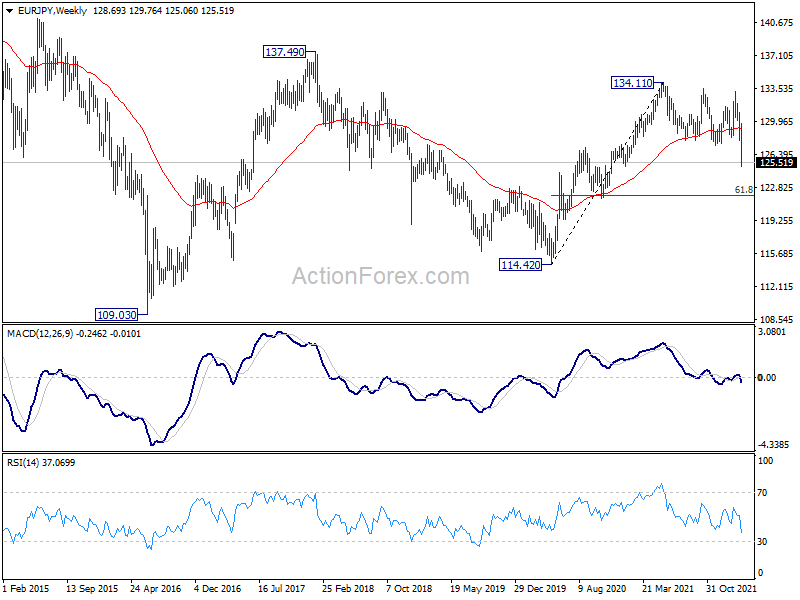
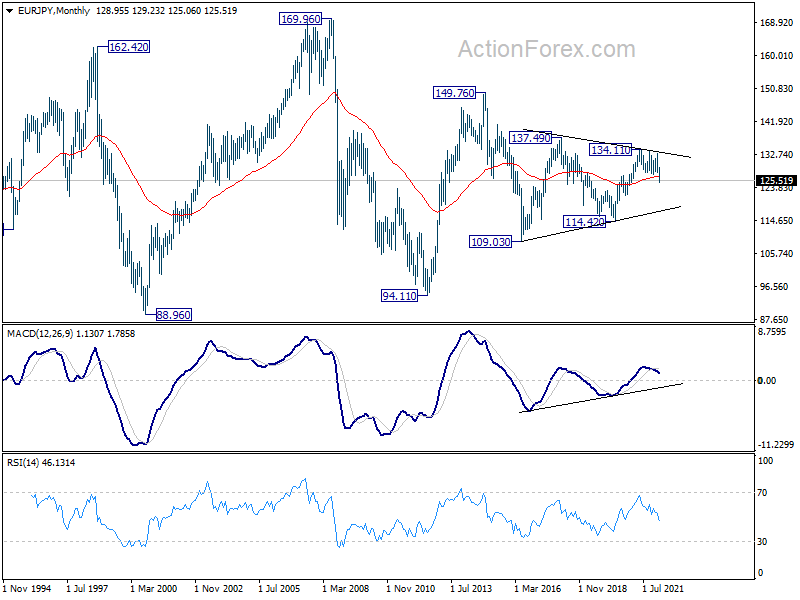
In the long term picture, EUR/JPY is staying in long term sideway pattern, established since 2000. Long term outlook will remain neutral until breakout from the range of 109.03/137.49.
EUR/GBP Weekly Outlook
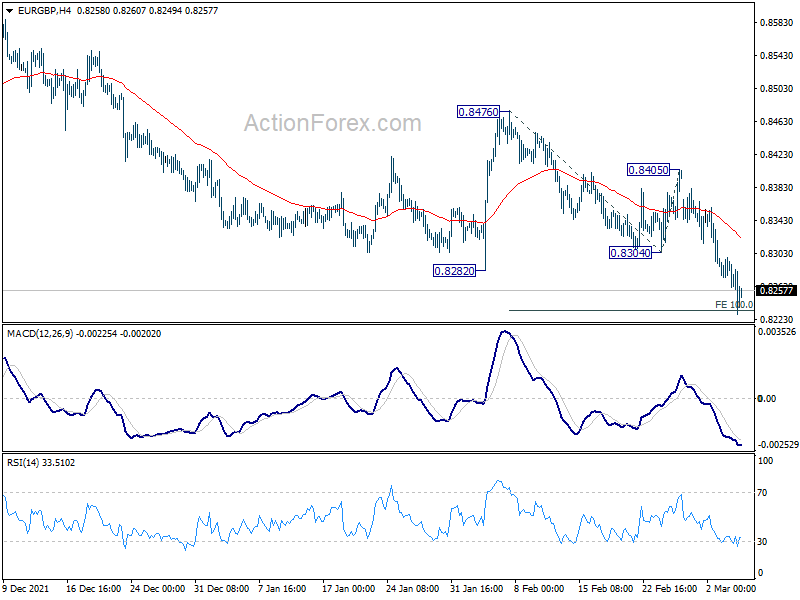
EUR/GBP's dropped to as low as 0.8229 last week and there is no sign of bottoming yet. Initial bias stays on the downside this week first. Firm break of 100% projection of 0.8476 to 0.8304 from 0.8405 at 0.8233 will target 161.8% projection at 0.8127. On the upside, above 0.8304 minor resistance will turn intraday bias neutral first.
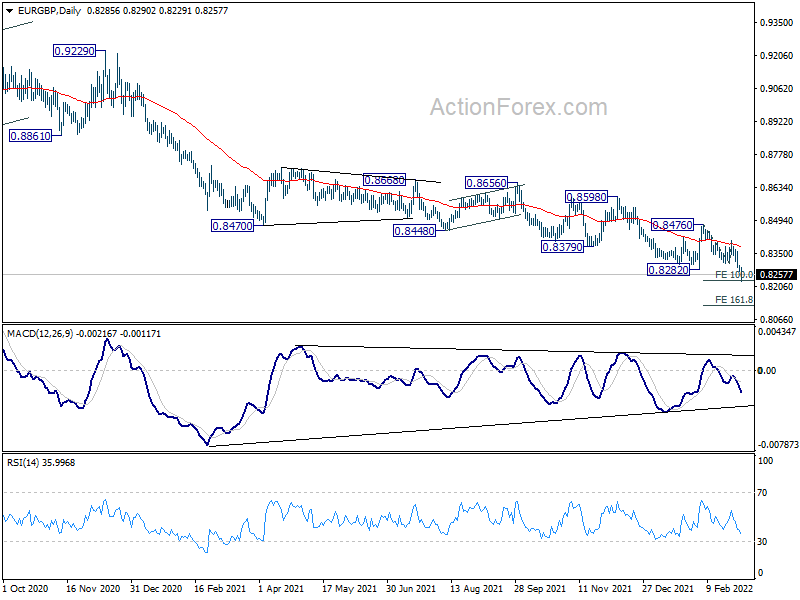
In the bigger picture, the down trend from 0.9499 is expected to continue as long as 0.8476 resistance holds. Sustained trading below 0.8276 support will argue that the whole up trend from 0.6935 (2015 low) has reversed. Deeper fall should be seen to 61.8% retracement of 0.6935 to 0.9499 at 0.7917 next.
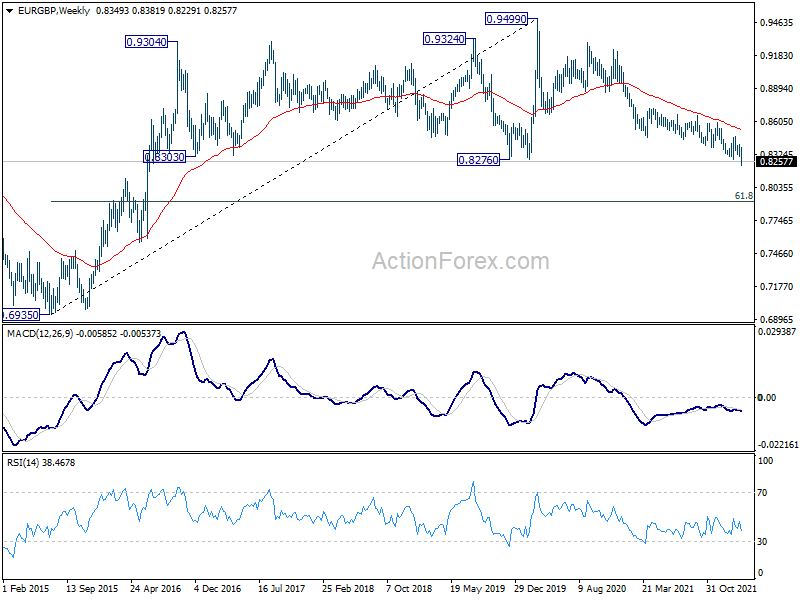
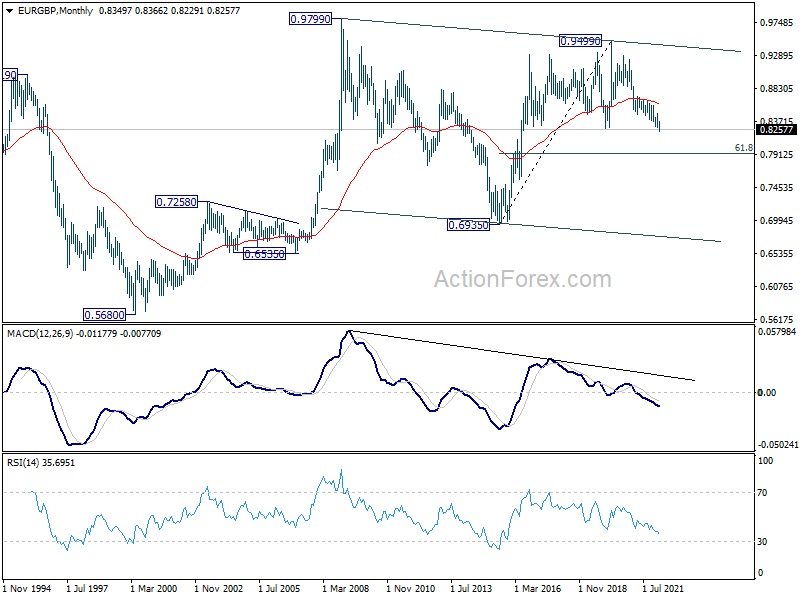
In the long term picture, current development argues that fall from 0.9499 is probably the third leg of the pattern from 0.9799 (2008 high). Sustained break of 61.8% retracement of 0.6935 to 0.9499 at 0.7917 will pave the way back to 0.6935 (2015 low) and probably below.
EUR/AUD Weekly Outlook
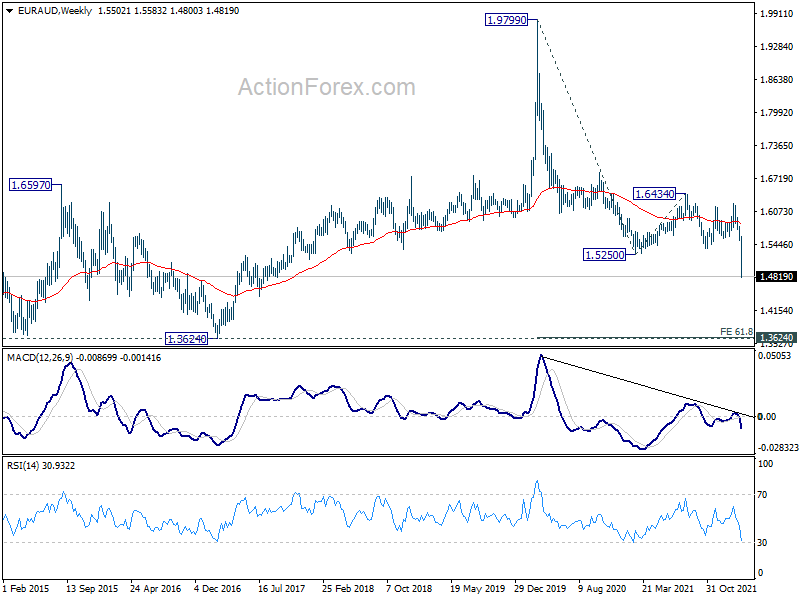
EUR/AUD dropped to as low as 1.5583 last week and the strong break of 1.5250 confirmed resumption of larger down trend from 1.9799. Initial bias stays on the downside this week for next target at 161.8% projection of 1.6343 to 1.5354 from 1.6223 at 1.4476. On the upside, above 1.5118 minor resistance will turn intraday bias neutral and bring consolidations, before staging another fall.
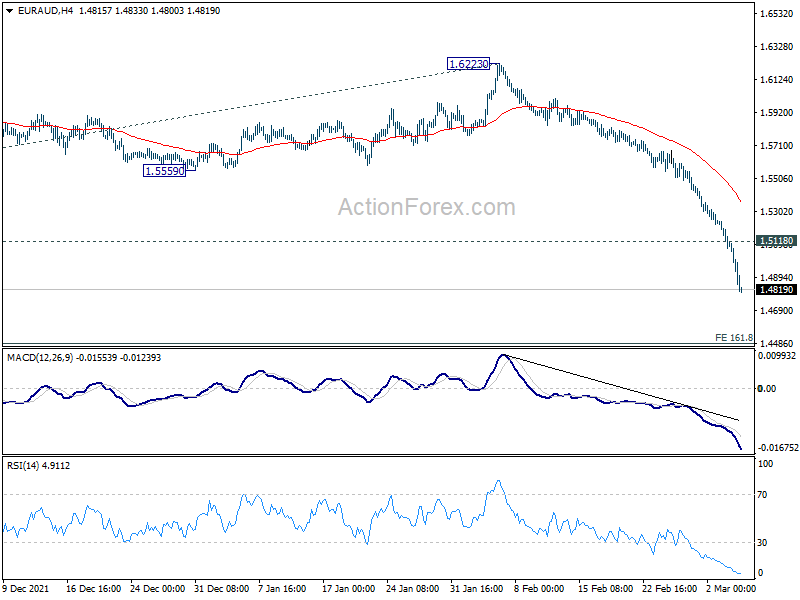
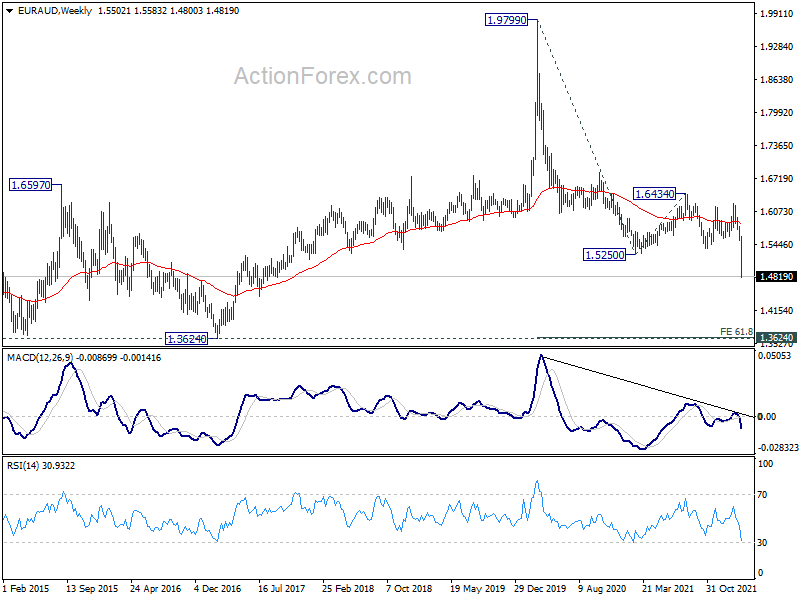
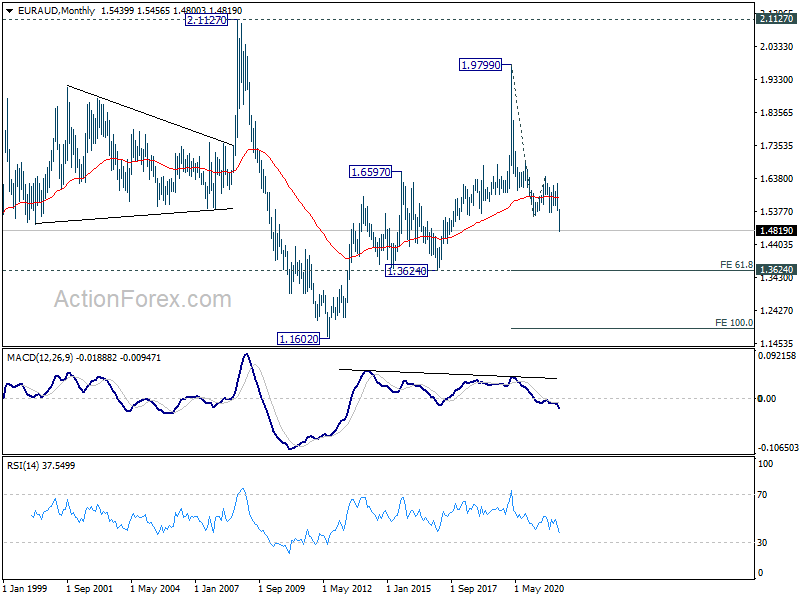
In the bigger picture, fall from 1.9799 is seen as a long term impulsive move. Next target is 61.8% projection of 1.9799 to 61.8% projection of 1.9799 to 1.5250 from 1.6434 at 1.3623, which is close to 1.3624 long term support (2017 low). Some support could be seen there to bring interest rebound. But overall, break of 1.5354 support turned resistance is needed to be the first sign of medium term bottoming. Otherwise, outlook will stay bearish in case of recovery.
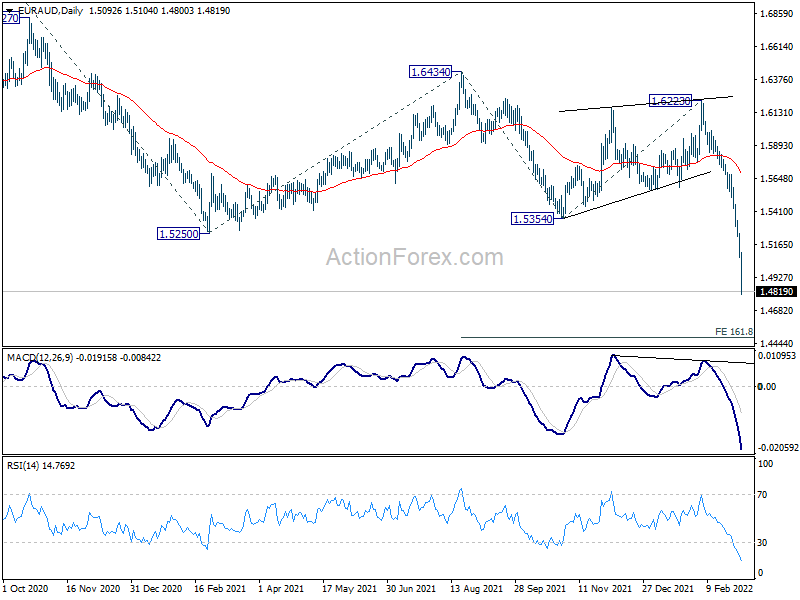
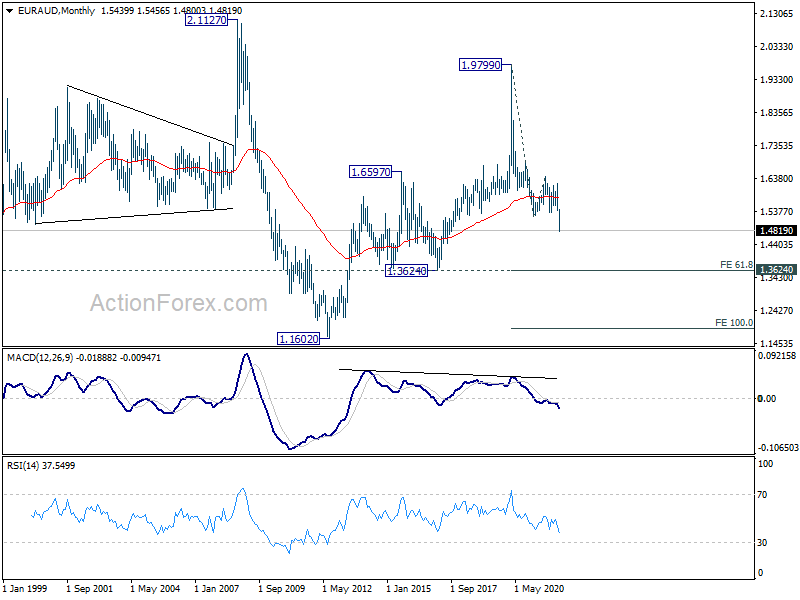
In the longer term picture, fall from 1.9799 (2020 high) is seen as the third leg of the pattern from 2.1127 (2008 high. Deeper fall should be seen to 1.3624 support. Decisive break there would pave the way back to 1.1602 (2012 low).
EUR/CHF Weekly Outlook
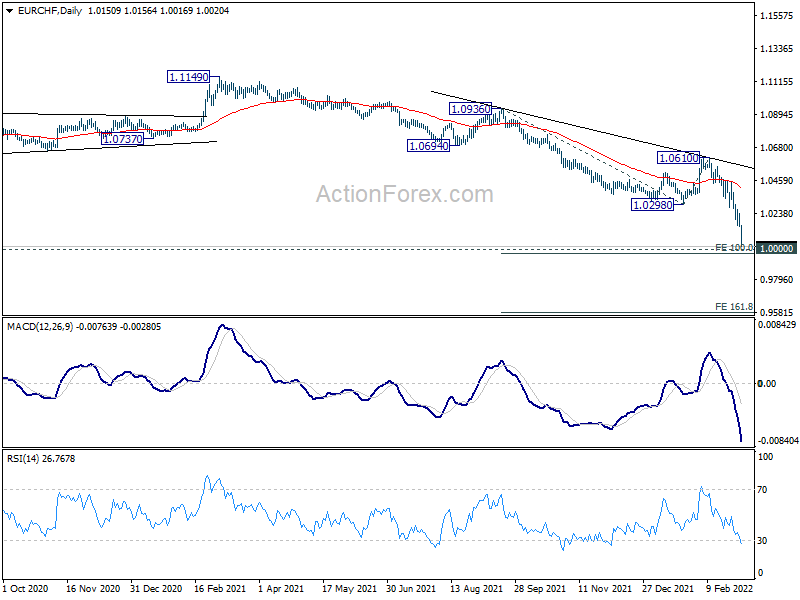
EUR/CHF's down trend accelerated to as low as 1.0016 last week, just ahead of parity. Initial bias stays on the downside this week for 100% projection of 1.0936 to 1.0298 from 1.0610 at 0.9972. There might be some support there, and break of 1.0157 minor resistance will turn intraday bias neutral first. But in any case, near term outlook will stay bearish as long as 1.0298 resistance turned support holds. Firm break of 0.9972 will target 161.8% projection at 0.9578.
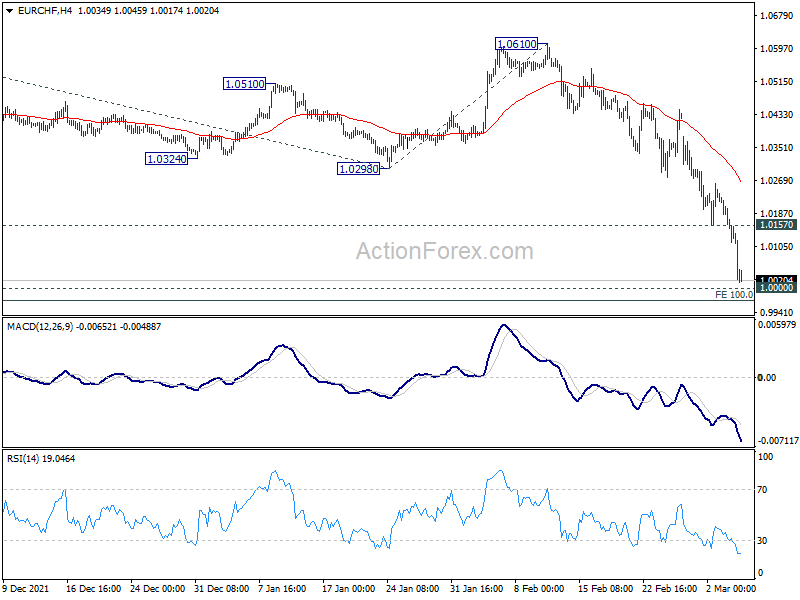
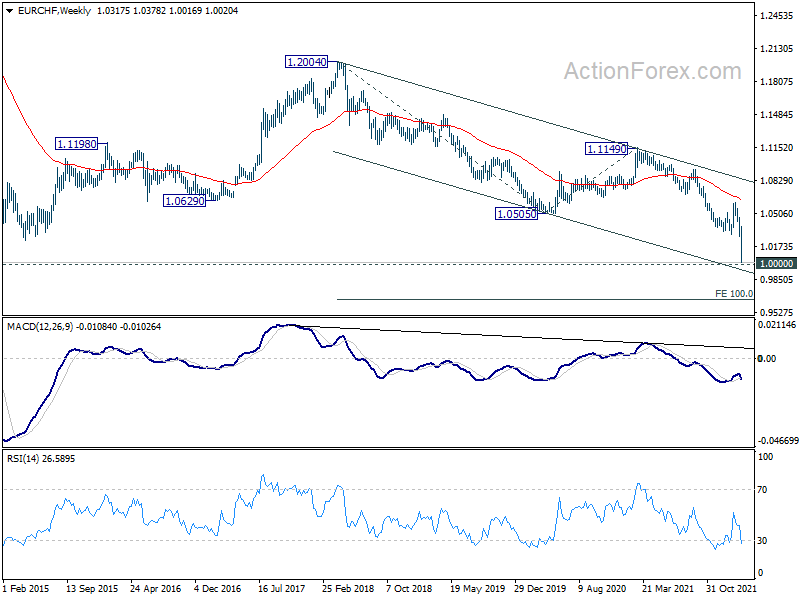
In the bigger picture, long term down trend from 1.2004 (2018 high) is still in progress. Next target is 100% projection of 1.2004 to 1.0505 to 1.1149 at 0.9650. Firm break there will target 100% projection at 0.9650. In any case, break of 1.0505 support turned resistance is needed to be the first sign of medium term bottoming. Otherwise, outlook will remain bearish.
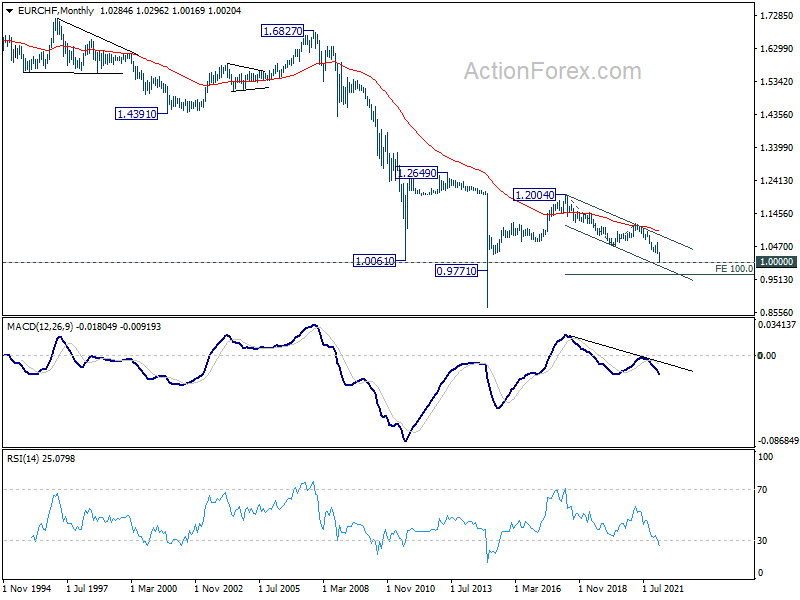
In the long term picture, capped below 55 month EMA, EUR/CHF is seen as extending the multi-decade down trend. There is no prospect of a bullish reversal until some sustained trading above the 55 month EMA (now at 1.0909).
Euro, European Stocks and Yields in Free Fall as WW III is Near
Russia invasion of Ukraine continued last week and risk aversion intensified sharply after Russia's attempt to attack Zaporizhzhia nuclear power station. European stocks took a steep dive with benchmark yields. Oil prices surged to levels not seen in more than a decade. Gold was originally steady but staged a late rally, probably as people remembered that it's a safer asset to hold than cryptos in time of world war III.
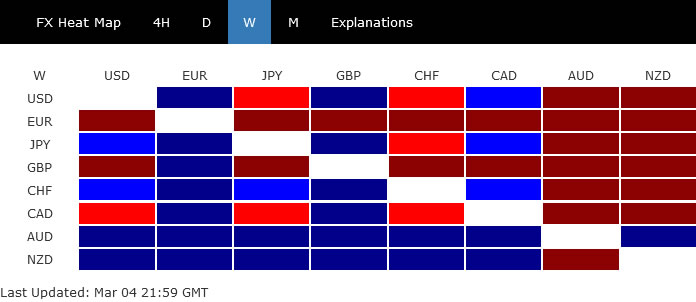
In the currency markets, Euro was overwhelming the worst performing one, with Sterling a distant second. While safe-haven flows boosted Swiss Franc, Aussie and Kiwi were the ones benefited most by skyrocketing commodity prices. Dollar ended mixed with Yen
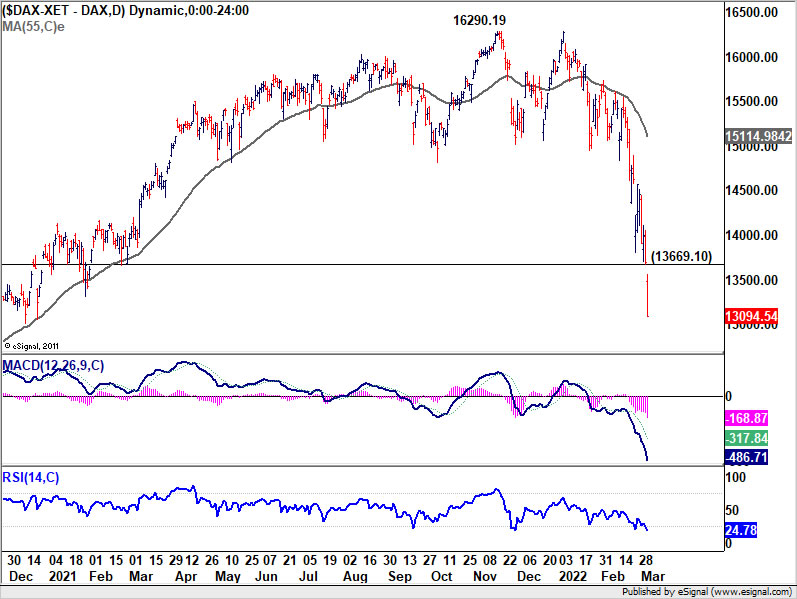
DAX in free fall with benchmark bund yield
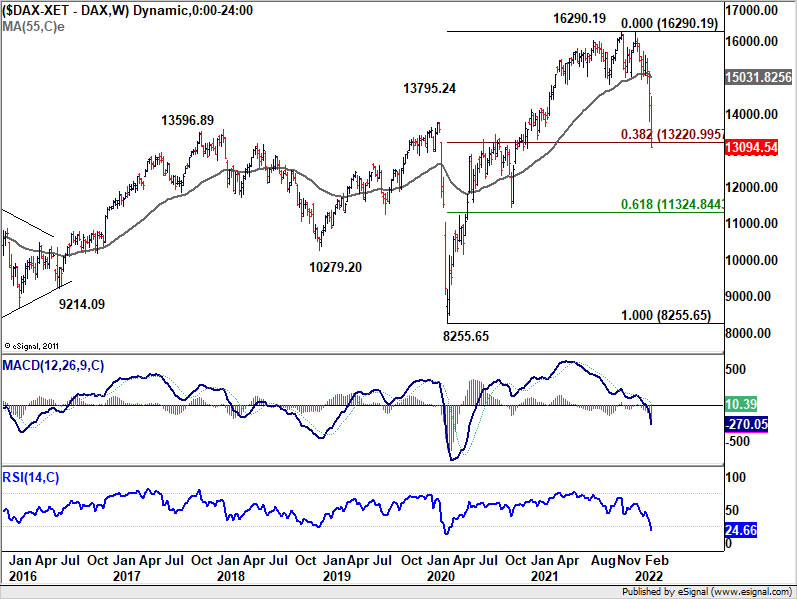
Germany DAX was in free fall last week, and selloff was in particular fierce on Friday after a gap down. The close below the long term fibonacci level at 13220.99 (38.2% retracement of 8225.65 to 16290.19) was a rather bad sign. For the near term, outlook will stay bearish as long as the upper edge of the gap at 13669.10 holds. DAX could continue the decline to 38.2% retracement at 11324.84 before finding a bottom. Meanwhile, a break above 13669.10 will suggest some stabilization and consolidations, before staging another fall.
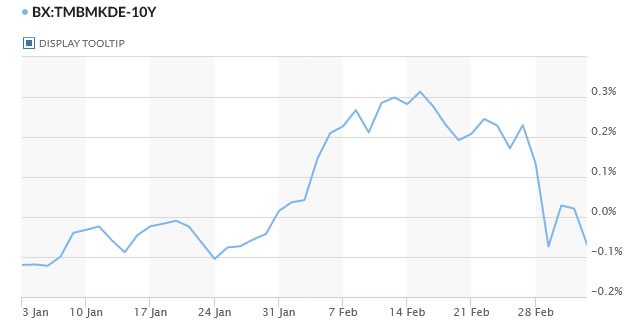
10-year bund yield closed the week down nearly -0.3 to -0.68, turned negative again for the first time since late January.
FTSE also tumbled with benchmark gilt yield
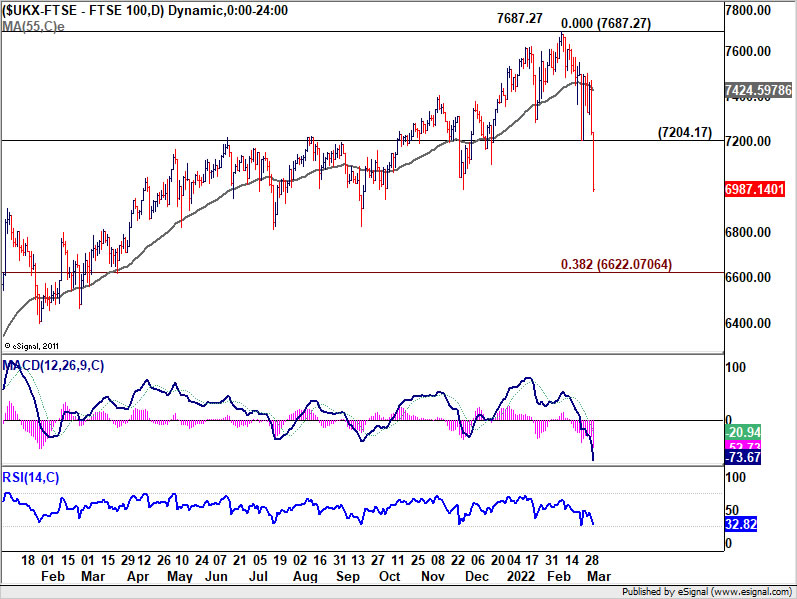
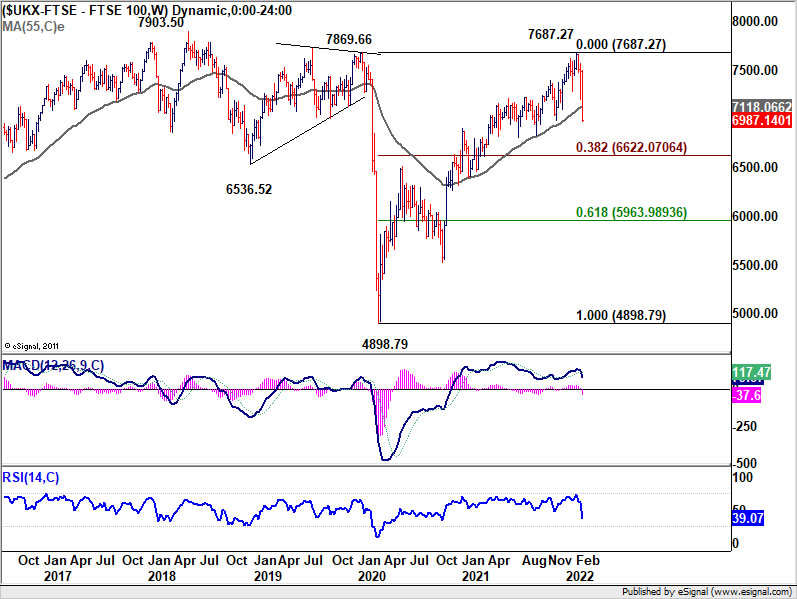
Selloff in FTSE was also steep, even though it's less bearish than DAX's. For now, further decline is expected in FTSE as long as 7204.17 support turned resistance holds. It should now be in correction to whole correction from the up trend from 4898.79. Deeper fall should be seen to 38.2% retracement of 4898.79 to 7687.27 at 6222.07, before finding a bottom.
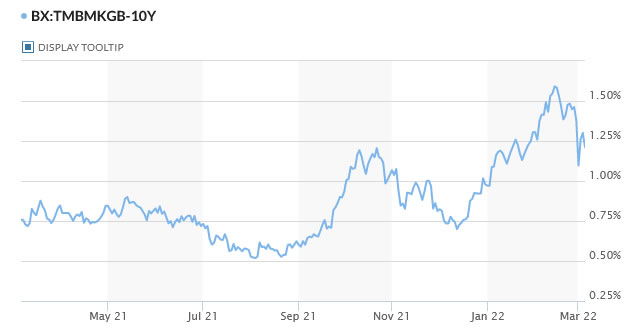
10-year gilt yield also closed down by 0.251 to 1.211, back at the level before February.
US stocks relatively resilient as Fed bets pared
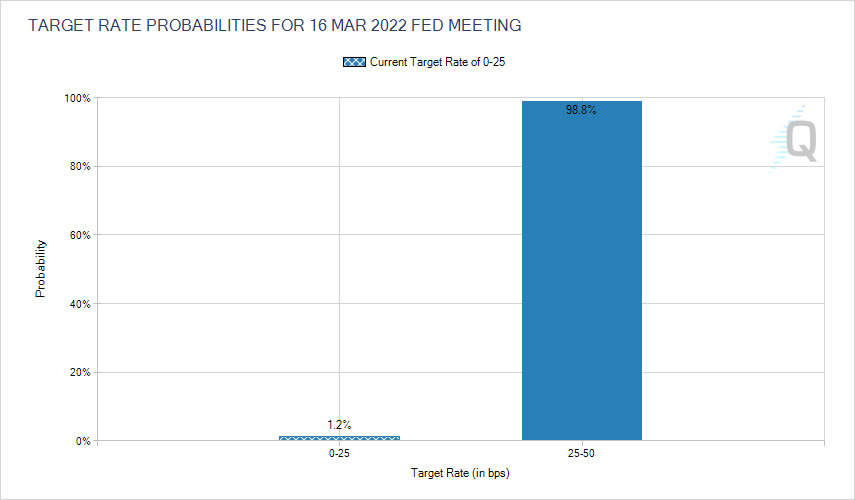
The selloff in US stocks was much less severe, obviously because it's out of the war zone while traders also pare back expectation of Fed rate hike. Indeed, Fed fund futures now implies 98.8% chance of a 25bps hike only at the March 15-16 FOMC meeting, with 1.2% chance of Fed standing pat.
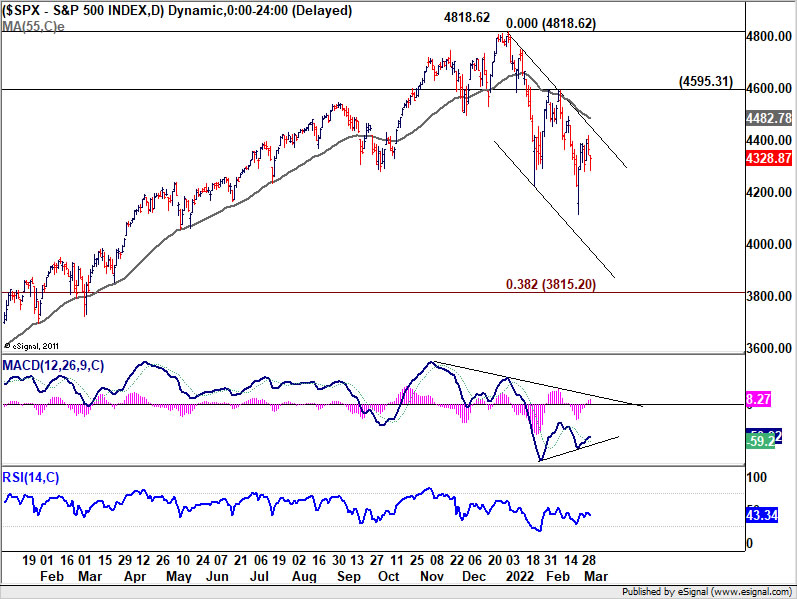
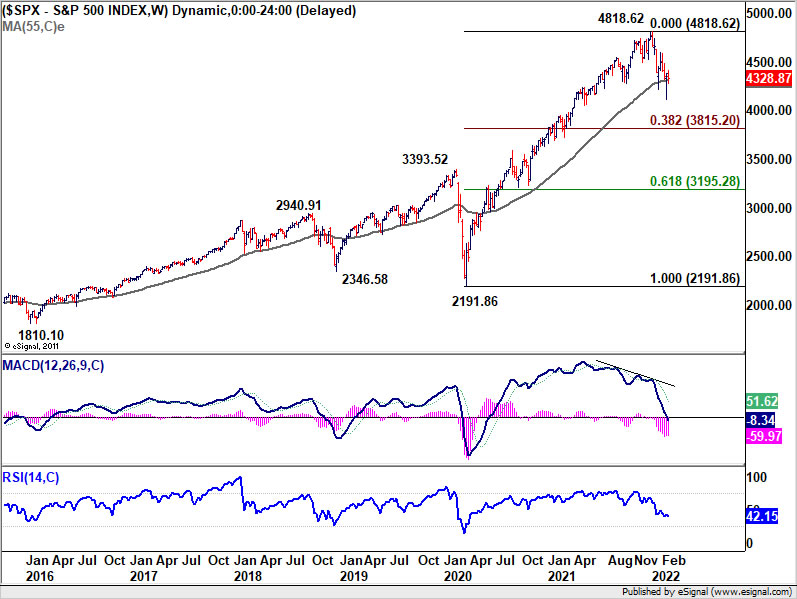
Still, while S&P 500 recovered, the decline from 4818.62 is still intact. Such fall is seen as a correction to whole up trend from 2191.86, and should target 38.2% retracement of 2191.86 to 4818.62 at 3815.20, before making a bottom. Or, it will have to break through 55 day EMA (now at 4482.79) to indicate reversal.
Dollar index broke 97.72 key fibonacci resistance
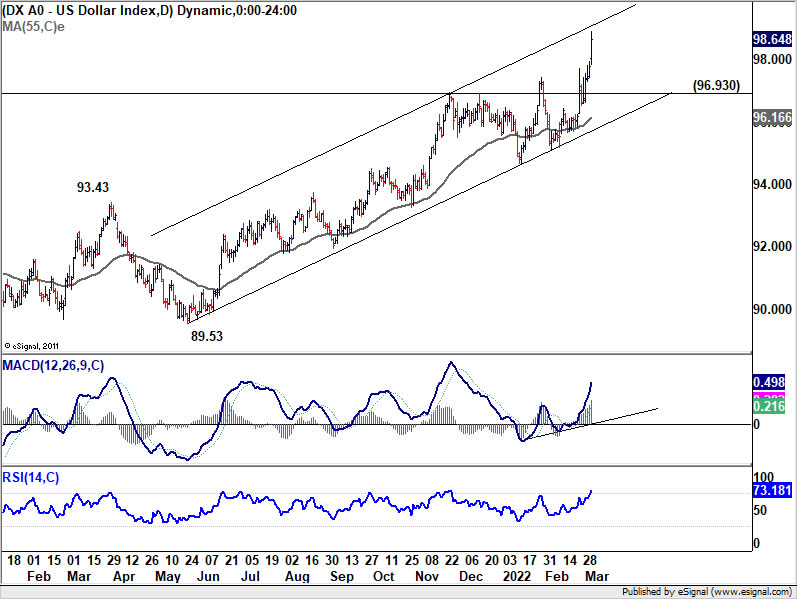
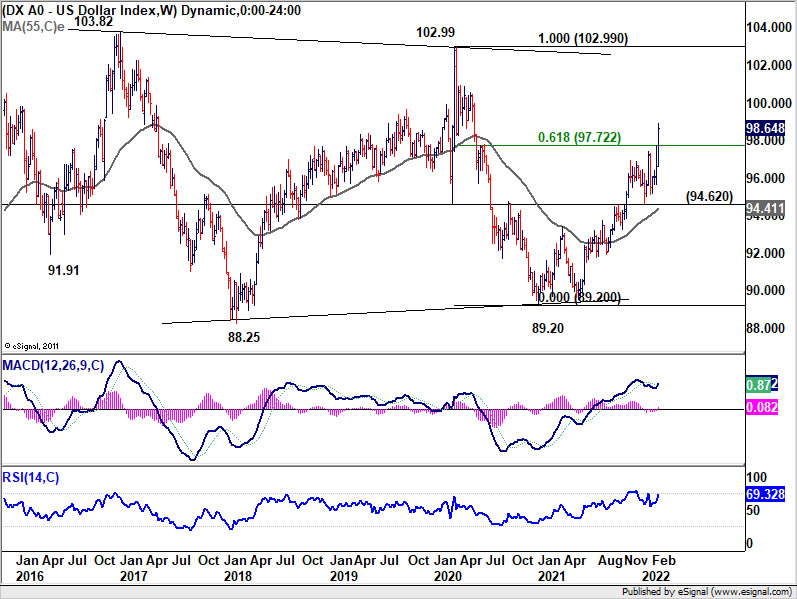
Dollar index surged to close at 96.84, thanks to Euro's ultra-weakness. Near term outlook will now stay bullish as long as 96.93 resistance turned support. Immediate focus in channel resistance at around 99.00. Sustained break there will be a sign of upside acceleration.
Also, with 61.8% retracement of 102.99 to 89.20 at 97.72 taken out, next target will be 102.99/103.82 long term resistance zone.
Gold ready to resume rally to retest 2074 high
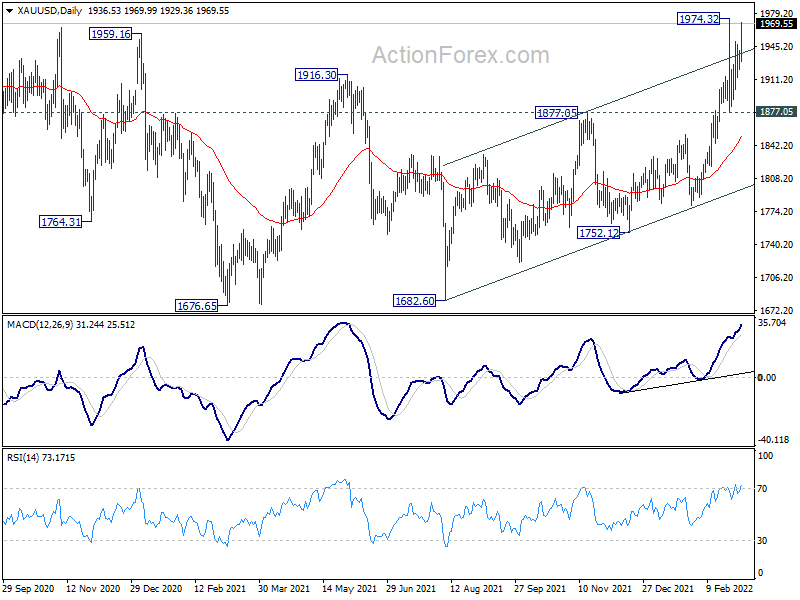
Gold's late rally argues that correction from 1974.32 has completed after drawing support from 1877.05 resistance turned support. The buying might have come as people realized that Gold is a better asset to hold than cryptos in real war.
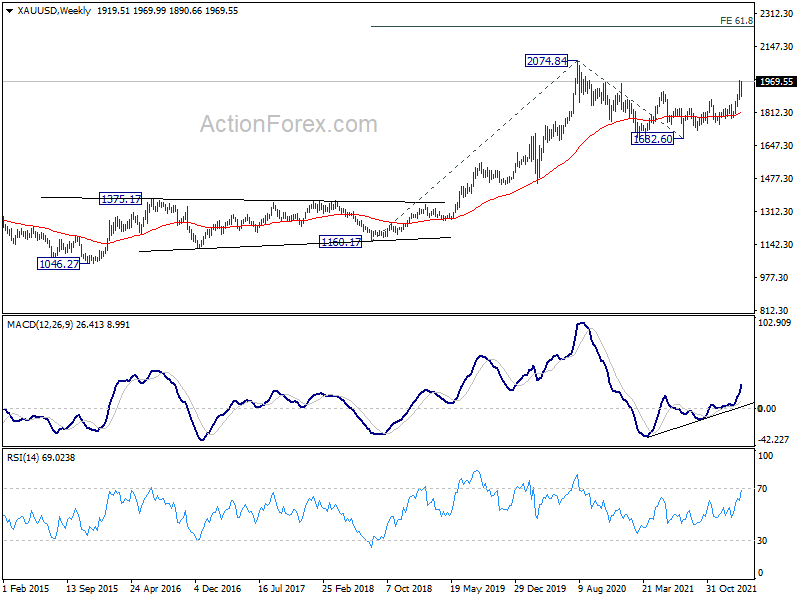
Immediate focus is now on 1974.32. Firm break there will resume the rise from 168.60 to retest 2074.84. Depending on the upside momentum of the next move, there is prospect of resuming whole long term up trend through 2075.84 to 61.8% projection of 1160.17 to 2074.84 from 1682.60 at 2247.86.
WTI pressing key 115 resistance zone, more rally to come?
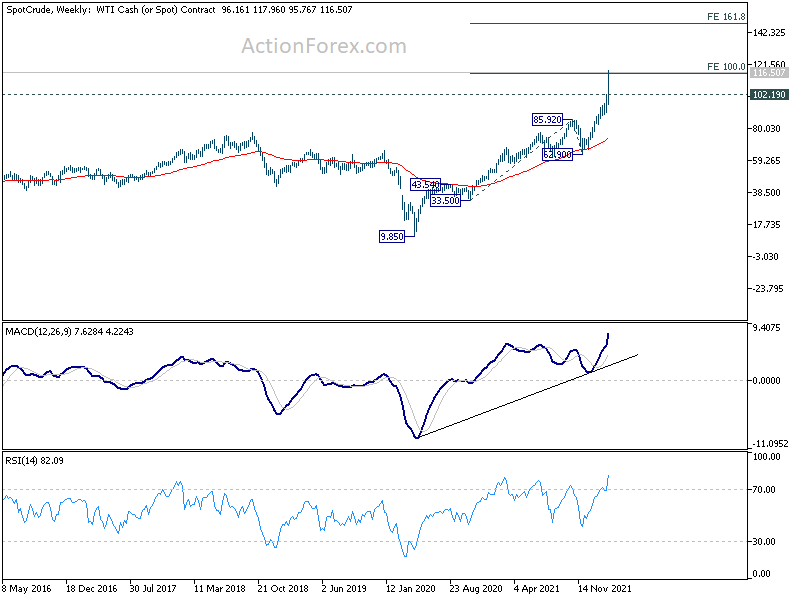
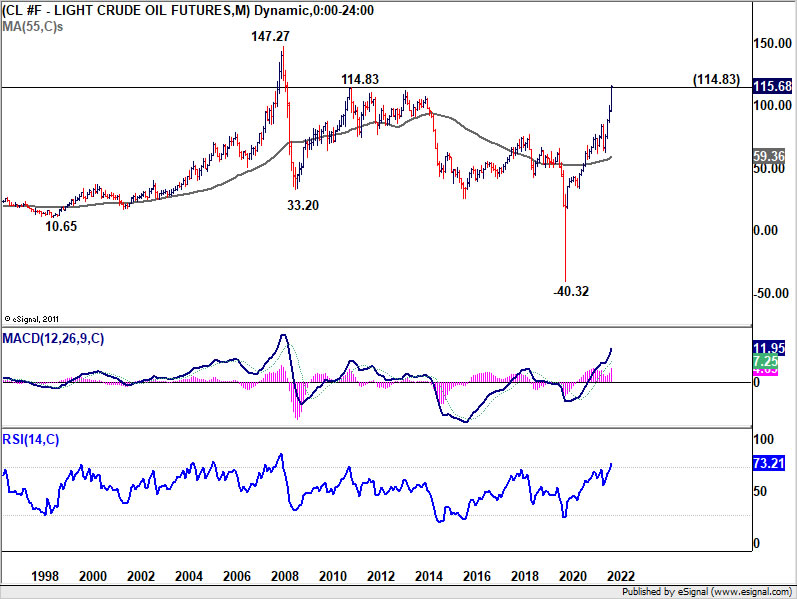
WTI crude oil had a powerful rally to close at 116.50. Theoretically, it's now in a zone to top, at around 100% projection of 33.50 to 85.92 from 62.90 at 115.32, and more importantly, long term resistance at 114.83 (2011 high).
However, there is so far no sign of topping yet, and further rise is expected as long as 102.19 support holds. Sustained trading above 115.32 could prompt even more upside acceleration, as so in a fear-driven move in commodity markets. That's just like the dive to negative at the start of the pandemic.
In that case, next target will be 161.8% projection at 147.71. For those who've be around long enough, it's not something unthinkable. It's just the high reached back in 2008, not that long ago.
EUR/AUD in free fall towards 1.3623/4 first
EUR/AUD was the biggest mover last week, losing a massive -5.15%. The strong break of 1.5250 low confirmed resumption of long term down trend from 1.9799 (2020 high). From a longer term perspective, the fall from 2.1127 (2008 high) to 1.1602 (2012 low) was an impulsive move. It's followed by a three wave corrective move up to 1.9799. Decline from there is so far, rather impulsive looking.
Hence, for the medium term, EUR/AUD could first target 61.8% projection of 1.9799 to 1.5250 from 1.6434 at 1.3623, which is close to 1.3624 long term support (2017 low). It's still early to say, but there is prospect of a long term down move to 100% projection at 1.1885 before forming a real bottom.
EUR/CHF Weekly Outlook
EUR/CHF's down trend accelerated to as low as 1.0016 last week, just ahead of parity. Initial bias stays on the downside this week for 100% projection of 1.0936 to 1.0298 from 1.0610 at 0.9972. There might be some support there, and break of 1.0157 minor resistance will turn intraday bias neutral first. But in any case, near term outlook will stay bearish as long as 1.0298 resistance turned support holds. Firm break of 0.9972 will target 161.8% projection at 0.9578.
In the bigger picture, long term down trend from 1.2004 (2018 high) is still in progress. Next target is 100% projection of 1.2004 to 1.0505 to 1.1149 at 0.9650. Firm break there will target 100% projection at 0.9650. In any case, break of 1.0505 support turned resistance is needed to be the first sign of medium term bottoming. Otherwise, outlook will remain bearish.
In the long term picture, capped below 55 month EMA, EUR/CHF is seen as extending the multi-decade down trend. There is no prospect of a bullish reversal until some sustained trading above the 55 month EMA (now at 1.0909).
Summary 3/7 – 3/11
Monday, Mar 7, 2022
[php_everywhere instance="1"]
Tuesday, Mar 8, 2022
[php_everywhere instance="2"]
Wednesday, Mar 9, 2022
[php_everywhere instance="3"]
Thursday, Mar 10, 2022
[php_everywhere instance="4"]
Friday, Mar 11, 2022
[php_everywhere instance="5"]
Weekly Economic & Financial Commentary: The U.S. Economy Had Solid Momentum Ahead of Russia’s Invasion
Summary
United States: The U.S. Economy Had Solid Momentum Ahead of Russia's Invasion
- February's employment data showed the economy had strong momentum ahead of Russia's invasion of Ukraine and amid the Fed's shift to a more hawkish tone on monetary policy. Nonfarm employment surged by 678,000 jobs, and job growth over the prior two months was revised higher by 92,000 jobs. This week's factory orders and ISM manufacturing survey also pointed to strengthening momentum in the factory sector.
- Next week: Trade Balance (Tuesday), CPI (Thursday), U. of Mich. Consumer Sentiment (Friday)
International: Bank of Canada Kicks Off Rate Hike Cycle
- Canada's Q4 GDP came in stronger than expected in the fourth quarter, rising 6.7% quarter-over-quarter and setting the stage for the Bank of Canada's (BoC) monetary policy meeting. The central bank kicked off its rate hike cycle at its March monetary policy meeting with an initial, and widely expected, 25-bp policy rate increase to 0.50%.
- Next week: Brazil CPI (Tuesday), Mexico CPI (Wednesday), ECB Rate Decision (Thursday)
Interest Rate Watch: Rates on a Roller Coaster Ride
- Russia's invasion of Ukraine last week, followed by wide-ranging and severe sanctions placed on Russia by numerous Western countries, sent global bond yields into motion this week.
Credit Market Insights: Russia-Ukraine War Increases Market Volatility
- Russia's invasion of Ukraine has prompted sweeping financial and economic sanctions. S&P Global cut the Russian government's rating to junk, while Moody's has issued a junk warning. In reaction, credit default swaps on Russia's shorter-term government debt has risen to record levels.
Topic of the Week: A Climb Down from Inflation Highs Resisted by Bread and Butter
- Food commodities have been a strong driver of inflation over the past two years, and the CPI for food has risen at the strongest pace in nearly 40 years, tacking on one percentage point to the 7.5% year-over-year increase in headline CPI in January.
The Weekly Bottom Line: Canada – Rate Hikes Have Commenced
U.S. Highlights
- The labor market added 678k jobs in February, and the unemployment rate fell to 3.8% - the lowest reading since the pandemic began.
- Early indicators suggest that manufacturing and services sectors were out of sync in February, with the former accelerating and the latter slowing down. The difference is largely attributed to continued weakness in demand for services.
- The Russia-Ukraine War continues to reverberate through financial markets, lifting commodity prices and threatening to tighten financial conditions further. The Fed is likely to raise interest rates in March, but the speed of future rate hikes is more uncertain.
Canadian Highlights
- The Bank of Canada raised the overnight rate by 0.25 percentage points to 0.5%, citing strong economic data and the absorption of economic slack.
- The Canadian economy grew by a robust 6.7% annualized in the fourth quarter of 2021, enough to remove any remaining economic slack created by the pandemic.
- Financial stress has increased as a result of the war in Ukraine. This will be an important indicator to watch in considering the future path of monetary policy and economic growth.
U.S. - Economy Marches On, Volatility Spikes due to the Russia-Ukraine War
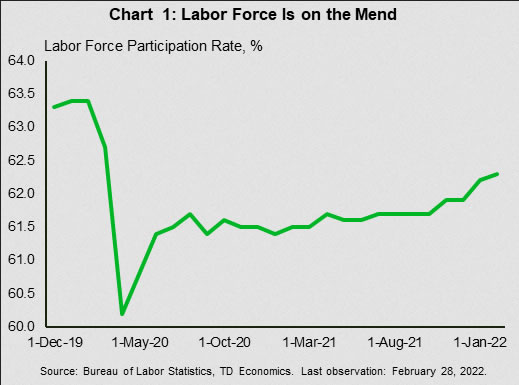
It’s the first week of March, which means we get the initial glance at how the economy did in February, when the Omicron wave started to ease. This morning, the U.S. Bureau of Labor Statistics surprised the market with 678k jobs created in February, well above 400k anticipated by forecasters. This was on top of an upward revision of 92k to December and January. The unemployment rate fell to 3.8 % – the lowest reading since the pandemic, just 0.3 percentage points above the level two years ago. The labor force – a measure of people working or actively looking for work – also made progress. The labor force participation rate ticked up to 62.3% after 304k people joined labor force in February (Chart 1). All in all, labor market is getting tighter and tighter.
In the meantime, leading business indicators diverged. As measured by the ISM Index, the manufacturing sector reversed three months of decline, accelerating to 58.6. Demand was solid, with new orders moving above 60 again. Production accelerated, but it could have been even stronger without materials supply constraints. The backlog of orders index jumped by almost 9 percentage points (ppts), while supplier deliveries inched 0.5 ppts higher. Despite all these challenges, inventory rebuilding continued, albeit at a very slow pace adding only 0.4 percentage points in February.
Surprisingly, the services sector slowed in February, with the two demand indicators – business activity and new orders – declining to mid-50 levels, last seen exactly one year ago. The consensus anticipated a modest increase, expecting that the fading threat of Omicron would help the services sector bounce back. Respondents blamed the post-holiday fatigue and difficult business conditions, affected by capacity constraints, inflation, logistical challenges, and labor shortages. Indeed, supply-side indicators deteriorated as delivery times slowed again while the employment index moved back into the contractionary territory.
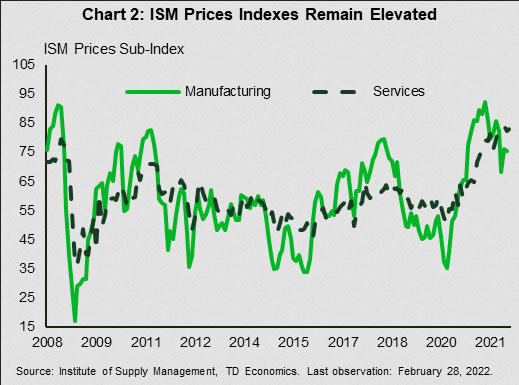
The price sub-indexes remained elevated, although price pressures seem to track lower in the manufacturing sector, while services continue to struggle with a reading above 83 (Chart 2). Despite these differences, there is little doubt that next week’s CPI reading will come in much higher than the 2% target. With the threat of higher prices becoming more entrenched, the Fed is unlikely to hesitate to raise the fed funds rate by 25 basis points on March 16th.
Meanwhile, Russia’s invasion of Ukraine has reverberated through financial markets, lifting a key measure of volatility to the highest level in more than a year. Although the U.S. trade dependency on Russian and Ukrainian products is limited to less than 1% (according to the World Bank), the U.S. economy may suffer through other channels. The conflict has already resulted in the biggest weekly surge in commodity prices since 1974, and threatens to exacerbate pandemic-induced logistical challenges. Both of these forces will lead to higher prices, and a drag on economic growth. Meanwhile, further deterioration in financial conditions would be equivalent to monetary tightening, which could force the Fed to slow down the speed of rate hikes in the future.
Canada - Rate Hikes Have Commenced
Surprising no one, the Bank of Canada kicked off its path to normalizing monetary policy from the extraordinary setting it has maintained through the pandemic. On Wednesday, the Bank raised its key lending rate by 0.25 percentage points to 0.5%, the first in what is likely to be a string of rate hikes.
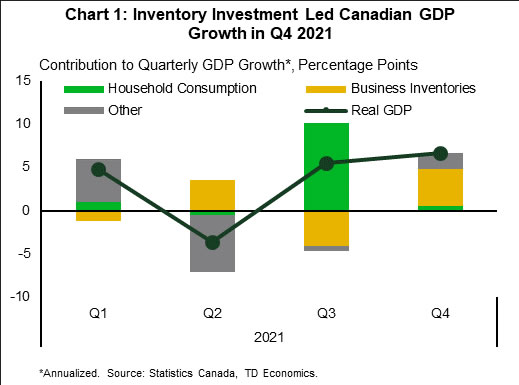
The Bank of Canada's decision came on the heels of the release of economic data for the fourth quarter of 2021 that showed the Canadian economy growing by a robust 6.7% annualized on the quarter and 4.6% for the year as a whole. The economy grew strongly to end the year, even as household spending was relatively soft and spending on goods edged lower. Instead, growth was led by businesses increasing production in order to rebuild inventories that had been dwindled by the combination of supply constraints and past strong sales (Chart 1).
The Bank's rate decision comes as the global economy is thrown into a period of heightened uncertainty due to the Russian invasion of Ukraine. The war in Ukraine will worsen supply constraints and exacerbate inflationary pressures. There is little the Bank of Canada can do to prevent that. It does, however, have a lever to, as governor Tiff Macklem noted in a speech following the decision, "lower the parts of inflation that are driven by domestic demand." Higher borrowing costs will slow demand in interest rate sensitive sectors of the economy, like housing, that have experienced the most rapid price appreciation through the pandemic. Monetary policy will not slow inflation on a dime, but rate increases today are necessary for returning the trajectory of inflation lower over the next year.
In addition to rate hikes, the Bank of Canada will begin normalizing its balance sheet, which ballooned to over 20% of GDP as a result of large scale asset purchases of government bonds. Governor Macklem came out strong in his messaging on the central bank's plans for quantitative tightening (QT), noting that the maturity of the Bank's holdings is relatively short, and by simply allowing them to mature, the Bank could move close to its pre-pandemic stance over the next two years. Communicated in advance, QT is unlikely to put significant upward pressure on interest rates, but it will slow deposit growth and contribute to tighter financial conditions.
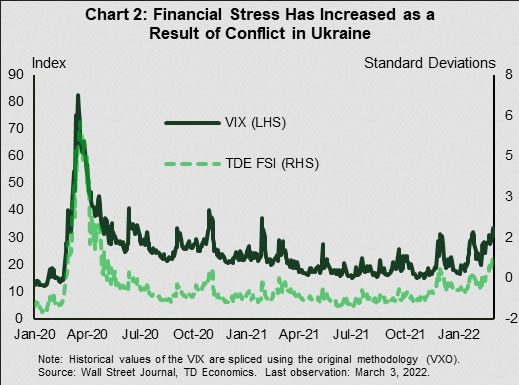
Stress in financial markets will be an important indicator to monitor in gauging future monetary policy decisions as well as the economic outlook. So far, credit spreads have remained relatively contained, widening but not yet to worrisome levels (see Chart 2). Equity market volatility has increased, but North American stock markets have moved sideways rather than significantly lower. The TSX has performed better than other indexes, reflecting its energy tilt. As of writing, it was up on the week. This may not last. Financial volatility and stress is likely to worsen the longer the conflict continues.
Canadian Labour Market to Power Back from Omicron Blow
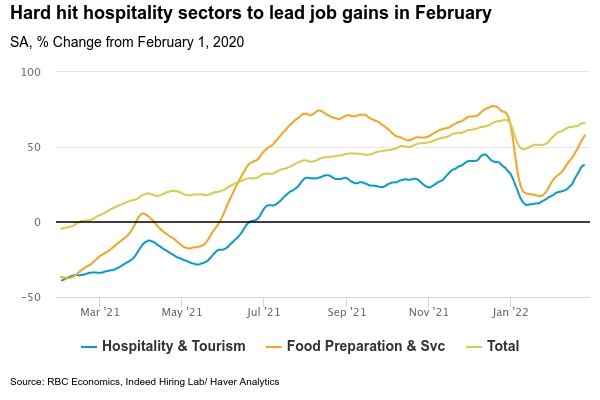
We expect Canada’s job market to have posted a strong comeback from the latest pandemic wave. We expect February’s job report will retrace three-quarters of the 200,000 jobs lost in January. High-contact hospitality sectors again took the brunt of the hit from Omicron, as did regions (Ontario and Quebec) that imposed more aggressive restrictions. But virus spread and containment measures have now eased. Early data on restaurant bookings and our own tracking of card transactions is pointing to a rapid rebound in spending in February—and job postings have bounced back sharply. Hours worked are also expected to climb after falling 2.2% in January due to elevated worker absenteeism. With the economic impact of the virus fading, labour shortages will remain a more pressing issue for many businesses than a lack of orders. Indeed, high demand for workers and shrinking numbers of unemployed people mean wages are likely to rise.
Record household net wealth, driven by rising home prices and stock market gains, are expected in the Q4 Canadian household balance sheet Friday. The closely-watched debt-to-income ratio likely surged to well above pre-pandemic levels—fueled by higher debt levels and a return to more normal disposable incomes as government pandemic support tapered off. Most pandemic debt growth has come from mortgages financed at low interest rates. So even as debt loads edged higher in Q4, payments associated with them likely remained at low levels. To be sure, financial markets have been rocked in Q1 by the Russian invasion of Ukraine. But households are buttressed by a large amount of savings accumulated over the course of the pandemic. And strengthening job markets are expected to push disposable incomes even higher.
Week ahead data watch:
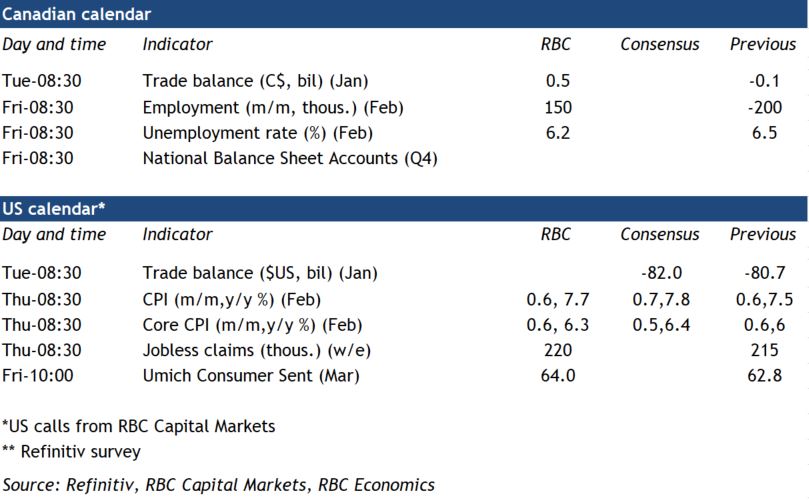
- Canadian merchandise trade will likely move into surplus (0.5B) as higher oil prices (which increased 16%) lifted exports—but the strong gain in imports of communication equipment in December won’t be repeated.
- United States inflation is expected to have jumped higher to 7.7% on a year over basis as consumers paid more at the pump (+40%). We also expect to see evidence of price pressures broadening.
Week Ahead – Enormous Uncertainty
Recession risks mounting
It’s been another week of significant volatility in financial markets, one in which European indices edged closer to bear market territory, oil prices hit a 10-year high around $120, and safe-haven gold came close to $2,000.
The Russian invasion of Ukraine and the severe sanctions imposed on it by the West have created enormous uncertainty in the markets and for the global economy. Next week offers a number of different financial market events but this will no doubt remain front and center.
With commodity prices soaring in response to the latest developments, the job of central banks has just gotten even harder. Faced with increased recession and inflation risks, policymakers will be forced into some difficult decisions in the coming months, starting with the ECB next week as it pivots away from the transitory narrative and towards tapering and rate hikes.
US
The last major economic data release before the Fed’s March 16th policy meeting is expected to show inflationary pressures are not slowing down at all. The February inflation report is expected to show prices rose 0.8% since January and almost 8% over the last 12 months. Fed Chair Powell noted in his testimony to Congress that if inflation stays hot, the Fed could hike rates by 50 basis points at a monetary policy meeting. Inflation seems poised to worsen and that could lead to a rapid withdrawal of accommodation by the Fed.
EU
It goes without saying that the focus next week remains on Ukraine and whether any progress has been made towards de-escalating the crisis. There’s little hope of significant progress after two meetings between delegations from Ukraine and Russia and the attacks seen late in the week, including one on the Zaporizhzhia nuclear plant, offer little hope that Putin has been deterred by sanctions.
The ECB meets next week and we’re expecting to get confirmation of the hawkish shift that’s been so evident since the last meeting. New economic projections will allow for the change of tone, the question is how big a change we’ll see. The end of net asset purchases in the coming months looks inevitable. But will they allude to rate hikes this year? Obviously, the situation in Ukraine complicates the outlook which may result in some hesitation from the central bank.
UK
A quiet week is in store for the UK with economic data largely tiers two and three. The only release of note will be GDP on Friday.
Russia
Western sanctions imposed on Russia in response to its invasion of Ukraine will have a crippling effect on the economy, and the record lows and excessive volatility we’ve seen in the ruble over the last week are reflective of that. Exports are already facing extreme complications as a result of the sanctions, even those the West has sought to shield like oil. The stock market hasn’t opened since the sanctions were imposed and those Russian companies that trade abroad have been pummelled. The stock market will remain closed until at least next Wednesday.
Against this backdrop, CPI and GDP data just don’t really matter at the moment. Inflation is about to sky-rocket and the economy fall into a terrible recession. Interest rates have been hiked from 9.5% to 20% in the last week and further may be necessary as the CBR looks to stabilize the currency, having been restricted by sanctions against the central bank.
South Africa
GDP is the only data release of note next week, with a few other low-tier releases also due. The rand has continued to slip against the dollar this week in risk-averse trade.
Turkey
Inflation rose to more than 54% last month as the country continues to suffer the consequences of poor monetary policy decisions. Higher commodity prices could compound those problems in the months ahead.
Unemployment data will be released next week.
China
China’s Two Sessions concludes tomorrow night. A sharp drop in the 2022 GDP target could spark China’s equity selling on Monday if markets interpret it as a slowing economy. China stocks are finishing the week under pressure, particularly the tech heavyweights listed in Hong Kong.
CNY continues to trade strongly as the ex-Dollar component of the basket weakens. CNY and CNH continue to benefit from haven inflows.
India
No significant data.
India equities and the rupee have come under pressure as oil prices continue to skyrocket; Indian markets have a high beta to imported energy.
Australia
The week features Westpac consumer confidence, ANZ job ads, and NAB Biz Conf. All should continue to outperform despite the heavy flooding in Eastern Australia. Equities have traded sideways but have mostly avoided Ukraine contagion and the currency has in fact rallied. The massive global rally in commodities will heavily benefit Australia and the AUD should remain robust next week.
New Zealand
NZ electronic retail spending, Business PMI and food inflation will show an economy overheating, and likely increase calls for fast RBNZ tightening. That will be a headwind for equities but may boost the currency which is rallying on the commodity boom like the AUD.
Japan
Japan releases GDP which should highlight a post-delta recovery after a tough Q3, but the data is too backward-looking to materially impact markets.
USD/JPY is range-bound between higher US yields supporting the cross, and domestic repatriation flows capping it due to geopolitical events.
Economic Calendar
Monday, March 7
Economic Data/Events
- CERA week begins with speeches from Saudi Aramco and Shell CEOs
- China Foreign Minister Wang Yi speaks at National People’s Congress session
- China foreign reserves, trade data
- Australia foreign reserves
- Germany factory orders
- Australia’s PM Morrison speaks at the Lowy Institute, an Australian think tank
- SNB posts annual results
Tuesday, March 8
Economic Data/Events
- US wholesale inventories, trade
- Eurozone GDP
- Germany industrial production
- Mexico international reserves
- New Zealand construction work
- Australia household spending, NAB business conditions
- Indonesia foreign reserves
- Japan bankruptcies, leading index, BoP
- Poland rate decision: Expected to raise rates 50bps to 3.25%
- South Africa GDP
- Spain industrial production
- Apple new product event
Wednesday, March 9
Economic Data/Events
- Australia consumer confidence
- New Zealand truckometer heavy traffic, manufacturing activity
- Japan GDP, machine tool orders, M2 money stock
- Russia CPI
- RBA Gov Lowe to address the AFR Business Summit 2022 & Deputy Gov Debelle will speak on a panel about the digital economy
- Thailand consumer confidence
- China aggregate financing, PPI, CPI, money supply, new yuan loans
- Italy industrial production
- Mexico CPI
- EIA Crude Oil Inventory Report
Thursday, March 10
Economic Data/Events
- US Feb CPI M/M: 0.8%e v 0.6% prior; Y/Y: 7.9%e v 7.5% prior, jobless claims
- ECB interest rate decision: No change in monetary policy expected; March projections to reflect the impact of war in Ukraine
- ECB President Lagarde post-rate press conference
- Israel GDP
- New Zealand card spending, home sales
- Japan PPI, Tokyo office vacancies
- Thailand consumer confidence
- Australian consumer inflation expectations
- South Africa manufacturing production, current account
Friday, March 11
Economic Data/Events
- US University of Michigan consumer sentiment
- UK industrial production, BOE inflation attitudes survey
- Canada unemployment
- Germany CPI
- RBA Gov Lowe speaks at the Banking 2022 conference
- India industrial production
- Japan household spending
- Thailand forward contracts, foreign reserves
- Mexico industrial production
- New Zealand food prices, PMI
- China FDI YTD
- Spain CPI
- Turkey’s current account, industrial production
Sovereign Rating Updates
- Norway(S&P)
- Portugal (S&P)
- Ukraine (S&P)