Sample Category Title
Euro in Free Fall Again While Dollar Rebounds on Strong NFP
Dollar rises notably in early US session with help from strong headline non-farm payroll job growth, even though wages disappoint. But still, the overwhelming theme is Euro selloff on Russia invasion of Ukraine. The common currency is actually suffering a fresh round of heavy selling, just after NFP risk is cleared.
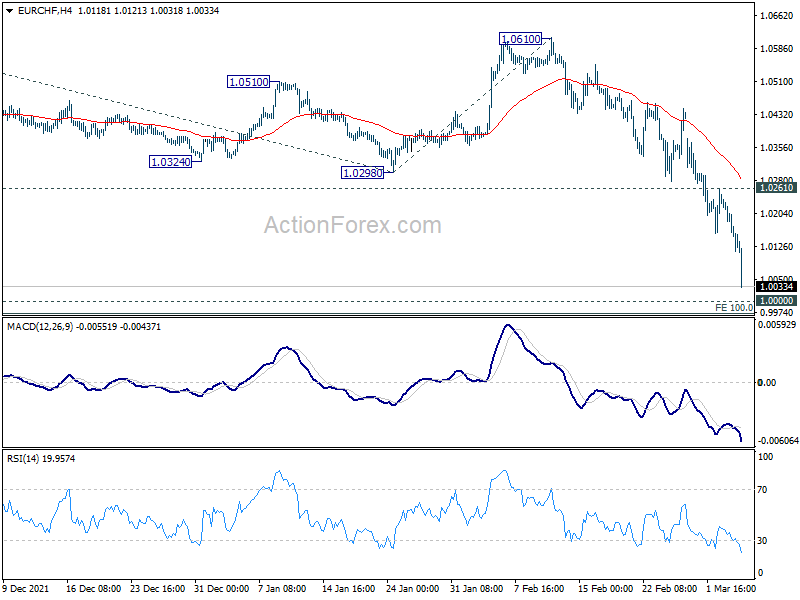
Technically, it shouldn't be over the top by now, saying that EUR/CHF could even break parity before weekly close, considering the downside momentum. EUR/JPY has also taken out an important long term fibonacci support level at 126.58. EUR/GBP has taken out long term support at 0.8276. Things are getting from bad to worse for Euro.
In Europe, at the time of writing, FTSE is down -2.81%. DAX is down -2.94%. CAC is down -3.24%. Germany 10-year yield is down -0.069 at -0.048. Earlier in Asia, Nikkei dropped -2.23%. Hong Kong HSI dropped -2.50%. China Shanghai SSE dropped -0.96%. Singapore Strait Times dropped -0.83%. Japan 10-year JGB yield dropped -0.0168 to 0.152.
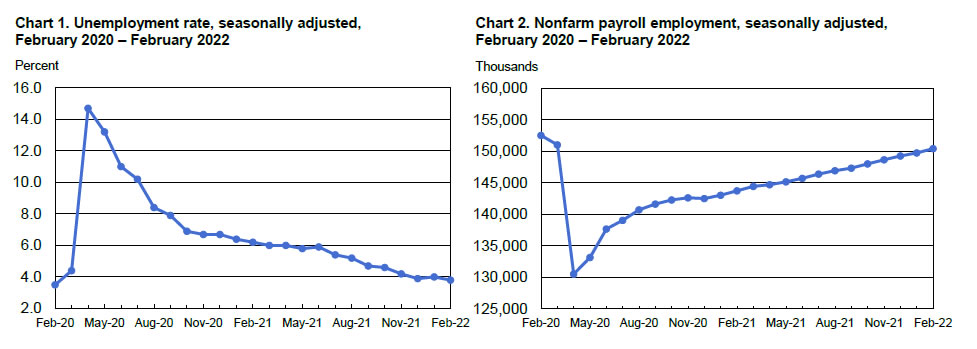
US NFP employment rose 678k in Feb, but wage growth flat
US non-farm payroll employment rose 678k in February, above expectation of 438k. Employment was still down -2.1m, or -1.4% from its pre-pandemic level in February 2020. Job growth was widespread over the month, led by gains in leisure and hospitality, professional and business services, health care, and construction.
Unemployment rate dropped from 4.0% to 3.8%, better than expectation of 3.9%. That's still above pre-pandemic level of 3.5%. Number of unemployed edged down to 6.3m, above pre-pandemic level of 5.7m. Labor force participation rate was little changed at 62.3%.
Wage growth was a disappointment, however, with average hourly earning rose 0.0% mom, well below expectation of 0.6% mom.
Eurozone retail sales rose 0.2% mom in Jan, EU up 0.6% mom
Eurozone retail sales rose only 0.2% mom in January, well below expectation of 1.5% mom. Volume of retail trade increased by 0.2% for non-food products, remained unchanged for food, drinks and tobacco, and fell by -1.3% for automotive fuels.
EU retail sales rose 0.6% mom. Among Member States for which data are available, the highest monthly increases in the total retail trade volume were registered in Poland (+5.9%), Luxembourg (+4.2%) and Denmark (+3.7%). The largest decreases were observed in Slovenia (-4.6%), Portugal (-2.8%), and Lithuania (-2.5%).
UK PMI construction rose to 59.1, input cost inflation eased
UK PMI Construction rose from 56.3 to 59.1 in February, above expectation of 57.4. Markit said growth was led by marked and accelerated rise in housing activity. Input cost inflation dipped to 11-month low. Business confidence eased to softest since January 2021.
New Zealand ANZ consumer confidence dropped to record low
New Zealand ANZ-Roy Morgan consumer confidence dropped -16 pts to 81.7 in February, hitting a record low since data began in 2004. Inflation expectations were little changed at 5.6% while house price inflation expectations eased from 5.3% to 4.8%.
ANZ said: "This month's data looks grim, but there are undoubtedly some temporary impacts in there. Time will tell what the other side looks like, but we do know that Omicron is fast and furious, and will blow through relatively quickly.
Australia retail sales rose 1.8% mom in Jan
Australia retail sales rose 1.8% mom to AUD 32.49B in January. Comparing to the same month a year ago, sales rose 6.4% yoy.
"The emergence of the Omicron variant and rising COVID-19 case numbers, combined with an absence of mandated lockdowns has resulted in a range of different consumer behaviours. We have seen the type of spending previously associated with lockdowns occurring simultaneously with those associated with the easing of lockdown conditions," Director of Quarterly Economy Wide Statistics, Ben James said.
"This had led to variations across the industries with Food retailing recording a rise in sales consistent with previous COVID-19 outbreaks as consumers exercise caution amidst surging case numbers. However, the absence of lockdowns meant that other discretionary industries which would usually see a fall during the pandemic have recorded mixed results."
EUR/USD Mid-Day Outlook
Daily Pivots: (S1) 1.1026; (P) 1.1074; (R1) 1.1114; More...
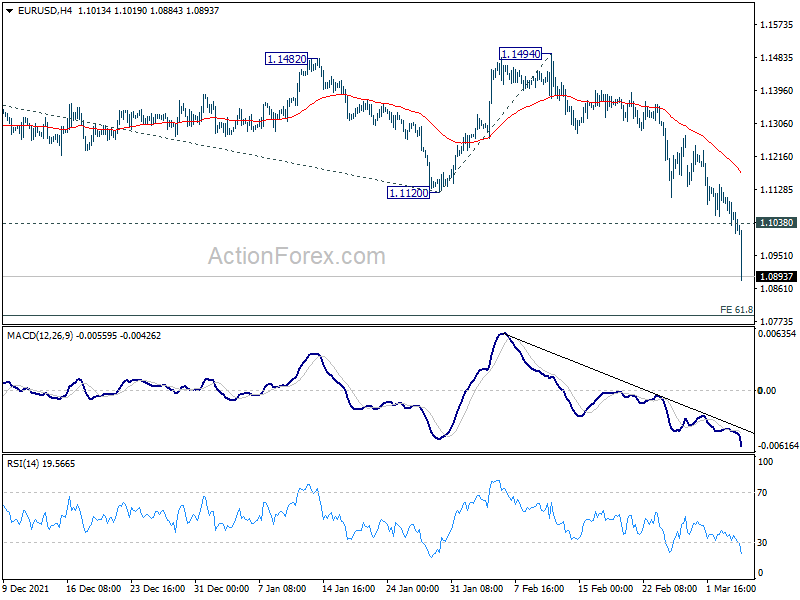
EUR/USD's decline accelerates further to as low as 1.0888 and intraday bias remains on the downside. Current down trend should target 61.8% projection of 1.2265 to 1.1120 from 1.1494 at 1.0786 next. On the upside, above 1.1038 minor resistance will turn intraday bias neutral and bring consolidations first, before staging another decline.
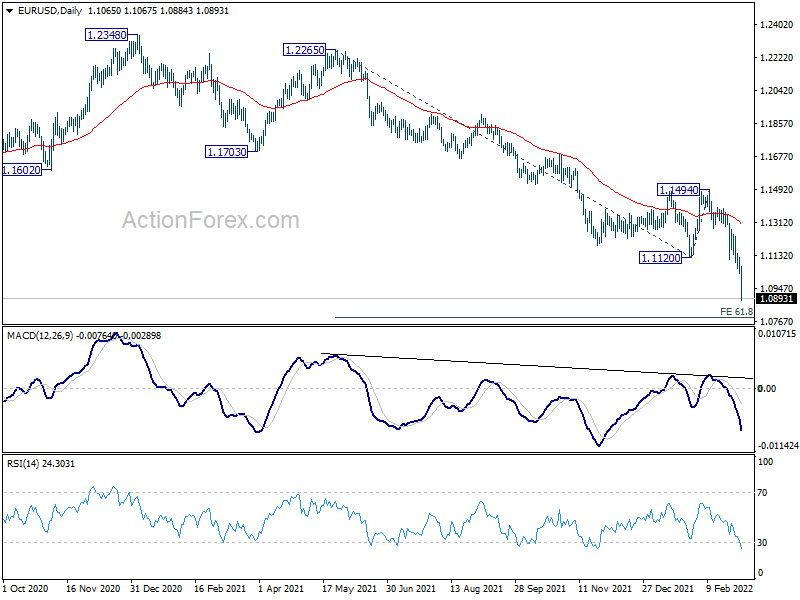
In the bigger picture, the decline from 1.2348 (2021 high) is expected to continue as long as 1.1494 resistance holds. Firm break of 1.0635 (2020 low) will raise the chance of long term down trend resumption and target a retest on 1.0339 (2017 low) next. Nevertheless, break of 1.1494 will maintain medium term neutral outlook, and extend range trading first.
Economic Indicators Update
| GMT | Ccy | Events | Actual | Forecast | Previous | Revised |
|---|---|---|---|---|---|---|
| 23:30 | JPY | Unemployment Rate Jan | 2.80% | 2.70% | 2.70% | |
| 07:00 | EUR | Germany Trade Balance (EUR) Jan | 9.4B | 7.5B | 6.8B | |
| 07:45 | EUR | France Industrial Output M/M Jan | 1.60% | 0.40% | -0.20% | -0.10% |
| 09:30 | GBP | Construction PMI Feb | 59.1 | 57.4 | 56.3 | |
| 10:00 | EUR | Eurozone Retail Sales M/M Jan | 0.20% | 1.50% | -3.00% | -2.70% |
| 13:30 | CAD | Building Permits M/M Jan | -8.80% | 0.10% | -1.90% | -2.40% |
| 13:30 | CAD | Labor Productivity Q/Q Q4 | -0.50% | -0.20% | -1.50% | -1.20% |
| 13:30 | USD | Nonfarm Payrolls Feb | 678K | 438K | 467K | 481K |
| 13:30 | USD | Unemployment Rate Feb | 3.80% | 3.90% | 4.00% | |
| 13:30 | USD | Average Hourly Earnings M/M Feb | 0.00% | 0.60% | 0.70% | 0.60% |
| 15:00 | CAD | Ivey PMI Feb | 54.2 | 57.4 |
US NFP employment rose 678k in Feb, but wage growth flat
US non-farm payroll employment rose 678k in February, above expectation of 438k. Employment was still down -2.1m, or -1.4% from its pre-pandemic level in February 2020. Job growth was widespread over the month, led by gains in leisure and hospitality, professional and business services, health care, and construction.
Unemployment rate dropped from 4.0% to 3.8%, better than expectation of 3.9%. That's still above pre-pandemic level of 3.5%. Number of unemployed edged down to 6.3m, above pre-pandemic level of 5.7m. Labor force participation rate was little changed at 62.3%.
Wage growth was a disappointment, however, with average hourly earning rose 0.0% mom, well below expectation of 0.6% mom.
Forget NFP; It is All About Ukraine Situation
Today’s US jobs report is not going to mater much, let’s face it.
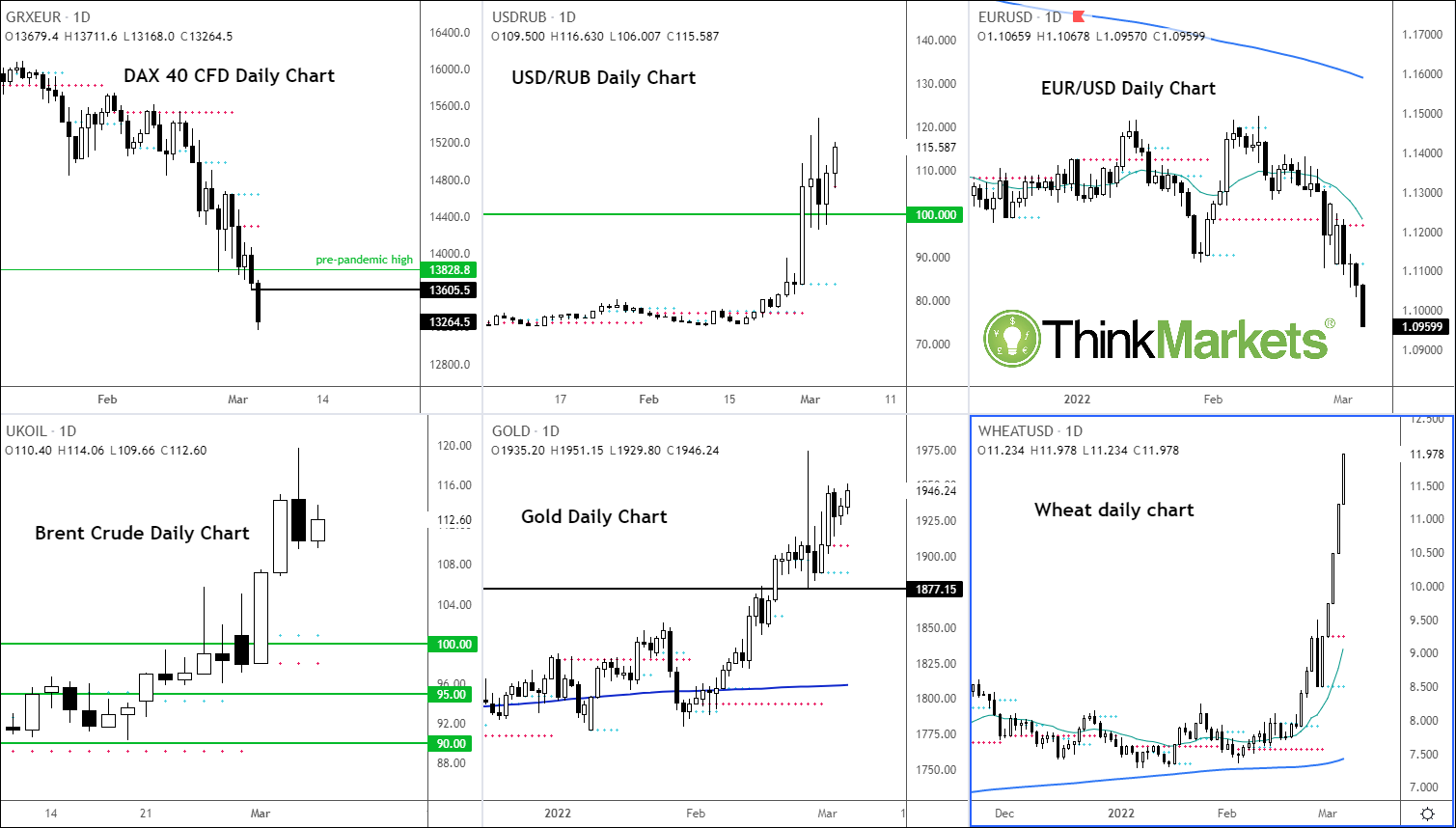
Fed Chair Jay Powell has already come out and said he will recommend a 25 basis point hike at their meeting later this month. Inflationary pressures are surging. This week, we have seen commodities such as crude oil, wheat and corn rise massively, along with aluminium and a few other base metals. This is all to do with Russia’s invasion of Ukraine, fuelling fears of supply crunches. Stocks are reeling and the euro has fallen below $1.10 ahead of next week’s ECB meeting. It is risk off – a black Friday, if you will.
But for what it is worth, analysts are expecting to see another solid showing from the US jobs market. Some 400K net new non-farm jobs are expected to have been created in February. More to the point, average hourly earnings, a key indicator of price pressures, are expected to have risen another 0.5% month-over-month to take the year-over-year reading to 5.8% form 5.7% previously.
Regardless of the outcome of the jobs report, I am expecting risk aversion to remain the dominant theme heading into the weekend, meaning we are unlikely to see a big turnaround in the stock markets. No sane investors will want to take the risk of having huge exposure to markets that have been roiled by the Russia’s invasion of Ukrainian given how volatile the situation is going to be – that’s unless something changes dramatically in the next few hours. At the time of writing, the major European indices were down 3-4 percent.
I am also expecting gold to go well north of $2,000 in days ahead. The precious metal is currently consolidating its gains after the big breakout recently. But as nothing has changed fundamentally, I expect a continuation in the ongoing bullish trend, possibly as soon as later this afternoon
Aussie Extends Rally
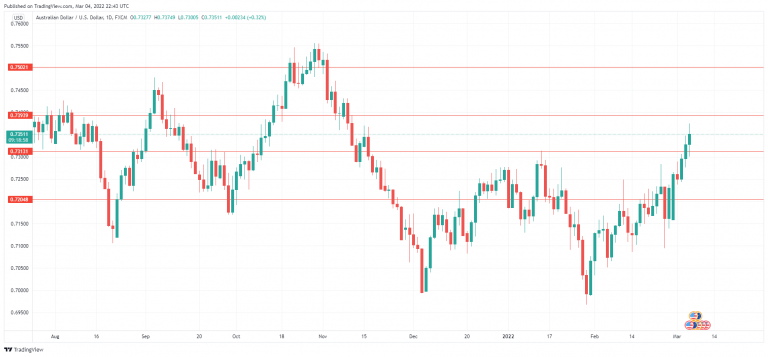
The Australian dollar continues its impressive rally and is in positive territory on Friday. AUD/USD has climbed 1.37% this week.
The war in Ukraine shows no signs of letting up, and news that a Russian missile scored a direct hit on a Ukrainian power plant has made investors even more jittery about the war in Europe. The Australian dollar is a risk currency, but the loss of risk appetite hasn’t affected the Aussie one bit. With commodities surging ever higher on fears of a disruption of supplies from Russia, Australian exports of oil, coal and gold will be even more in demand. This has boosted the Australian dollar, as has recent solid economic releases.
Australian retail sales bounce back
There was more positive news as retail sales for January rebounded with a gain of 1.8%, which matched the estimate. This followed a dismal reading of -4.4% in December. Consumer spending and exports are on an upswing, and this double-barrelled boost in domestic and foreign demand bodes well for the Australian dollar.
The RBA has done its best to dampen rate fever, but if the economy continues to churn out strong numbers, Governor Lowe will be under pressure to raise rates earlier than expected. Lowe has said that the RBA will not lift rates until inflation is sustainably within the bank’s target band of 2-3%, but the markets are expecting a number of rate hikes this year, perhaps as early as June.
Fed Chair Powell put to bed any doubts about a rate hike from the Federal Reserve in March. Powell told lawmakers that the war in Ukraine has led to greater uncertainty, but that the Fed committed to a raising rates. On Thursday, Powell told a Senate committee that in hindsight, the Fed should have tightened more quickly, given the surge inflation. For months, the Fed Chair had insisted that inflation was transitory but was forced to abandon this stance as inflationary pressures refused to recede and inflation rose to its highest level in decades.
AUD/USD Technical
- There is resistance at 0.7393 and 0.7502
- AUD/USD has weak support at 0.7313. Below, there is support at 0.7204
EUR/USD Outlook: The Euro Could Collapse after Break of Key Supports at 1.1000/40
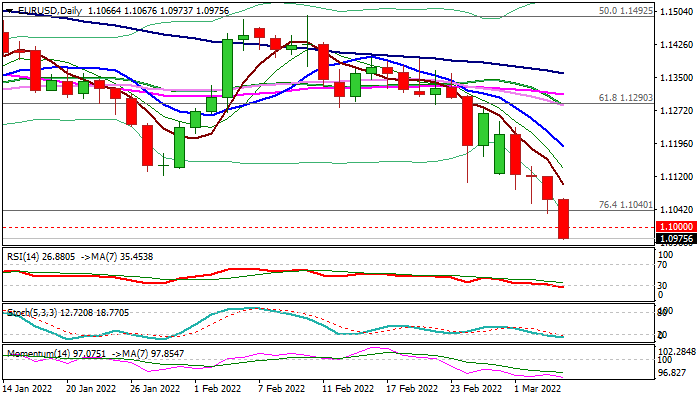
The Euro fell below 1.10 on Friday, dragged by fresh fall in stock markets on increased risk aversion, as fears over the war in Ukraine rise after the Russian forces seized the biggest nuclear plant in the Europe and growing concerns about the impact of sanction on Russia to the bloc’s economy.
Eventual break of pivotal supports at 1.1040/00 (Fibo 76.4% of 1.0635/1.2349 rally / psychological level) could spark stronger bearish acceleration and risk test of 2020 low at 1.0635, as there are no significant obstacles on the way and overall sentiment continues to sour.
Weekly close below these levels would confirm strong bearish signal.
Technical studies on both, daily and weekly charts remain on negative setup and add to bearish outlook, with fundamentals to remain the main driver.
Traders focus on today’s US labor data for February, with solid job gains and drop in unemployment forecasted that would further support dollar and increase pressure on the single currency.
Res: 1.1000; 1.1040; 1.1067; 1.1100.
Sup: 1.0935; 1.0890; 1.0836; 1.0800.
Oil Price Moved into a Positive Zone above $105 Resistance
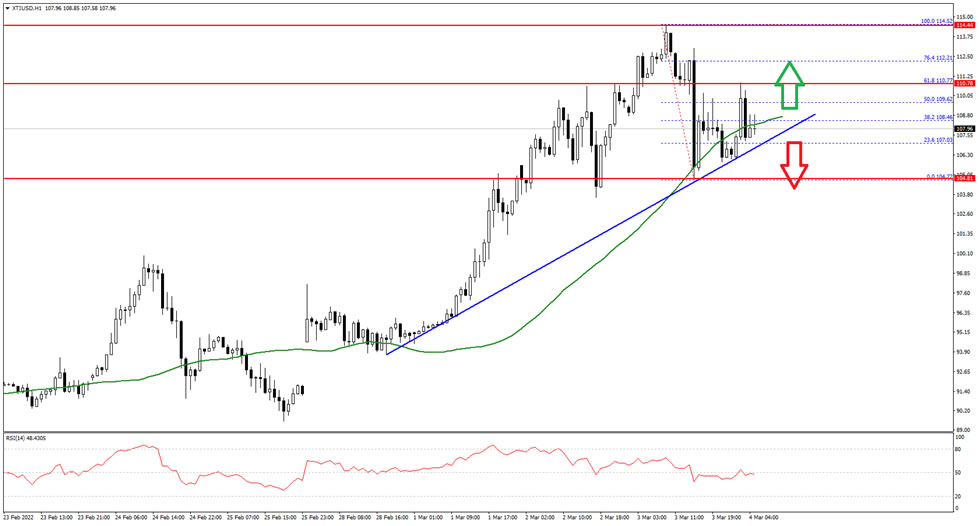
Crude oil price started a fresh increase above the $100.00 resistance against the US Dollar. The price even accelerated higher above the $105 resistance to move into a positive zone.
It traded as high as $114.52 before correcting lower. The price is now consolidating near the $108.00 level and the 50 hourly simple moving average. There is also a key bullish trend line forming with support near $107.65 on the hourly chart.
If there is a downside break below the trend line support, the price might accelerate lower to $105.00. Any more losses might call for a test of $100.00 on FXOpen.
An immediate resistance is near the $109.50 level. A break and close above the $109.50 level might push the price above $110.00. The next key resistance is near the $110.80 level, above which the price might rise steadily towards the $113.50 resistance level.
Dollar Index Reaches New 21-Month Peak; Retains Positive Move
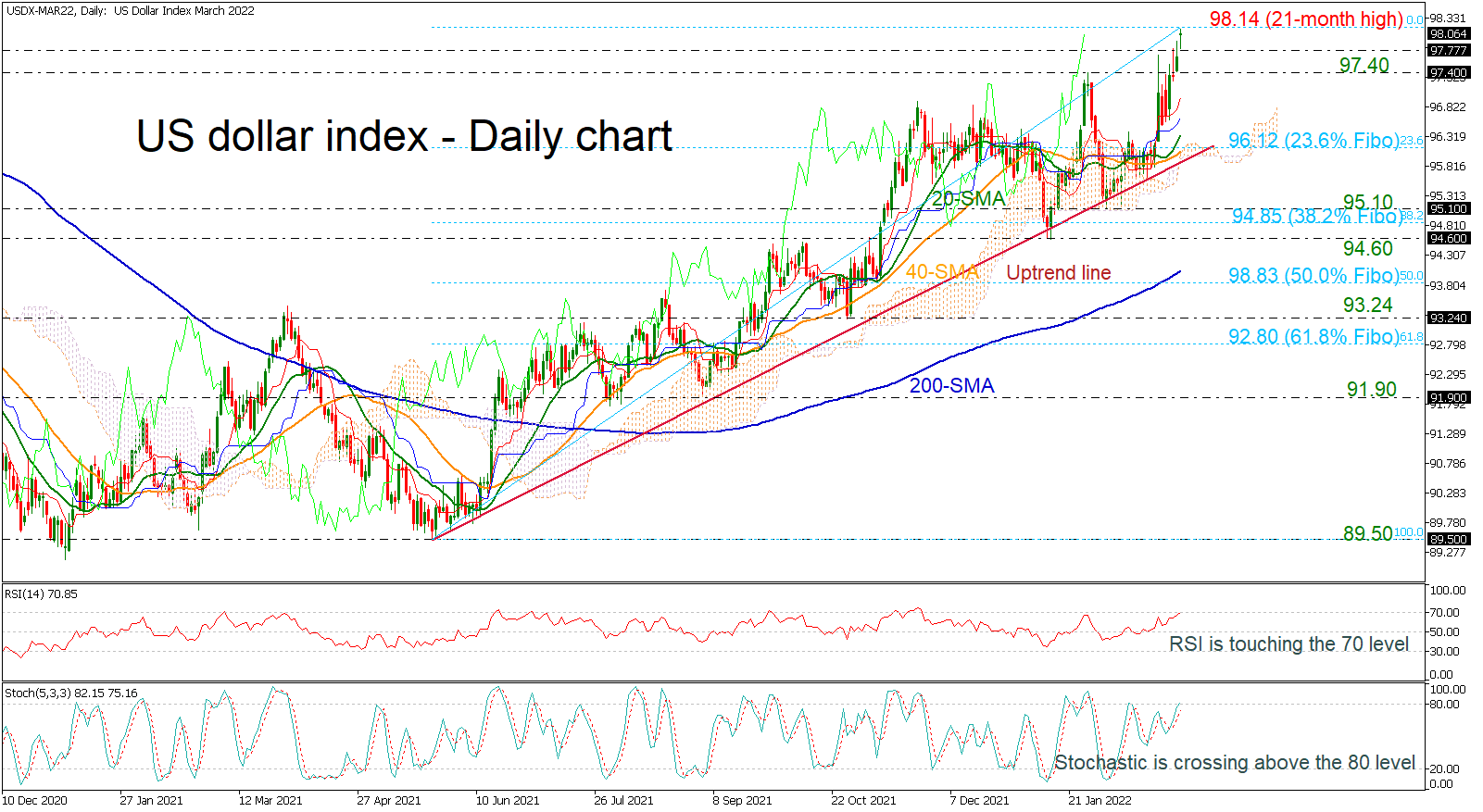
Dollar index is flirting with the 21-month high of 98.14 after the rebound off the uptrend line in the previous days. The RSI is approaching the 70 region, while the stochastic is ready to cross the 80 level, both are suggesting that the next move may be to the downside rather than to the upside as the indicators reached their overbought levels.
If the price retreats the next immediate support could come from the 97.40 zone. Even lower, the 20-day simple moving average (SMA) at 96.33 ahead of the 23.6% Fibonacci retracement level of the up leg from 89.50 to 98.14 at 96.12. Steeper declines below the descending trend line may open the door for the 95.10 barrier.
On the other hand, a successful climb beyond the 21-month high of 98.14 may drive traders until the 98.75 inside swing low from April 2020 and the 101.00 round number.
All in all, the index has been in a strong positive tendency since May 2021 and only a drop beneath the ascending trend line and the 200-day SMA at 94.00 may change this outlook.
Euro Falls to 22-Month Low
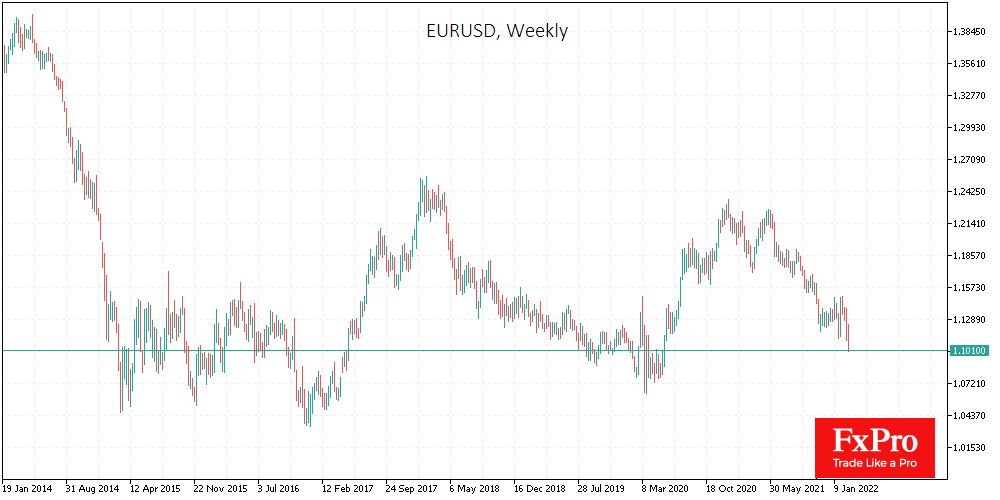
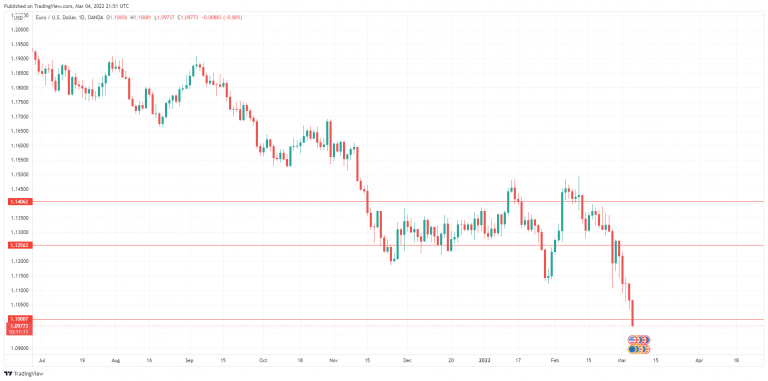
After starting the week with gains, the euro has been on a nasty slide, which has continued on Friday. EUR/USD has dropped below the symbolic 1.10 level in the European session and is at its lowest level since June 2020.
Fire at Ukraine nuclear plant sends euro lower
The intensified fighting which is raging in Ukraine has taken its toll on the euro. The grim news of a fire at a Ukrainian nuclear plant caused by Russian shelling has resulted in safe haven flows which has boosted the US dollar. The eurozone is geographically close to the crisis and fears over shortages of gas and oil supplies due to a dependence on Russian supplies are weighing heavily on the currency. With risk appetite remaining low, the euro’s slide is likely to continue, absent news of a ceasefire in Ukraine or the announcement of an agreement in the Iran nuclear talks. The US dollar is also benefitting from the relentless surge in commodity prices, notably oil. The dollar index has risen to 98.14, up 0.36% on the day.
The ECB holds a policy meeting on March 10th and it appears likely that the central bank will not tighten policy, despite a signficant rise in eurozone CPI. There have been recent statements from ECB officials urging the ECB from undertaking any significant shift in policy while the Ukraine crisis continues. We can expect central banks, including the ECB, to be cautious and raise rates at a slower pace than had been expected before the Ukraine crisis.
The financial markets are understandably being driven by the war in Europe, but there are key events that should still be treated as market-movers. One of the most important events on the economic calendar is nonfarm payrolls. The consensus stands at a 475 thousand. Anything higher than that will practically cement a 25-basis point by the Fed, while a massive miss could make the Fed think twice about a March rate hike. Barring a huge surprise from the NFP, the Fed is likely to remain on track for a rate hike later this month.
EUR/USD Technical
- There is resistance at 1.1256 and 1.1406
- EUR/USD is testing a major support level at 1.1100. Below, there is support at 1.0842
EUR/USD Can Bounce During NFP Before Testing New Lows: Elliott Wave Analysis
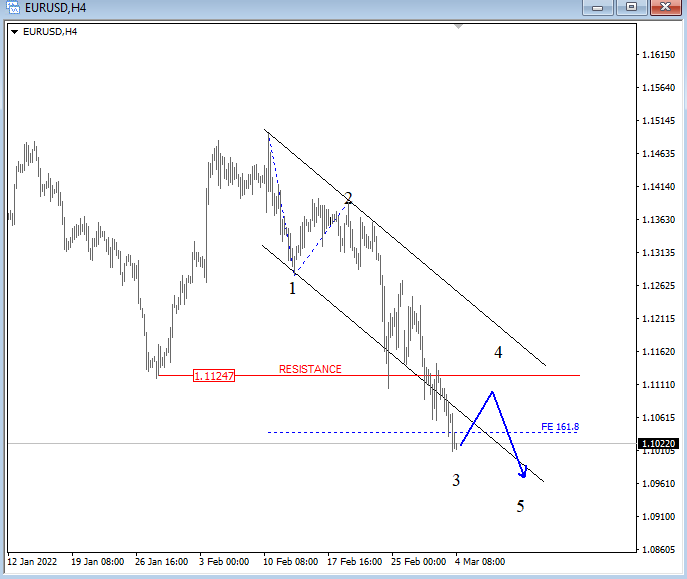
EURUSD is coming sharply down due to the situation in Ukraine, and it seems that the pair is in an impulsive sell-off headed back to a new low, thus more weakness can follow after rallies until it fully completes a five-wave bearish cycle. We see pair in wave 3 now so an upcoming bounce into wave 4 can stop at 1.1124 resistance. So we will have to be aware of bounce and recovery into a higher degree wave 4 ahead of today's NFP report.
EUR/USD 4h Elliott Wave anlaysis
Flee from Euro Gathers Momentum, Pushing Towards Parity with the Franc
The single currency approached 1.1000 against US Dollar – its lowest since May 2020 – and is close to declining for the fourth week in a row. Investors fleeing into safe havens outside the eurozone continues to gain momentum.
The single currency is also losing sharply against the Swiss franc, falling to 1.01, the lowest since January 2015. In modern history (at least since 1993), the EURCHF has only traded lower briefly in August 2011 and at the Swiss National Bank’s unpegging of the exchange rate in 2015.
In the meantime, the franc against the dollar is trading in a tight sideways position around 0.9200.
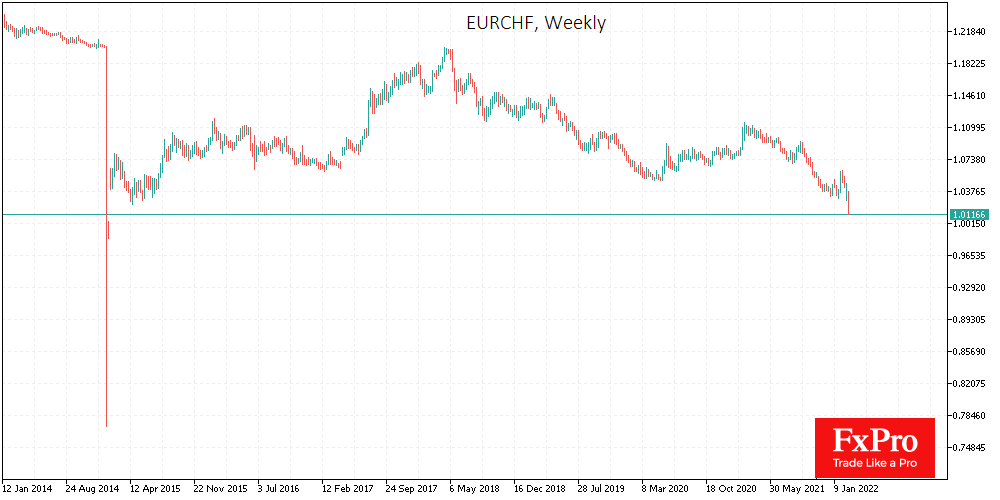
A few observers argue that with the euro approaching parity with the franc, the risks of active interventions or a re-establishment of a strict peg increase. But we believe that it is still not the time for such a move.
The NBS is not facing a downgrade now after the financial crisis. On the contrary, the risks of accelerating inflation are increasing, and the national currency appreciation helps to dampen external inflationary pressures.
Furthermore, the stability of the franc against the dollar indicates that we see a flight away from the euro rather than a general pull towards the franc.