Sample Category Title
Most Markets Shrug Sanctions on Russia, NZD Jumps after Hawkish RBNZ
US stocks tumbled sharply overnight after the West unveiled a wave a sanctions on Russia's invasion on Ukraine, and warned that more are underway. But other markets were pretty steady, with Asian markets trading mildly higher. Gold is struggling to stand above 1900 handle. WTI crude oil is also gyrating below 96.
In the currency markets, New Zealand dollar rises broadly after more hawkish than expected RBNZ rate hike. Aussie and Canadian Dollar are following next. Dollar is the softest for today, followed by Euro and Yen. Sterling and Swiss Franc are mixed. There is no clear safe-haven flow in the forex markets.
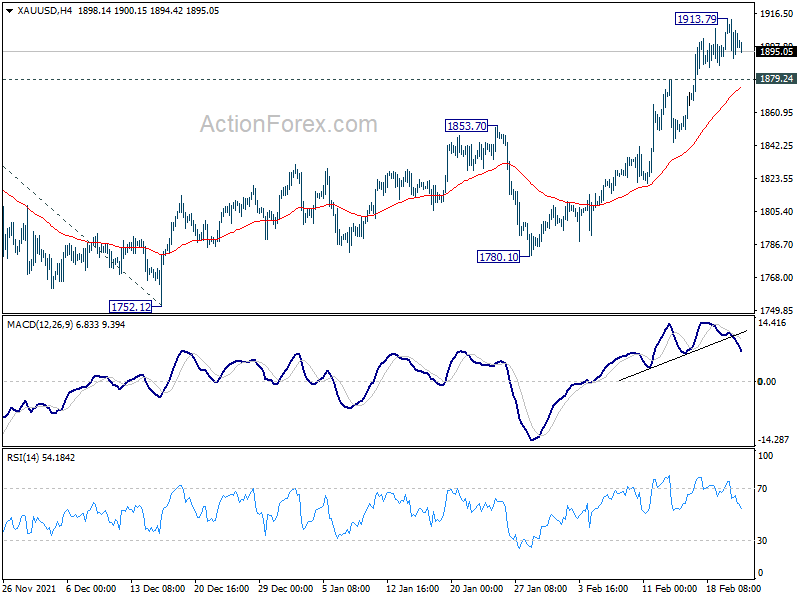
Technically, some attention will be paid to Gold. Firm break of 1879.24 minor support will confirm short term topping at 1913.79. Deeper pull back could be seen back to 1853.70 resistance turned support and possibly below. That, if happens, might be a sign of reverse safe-haven flows in other markets.
In Asia, at the time of writing, Hong Kong HSI is up 0.84%. China Shanghai SSE is up 0.78%. Singapore Strait Times is down -0.35%. Japan is on holiday. Overnight, DOW dropped -1.42%. S&P 500 dropped -1.01%. NASDAQ dropped -1.23%. 10-year yield rose 0.016 to 1.948.
RBNZ hikes rate to 1%, starts managed bond sales, raised OCR peak forecast
RBNZ raised OCR by 25bps to 1.00% as widely expected. Additionally, it will start to start reduction of the bond holdings under the Large Scale Asset Purchase program through "both bond maturities and managed sales.
The central bank also said "further removal of monetary policy stimulus is expected over time given the medium-term outlook for growth and employment, and the upside risks to inflation."
In the minutes, it's noted, "when deciding whether to move the OCR up by 25 or 50 basis points, many members saw this as a finely balanced decision."
However, firstly, the active sales of bond holdings may "put some upward pressure on longer-term interest rates". Also, the OCR is expected to "peak at a higher level than assumed" at the November MPC. The OCR peak was raised to around 3.4% in 2024, compared to 2.6% in November review.
Hence, the Committee came to a consensus of a 25bps hike, but "affirmed that it was willing to move the OCR in larger increments if required over coming quarters."
NZD/USD extends rebound after RBNZ, AUD/NZD dips
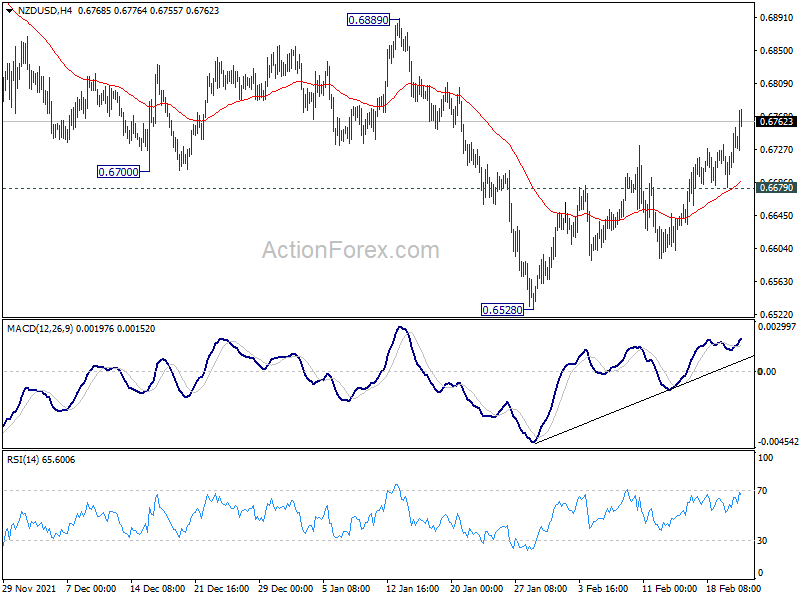
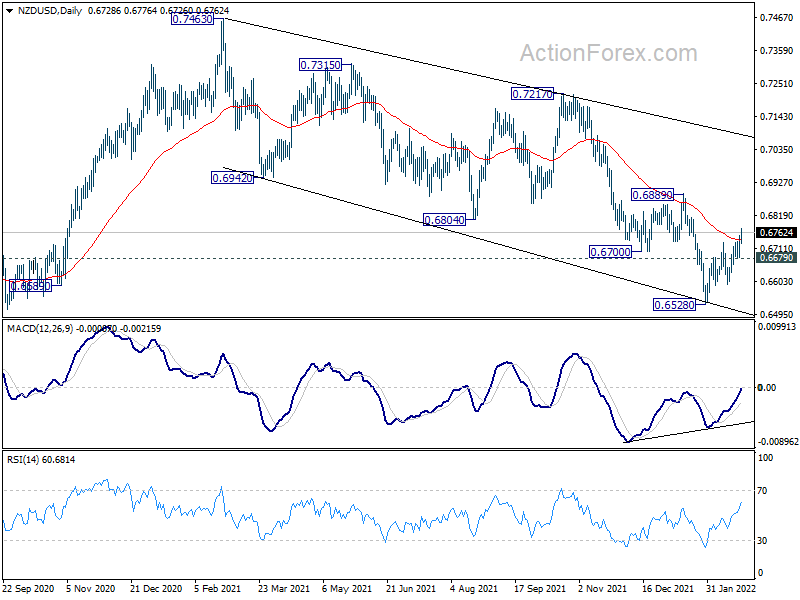
New Zealand Dollar rises broadly after more hawkish than expected RBNZ policy decision. NZD/USD is extending the rebound from 0.6528 short term bottom. Further rise is now expected as long as 0.6679 minor support holds, to 0.6889 resistance next.
It's still too early to conclude that NZD/USD's down trend from 0.7463 has completed. Rejection by 0.6889 resistance will maintain medium term bearishness for another decline through 0.6528 low. Nevertheless, firm break of 0.6889 will raise then chance of bullish reversal and turn focus to trend line resistance at around 0.7080.
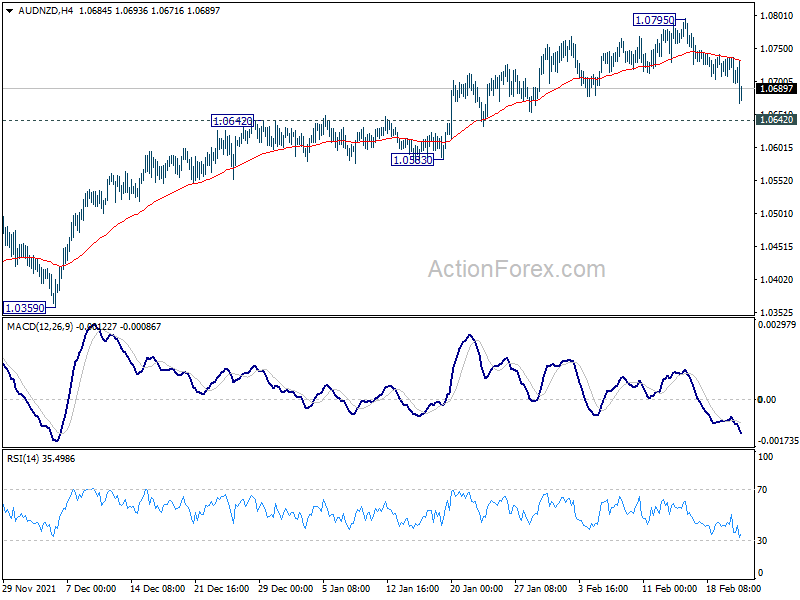
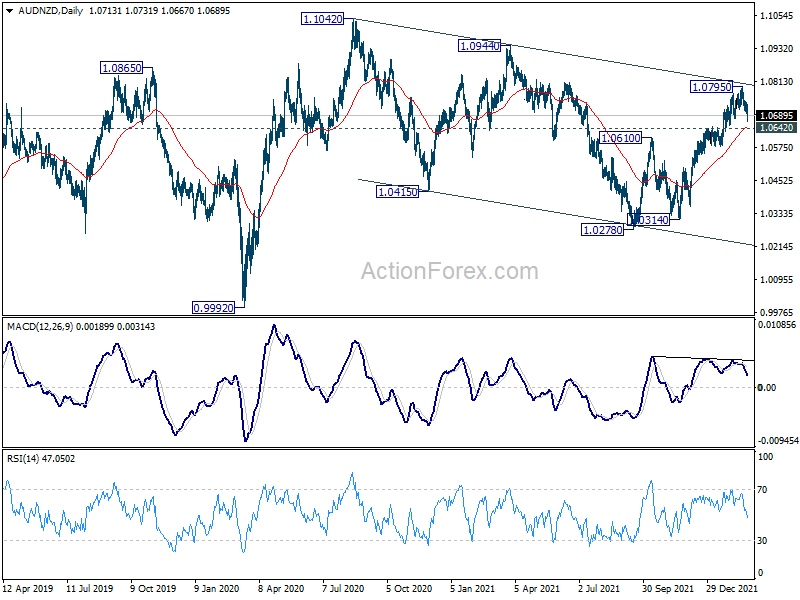
AUD/NZD dips notably too and immediate focus is now on 1.0642 resistance turned support, which is also close to 55 day EMA (now at 1.0649). Sustained break there will argue that whole rise from 1.0278 has completed at 1.0795, after rejection by medium term channel resistance. In this case, fall from 1.0795 should develop into another falling leg to the whole down trend from 1.1042, targeting 1.0278 low again.
Fed Bostic: Fed can pull back some support without jeopardizing employment
Atlanta Fed President Raphael Bostic said yesterday that the US economy is "still quite strong". It's in a situation "where it can stand on its own". Thus, Fed can pull back some emergency support "without jeopardizing employment."
Bostic also noted that the new sanctions on Russia provided some uncertainty. And, "that kind of uncertainty is a downward risk to economic output" that will be factored into how he thinks about monetary policy.
Elsewhere
Australia wage price index rose 0.7% qoq in Q4, matched expectations. Construction work down dropped -0.4% in Q4, below expectation of 2.1%.
Looking ahead, Germany Gfk consumer confidence, Swiss ZEW expectations, and Eurozone CPI final will be released in European session. The US calendar is empty today.
EUR/CHF Daily Outlook
Daily Pivots: (S1) 1.0364; (P) 1.0413; (R1) 1.0487; More....
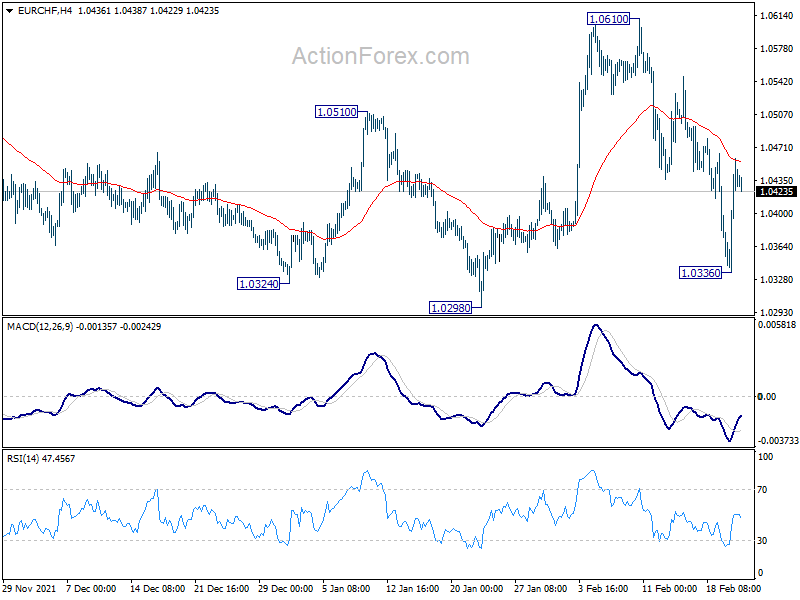
EUR/CHF rebounded strongly after hitting 1.0336 and intraday bias is turned neutral first. Corrective pattern from 1.0298 might be extending with another leg. But even in case of stronger rise, up side should be limited by 38.2% retracement of 1.1149 to 1.0298 at 1.0623. On the downside, below 1.0336 will target 1.0298 low first. Firm break there will confirm larger down trend resumption.
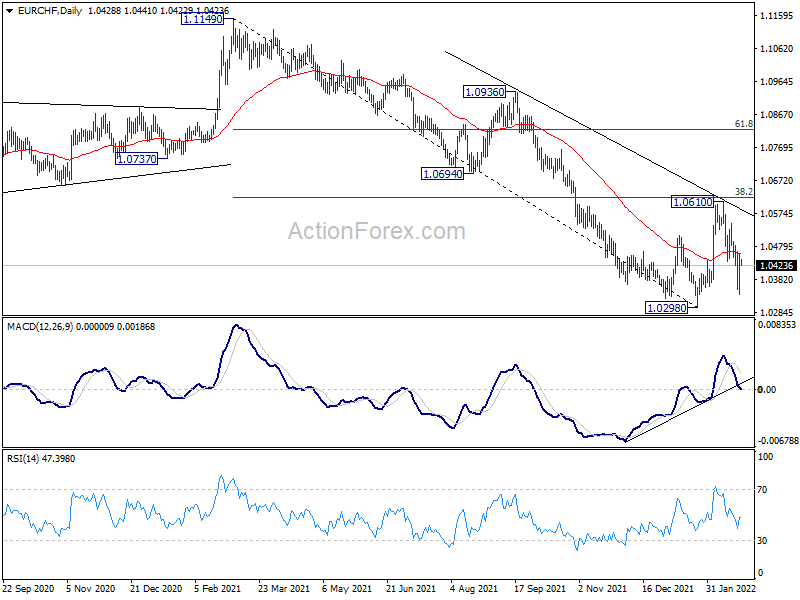
In the bigger picture, a medium term bottom was formed at 1.0298 on bullish convergence condition in daily MACD. Rebound from there is still tentatively viewed part of a corrective pattern. That is, larger down trend from 1.2004 (2018) could still extend through 1.0298 to 61.8% projection of 1.2004 to 1.0505 to 1.1149 at 1.0223. However, sustained trading above 55 week EMA (now at 1.0667) will argue that the down trend is over, and bring stronger rise back to 1.1149 next.
Economic Indicators Update
| GMT | Ccy | Events | Actual | Forecast | Previous | Revised |
|---|---|---|---|---|---|---|
| 00:30 | AUD | Wage Price Index Q/Q Q4 | 0.70% | 0.70% | 0.60% | |
| 00:30 | AUD | Construction Work Done Q4 | -0.40% | 2.10% | -0.30% | -1.20% |
| 01:00 | NZD | RBNZ Interest Rate Decision | 1.00% | 1.00% | 0.75% | |
| 02:00 | NZD | RBNZ Press Conference | ||||
| 07:00 | EUR | Germany Gfk Consumer Confidence Mar | -6.2 | -6.7 | ||
| 09:00 | CHF | ZEW Expectations Feb | 9.5 | |||
| 10:00 | EUR | Eurozone CPI Y/Y Jan F | 5.10% | 5.10% | ||
| 10:00 | EUR | Eurozone CPI Core Y/Y Jan F | 2.30% | 2.30% |
NZD/USD extends rebound after RBNZ, AUD/NZD dips
New Zealand Dollar rises broadly after more hawkish than expected RBNZ policy decision. NZD/USD is extending the rebound from 0.6528 short term bottom. Further rise is now expected as long as 0.6679 minor support holds, to 0.6889 resistance next.
It's still too early to conclude that NZD/USD's down trend from 0.7463 has completed. Rejection by 0.6889 resistance will maintain medium term bearishness for another decline through 0.6528 low. Nevertheless, firm break of 0.6889 will raise then chance of bullish reversal and turn focus to trend line resistance at around 0.7080.
AUD/NZD dips notably too and immediate focus is now on 1.0642 resistance turned support, which is also close to 55 day EMA (now at 1.0649). Sustained break there will argue that whole rise from 1.0278 has completed at 1.0795, after rejection by medium term channel resistance. In this case, fall from 1.0795 should develop into another falling leg to the whole down trend from 1.1042, targeting 1.0278 low again.
RBNZ hikes rate to 1%, starts managed bond sales, raised OCR peak forecast
RBNZ raised OCR by 25bps to 1.00% as widely expected. Additionally, it will start to start reduction of the bond holdings under the Large Scale Asset Purchase program through "both bond maturities and managed sales.
The central bank also said "further removal of monetary policy stimulus is expected over time given the medium-term outlook for growth and employment, and the upside risks to inflation."
In the minutes, it's noted, "when deciding whether to move the OCR up by 25 or 50 basis points, many members saw this as a finely balanced decision."
However, firstly, the active sales of bond holdings may "put some upward pressure on longer-term interest rates". Also, the OCR is expected to "peak at a higher level than assumed" at the November MPC. The OCR peak was raised to around 3.4% in 2024, compared to 2.6% in November review.
Hence, the Committee came to a consensus of a 25bps hike, but "affirmed that it was willing to move the OCR in larger increments if required over coming quarters."
(RBNZ) More Tightening Needed
The Monetary Policy Committee today increased the Official Cash Rate (OCR) to 1 percent. The Committee also agreed to commence the gradual reduction of the Reserve Bank's bond holdings under the Large Scale Asset Purchase (LSAP) programme - through both bond maturities and managed sales.
The Committee agreed it remains appropriate to continue reducing monetary stimulus so as to maintain price stability and support maximum sustainable employment.
The level of global economic activity is generating rising inflation pressures, exacerbated by ongoing supply disruptions. The pace of global economic growth has slowed however, due to the general elevated uncertainty created by the persistent impacts of COVID-19, and clear signals that monetary conditions will tighten over the course of 2022.
In New Zealand, underlying economic strength remains in the economy, supported by aggregate household and business balance sheet strength, fiscal policy support, and continued strong export returns. However, some short-term economic disruption is expected given the current growing COVID-19 health challenge. The high vaccination rates across New Zealand will assist significantly to reduce this disruption.
Economic capacity pressures have continued to tighten. Employment is now above its maximum sustainable level, with a broad range of economic indicators highlighting that the New Zealand economy continues to perform above its current potential.
Headline CPI inflation is well above the Reserve Bank's target range, but will return towards the 2 percent midpoint over coming years. The near-term rise in inflation is accentuated by higher oil prices, rising transport costs, and the impact of supply shortfalls. These immediate relative price movements risk generating more generalised price rises, especially given the current domestic capacity constraints.
The Committee agreed that further removal of monetary policy stimulus is expected over time given the medium-term outlook for growth and employment, and the upside risks to inflation.
More information:
- View the February 2022 Monetary Policy Statement
- Download the February 2022 Monetary Policy Statement (PDF 7.3MB)
Summary Record of Meeting
The Monetary Policy Committee discussed developments affecting the outlook for monetary policy. Global economic activity experienced a robust recovery in 2021. The pace of growth is expected to slow, weighed down by resource and production constraints.
Global inflation is expected to peak during 2022 and then moderate, as supply disruptions are gradually resolved. However, global inflation is currently higher, and expected to ease more gradually than anticipated in the November Statement.
The Committee noted that central banks are now looking to increase interest rates sooner and by more than anticipated in the November Statement. The rise in global interest rates has resulted in a fall in the New Zealand dollar, as interest rate differentials have narrowed. Bond and equity prices have been more volatile of late, in part due to the shift in monetary policy expectations and a rise in geopolitical tensions. The Committee noted that asset valuations had been boosted by very low interest rates, and that higher interest rates may dampen these valuations in future.
The New Zealand economy has been resilient in the face of the COVID-19 pandemic to date. Export prices have remained high, supported by the solid international economic recovery. Domestic spending and investment have also been robust. However, conditions have been very difficult for some businesses, especially in service industries.
The recent emergence and spread of the Omicron COVID-19 variant is expected to further disrupt economic activity in the near term. People's ability and willingness to work and spend will be strongly determined by near-term health outcomes.
The Committee reconfirmed that house prices in New Zealand are above their sustainable level, but are expected to ease over time. They noted that house prices had begun to ease, with monthly falls in December and January. Mortgage lending growth has also slowed. Government regulatory and tax policy changes, and high rates of residential building are expected to slow house prices. Higher mortgage interest rates will also play a role in the transition of house prices toward a more sustainable level over coming years.
Resource constraints are evident in the economy, and will be exacerbated by further disruptions from the Omicron outbreak. Employment is above its maximum sustainable level. The Committee noted that there has been some upward pressure on nominal wages, as expected, consistent with the tight labour market. They also noted that wage growth continues to lag CPI inflation.
The Committee discussed the outlook for net migration to New Zealand with the international borders being reopened in stages over coming months. The impact on labour supply is uncertain in the near term, but a positive inflow is expected over time as border flows return to normal. The Committee noted that net migration is assumed to increase slowly, helping to gradually ease skill shortages.
Annual CPI inflation has increased largely as expected in the November Statement, reflecting domestic capacity constraints and higher prices for imported goods, in particular oil. The Committee noted that annual inflation is expected to peak in early-2022, and then ease over the course of the year, returning to within their target range in mid-2023. The Committee agreed that further removal of monetary stimulus is necessary to achieve their Remit.
The OCR remains the Committee's preferred tool for implementing monetary policy, and the impact of additional monetary policy tools is considered when determining the level of the OCR. With regards to the latter, members noted that the Funding for Lending Programme (FLP) window closes this year. They also noted that the cost of bank funding from the FLP is rising in line with the OCR.
The Large Scale Asset Purchase (LSAP) programme was introduced in March 2020, providing significant stimulus and supporting the functioning of the bond market. Purchases under the programme were halted in July 2021.
The Committee agreed that managing down the Bank's holdings of these bonds was now consistent with their monetary policy objectives. Members also agreed that managed sales of bond holdings, in addition to not investing the proceeds of maturities, was most consistent with achieving their mandate over time (further details below).
The Committee discussed the extent of monetary tightening required to meet their price stability and maximum sustainable employment mandate. In doing so, the Committee applied their least regrets framework, noting that the most significant risk to be avoided at present was longer-term inflation expectations rising above the target and becoming embedded in future price setting.
It was agreed that more monetary tightening was needed than signalled in the November Statement. The Committee confirmed that the outlook for a higher OCR at the end of the projection horizon was a balanced reflection of the likely path of interest rates.
The pace at which monetary stimulus should be reduced was discussed by the Committee. Members agreed there were many factors to assess, balancing the need to reduce monetary stimulus with many uncertainties. They considered the balance of risks and noted that the behavioural responses of household and businesses in the face of higher interest rates would be important for the appropriate pace of tightening.
The Committee agreed that while higher interest rates are necessary, households and firms may have become more sensitive to interest rate changes as their debt levels have risen. Members also noted that a significant proportion of mortgages will be reset at higher interest rates over calendar 2022.
The current Omicron outbreak will lead to economic disruption and may weigh on consumer and investor confidence in the near term. Health outcomes will be important, in particular how these impact the supply capacity of the economy and level of demand.
While government spending and investment remains strong, the impulse to growth from fiscal support is now ebbing and will wane.
The recent signs of slowing in demand for housing was discussed by the Committee, which noted that house prices may fall further. The Committee agreed that higher interest rates were consistent with house prices becoming more sustainable. They also noted the Bank's recent policy adjustments to support the stability of the financial system, including tightening of loan-to-value ratio restrictions last year and ongoing changes to improve the capital adequacy of banks. The Committee acknowledged that some recent, more highly-leveraged, borrowers may be financially stretched in a higher interest rate environment.
When deciding whether to move the OCR up by 25 or 50 basis points, many members saw this as a finely balanced decision.
When considering the case for a 50 basis point increase, the Committee noted the high starting point for inflation and the drift upwards in measures of inflation expectations. The Committee agreed that maintaining stable longer‑term inflation expectations near the mid-point of their target would greatly assist their purpose.
When considering the case for a 25 basis point increase, members noted that interest rates had already increased significantly late last year, and are expected to continue rising as the OCR is progressively increased. They also noted that conditional on the outlook, the OCR is expected to peak at a higher level than assumed at the November Statement. In addition, sales of the Bank's LSAP bond holdings may put some upward pressure on longer-term interest rates. Members of the Committee were conscious of broader uncertainty in the midst of the current Omicron wave.
Weighing the options, the Committee came to a consensus to increase the OCR by 25 basis points. The Committee also affirmed that it was willing to move the OCR in larger increments if required over coming quarters.
On Wednesday 23 February, the Committee reached a consensus to:
- Increase the OCR to 1 percent.
- Not reinvest the proceeds of any upcoming LSAP bond maturities.
- In addition, direct the Reserve Bank to sell nominal New Zealand Government Bonds and Inflation-indexed New Zealand Government Bonds to New Zealand Debt Management at a rate of $5 billion per fiscal year, commencing in July 2022, provided it remained consistent with the Bank's monetary policy objectives, and subject to market conditions.
- Hold the Local Government Funding Agency bonds until maturity.
Attendees:
Reserve Bank staff: Adrian Orr, Christian Hawkesby, Yuong Ha
External: Bob Buckle, Peter Harris, Caroline Saunders
Observer: Bryan Chapple
Secretary: Elizabeth Kendall
Media contact:
James Weir
Senior Adviser External Stakeholders
DDI: +64 4 471 3962 | MOB: 021 103 1622
Email: James.Weir@rbnz.govt.nz
The Monetary Policy Committee's deliberations on the gradual reduction of the LSAP portfolio
The Committee discussed options for gradually managing down the size of the LSAP portfolio, guided by its principles for monetary policy tools (see Chapter 2, Box B). The Committee agreed that gradual reduction in the LSAP portfolio should seek to achieve three objectives:
- Have minimal impact on monetary stimulus – the bond holdings will not be actively used to remove monetary stimulus;
- Avoid harming the efficient functioning of financial markets which is essential for the functioning of the economy and the transmission of monetary policy; and
- Ensure that the MPC have the capacity to use the LSAP tool effectively, if economic and financial conditions deteriorate.
Reducing bond holdings will provide the Committee more scope to use LSAPs in the future and will support the management of liquidity in the financial system. Some members noted that some longer-term interest rates may change as the market analyses the net effect on bond supply. However, bond holdings will be gradually reduced to minimise unnecessary volatility in interest rates, consistent with the Committee's Remit.
The Committee considered whether selling bonds back into the secondary market would be appropriate and noted that selling bonds to New Zealand Debt Management (NZDM) would be the most efficient approach, providing the market with clarity around net bond supply.
The Committee agreed not to reinvest the proceeds of any upcoming bond maturities and directed the Reserve Bank to sell the nominal New Zealand Government Bonds and Inflation-indexed New Zealand Government Bonds to NZDM at a rate of $5 billion per fiscal year. The Committee agreed to hold the Local Government Funding Agency Bonds until maturity, as the holdings of these bonds are comparatively small.
This pace of sales would continue provided it remained consistent with the Reserve Bank's monetary policy objectives, and subject to market conditions. The Committee reserves the right to change the rate of sales or halt sales should conditions change, but do not foresee such changes to be common. The Reserve Bank intends to commence bonds sales in July following further consultation with the NZDM, and will issue a market announcement in coming months outlining operational details prior to commencement.
In accordance with the LSAP indemnity, staff consulted the NZDM on a range of options for reducing the LSAP portfolio. The Committee's decision to sell bonds back to the NZDM will have implications for the NZDM's funding programme and the NZDM will provide updated issuance guidance at the Budget in May.
Members noted that the bond holdings would continue to provide a small amount of ongoing marginal monetary stimulus, which would gradually reduce over time as bonds holdings are reduced. Members reiterated that the OCR remains the most effective and efficient way of adjusting monetary stimulus in either direction. Therefore, the stance of monetary policy will continue to be communicated primarily via changes to the OCR and conditional forward guidance through the published OCR track.
Fed Bostic: Fed can pull back some support without jeopardizing employment
Atlanta Fed President Raphael Bostic said yesterday that the US economy is "still quite strong". It's in a situation "where it can stand on its own". Thus, Fed can pull back some emergency support "without jeopardizing employment."
Bostic also noted that the new sanctions on Russia provided some uncertainty. And, "that kind of uncertainty is a downward risk to economic output" that will be factored into how he thinks about monetary policy.
Technical Outlook and Review
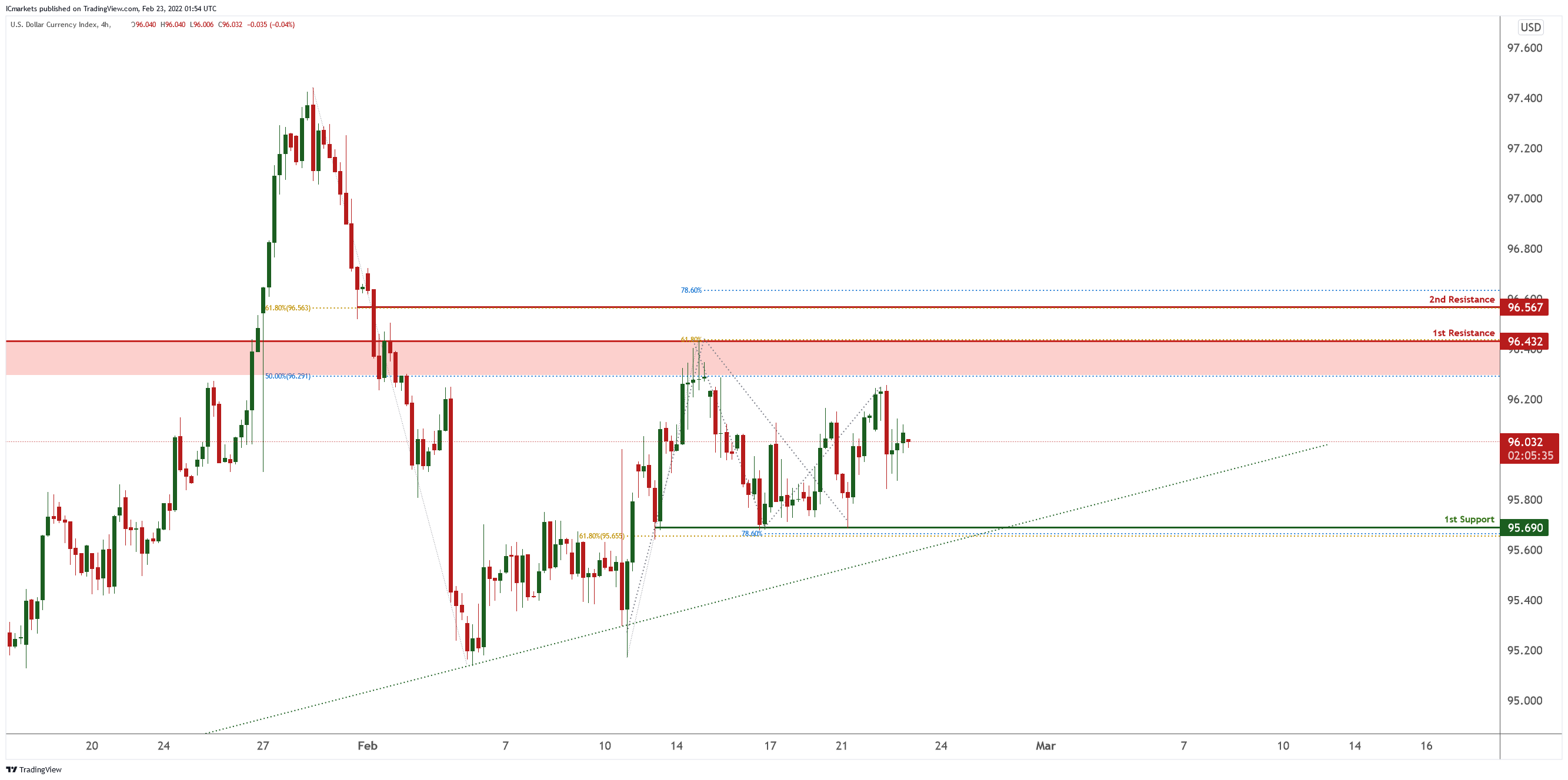
DXY:
On the H4 chart price is abiding by an ascending trendline and between 1st resistance level of 96.432 in line with 61.8% Fibonacci projection, 50% Fibonacci retracement and 1st support level of 95.690 in line with 78.6% Fibonacci projection , 61.8% Fibonacci retracement. Price can potentially dip to 1st support level. Our bearish bias is supported by technical indicators.
Areas of consideration
- H4 1st resistance at 96.432
- H4 1st support at 95.690
XAU/USD (GOLD):
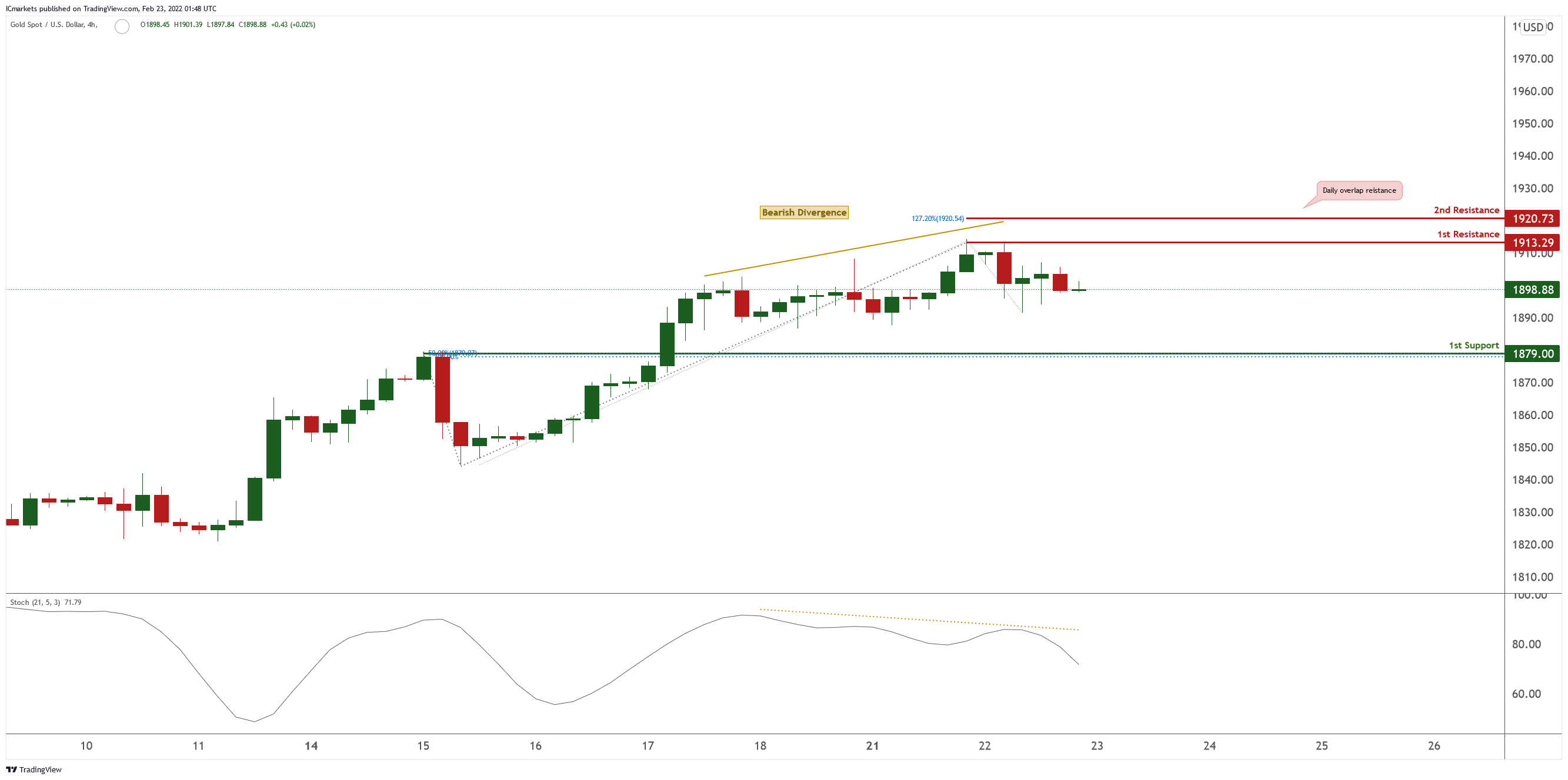
On the H4 chart price near 1st resistance level of 1913.29 in line which is the graphical swing high level. Price can potentially dip to the 1st support level of 1879 in line with 50% Fibonacci retracement and 100% Fibonacci projection. Our bearish bias is supported by the stochastic indicator as it shows a bearish divergence.
Areas of consideration
- H4 1st resistance at 1913.14
- H4 1st support at 1879
GBP/USD
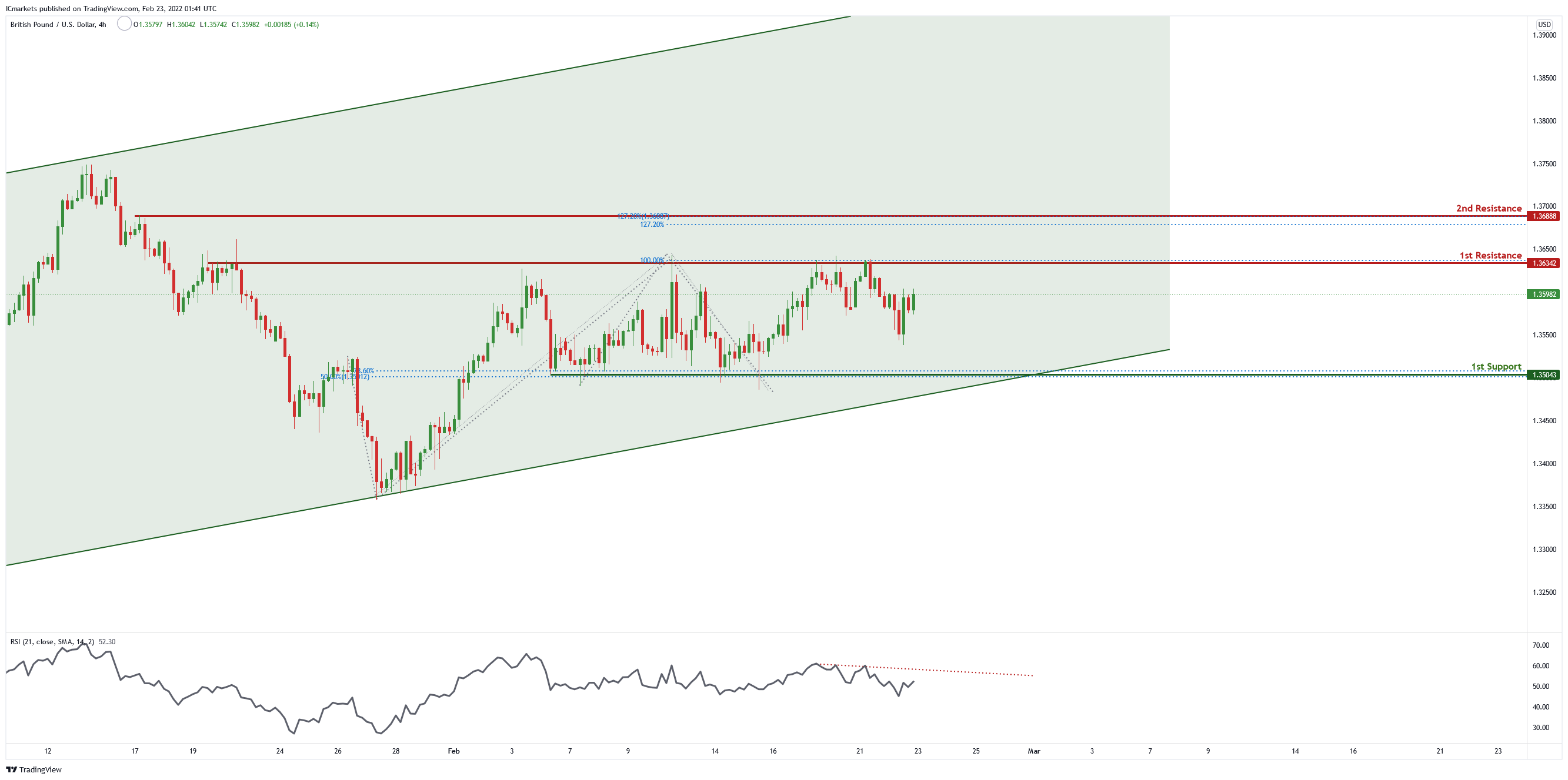
On the H4 chart , price is near 1st resistance level of 1.36342 in line with 61.8% Fibonacci retracement and 100% Fibonacci projection. Price can potentially dip to the take profit level of 1.35043 in line with 50% Fibonacci retracement and 78.6% Fibonacci projection . Our bearish bias is supported by the RSI indicator as it is abiding by a descending trendline
Areas of consideration
- H4 1st resistance at 1.36342
- H4 1st support at 1.35043
USD/CHF:
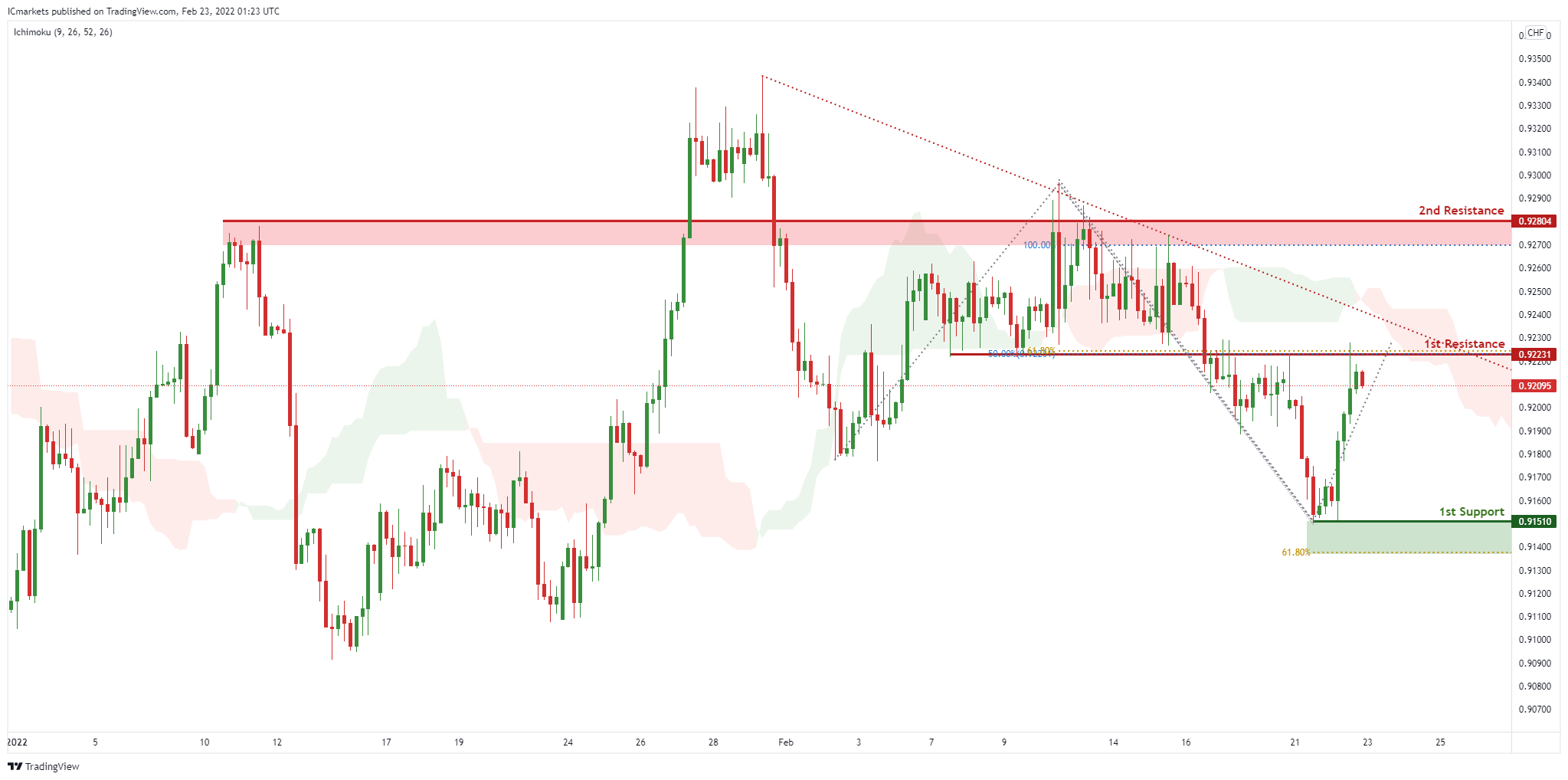
On the H4 timeframe, prices are on bearish momentum and abiding to our descending trendline. We see the possibility of bearish continuation from our 1st resistance at 0.92231 in line with 50% Fibonacci retracement towards our 1st support at 0.91510 in line which is an area of Fibonacci confluences. Our bearish bias is further supported by prices trading below our Ichimoku clouds and the descending trend line.
Areas of consideration :
- H4 1st resistance at 0.92231
- H4 1st support at 0.91510
EUR/USD :
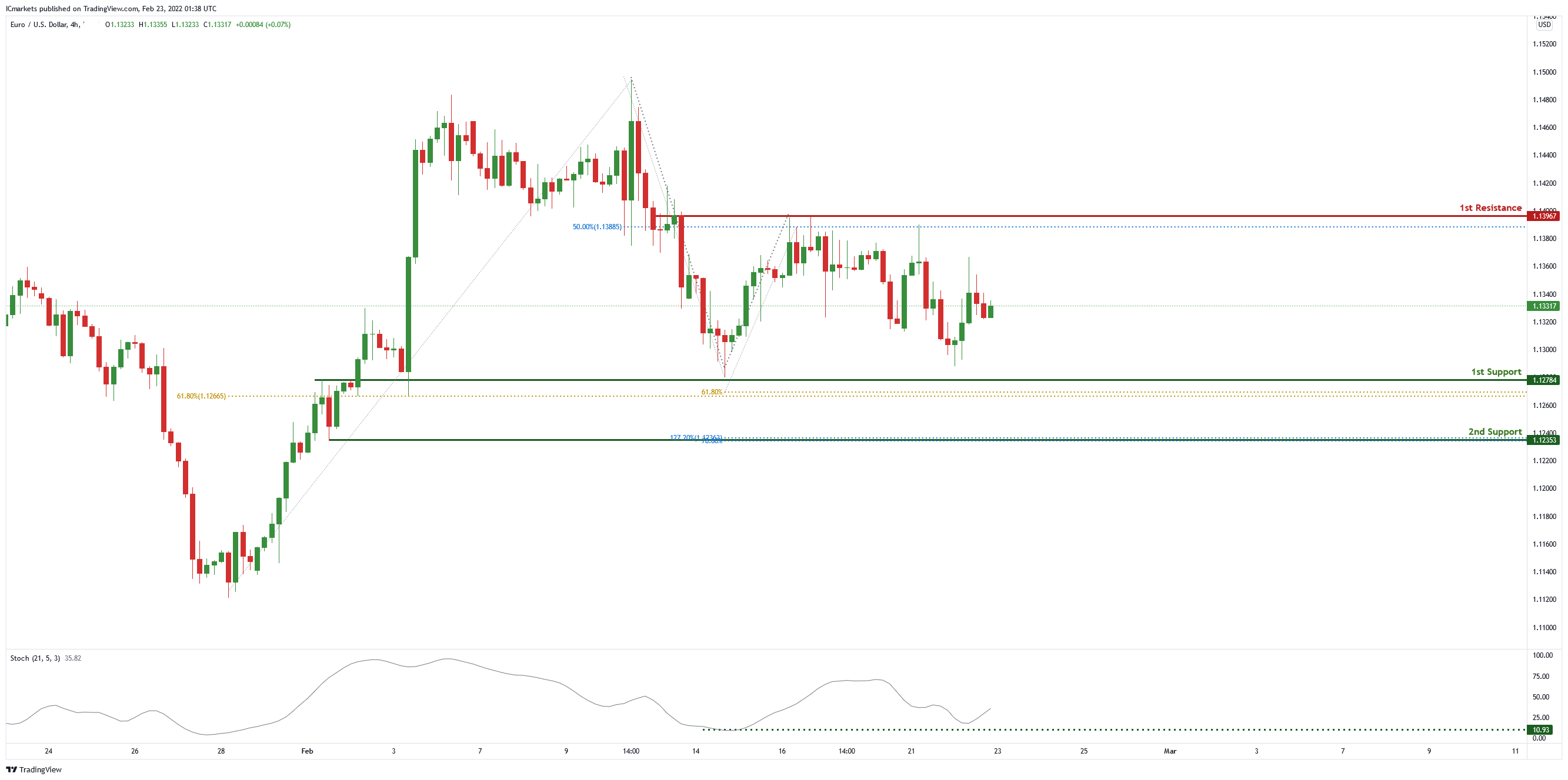
On the H4 chart, price is in the middle of 1st resistance of 1.13967 in line with 50% Fibonacci retracement and 1st support of 1.12784 in line with 61.8% Fibonacci retracement and 61.8% Fibonacci projection. Price can potentially bounce from the 1st support to the 1st resistance level. Our bullish bis is supported by the stochastic indicator as it is near support level.
Areas of consideration
- H4 1st support at 1.12784
- H4 1st resistance at 1.13967
USD/JPY
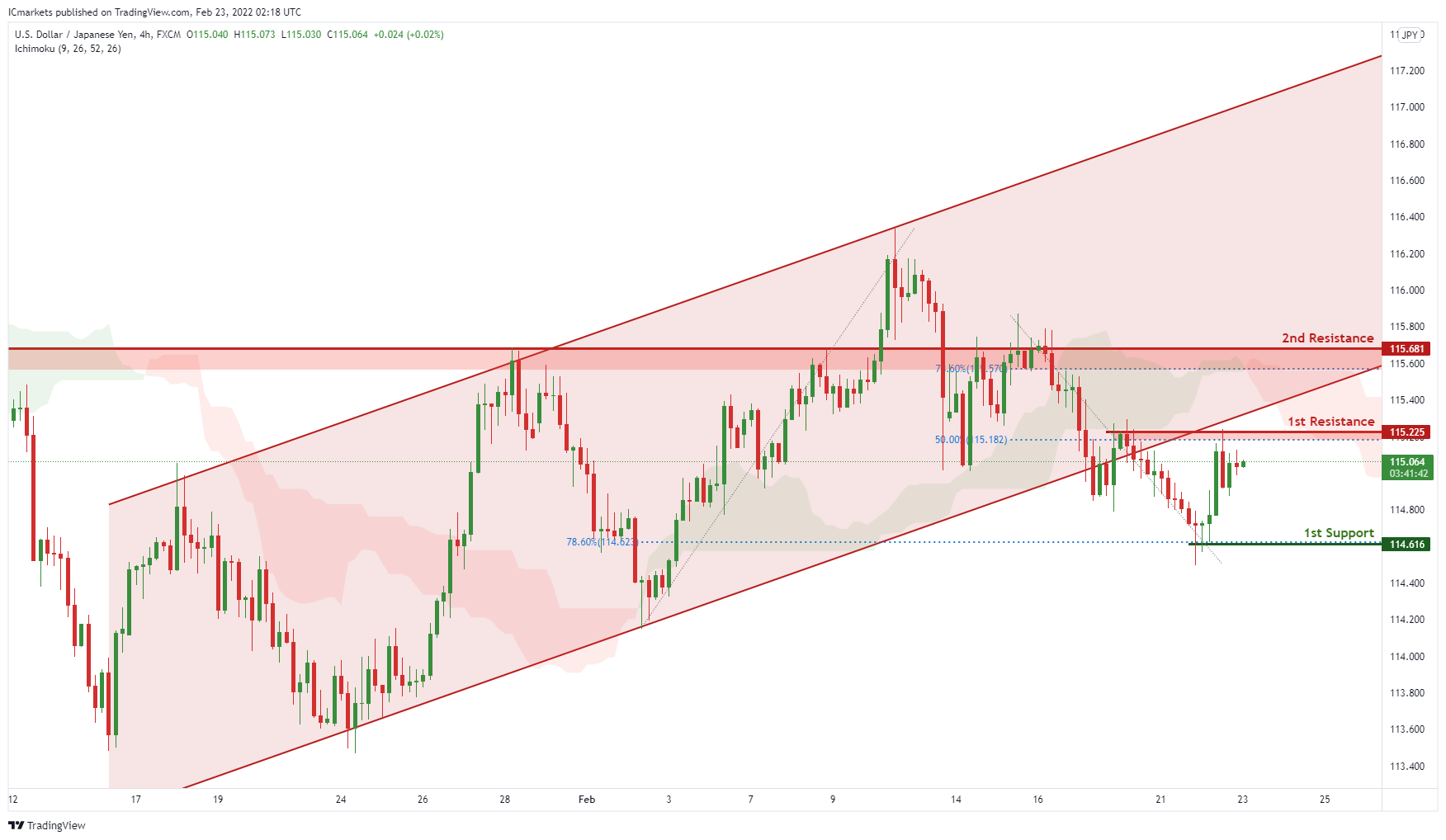
On the H4 timeframe, prices are on bearish momentum and abiding to our descending trendline. We see the possibility of bearish continuation from our 1st resistance at 115.225 in line with 50% Fibonacci retracement towards our 1st support at 114.616 in line which is an area of Fibonacci confluences. Our bearish bias is further supported by prices trading below our Ichimoku clouds.
Areas of consideration:
- H4 time frame, 1st resistance at 115.225
- H4 time frame, 1st support at 114.616
AUD/USD:
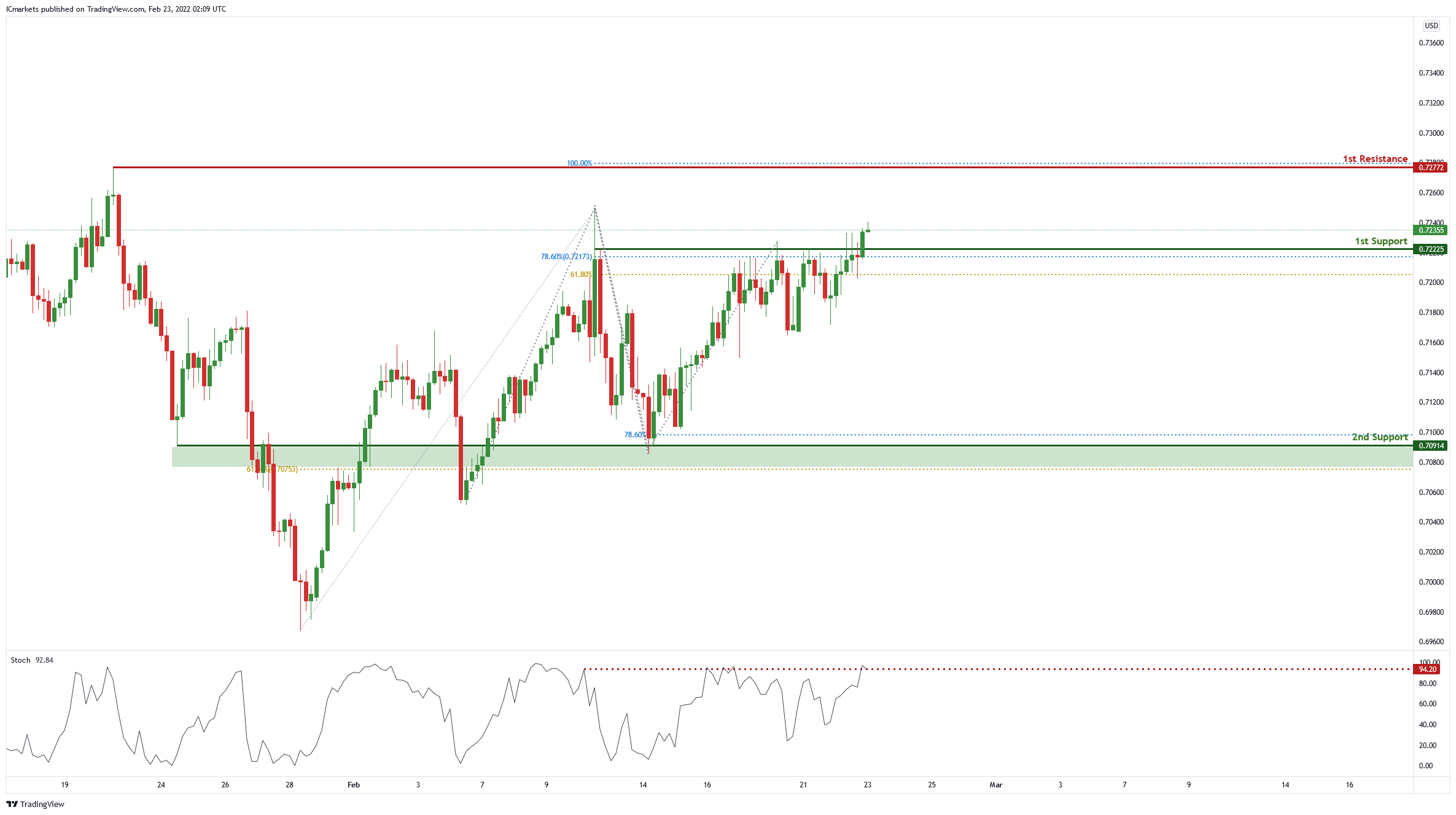
On the H4 chart , price is near 1st support level of 0.72181 in line with 78.6% Fibonacci projection and 61.8% Fibonacci retracement. Price can potentially dip to the 2nd support level of 0.70914 in line with 78.6% Fibonacci projection and 61.8% Fibonacci retracement. Our bearish bias is supported by RSI indicator as it is abiding by a descending trendline
Areas of consideration:
- H4 1st support at 0.72181
- H4 2nd support at 0.70914
NZD/USD:
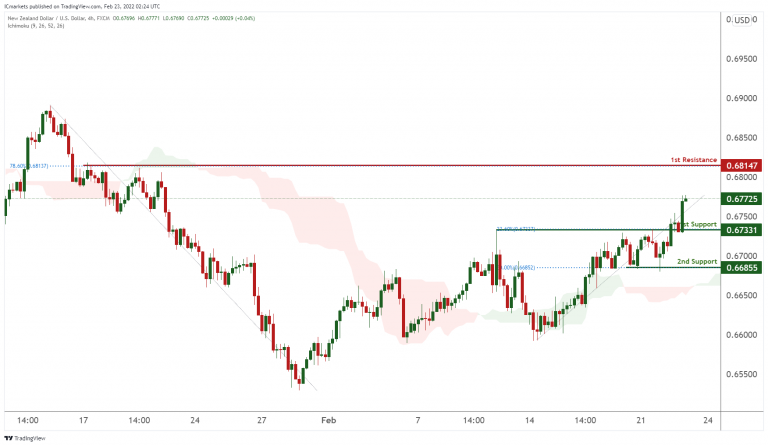
On the H4 timeframe, prices are approaching a pivot and are on bullish momentum. We see potential for a bounce from our 1st support at 0.67331 in line with 38.2% Fibonacci retracement towards 1st resistance at 0.68147 in line with 78.6% Fibonacci retracement. Prices are trading above our ichimoku cloud support, further supporting our bullish bias. Alternatively, our stop loss will be placed at 0.66855 in line with 50% Fibonacci retracement.
Areas of consideration:
- H4 time frame, 1st resistance at 0.68147
- H4 time frame, 1st support at 0.67331
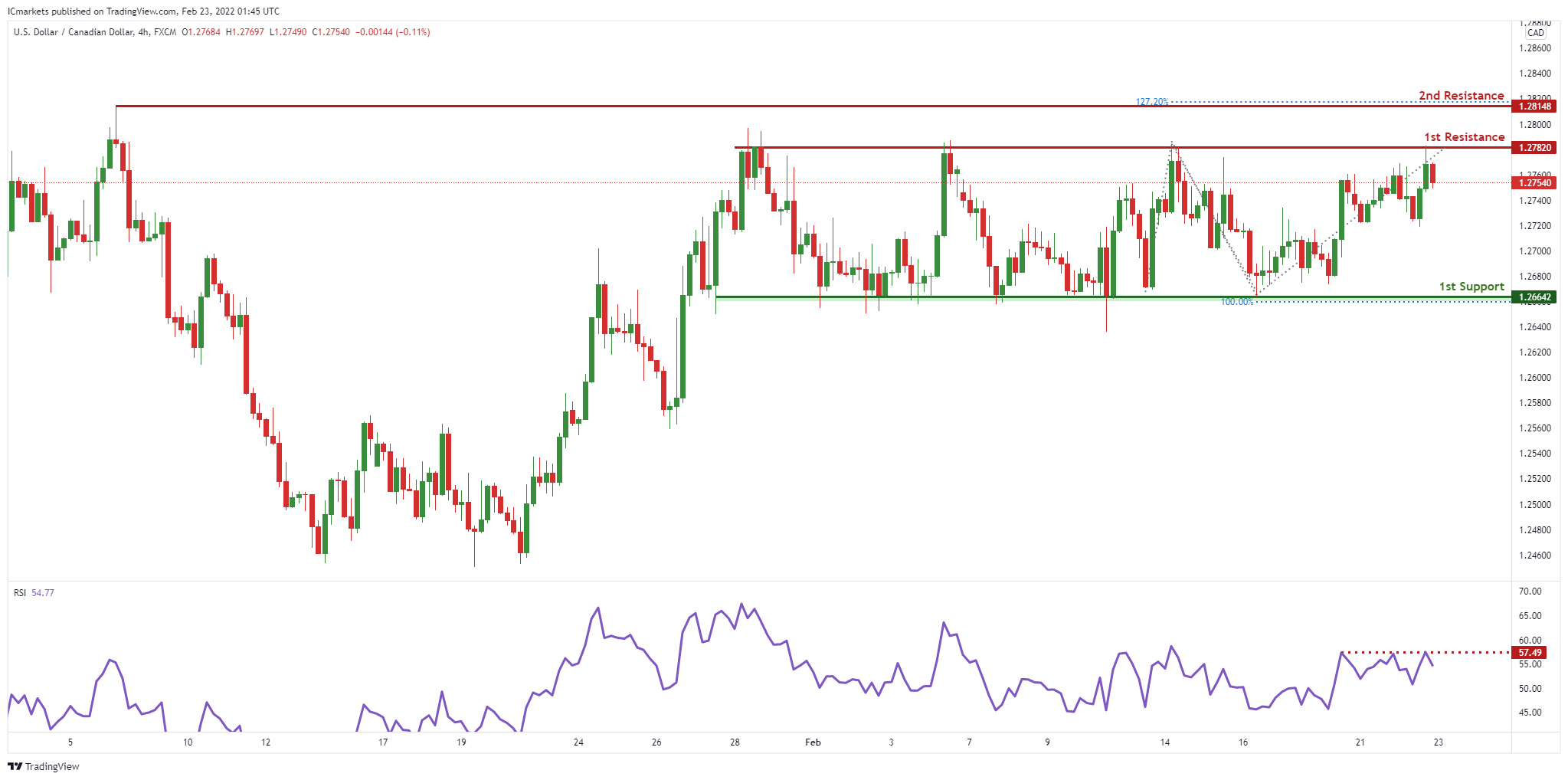
USD/CAD:
On the H4 timeframe, We see the possibility of bearish continuation from our 1st resistance at 1.27820 in line with horizontal swing high resistance towards our 1st support at 1.26642 in line with the 100% Fibonacci extension level. Our bearish bias is further supported by prices reversing off the RSI indicator.
Areas of consideration:
- H4 time frame, 1st support at 1.26642
- H4 time frame, 1st resistance at 1.27820
OIL:
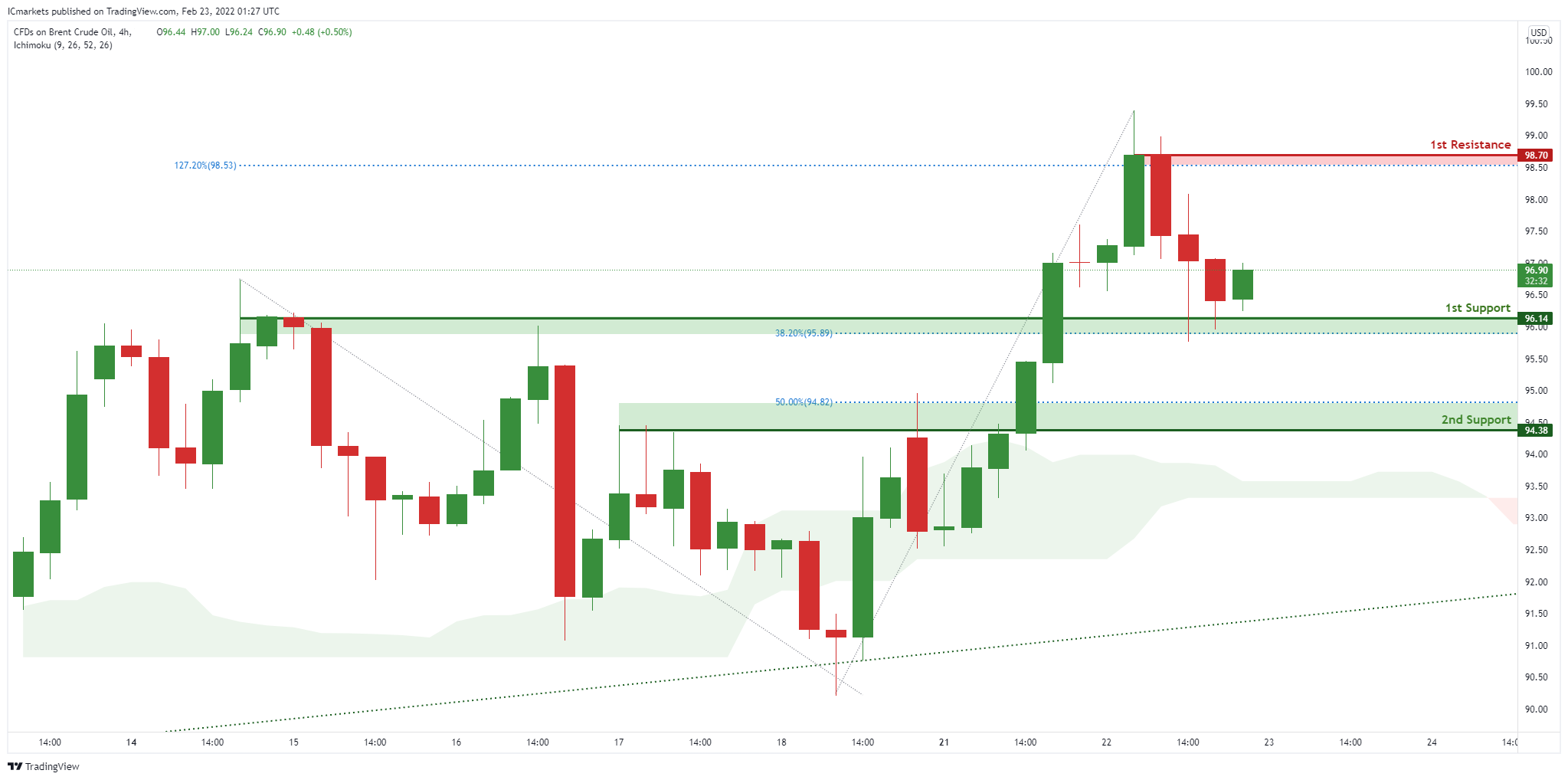
On the H4, with price moving above the ichimoku cloud, we can expect bullish continuation from our 1st support at 96.14 in line with 38.2% Fibonacci retracement towards our 1st resistance at 98.70 which is a strong resistance and in line with 127.2% Fibonacci extension. Alternatively, price may break 1st support structure and head for 2nd support, which coincides with the ascending trendline and 50% Fibonacci retracement at 94.38
Areas of consideration:
- H4 time frame, 1st resistance of 98.70
- H4 time frame, 1st support of 96.14
Dow Jones Industrial Average:
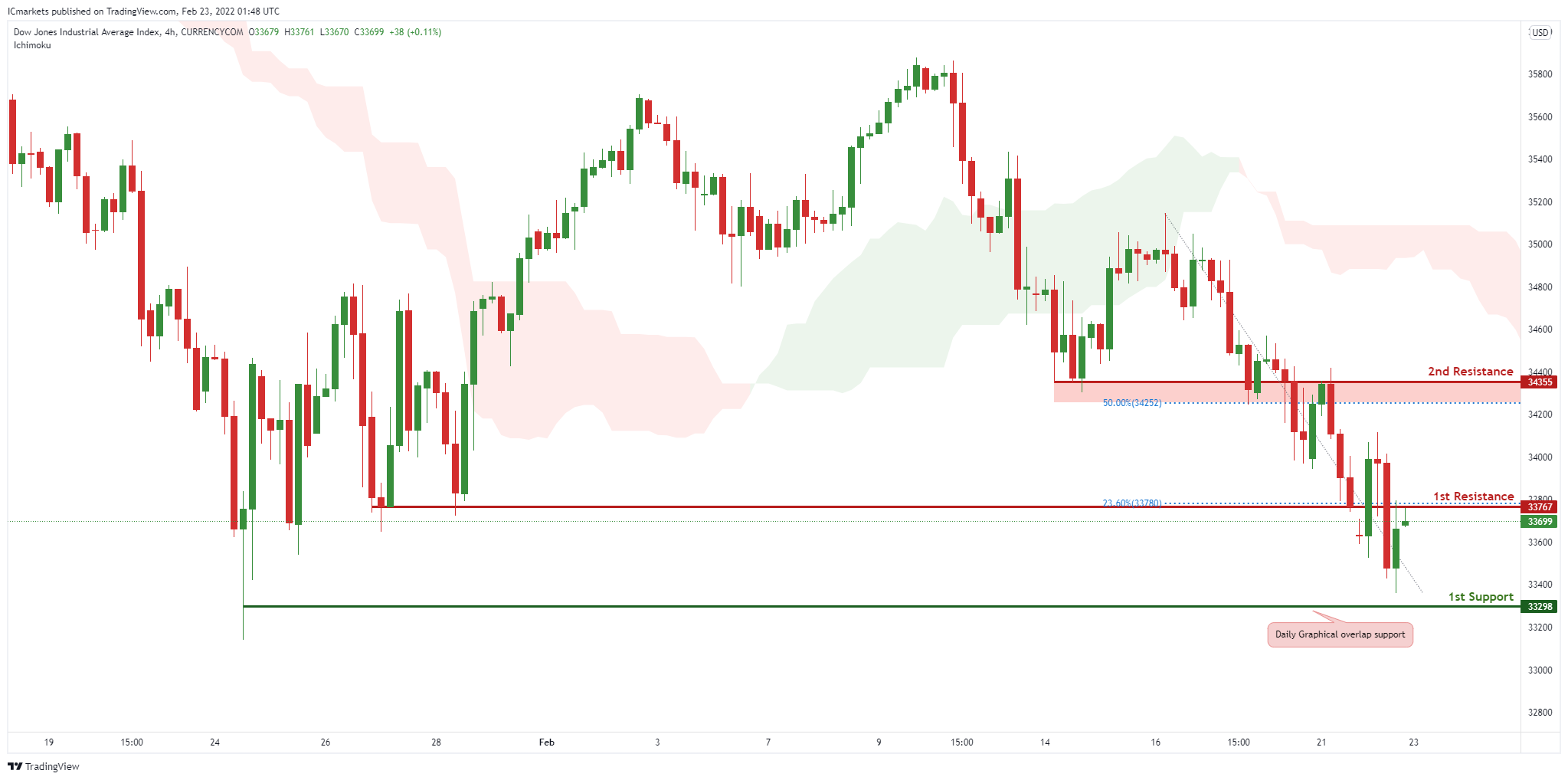
On the H4 timeframe, We see the possibility of bearish continuation from our 1st resistance at 33767 in line with horizontal overlap resistance towards our 1st support at 33298 in line with the horizontal swing low support. Alternatively, price may break 1st resistance and head for 2nd resistance at 34355 in line with the 50% Fibonacci retracement level. Our bearish bias is further supported by how price is moving below the ichimoku cloud
Areas of consideration :
- H4 1st support at 34355
- H4 1st resistance at 33767
First Impressions: RBNZ Monetary Policy Statement
First impressions of the RBNZ's February 2022 Monetary Policy Statement.
RBNZ Monetary Policy Statement, February 2022
- The Reserve Bank’s decision to increase the OCR by 25 basis points to 1% was as expected.
- However, the overall tone of the statement was notably more hawkish.
- The Committee noted that the decision between a 25bp and a 50bp increase was finely balanced.
- The RBNZ lifted its projected OCR track to a peak of around 3.4% in 2024, compared to a 2.6% peak in its November review.
- Furthermore, it announced a plan to reduce the size of its Government bond holdings over time through sales as well as maturities. This would presumably put some upward pressure on longer-term interest rates, adding to the overall tightening in financial condition.
- The RBNZ expects inflation to remain above the 1-3% target range through to early next year, and to linger in the upper half of the range in the following years.
Implications
The biggest surprise in today’s statement was the extent of the lift in the projected OCR track – higher even than our top-of-the-market forecast of 3%. The RBNZ’s activity and inflation forecasts are similar to ours in many respects, so the difference in view seems to lie in a judgement about what monetary policy settings will be needed to achieve those outcomes.
The RBNZ clearly faces a challenge in bringing inflation pressures under control. But as we noted in our latest Economic Overview, the housing market is already cooling in response to higher interest rates, and border restrictions and the spread of Omicron will weigh on the overall demand impulse over this year. As a result, we think the risks around our forecast of a 3% peak OCR are starting to look more two-sided.
For now, we continue to expect a series of 25bp hikes at upcoming policy reviews. However, given how much work the RBNZ believes it has ahead of it, the risk of a 50bp move at any given meeting remains live.
Full RBNZ statement
More tightening needed
The Monetary Policy Committee today increased the Official Cash Rate (OCR) to 1 percent. The Committee also agreed to commence the gradual reduction of the Reserve Bank’s bond holdings under the Large Scale Asset Purchase (LSAP) programme - through both bond maturities and managed sales.
The Committee agreed it remains appropriate to continue reducing monetary stimulus so as to maintain price stability and support maximum sustainable employment.
The level of global economic activity is generating rising inflation pressures, exacerbated by ongoing supply disruptions. The pace of global economic growth has slowed however, due to the general elevated uncertainty created by the persistent impacts of COVID-19, and clear signals that monetary conditions will tighten over the course of 2022.
In New Zealand, underlying economic strength remains in the economy, supported by aggregate household and business balance sheet strength, fiscal policy support, and continued strong export returns. However, some short-term economic disruption is expected given the current growing COVID-19 health challenge. The high vaccination rates across New Zealand will assist significantly to reduce this disruption.
Economic capacity pressures have continued to tighten. Employment is now above its maximum sustainable level, with a broad range of economic indicators highlighting that the New Zealand economy continues to perform above its current potential.
Headline CPI inflation is well above the Reserve Bank’s target range, but will return towards the 2 percent midpoint over coming years. The near-term rise in inflation is accentuated by higher oil prices, rising transport costs, and the impact of supply shortfalls. These immediate relative price movements risk generating more generalised price rises, especially given the current domestic capacity constraints.
The Committee agreed that further removal of monetary policy stimulus is expected over time given the medium-term outlook for growth and employment, and the upside risks to inflation.
Gold Price Faces Big Challenge Near $1,920
Key Highlights
- Gold price rallied above the $1,880 and $1,900 resistance levels.
- A key bullish trend line is forming with support near $1,875 on the 4-hours chart.
- EUR/USD is still struggling to clear the 1.1400 resistance zone.
- GBP/USD corrected lower after it was rejected near 1.3640.
Gold Price Technical Analysis
Gold price formed a base above the $1,780 level and started a fresh increase against the US Dollar. The price broke the $1,800 and $1,820 resistance levels to move into a positive zone.
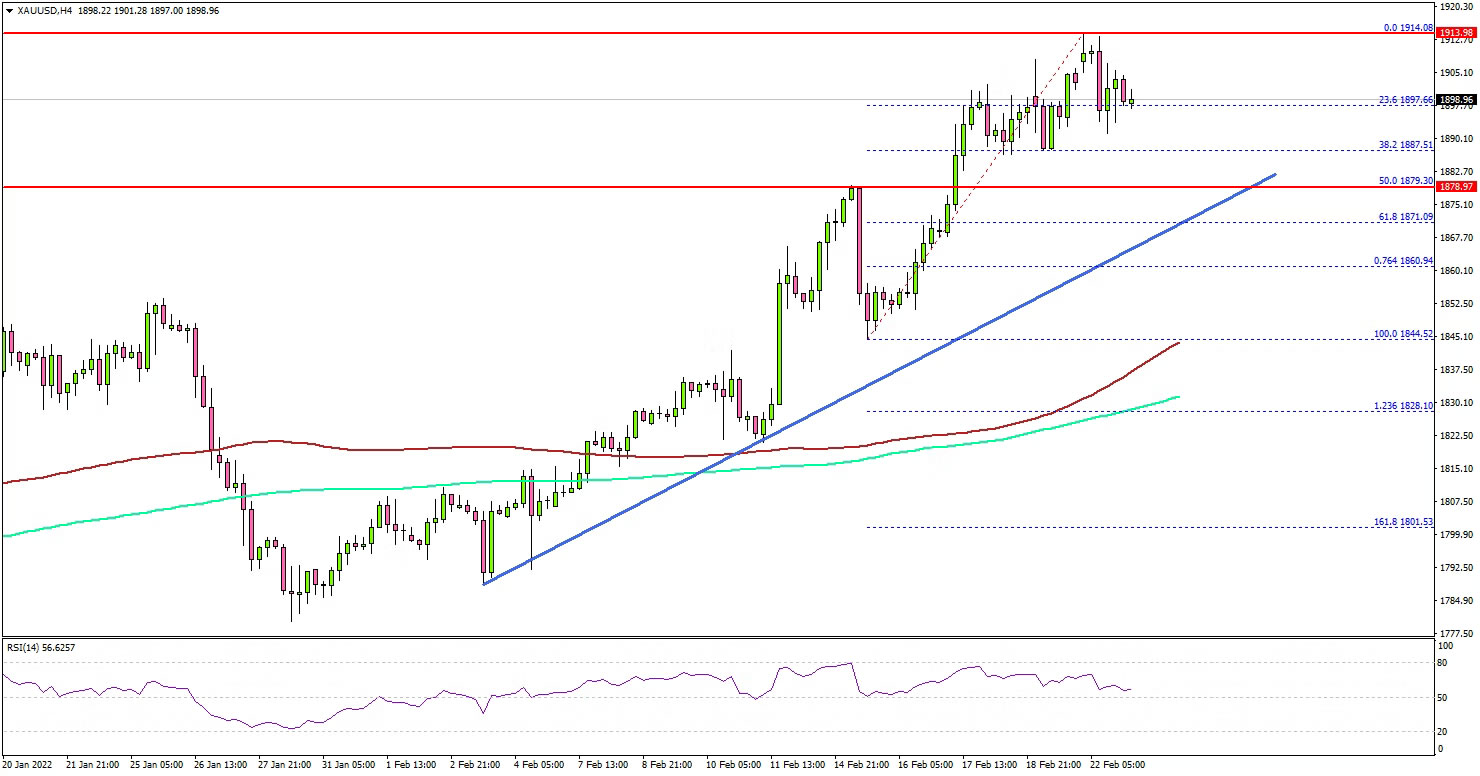
The 4-hours chart of XAU/USD indicates that the price was able to settle above the $1,880 resistance, the 100 simple moving average (red, 4-hours) and the 200 simple moving average (green, 4-hours).
It even climbed above the $1,900 level. A high is formed near $1,915 and the price is now consolidating gains. On the upside, the bulls are facing a major hurdle near $1,915 and $1,920. A close above $1,920 might set the pace for a move to $1,950.
If not, the price might correct lower and trade below the $1,885 level. The next major support is near $1,875 and a key bullish trend line on the same chart. Any more losses might send the price towards $1,850.
Fundamentally, the US Manufacturing Purchasing Managers Index (PMI) for Feb 2022 (Prelim) was released yesterday by the Markit Economics. The market was looking for a rise from 55.5 to 56.0.
The actual result was positive, as the US Manufacturing Purchasing Managers Index (PMI) increased from 55.5 to 57.5. Besides, the US Services PMI increased from 51.2 to 56.7.
Looking at EUR/USD, the pair is still facing a strong resistance near 1.1380 and 1.1400. Besides, GBP/USD reacted to the downside after the bears protected the 1.3640 resistance.
Economic Releases to Watch Today
- Germany’s GfK Consumer Confidence for March 2022 – Forecast -6.3, versus -6.7 previous.
What is Gold’s Rise Telling Us Indirectly?
The Gold market presented significant strength moving upwards in the most recent daily sessions. Gold has moved in positive territory for the past 3 consecutive weekly sessions, while it is currently trading at a new 2022 high as a result of the recent bullish interest from traders. The global interest for the Gold market remains at extremely high levels especially at times such as the current, where geopolitical uncertainty seems to be the main focus. In this report we will be looking into the most important news moving Gold prices at the moment. We will finalize with our Gold technical analysis and provide a complete report for traders to work with.
In the past days and in the past week, Gold’s largest daily movement was carried out on the 17th of February. Gold strengthened in the European session on Thursday the 17th with no significant economic releases to validate the movement except the FOMC meeting minutes that took place the previous night. Through the report it was confirmed that inflationary pressures in the US have broadened in the second half of 2021 and may have now impacted sectors that were not affected by the pandemic in the first place. We must also highlight that US Inflation rates for January 2022 increased further possibly paving the road for the FOMC to start enacting interest rate hikes. Furthermore, analyst speculations on the path the central bank may select, can be strengthening or weakening the USD depending on how hawkish or bearish the sentiment is. At the moment, the FOMC seems to follow a more cautious or patient approach which may be restraining the US dollar but pushing Gold prices higher. In the past week, the USD Index gained marginally while Gold surged remarkably, implying the correlation between them remains weak yet positive. Understanding when Gold’s volatility increases can provide hints as to what may be motivating traders in the short term.
The main attraction for the Gold market and the global media scene at the moment, remains the developments on the Russia Ukraine subject. In the past week and specifically on the 18th of February the Donbass area in Ukraine announced evacuations, with people moving into Russian territory. Gold seems to be absorbing positive volatility from developments in Ukraine due to the fact that the tensions could be intensifying but also because it can lead to further economic risk. Europe’s trade relations to Russia in terms of energy sources can be tarnished while the subject could add up to already worrying inflationary pressures. As noted in our previous week’s report, in the scenario of escalation of tensions we may see Gold prices picking up while in a de-escalation scenario Gold prices may return lower.
As a final note, the upcoming economic releases from the US in the days to come, have the potential of moving Gold prices and caution is advised if traders are to place orders prior, during or after the releases. On Wednesday the 24th of February we get the GDP 2nd Estimate rate for Q4, the weekly Initial Jobless Claims figure and the New Home Sales-Units for January. On Thursday the 25th we get the Consumption Adjusted and Durable Goods rates for January while the Final University of Michigan Economic sentiment figure for February will also be released. On Tuesday the 1st of March we get the important ISM Manufacturing PMI figure for February.
Technical Analysis
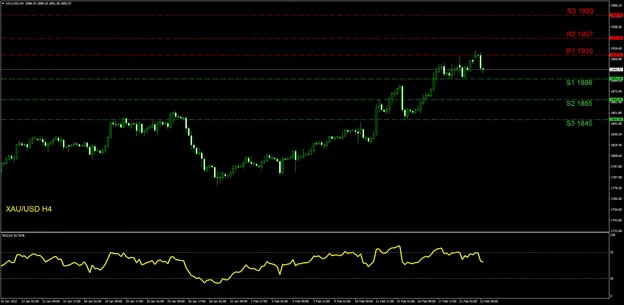
XAU/USD H4
The price action has recently reached and tested the (R1) 1910 resistance level but returned to lower grounds eventually. Note the (R1) 1910 is the highest level Gold has reached since June 2021. If this level is surpassed upwards then the (R2) 1927 line is in our view the most probable stop for traders. However, as our fundamental subjects seem to remain intact we have added also the (R3) 1950 level which can become a target in a strong bullish interest scenario. In case the precious metal is undertaken by a selling interest, the (S1) 1886 level can be reached first while the (S2) 1865 level is our next level, if the selling is to continue. Our final support level stands at the (S3) 1845 hurdle which can be reached in an extensive bearish trend line. Please note the RSI indicator has dropped below 70 implying some selling has taken place in the most recent hours. Overall Gold has breached new yearly high levels consistently thus we tend to support an upward bias, as our personal view.
Elliott Wave View: Nasdaq (NQ) Looking to Do Bigger Pullback
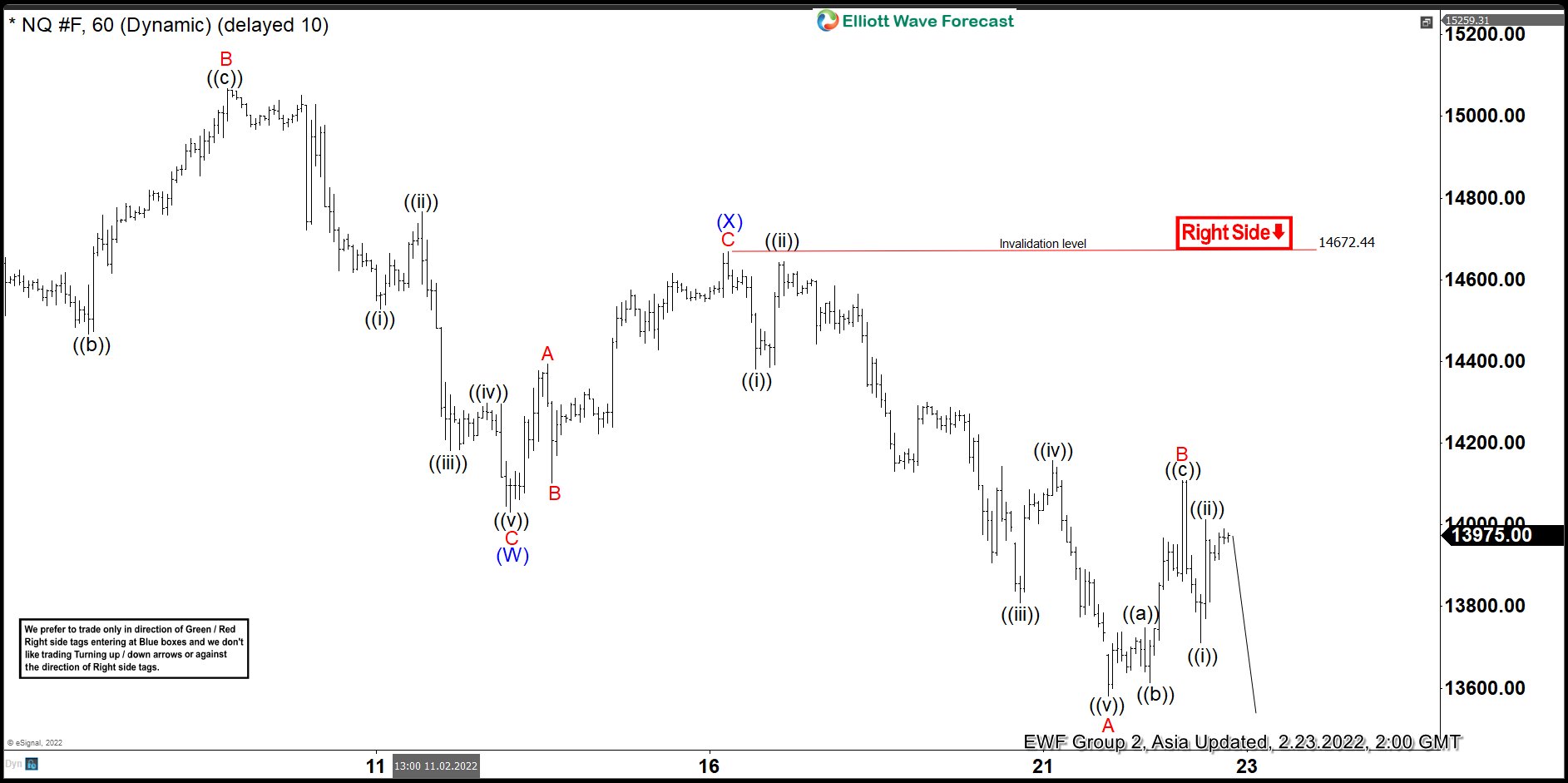
Short Term Elliott Wave in Nasdaq (NQ) suggests that the decline from February 2, 2022 peak is unfolding as a double three Elliott Wave structure. Down from February 2, wave A ended at 14362.75, and rally in wave B ended at 15068. Index then resumes wave C lower towards 14031. This completed wave (W) in higher degree. Corrective rally in wave (X) ended at 14672.44 with internal subdivision as a zigzag structure.
Up from wave (W), wave A ended at 14394 and pullback in wave B ended at 14102. Wave C higher ended at 14672.44 which completes wave (X) in higher degree. Wave (Y) lower is in progress with internal subdivision as a zigzag. Down from wave (X), wave ((i)) ended at 14381 and wave ((ii)) ended at 14645, Wave ((iii)) ended at 13809.75, wave ((iv)) ended at 14157.50, and final leg lower wave ((v)) ended at 13580.25. This completed wave A of (Y). Wave B of (Y) rally is proposed complete at 14108.25 and Index has turned lower. Near term, as far as pivot at 14672.44 high stays intact, expect rally to fail in 3 or 7 swing for further downside.
Nasdaq (NQ) 60 Minutes Elliott Wave Chart