Sample Category Title
Eco Data 2/23/22
[php_everywhere instance="1"]
CADJPY Currency Pair Wave Analysis
- CADJPY currency pair reversed from support area
- Likely to rise to resistance level 91.00
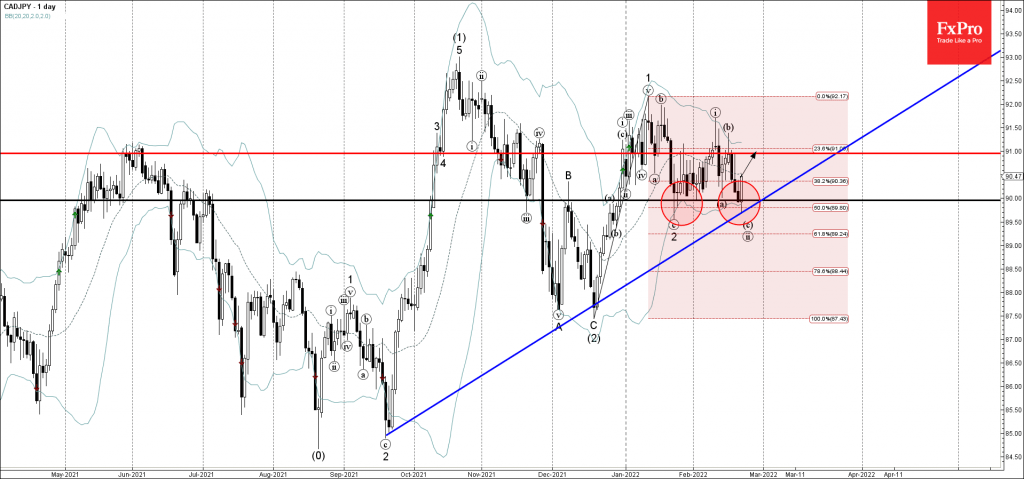
CADJPY currency pair earlier reversed up from the support zone located between the round support level 90.00 (which has been reversing the pair from the middle of January), support trendline from September, lower daily Bollinger Band and the 50% Fibonacci retracement of the previous sharp upward impulse wave 1 from December.
The upward reversal from this support area stopped the earlier minor ABC correction (ii).
Given the strong yen outflows – CADJPY currency pair can be expected to rise further toward the next resistance level 91.00.
Sunset Market Commentary
Markets
Markets have been preparing for the worst case scenario in the Ukrainian conflict and remarkably breathed a sigh of (short term) relief as it played out. The Russian “peace-keeping” mission in the self-declared separatist republics in the Donbas region met with outrage by the west who is preparing sanctions against the country. These include halting the German certification process to exploit the NordStream 2 pipeline and preparing some sort of financial embargo. The Russian ruble crashed the past couple of days towards the 2020 lows around USD/RUB 80 and is trading there volatile today. Brent crude set an intraday high at $99.5/b. It has been since the summer of 2014 since we’ve seen 3 digits for the black gold. The real precious metal closes in on $1916/ounce resistance which is the June 2021 top. On broader markets, main European equity indices recovered from steep opening losses to currently trade flat on the day. US stock markets lose around 0.5% at the start, but keep in mind that they were closed yesterday in observance of President’s Day. Core bonds showed the biggest momentum turnaround, feeling new selling pressure. Likely as higher commodity prices resulting from the conflict risk amplifying inflationary dynamics and hence speed up policy responses. The US yield curve bear flattens with yields rising by 5.2 bps (2-yr) to 0.4 bps (30-yr). The optical European underperformance against US Treasuries is again partly result from yesterday’s action. German yields add 8.4 bps (3-yr) to 4 bps (30-yr) in a daily perspective. Peripheral bonds perform relatively well, tightening up to 3 bps for Italy. EUR/USD retraced on yesterday’s steps, trading again a little bit higher in well-known 1.13 big figure. The pair is currently changing hands around 1.1340. Sterling is today’s underperformer with EUR/GBP surging from 0.8310 towards 0.8370. UK Gilts today outperform German Bunds. Hawkish BoE governor Ramsden said that some further modest tightening in monetary policy is likely to be appropriate in coming months, but pushed back against aggressive market pricing. The eco calendar contained improving German Ifo investor sentiment – in line with PMI’s yesterday – but didn’t impact trading.
News Headlines
The Belgium Business Barometer (slowly) declined further from 2.7 in January to 2.3 in February, according to monthly business survey published by the National Bank of Belgium. It was the third consecutive monthly decline. Especially sentiment in business related services deteriorated as the managers’ outlook for general demand faced a substantial downwardly revision. The decline in the manufacturing industry was limited (0.3 from 0.8) and was due to a less favourable assessment in total order books and stock levels. After three consecutive falls, sentiment in trade improved from -4.8 to -2.6 due to positive demand forecasts and projections of orders placed with suppliers. Sentiment in the building industry improved from 0.2 to 2.3. The overall smoothed synthetic curve, reflecting the underlying trend, continued to drop slightly.
The National Bank of Hungary today as expected raised the corridor of its policy rates by 50 bps. In order to anchor inflation expectations and mitigate second-round inflation risks, the central bank raised the base rate and the overnight deposit rate to 3.40%. The overnight and the one-week collateralized lending rates were increased to 5.40%. The MNB will continue to set the one-week deposit rate at weekly tenders. The MPC indicates that risks to the outlook for inflation have increased and continue to be on the upside, which necessitates the continuation of the base rate tightening cycle on a monthly basis. Deputy governor Virag was quoted that inflation might rise to 8.0%/8.5% in February. After initially losses due to regional geopolitical tensions, the forint intraday rebounded to the EUR/HUF 355.80 area.
GBP/USD Outlook: Cable Turns South on Dovish Comments from BoE Policymaker
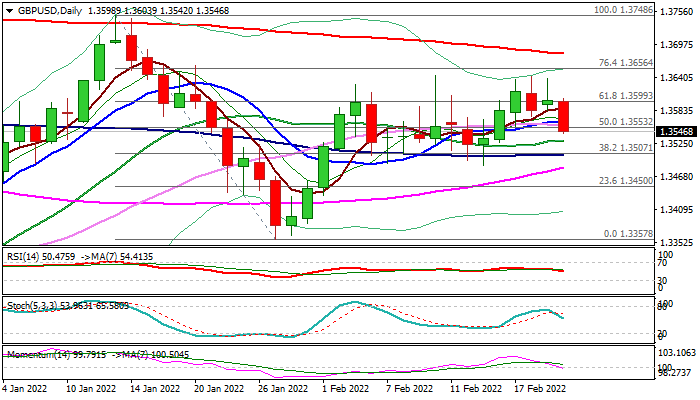
Cable lost traction on Tuesday and fell to four-day low, following repeated failure to sustain break above key 1.36 barrier (Fibo 61.8% of 1.3748/1.3357 descend).
Near-term sentiment softened on renewed tensions over Ukraine and relatively dovish comments from BoE Hawk Ramsden, who said that some further modest tightening is likely to be appropriate, deflating expectations for more aggressive action from BoE after he asked for 0.5% hike on Feb 3 policy meeting as the only internal MPC member.
Fresh dip weakens near-term structure and pressuring pivotal supports at 1.3539/33 (daily cloud top/Fibo 38.2% of 1.3357/1.3642 upleg), with firm break here to further soften the tone and risk drop towards next strong supports at 1.3500 zones (100DMA/50% retracement of 1.3357/1.3642).
South-heading 14-d momentum on daily chart is breaking into negative territory and support fresh bears, but the action might be slowed or even contained by the top of relatively thick daily cloud.
Res: 1.3564; 1.3600; 1.3615; 1.3642.
Sup: 1.3533; 1.3509; 1.3500; 1.3486.
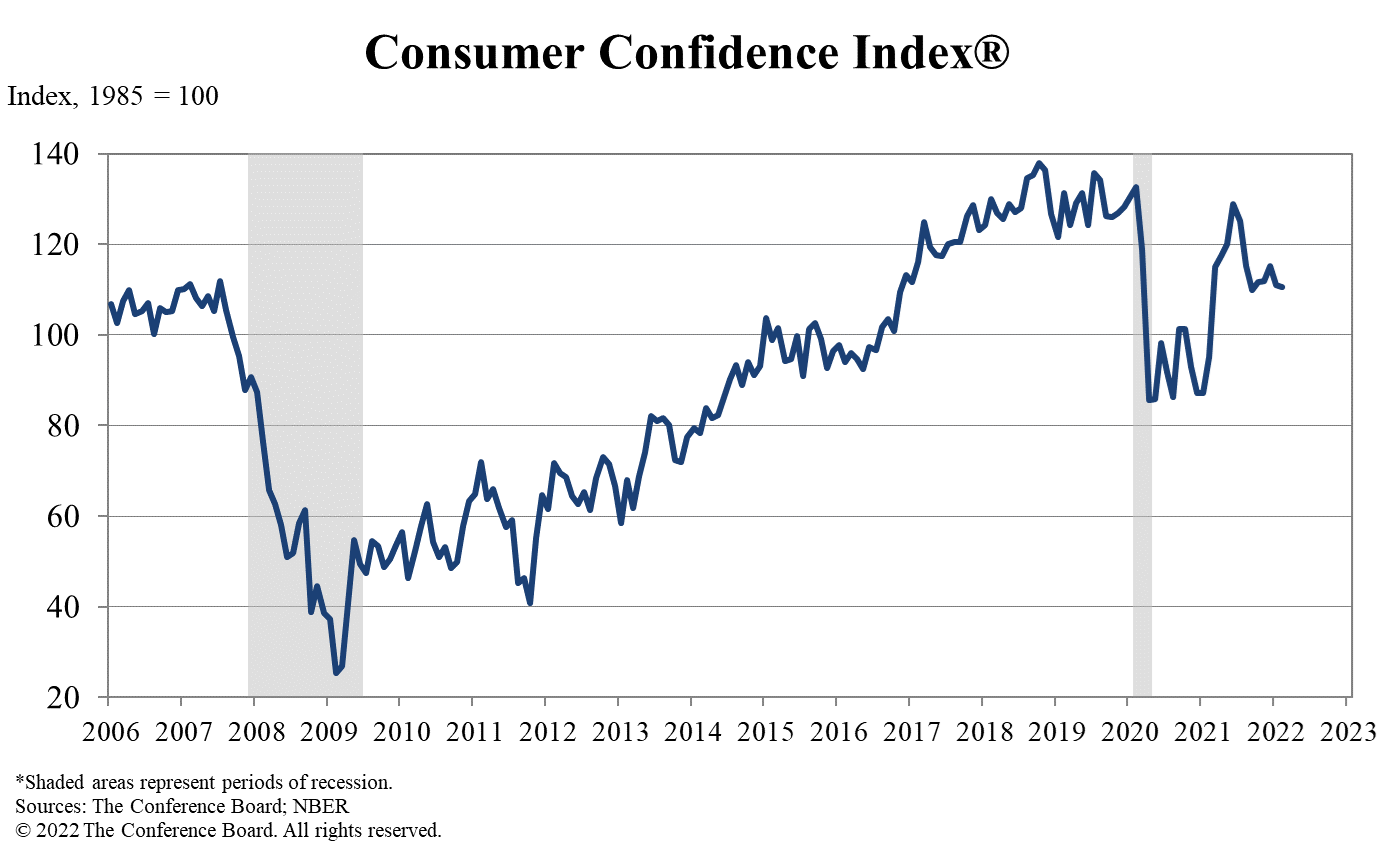
US consumer confidence dropped to 110.5, down slightly for a second consecutive month
US Conference Board Consumer Confidence index dropped from 113.8 to 110.5 in February, above expectation of 110.2. Present Situation Index improved from 114.5 to 145.1. Expectations Index dropped from 88.8 to 87.5.
"Consumer confidence was down slightly for a second consecutive month in February," said Lynn Franco, Senior Director of Economic Indicators at The Conference Board.
"The Present Situation Index improved a touch, suggesting the economy continued to expand in Q1 but did not gain momentum. Expectations about short-term growth prospects weakened further, pointing to a likely moderation in growth over the first half of 2022. Meanwhile, the proportion of consumers planning to purchase homes, automobiles, major appliances, and vacations over the next six months all fell."
"Concerns about inflation rose again in February, after posting back-to-back declines. Despite this reversal, consumers remain relatively confident about short-term growth prospects. While they do not expect the economy to pick up steam in the near future, they also do not foresee conditions worsening. Nevertheless, confidence and consumer spending will continue to face headwinds from rising prices in the coming months."
BTCUSD Retains Bearish Structure but RSI Suggest Bullish Move
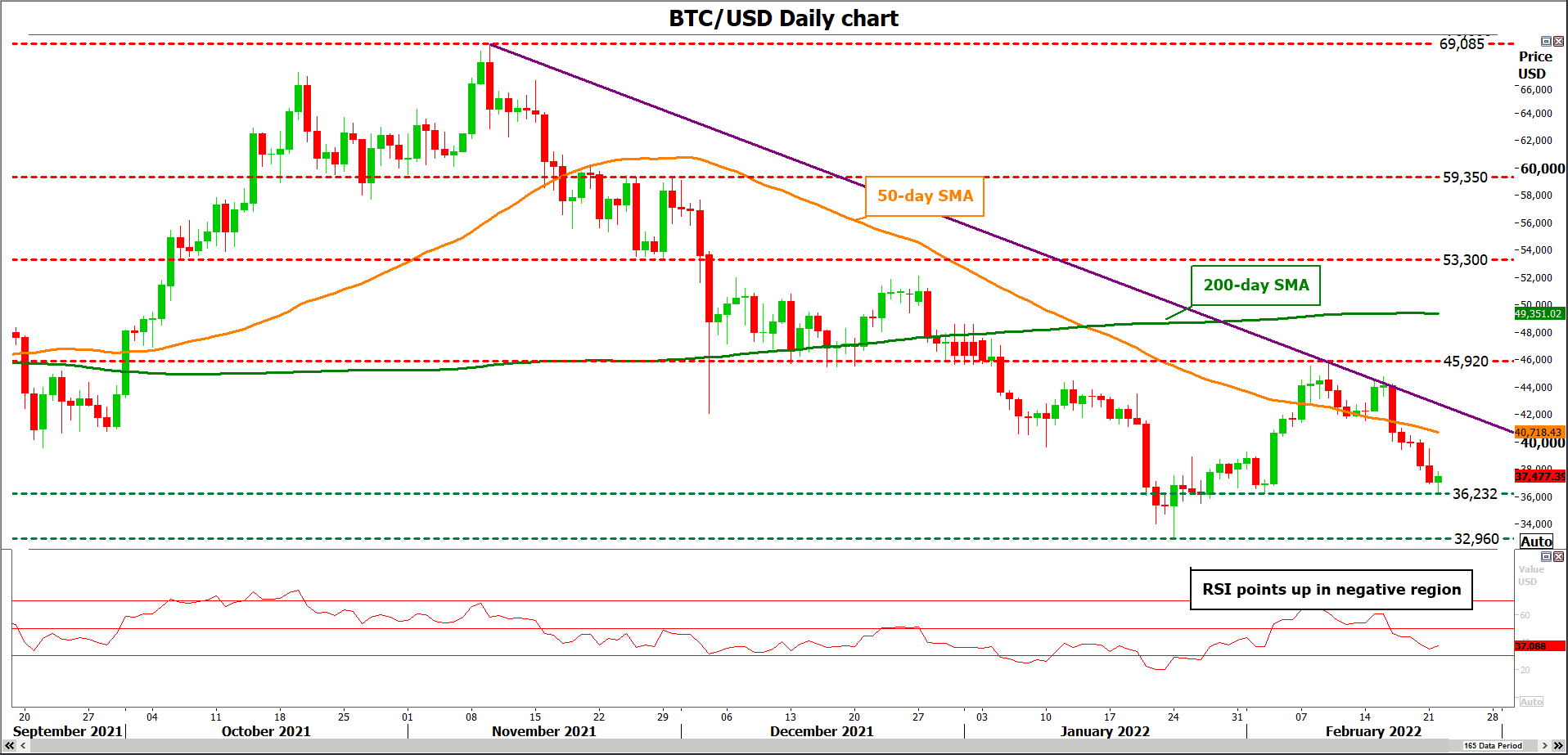
BTCUSD found support at the 36,232 level after the negative movement that started after the pullback off the descending trend line. The RSI indicator is heading upwards in the negative region, suggesting a potential upside recovery.
Should the pair stretch north, the 50-day simple moving average (SMA) could provide immediate resistance before the prices touches the ascending trend line around 42,000. A significant step higher, breaking the diagonal line could bring the bullish sentiment back into play, sending the price probably towards 45,920. If the buying interest extends, attention could then turn to the 200-day SMA at 49,351.
On the flip side, immediate support could come from the 36,232 level which may halt bearish movements. Steeper decreases could also touch the 32,960 support level, taken from the latest low.
In the medium-term picture, BTCUSD has been trading bearish in the past three months after the drop below the 69,085 high. Still, if the price manages to cross above the 200-day SMA at 49,351, the bearish outlook could switch into a bullish one.
Russia Sanctions Roll in but Risk Appetite Improves a Bit; RBNZ Policy Decision Looms
Ukrainian crisis moves to the next stage of sanctions
Markets woke up to another Ukrainian drama on Tuesday as Europe, the UK and the US came to threaten the first barrage of sanctions against Russia following Putin’s recognition of two ex-soviet and Moscow-backed regions in Ukraine Donetsk and Luhansk late on Monday, which could strategically allow Russia to enhance its military forces.
The traditional haven gold opened the day with a soft positive gap, but bullish pressures fade immediately before the price touches June’s peak of $1,916 after the Ukrainian president Volodymyr Zelensky stated that there will be no war or wide escalation with Russia, with the price falling as low as $1,891 in the aftermath. Of course, he called his foreign allies to use punishing sanctions, and some of them including the UK have already announced some bans against Russian banks and individuals, with the European Union also set to unveil its own countermeasures later today, particularly regarding the halt of the Nord Stream 2 gas pipeline. But honestly, whether the countermeasures will go wild, especially as long as there is no official invasion, remains to be seen given Europe’s reliance on energy sources. Hence, how painful the penalties will be will determine the size of upside movements in gold in the coming days or weeks.
Euro pares losses but pound still bleak
In other haven assets, bond markets also gave up some ground, pushing the 10-year Treasury yield back above 1.90%. The European yield equivalents staged a swifter recovery as risk sentiment improved a bit. The latter is also evident in FX and stock markets. Although the geopolitical impact on currencies has been relatively less vigorous, euro/dollar responded quickly to the latest encouraging headlines, running from a low of 1.1280 to 1.1366. Probably, the upside surprise in the German Ifo business climate index, which signaled that the EU’s powerhouse will benefit massively from the easing of the coronavirus crisis, provided a helping hand as well.
The yen came under pressure, helping the dollar to rebound near the key support of 114.70, though the 115.00 number remains a key barrier for now.
On the other hand, the pound has yet to show any bullish appetite against the dollar and the yen. Perhaps comments from the BoE policymaker Dave Ramsden supporting only a modest monetary tightening in the coming months canceled any upside moves as rate expectations for a 50 bps eased. Pound/dollar was last seen lower at 1.3547, while pound/yen was more or less steady at 155.88. Euro/pound bounced strongly up to 0.8382, erasing a four-day losing streak.
RBNZ to raise rates for the third time
The New Zealand dollar will attract special attention when the Reserve Bank of New Zealand (RBNZ) announces its policy decision during the early Asian trading hours on Wednesday. Investors are fully convinced that the central bank will deliver its third 25 bps rate hike in a row, while there is a 30% chance for a 50 bps rise as well. Hence, unless the RBNZ moves fast with a 50 bps rate hike to mitigate the hot inflationary pressures and/or uses a hawkish tone to brighten the future of the economy, the policy announcement itself could even be a classic selling the fact case for kiwi/dollar, blocking the way above the tough 0.6730 resistance.
Stock sell-off pauses, oil hits fresh highs
In equities, European indices avoided the slump in Asia, recouping earlier losses to turn almost neutral in the day as traders pushed some funds out of safe havens. Energy, real estate and consumer cyclicals shares were the top performers. Futures tracking the S&P 500, the Nasdaq 100 and Dow Jones are currently pointing to a milder negative open as well.
Finally, oil continues to make headlines. The international benchmark Brent crude was close to touch the crucial $100/barrel before sliding to $97.42, while WTI crude extended Monday’s rally to a fresh seven-year high of $94.90, stoking worries that global inflation may keep trending higher. While progress in the Iranian-US nuclear talks could be a headwind to the oil rally, the war factor in Ukraine is threatening another supply shock If materialized.
USD/JPY Mid-Day Outlook
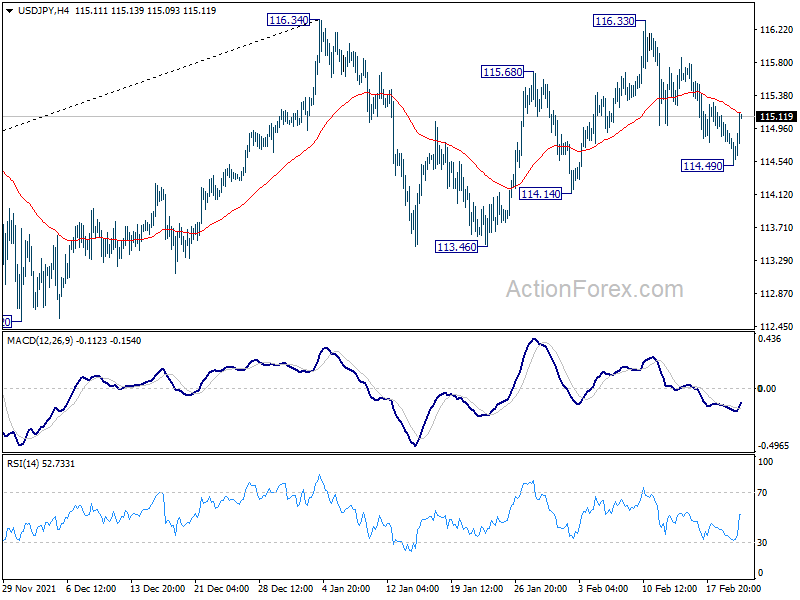
Daily Pivots: (S1) 114.61; (P) 114.87; (R1) 115.01; More...
Intraday bias in USD/JPY is turned neutral as it recovered after dipping to 114.49. On the downside, break of 114.49 will resume the decline from 116.33, as the third leg of the corrective pattern from 116.34. Further break of 114.14 and will target 113.46 support and below. On the upside, firm break of 116.34 will resume larger up trend.
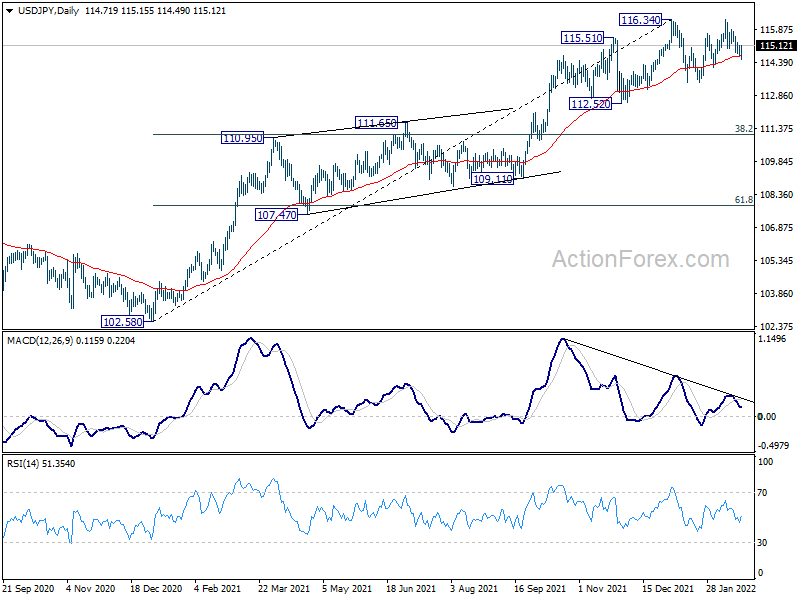
In the bigger picture, no change in the view that rise from 102.58 is the third leg of the up trend from 101.18 (2020 low). Such rally should target a test on 118.65 (2016 high). Sustained break there will pave the way to 120.85 (2015 high) and raise the chance of long term up trend resumption. This will remain the favored case as long as 55 week EMA (now at 111.61) holds.
USD/CHF Mid-Day Outlook
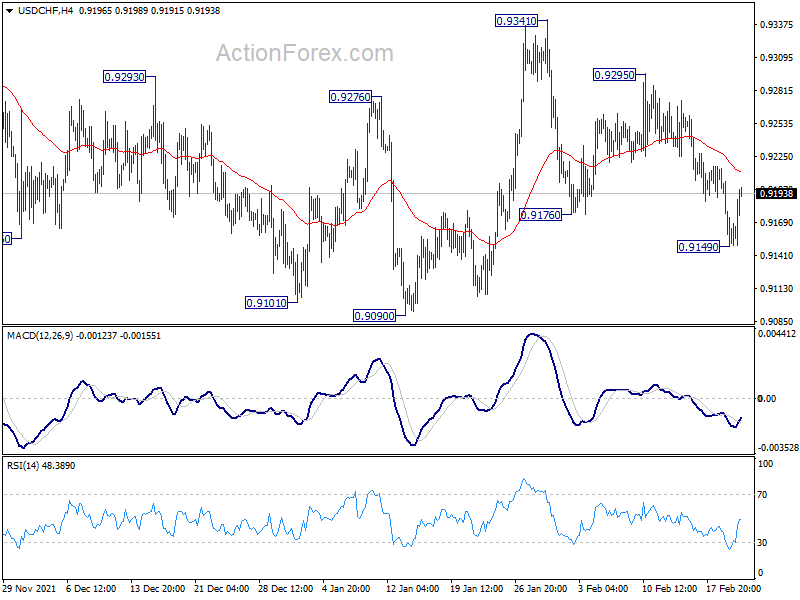
Daily Pivots: (S1) 0.9132; (P) 0.9176; (R1) 0.9203; More....
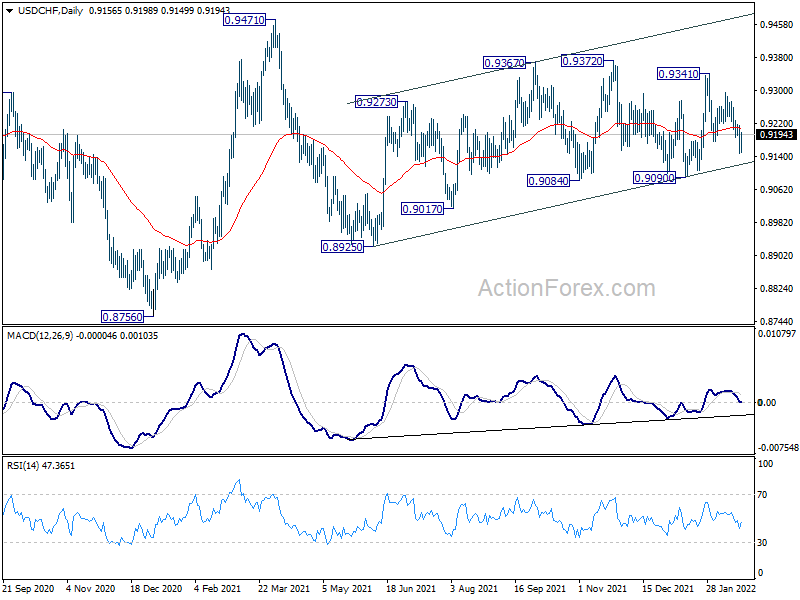
Intraday bias in USD/CHF is turned neutral as it recovered after hitting 0.9149. Overall outlook is unchanged that choppy sideway trading could continue. Choppy rise from 0.8925 would still be in favor to extend higher as long as 0.9090 support holds.
In the bigger picture, medium term outlook will be neutral at best as long as 0.9471 resistance holds. Larger down trend could still extend through 0.8756 (2021 low). However, firm break of 0.9471 will argue that the trend has already reversed and rebound the rally from 0.8756 with another impulsive move.
GBP/USD Mid-Day Outlook
Daily Pivots: (S1) 1.3579; (P) 1.3609; (R1) 1.3632; More...
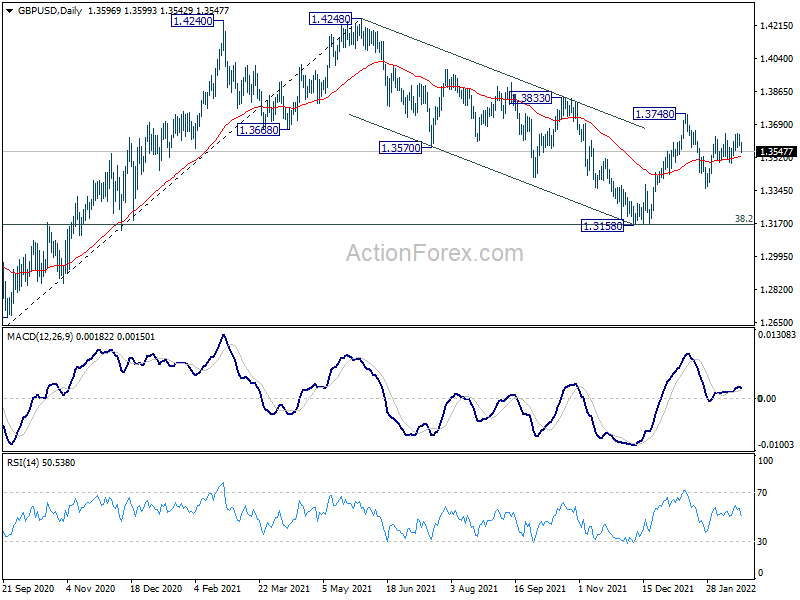
No change in GBP/USD's outlook and intraday bias remains neutral for the moment. On the upside, break of 1.3642 will resume the rebound from 1.3356 to 1.3748 resistance. Firm break there will revive the bullish case that correction from 1.4248 has completed with three waves down to 1.3158. Further rally should then be seen to retest 1.4248 high. On the downside, though, break of 1.3485 will turn bias to the downside for 1.3356 support instead.
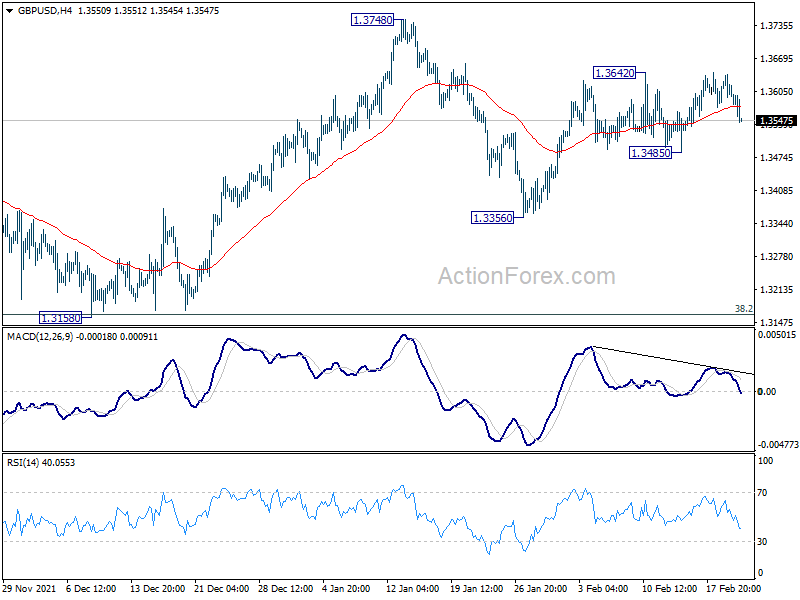
In the bigger picture, as long as 38.2% retracement of 1.1409 to 1.4248 at 1.3164 holds, up trend from 1.1409 (2020 low) is still in progress. On resumption, next target will be 38.2% retracement of 2.1161 to 1.1409 at 1.5134. Nevertheless sustained break of 1.3164 will argue that whole rise from 1.1409 has completed and bring deeper fall to 61.8% retracement at 1.2493.