Sample Category Title
AUDJPY Defies the Volatility, Maintains Neutral Profile
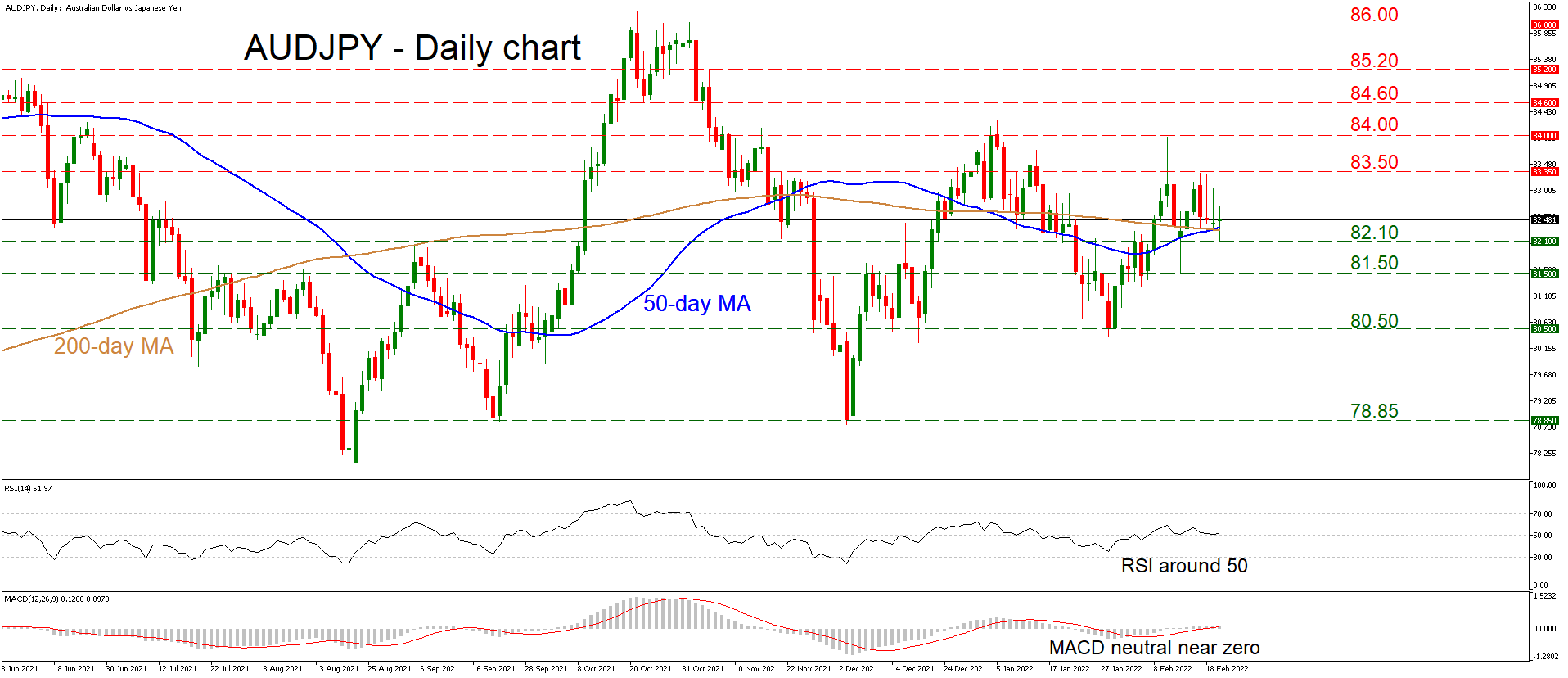
AUDJPY has been immune to all the volatility in the broader market lately, which is quite surprising since the pair is considered a proxy for risk appetite. The price action has been trapped within a narrow range between 84.00 and 80.50 for several months now.
The convergence between the moving averages (MAs) confirms that the picture is neutral. It’s a similar story with the short-term oscillators as both the RSI and the MACD are stuck near their neutral levels, providing no clues about what’s next.
In case the bulls retake control and the pair powers higher, the first barrier to advances may be the 83.50 zone. A violation would turn the focus towards the upper boundary of the aforementioned range, near the 84.00 handle.
On the downside, the bears could fight their first battle around the 82.10 region. If that doesn’t hold, the next target could be the 81.50 level, where another break might open the door for the lower boundary of the range at 80.50.
In short, AUDJPY is trapped in a holding pattern. A decisive move either above 84.00 or below 80.50 is needed to inject life back into the market.
Daily Technical Analysis
EUR/USD
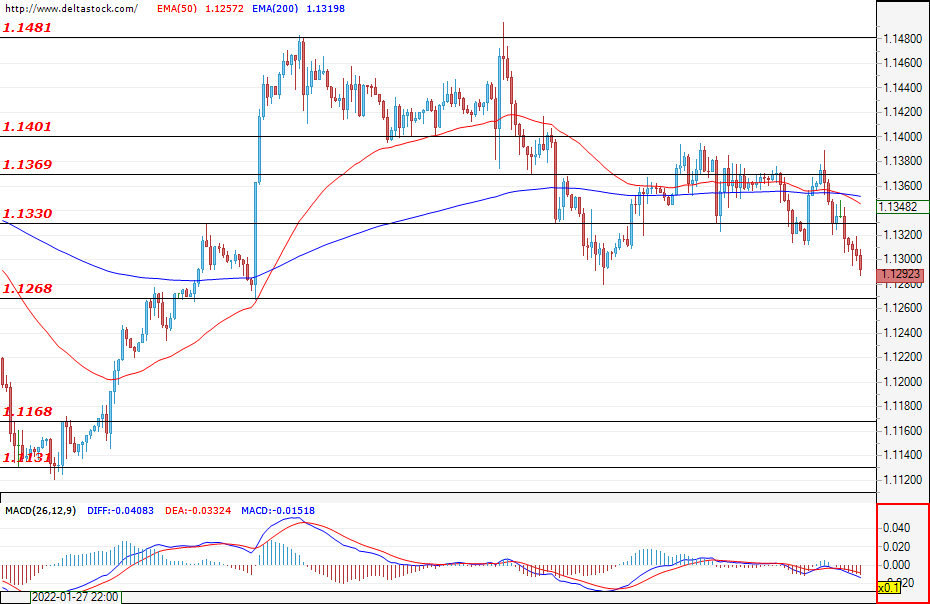
At the end of yesterday's trading session, the bears managed to prevail and gained enough momentum, breaching the 1.1330 support area. At the time of writing, the currency pair is about to test the 1.1270 support level. If the single European currency continues to lose ground against the U.S. dollar, then we may see a successful breach of the mentioned support, which will most likely be followed by a further depreciation towards the next significant support zone at 1.1170. In the upward direction, the first important resistance zone is the level of 1.1400.
USD/JPY
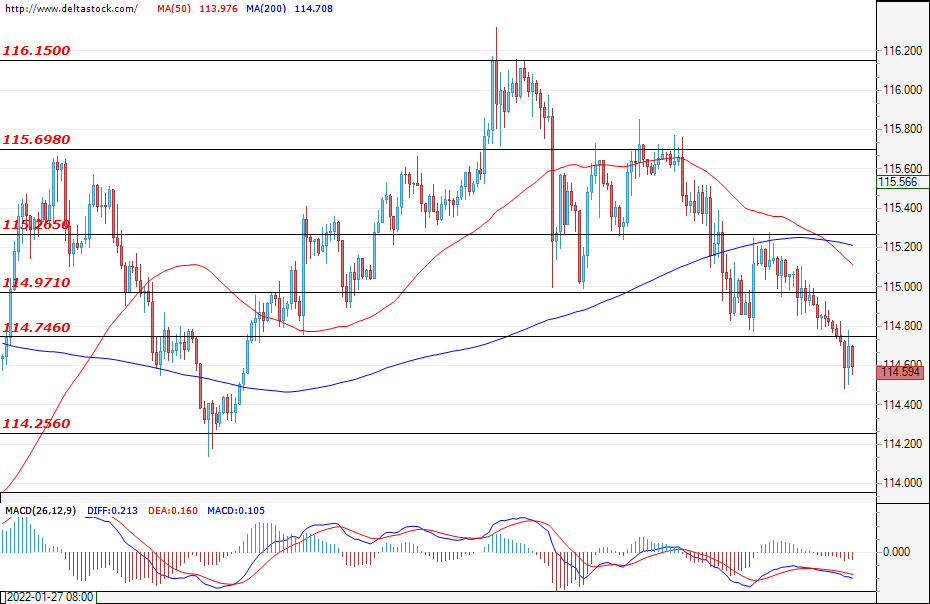
The U.S. dollar continues to lose ground against the Japanese yen and at the time of writing the analysis, it is hovering above the now breached support area at 114.74 – a level that currently also plays the role of first important resistance. If the breach here is confirmed, then we could expect for the negative market sentiment to worsen, as well as an attack on the next support zone at 114.25.
GBP/USD
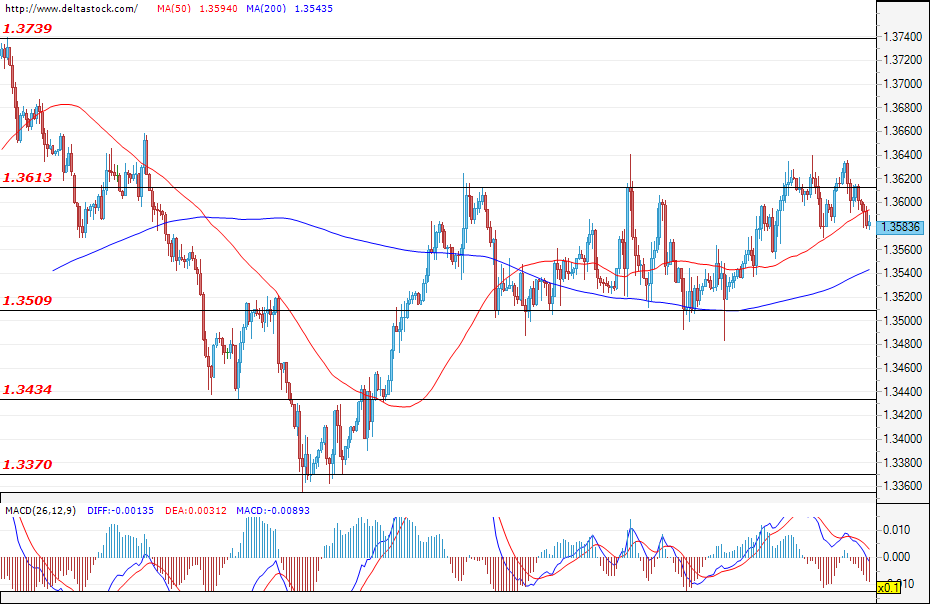
The U.S. dollar is losing ground against the British pound, with the bears currently successfully limiting the appreciation of the pound to the resistance level at 1.3613. However, the most likely scenario is for another attack on and a breach of the upper boundary of the formed range between the levels of 1.3500 – 1.3600. A breach of the aforementioned resistance could predetermine the future move for the Cable.
EUGERMANY40
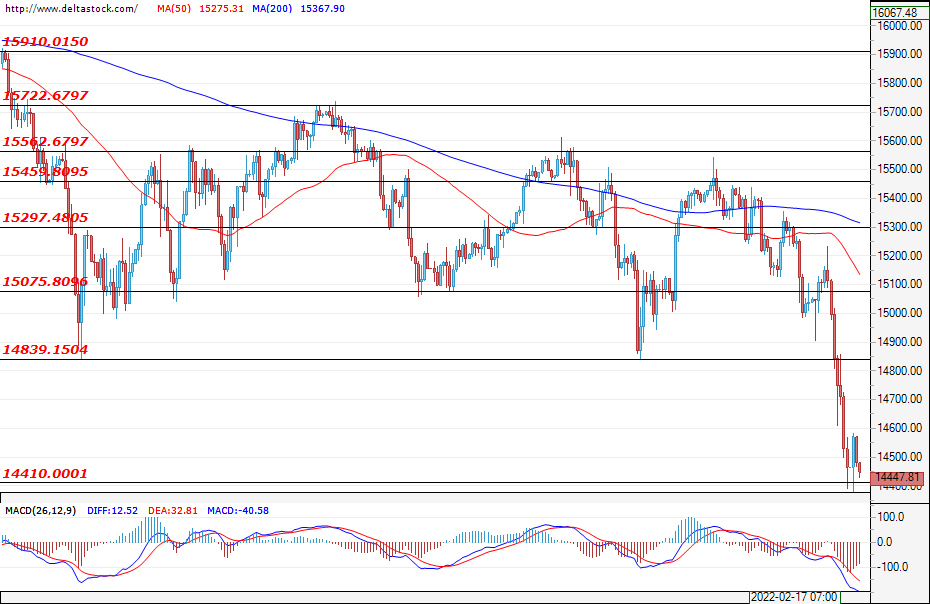
The German index breached the important support at 14840, which gave the bears a serious advantage. They, in turn, led the trade towards the next support zone at 14410. Because of this, the EUGERMANY40 lost nearly 4% of its value in the last session alone. Rising inflation and escalating tensions between Russia and Ukraine could be the catalyst that could lead the German index towards a successful breach of the support area at 14410, and then depreciate it even further towards the zone at around 14000.
US30
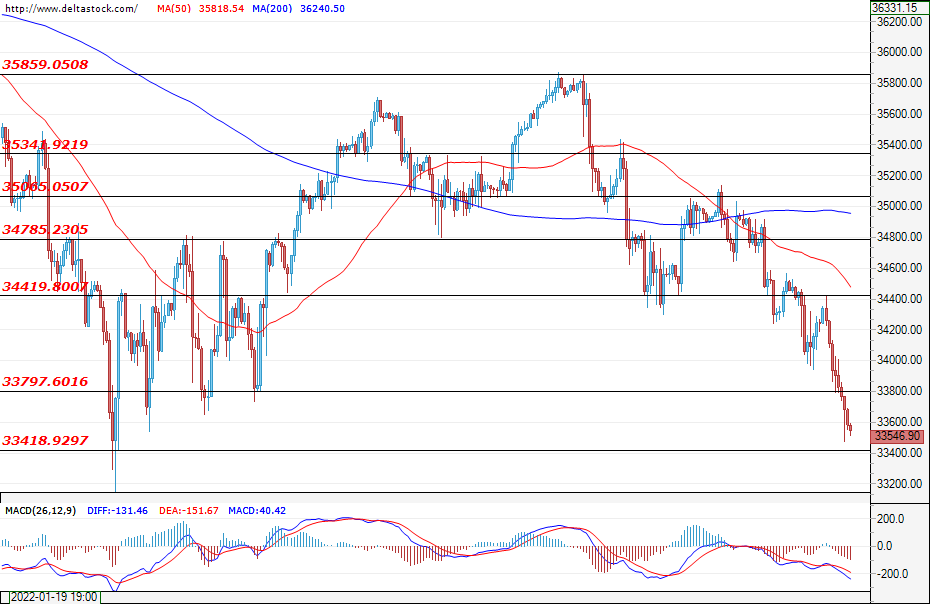
The U.S. blue-chip stock index continues to lose ground from the beginning of this week as tensions between Russia and Ukraine continue to grow. The index lost about 1% of its value during the past session, with market sentiment remaining negative – for a test and breach of the support zone at 33418. In addition to the growing geopolitical tensions in Eastern Europe, investors are also monitoring the Federal Reserve’s decision to tighten the monetary policy through multiple interest rate hikes throughout the year, starting next month. This could mark the beginning of an extensive bearish presence on the market and lead to long-term sell-offs for the U.S. index.
Russia in the Spotlight
Market movers today
Market continues to focus on the Russia-Ukraine situation after Putin yesterday formally recognized the two separatist regions in Eastern Ukraine, Donetsk and Luhansk, as independent. Kremlin ordered troops to move into the area, while Biden announced that US will impose economic sanctions on the separatist regions. Further clarity on the West's response, Russia's next steps as well as the Blinken-Lavrov meeting scheduled for Thursday remain key focus points.
While the geopolitics are clearly the most important market driver for now, US February Markit Flash PMIs will be released in the afternoon, and consensus looks for an uptick in the services sector following EA figures yesterday. Central Bank of Hungary will have a meeting today followed by Reserve Bank of New Zealand overnight, we expect 25bp hikes from both.
The 60 second overview
Russia. President Putin has recognised the two break-away regions (Donetsk and Luhansk) - something the West has previously said would be a deal-breaker for further talks. Diplomatic stalemate between Russia and the West remains. Military escalation has already started in Eastern Ukraine and, according to US intelligence, Russia has the readiness for an imminent large-scale attack on Ukraine. Considering military escalation in Eastern Ukraine has started, markets remain surprisingly calm with negative reactions thus far contained to RUB-linked assets. Yesterday marked one of the first days where we saw notable contagion to global assets from the escalating situation. See more in Research Russia - Hope dies last - Nervous markets are far from pricing in a full-blown war, 22 February.
Brent hits cycle high: Brent reached a new cycle high yesterday as Russia-Ukraine geopolitical tensions grew further. The market puts a premium on oil due to the risk that Russian oil exports will be hit by sanctions. However, oil is also following the broad 'super cycle' like trend higher in commodity prices, which owes to strong global demand. Hence, even if the tensions should deescalate, oil prices will not necessarily drop much.
Spreads widen further in Europe and elsewhere: Risk sentiment was sour yesterday, despite the surprising strong preliminary PMIs from Germany and France in the morning. Bunds ended broadly unchanged on the day albeit with a choppy session amid US cash markets closed for Presidents Day. Spread widening was recorded across the board for the 5y+ area. BTPs-Bund spreads widened 7bp to 171bp. In light of the rising tensions and Putin recognizing the two separatist regions in Eastern Ukraine, Donetsk and Luhansk, as independent and with Kremlin ordering troops to move into the area, we expect a continuation of the sour risk sentiment today.
Equities: The week kicked off on an anxious note. This anxiety will be even more enhanced in today's session as Russia has ordered troops into Eastern Ukraine. US futures are tumbling 1-2% this morning, oil prices are surging (Brent USD 97/bl) and RUB hitting a new year-to-date low. US markets were closed for holiday on Monday, but Europe took height for the increased tension and resumed the gloomy sentiment from last week. Stoxx 600 lost another -1.3% in a risk off session (all sectors lower) on Monday led by growth cyclicals. Materials, health care and consumer staples the relative winners, tech and cars relative losers.
FI: Spread widening was recorded across the board for the 5y+ area. BTPs-Bund spreads widened 7bp to 171bp.
FX: NOK continues to trade on a weak footing. EUR is hit by rising energy prices and rising risk aversion as geopolitics escalate.
Credit: The downbeat risk sentiment yesterday also affected credit markets, with iTraxx Xover closing almost 7bp wider and Main 1.1bp wider. HY bonds widened 4bp and IG 3bp.
The Swiss Franc Outperformed
Markets
Geopolitics completely overshadowed strong and promising European PMI business confidence (from 52.3 to 55.8 on a rebound in services). The Kremlin dashed early optimism on a potential Biden-Putin summit, calling it premature and unconfirmed. Tensions near the Ukrainian border instead intensified. Russian assets were dumped: the ruble lost more than 3% vs the euro and the dollar, the Moscow exchange index tanked a whopping 10% (intraday even 16%) and CDS spreads jumped several tens of bps. Oil prices rose about 2% (Brent closed at $95.39/b) as supply worries mount. Risk-off held sway on European markets as well with equities losing more than 2%.
The Swiss franc outperformed. Safe haven bids pummeled EUR/CHF back below 1.04. The Japanese yen came in second (USD/JPY 114.74, EUR/JPY 129.79). EUR/USD drifted lower to the low 1.13 area. The euro also lost out against sterling with EUR/GBP easing from 0.834 to 0.831.
German yields erased a part of their opening gains. The curve bear flattened with yields 1.4 bps (10y) to 2.4 bps (2y) higher. The US bond (and equity) market faces a rude awakening after a long weekend (closed yesterday for President’s Day).
Russian president Putin held a long speech yesterday evening that eventually lead him signing decrees recognizing two self-proclaimed separatist republics in the Donetsk and Luhansk regions in eastern Ukraine. With the order, Putin also send “peacekeeping forces” to the regions. It’s a dramatic escalation in the stand-off with the US and its allies warning Russia may take it a step further. Countries including the US, Canada and the UK have already announced sanctions.
US bond yields decline up to 6.2 bps (10y) this morning. This morning’s price action in the Bund future is interesting though. It traded for most of the Asian session a tad below yesterday’s close. Further rising oil prices (2-3%) and the impact it could have on inflation is providing counterweight. In a similar peculiar move, safe haven currencies fail to profit from the heightened uncertainty. The economic calendar (Conference Board consumer confidence in the US and the Ifo indicator in Germany) remains subordinated to geopolitical developments. Another classic risk-off session in theory provides a fertile breeding ground for core bonds. We keep the lackluster (Bund) performance in Asian dealings at the back of our minds though. First meaningful support in the German 10y yield stands at around 0.15%. We are looking at the 1.80% area in the US 10y.
The dollar should profit but its recent performance isn’t that convincing either. EUR/USD is currently trying to keep the 1.13 alive. A break lower brings 1.123 and next 1.1186 back on the radar. EUR/GBP is trading in the 0.832 area.
News Headlines
A Bloomberg article refers to a report by the advisory board to Germany’s finance ministry which argues in favour moderately extending debt maturities in order to increase planning security in the budget and reduce risks. In the report they stress that Germany’s tendency to issue mainly short-term bonds has been a cheap strategy, but comes with risks attached in rising interest rate environment. Longer maturities on the other hand help to stabilize tax and spending policies and decouple them from mortgage savings. Additionally, they also increase crisis resilience if, for example, there were financial problems in the euro area. ECB governing council member Villeroy repeated his call to end net asset purchases around the third quarter of this year in an interview with French newspaper Liberation. Afterwards, the timing of events depends much on how inflation evolves. There’s no point deciding now on the future date of interest rate increases, he argues. Time is essential to avoid errors: action must be neither taken too late, at risk of letting inflation get out of control, not too early, at risk of putting the brakes on the recovery.
Crude Oil and Gold Prices Jump as Invasion Worries Rise
US futures declined in early trading as geopolitical fears rose. Those tied to the Dow Jones declined by about 200 points while S&P 500 fell by about 35 points. The main concern among investors is that Russia seems to be forming a pretext for invading Ukraine. On Monday, as Putin held a security meeting in Moscow, Russian forces said that they had killed 5 Ukrainian officials. At the same time, he recognized two separatist groups in Ukraine. Therefore, there is a likelihood that stocks will be under pressure when the market opens later today.
The price of crude oil held steady as focus remained on geopolitics and the strength of the global economy. On Monday, data from the UK and the Eurozone showed that manufacturing and services activity did well in February. Therefore, this is a sign that the economy will keep doing well as countries reopen. Oil also rose as investors priced in supply constraints if western countries decide to impose sanctions on key Russian industries. While oil and gas will be spared from the sanctions, there is a likelihood that flows from Russia will be curtailed.
The US dollar was little changed on Tuesday morning. The key driver for the currency will be the upcoming consumer confidence data by the Conference Board. Analysts polled by Reuters expect the data to show that confidence declined from 113.8 in January to 110.0 in February. This drop will be because of the rising inflation as recent data revealed that the average American bill has risen by more than $200. The US dollar will also react to the latest flash manufacturing and services PMI numbers.
EURUSD
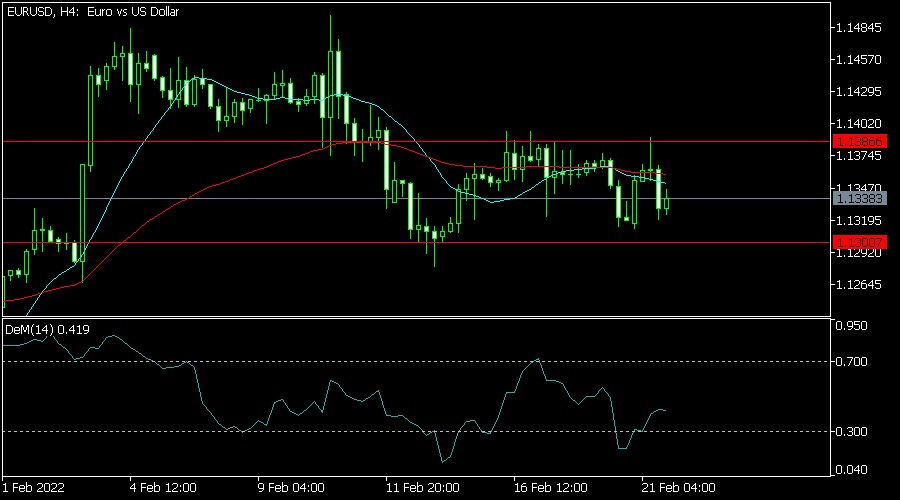
The EURUSD pair is trading at 1.1337, which is slightly above Monday’s low of 1.1320. On the four-hour chart, the pair moved slightly below the 25-day and 50-day moving averages. It is also slightly below the key resistance level at 1.1385 while the DeMarker indicator has moved slightly above the oversold level. Therefore, the pair will likely resume the bearish trend as bears target the next key support at 1.1300.
GBPUSD
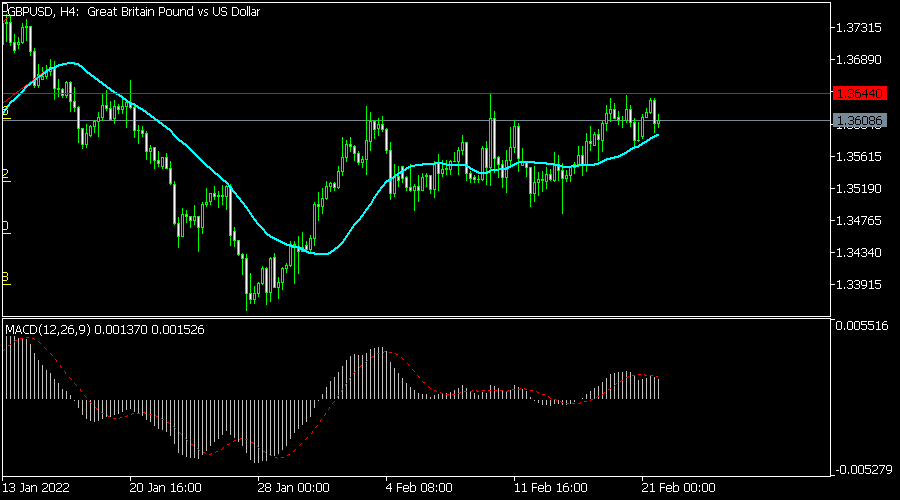
The GBPUSD pair was also little changed in the overnight session. It is trading at 1.3600, where it has been in the past few days. This price is slightly below the key resistance level at 1.3645, which it struggled to move above several times last week. It is above the 25-day moving average and is at the same level as the 23.6% Fibonacci retracement point. Therefore, the pair will likely have a bullish breakout today.
XBRUSD
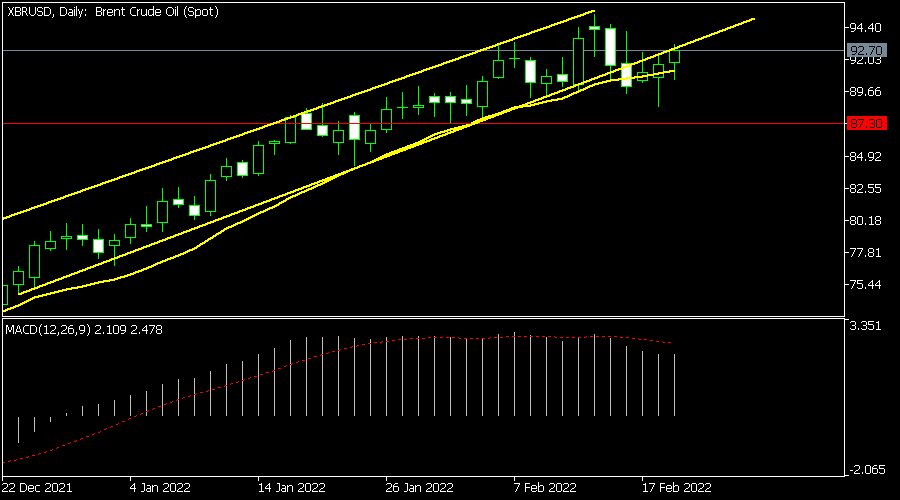
The XBRUSD pair jumped to a high of 93 as geopolitical concerns remained. On the daily chart, the pair retested the lower side of the ascending channel shown in yellow. It also rose above the 25-day moving average while the MACD is above the neutral level. Therefore, the pair will keep rising as geopolitical issues converge with rising demand worries.
Is it a War Declaration?
All hell broke loose yesterday, as the Russian President Putin said on a TV address that he recognizes the Ukraine’s two separatist regions Donetsk and Luhansk as republics. The latest statement also hints to the end of the Minsk agreement and a clearly heightens the risk of a Russian invasion in Ukraine in the coming days. Putin already ordered ‘peacekeeper forces’ into these regions.
The latest turn of events narrows the chances of a Russian pullback, and the window for diplomacy is almost shut. The US ordered new sanctions on Russia and the new Russian-backed republics; Europeans pledged to respond as well. This is the worst escalation since the Cold War.
After the US-China trade war and a global pandemic, the Russian crisis is the next big thing on the world’s agenda. Unfortunately, governments and central banks have limited munition left to fight back a war-induced global recession.
Market reaction: Russian futures lost near 14% yesterday, the DAX futures were trading 4% lower as Putin was breaking the news, the natural gas futures were up 8%, oil jumped more than 3% and gold advanced to $1914 per ounce.
The risk off mode will likely stay on for the coming hours, but at this point it’s hard to predict what’s next. Any positive news could reverse the bearish action and lead to sudden jumps in risk asset prices, yet a further escalation of tensions, which now became the base case scenario, should further enhance gains in energy, safe haven assets and gold.
US crude flirted with the $95 a barrel yesterday. A concrete military action in Ukraine would mean a severe disruption to energy supplies - and other commodities, and should gather enough momentum to send the barrel of crude above the $100 mark.
Gold has been a solid hedge against the geopolitical tensions, although it hasn’t been a brilliant hedge against the rising inflation and inflation expectations over the past couple of months. There is potential for a further advance toward $1950/2000 region.
In the FX markets, the US dollar remains strong, and the activity on other FX pairs is mostly driven by a solid demand for greenback. The EURUSD is testing the 1.1280/1.1300 support, while the USDJPY loses ground below the 115 level, as capital flows into the safe haven yen. The Swiss franc is also stronger against the greenback, but the gains are more notable against the euro. The euro-swissy fell from above 1.06 to 1.035 in about two weeks. It’s bad news for the Swiss export companies, but it’s good news from an inflation perspective, as inflation in Switzerland remains very much contained compared to the rest of the world, as the strong franc protects Switzerland against a part of the global overheating in consumer prices.
Research Russia: Hope Dies last – Nervous Markets are Far from Pricing in a Full-Blown War
- Diplomatic stalemate between Russia and the West remains. Military escalation has already started in Eastern Ukraine and, according to US intelligence, Russia has the readiness for an imminent large-scale attack on Ukraine.
- On Monday evening, Putin announced he will sign the decree for recognizing separatist Luhansk and Donetsk People's Republics in Eastern Ukraine – a move previously indicated as a potential deal-breaker for diplomacy by the West.
- Considering military escalation in Eastern Ukraine has started, markets remain surprisingly calm with negative reactions thus far contained to RUB-linked assets.
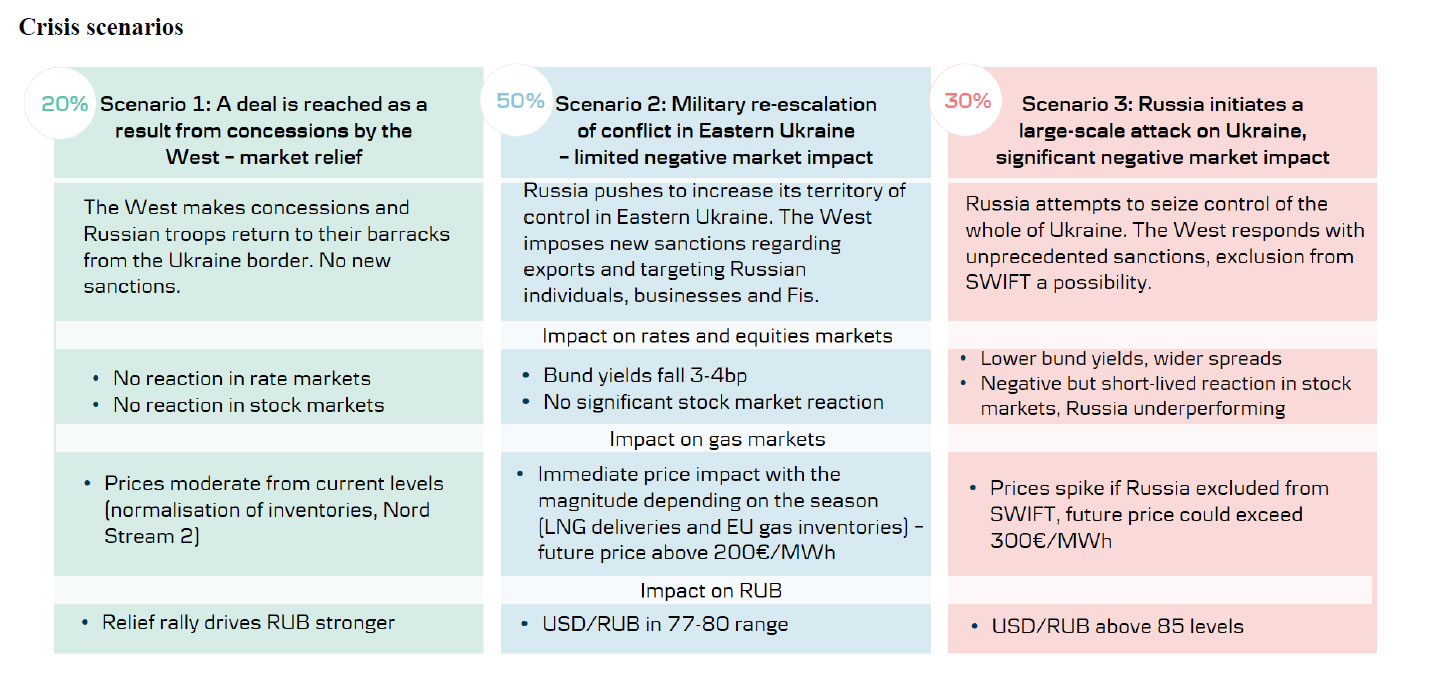
- Compared to the situation in January, we now see a diminishing probability for a peaceful solution and raise our estimate of a probability for a full-blown war. The latter would trigger a substantial fall in RUB, weaker EUR and weaker Scandies. Safe-haven assets would benefit, while rising uncertainty would hit stock markets.
The threat of war is rising but diplomacy is still alive
Last week, Russia published its response to the US/NATO proposal that addressed the security guarantees presented by Russia in December. The stalemate continues: Russia was unsatisfied with the US/NATO response which unsurprisingly rejected Russian demands to halt NATO's expansion to the east and a major rollback of the alliance's presence in its current eastern member states. The US/NATO insist on maintaining the 'open-door' policy, while Kremlin repeatedly calls it their key priority. While the Russian response does not raise high hopes for a diplomatic solution, Russia has not fully closed the door for further diplomatic talks regarding other issues such as arms control and military exercises.
The two sides publicly disagree on a number of other issues regarding the current state of affairs. The US has announced, based on intelligence, that Russia has the readiness to launch a large-scale attack on Ukraine any time now. Media reports have indicated that Putin may have already made the decision to invade. Meanwhile, Russia insists they are not planning to attack and accuse the West of constant provocation. Russian reports that they have been withdrawing troops from the vicinity of Ukraine since last week have been disputed by the West. On the contrary, US and NATO report that Russian buildup of troops (now accumulating to more than 150,000) and artillery at the Ukraine border has continued.
Military escalation in Eastern Ukraine is already happening. Since last Thursday, we have witnessed a number of reports on shelling incidents and ceasefire violations along the line of contact between Ukraine and separatist-held regions. Based on media reports, the security situation in Eastern Ukraine is getting worse by day and for example water supplies have been cut off in some areas.
EUR/USD Daily Outlook
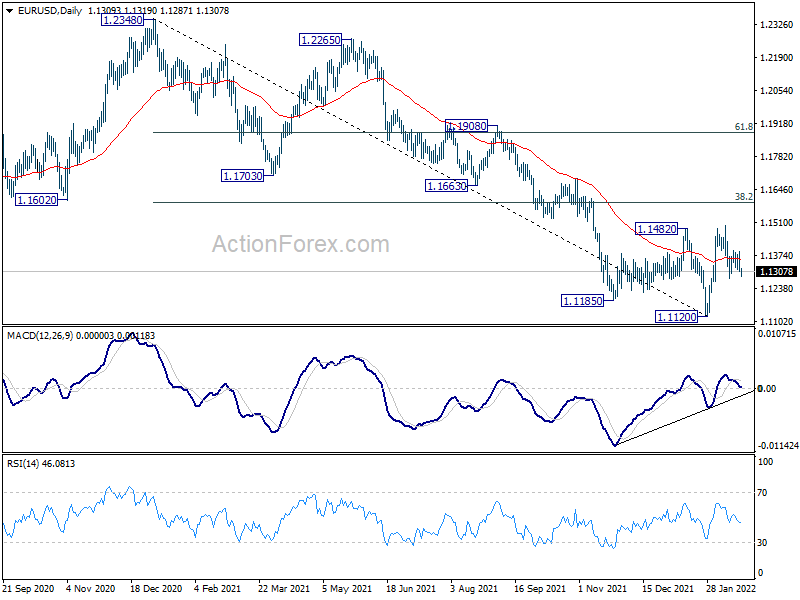
Daily Pivots: (S1) 1.1282; (P) 1.1336; (R1) 1.1364; More...
EUR/USD is still bounded in range of 1.1265/1482 and intraday bias remains neutral. On the upside, firm break of 1.1482 will target 38.2% retracement of 1.2348 to 1.1120 at 1.1589 next. Sustained break there will argue that whole fall from 1.2348 has completed too and target 61.8% retracement at 1.1879. On the downside, however, break of 1.1265 support will dampen this bullish view and bring retest of 1.1120 low instead.
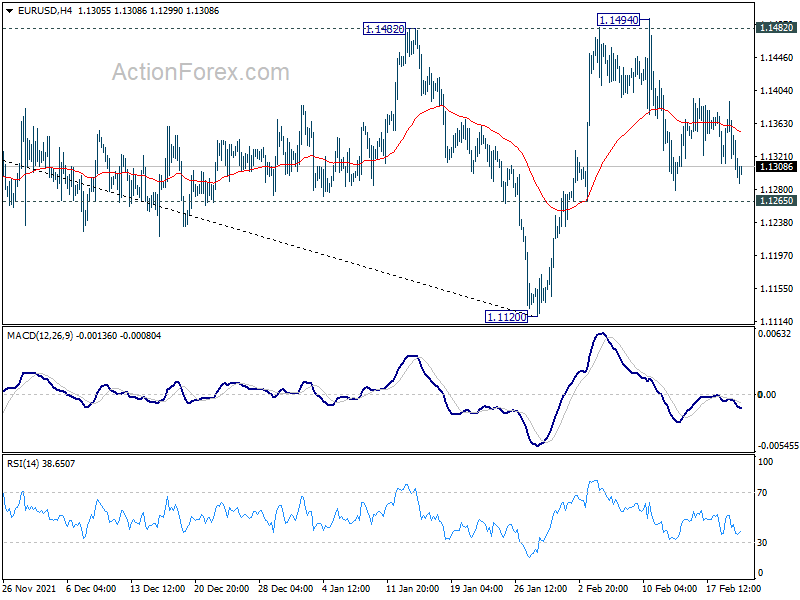
In the bigger picture, the decline from 1.2348 (2021 high) is seen as a leg inside the range pattern from 1.2555 (2018 high). Sustained trading above 55 week EMA (now at 1.1593) will argue that it has completed and stronger rise would be seen back towards top of the range between 1.2348 and 1.2555. However, firm break of 1.0635 (2020 low) will raise the chance of long term down trend resumption and target a retest on 1.0339 (2017 low) next.
GBP/USD Daily Outlook
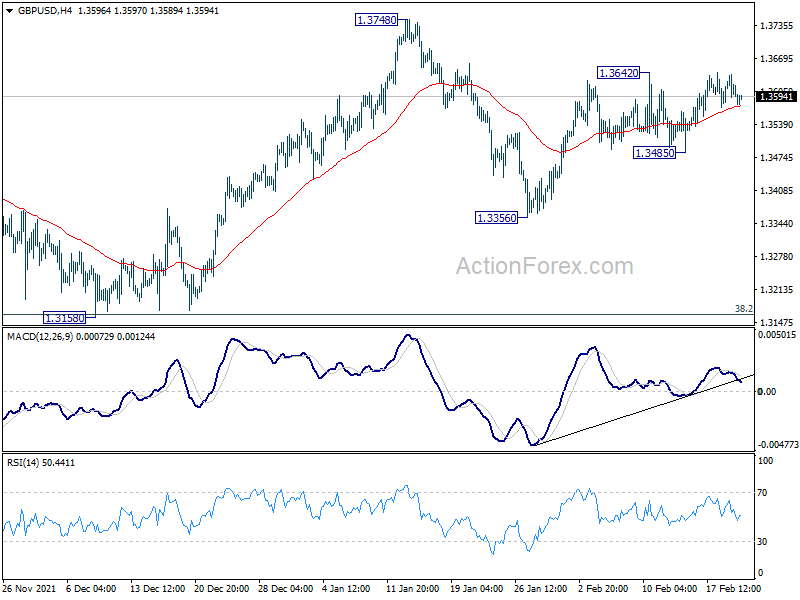
Daily Pivots: (S1) 1.3579; (P) 1.3609; (R1) 1.3632; More...
Range trading continues in GBP/USD and intraday bias remains neutral. On the upside, break of 1.3642 will resume the rebound from 1.3356 to 1.3748 resistance. Firm break there will revive the bullish case that correction from 1.4248 has completed with three waves down to 1.3158. Further rally should then be seen to retest 1.4248 high. On the downside, though, break of 1.3485 will turn bias to the downside for 1.3356 support instead.
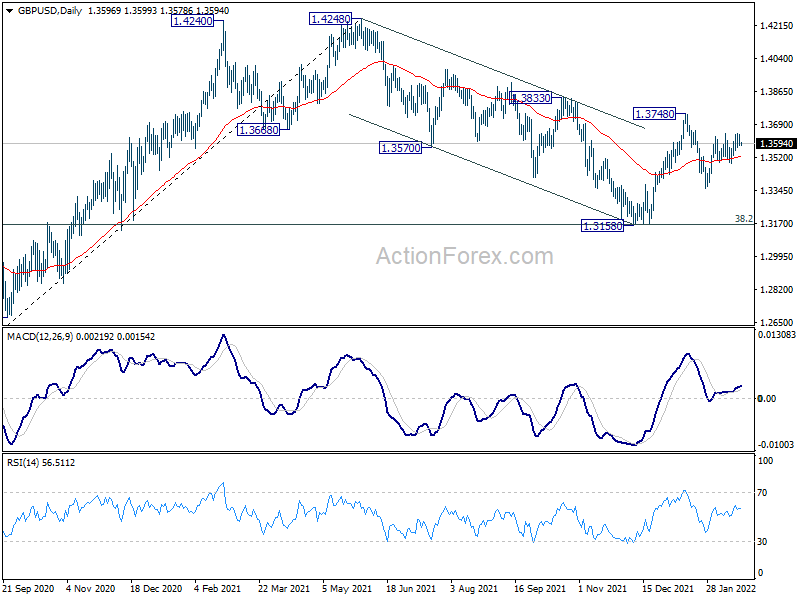
In the bigger picture, as long as 38.2% retracement of 1.1409 to 1.4248 at 1.3164 holds, up trend from 1.1409 (2020 low) is still in progress. On resumption, next target will be 38.2% retracement of 2.1161 to 1.1409 at 1.5134. Nevertheless sustained break of 1.3164 will argue that whole rise from 1.1409 has completed and bring deeper fall to 61.8% retracement at 1.2493.
USD/CHF Daily Outlook
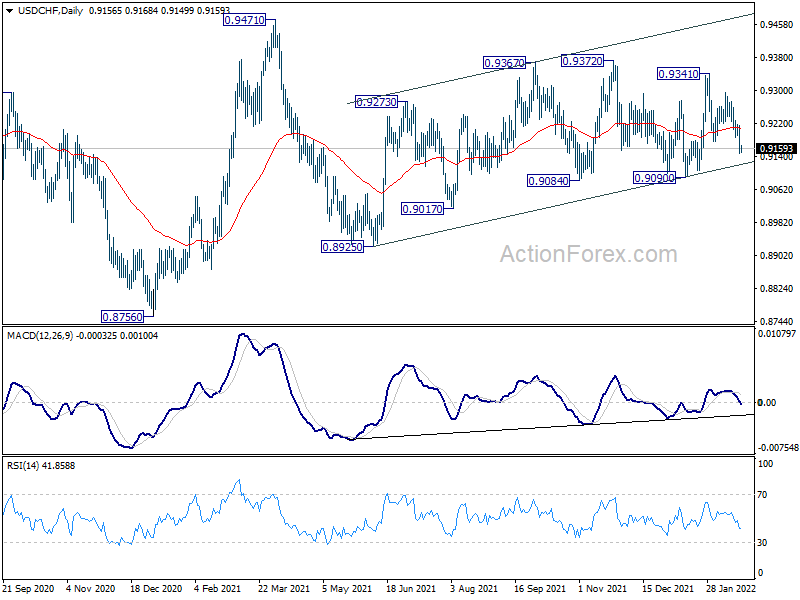
Daily Pivots: (S1) 0.9132; (P) 0.9176; (R1) 0.9203; More....
Intraday bias in USD/JPY remains on the downside as fall form 0.9341 is in progress for 0.9090 near term support. Firm break there will argue that choppy rise from 0.8925 has completed and bring deeper decline to this support. Nevertheless, above 0.9217 minor resistance will turn intraday bias neutral again, and retain some mild near term bullish flavor.
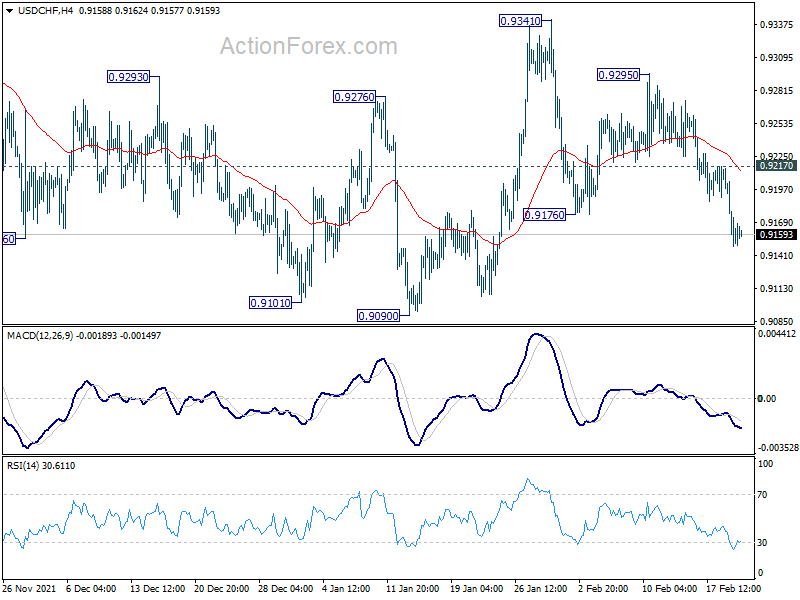
In the bigger picture, medium term outlook will be neutral at best as long as 0.9471 resistance holds. Larger down trend could still extend through 0.8756 (2021 low). However, firm break of 0.9471 will argue that the trend has already reversed and rebound the rally from 0.8756 with another impulsive move.