

Sample Category Title
Will Dollar Ignore Solid US Data Again?
The week is loaded with US economic data releases, most of which are scheduled for Friday. There has been a shift in the trading dynamics governing the dollar lately, with strong data being unable to boost the reserve currency. If this pattern continues, it would be another sign the overall trend is exhausted.
Dollar refuses to obey
Let’s start with the good news - the US economy is in good shape. The jobs market is approaching full employment, consumers continue to spend with confidence, and inflationary pressures have intensified.
As such, markets have priced in six rate increases by the Fed for this year, betting that the central bank will be forced to slam on the brakes to bring inflation under control. But despite these huge moves in bond markets, the dollar remains flat for the year. Even fears of armed conflict in Ukraine couldn’t boost the reserve currency for long.
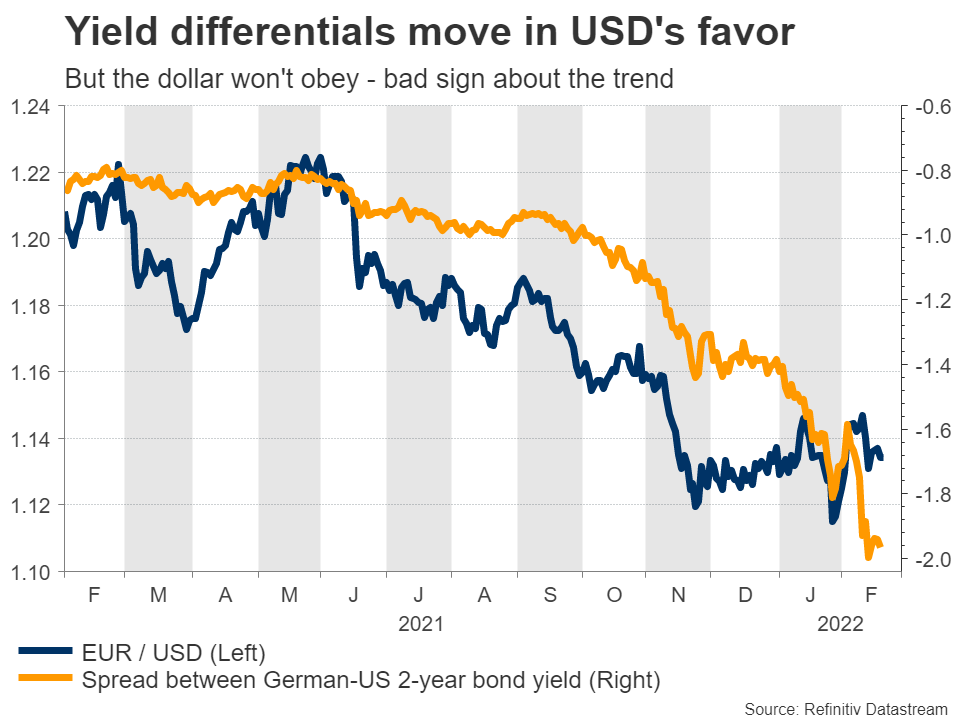
This sluggish behavior has been on full display lately as the greenback has been unable to capitalize on positive surprises in important US economic indicators. A stellar jobs report, another scorching hot inflation number and a massive beat in retail sales over the past few weeks did not have the impact someone would expect - the dollar barely rose in the aftermath or even fell.
When a currency cannot rally on good news, that’s an ominous sign. It suggests the uptrend is running out of steam.
Another round of data
Now the question is, will the dollar continue to behave this way? We’ll get the answer after the next batch of economic data. The show will get started on Tuesday with the Markit PMIs for February. Then on Thursday, the spotlight will fall on the second estimate of GDP for Q4 and a parade of Fed speakers.
But the main event is on Friday, when the core PCE price index is released. This is the Fed’s favorite inflation measure and it will be accompanied by consumption data and durable goods orders, all for January. Most of these indicators are forecast to have improved from the previous reading.
Admittedly these indicators are a little ‘outdated’ by now, but nevertheless, it will be interesting to see how the dollar reacts to any surprises.
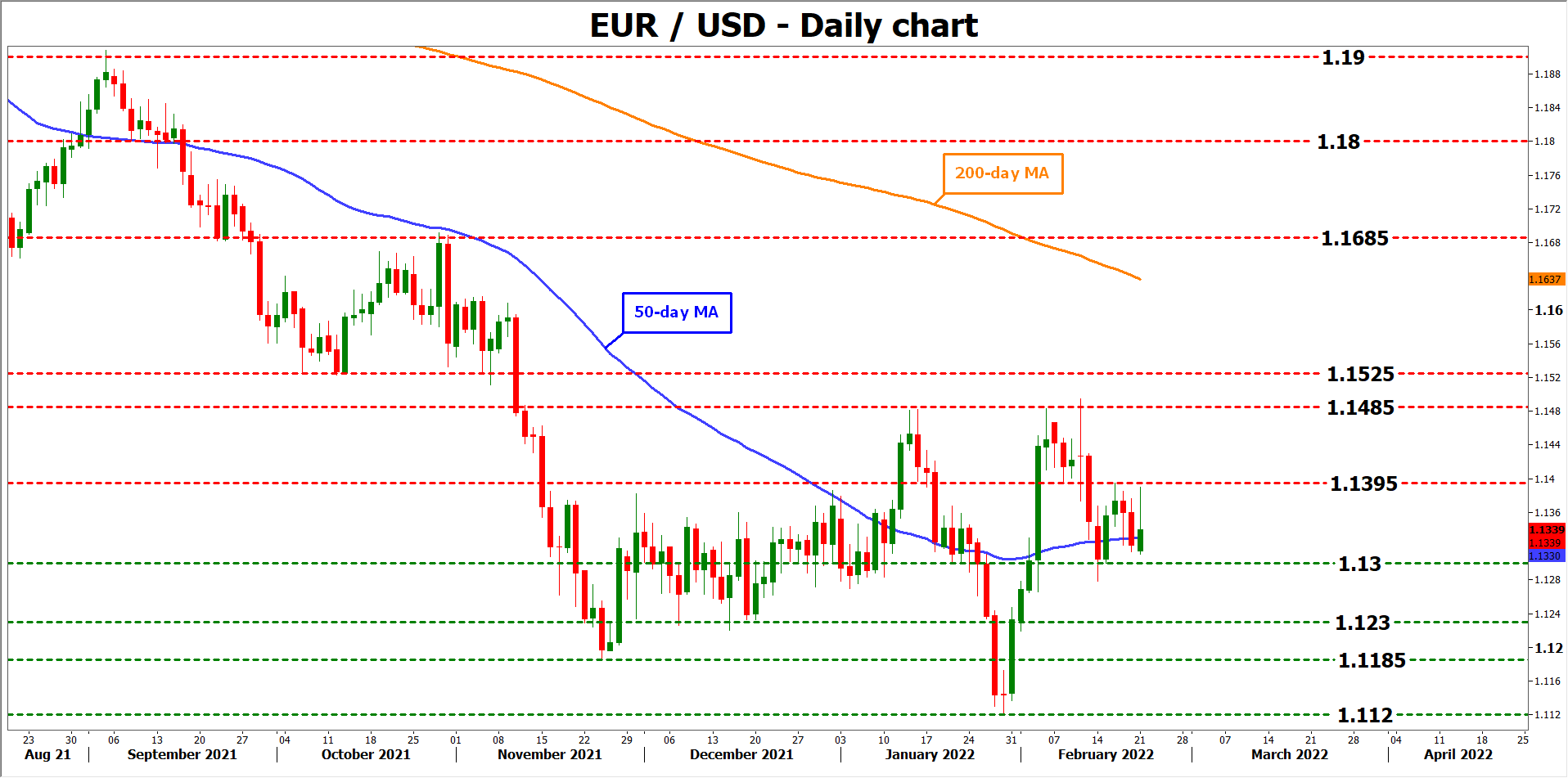
Taking a closer look at euro/dollar, the pair has been trapped in a narrow range between 1.1395 and 1.1300 for a week now, and a break on either side is needed to give traders a clearer sense of direction.
Dollar outlook
Overall, the dollar’s performance has been rather disappointing. The stars have aligned this year with geopolitical tensions, volatility in stock markets, and traders betting aggressively on Fed rate increases - yet the greenback has nothing to show for it.
Of course, we cannot analyze the dollar in a vacuum. Much of this lackluster performance boils down to the euro, which came back to life after the European Central Bank signaled that rate increases are on the menu for this year.
Still, the dollar’s future doesn’t seem very bright here. Traders may have gone too far already with Fed bets and when inflation finally peaks, some of those bets could be dialed back. That might happen relatively soon as government spending is fading, supply chains have started to correct, and the year-over-year comparisons in inflation will become tougher after March.
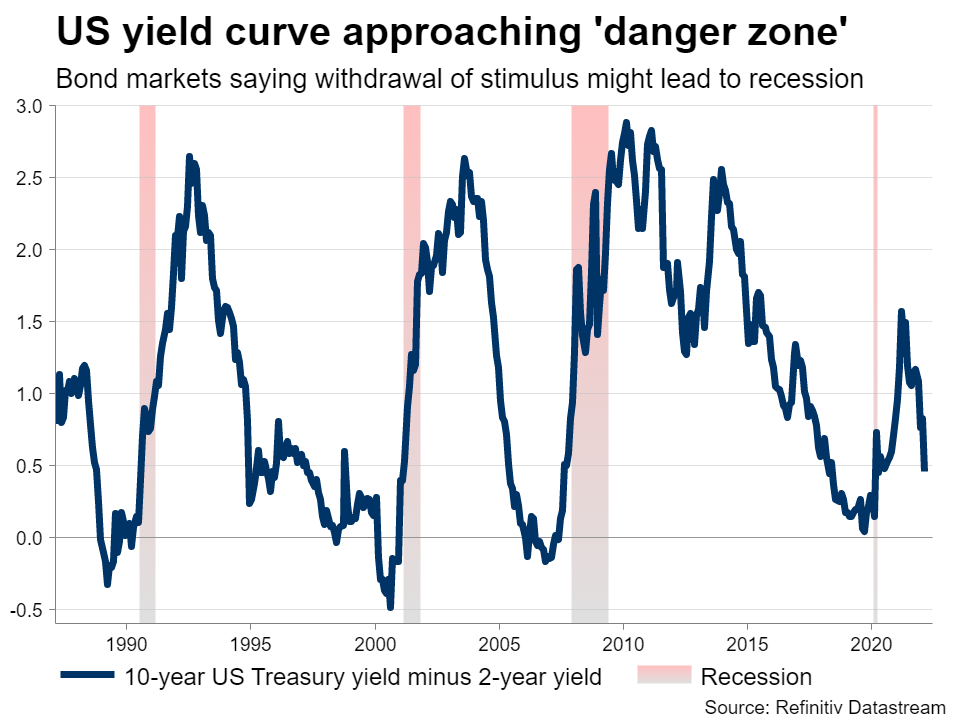
Politics argue the same point. The Democrats will probably lose Congress later this year, which means the days of generous government spending are over. Combined with the Fed raising rates, economic growth will likely slow. All this suggests the dollar’s rally might be on its final legs.
The main risk to this view? Inflation remains persistently high, forcing the Fed to tighten even more aggressively. But that could also backfire, by raising the risk of a policy-induced recession.
Either way, it’s just difficult to see a ton of upside for the dollar from here, with the Fed already priced so generously.
CADJPY Bears Subdued Again by One-Month Floor
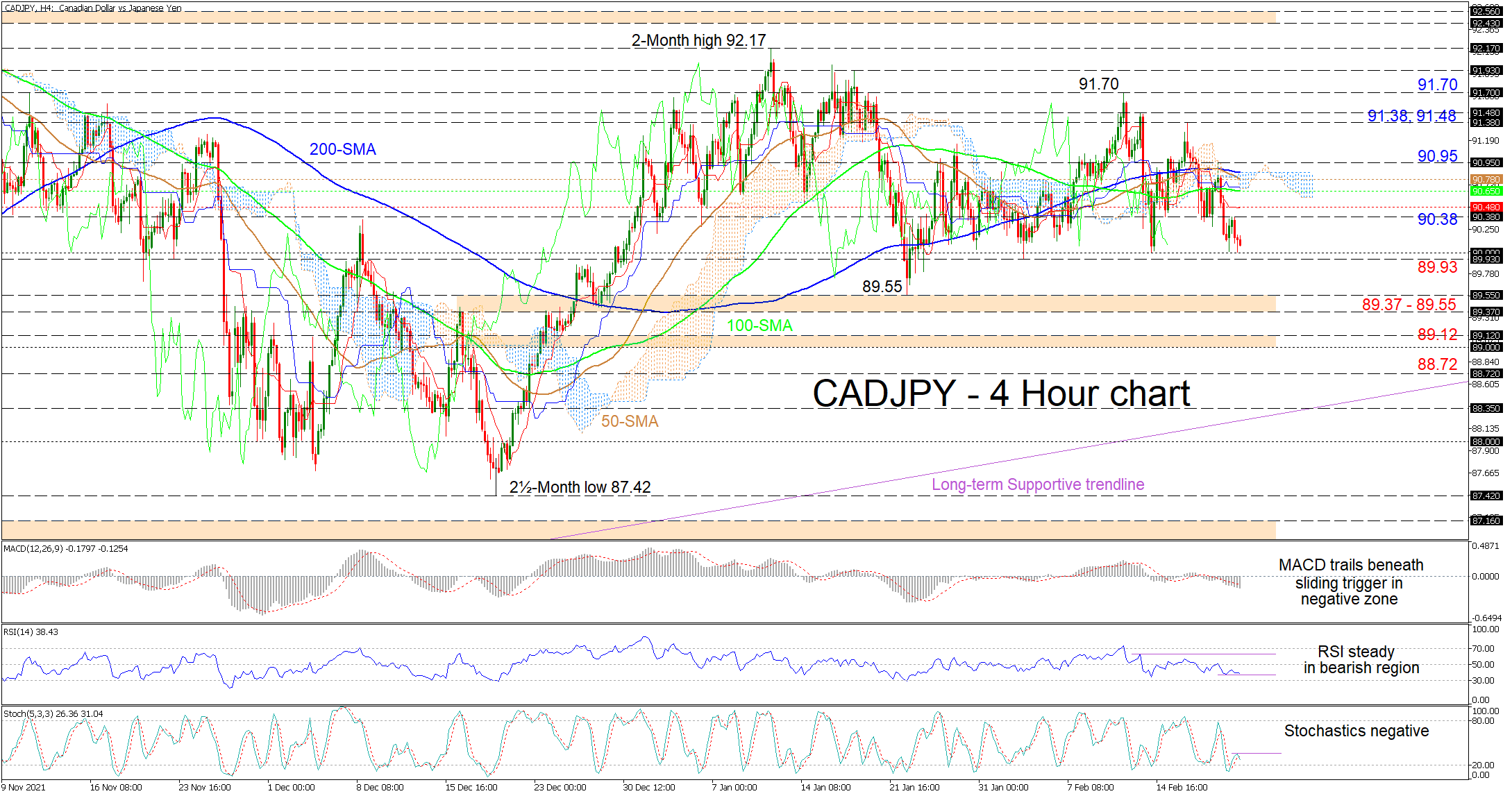
CADJPY is struggling to accelerate its freshly revived negative bearing further below the 90.00 handle, where a support base has somewhat solidified since the end of January. The longer-term simple moving averages (SMAs) are steadier than the 50-period SMA, which has dipped, sponsoring the latest decline in the pair.
The Ichimoku lines indicate that negative forces have paused, while the Ichimoku cloud maintains its frail bearish tone. The short-term oscillators are also reflecting mixed signals in directional momentum as price action dissolves around the 90.00 level. The MACD is holding underneath its red signal line, while the stochastic oscillator is turning negative again. On the other hand, the RSI is drifting in bearish territory, implying frail negative momentum.
If the negative price trajectory persists, the immediate base of 89.93-90.00, which has been confronted multiple times since the latter part of January could put sellers to the test. However, if this minor foundation fails to keep the bears at bay, they may then challenge the 89.37-89.55 support border, the latter being the January trough. If selling pressures intensify further, the 89.00-89.12 barrier could draw traders’ focus ahead of the 88.72 low and longer-term supportive line pulled from the 77.90 level.
Alternatively, if buyers find traction from the 89.93-90.00 foothold, upside friction could commence from the 90.38 high and the red Tenkan-sen line overhead at 90.48. Pushing higher, a fortified section of resistance from the 100-period SMA at 90.65 until the 90.95 high could impede additional advances in the pair. However, in the event the bulls pilot beyond the cloud, the congested 91.38 and 91.48 barriers may come under fire before the bulls aim for the February 10 peak of 91.70.
Summarizing, CADJPY is sustaining a broader bullish structure above the 87.42 trough. That said, currently the price is trading closer to the lower part of a more sideways move in the pair, where the minor bearish tilt in the price is struggling to evolve into a correction towards the diagonal line.
Sunset Market Commentary
Markets
European investors were unlikely to place high profile directional trades, lacking guidance from the other side of the Atlantic as US investors were absent for President’s day. Still, French president Macron announcing an agreement ‘in principle’ on a high level meeting between presidents Putin and Biden on Ukraine raised hope for the geopolitical risk-off to move a bit to the background. Maybe there was room for economic data to play a more prominent role. The hope proved not justified. The EMU preliminary PMI’s were not to blame. The January surveys brought an excellent bulletin on the post-Omicron health of the European economy. The composite PMI rose from 52.3 to 55.8, the highest level in 5 months. The services activity rebounded sharply (55.8 from 51.1) as restrictions are scaled back. The manufacturing PMI remained at a very solid 58.4. The latter also enjoyed some tentative relief of supply bottlenecks. Both services and manufacturing were supported by stronger demand/orders. This demand-driven rebound supported employment and wage growth. Companies are ever more passing higher energy and other costs to end consumers, leading to the sharpest rise in prices charged in the history of the survey according to Markit. Such a cyclical, demand-driven rise in inflation only reinforces the case for the ECB to prepare a substantial reduction in policy support when it meets on March 10. The European/German 10-y yield temporarily rose 4-5 basis points immediately after the open. However, headlines from Kremlin labeling a presidential meeting as premature and on new incidents at the Ukraine/Russian boarder soon reverted European markets into risk-off modus. The German curve flattens with the 2-y yield raising (+1.5bp). The 30-y eased 2 bps. Solid EMU PMI’s also don’t help peripheral bonds with the 10-y Italian spread widening 4bps. Greece was the exception to the rule (-3 bps). Major European indices nosedived after modest opening gains to currently lose up to 1.75%. The EuroStoxx 50 graph end last week already showed serious cracks. Breaking below the multiple neckline/4000 level is raising the red alert!
FX markets followed the broader intraday dynamics. EUR/USD touched an intraday top near 1.1390 upon the release of a strong French PMI. In retrospect, this only turned out to be a short-term opportunity to sell. The pair currently trades in the 1.1335 area. The DXY TW USD index also returned to the 96.00 level. The yen (EUR/JPY 130.20; USD/JPY 114.85), but especially the Swiss franc (EUR/CHF sub 1.04) paly their safe haven role. Sterling is also holding resilient, ceding little ground against the dollar (1.3610) and gradually gaining against the euro (EUR/GBP 0.833). EMU PMI’s were excellent but the UK February performance was even more impressive with the composite PMI jumping from 54.2 to 60.2. No reason at all for the BoE to backtrack on its intentions to normalize policy. CE currencies (PLN, HUF, CZK) again weathered the risk-off without any significant damage.
News Headlines
French Finance Minister Le Maire said tax cuts and subsidies will be used for as long as needed to protect consumers and companies from surging energy prices. The Macron government has earmarked some €15.5 bn to cap electricity and costs. Those measures will end early 2023, when regulated tariffs will be reviewed. But Le Maire figured it would be possible to stick to the pledge made by relying on stronger growth and more efforts to address structural weaknesses. The Finance Minister said Macron would do that by overhauling pensions and improve public-sector costs and efficiency if re-elected for another 5-year term in April.
Germany’s Bundesbank in its monthly report said the country tipped into a second Covid-driven recession. The economy contracted 0.7% q/q in the final quarter of last year and may decline “noticeably” in the first quarter of 2022. The BuBa said it’s not just the close-contact services sector that was hit by the restrictions. Pandemic-related worker absence as a result of the rapidly spreading Omicron mutation has also affected activity in other sectors. The Bundesbank does expect the economy to rebound rapidly (in the spring) and strongly thanks to still-strong demand and easing supply-chain pressures. Today’s German PMI release serves as a point in case.
Ukraine Conflict Continues to Move Markets
- CHF leads amid haven flows, USD weakens
- Stocks drop
- Gold off overnight lows
The appetite for risk is very low right low. Sentiment continues to be dominated by headlines concerning Ukraine, Russia and the West. The latest headline was that Russia has apparently killed five people who tried to violate border. Inflation woes haven’t gone away either. The result? Investors have sold stocks, causing haven flows into the Swiss franc. Gold has bounced off its overnight lows and threatening to move decisively above $1900 hurdle.
It has already proved to be a very volatile start to the new week. The day started with gaps on index futures overnight, before a sharp rally on the back of news of a possible Biden-Putin meeting. However, the indices then gave up those gains to drop to fresh lows. This was in response to new from Russia where the government said there are "no concrete plans" for such a summit yet. This cast doubt on the meeting, although Moscow did not rule it out happening in the future. In addition, the hostilities in Donbass further weighed on sentiment.
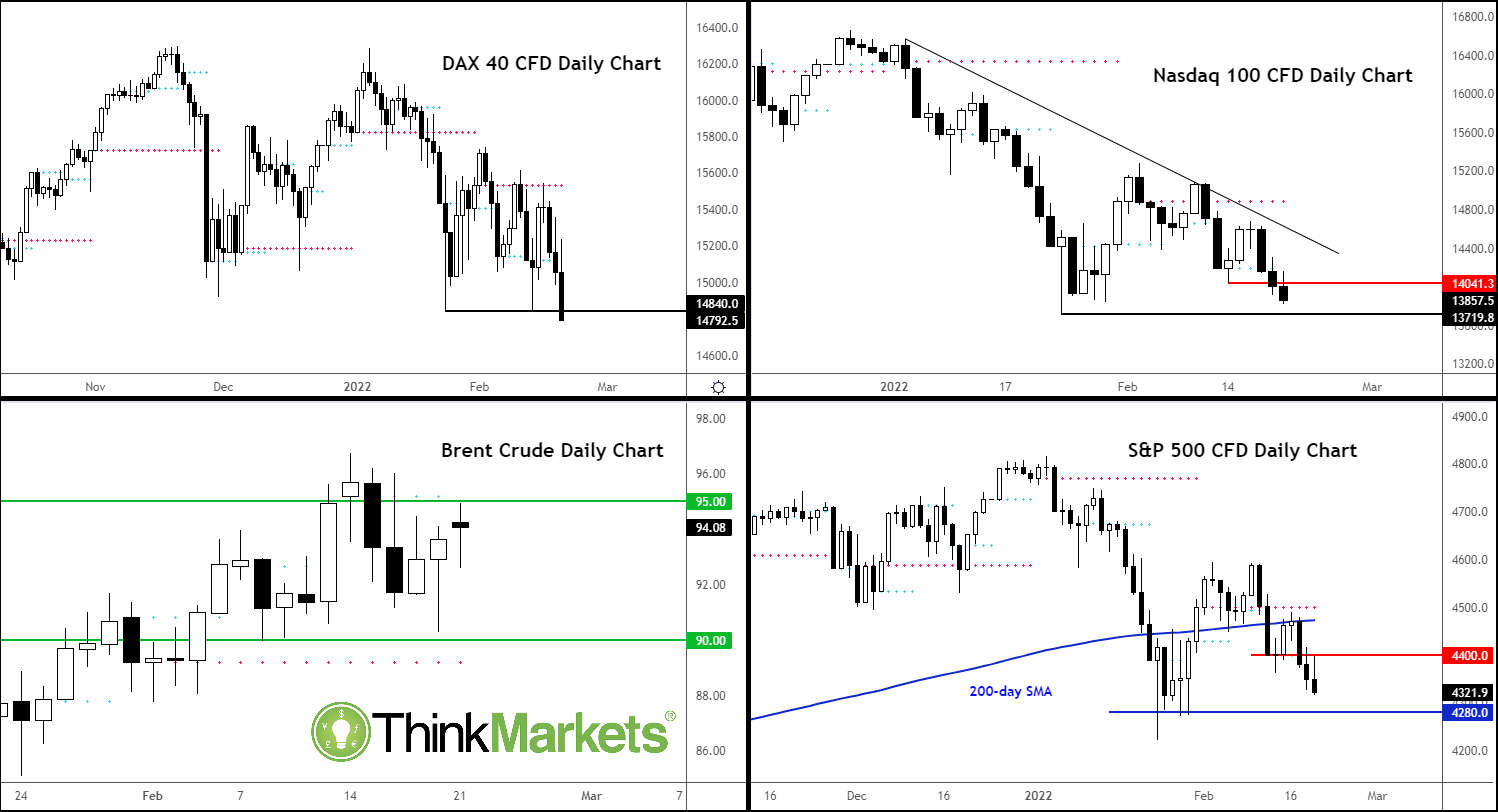
As we head to the afternoon session, there’s an awful lot to look forward to in terms of data, and with holidays in US and Canada, it is going to be rather quiet. Any news from the Russia-Ukraine situation should move the markets sharply, as volumes are expected to be thin.
On the macro front, there was some good news from Europe earlier this morning as services PMIs came out stronger than expected, suggesting a faster recovery from the omicron blip. However, with sentiment dominated by geopolitics, European markets were unable to find much support.
Looking further out in the week, we have interest rate decision from the Reserve Bank of New Zealand, as well as the US GDP and PCE prints. On a micro level, we will get to see how strong London-listed banks performed in the last quarter, this week. The likes of HSBC, Barclays and Lloyds are set to post their full-year numbers. We will also here from Rolls-Royce, Home Depot and Moderna.
Yen Steady ahead of BoJ Core CPI
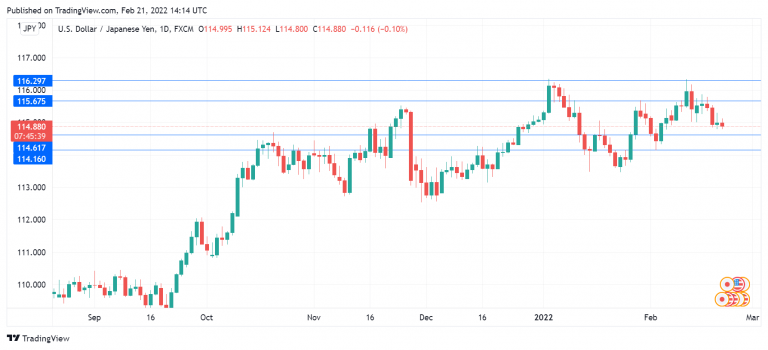
The Japanese yen has started the week quietly and is trading slightly below the 115 line.
Investors eye Japanese inflation releases
The focus will be on Japanese inflation indicators in the coming week, with three events on the economic calendar. Like other major economies, Japan is dealing with a rise in inflation, although the pace has been much more moderate than what we’re seeing in the UK or the US. Inflation remains well below the Bank of Japan’s target of 2%, so there is no talk of raising interest rates in the near future.
The January reading of BoJ Core CPI, the central bank’s preferred inflation gauge, will be released on Tuesday. The indicator rose 0.9% y/y in December, up from 0.8% and its highest level since May 2016. On Friday, Tokyo Core CPI for February will be released. After a weak reading of 0.2% y/y in December, the indicator is expected to rise to 0.4%.
The crisis brewing in Ukraine remains at a critical stage, as there have been further skirmishes between the Ukraine army and the pro-Russian separatists, with fears that Russia is deliberately creating these flare-ups in order to justify an invasion of Ukraine. Russia has amassed over one hundred thousand troops around the border with Ukraine, and could choose to invade at any time. However, there have been some diplomatic moves in the meantime, notably a possible summit between Presidents Biden and Putin this week. Biden expressed his willingness to meet Putin if there was no invasion. We can expect a ping-pong reaction from the markets in the coming days, with market direction dependent to a large extent on what President Putin does next.
USD/JPY Technical
- 114.61 is under strong pressure in support. Below, there is support at 114.16
- There is resistance at 115.68 and 116.30
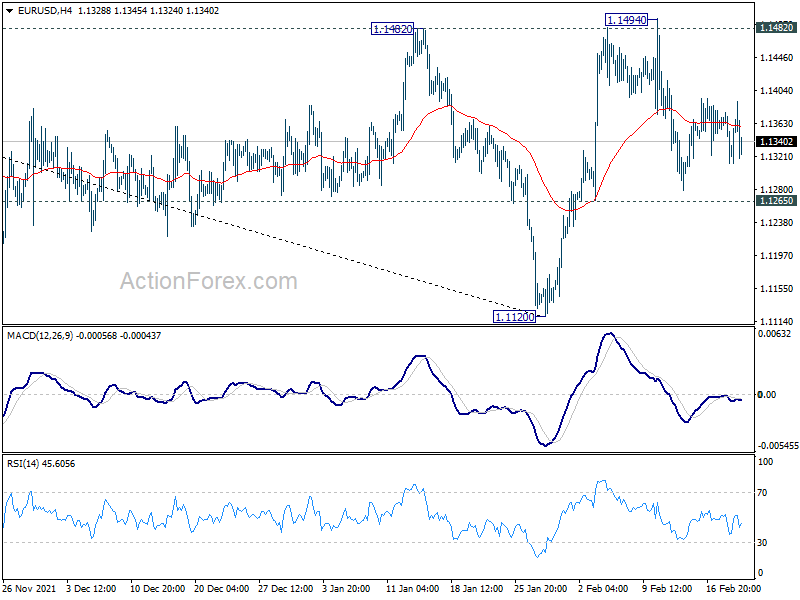
EUR/USD Mid-Day Outlook
Daily Pivots: (S1) 1.1300; (P) 1.1338; (R1) 1.1363; More...
Intraday bias in EUR/USD stays neutral and outlook is unchanged. On the upside break of 1.1482 will target 38.2% retracement of 1.2348 to 1.1120 at 1.1589 next. Sustained break there will argue that whole fall from 1.2348 has completed too and target 61.8% retracement at 1.1879. On the downside, however, break of 1.1265 support will dampen this bullish view and bring retest of 1.1120 low instead.
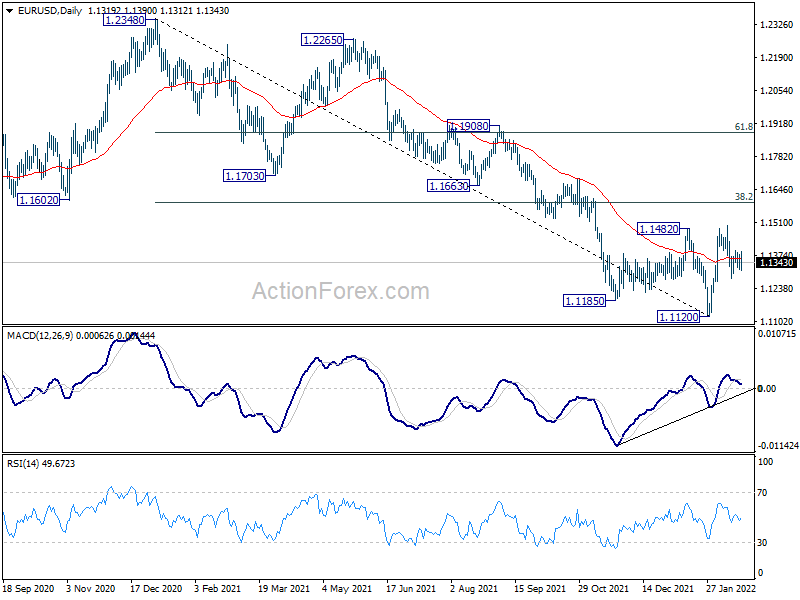
In the bigger picture, the decline from 1.2348 (2021 high) is seen as a leg inside the range pattern from 1.2555 (2018 high). Sustained trading above 55 week EMA (now at 1.1593) will argue that it has completed and stronger rise would be seen back towards top of the range between 1.2348 and 1.2555. However, firm break of 1.0635 (2020 low) will raise the chance of long term down trend resumption and target a retest on 1.0339 (2017 low) next.
GBP/USD Mid-Day Outlook
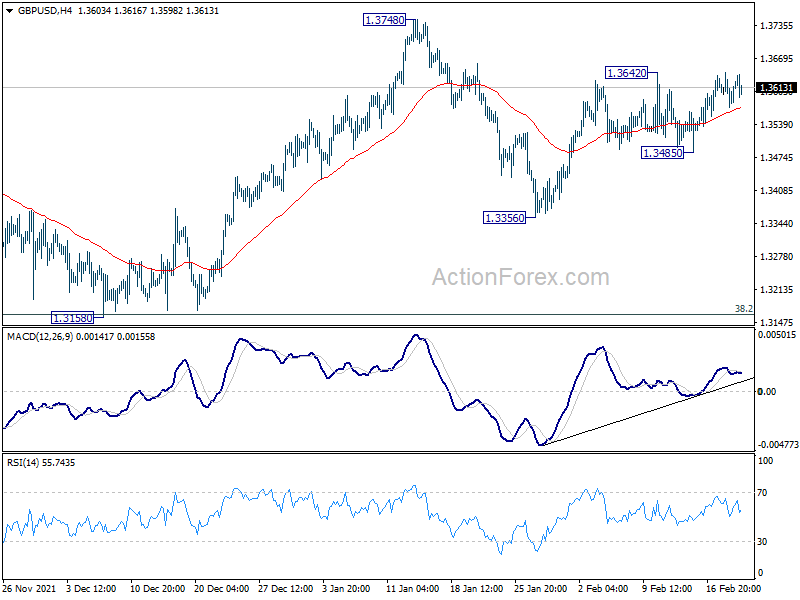
Daily Pivots: (S1) 1.3564; (P) 1.3604; (R1) 1.3633; More...
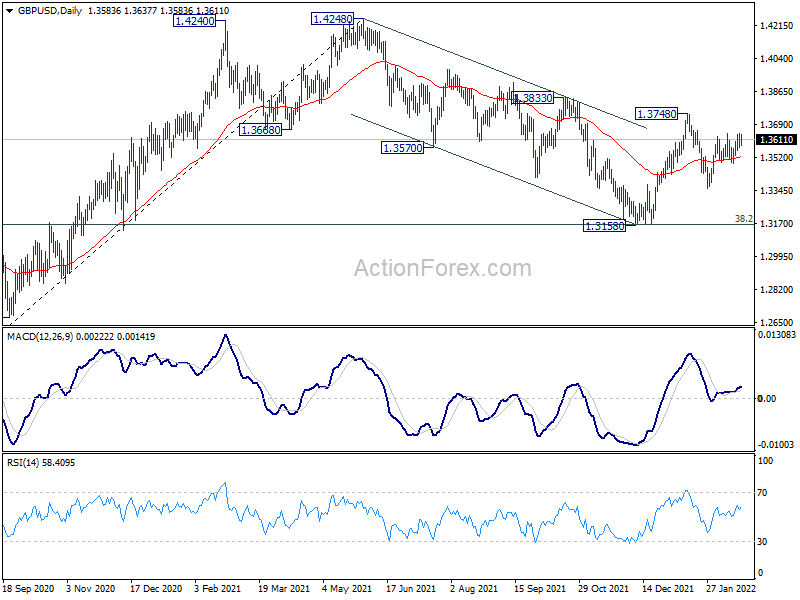
Intraday bias in GBP/USD remains neutral and outlook is unchanged. On the upside, break of 1.3642 will resume the rebound from 1.3356 to 1.3748 resistance. Firm break there will revive the bullish case that correction from 1.4248 has completed with three waves down to 1.3158. Further rally should then be seen to retest 1.4248 high. On the downside, though, break of 1.3485 will turn bias to the downside for 1.3356 support instead.
In the bigger picture, as long as 38.2% retracement of 1.1409 to 1.4248 at 1.3164 holds, up trend from 1.1409 (2020 low) is still in progress. On resumption, next target will be 38.2% retracement of 2.1161 to 1.1409 at 1.5134. Nevertheless sustained break of 1.3164 will argue that whole rise from 1.1409 has completed and bring deeper fall to 61.8% retracement at 1.2493.
USD/JPY Mid-Day Outlook
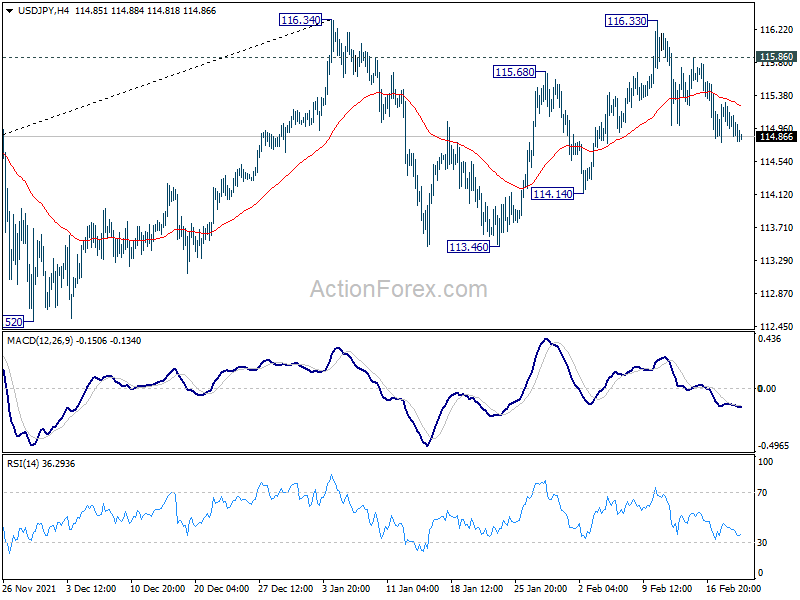
Daily Pivots: (S1) 114.79; (P) 115.05; (R1) 115.30; More...
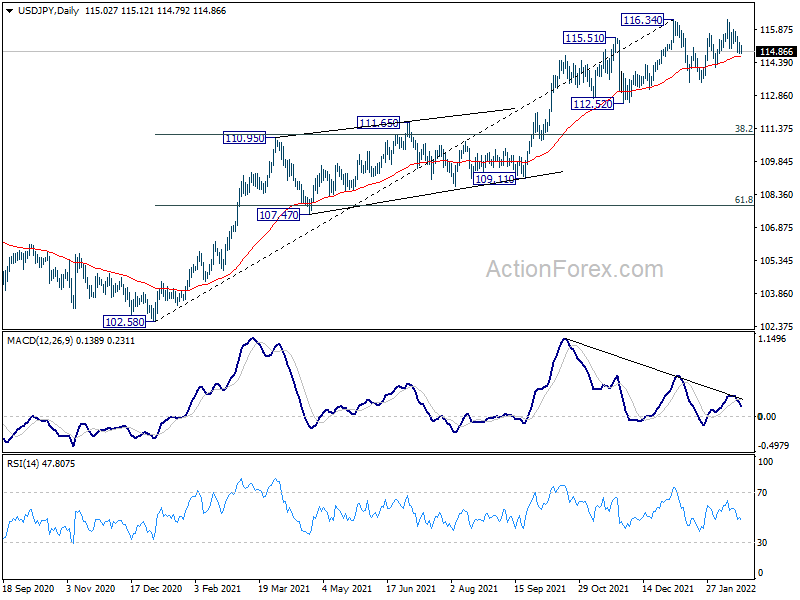
Intraday bias in USD/JPY remains mildly on the downside and outlook is unchanged. Fall from 116.33 is seen as the third leg of the corrective pattern from 116.34. Deeper decline would be seen to 114.14 support. On the upside, however, break of 115.86 will turn bias back to the upside for 116.34 resistance instead.
In the bigger picture, no change in the view that rise from 102.58 is the third leg of the up trend from 101.18 (2020 low). Such rally should target a test on 118.65 (2016 high). Sustained break there will pave the way to 120.85 (2015 high) and raise the chance of long term up trend resumption. This will remain the favored case as long as 55 week EMA (now at 111.31) holds.
USD/CHF Mid-Day Outlook
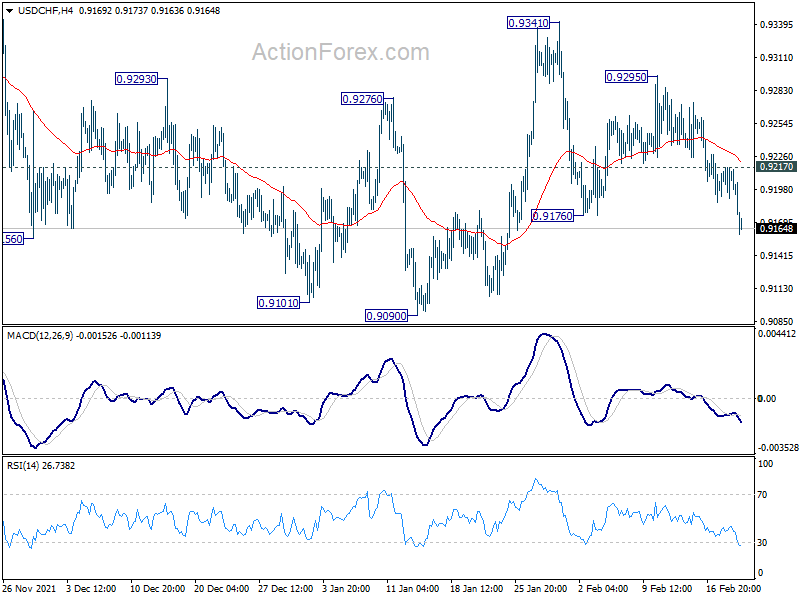
Daily Pivots: (S1) 0.9197; (P) 0.9208; (R1) 0.9223; More....
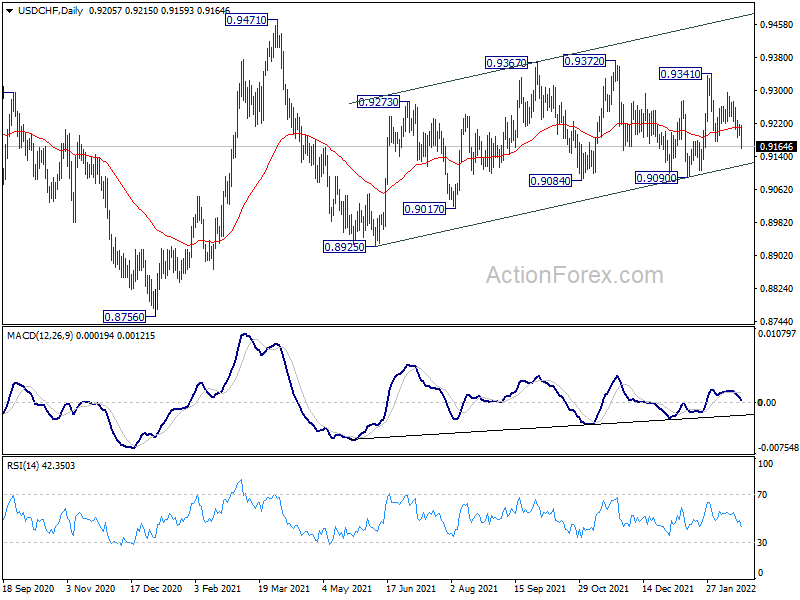
Intraday bias in USD/CHF mildly on the downside with break of 0.9176 support. Fall from 0.9341 could now target 0.9090 near term support. Firm break there will argue that choppy rise from 0.8925 has completed and bring deeper decline to this support. Nevertheless, above 0.9217 minor resistance will turn intraday bias neutral again, and retain some mild near term bullish flavor.
In the bigger picture, medium term outlook will be neutral at best as long as 0.9471 resistance holds. Larger down trend could still extend through 0.8756 (2021 low). However, firm break of 0.9471 will argue that the trend has already reversed and rebound the rally from 0.8756 with another impulsive move.
Swiss Franc Surges as Risk Sentiment Turns Sour Again
Risk sentiment turns sour again as the arrangement for a Biden-Putin summit looks far from being promising. As the same time, there seems to be some scattered escalations in Russia-Ukraine situations. Major European indexes are trading mildly lower, together with US futures. Gold is holding in tight range slightly below 1900 handle. But in the currency markets, Swiss Franc surges sharply today on safe-haven flow. Meanwhile, Dollar and Euro are under some selling pressure. Economic data are largely ignored.
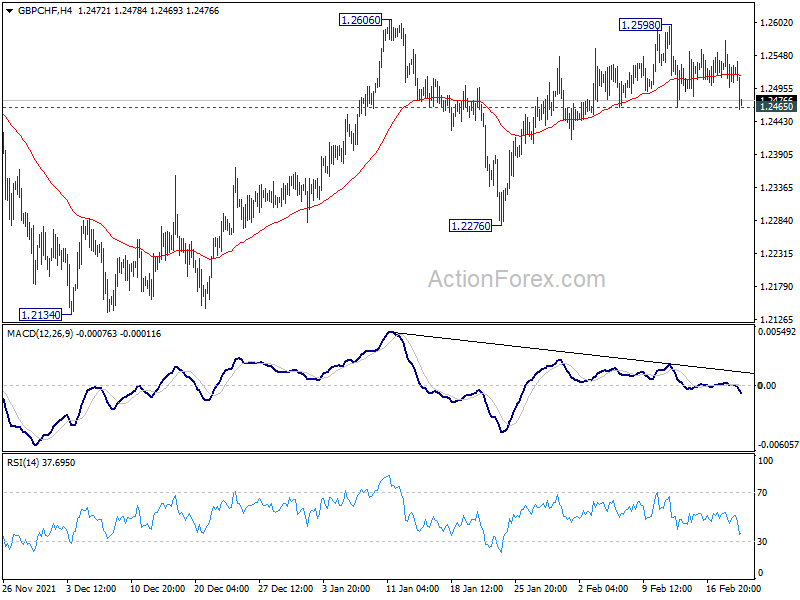
Technically, we'd continue to focus on developments in Swiss Franc crosses. USD/CHF's break of 0.9176 minor support suggests that deeper fall is now in progress. But sustained break of 0.9090 support is still needed to turn near term outlook full bearish. EUR/CHF is heading towards 1.0298 low and firm break there will confirm medium term down trend resumption. Meanwhile, as noted earlier today, break of 1.2465 support in GBP/CHF will suggest that rise from 1.2276 has completed and bring deeper fall back to this level.
In Europe, at the time of writing, FTSE is down -0.56%. DAX is down -1.93%. CAC is down -2.08%. Germany 10-year yield is up 0.006 at 0.198. Earlier in Asia, Nikkei dropped -0.78%. Hong Kong HSI dropped -0.65% China Shanghai SSE dropped -0.00%. Singapore Strait Times rose 0.22%. Japan 10-year JGB yield dropped -0.0115 to 0.209.
UK PMI Manufacturing unchanged at 57.3, services jumped to 60.2
UK PMI Manufacturing was unchanged at 57.3 in February, below expectation of 57.5. PMI Services surged from 54.1 to 60.8, above expectation of 55.2, an 8-month high. PMI Composite rose from 54.2 to 60.2, also an 8-month high.
Chris Williamson, Chief Business Economist at IHS Markit, said:
"The latest PMI surveys indicate a resurgent economy in February, as business activity leapt as COVID-19 containment measures were relaxed.
"With the PMI's gauge of output growth accelerating markedly in February and cost pressures intensifying to the second-highest on record, the odds of an increasingly aggressive policy tightening have shortened, with a third back-to-back rate rise looking increasingly inevitable in March.
"However, the indications of a growing plight for manufacturers will need to be watched, and the service sector's new business index will need to be monitored for signs of the demand revival losing steam. Given the rising cost of living, higher energy prices and increased uncertainty caused by the escalating crisis in Ukraine, downside risks to the demand outlook have risen."
Bundesbank: German economy to decline in Winter, pick up again in Spring
Bundesbank said in the latest monthly report that German economic output is likely to decline noticeably again in the winter quarter of 2022.
But economic prospects are "good". It said, "in view of the very good demand situation, the German economy should pick up speed again in the spring, provided that the pandemic subsides and the supply bottlenecks continue to ease."
"Thus, from today's perspective, the economic outlook is only slightly less favorable than expected in the projections from December 2021, despite the increased burden caused by the pandemic and high inflation,"conclude the experts.
Eurozone PMI manufacturing dipped to 58.4, but services jumped to 55.8
Eurozone PMI Manufacturing dipped slightly from 58.7 to 58.4 in February, below expectation of 58.7. PMI Services, on the other hand, jumped from 51.1. to 55.8, above expectation of 51.7. PMI Composite rose from 52.3 to 55.8, a 5-month high.
Chris Williamson, Chief Business Economist at IHS Markit said:
"The eurozone economy regained momentum in February as an easing of virus-fighting restrictions led to renewed demand for many consumer services, such as travel, tourism and recreation, and helped alleviate supply bottlenecks. Business optimism in the outlook has likewise improved as companies look to the further reopening of the economy, encouraging increased hiring.
"However, although easing, supply constraints remain widespread and continue to cause rising backlogs of work. As such, demand has again outstripped supply, handing pricing power to producers and service providers. At the same time, soaring energy costs and rising wages have added to inflationary pressures, resulting in the largest rise in selling prices yet recorded in a quarter of a century of survey data history.
"The strength of the rebound in business activity signalled by the PMI provides welcome evidence that the economy has so far shown encouraging resilience in the face of the Omicron wave, but the intensification of inflationary pressures will add to speculation of an increasing hawkish stance at the ECB."
Germany PMI Manufacturing dropped from 59.8 to 58.5 in February, below expectation of 59.4. PMI Services rose from 52.2 to 56.6 in February, above expectation of 53.2, highest in six months. PMI Composite rose from 53.8 to 56.2, also the highest in six months.
France PMI Manufacturing rose from 55.5 to 57.6 in February, above expectation of 55.5, highest in 7 months. PMI Services rose from 53.1 to 57.9, above expectation of 53.5, highest in 49 months. PMI Composite rose from 52.7 to 57.4, highest in 8 months.
Australia PMI composite jumped to 55.9, economy bounced back quickly
Australia PMI Manufacturing rose from 55.1 to 57.6 in February. PMI Services jumped from 46.6 to 56.4, an 8-month high. PMI Composite rose from 46.7 to 55.9, also an 8-month high.
Jingyi Pan, Economics Associate Director at IHS Markit, said:
"The Australian economy bounced back quickly in February, according to the IHS Markit Flash Australia Composite PMI, after contracting sharply at the start of 2022, hit by the COVID-19 Omicron wave.
"Demand and output both returned to growth, boding well for hiring activity in February. That said, shortages of input materials and labour persisted as issues for private sector firms. This led to input prices continuing to increase sharply while selling price inflation hit a record according to the latest PMI survey. While this perhaps comes as no surprise in the initial recovery phase from the latest COVID-19 wave, the lingering impact on overall inflation and wages will have to be closely followed.
"Business confidence amongst private sector firms improved once again in February after briefly dipping in January, reflecting the short-lived nature of the latest COVID-19 wave, which was a positive sign."
Japan PMI manufacturing dropped to 52.9 in Feb, services dropped to 42.7
Japan PMI Manufacturing dripped from 55.4 to 52.9 in February, below expectation of 55.0. PMI Services dropped sharply from 47.6 to 42.7, worst reading since May 2020. PMI Composite dropped from 49.9 to 44.6.
Usamah Bhatti, Economist at IHS Markit, said:
"Activity at Japanese private sector businesses contracted sharply during February as the Omicron variant of COVID-19 led to record case numbers and renewed restrictions in Japan. The decline was the second in successive months though was the sharpest recorded for 20 months and came amid the steepest downturn in the services sector since the first wave of the pandemic in May 2020. Moreover, manufacturers signalled a reduction in output for the first time in five months, though the rate of contraction was considerably softer than that seen in the dominant services sector, and was only mild overall.
"Private sector firms also noted a decrease in aggregate new business for the first time since September, largely driven by domestic reductions while new export orders broadly stagnated. Firms continued to report that rising input prices and material shortages, notably in fuel and metals continued to dampen private sector activity. In fact, February saw the strongest rise in average cost burdens since August 2008.
"Companies were optimistic that activity would improve in the year ahead, though the continued resurgence of COVID-19 had clouded the outlook and drove optimism to a six-month low."
USD/CHF Mid-Day Outlook
Daily Pivots: (S1) 0.9197; (P) 0.9208; (R1) 0.9223; More....
Intraday bias in USD/CHF mildly on the downside with break of 0.9176 support. Fall from 0.9341 could now target 0.9090 near term support. Firm break there will argue that choppy rise from 0.8925 has completed and bring deeper decline to this support. Nevertheless, above 0.9217 minor resistance will turn intraday bias neutral again, and retain some mild near term bullish flavor.
In the bigger picture, medium term outlook will be neutral at best as long as 0.9471 resistance holds. Larger down trend could still extend through 0.8756 (2021 low). However, firm break of 0.9471 will argue that the trend has already reversed and rebound the rally from 0.8756 with another impulsive move.
Economic Indicators Update
| GMT | Ccy | Events | Actual | Forecast | Previous | Revised |
|---|---|---|---|---|---|---|
| 22:00 | AUD | CBA Manufacturing PMI Feb P | 57.6 | 55.1 | ||
| 22:00 | AUD | CBA Services PMI Feb P | 56.4 | 46.6 | ||
| 00:30 | JPY | Manufacturing PMI Feb P | 52.9 | 55 | 55.4 | |
| 07:00 | EUR | Germany PPI M/M Jan | 2.20% | 1.50% | 5.00% | |
| 07:00 | EUR | Germany PPI Y/Y Jan | 25.00% | 24.20% | 24.20% | |
| 08:15 | EUR | France Manufacturing PMI Feb P | 57.6 | 55.5 | 55.5 | |
| 08:15 | EUR | France Services PMI Feb P | 57.9 | 53.5 | 53.1 | |
| 08:30 | EUR | Germany Manufacturing PMI Feb P | 58.5 | 59.4 | 59.8 | |
| 08:30 | EUR | Germany Services PMI Feb P | 56.6 | 53.2 | 52.2 | |
| 09:00 | EUR | Eurozone Manufacturing PMI Feb P | 58.4 | 58.7 | 58.7 | |
| 09:00 | EUR | Eurozone Services PMI Feb P | 55.8 | 51.7 | 51.1 | |
| 09:30 | GBP | Manufacturing PMI Feb P | 57.3 | 57.5 | 57.3 | |
| 09:30 | GBP | Services PMI Feb P | 60.8 | 55.2 | 54.1 |