

Sample Category Title
UK PMI Manufacturing unchanged at 57.3, services jumped to 60.2
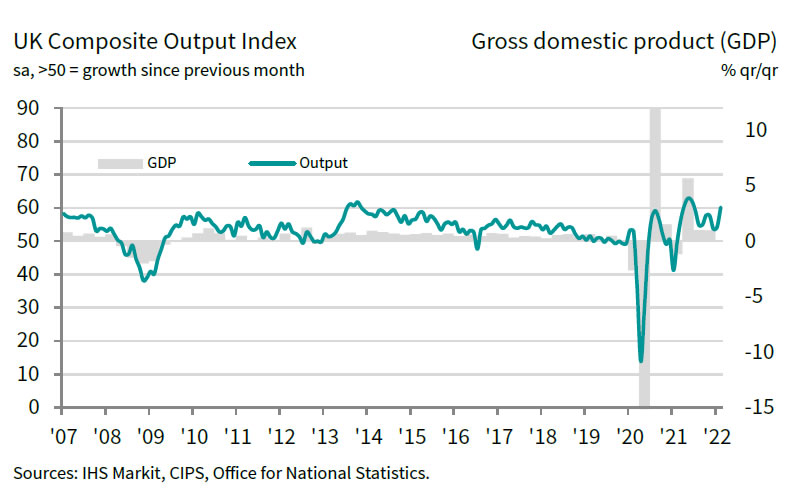
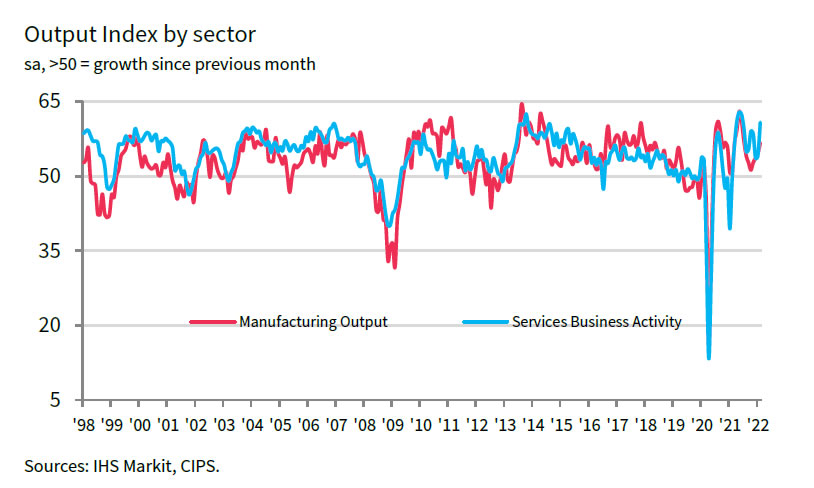
UK PMI Manufacturing was unchanged at 57.3 in February, below expectation of 57.5. PMI Services surged from 54.1 to 60.8, above expectation of 55.2, an 8-month high. PMI Composite rose from 54.2 to 60.2, also an 8-month high.
Chris Williamson, Chief Business Economist at IHS Markit, said:
"The latest PMI surveys indicate a resurgent economy in February, as business activity leapt as COVID-19 containment measures were relaxed.
"With the PMI's gauge of output growth accelerating markedly in February and cost pressures intensifying to the second-highest on record, the odds of an increasingly aggressive policy tightening have shortened, with a third back-to-back rate rise looking increasingly inevitable in March.
"However, the indications of a growing plight for manufacturers will need to be watched, and the service sector's new business index will need to be monitored for signs of the demand revival losing steam. Given the rising cost of living, higher energy prices and increased uncertainty caused by the escalating crisis in Ukraine, downside risks to the demand outlook have risen."
Gold Falters Around 1,900 Mark, Bullish Mood Dubious
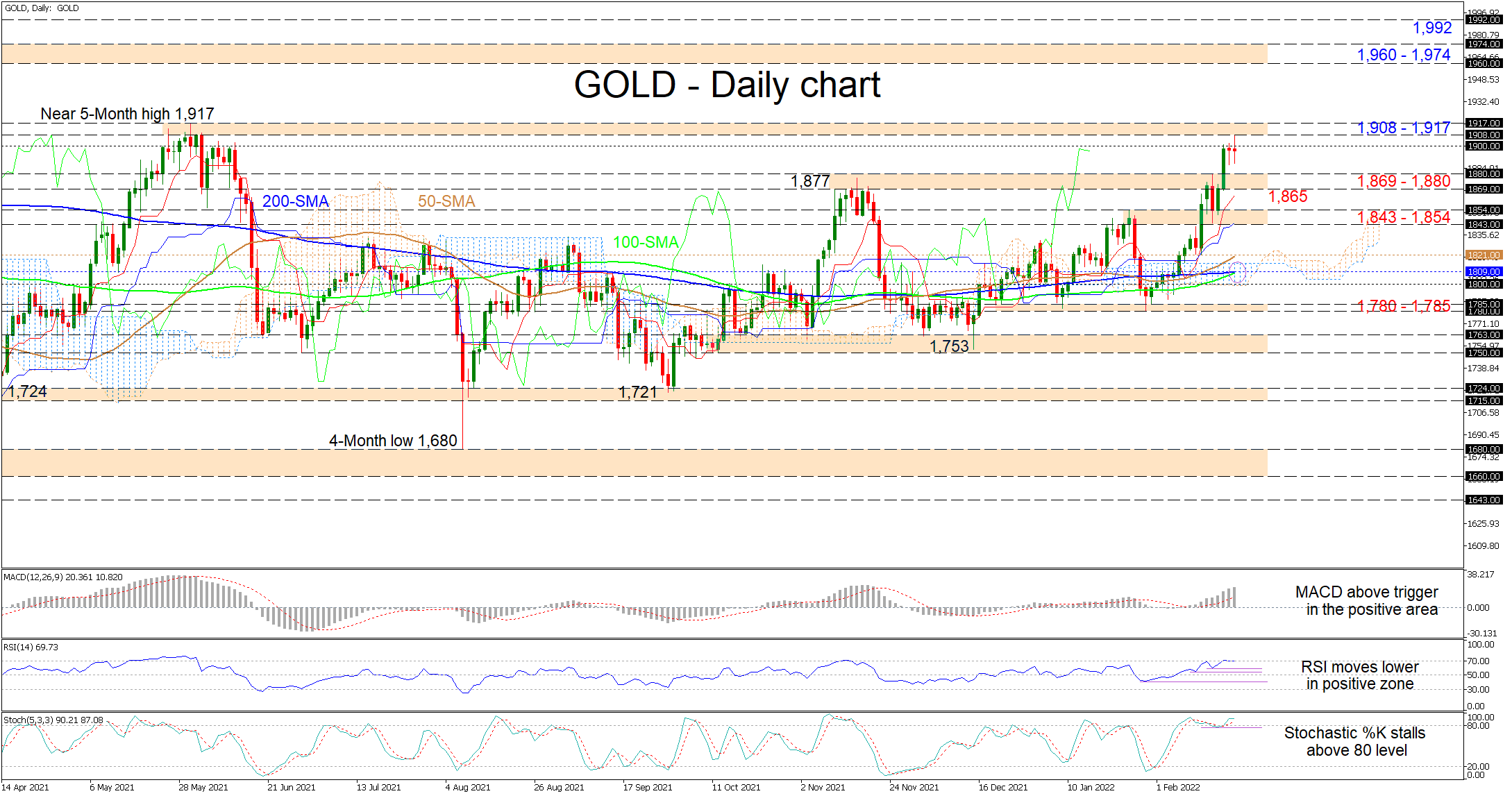
Gold in the previous trading session transmitted a bearish reversal message around the 1,900 price hurdle, following a three-week rally from the 1,780 trough. The hanging man candle formation is receiving credence with the subsequent negative candle, which until now has failed to close higher than the 1,900 barrier. However, the bullish 50- and 100-day simple moving averages (SMAs) and the near completion of a positive overlap of the 200-day SMA by the 100-day one, suggests more advances in the precious metal are still on the table.
The rising Ichimoku lines are indicating that positive forces have yet to fully abate, while the short-term oscillators are hinting of weakness in upside momentum. The MACD, some distance in the positive region, is slowing a tad above its red trigger line, while the RSI is sliding from the 70 overbought level. Furthermore, the stochastic %K line has dipped a bit in the overbought territory.
If the commodity’s price continues to fade from the 1,900 vicinity, preliminary support could commence from the 1,869-1,880 zone. In the event the price attempts to retrace even further, the approaching red Tenkan-sen line at 1,865 may interrupt the test of the 1,843-1,854 barricade. Now, should the latter obstacle also fail to dismiss negative pressures from gaining pace, the bears may then target a buffer zone extending from the 50-day SMA at 1,821 until the 1,800 hurdle.
Alternatively, if buyers re-emerge, instant upside constraints could emanate from the 1,900 border followed by the 1,908-1,917 resistance ceiling, shaped by the rally peaks around the end of May and early part of June 2021. Successfully conquering this limitation may feed the haven appeal of the yellow metal, possibly propelling the price towards the 1,960-1,974 resistance section. If bullish pressures persist and overstep the 1,960-1,974 deterrent, linked to the rally peaks from September 2020 and January 2021, the 1,992 high could then draw traders’ focus.
Summarizing, gold’s medium-term neutral bias is exhibiting a growing bullish tone and a bullish breakout above the 1,908-1,917 ceiling could see gold shine again. That said, failure to close north of the 1,900 handle could spark worries about the latest rally in the commodity.
The Kitchen Sink Trade Passed Sooner than Expected
A belated good morning from Jakarta where I am on day two of managed isolation and where, unfortunately, my hotel room’s internet ceased functioning last night. Back home in New Zealand, it’s been nearly two months since I looked at the markets closely, but the effects of the pandemic behind the Great Wall of Jacinda have been clear to see and most certainly have played out similarly in other parts of the world.
The ham-fisted quantitative easing by the Reserve Bank of New Zealand has caused one of the greatest wealth transfers in the country’s history as asset prices headed into space. I was also shocked by the increase in the cost of living which can’t just be explained away by “the pandemic.” I have spent the last two months describing New Zealand as Norway prices with Nigerian salaries. Having grossly overheated the economy, the RBNZ now faces the problem of putting the genie back in the bottle, painfully. I expect a 0.50% rate hike this week and some bashful dovish backtracking. February 2022 could be the lowest we see the New Zealand dollar for a long time.
Elsewhere, it appears that the usual “kitchen-sink” trade that usually starts the year has already played out and reversed. By this I mean that in my experience, markets usually walk into the office on January 3rd, feeling like they need to do “something” to start the new budget year. With a new budget year, the financial market group-think kitchen sink is then thrown at the trade, which works well for the first month as the herd joins in. That is followed by two to three months of being painfully squeezed out, leaving everyone square and scratching their heads by Q2.
This year the street finally listened to me and decided that rising interest rates, notably by the Federal Reserve, were a reality. The “buy everything” 2020/21 trade promptly tanked; led by stocks, cryptos, EM, and the US dollar rolled over FX markets like a Russian tank lost in Belarus. Gold and oil went bid and stayed bid, more on that later. The trade ran out of momentum in early February and sure enough, the street appears to have been squeezed out of a lot of it, even before March, leaving many asset classes in a “what now?” state.
I suspect the US yield curves refusal to price in inflation-for-longer is the main culprit, and let’s face it, there is still plenty of cash out there looking for a home as well. Although the US yield curve has moved higher as the reality of a tightening Fed threw buckets of cold water on the” cost of capital is zero per cent forever” gnomes, the long end of the US curve has refused to buckle to the inflation worries. Duration and liquidity play their part I agree, but 20-year and 30-year yields are still only 27 and 14 basis points higher than February 2021. Someone is going to be horribly wrong here at some stage.
My two months in New Zealand have left me with a sinking feeling that inflation is going to be higher and around longer than the market’s complacency/hope/group-think would have us believe. And let’s face it, a lot of governments could use a few years of inflation to inflate their pandemic borrowings away, nothing written on paper of course. That realisation and an ensuing move higher in longer-dated yields could be the schism that sees another big leg down in stocks and cryptos.
I very much doubt we will see inverse yield curves anytime soon. Nothing the Sackler Family produced has been as addictive as QE to many major central banks, notably the ECB and the BOJ, with the Fed not far behind. What should have been a last resort and tactical policy for global emergencies has become a fait accompli to keep the global asset price party rockin’, and to allow global investors to never have to take a loss, no matter how dumb the investment decision. I have no doubt that some evolution of backtracking will appear soon thereafter.
Two markets where prices have not retreated to any extent are oil and gold. That likely serves as a warning signal. A rapidly reopening world where omicron is omi-gone, unless you are Mainland China, Hong Kong or New Zealand, is supporting oil prices. More open borders, travel and overseas holidays are on the way, virus be damned. Sadly also, I have been right on the seriousness of Russia’s “exercises” on the Ukraine’s borders. Oil is unlikely to fall in this environment and it is a fertile ground for gold as a haven as well. Something Russia and China have been accumulating plenty of over the past decade. Gold’s refusal to roll over as global yields rise is a huge signal that many investors are nervous and can’t be explained away by such things as the India wedding season demand.
I have said repeatedly that 2022 would be a year of a lot more two-way price action that would make investors’ honest for the first time in years. The “buy-everything” trade is dead, long live the “buy-everything” trade. That certainly seems to be how it is playing out already and I expect to hear a lot more HODL’s in the Reddit forum and crypto space. In my day, HODL was a handy English footballer, now it’s hold on for dear life. There is only one gold element, but seemingly more cryptocurrencies than there are fiat national currencies. They can’t all supplant the current financial system. When I start hearing the word “blockchain” used by the sector, something missing in action for years, I’ll maybe start taking them seriously. In the meantime, the more HODL’s I hear, the happier I will be knowing there is just one gold.
By the way, a Russian invasion could be good for stocks. Yes, you’d want to sell everything European as 40% of its gas supply gets cut off, and yes, Brent crude will probably trade as high as $150 a barrel. Gold will make new all-time highs, the US Dollar will leap higher, and equities will get blasted initially. But on past form, the world’s central banks will immediately respond with a massive easing and a flood of liquidity. If this sounds familiar, it is, have a look at the GFC and March 2020 and the price action that followed.
In the short-term, expect markets to bounce around on Ukraine/Russia headlines. The biggest risk to Russia right now is probably that Vladimir Putin laughs himself to death at the Western response, but any “talks” headlines should spur straw-grasping rallies in markets.
Dollar Dips on Talk of Biden/Putin Meet
US/Russia summit lifts FX risk sentiment
Most of the major currencies appear to be around their year-end levels as the end of the month approaches, having weathered a US dollar storm over the first five weeks of 2022. The prospect of interest rate rises outside of the US, and a stubborn long end of the US curve has seen the US dollar retreat in the past two weeks, as the kitchen sink buy-US dollar-trade was slowly squeezed out.
Currency markets seem very much in no man’s land now leaving them vulnerable to intraday swings in sentiment creating much noise, but little direction. The noisiest corner is the Ukraine situation right now, and the in-principal summit agreement between the US and Russia today has lifted most currencies at the expense of the US dollar. The dollar index gas slipped 0.30% to 95.80 and dollar losses could continue if 95.50 fails.
Euro and sterling have risen 0.40% and 0.25% to 1.1370 and 1.3620 with resistance at 1.1400 and 1.3650. AUD/USD and NZD/USD both rode the sentiment wave higher this morning, climbing 0.50% and 0.40% higher to 0.7215 and 0.6720. 0.7250 and 0.6750 form near-term barriers.
Similarly, Asian currencies have rallied today, although more cautiously. The SGD, THB, PHP, KRW, IDR and MYR rose between 0.10% and 0.20% with the Indian Rupee set to do the same this afternoon. USD/CNY is unchanged at 6.3300 after China left the LPRs unchanged and with chat of safe-haven status doing the rounds. Fair play with a managed currency and the firepower of the Bank of China.
I will form more cohesive thoughts on currency markets in the days ahead, but nothing I am seeing today is screaming momentum and breakout. With US markets away and reducing liquidity, traders are unlikely to risk much pain on the short US dollar trade, and the threat of Ukraine headlines means choppy range-trading is likely to dominate the session.
Eurozone PMI manufacturing dipped to 58.4, but services jumped to 55.8
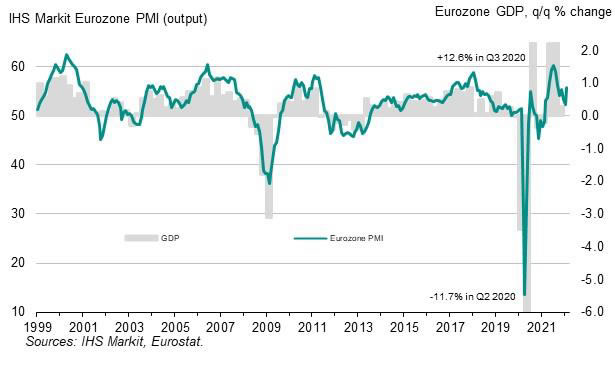
Eurozone PMI Manufacturing dipped slightly from 58.7 to 58.4 in February, below expectation of 58.7. PMI Services, on the other hand, jumped from 51.1. to 55.8, above expectation of 51.7. PMI Composite rose from 52.3 to 55.8, a 5-month high.
Chris Williamson, Chief Business Economist at IHS Markit said:
"The eurozone economy regained momentum in February as an easing of virus-fighting restrictions led to renewed demand for many consumer services, such as travel, tourism and recreation, and helped alleviate supply bottlenecks. Business optimism in the outlook has likewise improved as companies look to the further reopening of the economy, encouraging increased hiring.
"However, although easing, supply constraints remain widespread and continue to cause rising backlogs of work. As such, demand has again outstripped supply, handing pricing power to producers and service providers. At the same time, soaring energy costs and rising wages have added to inflationary pressures, resulting in the largest rise in selling prices yet recorded in a quarter of a century of survey data history.
"The strength of the rebound in business activity signalled by the PMI provides welcome evidence that the economy has so far shown encouraging resilience in the face of the Omicron wave, but the intensification of inflationary pressures will add to speculation of an increasing hawkish stance at the ECB."
Daily Technical Analysis
EUR/USD
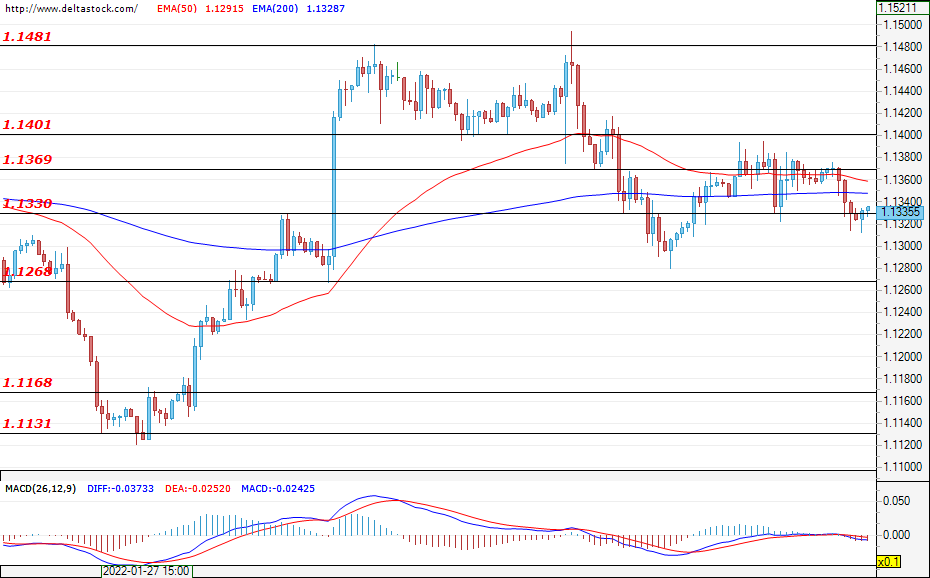
The test of the support zone at 1.1330 was not successful, and during the early hours of today`s trading, the pair is trading above the mentioned level. If the bulls prevail, then the expectations will be for an attempt to breach the resistance zone at 1.1369. If the bulls are successful and manage to breach the next target at 1.1401 as well, then we will most likely witness a rally towards the level at 1.1481. If, however, the bearish attack continues and they manage to violate the support of 1.1330, then the sell-off could easily deepen towards the important support at 1.1268. The situation in Ukraine will most likely be the main factor driving the markets during this week.
USD/JPY
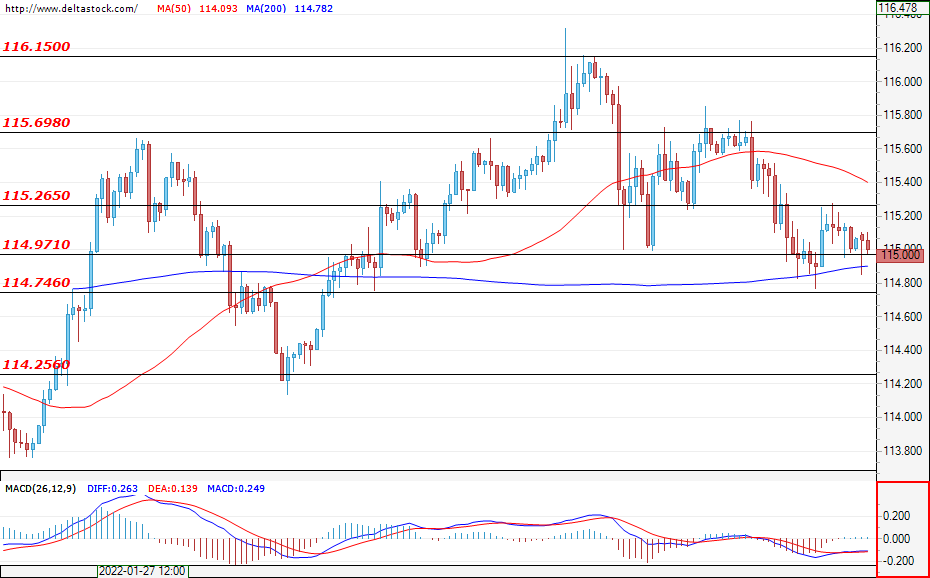
On Friday, the bulls did not gain enough momentum and the recovery was limited to the zone at 115.26. The dollar erased some of its recent gains against the yen, and at the time of writing, the pair is consolidating around the support zone at 114.97. If the bears breach the mentioned level, then a continuation of the sell-off would be the most probable scenario. Violation of the target at 114.74 should strengthen the negative expectations for the future path of the Ninja and will most likely lead to a test of the support at 114.25. The first target for the bulls is still the level of 115.26, followed by the upper resistance at 115.69.
GBP/USD
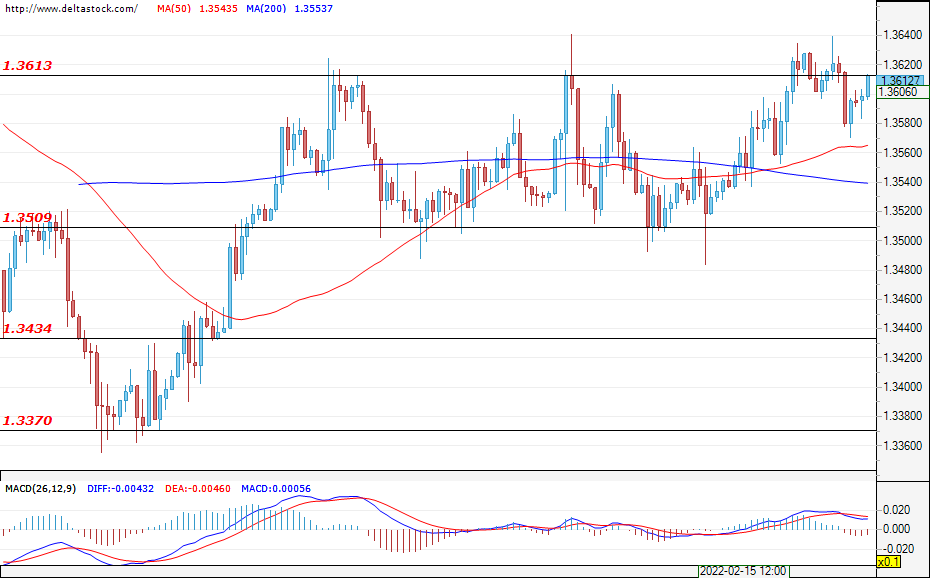
The positive sentiment remained unchanged, and during the early hours of today`s trading, the Cable is re-testing the resistance zone at 1.3613. A successful violation of the aforementioned zone could easily lead to new gains for the pound against the dollar and could help for a rally towards the upper target at 1.3650. The first support can be found at the level of 1.3509, followed by the lower zone at 1.3434.
EUGERMANY40
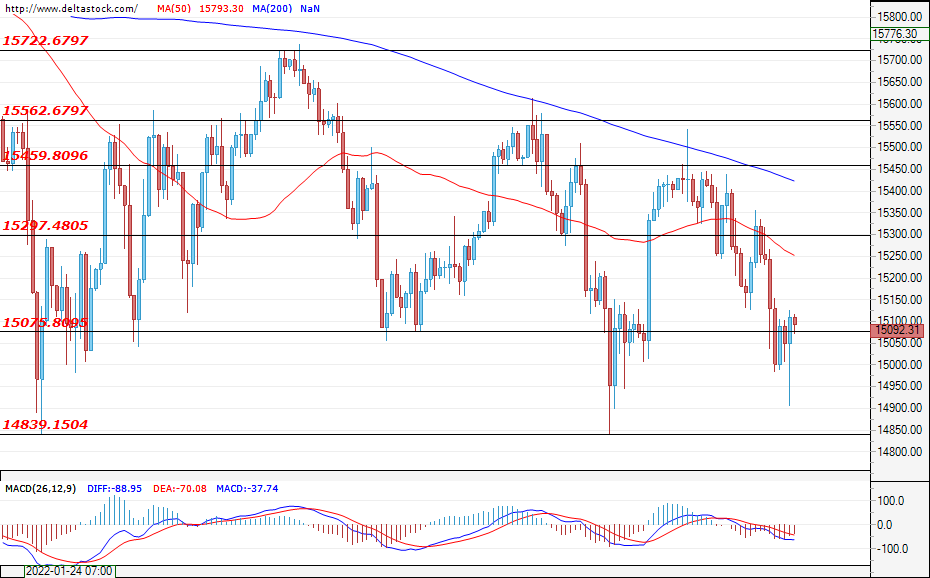
The bears could not breach the psychological level at 15000. If the bearish momentum fades and the bulls breach the resistance level at 15297, then the rally will most likely extend above 15459, drawing a more bullish picture for the index.. If the bears re-enter the market, however, then a new test and a breach of the support at 15075 will be the most probable scenario. This could easily deepen the drop, leading to a move towards the support at 14839. This week, the Russia-Ukraine conflict will be the main force driving the price action and any positive news on that front should lead to a strong rally – and vice versa.
US30
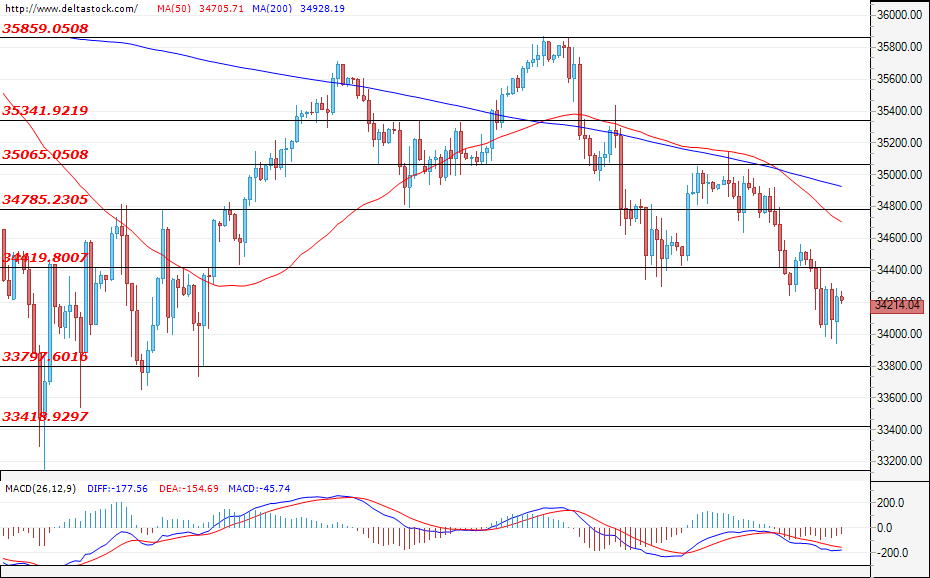
The expectations for the U.S. – Russia summit helped the U.S. index to recover from its lower open at the start of the trading week. At the time of writing, the price is hovering around 34226, and if the bulls take control, then they will most likely try to breach the level at 34419, which is currently acting as resistance. The first target for the bears is the support zone at 33797, followed by the lower level at 33418. The data for the U.S. consumer confidence (Tuesday; 15:00 GMT), as well as the initial jobless claims data (Thursday; 13:30 GMT) should lead to an increase in volatility this week.
Gold and Silver Prices Jump as Ukrainian Risks Rise
Gold has become a winner amid escalating tensions between western countries and Russia. Investors have rushed to safe havens like gold, pushing its price to the highest level since June last year. Gold has risen in 13 of the past 15 sessions and from this year’s low of $1,780 to $1,900. Analysts expect that gold could keep rising in the coming months if tensions rise. During the weekend, tensions on Ukraine kept rising as more Russian military officials continued moving closer to the Ukrainian border. Other metals like silver, platinum, and palladium have also been in an upward trend.
The euro declined on Monday morning as traders waited for key economic data from Europe. In Germany, the statistics agency will publish the latest producer price index (PPI) data. The PPI is expected to show that the PPI rose to 1.5% in January leading to a year-on-year gain of 24.2%. That will be the highest increase since the data was collected. Later, Markit will publish the flash manufacturing and services PMI numbers from Germany, France, and the European Union. Economists expect the data to show that business activity in Europe continued to do well in February as countries reopened.
The market activity will be a bit muted today since the US markets will be closed for the President’s Day holiday. Therefore, the key driver will be the tensions about Ukraine. During the weekend, President Biden warned that Putin had decided to invade Russia. Similarly, Boris Johnson warned that an attack would likely provoke one of the biggest conflicts in Europe. Another key thing to watch will be the latest interest rate decision by the Chinese central bank.
EURUSD
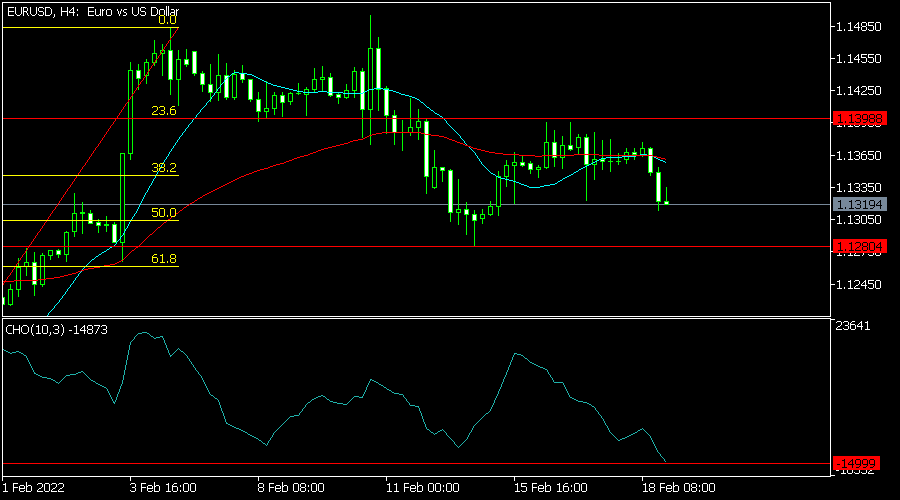
The EURUSD pair declined to a low of 1.1320, which was lower than last week’s high of 1.1400. On the four-hour chart, the pair has moved below the 25-day and 50-day moving averages while the Chaikin Oscillator has moved to the lowest level since January 26. It has also moved above the 50% Fibonacci retracement level. Therefore, the pair will likely keep falling as bears target the key support at 1.1280.
XAUUSD
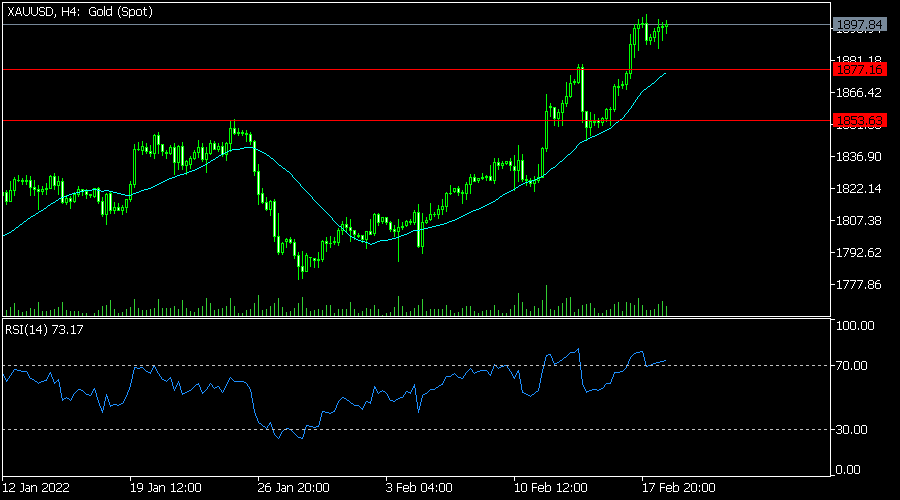
The XAUUSD pair maintained its bullish trend as investors rushed to safe havens. It is trading at 1,897, which is a few points below last week’s high of 1,900. The pair is slightly above the key level at 1,877. It also moved above the short term and long-term moving averages while the Relative Strength Index is comfortably above the overbought level. Therefore, the pair will likely keep rising this week.
GBPUSD
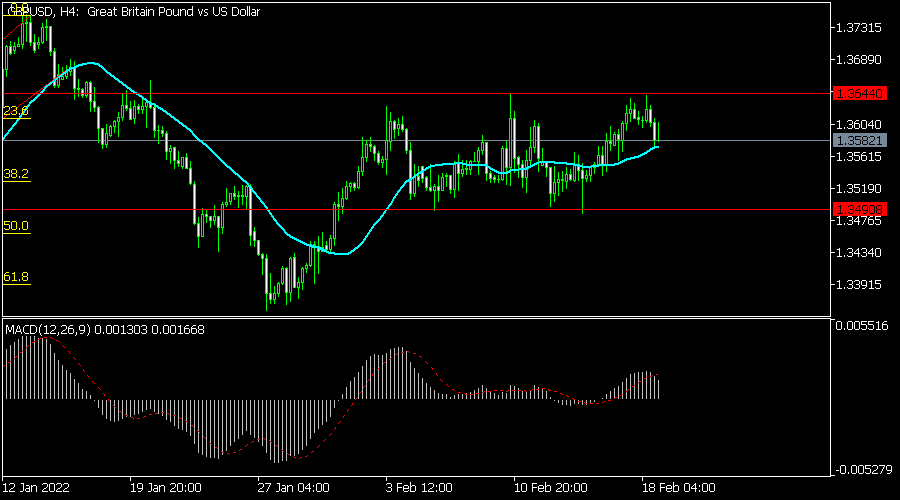
The GBPUSD pair declined slightly ahead of the latest flash PMI numbers from the UK. It is trading at 1.3582, which is lower than last week’s high of 1.3645. On the four-hour chart, the pair moved slightly below the 23.6% Fibonacci retracement level. The MACD has also formed a bearish divergence pattern. Therefore, the pair will likely keep falling, with the next key support being at 1.3550.
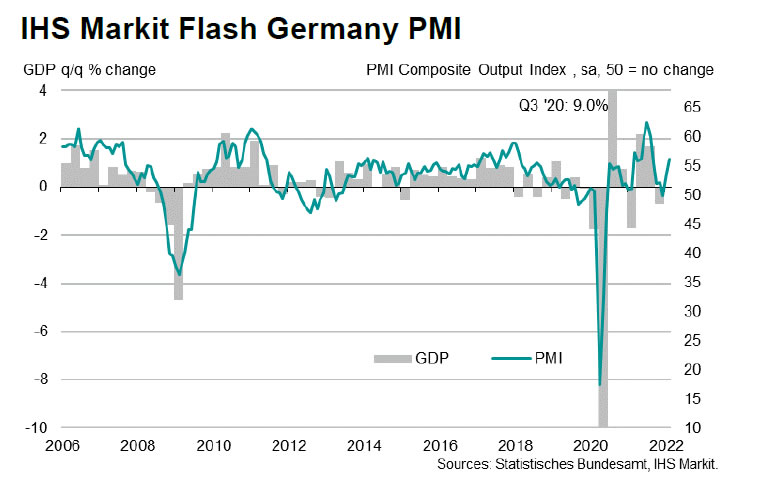
Germany PMI composite rose to 56.2, continued to regain momentum
Germany PMI Manufacturing dropped from 59.8 to 58.5 in February, below expectation of 59.4. PMI Services rose from 52.2 to 56.6 in February, above expectation of 53.2, highest in six months. PMI Composite rose from 53.8 to 56.2, also the highest in six months.
Phil Smith, Economics Associate Director, at IHS Markit said:
"The German economy continued to regain momentum in February following December's brief stagnation in output growth. Overall activity rose the most since last August, driven this time by the services sector as manufacturing production increased more slowly than in January, when it had provided the main impetus.
"Although goods production rose at a softer pace, data on new orders showed the fastest rise in six months. Moreover, supply chain pressures appeared to ease further as average lead times lengthened to the least extent since November 2020.
"Inflationary pressures remained strong, however. Overall input prices rose at a similar rate as at the turn of the year, despite the slowest rate of inflation in manufacturing for a year. Meanwhile, prices charged for goods and services increased at the second-fastest rate on record."
France PMI composite rose to 57.6, strongest since last June
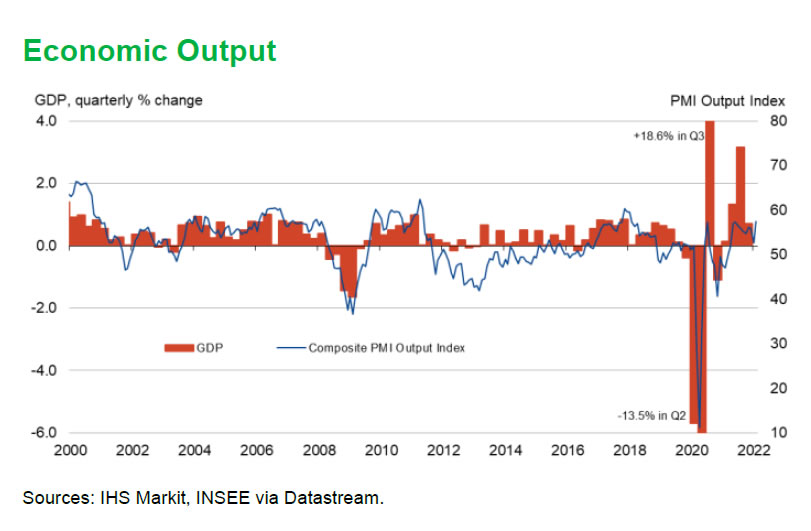
France PMI Manufacturing rose from 55.5 to 57.6 in February, above expectation of 55.5, highest in 7 months. PMI Services rose from 53.1 to 57.9, above expectation of 53.5, highest in 49 months. PMI Composite rose from 52.7 to 57.4, highest in 8 months.
Joe Hayes, Senior Economist at IHS Markit said:
"The slump in January proved to be short-lived as business activity growth accelerated sharply in February to its strongest since last June. Now that the trajectory of COVID-19 in France is on the downturn, this should continue to facilitate greater activity levels across both sectors. Indeed, anecdotal evidence from our survey panel suggests that business confidence is improving and supporting demand conditions.
"However, the economic themes for 2022 will be focused on supply chains and inflation, which seem a long way off normalising based on the latest PMI survey. Supplier delivery times lengthened sharply once again during February, while input cost inflation remains stubbornly elevated. Sources of inflation are broad – our panel members reported rising prices for a multitude of inputs, and these are now being compounded by rising utility costs and wages.
"We're still yet to see these issues dent output, demand and employment, but it will take prudent macroeconomic management from policymakers to alleviate supply-side pressures without harming the demand-side of the economy."
Focus turns to Europe today since the US remains closed
Markets
The Ukrainian conflict with Russia continued to set the tone on financial markets. Reports of some 190k troops having amassed near Ukraine’s borders shattered market hopes for a diplomatic way out even as the US’s and Russia’s foreign ministers agreed to talk further this week. European stocks eased about 1%. The Nasdaq (-1.23%) underperformed in the US ahead of the long weekend (US on Monday closed for President’s Day). Core bonds gained with the German Bund outperforming despite more ECB members (Kazimir, Vasle) arguing for faster policy normalization. The curve bull steepened with yields dropping 4.9-5.6 bps in the 2y-5y and 3.9 bps in the 10y. The latter neared a first support level just below 0.20%. US yields fell -0.1 bps (2y) to -5.2 bps (30y) in a bull flattening move. As with core bonds, the US dollar enjoyed save haven flows too, appreciating vs most peers. The trade-weighted DXY rose to 96.04. EUR/USD slid from 1.136 to 1.132. Other haven currencies including the yen and the Swiss franc mostly gained too. Strong UK retail sales concluded the economic update last week. The BoE is poised to hike further but much (if not all) has been discounted already. The pound gained against the euro amid risk-off nevertheless and continues to be a EUR/USD copycat. EUR/GBP drifted towards 0.833.
Japanese PMI confidence this morning came in weak amid Omicron-related restrictions (see below). The trading session is dominated however by … news on the geopolitical front. President Biden and Putin agreed to their French counterpart Macron’s proposal to meet. Most Asian-Pacific stocks still trade in the red but significantly paired the much bigger losses at the open. European futures inches half a percent higher. US Treasuries’ and German Bund’s gains evaporated. The dollar is under pressure. EUR/USD is able to recoup all of Friday’s losses (1.137). USD/JPY doesn’t make it above 115 though.
Focus turns to Europe today since the US remains closed. February PMIs in the region are likely to improve with earlier Covid restrictions having been reversed in many countries. At this time in the cycle, activity data such as the PMIs usually get more market attention but we have to admit that this hasn’t been so much the case yet. We’re keen to see whether that starts to change. A good reading in any case may reinforce current market optimism. We must add, though, that risk sentiment is very much ebbing and flowing according to the geopolitical headline of the day. Core bond yields may recover from Friday’s hit. We look for Germany’s 10y and the European 10y swap yield to find support at 0.188% and 0.77% respectively. The euro should be capable of at least maintaining current gains vs the dollar and sterling. First resistance in EUR/USD situates at 1.1386.
News Headlines
Japanese February PMI’s deteriorated significantly. The composite PMI fell from 49.9 to 44.6 with both manufacturing (52.9 from 55.4) and services (42.7 from 47.6) contributing. It’s the sharpest decline in 20 months. The omicron variant of the Covid-19 virus led to record case numbers and renewed restrictions in Japan in February. Details were weaker across the board with stronger declining output, lower orders and a weaker, though still positive, outlook. Rising input prices and material shortages, notably in fuel and metals continued to dampen private sector activity. Last month saw the strongest rise in average cost burdens since August 2008. The Japanese yen doesn’t budge this morning near USD/JPY 115.
Australian February PMI’s marked a stark contrast with the Japanese numbers. The composite PMI rebounded from 46.7 to 55.9, especially driven by the services sector (56.4 from 46.6). The manufacturing gauge rose further from 55.1 to 57.6. The easing of the (January) Omicron wave enabled a rapid return to growth for the Australian private sector. Demand and output both recovered, boding well for hiring activity in February. Shortages of input materials and labour persisted as issues for private sector firms, leading to a continued sharp increase of input prices. Selling price inflation hit a record in February. The Aussie dollar gains this morning with AUD/USD moving from 0.7170 to 0.7220 in a generally positive risk climate.