Sample Category Title
EUR/USD Daily Outlook
Daily Pivots: (S1) 1.1300; (P) 1.1338; (R1) 1.1363; More...
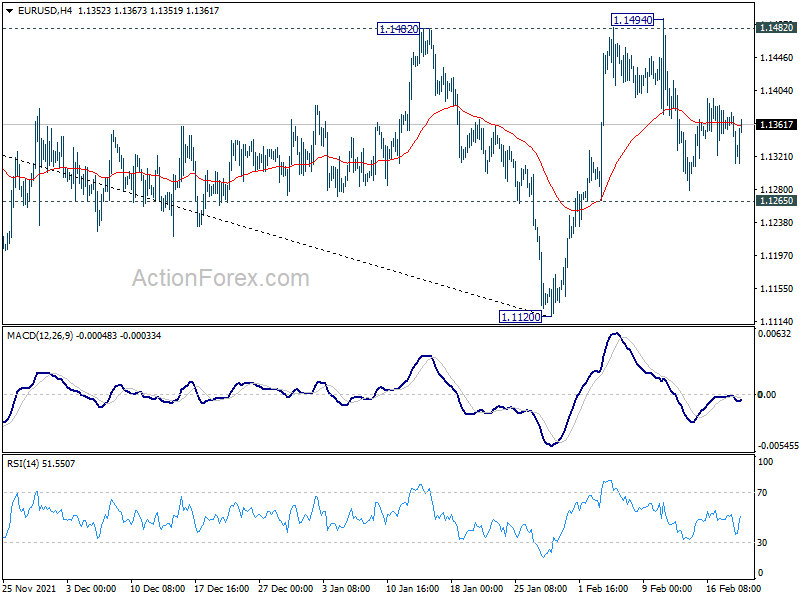
Intraday bias in EUR/USD remains neutral for the moment. On the upside break of 1.1482 will target 38.2% retracement of 1.2348 to 1.1120 at 1.1589 next. Sustained break there will argue that whole fall from 1.2348 has completed too and target 61.8% retracement at 1.1879. On the downside, however, break of 1.1265 support will dampen this bullish view and bring retest of 1.1120 low instead.
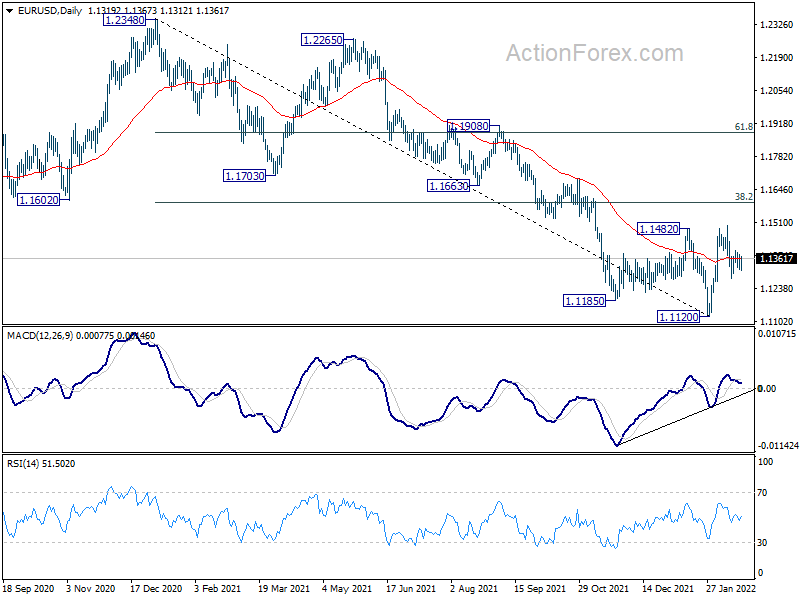
In the bigger picture, the decline from 1.2348 (2021 high) is seen as a leg inside the range pattern from 1.2555 (2018 high). Sustained trading above 55 week EMA (now at 1.1593) will argue that it has completed and stronger rise would be seen back towards top of the range between 1.2348 and 1.2555. However, firm break of 1.0635 (2020 low) will raise the chance of long term down trend resumption and target a retest on 1.0339 (2017 low) next.
GBP/USD Daily Outlook
Daily Pivots: (S1) 1.3564; (P) 1.3604; (R1) 1.3633; More...
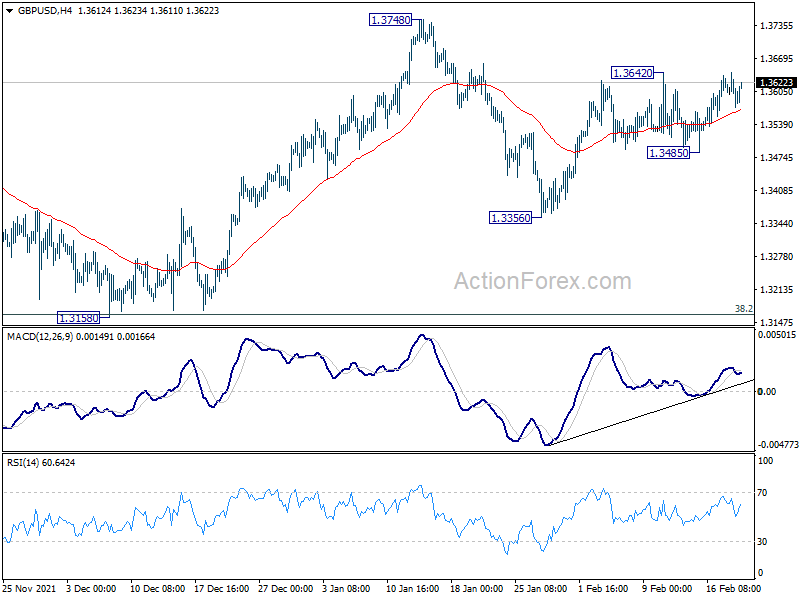
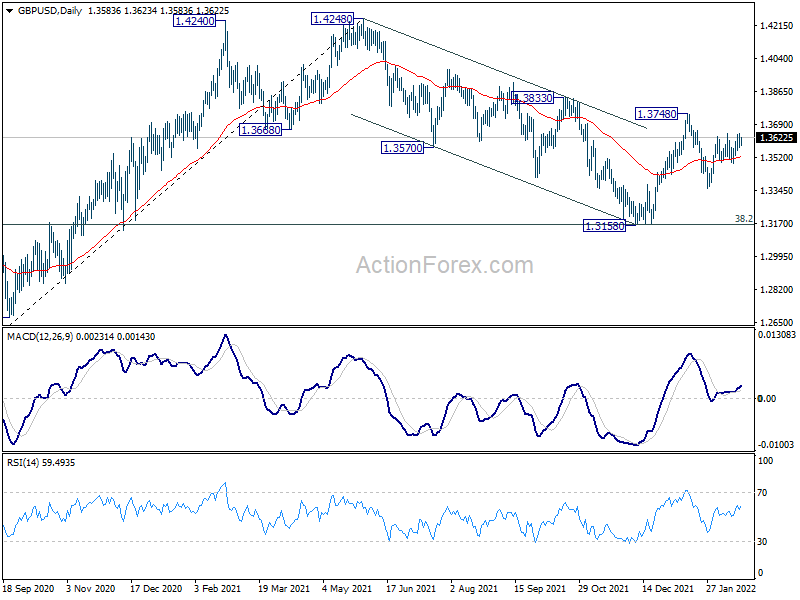
Intraday bias in GBP/USD stays neutral at this point. On the upside, break of 1.3642 will resume the rebound from 1.3356 to 1.3748 resistance. Firm break there will revive the bullish case that correction from 1.4248 has completed with three waves down to 1.3158. Further rally should then be seen to retest 1.4248 high. On the downside, though, break of 1.3485 will turn bias to the downside for 1.3356 support instead.
In the bigger picture, as long as 38.2% retracement of 1.1409 to 1.4248 at 1.3164 holds, up trend from 1.1409 (2020 low) is still in progress. On resumption, next target will be 38.2% retracement of 2.1161 to 1.1409 at 1.5134. Nevertheless sustained break of 1.3164 will argue that whole rise from 1.1409 has completed and bring deeper fall to 61.8% retracement at 1.2493.
USD/CHF Daily Outlook
Daily Pivots: (S1) 0.9197; (P) 0.9208; (R1) 0.9223; More....
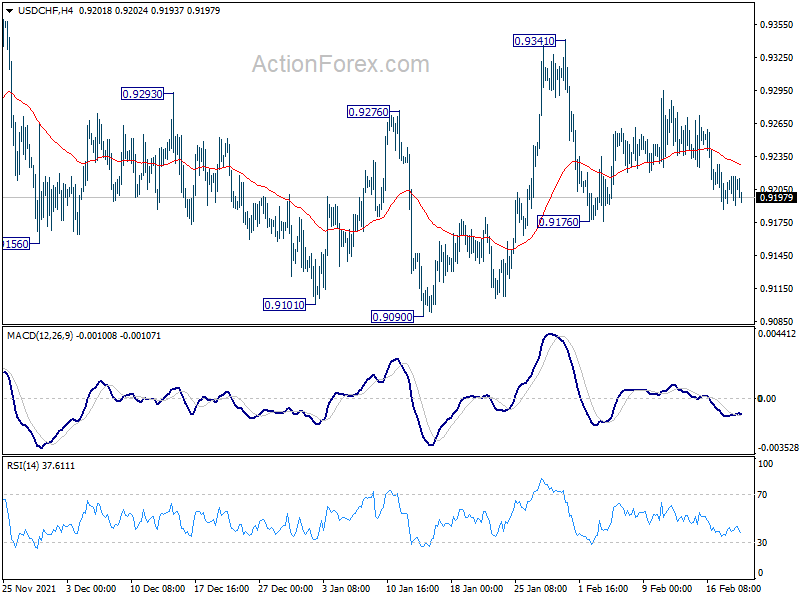
Intraday bias in USD/CHF remains neutral for the moment. Overall, further rally is mildly in favor as long as 0.9090 support holds. On the upside, break of 0.9372 will resume the choppy rally from 0.8925 to 0.9471 high. However, break of 0.9090 will turn bias back to the downside for 0.8925 support instead.
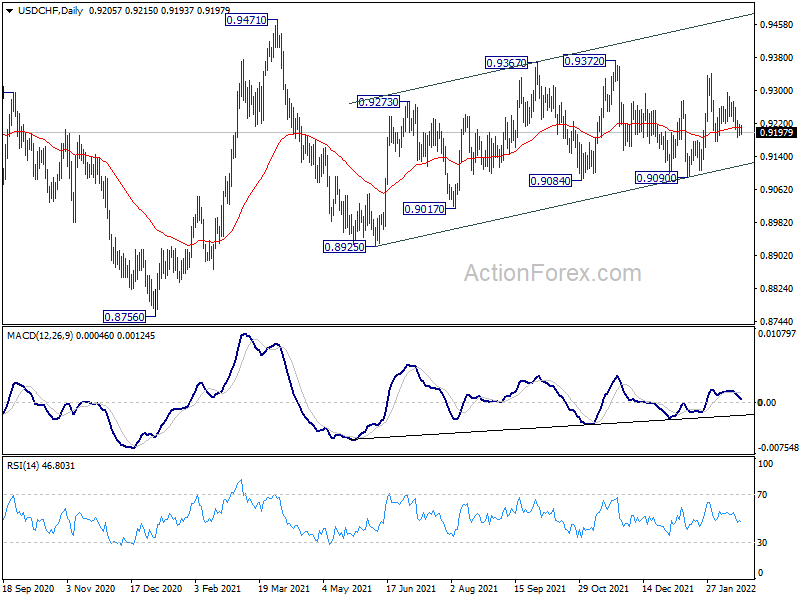
In the bigger picture, medium term outlook will be neutral at best as long as 0.9471 resistance holds. Larger down trend could still extend through 0.8756 (2021 low). However, firm break of 0.9471 will argue that the trend has already reversed and rebound the rally from 0.8756 with another impulsive move.
USD/JPY Daily Outlook
Daily Pivots: (S1) 114.79; (P) 115.05; (R1) 115.30; More...
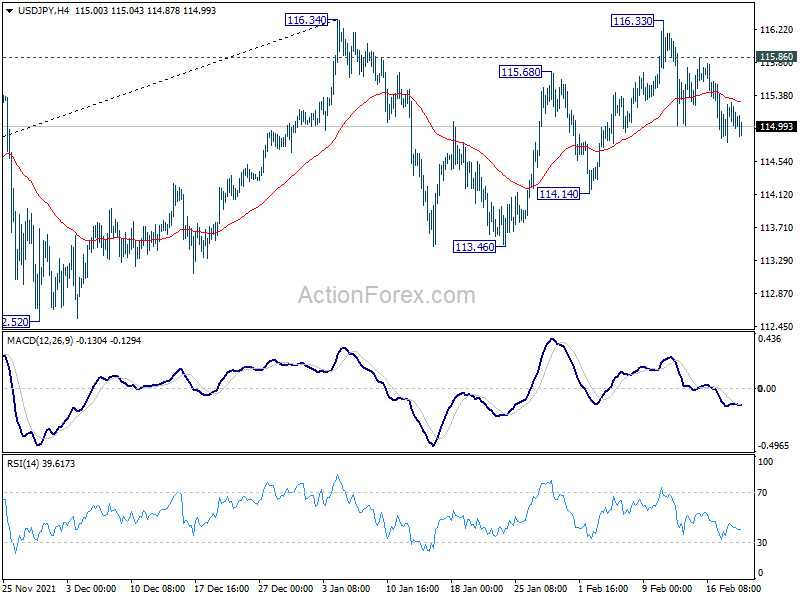
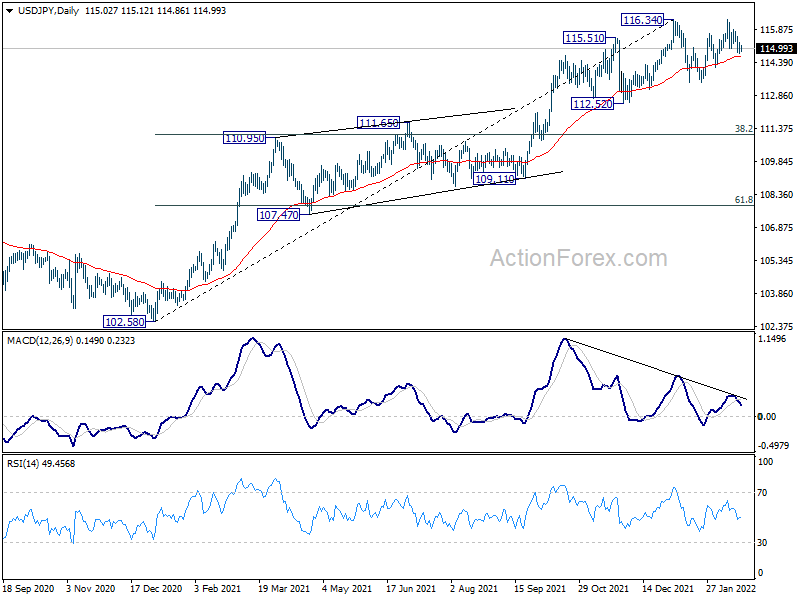
Intraday bias in USD/JPY remains mildly on the downside at this point. Fall from 116.33 is seen seen as the third leg of the corrective pattern from 116.34. Deeper decline would be seen to 114.14 support. On the upside, however, break of 115.86 will turn bias back to the upside for 116.34 resistance instead.
In the bigger picture, no change in the view that rise from 102.58 is the third leg of the up trend from 101.18 (2020 low). Such rally should target a test on 118.65 (2016 high). Sustained break there will pave the way to 120.85 (2015 high) and raise the chance of long term up trend resumption. This will remain the favored case as long as 55 week EMA (now at 111.31) holds.
USD/CAD Daily Outlook
Daily Pivots: (S1) 1.2679; (P) 1.2706; (R1) 1.2737; More...
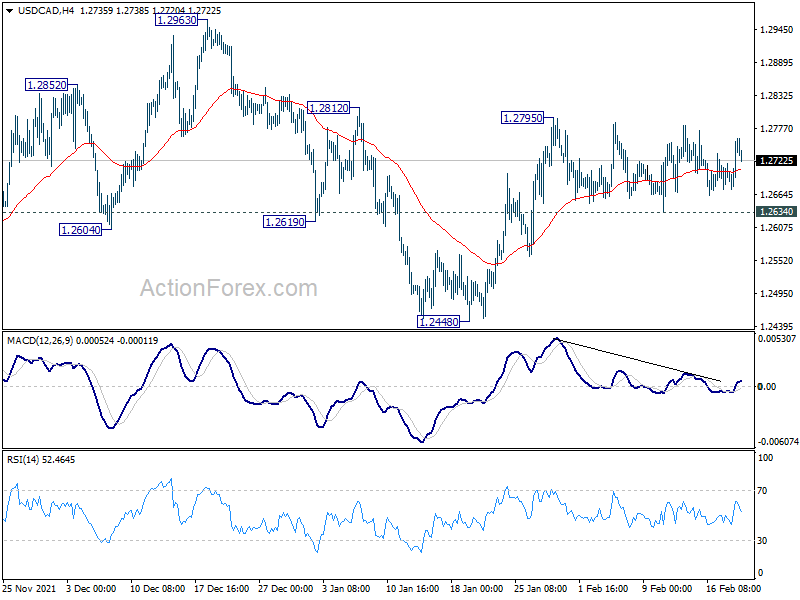
Intraday bias in USD/CAD remains neutral as consolidation continues below 1.2795. Further rise is in favor with 1.2634 minor support intact. On the upside, break of 1.2795 will resume the rally from 1.2448 to 1.2963 resistance next. However, break of 1.2634 support will turn bias back to the downside for 1.2448 support instead.
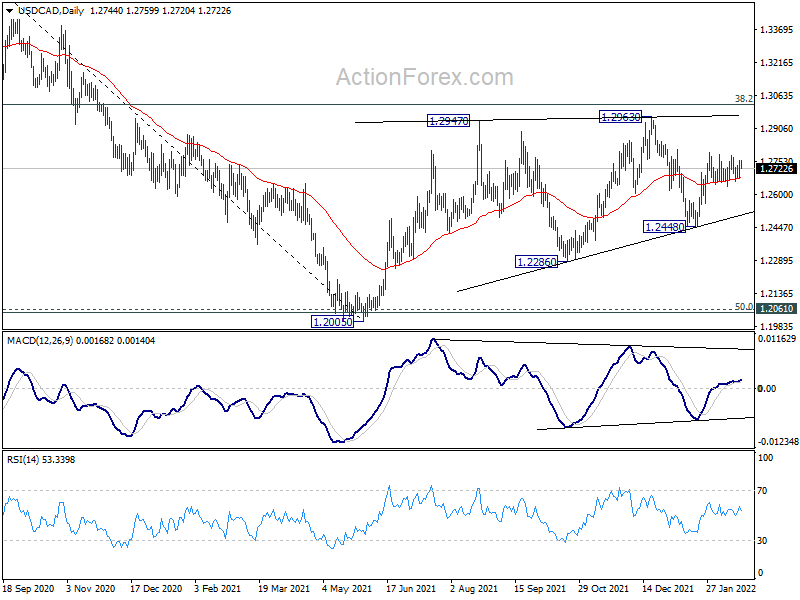
In the bigger picture, focus stays on 38.2% retracement of 1.4667 (2020 high) to 1.2005 (2021 low) at 1.3022. Sustained break there should confirm that the down trend from 1.4667 has completed after defending 1.2061 long term cluster support. Further rise would then be seen towards 61.8% retracement at 1.3650. However, rejection by 1.3022 will maintain medium term bearishness. Break of 1.2005 will resume the down trend from 1.4667 and that carries larger bearish implications too.
AUD/USD Daily Report
Daily Pivots: (S1) 0.7153; (P) 0.7190; (R1) 0.7216; More...
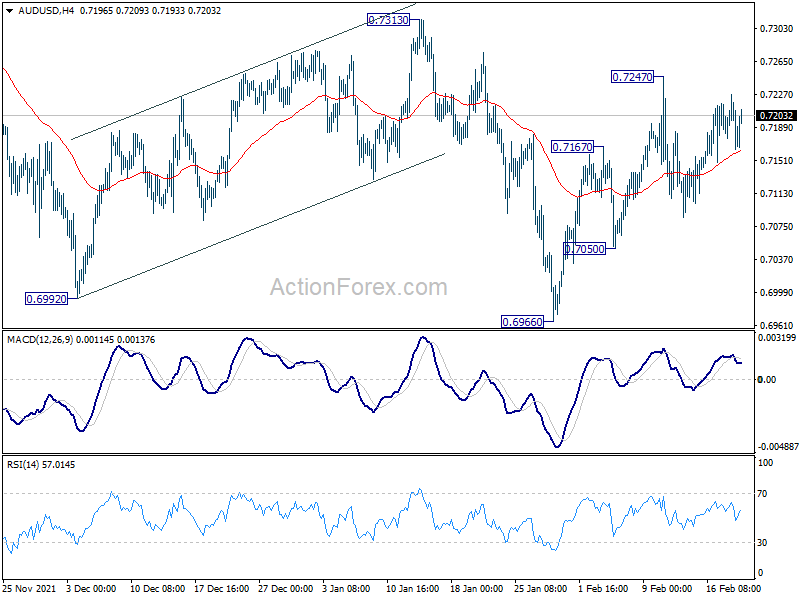
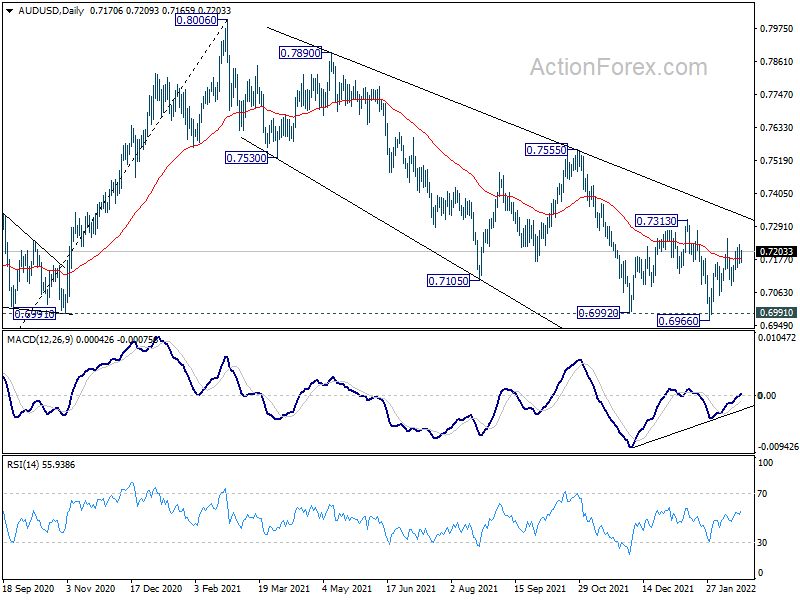
Intraday bias in AUD/USD remains neutral at this point. Further rise would remain in favor as long as 0.7050 support holds. Above 0.7247 will target 0.7313 resistance. Decisive break there argue that correction from 0.8006 has completed at 0.6966, after hitting 0.6991 key support. Outlook will be turned bullish for 0.7555 resistance next. On the downside, however, break of 0.7050 support will bring retest of 0.6966 low instead.
In the bigger picture, focus remains on 0.6991 key structural support. Sustained break there will argue that the whole up trend from 0.5506 might be finished at 0.8006, after rejection by 0.8135 long term resistance. Deeper decline would then be seen back to 61.8% retracement of 0.5506 to 0.8006 at 0.6461. Meanwhile, strong rebound from 0.6991 will retain medium term bullishness. That is, whole up trend from 0.5506 is still in progress.
Markets Steady as Biden and Putin Agreed on a Ukraine Summit
The markets are steadily mixed in Asian session today. Sentiment is stabilized somewhat on news that US President Joe Biden and Russian President Vladimir Putin have agreed in principle to a summit over Ukraine, as brokered by French President Emmanuel Macron. Nevertheless, risks of imminent war remain. For now, Aussie and Kiwi are the slightly firmer ones while Dollar and Yen are soft. But the picture could easily change on geopolitical developments. PMI data from Eurozone and UK will likely take a back seat.
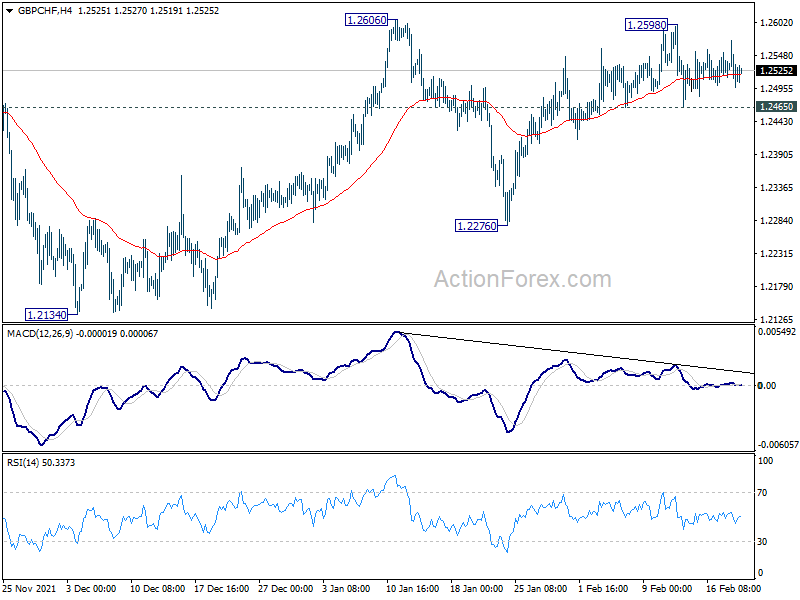
Technically, we'll keep an eye on GBP/CHF to gauge overall risk sentiment. It's so far resiliently hold above 1.2465 minor support, and further rise is still mildly in favor through 1.2598/2606 resistance. However, firm break of 1.2465 will indicate that rise from 1.2276 has completed, probably the pattern from 1.2134 too. Deeper decline would be seen back to 1.2276 support, and possibly further through 1.2134 if risk aversion intensifies.
In Asia, at the time of writing, Nikkei is down -0.86%. Hong Kong HSI is down -0.71%. China Shanghai SSE is down -0.36%. Singapore Strait Times is up 0.18%. Japan 10-year JGB yield is down -0.0061 at 0.214.
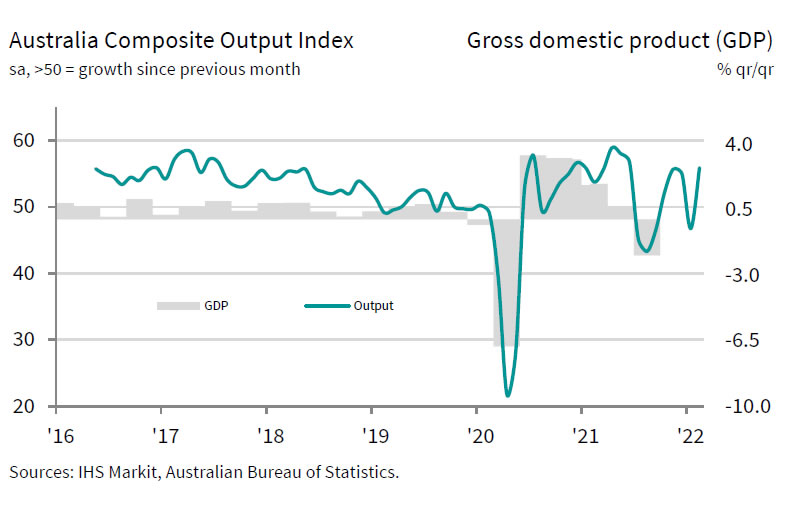
Australia PMI composite jumped to 55.9, economy bounced back quickly
Australia PMI Manufacturing rose from 55.1 to 57.6 in February. PMI Services jumped from 46.6 to 56.4, an 8-month high. PMI Composite rose from 46.7 to 55.9, also an 8-month high.
Jingyi Pan, Economics Associate Director at IHS Markit, said:
"The Australian economy bounced back quickly in February, according to the IHS Markit Flash Australia Composite PMI, after contracting sharply at the start of 2022, hit by the COVID-19 Omicron wave.
"Demand and output both returned to growth, boding well for hiring activity in February. That said, shortages of input materials and labour persisted as issues for private sector firms. This led to input prices continuing to increase sharply while selling price inflation hit a record according to the latest PMI survey. While this perhaps comes as no surprise in the initial recovery phase from the latest COVID-19 wave, the lingering impact on overall inflation and wages will have to be closely followed.
"Business confidence amongst private sector firms improved once again in February after briefly dipping in January, reflecting the short-lived nature of the latest COVID-19 wave, which was a positive sign."
Japan PMI manufacturing dropped to 52.9 in Feb, services dropped to 42.7
Japan PMI Manufacturing dripped from 55.4 to 52.9 in February, below expectation of 55.0. PMI Services dropped sharply from 47.6 to 42.7, worst reading since May 2020. PMI Composite dropped from 49.9 to 44.6.
Usamah Bhatti, Economist at IHS Markit, said:
"Activity at Japanese private sector businesses contracted sharply during February as the Omicron variant of COVID-19 led to record case numbers and renewed restrictions in Japan. The decline was the second in successive months though was the sharpest recorded for 20 months and came amid the steepest downturn in the services sector since the first wave of the pandemic in May 2020. Moreover, manufacturers signalled a reduction in output for the first time in five months, though the rate of contraction was considerably softer than that seen in the dominant services sector, and was only mild overall.
"Private sector firms also noted a decrease in aggregate new business for the first time since September, largely driven by domestic reductions while new export orders broadly stagnated. Firms continued to report that rising input prices and material shortages, notably in fuel and metals continued to dampen private sector activity. In fact, February saw the strongest rise in average cost burdens since August 2008.
"Companies were optimistic that activity would improve in the year ahead, though the continued resurgence of COVID-19 had clouded the outlook and drove optimism to a six-month low."
RBNZ to hike by 25bps or 50bps?
RBNZ is widely expected to raise interest rate by another 25bps to 1.00% this week. Though, there are some speculations of a 50bps hike. Focuses will also be on RBNZ's guidance on the rate path ahead, as well as any plan to start offloading the NZD 54B of government bonds purchased between March 2020 and July 2021.
In the UK, Monetary Policy Report hearings in the parliament will be the main focus. Governor Andrew Bailey will be scrutinized on inflation outlook, as CPI hit three decade high of 5.5% in January. Given that four MPC members actually voted for a 50bps hike at last meeting, markets are also eager to know how the hawk/dove balance is evolving.
On the data front, PMIs from Australia, Japan, Eurozone, UK and US will be featured. US consumer confidence, durable goods orders and PCE inflation could be another market mover. Germany Ifo business climate, New Zealand retail sales are also among those to be watched. Here are some highlights for the week:
- Monday: Australia PMIs; Japan PMI manufacturing; Eurozone PMIs; UK PMIs.
- Tuesday: Japan corporate services prices; UK Public sector net borrowing; Germany Ifo business climate; UK house price index, PMIs, consumer confidence.
- Wednesday: Australia wage price index, construction work done; RBNZ rate decision; Germany Gfk consumer climate; Swiss Credit Suisse economic expectations; Eurozone CPI final.
- Thursday: New Zealand trade balance; Australia private capital expenditure; US GDP, jobless claims, new home sales.
- Friday: New Zealand retail sales; Japan Tokyo CPI; Germany Gfk consumer confidence; Germany GDP final, import prices; France GDP, consumer spending; Eurozone M3 money supply; US personal income and spending, durable goods orders, pending home sales.
AUD/USD Daily Report
Daily Pivots: (S1) 0.7153; (P) 0.7190; (R1) 0.7216; More...
Intraday bias in AUD/USD remains neutral at this point. Further rise would remain in favor as long as 0.7050 support holds. Above 0.7247 will target 0.7313 resistance. Decisive break there argue that correction from 0.8006 has completed at 0.6966, after hitting 0.6991 key support. Outlook will be turned bullish for 0.7555 resistance next. On the downside, however, break of 0.7050 support will bring retest of 0.6966 low instead.
In the bigger picture, focus remains on 0.6991 key structural support. Sustained break there will argue that the whole up trend from 0.5506 might be finished at 0.8006, after rejection by 0.8135 long term resistance. Deeper decline would then be seen back to 61.8% retracement of 0.5506 to 0.8006 at 0.6461. Meanwhile, strong rebound from 0.6991 will retain medium term bullishness. That is, whole up trend from 0.5506 is still in progress.
Economic Indicators Update
| GMT | Ccy | Events | Actual | Forecast | Previous | Revised |
|---|---|---|---|---|---|---|
| 22:00 | AUD | CBA Manufacturing PMI Feb P | 57.6 | 55.1 | ||
| 22:00 | AUD | CBA Services PMI Feb P | 56.4 | 46.6 | ||
| 00:30 | JPY | Manufacturing PMI Feb P | 52.9 | 55 | 55.4 | |
| 07:00 | EUR | Germany PPI M/M Jan | 1.50% | 5.00% | ||
| 07:00 | EUR | Germany PPI Y/Y Jan | 24.20% | |||
| 08:15 | EUR | France Manufacturing PMI Feb P | 55.5 | 55.5 | ||
| 08:15 | EUR | France Services PMI Feb P | 53.5 | 53.1 | ||
| 08:30 | EUR | Germany Manufacturing PMI Feb P | 59.4 | 59.8 | ||
| 08:30 | EUR | Germany Services PMI Feb P | 53.2 | 52.2 | ||
| 09:00 | EUR | Eurozone Manufacturing PMI Feb P | 58.7 | 58.7 | ||
| 09:00 | EUR | Eurozone Services PMI Feb P | 51.7 | 51.1 | ||
| 09:30 | GBP | Manufacturing PMI Feb P | 57.5 | 57.3 | ||
| 09:30 | GBP | Services PMI Feb P | 55.2 | 54.1 |
Technical Outlook and Review
DXY:
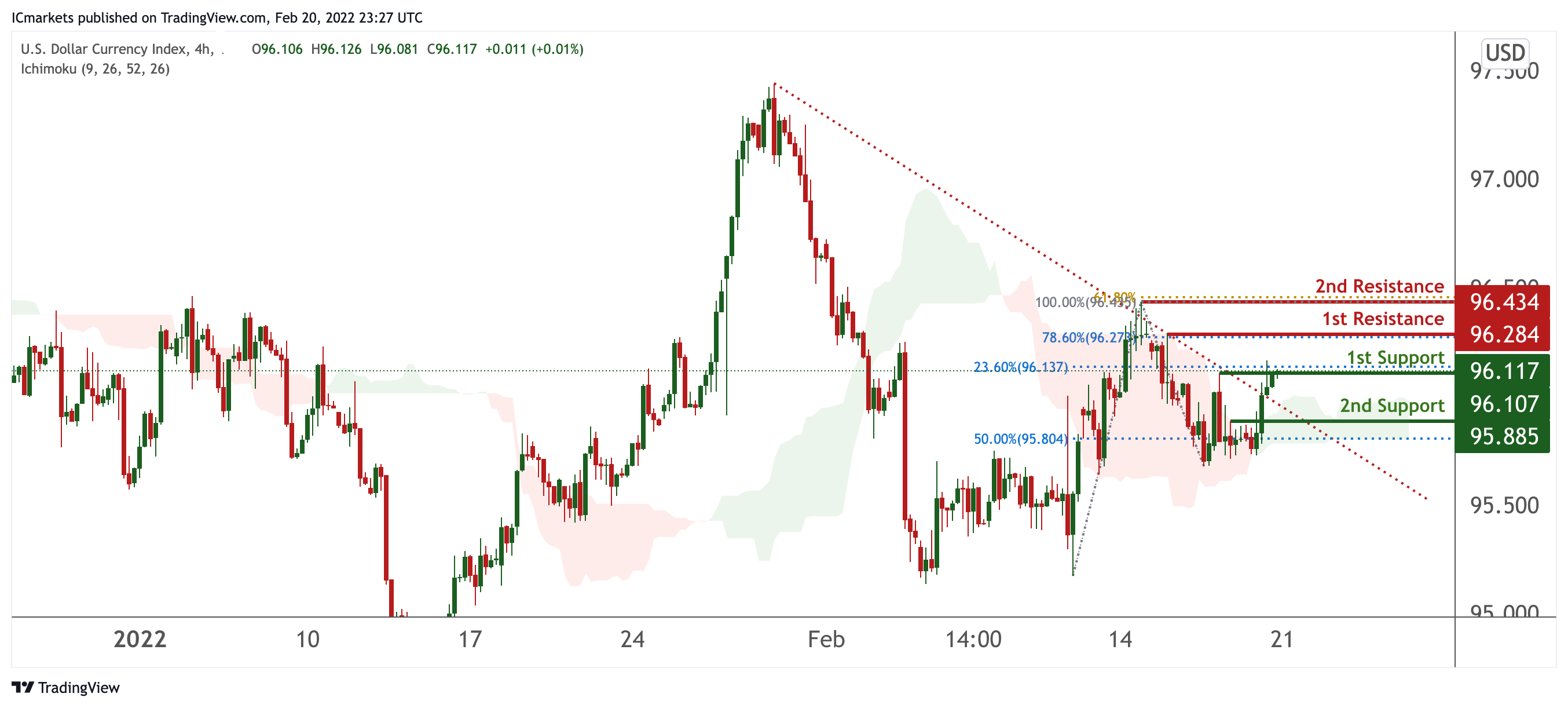
On the H4, prices are on bullish momentum and have recently broken out of our daily descending trendline. We see potential for bullish continuation from our 1st support at 96.106 in line with 23.6% Fibonacci retracement towards our 1st resistance at 97.297 in line with 78.6% Fibonacci extension. Prices are trading above our Ichimoku Cloud support, further supporting our bullish bias.
Areas of consideration:
- H4 time frame, 1st resistance at 96.284
- H4 time frame, 1st support at 96.117
XAU/USD (GOLD):
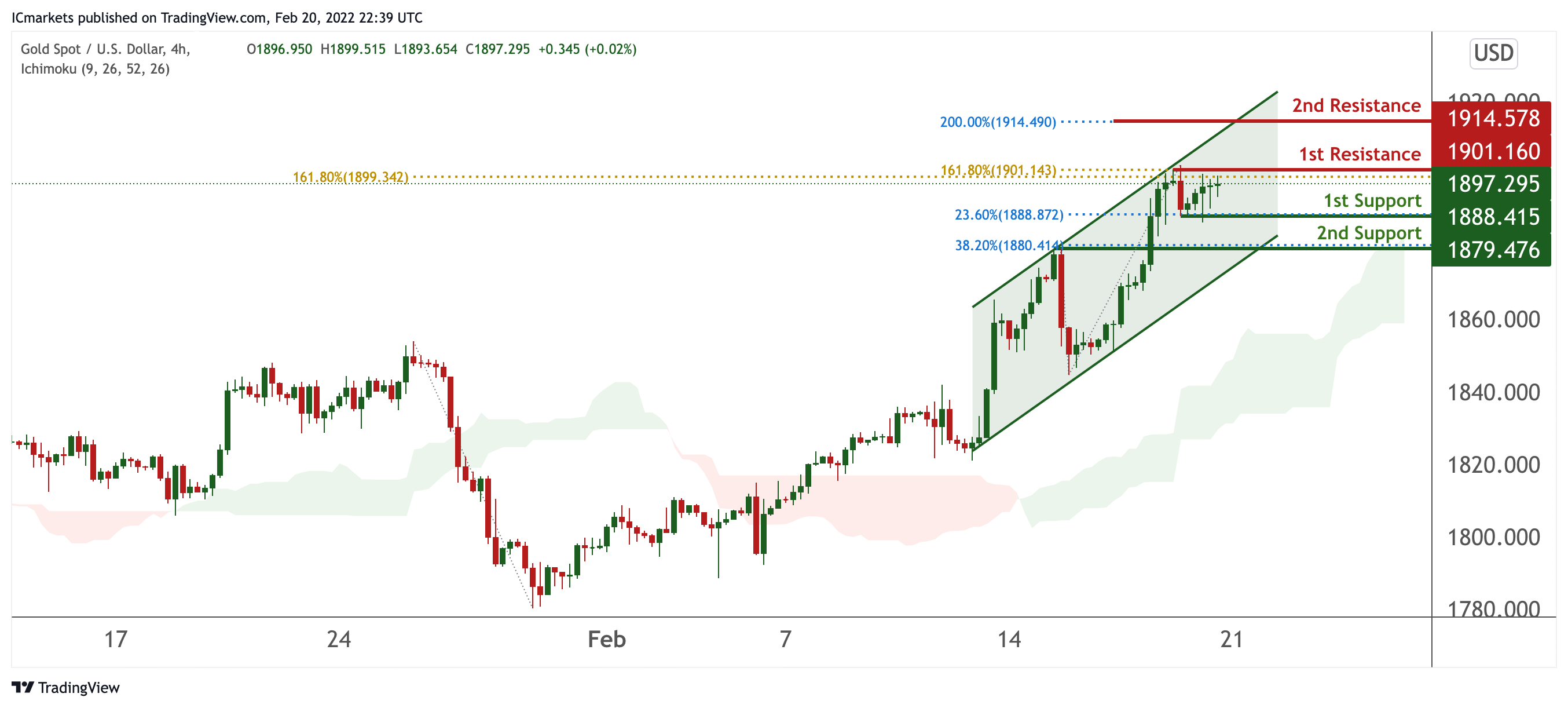
On the H4 chart, prices are on bullish momentum and abiding to our ascending channel. We see potential for bullish continuation from our 1st support at 1888.415 in line with 23.6% Fibonacci retracement towards our 1st resistance at 1901.160 in line with 161.8% Fibonacci Projection and 161.8% Fibonacci Extension. Prices are trading above our Ichimoku support, further supporting our bullish bias.
Areas of consideration:
- 4h 1st support at 1888.415
- 4h 1st resistance at 1901.160
GBP/USD
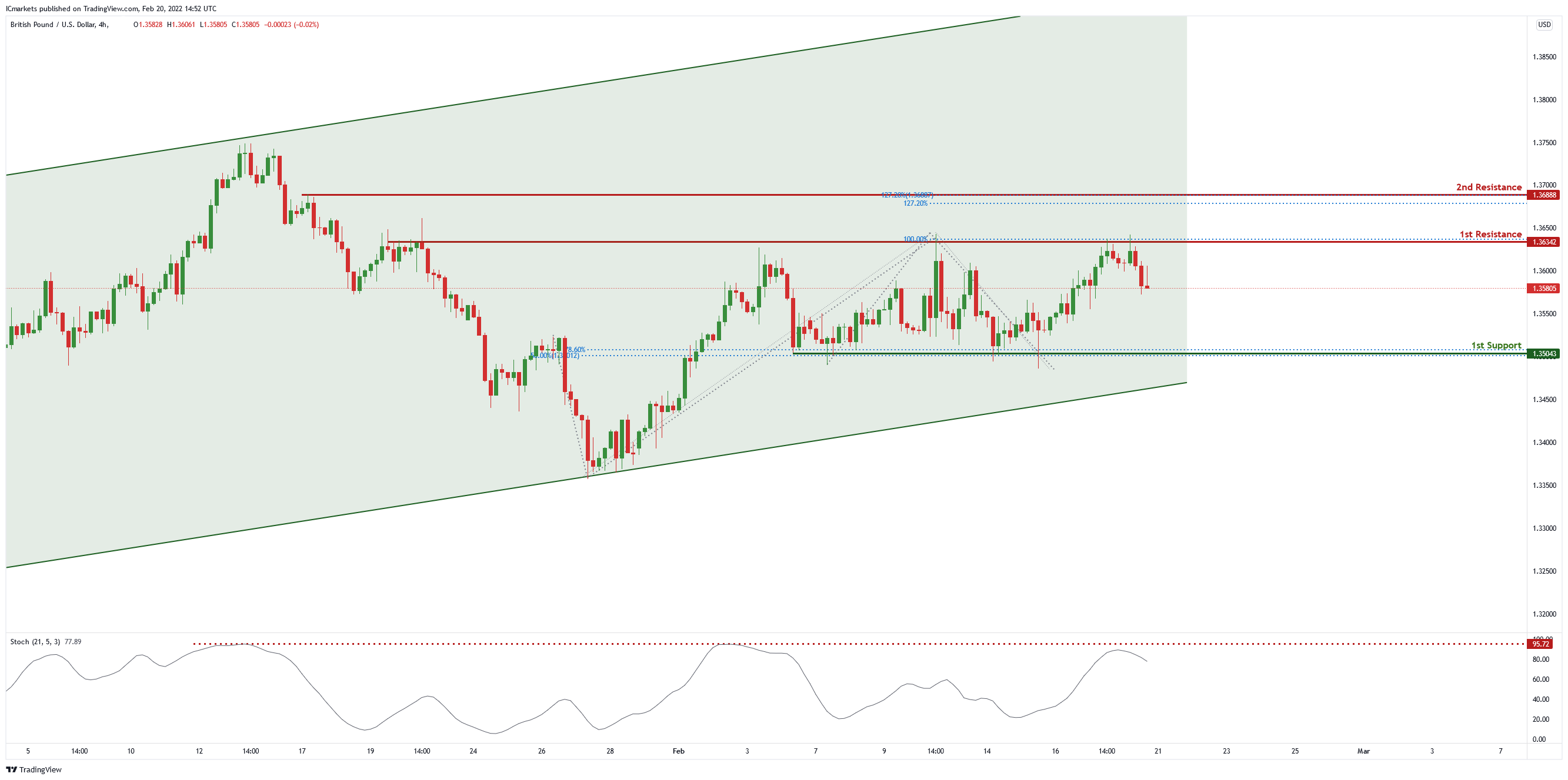
On the H4 chart , price is near 1st resistance level of 1.36342 in line with 61.8% Fibonacci retracement and 100% Fibonacci projection. Price can potentially dip to the take profit level of 1.35043 in line with 50% Fibonacci retracement and 78.6% Fibonacci projection . Our bearish bias is supported by the stochastic indicator as it is near resistance level.
Areas of consideration
- H4 1st resistance at 1.36342
- H4 1st support at 1.35043
USD/CHF:
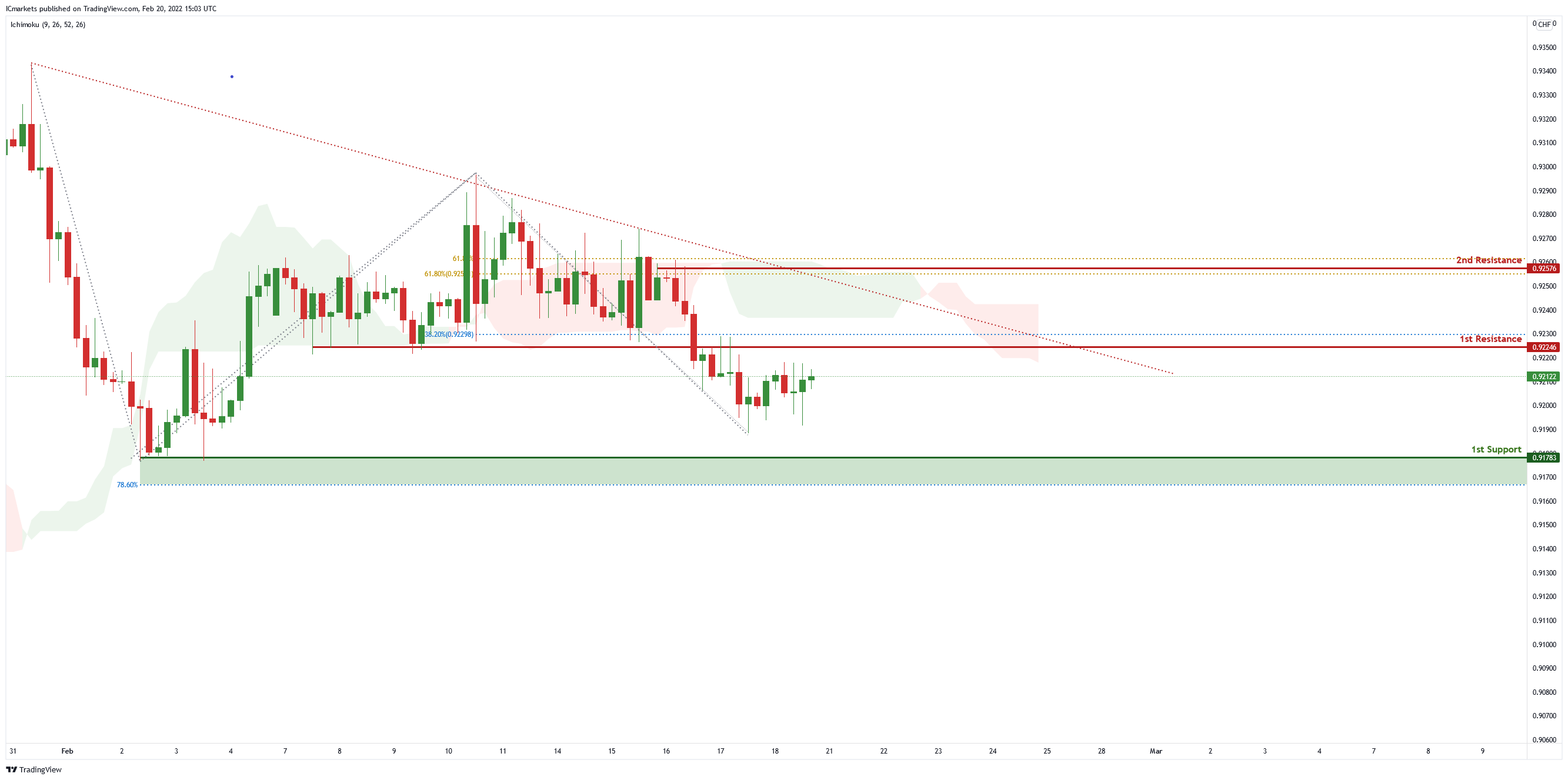
On the H4 chart, price is abiding by a descending channel and near 1st resistance level of 0.92246 in line with 38.2% Fibonacci retracement. Price can potentially dip to the 1st support level of 0.91783 in line with 78.6% Fibonacci projection. Our bearish bias is supported by the ichimoku cloud indicator as price is trading below it.
Areas of consideration :
- H4 1st resistance at 0.92246
- H4 1st support at 0.91783
EUR/USD :
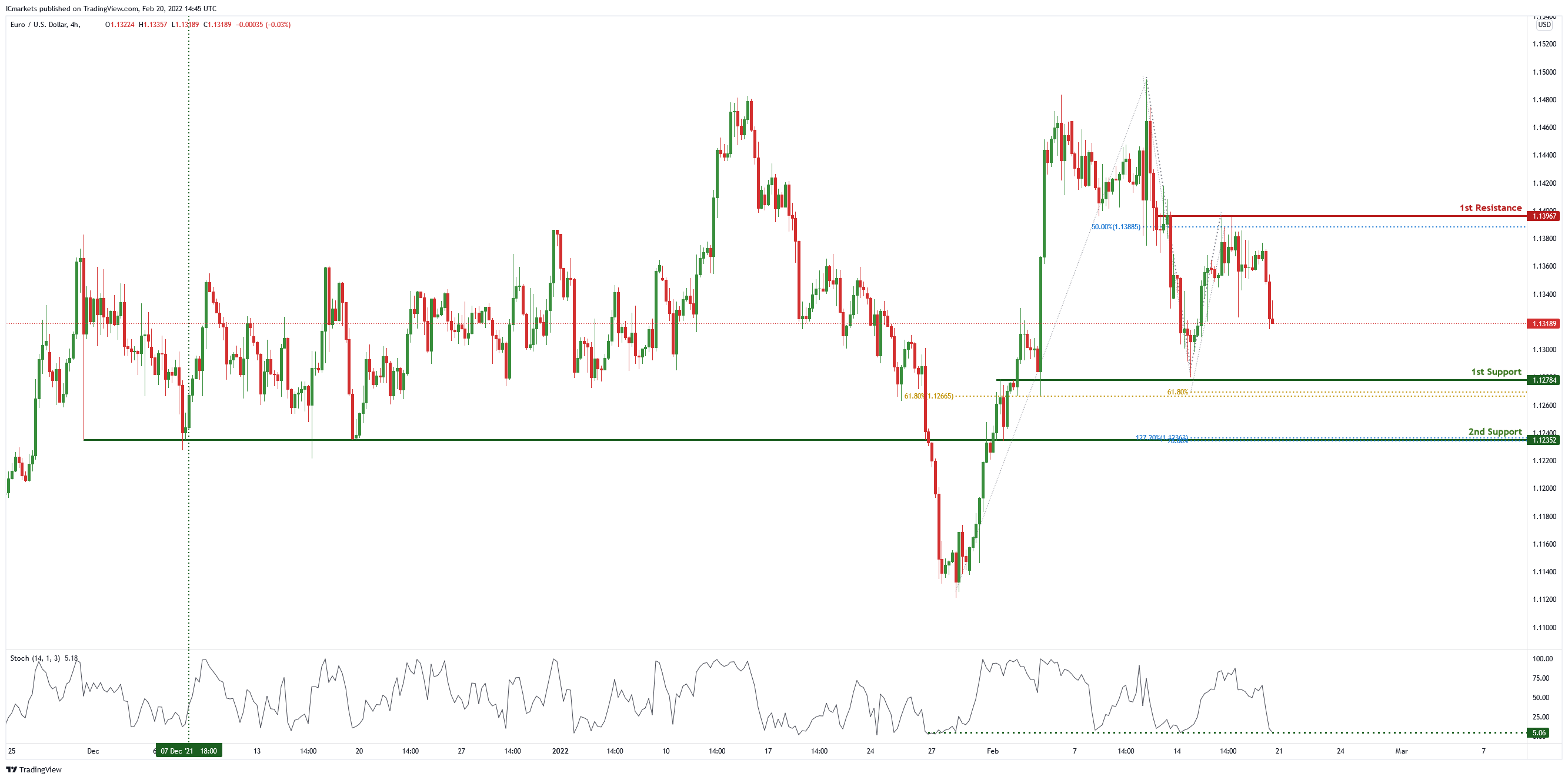
On the H4 chart price is near 1st support level of 1.12784 in line with 61.8% Fibonacci retracement and 61.8% Fibonacci projection. Price can potentially go to the 1st resistance level of 1.13967 in line with 50% Fibonacci retracement. Our bullish bias is supported by the stochastic indicator as it is at support level.
Areas on consideration :
- H4 1st support at 1.12784
- H4 1st resistance at 1.13967
USD/JPY:
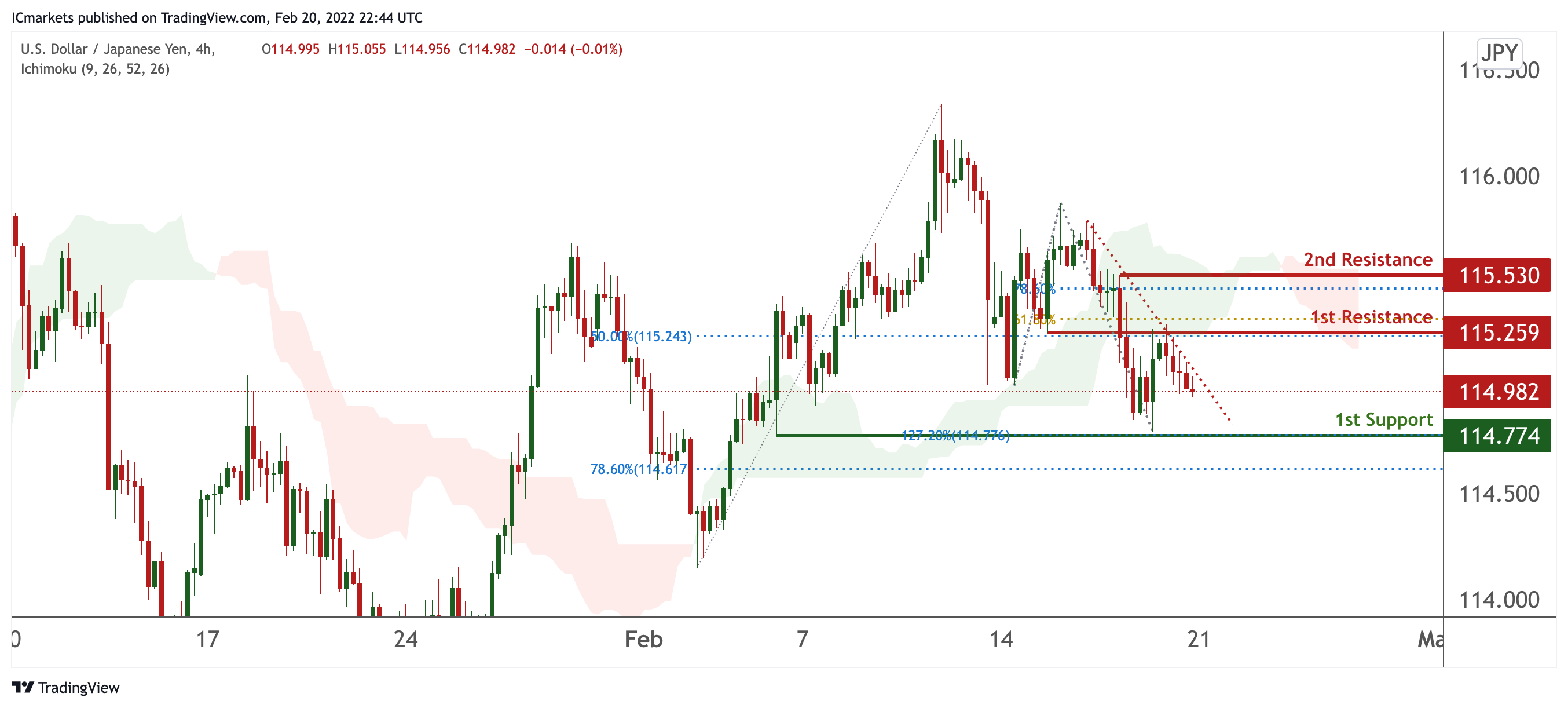
On the H4 timeframe, prices are on bearish momentum and abiding to our descending trendline. We see the possibility of bearish continuation from our 1st resistance at 115.259 in line with 61.8% Fibonacci extension and 50% Fibonacci retracement towards our 1st support at 114.774 in line with 127.2% Fibonacci extension and 78.6% Fibonacci retracement. Our bearish bias is further supported by prices trading below our Ichimoku clouds and being on bearish momentum.
Areas of consideration:
- H4 time frame, 1st resistance at 115.259
- H4 time frame, 1st support at 114.774
AUD/USD:
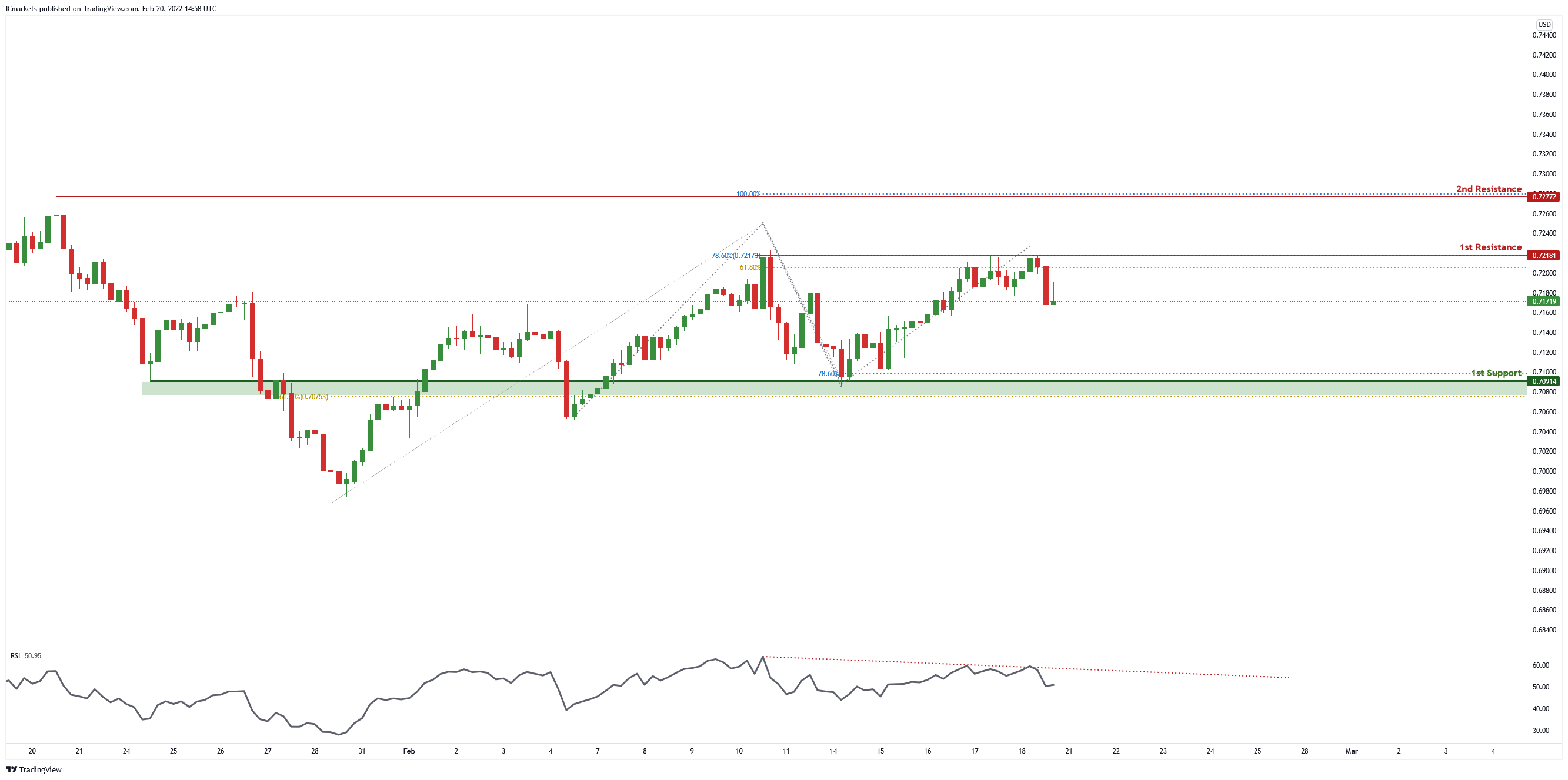
On the H4 chart , price is near 1st resistance level of 0.72181 in line with 78.6% Fibonacci projection and 61.8% Fibonacci retracement. Price can potentially dip to the 1st support level of 0.70914 in line with 78.6% Fibonacci projection and 61.8% Fibonacci retracement. Our bearish bias is supported by RSI indicator as it is abiding by a descending trendline
Areas of consideration:
- H4 1st resistance at 0.72181
- H4 1st support at 0.70914
NZD/USD:
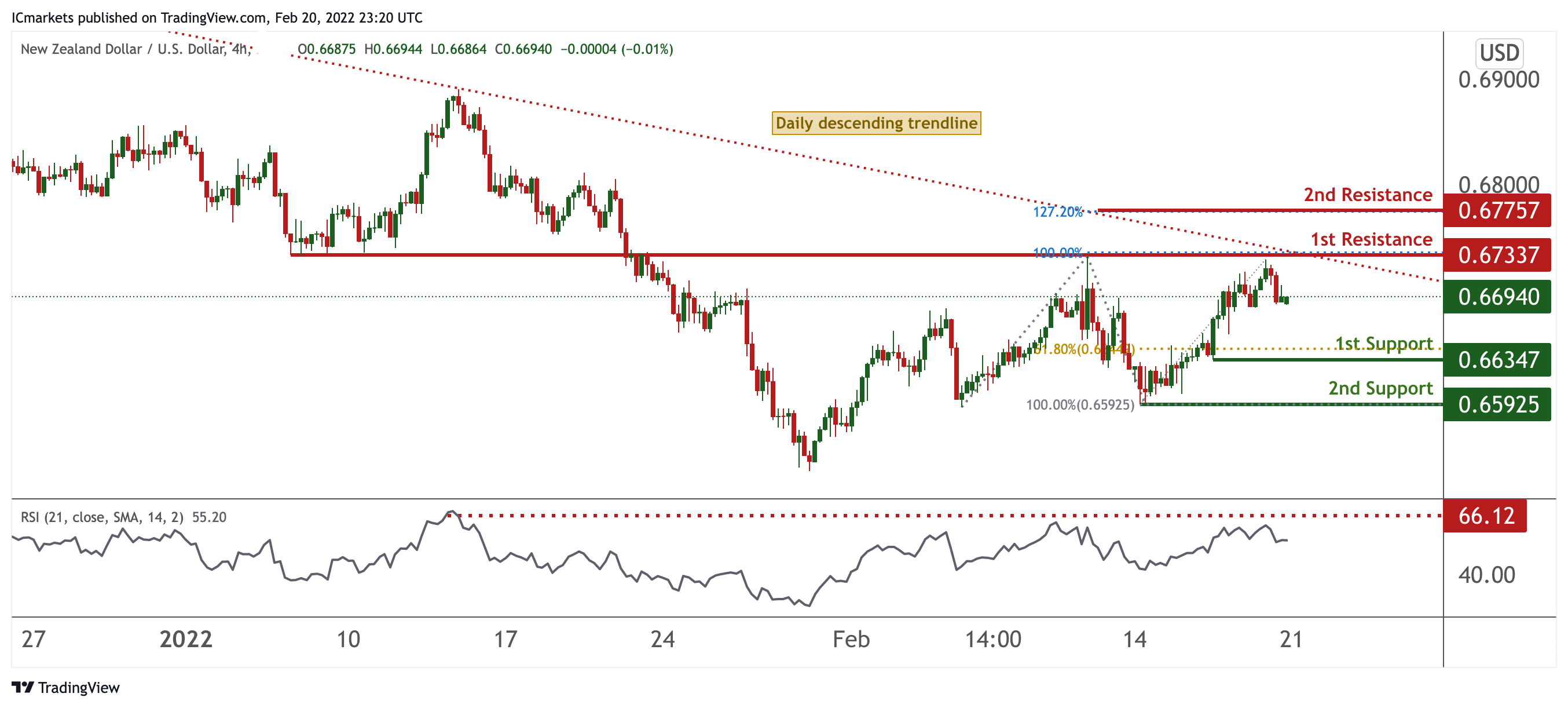
On the H4 timeframe, prices are on bearish momentum and abiding to a daily descending trendline. We see potential for a dip from our 1st resistance at 0.67337 in line with 100% Fibonacci extension and descending trendline towards 1st support at 0.66347 in line with 61.8% Fibonacci retracement. RSI are at levels where dips previously occurred, further supporting our bearish bias. Alternatively, our stop loss will be placed at 0.67757 in line with 127.2% Fibonacci extension.
Areas of consideration:
- H4 time frame, 1st resistance at 0.67337
- H4 time frame, 1st support at 0.66347
USD/CAD:
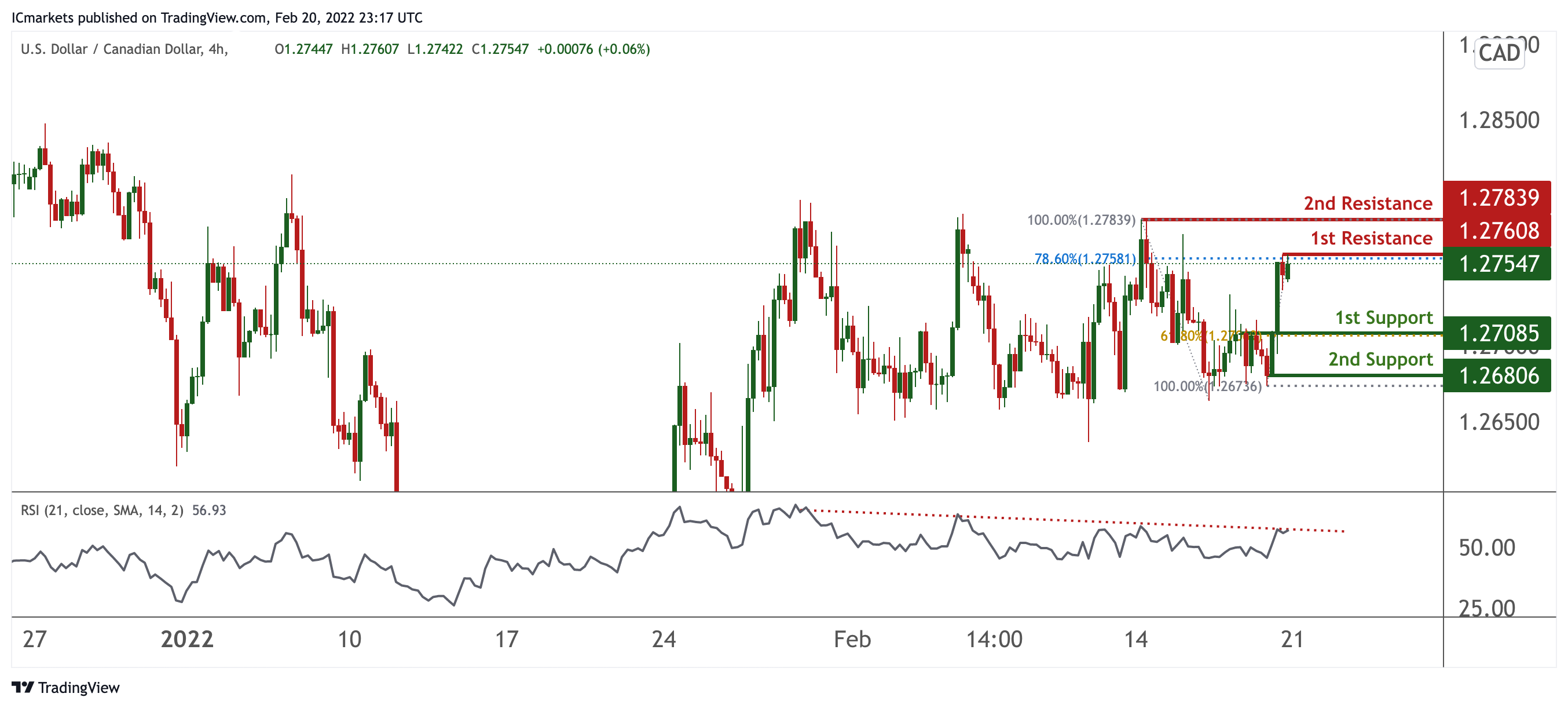
On the H4, prices are consolidating sideways. With RSI depicting bearish momentum, we can expect price to drop from our 1st resistance at 1.27608 in line with 78.6% Fibonacci retracement towards our 1st support in line with horizontal overlap support and 61.8% Fibonacci retracement at 1.27085. Alternatively, price may break 1st resistance structure and head for 2nd resistance, which coincides with horizontal swing high resistance and 100% Fibonacci retracement at 1.27839.
Areas of consideration:
- H4 time frame, 1st support at 1.27085
- H4 time frame, 1st resistance at 1.27608
OIL:
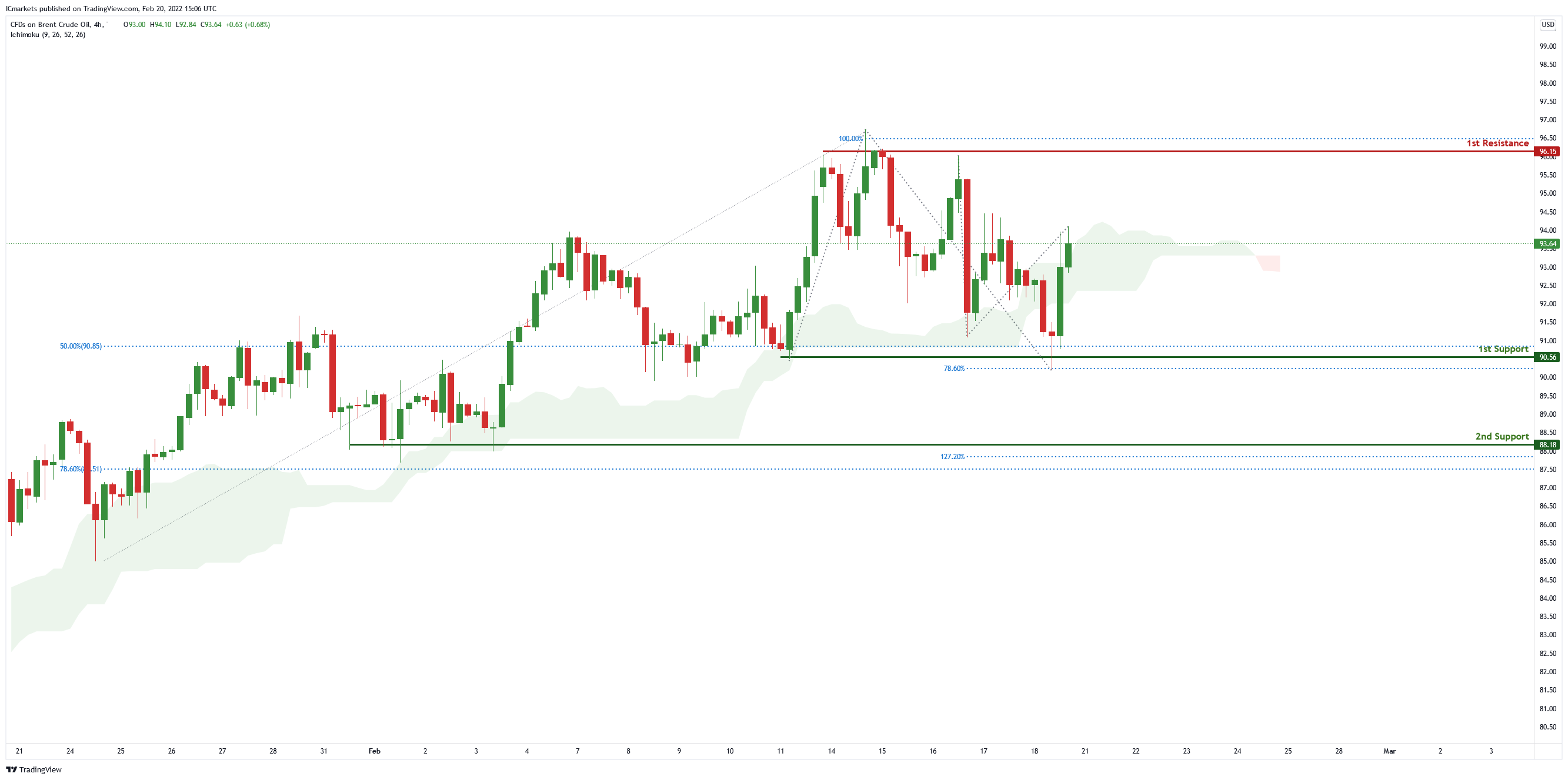
On the H4 chart , price has recently bounced off the 1st support level of 90.56 in line with 50% Fibonacci retracement and 78.6% Fibonacci projection. Price is heading towards the 1st resistance level of 96.15 in line with 100% Fibonacci projection. Our bullish bias is supported by the ichimoku cloud indicator as price is trading above it.
Areas of consideration:
- H4 time frame, 1st resistance of 96.15
- H4 time frame, 1st support of 90.56
Dow Jones Industrial Average:
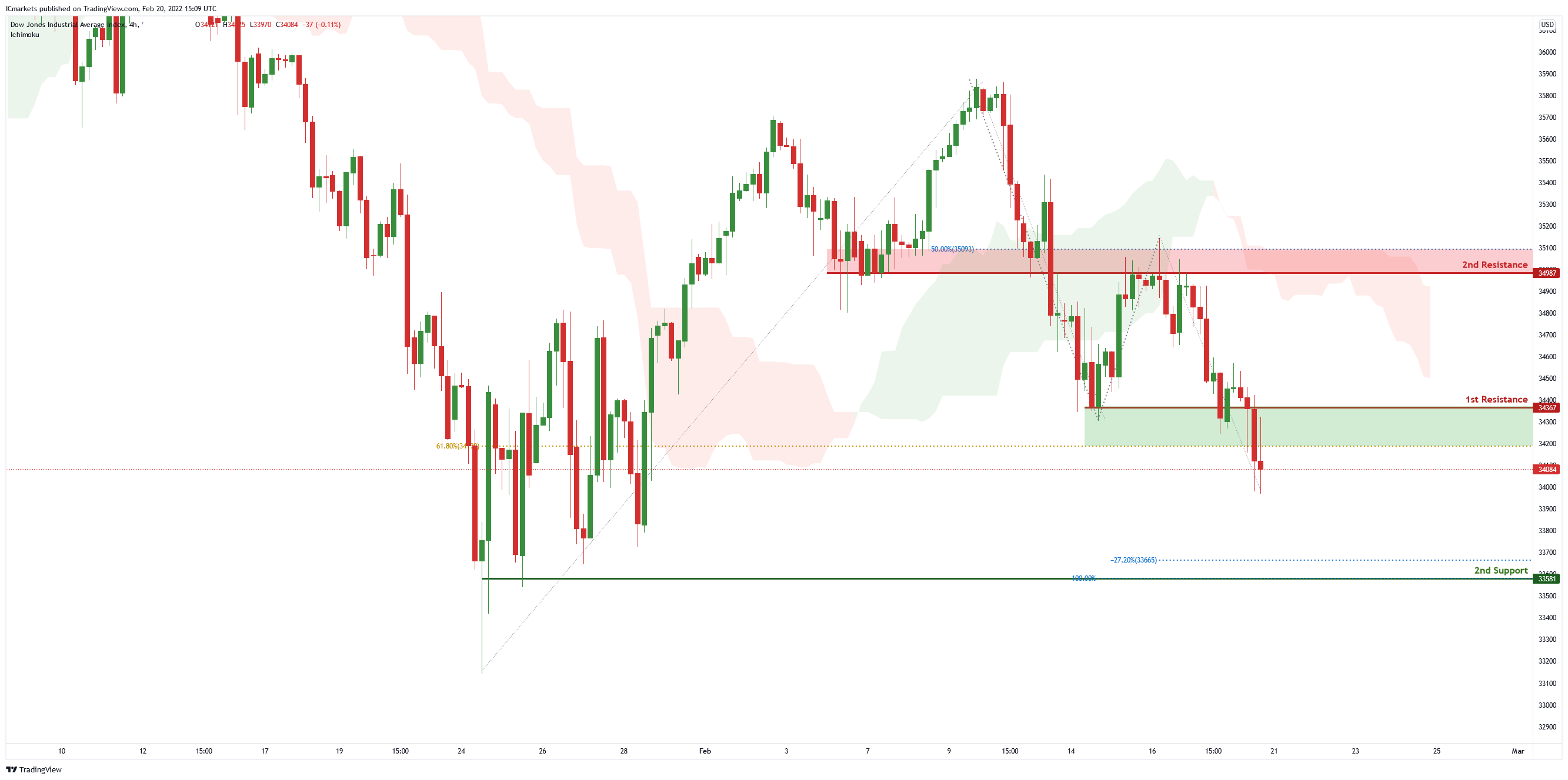
On the H4 chart price is near 1st resistance level of 34367 in line with 61.8% Fibonacci retracement. Price can potentially dip to the 1st support level of 33581 in line with -27.2% Fibonacci retracement and 100% Fibonacci projection. Our bearish bias is supported by the ichimoku cloud indicator as price is trading below it .
Areas of consideration:
- H4 1st resistance at 34367
- H4 1st support at 33581
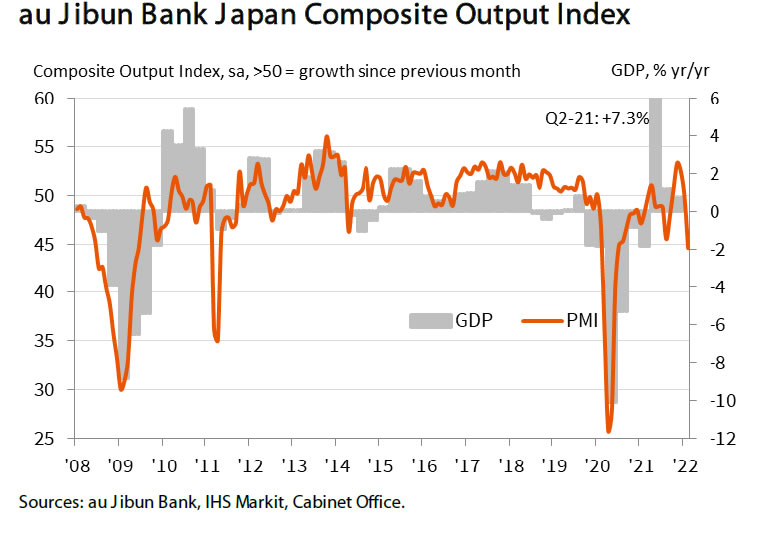
Japan PMI manufacturing dropped to 52.9 in Feb, services dropped to 42.7
Japan PMI Manufacturing dripped from 55.4 to 52.9 in February, below expectation of 55.0. PMI Services dropped sharply from 47.6 to 42.7, worst reading since May 2020. PMI Composite dropped from 49.9 to 44.6.
Usamah Bhatti, Economist at IHS Markit, said:
"Activity at Japanese private sector businesses contracted sharply during February as the Omicron variant of COVID-19 led to record case numbers and renewed restrictions in Japan. The decline was the second in successive months though was the sharpest recorded for 20 months and came amid the steepest downturn in the services sector since the first wave of the pandemic in May 2020. Moreover, manufacturers signalled a reduction in output for the first time in five months, though the rate of contraction was considerably softer than that seen in the dominant services sector, and was only mild overall.
"Private sector firms also noted a decrease in aggregate new business for the first time since September, largely driven by domestic reductions while new export orders broadly stagnated. Firms continued to report that rising input prices and material shortages, notably in fuel and metals continued to dampen private sector activity. In fact, February saw the strongest rise in average cost burdens since August 2008.
"Companies were optimistic that activity would improve in the year ahead, though the continued resurgence of COVID-19 had clouded the outlook and drove optimism to a six-month low."
Australia PMI composite jumped to 55.9, economy bounced back quickly
Australia PMI Manufacturing rose from 55.1 to 57.6 in February. PMI Services jumped from 46.6 to 56.4, an 8-month high. PMI Composite rose from 46.7 to 55.9, also an 8-month high.
Jingyi Pan, Economics Associate Director at IHS Markit, said:
"The Australian economy bounced back quickly in February, according to the IHS Markit Flash Australia Composite PMI, after contracting sharply at the start of 2022, hit by the COVID-19 Omicron wave.
"Demand and output both returned to growth, boding well for hiring activity in February. That said, shortages of input materials and labour persisted as issues for private sector firms. This led to input prices continuing to increase sharply while selling price inflation hit a record according to the latest PMI survey. While this perhaps comes as no surprise in the initial recovery phase from the latest COVID-19 wave, the lingering impact on overall inflation and wages will have to be closely followed.
"Business confidence amongst private sector firms improved once again in February after briefly dipping in January, reflecting the short-lived nature of the latest COVID-19 wave, which was a positive sign."