

Sample Category Title
GBP/JPY Weekly Outlook
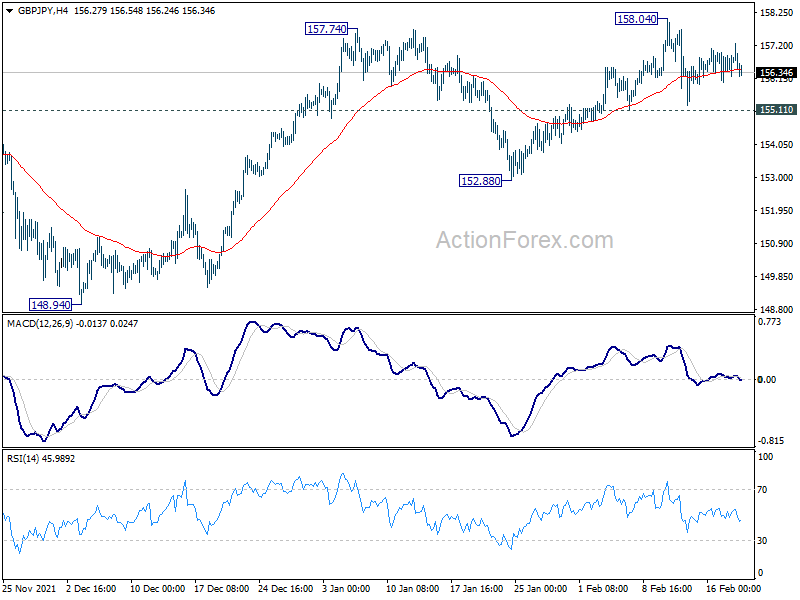
GBP/JPY stayed in range below 158.04 last week and outlook is unchanged. Initial bias remains neutral this week first. On the downside, break of 155.11 resistance should confirm rejection by 158.19 resistance. Intraday bias will be turned to the downside for 152.88 support, to extend the corrective pattern from 158.19 with another falling leg. However, on the upside, sustained break of 158.19 will resume larger up trend.
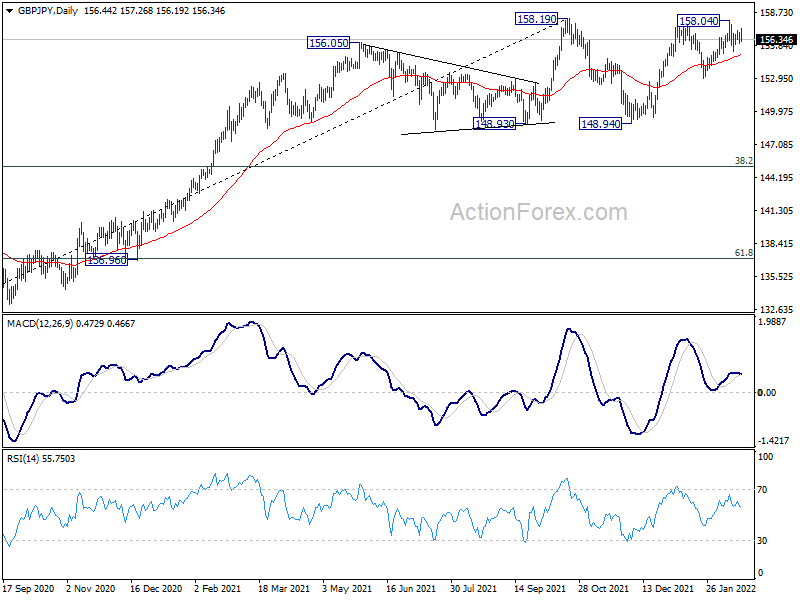
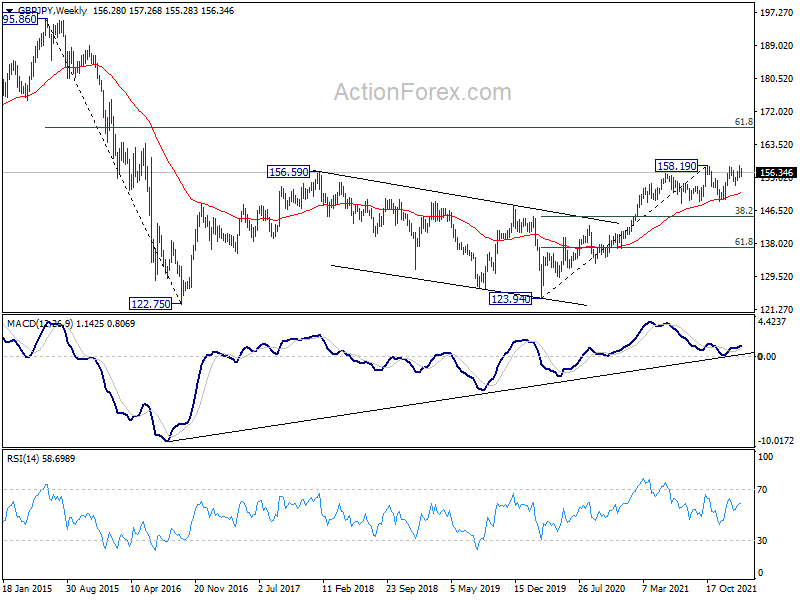
In the bigger picture, price actions from 158.19 are seen as developing into a consolidation pattern to up trend from 123.94 (2020 low). Downside should be contained by 123.94 to 158.19 at 145.10 to bring rebound. Firm break of 158.19 will resume the up trend to long term fibonacci level at 167.93. However, sustained break of 145.10 will raise the chance of trend reversal and target 61.8% retracement at 137.02.
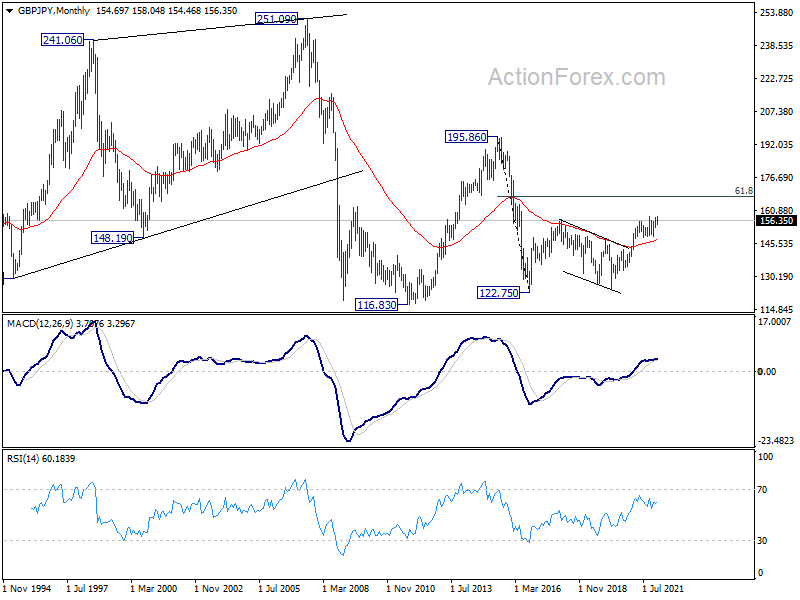
In the longer term picture, as long as 55 month EMA (now at 147.32) holds, we'd still favor more rally to 61.8% retracement of 195.86 to 122.75 at 167.93. But sustained trading below 55 month EMA will at least neutralize medium term bullishness and re-open the chance of revisiting 122.75 low (2016 low).
EUR/JPY Weekly Outlook
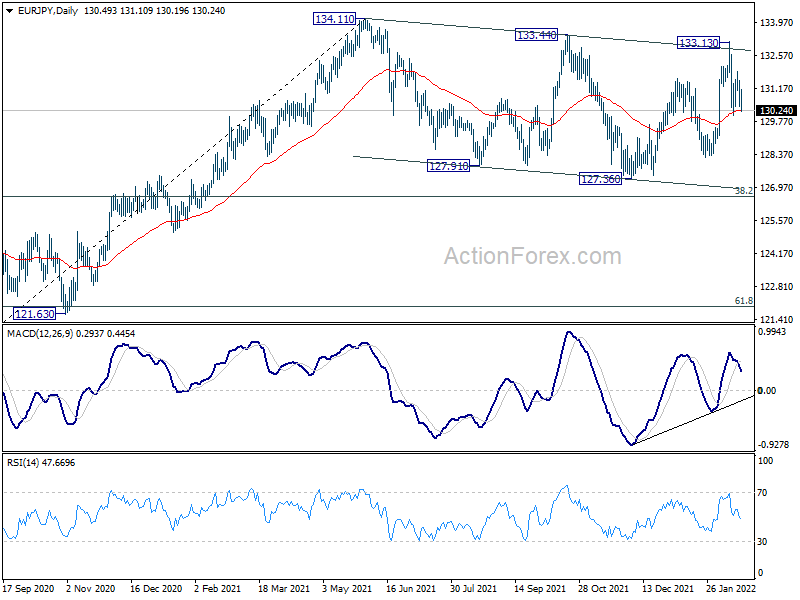
EUR/JPY recovered after dipping to 130.03 last week and initial bias stays neutral this week first. Corrective pattern from 134.11 is seen as extending with another falling leg. Break of 130.03 will bring deeper fall to 128.23 support first. Break will target 127.36 support and below. On the upside, however, break of 133.13 will bring retest of 134.11 high.
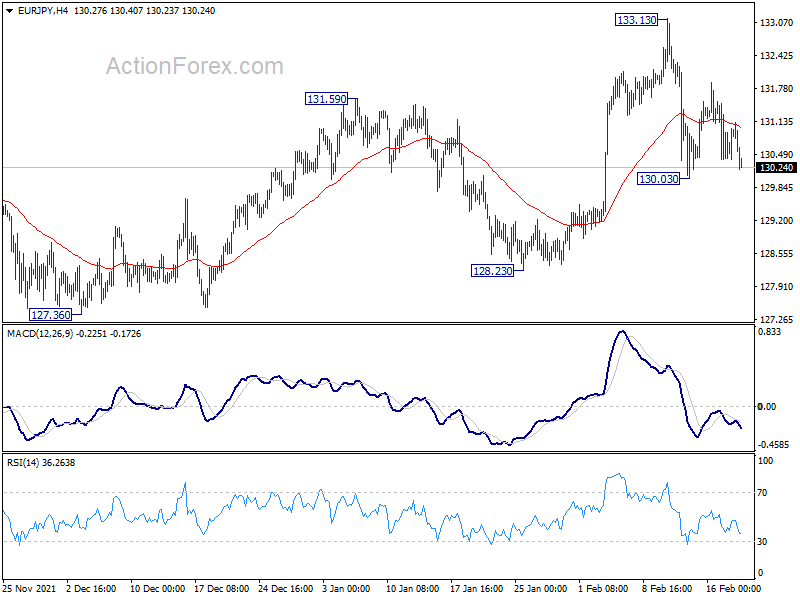
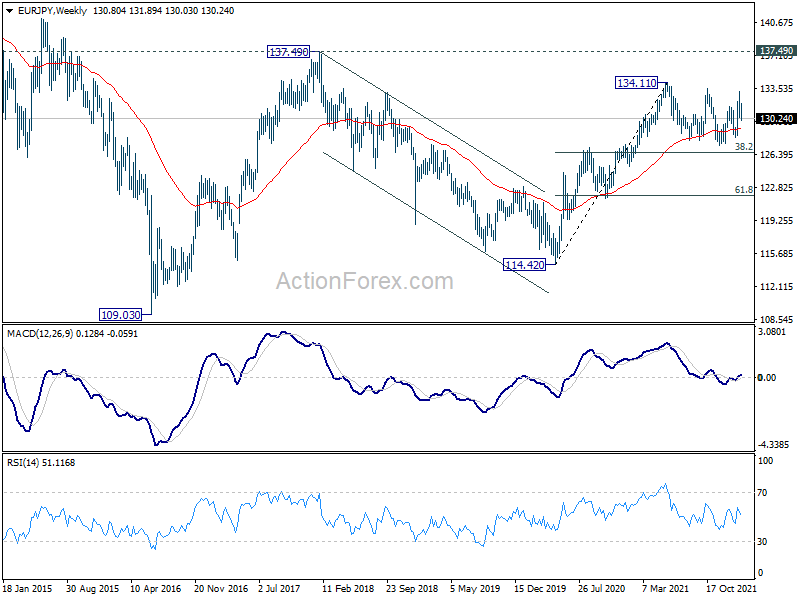
In the bigger picture, price actions from 134.11 are currently seen as a consolidation pattern only. As long as 38.2% retracement of 114.42 (2020 low) to 134.11 at 126.58 holds, up trend from 114.42 is still in favor to continue. Break of 134.11 will target long term resistance at 137.49 (2018 high). However, sustained break of 126.58 will raise the chance of bearish reversal. In this case, deeper decline would be seen to 61.8% retracement at 121.94, and possibly below.
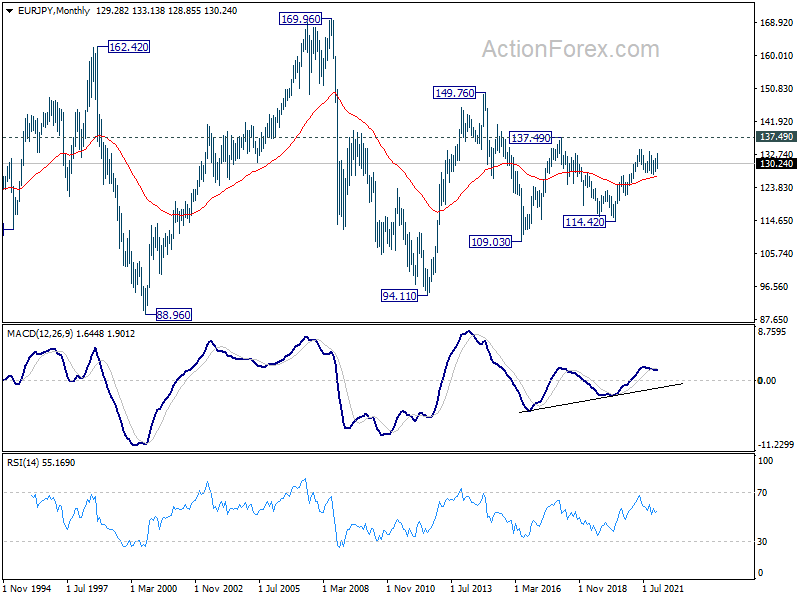
In the long term picture, EUR/JPY is staying in long term sideway pattern, established since 2000. Long term outlook will remain neutral until breakout from the range of 109.03/137.49.
EUR/GBP Weekly Outlook
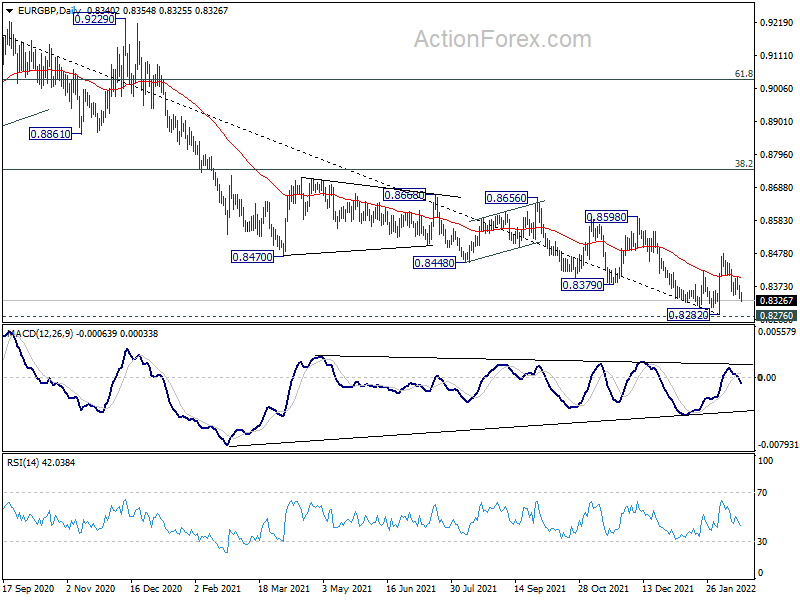
EUR/GBP's fall from 0.8476 continued last week after brief recovery. Initial bias stays on the downside this week for retesting 0.8282 low. Sustained break of 0.8276 key long term support will carry larger bearish implication. On the upside, above 0.8401 minor resistance will turn bias back to the upside for 0.8476 resistance. Break there will resume the rebound from 0.8282.
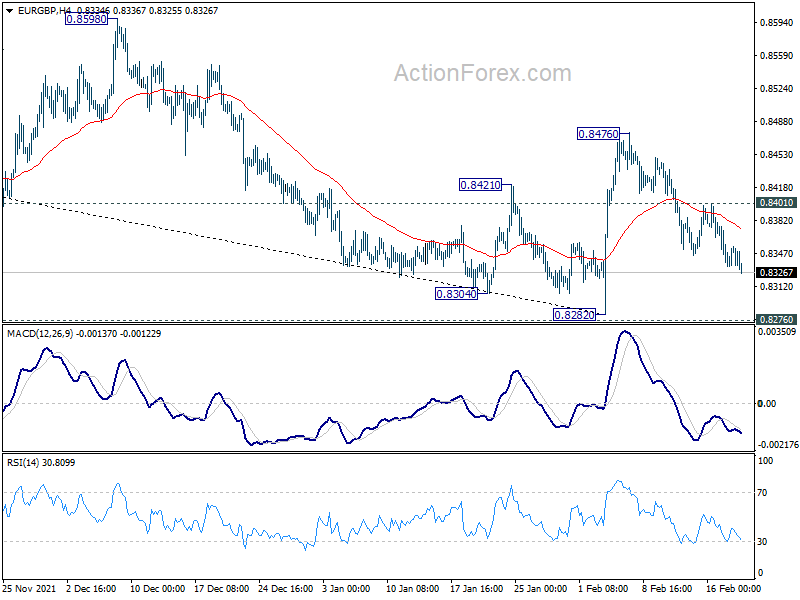
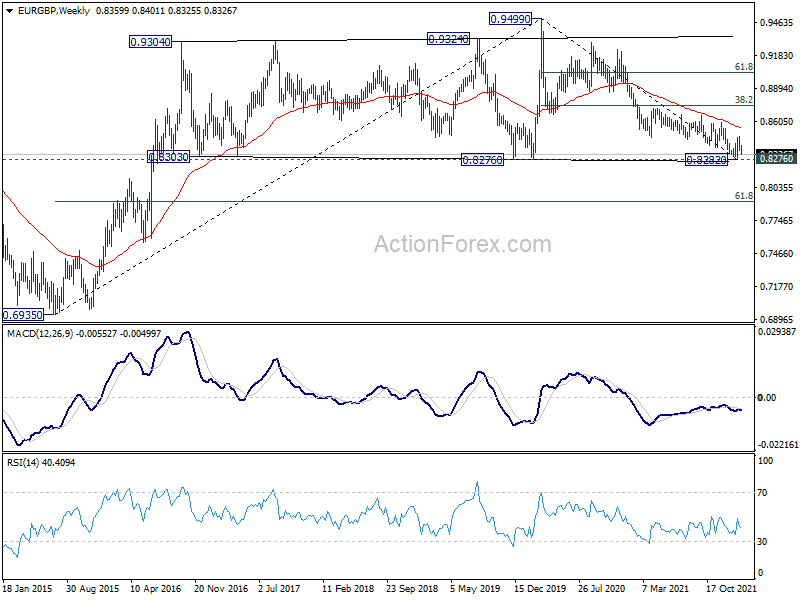
In the bigger picture, price actions from 0.9499 (2020 high) are still seen a corrective pattern that should be contained by 0.8276 long term support (2019 low). Sustained trading above 38.2% retracement of 0.9499 to 0.8282 at 0.8747 will affirm this bullish case. However, sustained break of 0.8276 will argue that the long term trend has reversed. Deeper decline would be seen to 61.8% retracement of 0.6935 to 0.9499 at 0.7917.
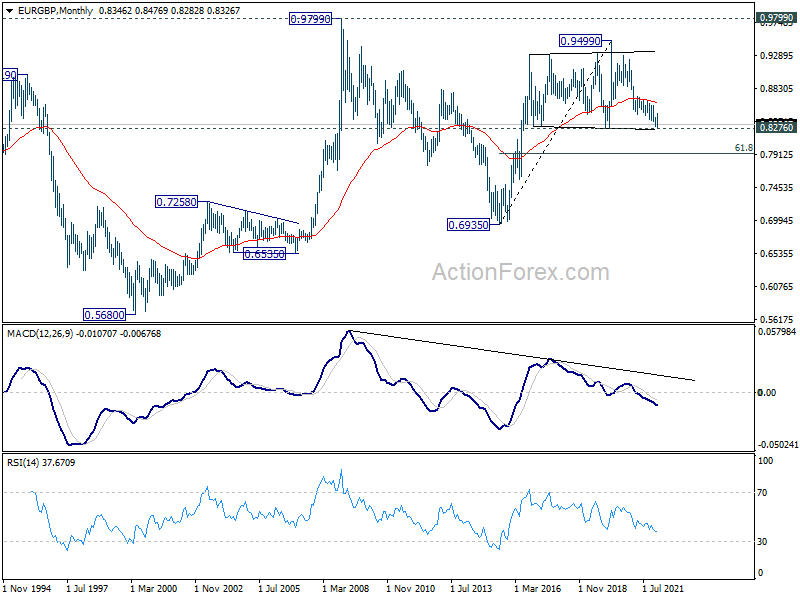
In the long term picture, outlook will stay bullish as long as 0.8276 support holds. Break of 0.9499 is in favor at a later stage, to resume the up trend from 0.6935 (2015 low). However, sustained break of 0.8276 will indicate long term trend reversal, and target 61.8% retracement of 0.6935 to 0.9499 at 0.7917, and possibly below.
EUR/AUD Weekly Outlook
EUR/AUD's break of 1.5776 support last week argues that rise from 1.5559 has completed at 1.6223 already. Initial bias is now on the downside for 1.5559 support first. Break there will also indicate that corrective rise from 1.5354 has completed in form of a three wave pattern. Deeper fall would then be seen back to 1.5250/5354 support zone. On the upside, above 1.6002 minor resistance will bring retest of 1.6223 resistance instead.
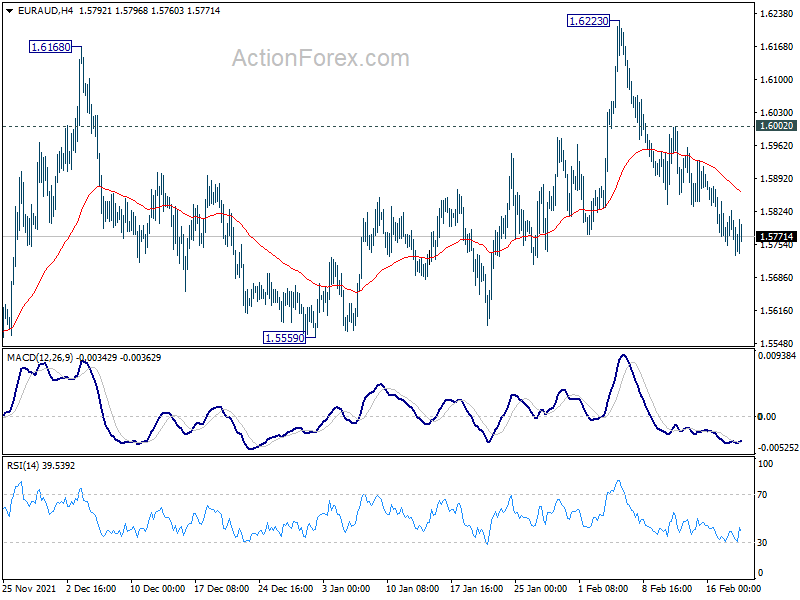
In the bigger picture, rise from 1.5354 is seen as the third leg of the corrective pattern from 1.5250 low. Further rise cannot be ruled out, but even in that case, strong resistance should be seen at 38.2% retracement of 1.9799 to 1.5250 at 1.6988. Larger down trend from 1.9799 is in favor to extend through 1.5250 at a later stage.
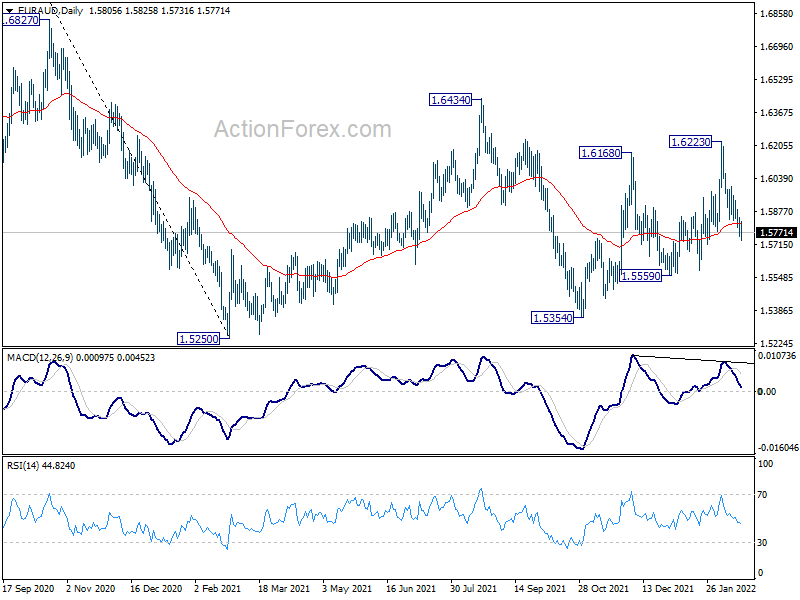
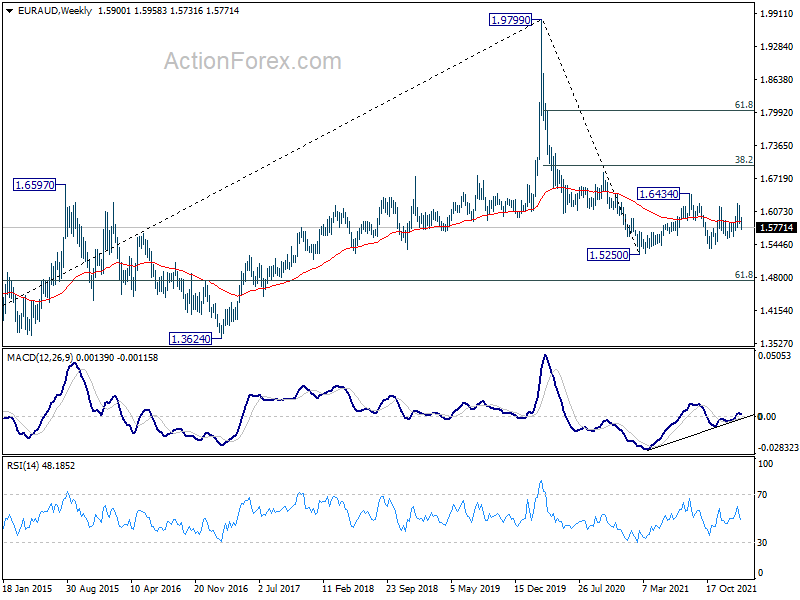
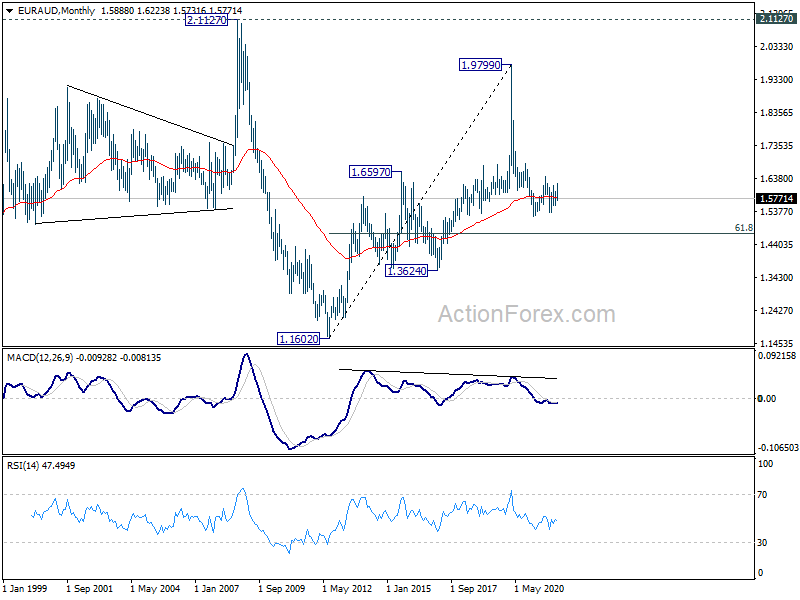
In the longer term picture, fall from 1.9799 (2020 high) is seen as a long term down trend. Further decline will remain in favor as long as 38.2% retracement of 1.9799 to 1.5250 at 1.6988 holds. Break of 1.5250 will target 61.8 retracement of 1.1602 (2012 low) to 1.9799 at 1.4733
EUR/CHF Weekly Outlook
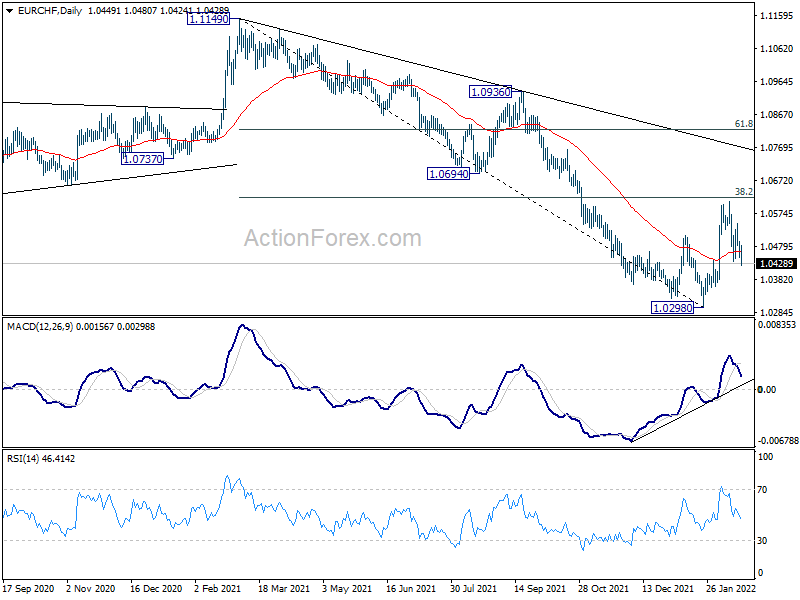
EUR/CHF's decline from 1.0610 extended lower last week and break of 1.0439 support argues that rebound from 1.0298 low has completed at 1.0610. The came after rejection by 38.2% retracement of 1.1149 to 1.0298 at 1.0623. Initial bias is now on the downside this week fir retesting 1.0298 low. On the upside, above 1.0480 minor resistance will turn intraday bias neutral first.
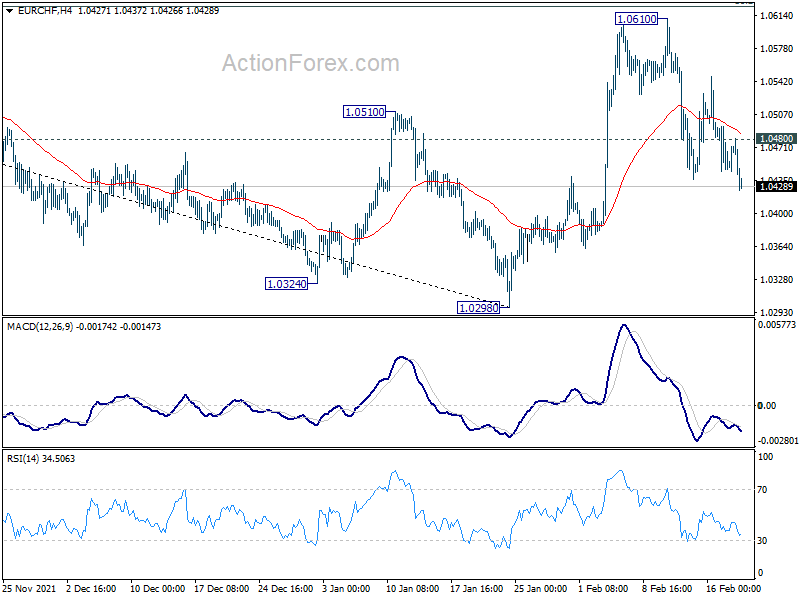
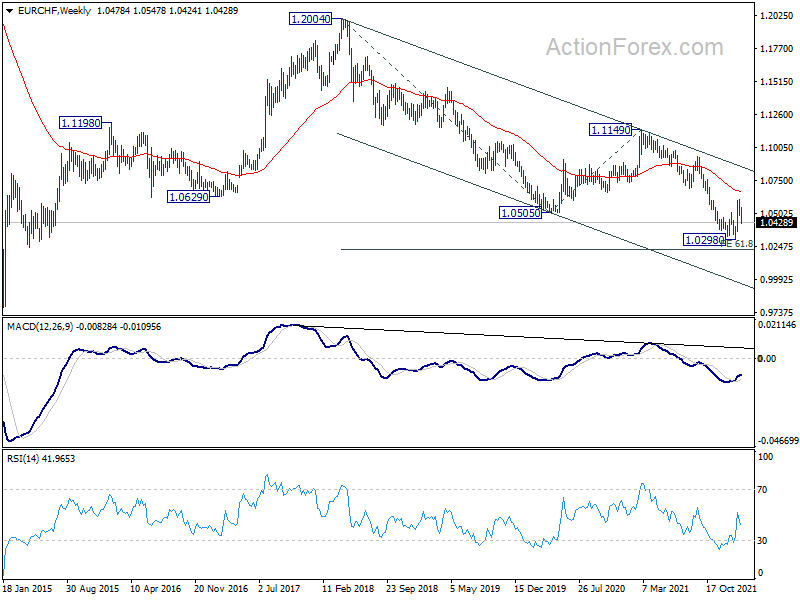
In the bigger picture, a medium term bottom was formed at 1.0298 on bullish convergence condition in daily MACD. Rebound from there is still tentatively viewed part of a corrective pattern. That is, larger down trend from 1.2004 (2018) could still extend through 1.0298 to 61.8% projection of 1.2004 to 1.0505 to 1.1149 at 1.0223. However, sustained trading above 55 week EMA (now at 1.0667) will argue that the down trend is over, and bring stronger rise back to 1.1149 next.
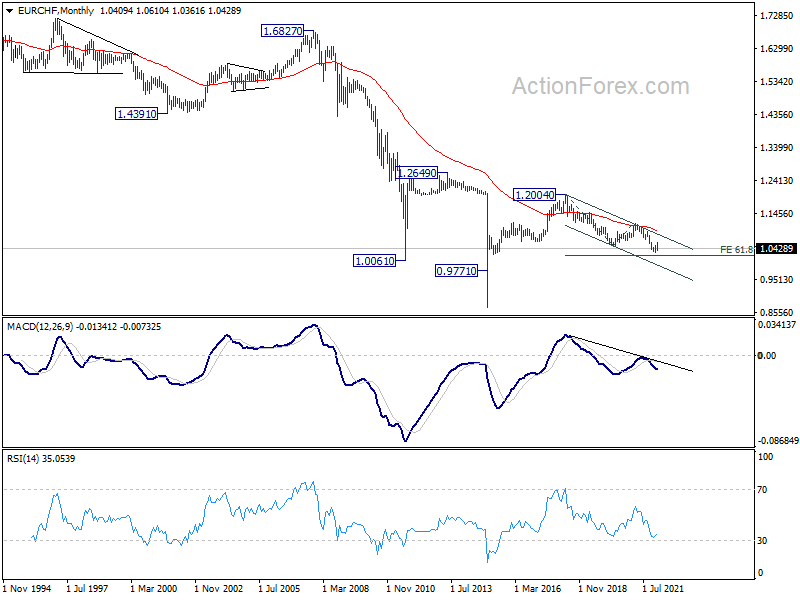
In the long term picture, prior rejection by 55 month EMA (now at 1.0947) maintains long term bearishness. Down trend from 1.2004 could still extend lower as long as 1.1149 resistance holds.
Indecisive Markets Awaited Clarity on Russia-Ukraine Situation, Euro Weakened
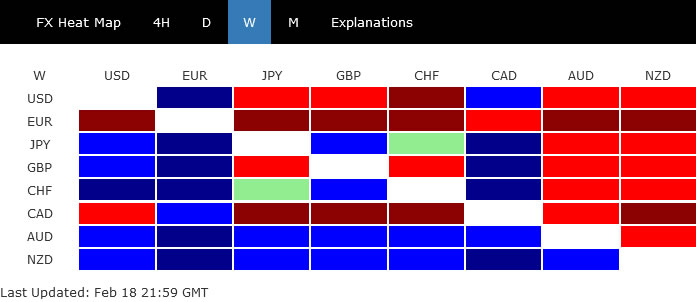
The markets were rather indecisive last week, as there is still no clarity on the Russia-Ukraine situation. The fall in benchmark treasury yields and rally in Gold suggest some risk-off undertone. But then, the selloff in equities was not very committed. Meanwhile, crude oil price gyrated in established range on conflicting developments.
In the currency markets, New Zealand Dollar ended as the strongest one, followed by Aussie. But Yen and Swiss Franc were picking up towards the end of the week. Euro was the worst performing one, followed by Canadian, and then Dollar. Sterling was mixed in the middle.
S&P 500 gyrated lower but remained resilient
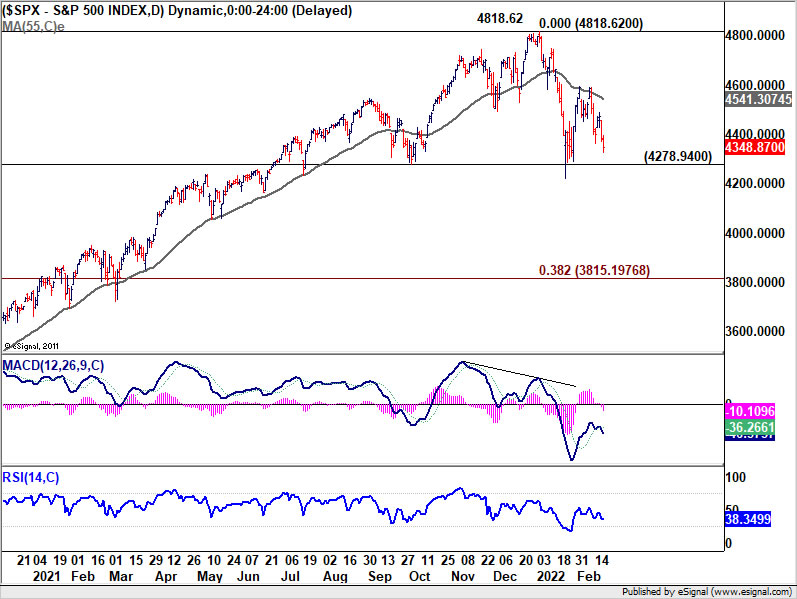
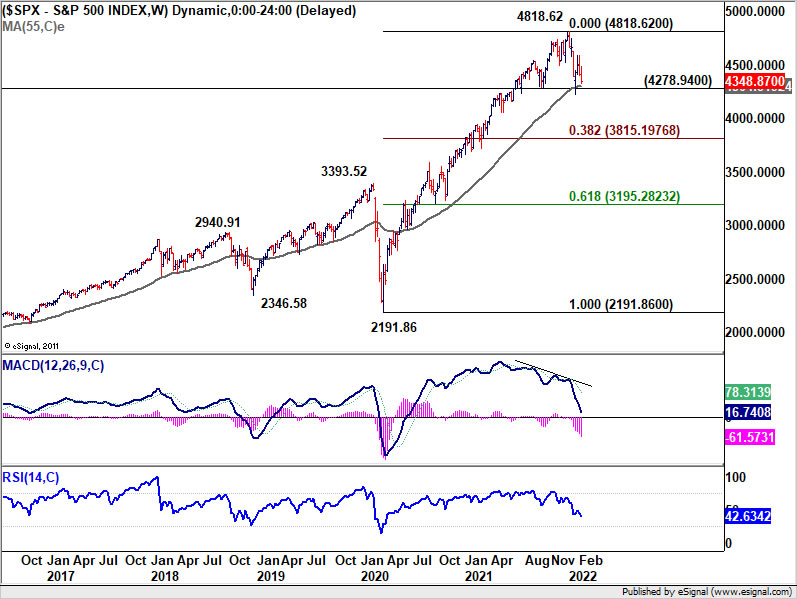
S&P 500 gyrated lower on risk aversion last week, but there was not disaster yet. Prior rejection by 55 day EMA is a bearish sign. But it's holding on to 4278.94 support, as well as 55 week EMA so far. Price actions from 4818.62 high could still develop into a sideway consolidation pattern, and firm break of 55 day EMA (now at 4541.30) will bring retest of 4818.62.
However, sustained trading below 4278.94 and 55 week EMA (now at 4304.51) will argue that it's already in a deep medium term correction. The fall from 4818.62 would target 38.2% retracement of 2191.86 to 4818.62 at 3815.19 at least, before forming a bottom.
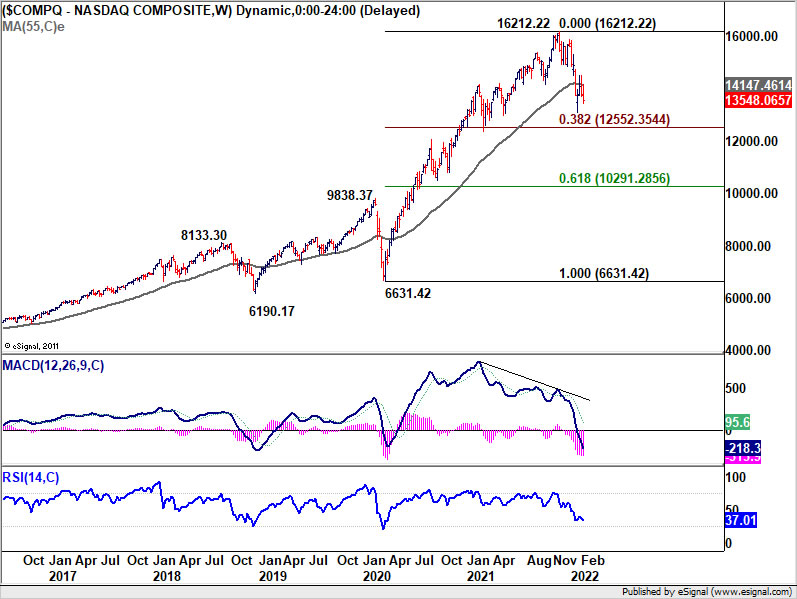
NASDAQ to defend 12552 fibonacci support
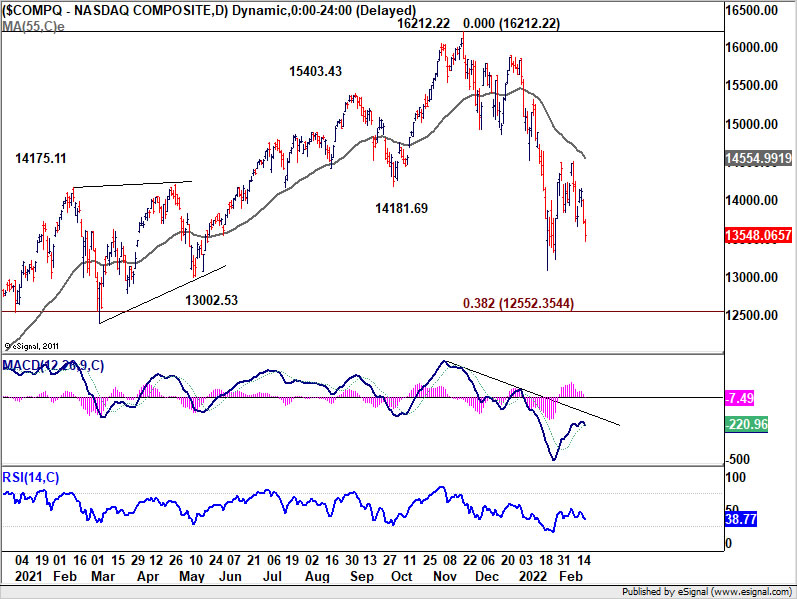
Also, it should be noted that NASDAQ's development was more bearish, as it has already taken out equivalent support level at 1481.69 and 55 week EMA for some time. Correction from 16212.22 is already in proximity to 38.2% retracement of 6631.42 to 16212.22 at 12552.35.
For now, we'd still expect strong support from 12552.35 to bring rebound. But sustained break there would open up deeper medium term correction to 61.8% retracement at 10291.28. That, if happens, could drag S&P 500 through the above mentioned 4278.94 support zone.
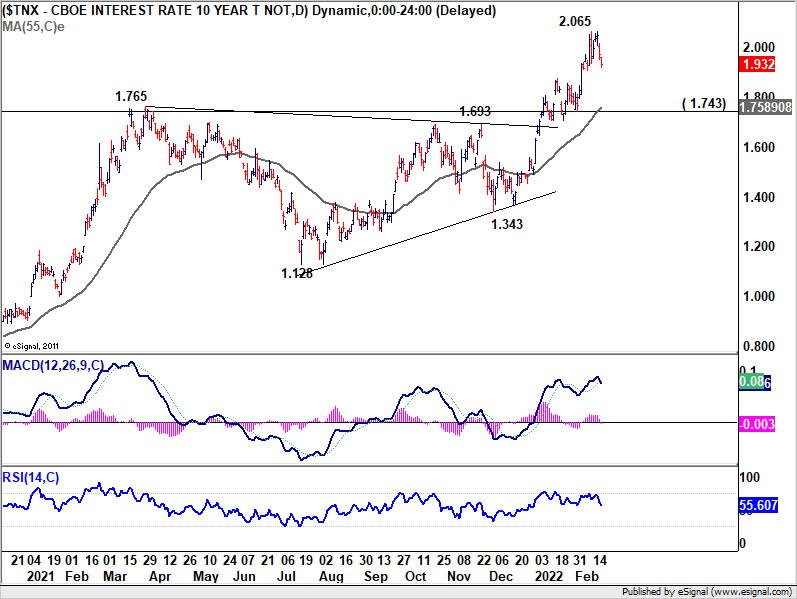
10-year yield failed 2% handle again
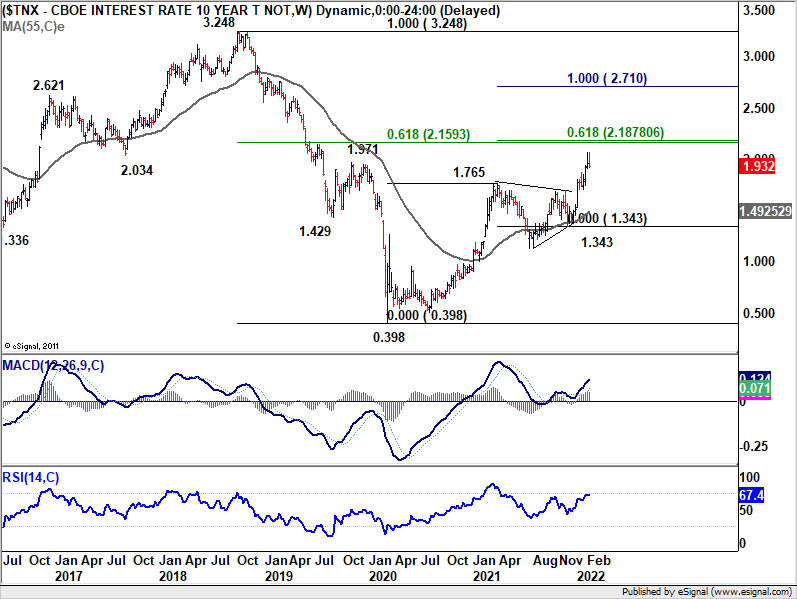
10-year yield failed to close by 2% handle again last week and retreated. 2.065 looks like a short term top now and there should be some consolidations below this level for the near term. But downside should be contained above 1.743 support to bring another rally. We'd expect a test on key resistance zone in 2.159/87 cluster level, or at least an attempt.
The 2.159/87 zone represents 61.8% retracement of 3.248 to 0.398 at 2.159, and 61.8% projection of 0.398 to 1.765 from 1.343 at 2.187. This level is not expected to be taken out decisively, unless markets believe that inflation would spiral out of control of Fed's hands. Meanwhile, firm break of 1.743 support would be an indication of a drastic turn in overall risk sentiment, which is still not likely.
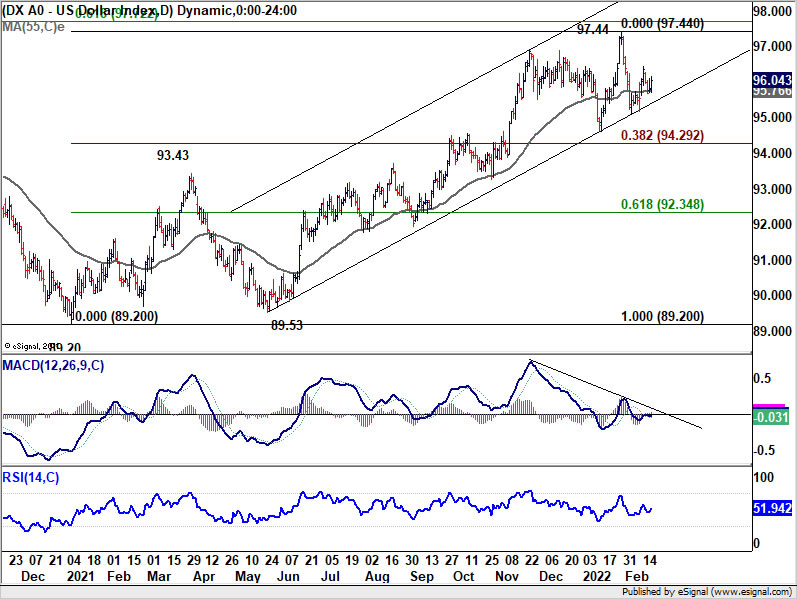
Dollar index to stay in range between 94.29/97.44
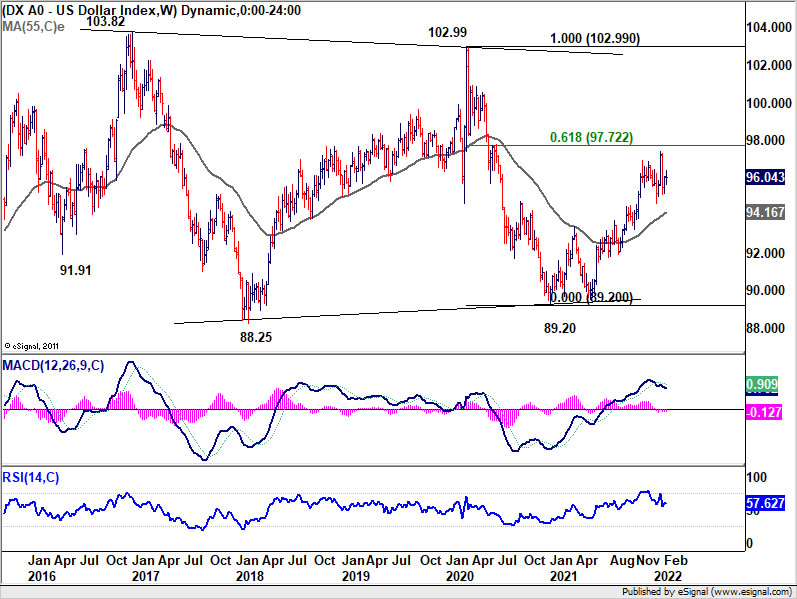
Dollar index remain stuck in range between 94.62/97.44 last week. For now, it appears that there won't be enough momentum to break through 61.8% retracement of 102.99 to 89.20 at 97.72 for the near term, even in case of rise resumption. Instead, DXY would gyrate sideway, in range above 38.2% retracement of 89.20 to 97.44 at 94.29.
Medium term bias will remain on the upside as long as 94.29 holds. But a firm break there will set up deep pull back to 61.8% retracement at 92.34, or even reverse the whole up trend from 89.20.
Gold resumed rally, heading to 1946 projection level
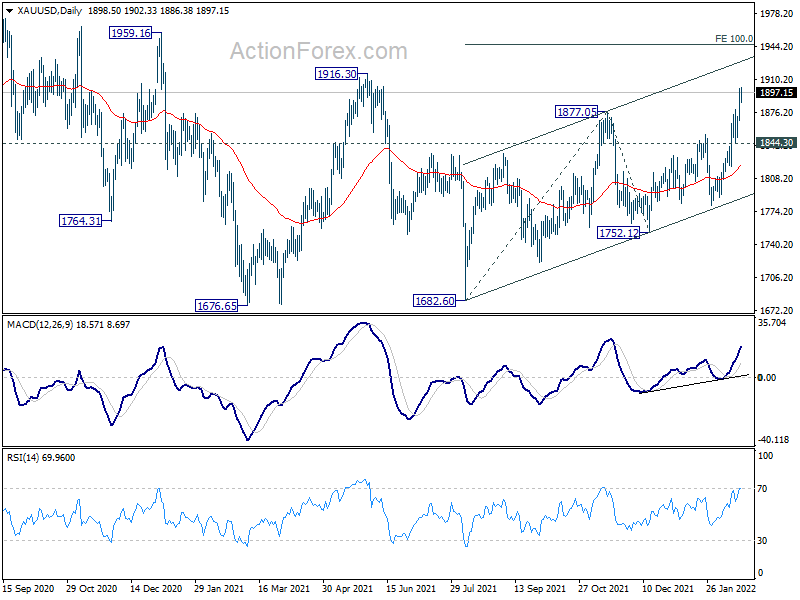
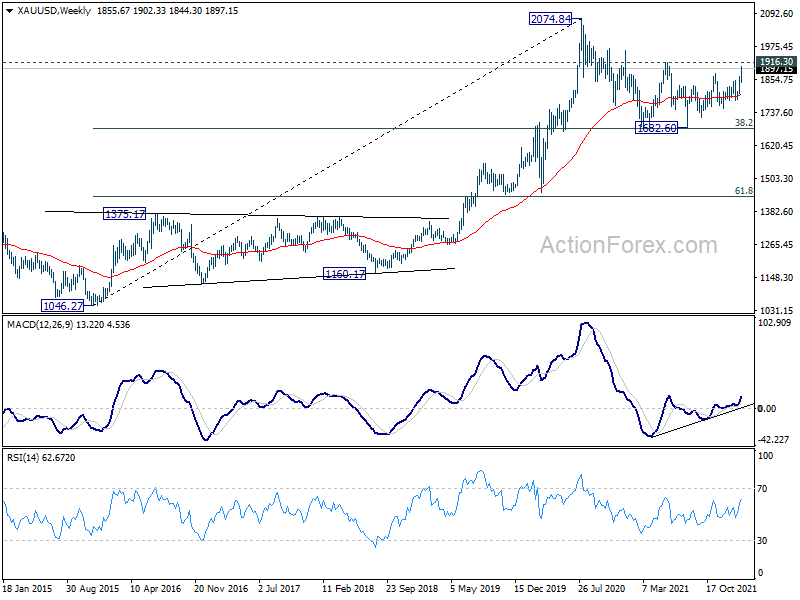
Gold's rally resumed last week and breached 1900 handle. Outlook will stay bullish as long as 1944.30 support holds. Rise from 1682.60 is in progress and further rise should be seen through 1916.30 resistance to 100% projection of 1682.60 to 1877.05 from 1752.12 at 1946.57.
It should also be noted that firm break of 1916.30 should confirm completion of the correction from 2074.84 at at 1682.60. Further break of 1946.57 will suggest medium term up side acceleration. In this case, retest of 2074.84 high should be quickly within reach.
WTI crude oil still in favor to target 100 handle
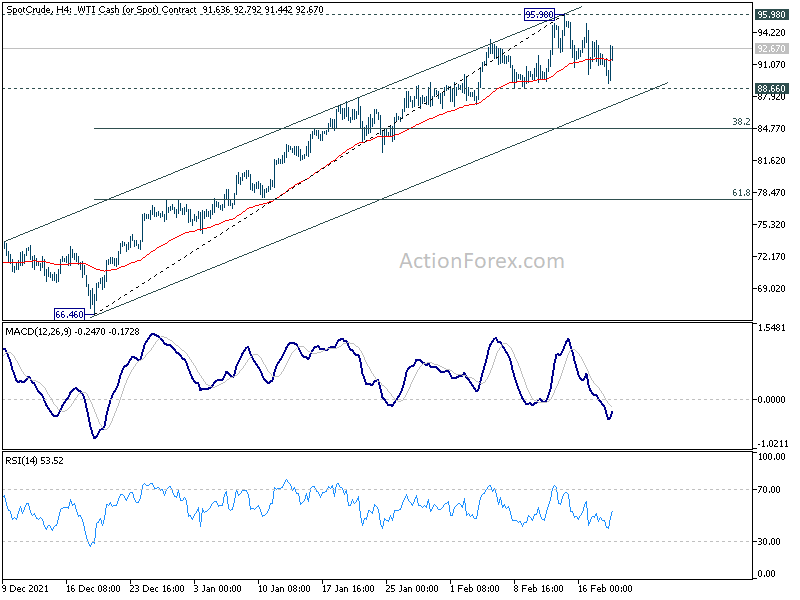
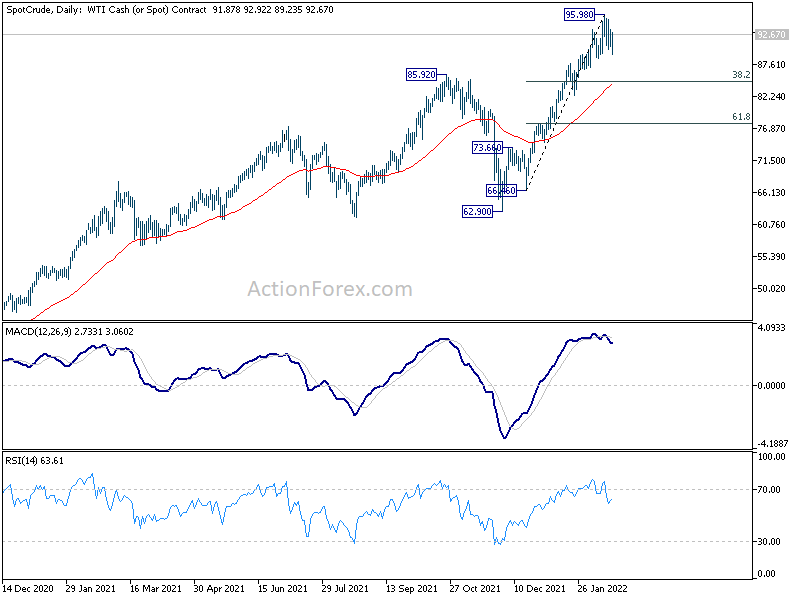
WTI crude oil originally dipped on news of a Iran nuclear deal, but then rebounded on risk aversion again. For now, WTI is holding above 88.66 support. Thus, near term outlook stays bullish for another rise through 95.98 towards 100 handle. However, break of 88.66 will now argue that it's in a deeper correction to 38.2% retracement of 66.46 to 95.98 at 84.70.
Bitcoin to head back to 33k support after as rebound completed
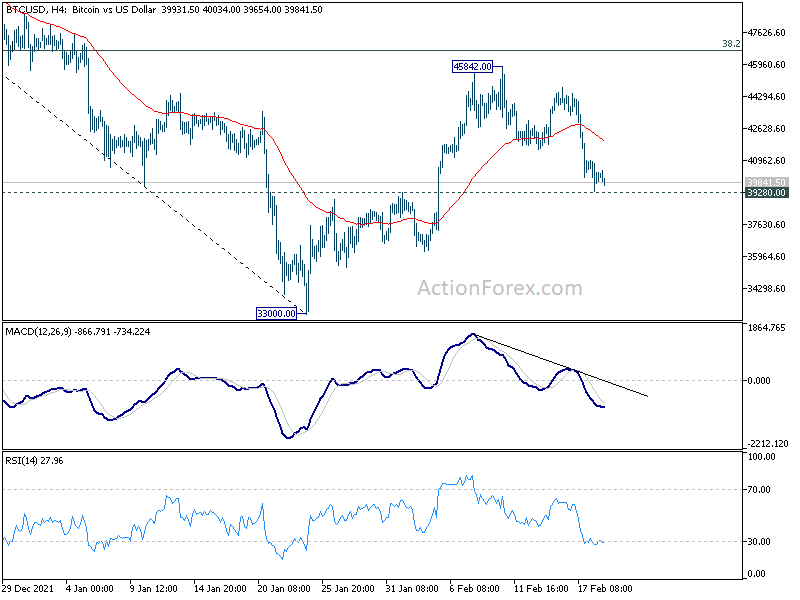
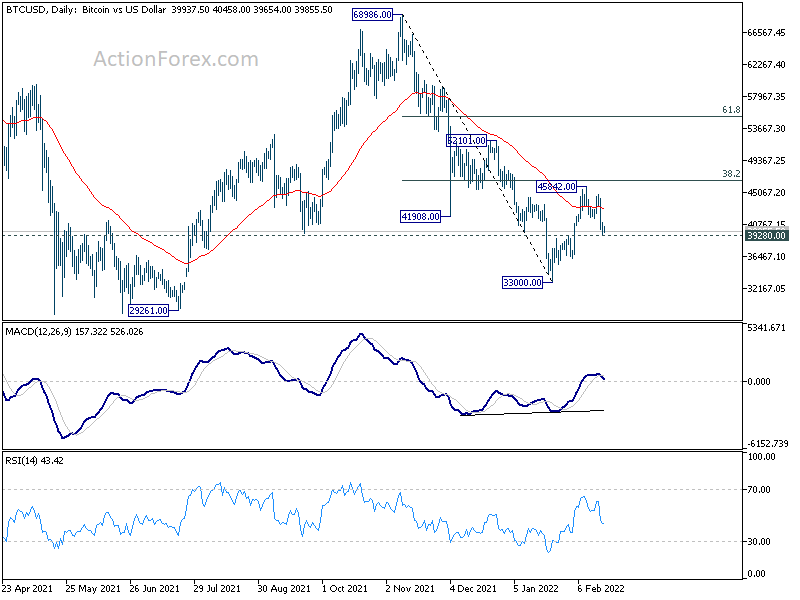
Bitcoin's decline last week suggests that rebound from 33000 has completed at 45862. That came after rejection by 38.2% retracement of 68986 to 33000 at 46476. The development suggests that the larger down trend from 68986 is not over. Break of 32980 support will bring deeper fall back to 33000 support, and then to 29261 support next.
EUR/CHF Weekly Outlook
EUR/CHF's decline from 1.0610 extended lower last week and break of 1.0439 support argues that rebound from 1.0298 low has completed at 1.0610. The came after rejection by 38.2% retracement of 1.1149 to 1.0298 at 1.0623. Initial bias is now on the downside this week fir retesting 1.0298 low. On the upside, above 1.0480 minor resistance will turn intraday bias neutral first.
In the bigger picture, a medium term bottom was formed at 1.0298 on bullish convergence condition in daily MACD. Rebound from there is still tentatively viewed part of a corrective pattern. That is, larger down trend from 1.2004 (2018) could still extend through 1.0298 to 61.8% projection of 1.2004 to 1.0505 to 1.1149 at 1.0223. However, sustained trading above 55 week EMA (now at 1.0667) will argue that the down trend is over, and bring stronger rise back to 1.1149 next.
In the long term picture, prior rejection by 55 month EMA (now at 1.0947) maintains long term bearishness. Down trend from 1.2004 could still extend lower as long as 1.1149 resistance holds.
Summary 2/21 – 2/25
Monday, Feb 21, 2022
[php_everywhere instance="1"]
Tuesday, Feb 22, 2022
[php_everywhere instance="2"]
Wednesday, Feb 23, 2022
[php_everywhere instance="3"]
Thursday, Feb 24, 2022
[php_everywhere instance="4"]
Friday, Feb 25, 2022
[php_everywhere instance="5"]
Weekly Economic & Financial Commentary: Minutes and Fed Speak Tamp Down Prospect of 50-bp Hike in March
Summary
United States: U.S. Economy Pushing Through Omicron and Inflation Headwinds
- Retail sales jumped 3.8% in January, well above expectations. Industrial production strengthened 1.4% during the first month of the year. Housing activity remained robust in January—while housing starts fell 4.1%, building permits edged up 0.7% and existing home sales jumped 6.7%. Meanwhile, January's Leading Economic Index declined 0.3% and the Producer Price Index leaped 1.0%.
- Next week: New Home Sales (Thurs), Personal Income & Spending (Fri), Durable Goods (Fri)
International: Japanese Growth Rebounds as Economy Reopens
- Japan's GDP rebounded in the final quarter of 2021, with activity recovering after the state of emergency that was in place for Tokyo and surrounding areas was lifted. Q4 GDP grew at a 5.4% quarter-over-quarter annualized rate, with consumer spending especially strong. However, there are signs the economy has started on a soft note in 2022, and with inflation benign, the Bank of Japan's easy monetary policy looks set to remain in place for some time.
- Next week: Eurozone PMIs (Mon), U.K. PMIs (Mon), RBNZ Rate Decision (Wed)
Interest Rate Watch: Minutes and Fed Speak Tamp Down Prospect of 50-bp Hike in March
- Minutes from the FOMC's January meeting released this week signaled a rate hike is imminent but did not indicate that officials were itching to lift the fed funds rate by an unusually large 50 bps. With Fed speakers this week seemingly less enthusiastic about the prospect of a 50 bps hike, market expectations for such a move have fallen back below 50%.
Topic of the Week: Russia-Ukraine Conflict Not a Global Economic Risk
- Tensions tied to the Russia-Ukraine situation have intensified in recent days. Although we do not have any particular insight into conditions on the ground or wish to speculate on the mindset of leaders involved, assessing the potential economic and financial market reaction to an escalation is still a valuable exercise.
The Weekly Bottom Line: All About Inflation and Geopolitics
U.S. Highlights
- Inflation concerns and rising geopolitical tensions took a toll on equity markets this week. Regarding inflation and monetary policy, minutes from the January FOMC meeting indicate that most participants believe that the Fed should hike rates at a faster clip than it did during the post-2015 period.
- Retail sales beat market expectations in January, rising 3.8%. Driving the gain were strong receipts at auto & parts dealers and non-store retailers.
- Housing starts fell 4.1% in January, but on a trend basis remain at the highest level since 2006. Existing home sales were upbeat, rising 6.7% last month. The strong showing likely reflects some pull-forward in activity.
Canadian Highlights
- Data out this week reinforced the call for the Bank of Canada to move on raising interest rates. Average home prices posted their fastest monthly gain outside of the early-pandemic period since 1989 in January.
- Not to be outdone, headline CPI inflation ran at its quickest rate since 1991, with broad price pressures across major categories.
- The BoC will begin their rate hike campaign in March and their policy rate should reach its pre-pandemic level by the mid-point of next year. If inflation continues to surprise on the upside, it could get there even faster.
U.S. - All About Inflation and Geopolitics
The week started off on a ‘lovely’ note, but the high cost of roses – a fairly inelastic good on Valentine’s Day – is likely to have reminded the average consumer once again of the strong inflationary pressures the country is facing. Concerns regarding high inflation, together with rising geopolitical (Ukraine-Russia) tensions added to equity market volatility.
On inflation, minutes from the January 25-26 Federal Open Market Committee (FOMC) meeting showed growing concern over elevated inflation. From our lens, there is no longer a question of whether the Fed will hike rates soon, but by how much. On this front, most participants believed a faster pace of hikes than that of the post-2015 period would likely be warranted this time around. In this vein, St. Louis Fed President Bullard, reiterated this week that without swift Fed action, inflation may become an even more serious problem. Bullard has advocated for the front-loading of rate hikes, calling for a cumulative full percentage point hike over the next three meetings. Market odds were in tune with some front-loading last week, briefly tilting towards a 50-basis point hike in March, but have since cooled.
The Fed’s hiking pace will ultimately be heavily dependent on how the economy and especially interest rate sensitive sectors, such as housing, respond to higher rates. A series of data reports this week drove in the point that the economy started 2022 on decent footing. Retail sales surged 3.8% month-to-month in January, well above the market consensus forecast for a 2.0% print. Driving the gains were higher receipts at auto & parts dealers (5.7%) and non-store retailers (+14.5%). The latter, a proxy for online sales, is likely to have benefitted from a surge in infections last month.
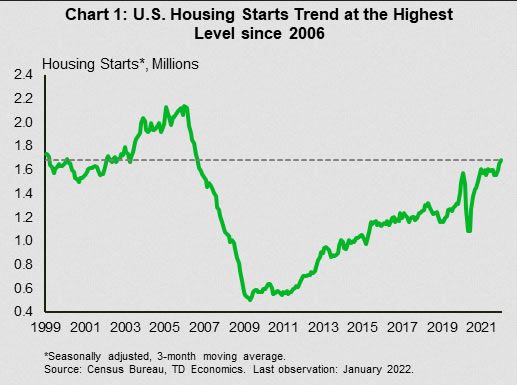
Homebuilding activity, meanwhile, had a soft start to the year, with housing starts falling 4.1% (m/m) in January. Judging by the many obstacles that builders face, such as material and labor shortages, this result isn’t entirely unwarranted. Rising absenteeism among infected workers during January’s Omicron wave is also likely to have weighed on the pace of new construction. Yet, it’s important to not lose the forest for the trees. On a trend basis, homebuilding activity remains near the highest level since 2006, while homebuilder confidence remains near its highest level on record (Chart 1).
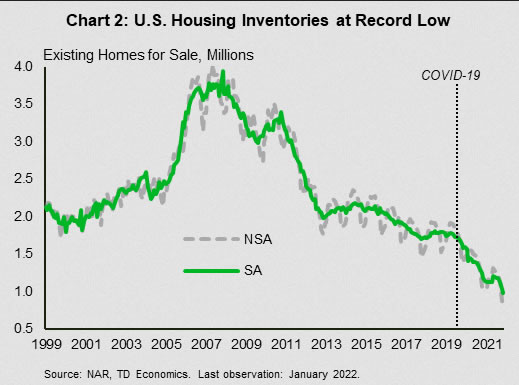
The severe housing supply shortage is supporting builder optimism and new residential construction activity. Existing home sales surged 6.7% (m/m) in January, defying market expectations for a decline. This strong sales pace bit into inventories, sinking them to the lowest level on record (Chart 2). The imbalance is likely to keep builders busy for quite some time. January’s strong showing also likely represents some pull-forward in activity with homebuyers trying to get ahead of higher mortgage rates. This may come at the expense of a slower sales pace later in the year. The intuition of higher rates, however, has proven correct, with average 30-year mortgage rates surging to around 4% in recent weeks. As the Fed pulls away from ultra-loose monetary policy, higher rates will weigh on affordability, which will take some additional steam out of demand. This is but one reason as to why the Fed’s hiking pace will bear careful watching.
Canada - Cementing the Call for Higher Rates
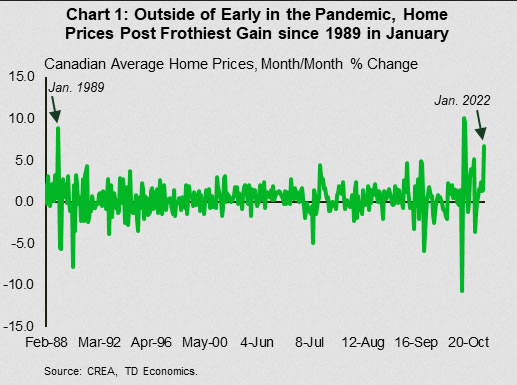
As is well known, Canadian home prices have been on a significant upward trajectory during the pandemic. However, this narrative went to a whole new level this week, as data for January showed a near 7% m/m gain in average home prices. Excluding the brief period in early 2020 when activity and prices were bouncing back from lockdown, this marked the bubbliest monthly rise since 1989 (Chart 1). Notably, prices rose across all provinces. In the GTA (the nations' largest market), prices increased at their fastest pace since early 2017, when the region was arguably in the grips of a speculative bubble. Upward price pressure is likely to have some staying power, as the months' supply of properties remained at an historic low.
Rising prices erode housing affordability, and this worsening backdrop has made it tougher for first-time homebuyers to jump into the market. Bank of Canada data released last month drives this point home, as it shows the share of purchases accounted for by first-time homebuyers falling to 47% as of mid-June last year, versus 53% in early 2015. At the same time, the share of home purchases made by investors is on the rise, climbing to about 21% from 19% before the pandemic struck. If price growth continues at these frothy rates, these trends could continue. Or in a worst-case scenario, investors suddenly leave the market and prices adjust downward very quickly.
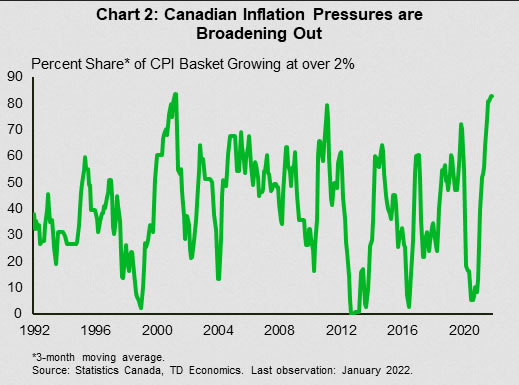
Home prices weren't the only high-profile price data released this week. Consumer price inflation also ran hotter than what the market was expecting in January, with the headline rate touching 5.1% year-on-year. Seasonally adjusted prices up were up a robust 0.6% month-on-month and every category saw gains well above their recent historic norms. Core inflation measures also ticked higher, and inflation is broadening out across categories (Chart 2). The picture may not be much better for this month either, as oil prices have shot higher amid geopolitical uncertainties, despite some reversal this week. What's more, blockades (most notably at the Ambassador Bridge, which was resolved this week) have added further strain to supply chains.
All in, these data points served to reinforce (and amplify) the narrative that rates are going to be moving higher, beginning in early March. How much higher is a matter of some debate. For their part, markets are pricing in nearly seven hikes by end of this year. The forecast we put out last month envisioned a slower pace, with six rate hikes taking place from March through the first half of next year. This would take the overnight rate to 1.75%, where it last sat before the pandemic hit. However, if inflation turns out to be a tougher nut to crack, policymakers may be forced to push the rate even higher than this level.
Week Ahead – Markets Remain Volatile
Investors on edge as Ukraine tensions rise
There’s been no shortage of volatility in the markets so far this year and it doesn’t look like that is going to change any time soon. The focus has shifted slightly in recent weeks from monetary policy to geopolitics as Russian troops have built up on the Ukrainian border and the West has warned of an imminent invasion.
This has only added to the anxiety that has been evident in the markets for weeks and unless there is a significant de-escalation, the rollercoaster ride that has been 2022 looks set to continue. All sides still appear to have a desire to find a diplomatic solution but things can change quickly which will keep traders on their toes.
As always, there will be a heavy focus on central banks next week and what policymakers are saying ahead of upcoming meetings. Inflation is continuing to rise and a major escalation in Ukraine could make life even harder. So many rate hikes are already priced in this year but there’s always room for more.
US
The focus on Wall Street will primarily remain on geopolitical tensions, but Fed tightening bets could get bolstered after key earnings updates from retailers, economic data about the consumer, and the Fed’s preferred inflation gauge. If the consumer continues to show resilience and inflationary pressures suggest the peak might be more than a couple of months away, the case for a supersized March liftoff will grow.
Atlanta Fed President Raphael Bostic will take part in a moderated discussion about the Fed’s role in the community on Tuesday. Fed speak on Thursday will include Thomas Barkin discussing the economic outlook, Raphael Bostic on banking in a digital era, and Loretta Mester covering monetary policy.
EU
The next week is littered with economic data releases but none are likely to be game-changers. Granted, the final CPI could throw up a surprise in these anxious times but there isn’t much of a history of that. The PMIs could also offer some insight into future inflationary pressures that are building.
Speeches from ECB policymakers will be key next week ahead of the March meeting, with President Christine Lagarde among those due to speak on Friday.
Ultimately though, next week is about maintaining peace in the East. We’re still getting daily warnings of an imminent Russian invasion of Ukraine, despite assurances that this is not the plan. There have been contradictory reports of troops leaving/arriving at the border this week which has further muddied the picture. US Secretary of State Antony Blinken accepted an invitation to meet Russian Foreign Minister Sergei Lavrov in Europe next week which has offered hope that an invasion won’t come before.
UK
Next week gets underway with PMI releases on Monday but the key focus will be the Monetary Policy Report Hearing on Wednesday, along with other appearances by BoE policymakers around it. Granted, the PMIs could offer some inflation clues but with the CPI once again surpassing expectations in January and markets priced for some aggressive tightening, the views of the MPC will be the headline.
Russia
The focus next week will no doubt be on the Ukrainian border and whether Western intelligence of an imminent invasion is accurate. Lavrov’s meeting with Blinkin later in the week could be the key event.
The CBR releases the monetary policy report on Monday as the tightening cycle continues and further hikes could follow.
South Africa
South Africa’s Finance Minister will present the 2022 budget in parliament on Wednesday.
Unemployment and PPI are the only standout data releases as the SARB weighs up more hikes after successive increases in November and January.
Turkey
A relatively quiet week by Turkey’s standards with a few data releases the only events of note and even these are mainly tier three. The CBRT refrained from cutting rates again in February as it conducts its review following 500 basis points of cuts in four meetings late last year.
China
It is a light economic calendar in China, with no tier one releases. On Monday, China releases loan prime rates (LPR) for February. After cuts in January, China’s banks are expected to maintain both the February 1-year LPR at 3.70% and the 5-year LPR at 4.60%.
India
No major data or events next week.
Australia
RBA Governor Philip Lowe will give online remarks to the G20 meeting in Indonesia on Digital Payments after the market closes on Friday.
Australia’s economy continues to strengthen and this week’s events are expected to reflect improving conditions.
On Monday, manufacturing, services, and composite PMIs will be released, then Wednesday will offer construction and wage growth data for 2021 Q4. Construction work done is expected to rebound strongly with a gain of 2.1% q/q after a weak reading of -0.3% in Q3. The Wage Price Index is forecast to rise 2.4% y/y, up from 2.2% in the third quarter.
Private capital expenditure will be published on Thursday. The consensus stands at 2.5% q/q, following a -2.2% reading in Q3.
New Zealand
The Reserve Bank of New Zealand is widely expected to raise interest rates when it meets on Wednesday, in response to inflationary pressures and a robust labor market.
Inflation has been rising, primarily due to higher energy costs and there is the danger of a wage-price spiral since wages haven’t kept up with inflation. The labour market remains tight, with unemployment at just 3.2%.
The RBNZ is expected to raise rates by 25 basis points, bringing the cash rate to 1.00%. Further hikes are expected in the coming months, although the pace of rate moves will depend on economic conditions.
On Friday, New Zealand releases retail sales for 2022 Q1. Retail sales plunged in the fourth quarter, with the headline reading declining by 8.1% and core retail sales falling by 6.7%.
Japan
The spotlight will be on Japanese inflation indicators in the coming week. Inflation has been rising in Japan after decades of deflation. Still, inflation remains well below the Bank of Japan’s target of 2%.
The January reading of BoJ Core CPI, the central bank’s preferred inflation gauge, will be released on Tuesday. The indicator rose 0.9% y/y in December, up from 0.8% and its highest level since May 2016.
On Friday, Tokyo Core CPI for February will be released, giving us a good idea of what to expect from February inflation releases.
Singapore
Singapore has experienced rising inflation, with a 4.0% gain in December. January CPI, which will be released on Wednesday, is expected to remain high. The upward price pressures are attributable to higher food prices, pent-up demand after reopening, and supply disruptions
Economic Calendar
Friday, Feb. 18 (After Market Close)
- RBA Governor Philip Lowe to give remarks on Digital Payments to G20 meeting in Indonesia
Monday, Feb. 21
Economic Data/Events
- European Flash manufacturing/services PMIs: Eurozone, France, Germany, and the UK
- Australia Manufacturing PMI
- China property prices, loan prime rates
- Fed Governor Bowman speaks at ABA National Conference for Community Bankers.
- EU Foreign Ministers meet in Brussels
- UK PM Johnson to end of Covid restrictions and legal rule to self-isolate.
- Sweden Riksbank minutes
- Thailand GDP
- Japan PMI, machine tool orders
Tuesday, Feb. 22
Economic Data/Events
- US Conference Board consumer confidence
- Italy CPI
- BOE Member Ramsden speaks at the National Farmers’ Union Conference
- Australia consumer confidence
- New Zealand credit card spending
- Japan PPI services
- Germany IFO business climate
- Hungary rate decision: Expected to raise interest rate 50bps to 3.40%
- Mexico international reserves
- South Africa unemployment
Wednesday, Feb. 23
Economic Data/Events
- Eurozone CPI
- Singapore CPI
- BOE Governor Andrew Bailey appears before the Treasury Committee.
- South Africa budget presentation
- New Zealand rate decision: Expected to raise official cash rate 25bps to 1.00%
- Australia wage price index, construction work done, Bloomberg economic survey
- Thailand trade
Thursday, Feb. 24
Economic Data/Events
- US new home sales, Q4 GDP (2nd reading), initial jobless claims
- Fed’s Mester and Bostic to speak
- Mexico central bank releases monetary policy minutes
- The first annual Bank of England Agenda for Research (BEAR) Conference: The Monetary Toolkit. BOE Governor Bailey gives opening address, Deputy Governor Broadbent will moderate a panel and Chief Economist Pill will deliver the closing remarks
- New Zealand trade
- Australia private capital expenditure
- Japan department store sales
- EIA Crude oil inventory report
Friday, Feb. 25
Economic Data/Events
- US consumer income, durable goods, University of Michigan consumer sentiment
- France CPI, GDP
- Germany GDP
- Mexico GDP, trade
- Russia industrial production
- Singapore industrial production
- Eurozone economic confidence, consumer confidence
- New Zealand retail sales
- Japan Tokyo CPI, coincident index
- Thailand production index, capacity utilization
Sovereign Rating Updates
- Denmark (S&P)
- Belgium (Moody’s)
- Portugal(DBRS)